J. L. BELL is a Massachusetts writer who specializes in (among other things) the start of the American Revolution in and around Boston. He is particularly interested in the experiences of children in 1765-75. He has published scholarly papers and popular articles for both children and adults. He was consultant for an episode of History Detectives, and contributed to a display at Minute Man National Historic Park.

Subscribe thru Follow.it


•••••••••••••••••


Showing posts with label Venture Smith. Show all posts

Sunday, November 26, 2017

Shorto on Revolution Song in Boston, 30 Nov.

Back in 2009, Ray Raphael contributed a “guest blogger” posting here about his book Founders, which traces the history of the Revolution through seven individuals.

Ray wrote: “One of the characters is a given: George Washington. There is absolutely no way we can tell the larger story of the war and the nation’s founding without him. We know this. But who else?” That question prompted a couple of days of discussion of candidates.

Now journalist and historian Russell Shorto has taken up a similar challenge with his book Revolution Song: A Story of American Freedom. It retells the Revolution through six figures:
Coghlan brings some scandalous glamour to the project since she and Aaron Burr were reportedly an item early in the war and she later became a courtesan in London. In Revolutionary Ladies, Philip Young presented evidence that Coghlan died years before her Memoir was published, suggesting that at least some of its tales were fraudulent. Shorto argues instead that Coghlan faked her death and fled to Paris. So that’s interesting right there.

Shorto will present Revolution Song at the Massachusetts Historical Society on Thursday, 30 November. The event will start with a reception at 5:30 P.M., and Shorto will speak and sign books starting at 6:00. Registration costs $10.

Friday, July 12, 2013

Great Men and Ordinary Americans

In his New York Times review of Joseph J. Ellis’s Revolutionary Summer: The Birth of American Independence, Andrew Cayton of Miami University argued that the book is missing a very big part of what constituted a revolution:
It simply won’t do to talk about a revolutionary summer in which the only voices are those of prominent white men and the recollections of 15-year-old Joseph Plumb Martin, written decades later. Ellis includes a handful of paragraphs on women, enslaved Africans and working-class artisans. But they read like generic concessions to critics who have chastised him for celebrating already celebrated white men rather than the rest of North America’s diverse population. The point Ellis misses is that attention must be paid to the people outside Congress not from a desire to make history more inclusive but because their voices were loud and their choices important, not least in their impact on the actions of the men inside Congress.

Incorporating more people would fundamentally change Ellis’s story, making it messier and less predictable. The “conspicuous consensus” on independence that emerged in Congress occurred nowhere outside of New England. Nor, again, were the maneuvers of the British Army the only challenges confronting members of Congress. It seemed obvious to many Americans that a state of war had existed with Britain since shots were fired at Lexington on April 19, 1775. Everywhere ad hoc committees were creating new political institutions, agreeing with Thomas Paine in his best-selling “Common Sense” that monarchy, not George III, was the basic problem. Honest men could govern themselves better than “the Royal Brute of Britain” could; on the day Americans proclaimed a new charter of government in which “the law is king,” they should demolish a symbolic crown and scatter its pieces “among the people whose right it is.”

This stunning proposition horrified other Americans. Just as thousands were choosing independence because it promised revolution in favor of natural rights and self-government, so thousands were choosing the British Empire because they dreaded a democratic revolution that they feared would degenerate into anarchy and popular tyranny. Many believed the imperial tensions reflected inept administration rather than structural failure. Ellis writes that “most probably, a poll of the American population” in September 1776 “would have revealed a citizenry more politically divided and receptive” to Richard Howe’s peace terms “than the Continental Congress or its diplomatic representatives.” It is a point he fails to develop. [John] Adams spoke for a small percentage of the population. So did [John] Dickinson. . . .

In short, what made the summer of 1776 revolutionary was the range of options, the cacophony of voices, the increasing resort to violence, the growing sense that nothing was safe. Americans like to believe that their revolution as well as their independence was a moderate affair in which the founding fathers were in control of events rather than the other way around. Unfortunately, “Revolutionary Summer” reinforces that perception.
In a big sense, Ellis already responded to that sort of critique of his work twelve years earlier in his preface to Founding Brothers:
The apparently irresistible urge to capitalize and mythologize as “Founding Fathers” the most prominent members of the political leadership during this formative phase has some historical as well as psychological foundation, for in a very real sense we are, politically, if not genetically, still living their legacy. And the same principle also explains the parallel urge to demonize them, since any discussion of their achievement is also an implicit conversation about the distinctive character of American imperialism, both foreign and domestic.

A kind of electromagnetic field, therefore, surrounds this entire subject, manifesting itself as a golden haze or halo for the vast majority of contemporary Americans, or as a contaminated radioactive cloud for a smaller but quite vocal group of critics unhappy with what America has become or how we have gotten here. Within the scholarly community in recent years, the main tendency has been to take the latter side, or to sidestep the controversy by ignoring mainstream politics altogether. Much of the best work has taken the form of a concerted effort to recover the lost voices from the revolutionary generation—the daily life of Marsha Ballard as she raised a family and practiced midwifery on the Maine frontier; the experience of Venture Smith, a former slave who sustained his memories of Africa and published a memoir based on them in 1798. This trend is so pronounced that any budding historian who announces that he or she wishes to focus on the political history of the early republic and its most prominent practitioners is generally regarded as having inadvertently confessed a form of intellectual bankruptcy.

Though no longer a budding historian, my own efforts in recent years, including the pages that follow, constitute what I hope is a polite argument against the scholarly grain, based on a set of presumptions that are so disarmingly old-fashioned that they might begin to seem novel in the current climate. In my opinion, the central events and achievements of the revolutionary era and the early republic were political. These events and achievements are historically significant because they shaped the subsequent history of the United States, including our own time. The central players in the drama were not the marginal or peripheral figures, whose lives are more typical, but rather the political leaders at the center of the national story who wielded power. What's more, the shape and character of the political institutions were determined by a relatively small number of leaders who knew each other, who collaborated and collided with one another in patterns that replicated at the level of personality and ideology the principle of checks and balances imbedded structurally in the Constitution.
Given how much power elite men wielded in eighteenth-century society, it does make sense to look at their words and actions. And Cayton doesn’t argue that Revolutionary Summer should ignore the arguments of the politicians in Philadelphia. Rather, he reminds us that those men were influenced by the populace around them, sometimes in ways they didn’t recognize. It’s valuable to study the Revolution from both the top and the bottom.

And the fact that Ellis misspelled the name of Laurel Thatcher Ulrich’s subject Martha Ballard as “Marsha” undercut his implicit claim to have carefully considered other approaches.

Tuesday, October 09, 2012

New England Historical Association conference, 13 Oct.

The New England Historical Association’s fall conference will take place this Saturday, 13 October, at Merrimack College in North Andover.

I won’t be able to attend this year, but some of the papers on the program caught my eye:
  • Thomas Goldscheider, “Shays’s Rebellion”
  • Jonathan Bratten, “War for the Soul of America: British Protestant Ministers in the French and Indian War, 1754-1763″
  • Bryan Sinche, University of Hartford, “Constituting Value in A Narrative of the Life and Adventures of Venture, a Native of Africa
  • Betsy DeBrakeleer, Willowbrook Museum, “‘Oh, look at the lady blacksmith!’: Recovering, Documenting, and Narrating the Historical Narrative of American Women Blacksmiths”
  • Robert G. Brooking, Georgia State University, “‘Plunged into a state of distress and ruin’: The Exile of Sir James Wright, Georgia’s Final Colonial Governor”
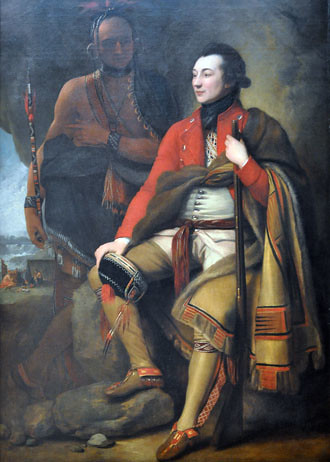
  • Debra A. Lavelle, Ohio State University, “Imperial Americans: The Presence of the Antique in Benjamin West’s Portrait of Colonel Guy Johnson and Karonghyontye” (shown above)
  • Daniel Gardner, Stonehill College, “The Magnetic Properties of Wampum: Shell Beads in North American Interregional Trade Systems”
  • Ann M. Becker, State University of New York, Empire State College, “The Revolutionary War Pension Act of 1818”