






Counting Votes in Independence Hall
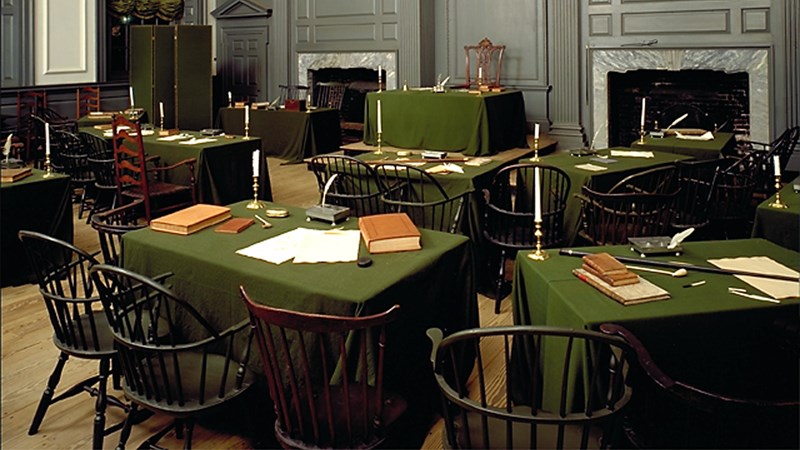
Jay didn’t make it, and on that date the delegations in Philadelphia took a test vote in their committee of the whole.
Nine colonies voted for independence. Four voted otherwise.
Rutledge’s South Carolina voted against. That colony contained the fourth largest port in North America and was very tied in with trade to the Caribbean and Africa.
Pennsylvania voted against independence. Its large delegation was split. Such heavyweights as John Dickinson and Robert Morris opposed the measure while a minority including Benjamin Franklin favored it.
Delaware had sent three delegates to Congress, but only two were present. Those men, Thomas McKean and George Read, disagreed. As a result, that delegation had to abstain.
New York also abstained because its delegates had received no guidance from its provincial congress. That colony contained the second-largest port along the coast, under imminent threat from the British military.
The vote was thus 9 delegations for independence, 2 against, and 2 abstaining.
The committee of the whole thus supported independence, but a big chunk of the Middle Colonies, including the two largest cities, were missing from the pro-independence bloc. There was no formal requirement that the vote be unanimous, but everyone realized that reporting disunity would hamper any ongoing resistance to the Crown.
The next day, Caesar Rodney returned from Delaware, “detained by thunder and rain,” as he wrote. McKean later said his colleague appeared “at the State-house door, in his boots and spurs.” Rodney’s arrival tipped the Delaware delegation into the pro-independence camp.
10 – 2 – 1.
Rutledge saw the trend. He decided that the danger of displaying disunity was worse than the danger of declaring independence before finishing the Articles of Confederation and Perpetual Union. He moved for a new vote, signaling that South Carolina would switch to approval.
11 – 1 – 1.
Thinking along the same lines, Dickinson and Morris chose not to attend the 2 July session of the Congress. That meant most of the Pennsylvania delegates in the assembly hall supported independence, changing that colony’s vote.
12 – 0 – 1.
The Congress could thus report that the vote for independence was unopposed.

No comments:
Post a Comment