J. L. BELL is a Massachusetts writer who specializes in (among other things) the start of the American Revolution in and around Boston. He is particularly interested in the experiences of children in 1765-75. He has published scholarly papers and popular articles for both children and adults. He was consultant for an episode of History Detectives, and contributed to a display at Minute Man National Historic Park.

Subscribe thru Follow.it


•••••••••••••••••


Showing posts with label Thomas Wooldridge. Show all posts

Wednesday, May 17, 2023

A Commonplace Article on Phillis Wheatley

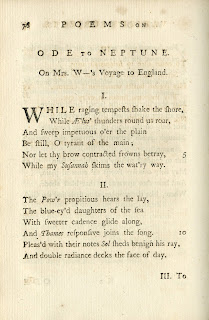
Yesterday my article “Phillis Wheatley’s ‘Mrs. W—’: Identifying the Woman Who Inspired ‘Ode to Neptune’” appeared on Commonplace, the web magazine on early America.

This year marks the sestercentennial of the publication of Wheatley’s Poems on Various Subjects, Religious and Moral.

That anniversary has prompted a lot of new scholarship, including David Waldstreicher’s biography, a reissue of Vincent Carretta’s biography, and the issue of Early American Literature I linked to yesterday. This article is my small contribution to that work.

Some folks might spot how I developed this article from material originally posted here on Boston 1775 in 2015. Since this blog could disappear with the flick of a switch at the Alphabet corporation, I looked for a more lasting place to share those findings.

It’s gratifying to see this article on Commonplace since I’ve been reading that web magazine for over twenty years now. In citing that site, I always have trouble remembering how to spell the title, and it turns out there’s a good reason for that: “Commonplace originally launched in 2000 as Common-Place: The Journal of Early American Life.”

The founding editors were Jane Kamensky and Jill Lepore, and the original institutional sponsor was the American Antiquarian Society. Today it’s an initiative of the Omohundro Institute of Early American History and Culture as well as the A.A.S. It no longer follows the model of academic journals with a collection of articles all published together each quarter, but rolls out material weekly and in a newsletter for subscribers. On this article I had the benefit of working with editor Joshua Greenberg and copyeditor Jordan Taylor, and I can recommend the process.

Saturday, September 26, 2015

Alderman Wooldridge and an Unfortunate Young Woman

Last month I introduced the figure of Thomas Wooldridge, an alderman of London who started the war as spokesman for the London merchants doing business with America and ended going bankrupt for the second time before dying in distant Boston.

While he was still a respectable magistrate in London, Wooldridge showed up in this story in the May 1777 London Magazine alongside a list of prisoners the American army took at Trenton:
Saturday 3 [May].

Yesterday two inhabitants of the parish of St. Mary Abchurch, made application to Mr. Alderman Wooldridge, at Guildhall for a warrant against the keeper of an infamous house, agreeable to the particular directions of the act of parliament; a warrant was granted, and Mr. Payne the constable immediately went to execute it; he presently came with the prisoner, a woman so big with child that she was on the eve of delivery; with her a pretty young woman, who, it afterwards turned out, was a nymph of the house.

Being closely interrogated by the alderman about her situation, she burst into a flood of tears, and a scene ensued that was extremely affecting: she said that she had lived in many reputable families, which she named, till being debauched by an attorney’s clerk, by whom she was with child, she was compelled to leave service and go to her father; but her mother-in-law [i.e., stepmother] turning her out of doors, she had no other resource to fly to than seeking that dissolute way of life which she now followed: every person present felt for the unfortunate girl, though nobody so much as herself, for her story was accompanied with the most evident emotions of contrition.

The alderman, in very severe terms, reprehended the keeper of the brothel, for to such characters, he justly observed, girls in general owed their ruin; but as the prisoner’s situation made her a very unfit object for a jail, she was permitted to return home, on a promise to discontinue the practice for which she was apprehended.

The young woman was sent by a constable to her father, who is a man of reputation; and we trust he will exercise tenderness, and not severity to a girl who appears to be more unfortunate than abandoned.
No word about how to deal with her stepmother.

See the In the Words of Women for an analysis of the print shown above.

Thursday, August 20, 2015

The Rise and Fall of Thomas Wooldridge

Thomas Wooldridge (often called Woolridge) returned to London by September 1773, having cultivated a relationship with Secretary of State Dartmouth and made contact with merchants in multiple North American ports. Through his father-in-law, William Kelly, he already had excellent connections among the London merchants investing in the American trade.

Kelly took ill and died in 1774, and Wooldridge, still in his mid-thirties, stepped up to become a spokesman for London’s American traders. In the months when Parliament voted on its Coercive Acts, that interest group was lobbying hard for a peaceful end to the American crisis.

The merchants’ strategy seems to have been to argue that a rupture with the colonies would be bad for their nation’s economy and their own—but that they shouldn’t have to reveal how much loss they were personally exposed to, lest their creditors lose faith in them. Wooldridge met with Edmund Burke in January 1775 and with Josiah Quincy, Jr., the next month. In 1778 he testified to Parliament about losses to American privateers.

By then Wooldridge was an alderman of the City of London, elected in 1776 for the district called the Bridge Ward Within (shown above in 1720). He remained in that post until February 1783, though not always comfortably.

In 1777 Wooldridge was chosen sheriff of London and Middlesex, but that September he declined the office because of financial reverses. That same year, he declared bankruptcy. Wooldridge found a sympathetic audience in London. The same issue of the London Magazine that reported his resignation and the ensuing debate went on to say:
Last Thursday at a meeting of the creditors of a North American merchant, the state of his affairs was laid before them, by which it appeared, that his present situation could not in the least degree be imputed to any misconduct of his own, but totally owing to the present unhappy state of affairs in America. It appeared there is now due to the house 70,000l. from that quarter, and that the demand upon the house is no more than about 27,000l. It was agreed that a letter of credit be given to the said gentleman for three years; that his affairs should be put under the inspection of five trustees, and that he should assist in getting in his effects, allowing him a stipend of 500l. per ann. for his time, trouble, and the maintenance of his family, house rent, &c.
That merchant may well have been Wooldridge himself.

That same year, Wooldridge spoke out against the prosecution of the Rev. William Dodd for forgery. Later he signed one of the petitions Lord George Gordon circulated protesting the granting of political rights to Catholics. When in 1780 that movement provoked anti-Catholic riots in London, however, Alderman Wooldridge sent letters to Lord Jeffery Amherst requesting troops to keep peace in his district.

Britain lost the war, of course, and that result sunk Wooldridge’s prospects, whether because his firm’s debts became uncollectible or because the peace revealed that his finances were far worse than he’d represented. Wooldridge was imprisoned for debt in 1783 and had to declare bankruptcy again the next year.

This time, the City wasn’t forgiving. To lose one fortune was a misfortune; to lose it again looked like mere carelessness, or worse. Furthermore, according to Ben Saunders’s article “The Swindler Detected,” the city government determined that Wooldridge had been maintaining himself by submitting false expenses, skimming fines, and forcing defendants into military service, pocketing recruiting fees.

After a raucous meeting of the aldermen, Wooldridge’s voters stripped him of his post, an unprecedented step that prompted him to sue to get it back. That effort failed, though his wife Susanna continued to receive substantial sums from the aldermen’s budget for years afterward, “independent of her husband, for the support of herself and her children.”

Wooldridge’s reputation was ruined from then on. The City Biography of 1799, which was full of unabashed gossip about London politicians, stated of Wooldridge:
He was at one period regarded as a mouth-piece to the City, and if he had possessed capacity equal to his effrontery, it is probable he would have made a considerable figure. Impudence made him, and caused him to be unmade, an Alderman; but he had no talents beyond those that commonly fall to the lot of Aldermen.
In the new U.S. of A., lawsuits over the property and debts of William Kelly, his sons, and Thomas Wooldridge continued for years, such as this 1795 case in Pennsylvania. As for Wooldridge himself, at some point he went back to America. He was in Boston by late 1793, when a couple named a child after him. And he died in Boston by 4 Jan 1794, as reported in the Columbian Centinel, and was buried out of King’s Chapel. The 6 January Boston Gazette reported the death “In this town, Thomas Wooldridge, Esq. aged 54, late an Alderman of the city of London.”

Wednesday, August 19, 2015

Phillis Wheatley and Susanna Wooldridge

Yesterday I proposed that Phillis Wheatley wrote her “Ode to Neptune” about Susanna Wooldridge (sometimes spelled “Woolridge”). Here’s my argument.

On 29 Aug 1771, the New-York Journal ran this piece of news from London:
Saturday last was married, Thomas Wooldridge, Esq; Provost Marshal General, and Receiver General of his Majesty’s province of East-Florida, also Fort Adjutant and Barrack-master of Fort St. Marks, to Miss Kelly, daughter of William Kelly, Esq; of John street, Crutched Friers.
“Crutched Friars” was a newly fashionable neighborhood in the City of London near Tower Hill, named after a monastery closed by Henry VIII and burned in the Great Fire. Kelly later moved into “The Crescent” nearby, shown above in its modern form.

That wedding notice was meaningful for New Yorkers because the bride’s father did a lot of business in the city, and in America. William Kelly was a partner of Abraham Lott, treasurer of New York colony. He invested in the Great Dismal Swamp Company. In the summer of 1773, the East India Company invited Kelly along with select other merchants to discuss shipping tea to America. His business associates and executors included Brook Watson of shark fame.

Kelly’s August 1774 will, written when he was “in Bath for the recovery of a Numbness that has attacked me in my feet,” gives the name of the daughter who married Thomas Wooldridge as Susanna. It also indicates that before the marriage Kelly had promised Wooldridge “£3,000 in lands in the Provinces of New York and New Jersey” while arranging £2,000 for Susanna “free from the debts and control of her husband.”

Thomas Wooldridge has already made an appearance on Boston 1775. My description of him back then was based on his correspondence with the Earl of Dartmouth, mostly about patronage positions in Florida mentioned in the wedding notice above. In 1772 Wooldridge was back in America, traveling around and currying favor by sending Dartmouth various dispatches, an effort that promised to pay off when the earl became Secretary of State.

Among the people Wooldridge met in America, as I described before, was Phillis Wheatley. On 24 Nov 1772 he sent Dartmouth a letter telling how she’d answered his challenge to compose a poem as he watched. He enclosed the result, “To the Earl of Dartmouth,” and Wheatley’s personal letter. Those documents are dated 10 October—the same date as her “Ode to Neptune.” Later that month, he stood sponsor for a baby during a baptism at King’s Chapel and then he went back to New York to write his report to Dartmouth.

I don’t have evidence that Thomas Wooldridge had brought his bride to America and that she was planning to sail back home to London toward the end of 1772. But I think that was the case. She’s certainly a “Mrs. W——” who could be addressed as “Susannah.” Perhaps Susanna Wooldridge came to Boston with her husband and met Wheatley. Perhaps Thomas asked the enslaved poet for a special composition which he could bring back to his wife in New York. But this seems like a more logical story for that poem than that Wheatley wrote it for Susannah Wheatley (who never sailed abroad) or Patience Wright (who never went by “Susannah”).

Under my scenario, “Ode to Neptune” isn’t Phillis Wheatley’s plea for smooth sailing for her beloved mistress or for an artistic colleague, but a well-crafted commission in classical style created for a well-connected patron. Wheatley was adept at that aspect of an eighteenth-century author’s life, just as she was adept with words.

TOMORROW: Thomas and Susanna Wooldridge in London during the war.

Saturday, October 22, 2011

“I asked if she could write on any Subject”

Thomas Wooldridge was a British businessman who moved to St. Augustine after the Floridas became part of the British Empire in 1763. He got appointed as provost marshal, fort adjutant, and barrack master for the army base, and receiver general of quit rents for the civil government. The first jobs included some work, the latter none. Wooldridge married a local widow in 1768; she died two years later.

In 1769, Gov. James Grant started to maneuver Wooldridge out of his offices, so the man sent a plea for help to the Earl of Dartmouth (shown here). In November 1771 Wooldridge told Dartmouth that the governor hadn’t paid his salary. Since he was writing from New York, having left Florida without leave from his superiors, one can see the governor’s point. The following July, Grant’s successor suspended Wooldridge from his Florida posts.

Wooldridge went to London and tried to sell his positions, but the Secretary at War refused to accept his resignation under those circumstances. Wooldridge kept complaining to Dartmouth, and after he returned to North America he started sending reports on the political situation there. It looked like he had bet on the right horse when Lord Dartmouth became Secretary of State in the summer of 1772.

That October, Wooldridge was in Boston, where he encountered Phillis Wheatley. The next month, he sent his patron an account of their interactions:

While in Boston, I heard of a very extraordinary female slave, who had made some verses on our mutually dear deceased Friend [Rev. George Whitefield]; I visited her mistress, and found by conversing with the African, that she was no Impostor: I asked if she could write on any Subject; she said Yes; we had just heard of your Lordship’s appointment; I gave her your name, which she was acquainted with. She immediately wrote a rough Copy of the inclosed Address & Letter, which I promised to convey or deliver.

I was astonish’d, and could hardly believe my own Eyes. I was present while she wrote and can attest that it is her own production; she shew’d me her Letter to Lady Huntingdon, which I daresay, Your Lordship has seen; I send you an account signed by her master of her Importation, Education &c. they are all wrote in her own hand.

Pardon the account I have given you of this poor untutor’d slave, when, possibly, your precious time may be very ill bestowed in reading my scrawls
Along with his own letter, dated 24 November in New York, Wooldridge sent a letter and verses from Wheatley dated 10 October and a short biographical sketch credited to her owner’s son Nathaniel Wheatley and dated 12 October. (That would later be the basis of the biography that appeared at the start of her Poems on Various Subjects.)

Wheatley’s letter was printed in the 3 June 1773 New-York Journal, along with a further account of Wooldridge’s visit:
A Gentleman who had seen several of the Pieces ascribed to her, thought them so much superior to her Situation, and Opportunities of Knowledge, that he doubted their being genuine—And in order to be satisfied, went to her Master’s House, told his Doubts, and to remove them, desired that she would write something before him. She told him she was then busy and engaged for the Day, but if he would propose a Subject, and call in the Morning, she would endeavour to satisfy him. Accordingly, he gave for a Subject, The Earl of Dartmouth, and calling the next Morning, she wrote in his Presence, as follows…
(Both quotations come the 1988 edition of Wheatley’s works, edited by John C. Shields.)

Thus, we have a contemporaneous account of how Phillis Wheatley responded to a stranger skeptical about her ability to write poetry. We don’t have to imagine the details of a “tribunal” of eighteen Bostonians quizzing her in the Town House.

It’s a bit awkward that the evidence Wheatley produced was a tribute to a British government minister who soon became unpopular with Americans. But in the fall of 1772, Whigs held out hope that Dartmouth would change London’s colonial policies.

Phillis Wheatley composed her verses and letter for Lord Dartmouth just a few days before the date on the document in which Boston’s most elite gentlemen attested to her talents. Both steps were part of her preparations to have her poems published in London.

TOMORROW: Why not in Boston?