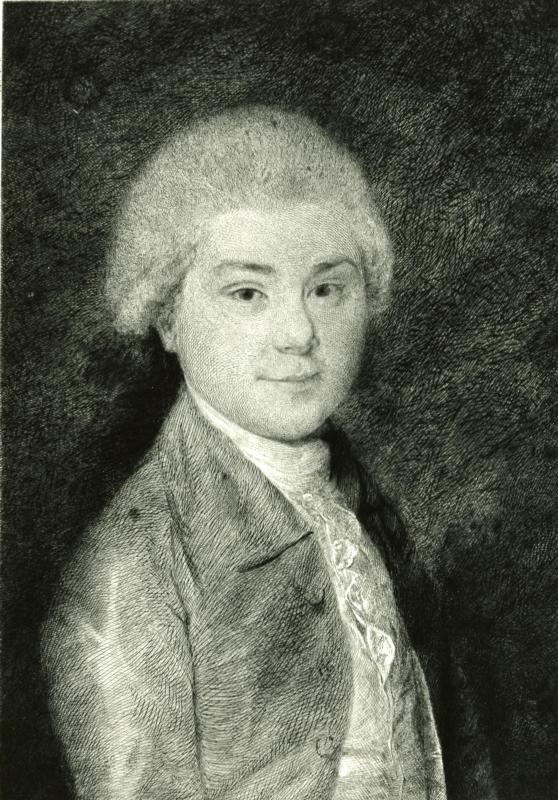
J. L. BELL is a Massachusetts writer who specializes in (among other things) the start of the American Revolution in and around Boston. He is particularly interested in the experiences of children in 1765-75. He has published scholarly papers and popular articles for both children and adults. He was consultant for an episode of History Detectives, and contributed to a display at Minute Man National Historic Park.

Subscribe thru Follow.it


•••••••••••••••••


Showing posts with label Timothy Cutler. Show all posts

Friday, October 03, 2025

“To Ring the Bells for two hours Each Time”

Yesterday I described the arrival in 1745 of a set of eight bells from Gloucester, England, for the steeple of Christ Church, now also called Old North Church.

Those bells were tuned to different notes and made for change ringing, the first such set to arrive in British North America. Few Bostonians had heard that style of bell-ringing. Even fewer knew how to do it.

The church’s website states:
Reverend Timothy Cutler had a difficult time finding any experienced bellringers. They sat idle and unused for five years—that is, until 1750, when a group of teenage boys living in the North End was contracted to ring for two hours per week for one year. Each of them was paid 2 pennies a week for their work.
Those boys formed a collective, and its charter agreement survives in the church archive:
We the Subscribers Do agree To the Following Articles Viz

That if we Can have Liberty From the wardens of Doctor Cuttlers church we will attend there once a week on Evenings To Ring the Bells for two hours Each Time from the date here of For one year

That will Choose a Moderator Every three Months whose Business shall be to give out the Changes and other Business as Shall be Agreed by a Majority of Voices then Present

That None shall Be admitted a Member of this Society without a Unanimous Vote of the Members then Present and that No member Shall begg Money of any Person In the Tower on Penalty of Being Excluded the Society

and that will Attend To Ring at any Time when the Warden of the Church Aforesaid shall desire it on Penalty of Paying three Shillings for the good of the Society (Provided we Can have the whole Care of the Bells)

That the Members of this Society Shall nott Exceed Eight Persons

and all Differences To be decided By a Majority of Voices

John Dyer
Paul Revere
Josiah Flagg
Barthw. Ballard
Jonathan Law [Low?]
Jona. Brown, junr.
Joseph Snelling
For some of these names there are multiple candidates in the Boston vital records, and I have no candidate at all for Law/Low. But it looks like all of these signers were in their late teens in 1750 except Dyer, born in 1730. Revere, born at the start of 1735, and Flagg, born two years later, were the youngest. (Nonetheless, Revere signed with a fancy paraph.)

Here’s a question I haven’t seen discussed before. Seven boys signed that agreement to ring the bells—but there were eight bells. They seem to have recognized that in limiting their society to “Eight Persons.” Shouldn’t they have brought in someone else? Or did the sexton of Christ Church join them in pulling a bell rope since sextons usually rang the bells in Boston?

The church’s statement that each boy was named 2d. a week suggests that payments might show up in the account books. It would be interesting to see how long the payments and thus the bell-ringing society might have lasted.

TOMORROW: The fading of Boston’s bells.

Thursday, October 02, 2025

“A fine set of 8 Bells were brought hither”

On 25 July 1745 the Boston News-Letter reported the arrival of a new type of sound in Boston—or at least the potential for one.

The newspaper said:
Last Week a fine set of 8 Bells were brought hither in a Vessel from Bristol, designed for Dr. [Timothy] CUTLER’s Church at the North Part of this Town: We hear the largest of them is near 1500 Weight, and the whole Set about 7000.
That was Christ Church, now also known as the Old North Church. Its steeple was also the tallest in town. As an Anglican place of worship, it could be fancier than the several Congregationalist meetinghouses with their single bells.

The church’s website states:
Old North has a total of 8 bells, each cast to ring at a different pitch. The treble bell, or #1, is the smallest bell and weighs in at about 620 lbs. The largest is the tenor, or #8, which weighs about 1,500 lbs. Each bell is hung inside a wooden wheel and frame, with ropes attached that extends to the bell-ringing chamber two floors down.
Each bell has a unique message cast in its metal:
  • 1: “Abel Rudhall of Gloucester, cast us all, Anno 1744.”
  • 2: “Since generosity has opened our mouths, our tongues shall ring aloud its praise. 1744.”
  • 3: “The subscription for these bells was begun by Iohn Hammock and Robert Temple, Church Wardens, Anno 1743; completed by Robert Ienkins and Iohn Gould, church Wardens, Anno 1744.”
  • 4: “William Shirley, Esq., Governor of the Massachusetts Bay, in New England. Anno 1744.”
  • 5: “God preserve the Church of England. 1744.”
  • 6: “We are the first ring of bells cast for the British Empire in North America. A.R. 1744.”
  • 7: “This Church was founded in the year 1723. Timothy Cutler, DD, the first Rector, A.R. 1744”
  • 8: “This peal of eight bells is the gift of a number of generous persons to Christ Church, in Boston, N.E. Anno 1744.”
“A.R.” usually meant “in the year of his reign,” referring to the current king, but here it appears to be used as a synonym for “A.D.”

Abel Rudhall (1714–1760) was the head of a family firm that cast bells in Gloucester from 1684 to 1835. According to Wikipedia, his grandfather had invented a way of “tuning bells by turning on a lathe rather than the traditional chipping method with a chisel.”

Those bells were designed to be rung together, but that required a group of bell-ringers.

TOMORROW: You rang?

Wednesday, January 18, 2017

“The Child whom you used to lead out into the common”

In April 1785, seventeen-year-old John Quincy Adams had finished his first job, as secretary and translator for American minister Francis Dana in the court of Catherine the Great.

Young J. Q. Adams returned to France, where his family was living during another diplomatic mission. He prepared to sail home to Boston and enter Harvard College.

On 27 April, John Adams wrote a letter for his son to hand to their cousin Samuel:
The Child whom you used to lead out into the common to see with detestation the British Troops and with Pleasure the Boston Militia will have the Honour to deliver you this Letter. He has since seen the Troops of most Nations in Europe, without any Ambition I hope of becoming a military Man. He thinks of the Bar and Peace and civil Life, and I hope will follow and enjoy them with less Interruption than his Father could.

If you have in Boston a virtuous Clubb, such as We used to delight and improve ourselves in, they will inspire him with Such sentiments as a young American ought to entertain, and give him less occasion for lighter Company. I think it no small Proof of his Discretion, that he chooses to go to New England rather than old [i.e., to a British university]. You and I know that it will probably be more for his Honour and his Happiness in the result but young Gentlemen of Eighteen dont always See through the same Medium with old ones of fifty.

So I am going to London [as U.S. minister to the Court of St. James]. I suppose you will threaten me with being envyed again. I have more cause to be pitied, and al[though I will] not say with Dr Cutler that “I hate [to be] pitied” I dont know why I should dread Envy.—I shall be sufficiently vexed I expect. But as Congress are about to act with Dignity I dont much fear that I shall be able to do something worth going for. If I dont I shall come home, and envy nobody, nor be envied. if they send as good a Man to Spain as they have in [John] Jay for their foreign department and will have in [Thomas] Jefferson at Versailles I shall be able to correspond in perfect Confidence with all those public Characters that I shall have most need of Assistance from and shall fear nothing.
The editors of the Adams Papers report that in his letters John Adams twice quoted “old Dr. Cutler” saying that he hated to be pitied. They posit that was an allusion to the Rev. Dr. Timothy Cutler (1684-1765), longtime minister at Christ Church (Old North) in Boston. I haven’t found any other source for the remark, nor confirmation, but Cutler was a well-known figure in New England, recognized for being haughty, so it seems like a good guess.

TOMORROW: Helicopter parenting from the land of the balloon.