J. L. BELL is a Massachusetts writer who specializes in (among other things) the start of the American Revolution in and around Boston. He is particularly interested in the experiences of children in 1765-75. He has published scholarly papers and popular articles for both children and adults. He was consultant for an episode of History Detectives, and contributed to a display at Minute Man National Historic Park.

Subscribe thru Follow.it


•••••••••••••••••


Showing posts with label John Vassall. Show all posts

Wednesday, June 10, 2026

Three Podcast Episodes

Producing a podcast strikes me as a lot of work, but speaking about Boston history on other folks’ podcasts is always fun.

Here are three episodes I’ve recorded in the last few months. Enjoy all you can.

“The Spark: How Boston Ignited the American Revolution” on The Object of History from the Massachusetts Historical Society

We ask several historians for their thoughts on why Boston helped light the spark of the American Revolution. Was there something unique about Boston's community or geography that made it prone to a rebellious spirit? We sit down with J. L. Bell, Historian of the Revolutionary Era in Massachusetts, Garrett Dash Nelson, President & Head Curator at the Leventhal Map & Education Center at the Boston Public Library, and Kathryn Lasdow, Assistant Professor of History and Director of Public History at Suffolk University, to answer this question.
I’d already been mulling about “Why did the Revolutionary conflict flare up in Boston?” when the invitation to explore that question arrived. Hear my threefold answer and more.

“Boston” on History’s Greatest Cities from History Extra
As one of the oldest cities in the United States, Boston played a pivotal role in the outbreak of the American Revolutionary War, as well as the signing of the Declaration of Independence that followed. In this episode of History’s Greatest Cities, Paul Bloomfield is joined by writer John Bell to explore the storied history of the capital of Massachusetts. Together, they wander through Boston’s oldest neighbourhoods, tracing the story of this harbour city from its pre-colonial roots, through Puritan settlement, to its rise as a major port and administrative centre of the British Atlantic world.
This podcast asks its guests to answer a series of questions, from major events to foods a visitor mustn’t miss.

“Not What You Hurd” on Antiques Roadshow Detours from GBH
In the world of rare silver, American Colonial silver is the stuff collectors dream of. So, when a pair of drinking vessels or “canns,” complete with intricate engraving by a master Boston craftsman, were discovered during ROADSHOW’s visit to Akron in 2023, expert Nick Dawes examined the cups’ clues to reveal both the silver’s early-American history and extraordinary value. But does Nick’s tale of the tankards hold water? Join host Adam Monahan as he searches for the untarnished truth, picking through the many stories, half-truths, and wishful legends in a quest for what may or may not have been lost to history forever.
My voice pops up occasionally on this episode, leaving more time for the fine local historians Joel Bohy and Caitlin DeAngelis.

Saturday, September 20, 2025

New Research on the Vassall Mansion in Cambridge

The Longfellow House–Washington’s Headquarters National Historic Site is unveiling a special history study researched over many years and in multiple countries. It adds tremendous detail to a dimension of that Cambridge mansion that people have long known about more generally.

That mansion in Cambridge was built in 1759 for John Vassall, heir to wealthy slave-labor plantations on Jamaica. It was not only erected with the profits of slavery, but it was staffed by enslaved workers for two decades.

While John Vassall took his family to England in the first year of the Revolutionary War, at least one family he had enslaved, led by Tony and Cuba Vassall, stayed behind to gain their freedom and found an African-American community nearby.

Black History at the Vassall Estate by Caitlin DeAngelis, Carla D. Martin, Rayshauna C. Gray, Aabid Allibhai, and Eshe Sherley digs into that story from every possible angle, using archives in the U.S. of A., Jamaica, Antigua, and Britain. The story it tells extends from the origins of the (white) Vassall family fortune through the political activity of the (black) Vassall family in the ante-bellum republic.

Two events in the next month will illuminate those findings for the public.

Thursday, 25 September, 6 to 7 P.M.
Black History at the Vassall Estate
Caitlin DeAngelis, Carla Martin, Rayshauna Gray, Aabid Allibhai, and Eshe Sherley
Online, free with registration

A new landmark study documents and analyzes the Black experience at 105 Brattle Street and in the wider Cambridge community from the mid-1700s to the mid-1800s. The authors will introduce the project, share key findings, and take you behind the scenes of their research and writing process.

This study is remarkable not only for the history it documents—much of it appearing in print for the first time—but also for the breadth of research behind it. In partnership with lineal descendants of the Black Vassalls, the authors consulted sources spanning New England, the United Kingdom, and the Caribbean over the course of more than three years. Research of this scale is rare, and even more rarely presented in a format accessible to all readers.

Everyone who registers for that event will receive a digital copy of the study, which is also available for downloading here.

Sunday, 12 October, 1 to 3 P.M.
In Search of Darby Vassall: Tour of Cambridge & Beyond
Denise Washington and Joel Mackall
Free with registration

Starting at Longfellow House–Washington’s Headquarters, travel by trolley in greater Cambridge between seven stops with a Vassall descendant and an educator. Each stop reflects a key location in the life of Darby Vassall (1769-1861), a lifelong community activist who endured slavery and seized freedom with his family in Revolutionary Cambridge. Early dinner provided after the tour.

Tuesday, November 19, 2024

The Good Properties of Richard Lechmere

Back here, in introducing a letter by Richard Lechmere, I wrote about him as leaving his country estate in Cambridge after accepting a seat on the mandamus Council and moving into Boston.

Charles Bahne, Cambridge historian and good friend of the blog, commented:
I question whether Richard Lechmere ever lived in what is now called East Cambridge. Certainly he owned a lot of land there, much of it inherited from his in-laws, the Phips family, and then he bought more parcels from other Phips heirs. And from this we get the names of Lechmere's Point, Lechmere Square, Lechmere station, and, at one time, the Lechmere Sales chain of department stores.

But my understanding is that the Phips mansion standing on that land in East Cambridge hadn't been occupied for some years prior to Lechmere's inheritance, and I don't think he ever lived there himself. It was in a remote location with no easy access, often becoming an island at high tide.

The Cambridge residence I associate with Richard Lechmere was the Tory Row house on Brattle Street, which he built circa 1761. In 1771 Lechmere sold that house to Jonathan Sewall, who still owned it in 1774-75. About the same time, Lechmere bought an estate residence in Dorchester, from Thomas Oliver, who had moved to Cambridge shortly before that. But it appears that Lechmere only owned that Dorchester house for about eight months, before selling it to an Ezekiel Lewis, who in turn quickly resold it to John Vassall [Jr.], another Tory Row resident. (And as you know, John, the Vassall, Oliver, Lechmere, and Phips families were all intermarried with each other.)

Lechmere may have purchased the Dorchester property with the intent of moving there, but since he resold it so quickly, he may never have actually occupied the estate. I believe he may already have relocated to Boston itself by 1772 or so. (I remember reading that somewhere, but can't track the source down right now.) He did own a large distillery in Boston.

The fact that the Phips mansion in East Cambridge was vacant in 1775 may well have been a reason why Gen. [Thomas] Gage chose that isolated area as the landing place for the Concord expedition on April 18. With no nearby residents, there wouldn't be any nosy neighbors to notice the troops' arrival.
There’s no dispute that Richard Lechmere owned a lot of property when he left Massachusetts. On 13 Oct 1784 he applied to the Loyalists Commission, seeking compensation for his losses. The commission’s records discuss “his House in Boston,” “his farm at Cambridge,” part of “a great Distillery at Boston,” “some Land at Muscongus” in Maine, and “property at Bromfield [Brimfield] & Sturbridge.”

But where did Richard Lechmere live? Some of those properties were real-estate investments. He may have moved between a couple of houses seasonally. But where was his legal residence? I went looking for period sources.

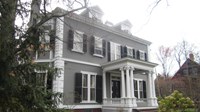
Lechmere’s name (as well as others’) is still attached to his 1760s home on Brattle Street in Cambridge, shown above. But according to Cambridge historian Lucius Paige, Lechmere turned that property over to royal attorney general Jonathan Sewall on 10 June 1771.

The 17 May 1770 Boston News-Letter contains an advertisement for the Dorchester house that had belonged to Thomas Oliver. That ad directed inquiries to “Richard Lechmere, of Cambridge,” meaning he didn’t move to Dorchester, just owned the property there while still living in Cambridge.

On 22 Aug 1773 the Boston Evening-Post contains another advertisement for a house in Boston on Hanover Street, “lately in the Occupation of Jacob Royall, Esq; deceased.” That directs inquiries to “Richard Lechmere, of Boston.” So by that date Lechmere presented himself as back in the town of his birth, no longer a Cambridge resident.

According to James Henry Stark’s Loyalists of Massachusetts, the Boston real estate confiscated from Lechmere was a house, land, and distill-house on Cambridge Street. He may have moved there from Hanover Street, or the house in that second advertisement was another property he managed. Cambridge Street was probably where Richard Lechmere was living when he became a mandamus Councilor—already safe from actual Cambridge residents.

Friday, September 06, 2024

The Flight of the Cambridge Loyalists, part 3

When the ministry in London chose supportive gentlemen for the Council under the Massachusetts Government Act, one was William Vassall (1715–1800, shown here with his son Leonard wanting help with homework).

William was the last male in his generation of Vassalls, thus the head of a wealthy Anglican family that generally supported the Crown.

However, he wasn’t a politician, and former governor Thomas Hutchinson called him “naturally timid.” And since marrying Margaret Hubbard, he was living on her very nice estate in Bristol, Rhode Island.

On 25 August, Gov. Thomas Gage wrote to Secretary of State Dartmouth that William Vassall was among three men who “plead age and infirmities, but I believe choose to avoid the present disputes.” Those disputes were taking the form of angry rural crowds pressuring the new-fangled mandamus Councilors to resign or leave town.

Some of William’s relatives witnessed the even bigger crowds in Cambridge on 2 Sept 1774, later dubbed the “Powder Alarm.” His niece Elizabeth was married to Lt. Gov. Thomas Oliver, and his sisters Susanna and Anna were the wives of George Ruggles and John Borland, respectively.

And then there was William’s nephew John Vassall, owner of the richest estate in Cambridge—now the Longfellow House–Washington’s Headquarters National Historic Site.

As a rich country gentleman, John Vassall had the usual appointments of justice of the peace and militia colonel. But he’d never sought to serve in a political office.

Until that week. On the morning of 2 September, Gov. Gage wrote to Dartmouth:
I have given Your Lordship in my letter of this date, the names of several of the New Council who desire to resign their Seats; and I have now the honour to transmit you the names of Three Gentlemen who desire to be of the Council, vizt.—Mr. John Vassall of Cambridge, Mr. Eliakim Hutchinson, and Mr. Nathaniel Hatch.
John Vassall probably thought that by joining the Council he would not only be supporting his king but also stepping up act as head of the family.

When he wrote, Gage didn’t know that thousands of men with sticks were marching along the road in front of John Vassall’s house. Nor did those men know that John Vassall had volunteered to be on the Council.

At that moment only John Vassall knew how close he was to receiving a summons from those thousands of men, as Joseph Lee and Samuel Danforth did. By the end of the day, he and his wife must have heard from their siblings, Elizabeth and Thomas Oliver, about the threatening crowd that surrounded the lieutenant governor’s house and demanded he resign.

In 1784, John Vassall told the British government’s Loyalists Commission: “He was afraid of the Mob who knew his principles & he went to Boston a Day or two after Govr. Oliver’s House was attacked.” 

On 23 Feb 1775, the Boston News-Letter published a long article about how various Loyalists had been driven from their homes. It said: “Col. Vassall, of Cambridge, from intolerable threats, and insolent treatment to his friends and himself, has left his elegant seat there, and retired to Boston, with his amiable family, for protection.”

The lack of specific examples of “insolent treatment” and Vassall’s report of leaving Cambridge within a couple of days after the “Powder Alarm” suggest that there may not have been many real confrontations. But there was a lot of real fear.

In the fall of 1774 the London government sent a writ of mandamus appointing John Vassall and others to the Council. On 15 December, Gov. Gage wrote back: “Messrs. Erving, Vassal and Hatch have accepted the honour conferred upon them, but desire that it may be kept secret for a time, and that they may not be called upon till they are prepared.”

The next Council meeting Gage convened was on 17 July. But Vassall didn’t participate. In 1784 he told the Loyalists Commission that “he was never sworn in owing to an Accident which made him lame.” Natural timidity might have run in the family. 

Sunday, February 20, 2022

“After 28 Years of active and unremitting Service”

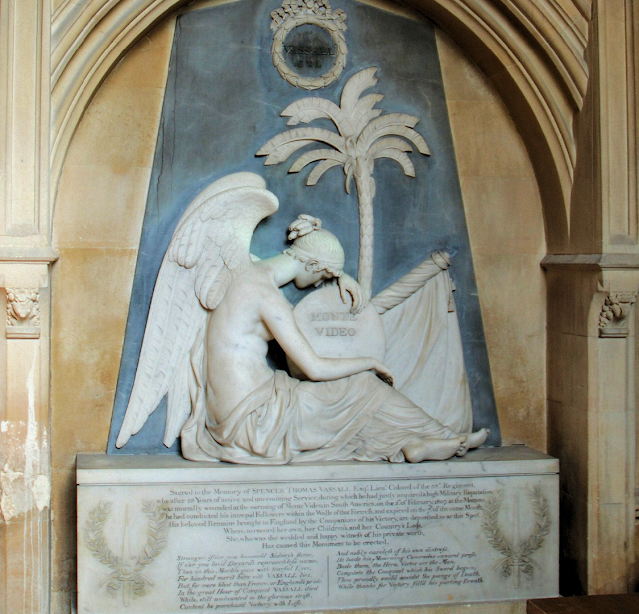
This monument is installed in St. Paul’s Church in Bristol, England. It shows an angel mourning over a stone labeled “Monte Video” with a palm tree in the background.

This artwork was installed to honor of Lt. Col. Spencer Thomas Vassall of His Majesty’s 38th Regiment of Foot. As the inscription explains:
after 28 Years of active and unremitting Service, during which he had justly acquired a high Military Reputation [he] was mortally wounded at the storming of Monte Video in South America, on the 3rd of February 1807, at the Moment he had conducted his intrepid Followers within the Walls of that Fortress, and expired on the 7th of the same Month
Vassall’s fellow officers brought his remains back to Britain, and his wife paid for this monument.

Lt. Col. Vassall began life in 1764 in Cambridge, Massachusetts, the second son of John and Elizabeth Vassall. He was born in the mansion now known as Longfellow House–Washington’s Headquarters National Historic Site. The Vassall family was immensely wealthy from slave-labor plantations on Jamaica.

On 2 Sept 1774, when Spencer was ten years old, thousands of Massachusetts farmers marched up and down the street outside his house in the event later called the “Powder Alarm.” Those men demanded that several neighbors—including attorney general Jonathan Sewall, Council members Samuel Danforth and Joseph Lee, and Middlesex County sheriff David Phips—give up their royal appointments under the new Massachusetts Government Act or apologize for actions they had taken under that law.

At the end of the day the crowd surrounded Lt. Gov. Thomas Oliver’s house, about a mile to the west, and threatened him into signing a resignation. The lieutenant governor was Spencer’s uncle (in two ways). Undoubtedly that experience affected the Vassall and Oliver children, but I don’t think any of them left comments or reminiscences about it.

Nobody in that 1774 crowd knew that Spencer’s father had just written to Gen. Thomas Gage offering to join the Council as well. And John Vassall didn’t want anyone to know. Within a couple of weeks, he packed up his family and moved into Boston for safety. Spencer and his siblings never saw their Cambridge home again.

By early 1776, the Vassalls were in Britain. Later that year, the family bought Spencer, aged twelve, a commission in the British army. He went on active duty a couple of years later. From October 1782 to the end of the American War, he was at Gibraltar while it was under siege from the Spanish and French. In later conflicts he served in Flanders, Antigua, France, Spain, Holland, Ireland, and South Africa. And, as related above, he died leading a British army attack in Uruguay.

One detail not mentioned on Lt. Col. Spencer Vassall’s monument is that he was born in America. His parents had spent even more of their lives in Massachusetts, and their monument in the same church also says nothing about having been born, married, and started a family in Cambridge. The Vassalls left that difficult part of their history behind.

Monday, March 08, 2021

“The End of Tory Row” Online, 11 March

On the evening of Thursday, 11 March, I’ll offer an online presentation for the Longfellow House–Washington’s Headquarters National Historic Site about “The End of Tory Row.”

For the past several years, I’ve spoken about that mansion’s Revolutionary history each March around Evacuation Day.

Usually those talks have focused on Gen. George Washington, who used the house as his headquarters from July 1775 to April 1776, and challenges he faced. Last year, for example, I shared information about Native American visitors to Cambridge during Washington’s time and his efforts at diplomacy on the continent.

That was the last public event I attended for many months. The audience was small and the chairs distanced, according to the protocols of the time. Soon most local institutions shut down completely for visitors. Historical talks moved online, which has brought both technical difficulties and benefits in wider access.

This year’s talk will look at how what’s now Brattle Street in Cambridge became a neighborhood of wealthy households, all related to John Vassall, the man who in 1759 commissioned and moved into that mansion. And how in September 1774 that enclave dissolved under political and militia pressure. I’ll also discuss how that neighborhood’s lifestyle depended both economically and in daily life on the exploitation of slavery.

I’ve discussed the Vassall family and the events of September 1774 before, but this year I’m trying to make more of the online format by incorporating more visuals and perhaps even moving footage. There will be a live question-and-answer session after the presentation.

This online event is free to all through support from the Friends of Longfellow House–Washington’s Headquarters, the Massachusetts Society of the Cincinnati, and the National Park Service. To register in order to receive the viewing link, please start at this page. The event will start at 7:00 P.M. on Thursday.

Saturday, February 28, 2015

New Database of Massachusetts Anti-Slavery Petitions

Yesterday saw the official debut of the Digital Archive of Massachusetts Anti-Slavery and Anti-Segregation Petitions. This online database is a collaboration between the Massachusetts Archives and Harvard’s Radcliffe Institute, Center for American Political Studies, and Hutchins Center for African and African American Research.

Two years in the making, the collection offers views of 3,500 documents filed with the Massachusetts General Court from the 1600s to the 1800s. I saw a Twitter message saying that some of those petitions appears to have never been opened before being digitized.

Boston 1775 reader Nicole Topich, who worked on the project, alerted me to a number of items from the database relating to people discussed on this blog. For example, I’ve been passing on news about the identification of a young African-American portrait artist named Prince Demah. His mother Daphne appears in several documents because she was part of the estate confiscated from the Loyalist merchant Henry Barnes.

The state told the men it appointed to administer that estate to pay her from its earnings. The second of those men, Simon Stow, ended up suing his predecessor with the state’s encouragement. In June 1789 Stow complained to the legislature that he was still paying Daphne and thought she could live more cheaply in the countryside, but she was refusing to leave Boston. The legislature excused Stow from that responsibility. Two years later, Daphne petitioned directly, describing herself as having been “born in Africa,” “purchased by Henry Barnes, Esqr.,” and too old to support herself. The legislature authorized Joseph Hosmer to pay for her expenses on the state account.

Similar issues arose in the case of Tony (Anthony) and Cuba (Coby) Vassall, who had been enslaved to different members of the Vassall family in Cambridge. (As a child, Cuba had worked at the Royall House in Medford.) In 1780 the couple petitioned the legislature to be granted land from the John Vassall estate so as to support themselves. Tony stated that since the war began:
he and his family have since that time occupied a small tenement, with three quarters of an Acre of land, part of Mr. John Vassall’s estate in Cambridge and has paid therefor a reasonable rent, and all the taxes that were assessed upon him. . . .

the earlier part & vigour of their lives is spent in the service of their several masters, and the misfortunes of war have deprived them of that care & protection which they might otherwise have expected from them—

the land Your Petitioners now improve is not sufficient to supply them with such vegetables as are necessary for their family use, and their title is so precarious that they can’t depend on a continued possession of the same—

they might however promise themselves a tolerable subsistence by their industry & attention, if this Honble Court would grant them a freehold in the Premises and add one quarter of an acre of adjoining land to that which they now improve.
The following February, the legislature responded by voting Anthony Vassall a £12 annual pension but no more land. After his death, in 1811 the widow “Cuby” requested that the pension continue; her plea eventually succeeded, but she died the next year. Their son Darby, who reportedly met Gen. George Washington when he arrived at the John Vassall house to use it as his headquarters, lived long enough to sign a petition against the Fugitive Slave Law in 1861.

The database also contains digitized documents that don’t appear to have a direct connection with slavery. For instance, there are several petitions from Samuel Adams the wire-worker in the 1850s asking for compensation from the state for losses he sustained in the Shays Rebellion over sixty years before. They show Adams gathering pages of signatures in support of his cause, just as the opponents of the Fugitive Slave Law would do.

Wednesday, July 10, 2013

Gen. Washington Coming to Cambridge Discovery Days

This weekend, 13-14 July, the city of Cambridge is hosting its annual Discovery Days of historic walks, lectures, and building tours. For the first time this year, that event includes a Revolutionary encampment at Longfellow House–Washington’s Headquarters National Historic Site and Longfellow Park on either side of Brattle Street.

On 15 July 1775, Gen. George Washington paid for cleaning, and presumably moved into, the mansion that the Loyalist John Vassall had left behind the previous September after the “Powder Alarm.” For the next nine months Washington lived there with Gen. Horatio Gates, his secretaries and aides, and after December his wife Martha and her son and daughter-in-law.

Why did the new commander-in-chief choose that home for his headquarters? Neither he nor his staff nor the Massachusetts Provincial Congress left any direct statements about his thinking. I looked at several theories that authors have suggested over the years. For instance, some suggested that the Vassall house was further away from British artillery batteries—but eighteenth-century guns couldn’t have reached central Cambridge.

In the end I concluded that Washington’s most likely motive was not to get away from the British but to get away from his own men. The house that Gen. Artemas Ward used as his headquarters (now gone) and the first house Washington used when he arrived at Cambridge were both right next to Harvard College, where hundreds of Continental soldiers were barracked. Washington liked hierarchy. He liked order. He had work to do. I think he thought putting more distance between headquarters and the enlisted men was a good thing.

Plus, in 1775 the Vassall estate—the most expensive in Cambridge, with barns, stables, fields, gardens, orchards, and land extending to the Charles River—might have reminded Washington of Mount Vernon.

A gentleman who portrays Gen. Washington will be part of Cambridge Discovery Days’ reenactment on Sunday, 14 July. (I understand that he recently sustained an injury, so the general might be even stiffer than usual.) There will be infantry drills, demonstrations of medical care, and other aspects of life in the American camp. This being the middle of a city, the soldiers won’t be firing their muskets—so consider this event as reenacting camp in August after the general discovered how little gunpowder his army had and ordered the troops not to fire their guns needlessly.

ADDENDUM: This afternoon I obtained a schedule for the day. Highlights include:
  • 10:30 and 11:30 A.M., 1:30 and 3:30 P.M.: Drill demonstrations and training for young visitors (April 1775-April 1776).
  • 11:00 A.M.: Gen. Washington and his aides arrive (July 1775).
  • 12:00 noon: Gen. Washington inspects the troops and inquires into an officer’s behavior at Bunker Hill (July 1775).
  • 12:30 P.M.: The general invites John Adams to a potluck dinner (January 1776).
  • 1:00 P.M.: Col. Benedict Arnold arrives with a report and expenses from Ticonderoga (August 1775).
  • 2:00 P.M.: Is there a spy ensconced in the American camp? (September 1775)
  • 3:00 P.M.: Formal transfer of command from Gen. Artemas Ward (July 1775).

Sunday, May 05, 2013

Unabashed Gossip at Fieldstone Common

Last month genealogist Marian Pierre-Louis and I gossiped by phone about children in Revolutionary Boston, the Vassall families of Cambridge, and other topics.

That was for an episode of Marian’s internet radio show and podcast Fieldstone Common, and you can hear the recording here. There are also a couple of photos of me on the episode’s webpage, and Marian’s introduction explains how I fell into historical research.

Wednesday, November 14, 2012

The Vassalls’ Pension and Tonight’s Lecture in Medford

On 17 June 1858, an anniversary of the Battle of Bunker Hill, the Massachusetts Historical Society held a special meeting at the house of member Henry W. Longfellow. Members shared some documents about the first owner of that house, John Vassall.

Massachusetts judge Lemuel Shaw recalled a case from early in his legal career that started when the state confiscated that property because Vassall was an absent Loyalist:
The estate having been confiscated by the Government because its owner was a Tory, when the commissioners were putting it up for sale, an old colored man, a slave, who had long served in the Vassal family, stepped forth, and said, that HE was no Tory, but a friend of liberty; and having lived on the estate all his life, he did not see any reason why he should be deprived of his dwelling. On petitioning the General Court, a resolve was framed, granting Tony a stipend of twelve pounds annually.

About 1810 (after Tony’s death), Cuba, his widow, went to the State Treasurer to get her stipend; but it was found that the resolve did not include herself. Mr. Shaw, then a member of the House, presented her petition for the continuance of the grant. It met with favor, and the annual sum was voted to Cuba during her natural life.
Shaw’s extemporaneous recollection wasn’t completely accurate, and reflects the dismissive racism of his time (referring to Tony and Cuba Vassall only by their first names), but it’s impressively close. The Massachusetts legislature responded to Tony Vassall’s petition by voting to pay “the sum of twelve pounds in specie, or a sum in bills of credit equivalent, to the said Anthony” each year.

Tony Vassall died in 1811, receiving obituaries in the Boston Repertory and Columbian Centinel. His widow Cuba petitioned for the pension to continue, and on 28 Feb 1812 the legislature granted her $40 per year. But she died only a few months later.

Tonight I’ll discuss the lives of Cuba Vassall and her mistress Penelope (Royall) Vassall at their first home in Massachusetts, the Royall House and Slave Quarters in Medford. Later they lived on “Tory Row” in Cambridge; Penelope was John Vassall’s aunt and neighbor, and in the early 1770s Cuba was his property. I’ll discuss how the Revolution disrupted those old relationships and sent both women off on new paths. That talk starts at 7:30. Admission is free for members, $5 for non-members.

Saturday, October 20, 2012

Upcoming Talks in Sudbury and Medford

Yesterday’s posting offers a chance to mention two talks I’m looking forward to giving next month.

On Monday, 5 November, I’ll speak to the Sudbury Minutemen about “The Powder Alarm,” the militia mobilization in September 1774 that marked the end of royal authority in most of Massachusetts. That will start at 8:00 at Longfellow’s Wayside Inn in Sudbury.

Here’s some of Dr. Thomas Young’s commentary on the event to Samuel Adams, who had left Boston for the First Continental Congress:
That treacherous, sneaking and cowardly action, of seizing our Province powder set all the Country in a flame. Every one now feels the matter coming home to him. It gave me much pleasure to see the behavior of the people at Cambridge. When Doctr. [Joseph] Warren and I arrived there Judge [Samuel] Danforth was addressing perhaps four thousand people in the open air; and such was the order of that great assembly that not a whisper interrupted the low voice of that feeble old man from being heard by the whole Body.

And when their Committee had heard and were satisfied wt. Collo. [David] Phips’s vindication of his conduct and promise to call in his Venires and marshalled them to receive the information and take their minds upon it they kept their particular stations for three hours in the scorching sun of the hottest day we have had this summer. Such patient endurance is certainly a principal ingredient in the composition of that character emphatically stiled a Good Soldier.
Danforth was a long-time member of the Council, newly reappointed by the London government under a writ of mandamus. Phips was the sheriff of Middlesex County; the day before, he had helped the army take control of the gunpowder and two small cannon assigned to the local militia. The crowd demanded that they and other royal appointees in Cambridge resign their posts and not to support Gen. Thomas Gage’s further actions. Young’s “Venires” remark referred to another aspect of the people’s resistance: refusing jury service and shutting down the courts.

As I described yesterday, this gathering had a big effect on John Vassall and his extended family, some of whom were targets of the crowd’s anger. On Wednesday, 14 November, I’ll talk about that Vassall family, as well as another Vassall family they left behind—their enslaved household workers.

The venue for that event is the Royall House and Slave Quarters in Medford (shown above). John Vassall’s aunt Penelope grew up on that estate as the daughter of the elder Isaac Royall. When she married and moved to Cambridge, she brought an enslaved girl named Cuba. The start of the war sent Penelope Vassall fleeing with her daughter and son-in-law, though the two women eventually returned. It also left Cuba Vassall, her husband, and their children free—but they had to build lives in an uncertain new society.

“Penelope Royall, Cuba Vassall, and the Families of Tory Row” will start on 14 November at 7:30 P.M. Admission is free for R.H.S.Q. members and $5 for non-members.

Friday, October 19, 2012

The Vassalls of Cambridge

Although the title of my book-length study for the National Park Service is Gen. George Washington’s Headquarters and Home—Cambridge, Massachusetts, it gets a running start with the building of that house sixteen years before Washington arrived.

In 1759 John Vassall (1738-1797) turned twenty-one and came into his inheritance of large sugar plantations on Jamaica. He had the best upbringing that his maternal grandfather, Lt. Gov. Spencer Phips, could provide. He had a Harvard degree. And from his late father he had farmland in Cambridge with a house on the north side of the road out to Watertown.

But that house evidently wasn’t exactly what John Vassall wanted, so he had it torn down and a handsome new Georgian mansion built nearby. Over the next fifteen years Vassall added to the estate until he owned 90 acres, paying more real-estate tax than anyone else in Cambridge.

In January 1761, John Vassall married Elizabeth Oliver (1741-1807), daughter of a Dorchester man with Caribbean plantations. Seven months earlier, John’s sister Elizabeth had married Elizabeth’s brother Thomas Oliver. Miss Elizabeth Vassall thus became Mrs. Elizabeth Oliver, and Miss Elizabeth Oliver became Mrs. Elizabeth Vassall. In 1766, the Olivers moved to Cambridge, commissioning a handsome mansion of their own, now called Elmwood.

John Vassall’s life in Cambridge in the late 1760s would have given Bertie Wooster fits: he was surrounded by aunts. His father’s brother Henry Vassall and wife Penelope lived pretty much across the street. Near the college was his father’s sister, Anna Borland, and her husband. Two of his mother’s sisters, Mary Lechmere and Rebecca Lee, lived along the Watertown road to the west with their husbands. Then came another paternal aunt, Susanna Ruggles, with hers. And finally the Olivers. All those houses are still intact, too, though one has been moved. They comprise most of “Tory Row.”

This chapter describes the “Powder Alarm” of 2 Sept 1774 from the Vassalls’ point of view. Imagine being Spencer Vassall, John and Elizabeth’s ten-year-old second son, watching 4,000 men with sticks march past your house to the town common to demand that all the men appointed to the new royal Council step down. Then watching those thousands of men walk back past your house to your uncle’s, where they threatened his life until he signed a resignation under protest. Did Spencer know that his father had recently told Gov. Thomas Gage he was willing to sit on the Council as well? (That news was kept secret, and John Vassall never actually took the seat.)

The Vassalls left their Cambridge home for their Boston home that September, then left Boston for Halifax in 1775 and were in London by June 1776. With most of his wealth coming from Jamaica, John Vassall easily weathered the loss of his Massachusetts properties. In fact, the memorial inscriptions for him and his wife in St. Paul’s Church in Bristol don’t even mention Massachusetts, where both were born and where they had seven of their eight children (two dying young).

And what about Spencer Vassall? He was ready to fight in the American war. His father bought him an army commission, and he apparently entered the service in 1778 at the age of fourteen. Lt. Vassall served at Gibraltar from October 1782 to the end of the war; for the British, staving off Spain’s attempt to regain this territory was an important and heroic campaign. Vassall remained in the army through the wars with Revolutionary and Napoleonic France, serving in Flanders, Antigua, France, Spain, Holland, Ireland, and South Africa. He died leading a British attack on Montevideo, Uruguay, in 1807.

Amelia Opie wrote an epitaph to Capt. Spencer Vassall that began:
Stranger, if e’er you honor’d Sidney’s fame,
If e’er you lov’d Bayard’s reproachless name,
Then on this marble gaze with tearful eyes,
For kindred merit here with Vassall lies!…
The first chapter of the report includes more mediocre poetry about the captain, plus the family’s vital records, descriptions of John Vassall’s social and public life, details of a mysterious shooting in Lincoln, and remarks on whether Vassall was really a figure in Mercy Warren’s The Group or involved in a Loyalist disinformation campaign during the war.

Tuesday, October 16, 2012

Gen. Washington in Cambridge

I took this photograph at Longfellow House–Washington’s Headquarters National Historic Site this past Saturday.

It shows a gentleman of the 10th Massachusetts reenacting group portraying Gen. George Washington, greeting guests at the front gate of the estate.

The uniform is modeled after the one Washington ordered for his Virginia militia regiment and then wore to war, as portrayed by Charles Willson Peale and others. The tailor who made this outfit, Henry M. Cooke IV, made two like ones for Mount Vernon.

Besides visiting the general and his troops, I had another reason to go to Cambridge on Saturday. For the past few years I’ve been intensely examining Washington’s activity at his first headquarters for what the National Park Service calls a “historic resource study.” And the agency had the first printed copies available at the site that day.

General George Washington’s Headquarters and Home — Cambridge, Massachusetts is a 669-page, eighteen-chapter study of how the commander-in-chief came to occupy the mansion that Loyalist planter John Vassall had left behind and what he did there. Over the next couple of weeks I’ll lay out those chapters to show the scope of the report and some of its findings.

Spiral-bound copies of this government report are available at Longfellow House–Washington’s Headquarters N.H.S. The agency also plans to make the whole darn thing available for downloading or reading online, but I don’t think that’s ready yet.

Sunday, February 19, 2012

House Tours at Washington’s Headquarters, 22 Feb.

On Wednesday, 22 February, Longfellow House–Washington’s Headquarters in Cambridge is offering free tours focusing on the house’s Revolutionary history every half-hour from 11:30 A.M. to 3:30 P.M. Tours usually take about an hour, and there’s a limit to how many people can be in each group.

George Washington moved into this mansion, left behind by Loyalist John Vassall and family, in the middle of July 1775. Martha Washington joined him in December. The couple was living there during the general’s birthday in 1776, when he turned forty-four. At the time, he was probably more engrossed in deciding whether to move onto the Dorchester peninsula than in celebrating.

This year’s Washington’s Birthday open house marks a changing of the guard at the site. Nancy Jones, Supervisory Park Ranger for several years, is retiring from the National Park Service at the end of the month. Meanwhile, Garrett Cloer has arrived as a new ranger, bringing experience from Independence National Historical Park in Philadelphia. Both will be leading tours on Wednesday. Stop in and say hi!

Sunday, July 03, 2011

“The residence of his excellency General Washington”

The Massachusetts Provincial Congress’s records say that on 26 June 1775 the body voted

That the president’s house in Cambridge, excepting one room reserved by the president for his own use, be taken, cleared, prepared, and furnished, for the reception of General [George] Washington and General [Charles] Lee, and that a committee be chosen immediately to carry the same into execution.
Most of the time that congress used “the president” to refer to its presiding officer, who at that point was James Warren. However, Warren’s own house was in Plymouth, and he was staying somewhere in Watertown, so this must mean another “president’s house in Cambridge.”

The only president who lived in Cambridge was the Rev. Dr. Samuel Langdon of Harvard. And with the college closed, he didn’t need the whole building, right? That house still stands on the edge of Harvard Yard, and is officially called the Wadsworth House (shown above).

The generals arrived in Cambridge on 2 July. Four days later, the congress ordered its Committee of Safety “to desire General Washington to let them know if there is any house at Cambridge, that would be more agreeable to him and General Lee than that in which they now are.” That suggests its members had heard murmurs that the generals weren’t fully satisfied.

By the next day, it was clear that the two generals would be living separately, and on 8 July the Committee of Safety decided that “it is necessary the house of Mr. John Vassal, ordered by Congress for the residence of his excellency General Washington, should be immediately put in such condition as may make it convenient for that purpose.” It looks like he moved in a week later; at least his aide Thomas Mifflin paid the cleaning bill on 15 July.

John Vassall had left that mansion when he moved his family into army-occupied Boston in September 1774. In the 1790s Andrew Craigie, who back in 1775 had worked for the Provincial Congress as an apothecary, bought the house and expanded it. After his widow’s death it became the home of Henry Wadsworth Longfellow and family, and it’s now Longfellow House–Washington’s Headquarters National Historic Site.

Thus, Prof. Cornelius Conway Felton was correct in telling Washington Irving that what he called “the Cragie House” was Gen. Washington’s headquarters and residence for most of the siege of Boston. But Irving had been correct when he originally wrote that the Provincial Congress had first put Washington and Lee up in the Harvard president’s house.

COMING UP: Where did Gen. Charles Lee live?

Saturday, April 02, 2011

Washington’s Wine Bottles?

The Northeast Museum Services Center of the National Park Service has an Archeology Lab, and that lab has a blog. Back in February it posted, “Did These Bottles Belong to George Washington?” as the hook for an article about finds at Longfellow House–Washington’s Headquarters National Historic Site in Cambridge.

The posting says:

Between 1759 and 1791 the house was home to several families. Both families were interested in botany and horticulture and purchased many plants for the yard. Evidence of fruit bearing trees, rye grass, cactus, and butterfly wings all speak to both the indigenous and exotic plants on the property.

The Longfellow house served as headquarters for George Washington and his officers from July 1775 to April 1776. During Washington’s 9 month occupation of the house, his steward, Ebenezer [actually, I believe, Timothy] Austin kept meticulous account books of expenses for food, drink and household goods. The account books list orders for mutton, fowl, butter, eggs, fish, smoking pipes, a sugar pot, and an earthen platter. . . .

The well-preserved biological material adds some additional clues. Seeds, eggshell fragments, and oyster shells, and animal bones were well-preserved in the feature. Fish, goat, chicken, rabbit, and rock dove are all represented. Seeds from a muskmelon or cucumber, apple or pear were also recovered from the basement and are listed as being purchased during Washington’s time in the home. Three cherry stones were also recovered and Ebenezer Austin entered payment for cherries in at least two different days in August 1775. One half of an olive pit was also recovered. Austin does not list any purchases for olives, but records from 1772 and again in 1783 document that George Washington ordered olives for his household in Mount Vernon. . . .

So how can we be certain that this trash deposit dates from the mere 9 months that George Washington occupied the house? We simply aren’t sure yet. The detailed accounts by Ebenezer Austin are extremely helpful and remind us that Historical Archaeology is a combination of historic research, architectural analysis, and archeological excavation.
That last paragraph acknowledges that it’s nearly impossible to tie artifacts to a particular nine months out of the house’s first thirty-two years. I suspect that Washington’s name comes up only because:
  • We have his household accounts because he submitted them to the Continental Congress for reimbursement, and we don’t have such detail for the people who lived in the mansion the rest of the time.
  • Gen. Washington’s a much bigger celebrity than John Vassall, Nathaniel Tracy, and Andrew Craigie, the other men known to have headed that household in the late 1700s.
But I suspect the archeologists know that very well. This is really a study of the garbage of an upper-class household in late-eighteenth-century New England. All the families, personal or military, who lived in that house probably shared a similar lifestyle when it came to the dinner table.

Monday, February 14, 2011

A “Romantic” Mansion in Roxbury

In 1874, Emily Pierpont Delesdernier (1840-1915) published Fannie St. John: A Romantic Incident of the American Revolution. Though inspired by family lore, that book was fiction.

Delesdernier described an old Roxbury mansion, built in 1723 by Francis Brinley and bought just before the Revolution by her great-grandfather Robert Pierpont, like this:

It was situated in the midst of a large domain of park and wooded hills, and presented a picture of grandeur and stateliness not common in the New World. There were colonnades, and a vestibule whose massive mahogany doors, studded with silver, opened into a wide hall, where tessellated floors sparkled under the light of a lofty dome of richly painted glass. Underneath the dome two cherubs carved in wood extended their wings, and so formed the centre, from which an immense chandelier of cut glass depended. Upon the floor beneath the dome there stood a marble column, and around it ran a divan formed of cushions covered with satin of Damascus of gorgeous coloring. Large mirrors with ebony frames filled the spaces between the grand staircases, at either side of the hall of entrance. All the paneling and woodwork consisted of elaborate carving done abroad, and made to fit every part of the mansion where such ornamentation was required. Exquisite combinations of painted birds and fruits and flowers abounded everywhere, in rich contrast with the delicate blue tint that prevailed upon the lofty walls.

The state rooms were covered with Persian carpets, and hung with tapestries of gold and silver, arranged after some graceful artistic foreign fashion.

The traditions of the princely grandeur of the ancient home have often been recalled at family reunions, but the old place has suffered many changes at the hands of its various owners, who, in attempting modernizing, have destroyed almost every vestige of former magnificence.
When Gen. George Washington arrived in Cambridge, Gen. Artemas Ward took command of the American army’s southern wing, and used this house as his headquarters. Later, in 1809, Gen. Henry Dearborn, who had started his military career as a young officer from New Hampshire in the siege of Boston, moved into the mansion.

By the mid-1800s, the building had been modified almost beyond recognition. Soon after the publication of Fannie St. John, a fire damaged the eastern portion. By then a Catholic order, the Redemptorist Fathers, owned the property and was building a cathedral nearby.

Delesdernier’s novel provided the only detailed description of the building as it had appeared in the Revolution—even though she hadn’t been alive then, and her description was highly romanticized and fairly Victorian. Several local historians quoted the passage from Fannie St. John, and reprinted the nineteenth-century engraving of the house shown above. Francis S. Drake’s history of Roxbury cited Delesdernier’s “somewhat fanciful description” and added with Yankee hospitality:
This once charming locality has completely lost its identity, and the region from the Parker Hill quarries to “Grab Village” is now largely occupied by natives of the Emerald Isle and their numerous progeny.
In The Glories of Mary in Boston: A Memorial History of the Church of Our Lady of Perpetual Help (1921), the Rev. John F. Byrne quoted the passage and added:
Some of our readers, we presume, will consider the foregoing description overdone, but the lady who wrote it, stoutly maintains its truth and adds that “traditions of the princely grandeur of the ancient home have often been recalled at family reunions.” Moreover, several old residents of Roxbury who were in a position to know, have assured the writer that even in their childhood days the house was famous for its magnificent mirrors.
Of course, those mirrors could have arrived well after the Revolution.

Most recently, the description surfaces in Thomas B. Allen’s Tories: Fighting for the King in America’s First Civil War, a lively history of Loyalists’ experiences. However, through a mix-up of generals’ headquarters, that book presents it as a description of the John Vassall mansion in Cambridge, where Gen. Washington lived starting in late July 1775.

Washington did visit the old Brinley mansion when it was Ward’s headquarters. He presided over councils of war there in November 1775 and again in March 1776, as the Americans were on the verge of victory. So it was the site of historic events, whether or not it was romantic.

Wednesday, June 30, 2010

Tunnel Under Brattle Street?

On Sunday I was at the Longfellow National Historic Site in Cambridge, and the question of tunnels surfaced. Apparently some visitors have asked about tunnels from the house either down to the Charles River, or under the Charles River to Boston. Supposedly Gen. George Washington made use of these tunnels while he lived in that house during the siege of Boston. It’s not clear. Then again, it’s not true.

The old tunnel story involving that house is that its first owner, John Vassall, commissioned a passage under what is now Brattle Street to his uncle Henry Vassall’s house nearby. This story was circulating in the mid-1800s. Isabella James, née Batchelder, who grew up in that other house across the road, wrote about it in Theatrum Majorum: The Cambridge of 1776, published in 1875:

A strong belief prevails in Cambridge that a subterranean passage connects this house with Mr. H. W. Longfellow’s, and that it was constructed to enable the two Vassall families to visit each other without exposure to the outside world. Many years ago the writer with her brothers and a brother of the Poet made a progress through the cellars in a vain search after this mysterious and mythical passage-way, one of the party only retaining a conviction that if a walled-up arch of solid masonry could be opened the entrance might be found.
The “brother of the Poet” could have been Samuel, Stephen, or Alexander Wadsworth (Waddy) Longfellow; I’ll have to check with the staff at the House to know which one is most likely.

Oliver Bronson Capen’s 1904 article “Country Homes of Famous Americans” in the magazine Country Life in America apparently alluded to that exploration:
There is a tradition, the origin of which is lost in obscurity, that a subterranean passage connects the houses. A generation or so ago the children of the neighborhood set about to discover this tunnel. Sentinels were posted in both cellars, but diligent knocking of the walls and the most vigorous efforts of youthful lungs failed to unravel the mystery.
Finally, Samuel F. Batchelder, who I think was Isabella James’s little brother, tried to put the story to rest in a 1914 article for the Cambridge Historical Society called “Col. Henry Vassall and His Wife Penelope Vassall with Some Account of His Slaves.” He wrote:
A tradition of delicious mystery connects the two houses by a secret underground passage. A bricked-up arch in Colonel Henry's cellar wall appears to be the foundation of both the tradition and that part of the building. We may assume, from what we know of the owner, that the feature was much more probably the entrance to a wine vault.

Although this primitive “subway” has caved in under the prodding of modern investigation, the touch of romance indispensable for a historic mansion was supplied, up to living memory, by an absolutely authentic secret recess closed by a sliding panel. Since the “secret” of its location—by the fireplace in one of the oldest rooms—was as usual public property, there was, naturally, nothing in it.
And yet the tunnel rumor lives on today, now even longer and attached to the name of Gen. Washington.

Tuesday, August 04, 2009

Revisiting the “Powder Alarm” in Cambridge, 8 and 15 August

At 2:00 P.M. on the next two Saturdays, 8 and 15 August, I’ll lead a walking tour in Cambridge titled “The Powder Alarm of 1774 and the End of British Government in Massachusetts.” This is just one of the tours and events of the 2009 Cambridge Discovery Days.

I’ve led this tour along Brattle Street before, but this year’s excursion will include:

  • a new site (well, it’s been there for over two hundred years, but I haven’t had anything to say about it before).
  • Lt. Gov. Thomas Oliver’s anguished description of confronting the crowd at his house.
  • what that day meant to the previously unpolitical John Vassall and his young sons.
I’ll have to talk fast and walk fast, and the route is about a mile and a half, so please wear comfortable shoes if you come along. Our starting point is the Cambridge Center for Adult Education building at 42 Brattle Street.

Friday, March 20, 2009

Tory Row When the Houses Still Belonged to Tories

My talk last night at Gen. Washington’s 1775-76 headquarters kept coming back to this map of that part of Cambridge in 1776. Some folks wanted yet another look, so here it is.

This is a detail of the wonderful map that Henry Pelham engraved in England after leaving Boston with the British military in 1776. You can explore the whole thing through the Library of Congress’s website of maps from the American Revolution and Its Era. North on this map is at about two o’clock, in case you’re having trouble orienting it with today’s streets and Charles River.

All five mansions that Pelham labeled in the top half of this detail are still standing:

  • The house of “Lt. Govr. Oliver” is Elmwood, official residence of Harvard’s president.
  • The homes of “Mr. Fairweather” and “Judge Sewall” are in private hands, the latter with a redesigned exterior.
  • The house of “Judge Lee” is headquarters of the Cambridge Historical Society.
  • The house of “Col. Vassel” is Longfellow National Historic Site, where I was speaking.
And I bet folks can spot a few other buildings in this part of Cambridge in 1776 that are still standing today. How accurately Pelham was able to depict their footprints while he was stuck behind the British lines is another question.