


J. L. BELL is a Massachusetts writer who specializes in (among other things) the start of the American Revolution in and around Boston. He is particularly interested in the experiences of children in 1765-75. He has published scholarly papers and popular articles for both children and adults. He was consultant for an episode of History Detectives, and contributed to a display at Minute Man National Historic Park.

Subscribe thru Follow.it


•••••••••••••••••


Showing posts with label Joachim. Show all posts

Tuesday, February 21, 2023

“A Negro Boy named Jack, Alias Emannuel who was a slaive”
In 1882 the Newport Historical Magazine published a transcription of a document “so badly mutilated as to be nearly illegible.”

It read:
BOSTON, New England, The 6th. October, 1705.

This Day by me The subscriber was Exposed to publick Sale by the Candle at Mr. Skinners, The Swan Taverne, A Negro Boy named Jack, Alias Emannuel who was a slaive Taken from the Portuguese by the Pirate Sen’r Quares and his crew in the Brigt. Anna and brought into this port among other things, And by order of the Govemt. here the said Slave was Exposed to Sale after some Days Notification at the Coffee House & other Publick Places in writing, and was Sett up at 19 G’s, the highest bidder appearing at the Sd. Sale was Henry Shaw who had him fairly for Twenty pound this money at Eight Shillings p. ounce Troy.

SHANNON, Vendue Master.
Much the same language appears on the certificate of sale of Joachim, alias Cuffee, that I discussed yesterday. The date, place, and vendue master are the same—I think that auctioneer was Nathaniel Shannon (1655–1723), also the port’s naval officer and later a notary.

The document about Joachim was sent to the Colonial Office in London because of a legal dispute over the sale. It went into a government file and was preserved well. Evidently the similar certificate about “Jack, Alias Emannuel” stayed in private hands in America and got tattered.

In that legal dispute, Paul Dudley argued that he had bought Joachim at a fair price because, as an archivist summarized, “there was another negro sold at the same time at the same price.” That must have referred to Jack/Emmanuel, sold to Henry Shaw.

I think the Joachim certificate says he was “Sett up at 19£,” meaning the starting price in the auction was £19. Dudley was the last bidder at £20. If the transcription of the Jack certificate is right, then the starting price to own him was 19 guineas, or £19.19s, but I suspect that both auctions actually started at £19 and ended at £20. There wasn’t what we’d call a bidding war.

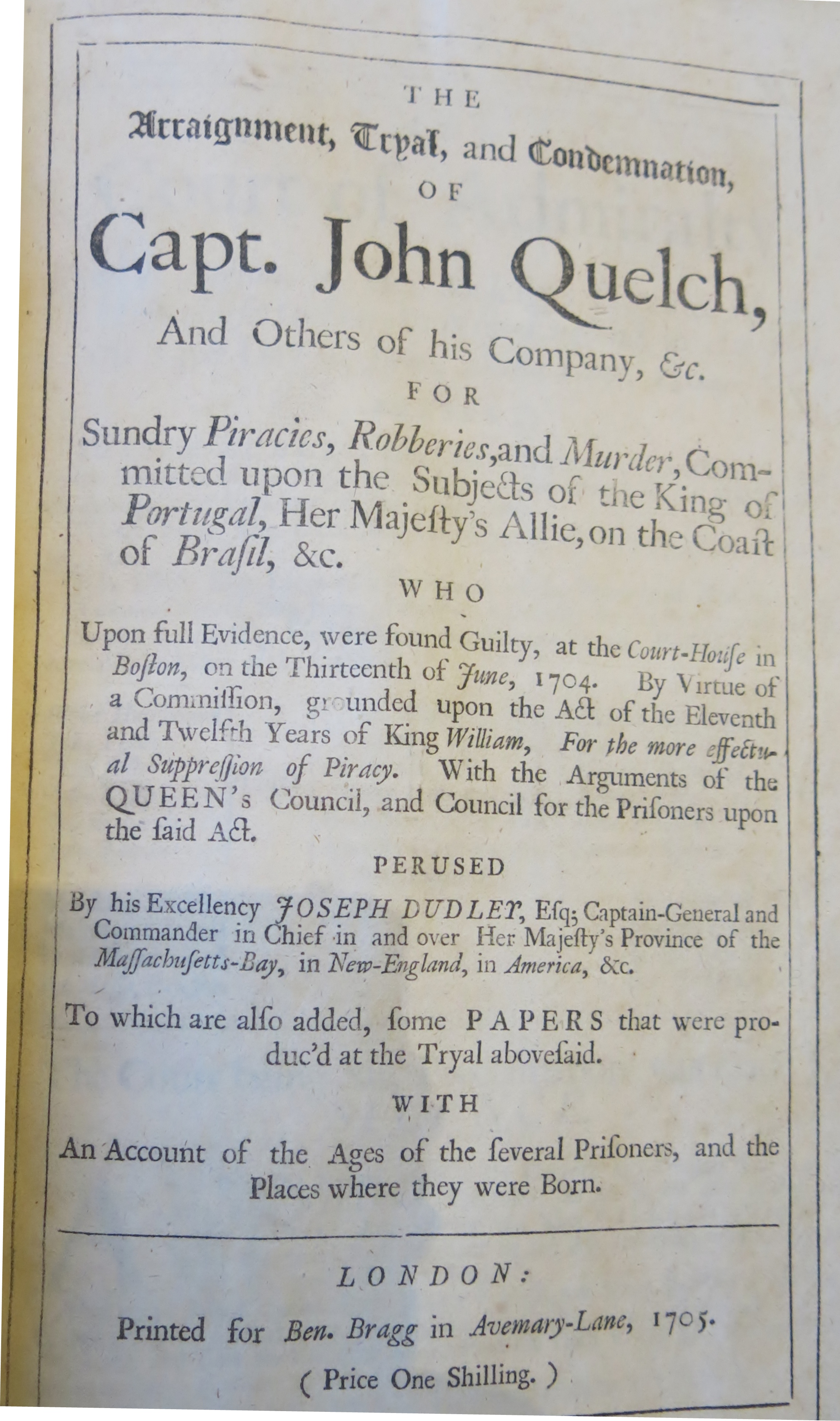
Both Joachim and Jack were involved in another legal proceeding: the 1704 trial of Capt. John Quelch and members of his crew for attacking and capturing Portuguese ships. At the time, Britain and Portugal were allies. The letter of marque that authorized Quelch to attack enemy shipping didn’t apply.

According to this summary of the trial record:
Joachim and Emmanuel were both called upon to testify against Quelch and certain members of his crew. Emmanuel specifically identified Christopher Scudamore as the murderer of his master Bastian, while both men [sic] testified that Quelch and his crew ordered them to claim that they had been Spanish enslaved people rather than Portuguese upon returning to Boston in order to cover up the crimes against Portuguese ships.
It’s notable that both boys testified under Christian names. When being resold the following year, Joachim was called “alias Cuffee,” presumably his original birth name. In contrast, Emmanuel was called “Jack, Alias Emannuel,” so had he taken (or been assigned) a new name in the English colony?

Monday, February 20, 2023

The Power of Specific Names and Details

This month the First Parish in Roxbury published a report by Aabid Allibhai that details the slave-holding by members of its congregation in the colonial period.

I have to admit no surprise at the fact that there were enslavers worshipping in a long-established meetinghouse in a large, prosperous town near Boston in the 1600s and 1700s.

The value of reports like this one (which can be downloaded in P.D.F. form) is bringing personal details out of the records. Here’s one example.

As Wayne Tucker wrote at the Eleven Names Project, in 1916 Great Britain published a volume of its Calendar of State Papers, Colonial Series, covering the years 1706-1708. Its entries summarized the documents and files stored in the Public Records Office. Like indexes and other compilations, such calendars were a valuable way for researchers to know where to look on different topics.

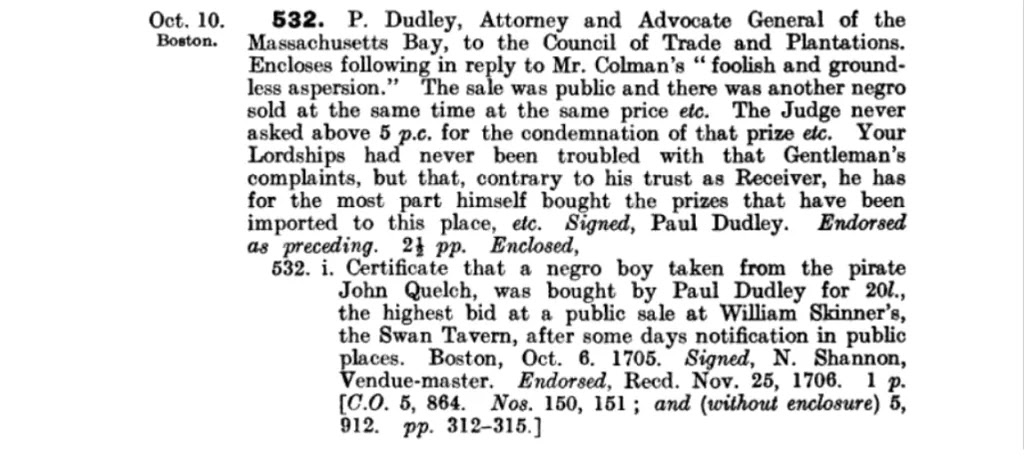
A few of those entries summarized documents in a court dispute involving Massachusetts chief justice Paul Dudley, privateer co-owner John Colman, and an enslaved “negro boy.” See the summary of document 532.i below.

In his report Allibhai reprints a scan of that actual certificate, showing that the child in question was named “Joachim alias Cuffee.”

That name was important enough in 1705 for auctioneer N. Shannon to put it into his certificate. But the archivist summarizing that document two hundred years later didn’t think researchers would want to know the boy’s name. That omission reflected the thinking of that time. He wasn’t an important person in this event, just the object of a dispute.

Simply by naming the enslaved child, Allibhai’s report helps to restore his individual humanity. Furthermore, as Allibhai and Tucker show, knowing the boy’s names makes it possible to find other references to him. He was baptized, presumably changing the African day name “Cuffee” for the Christian name “Joachim.” He was no more than fourteen years old. He testified at the trial of the privateering sailors.

The original certificate describes Joachim’s “Publick Sale by the Candle.” This was a form of auction in which a small burning candle served as a timer, and people had to get their best bids in before the candle went out or melted past a certain spot. Samuel Pepys wrote in his diary on 3 Sept 1662 about such an auction:
pleasant to see how backward men are at first to bid; and yet when the candle is going out, how they bawl and dispute afterwards who bid the most first.

And here I observed one man cunninger than the rest that was sure to bid the last man, and to carry it; and inquiring the reason, he told me that just as the flame goes out the smoke descends, which is a thing I never observed before, and by that he do know the instant when to bid last, which is very pretty.
The modern equivalent of waiting until the last second to enter your eBay bid.

Was Joachim present during that auction, watching that candle? The specifics—of the scene, of the boy’s name—can’t help but make the historical moment more compelling.

TOMORROW: A similar document.