


J. L. BELL is a Massachusetts writer who specializes in (among other things) the start of the American Revolution in and around Boston. He is particularly interested in the experiences of children in 1765-75. He has published scholarly papers and popular articles for both children and adults. He was consultant for an episode of History Detectives, and contributed to a display at Minute Man National Historic Park.

Subscribe thru Follow.it


•••••••••••••••••


Showing posts with label Robert Love. Show all posts

Sunday, November 29, 2020

Why Was Samuel Emmons Called to Testify?

On 28 Nov 1770, the attorneys prosecuting eight soldiers for the Boston Massacre called Samuel Emmons to the witness stand.

According to defense counsel John Adams’s notes on the trial, Emmons’s testimony consisted entirely of:
I dont know any of the Prisoners. Nor anything.
Prosecutor Robert Treat Paine wrote Emmons’s name in his notes and then crossed it out. The published record of the trial, prepared from John Hodgson’s shorthand notes, didn’t mention Emmons at all.

Hiller B. Zobel’s The Boston Massacre quotes Emmons as adding, “I was not in King Street. My brother was.” However, those words don’t appear in the many documents transcribed in The Legal Papers of John Adams, co-edited by Zobel. I don’t see an Emmons brother among the other witnesses.

So why was Samuel Emmons on the witness list?

I think the answer appears in the 1 Jan 1764 Boston News-Letter, where Emmons advertised:
TAR-WATER,
MADE of Genuine Tar, to be sold by Samuel Emmons, Ropemaker, in Milk-Street, nigh the Foot of the Rope-Walks.
Bishop George Berkeley and other authorities promoted water infused with tar as a medicine. Tar was also used in preparing ropes for use on ships, so a ropemaker might well have a supply around. Emmons’s advertisement put him in the part of central Boston where John Gray’s ropewalk stood.

Thus, Emmons was almost certainly a witness to the big brawls between ropemakers and soldiers on 1 and 2 March, one of the events that raised tensions before the Massacre. Three of the soldiers on trial—Mathew Kilroy, William Warren, and John Carroll—were involved in those fights, as was victim Samuel Gray.

It looks like the prosecutors put Samuel Emmons on their list of possible witnesses as part of a plan to make the ropewalk fight a significant part of their case, just as it played a big role in the town’s Short Narrative of the Horrid Massacre. Later on 28 November they called ropemaker Nicholas Feriter to the stand; he described being involved in the fight and seeing Kilroy and Warren on the other side.

In a modern trial, those prosecutors would have learned more about what Samuel Emmons did and didn’t have to say before calling him to the stand. But Samuel Quincy and Paine didn’t have the time and personnel that modern prosecutors command. Who knows what the jury made of his remark?

More about Samuel Emmons appears in Robert Love’s Warnings, by Cornelia H. Dayton and Sharon V. Salinger. In 1753 he married Rachel Love, daughter of town employee Robert Love. They had their children baptized in the West Meetinghouse. In the 1780s Samuel became disabled because of “several touches of the Palsey,” and Rachel supported the family by keeping a small shop with a liquor license.

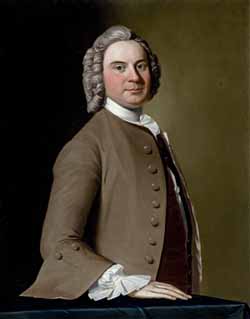
Friday, February 26, 2016

Jerusalem Banned in Boston

I haven’t found any newspaper notices of the model of ancient Jerusalem in Boston the way it was advertised in Philadelphia, New York, Newport, and Providence (as quoted over the past two days).

But we know it was on display at the White Horse Tavern in the South End by 26 Oct 1764 because the merchant John Rowe (shown here) went to view it. And he was not impressed. In his diary he wrote:
Went after dinner to see a Show at the White Horse wh. was a very faint Representation of the City of Jerusalem, in short ’tis a great Imposition on the Publick. I dont Remember to have seen so much Rainfall in so short a time
The phrase “imposition on the public” was a common idiom for a fraud.

Almost two weeks later, on 8 November, the Boston selectmen’s records contain this item:
Complaint having been made to the Selectmen by a number of the Inhabitants, that ——— & his Mother are entertained at Mr. Moultons Tavern at the sign of the White Horse, at which Place he exhibits the City Jerusalem in Wood work whereby he draws considerable sums from the Inhabitants and as upon enquiry the Representation is not esteemed by Judges to be the work of Art & ingenuity, but rather an imposition on the public.

Voted, that Mr. Adams be directed to warn them to leave this Town immediately, and also to acquaint Mr. Moulton that the Selectmen expects he will not suffer any more exhibitions of the same in his House.
Unfortunately, the selectmen didn’t record the name of the exhibitor and his mother, who were apparently traveling around with the model. Maybe town employee Robert Love wrote it down; he made regular stops at the White Horse Tavern asking about new arrivals from Providence, but people who were obviously passing through town may not have caught his attention.

The innkeeper at the White Horse Tavern was Joseph Morton, not Moulton—though this wasn’t the only time his name was misspelled that way. His teenage son Perez would grow up to be a noted and somewhat notorious attorney.

The “Mr. Adams” the selectmen sent to close this exhibit was Abijah Adams, a young men elected Clerk of the Market the previous month. He was chided the following January for “great neglect in the Warning Strangers to depart this Town.”

But let’s look at the selectmen’s own neglect. Even if Rowe had gone to see the model city on the day it opened, the exhibit had drawn “considerable sums from the Inhabitants” for fourteen days before the town fathers acted. This little Jerusalem had spent about three weeks in each of Newport and Providence. If the exhibitors had planned to spend about the same time in Boston, they were through most of their planned run when the selectmen ordered them “to leave this Town immediately.”

Perhaps, as I suspect happened in the case of rope-flyer John Childs, Boston’s selectmen were making a show of shooing something theatrical out of town only after people had had a chance to enjoy it if they chose.

Newspaper ads show that the Jerusalem model traveled back through New York, and on 6 June 1765 it was once again on display in Andrew Angel’s Green Tree Tavern in Philadelphia. “This Curiosity has been seen by a great Number of Gentlemen, Ladies, and others, with great Satisfaction,” the Pennsylvania Gazette advertisement assured readers. The price was one shilling, “but to the poorer Sort, and Children, an Allowance will be made.”

Friday, January 15, 2016

Book Prizes from the A.H.A.

At their meeting earlier this month, the members of the American Historical Association announced the winners of their awards for books, other media, and teaching.

The Littleton-Griswold Prize for book on “the history of U.S. law and society (broadly defined)” went to a book about pre-Revolutionary Boston: Robert Love’s Warnings: Searching for Strangers in Colonial Boston, by Cornelia H. Dayton of the University of Connecticut, Storrs, and Sharon V. Salinger of the University of California, Irvine.

I’ve mentioned this book before, but here’s the publisher’s description:
In colonial America, the system of “warning out” was distinctive to New England, a way for a community to regulate those to whom it would extend welfare. Robert Love’s Warnings animates this nearly forgotten aspect of colonial life, richly detailing the moral and legal basis of the practice and the religious and humanistic vision of those who enforced it.

Historians Cornelia H. Dayton and Sharon V. Salinger follow one otherwise obscure town clerk, Robert Love, as he walked through Boston’s streets to tell sojourners, “in His Majesty’s Name,” that they were warned to depart the town in fourteen days. This declaration meant not that newcomers literally had to leave, but that they could not claim legal settlement or rely on town poor relief. Warned youths and adults could reside, work, marry, or buy a house in the city. If they became needy, their relief was paid for by the province treasurer. Warning thus functioned as a registration system, encouraging the flow of labor and protecting town coffers.

Between 1765 and 1774, Robert Love warned four thousand itinerants, including youthful migrant workers, demobilized British soldiers, recently exiled Acadians, and women following the redcoats who occupied Boston in 1768. Appointed warner at age sixty-eight owing to his unusual capacity for remembering faces, Love kept meticulous records of the sojourners he spoke to, including where they lodged and whether they were lame, ragged, drunk, impudent, homeless, or begging. Through these documents, Dayton and Salinger reconstruct the biographies of travelers, exploring why so many people were on the move throughout the British Atlantic and why they came to Boston. With a fresh interpretation of the role that warning played in Boston’s civic structure and street life, Robert Love’s Warnings reveals the complex legal, social, and political landscape of New England in the decade before the Revolution.
In addition, here are some other prize-winners covering eighteenth-century America.

Freedom’s Mirror: Cuba and Haiti in the Age of Revolution, by Ada Ferrer of New York University, won the Friedrich Katz Prize in Latin American and Caribbean history and the Wesley-Logan Prize in African diaspora history, and shared the James A. Rawley Prize for the integration of Atlantic worlds before the twentieth century.

Final Passages: The Intercolonial Slave Trade of British America, 1619–1807, by Gregory E. O’Malley of the University of California at Santa Cruz, shared the Rawley Prize and won the Morris D. Forkosch Prize in the field of British, British Imperial, or British Commonwealth history since 1485.

The Empire of Necessity: Slavery, Freedom, and Deception in the New World, by Greg Grandin of New York University, shared the Albert J. Beveridge Award on the history of the United States, Latin America, or Canada, from 1492 to the present.

Saturday, November 14, 2015

The Life and Death of David Murray

On 10 Apr 1755, shoemaker David Murray and Mary Fitzgerald married at the New South Meetinghouse, having announced their intention the previous October.

Soon afterward, Boston employee Robert Love visited them at their home on Blowers’s Wharf in the South End, according to Cornelia Hughes Dayton and Sharon H. Salinger in their study Robert Love’s Warnings: Searching for Strangers in Colonial Boston.

Over the next fifteen years the Murrays had children, but David remained a journeyman, never doing well enough at making shoes to open his own shop.

Then, on 12 Aug 1771, the Boston Evening-Post carried this item:
Last Thursday Afternoon [i.e., 8 April] David Murray, a Shoemaker belonging to this Town, was found dead on the Beach near the Neck, an some Marks of Violence appearing on several Parts of his Body, and the Jury of Inquest being of Opinion that his Death was occasioned by some violent Blows, one Willson, a Tobacconist, who had been with him in  a Boat to the Castle, and came off with him from thence the Evening before, was taken up and examined, and telling many contradictory Stories relative to the Affair he was the next Day committed to Goal on a strong Suspicion of being the Means of his untimely End.
The indictment accused Willson of beating Murray to death with his fists. Within a month, Willson was on trial for murder. His attorney: Josiah Quincy, Jr.

TOMORROW: Quincy’s plea to the jury.

Thursday, April 30, 2015

Revolutionary Lectures at the Boston Public Library

As part of its Local and Family History lecture series, the Boston Public Library will host some notable free talks on Revolutionary topics over the next several months.

Wednesday, 6 May, 6:00 P.M.
Robert Love’s Warnings: Searching for Strangers in Colonial Boston
Cornelia Hughes Dayton

In colonial America, warning out was a way for a community to regulate those to whom it would extend welfare. Between 1765 and 1774, an indefatigable town employee named Robert Love warned out four thousand new arrivals, including immigrants, newcomers from rural towns, and demobilized British soldiers. The records he left offer a unique insight into Boston’s population just before the Revolutionary War. Dayton, Associate Professor of History at the University of Connecticut and coauthor with Sharon V. Salinger of the first study of those documents, will discuss why so many people were on the move throughout the British Atlantic and why they came to Boston. In the Abbey Room.

Monday, 1 June, 6:00 P.M.
Boston and the American Revolution
Robert J. Allison

Why did the Revolution begin in Boston? What caused Bostonians to be more rebellious than other British subjects in North America? What were the Revolution’s consequences in Boston and beyond? Allison will examine these questions and discuss the consequences of the Revolution in Boston and beyond. He is chairman of the history department of Suffolk University, teaches at Harvard Extension School, and is vice president of the Colonial Society of Massachusetts. His many books include The Boston Massacre, A Short History of Boston, and The American Revolution: A Concise History. He teaches the online History of Boston course. In the Abbey Room.

Monday, 13 July, 6:00 P.M.
Thursday, 9 July, 6:00 P.M.
Lafayette and the Farewell Tour: Odyssey of an American Idol
Alan R. Hoffman

On the same week as the historic arrival of Lafayette’s frigate Hermione to Boston harbor, Hoffman shares expert insight into the Marquis and his farewell tour of America. Hoffman, the translator of Lafayette in America in 1824 and 1825: A Firsthand Account of Lafayette’s Farewell Tour of America, describes the French nobleman’s reputation and explores its origins. In the Commonwealth Salon. [ADDENDUM: The day after seeing this talk announced, I got a report that the Boston Public Library will be closed on 13 July for lack of electricity, perhaps as part of its renovation. So I wasn’t surprised to learn that Hoffman’s talk is rescheduled.]