J. L. BELL is a Massachusetts writer who specializes in (among other things) the start of the American Revolution in and around Boston. He is particularly interested in the experiences of children in 1765-75. He has published scholarly papers and popular articles for both children and adults. He was consultant for an episode of History Detectives, and contributed to a display at Minute Man National Historic Park.

Subscribe thru Follow.it


•••••••••••••••••


Showing posts with label Abijah Brown. Show all posts

Sunday, May 30, 2021

The Service of Pvt. Amos Harrington
Earlier this month I wrote about Lt. Col. Abijah Brown, and how a Continental Army court-martial in October 1775 found him guilty of “employing Harrington for fourteen days, and Clarke for eighteen days, out of Camp, upon his own business.”

In other words, while those two enlisted men were supposed to be on the siege lines with the rest of Col. Benjamin Ruggles Woodbridge’s regiment, Brown actually had them working on his farm in Waltham.

It was a pleasant surprise to be able to identify one of those men from army records. He was Pvt. Amos Harrington of Waltham. That’s the only man named Harrington in the Woodbridge regiment, and of course his home town matches Lt. Col. Brown’s.

Amos Harrington was born in Waltham on 18 Nov 1755, making him almost twenty years old when he became a legal matter.

On 19 April, he marched with Capt. Abraham Peirce’s Waltham militia company. The alarm reached Waltham late, so its men didn’t engage with the British troops that day, but on orders from regimental colonel Thomas Gardner they “served as guards until Saturday, the fourth day after the fight at Concord.”

As of 30 Sept 1775, Amos Harrington was listed in Capt. Seth Murray’s company in Col. Woodbridge’s regiment, assigned to Prospect Hill. Whether he was actually there or not during the harvest season was another question.

Harrington appears to have gone home at the end of the year, but then he mobilized with his local company from 4 to 8 March 1776. At Gen. George Washington’s request, Massachusetts called up militia troops to support the push onto Dorchester Heights and reinforce the lines against possible counterattack.

On 10 Oct 1779 Amos Harrington married his cousin Esther, and their first son arrived less than six months later. According to Frederick Lewis Weis’s Harrington genealogy quoted at this Find a Grave page, they had ten children in all, three dying in infancy. Esther died in October 1794, several months after giving birth to her last daughter, who survived her.

After that, I lose track of Pvt. Amos Harrington. He never applied for a Revolutionary War pension, suggesting that he died before the law made those available for nearly all veterans.

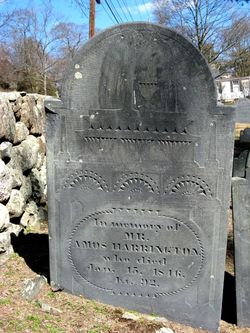
Weis’s genealogy says Harrington died in Weston on 15 Jan 1846. However, Weston vital records make clear that was another man of the same name, born in that town in 1754 and still “single” when he died. He was called up for militia service under Capt. Jonathan Fisk in August 1777, as Gen. John Burgoyne was coming down from Canada. I put his gravestone above.

I’d been hoping the Amos Harrington from Waltham did indeed live into the Polk administration, apply for a pension, and leave some comment about his service under (and work for) Lt. Col. Brown in 1775. But no such luck.

Friday, May 14, 2021

Fifteen Years of Boston 1775

Fifteen years ago today, the first Boston 1775 posting appeared on the web.

(I later went back and added a couple of introductory posts with earlier dates, but the 14 May 2006 entry was the first to hit the web.)

I’d been planning a website for sharing some of the little stories I was finding about Revolutionary New England, and my friend and fellow author Greg Fishbone told me how blogging software could be the platform for such a site.

Then I went to a writers’ conference workshop by another friend and fellow author, Mitali Perkins, and she encouraged everyone to just share their expertise and ideas with the world, focusing on content instead of website architecture. So I found a template and started blogging.

That was fairly early in the blogging wave, which has now passed. A lot of discourse about history, both among academics and the public, has moved to social media and podcasts. Lately the chattering class is excited about Substack. Yet I’ve stuck with a daily blog.

I had no idea what the effects of Boston 1775 would be. It became my bona fides when I didn’t have institutional credentials to point to, and it opened doors for new projects. It also led me into many topics I hadn’t considered exploring. That’s probably why I enjoy writing new essays every day—I keep being drawn into learning new things.

One example is the series earlier this month on Abijah Brown of Waltham. I’d never heard of him before. Those posts grew from my longer-term project on the first months of the Continental artillery regiment, what I hope is the eventual follow-up to The Road to Concord.

A few years back, I noticed a letter from Samuel Adams in which he referred to Scarborough Gridley with the rank of colonel. Since I knew that the Continental Army had cashiered Scar Gridley out of the artillery regiment in the fall of 1775 while he was still only a major, that mistake amused me. Last year I tracked down the letter again and wrote a couple of postings about what Scar was up to.

Researching that episode led me to the petitions that Gridley’s father, Richard, who really was a colonel, sent to the Continental Congress. I didn’t want those documents to go to waste, so I started what I thought would be a short series on them. One of those was about a debt to “Major Brown,” so I took my usual approach and tried to identify who that could be.

All I initially wanted to find was a given name to insert in brackets in the middle of the phrase “Major Brown.” I had no idea that Abijah Brown would turn out to have gotten into so many disputes, received special (disapproving) mention in Gen. George Washington’s general orders, or inspired Massachusetts General Court resolutions. Before I knew it, Lt. Col. Brown had taken over a week.

The freedom to go off on tangents like that is one reason I’ve resisted monetizing Boston 1775 with ads. If I get intrigued by a man like Abijah Brown, I’d rather not worry, even a little bit, about whether he’ll keep the numbers up.

I do have a Ko-fi account for tips, but I don’t push it. I’m trying to figure out whether the Patreon model could work, offering something extra to financial supporters. Ideas are welcome, but I expect to continue chasing rabbits on this site for a while yet.

Saturday, May 08, 2021

“At the time the said Horse and Sulky was furnished”

The challenges of managing Lt. Col. Abijah Brown drew me away from the episode that initially drew my attention to him—Col. Richard Gridley’s 1786 request to the Continental Congress to reimburse him for the cost of a horse killed at Bunker Hill.

Brown had provided Gridley with that horse while they were both working for the Massachusetts Provincial Congress’s army in the spring of 1775. It’s unclear whether it was his horse or one he borrowed from someone else with a promise of compensation.

At the end of the war, Brown asked the Massachusetts government to give him the price of the dead horse. When the state declined, he sued Gridley for that sum, recovering damages in court. Gridley then petitioned the Confederation Congress.

Back on 14 June 1775, the Continental Congress had started the process of taking command of that army besieging Boston. That change became official at the highest level on 2 July when Gen. George Washington arrived in Cambridge and presented his commission to Gen. Artemas Ward.

British artillery fire killed Col. Gridley’s horse on 17 June—after the Congress had voted to assume responsibility for the New England army but before it could actually do so. So what did that mean for reimbursing the colonel?

The Confederation Congress appointed a committee to consider the details. Those officials were:
Those gentlemen reported:
On the above Memorial the Board observe that Colonel Gridley was not an Officer in the Service of the United States, at the time the said Horse and Sulky was furnished by Major Brown.

That by the Application made to the State for payment, it appears that the Person who furnished the said Horse and Sulky did not conceive it a proper charge against the United States.

The Board are therefore of Opinion, that the Claim of the Memorialist cannot be allowed, without establishing a precedent which would subject the General Treasury to a multitude of Claims, with which the Union are not chargeable, and submit to the Judgment of Congress the following Resolve:

That the Claim stated in the Memorial of Colonel Richard Gridley, cannot be admitted as a proper charge against the United States.
I can’t help but think that both levels of government—Massachusetts and the Continental Congress—would have been more generous toward Gridley if they had had any actual funds to spend. Because unquestionably Brown had supplied the horse for military use, and Gridley had lost it in an important battle.

But the mid-1780s was just the wrong time to ask American governments for money.

Friday, May 07, 2021

Commanding Lt. Col. Abijah Brown

As I related yesterday, Lt. Col. Abijah Brown chose not to reenlist in the Continental Army for the year 1776. He remained in Waltham as the army moved south.

But Brown remained active in the Massachusetts militia. As much of a headache as he was to work with, Brown really was committed to the Patriot cause. And he appears to have been capable. Within a couple of years he resumed his work in the Waltham town government as well.

It looks like authorities who had dealt with Brown before might have learned to be really strict with him, to leave him as little wiggle room as possible.

For instance, in late 1776 Brown led some Massachusetts militia troops north to Lake Champlain, but then balked at further orders. On 10 September, Gen. Horatio Gates, who no doubt recalled how Brown had escaped serious punishment a year earlier during the siege of Boston, wrote from Fort Ticonderoga to Lt. Col. Philip Van Cortlandt:
On receipt of this you will immediately order Lieutenant-Colonel Abijah Brown (who is now at Skenesborough) to this post. If he offers to make any hesitation or delay, you will instantly put him under an arrest and send him down under a good guard.
There might be a sad backstory to that conflict. Two days after that letter, Lt. Brown’s teen-aged son, Abijah, Jr., died at Skenesborough (now Whitehall).

In the spring of 1778 Lt. Col. Brown mustered militiamen for another mission to upstate New York. He wrote to the Massachusetts General Court about those troops needing arms. On 9 June the legislature resolved:
On the Petition of Colo. Abijah Brown praying that a number of militia-men mentioned in his petition, who are now on their march to join their regiment at North River, may be supplied with Fire Arms and accoutrements.

Resolved that the Board of War be, and they hereby are directed to deliver to said Colo. Brown twenty-two Fire Arms and accoutrements for the use of said men, he giving security to said Board of War that said Fire Arms and accoutrements shall be returned in good repair at the expiration of their tour of duty; and that there be stopped out of each one’s wages who shall so receive Fire Arms, the sum of ten shillings for the use of the same, unless any one or more shall choose to purchase said Fire Arms and accoutrements, in which case the Board of War are directed to sell to such as choose to purchase and give them a receipt for their payment.
Evidently some people thought that law wasn’t strong and specific enough to ensure the state would be fully repaid. The next day, the General Court resolved:
WHEREAS some doubts have arisen with respect to the Resolve on the Petition of Lieut. Colo. Abijah Brown of the 9th instant, for solving of which it is

Resolved that the Board of War be directed without delay to deliver to Lieut. Colo. Abijah Brown, twenty-two Fire Arms and accoutrements compleat for the use of that number of men belonging to the regiment of militia from this State, commanded by Colo. [Thomas] Poor; and that the Board of War take an obligation of Lieut. Colo. Brown for the return of the arms and accoutrements aforesaid in good order, at the expiration of the term for which said regiment is raised, and also said Brown’s obligation for ten shillings for the use of each Fire Arm and accoutrement delivered as aforesaid, as also to pay the said Board of War for each of the said arms and accoutrements as may be deficient, or that may be purchased by any of the men, such price as they shall determine, and that the Board of War be directed to set the price of said Fire Arms and accoutrements previous to their being delivered out.
Abijah Brown lived to the age of eighty-one, dying in 1818 at the home of a widowed daughter in Lincoln.

TOMORROW: Back to Col. Gridley’s horse.

Thursday, May 06, 2021

The Court Martial of Lt. Col. Abijah Brown

In October 1775, for the second time in a half a year, Patriot authorities met to formally judge the behavior of Waltham’s Lt. Col. Abijah Brown.

The first time was in late May, when a committee of the Massachusetts Provincial Congress assessed reports that Brown was badmouthing that body because he didn’t like the orders he had received.

The second time, the judges were Continental Army officers assembled for a court martial, and Brown faced the charge of “endeavouring to defraud the Continent, in mustering two Soldiers, whom he at the same time employed in working upon his farm.”

That board’s judgement, as reported in Gen. George Washington’s general orders for 7 October, was:

The Court having duly considered the evidence, are of opinion, that Lieut. Col. Brown is not guilty of any fraud, in endeavouring to have Harrington and Clarke muster’d, in the manner he did: But the Court are of opinion, that Col. Brown is guilty of employing Harrington for fourteen days, and Clarke for eighteen days, out of Camp, upon his own business; yet are inclined to think it was done rather thro’ Ignorance, than a fraudulent intent, and therefore adjudge that he be fin’d Four Pounds, lawful money, for the said offence.
Brown appears to have deployed the George Costanza “Was that wrong?” defense. And once again, the official verdict was that Brown had done what he was accused of doing but didn’t deserve serious punishment.

The commander-in-chief felt he had to abide by that verdict, but he made clear that he wasn’t pleased:
The General orders Lt Col. Brown to be released, as soon as he has paid his fine to Dr [Isaac] Foster, Director of the hospital, who will apply it to the use of the sick, in the General hospital, under his care—

The General hopes, the Stigma fixed on Lieut. Colonel Brown by the above sentence, will be a sufficient warning to all Officers, not to be guilty of the like offence, especially as the General is confident, no General Court martial will, for the future, admit a plea of Ignorance, in excuse of so atrocious a crime.
For the adjutant general, Horatio Gates, the outcome of this court martial showed the need for wider reform:
Much regulation is wanted in the Continental Articles of War, as in many Instances they have been found to give too Discretionary a power to the Members who compose Genl Courts Martial, a very Flagrant instance having happen’d lately in the trial of Lieut. Colo. Abijah Brown.
At the time, Washington, Gates, and other commanders were busy reorganizing the Continental Army for the new year and trying to convince men to reenlist. Col. Benjamin Rugggles Woodbridge evidently indicated that he would not return in 1776. But that didn’t open a position in his regiment for Lt. Col. Brown.

Instead, on 3 November a council of war ranked Brown as sixth in seniority among the lieutenant colonels but then assigned him to a regiment under Loammi Baldwin (shown above), still a lieutenant colonel himself but to be commissioned on 1 January as the most junior colonel in the new army.

Brown ultimately declined to reenlist. Gen. Washington and his headquarters staff probably weren’t sad to see him go.

TOMORROW: One more march.

Wednesday, May 05, 2021

Lt. Col. Abijah Brown in the Fight

After Lt. Col. Abijah Brown and his Waltham company reported to the Massachusetts army at Cambridge in late May 1775, there was a question of what regiment they should belong to.

As of 19 April, Brown was a major in Thomas Gardner’s Middlesex County militia regiment. But the militia wasn’t the same as the newly forming, enlisted-through-December Massachusetts army. Gardner already had his top officers: Lt. Col. William Bond and Maj. Michael Jackson. They were officially commissioned on 2 June.

Brown ended up as lieutenant colonel in Col. Benjamin Ruggles Woodbridge’s regiment, drawn otherwise from western Massachusetts and still getting organized. Woodbridge (1739-1819, shown here) was a wealthy bachelor physician from South Hadley. He needed companies to fill an entire regiment and justify his rank as colonel, and Brown needed a regiment where he could be lieutenant colonel.

It took until 21 June before the committee of safety thought Woodbridge’s eight companies were ready for a commission. As of 29 July Gen. George Washington still deemed that regiment to be among the four “most deficient” in the Continental Army.

Brown was officially listed as joining Woodbridge’s regiment on 17 June. That became an issue months later when he came to collect his pay. According to the Continental Army records, he had worked only six and a half months in 1775, but Massachusetts records show the committee of safety had set him to work a month earlier than that, and he probably showed up in Cambridge on 21 May.

Brown pressed his case to the Massachusetts General Court, which on 31 Aug 1776 resolved:
That there be paid out of the publick Treasury to Colonel Abijah Brown, nine pounds, for twenty seven days’ service as Lieutenant-Colonel in Colonel Woodbridge’s Regiment, it appearing he was made up in the muster-roll of said Regiment so much short of the time he was in cervice.
This is an example of Brown’s persistence in seeking what he wanted.

Though not yet official, Woodbridge’s regiment fought in the Battle of Bunker Hill on 17 June. As it crossed the peninsula into Charlestown, the companies split up and rushed forward to different parts of the line. There are few sources about what Woodbridge’s men did on that day, but they were definitely in the fight.

At the end of September, Col. Woodbridge’s regiment was stationed “at west side of Prospect Hill on the road leading from Charlestown River to Monotomy.”

How well was Lt. Col. Brown getting along with his regimental commander? Gen. Washington’s general orders for 29 Sept 1775 include this item:
A Court of enquiry to sit this afternoon at three ’OClock to examine into the Complaint of Lt Col. Abijah Brown of the 25th Regt against Col. Ruggles Woodbridge—Col. [John] Glover president, Col. [Ebenezer] Bridge, Major [Daniel] Wood, Major [William Raymond] Lee and Major [John] Durgee [Durkee], members.
Unfortunately, that record doesn’t say what Brown’s “Complaint” was. Since Col. Woodbridge remained in the army for the rest of the year, even sitting on other court-martial boards, the court appears to have ruled in his favor.

That proceeding was followed by another reported on 7 October:
Lieut. Col. Abijah Brown tried at a late General Court martial, whereof Col. [Daniel] Hitchcock was presdt—for “endeavouring to defraud the Continent, in mustering two Soldiers, whom he at the same time employed in working upon his farm
TOMORROW: The verdict, and the generals’ opinion of the verdict.

Tuesday, May 04, 2021

“The secret resentment of designing persons”

In late May 1775, the Massachusetts committee of safety received a message from Abijah Brown of Waltham reporting that he had delivered three cannon to Watertown as ordered, and that he was their “most obedient and most humble servant.”

But the committee also received a report co-signed by five Waltham selectmen that Brown was bad-mouthing them and Gen. Artemas Ward as the equivalent to “a set of idiots and lunaticks.”

Perhaps even more disturbing, Brown was reportedly saying things like:
that the [Massachusetts Provincial] Congress had no power to do as they did; for all the power was and would be in the Army; and if the Congress behaved as they did, that within forty-eight hours the Army would turn upon the Congress, and they would settle matters as they pleased; that there would be nothing done but what would be done by the Army
Notably, Brown lumped Gen. Ward in with “the Congress” instead of “the Army.” It would be interesting to know what he might have meant by this rant—was he pining nostalgically for the situation only a few months earlier, when locally appointed town committees and militia companies were organizing rebellion with no provincial authority telling them what to do? Or did he just want to keep those three cannon? 

The committee of safety, with Benjamin White of Brookline in the chair, decided that “any determination on this case is out of the department of this committee” and passed it up to the whole congress. They added a wish “that you may be furnished with such light as may enable you to determine thereon as to you in your wisdom.” So good luck, gentlemen.

The lead signatory of the report, Jonas Dix, was himself a member of the provincial congress. Earlier in the year, Brown had led an effort to disqualify him from that post. Presumably he was happy to share all that he had heard back in Waltham.

The legislature appointed a committee led by Dr. Richard Perkins of Bridgewater to consider the matter. On 27 May he reported back. Notably, he addressed the “complaint against lieutenant colonel Brown.” The Waltham warning had referred to “Abijah Brown, who calls himself Lieutenant-Colonel,” casting doubt on his rank. So by using that title the committee recognized Brown as a high-ranking officer in the state army.

Dr. Perkins said:
That after a full hearing of the allegations and proofs for and against said Brown on the complaint of some unknown person through the selectmen of Waltham to this honorable Congress we are of the sentiment that an unhappy controversy has existed in said town relating to public affairs in which said Brown had exerted himself very earnestly in favor of the cause of liberty by which means he had disgusted several persons who have since endeavored therefor to censure and stigmatize him as being an officious busy designing man

and unhappily it appears that Mr Brown has associated in taverns indiscriminately with many persons in discourse with whom he at some times had inadvertently expressed himself which he would not strictly justify himself in

And that it is evident those disaffected antagonists of Mr Brown’s had taken the advantage of his halting purely from revenge and the committee adjudge from the whole of the evidence for and against said Brown that he is injuriously treated by the secret resentment of designing persons and that he ought to be reinstated to the esteem and countenance of every friend to the liberties of this country
The official ruling, in sum, was that some of Lt. Col. Brown’s neighbors (Dix?) were out to get him—and that he had helped them along by running off at his mouth. Would that scare be enough to make him toe the line in future?

TOMORROW: Of course not.

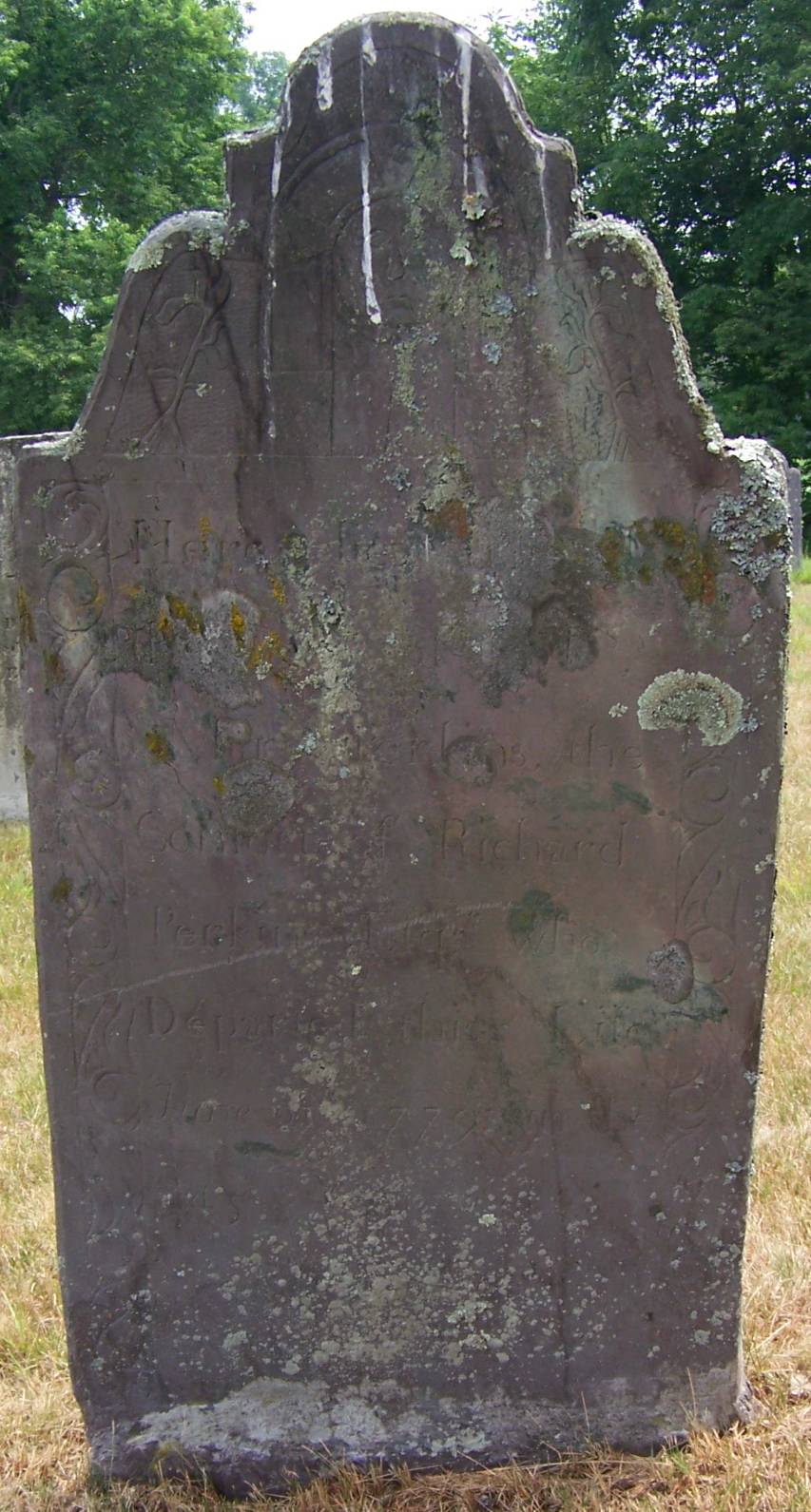
(I couldn’t find Dr. Richard Perkins’s gravestone to stand in for a portrait, so the stone above is for his wife Mary [1735-1779]. She was John Hancock’s older sister. Richard and Mary were also stepsiblings, his widowed father having married her widowed mother.)

Monday, May 03, 2021

“Representing the General and Committees as a set of idiots”

As I related yesterday, in April 1775 the Massachusetts Provincial Congress’s committee of safety ordered Abijah Brown of Waltham to prepare three cannon for use.

Then, about three weeks later, the congress ordered him to deliver those three guns to Watertown.

That wasn’t the congress’s first dealing with Brown. Back in February, the rebel legislature had to consider “A petition of Abijah Browne and others, setting forth the irregularity of the choice of Jonas Dix, Esq., to represent the town of Waltham in this Congress.”

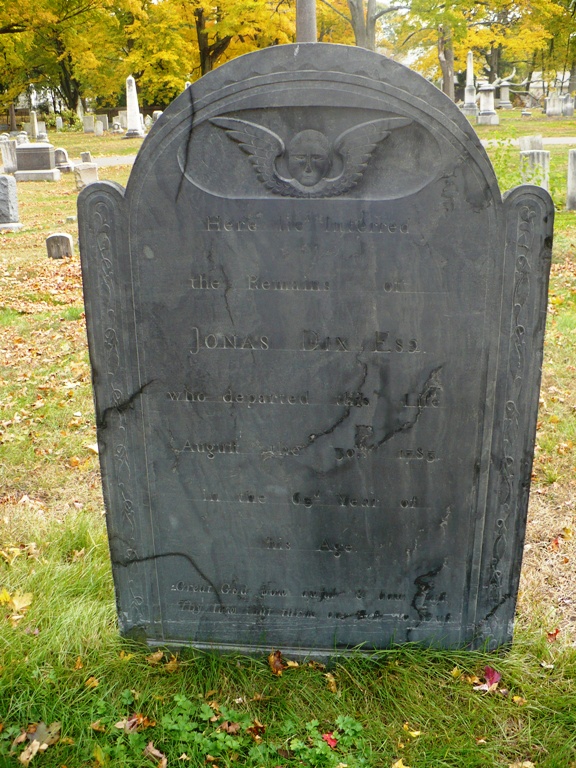
Other Waltham men led by Leonard Williams sent a petition supporting Dix (1721-1783, gravestone shown above courtesy of Find a Grave). Obviously, there was some sort of argument going on in Waltham. It might even have been over politics.

The congress decided to stay out of it. It decided that even if the first petition’s complaints were all true, they were “not sufficient to disqualify Jonas Dix.” So he remained in his seat, in power, with a (further?) reason to dislike Abijah Brown.

Those circumstances set the stage for another message to the congress, printed in Force’s American Archives, that followed the orders to Brown to hand over the cannon:
Whereas a number of the inhabitants in and about Waltham, in the County of Middlesex and Province aforesaid, having a deep sense of their obligations to the Honourable Committee for their services, upon information given, look upon themselves in duty bound, to represent to them in this publick manner, the repeated and publick insults and abuses that the Honourable Committee and Congress are from day to day treated with by one Abijah Brown, who calls himself Lieutenant-Colonel, who, from time to time, and in different company, in the most publick manner upon the road, and in publick houses, where company of strangers or town’s people are on any occasion assembled, taking such opportunity to declare, though in such profane language that we must be excused from repeating, viz: that the Congress had no power to do as they did; for all the power was and would be in the Army; and if the Congress behaved as they did, that within forty-eight hours the Army would turn upon the Congress, and they would settle matters as they pleased; that there would be nothing done but what would be done by the Army; and with respect to the General [Artemas Ward] and Committee, that they had no more right or power to give their orders to remove the cannon and stores from Waltham, than one John Stewart, who is a poor unhappy man, that is non compos mentis; hereby representing the General and Committees as a set of idiots and lunaticks, in order to lessen and bring into contempt the power and authority of the Province, at this very important day.

This conduct from one assuming rank in the Army, in and about Head-Quarters where the Army is, and his reasons for such conduct, we leave every one to judge for himself, &c.

We therefore would bumbly pray that your Honours would be pleased to take into your consideration this very dangerous matter, before it is too late, and before the seeds of discord and mutiny have taken too deep root, and take such steps to put an end to it, as well as to him, with regard to his being any way concerned in the Army, as your Honours in your wisdom shall see fit.

Abner Sanders, John Sanders, Jedediah White, Peter Ball, Eleazer Bradshaw, &c., of Waltham, and Captain Abijah Child, now in the Army, stand ready, upon any day ihat your Honours may appoint, to appear and give your Honours the fullest proofs of what is here set forth, though this is but in part.

Jonas Dix,
Nath’l Bridge,
Josiah Brown,
John Clark,
Selectmen of Waltham.
Abijah Brown was clearly upset about being ordered by the Massachusetts army command to hand over the cannon he had been working on.

And Jonas Dix was clearly thinking Brown shouldn’t be in the Massachusetts army at all, especially at a lieutenant colonel’s rank.

TOMORROW: The congress plays referee.

Sunday, May 02, 2021

How Maj. Abijah Brown Went to War

Abijah Brown was born in Watertown in 1736, and on 24 May 1758, at the age of twenty-one, he married Sarah Stearns of Waltham.

Their first child, Abijah, Jr., was born in Watertown the following March. By the next year they had moved to Waltham, where Sarah gave birth to:
  • Edward (1760)
  • Anna (1763)
  • Elizabeth (1765)
  • Jonathan (1767)
  • Abner (1769)
Abijah Brown became involved in town politics as a selectman and meeting moderator. He served on committees to respond to the Boston committee of correspondence, draft instructions for the town’s legislators, and attend the Middlesex Convention of late August 1774.

Brown was also active in the town militia company, rising to captain in 1773 and major at the start of the war. According to Henry Bond’s Family Memorials (1855), he was “one of the first to ascertain the proposed march of the British upon Concord and was active in giving the alarm.” I’m not sure what that means because most histories say that Waltham never got word about the British march on 19 April and had to catch up to its neighbors.

Contemporaneous evidence leaves no doubt that Brown was militarily active in the first weeks of the war. On 28 April the Massachusetts committee of safety declared “Major Brown appointed to give such repairs to the cannon at Waltham, as may be judged proper.” Three days before the committee had ordered that “three Cannon now at Marlborough, be brought to the Town of Waltham, and mounted on carriages prepared for them, till further orders.” 

In this period Maj. Brown probably supplied Col. Richard Gridley, the commander of the artillery regiment, with a horse and sulky so he could move around the siege lines as quickly as possible, overseeing fortifications and gun emplacements.

On 17 May the committee of safety issued new orders:
That the three pieces of cannon, with the stores, now at Waltham, be immediately removed to Watertown, near the bridge, by the advice of the general [Artemas Ward], and that Mr. Elbridge Gerry, one of the Committee of Supplies, be desired and empowered to remove the same.
Where did that leave Maj. Brown? On 19 May he wrote back to the committee:
Agreeable to your order I have removed the cannon under my care at Waltham, to the Town of Watertown, and have delivered them to the Committee of Correspondence for the same Town; and shall have my company in readiness to march to Cambridge to-morrow morning.

I am, gentlemen, with much respect, your most obedient and most humble servant…
TOMORROW: But was he? Was he really?

Saturday, May 01, 2021

“The Horse so furnished was Killed at the Battle”

Yesterday I discussed Richard Gridley’s petitions to the post-war Continental Congress to keep compensating him for the loss of his Crown pension from the previous wars.

Both Gridley and the Congress were caught in the 1780s economy, when there was a postwar depression and both Continental and state notes had lost value.

Here’s an extract from the Congress’s records on 24 July 1786, shedding light not only on the retired colonel’s financial straits but also the Battle of Bunker Hill, where he was wounded.

Samuel Osgood, Walter Livingston, and Arthur Lee were tasked with assessing a “Memorial of Richard Gridley of the State of Massachusets” asking to be paid for a very particular reason:
the Memorialist states, that in the month of May, 1775, being then acting under a Commission of the State of Massachusets, as Colonel of a Regiment of Artillery, he was furnished with a Horse and Sulky, for the purpose of conveying himself and his Surveying Instruments, to such Places as the Public Service should require, by Major Brown who was employed to provide the Army with such Articles as they might want.

That the Horse so furnished was Killed at the Battle of Bunker’s Hill, and the Sulky (being kept in the Public Service ’till the Year 1780) rendered altogether useless.

That Major Browne having applied to the State of Massachusets for the payment of the said Horse and Sulky, was refused payment, and that in consequence he commenced a Suit against the Memorialist and has recovered Judgment for Fifty Pounds Lawful Money of Massachusets, which Sum he has been obliged to Pay.
I knew identifying “Major Brown” would be a challenge because that surname was so common and men’s ranks changed quickly between 1774 and 1776. Plus, Gridley’s 1986 petition might have referred to the man by a rank he attained later than the moment he discussed.

In the end, I’m guessing that “Major Brown” was Abijah Brown (1736-1818) of Waltham, who did have the rank of major in early 1775 before becoming a lieutenant colonel that fall.

I have two reasons for pointing to that Abijah Brown out of the crowd of Browns (and indeed the smaller crowd of Abijah Browns) in Massachusetts in 1775. First, the Massachusetts Provincial Congress did ask Maj. Brown of Waltham to work on supplies for Gridley’s artillery regiment. Second, Abijah Brown was a cranky, pushy man who seems like just the sort to sue a septuagenarian over a horse killed in battle eleven years earlier.

TOMORROW: Meeting Maj. Brown.