J. L. BELL is a Massachusetts writer who specializes in (among other things) the start of the American Revolution in and around Boston. He is particularly interested in the experiences of children in 1765-75. He has published scholarly papers and popular articles for both children and adults. He was consultant for an episode of History Detectives, and contributed to a display at Minute Man National Historic Park.

Subscribe thru Follow.it


•••••••••••••••••


Showing posts with label Middleboro. Show all posts

Saturday, November 12, 2022

Seeking John Morey in Roxbury
There were two generations of men named John Morey (also spelled Mory) in Roxbury.

The first John Morey was born in 1687 and married a woman named Hannah. They had several children, including a baby named John in 1736 who died early and another named John born on 23 Jan 1738. The couple’s daughters married into the Pierpoint and Turrell families.

This John Morey became prominent and wealthy. In 1734 he served as one of the two coroners of Suffolk County. As of 1741, he was using the suffix “Esq.” in a newspaper advertisement. In 1745 and 1753, Morey took in poor teenagers under indenture from the Boston Overseers of the Poor.

Morey also owned enslaved people. According to Hannah Mather Crocker, he was the owner of a mason named John Marcy, whom he hired out for jobs in Boston. Marcy was evangelized by hearing the Rev. George Whitefield, joined the Rev. John Moorhead’s church, married an enslaved servant of Lt. Gov. William Dummer, and eventually gained his freedom.

That John Morey died in 1771. He left an estate valued at almost £3,400. It included a large farm and lots of livestock, but also an eight-day clock, a map of the city of London, and five books—more luxury goods than an ordinary farmer had. He was labeled a “Gentleman” in his son’s newspaper advertisement settling the estate.

Also on that 1771 estate inventory were:
  • …a Nego [sic] Boy Named Cato about 12 Years Old…[valued at £]32.0.0
  • …a Negro Garl About 11 Years Old…26.13.4
  • …Ditto Named Bino About 7 Years Old…16.0.0
  • …Ditto Named Zippra an Inferm garl…6.0.0
It looks like the clock went to the West Roxbury meetinghouse. At least, the publication of an 1853 sermon referred to the meetinghouse having that clock with Morey’s name as donor on it. The church also received a silver baptismal basin in 1774; I’m guessing that was given by the younger John Morey but at the behest of his father.

Back in 1768, that second-generation John Morey had turned thirty and married Mary Cheney, born in 1743. The following year, that couple had their first baby, a son they naturally named John. He was followed by Hannah in 1771, Ebenezer Cheaney in 1774, and Susannah in 1776.

Mary’s father was Ebenezer Cheney (1699–1780) of Roxbury. His will left her considerable real estate in Middleborough. The couple prepared to move south. On 2 Oct 1783 John Morey advertised in the Independent Chronicle to sell “A very valuable Farm in Roxbury…containing one hundred and fifty Acres,” plus “Salt Marsh” and “near twenty Acres of good Wood Land.” Interested parties could speak with Morey or three of his neighbors, one being Eleazer Weld, Esq. Morey also called in his debts.

In March and April 1785, four Boston newspapers ran identically worded advertisements announcing the sale “By Publick Vendue [i.e., auction], on the premises, the Monday the 25th day of April next, The valuable FARM of Mr. John Morey, lying in Roxbury.” Reflecting the postwar economic situation, this ad said:
N.B. The payment will be made easy to purchasers, as the whole sum will not be immediately wanted, and government securities will be taken at their common rate of discount.
This time people could inquire of Weld and two other neighbors, but Morey was no longer said to be living on the property.

The facts of John Morey’s life shed a little light on the sale/indenture of the boy named Dick Morey in July 1785, discussed yesterday. For one thing, Morey was leaving that child behind in Roxbury as he moved to a new farm in Middleborough. David Stoddard Greenough paid him £5 for Dick’s next sixteen years, less than the value of a seven-year-old girl for life back in 1771. 

More ominously, it looks like that enslaved girl named Bino whom Morey inherited in 1771 was probably the mother he called “my Negro servant Binah” in 1785. She had given birth around 1780 when she was about sixteen years old. We don’t know who the father was, but he was white since Bino was listed as “a Negro Garl” and her son as “a Molatto Boy.” The list of possible fathers has to start with John Morey himself.

Finally, the Eleazer Weld who helped in selling the Morey farm was also one of the magistrates who affirmed Dick Morey’s indenture in 1787.

John Morey died in Middleborough in 1800, his widow Mary in 1821.

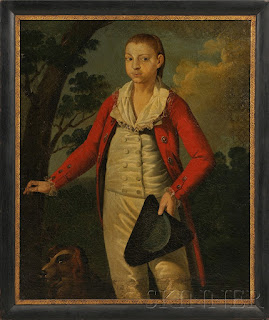
David S. Greenough and his wife Anna had a son (shown above) in the Loring Greenough House in 1787. Anna also had one surviving child from her first marriage. Those boys presumably grew up with Dick Morey as a household servant or farm hand in between their ages but not in their class.

However, I haven’t found any record of Dick Morey past those two documents from 1785–1787.

Thursday, July 11, 2019

Deborah Sampson’s First Masquerade

The Museum of the American Revolution in Philadelphia announced a new acquisition with this article in the New York Times.

The news hook is Deborah Sampson, the young woman from Middleboro who served in the Continental Army under the name of Robert Shurtliff. Alison Leigh Cowan’s article says:
Did she fight in the decisive Battle of Yorktown, as she later insisted on multiple occasions? And how did she keep her secret for the many months she served in Washington’s light infantry?

Now, scholars say the discovery of a long-forgotten diary, recorded more than 200 years ago by a Massachusetts neighbor of Sampson, is addressing some of the questions and sharpening our understanding of one of the few women to take on a combat role during the Revolution. . . .

The diary, written by Abner Weston, suggests Sampson likely did not fight at Yorktown as she claimed. He dates Sampson’s botched enlistment to a period around January 1782, months after the British thrashing at Yorktown. . . .

The…diary that just resurfaced is a hand-stitched, 68-page account of the period between March 28, 1781 and August 16, 1782, which Weston updated while back home in Middleborough, Mass., where Sampson also lived.

In an entry for Jan. 23, 1782, Weston, then 21, wrote with variant spelling about an “uncommon affair” that rocked the town. A woman, posing as a man, had tried to enlist.

“Their hapend a uncommon affair at this time,” he wrote, “for Deborah Samson of this town dress her self in men’s cloths and hired her self to Israel Wood to go into the three years Servis. But being found out returnd the hire and paid the Damages.”
There’s indeed some new information there, but Sampson’s enlistment after Yorktown hasn’t been in doubt. Alfred Young’s biography Masquerade: The Life and Times of Deborah Sampson, Continental Soldier (2004) firmly sets Sampson’s enlistment in the spring of 1782 based on Continental Army records.

Masquerade also discusses Sampson’s earlier abortive enlistment based on a local minister’s account and town lore collected generations later by John Adams Vinton. A young recruit named Timothy Thayer didn’t show up for duty, prompting inquiries which revealed that Thayer was actually Sampson.

Abner Weston’s diary entry provides an additional source for that episode. It suggests Israel Wood was not the local army recruiter, as Al Young guessed, but someone trying to hire a substitute so he wouldn’t have to serve himself.

Sampson hid this moment from her biographer, so we have no record of what she was thinking. Was she just hoping to collect the recruitment money and vanish with it back into women’s clothing? Or was she planning to march off as a young man, but something got in the way? Either way, a few months later Sampson once again put on male clothing, went to another town where they didn’t know her, and began her documented army service as Robert Shurtliff.

Wednesday, May 16, 2018

Hunter on Dighton Rock in Middleboro, 19 May

On Saturday, 19 May, the Massachusetts Archaeological Society will host a special lecture by Douglas Hunter on “The Place of Stone: Dighton Rock and the Erasure of America’s Indigenous Past.”

Drawing on his book of the same name, Dr. Hunter will discuss the legacy and mythology behind a petroglyph-covered boulder found in the area that became Berkley:

First noticed by colonists in 1680, Dighton Rock in Massachusetts by the nineteenth century was one of the most famous and contested artifacts of American antiquity. This forty-ton boulder covered in petroglyphs has been the subject of endless speculation that defies its Native American origins. Hunter dissects almost four centuries of Dighton Rock’s misinterpretation, to reveal its larger role in colonization and the conceptualization of Indigenous peoples.
Among the many New England scholars who studied the rock was the Rev. Dr. Ezra Stiles. In 1766, while living in Newport, Rhode Island, he saw a copy of a broadside about the boulder written by the Rev. Dr. Cotton Mather. (Other men who had written about the rock included Prof. John Winthrop of Harvard and Dr. William Douglass, best known for opposing smallpox inoculation and Mather’s other ideas.)

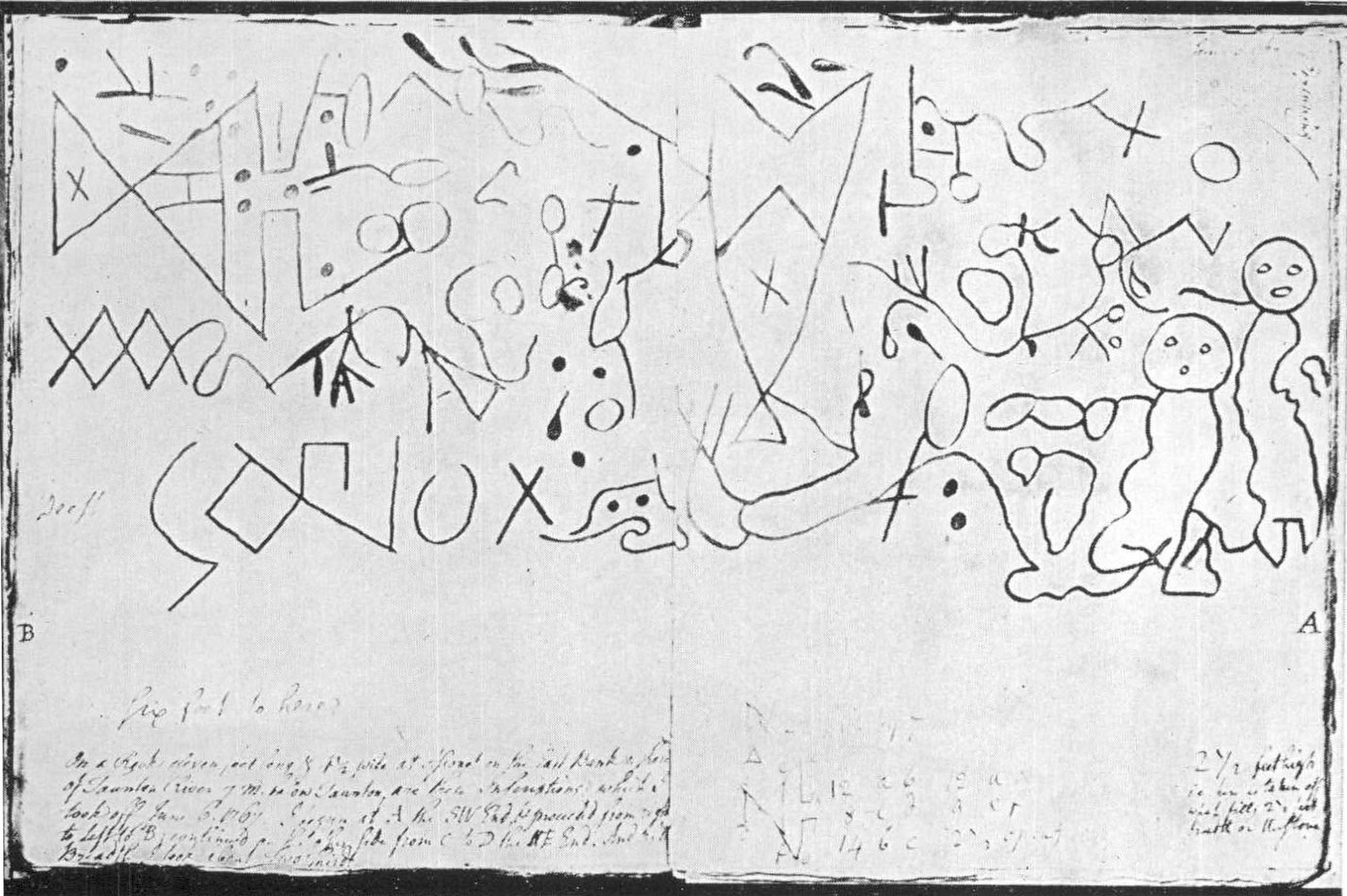
In June 1767 Stiles went to visit a man who lived half a mile from the rock. He used chalk to make the markings more distinct and then drew them in his journal, stating on 6 June: “Spent the forenoon in Decyphering about Two Thirds the Inscription, which I take to be in phoenician Letters & 3000 years old.”

Stiles returned in July for more investigation. He “washed & skrubbed the Rock with a Broom,” fighting the water level, before drawing more surfaces. The next month, two local men did the minister the favor of going out and collecting more drawings, measurements, and even what seems to be a casting of the scrapes in “the Phœnitian rock.”

Here’s one of Stiles’s drawings, courtesy of the Colonial Society of Massachusetts.
In 1768 the Swiss artist Pierre Eugène du Simitière visited Stiles on his way to settle in Philadelphia. He studied the material that the minister had collected. He looked at the characters on Mather’s broadside and and observed, “They are also totally different from the copy taken by Dr. Stiles.” Indeed, most or all of those researchers were seeing what they wanted to see.

Hunter’s talk about this history and what it shows about colonial New Englanders’ attitude toward the Natives around them will take place at the Robbins Museum of Archaeology, 17 Jackson Street in Middleboro, starting at 1:00 P.M. The program is free, but the society suggests a donation of $5 per person.

Sunday, February 03, 2013

More Upcoming History Seminars

Last week I noted an upcoming session in the Boston Early American History Seminar. The Massachusetts Historical Society sponsors other seminar series that sometimes touch on the period and issues of the American Revolution.

On Thursday, 7 February, at 5:30 P.M. in the series on the History of Women and Gender Jennifer Morgan of New York University will present “Partus Sequitur Ventrem: Slave Law and the History of Women in Slavery.” Linda Heywood of Boston University will comment on the paper, and then the discussion will be open to all attendees.

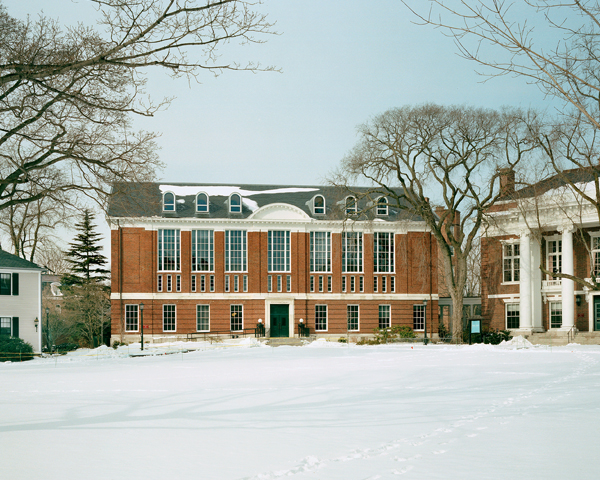
This conversation will take place at the Schlesinger Library of the Radcliffe Institute for Advanced Study in Cambridge (shown above, courtesy of renovation architects Venturi, Scott Brown and Associates). Morgan’s essay is circulated in advance to subscribers and will be available on paper at the meeting. Afterwards there will be a light buffet supper. To reserve a space, email the M.H.S. seminars office.

The Boston Environmental History Seminar will meet at the M.H.S. on Boylston Street on Tuesday, 12 February, at 5:15 P.M. Ben Cronin of the University of Michigan will share his paper “‘To clear the herring brook’: Fluvial Control, Common Rights, and Commercial Development in Plymouth County, Massachusetts, 1660-1860.” William F. Hanna III, author of A History of Taunton, Massachusetts, will comment. This paper is described as follows:
By examining towns of Plymouth County, particularly Pembroke and Middleboro, this project shows how political, economic, and at times military power flowed from effective control of the waterways. The shift in what might be called “water regimes” was a crucial location of what Charles Sellers has called the Market Revolution.
Again, the society asks people to email the M.H.S. seminars office to reserve a space so they know how many are coming.

Finally, on Tuesday, 19 February, at 5:15 P.M., the Early American History Seminar has rescheduled a session with Daniel R. Mandell of Truman State University on his paper “Revolutionary Ideologies and Wartime Economic Regulation.” Brendan McConville of Boston University will comment, which should ensure a lively conversation. Again, email the M.H.S. seminars office to reserve a seat at the seminar and supper table.