J. L. BELL is a Massachusetts writer who specializes in (among other things) the start of the American Revolution in and around Boston. He is particularly interested in the experiences of children in 1765-75. He has published scholarly papers and popular articles for both children and adults. He was consultant for an episode of History Detectives, and contributed to a display at Minute Man National Historic Park.

Subscribe thru Follow.it


•••••••••••••••••


Showing posts with label James Bowdoin. Show all posts

Saturday, July 18, 2026

“To hear the proclamation for independance read and proclamed”
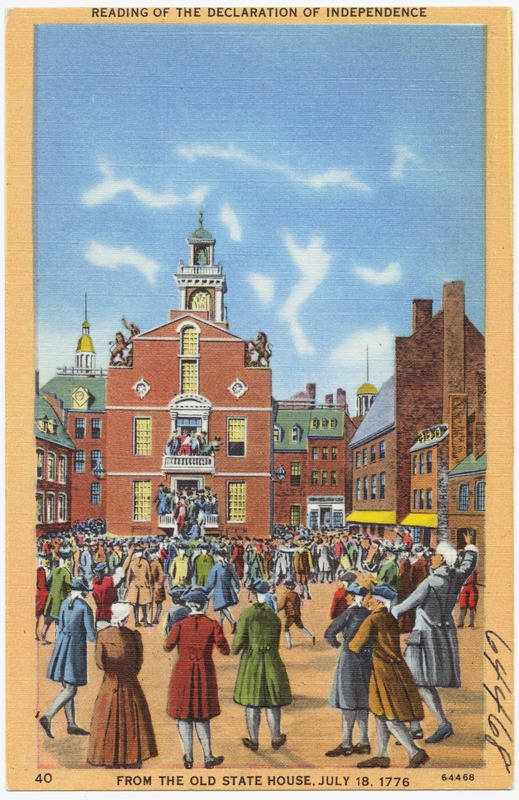
On 18 July 1776, 250 years ago today, the Declaration of Independence was officially proclaimed in Massachusetts.

People had already heard about the Continental Congress’s vote, and many had probably read the Declaration in newspapers. But this was a governmental ceremony. It happened in two places, and on two levels.

With no governor, the highest executive authority in Massachusetts was the Council. Most of its members were meeting in the Edmund Fowle house in Watertown.

Therefore, one part of the official reading was performed by Council secretary Perez Morton, reading the Declaration to the Council and to a crowd gathered outside. Also present were delegates from the Mi’kmaq and St. John’s/Maliseet communities, ready to sign a treaty of friendship with this new United States.

In Boston, there was a parallel, larger ceremony. Inside the Council’s chamber in what was now the State House, Suffolk County sheriff William Greenleaf read the Declaration to some Council members and other officials.

Col. Thomas Crafts of the Massachusetts artillery regiment, who had a bellowing voice, then “deaconed” or repeated the text phrase by phrase from the balcony of the Council chamber to the crowd gathered on the street below.

Thus, most Bostonians at the event heard Col. Crafts’s reading, but the official proclamation in Boston came from Sheriff Greenleaf. The ceremony was meant for both government officials and the “people out of doors.”

On 21 July, Abigail Adams reported to her husband:
Last Thursday after hearing a very Good Sermon I went with the Multitude into Kings Street to hear the proclamation for independance read and proclamed. Some Field peices with the Train were brought there, the troops appeard under Arms and all the inhabitants assembled there (the small pox prevented many thousand from the Country).

When Col. Crafts read from the Belcona of the State House the Proclamation, great attention was given to every word. As soon as he ended, the cry from the Belcona, was God Save our American States and then 3 cheers which rended the air, the Bells rang, the privateers fired, the forts and Batteries, the cannon were discharged, the platoons followed and every face appeard joyfull.

Mr. [James] Bowdoin [a senior member of the Council] then gave a Sentiment, Stability and perpetuity to American independance.

After dinner the kings arms were taken down from the State House and every vestage of him from every place in which it appeard and burnt in King Street. Thus ends royall Authority in this State, and all the people shall say Amen.
Not everyone was entirely pleased. Merchant John Rowe characterized the celebration as “a Great Confusion in Town.”

Pulling the royal emblems of the lion and unicorn down from the State House roof was probably inspired by reports of New Yorkers toppling the statue of King George III after that city’s reading of the Declaration on 9 July. But the street was still called King Street until 1784.

Thursday, December 12, 2024

“You found the money and Sam Adams the brains”

For the first years of the Revolutionary War, Massachusetts continued to operate on the basis of its provincial charter.

The General Court was elected each year, starting in the summer of 1775, when it took over from the Provincial Congress. Its members chose a Council.

That Council exercised executive power, as the charter had specified for times when the royally-appointed governor and lieutenant governor were absent from the province. Which they were, for obvious reasons.

It took years, and two tries, before the towns of Massachusetts ratified a new constitution in 1780. That provided for a governor again—to be elected by the people rather than appointed.

On 19 October, the Rev. William Gordon of Roxbury wrote to John Adams, then on a diplomatic mission in Europe, about that choice:
Mr. [John] Hancock will be governour, unless Death should prevent it. I was employed by a Boston representative under the rose, to plead with Mr. [James] Bowdoin that pro bono publico [for the good of the public] he would condescend to serve as Lt. Govr.: I urged that plea, and encourage the expectation from his not declaring off, that, if the Genl. Ct. are pritty well agreed, he will not decline. He will be a good poize, and prevent undue influence and eccentric motions.

Some time back several persons dined together with the above mentioned, the conversation turned upon old matters, a country booby of a representative said, “ay I remember we used to say that you found the money and Sam Adams the brains.” A pause commenced for some minutes before the conversation was renewed. The poor mortal, upon being afterwards spoken to upon the impropriety of his remark, apologized by pleading, it was the truth and he thought there could be no hurt in speaking it.
This was during a rift between Hancock and Samuel Adams, with Gordon on Adams’s side and relishing anecdotes that made Hancock look foolish.

Hancock did indeed become governor less than a week later, but his lieutenant governor was Thomas Cushing. Bowdoin was the next elected governor, serving two difficult terms before losing to Hancock, who had decided he was healthy again. Eventually Samuel Adams became lieutenant governor under Hancock, and then succeeded him in 1793.

Wednesday, November 13, 2024

“You justly observe that he has a difficult card to play”

Yesterday I started quoting from Loyalist merchant Richard Lechmere’s 22 May 1775 letter about the beginning of the Revolutionary War, as transcribed and shared a few years ago at Heritage Auctions.

Lechmere was notably ambivalent about the performance of Thomas Gage as both commander of the British army in North America and royal governor of Massachusetts.

On the one hand, he thought the ministry in London was hamstringing Gage by not sending him enough troops and limiting his autonomy:
The fine friends of Government that are hear [sic] impatiently long, for the Arrival of the Troops from Ireland, The Marines and recruits are arriv’d about 1100 in all, when the others arrive we hope, the Rebels may be drove to some distance from the town, tho’ we have our fears that the General has not and will not have Sufficient power from the Minister to act offensively, we form this Opinion from what has (or rather has not) been done, ’tis a pity he had not discretionary powers, the want of this, has, and I fear will again produce some bad Consequences.
On the other hand, Lechmere suspected that Gage was holding his forces back. After describing the previous day’s fighting over Grape Island, the merchant wrote:
in the Hay Expedition ’tis said both the Troops and Schooners had orders not to Fire, this seems very strange, indeed there has been several instances of their firing upon Boats and their not returning it, these little attempts and not succeeding in them, give the Rebels great sprit, and I wish it may not have the opposite Effect upon the Troops, the General is one of the most humane good men that lives, and I wish his tenderness may not in the end hurt him, and the Cause, he feels and Pitys the distresses of the Country
In particular, Lechmere thought Gage had erred in not calling on his Council—a body that Lechmere himself had been appointed to.
As to the Council we have not been call’d together since I wrote you, nor it is it I believe the wish of any one member so to be, but I can’t help saying, the Gov.r miss’d the best Opportunity of having them recogniz’d by the People the day after the 19 April,

town Meeting was call’d with a design to choose a Committee to wait upon the Gov.r to Ask his Leave that the Inhabitants might remove out of town with their Effects, this Committee was [composed?] of the Select Men with the Addition of Mr [James] Bowdin as their Chairman, they went to the Governor towards Evening, and after being with him some time, he Consented that they might remove with their Effects, whenever they pleas’d,

it woul’d have been a lucky circumstance if he had said, he should as it was a matter of a civil nature consult his council, and in the Next day give his answer but unluckily he was in my poor opinion a little to precipitate, in giving his Answer immediately, and they have been constantly moving out every day since I really believe he has done this from good principles, because he could not render us more obnoxious than we were before but in this once instance, I think he was wrong.

you justly observe that he has a difficult card to play, but when he is invested with powers, I hope he will convince the Rebels that he does not want [courage?] to execute them
Gage did cancel permission for people to leave Boston and then negotiated an agreement that they would deposit their firearms with the selectmen at Faneuil Hall before reopening the gates. Naturally, people criticized him for both decisions.

TOMORROW: News from outside.

Wednesday, August 07, 2024

“He had had Hopes of proceeding with them to the Congress”

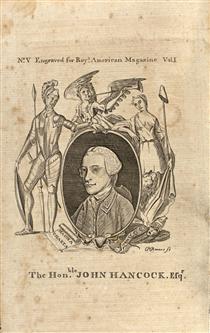
As I wrote yesterday, in June 1774 the Massachusetts General Court put James Bowdoin (shown here, as a younger man) atop its list of delegates to the First Continental Congress.

Two months later, however, Bowdoin declined the position. According to the 15 Aug 1774 Boston Gazette:
Some Days before the Departures of the Committee for the Congress, Mr. BOWDOIN sent them a Letter acquainting them, That he had had Hopes of proceeding with them to the Congress, but Mrs. BOWDOIN’s ill State of Health, occasioned by a long continued Slow Fever, necessitated him to lay aside all Thoughts of it.
Curiously, the same day’s Boston Evening-Post replaced the words “Mrs. BOWDOIN’s” with “his,” thus reporting that Bowdoin himself was sick. The Boston Post-Boy and later Massachusetts newspapers read the same as the Boston Gazette, indicating the Fleets’ paper was wrong.

On 10 September, Bowdoin repeated that explanation to his son-in-law John Temple, writing of “ye. Congress at Phila., to wch. Mrs. Bowdoin’s illness prevented my going.” Months later, he would complain about his own infirmities preventing him from doing all the political work he wanted to handle, but not in 1774.

Decades afterward, John Adams told Timothy Pickering that “Mr Bowdoin was chosen at the head of the Massachusetts delegation to Congress,” but “His relations thought his great fortune ought not to be hazarded.” That’s just the sort of pressure that the older John Adams prided himself on resisting and sometimes projected onto others.

The contemporaneous evidence suggests that, despite typesetting errors and Adams aspersions, Bowdoin really did stay home because of his wife Elizabeth’s sickness. Of course, that sickness could have been brought on by worrying about her husband and the family fortune.

Bowdoin dropping out opened up a slot in the Massachusetts delegation where John Hancock would have fit nicely. He and Bowdoin were both wealthy and respected Boston merchants. By late July, local newspapers reported, Hancock had recovered from a serious illness and was up and about. He would have loved being called to duty as a delegate by popular acclaim even more than being chosen in the first place.

But perhaps Hancock still didn’t feel up to a long journey. Or perhaps his colleagues saw no way to make him an official provincial delegate since Gen. Thomas Gage had dissolved the General Court and there was no substitute legislature yet.

Whatever the exact reasons, Hancock never attended the First Continental Congress. (But in the spring of 1775 he arrived at the Second as a star. Just as he liked.)

Tuesday, August 06, 2024

Hancock and the First Continental Congress

Sometime in early June 1774, as I discussed yesterday, John Hancock became sick.

That month he was not in evidence at Salem during the sitting of the Massachusetts General Court.

The main business of that legislative session, as I recounted in June, was to choose delegates to the new Continental Congress in Philadelphia.

Hancock’s absence, and the fact that his colleagues understood him to be seriously ill, help to explain why he wasn’t selected as one of Massachusetts’s delegates.

Later in his career, Hancock gained a reputation for claiming illness when he faced a political task he’d rather not tackle.
  • He was too ill to remain as governor when the post-war debt crisis was hitting western Massachusetts farmers (but happily returned to that office after the Shays Rebellion was over).
  • He was too ill to attend most of Massachusetts’s convention on ratifying the U.S. Constitution (until he could enter with a crucial speech supporting the document with changes).
  • He was too ill to wait on President George Washington in Boston (though eventually he was dramatically carried into that meeting).
But this 1774 illness doesn’t look like one of those moments. Representing beleaguered Massachusetts in front of the continent’s leading gentlemen, amassing political capital without tough decisions—that sort of politics Hancock loved. It would have been out of character for him to duck going to Philadelphia.

But with Hancock home sick, the General Court chose a delegation of “the Hon. James Bowdoin, Esq; the Hon. Thomas Cushing, Esq; Mr. Samuel Adams, John Adams, Esq; and Robert Treat Paine, Esq”.

Of that group, Bowdoin and Cushing had the same profile as Hancock: wealthy, educated, well-mannered Boston merchants who were spending most of their time on politics. Those two men were older and higher-ranking in government, however. So it’s conceivable that Hancock would have been left off this list anyway, in favor of men with more seniority.

But then Bowdoin decided he couldn’t go.

TOMORROW: An opening? 

Sunday, June 30, 2024

When Adams Chaired the Boston Town Meeting

Friday, 17 June 1774, turned out to be the last day the Massachusetts assembly met under the Crown.

Before Gov. Thomas Gage shut them down, Samuel Adams and his allies used that session to authorize a delegation from the colony to the Continental Congress, as I’ve just recounted.

On the same day, there was the continuation of a town meeting in Boston. Some of that port’s merchants had started to grumble against the Whigs’ insistence that no one should pay for the tea destroyed in December (or in March, for that matter).

Adams was officially the moderator of that ongoing meeting. Expecting “a warm engagement” with the conciliatory party, Dr. Joseph Warren urged Adams to return to Boston to wield the gavel. But he was was stuck “at Salem, attending the Business of the General Court.”

At 10:00 A.M., the meeting began in Faneuil Hall. The first order of business was appointing a temporary moderator in Adams’s place. The gathering’s unanimous choice was James Bowdoin, a wealthy merchant, learned man, and genteel political leader for the Whigs.

A committee of three men went to Bowdoin’s home near Beacon Hill. He wasn’t there.

The meeting then selected merchant John Rowe to moderate. This was an unusual choice because Rowe was not a Whig stalwart. Nor was he really a Loyalist stalwart. He was a “trimmer,” adjusting his political sails according to the prevailing winds and what looked most advantageous to his business.

Perhaps the public remembered Rowe’s remark back in December about mixing tea and saltwater—the first public suggestion of that method of resolving the standoff over the East India Company cargo. Secretly Rowe appears to have regretted that remark and tried to keep a low profile afterward. So he would hardly want to chair a town meeting making controversial decisions.

In his diary Rowe wrote: “I was much engaged & therefore did not accept.” But he added a remark showing his real attitude: “The People at present seem very averse to Accommodate Matters. I think they will Repent of their Behaviour, sooner or later.”

Back at Faneuil Hall, the gathering moved on to vote for a gentleman who had never moderated the Boston town meeting before. In fact, he later said he usually kept away from town meetings. But he had represented Boston for one year in the Massachusetts General Court.

This was John Adams. Per the record, “a Committee of three Gentlemen” went to him with news of their choice, and Adams “gave his Attendance accordingly.”

TOMORROW: John Adams in the chair.

Tuesday, July 18, 2023

“The Affair of delivering up the Arms”

On 23 Apr 1775, as recounted yesterday, the Boston town meeting approved an arrangement with Gen. Thomas Gage for people to store their weapons in exchange for the chance to leave their besieged town.

The committee who served as intermediaries between Gage and the town quickly wrote to Dr. Joseph Warren, chair of the Massachusetts Provincial Congress’s committee of safety:
Sir:

The following proceedings contain the Agreement made between his Excellency General Gage and the Town of Boston.

You are informed it is the earnest desire of the inhabitants, that such persons as incline to remove into the Town with their effects, may be permitted so to do without molestation, and they having appointed us as a Committee to write to you on this subject, we hope this request will be complied with, as the Town, in a very full meeting, was unanimous in this and every other vote, relating to this matter; and we beg the favour of as speedy an answer as may be.

We are, most respectfully, your obedient humble servants,
James Bowdoin, John Pitts,
John Scollay, Ezek. Goldthwait,
Tim. Newell, Alexander Hill,
Thos. Marshall, Henderson Inches,
Samuel Austin, Edward Payne.
That letter was later printed in Peter Force’s American Archives (probably with stylistic editing).

Town officials then got to work collecting people’s guns. The records of the selectmen are entirely blank from 19 Apr 1775 to 20 May 1776, but other sources offer peeks into this work.

Selectman Scollay (shown above) later wrote, “The Affair of delivering up the Arms & of the Inhabitants removal has given us great trouble.” That was even with the help of the constables the town had elected back in March—up to twelve men.

The family of lawyer Samuel Swift later claimed that his “zeal and resolution…caused many Bostonians to secrete their arms.” There’s not much evidence to support that flattering lore, but then arms-hiding would have been secret. Most townspeople seem to have cooperated grumpily. On 24 April the hat merchant Thomas Handysyd Peck even wrote to Gen. Gage about cannon:
their is two Iron Guns in my store I think about four Pounders if your Exellency thinks best that the guns should be Removed if you Sir will order to what Place I will take Care and have it Done. . . .

PS Those Guns have no Carrages and have laid ever since last war.
It looks like the selectmen thought the collection could be finished in a couple of days. The 26 June Boston Gazette stated:
The meeting was then adjourned to Tuesday morning the 25th of April, ten o’clock in the Forenoon, and was continued by successive adjournments to thursday, P. M. the 20th [sic, 27th] of April, 1775, when the town met to receive the further report of the committee.
TOMORROW: What the committee had to say.

Saturday, July 15, 2023

“Upon the inhabitants in general lodging their arms in Faneuil-hall”

On 22 Apr 1775, with the Massachusetts militia besieging the king’s soldiers inside Boston, many townspeople wanted to get out of the way.

Gen. Thomas Gage, army commander and royal governor, had his own priorities: forestalling any citizen uprising against those soldiers.

Gage had approached Boston’s selectmen to start discussions on avoiding discontent and unrest. Those officials seized the opening to talk about letting people leave town.

In addition to five of the seven selectmen (John Hancock and Oliver Wendell had left Boston earlier in the month before fighting broke out), the town appointed four men to communicate with the governor. They were all established businessmen with political experience:
  • James Bowdoin, a member of the Council, firm Whig, and, therefore, longtime headache for Govs. Francis Bernard and Thomas Hutchinson. He was, however, wealthy and learned, thus undeniably respectable. Also, though Bowdoin might excuse violence after the fact, he didn’t encourage it beforehand.
  • Ezekiel Goldthwait (shown above), insurance broker, registrar of deeds, and veteran of other political offices, including Boston town clerk. While calling himself a Whig, Goldthwait was more centrist than most in that party and maintained friendly relations with the royal governors. Some people even called him a Tory.
  • Henderson Inches, a Boston selectman voted out earlier in the decade for not pushing as hard on the Massacre orations as the voting public wanted, but still in the Whig party.
  • Edward Payne, wounded in the Boston Massacre while standing peacefully on his front steps—but he chose not to sue about it. 
  • Alexander Hill, a warden and fireward often chosen to audit the town’s accounts. Though he had been put on the town’s committee of correspondence, Hill was rarely involved in protests and debates over imperial issues.
In sum, these were gentlemen whom the governor couldn’t dismiss or treat with suspicion.

It’s a sign of the emergency situation that the town met on Sunday, 23 April. Indeed, Hill’s job as warden had been to ensure that people didn’t conduct business on the Sabbath. But these were desperate times.

The record published in the 26 June Boston Gazette continued:
Sabbath morning ten o’clock, April 23, 1775.

The town met according to adjournment.

The said committee made a verbal report. Whereupon it was desired that the committee would withdraw and reduce their report to writing, which was accordingly done, and is as follows, viz.

The committee appointed by the town to wait upon his excellency General Gage, with a copy of the two votes passed by the town yesterday in the afternoon; report, that they being read to him by the committee, and a long conference had with him upon the subject matter contained in the said votes, his excellency finally gave for answer, that upon the inhabitants in general lodging their arms in Faneuil-hall, or any other convenient place, under the care of the Selectmen, marked with the names of the respective owners, that all such inhabitants as are inclined may depart from the town, with their family’s and effects; and those who remain may depend upon his protection. And that the arms aforesaid at a suitable time would be return’d to the owners.
Most men in Boston, as in other towns, were required by law to drill with the militia and therefore owned firelocks. Gen. Gage didn’t want those guns used against his soldiers. He also didn’t want people to take their weapons out of town, join the besieging force, or arm fighters in that force.

On the other hand, the province had just gone through several months of Patriots complaining that they had the right—indeed, the obligation—to amass weapons, gunpowder, and other military supplies. Bostonians couldn’t participate much in that arming of the countryside, being under army occupation, but they supported it. Would they give up their means of self-defense?

TOMORROW: The townspeople’s expectations?

Friday, July 14, 2023

Boston’s Town Meeting on the Fourth Day of the War

As quoted yesterday, on 3 Apr 1775 the Boston town meeting voted to continue their work by adjournment on 17 April.

By that date, town clerk William Cooper had slipped out of town with the official records. Also unavailable were Samuel Adams, chosen moderator of that meeting, and selectman John Hancock.

I’ve found no record of a notice that Bostonians would not meet that day, nor indication that they tried. The following day, Gen. Thomas Gage set his plan for the Concord expedition in motion, and the day after that the province was at war.

The first indication of another town meeting appeared in Isaiah Thomas’s Massachusetts Spy, newly moved to Worcester, on 3 May. After a detailed account of the first day of fighting, that paper stated:
It is now thirteen days since Boston was entirely shut up. The Sunday after the battle there were but two or three religious assemblies that met in Boston. In the Forenoon there was a town meeting, at which a Committee, consisting of the Select-Man, were chosen to wait upon General Gage, in order to get permission for the inhabitants to remove out of town with their effects.
A more detailed and apparently more accurate account appeared in the Boston Gazette on 26 June. This report used the legal formula of Boston’s other town meetings, and it’s clear the selectmen were involved, so this appears to meet all the criteria to be an official meeting.
Boston, ff. At a Meeting of the Freeholders and other Inhabitants of the Town of Boston legally warned, on Saturday the Twenty second day of April, A. D. 1775.

The Hon. JAMES BOWDOIN, Esq [shown above]; was chosen Moderator.

The Moderator informed the town that the present meeting was in consequence of an interview between his excellency General Gage and the Selectmen, at his desire, and mentioned the substance of the conversation that pass’d; and also that the Selectmen with the advice and assistance of a number of gentlemen had prepared several votes, which they thought it might be proper for the town to pass—And which in conjunction with the assurances that had been given to his excellency by the selectmen, they apprehended from the interview aforesaid, would be satisfactory to his excellency——

Whereupon,
The Hon. James Bowdoin, Esq; Ezekiel Goldthwait, Esq; Mr. Henderson Inches, Mr. Edward Paine, Mr. Alexander Hill, together with the selectmen, viz. John Scollay, Esq; Mr. Timothy Newell, Mr. Samuel Austin, Thomas Marshall, Esq; & Mr. John Pitts, were appointed a committee to consider of this important matter, and were desired to report as soon as may be.

The said Committee made report, and after some debate, the two following votes passed unanimously, viz.

His excellency General Gage in an interview with the selectmen, having represented that there was a large body of men in arms assembled in the neighbourhood of this town, with hostile intentions against his majesty’s troops stationed here, and that in case the troops should be attacked by them, and the attack should be aided by the inhabitants of the town, it might issue in very unhappy consequences to the town.

For prevention whereof, his excellency assured the selectmen, that whatever might be the event of the attack, he would take effectual care, that the troops should do no damage, nor commit any act of violence in the town; but that the lives and properties of the inhabitants should be protected and secured, if the inhabitants behaved peaceably; and the selectmen in behalf of the town engaged for the peaceable behaviour of the inhabitants accordingly:

In confirmation of which engagement—Voted,
That as the town have behaved peaceably towards the troops hitherto, they hereby engage to continue to do so; and the peace officers, and all other town officers, are enjoined, and the magistrates, and all persons of influence in the town, are earnestly requested to exert their utmost endeavors to preserve the peace of the town:

The Town at the same time relying on the assurances of his excellency, that no insult, violence or damage shall be done to the persons or property of the inhabitants, either by the troops or the kings Ships, whatever may be the event of the attack his excellency seems to apprehend; but of which attack we have no knowledge or information whatever, as all communication between the town and country has been interrupted by his excellency’s order, ever since the collection of the body aforesaid.

Whereas the communication between this town and the country both by land and by water is at present stop’d by order of his excellency General Gage, and the inhabitants cannot be supplied with provisions, fuel and other necessaries of life; by which means the sick and all invalids must suffer greatly, and immediately; and the inhabitants in general be distress’d, especially such (which is by much the greatest part) as have not had the means of laying in a stock of provisions, but depend for daily supplies from the country for their daily support, and may be in danger of perishing, unless the communication be opened:

Therefore, Resolved,
That a committee be appointed to wait on his excellency General Gage, to represent to him the state of the town in this regard, and to remind his excellency of his declarations in answer to addresses made to him when the works on the neck were erecting, viz. “That he had no intention of stopping up the avenue to the Town, or of obstructing the inhabitants or any of the country people coming in or going out of the town as usual;” that “he had no intention to prevent the free egress and regress, of any person to and from the town, or of reducing it to the state of a garrison; that he could not possibly intercept the intercourse between the town and country;” that “it is his duty and interest to encourage it; and it is as much inconsistent with his duty and interest to form the strange scheme of reducing the inhabitants to a state of humiliation and vassalage, by stopping their supplies,”—

Also, to represent to him, that in consequence of these repeated assurances of his excellency, the fears and apprehensions of the inhabitants, had generally subsided, and many persons who had determined to remove with their effects, have remain’d in town, whilst others largely concern’d in navigation, had introduced many valuable goods, in full confidence of the promised security:

That the Town think his Excellency incapable of acting on principles inconsistent with honor, justice and humanity, and therefore that they desire his excellency will please to give orders for opening the communication, not only for bringing provisions into the town, but also, that the inhabitants, such of them as incline, may retire from the town with their effects without molestation.

The same Committee were appointed to wait upon the General with the foregoing votes.

Then the meeting was adjourned to Sabbath morning, ten o’clock.
The town was reminding Gen. Gage of all the promises he’d made in the preceding months of keeping life as normal as possible. Of course, now there was a besieging army outside (“a large body of men in arms assembled in the neighbourhood”). How would the general respond?

TOMORROW: Sunday meeting.

Thursday, May 11, 2023

Early American Science in Kansas City

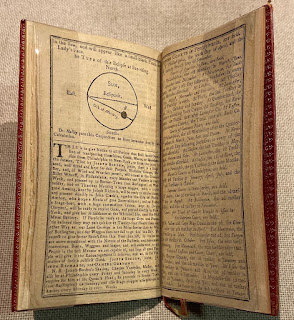
The Linda Hall Library in Kansas City is featuring a small but mighty display of publications titled “Promoting Useful Knowledge: The American Philosophical Society and Science in Early America.”

The items include:
The label on the Thomas almanac says, “after the battles of Lexington and Concord, Thomas had to move his press from Boston to Worcester to prevent his own arrest and that of his printers, and to prevent the presses from being seized and destroyed by the British.”

Thomas left Boston just before the war began to feel safe from the British army. Timothy Bigelow and other Worcester Patriots assured him he could sell newspapers in their town.

Thomas hoped to gain the printing business of the Massachusetts Provincial Congress, but then Benjamin Edes set up in Watertown and Samuel and Ebenezer Hall moved their press from Salem to Cambridge. Thomas got the contract to print the congress’s report on the opening battle and nothing else, but he did become Worcester’s postmaster.

Back to the Linda Hall Library exhibit. Its anchor is a copy of Poor Richard’s Almanack for 1753, describing Benjamin Franklin’s first electrical experiments and showing a transit of the planet Mercury.

That almanac was loaned to the library by the American Philosophical Society in Philadelphia after a bet on the outcome of last winter’s Super Bowl. (The Kansas City Chiefs beat the Philadelphia Eagles, 38–35.) The story behind the exhibit is thus itself notable.

I was also intrigued by the story behind the Linda Hall Library. Herbert and Linda Hall left a multimillion-dollar bequest to establish “a free public library for the use of the people of Kansas City.” In post–World War Two America, the trustees decided that institution should be dedicated to scientific and technical information.

The Linda Hall Library started by purchasing the collection of the American Academy of Arts and Sciences, founded in 1780 by James Bowdoin and other Enlightened gentlemen from newly independent Massachusetts. Which probably explains why it holds so many almanacs from New England.

Friday, March 10, 2023

The Captain Who Hosted Gen. Washington in Boston

In looking for clues about the ship captain who told Gen. George Washington that the British military was preparing to leave in March 1776, I came across this line in an 18 March letter from Thomas Cushing to Robert Treat Paine:
A Detachment of our Troops have gone into Boston and this Day General Washington & his Suit dined with Captain Erving.
Was that the same captain as the Erving, Irvine, Irwin, Erwin, or Ervin who provided the general with useful information about two weeks before?

Did Washington choose to dine inside liberated Boston with the mariner who had first told him the British were preparing to leave?

It appears not.

Rather, the consensus is that Washington’s host was the Boston merchant captain and erstwhile Council member John Erving, Sr. However, as the editors of the R. T. Paine Papers commented:
John Erving (c. 1692–1786), a wealthy Boston merchant originally from the Orkneys, was an odd choice as Washington’s first dinner host. A member of the Council for some twenty years, Erving declined the offer of a seat on General [Thomas] Gage’s Mandamus Council, but his sons John and George accepted. All three of his surviving sons became Loyalists, and at least one of had just left Boston with the British troops.
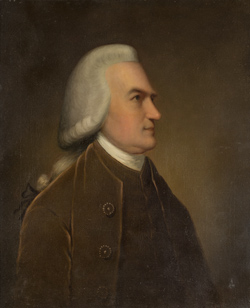
I think the answer to that minor mystery goes back to James Bowdoin (shown above), the same man whose anecdote about Gen. William Howe sent me looking for Washington’s late informants in the first place.

Bowdoin was a senior member of the Massachusetts Council who had met several times with Gen. Washington in the preceding months. On good days he was the senior figure in the Massachusetts government. And John Erving, Sr., was his father-in-law.

Bowdoin couldn’t host Washington at his own house since he didn’t know what shape it was in after British occupation. But old Capt. Erving had stayed in Boston through the siege and could still host a genteel dinner.

True, most Erving men had shown themselves to be Loyalist, but perhaps that was all the more reason to reward a well-connected patriarch who had decided to remain in town as the British left.

Tuesday, March 07, 2023

“Came to Head Quarters and gave the following Intelligence”

After Continental troops moved onto Dorchester heights on the night of 4–5 March 1776, Gen. George Washington and his commanders waited anxiously for the British response.

As of 8 March, Gen. Horatio Gates was telling John Adams that headquarters still didn’t know what was going on inside Boston “as neither Townsman, nor Deserter, has yet come in to acquaint us!”

But some men were making their way out of Boston, bringing intelligence. Maj. Samuel Blachley Webb (shown above, courtesy of the New-York Historical Society), stationed with Gen. Israel Putnam’s brigade in Cambridge, wrote in his journal on 8 March about “Capt. Erving, of Salem, who last night stole out of Boston.”

Four different letters sent from Washington’s headquarters on 9 March, the next day, described that man in slightly different ways:
After looking at Salem vital records, which provide yet more variant spellings, I think this captain was most likely named Ervin, so I’m going to refer to him that way.

At first I thought Capt. Ervin was the most likely person to have reported Gen. William Howe’s exclamation on seeing the Dorchester heights fortifications. His rank as a captain in command of a “Transport,” or troop ship, suggested that the general was more likely to have spoken frankly in front of him.

However, the timing doesn’t quite work. In one of his 9 March letters Gen. Washington wrote that it was “Yesterday evening,” or 8 March, when this captain “came to Head Quarters and gave the following Intelligence.” James Bowdoin understood that the general questioned the source we’re looking for at or after midday dinner on 9 March.

In addition, Bowdoin used the term “deserter.” None of the headquarters letters used that word for the sea captain, even when Washington described him as “A Captain of a Transport,” presumably working for the Crown.

But Maj. Webb did use that language in describing another man in his diary on 9 March: “Three Inhabitants and one Soldier last night deserted to us from Boston—they confirmed the accounts Rec’d yesterday…” If that soldier reached Washington’s Cambridge headquarters on 9 March, then the general would have seen him as an army deserter and questioned him that day, as Bowdoin described.

Finally, while Ervin and the deserter told the same basic story about the British authorities preparing to leave, they provided different details—about numbers, hospital ships, and so on.

It therefore looks like Gen. Washington spoke to Capt. Ervin on the evening of 8 March, received a letter from the Boston selectmen with similar news (as discussed here), and dispatched reports based on all that information to the Congress and nearby colonies in the middle of 9 March. Later on that day the deserting soldier arrived, offering yet more corroboration and the story of Gen. Howe exclaiming, “Good God! These fellows have done more work in one night than I could have made my army do in 3 months. What shall I do?”

TOMORROW: Digging into these intelligence sources.

Monday, March 06, 2023

“I hear that General How said…”

For decades authors have quoted Gen. William Howe seeing the Continental fortifications on Dorchester heights and remarking: “These fellows have done more work in one night than I could have made my army do in three months.”

Few if any of those authors cited a primary source for that remark. Many presented the quotation with variations on the phrase “It is said…,” admitting they have no direct source and/or acknowledging some doubt.

Indeed, when seeing pre-20th-century American authors report what a British commander said privately within a besieged town, we should be skeptical. How did they know? Americans had access to only a few sources from the British side in those years. 

In this case, however, I traced the quotation back to March 1776, with a provenance pointing to Gen. Howe. On 10 March, Massachusetts Council member James Bowdoin wrote:
Mr. [John] Murray, a clergyman, din’d with the General [George Washington] yesterday, and was present at the examination of a deserter, who upon oath says that 5 or 600 [British] troops embarked the night before without any order or regularity; the baggage was hurried on board without an inventory; that he himself helped the General’s [Howe’s] baggage on board, and that two hospital ships were filled with sick soldiers, and the utmost horror and confusion amongst them all.

The General [Washington] recd. a l[ette]r. from the selectmen informing him that in the midst of their confusion they apply’d to Mr. Howe, who told them that if Mr. Washington woud order a cessation of arms and engage not to molest him in his embarkation, he woud leave the town without injuring it; otherwise he would set it on fire. To which the General replyed that there was nothing in the application binding on Mr. Howe. He therefore could not take any notice of it.

The deserter further says that Mr. Howe went upon a hill in Boston the morning after our people took possession of Dorchester Neck, when he made this exclamation: “Good God! These fellows have done more work in one night than I could have made my army do in 3 months. What shall I do?”
Abigail Adams told the same story in a letter to her husband on 17 March:
I hear that General How said upon going upon some Eminence in Town to view our Troops who had taken Dorchester Hill unperceived by them till sun rise, “My God these fellows have done more work in one night than I could make my Army do in three months” and he might well say so for in one night two forts and long Breast Works were sprung up besides several Barracks. 300 & 70 teems were imployed most of which went 3 load in the night, beside 4000 men who worked with good Hearts.
The Adams letters were widely reprinted in the 1800s. That put the quotation into circulation among American authors, with “My God” quoted more often than Bowdoin’s “Good God!” 

Of course, the reliability of the Howe quotation still rests on believing the Rev. John Murray and that unidentified “deserter.” But as far as Revolutionary traditions go, tracing this story back to within five days of when it reportedly took place is about as good as we get.

TOMORROW: Digging for that “deserter.”

Thursday, December 31, 2020

“A determination to discourage a faithful Servant of the Crown”

For acting governor Thomas Hutchinson, the dispute between his Council and the provincial secretary Andrew Oliver was yet one more headache in 1770.

On 28 September, Hutchinson told the departed but still official governor, Sir Francis Bernard: “[Royall] T[yle]r is sowered by that deposition of the Secretarys which was published in England and it has hurt me every way.” (Bernard had been responsible for that publication, at least in part, but Hutchinson didn’t let on that he suspected that.)

Writing to John Pownall, an official in the Colonial Office, two days later, Hutchinson was more careful to avoid suggesting the controversy had hurt his effectiveness:
The Council except a few are…very friendly to me though there is some abatement of their friendship since the deposition of the Secretary taken by my order relative to the Affair of the Troops has been published. These publications & the sufference of the Letters to the Ministry of which a fresh parcel was sent by the last Ship to be made publick do infinite disservice.
Ironically, Hutchinson was just as upset about leaks as the Council—just different leaks.

There was also a private dimension to this dispute. On 10 October, while the Council was in the midst of collecting the depositions I quoted over the past couple of days, the acting governor’s son Thomas, Jr., married Sally Oliver, daughter of the secretary.

The families were already related by marriage. Thomas Hutchinson and Andrew Oliver had married sisters. In February 1770, Hutchinson’s daughter Sarah married Dr. Peter Oliver, son of Andrew Oliver’s brother Peter.

All three of those men were royal appointees. Thomas Hutchinson was lieutenant governor, thus acting governor, and also chief justice of Massachusetts. Andrew Oliver was secretary and was supposed to have been the stamp agent. Peter Oliver was a judge. Furthermore, other relatives were in the provincial government. John Cotton, the deputy secretary, was half-brother to the sisters who had married Hutchinson and Andrew Oliver. And Hutchinson had been trying to get his nephew Nathaniel Rogers appointed provincial secretary before the young man died.

Of course, there were family alliances on the other side of the political divide as well. James Bowdoin, the principal author of the complaint against Oliver, was a son-in-law of fellow Councilor John Erving, brother-in-law of fellow Councilor James Pitts, and father-in-law of Customs Commissioner John Temple, whom other royal appointees regarded as a snake.

Eighteenth-century society ran on such familial connections. People expected officials to look out for their relatives, and officials expected their relatives to be loyal assistants in government. Neither side was pure in this regard, and both sides complained about the other using family ties too much.

On 30 October, Hutchinson summed up his view of the controversy over Oliver’s description of the Council meeting in another letter to Pownall:
Unfortunately it has got published. Mr. Tyler denied that he made any mention of the Commissioners. I am sure I heard it from him but could not be certain whether that Day or a day or two before. Three or four Witnesses present swore, they heard it that Day. All the Council say they do not remember it.

They have not however directly charged the Secretary with false swearing but to a long Narrative drawn up by Mr. Bowdoin there is added divers Resolves declaring him guilty of a Breach of trust in taking the Minutes &c. The whole is a weak but malicious injurious performance which they have ordered to be recorded. . . .

I gave them my Opinion that these Resolves would be more resented than any thing which preceeded them as they plainly indicated a determination to discourage a faithful Servant of the Crown from doing his Duty as far as lay in their power.

These proceedings I hope will not pass without censure either in [privy] Council or when the State of the Province comes before the Parliament. Such a censure would mortify the party and being made matter of Record here would remove the reproach which otherwise will be transmitted to posterity upon the Secretarys Character.
In fact, the London government was already preparing to reward Andrew Oliver for his service. When Hutchinson officially became the royal governor, Oliver was promoted into his brother-in-law’s spot as lieutenant governor. And in 1772 Peter Oliver succeeded Hutchinson as chief justice.

(Hutchinson’s 1770 letters will appear in the Colonial Society of Massachusetts’s next collection of his correspondence, scheduled to be published in the new year.)

Wednesday, December 30, 2020

“The breach of a most essential privilege of this Board”

On 12 Oct 1770, eight members of the Massachusetts Council delivered their depositions about what had happened on 6 March, the day after the Boston Massacre.

Harrison Gray, who was also the provincial treasurer, dated his testimony 9 October while the other depositions were all dated on the 12th. Samuel Danforth, the senior Councilor present, and Royall Tyler provided solo accounts. Three men signed one deposition and two another, very similar, which doesn’t really add up to independent evidence.

The focus of controversy was provincial secretary Andrew Oliver’s report that Tyler had said of prominent men in Massachusetts, “they had formed their plan, and that this was a part of it to remove the Troops out of town, and after that the Commissioners.” And the main issues were—

1) Did Tyler really refer to the Customs Commissioners? Witnesses saying he did included Capt. Benjamin Caldwell, R.N.; deputy secretary John Cotton; and clerk Francis Skinner. Lt. Col. William Dalrymple said, “Something of that kind was mentioned by some Gentleman of the Council during the debates; but I cannot say whether it was by Mr. Tyler.” All eight Councilors said they had no recollection of that remark, some said they would definitely have remembered such a thing, and some argued that mentioning the Commissioners made no logical sense.

2) When Tyler spoke of a ”plan,” did he mean a plan formed before the shooting on 5 March or in the twelve to eighteen hours that had elapsed since it? Again, all the Councilors agreed that they didn’t see how anyone would take Tyler’s words to mean the first. To be sure, they had to work through some logical and semantic brambles to get there, as the scholarly Samuel Danforth showed:
whereas the mention made by Mr. Tyler of a plan that had been formed, (considering that the interval of time between those outrages and Mr. Tyler’s narration was scarce sufficient wherein to form such a plan and the knowledge of it to reach Mr. Tyler) may by some be understood to refer to a plan formed before those outrages were committed, this deponent testifies that nothing said by Mr. Tyler, in his hearing, did convey to him any idea of such a plan formed previous to those outrages; and how incautiously and madly so ever some individuals highly incensed, might have expressed themselves, and what apprehensions so ever Mr. Tyler (thro’ misinformation or otherwise) might then have of a plan formed for removing the troops from the town, in any other way than by prevailing with their officers to remove them, this deponent verily believes that no combination had ever been formed, or plan concerted for the purpose of removing the troops, either in the town of Boston or elsewhere; having never heard it suggested by any other person then Mr. Tyler either then or at any time since
On this point, witnesses Cotton and Skinner agreed that Tyler hadn’t appeared to mean a plan made before the Massacre. However, no one disputed that Tyler had spoken of a “plan.” 

3) Was Oliver wrong to send to London a description of the Council meeting that went beyond the official minutes? The secretary declared that he could, and indeed should, provide a full report on the Council to Sir Francis Bernard, still the official royal governor. The Councilors felt Oliver had broken a norm and cast the province in a bad light just like Bernard’s letters to London, exposed the year before.

That bad light was the real issue, of course. Especially since Bernard had Oliver’s account printed (not unlike how the Boston Whigs had published his letters). Massachusetts politicians had been trying to portray Boston as a peaceful, loyal British town unfairly maligned by royal officials and subjected to an unnecessary military presence. That argument was harder to make if the Council—the governor’s top local advisors—had been close to threatening armed rebellion.

After collecting all the statements, on 16 October the Council named a committee to report on the matter. This consisted of five Councilors not present on 6 March: William Brattle; James Bowdoin (shown above); James Otis, Sr.; John Bradbury; and Stephen Hall.

According to acting governor Thomas Hutchinson, Bowdoin had already revealed his response to Oliver’s account by telling Thomas Flucker, “Why this Deposition of the Secretary has defeated every thing we aimed at by the Narrative & Deposition sent home.”

Sure enough, on 24 October the Council adopted a detailed report, penned by Bowdoin, that went over every disputed detail and ended in four resolutions:
I. RESOLVED unanimously, That Andrew Oliver, Esq; Secretary of this Province, by secretly taking minutes at Council, of what was said by the members of Council, in their debates, also by signing a paper containing those minutes, and further by giving his deposition to the truth of it, has in each and all those instances acted inconsistent with the duty of his office, and thereby is guilty of a breach of trust.

II. RESOLVED unanimously, That the said Andrew Oliver, Esq; inasmuch as such proceedings are destructive of all freedom of debate, is guilty of the breach of a most essential privilege of this Board.

III. WHEREAS the said Andrew Oliver, Esq; has suggested in his said deposition, that because his draft was allowed strictly to express the truth, it would not stand well on the Council records, and was therefore rejected by the Council; RESOLVED unanimously, That by such suggestion he has injured and abused the members composing that Council, and by so doing has reflected great dishonor on this Board.

IV. RESOLVED, That an attested copy of this report, and the petitions and depositions, to which it relates, be sent to Mr. Agent [William] Bollan, in order that he may make the best use of them he can, for the benefit of this Province.
Oliver responded with a letter protesting his honor and repeating that he’d reported the truth. The Council sent back a letter rejecting that claim and had the whole collection of documents printed as Proceedings of His Majesty's Council of the Province on Massachusetts-Bay, Relative to the Deposition of Andrew Oliver, Esq. Just one more dispute between the Massachusetts Whigs and the royal authorities with no resolution, just a feeling of grievance on both sides.

TOMORROW: A family feud?

Sunday, August 09, 2020

The Life and Death of Nathaniel Rogers

Nathaniel Rogers was born in Boston in 1737. His mother was a sister of Thomas Hutchinson, who later that year was chosen to be both a selectman and the town’s representative to the Massachusetts General Court.

Young Natty was orphaned as a small boy, and his Uncle Thomas raised him, treating him as another son. He didn’t attend Harvard College, but he nonetheless gained a degree by getting a master’s degree from the University of Glasgow and then asking Harvard to recognize that with a reciprocal (ad eundem) bachelor’s.

While Rogers was in Britain, he came across a copy of New-England’s Prospect by William Wood, a guide to joining the new Massachusetts Bay Colony published in 1634. This was just the sort of historical source his uncle liked. Rogers arranged for it to be reprinted in Boston in 1764, adding a long introduction that fit the founding of Massachusetts into the overall Whig history of Britain.

The political philosophy Rogers expressed in that introduction fit well alongside the arguments James Otis, Jr., was making in his pamphlets about recent Crown laws violating long established rights. In fact, James Bowdoin apparently assumed Otis wrote the introduction, writing his name into a copy.

Rogers saw himself as a Whig and a proponent of American interests. On a trip to London in 1767, he wrote to his uncle about former prime minister George Grenville:
Mr Greenville seems our most bitter enemy, & takes every opportunity to render us obnoxious. The only motion this session upon American matters was made by him, that an Enquiry should be entered into by the House upon a certain Boston paper of Octo. 5. containing the most virulent aspersions & insinuations . . .

As far as I can judge from the very short time I have been here, nothing like threatning will do here, it will serve to enflame minds already much agitated but representations supported by facts & strong reasoning will be attended to. America appears of Consequence, & the Nation in general seems interested, the Manufacturers & commercial people so far as their Interest is Affected are on our side, but all the Landed Interest are against us.
He also blamed the Customs service for having “stretched their Authority to the utmost,” which was “one great cause of their ill usage.”

Nonetheless, as Rogers’s warning against “threatning” suggests, he opposed the political methods of the Boston Whigs: public demonstrations, boycotts, harsh rhetoric in the newspapers, legislative confrontations with the governor, and of course riots. He was pleased when the Crown cracked down on his home town, writing, “We were grown into a most wretched state before the arrival of the troops. . . . the firmness of parliament will be the only cure of these Evils.”

Ultimately, Rogers was invested in the imperial patronage system. He used his connections with Lt. Gov. Hutchinson in business and in seeking royal appointments. He married into the extended Wentworth family that supplied New Hampshire with its governors, and he adopted his wife’s Anglicanism. In London he tried to line up support for himself to succeed Andrew Oliver, his uncle’s brother-in-law, as royal secretary of Massachusetts.

In the fall of 1769, Customs house records revealed that Rogers had continued to ship in goods from Britain in defiance of the non-importation agreement. A 4 October Boston town meeting condemned him along with a few other importers. That same day Hutchinson wrote to the absent governor:
Rogers…thinks himself in immediate danger and desired to know if I could protect him. I told him that if he could pitch upon any particular person he might go & make oath before a Justice of peace & he would bind him to keep the peace &c. I could do no more for him. He will not be able to hold out unless he quits the Town.
In early January 1770, William Molineux led a polite but ominous crowd to Rogers’s door. He still refused to yield—unlike his cousins, the Hutchinson brothers. Hosting British army officers in his house might have helped. But in May, with the regiments removed and the Whigs ramping up pressure, Rogers left for New York.

By then, however, Nathaniel Rogers’s name had become notorious. The Sons of Liberty paraded his effigy around the city, then hanged and burned it. He left Manhattan in the middle of the night. A few days later, another effigy appeared outside his inn on Long Island. Back in Boston in June, he found people “repeatedly breaking his windows and in a most beastly manner casting tubs of ordure at his door.” He tried New Hampshire but turned down a seat on that colony’s high court because he still held out hope for an appointment in Massachusetts.

Returning in Boston, on 9 August Rogers visited Justice Edmund Quincy to swear out a complaint against someone for harassing him. Hutchinson wrote:
As he held up his hand to swear that he had grounds to suspect the person the Justice observed a Tremor and asked if he was not well and advised him not to give himself so much concern. He had got but a few steps from the Justices door by the Post Office when he complained of being ill to a woman who stood at her shop door and who asked him in where he remain’d near half an hour fancying he should grow better but an apoplectic fit came on, his countenance changed to black instantly and before I could get to him after notice given to me he was in the Agonies of death.
Nathaniel Rogers died at the age of thirty-three, 250 years ago today.

TOMORROW: Posthumous notoriety.

Monday, June 01, 2020

“The Illegality of holding the Court in any other Town than Boston”?

On 1 June 1770, the Massachusetts house continued its discussion with acting governor Thomas Hutchinson about why the legislature was meeting in Cambridge.

The dispute over that issue began in 1769, when Gov. Francis Bernard moved the Massachusetts General Court out of Boston. It continued when Hutchinson convened a second session of that term in March.

The first thing the new house did after electing their officers was to prepare a “remonstrance” against not meeting in Boston. The committee to write that protest included James Bowdoin (named first and thus probably the principal author), Samuel Adams, Joseph Hawley, John Hancock, and Daniel Leonard.

The remonstrance began:
BEING returned by our respective Towns to represent them in the Great and General Court or Assembly of this Province, directed by his Majesty’s Writ under your Hand and Seal, to be convened at Harvard-College in Cambridge, We beg Leave to represent to your Honor our Opinion: That the only Writ established by Law for the convening a General Assembly, is apparently formed, upon a Supposition that the Town-House in Boston is the only Place where the said Assembly is to be convened, held and kept.

Our Fathers in the Year 1721 were evidently of Opinion, that the convening holding and keeping the Assembly at any other Place, was contrary to the Act of this Province, of the Tenth of William the Third, which establishes the Form of the Writ: Accordingly, when the Assembly was then adjourned to this Place, though the Providence of God had rendered it impossible for them, consistent with Safety to their Lives, to meet in Boston, by reason of a contagious Distemper which raged there, Governor [Samuel] Shute declared, that he did not mean the Adjournment should ever after be drawn into Precedent; And the three Branches of the Legislature passed a Resolve, to make valid their Proceedings; which they would not have done, if they had thought the Adjournment from the Town-House in Boston, however necessary, had been consistent with the aforementioned legal Establishment.
The message went on to discuss Gov. William Burnet convening the assembly in Salem in 1729.

Hancock was the one member of the drafting committee also named to the committee to deliver the result to Hutchinson. But the lieutenant governor avoided meeting with Hancock and his colleagues on 30 May. He read the remonstrance and replied with a letter dated the next day, and it was entered into the house record 250 years ago today.

The acting governor said:
By the Charter the Governor has the sole Power of Adjourning and Proroguing the General Assembly. There is no Limitation of Time or Place. Can it be supposed that merely by Force of the Form of a Writ for calling the General Assembly, this Power is taken away or abridged? Will it not rather be supposed that the Word Boston in this writ, is meer Matter of Form, especially when it is considered that it will be equally necessary for the Writ to be dated at Boston, (for that is a Part of the Form) as it is for the Court to be convened there? Now it must, in the very Nature of the Thing, be perfectly indifferent in what Place the Writ is dated.
As for deploying historical precedents, you don’t address the author of The History of the Colony of Massachusets-Bay without having all your evidence in order. Hutchinson acknowledged what happened under Shute and Burnet but said those disputes actually showed the question had been decided in favor of his position. He then went on to a historical moment of his own:
I must put you in Mind that in the Year 1737, the King, for the more convenient carrying into Execution a Commission for settling the Line between this Province and New-Hampshire, instructed the Governor to remove the General Court to Salisbury, where more than one Session was held: Whether this was necessary or not, I will not determine; but if it was necessary, I know that his late Majesty was the sole Judge of the Necessity.

I was then a Member of the House, and do not remember a Word to have been said of the Illegality of holding the Court in any other Town than Boston. The Point had been settled a few Years before, and was fresh in the Memory of the House.
Neither side in this debate mentioned how the General Court had met in Cambridge during the smallpox epidemic of 1764, only six years before. As under Gov. Shute, people agreed that a raging contagious distemper required taking unusual steps, especially when their own health was concerned.