J. L. BELL is a Massachusetts writer who specializes in (among other things) the start of the American Revolution in and around Boston. He is particularly interested in the experiences of children in 1765-75. He has published scholarly papers and popular articles for both children and adults. He was consultant for an episode of History Detectives, and contributed to a display at Minute Man National Historic Park.

Subscribe thru Follow.it


•••••••••••••••••


Showing posts with label David Bushnell. Show all posts

Tuesday, October 31, 2023

“Discovered to be active in exposing our works to the enemy”?

Benjamin Boardman (1731–1802, shown here) graduated from Yale College in 1758, and two years later he became the minister in Middle Haddam, Connecticut.

When Gen. Joseph Spencer led Connecticut troops to the siege of Boston in the spring of 1775, Boardman went along as a chaplain.

He kept a diary from 31 July to 12 November, at least, and that document was published by the Massachusetts Historical Society in 1892.

Boardman recorded mostly events in the Connecticut regiments’ camp in Roxbury, particularly deaths, and news about big events elsewhere.

The minister’s frustration with rumors comes through in several places. On 9 November, for example, he wrote a detailed account of a British army raid on Lechmere’s Point in Cambridge and the Continental response. Then he added, “The above acct. cant be relied on,” and wrote down different details; “indeed there is no certainty can be come at,” he concluded.

Nonetheless, two entries stood out for me. On 31 August, the chaplain wrote:
I collected this day in cash for the encouragt. of Mr. Bushnels Machine the sum of £13.4.4. in cash out of our regt.
That must refer to the invention of David Bushnell, which turned out to be a small submarine and an underwater bomb or mine. This entry shows that Connecticut men were talking about the inventor’s work in the summer of 1775, even if they didn’t know the top-secret details.

On 31 October, Boardman’s entry was:
Bought me a flanel waistcoat this day, cost 9/2. We hear that Coll. [Joseph?] Gorham with about 40 tories are taken from ye. eastward who went after wood; also that Harry Knox, who married Secretary Fluckers daughter, and offered himself last July as a voluntary engineer to lay out our works, is taken & discovered to be active in exposing our works to the enemy.
At some later point Boardman returned to that entry, put marks around everything after the semicolon, and wrote: “Mistake of ye. clause in the crotchets.” In other words, never mind that thing about Knox. For that matter, the rumor about Gorham doesn’t seem reliable, either.

Nonetheless, this diary entry shows that some people in the American camp were suspicious about Knox’s family ties in the same month that Gen. George Washington had started angling to get him appointed to command the whole Continental artillery.

That October had started with news of “Doctr. [Benjamin] Church under an arrest for keeping up a correspd. with the enemy in Boston,” as Boardman wrote. Men were deserting both to and from the enemy. So it was easy to be suspicious about someone with such strong ties to the royal government as Knox had. Even if such rumors were quickly deemed to be unfounded.

Thursday, February 16, 2023

“Except these boats all in a hurry”

Continental surgeon general Benjamin Church’s secret letter to Maj. Edward Cane of the British army contained three warnings about attacks on the British forces by water.

Early on in that 24 Sept 1775 missive, Dr. Church wrote:
The distroying the Ships in the manner I wrote you before they began to dispair of tho’ the former of the Machine is full of faith that he can do it, Works on hardly and so let him, I say.
This is probably the same “mashine” that engineer Jeduthan Baldwin wrote about in December:
went in the afternoon to Dotchester point to See the mashine to blow up Shiping, but as it was not finished, it was not put into the water.
Church’s letter suggests that the man forming that machine was at work months earlier, in September.

But what was the machine? David Bushnell’s submarine is one possibility. We know he was at work on that invention by August 1775, and that in October people in the American camp were hoping to see it soon. But the dates don’t quite match up; Bushnell was still toiling in the Connecticut River on 7 December, so what did Baldwin see kept out of the water one week later? The machine at Dorchester Point might never have been finished while Bushnell’s Turtle actually went into battle in September 1776.

Church alerted his Crown contacts to other water-borne threats:
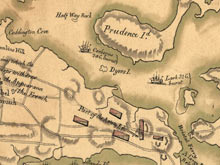
This day a floating battery hid herself under Mr Tempels Wharf, from Mistick bridge.

One hundred 50 flat bottom boats are ordered to be Compleated within 30 days they are building them as fast as they can at Water town and Cambrige I see them every day, this you may depend on. And I am not a little Surprised to find them so Engaged in making these boats, for I know the people in general think it impossible ever to go into Boston, you in it. ————. . . .

Our Assembly has been sitting 3 days they have been debating by what means they can keep the Coast Clear of tenders, but have not yet Concluded.

No News from the Congress some days things look as if our General intended to do something soon, than again I am strongly persuaded that nothing will be done, in fact war you out you could not satisfy yourself there is nothing that looks like matters Except these boats all in a hurry.
“Mr. Tempels Wharf” meant the wharf on the Mystic River that led to Robert Temple’s farm in Medford, shown above in a detail from Henry Pelham’s map of the siege.

In October, a couple of weeks after Dr. Church wrote, the Continental troops did try to attack the British in Boston with floating batteries. It didn’t go well, as these posts describe.

Gen. George Washington was indeed eager for an amphibious assault on Boston, but his council of war kept voting down his plans. Even the move onto Dorchester Heights included a contingency attack across the Charles River if the British tried to counterattack. But in the end all those flat-bottomed boats were never used in battle.

TOMORRROW: The flag-raising. 

Tuesday, February 04, 2020

Robert Fulton’s Submarine Struggles

Here’s another submarine design from the eighteenth century, this one from the artist and inventor Robert Fulton.

Fulton was born in Lancaster, Pennsylvania, in 1765, and moved to Philadelphia at the end of the Revolutionary War, establishing himself in the new republic. A few years later he went to London, where he studied art under Benjamin West and became interested in the big engineering developments of the age, particularly canal building and steam engines.

In the 1790s Fulton also tackled the challenge of submarines. I started looking into his work in those waters because some sources said he was inspired by David Bushnell’s Turtle. But Bushnell’s plans weren’t published until 1799, when Thomas Jefferson passed them on to the American Philosophical Society. There doesn’t seem to be any private link between Bushnell and Fulton. The two men’s designs show some similar points but many differences, and, as I wrote yesterday, many Europeans had been working on submarines for a long time.

In the spring of 1797 Fulton sold a big chunk of the proceeds from his canal-building system to John Barker Church in exchange for a big chunk of cash. Now flush, the inventor decided to visit France. He embarked in June so suddenly that he didn’t obtain a passport, which looked a bit suspicious. After all, Britain and France were at war. Even being an American was no guarantee of being welcomed since the U.S. of A. had just ratified the Jay Treaty.

Fulton planned to stay in France for six months. Instead, in December 1797 he laid out his system of submarine warfare to the French government and asked for funding to develop it. Even though he didn’t get that grant, Fulton saw enough opportunity in France that he stayed for more than six years.

In 1800 Fulton moved to Brest to build and test a submarine large enough for a crew of three. As shown above, the Nautilus had spinning propellers, a breathing tube, and a fold-out sail for propulsion when it surfaced. It worked fine in tests. Fulton also developed torpedos for that ship to use against enemy vessels.

The target of those torpedoes was the Britain’s Royal Navy. The Quasi-War between France and America also heated up in the late 1790s. Fulton had friends and interests in both Britain and the U.S. of A., but he didn’t seem worried about his inventions being used to attack those countries. Instead, he enjoyed being able to bring his ideas to reality and being lauded as one of the country’s relatively few engineers.

Like many Americans, Fulton admired republican France and hoped it would succeed. When he was actually in the country, however, Napoleon Bonaparte was taking over, turning France into a dictatorship on its way to an empire. And then, just as Fulton completed his experiments and submitted his report to the government, France made peace with its enemies and cut defense spending. Napoleon also became suspicious of Fulton when he dismantled the Nautilus for rebuilding, so no further funds were coming his way. In 1804 Fulton gave up on France and returned to Britain.

The British government looked at Fulton’s submarine designs and gave him some money. He refined his ideas, producing the image shown below, but Britain never moved to the construction stage. Apparently the government was more interested in making sure Fulton didn’t go work for any other government than in actually realizing his designs. After a couple of years the inventor, now in his forties, got impatient and headed home to America.

In the U.S. of A. Fulton went back to steam engines. His partner in that enterprise was Robert R. Livingston, formerly of the Continental Congress. The two men had met in Paris, Fulton as an aspiring submarine builder and Livingston as his country’s minister to France. In New York, Fulton even married into the Livingston family. The result of that alliance was the first practical, long-lasting steamboat, which stayed on the surface but transformed travel all over the world.

Monday, February 03, 2020

Looking at Submarines in the 1740s

This is a diagram of a submarine. It appeared in the Gentleman’s Magazine in 1747, illustrating an article titled “Description of a diving ship, built by order of his most serene highness Charles Landgrave of Hesse Cassel.”

The prince reportedly wanted a replica of “the famous diving ship, constructed by [Cornelis] Drebel” in 1620 and demonstrated in the Thames that decade—or at least a ship that did the same thing.

In the 1747 vessel, a man was supposed to fit into the horizontal cylinder marked E with more men in the larger cylinder working a pump. So this submarine was of considerable size. The article described its purpose as “to destroy the enemy’s ships” rather than, say, salvaging wrecks.

That magazine item concluded with this statement:
As to the difficulty of breathing in such a ship, Drebel mentions that he had provided a certain quintessence of air, one drop of which emitted would render the vitiated air again fit for respiration, but Dr [Denis] Papin imagines this is rather a thing to be wish’d than a reality.
Two years later the Gentleman’s Magazine published another picture of another submarine.
Although the accompanying article signed “T.M.” credited the picture and description to “M. Marriott,” it had actually been designed by Giovanni Alfonso Borelli in 1678. This cutaway view focused on the leather bellows that Borelli imagined being used to take in and expel water for ballast.

The second article prompted letters from Samuel Ley and John Lethbridge discussing submarines they had seen, read about, or developed themselves. There was some squabbling over credit.

Historians of the submarine presume that David Bushnell studied these pictures in the Gentleman’s Magazine as he developed his idea for a submarine as a Yale College student in the early 1770s, though he never mentioned such influence.

The magazine articles show how in the seventeenth and eighteenth centuries many European scientists were working on diving vessels, and people saw their military potential. At the same time, these diagrams show how inventive Bushnell was. His small Turtle didn’t look like either of these plans. It had some similarities to the one-person diving machine that Lethbridge described making, but even more significant differences. And Bushnell’s submarine actually worked.

Friday, July 06, 2018

The Final Fate of the Cerberus

Boston 1775 has periodically passed on news about the final resting-place of some Royal Navy ships notable in the Revolution:
Here’s another ship in that catalogue.

H.M.S. Cerberus famously arrived in Boston in May 1775 carrying three generals to assist Gov. Thomas Gage: William Howe, John Burgoyne, and Henry Clinton. A frigate named after a mythological three-headed monster could hardly have been a better gift for Patriot propagandists.

(The Earl of Sandwich, frequent First Lord of the Admiralty, liked naming warships after figures from classical mythology. Though he wasn’t in that office in 1758 when the Cerberus was launched, his preference had taken hold.)

The Cerberus was involved in the fight over Noddle’s Island and the Battle of Bunker Hill before returning to Britain with news of that disastrous victory. By the end of the year the warship was back along the American coast, patrolling east of New York’s Long Island. It helped the British military take over Newport in December 1776.

On 14 Aug 1777, the submarine inventor David Bushnell targeted the Cerberus off New London, Connecticut, with another invention: the floating mine. However, some of the warship’s sailors spotted one of Bushnell’s explosive barrels and hauled it aboard their boat. The device went off, killing three and wounding one.

In July 1778 H.M.S. Cerberus was back in Narragansett Bay when the first French fleet arrived. After several days of maneuvering, on 5 August it and three other frigates were chased down by two much larger French warships. The British captains chose to run their vessels aground and set them on fire rather than let them be captured.

In the 1970s a graduate student in archeology discovered the wreck of the Cerberus off Prudence Island. Very little of the frigate was left. That site is now protected by federal law.

Wednesday, January 11, 2017

The J.A.R. Starting the Year Off Big

Over at the Journal of the American Revolution, there have been several articles of interest this year already. And not just because they arose out of conversations involving me.

First, the organization has given its 2016 Book of the Year Award to Brothers at Arms, American Independence and the Men of France and Spain Who Saved It, by Larrie D. Ferreiro.

When I first looked at that book, I thought its marketing copy was too breathless—what student of the Revolutionary War doesn’t know that America’s ultimate victory depended on help from European governments, particularly France? But then I sampled the book, and I was impressed with the detail that Ferreiro brought to exploring that history.

Honorary mention goes to Edward G. Lengel’s First Entrepreneur: How George Washington Built His—and the Nation’s—Prosperity.

Last week the site featured one of its periodic round-robins, asking several of us contributors for short answers to some (hopefully) provocative questions. This series was:
As usual, there were a range of responses, especially from those of us who have a more narrow focus in our interests—with some lumping around particular personalities.

Finally, America’s History, L.L.C., will host its annual American Revolution Conference at Colonial Williamsburg on 24-26 March 2017. I attended last year for the first time, and enjoyed myself. Although some fine academic scholars attend, this isn’t an academic conference. In fact, it reminded me more of the fan conventions I’ve been to, except that in this case the corpus to study is real.

Sunday, July 17, 2016

Jerks, Shockers, and Lucky Dogs at the J.A.R.

The Journal of the American Revolution has just concluded one of its popular group interviews, in which chief editor Todd Andrlik asks a bunch of us contributors for our opinions on various questions. Sometimes we agree, sometimes there are almost as many answers as respondents.

This week the questions were:
The J.A.R. also recently opened an online shop selling unique Revolutionary-themed T-shirts, posters, and books, including The Road to Concord.

Wednesday, December 19, 2007

A Machine to Blow Up Shipping?

Yesterday I quoted Continental artillery colonel Jeduthan Baldwin’s record that on 14 Dec 1775 he “went in the afternoon to Dotchester point to See the mashine to blow up Shiping, but as it was not finished, it was not put into the water.”

It sure sounds like Baldwin really saw an unfinished machine which was eventually supposed to go into the water. Which puts me in mind of the pioneering submarine of David Bushnell, who had just graduated from Yale at the advanced age of thirty-five. Bushnell was working on his machine by August 1775, when a friend described it in a letter to Benjamin Franklin. On 23 Oct 1775, Samuel Osgood, aide de camp to Gen. Artemas Ward, wrote to John Adams from the camp at Roxbury:

The famous Water Machine from Connecticutt is every Day expected in Camp; it must unavoidably be a clumsy Business, as its Weight is about a Tun. I wish it might succeed [and] the Ships be blown up beyond the Attraction of the Earth, for it is the only Way or Chance they have of reaching St Peter’s Gate.
By the next month, a British spy named James Brattle, working as a servant of Continental Congress delegate James Duane, had sent the same news to Gov. William Tryon of New York.

However, as of 7 December Bushnell was still testing his craft on the Connecticut River, wrestling with a peculiar problem of submarine warfare: it’s dark inside a waterproof chamber, and lighting a candle uses up the oxygen supply. Bushnell, with Franklin’s advice, planned to use some bioluminescent plant materials, but they weren’t available in late fall.

Bushnell formally presented his submarine plan to the Connecticut Council in February 1776. At that time he planned to move it to Boston to engage the Royal Navy there, but the British evacuated the next month, making that trip unnecessary. The vessel, dubbed the Turtle, finally saw action on 6 Sept 1776 in New York harbor, the first submarine attack in naval history. (The picture above comes from Digital History at the University of Houston.) I haven’t come across any indication that a version of Bushnell’s machine was in Dorchester the previous December.

The machine that Baldwin saw might therefore have been another invention. There was at least one other grand scheme to attack the British fleet that fall. On 20 Oct 1775, John Hancock signed a letter drafted by a Congressional committee to Gen. George Washington:
Captain John Macpherson having informed the Congress that he had invented a method by which, with their leave, he would take or destroy every Ministerial armed vessel in North-America, [a committee of delegates] reported that the scheme, in theory, appeared practicable; and that, though its success could not be relied on without experiment, they thought it well worth attempting on the fleet in and about Boston Harbour, their destruction being an object of the utmost importance.

The Congress have therefore desired Captain Macpherson to repair immediately to Cambridge. They recommend this matter to your particular attention...
Macpherson was a Scotsman with experience in the Royal Navy who had settled in Philadelphia. His son, also named John, was an aide to Gen. Richard Montgomery in the American invasion of Canada; both men would die outside Québec at the end of the year.

On 8 Nov 1775, Washington replied that he wasn’t as optimistic about the captain’s plan as the captain was:
I laid myself under a solemn tye of secrecy to Captn. McPherson, and proceeded to examine his Plan for the destruction of the Fleet in the Harbour of Boston, with all that care and attention which the Importance of it deserved, and my Judgement could lead to: but not being happy enough to coincide in Opinion with that Gentleman, and finding that his Scheme would Involve greater expence, than (under my Doubts of its success), I thought myself justified in giving into, I prevaild upon him to communicate his plan to three Gentlemen of the Artillery (in this Army) well acquainted in the knowledge, and practice of gunnery; by them he has been convinced, that in as much as he set out upon wrong principles, the Scheme would prove abortive.

unwilling however to relinquish his favourite project of reducing the Naval force of Great Britain, he is very desirous of building a number of Row-Gallies for this purpose; but as the Congress alone are competent to the adoption of this measure, I have advised him (altho’ he offered to go on with the building of them at his own expence ’till the Congress should decide) to repair immediately to Philadelphia with his proposals; where, if they should be agreed to, or Vessels of Superior force, agreeable to the Wishes of most others, should be resolved on, he might set instantly about them, with all the materials upon the Spot; here they are to collect; to him therefore I refer for further information on this Head.
Capt. Macpherson carried this letter and others back to Philadelphia for the commander-in-chief. He could have returned to Boston by December, but I have no evidence that he did.

So what was the machine that Baldwin expected to see in use in December 1775? It might have been a prototype of Bushnell’s, or another of Capt. Macpherson’s ideas, or yet another machine created by someone else entirely. In any event, it didn’t work.