


J. L. BELL is a Massachusetts writer who specializes in (among other things) the start of the American Revolution in and around Boston. He is particularly interested in the experiences of children in 1765-75. He has published scholarly papers and popular articles for both children and adults. He was consultant for an episode of History Detectives, and contributed to a display at Minute Man National Historic Park.

Subscribe thru Follow.it


•••••••••••••••••


Showing posts with label Benjamin Barons. Show all posts

Sunday, October 06, 2019

The Paragraphs James Otis Cooked Up
In his diary John Adams described how he spent the evening of Sunday, 3 Sept 1769, in the Edes and Gill print shop: “preparing for the Next Days Newspaper—a curious Employment. Cooking up Paragraphs, Articles, Occurences, &c.—working the political Engine!”

James Otis, Jr., and Samuel Adams evidently brought the young lawyer along as they prepared propaganda for the next day’s readers. Media historians often quote that entry in discussions of how Boston’s Whig press operated.

While that writing process might have been typical, the paragraphs that the Whig leaders came up with after that particular Sabbath had unusual consequences. What Otis wrote that night broke whatever gentlemen’s truce he’d forged the day before with the Commissioners of Customs.

Three items appeared over Otis’s signature on page 2 of the 4 September Boston Gazette. At the top of the first column, labeled “ADVERTISEMENT,” was a paragraph that began:
WHEREAS I have full evidence that [Commissioners] Henry Hulton, Charles Paxton, William Burch, and John Robinson, Esquires, have frequently and lately treated the character of all true North Americans in a manner that it not to be endured, by privately and publickly representing them as Traitors and Rebels, and in a general combination to revolt from Great Britain.

And whereas the said Henry, Charles, William, and John, without the least provocation or color, have represented me by name as inimical to the rights of the Crown, and disaffected to his Majesty…
Otis concluded by asking the government in London to “pay no kind of regard to any of the abusive misrepresentations of me or my country.” So there.

Next was the text of an 11 August letter from Joseph Harrison, the long-time Customs Collector, denying he’d meant to “cast any person reflection or censure” on Otis in a report to his bosses. Otis had asked Commissioner Robinson about that issue on Saturday and received no answer. In the newspaper he had more to say, which I’ll quote tomorrow.

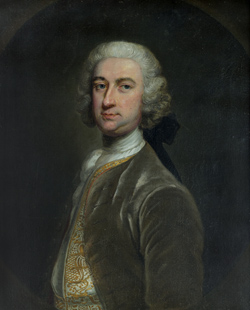
The third item consisted of extracts from a 1761 deposition by Charles Paxton (shown above) about a political alliance of rival Customs officer Benjamin Barons, the Boston merchants, and Otis. I started out to explain that issue, and after two long paragraphs I realized the most important detail in 1769 was that nobody cared. Eight or more years before, Otis reportedly was heard to “speak disrespectfully and threateningly of the Governor.” So what? Gov. Francis Bernard had left Boston under a cloud. That political fight was over. Otis had won.

As far as I can tell, the accusations Otis was responding to hadn’t appeared in any local newspaper. There were actually very few mentions of him in the Customs office documents recently leaked from London. Those few references were mostly about how he had moderated town meetings in late 1768 just before and after the arrival of the troops.

It looks to me like Otis was seeing direct accusations against him in what were at most oblique descriptions of him leading a generally obstreperous town. Furthermore, he thought it was a good idea to publicize those charges of disloyalty instead of letting them fade away. This doesn’t seem like a canny, rational political response. It seems a manifestation of the manic mood that comes through in John Adams’s other diary comments that week.

TOMORROW: How Otis lashed out verbally.

Saturday, November 07, 2009

Leaks and Counterleaks in Colonial Boston

As Kurt Opsahl of the Electronic Frontier Foundation described on Wednesday, the U.S. government’s “Stellar Wind” electronic surveillance program was exposed by government officials and private individuals troubled by what they saw as overreaching. But leaks revealing official misbehavior are nothing new; they also played a part in the politics leading up to the American Revolution.

The legal challenge to writs of assistance came in the midst of a feud between two Customs officials in Boston, Collector Benjamin Barons and Surveyor Charles Paxton. Both men slipped documents embarrassing to the other side into sympathetic newspapers.

The Customs service undertook a secret investigation into the situation. Within a couple of years the record of those hearings—including the names of accused smugglers and informants—made its way back from London. The busiest informant, Ebenezer Richardson, thus became even more of an outcast in Massachusetts than before.

Leaks continued to plague the royal governors for the next fifteen years. Someone in London supplied the province with copies of letters that Gov. Francis Bernard wrote in the mid-1760s criticizing how the province operated. Their publication in Boston made him so unpopular that he left in 1769.

A couple of years later, a leaker—most likely Sir John Temple, a former Commissioner of Customs—gave copies of similar letters from Gov. Thomas Hutchinson, Lt. Gov. Andrew Oliver, Gen. Thomas Gage, and other royal appointees to Benjamin Franklin, then acting as the Massachusetts General Court’s lobbyist in London.

Franklin sent those letters to Thomas Cushing with a warning not to let them become public. But a copy leaked, and Samuel Adams and John Hancock maneuvered them into print. They appeared to confirm Whig complaints that Hutchinson was seeking to cut back the province’s self-government. The fallout from that incident destroyed Franklin’s career in England.

Whigs weren’t the only people to leak material that embarrassed their rivals. Paxton and his colleagues at the Customs office ran that play as well. In the early 1760s, they had news of smuggled French molasses found in merchants’ ships printed alongside those same merchants’ solemn agreement a few years before not to trade with the French.

During the non-importation campaign of 1769-70, many Boston merchants signed an agreement not to buy goods from Britain as long as the Townshend duties were in place. Someone in the Customs office gave John Mein, printer of the Boston Chronicle, long lists of what cargo had been registered as arriving in Boston. These manifests revealed how many rich merchants—including some leaders of the boycott—were still receiving such goods.

Sunday, August 30, 2009

The Marriage of Ebenezer and Kezia Richardson

When Kezia Fowle and Thomas Hincher (or Henshaw) first got married in February 1742 (according to our modern calendar), they didn’t go to any of the meeting-houses in their native Woburn. Instead, they went to King’s Chapel in Boston.

That was an upscale Anglican church while their families back home were Congregationalist, but perhaps it was more welcoming to a couple in their circumstances. Three months later Kezia gave birth to the couple’s first child, also called Kezia.

In 1754, when Kezia wished to get married a second time, to her late sister’s husband Ebenezer Richardson, she went back to King’s Chapel (recently rebuilt in stone, as shown above). Their intention was announced in January, though they didn’t actually get married until 14 May. At that time, they both listed themselves as “of Boston,” having left Woburn behind. As I’ve been recounting, Ebenezer and Kezia had made themselves unpopular in two ways:

  • by having a child while Rebecca, his wife and her sister, was still alive.
  • by letting people believe the Rev. Edward Jackson was the father.
Ironically, if Ebenezer and Kezia had just managed to put off their affair, or not gotten pregnant during it, then they could have married after Rebecca Richardson’s death without raising many eyebrows. I’ve found several examples of widowers marrying sisters of their late wives in eighteenth-century New England.

Boston welcomed Ebenezer and Kezia Richardson in its traditional way: on 30 Sept 1754, a town employee “warned out” the couple, a legal ritual establishing that Boston took no responsibility if they came to need public assistance. But they stayed, and put down roots. In April 1758 the Richardsons buried a child out of Christ Church (now called Old North).

In Woburn, Ebenezer Richardson was a yeoman farmer, but in Boston he had to find a new way to support his family. At some point he began to offer confidential information to the province’s Attorney General, Edmund Trowbridge. (Folks who’ve followed this saga closely will recall that Trowbridge had also been Jackson’s lawyer.) Trowbridge later passed Richardson and his tips on to a Customs official named Charles Paxton.

In 1760 Paxton had a rival in the Boston Customs office: collector Benjamin Barons, who was more popular with local merchants, probably because he let them get away with more. On 4 December, Barons tried to talk Richardson over to his side. The informer heard him out, then hurried to Trowbridge and blabbed. The following February, Richardson signed a deposition about his conversation with Barons that went to London in the record of that office dispute.

Someone in London leaked that document, or news of its contents, back to Boston. From then on, Richardson was known as “the Informer.” He was particularly unpopular with the prominent merchants he’d named as being “concerned in the Illicit trade”: John Rowe, the elder Benjamin Hallowell, Solomon Davis, and Arnold Wells. Around that time the Customs service hired Richardson openly since he could no longer work undercover.

In August 1765, four days after a mob sacked Lt. Gov. Thomas Hutchinson’s mansion in the North End, Boston’s Overseers of the Poor paid a man to carry Ebenezer Richardson, wife, and family to Woburn, possibly for their own protection.

In September 1767, after a dispute over a Customs search in the North End, a crowd of boys jeered Richardson’s home.

And in February 1770, when he tried to break up a picket line of boys outside an importer’s shop, those boys followed Richardson and threw garbage and rocks at his house. That confrontation ended with Richardson shooting Christopher Seider and Sammy Gore, and being arrested for murder.

At that time, Ebenezer and Kezia Richardson were still together. Their family also included two daughters—Sarah and Kezia—old enough to testify at Ebenezer’s murder trial. I haven’t found any other record of those girls.

There’s no evidence that the Richardsons’ marriage lasted through Ebenezer’s conviction, extended stay in jail awaiting sentencing, royal pardon, and flight from Boston. When he and his co-defendant petitioned the Crown for aid in early 1775, the other man referred many times to his “famely”; Richardson didn’t mention having a wife or child.

And that 1775 document is also the last trace I’ve found of Ebenezer Richardson.