


J. L. BELL is a Massachusetts writer who specializes in (among other things) the start of the American Revolution in and around Boston. He is particularly interested in the experiences of children in 1765-75. He has published scholarly papers and popular articles for both children and adults. He was consultant for an episode of History Detectives, and contributed to a display at Minute Man National Historic Park.

Subscribe thru Follow.it


•••••••••••••••••


Showing posts with label Richard Carpenter. Show all posts

Sunday, March 20, 2011

“Onboard the Prison Ship at New York”
A little more than nine months after Richard Carpenterimmigrant, barber, and former prisoner of warresigned from the Continental Army, his wife Elizabeth had another child. That boy died young and was “Buryd in the Burying ground at the back of the Alms house” in what we now call the Granary Burying Ground.

In March 1778 the Carpenters’ older three children were “Inoculated by Doctor [Thomas] Bulfinch for the Small Pox.” In February 1780 Elizabeth Carpenter had her second daughter, Kathrine. However, she held off on the baby’s baptism at Trinity Church for over two years, until July 1782.

I suspect that was because Richard had once more left town, and she was hoping to have the ceremony when he was back. According to the memoir of Ebenezer Fox, apprenticed to another barber in Boston around 1780, there wasn’t enough hairdressing work in town. Inflation was high, and Richard Carpenter had that growing family to feed. In addition, his swimming adventures in 1775 suggest he might have been a man of bold ideas. Like Fox, Carpenter apparently signed onto a privateer or naval warship.

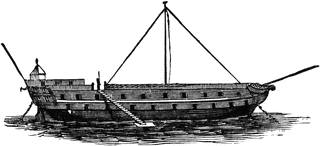
Carpenter’s ship was then captured by the Royal Navy (as was Fox’s). The barber’s name appears as “Richards Carpenter” on the British government’s roll of prisoners put on board the Jersey in New York harbor. That was an overcrowded, disease-ridden hulk.

The last entry on the family records page says:

Richard Carpenter Senior, Died onboard the Prison Ship at New York 6th Jany 1781 in the 35th Year of His Age
Carpenter had been caught and locked up by the British twice before, in Boston and then after escaping in Halifax. The third time he didn’t survive.

Later, someone made additions to earlier entries in the family records to say that Richard and Elizabeth’s three youngest children all got through the measles in February 1790.

An Elizabeth Carpenter married Thomas Lewis, Jr., in King’s Chapel in 1794. Another Elizabeth Carpenter married Josiah Nottage in 1796. Those brides could have been the barber’s widow or daughter, or unrelated women with the same name.

The records of King’s Chapel say that Samuel Carpenter and his wife Abigail had a son named George Washington Brackett Carpenter on 15 Feb 1801. I’m convinced Samuel was Richard’s second son, born while he was locked up in Boston jail; the little baby’s long name honors his father’s commander-in-chief and his mother’s family.

Samuel and Abigail named their other children William Dodd Carpenter and Caleb Strong Carpenter. They actually had three other boys, but the first William Dodd and Caleb Strong died within weeks of each other in 1803, so the couple named their next baby William Dodd as well. I haven’t found any more information about the family.

Saturday, March 19, 2011

“Do something for one of my old Jail Mates”

After Boston barber Richard Carpenter and Pennsylvania rifleman Walter Cruise got out of British custody around the turn of the year 1777, they went to Baltimore.

Why Baltimore? Because, with the British army cutting rapidly through New Jersey in the fall of 1776, the Continental Congress had moved south from Philadelphia. The political leaders didn’t realize, as so many American schoolchildren have learned since, that Gen. George Washington would win a battle at Trenton and decide the war. (At least that’s how it appears in capsule histories that skip rapidly through the battles from early 1777 through late 1781.)

On 13 Jan 1777 the Congress passed a special resolution about those two men:

That 100 dollars be paid to Walter Cruise, and 100 dollars to Richard Carpenter, who have been long detained prisoners by the enemy, and cruelly treated by them; and that they be recommended to General Washington to be employed in the service of the United States, in such way as he shall think proper.
John Hancock as president of the Congress sent that resolution to Washington in a brief note on 15 January. Nine days later, Washington wrote a couple of lines to Col. John Patton asking him to appoint Cruse to a position in the Sixth Pennsylvania Regiment. Cruse retired in June 1778 at the rank of captain.

As for Carpenter, he asked to serve in a Massachusetts regiment, so Washington wrote a letter about him to the Massachusetts Committee of Safety. He apparently carried it home to Boston in February 1777, and then became a second lieutenant in the 15th Massachusetts with his appointment back-dated to 1 January.

Unfortunately, Carpenter seems to have been unsuited for the position. On 5 Oct 1777 James Lovell, by then a Congress delegate, wrote to Gen. Horatio Gates about the man:
I wish for the Sake of a most deserving Woman & lovely young Children, you could contrive to do something for one of my old Jail Mates, now a Lieutenant in yr. Army—Richard Carpenter.

He is bold as a Lion in our Cause; but I have only my Wife's Assertion that he is intirely altered from what he appeared in the days of his Confinement, when non procul atrita pendebat Cantharus ansa [“not far away his flagon hung by its worn handle,” a quote from Virgil about being a heavy drinker—Lovell was a former Latin teacher, after all].

His Orthography is by no means his greatest Recommendation, as you will See by the inclosed. I have given you the only two unfavourable Hints I knew respecting him. If he proves my Wife's account true he is worthy of yr Notice, and I will own myself his Friend.
Evidently Carpenter had visited Mary Lovell to ask a favor from her husband for old time’s sake. But the barber ended up resigning from the Continental Army on 26 October.

TOMORROW: I wish I could say this ends happily.

Friday, March 18, 2011

Richard Carpenter “Returned from his Captivity”

Yesterday we left the barber Richard Carpenter “still confined in one room at Halifax” with many other American prisoners in September 1776.

A year earlier, his wife Elizabeth had been confined another way, giving birth to their third child, Samuel. I assume she was also confined in army-occupied Boston because the baby was baptized by the Rev. Andrew Eliot, the only Patriot-leaning Congregationalist minister who stayed in town through the siege.

The Carpenters’ previous two children, Richard, Jr., and Elizabeth, had been baptized in Boston’s Presbyterian meeting by the Rev. John Morehead (shown above, courtesy of the Presbyterian Heritage Center), but that society went into abeyance after Morehead died and the war began.

The 15 January 1777 New England Chronicle brought that family good news:

Mr. Richard Carpenter, of this Town, who was under Sentence of Death in this Metropolis last Winter, by Order of General Gage, and ever since detained a Prisoner, and treated in the most barbarous Manner, is it said, made his Escape from the Enemy, at New-York, about a Fortnight since.
Shortly afterward that same column of the newspaper said that Consider Howland had arrived in Boston from New York, having been freed on parole. Since Howland was one of the prisoners being held with Carpenter the previous September, I suspect he brought the news of the barber’s freedom.

Carpenter may not have escaped, however. He may have been released in a prisoner exchange. The 27 February New England Chronicle ran this story from Baltimore, where the Continental Congess was meeting:
On the first instant, Mr. Walter Cruise, belonging to Captain Dowdle’s Virginia Rifle Company, who was taken at Charlestown neck (near Boston) the 29th of June [actually July], 1775, arrived in this city, being exchanged, after a tedious and cruel imprisonment of 17 months; Mr. Richard Carpenter, came with him.

The integrity of these BRAVE and unfortunate MEN, who, though Europeans, treated with disdain, during their confinement, the promises of persons sent to intice them into the British service, will, it is hoped, recommned them to the attention of those in power.
Maybe other documents will surface to confirm how Richard Carpenter became free. For him and his family, the manner of his release probably didn’t matter. On the Carpenter family records page (now owned by the New England Historic Genealogical Society) is this notice:
Richard Carpenter Senior Returned from his Captivity in Feby 1777—after being Nineteen Months absent from his family During which time he was under sentance of Death for Fritning the Generals Gage How Burgoin & Clinton and twenty two British Regiments in the town of Boston but through the goodness of Almighty God I am now Clear of them all
But there was still a war on.

TOMORROW: “The attention of those in power.”

Thursday, March 17, 2011

Richard Carpenter “apprehended and confined in irons”

Two hundred thirty-five years ago today, the British fleet pulled away from Boston’s wharves, carrying several thousand soldiers, about a thousand Loyalist refugees, and a few prisoners that Gen. William Howe deemed too valuable to leave behind.

The most prominent of those was James Lovell, former assistant teacher at the South Latin School. Letters from him were apparently found in Dr. Joseph Warren’s pockets after the battle of Bunker Hill. Lovell had been locked up since the summer of 1775, and had unsuccessfully pleaded with Gen. Washington to exchange him.

Another prisoner on the fleet was Richard Carpenter, the barber who swam from Boston to Dorchester and back in late July 1775.

Boston newspapers tried to keep track of men known to be prisoners (see the examples at Rag Linen), and they spread more news of Carpenter in late July 1776. Here’s the version that appeared in the Boston Gazette on the 29th:

Last Tuesday Evening came to town from Halifax, Lieut. Scott of Peterborough, in New Hampshire Government, who was wounded and taken Prisoner at the memorable Battle of Bunker Hill the 17th of June, 1775, and has been a Prisoner ever since.

He informed, That he with 13 others broke Goal about 5 Weeks ago, and betook themselves to the Woods where they separated; that Captain [Sion] Martindale and his first and second Lieutenants, John Brown, Rifleman, Leonard Briggs of Ware, and himself arrived at Truro at the head of the Cobbecut river, after a travel of 3 days, where they procured a boat and got to the Eastward;

that Richard Carpenter formerly Barber in this town, Philip Johnson Peak, David Kemp of Groton, and Corporal [Walter] Cruse of Virginia, and two others took the road to Windsor where they were apprehended and confined in irons;

that Benjamin Willson of Billerica, one of the Bunker Hill Prisoners died lately in goal; and that he left Master James Lovell still confin’d, in high health and spirits
On 18 September the Connecticut Journal had a long report on prisoners of war “still confined in one room at Halifax, among felons, thieves, robbers, negroes, soldiers, &c.” At the top of that long list were “James Lovil & Richard Carpenter of Boston.” Further down was “Col. Ethan Allen, of Bennington.”

The report concluded, “All in the goal but [Bunker Hill prisoner Daniel] Sessions, are well and in good spirits; but wishing greatly for an exchange.”

TOMORROW: Richard Carpenter free at last.

Wednesday, March 16, 2011

“Carpenter was sentenced to be hanged this day”

On 18 July 1775, the Dublin-born barber Richard Carpenter swam from Boston, held by the British military, to Dorchester, under the control of provincial troops.

On the night of 19 July, he swam back.

Boston selectman Timothy Newell reported in his journal that “Mr. Carpenter was taken by the night Patrole.” Teenager Peter Edes encountered him in the Boston jail as they were both taken to a building called Concert-Hall for a military inquiry and trial:

My four room companions and myself were escorted as before, with one Carpenter a barber, who swam from Boston to Cambridge [sic], and back again. The said Carpenter and Mr. [John] Hunt were examined.
An unnamed British officer wrote to someone in London on 25 July that Carpenter had been “caught last week swimming over to the rebels, with one of their General’s passes in his pocket.” Evidence in Gen. George Washington’s papers suggests that Carpenter had no interaction with him, but during his day on the American side of the siege lines he could have met Gen. John Thomas or even Gen. Artemas Ward. Or the British officer could have been passing on bad information.

The royal authorities quickly found Carpenter guilty and sentenced him to death. According to Newell, the barber heard
sentence passed on him to be executed the next day,—his coffin bro’t into the Goal-yard, his halter [i.e., noose] brought and he dressed as criminals are before execution.

Sentence was respited and a few days after was pardoned.
Newell didn’t write his journal entries on the dates attached to them, but a few days afterward, so events got mashed up. The young merchant William Cheever puts the mock execution on 21 July:
one Carpenter was sentenced to be hanged this day for carrying Intelligence over to the Provincials by swiming; however it was thought fit to reprieve him.
Other sources add more haze to the picture, however. According to that British officer on 25 July, Carpenter was still due to “be hanged in a day or two.” On Friday, 28 July, Ezekiel Price, outside of Boston, recorded this rumor:
the barber who swam from Boston to Dorchester about ten days ago, returned again into Boston, was taken up by General [Thomas] Gage, and hanged on Copps Hill last Saturday.
As for Peter Edes in the Boston jail, his journal never mentions Carpenter again.

So what was going on? The British authorities probably wanted to scare Carpenter into confessing all that he knew about the rebels’ intelligence operations. Which may not have been much, since he appears to have been acting on his own.

It’s also possible that the royal government wanted to scare other prisoners or Bostonians into cooperating, while also showing that it could be merciful. But in that case, I would expect to read more about Carpenter in Edes’s diary.

For a while I considered the possibility that Carpenter had been a British plant, with the aborted execution a way of providing him with cover, but other sources show that the army kept him locked up through the siege and beyond.

In the end, the British military found Carpenter suspicious and dangerous, but just wasn’t ready to hang him. I think that reflects how this early in the war neither side had the stomach for such fatal measures. The executions of Thomas Hickey and Nathan Hale were still several months away.

TOMORROW: Richard Carpenter in and out of prison.

Tuesday, March 15, 2011

Richard Carpenter: barber and swimmer

In honor of my talk on “Washington’s First Spy Ring” in Cambridge this Thursday, this will be Intelligence Week at Boston 1775.

“Intelligence?” longtime readers might say. “What a change of pace!”

In fact, the man I’ll profile seems to have stumbled into military intelligence and counterintelligence efforts during the summer of 1775 without actually showing much animal intelligence.

I’ve mentioned him a couple of times before, when quoting the diaries of Timothy Newell and William Cheever: a barber named Carpenter who swam across Boston harbor during the siege—twice. And that was once too many.

Thanks to a webpage at the New England Historic Genealogical Society and some database searching, I’ve now identified that man as Richard Carpenter. My earliest record of him is an advertisement in the Boston Chronicle of 20 Feb 1769:

Richard Carpenter,
Hair Dresser and Peruke-Maker
from LONDON,

INFORMS all Ladies and Gentlemen, that he has just opened SHOP in King-Street, north-side of the Town-House, next Door to Mrs. Jean Eustis’s, where all those that will be kind enough to favour him with their Custom, will be well served and the best attendance given.
That location puts Carpenter near the scene of the Boston Massacre, but his name doesn’t appear in the record of that event. (For more on Jane Eustis, see Patricia Cleary’s biography Elizabeth Murray.)

According to a page from a family record now owned by the N.E.H.G.S., Carpenter was originally from Dublin. On 6 Dec 1770 he married Elizabeth Brackett of Boston in King’s Chapel (shown above). The couple had a son in 1772, a daughter in 1773, and were expecting again when the war broke out in April 1775.

On 18 July, Carpenter decided to get out of the besieged town. The next day, Ezekiel Price, an official stuck outside Boston, recorded this tidbit in his diary:
One Carpenter, who last evening swam from Boston to Dorchester, says that it was very sickly in Boston; and that provisions were very scarce in Boston, and the people in great distress.
That doesn’t sound like a very nice place to be, but nonetheless Carpenter decided to go back. It looks like he had left his family behind, so maybe he’d left to get food for them. Or maybe he just had poor impulse control. In any event, as Price later wrote in his diary, the very next night Carpenter “returned again into Boston” the same way he came.

And was immediately caught by the British military.

TOMORROW: Trial, sentence, and execution.

Tuesday, November 30, 2010

“Martial Law has had a full Swing”

Here’s another glimpse of life inside besieged Boston from William Cheever’s diary, now online at the Massachusetts Historical Society. This time the entry comes from 21 July 1775:

A Court martial has been held for several days upon Mess’rs Lovell, Leach and others, at which one Carpenter was sentenced to be hanged this day for carrying Intelligence over to the Provincials by swiming; however it was thought fit to reprieve him.

Martial Law has had a full Swing for this month past. The Provost with his Band entering houses at his pleasure, stoping Gentlemen from enter:g their Warehouses and puting some under Guard: as also pulling down Fences, etc., particularly Mr. Carnes’s Rope Walk and our Pasture.
The jailhouse diaries of Peter Edes, published in 1837, and John Leach, published in the New England Historical and Genealogical Register in 1865, have lots more detail about these proceedings. Which makes sense, since they were among the accused. The royal authorities eventually figured out that the man who had corresponded with Dr. Joseph Warren before the Battle of Bunker Hill was James Lovell. They let Edes and Leach go, but kept Lovell locked up past the end of the siege.

The man named “Carpenter” was, according to Leach’s journal, a barber by trade. He swam from Boston to Dorchester in July, and then back—when he was caught. Selectman Timothy Newell’s diary has more about his dramatic reprieve from hanging. [ADDENDUM FROM MARCH 2011: His name was Richard Carpenter.]

The “Provost” was William Cunningham, whose mythical end I discussed here. He and his sons had long careers as prison wardens in Britain after the war. I need to track down a book about prison reform in Gloucestershire for more information on them.

Finally, Cheever mentions “Mr. Carnes’s Rope Walk.” This was Edward Carnes, and his house and rope factory was on the sparsely-settled side of Beacon Hill, under where Historic New England’s headquarters are now. In 1782 Carnes would marry Sarah Cheever, William’s 47-year-old aunt.

TOMORROW: Church and state.

Monday, July 30, 2007

A British Officer’s Worries

The situation inside besieged Boston was looking dire, according to this 25 July 1775 letter from a British officer to gentleman in London, published in Force’s American Archives and presumably reprinted from a British newspaper.

As far as I can guess from a matter not perfectly known, we at present are worse off than the rebels. In point of numbers they so surpass us, that we are like a few children in the midst of a large crowd. Trusting to this superiority, they grow daily more and more bold, menacing us most insolently, and we fear, when the days shorten, and dark nights come on, they will put some of their threats in execution, unless other re-enforcements, and a fleet of men-of-war arrive soon.

They know our situation as well as we do ourselves, from the villains that are left in Town, who acquaint them with all our proceedings, making signals by night with gunpowder, and at day out of the church steeples. About three weeks ago three fellows were taken out of one of the latter, who confess they had been so employed for seven days. Another was caught last week swimming over to the rebels, with one of their General’s passes in his pocket; he will be hanged in a day or two.
Could this swimmer be the mysterious barber named Carpenter I discussed back here? [ADDENDUM FROM MARCH 2011: His name was Richard Carpenter.] That would explain why he had gone over to Dorchester and back, but not why the military authorities later pardoned him (if indeed they did).

Since we have been here, we have been re-enforced by four Regiments; but many of the men are very ill with fluxes, occasioned by the bad water which they got on landing, and the want of fresh provisions. No action has happened since the 17th of June.

A few shot have been exchanged by scouting parties; one morning they beat in our advanced guard, and burnt the guard-house; and on the, 19th [probably the 12th] instant [i.e., this month] they set fire to the Light-house, and one of our men-of-war lying but a mile from it. As it was calm we could not get at them, their whale-boats, in which they made their escape, outrowing any of our boats, and a small island lying between them and the ship, prevented her firing on them. They took from the Light-house a six pounder and a swivel.
It had been five weeks since the army had won its costly victory at the Battle of Bunker Hill. The government in London had just received word of that event, and it would take several more weeks before they could send significant supplies.

Friday, July 20, 2007

Carpenter Sentenced to Hang—or Maybe Not

Tonight I break off from testimony about the Boston Massacre to a more mysterious story from 237 years ago.

Ezekiel Price (c. 1728-1802) was a familiar face in Boston business circles: he was variously Clerk of the Court of Common Pleas, Registrar of Deeds, notary public, and an insurance broker. However, in the summer of 1775 Price had gotten out of Boston and behind the provincial lines. He kept a diary that noted other people’s departures from town and the news they brought with them. On 19 July 1775, Price recorded this tidbit:

One Carpenter, who last evening swam from Boston to Dorchester, says that it was very sickly in Boston; and that provisions were very scarce in Boston, and the people in great distress.
This was a man named Carpenter, not a carpenter, but I haven’t been able to identify his first name. [ADDENDUM FROM MARCH 2011: His name was Richard Carpenter.] All I can say for sure is that he didn’t stick around in Dorchester.

Boston selectman Timothy Newell recorded the next chapter in Carpenter’s story:
20th [July]. Mr. Carpenter was taken by the night Patrole—upon examination he had swum over to Dorchester and back again, was tried here that day and sentence passed on him to be executed the next day,—his coffin bro’t into the Goal-yard, his halter [i.e., noose] brought and he dressed as criminals are before execution. Sentence was respited and a few days after was pardoned.
(“Goal” was a common eighteenth-century spelling for “jail.”)

Back to Ezekiel Price. On Friday, 28 July, he wrote down this rumor:
Hear that Carpenter, the barber who swam from Boston to Dorchester about ten days ago, returned again into Boston, was taken up by General [Thomas] Gage, and hanged on Copps Hill last Saturday.
That hanging would have been on 22 July. Newell’s account implies that Carpenter was prepared for execution on the 21st. He was writing from the perspective of “a few days after,” so he might have had the date wrong but the outcome right. So was Carpenter hanged or not?

The man also pops up in the jailhouse diary of Peter Edes, a teenager left behind by his father, printer Benjamin Edes, and then arrested on charges of “concealing firearms.” On the 18th and 19th Peter and his cellmates had been taken to the Concert Hall for a military inquiry, which went nowhere. On the 20th, he wrote:
My four room companions and myself were escorted as before, with one Carpenter a barber, who swam from Boston to Cambridge [sic], and back again. The said Carpenter and Mr. [John] Hunt were examined.

We were all sent to prison again, under a strong guard. This is the third day we were carried out to trial, (four hours each time, and nothing asked but what was mentioned before,) and no examination, under all the disgrace and contempt they could contrive.
The next day, young Edes wrote, “No court of inquiry held, so that we are still held in suspense. We had been in prison 29 days, when we found out by chance from the serjeant’s return, what our crimes were, and yet we were ordered to prepare for trial, and not accused of any thing.” (Imagine how bitter Peter Edes would have been if he’d been locked up that way for four or five years, like some young men his age today.)

Edes never mentioned Carpenter again. Either a fake execution and pardon or a real hanging would have caught his attention if he’d heard about them. So Carpenter’s fate was apparently not widely reported back in the jail. Yet Price heard that he was hanged, and Newell that he’d been pardoned.

I wish I knew the full story here. Was Carpenter a smuggler? Was he gathering information or carrying messages—and if so, for which side? Did the military authorities decide he was harmless, or did he save himself by offering to cooperate with them? Were the preparations for hanging meant to scare him, or to scare or impress others?