J. L. BELL is a Massachusetts writer who specializes in (among other things) the start of the American Revolution in and around Boston. He is particularly interested in the experiences of children in 1765-75. He has published scholarly papers and popular articles for both children and adults. He was consultant for an episode of History Detectives, and contributed to a display at Minute Man National Historic Park.

Subscribe thru Follow.it


•••••••••••••••••


Showing posts with label Crown Point. Show all posts

Saturday, December 06, 2025

“Knox’s Mission to Lake Champlain” in Saratoga, 11 Dec.

On Thursday, 11 December, I’ll be in Saratoga, New York, to share thoughts on “Myths and Realities of Col. Henry Knox’s Mission to Lake Champlain.”

Our event description:
In November 1775, Gen. George Washington gave Henry Knox a mission to travel to New York and bring back cannons for the Continental Army. Knox was a 25-year-old bookseller with no military rank. His trek back to Cambridge has become a beloved part of the American saga. This talk digs deeper into that story, examining such questions as who first had the idea to fetch cannon from Lake Champlain, how Knox had contributed to the Patriot movement, the ways weather affected the mission, and how much those cannon changed the British army’s plans.
This talk will take place in the Saratoga National Historical Park visitor center starting at 6:30 P.M. It is free, but because seating is limited, the park asks people to make reservations by email to SARA_Reservations@nps.gov. The Friends of Saratoga Battlefield supports this and other fall lectures at the park.

The Saratoga battlefield park is within the town of Stillwater, New York. Exactly two hundred and fifty years before the date of this talk, Knox wrote in his diary, he sent a man from Fort George “to Squire Palmer of Stillwater to prepare a number of Sleds & oxen to drag the Cannon presuming that we should get there.”

According to the Gilder Lehrman Institute’s abstract of Knox’s letter to Palmer, the colonel asked for forty sleds. Since he would soon refer to “eighty Yoke of oxen,” that meant he was planning to use four beasts per sled. (The institute also says that letter was dated 12 December, so it’s possible Knox was off by a day in his journal.)

George Palmer (1719–1809) was a local bigwig, more than twice Knox’s age. According to Stillwater’s website, he had “at his own expense equipped a company of militia which marched to Crown Point and Ticonderoga, arriving just after Ethan Allen had taken the fort.”

Palmer came to Fort George on 13 December and “agreed to provide the necessary number of sleds & oxen & they to be ready by the first snow.”

COMING UP: Making other plans.

Sunday, October 12, 2025

Studying Henry Knox with Fort Ti

The Sestercentennial of Col. Henry Knox’s mission to Lake Champlain in the winter of 1775–76 is coming up, and Fort Ticonderoga is on it.

That site naturally feels some ownership of that saga since some of the artillery pieces Knox hauled to the siege of Boston came from there. Some, however, came from other fortifications along the lakes, such as Crown Point. Fort Ti is the best restored and most active of those historic locales, so it gets almost all the attention.

For more on that ordnance, I recommend this video with Fort Ti curator Matthew Keagle. He describes how Continental authorities moved artillery around in the summer and fall of 1775, preparing for Gen. Richard Montgomery’s push into Canada and also laying the ground for an idea that Benedict Arnold had floated back in the spring—trucking some of those guns toward Boston.

In addition, Fort Ticonderoga is offering a free virtual teacher institute on the topic “Noble Train!: Henry Knox and the Siege of Boston” on Saturday, 15 November, from 10 A.M. to 2 P.M.

The presentations will include:
  • “Henry Knox: Beyond the Noble Train of Artillery” by Fort Ticonderoga’s Director of Academic Programs, Rich Strum
  • “The Revolutionary Lives and Letters of Lucy and Henry Knox” by Dr. Phillip Hamilton from Christopher Newport University
  • “The Ticonderoga Soldiers Project” by Kate Tardiff, Archivist at Fort Ticonderoga
  • “The Siege of Boston and Evacuation Day” by Dr. Robert Allison from Suffolk University
  • “Real Time Revolution®: Bringing Henry Knox into the Classroom” by Tim Potts from S.U.N.Y. New Paltz and Rich Strum
Participants must register in advance, though the session is free for educators. 

Thursday, May 30, 2024

“The Rout taken by Capts Malcom and Holmes, from Quebec”

Yesterday’s posting brought John Malcom back to Boston in August 1760 after more than eight months as a prisoner of war in French Canada.

On 24 November, the Boston Evening-Post reported that “Capt. Malcom…arrived here last week from Ireland.” That was probably John’s younger brother, Daniel Malcom, but there’s just enough time for John to have made that round trip as a way to get his sea legs back, so I can’t say for certain.

It looks more likely that John returned to trading with a voyage to a different port: Québec!

One might think he’d had enough of that region. But viewed another way, it made sense for John Malcom to start sailing to the British Empire’s new city. In his months in Canada, he probably learned the language, observed the culture, made some contacts.

That first voyage turned out to be harder than he planned. According to the 16 Feb 1761 Boston Evening-Post, Malcom’s sloop Wilmot got iced in on the St. Lawrence River, along with a score of other ships.

Malcom and John Holmes, master of the Sally out of Philadelphia, decided to return by land.

The same issue of the Evening-Post explained:
On the 8th of January they left Quebec in a Sleigh, in company with 12 other Sleighs having Goods for Montreal, and travel’d on a good Road to Trois Rivieres: From thence they went up the River on the Ice, and passing over Sorrell, arrived at Montreal in 2 Days:—

After tarrying there 2 Days they proceeded in their Sleigh to Chamble, St. John’s and Isle au Noix, which they reached in 3 Days more: During this Time the Season was moderate for Winter.—

From the Isle au Noix they travel’d 45 Mile on Lake Champlain in one Day, but the next Morning after going some Miles, finding the Ice grow weak, they left their Sleigh, and went ashore with their Horse and Baggage on the South-East Side of the Lake; it being bad Travelling in the Woods, it was 5 Days and as many Nights before they arrived at Crown Point.—

On their Way they met an Officer with Dispatches for the Governors of Montreal and Quebec; with Accounts of the Death of his late Majesty King George the Second, & of the Accession of his present Majesty King George the Third to the British Throne.—

At Crown Point they tarried one Day, and having procured another Sleigh, they proceeded to Ticonderoga, and over Lake George to Fort George: Thence proceeded to Fort Edward, but the Road not being broke they travelled with only their Horse:—

From Fort Edward they went in a Sleigh to Albany: From whence they came to Town by Land on Monday last the 9th of February.
The captains brought news that Maj. Robert Rogers was on his way to Detroit, another new British possession. That information came from Capt. Jonathan Brewer and other officers in the rangers.

When Malcom and Holmes made this trip, they were traversing a route that just a couple of years earlier had crossed the border between two rival empires. I think that was why the Fleets devoted so much of their newspaper to this account: for their readers, the possibility of traveling or shipping goods over land to Montreal and Quebec really was news.

TOMORROW: John Malcom makes his move.

Saturday, December 10, 2022

Keagle on “Henry Knox” in Lake George, 19 Dec.

On Monday, 19 December, the Lake George Battlefield Park Alliance and the Warren County Historical Society will host a talk on “Henry Knox and the Hunt for Heavy Artillery” by Dr. Matthew Keagle, Curator at the Fort Ticonderoga Museum.

The event description says:
Keagle will explore the Continental Army’s need for heavy cannon in 1775 and how it informed not only Henry Knox’s famous 300-mile expedition from Ticonderoga to Boston, but the broader plans for the campaign of 1775 in the Lake George and Lake Champlain region.

The presentation will explore questions such as: did Knox think up the plan to get cannon from Fort Ticonderoga? did he strip the fort of its artillery? and how did Benedict Arnold aid Knox’s efforts and anticipate the Continental Army’s ongoing needs?
This may be a spoiler, but the answers to the first and third questions are related.

This program will begin at 7:00 P.M. at the Holiday Inn Lake George, 2223 Canada Street. It is free and open to the public. To register for a seat, email info@lakegeorgebattlefield.org.

Wednesday, November 18, 2020

The First Mobbing of Jesse Saville

Another event of 1770 that I neglected on its 250th anniversary this year was the mobbing of Jesse Saville.

Or rather, the mobbing of Jesse Saville in March 1770, because we have to distinguish that mobbing from several others.

To start at the beginning, in the summer of 1768 a Gloucester sea captain named Samuel Fellows told the Customs Office in Salem that the schooner Earl of Gloucester was about to arrive with undeclared molasses. Fellows used to command that ship for the merchant David Plumer, and evidently he was peeved at being replaced.

Samuel Fellows had been born in Ipswich in 1736, but was described as “of Gloucester” when he married Mercy Treadwell of Ipswich in 1763. Their first two children were sons born in Gloucester in 1764 and 1765. Samuel Fellows had also served as an ensign at Crown Point in 1755.

Acting on Capt. Fellows’s tip, Customs surveyor Joseph Dowse went to Gloucester on 6 September and seized more than thirty-three barrels of molasses from the Earl of Gloucester. At some point the Commissioners of Customs also talked to Fellows about coming to work for them. With more powers and more revenue under the Townshend Act, the department was expanding.

The next day, Plumer and several dozen friends came after Capt. Fellows. Which meant they came to the house of Jesse Saville, up on the Annisquam peninsula, where Fellows was staying.

Saville was a tanner, born in 1740 as the twelfth and youngest child of a cooper. In 1763 he married Martha Babson, and they had sons Thomas (1764), Abiah (1766), and John (April 1768), with more children on the way. The household appears to have included some of Jesse’s adult relatives, and he also spoke of “my Servant,” the usual euphemism for a slave. So I can’t tell if this was a wealthy family with a big house and a staff, or a poor family with boarders and everyone crowded together into one building used for both living and manufacturing.

This is how Saville described the confrontation at his house on 7 Sept 1768, with his own creative spelling, as published in the Essex Institute Historical Collections:
…a number of men came To my House,…the number of about 70, all of Sd. Gloucester, as nigh as could be Judged. They asked Leave to go into the house to Sarch for Capt. Fellows, wich they Did, not then ofering any abuse onely in Talek.

My wife Sent my Servant of an erant [and] David Plumer Seized him by the Coller Refusing to Let him go. His mistress called him Back [but] they would not Let him Come but Sd. If he was Sint he should not go unless they knew hiss bysness but Docter [Samuel] Rogers Tock out his Instrements, the wich he halls Teath with, [and] threatened to Hall all his teath out unless He told where Capt. Fellows was, threatening to Split his head open with a Club, Holding it over his head. Then they left the House.

[In] about an Hour, in wich Time Capt. Fellows Road up to our house, Thomas Griffin, Shore man, Seeing him Ride up that way Ran after the mob, told them he was gone up there. In about one hours time they Returnd wich my wife Seeing them told Capt. Fellows of. He ameadaately Run out of Doors as fast as posable.

No Person was in the house Excapt my wife & my mother, Dorcas Haskel, Mary Savell, with two of my Small Childredn. They Came up to the Doors and Sorounded the house with Clubs & axes. The wimen Seing them Run in Such a maner affrited fastning the Doors & windows.

They Crys with Shouting we got him. They Cryed opin the Doors.

They Refused declaring to the mob ther was no man bodey in the house Except a Child of 5 months old they could give oath.
That child was obviously baby John, but what about his older brothers, aged four and two? And who was the little girl Saville mentioned later? Was “Mary Savell” Jesse’s mother, already mentioned, or his older sister?
Mr. Plumer Told them, Gentlemen why Dont you walek in. Mr Plumer Did not go into the house himself.

My mother Told them they Come in upon the Peril of there Lives if they oferd To break Down the Doors. They immeadately Stove Down one Door and Entered a grate number of the abouve persons & William Stevens, Brick Laior, Like wise and a grate many Strangers wich they Didnot no. They Like wise beat of a Lach & buttons of another Door, struck the pole of the ax into the Door & Caseing very much Dammageing. The Same Broak a Seller window to peaces, a Chain, thro’d over barils, Chests, Tables & tubs, Ransacked the house, all parts of it, Broak a bundle of Dry fish to peaces, Destroyed a good deal of the Same, Tock a Gun and broak it by throghing it out of the garit window.

Benjm. Soams, B[arrel]. Cooper, pinted it, a Loadin Gun, Toward my wife, ordered her out of Doors, A Little gairl of about tow or three of ours so terified, Cryed To my wife fainting a way. They call’d my mother [and] my wife all the hoors and all the Dam’d biches and Every Evil name that they Could think of Stricking Down their Clubs on the flour Each Side of them. My mother beg’d they would Spare her Life for it was not Posable She Could Live one hour. They would not listen to her intreateys.

They Sarched the house over & over Several times Halling all the Beds into the flours. After awile they left the house, then went Down to the meeting house. There Joseph York, shoe macker, gave them vitels & Drink and was back and forward with them while absent from our house wich Generally is Judg’d he was ordered to Do what he Did by his father[-in-law] Deacon Samuel Griffin of sd. Town. Our folcks Sent for Some of the nabors to come for they Expected to be killed if they came again. Some sd. they were glad. Some was affraid to Come So a bitter afternoon they had.
TOMORROW: Where was Jesse Saville?

[The photo above shows the Edward Haraden House, built on Annisquam in the mid-1600s and expanded in the mid-1700s and later.]

Sunday, June 18, 2017

“Henry Knox’s First Mission” in Framingham, 20 June

On Tuesday, 20 June, I’ll speak at the Framingham History Center’s annual meeting, debuting a new talk on “Myths and Realities of Col. Henry Knox’s First Mission.”

As recounted in almost every history of the Revolutionary War, in the winter of 1775-76 young Boston bookseller Henry Knox traveled northwest to Fort Ticonderoga and Crown Point in New York to gather large cannon and haul them back to Gen. George Washington’s army besieging Boston.

By 25 Jan 1776, Knox had brought fifty-eight pieces of artillery as far as Framingham. We don’t know that from his own papers since the young colonel had stopped keeping a journal of the journey. Instead, we have John Adams’s detailed report of what he saw in Framingham that day.

In this talk I’ll address these questions and more:

  • What sort of artillery did the Massachusetts provincial army start with?
  • Who had the idea of fetching cannon from the Lake Champlain forts?
  • How and when did Knox get out of Boston?
  • What were Knox’s main qualifications to become colonel?
  • How did the weather affect Knox’s mission?
  • What does the stop in Framingham tell us about Knox’s route?
  • What happened to the fifty-ninth cannon Knox started out with?
  • What effect did Knox’s cannon have on the British army’s plans?

This event will take place at the Edgell Memorial Library, 3 Oak Street in Framingham. It’s for Framingham History Center members and donors, so if you wish to attend you can join the organization and support local history. The evening will start at 7:00 with some organization business, and there will be refreshments and books for sale afterward.

(The photo above, courtesy of Wikipedia, shows Framingham’s marker along the Henry Knox Trail, tracing his documented or likely route from New York to the siege lines.)

Sunday, June 11, 2017

Moses Parker, “the most prominent military character”

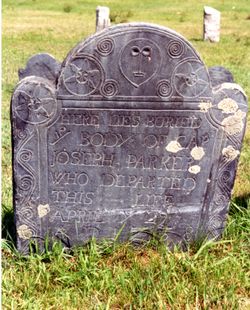
Moses Parker was born on 13 May 1731 in Chelmsford. Seven years earlier, his father Joseph had served as a “Lieutenant of a company of snowshoe-men” in what would be called Dummer’s War. Once back home, Joseph Parker served on committees and boards for both his meetinghouse and his town.

In 1738, when Moses was seven years old, Joseph Parker died. According to a Parker family genealogy he “perished, with his whole command, in a terrible battle with the Oneidas.” However, I can’t find any other mention of such an event. And his body was buried in Chelmsford, not a frontier battlefield. Joseph Parker’s gravestone appears here, courtesy of Find a Grave.

As an adult, Moses Parker followed his father into the provincial military service. A Chelmsford company set out for northern New York in March 1755 and stayed until January. Moses Parker went out as a sergeant and evidently came back as an ensign.

Wilkes Allen’s 1820 History of Chelmsford then says of Parker:
In 1758, he was honored with a lieutenant’s commission in a company commanded by Capt. Jona. Butterfield, and raised for the express purpose of a general invasion of Canada. He was promoted to a captain in the succeeding year, and in 1760, commanded a company at Fort Frederick, St. John’s. In this expedition he distinguished himself as a brave soldier, and as an intrepid and dauntless officer, he was endeared to those under his care by his assidiuous [sic] attention to their wants and constant endeavors to render their situation as pleasant as circumstances would permit.

Such was his reputation that when Governour [Francis] Bernard in 1761, was selecting from a multitude of applicants, thirty captains for that year’s service, Capt. Parker stood forth the most prominent military character on the list. Col. [Nathaniel] Thwing [1703-1768] and Col. [William] Arbuthnot [1726-1765] declared, that “they would not go without him, that he was the only Captain they had insisted upon.” So great was his popularity, that his friends assured him, that if he would accept of a captainship, “fifty men might be immediately raised to serve under him.” [Footnote citation: “M.S. Letter of Oliver Fletcher, Esq.”]
According to the Rev. Wilson Waters’s 1917 history of Chelmsford, Parker’s farm was 150 rods south of where “the Middlesex turnpike [now Turnpike Road]…crosses River Meadow brook.”

In May 1774, Moses Parker was named as one of Chelmsford’s committee of correspondence. In April 1775, he commanded a company that responded to the Lexington Alarm. And on 19 May 1775 he accepted a commission from the Massachusetts Provincial Congress, with Dr. Joseph Warren presiding and signing the paperwork, as a lieutenant colonel.

Parker was in the regiment of Col. Ebenezer Bridge, a thirty-one-year-old Harvard graduate and son of Chelmsford’s minister. The major was twenty-three-year-old Dr. John Brooks of Reading. At age forty-four, with four military campaigns under his belt, Lt. Col. Parker was the regiment’s veteran officer.

On the night of 16 June 1775, Col. Bridge’s regiment was ordered to march onto the Charlestown peninsula under Col. William Prescott and fortify Bunker’s Hill.

TOMORROW: In the redoubt.

Thursday, January 26, 2017

How Many Cannon Did Henry Knox Transport?

Another question about Col. Henry Knox’s mission to northern New York to collect artillery for the siege of Boston is how many pieces he brought. And how many did he leave behind?

We have a couple of counts of artillery-pieces in the region from Gen. Philip Schuyler:
Schuyler first counted 54 cannon at Fort Ti with sizes ranging from four-pounders to eighteen-pounders, but 29 of those were in a category called “Bad cannon.” By December Schuyler was counting 53 cannon in all. There were other artillery pieces as well, including swivel guns and mortars. The general sent some weapons north into Quebec with Gen. Richard Montgomery.

Henry Knox left at least three different listings of the artillery pieces he decided to transport back. The first, dated 10 Dec 1775, was transcribed in his earliest biography, by Francis S. Drake. It includes 59 pieces of artillery, including 43 cannon and 16 mortars of different sorts. Knox also determined that one brass cannon Schuyler had labeled an eighteen-pounder was instead a twenty-four-pounder; the difference in bore appears to have been less than half an inch.

On 17 December, Knox sent Gen. Washington a list of the guns he planned to bring east, probably so that Massachusetts blacksmiths could start making shot for them. That list contained only 55 guns—he left off 4 twelve-pounders from his earlier list.

Drake also transcribed the heading of Knox’s expense report for this trip:
For expenditures in a journey from the camp round Boston to New York, Albany, and Ticonderoga, and from thence, with 55 pieces of iron and brass ordnance, 1 barrel of flints, and 23 boxes of lead, back to camp (including expenses of self, brother, and servant), £520.15.8¾.
So we might think the colonel transported 55 cannon to Boston, including 43 cannon. But on 5 January he told Gen. Washington, “We got over 4 more dble fortified 12 pounders after my last to your excellency.” So his count was back to 59. Why Knox mentioned only 55 on his expense report is a mystery, but presumably his expenses were the same.

Yet another Knox document was transcribed in the first volume of the Harvard Illustrated Magazine, published in 1900.
Knox evidently made these notes during his journey, recording what ordnance went on a scow and what on a periauger. There are overlapping listings here, but at that point the freight included “42 Cannon of different Sizes” and “16 Mortars.”

Those numbers match the inventory that I quoted yesterday from John Adams, who viewed the train of artillery in Framingham in January 1776. (Of course, an editorial note indicates that the editors of the Adams papers used the Knox papers as a reference, so we should expect them to match.)

We also have Knox’s diary for the first part of his trip, and that tells us that he lost one cannon along the way. On the afternoon of 4 January, he wrote, he was “much alarm'd by hearing that one of the heaviest Cannon had fallen in to the [Mohawk] River at Half Moon Ferry.”

Three days later, near Albany, another cannon went “fell into the River notwithstanding the precautions we took.” Knox and the locals managed to get that gun out of the water the next day, but he’d had to leave the first sunken gun behind. That explains why he set out with one more iron eighteen-pounder than Adams saw.

Thus, Col. Knox set out from Lake Champlain with 59 artillery pieces, including 43 cannon; lost one eighteen-pounder; and arrived in eastern Massachusetts with the rest.

I’ve seen a report that the 59 artillery pieces Knox selected came almost evenly from Crown Point and Fort Ticonderoga. However, I haven’t found a source for that statement.

There’s also the story told in an article in the Bulletin of the Fort Ticonderoga Museum titled “History of a Wandering Cannon.” During work on a dam across the Mohawk River in the 1850s, an iron six-pounder with the royal monogram was dredged up. It was eventually displayed at the restored Fort Ti as the cannon Knox had lost back in 1776. But I’m not sure how it shrank from being an eighteen-pounder.

Thursday, March 15, 2012

The Continentals’ Big Cannon

In 1871, Horatio Bateman’s Biographies of Two Hundred and Fifty Distinguished National Men said this about Henry Knox:
When young Knox presented himself at Washington’s headquarters, our army was destitute of cannon, without which he felt that it was impossible to cope with the British forces.
This claim, that the Continental Army had no artillery until Knox brought some back from the Lake Champlain forts, pops up in a lot popular sources, though few historians who’ve studied the record make the same mistake.

Many sources show that the Massachusetts Committee of Safety began to collect artillery pieces for an army in the fall of 1774. Their agents sought cannon from ships, shore batteries, militia armories, and hardware stores. In early April 1775, James Warren wrote to his wife from Concord, “This town is full of cannon…” During the Battle of Bunker Hill, four American artillery companies deployed with eight field-pieces, though by the end of the day they had lost five.

Knox’s trek to Crown Point and Fort Ticonderoga in the winter of 1775-76 certainly added to the Continental Army’s artillery. He and his men brought back forty-three cannon, including one brass 24-pounder and eleven 18-pounders, one brass and ten iron.

(Cannon were designated by the weight of the largest ball they could throw; thus, a 24-pounder could propel an iron ball weighing twenty-four pounds. The mouth of a 24-pounder was nearly six inches wide. For more on Revolutionary-era artillery, check out this page from Yorktown.)

Even so, the Continental Army already had guns of that size. Here’s an entry from the journal of Pvt. Samuel Bixby, stationed in Roxbury:
July 1st [1775]. Saturday. We are fortifying on all sides, and making it strong as possible around the Fort. We have two 24 lbs. Cannon, & forty balls to each. We have hauled apple trees, with limbs trimmed sharp & pointing outward from the Fort. We finished one platform, & placed the Cannon on it just at night, and then fired two balls into Boston.
Knox helped to lay out that fortification, which attracted praise from Gen. George Washington and Gen. Charles Lee four days later.

Pvt. Bixby mentioned “the 24 pounder in the Great Fort above the meeting house” again on 2 August, and on 21 September wrote, “We fired from the lower fort with our 18 pounder.” On 6 October he wrote:
6th. Frid. About 9 o’c. A.M. we flung two 18 lb balls into Boston from the lower fort, just to let them know where to find us, for which the enemy returned 90 shots.
Clearly the Continentals were outgunned by the Royal Artillery, and had a lot less gunpowder and shot to use. But it’s a myth to say that Washington’s troops had no guns or even no heavy guns until Col. Knox got back from Fort Ticonderoga.

I’ll have more to say about the myths and realities of the Continental artillery tonight at Longfellow House–Washington’s Headquarters National Historic Site.

Thursday, June 30, 2011

Handsome Pictures in a Disappointing Picture Book

Henry Knox: Bookseller, Soldier, Patriot, by Anita Silvey and Wendell Minor, is a picture-book biography published last year.

The back cover shows Henry Knox as he might have looked at age nine, starting his apprenticeship as a bookbinder. In that picture I can perceive the features that Gilbert Stuart painted forty-seven years later, and the cheery, winning personality Knox’s contemporaries described.

All of Minor’s paintings are handsome and evocative. But I can’t recommend the book because the text contains too many errors and exaggerations. Some of those mistakes appear in popular biographies of Knox, such as the notion that the heavy cannon from Fort Ticonderoga were “all the working artillery of the Continental Army.” But others I can’t find any support for.

Most important is the statement that contemporaries called the trek from Ticonderoga with those cannon “Knox’s Folly.” In fact, the idea of hauling guns from Lake Champlain to Cambridge had been around for months before Knox undertook it. Massachusetts’s original orders to Col. Benedict Arnold to take the fort also told him to bring back the cannon inside. Gen. George Washington’s council of war in October 1775 agreed that the army should transport guns from Crown Point. It doesn’t take much away from Henry Knox’s hard work to acknowledge that he wasn’t a lone rebel standing up to a crowd.

There are a lot of other misstatements, large and small. When Henry was nine, it was not “difficult for such a young boy to find full-time work”; hundreds of Boston boys were apprentices by that age. There were not “several thousand British troops” in Boston when Knox came of age in 1771; there were a few hundred stationed on Castle Island. The British military never “surrounded the city” and kept out food; that’s what the provincial military tried to do during the siege.

Gen. Washington arrived in Cambridge not on 14 June 1775, but 2 July. “Randall lineback oxen” are a modern breed; the term does not date from the eighteenth century. A list of “all the major battles of the war” should include Saratoga, Brandywine, Monmouth, Cowpens, and more, not just Washington’s famous triumphs of “Valley Forge, Trenton, Princeton, and Yorktown”—especially since Valley Forge was a winter encampment, not a battle. Gen. Howe was not knighted until after the siege of Boston, and Gen. Ward spelled his name “Artemas.”

I wish I’d had a chance to fact-check this book before it went to the printer. Its basic story of Henry Knox is solid. With a thorough vetting, the text could have matched the quality of the art.

(Review based on advance unbound copy supplied by the publisher.)