J. L. BELL is a Massachusetts writer who specializes in (among other things) the start of the American Revolution in and around Boston. He is particularly interested in the experiences of children in 1765-75. He has published scholarly papers and popular articles for both children and adults. He was consultant for an episode of History Detectives, and contributed to a display at Minute Man National Historic Park.

Subscribe thru Follow.it


•••••••••••••••••


Showing posts with label food. Show all posts

Wednesday, June 10, 2026

Three Podcast Episodes

Producing a podcast strikes me as a lot of work, but speaking about Boston history on other folks’ podcasts is always fun.

Here are three episodes I’ve recorded in the last few months. Enjoy all you can.

“The Spark: How Boston Ignited the American Revolution” on The Object of History from the Massachusetts Historical Society

We ask several historians for their thoughts on why Boston helped light the spark of the American Revolution. Was there something unique about Boston's community or geography that made it prone to a rebellious spirit? We sit down with J. L. Bell, Historian of the Revolutionary Era in Massachusetts, Garrett Dash Nelson, President & Head Curator at the Leventhal Map & Education Center at the Boston Public Library, and Kathryn Lasdow, Assistant Professor of History and Director of Public History at Suffolk University, to answer this question.
I’d already been mulling about “Why did the Revolutionary conflict flare up in Boston?” when the invitation to explore that question arrived. Hear my threefold answer and more.

“Boston” on History’s Greatest Cities from History Extra
As one of the oldest cities in the United States, Boston played a pivotal role in the outbreak of the American Revolutionary War, as well as the signing of the Declaration of Independence that followed. In this episode of History’s Greatest Cities, Paul Bloomfield is joined by writer John Bell to explore the storied history of the capital of Massachusetts. Together, they wander through Boston’s oldest neighbourhoods, tracing the story of this harbour city from its pre-colonial roots, through Puritan settlement, to its rise as a major port and administrative centre of the British Atlantic world.
This podcast asks its guests to answer a series of questions, from major events to foods a visitor mustn’t miss.

“Not What You Hurd” on Antiques Roadshow Detours from GBH
In the world of rare silver, American Colonial silver is the stuff collectors dream of. So, when a pair of drinking vessels or “canns,” complete with intricate engraving by a master Boston craftsman, were discovered during ROADSHOW’s visit to Akron in 2023, expert Nick Dawes examined the cups’ clues to reveal both the silver’s early-American history and extraordinary value. But does Nick’s tale of the tankards hold water? Join host Adam Monahan as he searches for the untarnished truth, picking through the many stories, half-truths, and wishful legends in a quest for what may or may not have been lost to history forever.
My voice pops up occasionally on this episode, leaving more time for the fine local historians Joel Bohy and Caitlin DeAngelis.

Thursday, May 28, 2026

“Specimens of Indian Insult”

I’ve quoted a couple of accounts of mock battles on Boston Common during militia musters, as reported proudly in the local newspapers. On those occasions, half the local unit provided an enemy by portraying the French.

Here’s a report from the 12 May 1774 Norwich Packet, describing a different scenario in Woodstock, Connecticut, a town on the border with Massachusetts:
NORWICH, May, 12.

A Correspondent from Woodstock informs us, that on Monday the 2d. Inst. the Three Military Companies of that Town met upon the Parade, in the First Society, where they performed the Manual Exercise with a Spirit and Activity that did Honour to their Officers and themselves.

At Eleven o’Clock a Troop of Horse, under the Command of Capt. Samuel McClellan, came upon the Parade; which, for elegance of Dress, goodness of the Horses, and suitable Furniture, were judged, by the numerous Spectators present, to be inferior to no Troop in America.

At Three o’Clock the Foot and Troop feigned a Skirmish with each other, which they conducted with Propriety and Order: Suddenly a Company of Aborigines appeared, who made Captives of some of the Children present, and gave other Specimens of Indian Insult to the Foot and Horse: Their Depredations roused the New-England Spirit in the Troop, who, with seem Fury, attacked and drove them yelling off the Field, to the great Joy of the Spectators.

The good Order that was observed, not only by the Troop and Foot Companies, but also by the Spectators, was remarkable.----No Injury was sustained by any One present. The Day and Evening Entertainments, were concluded with strict Sobriety and Decency.

The Captain of the Troop gave an elegant Dinner to his Company and a Number of Gentlemen, as also did Capt. [Benjamin?] Lyon, and the Colonel of the Regiment honoured the Day with his Presence.
I’ve found this event mentioned in a local history but not quoted in full. It offers an example of what Philip J. Deloria called “playing Indian” in American culture. This moment was a few months after the Boston Tea Party, a few months before the Patriot press began to share fearful speculations that the Crown government might recruit Natives and French Canadians to attack resistant colonies.

Ironically, the town of Woodstock contains the site of Wabaquasset, a Native American “praying town” from the mid-1600s. That community was split and depopulated by the King Philip’s War. Englishmen from Roxbury then settled the land. The town’s seal now depicts Native and English men standing on either side of a heraldic shield.

Tuesday, May 26, 2026

“Environmental History & the War of Independence” in Boston, 27 May

David Hsiung is the Dr. Charles R. and Shirley A. Knox Professor of History at Juniata College in Pennsylvania.

For several years he’s been working on the problem of how the enviroment affected the American Revolution, how the Revolution affected the environment, and how it’s possible to study those interactions with the data we have.

That is, of course, a huge topic, so part of the historiographical challenge is, I’m sure, to narrow down and define the questions in a manageable way. In the meantime, I’ve been enjoying his articles and lectures, which always open my eyes to new ways of seeing this history.

On Wednesday, 27 May, David Hsiung will be at the Massachusetts Historical Society for a conversation with Joyce A. Chaplin of Harvard, author most recently of The Franklin Stove: An Unintended American Revolution.

The description of “Curious & Complex Connections: Environmental History & the War of Independence” says:
Many of us give only a moment’s thought about the environment when considering the War of Independence: the slope of Breed’s Hill, the ice-choked Delaware River, and diseases such as smallpox. But what might we gain by connecting biology, ecology, and geology to the thinking and actions of soldiers and civilians? Rebels and British soldiers acquired and used energy in the form of food, fuel, and work animals, which shaped people’s lives, the course of the war, and the direction of environmental change.
This is a hybrid event starting at 6 P.M., with a reception in the preceding half-hour for people attending in person. Attendance costs $10, but is free to M.H.S. members and Card to Culture participants. Listening in online is free. Register for either form of access through this page.

Folks can also take in these talks from Prof. Hsiung:

Friday, May 01, 2026

”No other Crime, but retaining their Allegiance to the King”

We left John Hill, his wife Elizabeth (?), and his daughter in the Boston jail in February 1777, suspected of “being Enemical to the States” and “attempting to Carry Intillegence to the Enemy.”

The next trace of Hill that I’ve found is from John Noble’s article “Some Massachusetts Tories” for the Colonial Society of Massachusetts in 1900:
At the July [court] Term, 1777, John Hill of Boston recovers judgment in a plea of the case against Crean Brush for £2.8s.10d lawful money, and costs.
Did Hill sue Brush, his employer during the evacuation from Boston, for some loss? Or was this another John Hill?

There’s firmer information from John Howe’s Newport Gazette, published in the British-occupied city on 20 Nov 1777:
By Mr. JOHN HILL, who left Boston the 15th of October, we learn, that Dr. [Benjamin] Church, Mr. John Dean Whitworth, of the Queen’s Rangers, and a Number of others, are yet confined in Boston; Dr. [Mather] Byles is confined in his own House; and upwards of 70 Persons, who can be charged with no other Crime, but retaining their Allegiance to the King, and Attachment to that happy Constitution under which they were born, and from which they have enjoyed the most solid and inestimable Blessings, are now confined on board a Prison Ship in that Harbour.—

He also adds, that almost every Goal in New England is filled with these unhappy People.

Mr. Hill has also favoured us with the current Prices, in Lawful Money, of the following Articles, at the Time he left it:
Beef, — — 0.1.3
Mutton, — — 0.1.6
Butter, — — 0.4.0
And so on through a list of other meats and foods, alcohols, sugars, teas, and cordwood to shoes for men (£2.2/pair) and women (£1.10/pair).

Presumably Howe was making the point about price inflation in Continental-governed areas, but we’d have to find pre-war costs for comparison.

Years later John Hill told the Loyalists Commission, as recorded by Todd Braisted:
That on the 17th of March 1776, he left Boston, with the Royal Army; but was taken at Sea, by the Rebels, . . . himself, his Wife, & Daughter was carried back to Boston, and he confined in Prison 19 months; they were all tried For their lives, but not Condemned.

In November 1777, they were Exchanged, went to Halifax, and afterwards to New York
Hill’s memory was off by just a few weeks. It’s possible he didn’t remember the port his family came through, or that the Hills went from Newport to Halifax. Adding to the confusion on that point, on 16 Oct 1777 the Independent Chronicle reported that “a Cartel” ship “with upwards 130 Prisoners on board” had sailed the previous day from Boston for Halifax. 

By whatever route they left New England, John Hill, his wife, and his daughter eventually returned to New York, the city he’d been chased out of in the spring of 1775. But now it was held by the British military.

TOMORROW: Inspector Hill.

Friday, April 10, 2026

“With an Irony which inflamed their resentments”

As Crean Brush was seizing linen and woolens for the British military in March 1776, some of the wealthy merchants who owned that cloth complained to Gen. William Howe’s headquarters.

Brush responded with a memo to Gen. James Robertson, who was overseeing the evacuation:
if any Articles were removed which did not answer the description [in Howe’s order] the Parties are only to blame they being repeatedly called on to declare the Contents of each which they obstinately refused—

These People your Memorialist are irritated against him but your Memorialist begs leave to assure your Honor he is fully able to prove that his Conduct toward them was governed with politeness coolness & moderation

true it is that when attempts were made to engage his attention in tedious dissertations on Magna Charta & the rights of British Subjects with intent to retard him in the execution of his Office he did interrupt such Harangues & with an Irony which inflamed their resentments complimented them on their Eloquence which had in Town Meetings been so successful as to throw all America into confusion but that I was upon Business which I was determined to execute without interruption—

The Goods I received from the Stores were taken on board & stowed away with all the care & attention my peculiar Situation would possibly admit and I solemnly aver that from the 5th to the 13th March my own Assiduity was so great that I did not in any one Night allow Myself more than two Hours Sleep…
With the help of his assistants plus “two boys and a man” on board the Elizabeth, Brush managed to pack that brig. Some of Cyrus Baldwin’s goods went onto the Minerva.

At some point Brush’s assistants—Charles Blasquet, Richard and John Hill, and David Cunningham—appear to have asked what arrangements he’d made to get them and their families out of Boston. To his credit, he didn’t just ask what arrangements they’d made for themselves. Instead, Brush recognized that they’d “neglected their own Concerns to serve Government at my request.”

Crean Brush hustled those men and their families onto the Elizabeth into “a small space between Decks.” He later told Gen. Howe they had all brought their own provisions so they “cannot be the least convenience to any Person on board.” Basically, he asked for forgiveness instead of permission.

Brush’s memos to Robertson and Howe, published in the Naval Documents of the American Revolution, document the hurry and disorder of the evacuation. He was managing goods that merchants had asked him to store, goods that he’d seized from Patriots who had left Boston, the cloth that he’d been commissioned to keep out of rebel hands, and his own property. And he was trying, at least on paper, to keep these all separate and safely stored.

Conflict continued even on the Elizabeth. Brush had loaded nineteen barrels of flour on board, on “Major Hutchinsons orders”—I think this was Maj. Frances Hutcheson of the 60th Regiment, the army paymaster. Brush told Robertson:
the second Barrell which was opened I sent for some [flour] which when discovered by Mr [Caleb] Wheaten he imperiously flourished [his sword] over me while in Bed & told me he was surprized at the assurance I dared to shew in giving directions to have any,

Upon which I told him he was an insignificant inpertinent Puppy.

Captain [Peter] Ramsey at that instant came in declared he would not hear one word of the occasion which provoked me to use the words I have mentioned but that if I uttered three words more he would send me Prisoner on board the Commodore—
While dealing with such quarrels, Capt. Ramsey got the Elizabeth out of Boston harbor with the rest of the evacuation fleet by the end of March.

And on 2 April three American schooners captured the ship.

TOMORROW: In custody.

Wednesday, December 17, 2025

Eight Runaway Men in a Boat from Boston

Capt. Richard Dodge was a Continental Army officer stationed in Chelsea during the second half of 1775. Like his regimental commander, Lt. Col. Loammi Baldwin, he sent periodic reports to Gen. George Washington’s headquarters about what he saw in Boston harbor.

On 16 December, Dodge reported some exciting news: “Last Eveing Eight men Runaway in a bote from Boston to our guard at the farry.”

Following recently enacted protocol, Dodge sent those men to a local health committee who “Clensed them by Smooking them” against the smallpox.

Six (or seven, according to the 25 December Boston Gazette) of those eight men were “masters of Vassels” captured by the Royal Navy and brought into Boston over the preceding months.

One, Capt. James Warden, had sailed for the Philadelphia merchant Thomas Mifflin and was anxious to renew their acquaintance now that Mifflin was the army’s quartermaster general. Naval Documents of the American Revolution reports that Warden was commanding the schooner Tryal on 22 August when it surrendered to H.M.S. Nautilus under Capt. John Collins.

The Essex Journal of Newburyport identified another of those ship’s captains as named Nowell, possibly Silas Nowell (who wouldn’t have been held that long). He came out with a copy of the Boston News-Letter, the only newspaper still being published in the town, and the news that Gen. John Burgoyne had sailed for England.

On 17 December, 250 years ago today, Dodge wrote out a précis of what those men told him about life inside Boston. The prices for food were high. One escapee reported that “he Dined with a man that Dined with Lord parsey a feu Day ago upon horse beaff.”

Firewood was even scarcer with winter coming on. Gen. William Howe had ordered the Old North Meeting-House and empty houses torn down for fuel. We also know Howe told London that he might have to order wharves torn up next.

Citing Capt. Nowell, the newspapers added that “all the drugs and medicines in the town have been seized for the use of the army.”

TOMORROW: Tales of the searcher.

Sunday, December 14, 2025

“I Enquired for the waggon master”

On 16 May 1776, Gen. John Sullivan was at Albany, New York, trying to organize the remnants of the Continental Army’s invasion of Canada.

He sent a letter to Gen. George Washington complaining of the Northern Department’s wagon master, among other things:

Early on the 15 Inst. to my Surprize I found three hundred Barrels (which I had Sent forward) Lying on the Beach without any teams to Carry them to Still water about twelve miles further

I Enquired for the waggon master & was Informed he was at his own House About Six miles off

I Immediately wrote him of the Necessity of his Exerting himself at this time
Two days later Sullivan sent off another complaint about the wagon drivers:
I found at Still water a Number of Barrells of Pork that the Waggoners had Tap[p]ed & Drawn off the pickle to Lighten their Teams. This pork must Enevetably be Ruin’d before it can reach Canada,

as Genl [Philip] Schuyler was Absent I Order’d the Commissary not to Receive any Such from the Waggoners & the Commissary at half moon not to receive out of the Boats any or Deliver out such to the Waggoners.

I order’d the Waggoners not to Receive any such as it would Eventually be thrown on their hands I then Directed the Commissary here not to Send any Barrels forwards that had lost the Pickle which would be only taking up Batteaus & Waggons to Cary Provisions which when brought to Canada Could not be Eaten.

By this Step I hope to prevent any further fraud in the Waggoners who (it is said) Learnt this piece of Skill in the Last War, for which Some of them were well flogged, and I hope Some of them may Share the Same fate—again.
Washington passed on word of those complaints to Schuyler, who responded a month later:
As to the Waggon master he is an Industrious Active and I believe an honest Man, But It is not in his Power, nor any Mans whatsoever to procure Waggons at all Times & at that Time It was peculiarly difficult both on Account of the Scarcity of Forrage the Badness of the Roads and the extravagant Abuses the Waggoners had met with from some of the Troops that preceded General Sullivan’s Brigade.
Neither general named the wagon master, which might reflect how he wielded authority over the teamsters but wasn’t at the level of a gentlemen. Their letters do offer some clues about the man: He had his own house about six miles from where Sullivan was in Albany. He was literate. He was independent.

Now that man in May 1776 wasn’t necessarily the same official whom Schuyler oversaw in December 1775. Nonetheless, he was clearly not one of Schuyler’s slaves.

TOMORROW: Names at last.

Sunday, November 23, 2025

Back to the Scene of the Crime

A significant portion of The Road to Concord focuses on one spot in Boston: the corner of West Street and Tremont Street. There, across from the Common, stood the South Writing School and the newer gunhouse of the militia train of artillery.

(Now that space is occupied by a Suffolk University dormitory, a Sal’s Pizza, and a Blue Bikes rack.)

In September 1774, as I wrote in the book, the artillery company dissolved amid political recriminations. Soon their four small brass cannon disappeared, two from that corner.

In April 1775, war broke out, in some immediate sense because of those cannon, and all of Boston’s public schools shut down.

The following March, the British military left Boston. Patriot authorities gained control. After tending to the most dire problems, the selectmen looked ahead to a new school year, which would ordinarily begin in July.

In June the selectmen ordered the South Writing School to reopen. However, Master Samuel Holbrook was still out of town. So were a lot of families—Boston’s population was only a fraction of what it had been.

The selectmen therefore said that James Carter, the master of the Queen Street Writing School, would fill in for Master Holbrook. In effect, I think, that was consolidating the two schools for at least a few months until enough pupils returned to justify reopening both schoolhouses.

In October 1777 the town looked into repairing the South Writing School, possibly from damage during the siege. Two months later, Master Holbrook asked for an assistant, to be paid £34 plus £16 “on Accot. of the rise of Provisions”—i.e., the price of food had inflated. 

Ordinarily a schoolmaster had an adult assistant called an “usher,” paid about half of the master’s salary. Holbrook asking for an “assistant” with a smaller salary suggests that he was seeking to hire a teenager, as he had employed Andrew Cunningham in 1774–75. Perhaps he had in mind his own son Abiah, then fourteen years old.

We can see the effects of inflation in how the town meeting voted to pay Holbrook over the next few years:
  • March 1778: £100 salary plus £100 “on Account of the present high Price of Provisions &c.” in the next six months.
  • November 1778: £140 more to cover the remaining six months of the year.
  • March 1779: a town committee recommended £600 for Holbrook himself plus £100 for his usher and £30 house rent. The meeting approved even more: £640 for the master, £300 for the usher.
  • November 1779: and another supplemental grant, £1,500 for September through March.
Master Holbrook’s usher arriving in October 1778 was named Abiah Holbrook. The master’s son would still have been too young to command that title and salary. But Holbrook also had a nephew named Abiah Holbrook. A man of that name advertised a school in Portsmouth, New Hampshire, from 1775 to 1777. So perhaps that man moved to Boston to work for his uncle, taking the place of his young cousin. Running writing schools was a family business; Master Holbrook had started out working as usher under his own brother—named, of course, Abiah.

Thus, as the 1770s ended, the South Writing School was back in operation under Master Samuel Holbrook, just as it had been at the start of the decade. But it was costing a lot more to operate, at least in inflated wartime currency.

TOMORROW: Changes at the gunhouse.

Thursday, September 04, 2025

“The blood continued to dribble, for two days after”

In 1805, Henry St. John Neale published the second edition of his Chirurgical Institutes, Drawn from Practice, on the Knowledge and Treatment of Gun-shot Wounds.

In another book Neale identified himself as “formerly surgeon to the Duke of Northumberland’s regiment, of fifth battalion of infantry, and the Royal Hospital at Chatham.”

The Duke of Northumberland was previously Earl Percy, colonel of the 5th Regiment. The 1781 Army List names Neale (rendered as “St. John Neill”) as surgeon of that regiment, appointed November 1780. He may have previously been a surgeon’s mate, or he may have drawn from his predecessors’ accounts of what they did earlier in the war.

Chirurgical Institutes contains a description of Lt. Thomas Hawkshaw’s condition and treatment by the 5th’s medical staff after he was wounded on 19 Apr 1775.

Neale’s section labeled “History of the wound of the gallant Captain Hawkshaw.” reported:
The most remarkable wound in the neck, which happened during the American war, was that of Captain Hawkshaw, of his Majesty’s 5th regiment of infantry, This gallant officer was wounded in the neck, by a musquet ball, which entered the coraco hyoideus muscle, on the right side, passing through and through behind the gullet, which it grazed in its passage.

The sufferings of that brave soldier, in the course of his cure, is far above my abilities to express, which he bore with the greatest fortitude. The instant after he received his wound, the blood gushed out in torrents from his mouth and nostrils, and the wound also bled profusely. At first it was feared that the large blood vessels had suffered, but they fortunately escaped from the blow: although the ball had passed within a hair’s breadth of the COROTID ARTERIES.

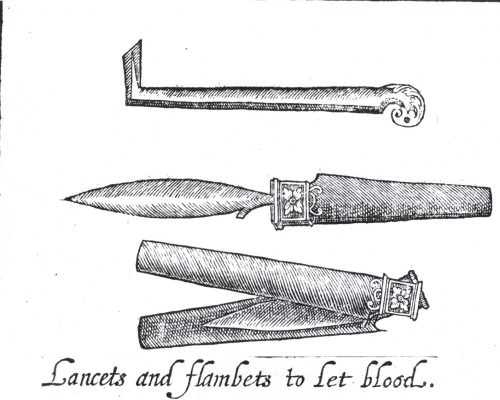
An external dilatation [stretching] was soon made, as much as the situation of the parts would admit, a soft dressing applied, and as soon as was possible, his neck covered with an emollient poultice. Soon after he was bled copiously, although he had lost a large quantity from the wound, and the blood continued to dribble, for two days after, from his mouth and nostrils.

In the evening he had a clyster [enema], and towards bed time, a few drops of laudanum, which was got down with great difficulty. He spent a restless night, and as we were fearful of a hæmorrhage, a surgeon was constantly with him. The next day all his powers of deglutition [swallowing] were impeded, so that he could scarcely get down fluids into his stomach, which was contrived to be conveyed through a small tube by suction: and the same method was used for his anodyne [painkiller] at night. The second and third night was something better than the first, but attended with considerable spasms at intervals.

On the third morning the dressings were removed, which came off with ease, from the suppuration which had taken place, and the wound dressed with warm balsamic digestives. The inflammation of the surrounding parts, was very considerable, which had communicated to both the larynx and pharynx.

From the third to the twentieth day, matters went on (all circumstances attending this extraordinary wound being considered) as well as could be expected. He was supported solely by fluids, which he sucked down through the small tube above mentioned, for the space of thirty days, sometimes cows milk, at other times panada [bread soup], with now and then a spoonful of wine.

About the end of this period, he was enabled to swallow spoon meat, but was reduced to great weakness. The peruvian bark [quinine] was now administered copiously, and in three weeks more he was enabled to get down solid food.

In another fortnight his wound was perfectly healed, and in every respect he was restored to his pristine health, to the great joy of all who were acquainted with the great merit of this brave officer.
Thomas Hawkshaw was a lieutenant when he was wounded, but he was promoted to be a captain-lieutenant in the 5th Regiment in November 1777 and then captain in November 1778. Neale probably knew him by that rank. There was certainly no other officer named Hawkshaw in the regiment.

It’s striking how these eighteenth-century military surgeons decided that a patient who just had blood gushing from his mouth, his nostrils, and a wound in his neck really needed to be “bled copiously.” And it’s a testament to Lt. Hawkshaw’s constitution that he survived.

TOMORROW: A deathbed admission?

Sunday, July 27, 2025

“We march’d into the camp & told the army what we had done”

I’ve been quoting Capt. Nathaniel Folsom’s account of his New Hampshire troops’ fight against a French and Indian force south of Lake George in the late afternoon of 8 Aug 1755.

He continued with lively detail:
After being closely engaged for about three quarters of an hour, they kill’d two of our men & wounded several more on our left wing, where they had gain’d a great advantage of us.

Which, with our being very much tired and fatigued, ocсаsioned us to retreat a little way back; but finding by our retreat we were likely to give the enemy a greater advantage we rallied again in order to recover the ground we had lost, and thinking that if we quitted the ground we should loose our greatest advantage, about fifteen or twenty of us ran up the hill at all hazard. Which we had no sooner done but the enemy fired upon us vigorously; & then, seeing us coming upon them (we being charg’d & they discharg’d) they run & gave us the ground.

Whereupon we all shouted with one voice and were not a little encouraged. In this skirmish Ensign Jonathan Folsom [the writer’s brother] was shot through the shoulder & several others wounded. At every second or third discharge during the engagement we made huzzas as loud as we could but not to be compar’d to the yells of our enemies, which seem’d to be rather the yellings of devils than of men.

A little before sunsetting I was told that a party of the Yorkers were going to leave us, which surpris’d me. I look’d & saw them in the waggon road with packs on their backs. I went to them & asked where they were going. They said to Fort Edward. I told them they would sacrifice their own lives & ours too. They answer’d they would not stay there to be kill’d by the damn’d Indians after dark but would go off by daylight.

Capt. [John] Moore and Lieut. [Nathaniel] Abbott & myself try’d to perswade them to tarry, but to no purpose till I told them that the minit they attempted to march from us I would order our New Hampe. men to discharge upon them. Soon after which they throw’d off their packs & we went to our posts again.

Upon my return to my tree, where I had fought before, I found a neat’s tongue (as I tho’t) and a French loaf, which, happening in so good a season, I gave myself time to eat of; & seeing my lieut. at a little distance, much tired & beat out, I told him if he would venture to come to me, I would give him something to comfort him. He came to me & told me I was eating a horse’s tongue. I told him it was so good I tho’t he had never eat anything better in his life.

I presently saw some Yorkers handing about a cagg of brandy, which I took part of & distributed amongst the men. Which reviv’d us all to that degree that I imagin’d we fought better than ever we did before.

Between sunsett and the shutting in of daylight we call’d to our enemies: told them we had a thousand come to our assistance; that we should now have them imediately in our hands; and thereupon made a great shouting & beat our drums. Upon which they drew off upon the left wing, but stood it on the front & right wing till daylight was in & then retreated & run off.

Then we begun to get things ready to march to the lake, when Providence sent us three waggon horses upon which we carry’d in six wounded men; made a bier & carried one on, lead some & carry’d some on our backs. We found six of our men kill’d & mortally wounded so that they dyed in a few days, and fourteen others wounded & shot through their cloaths, hatts, &c. With much difficulty we persuaded the Yorkers to go with us to the lake.

In about an hour after the battle was over we march’d & sent two men forward to discover who were inhabitants at the lake. Who met us and told us all was well. Whereupon we march’d into the camp & told the army what we had done. As soon as they understood by us that we had drove the enemy off & made a clear passage for the English between forts, the whole army shouted for joy, like the shouting of a great host.
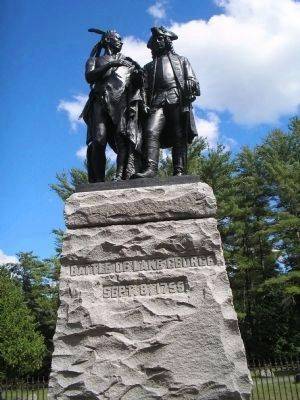
That was the third part of the Battle of Lake George. The French forces had won the first stage with their ambush of the British column heading south to Fort Lyman (Edward). But pressing that attack brought out the larger British force camped at Lake George, and the Crown won the second stage. Then Capt. Folsom, Capt. William Maginnis of New York, and other provincials came up behind the French fighters who had fallen back and started this third and smallest stage.

TOMORROW: Who won?

Friday, July 18, 2025

“Altho’ he made his living by crying, he was always in a most jovial mood”

Last week History.com published Elizabeth Yuko’s article “Town Criers Were the Original Social Media.”

The scope of this survey ranges from medieval period to the early nineteenth century, in Europe and various parts of America. Yuko quoted my observations on the town criers of Boston.

The 1796 Boston directory listed only John Weare as a crier, a post that Laurie Halse Anderson found he’d held since 1782. But Weare died in 1800. The 1809 Boston directory listed James Wilson as the town crier, living “over 23 Cornhill” near the center of town.

In Old Boston Town: Early in This Century (1883), James Hale wrote:
The steps of the Exchange Coffee House were much used by James Wilson, the town crier, to announce the auction sales of Whitwell & Bond, Thomas K. Jones & Co., David Hale (afterwards of N. Y. Journal Commerce), and other auctioneers, who did chiefly congregate in Kilby street, near State.

Jimmy was a great humorist, and altho’ he made his living by crying, he was always in a most jovial mood. He generally closed the formal announcement of an auction by some quizzical remark to a bystander, for he knew everybody, and was on familiar terms with all sorts and conditions of men.

Jimmy Wilson was often at his post about nine o’clock in the evening, ringing his bell loudly for several minutes to collect a large crowd, and then announcing a lost child, or a lost pocket-book. His account of the agony of bereaved parents would be heart-rending, when he would suddenly explode a joke which would start the crowd off, roaring.
In Rambles in Old Boston (1886), Edward Griffin Porter added:
James Wilson…for nearly half a century was better known probably among men, women, and children than any other person in the town. He was a short, thick-set, red-faced man, with keen eyes and a powerful voice. Although commonly known as the crier, he was a brush-maker by trade, and a good one too. The writer has seen a pair of clothes-brushes made by him, which have been in constant use in Boston for over seventy years, and are as good apparently as ever.

Wilson’s shop was in the basement of the Exchange Coffee-House, fronting upon what is now Congress Square. At one period he sold ale, after the English fashion, in pewter mugs, and had a foaming “toby” painted on his door to indicate it; but his chief sign was this bell in hand, said to be a correct copy of the bell he carried so many years.
Wilson’s retailing establishment eventually developed into today’s Bell in Hand tavern.

Saturday, July 05, 2025

“Siege and Liberation of Boston,” 7–8 Aug.

Registration is open for the third Pursuit of History Weekend that I’ve helped to program, this one on “The Siege and Liberation of Boston” on 7–8 August.

Organized with the folks who manage History Camp, these sessions are designed to offer in-depth looks at developments 250 years ago through expert speakers and visits to the actual sites where the history happened.

We’ll start on the slope of Breed’s Hill in Charlestown, exploring what turned out to be the decisive battle of the first campaign of the Revolutionary War. Sam Forman and Mary Adams will introduce two of the leaders of the American forces, Dr. Joseph Warren and John Stark. We’ll walk the battlefield and hear about ongoing investigations of the landscape from Boston City Archaeologist Joe Bagley. Then we’ll take a road trip to other places that the Continental Army fortified, which few visitors see. That day we plan to have meals at two restaurants that go back to the eighteenth century.

On the following day, we’ll move into the North End, collaborating with the Paul Revere House, the Old North Church, and veteran tour guide Charles Bahne to offer an in-depth look at the experience of living inside besieged Boston. Finally, I’ll speak about George Washington as a new commander-in-chief, what he thought his job was, and what he really learned.

The Pursuit of History webpage for this event has a video of me explaining more. Sam Forman and I are also scheduled to talk about the siege and this event in the History Camp discussion series on Thursday, 10 July, at 8:00 P.M.

This Pursuit of History Weekend is not, in fact, on a weekend but on a Thursday and Friday. That’s to allow people to also attend History Camp Boston on Saturday, 9 August, and even the related tours the next day if their history interests are still unsated.

And speaking of History Camp Boston 2025, I’ll be speaking there, too. My topic is related to the end of the Boston siege. That talk is called “Henry Knox, Loyalist?” It offers a new interpretation of that American general’s rise to prominence.

Saturday, June 14, 2025

“The said Inventory (A Very few Articles excepted)”

By 1787, Henry Howell Williams had been reestablished on Noddle’s Island for about three years.

Having stayed in Massachusetts throughout the war, Williams had also established his loyalty to the republic, which might have been in doubt back in 1774 and 1775.

Williams then decided to revive his effort to be compensated for the loss of his animals and the destruction of his farm and house back in May and June 1775.

Williams assembled a long list of the property he had lost twelve years before, including furniture, clothing, and food. A sampling of the items:
  • “24 very Eloquent Gilt Pictures, 1 small Carpet”
  • “1 Coat of Arms work'd on Satting with Silver & Gold thread”
  • “40 lb. of flax 2 Barrls Hops & 3 Quntal salt fish”
  • “3 Large Jarr’s Sweet meats never opened”
  • “1 Mahogy. Clock cost in England 25 £ Sterl. New”
  • “1 Silver Nipple & Bottle”
  • “60 bullets 30 lb. Lead. 6 Powdr horns. 2 Powdr flasks”
  • “1 Barrl. best hard Bread a large Quanty of Loaf Sugar”
  • “1 Large Bible & Several Other Books”
  • “3 Hogsheads New Rum Just got home from the W. Indies Quanty. 234 Gallons a 3/4–”
  • “6 Chissells 3 dung forks. Squares &c.”
  • “1 large Boat £32– 1 Moses do £14. 1 yall £10–”
  • “A New Black-Smiths Shop”
  • “333 Young Locust tree’s Cut down which were Set out by Mr. Williams & were to have been paid for by the Owners of the Island at 3/ Each”
As to livestock, Williams stated he had lost:
43 Elegant Horses...@ 30£ Each put into the Publick Stables … £1290:11:—
3 Cattle taken & used as Provisions for the Army … 30:11:—
220 Sheep used as Provisions as above @12/- … 132:11:—
4 fine Swine … 12:11:—
5 Dozn Fowls Turkys & Ducks … 6:11:—
The bottom line was £3645:6:2. That might or might not have been in debased local currency, but pound for pound that total was more than a third of what the East India Company had calculated as its loss in Boston harbor back in 1773.

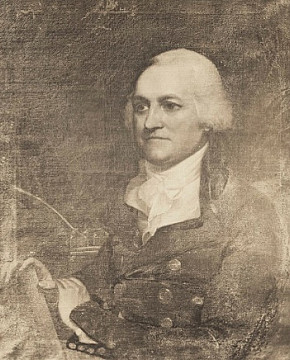
On 10 Mar 1787, Williams and his wife Elizabeth went before magistrate William Tudor (shown above) and swore
That the said Inventory (A Very few Articles excepted) was taken in the month of July following [the raids] & that according to my best Judgment and Recollection the Same is just and true
The whole document can be studied on the Massachusetts Historical Society’s website.

In addition, Williams had collected some evidence supporting his claim, or perhaps answering critics who had said back in 1775 and 1776 that he didn’t deserve financial support.

TOMORROW: Supporting documents.

Saturday, May 31, 2025

Heading into June 1775 with Confidence

One consequence of the Battle of Chelsea Creek is that by the end of May 1775 the provincial troops started to feel pretty powerful.

The militia mobilization of the Lexington Alarm had done significant damage to the Crown forces. Fortifications were keeping the king’s troops inside Boston.

The Royal Navy was seizing some ships and raiding coasts and islands for food. But three times now the provincial defenses had pushed back. Fairhaven men had recaptured two ships from Capt. John Linzee of H.M.S. Falcon. Hingham and other South Shore companies had forced troops off Grape Island with only a fraction of the hay they wanted.

And the fight over Hog Island and Noddle’s Island was even more impressive. The provincials came away with some livestock, reducing the food supply for besieged Boston. They set fire to hay being grown to feed the army’s horses.

In the fighting that followed, the provincials had deployed artillery for the first time and withstood return fire. They hadn’t lost any men, with four wounded and expected to recover, and reports out of Boston suggested some of the enemy had died. (Two seamen were killed, in fact, but some early reports put the number of Crown casualties as high as thirty.)

From H.M.S. Diana the provincial troops had pulled useful supplies: four four-pounder cannon, twelve swivel guns, the mast, and various bits of fresh rigging—the ship had been launched only the previous year.

And then those troops had actually destroyed the Diana—a Royal Navy warship! True, it was a relatively small vessel that had run aground, but that was obviously a provincial victory and a royalist loss.

Even the most cautious New England commanders and soldiers must have felt they were on a roll when they made the move onto the Charlestown peninsula on the night of 16 June. But the scale of the battle that followed was far beyond any other fight in the Boston campaign.

The Sestercentennial of the Battle of Bunker Hill will be observed on two successive weekends in June:
Make your plans now!

Thursday, May 29, 2025

“A Fire broke out on board the fine large Store-Ship”

While looking at the diary of Thomas Newell this spring, I was struck by this dramatic entry for 29 May 1773, 252 years ago today:
King’s store-ship burnt in this harbor. The inhabitants greatly surprised, fearing there was a great quantity of gunpowder on board. Thousands retired to the back part of the town, and over to Charlestown, &c.; but no powder happened to be on board.
John Rowe mentioned the same event in his diary, but he was out of town fishing during the panic, so his entry doesn’t preserve the same excitement.

For more detail I turned to the newspapers. Here’s the straightforward report in the 3 June Boston News-Letter:
at Noon, a Fire broke out on board the fine large Store-Ship, (which had been laying in this Harbour for several Months past commanded by Capt. [John] Walker, having Stores for the Navy) which soon communicated to the Masts, Rigging and Turpentine on the Deck, and before any Assistance came, her upper Works were almost wholly in a Blaze; so that little or no Attempt was made to extinguish it:—

The Boats from the Men of War, with some from the Town, towed the Ship over to Noddle’s Island, where, after scuttling her, she was left to burn to the Water’s Edge.—

The Fire, it is said, was occasioned by some Coals falling from the Hearth of the Cabouse on to the Deck, which had lately been pay’d over with Turpentine, and spread with such Rapidity that nothing could be taken out of her:—

The Captain, with his Wife and two Children, who usually kept on board, likewise a Boy (the other People belonging to her being ashore) were obliged to be taken out of the Cabin Windows, without being able to save the least Thing but what they had on:—

A report prevailing at the Time of the Fire, that a large Quantity of Powder was on board, put the Inhabitants in general into great Consternation, for fear of the Consequences that might arise from an Explosion thereof; but being afterwards assured that none was in her, they became perfectly easy, and the Hills and Wharfs were covered with Spectators to view so uncommon a Sight.

Some of the Stores in the Hold, such as Cordage, Cables, and Anchors, which were under Water before the Fire could reach them, will be saved.
A “caboose” was originally a ship’s galley, Merriam-Webster says. Advertisements from eighteenth-century America indicate a “caboose” could be sold separately from a ship, and in 1768 New York a man named Thomas Hempsted was killed by “the Caboose falling on him” as a ship keeled over. So I suspect it also meant the stove and other cooking equipment designed for a ship but not necessarily installed in a dedicated cabin.

The first documented use of the word “caboose” in English was in 1732, and Samuel Johnson didn’t include it in his 1755 dictionary. But everyone reading the Boston newspapers was expected to know what that meant.

TOMORROW: The conspiracy theories.

Sunday, May 25, 2025

“3 Sloops and one cutter had come out”

In May 1775, the people of Hingham and other towns along the South Shore from Boston weren’t really worrying about protecting livestock on harbor islands.

As a 3 May petition from selectmen in Braintree, Weymouth, and Hingham to the Massachusetts Provincial Congress put it, those towns felt “in great danger of an attack from the troops now in Boston, or from the ships in the harbor.”

They worried that the British military would attack the towns themselves, not off-shore pasturage—perhaps to seize food but mostly to punish the rebellious population.

The congress therefore authorized those towns to raise two and a half companies of men for their defense through the end of the year, on the same terms as the provincial soldiers being signed up to keep besieging Boston. In Hingham, James Lincoln took a captain’s commission and started recruiting.

On the morning of Sunday, 21 May, vessels were spotted maneuvering through the islands off the Weymouth shore. Abigail Adams described the response in north Braintree:
When I rose about six oclock I was told that the Drums had been some time beating and that 3 allarm Guns were fired, that Weymouth Bell had been ringing, and Mr. [Ezra] Welds [churchbell in Braintree’s middle precinct] was then ringing.

I immediatly sent of an express to know the occasion, and found the whole Town in confusion. 3 Sloops and one cutter had come out, and droped anchor just below Great Hill. It was difficult to tell their design, some supposed they were comeing to Germantown others to Weymouth. People women children from the Iron Works flocking down this Way—every woman and child above or from below my Fathers.

My Fathers family flying, the Drs. [Cotton Tufts’s] in great distress, as you may well immagine for my Aunt had her Bed thrown into a cart, into which she got herself, and orderd the boy to drive her of to Bridgwater which he did. The report was to them, that 300 hundred had landed, and were upon their march into Town.

The allarm flew [like] lightning, and men from all parts came flocking down till 2000 were collected
In Scituate, Paul Litchfield was home from Harvard College, his senior year cut short by the war. He wrote in his diary:
Just before meeting began in morning, hearing the King’s troops were landing near Hingham, the people in general dispersed, so no meeting.
The 25 May New England Chronicle, newly moved to Cambridge, reported this military response:
Last Sabbath about 10 o’clock A.M. an express arrived at General [John] Thomas’s quarters at Roxbury, informing him that four sloops (two of them armed) were sailed from Boston, to the south short of the bay, and that a number of soldiers were landing at Weymouth.

Gen. Thomas ordered three companies to march to the support of the inhabitants.
But the first newspaper report of the action was the 22 May Newport Mercury:
An express arrived here this morning, from Providence, with advice, that a party of soldiers from Boston had landed at Weymouth, and burnt the town down, and were ravaging the country when the express came away. Troops from all parts of the country were going to oppose them.——The particulars not yet come to hand.
TOMORROW: The particulars of what really happened.

Saturday, May 24, 2025

The Islands of Elisha Leavitt

Elisha Leavitt (1713–1790) was a blacksmith in Hingham, and a lot more. He also traded in goods, “engaged in navigation,” and owned part of a fishing company.

In the 1760s Leavitt started to amass a particular sort of real estate: Boston harbor islands. He bought Georges Island in 1765, Lovells Island in 1767, Grape Island just off Hingham, and half of Gallops Island. All told that was over 150 acres of land useful for raising hay and pasturing livestock.

In 1771 Leavitt bought the big old Thaxter house, shown above in a stereograph from the New York Public Library. By that time his son Martin was at Harvard College, preparing to be a doctor. The family was edging into gentility.

A Hingham tradition held that Leavitt was “a bitter Tory.” However, his name doesn’t appear in the newspapers or in Massachusetts Provincial Congress records as a suspected Loyalist. Aside from one election as a constable decades before, he wasn’t politically visible.

Likewise, there’s a tradition that Leavitt let “Nathaniel Ray Thomas and other tories of Marshfield” into his mansion through a “secret door” in September 1774 and hid them until they could make their way to Boston. But no one claimed to have actually seen this hidden room in the Leavitt house before it was demolished. It doesn’t appear to have been an isolated estate, safe from prying eyes. 

I find it hard to believe Leavitt could be well known for supporting the royal government and continue to live peacefully in Hingham from 1774 into 1777 (when his name first appeared in the Boston papers in an advertisement for an until-recently-enslaved man named Primus) and beyond. Massachusetts towns weren’t very forgiving of “bitter Tories” in those years. I suspect Leavitt may have been less militant than his neighbors but was probably more neutral than Loyalist.

In The Islands of Boston Harbor (1935), Edward Rowe Snow wrote: “Realizing that the British officers needed hay for their horses quartered in Boston, [Leavitt] sent word for them to come down to Grape Island and gather the hay.” But Snow offered no documentary evidence for such an offer.

As men like William Harris, Elijah Shaw, and Henry Howell Williams found out in May 1775, the Royal Navy and army was collecting food and forage as they needed, paying owners who cooperated and just taking the supplies otherwise. After all, there was a war on. Given those alternatives, Leavitt may very well have preferred to take the money.

In any event, on 20 May Lt. John Barker of the 4th Regiment inside Boston wrote in his diary:
A Detachment of 1 Subaltern and 30 [men] sent to Crape Island, about 9 miles from Town in the Bay, to bring up hay.
Barker meant Grape Island, Elisha Leavitt’s nearest island property.

TOMORROW: The alarm.

Wednesday, May 21, 2025

“Observing the Rebels landed on Noddles Island”

On 14 May 1775 the Massachusetts Provincial Congress’s committee of safety, aware that the British military was buying or confiscating sheep and cattle pastured on the Boston harbor islands, passed this resolution:
as the opinion of this committee, that all the live stock be taken from Noddle’s island, Hog island, Snake island, and from that part of Chelsea near the sea coast, and be driven back; and that the execution of this business be committed to the committees of correspondence and selectmen of the towns of Medford, Malden, Chelsea and Lynn, and that they be supplied with such a number of men as they shall need, from the regiment now at Medford.
That strong opinion apparently didn’t have the effect the committee wanted. It was, after all, recommending that other people undertake a difficult task that wouldn’t normally fall within their responsibilities.

So ten days later the committee resolved:
That it be recommended to Congress, immediately, to take such order respecting the removal of the sheep and hay from Noddle’s Island as they may judge proper, together with the stock on the adjacent islands.
The next day, 25 May, Gen. Thomas Gage wrote to Adm. Samuel Graves (shown above):
I have this moment received Information that the Rebels [intend] this Night to destroy, and carry off all the Stock & on Noddles Island, for no reason but because the owners having sold them for the Kings Use: I therefore give you this Intelligence that you may please to order the guard boats to be particularly Attentive and to take such Other Measures as you may think Necessary for this night.
According to Lt. John Barker, some British troops went onto Noddle’s Island that day “to bring off some hay.” But that was about it.

On the morning of 27 May, about 600 provincial soldiers under Col. John Nixon and Col. John Stark moved from Chelsea onto Hog Island. They began to round up livestock, most likely owned by Oliver Wendell, and set fire to hay and other crops.

In the afternoon, part of that provincial force crossed to Noddle’s Island, burning some structures. The smoke from the fires alerted British commanders. Capt. John Robinson of H.M.S. Preston sent an alert to Adm. Graves, who later wrote:
Upon observing the Rebels landed on Noddles Island, I ordered the Diana to sail immediately between it and the Main[land], and get up as high as possible to prevent their Escape, and I also directed a party of Marines to be landed for the same purpose.
That started the second significant fight of the siege of Boston, which local historians later named the Battle of Chelsea Creek. Rather than recounting the two-day action blow by blow, I recommend Craig J. Brown, Victor T. Mastone, and Christopher V. Maio’s article in the New England Quarterly from 2013 and HUB History’s recent podcast.

On Saturday, 24 May, Chelsea will commemorate the Sestercentennial of the Battle of Chelsea Creek. There will be military drills, artillery demonstrations, and other events at Port Park. The Governor Bellingham Cary House Museum will have an open house. There’s also a boat tour, but that’s sold out (and the Battle of Chelsea Creek wasn’t really a good event for sailing vessels, anyway).

On that same day, East Boston will commemorate the Sestercentennial of the Battle of Chelsea Creek at Condor Street Urban Wild with two battle reenactments at 11:00 A.M. and 3:00 P.M., a boat tour, a walking tour, military music, games, crafts, and the usual activities of modern public festivals.

After the anniversary passes, I’ll discuss a couple of the outcomes of that fighting.

Tuesday, May 20, 2025

“Permission to pass to & repass from Noddle’s Island”

As discussed yesterday, Henry Howell Williams’s oversaw what was probably the biggest farming operation in Boston harbor in 1775. He was renting Noddle’s Island to raise sheep, cattle, and horses and to grow forage and vegetables.

According to Mellen Chamberlain’s Documentary History of Chelsea, Williams’s “most profitable business had been supplying the King’s troops rendezvoused at Boston, in time of war, and merchant vessels, in time of peace, with fresh provisions from his fields and stock yards.”

That tie to the royal establishment and imperial trade was probably why Williams had signed a complimentary address to Gov. Thomas Hutchinson on his departure for London in June 1774, which quickly became a litmus test for Loyalism.

On the other hand, Williams also had strong ties to the other side of the political divide. He was the son of Roxbury farmer Joseph Williams, and I found hints that that family helped to smuggle cannon out of army-occupied Boston in 1774–75. Williams’s sisters married into Patriot families like the Mays, Heaths, and Daweses. His brother Samuel had moved out to Warwick but then came back east as a Provincial Congress delegate and militia captain.

On 21 April, Williams was in Boston and ran into William Burbeck, who held the Massachusetts government post of storekeeper at Castle William. A year later Burbeck described their interaction:
after some Conoversation with him setting forth my Concern how I should git out of town, Expecting every minute that I should be sent for; to go Down to that Castle—

he told me that he would Carry me over to Noddles Island if I would Resque it that he would Do the same for ye good of his Country; And am Sure that if we had been taken Crossing of water must have been confind. to this Day, or otherway more severly punished. . . . And that the Very next morning after; A party of men & Boat was sent after me And Serchd. my house & Shop to find me—

that after we got to ye Island Mr. Williams ordered one of his men to Carry me over to Chelsea by which means I am now in Cambridge—And that a few Days after I got into Cambridge sent to Mr. Williams Desiring him to Send my millitary Books & plans as also all my instruments which ye Army stood in great Need of. And Could not Do without.
Days after arriving behind provincial lines, Burbeck became the second-in-command of the Massachusetts artillery regiment.

However much Williams wanted to support the Patriot cause, the British military still controlled Boston harbor. So he also made a deal with the royal authorities. On 1 May, Capt. Robert Donkin, one of Gen. Thomas Gage’s aides, issued Williams a pass, shown above courtesy of the Massachusetts Historical Society.
Head Qrs. Boston 1st. May 1775

The Bearer, Mr. Williams, has the Commander in Chief’s permission to pass to & repass from Noddle’s Island to this place as often as he has occasion; he having given security to carry no people from hence, or bring any thing off the Island without leave from His Excelly or the Admiral—

Rt. Donkin
Aide Camp

NB. his own Servants row him.
Adm. Samuel Graves approved this pass as well. After all, the Royal Navy had at least one storehouse on Noddle’s Island, including a cooper’s shop.

Monday, May 19, 2025

Visiting Henry Howell Williams on Noddle’s Island

For the last third of the eighteenth century, Henry Howell Williams (1736-1802) leased Noddle’s Island in Boston harbor for farming.

Williams married Elizabeth Bell, daughter of the previous lessee, in 1762, and they moved onto the island. They had a large house on the western end.

The Williamses started raising a family there: six children born between 1765 and 1772, and another due to arrive on 6 July 1775.

Henry Howell Williams’s runaway advertisements in the Boston newspapers showed his household sometimes included other people as well: an eighteen-year-old Irish servant named Joseph Sullivan in 1764; a twenty-three-year-old “Negro Girl Servant, named PHILLIS,” in 1778.

Williams periodically advertised a stallion raised on the island as available “to cover.” That horse was named “the Young Barbe.”

In several summers Williams ran ads chastising people for coming onto the island to shoot birds, enumerating the harm they did:
  • “killed a Number of my Sheep” (1768).
  • “treading down the Grass on the mowing Ground” (1769).
  • “to conceal it, throw the [dead] Sheep into the Wells or Pond Holes” (1769).
  • “putting my Family in Danger of their Lives” (1770).
  • “bringing on Dogs, and driving my Stock from one End of the Island to the other” (1772).
The apex of these complaints appeared in August 1784:
the 9th Inst. as a number of men were mowing, a scoundrel of a gunner fired his piece and covered one of the men with a shower of small shot, which providentially did but little damage
Williams forbade other people from hunting on Noddle’s Island. Of course, the fact that he kept placing the ads meant people kept ignoring his ban.

I didn’t find any notices about hunting from Henry H. Williams in 1773. But the 26 July Boston Evening-Post ran this news item:
Last Saturday…Afternoon, Mr. Henry Knox, of this Town, Stationer, being a Fowling on Noddles Island, in discharging his Piece at some Game, it burst near the Breech, whereby his left Hand was shattered in a very dangerous manner; his little Finger entirely tore away, and the two adjoining ones were obliged to be cut off at the middle Joints, his Thumb and Fore Finger only remaining, and his Hand being otherwise so much hurt that it is feared whether even these will be saved.
I quoted the letter Knox wrote to one of his surgeons in the following March back here.

It’s possible that Henry H. Williams had given Knox special permission to go hunting on Noddle’s Island that July. And it’s possible Williams heard about the young bookseller’s accident and muttered, “Serves him right.”