






Heading into June 1775 with Confidence
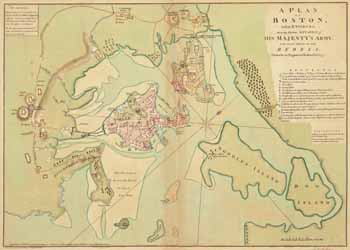
The militia mobilization of the Lexington Alarm had done significant damage to the Crown forces. Fortifications were keeping the king’s troops inside Boston.
The Royal Navy was seizing some ships and raiding coasts and islands for food. But three times now the provincial defenses had pushed back. Fairhaven men had recaptured two ships from Capt. John Linzee of H.M.S. Falcon. Hingham and other South Shore companies had forced troops off Grape Island with only a fraction of the hay they wanted.
And the fight over Hog Island and Noddle’s Island was even more impressive. The provincials came away with some livestock, reducing the food supply for besieged Boston. They set fire to hay being grown to feed the army’s horses.
In the fighting that followed, the provincials had deployed artillery for the first time and withstood return fire. They hadn’t lost any men, with four wounded and expected to recover, and reports out of Boston suggested some of the enemy had died. (Two seamen were killed, in fact, but some early reports put the number of Crown casualties as high as thirty.)
From H.M.S. Diana the provincial troops had pulled useful supplies: four four-pounder cannon, twelve swivel guns, the mast, and various bits of fresh rigging—the ship had been launched only the previous year.
And then those troops had actually destroyed the Diana—a Royal Navy warship! True, it was a relatively small vessel that had run aground, but that was obviously a provincial victory and a royalist loss.
Even the most cautious New England commanders and soldiers must have felt they were on a roll when they made the move onto the Charlestown peninsula on the night of 16 June. But the scale of the battle that followed was far beyond any other fight in the Boston campaign.
The Sestercentennial of the Battle of Bunker Hill will be observed on two successive weekends in June:
- Parade, concert, speeches, and other ceremonies in Charlestown on 13–17 June.
- Battle reenactment over similar terrain in Gloucester on 21–22 June.

1 comment:
CALEB HASKELL'S DIARY
[1775, Cambridge]
May 22nd, Monday.
Today a party of the enemy came out and landed on Grape Island, near Weymouth, in order to take some cattle off the island. Our people at Roxbury discovered them. A number went over on the island and beat them off without the loss of a single man.
Set fire to a barn and destroyed it with the hay, and brought the cattle off at night. I went on guard at Lechmere's Point.
May 23d, Tuesday.
Came off guard this morning. Were paraded on the Common in the afternoon. Heard prayers.
May 24th, Wednesday.
All still in the camp. No remarks.
May 25th, Thursday.
Attended prayers night and morning. Our army in high spirits.
May 26th, Friday.
Fine weather. This evening about three hundred of our people went down to Chelsea to prevent the enemy from taking the cattle off from Noddle's Island.
May 27th, Saturday.
Today, a party of the Massachusetts and New Hampshire forces, about 600, went over to Noddle's Island to bring off some cattle. The enemy landed on the island, and pursued our men till they got back to Hog island, at which time an armed schooner belonging to the enemy came to their assistance, and to prevent our people from leaving Hog Island - which she could not effect. Our people put a heavy fire of small arms upon the barges. Capt. Foster came with two field pieces and began to play upon the schooner, which soon obliged them to quit her. She then caught on Winnisimot ferryways. Our people set fire to her and burned her to the water. We saved all that was not burned. We took four pieces of cannon, a number of swivels and some clothing, and brought all the cattle off from both islands. In the engagement we had not one killed, and but three wounded, and those not mortally.
May 28th, Sunday.
This morning, held ourselves in readiness to assist our men fighting at Chelsea, which detained us from public worship. In the afternoon heard Dr. Langdon, from John 3:16-17.
May 29th, Monday.
This day, a quantity of the spoil taken at Chelsea was brought to Cambridge. In the evening saw a large fire, supposed to be in Boston. Had a report that 1000 men would come out; held ourselves in readiness to meet them.
May 30th, Tuesday.
This day, the remainder of the cattle taken from off the island were brought to Cambridge.
Post a Comment