J. L. BELL is a Massachusetts writer who specializes in (among other things) the start of the American Revolution in and around Boston. He is particularly interested in the experiences of children in 1765-75. He has published scholarly papers and popular articles for both children and adults. He was consultant for an episode of History Detectives, and contributed to a display at Minute Man National Historic Park.

Subscribe thru Follow.it


•••••••••••••••••


Showing posts with label Stamp Act Congress. Show all posts

Sunday, March 24, 2024

The Continentals from the Lower Counties
From the start of nationhood Americans have spoken of the “thirteen colonies,” but really it was more like twelve and a half.

The Penn family were proprietors of both Pennsylvania and Delaware and always appointed the same man to govern both.

Though Delaware had an older history of European settlement, Pennsylvania became much bigger and wealthier. The “Lower Counties on the Delaware” had their own legislature, but many people treated that area as a mere adjunct.

Delaware didn’t rate its own part of the “Join, Or Die.” snake that Benjamin Franklin printed in 1754, for example. (Though I should also note that all of New England was one piece.)

Under the Stamp Act, the British government appointed John Hughes to collect the tax in both Pennsylvania and Delaware.

The First Continental Congress’s Articles of Association in 1774 still referred to “the three lower counties of Newcastle, Kent and Sussex on Delaware,” as did the Second’s commission for a commander-in-chief in 1775.

We might say that Delaware made itself a full-fledged state by participating in the American resistance. The three counties sent representatives to the Stamp Act Congress and then the Continental Congresses. Deriving their authority from the people through a legislature meant those men were separate from the Pennsylvania delegation. By late 1775, John Adams was writing of “Thirteen Colonies.”

Delaware also raised its own troops to support the Continental Army in January 1776. Not many, since it was a small colony: about 800 men in one big regiment under Lt. Col. John Haslet. In the summer of 1776 those Delaware Continentals marched north to New York.

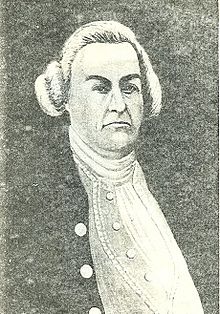
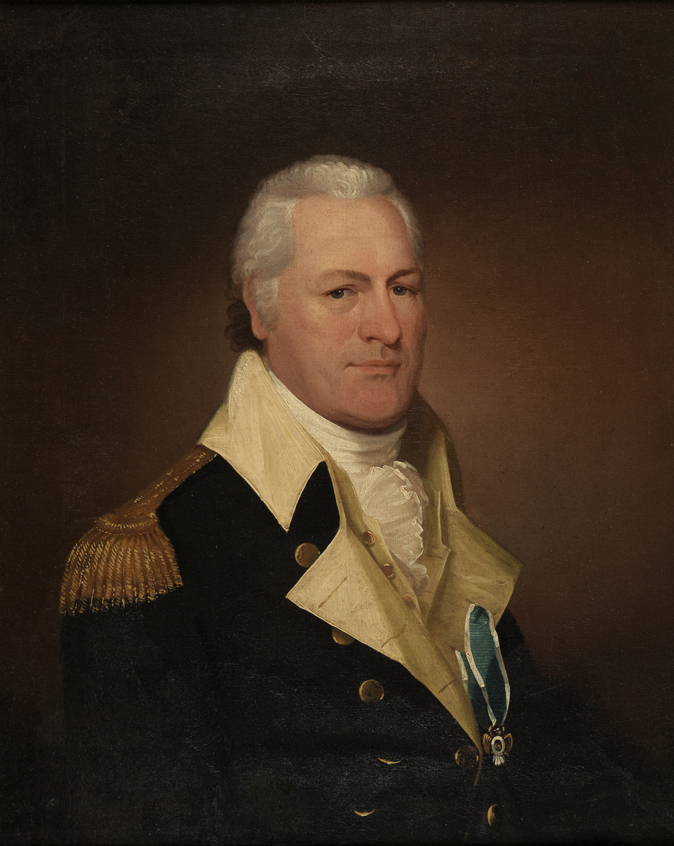
One young officer in that regiment was Lt. William Popham (1752–1847, shown above). He arrived in New York City on 21 August, and a few days later the Delaware Continentals crossed to Long Island. They were grouped with Marylanders under Gen. Stirling.

A few days later, Popham wrote:
I marched toward the ground occupied by our army, in the summit of the high ground in front of Gowanus, near the edge of the river, where the enemy were landing from their ships, one or two lying near the shore to cover the landing. Many shots were exchanged between us and the enemy.

About 12 o’clock Gen. Stirling came to the east brow of the hill and ordered the Delaware regiment up. Here we received the first order to load with ball, and take care that our men (who were awkward Irishmen and others) put in the powder first.

We then marched up and joined the army which was drawn up in line, my regiment and my company on the left. The whole bay was covered with the enemy’s shipping. The firing continued all the time of the enemy’s landing, and we lost several men.
The British and Hessians began to spread out and march toward the American positions. Haslet saw how “the enemy began to send detachments as scouts on our left.” Though the Continentals held the high spots, the Crown forces outnumbered them and might try to outflank them.

One more thing about the Delaware regiment: They wore blue coats with red facings, not unlike the Hessians.

TOMORROW: Two lieutenants meet.

Thursday, May 25, 2023

From the “Lower Counties” to an Independent State

Earlier in the week, I wrote about the fewer-than-thirteen colonies represented in Benjamin Franklin’s 1754 “JOIN, or DIE.” cartoon in the Pennsylvania Gazette.

The snake parts included Pennsylvania but not Delaware. From one perspective, Delaware was merely a part or adjunct of Pennsylvania. From another, it was a separate polity. The question wasn’t settled until 1776.

The area on the west side of what we call the Delaware River was the home of the Lenape, Nanticoke, and possibly Tuscarora people at the start of the seventeenth century. In 1631 the Dutch established a colony near the site of today’s Lewes, but that lasted about a year.

In 1638 Sweden tried imperial expansion and set up a colony at what’s now Wilmington. The Dutch returned in strength and took back the territory in 1655. Then the English seized Delaware from the Dutch in 1664.

That English expedition was acting on behalf of Prince James, Duke of York, later James II. Baron Baltimore, proprietor of Maryland, argued that the land should belong to his colony, but a duke had more clout than a baron. York turned his territory over to William Penn in 1682.

Penn was pleased that Philadelphia now enjoyed access to the sea along the Delaware River. He included his new “lower counties” in the Pennsylvania general assembly. But the old and new parts of the province didn’t work well together. In 1704 a separate Delaware assembly began meeting at New Castle.

In the top-down view of the Penn family and the imperial government in London, Pennsylvania and Delaware remained a single entity. They always had the same appointed governor. In 1765 the ministers in London named John Hughes as stamp master for all of Pennsylvania, including the ”lower counties.”

Franklin’s emblem showed a similar perspective. Though as a member of the Pennsylvania assembly he knew that the lower counties met separately, he didn’t think Delaware needed to be treated as a whole colony on its own. It was just an appendage to rapidly growing Pennsylvania, lacking western lands and a major port.

Other newspapers copied the Pennsylvania Gazette emblem, also leaving out Delaware. When Isaiah Thomas and Paul Revere adapted the original snake into a more dangerous kind for the Massachusetts Spy masthead, they added Georgia—but still filed Delaware under “P.”

What changed the way people looked at Delaware? I think the arrival of continent-wide Congresses was a big factor. (Ironically, the “JOIN, or DIE.” emblem was created to promote the first such gathering, the Albany Congress, which didn’t really work.)

Colony legislatures, not governors, sent delegates to the Stamp Act Congress of 1765 and later gatherings. That meant Delaware acted separately from Pennsylvania. The two delegations had equal votes in the Congresses. American Whigs happily counted twelve colonies at the First Continental Congress, thirteen at the second.

By 1776, those politicians were proclaiming that power rose from the people—or at least that top slice of the people who elected representatives. From that bottom-up perspective, Delaware was already separate from Pennsylvania. During that year, the Delaware legislature’s declarations and resolutions formally established the state as independent not only from Britain but also from its northern neighbor.

Wednesday, January 27, 2016

“The right of representation and taxation always went together”

Having spent a week on the U.S. Constitution and Bill of Rights, I’m going to jump back to 250 years ago and Parliament’s debate over what to do about the Stamp Act.

That law was clearly unenforceable in North America. The Marquess of Rockingham’s government was already working with Barlow Trecothick, spokesman for London’s merchants doing business with North America, to revise it. (The Journal of the American Revolution recently published an article with more about Trecothick’s role.)

But simply repealing the tax might suggest that the ministry thought it was as unconstitutional as Americans had complained. And Parliament could not countenance some of the colonists’ irregular methods of protest. Like the riots. And the unauthorized assemblies.

On 27 Jan 1766, according to Horace Walpole’s Memoirs of the Reign of King George the Third, an M.P. submitted the Stamp Act Congress’s petition against the law to the House of Commons. The Chancellor of the Exchequer asked for the petition to be withdrawn as coming from a body with no standing.
Mr. [William] Pitt warmly undertook the protection of the petition, which he affirmed was innocent, dutiful, and respectful. . . . He painted the Americans as people who, in an ill-fated hour, had left this country to fly from the Star Chamber and High Commission Courts. The desert smiled upon them in comparison of this country. It was the evil genius of this country that had riveted amongst them this union, now called dangerous and federal. . . . This country upon occasion has its meetings, and nobody objects to them; but the names of six or eight Americans are to be big with danger.

He could not guess by the turn of the debate, whether the Administration intended lenity or not. To him lenity was recommended by every argument. He would emphatically hear the Colonies upon this their petition. The right of representation and taxation always went together, and should never be separated. Except for the principles of Government, records were out of the question. “You have broken,” continued he, “the original compact if you have not a right of taxation.” The repeal of the Stamp Act was an inferior consideration to receiving this petition.

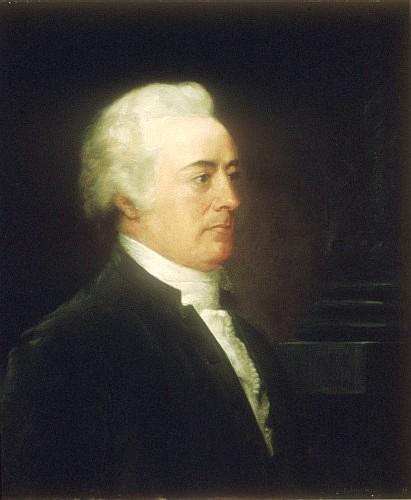
Sir Fletcher Norton [shown above] rose with great heat, and said, He could hardly keep his temper at some words that had fallen from the right honourable gentleman. He had said, that the original compact had been broken between us and America, if the House had not the right of taxation. Pitt rose to explain—Norton continued: “The gentleman now says, I mistook his words; I do not now understand them.”

Pitt interrupted him angrily, and said, “I did say the Colony compact would be broken—and what then?”

Norton replied, “The gentleman speaks out now, and I understand him; and if the House go along with me, the gentleman will go to another place.”
Walpole’s footnote explained that Norton meant, “To the bar of the House, whither members are ordered when they violate the rules or privileges of Parliament.” However, Maj. Thomas James, observing his first parliamentary session, thought he meant that Pitt “ought to have been sent to the Tower.”
Pitt at this looked with the utmost contempt, tossed up his chin, and cried, “Oh! oh!—oh! oh!”

“I will bear that from no man,” said Norton; “changing their place did not make Englishmen change their allegiance. I say the gentleman sounds the trumpet to rebellion; or would he have strangers in the gallery go away with these his opinions? He has chilled my blood at the idea.”

“The gentleman,” rejoined Pitt, “says I have chilled his blood: I shall be glad to meet him in any place with the same opinions, when his blood is warmer.”
In the end, Pitt’s approach gained only a handful of supporters, including Col. Isaac Barré and a new M.P. named Edmund Burke. The House set aside the Americans’ petition and moved on to other matters.

Meanwhile, behind the scenes, the government continued to look for a way out of the Stamp Act.

Monday, October 26, 2015

Timothy Ruggles Makes His Case

I’m going to jump ahead of the sestercentennial anniversaries to finish the story of Timothy Ruggles’s refusal to sign the results of the Stamp Act Congress he had presided over.

In 1766, the Massachusetts House demanded to know what Ruggles had been thinking. He told them. The legislature voted to reprimand its former speaker on 12 February.

Ruggles then asked his colleagues to allow him to publish his reasons for his conduct in the legislative record, and they said yes. A week later, after Ruggles submitted his case in writing, they voted no.

On 3 March, Ruggles read that same memorandum to the town meeting at his home in Hardwick. His neighbors voted that his reasons were “sufficient to vindicate his conduct.” Finally, on 5 May 1766, Ruggles had his case published in the Boston Post-Boy.

His arguments were:
  • “The petition agreed upon by the congress to be presented to his majesty not being conceived in terms clearly enough expressive of that duty and loyalty which are due to the best of sovereigns.”
  • “That it is more regular, constitutional and conformable to the constant practice of the colonies to have their petitions and remonstrances to the King and Parliament of Great Britain signed by the Speaker of their House,” not by a congress representing multiple colonies.
  • “That the signing said addresses by the committees of the several colonies which attended the congress, and who were empowered to sign the same, could by no construction come up to a general address from the colonies” since so few colonies were officially represented in New York.
  • “A matter of so great importance to the colonies and of so delicate a nature as the open and avowed claim of an exclusive right of taxation (however true) to be asserted in addresses to the King and Parliament for relief from an Act made by this very Parliament was a measure I could not bring myself to adopt.”
Ruggles acknowledged that he’d left New York on 25 October while other delegates gathered for one final session to sign the petitions. He didn’t really address the question of why, if he’d perceived such basic flaws in what the Stamp Act Congress was doing, he had presided over its meetings for the previous two and a half weeks.

The people of Hardwick continued to support Ruggles. They reelected him as their representative to the General Court and kept doing so until 1770, even after he voted to rescind the House’s circular letter of 1768.

In 1774 the ministry in London made Ruggles a mandamus councilor; Mercy Warren made him “Brigadier Hateall” in her satirical play The Group. During the siege of Boston he led a Loyalist militia. Ruggles evacuated the colony and died in Nova Scotia in 1795, thirty years after the Stamp Act Congress.

Sunday, October 25, 2015

Timothy Ruggles’s Challenge

One of the Stamp Act Congress’s first actions was to elect Timothy Ruggles as the presiding officer. People expected him to be more moderate than his fellow Massachusetts delegate, James Otis, Jr.

People also expected Ruggles to sign the public documents issued by that congress, along with clerk John Cotton. That was part of a convention chairman’s duties. (That’s why John Hancock’s name appeared on the first printed copies of the Declaration of Independence, and was so big on the calligraphic copy.)

But Ruggles refused to endorse the congress’s three petitions to the government in London, undercutting their legitimacy.

Otis argued with Ruggles, saying that the Massachusetts House had explicitly foreseen that the congress would prepare “a most loyal and dutiful address to his Majesty and his Parliament,” and “empowered [them] to sign and forward” such a document. It was important for the American colonies to show unity. But Ruggles insisted he wouldn’t sign.

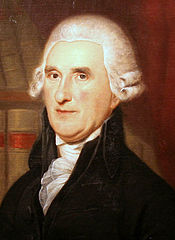
In 1813, the Delaware delegate Thomas McKean (shown above more than twenty years later) told John Adams how heated the discussion had become:
…when the business was finished, our President would not sign the petitions, and peremptorily refused to assign any reasons, until I pressed him so hard that he at last said, “it was against his conscience,” on which word I rung the charge so loud, that a plain challenge was given by him and accepted, in the presence of the whole corps; but he departed the next morning before day without an adieu to any of his brethren.

He seemed to accord with what was done during the session so fully and heartily, that Mr; Otis told me frequently it gave him surprize, as he confessed he suspected his sincerity.
Did Ruggles really challenge McKean to a duel on 24 October and then leave town? Ruggles was fifty-four, a former speaker of the Massachusetts house, a militia general and war veteran. His standing as a gentleman was secure, and New England didn’t have a big tradition of dueling.

In contrast, McKean was a thirty-one-year-old lawyer from Delaware, which barely qualified as a colony. (It was a three-county adjunct to Pennsylvania with a small separate legislature.) I can’t help but think that Ruggles would easily have brushed off whatever remarks the younger man had made. Almost five full decades later, however, there was no one left to contradict McKean’s dramatic version of events.

In any event, when the congress delegates gathered one last time on 25 October to sign the documents they had written together, Ruggles was already on his way home.

TOMORROW: The fallout in Massachusetts.

Saturday, October 24, 2015

The End of the Stamp Act Congress

By 24 Oct 1765, the Stamp Act Congress had revised and approved its three petitions to different parts of the British government, as described a couple of days back.

But delegate Robert Ogden (1716-1787) of New Jersey argued that the congress shouldn’t send those documents to London. Rather, he said, each delegation should bring them back to their colonial legislature for their colleagues to amend, approve, and then send across the Atlantic. Which wouldn’t really present a united front against the Stamp Act.

As speaker of the New Jersey house, Ogden had at first been reluctant to authorize any participation in the congress at all. Apparently under pressure from colleagues, he had presided over a special meeting to choose delegates without the authorization of Gov. William Franklin. When he put himself on the list, he probably hoped to steer the process.

Ogden’s late suggestion that the congress lacked legitimacy on its own made people accuse him of foot-dragging. By 2 November, Robert R. Livingston of New York wrote, the New Jersey speaker was “burnt in Effigy in almost all the Towns of East Jersey.” Ogden would resign his legislative seat by the end of that month.

The other delegates stuck with their original plan to send the petitions to London directly. They also voted to recommend “to the several colonies to appoint special agents for soliciting relief from their present grievances, and to unite their utmost interest and endeavors for that purpose”—in other words, a joint lobbying effort. Both those actions were tentative steps toward continental unity.

The only other recorded business on 24 October was an order for clerk John Cotton to sign his sparse record of the congress and arrange for it to be printed and distributed to the colonial legislatures. At least, that was the only business that actually got printed. (As a result, some accounts say the congress ended on that date.) Handwritten transcripts of the proceedings sent to the Maryland legislature and other contemporaneous documents indicated that the congress also met on the following day, 25 Oct 1765, to sign the petitions.

But even that wasn’t simple. For one thing, the New York delegation said that they shouldn’t sign the petitions (which some of them had helped to draft, and which listed “New-York” among the participating colonies) since their legislature hadn’t chosen them in an official session. As I said before, the men from Connecticut and South Carolina had already dropped out for similar reasons. The congress settled for having the documents “signed by such of the members as thought proper.”

That group didn’t include Robert Ogden. And then the congress’s chairman said he wouldn’t sign, either.

TOMORROW: Timothy Ruggles’s challenge.

Wednesday, October 21, 2015

The Stamp Act Congress’s Three Messages to London

On the same day that the Stamp Act Congress approved its Declaration of Rights and Grievances, which was mostly for public consumption, it also appointed three committees to draft formal messages to different branches of the British government:
The next day was Sunday. On Monday, 21 October, all three committees presented their drafts. Probably for some reason of protocol, the “address” to the king became a “petition.” The congress read, debated, and amended the documents, approving the first two on the 22nd and the third on the 23rd.

All three documents made the same argument, with varying degrees of obsequiousness, detail, and appeals to economic benefits. Here, for example, is how each appeal began. To the king:
That the inhabitants of these colonies, unanimously devoted with the warmest sentiments of duty and affection to your sacred person and government, and inviolably attached to the present happy establishment of the protestant succession in your illustrious house, and deeply sensible of your royal attention to their prosperity and happiness, humbly beg leave to approach the throne, by representing to your majesty, that these colonies were originally planted by subjects of the British crown, who, animated with the spirit of liberty, encouraged by your majesty’s royal predecessors, and confiding in the public faith for the enjoyment of all the rights and liberties essential to freedom, emigrated from their native country to this continent, and, by their successful perseverance, in the midst of innumerable dangers and difficulties, together with a profusion of their blood and treasure, have happily added these vast and extensive dominions to the Empire of Great Britain.
To the Lords:
That his majesty’s liege subjects in his America colonies, though they acknowledge a due subordination to that august body the British parliament, are entitled, in the opinion of your memorialists, to all the inherent rights and liberties of the natives of Great Britain, and have ever since the settlement of the said colonies, exercised those rights and liberties, as far as their local circumstances would permit.
To the Commons:
That the several late acts of parliament, imposing divers duties and taxes on the colonies, and laying the trade and commerce under very burthensome restrictions; but above all, the act for granting and applying certain stamp duties in America, have filled them with the deepest concern and surprise, and they humbly conceive the execution of them will be attended with consequences very injurious to the commercial interests of Great Britain and her colonies, and must terminate in the eventual ruin of the latter.
Even as the delegates approved those documents, their united front was cracking. Although men from Connecticut and South Carolina had helped to draft the messages to Britain, those delegations insisted on not being listed among the colonies endorsing those documents. The instructions from their legislatures, they said, didn’t authorize them to approve such petitions to London. That meant only half of the colonies originally invited to the Congress were visibly getting behind its results.

And when the delegates discussed how to sign those documents, their unity would break down further.

COMING UP: A challenge to a duel?

Monday, October 19, 2015

“It is the indispensable duty of these colonies”

By 19 Oct 1765, the Stamp Act Congress had been meeting and debating for over a week and a half. What sort of debate did they have? We have no idea. Clerk John Cotton’s record reads like this:
Wednesday, Oct. 9th. 1765, A.M. — Then the congress met according to adjournment. The congress resumed the consideration of the rights and privileges of the British American colonists, &c, the same was referred after sundry debates, for further consideration.

Then the congress adjourned until to-morrow morning, 11 o’clock.

Thursday, Oct. 10th, 1765, A.M. — Then the congress met according to adjournment, and resumed, &c, as yesterday — and then adjourned to 10 o’clock, to-morrow morning.
Repeat the entry for 10 October verbatim for the 11th, 12th, 13th, and so on through the 18th. (The delegates took Sunday the 15th off.)

Then a breakthrough on the 19th!
The congress met according to adjournment, and resumed, &c. as yesterday; and upon mature deliberation, agreed to the following declaration of the rights and grievances of the colonists in America, which were ordered to be inserted.
That Declaration of Rights and Grievances was drafted by John Cruger (1710-1791, shown above), mayor of New York and speaker of the New York assembly. The document had thirteen points, but the argument was basically threefold:
  • British colonists had the same rights as people in Britain itself.
  • Those rights included not being taxed without the consent of their own legislature, rendering the Stamp Act unconstitutional.  
  • And besides, the Stamp Act hurt the American economy and thus the whole empire.
The declaration concluded:
Lastly, That it is the indispensable duty of these colonies to the best of sovereigns, to the mother country, and to themselves, to endeavor, by a loyal and dutiful address to his majesty, and humble application to both houses of parliament, to procure the repeal of the act for granting and applying certain stamp duties, of all clauses of any other acts of parliament, whereby the jurisdiction of the admiralty is extended as aforesaid, and of the other late acts for the restriction of the American commerce.
In other words, by opposing the Stamp Act in every way, the men at that congress and elsewhere in America weren’t really defying the king, Parliament, and the British constitution. They were standing up for that system, “protestant succession” and all. It was even their duty to get the Stamp Act repealed! This remained the basis of American Whig thinking right up through the beginning of the war.

Some pre-war Whigs, such as John Cruger himself, never made the jump to believing that the only way to preserve the principles underlying that British constitution was to break with Britain entirely. He voted against the proceedings of the First Continental Congress in 1774 and soon retired from politics, sitting out the war in Kinderhook.

COMING UP: Three messages to Great Britain.

Friday, October 16, 2015

Did John Rutledge Meet Sir William Johnson in 1765?

As quoted yesterday, Richard Barry’s 1942 biography of John Rutledge described in dramatic detail how that South Carolina jurist met Sir William Johnson (shown at right, in red), the British Empire’s representative to the Six Nations.

According to Barry, Rutledge was in New York for the Stamp Act Congress in October 1765, and Johnson was making his yearly visit to the city with a retinue of Iroquois warriors.

Barry directly quoted Johnson’s joke about the congress, but he didn’t provide any specific citations for those words. Instead, his notes were general, pointing to the Thomas Addis Emmett Collection on the Stamp Act Congress in the New York Public Library, the Laurens Papers at the Long Island Historical Society [now at the Kendall Whaling Museum], and the Rutledge Family Papers at the Historical Society of Pennsylvania.

But we don’t have to go through all those archives to check Barry’s story. We can look at Sir William Johnson’s papers in the New York state library. In 1909 the state published a Calendar, or chronological list, of that correspondence. Two years later, that institution suffered a disastrous fire. In the 1920s, New York published transcripts of the surviving Johnson documents.

Both the Calendar of the Sir William Johnson Manuscripts and the published correspondence show that in October 1765 Johnson was writing letters from Albany and from his home at Johnson Hall, another hundred miles farther from New York City. He was nowhere near the Stamp Act Congress. (One of Sir William’s sons was in New York on 12 October, heading to Britain, according to a letter by John Watts.)

Furthermore, there’s no mention of a large body of Native American men camping north of New York in the city newspapers for that month. Merchant Thomas Ellison wrote a series of letters about events in the city that year, and the Iroquois didn’t come up.

Barry’s book turns out to be full of other refutable claims, stories without evidence, and outlandish interpretations. When he wrote John and Edward Rutledge of South Carolina (University of Georgia Press, 1997), James Haw wrote: “The only previous biography of John Rutledge, Richard Barry’s Mr. Rutledge of South Carolina, is unreliable. I have followed the advice of Professor George C. Rogers, Jr., to ignore Barry’s book.”

TOMORROW: And yet the Rutledge-Johnson meeting is in a respected textbook today.

Thursday, October 15, 2015

A Legendary Meeting at the Stamp Act Congress

Here’s a lively picture of events during the Stamp Act Congress, which took place in New York two and a half centuries ago this month.

It comes from the pages of Richard Barry’s Mr. Rutledge of South Carolina, a biography of delegate John Rutledge (shown here) published in 1942.
The day after Rutledge put up at the Kings Arms Inn, New York was startled by the arrival of two hundred Indians, heavily armed, but without war paint and in holiday attire. They came down the Albany Post Road as the retinue of Sir William Johnson, High Commissioner of His Majesty to the Six Nations, who was arriving from his castle a hundred miles beyond Albany for his annual visit.

John Rutledge hired a coach and rode out to the Mohawk camp to call on Sir William. As Rutledge entered the tent of the High Commissioner, nude red braves, Seneca warriors, lifted the flap. The visitor had never seen such native males, sleek, alert, silent.

“I see you’ve come to comb the King’s hair!” Sir William shouted as he greeted the young southerner. “Good! Only don’t take his wig off!” He laughed uproariously.

After they had talked a while, Rutledge wanted to know about the operation of the Hodenosenee, the parliament of the Six Nations. Sir William explained: each nation was sovereign internally, but externally, especially in war, the council of sachems was supreme; this gave individuality to six nations, yet they had the united strength of one; the autocratic power granted the chiefs in war was for limited periods and was not hereditary.

“If England is ever to become a great nation,” the High Commissioner summed up, “she must go to school to the Iroquois. The Six Nations control this continent, not by accident, but through the triumph of their science of government. If it had a chance their system could master Europe—or the world.“
Rutledge eventually chaired the congress’s committee to write a petition to the House of Lords, one of three documents it created. His biographer therefore claimed that “JR caused George III to repeal the Stamp Act.” As you might guess, Barry did not have a high threshold of evidence for what he wrote about Rutledge.

In fact, that story about Rutledge, Johnson, and the Iroquois visitors in New York is complete bunkum.

TOMORROW: Negotiating the burden of proof.

Thursday, October 08, 2015

The Choice between Ruggles and Otis

One of the first acts of the Stamp Act Congress when it convened in New York in October 1765 was to elect a chairman.

Arguably, that was the first political office to derive its authority from the thirteen colonies that would form the U.S. of A. eleven years later. Even if only nine of them had actually sent delegates to that congress, the others (plus Nova Scotia) at least got an invitation.

The winner of the vote was Timothy Ruggles (1711-1795, shown here), brigadier in the Massachusetts militia. According to the New York merchant John Watts, writing to a friend:
Brigr. Ruggles is Chairman, [James] Otis aimed at it and would have succeeded but they thought as he had figured much in the popular way, it might give their meeting an ill grace, but it is observed Otis is now a quite different man, and so he seems to be to me, not riotous at all.
Nearly forty years later, delegate Thomas McKean of Delaware recounted his version of events to John Adams, starting:
In the congress of 1765 there were several conspicuous characters: Mr; James Otis appeared to me to be the boldest and best speaker.—I voted for him as our President, but Brigadier Ruggles succeeded by one vote, owing to the number of the committee from New-York, as we voted individually
The record of the Stamp Act Congress states that the delegates chose Ruggles, and suggests the vote wasn’t unanimous, but it doesn’t mention any other candidates or any vote count. No delegates kept diaries or sent gossipy letters that have survived. Thus, there’s no contemporaneous evidence to confirm or refute McKean’s recollection. (More on his claims to come.)

As its clerk, the congress chose John Cotton (1728-1775), who was deputy secretary of the province back in Massachusetts, as well as registrar of wills in Suffolk County. Cotton was also half-brother to Lt. Gov. Thomas Hutchinson’s late wife and to the wife of former stamp agent Andrew Oliver, who was also his boss in the secretary’s office. In 1770 Hutchinson called Cotton “attached to Government and serviceable so far as his Sphere would permit.” He continued to hold offices in the royal bureaucracy until he died of the flux inside besieged Boston.

Cotton’s record of the congress is very spare, recording only the actions the body agreed to and not the preceding proposals, debates, and amendments. As their first procedural decision, later that first day, the delegates decided that each colony should have one vote, a precedent that remained for the Continental Congress of the 1770s. If McKean’s memory was accurate, then that form of voting would have made Otis the chairman instead of Ruggles.

Wednesday, October 07, 2015

When the Stamp Act Congress Convened

On 7 Oct 1765, the Stamp Act Congress convened at City Hall in New York (shown here). It was a week behind schedule.

As proposed by the Massachusetts House of Representatives back in June, this was a convention of delegates from the colonial legislatures of North America to come up with a common response to the Stamp Act.

Royal governors had done their best to stymie legislatures’ plans to participate in the congress, mostly by declining to convene those legislatures in time to choose delegates.

As a result, in Delaware, New York, and New Jersey legislative leaders chose delegates through committees or in meetings held without the governors’ approval. Other colonies, including the oldest and most populous, Virginia, couldn’t finagle a way to send anyone. Out of fourteen colonial legislatures invited (including Nova Scotia), only nine had representatives at the congress.

Massachusetts was one of those nine, but royal governor Francis Bernard was confident that he had things under control, as he reported to the Board of Trade in London on 8 July 1765:
It was impossible to oppose this Measure [for the congress] to any good purpose: and therefore the friends of Government took the lead in it, & have kept it in their hands; in pursuance of which, of the Committee appointed by this house to meet the other Committees at New York on the first of Octr. next, Two of the three are fast friends to Government & prudent & discreet men, such as I am assured will never consent to any undutiful or improper applications to the Government of great Britain. It is the general Opinion that nothing will be done in consequence of this intended Congress: but I hope I may promise myself that this province will act no indecent part therein.
The three Massachusetts delegates were all members of the committee that had recommended proposing the congress:
Probably because Massachusetts had instigated the meeting, there seems to have been consensus among the delegates that their chairman should be from that colony. But which man?

TOMORROW: America’s first national election?