






“Quite free from Lifes Distressing Care”
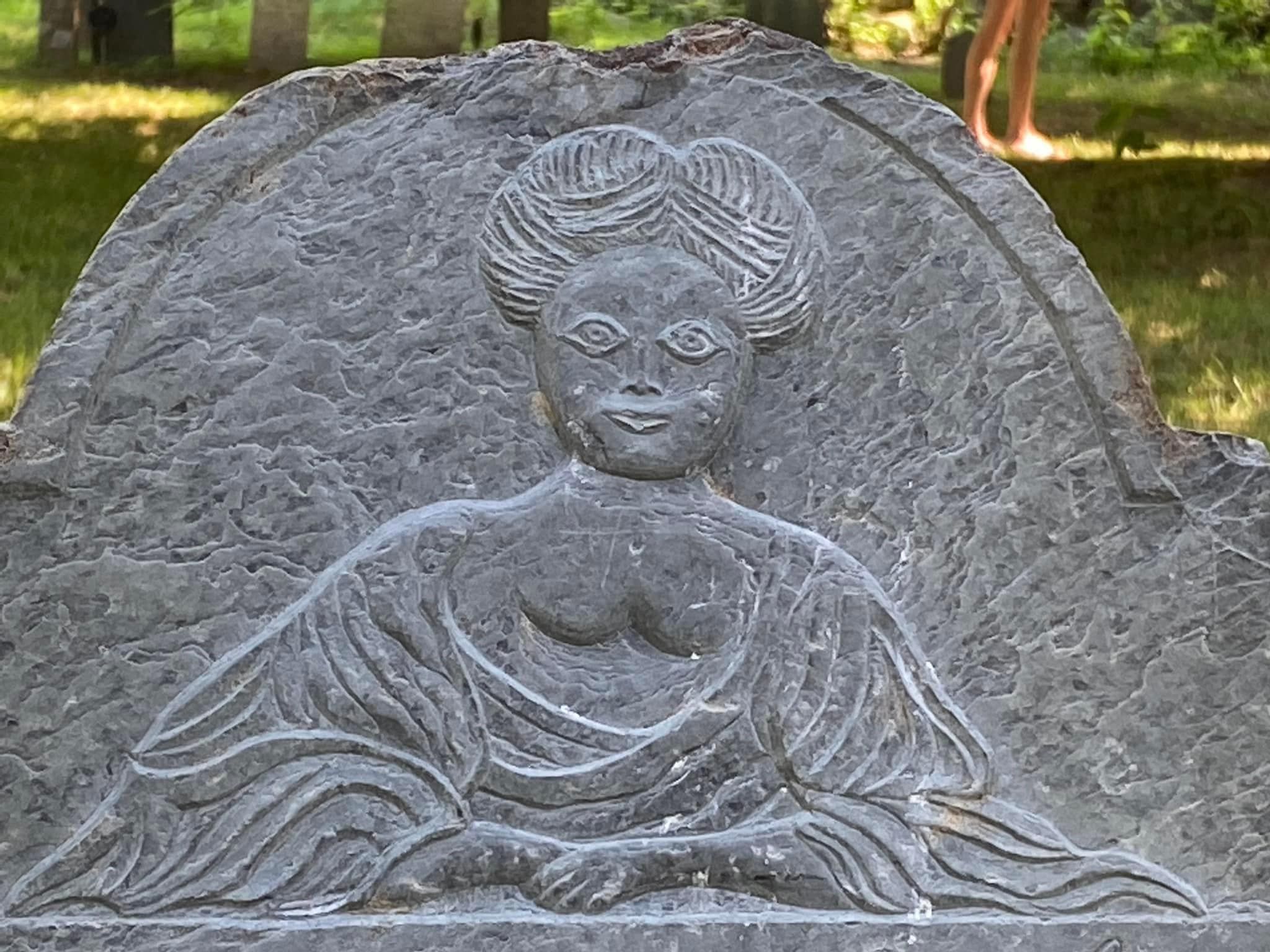
Mary’s husband, Samuel, commissioned a slate gravestone with a carved portrait and these words:
Here rests quite free from LifesSamuel Nasson also arranged for a large stone to lie over the grave, probably to stop animals from digging up his wife’s remains.
Distressing Care,
A loving Wife
A tender Parent dear;
Cut down in midst of days
As you may see,
But—stop—my Grief!
I, soon, shall equal be,
When death shall stop my breath
And end my Time;
God grant my Dust
May mingle, then, with thine.
Unfortunately for the couple’s memory, that stone appears to have inspired people in the early nineteenth century to think that it was placed to keep her from rising from the dead. Books and then websites came to refer to Mary Nasson as a witch.
In an essay at Early American Studies Miscellany, “Not a Witch: Public History in a Maine Graveyard,” Daniel Bottino and Hannah Peterson state:
Visitors to the grave today marvel at the stone slab, which according to stories available online was put there to keep Mary’s maleficent ghost from rising from her coffin and bewitching the townspeople of York. No matter how many attempts are made to clean the slab, it is always cluttered with coins and a wide variety of various tokens.Bottino and Peterson have tried to set the record straight for the public by using ghost tours and other staples of public history to discuss the facts.
There is no evidence that Mary Nasson was ever considered a witch during her lifetime, a fact that has not stopped the popularity of the witch’s grave legend. She was an ordinary woman; that is what makes her story interesting. The historical fantasy of Mary as a witch distracts us from learning about the lives of women like Mary in early New England and presents an erroneous image of her which would have shocked both her and her family.
(They also coauthored an article in Early American Studies’ summer 2023 issue, “‘I Hope I Have a Treasure in Heaven, Because My Heart Is There’: Salvation and Damnation in the Conversion Narrative of Patience Boston.” Boston also died in York at a young age, but in very different circumstances.)
