J. L. BELL is a Massachusetts writer who specializes in (among other things) the start of the American Revolution in and around Boston. He is particularly interested in the experiences of children in 1765-75. He has published scholarly papers and popular articles for both children and adults. He was consultant for an episode of History Detectives, and contributed to a display at Minute Man National Historic Park.

Subscribe thru Follow.it


•••••••••••••••••


Showing posts with label gunpowder. Show all posts

Tuesday, June 23, 2026

The Significance of Breed’s Hill Instead of Bunker’s

For one last posting on the label “Breed’s Hill,” I’ll share some thoughts on whether that label matters.

These days, it’s mostly useful as a fact that people (mostly of the male variety, to be frank) deploy to show they know more than average: ‘Well, actually, the Battle of Bunker Hill was fought on Breed’s Hill.”

Which is true, though:
Even more trenchant, what difference did that name make to the outcome of the battle? How did the “Breed’s Hill” label affect the seizure of the Charlestown peninsula? Or the deaths or wounding of nearly 1,500 men?

Well, actually, there’s an argument that Col. William Prescott’s insistence on fortifying Breed’s Hill before Bunker’s Hill, as he understood his orders to specify, did shape the outcome of the battle. Could the provincials have prevailed if they’d had a strong fallback position?

I’m dubious. The goal of the Massachusetts command—the committee of safety, Gen. Artemas Ward, and his council of war—was to keep the British army from seizing the Charlestown and Dorchester peninsulas, as intelligence said the Crown would soon try to do. The New England army’s countermeasure was to seize those positions first.

The real challenge, as Gen. John Thomas indicated from Roxbury, was holding those positions against a British counter-countermeasure. Thomas didn’t think that was feasible and declined to go onto Dorchester Heights that June.

The geography of Charlestown was more welcoming for such an advance from the mainland, but it doesn’t look like the New England army was truly prepared to hold that ground. With only a couple of days to get organized, the provincials didn’t have all the tools, artillery, and reinforcements lined up to fortify and stay on those high points. We see that from the limited support the front-line troops got during the battle.

Even beyond that, the crucial problem for the New England army turned out to be gunpowder. That would have been a problem no matter which hill they fortified.

To be fair to Gen. Ward, he was worried about a possible second British advance in Roxbury or elsewhere along the siege lines. He couldn’t throw all the provincial resources into Charlestown. But the Continental operation to fortify Dorchester Heights in March 1776 shows how effective preparation could overcome adverse conditions.

I even wonder if fortifying Bunker’s Hill might have changed the British commanders’ thinking in a way that would have produced a worse outcome for the provincials. Gen. William Howe saw a small redoubt on a relatively short hill that was close enough for cannon to reach Boston and thus worth cleaning out. He focused on that spot, with disastrous results.

If Howe had seen fortifications on Bunker’s Hill also or instead, he might have decided on a more cautious strategy, focused on cutting the provincials off at the neck. That might have produced many more rebel casualties and fewer British ones. The New Englanders could have ended the day more dismayed, the regulars more chuffed, with a consequent effect on the larger siege.

Tuesday, May 26, 2026

“Environmental History & the War of Independence” in Boston, 27 May

David Hsiung is the Dr. Charles R. and Shirley A. Knox Professor of History at Juniata College in Pennsylvania.

For several years he’s been working on the problem of how the enviroment affected the American Revolution, how the Revolution affected the environment, and how it’s possible to study those interactions with the data we have.

That is, of course, a huge topic, so part of the historiographical challenge is, I’m sure, to narrow down and define the questions in a manageable way. In the meantime, I’ve been enjoying his articles and lectures, which always open my eyes to new ways of seeing this history.

On Wednesday, 27 May, David Hsiung will be at the Massachusetts Historical Society for a conversation with Joyce A. Chaplin of Harvard, author most recently of The Franklin Stove: An Unintended American Revolution.

The description of “Curious & Complex Connections: Environmental History & the War of Independence” says:
Many of us give only a moment’s thought about the environment when considering the War of Independence: the slope of Breed’s Hill, the ice-choked Delaware River, and diseases such as smallpox. But what might we gain by connecting biology, ecology, and geology to the thinking and actions of soldiers and civilians? Rebels and British soldiers acquired and used energy in the form of food, fuel, and work animals, which shaped people’s lives, the course of the war, and the direction of environmental change.
This is a hybrid event starting at 6 P.M., with a reception in the preceding half-hour for people attending in person. Attendance costs $10, but is free to M.H.S. members and Card to Culture participants. Listening in online is free. Register for either form of access through this page.

Folks can also take in these talks from Prof. Hsiung:

Wednesday, February 25, 2026

“Boston is environed on all sides”

Having shared his version of the Battle of Lexington and Concord, as quoted over the last two days, the new Cambridge postmaster Jonathan Hastings, Jr., turned to the current situation.

His 11 June 1775 letter described the siege this way:
Boston is environed on all sides. 7000 Men at Camb. 6000 at Roxbury, exclusive of smaller Numbers wch. guard the Coasts both Eastward & Southward. [Thomas] Gage acknowleges our Superiority in Number, but says we have neither Government, Discipline nor Powder. The two first Charges are false; and I hope the other Colonies will not be backward to Supply us with the last, to let him see he is mistaken in that likewise.—

Indeed we are determined to defend ourselves in the best manner at all Events, rather than submit to Slavery.—Our Motto is the same which Caesar engraved on his Breast Plate—“Nil actum reputans si quid superesset agendum.”
That was a standard eighteenth-century British rendering of a line from Lucan’s Civil War, appearing in the Spectator and Lord Chesterfield’s letters. It translates more or less as “As long as there’s anything left to do, we don’t consider anything done.” Curiously, that Latin line appears differently in modern editions of Lucan. I can’t explain the discrepancy.
Should Massachusetts be conquered, your Halcyon Days will soon be at an end. God grant our union may be like that of a Band of Brothers, wch. can never be broken. The Light Troops in Boston we are informed have not done Duty for 4 Days. An Attack is expected soon, for every Delay on their part is a Strengthening to us.

It was not the Butler who fell in Battle, but a Samuel Cooke from Danvers the largest Man in the Colony, I suppose
A Danvers man named Samuel Cook, Jr., was indeed among the provincial casualties on 19 April, killed at the Jason Russell House. I haven’t found any other reference to his size. I’ll discuss why Hastings mentioned him tomorrow.
You must excuse my not being more particular, as John intends to write to your Brother, and my Business call me away: therefore would just acquaint you that an half a whole Sheet with your Name alone will afford a particular Pleasure to your sincere Friend & very humble Servant

Jonathan Hastings Junr.

P.S.—My Father & mother desire to be remembered to you & your Friends, & would inform you that our Papers are removed into the Country, & we know not where to look for any Receipts, therefore beg you will make yourself easy with regard to us—&c
JH
That looks like a very familiar closing for an eighteenth-century letter, begging more time to pay bills. Or maybe Hastings was replying to a correspondent who had begged more time.

Of course, there was a war on. The Hastings house had become the headquarters of both the Massachusetts committee of safety and Gen. Artemas Ward, so it’s understandable that the family had moved their records out.

TOMORROW: Clues to the crowd.

Friday, January 23, 2026

“A Fine Train of Artillery” Talk in Cambridge, 29 Jan.

On Thursday, 29 January, I’ll contribute to the discourse about Col. Henry Knox’s artillery trek with the talk on “‘A Fine Train of Artillery’: Henry Knox and the End of the Siege of Boston” at the Longfellow House–Washington’s Headquarters National Historic Site in Cambridge.

In the past few months I’ve already shared my take on the myths and realities of the Knox saga, and on Knox’s political profile before the war and how that might have contributed to his rise to command the artillery regiment.

For this new talk, therefore, I’m focusing on what Knox accomplished on his first military mission and how that affected the siege of Boston. Here’s our event description:
On January 18, 1776, Gen. William Heath wrote, “Col. Knox, of the artillery, came to camp. He brought from Ticonderoga a fine train of artillery.” Those 58 guns would nearly double the size of the Continental artillery force. But Gen. George Washington and his commanders still had to figure out the best way to use their new ordnance before they could drive the British military out of Boston.
Gen. Washington’s first proposal appears in his 18 February letter to John Hancock as chairman of the Continental Congress:
The late freezing Weather having formed some pretty strong Ice from Dorchester point to Boston Neck and from Roxbury to the Common, therby affording a more expanded and consequently a less dangerous Approach to the Town, I could not help thinking, notwithstanding the Militia were not all come In, and we had little or no Powder to begin our Operation by a regular Cannonade & Bombardment, that a bold & resolute Assault upon the Troops in Boston with such Men as we had (for it could not take Many Men to guard our own Lines at a time when the Enemy were attackd in all Quarters) might be crown’d with success . . .

from a thorough conviction of the necessity of attempting something against the Ministerial Troops before a Re-inforcement should arrive, and while we were favour’d with the Ice, I was not only ready, but willing and desirous of making the Assault; under a firm hope, if the Men would have stood by me, of a favourable Issue; notwithstanding the Enemy’s advantage of Ground—Artillery—&ca.
An infantry charge across the flat ice of the inner harbor against the British army’s fortified batteries on the Common and in the South End. What could go wrong?

This talk is due to start at 6 P.M. It’s free and open to the public, but because of limited seating the site asks people to register in advance. We’re working on how to record and/or livestream the talk as well.

Monday, November 24, 2025

The Laboratory beside Boston Common

As described in The Road to Concord, Boston’s South Writing School shared a fenced-in yard with the militia train’s newer gunhouse.

In September 1774, the two small brass cannon stored in that gunhouse disappeared, even as British regulars stood guard at its door.

Frustrated Royal Artillery men hauled away the rest of the train’s equipment. Then came the outbreak of war, the siege, the evacuation. And Boston had it gunhouse back.

Except it didn’t have the train’s guns anymore. The town meeting sent a committee of Thomas Crafts, Paul Revere, and Thomas Marshall to ask Gen. George Washington for those brass cannon, but they were already on their way to the New York theater.

The state military establishment scrounged up more cannon, mostly old iron guns abandoned by the British military. But those weapons were in demand, needed to arm ships and guard the harbors. Leaving them in a building beside the Common didn’t make sense.

What do you do with a gunhouse that has no guns to house? We can see the answer in a report in the 15 Aug 1776 New England Chronicle about how the town celebrated the eleventh anniversary of the first Stamp Act protest: “a Detachment of the Train of Artillery, with two Field Pieces, marched from the Laboratory into King-Street.” 

The gunhouse was turned into a “Laboratory” or workshop for making weapons, especially artillery equipment. On 3 December the Massachusetts House formally discussed how “to have a laboratory established,” but even before its committee finished its work the 27 Jan 1777 Boston Gazette was telling readers to find Col. Thomas Crafts “at the Laboratory” if they wanted to store their gunpowder.

Crafts had been second-in-command of the train before the war. He’d tried for the rank of artillery colonel in the Continental Army in late 1775 but was rebuffed. Massachusetts then made him colonel of its own artillery regiment, and that job included overseeing the Castle and “the Laboratory on the Common.”

The man running that workshop was William Burbeck (1715–1785, represented above by his gravestone on Copp’s Hill). He had been storekeeper of ordnance at Castle William until the war broke out, then slipped away to become lieutenant-colonel and second-in-command of the Continental artillery regiment under Col. Richard Gridley.

At the end of the siege of Boston, Burbeck informed Gen. Washington that his commission came from Massachusetts, not the Continental Congress. He would therefore stay in Massachusetts, not heading down to New York (or serving further under Col. Henry Knox, thirty-five years his junior).

Burbeck immediately went to work improving Massachusetts’s military supplies. By 18 Apr 1776, the Massachusetts General Court discussed how to supply him “with Powder, wherewith, to prove the Cannon lately Cast for the Use of the Colony.” A year later, he was chosen as the Continental agent to inspect gunpowder.

In the spring of 1778 the state legislature approved regulations for the laboratory in Boston, and that October it unanimously chose Burbeck to be “Comptroller of the Laboratory.” 

A year later, the legislature appointed Burbeck captain-lieutenant of the Castle (under John Hancock as captain of the castle, who was soon more busy as governor). Burbeck remained comptroller of the laboratory, but in early 1782 the General Court determined that work had “greatly decreased,” so it adjusted his pay accordingly while still making him responsible for the facility.

These days we might raise questions about having a weapons workshop, possibly used for testing gunpowder, right next to a school. But the people of newly independent Boston didn’t see a problem. What could go wrong?

TOMORROW: Fire!

Friday, October 31, 2025

“Sparking the Revolution” conference in Springfield, 20–21 Nov.

On 20–21 November the Springfield Armory will co-host the 2025 Fall Conference of the Firearms Research Center, on the topic of “Sparking the Revolution: Flintlocks, Gunpowder, and Policy in America’s War for Independence.”

The Firearms Research Center is based at the University of Wyoming law school. It states its mission as “to foster a broad discourse and produce meaningful change in how firearms are discussed and understood.”

The conference will open the afternoon of Thursday, 20 November, with a reception and fireside chat on the theme “Exercising the Bruen Test: A Study in the Modern-Day Debate on the Second Amendment.”

“Examining Revolutionary-era topics through the lens of today’s constitutional debates” will be Firearms Research Center director George Mocsary, Megan Walsh of the Gun Violence Prevention Law Clinic at the University of Minnesota, and moderator Ashley Hlebinsky, the center’s executive director.

The “Bruen test” is the outcome of a 2022 U.S. Supreme Court decision that stated the constitutionality of gun restrictions must be “consistent with the Nation’s historical tradition of firearm regulation.” Since there isn’t a consistent, unchanging, and non-discriminatory tradition of firearm regulation, judges have struggled to understand and apply that test. The Brennan Center for Justice says it’s unworkable. In a follow-up case this year, United States v. Rahimi, the nine Supreme Court justices issued seven opinions to tweak the Bruen language.

That opening session is scheduled to take place at the Springfield Armory National Historic Site. As a National Park Service unit, that’s currently closed because of the lapse in Congressional funding with almost all the employees furloughed. I suppose that location may change before 20 November.

On Friday, 21 November, the conference will move across the street to Springfield Technical Community College’s Scibelli Hall. That day’s program will include these parts.

Panel 1: Disarmament and the Revolution
  • Bob Cottrol, George Washington University
  • E. Gregory Wallace, Campbell University
  • James Slaughter, Marshall University
Guns of the American Revolution
Erik Goldstein, Colonial Williamsburg

The Earliest Days of Springfield Armory
Alex Mackenzie, Springfield Armory

Panel 2: The Colonial Militia
  • Jody Madeira, Indiana University
  • Joyce Malcolm, George Mason University
  • Alexander Cain, Author, We Stood Our Ground
Creating an Arsenal of Liberty
Andrew Fagal, Princeton University

Early Ballistics of the American Revolution
Joel Bohy, Antiques Roadshow

Find the full schedule here. Anyone can register to attend all of the sessions for free either in person or virtually.

Monday, July 28, 2025

A Hero of Lake George

The Battle of Lake George on 8 Sept 1755 probably involved fewer than 3,500 men, a little more on the British side than the French. Each commander reported that his force had faced a much larger foe, however.

Each commander also reported inflicting more casualties than his force suffered, and more casualties than the rival commander reported. In fact, it seems impossible to pinpoint the number of dead and wounded.

Both sides lost leaders, however. On the French side, Baron Dieskau was wounded and captured, and Canadian commandant Jacques Legardeur de Saint-Pierre was killed. The British lost Col. Ephraim Williams and Mohawk ally Hendrick Theyanoguin. Among the provincial officers who died of their wounds was Capt. William Maginnis of New York.

Gen. William Johnson was wounded early in the fighting near Lake George and had to sit out the rest of the battle. Not that he mentioned the last detail in his report to the Crown. Nor did he name Col. Phineas Lyman as the officer who took over and completed that part of the fight. But of course Johnson portrayed the battle as a great victory for Britain.

It probably was a British victory, though limited and costly. Crown forces could now move safely from Fort Lyman to Lake George, and the lakefront was clear enough to build another fort there.

But that clash was an even bigger win for William Johnson, Britain’s liaison to the Iroquois and new provincial general. He was made a baronet, thus Sir William Johnson. Eventually Benjamin West painted Johnson nobly sparing a French officer from attack by a Native warrior, as shown above.

The new baronet returned the king’s favor, renaming the nearby landmarks for the royal family: Lac du Saint-Sacrement became Lake George after George II, Fort Lyman became Fort Edward after one of the king’s grandsons (another slight for Phineas Lyman), and the new fort was dubbed Fort William Henry after the king’s younger son and another grandson. Since the territory remained in British hands, those names prevail.

As the senior (and surviving) British captain in the last part of this battle, Nathaniel Folsom enjoyed some of that glory. He rose within the New Hampshire military establishment, ranked as a colonel within a couple of years. Folsom’s businesses in Exeter prospered.

In 1774 the province chose Nathaniel Folsom as a representative to the First Continental Congress, alongside John Sullivan. His son, Nathaniel, Jr., participated in the first raid on Fort William and Mary that December. Decades later a veteran named Gideon Lamson stated (using military titles the men acquired later):
At nine, Colonel [John] Langdon came to Stoodley’s and acquainted General Folsom and company with the success of the enterprise,—that General Sullivan was then passing up the river with the loaded boats of powder and cannon.
Folsom took charge of one barrel of gunpowder removed from the fort.

Given Nathaniel Folsom’s success in the last war, his support for the Patriot resistance, and his activity in the New Hampshire Provincial Congress, it’s no surprise that that body voted to make him commander of the province’s troops on 21 Apr 1775. The legislators reaffirmed that decision on 23 May.

The problem was that no one had checked with the officer who was actually leading the New Hampshire troops around Boston.

TOMORROW: Stark divide.

Friday, May 30, 2025

“Lucky for the Town that the Fire broke out in the Day Time”?

Just above its report on the Royal Navy store ship that caught fire in Boston harbor on 29 May 1773 (quoted yesterday), Richard Draper’s Boston News-Letter ran this brief item about another event that same day:
Saturday last being the Anniversary of the Restoration of King Charles II. a Feu de Joy was fired on board the Men of War in this Harbour.
Ordinarily, royal anniversaries like the king’s and queen’s birthdays were celebrated by both civil and military authorities in Boston. In this case, there was a conspicuous absence of cannon salutes, bell-ringing, or toasts inside the town.

New England had generally supported the Parliamentary side in the English Civil War and the Protectorate of Oliver Cromwell that followed. Its people and elected officials shielded regicides from Charles II’s retribution. Most British people thought the Glorious Revolution of 1688 was a Good Thing, but New Englanders were particularly convinced that deposing the Stuarts was a necessary course correction as the kingdom sank back into papist tyranny.

Therefore, local forts and authorities didn’t join the Royal Navy in celebrating the Stuart Restoration that May day in 1773. But did the descendants of Puritans begrudge the military’s action?

Of course they did. Thomas and John Fleet’s Boston Evening-Post reported the same event this way:
Saturday last being the anniversary of the Nativity and Restoration of King CHARLES II. the Colours, (as usual on Red Letter Days) were displayed on board the Flag Ship here, and at One o’Clock a Feu de Joy from her and the Gibraltar (being the only Ships of War we had then here to protect us) was all the Notice, as we have yet heard, that was taken to honor the Memory of the execrable Race of the STEUART Family.
Even the newspaper’s use of the phrase “Red Letter Days” was fraught with meaning. Those were the saints’ days on the Anglican calendar, shunned by the Puritans. As late as 1758 Roger Sherman had to explain why he acknowledged those dates in the almanacs he published “to serve the Publick” of Connecticut despite being a devout Congregationalist.

As for the radical Boston Gazette, it didn’t mention the anniversary of Charles II’s coronation at all. But Edes and Gill’s report on the ship catching fire was highly political:
Saturday last about 12 o’Clock at Noon a Fire broke out on board the Britannia, Capt. John Walker, a Store Ship for the Fleet station’d here for the Protection of the Trade and Fishery, lying in the Harbour, and within Gunshot of the Town.

It being reported that there was a considerable Quantity of Powder on board, it put the Inhabitants in great Consternation. Thousands of People seeking Refuge from the falling of Chimneys, &c. in Case of an Explosion. However as it turn’d out, there was no Powder on Board; which if it had at first been ascertain’d, would have sav’d said Ship from being burnt almost to the Water’s Edge. Considerable Stores we hear were not consumed.

It is however some what lucky for the Town that the Fire broke out in the Day Time, and when only the People belonging to the Ship were on board, otherwise it might have been Matter of Representation to the Board of Admiralty at Home to have immediately fitted out a Fleet in order to apprehend certain Persons to be sent beyond the Seas to be tried, as in the Case of the Gaspee Schooner at Rhode-Island.

Be it as it may, this Accident may prove very beneficial to some in settling Accounts.
In this one report the Boston Gazette thus managed to suggest that:
  • The idea that Royal Navy warships were in the harbor to protect locals instead of threatening them was laughable.
  • Naval administrators were to blame for the slow firefighting response.
  • Authorities like Thomas Hutchinson would have been happy to add this fire to their list of false accusations about Boston.
  • The royal government was acting unconstitutionally in the Gaspee inquiry.
  • Some corrupt officials or contractors would use the fire to cover up embezzling or other crimes.
That was some impressive conspiracy theorizing.

I should note that the fire was seen at noon, the cannon salute to Charles II at 1:00 P.M. So locals couldn’t have set fire to the ship to protest the royalist celebration. On the other hand, navy commanders might have been more eager to salute the Stuart Restoration after seeing their store ship burning out of control in Boston harbor.

Thursday, May 29, 2025

“A Fire broke out on board the fine large Store-Ship”

While looking at the diary of Thomas Newell this spring, I was struck by this dramatic entry for 29 May 1773, 252 years ago today:
King’s store-ship burnt in this harbor. The inhabitants greatly surprised, fearing there was a great quantity of gunpowder on board. Thousands retired to the back part of the town, and over to Charlestown, &c.; but no powder happened to be on board.
John Rowe mentioned the same event in his diary, but he was out of town fishing during the panic, so his entry doesn’t preserve the same excitement.

For more detail I turned to the newspapers. Here’s the straightforward report in the 3 June Boston News-Letter:
at Noon, a Fire broke out on board the fine large Store-Ship, (which had been laying in this Harbour for several Months past commanded by Capt. [John] Walker, having Stores for the Navy) which soon communicated to the Masts, Rigging and Turpentine on the Deck, and before any Assistance came, her upper Works were almost wholly in a Blaze; so that little or no Attempt was made to extinguish it:—

The Boats from the Men of War, with some from the Town, towed the Ship over to Noddle’s Island, where, after scuttling her, she was left to burn to the Water’s Edge.—

The Fire, it is said, was occasioned by some Coals falling from the Hearth of the Cabouse on to the Deck, which had lately been pay’d over with Turpentine, and spread with such Rapidity that nothing could be taken out of her:—

The Captain, with his Wife and two Children, who usually kept on board, likewise a Boy (the other People belonging to her being ashore) were obliged to be taken out of the Cabin Windows, without being able to save the least Thing but what they had on:—

A report prevailing at the Time of the Fire, that a large Quantity of Powder was on board, put the Inhabitants in general into great Consternation, for fear of the Consequences that might arise from an Explosion thereof; but being afterwards assured that none was in her, they became perfectly easy, and the Hills and Wharfs were covered with Spectators to view so uncommon a Sight.

Some of the Stores in the Hold, such as Cordage, Cables, and Anchors, which were under Water before the Fire could reach them, will be saved.
A “caboose” was originally a ship’s galley, Merriam-Webster says. Advertisements from eighteenth-century America indicate a “caboose” could be sold separately from a ship, and in 1768 New York a man named Thomas Hempsted was killed by “the Caboose falling on him” as a ship keeled over. So I suspect it also meant the stove and other cooking equipment designed for a ship but not necessarily installed in a dedicated cabin.

The first documented use of the word “caboose” in English was in 1732, and Samuel Johnson didn’t include it in his 1755 dictionary. But everyone reading the Boston newspapers was expected to know what that meant.

TOMORROW: The conspiracy theories.

Thursday, March 27, 2025

The Short Military Career of Lt. Col. Thomas Williams, Jr.

The Journal of the American Revolution just published Tim Abbott’s article about Lt. Col. Thomas Williams, Jr. (1746–1776), of Stockbridge.

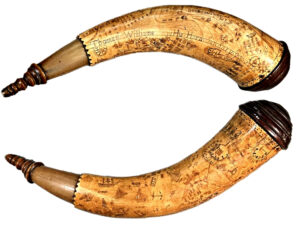
Williams left behind an engraved powder horn, now in the collection of the Stockbridge Library Museum and Archives. It shows Boston landmarks.

(This is different from the Dr. Thomas Williams powder horn recorded by Rufus Alexander Grider in 1888 and now lost.)

The siege lines around Boston contained some professional horn carvers selling their work to men who wanted souvenirs of military service. I suspect the Williams horn is one like that. As an officer and as a lawyer in civilian life, he probably didn’t have the time or inclination to do his own carving.

As Abbott’s article recounts, Williams was one of two minute company captains who responded to the Lexington Alarm from Stockbridge. The other company included a score of men from the town’s Native community and thus gets more attention.

As the troops besieging Boston organized themselves into an army enlisted through the end of the year rather than an emergency militia force, Williams became part of Col. John Paterson’s regiment. In September he volunteered for Col. Benedict Arnold’s expedition through Maine to Québec.

However, Williams was in the rear guard led by Lt. Col. Roger Enos (1729–1808), who in late October decided to turn back. That was controversial. Enos was tried and acquitted in a court-martial. He was probably lucky to go through that procedure before the army at Cambridge received “Colonel Arnolds evidence,” as Gen. George Washington reported.

Williams left Paterson’s regiment at the end of 1775, but on 9 Jan 1776 he became lieutenant colonel of a new regiment under Col. Elisha Porter to be sent up to Québec along Lake Champlain and the St. Lawrence River. This time Williams made it to the outskirts of the city, but smallpox was weakening the Continental forces.

Those Americans were trying to inoculate and fight the war at the same time. Abbott writes:
The timing for the deliberate exposure of Porter’s Regiment to smallpox could not have been worse. The inoculation process required effective quarantine for three to four weeks, during which the men were both weak and contagious. Even for those under treatment, severe cases could still develop and mortality rates under the best conditions still ran 1 to 2 percent. Porter’s men had no more than three days in hospital after they were inoculated before the siege was dramatically lifted by the arrival of a British fleet on May 6 and the American forces were soon driven back upriver in full retreat. Not only were they exposed to physical stress while they developed smallpox symptoms, but they became a significant vector for the spread of the disease to others in its more deadly form.
The American commander, Gen. John Thomas, died on 2 June. Lt. Col. Williams led his men back to Crown Point, New York, before falling ill. He didn’t make it home to Stockbridge.

Williams doesn’t appear to have left behind his own diary or letters—his powder horn might have been his only personal record of military service, and it probably wasn’t his own creation. Abbott has therefore done the work of reconstructing his career by weaving together official records and other officers’ accounts.

Thursday, March 20, 2025

Abraham Fuller and “the exact records of the military stores”

Yesterday I quoted a description of the Rev. Jonathan Homer of Newton late in life, by the poet and doctor Oliver Wendell Holmes.

Homer’s writings include a “Description and History of Newton, in the County of Middlesex,” published in the Collections of the Massachusetts Historical Society in 1798. And that article includes an anecdote related to the British army expedition to Concord 250 years ago next month.

In writing about the local politician Abraham Fuller (1720–1794), Homer said:
To him, as principal of a committee of the Provincial Congress at Concord, were committed the papers containing the exact records of the military stores in Massachusetts at the beginning of 1775. Upon the recess of the Congress, he first lodged these papers in a cabinet of the room which the committee occupied.

But thinking afterwards, that the British troops might attempt to seize Concord in the absence of the Congress, and that these papers, discovering the public deficiency in every article of military apparatus, might fall into their hands, he withdrew them, and brought them to his house at Newton.

That foresight and judgment, for which he was ever distinguished, and which he displayed in the present instance, was extremely fortunate for the country. The cabinet was broken open by a British officer on the day of the entrance of the troops into Concord, April 19, 1775, and great disappointment expressed at missing its expected contents.

Had they fallen into their hands, it was his opinion, that the knowledge of the public deficiency might have encouraged the enemy, at this early period, to have made such a use of their military force, as could not have been resisted by the small stock of powder and other articles of war which the province then contained. He considered the impulse upon his mind to secure these papers, as one among many providential interpositions for the support of the American cause.
Fuller was indeed a member of a Massachusetts Provincial Congress committee appointed on 22 Mar 1775 “to receive the returns of the several officers of militia, of their numbers and equipments,” plus inventories of the towns’ “stock of ammunition.”

He wasn’t the senior member, named first and thus by tradition the chair. All the others—Timothy Danielson of Brimfield; Joseph Henshaw of Leicester, Spencer, and Paxton; James Prescott of Groton; and Michael Farley of Ipswich—were colonels in the Massachusetts militia while Fuller was still a major. But he lived the closest to Concord, so it makes sense he felt responsible for securing the committee’s sensitive records.

(I should note that at this time, the congress included both Abraham Fuller from Newton and Archelaus Fuller from Middleton, and that spring both men held the militia rank of major. Sometimes clerk Benjamin Lincoln remembered to identify which “Major Fuller” the congress meant, and sometimes not. In this case, the official record dovetails with Homer’s story.)

Another version of this anecdote appears in the family genealogy Records of Some of the Descendants of John Fuller, Newton, 1644–1698, published in 1869 by Samuel C. Clarke:
Judge Fuller was a very earnest patriot before the Revolution, and it is told that previous to the fight at Concord, fearing that the British might destroy the County Records at that place, he rode over from Newton the day before the fight, and carried away the most valuable of the papers in his saddlebags to his house in Newton.
Interestingly, in a footnote Clarke quoted Homer’s text, which says Fuller hid sensitive records for the whole province, making his action more important. Yet Clarke stuck to what seems to be the family’s idea that those were only “County Records.” In a way they were, since the militia regiments were organized at the county level.

Clarke’s version also said that Fuller wanted to prevent the British regulars from destroying those records rather then to prevent those soldiers from reading them. That seems more in keeping with the Patriot mindset in early April 1775. They thought they were preparing well for war, not woefully deficient, and feared the army might destroy their means of self-governance.

All that said, I’ve never come across evidence that the British troops in Concord were looking for Provincial Congress records. Gen. Thomas Gage didn’t gather any intelligence about where those documents were kept or put them on his list of what the regulars should look for. No British officers on the march described such a search.

I therefore think that everything Homer wrote about “a British officer” breaking into the cabinet because he “expected” to find records inside is probably imaginary.

Fuller took care to keep those papers away from the army, just as Paul Revere and John Lowell took care to move John Hancock’s trunk into the woods at Lexington, and just as Azor Orne, Elbridge Gerry, and Jeremiah Lee took care to hide from the troops passing by their tavern in west Cambridge. But that doesn’t mean those careful actions thwarted the British mission in any way. We like to think our actions have an effect on the world.

(The photo above, courtesy of Find a Grave, shows the Fuller family tomb in Newton’s east burying-ground. It’s about half a mile from my house.)

Tuesday, December 31, 2024

Battling Myths and Misinformation about 1775

As we reach the cusp of the Sestercentennial year of 2025, I’m highlighting some articles I’ve written for the Journal of the American Revolution discussing myths and mistaken beliefs about the events of 1775.

Some of these articles were published in the past year, some more than a decade ago.

Here are the tl;dr versions with links to the full-length originals.

American Patriots didn’t call the laws that Parliament passed in 1774 to reform Boston (and Massachusetts as a whole) the “Intolerable Acts.” That term arose decades later in U.S. history textbooks. George III’s blanket term for those laws was “Coercive Acts.” Full article.

Tarring and feathering was a painful and humiliating public punishment, but it wasn’t fatal. Full article.

Dr. Joseph Warren didn’t obtain inside information about the British army march to Concord in April 1775 from Margaret Gage, Gen. Thomas Gage’s wife. Instead, he consulted with a man we’ve never heard of: a knife-maker named William Jasper. Full article.

Israel Bissell didn’t carry news of the fighting at Lexington south, and no single courier rode went all the way to Philadelphia. The first rider was named Isaac Bissell, and he carried the news to Hartford, Connecticut. Full article.

There’s solid evidence that Col. Israel Putnam (not Col. William Prescott) issued the order “Don’t fire till you see the whites of their eyes” at the Battle of Bunker Hill in June 1775. That phrase didn’t come from the Prussian army but from the Royal Navy. Full article.

Maj. John Pitcairn wasn’t fatally shot as he topped the wall of the provincial redoubt at Bunker Hill. Of the many men credited with that fatal shot, the best evidence points to Salem Poor, but he probably shot a different British officer. Full article.

Gen. George Washington didn’t respond to news of a gunpowder shortage in August 1775 by creating a false rumor of an adequate supply and feeding it to the British inside Boston. That was a novelistic touch created by a biographer misreading his sources. Full article.

Finally, my article for Age of Revolutions on how the “Join Or Die” snake evolved into the “Don’t Tread on Me” snake remains one of that site’s most read. While this essay doesn’t refute a clearly mistaken belief, I argue that those were two different species of American snakes: the glass snake and the rattlesnake.

If more people avoid repeating those myths and errors in the coming year, then my work will have benefited the world. And we can all move on to repeating new myths and errors.

Sunday, December 15, 2024

The Last of the Last Royal Governor of New Hampshire

As evening fell on 14 Dec 1774, New Hampshire militiamen finished their (first) raid on Fort William and Mary.

They loaded over a hundred barrels of gunpowder into a flat-bottomed boat. Just before embarking, they released John Cochran, commander of the fort, and his wife Sarah from confinement in their house.

But first they told Cochran to “go and take care of the Powder they had left.” As he reported that evening to Gov. John Wentworth (shown here), the raiders had left “one barrel.”

The royal governor lost most of his authority that day. He couldn’t even get men to row him out to the fort on his official barge.

Wentworth soon knew the identities of many of the raiders, but he didn’t foresee prosecuting them. “No jail would hold them long, and no jury would find them guilty,” he wrote. The most he could do was fire them from their appointed positions.

H.M.S. Canceaux and H.M.S. Scarborough arrived in Portsmouth harbor over the next week, preventing further attacks. The result was a stalemate, with the Patriots leaving Gov. Wentworth alone as long as they could proceed with their plans.

Those activists had already called a province-wide meeting in July 1774 to send delegates to the First Continental Congress. They did that again in January 1775 for the Second Continental Congress. Another meeting in late April endorsed the New Hampshire militia companies already heading toward Boston.

Gov. Wentworth convened the official New Hampshire legislature on 4 May 1775, then prorogued it. He tried to make peace between Capt. Andrew Barkley on the Scarborough, who was seizing supplies and sailors from ships, and the Patriot militiamen, now fortifying Portsmouth harbor against attack from the water.

On 13 June, Wentworth offered shelter to John Fenton, a retired British army captain and a New Hampshire militia colonel. A crowd gathered outside his mansion, pointing a cannon at the front door. Fenton gave himself up. The governor and his wife fled out the back, carrying their infant son.

The Wentworths took refuge at Fort William and Mary, still commanded by John Cochran. The governor reported, “This fort although containing upward of sixty pieces of Cannon is without men or ammunition,” but it was protected by the Scarborough.

Wentworth continued to try to exercise gubernatorial authority, sending messages to the provincial assembly as if he were in his mansion nearby rather than on an island in the harbor. The legislature ignored him and his declarations that their session was adjourned.

Soon it became clear that there was no point in staying in New Hampshire. Capt. John Linzee and H.M.S. Falcon arrived to carry away the fort’s remaining cannon and keep them out of rebel hands. On 23 August the Wentworths boarded a warship to sail to besieged Boston.

With Gov. Wentworth went John Cochran, commander of Fort William and Mary.

Cochran’s wife Sarah and their children weren’t in the fort that summer, however. They were on the family farm in Londonderry.

TOMORROW: A Loyalist family’s troubles.

Saturday, December 14, 2024

“Beset on all sides by upwards of four hundred men”

In 1770, New Hampshire governor John Wentworth appointed John Cochran (1730–1807) the official commander of Fort William and Mary in Portsmouth harbor. This was a more permanent responsibility than a militia rank, though less than the regular army.

According to an article in Loyalist Trails, Cochran was a sea captain who had settled on a farm in Londonderry, New Hampshire, with his wife Sarah and their children.

Both John and Sarah Cochran were on the fortified island on 14 Dec 1774, 250 years ago today. The evening before, Gov. Wentworth had sent a warning that local Patriots might try to take possession of the fort or its military supplies.

The Cochrans noticed an unusual number of visitors that day—men saying they’d just dropped by the island to chat, even though they’re never done that before. The couple became suspicious, and Sarah brought John his pistols.

More men arrived, kept outside by the fort’s guns. Future Continental Congress delegate John Langdon and sea captain Robert White convinced Cochran to let them in for a conversation.

Those two men told the commander they wanted to remove all the gunpowder from the fort. Cochran asked if they had authorization from the royal governor. Langdon reportedly replied that he “forgot to bring his Orders, but the Powder they were determined to have at all Events.”

In the evening Cochran wrote a quick report to Gov. Wentworth about what had happened next:
I received your Excellency’s favour of yesterday, and in obedience thereto kept a strict watch all night, and added two men to my usual number, being all I could get.

Nothing material occurred till this day one o’clock, when I was informed there was a number of people coming to take possession of the Fort, upon which, having only five effective men with me, I prepared to make the best defence I could, and pointed some Guns to those places where I expected they would enter.

About three o’clock the Fort was beset on all sides by upwards of four hundred men. I told them, on their peril, not to enter; They replied they would. I immediately ordered three four pounders to be fired on them, and then the small arms, and before we could be ready to fire again, we were stormed on all quarters, and they immediately secured both me and my men, and kept us prisoners about one hour and a half, during which time they broke open the Powder House, and took all the powder away, except one barrel, and having put it into boats and sent it off, they released me from my confinement.

To which can only add, that I did all in my power to defend the Fort, but all my efforts could not avail against so great a number.
Wentworth later interviewed witnesses, gathered depositions, and compiled a longer account. Those documents weren’t published until the 1970s. They contained more dramatic details, such as where the fort’s cannon shot had ended up: one four-pound ball “went thro a warehouse,” another “pass’d thro a Sloop,” and the third “lodg’d in an House in Kittery,” Maine.

As the attackers stormed in, Cochran found himself pushed back against a wall, his musket broken, jabbing at assailants with his bayonet. A Portsmouth sailor named Thomas Pickering jumped onto the captain’s shoulders and grabbed him by the neck. Finally the “Multitude” marched Cochran off to his house to retrieve the key to the powderhouse.

Instead, they found Sarah Cochran, who had herself “snatch’d a bayonet” and tried to rescue her husband. The crowd overpowered her and locked the couple (and perhaps their children) in the house while some went to break open the powder supply.

TOMORROW: What happened to the Cochrans?

Sunday, September 15, 2024

Where Was the Charlestown Powderhouse?


Before departing from the “Powder Alarm” entirely, I’ll draw on guest blogger Charles Bahne to address a pertinent question: Where was the powderhouse?

That may seem like a silly question since it’s a stone building that has stood atop the same hill since it was built shortly after 1700.

But some of our sources from 1774 refer to that location in different ways:
  • William Brattle: “This morning the Select Men of Medford, came and received their Town Stock of Powder, which was in the Arsenal on Quarry-Hill.”
  • Boston Gazette: “the powder house on quarry hill in Charleston bounds”
  • Rev. Dr. Samuel Cooper: “You have heard of the taking ye. Windmill, at Cambridg with the Province Powder.”
  • Rev. Ebenezer Parkman: “The Contents Magazine of Powder at Winter Hill had been carryed off.”
  • John Adams: “the Provincial Powder from the Magazine at Cambridge”
Charles Bahne wrote in an email:
Legally, the powder house was in Charlestown. But it was closer (both crow-flies distance, and actual roads) to the populated centers of either Medford or Cambridge, or even Menotomy, than it was to Charlestown.
  • Powder House Sq. to Medford Sq. = 1.23 miles airline, 1.47 miles by road, according to Google Maps
  • Powder House Sq. to Harvard Sq. = 1.90 miles airline, 2.14 miles by road
  • Powder House Sq. to Menotomy [Arlington Center] = 2.13 miles airline, 2.17 miles by road
  • Powder House Sq. to Charlestown Neck [Sullivan Sq.] = 2.47 miles airline, 2.49 miles by road
Once you got "beyond the Neck", Charlestown got long and skinny. And hardly anyone lived there. . . . While the powder house itself was in the town of Charlestown, the property just across the street was in Medford. The town/city boundaries in that area were adjusted at some point in the 1800s.

I suspect that one reason for choosing that site for a powder house—besides the fact that the old windmill was available—was that the area was unpopulated. If by chance it blew up, there was no one nearby to be killed or injured, no other property that might be destroyed.

But it was conveniently at a crossroads. Broadway was a straight line road between Charlestown Neck and Menotomy, although I suspect that it was a lightly used, poorly maintained thoroughfare, and not a highway. . . . The other crossroad was more important, the road from Medford to Cambridge, present day Harvard St., Warner St., and College Ave.
The picture above is a detail from an 1833 map, before the western arm of Charlestown became Somerville. The arrow points to the powderhouse. The circles show the population centers of Medford, Cambridge, and (at the lower right) Charlestown.

Proximity helps to explain why the man who “for a Number of Years had the Care of [the gunpowder] as to sunning and turning it,” William Gamage, lived in Cambridge. Proximity might explain why the Medford selectmen were the last to remove their town’s powder from the tower in August 1774; it was, after all, quite convenient where it was.

As for Winter Hill, that was fairly nearby and large. But the powderhouse stood atop its own drumlin, called Quarry Hill for decades because locals had taken stone from it, including the stone used to build the tower itself. That spot is now known as Powder House Hill.

Saturday, August 31, 2024

“Mr. Brattle presents his Duty to Governor Gage.”

In August 1774, Gen. Thomas Gage asked William Brattle, general overseeing the Middlesex County militia, for an inventory of the gunpowder in the Charlestown powderhouse.

I’ve quoted Brattle’s reply before, but that was an astonishing seventeen years ago, so I’m running that text again, as it appeared in the 5 September Boston Gazette. Apologies to anyone who remembers it exactly from before.

On 27 August, Brattle wrote:
Mr. Brattle presents his Duty to Governor Gage. He apprehends it his Duty to acquaint his Excellency from Time to Time with every Thing he hears and knows to be true and is of Importance in these troublesome Times, which is the Apology Mr. Brattle makes for troubling the General with this Letter.

Capt. [Jonas] Minot of Concord, a very worthy Man, this Minute informed Mr. Brattle that there had been repeatedly made pressing Applications to him to warn his Company to meet at one Minute’s Warning, equipt with Arms and Ammunition, according to law, he had constantly denied them, adding, if he did not gratify them he should be constrained to quit his Farms and Town;

Mr. Brattle told him he had better do that than lose his Life and be hanged for a Rebel, he observed that many Captains had done it, though not in the Regiment to which he belonged, which was and is under Col. Elisha Jones, but in a neighbouring Regiment.

Mr. Brattle begs Leave humbly to quere, Whether it would not be best that there should not be one Commission Officer of the Militia in the Province.

This morning the Select Men of Medford, came and received their Town Stock of Powder, which was in the Arsenal on Quarry-Hill, so that there is now therein, the King’s Powder only, which shall remain there as a sacred Depositum till ordered out by the Capt. General.

To his Excellency General Gage, &c. &c. &c.
This time around, I’m struck by the phrase “warn his company to meet at one minute’s warning, equipt with arms and ammunition.” This was weeks before the Worcester County Convention issued a call for towns to prepare a third of their militia members ”to be ready to act at a minute’s warning.” When the Massachusetts Provincial Congress endorsed that call in October, it left out the reference to a minute. Nonetheless, the popular term for those units became “minute companies” and “minute men.”

This 27 August letter shows that the proposal to have fighting men ready in a minute was already in the air before it became a formal proposal and before it reached print.

Indeed, because Brattle’s letter was transcribed into a lot of newspapers that September, it might well have played a role in popularizing the “minute’s warning” metric. And of course, that letter set off the chain of events that produced the “Powder Alarm.”

For more about that “Powder Alarm” and its Sestercentennial significance, you can listen to my conversation with Tiziana Dearing on WBUR’s Radio Boston show. And come out to the commemorations this Sunday, Monday, and Wednesday.

Friday, August 23, 2024

“Powder Alarm” Commemorations in Somerville & Cambridge, 1–4 Sept.

I’m participating in a series of free events at the start of September to commemorate the 250th anniversary of the “Powder Alarm” and the start of Massachusetts’ political independence from Britain.

For the people of Massachusetts, that independence began to coalesce more than a year and a half before the Declaration of Independence.

On September 1, 1774, the royal governor sent soldiers to Somerville and Cambridge to seize gunpowder and other militia supplies.

In response, on September 2 thousands of Middlesex County farmers marched into Cambridge and demanded resignations from all royal appointees in town. By the end of that day, it was clear that the governor no longer commanded any authority in most of Massachusetts. In the fall, towns set up an independent legislature and started to prepare for war.

Sunday, 1 September, 9:30 A.M.
Spark of the Revolution
Nathan Tufts Park, Broadway and College Avenue, Somerville

The Somerville Museum is partnering with the City of Somerville to produce a reenactment of the 1774 events at the Powder House, with remarks by Gen. Thomas Gage and other royal appointees, followed by a living history fair. The fair will include docent tours of the Powder House, activity tables, and even a scavenger hunt of the park! More information to be posted here.

Monday, 2 September, 1:00–5:00 P.M.
Rebellion along Tory Row
Longfellow House–Washington’s Headquarters National Historic Site, 105 Brattle Street, Cambridge
History Cambridge, 159 Brattle Street, Cambridge

Two of the mansions where Loyalist families lived in 1774 are hosting a range of events, indoors and out, for different ages and interests. People could, for example, enjoy what’s happening on the Longfellow–Washington grounds, join the first leg of my walking tour, and then sit down for a talk or two at History Cambridge.
  • 1:00–5:00: Family games and activities at Longfellow House–Washington’s Headquarters National Historic Site.
  • 1:45: J. L. Bell leads a walking tour of the colonial estates along Brattle Street, starting at Longfellow House–Washington’s Headquarters National Historic Site.
  • 2:30: Prof. Robert J. Allison lays out the political situation in Massachusetts in 1774 at History Cambridge.
  • 3:30: Michele Gabrielson speaks on Revolutionary printers and 18th-century media literacy at History Cambridge.
One more enticing detail: Because this Monday is Labor Day, Cambridge parking rules will not be in force.
Wednesday, 4 September, 6:30 P.M.
The Powder Alarm and Political Change
Cambridge Public Library

In the library auditorium, four historians discuss the history and significance of the 1774 Powder Alarm, including its political context, how it affected Cambridge’s Loyalist families, and the most basic fight for liberty along Tory Row. Here are the panelists:
  • Dan Breen is a professor of Legal Studies at Brandeis University. He received is Ph.D. in American History from Boston College, and is now putting the finishing touches on a book about the public monuments of Boston.
  • Caitlin G. DeAngelis, Ph.D., served as the head Research Associate for the Harvard and Slavery Project and as a Lecturer in History and Literature at Harvard University. In addition to articles about individuals from eighteenth-century New England, she is the author of The Caretakers: War Graves Gardeners and the Secret Battle to Rescue Allied Airmen in World War II.
  • MaryKate Smolenski is a Ph.D. candidate in American Studies at Boston University. She studies the memory of the American Revolution through print and material culture, and is particularly interested in how descendants of Revolutionary-era Loyalists remember their ancestors.
  • myself. My book The Road to Concord: How Four Stolen Cannon Ignited the Revolutionary War recounts the Powder Alarm as the launch of a month of seizing and stealing artillery.
End the summer with the start of independence!

Saturday, August 17, 2024

“One hundred barrels of gun-powder has been taken out”

On 2 Sept 1774, Gov. Nicholas Cooke reported that the Rhode Island government had finally acquiesced to Gen. George Washington’s wish for the colony to send an armed ship to Bermuda to pick up some gunpowder that island’s inhabitants were reportedly ready to sell to the American rebels.

The man for the job, Cooke said, was Abraham Whipple (1733–1819, shown here). He had commanded a privateer in the last war and had already taken one Royal Navy vessel: the Gaspee in 1772. Rhode Island had made him commodore of its fleet, which at that time consisted of two ships.

Rising from his sickbed, Whipple had one request:
He requests your Excellency to give him a Line under your Hand assuring the People of Bermuda that, in Case of their Assistance, you will recommend it to the Continental Congress to permit them to fetch Provisions for the Use of the Island. He does not purpose to make any Use of it unless he shall find it utterly impracticable to obtain the Powder without their Assistance.
Washington’s military secretary Joseph Reed drafted that document:
In the great Conflict which agitates this Continent I cannot doubt but the Assertors of Freedom & the Rights of the Constitution are possessed of your most favourable Regards & Wishes for Success. As the Descendants of Freemen & Heirs with us of the same glorious Inheritance we flatter ourselves that tho. divided by our Situation we are firmly united in Sentiment. The Cause of Virtue & Liberty is confined to no Continent or Climate it comprehends within its capacious Limits the wise & the good however dispersed & separated in Space or Distance. . . .
On 9 September, Cooke sent more news: “Zealous to do every Thing in our Power to serve the common Cause of America, the Committee have determined, instead of the small armed Sloop, to send the large Vessel with Fifty Men upon the Bermuda Enterprize.”

Whipple sailed on 12 September. Gov. Cooke probably thought the general would finally be satisfied. Then he noticed an item in the 14 September New-England Chronicle under a Philadelphia dateline:
Extract of a letter from Bermuda, dated August 21.

“Upwards of one hundred barrels of gun-powder has been taken out of our magazine: supposed by a sloop from Philadelphia, and a schooner from South Carolina: It was very easily accomplished, from the magazine being situated far distant from town, and no dwelling house near it.”
In fact, this gunpowder heist was an inside job. A Bermuda gentleman named Henry Tucker had made arrangements with the Continental Congress to trade that gunpowder for regular shipments of food. He had arranged for men to break into the storehouse on 14 August and load the 1,182 pounds of powder inside onto the two American vessels. Tucker even sent the Congress a bill for around £162. Read all about that in Hugh T. Harrington’s article for the Journal of the American Revolution.

Back in early August, Gov. Cooke had told Gen. Washington that there was no need for a special voyage since the Bermudans might very well move the gunpowder on their own. Now that turned out to be true. In fact, Tucker’s team had acted even as Cooke was maneuvering his legislature to fund Rhode Island’s effort for Washington’s sake. By the time Cdre. Whipple had sailed, the gunpowder in question had arrived at Philadelphia. Unfortunately, Cooke was unable to get Whipple and his armed ship back to Narragansett Bay.

Remarkably, the governor managed not to write to the general ‘I told you so.’

TOMORROW: Whatever happened to…

Friday, August 16, 2024

“The only Chance of Success is by a Sudden Stroke”

On 11 Aug 1775, Elisha Porter returned to Gen. George Washington’s headquarters with a letter from Rhode Island governor Nicholas Cooke, the second Cooke had sent within four days.

Both letters said the same thing about the general’s proposal to send an armed ship to Bermuda to collect gunpowder: Rhode Island couldn’t spare the resources to do it, and the Bermudans might deliver the gunpowder on their own.

That was not what Gen. Washington wanted to read. During the siege of Boston, he constantly sought to do something about the king’s troops in Boston. He felt the Continental Congress had sent him to drive that force out of Boston, not just to prod them until its commanders decided to leave.

The lack of gunpowder seemed like the biggest obstacle to any plan, so Washington was eager to take any action to fix that problem. Then he could get on to other schemes, like sending Col. Benedict Arnold up through Maine, launching armed schooners, or eventually proposing an attack across the frozen Charles River.

On 14 August, therefore, the general wrote back to the governor that the Bermuda plan was really good, and it depended on not quibbling and acting fast:
Having conversed with Collo. Porter and farther considered the Matter, I am of Opinion it ought to be prosecuted on the single Footing of procuring what is in the Magazine. The Voyage is short, our Necessity is great: The Expectation of being supplied by the Inhabitants of the Island under such Hazards as they must run, is slender: so that the only Chance of Success is by a Sudden Stroke. . . .

I should suppose the Captain who is to have the Direction of the Enterprize, would rather chuse to have Men whom he knew, and in whom he could confide in Preference to Strangers. From what Collo. Porter informs me, I do not see that [William] Harris’s Presence is absolutely necessary, and as his Terms would add considerably to the Expence, after obtaining from him all the Intelligence he could give, his Attendance might be dispens’d with.
Sea captain William Harris of New London, Connecticut, had come to Massachusetts proposing the voyage to Bermuda and obviously hoped to profit from it. Now Washington and Porter planned to milk him for information and cut him out of the deal.

Cooke didn’t write back until the end of the month. He hadn’t even proposed to the Rhode Island assembly that the colony undertake this mission, choosing instead to maneuver until he could work with a select committee. But he was still pessimistic: “At present the Undertaking appears to me extremely difficult. The most suitable Man we have for the Purpose is confined to his Bed by Sickness.”

Washington would not have been pleased to hear that.

TOMORROW: A mission from Rhode Island.