






New Foreword for Stark’s Loyalists of Massachusetts
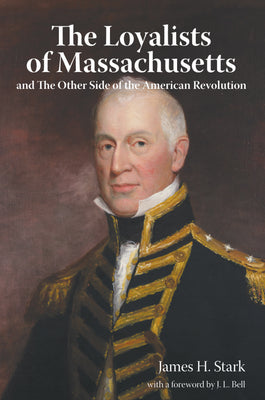
I came across a copy of Stark’s Loyalists of Massachusetts in my local library when I was early in my research on eighteenth-century Boston. I was struck by its combination of detailed research on exiled families and apparently still-hot resentment at how the whole Revolution thing turned out.
One notorious detail of this book is an illustration of Paul Revere on horseback—complete with fringed buckskin coat, beard, and vicious snarl.
In researching the publication of The Loyalists of Massachusetts for this foreword, I realized that Stark didn’t commission that and the other full-page illustrations. He reused them from an earlier history of the Revolution. He did, however, change the captions to make their message more pointed.
Stark published through his own printing company, which he had cofounded with a former “spirit photographer.” That gave him the freedom to devote hundreds of pages to “The Other Side of the American Revolution,” as his subtitle said.
I also looked into the reception of the book in 1910. Some reviewers thought Stark, a childhood immigrant from Britain, was too harsh on the Patriots. The press magnified that controversy. The argument became a front-page story in newspapers well outside New England as editors enjoyed the spectacle of elite Bostonians arguing over their ancestors’ actions.
Another of Stark’s interests was yachting. In fact, he was on a cruise when the controversy over his book broke out. I think he’d be pleased that the cover of this new edition shows Sir Isaac Coffin, alumnus of Boston’s South Latin School and admiral in the Royal Navy.

1 comment:
Congratulations, John, on your new publication.
Like you, I discovered Stark's book many years ago, and have found it to be a valuable resource.
My chief takeaway was how strongly Stark felt that superior personal qualities were always passed down within a family, from generation to generation. He clearly believed that we would have been much better off if the descendants of those exiled Loyalists were still around to govern Massachusetts in 1910.
I think Stark entirely missed the main point of the American Revolution: that all men, and women, are created equal. Our country has no inherited titles or peerage. And that's the way we want it.
Stark also published "Antique Views of ye Towne of Boston", an illustrated tome filled with reproductions of old engravings and prints of the city, including some by Paul Revere. I found this to be an equally valuable resource, especially in those days before internet research.
I agree with you, John, the illustration of Paul Revere looks like something out of the Old West, with the mountains in the distance, and definitely not anything you'd see in Middlesex County. Plus, Revere is clutching a pistol, while Stark's caption is laughable: "He [Revere] and another scout, named Dawes, was captured on the road to Lexington, April 19, 1775."
Post a Comment