






The Burdicks after the Boston Massacre
I imagine his wife Jane did a lot of the hosting since Benjamin remained Constable of the Town House Watch through 1774.
As the London government cracked down and war approached, the Burdicks moved out to Marblehead. Benjamin opened a “large, genteel, and commodious” inn opposite Jeremiah Lee’s mansion. Soon he was watching over auctions of captured goods and vessels. Later the inn hosted auctions of estates confiscated from absent Loyalists.
By 1786 Burdick had relocated to Danvers, at the Sign of the Flag, but that property was sold the next year. Jane was back in Boston when she died in 1791. I haven’t found a record of Benjamin’s death. (It doesn’t help that genealogists have intertwined him with a man of the same name from Westerly, Rhode Island.)
In 1778, the Boston merchant Samuel Phillips funded the opening of a new academy in Andover with Eliphalet Pearson as preceptor. The inaugural class of that school included Malcolm McNeil Burdick, born in Boston 1764—the Burdicks’ oldest son. (His first and middle name appeared with different spellings.) Malcolm was in his teens but for some reason listed as age ten in school records.
Later Malcolm M. Burdick went to sea, appearing in advertisements as master of the Minerva sailing from Baltimore to Liverpool in 1801 and of the John out of New York in 1807. By 1812 he had settled in Windham, Maine, where he advertised that someone else’s livestock had gotten onto his land.
Another of Benjamin and Jane Burdick’s sons, William, born in 1774, went into printing. In July 1795 he and Benjamin Sweetser cofounded a newspaper in Boston called the Courier. Soon that became The Courier, Boston Evening Gazette and Universal Advertiser. Burdick signed over his portion of the business to Sweetser in December, and it ceased publishing in March 1796 after a fire.
[ADDENDUM: From 1798 to 1800 William Burdick was the junior partner in publishing the Oriental Trumpet newspaper in Portland, Maine. He then returned to Boston.]
In 1809 William Burdick married Lucretia Sprague (1788–1849), daughter of Continental artillery veteran Samuel Sprague (1753–1844). According to her brother, the banker and poet Charles Sprague (1791–1895), their father was also part of the Boston Tea Party.
William Burdick reused the Boston Evening Gazette name for a new periodical in 1813. His printing office at Congress and State Streets was next to the Exchange Coffee House, and he bought stock in that jittery enterprise. The printer’s older brother Malcolm sold subscriptions up in Maine.
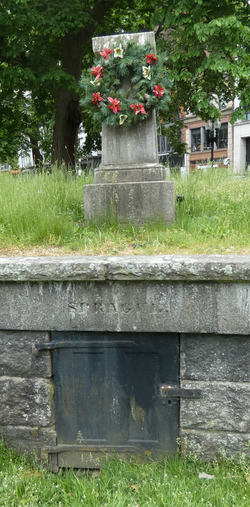
That Boston Evening Gazette evolved into the the Boston Intelligencer in August 1816. Burdick sold the business the following January and died on 30 May 1817, under Dr. John Collins Warren’s care. He was intestate but solvent, so his widow Lucretia could settle the estate and live for three more decades. She was interred in the Sprague family tomb in Boston’s Central Burying-Ground, shown above.

No comments:
Post a Comment