J. L. BELL is a Massachusetts writer who specializes in (among other things) the start of the American Revolution in and around Boston. He is particularly interested in the experiences of children in 1765-75. He has published scholarly papers and popular articles for both children and adults. He was consultant for an episode of History Detectives, and contributed to a display at Minute Man National Historic Park.

Subscribe thru Follow.it


•••••••••••••••••


Wednesday, June 12, 2019

Underwater Archeology off Yorktown

This Daily Press article out of Newport News about marine archeology in the York River near Yorktown speaks to human perseverance in a couple of ways.

First, it runs down all the ways Gen. Cornwallis tried to drive off the French fleet at the river’s mouth so that he could evacuate instead of surrendering.
He sets a few of his own ships afire and tries to drift them into the French warships. No luck.

He tries to slip away, loading his men into small boats to make for Gloucester, but a storm roars in and swamps the attempt.

Finally, he resorts to a tactic that’s been used by others: He sacrifices his own fleet.

Cornwallis sends a line of his ships toward the Yorktown beach until they run aground, forming a barrier he hopes will stop the French from landing troops.

To keep the rest out of his convoy out of enemy hands — as well as block the river with wreckage — Cornwallis issues orders to scuttle. Holes are drilled or chiseled in hulls and the vessels sink.
Which left a lot of ships’ hulls in the river.

The article also talks about the archeologists’ persistent efforts to investigate those wrecks since the Bicentennial period as public funding for such endeavors was being scuttled. The investigation is led, as was the one in the 1980s, by John Broadwater, then Virginia’s state underwater archeologist.
In 1988, a 20-page spread in National Geographic detailed their accomplishments — more than 5,000 relics recovered for posterity from one wreck alone, a ship named Betsy.

But state budget cuts came shortly after, and Broadwater’s position was axed. Work stopped on the project, and relics went into storage — many of them uninspected, which led to a scramble just last year, when live hand grenades from The Betsy were discovered sitting on shelves at the Department of Historic Resources in Richmond.

Now, at 75 years old, Broadwater has come home. He’s working with volunteers — some from the old Betsy days. Most of their equipment is donated. Most expenses are covered by the partners’ own money.
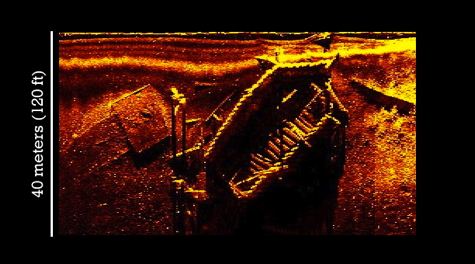
On the plus side, it looks like new technology has made locating wrecks easier than it was before. The picture above, coming from the Virginia Institute of Marine Sciences, shows a “side-scan sonar image” of a newly found wreck. Of course, the team needs access to that technology and more.

Tuesday, June 11, 2019

How Pvt. Joshua Williams Ended Up in Boston

A couple of days back I quoted a deposition from Pvt. Joshua Williams of His Majesty’s 29th Regiment about a bad encounter with Bostonians in June 1769. Williams said he was then new in the regiment and new in Boston, which intrigued me but which I didn’t know enough about British army bureaucracy to explain.

Luckily for me, that also intrigued Don Hagist, author of
British Soldiers, American War and editor of the Journal of the American Revolution. He looked up Williams in his sources and added his deep knowledge of how the British army worked in the Revolutionary era. Here’s what Don found out:

Joshua Williams, a soldier in the 29th Regiment, said that he was assaulted in June 1769 “a few days after he joined the regiment in Boston.” The regiment had arrived the year before, so Williams was either new to the regiment or had stayed behind somewhere when the regiment sailed for Boston.

Particularly interesting is that the “Mob of People” recognized that Williams was new to Boston, “a new or a Strange Lobster.” Did Bostonians know the faces of over three hundred soldiers of the 29th Regiment that well, or was there something else about Williams that made him stand out as being new in town?

Williams first appears on the regiment’s muster rolls prepared in October 1769, with no indication of where he came from. Following his career forward on the rolls shows that he recovered sufficiently from his injuries to serve in the 29th Regiment for two more years. He was discharged on June 4, 1771, when the regiment was in New Jersey, along with a number of other soldiers.

Men who had been injured while serving as soldiers often received pensions after returning to Great Britain and going before the pension examining board in Chelsea, a London suburb. The records of that board show that Joshua Williams appeared there on August 29, 1771, and was granted a pension. On that date he was thirty-two years old and had been in the army for nine years; he was from “Glocester” and had no skilled trade, instead being called a “labourer.”

With nine years in the army but only two in the 29th Regiment, he must have transferred from another corps into the 29th. When a regiment that was on foreign service was sent home, it was not unusual for able-bodied men to be drafted—transferred—into other regiments still on service in the foreign land. Although the 29th’s rolls do not record where their new men like Williams came from, his entry in the pension examination book suggests that he was, indeed, a draft.

The disability that made him eligible for a pension was having been “wounded at Fort Pitt,” probably during the siege of that place in 1763 during Pontiac’s War.

As a draft into the 29th, Williams probably retained his uniform from his previous regiment; he would not receive one from the 29th until the next annual clothing issue, late in the year for regiments in America. This would make him easily recognizable to the Boston mob.

And, since British soldiers owned their own clothing, the loss of his “new Regimental Hatt” meant that he would have to purchase a new one—unless the mob could be convinced to return the property of a man who had been wounded defending colonists on the western frontier.

Thanks, Don!

Monday, June 10, 2019

Di Spigna on Dr. Joseph Warren in the Coming Week

Christian Di Spigna, author of Founding Martyr: The Life and Death of Dr. Joseph Warren, the American Revolution’s Lost Hero is making another swing through New England with book talks and signings.

These events coincide with the conjunction of the paperback edition of Founding Martyr, Warren’s birthday (both on the 11th), Father’s Day (the 16th), and the anniversary of the Battle of Bunker Hill (the 17th).

Here are Christian’s upcoming public appearances:

Monday, 10 June, 7:00 P.M.
West End Museum, 150 Staniford Street, Boston

Tuesday, 11 June, 7:00 P.M.
Charlestown Historical Society, 43 Monument Square, Charlestown

Wednesday, 12 June, 7:00 P.M.
Adams National Historic Park, 1250 Hancock Street, Quincy

Thursday, 13 June, 6:00 P.M.
General Henry Knox Museum, 30 High Street, Thomaston, Maine

Tuesday, 18 June, 1:00 to 3:00 P.M.
Paul Revere House, 19 North Square Boston

Sunday, June 09, 2019

“A bayonet wrested from one of the pursuers”

Yesterday I quoted a deposition by a sergeant of the 29th Regiment about his run-in with John Ruddock, justice of the peace and captain of militia in Boston’s North End, 250 years ago this month.

Justice Ruddock was used to getting his way in that neighborhood. He was a big man—probably 300 pounds or more. In September 1766 he told Sheriff Stephen Greenleaf that he was “Unable to Walk far [and] must be Carried in his Chaise.” At that time, Ruddock was rattling off excuses why he couldn’t come help the sheriff and Customs officers search the storehouse of Daniel Malcom for smuggled goods. Because Ruddock was no fan of royal officials.

When the Crown government stationed troops in Boston in 1768, Ruddock was among their most active opponents. He was one of the magistrates who prosecuted Capt. John Willson for allegedly encouraging enslaved Bostonians to revolt. He arrested soldiers for disturbing the peace in both January and February 1769.

Sgt. John Norfolk of the 14th Regiment complained about another such confrontation:
That on or about the 22d. February 1769, in the evening, he heard a great noise in the street; and found it was occasioned by some Soldiers and Inhabitants who were at high words amongst whom was one Ruddock, who said he was a Justice of the peace, and expressed the words, Go fetch my broad sword and Fusee and Damn the Scoundrels, let us drive the Bloody backs to their Quarters, Send for my Company of Men, for I think we are men enough for them.

He the deponent did what was in his power to prevent their Quarreling and in striving to part the Soldiers and Inhabitants Received great abuses from a son of the said Ruddocks who took him by the hair and pulled him into a passage leading into the yard of Said Ruddocks house, shutting the Door upon him, and by repeated blows laid him on the ground quite insensible after he came to himself thay opened the door and kick’d him out of the passage, at the same time they took the opportunity of taking him his side, his Bayonet which he wore (being then a Corporol), and which is now in the possession of said Ruddock who hath refused to return it tho’ properly demanded, both by himself and a Serjeant sent By his Captain for that purpose.
According to Norfolk, Justice Ruddock wasn’t slowed at all by his weight that night. And his son—either John, Jr., or Abiel—yanked him into the family home.

Of course, the justice had his own view of the situation. He thought he was keeping the peace in the face of rowdy military men. Here’s how the Whigs reported the same event for newspapers in other colonies:
As some sailors were passing near Mr. Justice Ruddock’s house, the other night, with a woman in company, they were met by a number of soldiers, one of whom, as usual with those people, claimed the woman for his wife; this soon bro’t on a battle in which the sailors were much bruised, and a young man of the town, who was only a spectator, received a considerable wound on his head; a great cry of murder, brought out the justice, and his son, into the street; when the former who is a gentleman of spirit, immediately laid his hands upon two of the assailants, and called out to one who pretended to be an officer, and all other persons present, requiring them in his Majesty’s name to assist him as a magistrate, in securing those rioters;

instead of this, he was presently surrounded with thirty or forty soldiers, who had their bayonets in their hands, notwithstanding the unseasonable time of night; some of whom endeavoured to loose his hold of the persons he had seized, but not being able to do it, they then made at him with their fists and bayonets; when he received such blows as obliged him to seek his safety by flight;

they struck down a young woman at his door holding out a candle, and followed him and son into the entry-way of his house with their bayonets, uttering the most profane & abusive language, and swearing they would be the death of them both;

upon the first assault given to the magistrate, one of the persons present posted away to the Town-House, and acquainted the commanding officer of the picquet guard, of what was taking place; but it seems the officer did not apprehend himself at liberty to order a party out to secure, or disperse those riotous drunken soldiers.

Due enquiry is making for the discovery of those daring offenders, in order to their being presented to the grand jury, a bayonet wrested from one of the pursuers in the entry, may lead to a knowledge of the owner, and be a means of procuring proof.
The bayonet that the Ruddocks came away with is the link between these two accounts.

On 27 March, the Whigs reported a grand jury had brought charges “against a number of soldiers, for assaulting with drawn cutlasses and bayonets; smiting and wounded [sic], John Ruddock, Esq; one of his Majesty’s justices of the peace, when suppressing a riot at the north part of the town, late at night, in which they were actors.”

As of 21 April the royal judges still hadn’t begun that trial, the Whigs reported, “nor has any thing been done upon it, as we can yet learn.” Norfolk said nothing about being tried, so probably the whole matter dropped, leaving everyone angry.

Saturday, June 08, 2019

“Here comes A new or A Strange Lobster”

I’ve gotten away from reporting on what was happening in Boston 250 years ago, but this date offers a chance to catch up.

John Ruddock was the North End’s big man. He owned a shipyard and thus employed a large number of laborers. He was a justice of the peace and later a selectman. He was the captain of the militia company that manned the North Battery protecting that part of Boston harbor. (The picture of the North Battery above was engraved by Paul Revere for a militia certificate; the copy at the American Antiquarian Society is signed by Ruddock.) Ruddock was a fervent Whig in the pre-Revolutionary turmoil, as were his adult sons, John, Jr., and Abiel.

Justice Ruddock was also literally, physically big. When he died in 1772, John Andrews reported that he was “ye most corpulent man among us, weighing, they say between 5 and 600 weight.” Andrews’s numbers were typically exaggerated, but even Ruddock declared he was “a Very Heavy Man.”

So keep that picture in mind as we consider today’s sestercentennial event, recounted by Sgt. Thomas Smilie of His Majesty’s 29th Regiment of Foot:
That on the 8th. day of June 1769, John Ruddock [Jr.] Gent: with others assaulted said Serjt. Thomas Smilie on His Guard with Stones, Sticks &ca. & upon Sd. Smilie Entreating them to Desist from such outrages, they Swore bitterly that they would Either Kill or be Killed before they would go away, useing at the same time the most scurrilous & abusive Language to Sd. Smili, Such as Blood back Rascal, Red Herring &ca.,

Upon which Sd. Smilie Secured the Sd. John Ruddock untill he Could acquaint his Father being a Magistrate of the Town of Boston, Who Came Soon after in a Chaise with another Son, who used the Same Invectives Swearing that they would make the bloody back Rascals pay for it, Wishing fervently to have Sd. Smilie farther from the Barrack, Swearing if they had or his Guard should never Disturb the Inhabitants of Boston More.
Another member of the 29th Regiment also complained about how Bostonians behaved in June 1769, as recorded in mid-1770 by magistrates more sympathetic to the Crown than John Ruddock was.

Pvt. Joshua Williams stated:
That in the Month of June one Thousand Seven Hundred and Sixty Nine A few Days after he Joined the Regiment in Boston, he was going to his Barracks and was met by a Mob of People unknown to him, being A stranger in the place, they speaking to Each other in this manner, here comes A new or A Strange Lobster, and saing who sent him here, knock him Down, which they did, their Weapons being wood with one Sharp Edge, which Weapons Fractured, this Deponents Scull, some of them drove A Pike or Other Weapon into his Temples A Considerable length, they used this Deponent most Barbarous after he was knocked Down and was going to throw him into the Sea, others sai’d never mind him further, he is Dead already they Imediately left Deponent takeing A new Regimental Hatt, with them
It’s striking how Williams said his skull was fractured and he was left for dead, but he was still upset about that new hat. I suspect he got in trouble with his sergeant for losing that hat.

In both these cases, we have only a soldier’s description of what happened. Smilie and Williams provided sworn testimony, but they weren’t questioned by anyone representing the people they accused. We don’t know if they left out pertinent information that would complicate the picture of peaceful soldiers whom angry locals suddenly assaulted for no reason.

For example, Pvt. Williams’s story would look quite different if it turned out the men who attacked him with “A Pike or Other Weapon” were town watchmen carrying bill-hooks, trying to enforce the law.

So how does Sgt. Smilie’s depiction of the Ruddocks match up with what other sources say?

TOMORROW: A conflict from two sides.

Friday, June 07, 2019

Taking a New Look at the Saratoga Battlefield

The Saratogian reports on a four-week project at Saratoga National Historical Park in which military veterans help archeologists search for evidence of the battle there in 1777.

This project uses G.P.S. (Global Positioning System) and Li.D.A.R. (Light Detection and Ranging) technology to map the terrain, and metal detectors to find military artifacts with minimal disruption of the surface. The article reports:
The project’s focus is Barber’s Wheatfield where the decisive Second Battle of Saratoga was fought on the afternoon of Oct. 7, 1777, leading to the British Army’s surrender 10 days later in present-day Schuylerville.

British soldiers and their German allies needed the site’s wheat crop, which was ripe for harvesting because Americans had cut their food supply lines.

The battle that ensued lasted less than an hour and ultimately changed world history.

But no archaeology had ever been done there, so much of what occurred has remained a mystery for more than two centuries.

“Basically the battlefield is unknown,” said William A. Griswold, Ph.D., a National Park Service archaeologist for the Northeast Region. “We’re trying to get a handle on where the lines were, how the battle unfolded and how people were moving across the landscape.”

Hundreds of musket balls have been recovered since work began last week along with case shot from six- and 12-pound cannon.
Thirty-three veterans are working on the project, spending two weeks searching for artifacts and another fortnight cataloguing them.

In addition to the National Park Service, the program is organized by the American Battlefield Trust and the American Veterans Archaeological Recovery. More support is coming from local civic groups providing housing and meals and occupational therapy students from nearby Sacred Heart University making sure the participants don’t wear themselves out.

Thursday, June 06, 2019

Joanne Freeman on “Hamilton: The Exhibition”

The Yale News recently interviewed Prof. Joanne Freeman about her work on Alexander Hamilton. The article explains:
For a long time Freeman, professor of history and of American studies, was the only person she knew of who had much of an interest in Hamilton. “I spent many decades lecturing about Hamilton and essentially saying, ‘I know you’ve never heard of this person but you should, because he actually played an important role in the founding of our country,’” says Freeman.

“Now, with everyone adoring Hamilton due to the play, I spend a lot of time saying: ‘You know, he’s not as great as you think he is. He was a flawed figure with problematic politics.’ In my work, I want to show Hamilton in all of his complexity.”
Of course, Freeman shares some of the blame, or credit, for Hamilton’s newfound heroic status. She was one of Lin-Manuel Miranda’s sources for the Hamilton musical. She’s a more formal advisor for “Hamilton: The Exhibition,” a multimedia display in Chicago that’s popped up in conjunction with the performances of the musical there.

The exhibit comes from the same team that created the show, and Freeman says one of their goals was to fill in some holes—and correct some historical misconceptions—that the play leaves its excited audiences with. In the interview, Freeman says:
One major lapse in the show concerns the institution of slavery. It isn’t discussed for more than a line or two in “Hamilton” — yet the United States and the early modern world were grounded on the institution of slavery, so that had to be in the foreground of the exhibition. When you enter the first room of the exhibition (after the introductory film), you see shackles; the institution of slavery is the first thing you confront. It was at the center of Hamilton’s world.

The exhibit adds a lot of context along those lines — concerning slavery and any number of other topics: the role of women, the contributions of non-elite folk, and more. There are also more specific corrections that are almost like Easter eggs in the exhibit, such as a plaque that explains that [Thomas] Jefferson didn’t win the election of 1800 “in a landslide,” as the play suggests, or another one that notes (in a more comical vein) that Martha Washington did not name her feral tomcat Hamilton.
(I discussed that feline myth back here.)
Some topics were difficult to figure out how to put into physical form. One of them was Hamilton’s financial plan, which – to be honest — doesn’t sound inherently interesting to most people. We spent quite a long time trying to figure out how to make it compelling to the average person walking through the exhibit.

At one point, I said: ‘Here’s the thing. The entire government was an experiment, no one knew if it was going to function, and certainly no one knew if Hamilton’s financial plan was going to work. His plan proposed some radical ideas that a lot of people disagreed with, so there was a lot of uncertainty.’

And then there was a pause – and then David Korins [set designer for “Hamilton” the play] said, “What if when you enter the financial plan section, the floor is uneven so people feel a bit thrown off?” A fascinating suggestion — something that never would have occurred to me in a thousand years; making a historical concept concrete through set design. . . .

The day that the exhibition opened to the public, I watched people walk through the part of the exhibit that deals with Hamilton’s financial plan and sure enough when people crossed over into that room they immediately paused, and looked down at the floor.
Freeman is also a cohost of the Backstory podcast and author most recently of The Field of Blood: Violence in Congress and the Road to Civil War. The portrait of her above is by Justin Greenwood, from his and Jonathan Hennessey’s Alexander Hamilton: The Graphic History of an American Founding Father.

Wednesday, June 05, 2019

Boles on Non-Whites in Colonial Churches at Old South, 5 June

Tonight at Old South Meeting House, Richard Boles will speak on the topic “Interracial But Not Integrated: African Americans, Native Americans, and New England’s Colonial Churches.”

The event description says:

Many Native Americans and mostly-enslaved African Americans participated in New England churches between the 1730s and 1790s, including the Old South Meeting House and other Boston churches. They participated by attending services, being baptized, and taking the Lord’s Supper, and did so despite segregated seating arrangements and prohibitions against voting and holding church leadership positions.
New England’s Puritan culture avidly pushed everyone to participate in (Congregationalist) religious worship. At the same time, that society wanted to maintain lines between whites and non-whites, free and enslaved.

One manifestation of this was the requirement that black and Indian worshippers (as well as adolescent apprentices) sit in meetinghouse galleries or balconies, away from the pews owned by established families. Some meetings tried to maintain that customs well after New England states started to end slavery, insisting on segregated “negro galleries” even if African-American families had purchased pews. I quoted William C. Nell on how two churches mistreated the family of one Revolutionary War veteran way back here.

Richard Boles is professor of history at Oklahoma State University, specializing in the study of early American religion from the perspective of non-European worshippers and observers.

This event starts tonight at 6:30. It is co-presented by the Congregational Library & Archives and funded by the Lowell Institute. It is free and open to the public, though registration is requested.

Tuesday, June 04, 2019

Slavery and the Vermont Constitution, Then and Now

In The Atlantic, Parker Richards reports on a push in Vermont to amend the state constitution to remove the clause referring to slavery even though that clause forbids the practice.

The first clause of the independent state’s 1777 constitution’s declaration of rights said:
THAT all men are born equally free and independent, and have certain natural, inherent and unalienable rights, amongst which are the enjoying and defending life and liberty; acquiring, possessing and protecting property, and pursuing and obtaining happiness and safety. Therefore, no male person, born in this country, or brought from over sea, ought to be holden by law, to serve any person, as a servant, slave or apprentice, after he arrives to the age of twenty-one Years, nor female, in like manner, after she arrives to the age of eighteen years, unless they are bound by their own consent, after they arrive to such age, or bound by law, for the payment of debts, damages, fines, costs, or the like.
That paragraph was later changed to treat men and women equally, setting the age of majority for both at twenty-one. (That meant taking three years of majority away from women. I’m not sure when that change was made, and it’s quite possible that twenty-year-old women still had far fewer legal freedoms than twenty-year-old boys.)

The original Vermont constitution thus preserved some forms of unpaid labor common in the eighteenth century: apprenticeship of minors, indentured servitude for adults agreeing to such a contract, and work that courts required of people paying off debts and fines.

In practice, as I discussed back in 2014, some elite Vermonters still kept people enslaved in their households in the late 1700s. And the case of “Judge Jacobs’s Diana” shows a well-connected jurist exploiting Vermont’s anti-slavery constitution to avoid having to pay to support his former slave when she became ill.

Nonetheless, the language of Vermont’s 1777 constitution was revolutionary. It made quite clear that the new government would not enforce chattel slavery as practiced in the U.S. of A. and Britain’s remaining North American colonies. It rooted that stance in a belief in equality and natural rights. It made no distinction between locals and people “brought from over sea.”

Some present-day Vermonters don’t want the state constitution to include the word “slave,” or to reflect that there might ever be a legal way to compel someone else to work. This stance doesn’t appear to be based in a practical worry, such as that courts might force people into labor for unpayable debts. Rather, it’s bound up in concerns about current discrimination in the state.

The first proposed amendment would have removed the clause entirely. One chamber of the state legislature has instead passed language that preserves the original natural-rights statements and then spells out a prohibition on forced labor:
That all persons are born equally free and independent, and have certain natural, inherent, and unalienable rights, amongst which are the enjoying and defending life and liberty, acquiring, possessing and protecting property, and pursuing and obtaining happiness and safety; therefore slavery and indentured servitude in any form are prohibited.
Of course, that approach still acknowledges slavery. (It also doesn’t bar apprenticeships, which were sort of like unpaid internships except the food was better.) The process of amending the constitution in Vermont is long and involved, so it seems possible there will be further developments, or this particular initiative could falter.

Monday, June 03, 2019

When Wartime Riots Paralyzed London

On 2 June 1780, as I described yesterday, a crowd of over 50,000 people surrounded Parliament while Lord George Gordon presented a petition demanding a return to strictures on Catholics.

The House of Commons dismissed that petition, and the crowd dispersed from that part of London. But that evening people attacked the embassy of Sardinia. They destroyed a chapel connected to the embassy of Bavaria. They attacked neighborhoods of prominent Catholics. Sir John Fielding’s Bow Street Runners and other authorities arrested some rioters and locked them in Newgate Prison.

The next day, 3 June, larger crowds rampaged through Moorfields, a neighborhood where a lot of Irish workers had settled. A mob attacked Newgate Prison, freed fellow rioters and other prisoners, and then basically destroyed the complex. Then people attacked other prisons, and other embassies. They attacked the home of Lord Mansfield, the Chief Justice, who had supported the more liberal law about Catholics.

Violence continued for days, spilling well beyond the original grievances. On 7 June, there was a concerted assault on the Bank of England, stopped only by an upper-class militia unit and regular troops. All in all, the property damage cost up to £180,000, which many historians say was far more than the city of Paris suffered during the whole French Revolution. (I’d like to see the comparable figures, but that’s what they say.)

On that 7 June, the British government clamped down on the rioters with force. It brought in regular troops, including the Horse Guards and Foot Guards, as well as militias from nearby counties—12,000 armed men in all. Soldiers killed nearly 300 people and arrested 450, pacifying the city after a week of chaos. The government put scores of men on trial and sentenced dozens to death for acts of violence and theft, though not all those sentences were carried out.

London’s upper and middle classes, scared by the violence, supported such harsh measures. The Crown fined the Lord Mayor for not reading the Riot Act to the crowds earlier. A former Lord Mayor, John Wilkes, led troops against the rioters, ruining his reputation as a champion of the people and thus his political career. Another radical Whig, the Earl of Shelburne, responded to the uprising by proposing a national police force, but nothing came of that.

As for Lord George Gordon, he was locked up in the Tower and tried for treason, but acquitted. Nevertheless, the disturbances were named after him: the Gordon Riots. He continued to get in trouble with the authorities, eventually locked up again for insulting Marie Antoinette of France and the British legal system. By then he had converted to Judaism—beard, circumcision, and all—and he became quite a curiosity while locked up in the rebuilt Newgate Prison.

The unrest had at least one effect on the American Revolution. Early in 1780 Spain and Britain had started secret negotiations which could have led to Spain pulling its support for the new U.S. of A. The riots convinced Spanish diplomats that Lord North’s government might soon fall, so they ended the talks.

The B.B.C. radio program In Our Time recently hosted a discussion about the Gordon Riots, available as a podcast. The London Historians offers an introduction to the unrest by Prof. Jerry White in P.D.F. form. The episode was also fodder for nineteenth-century British novelists: Maria Edgeworth with Harrington and Charles Dickens with Barnaby Rudge. But of course, unlike the Stamp Act riots in North America and the storming of the Bastille in Paris, the Gordon Riots didn’t lead to revolution.

Sunday, June 02, 2019

Lord George Gordon’s Petition to Parliament

The engraving above shows Lord George Gordon, youngest son of the Duke of Gordon, delivering a petition to Parliament in 1780. That document came with over 400 pages of signatures, and there were other copies circulating. Estimates of the total number of people to sign Gordon's petition run as high as 120,000 Britons. In eighteenth-century society, that’s a mind-boggling number.

What did all those people want from Parliament? They asked the British government to repeal the Papists Act of 1778, which had lifted some of the legal restrictions on Roman Catholics imposed after the Glorious Revolution. Not that the new law allowed Catholics to vote or hold office in Britain, but they could now, for example, buy real estate.

One impetus for the new law was the British government’s need to recruit more Irish Catholics into the army to fight the American War. Previously men had to abjure their Catholic faith to become redcoats. After 1778, they simply had to swear allegiance to the Hanoverian king. Lord Mansfield, Britain’s Chief Justice, was one of the main proponents of this reform.

As for Gordon, he was a former Royal Navy lieutenant and Member of Parliament. In the House of Commons he had opposed Lord North’s policies toward the American colonies, but he didn’t get along with the opposition parties, either.

In 1779 Gordon formed the Protestant Association because he believed that British Catholics remained a threat who had to be suppressed. By then two of Europe’s big Catholic powers, France and Spain, had joined the Americans' war against the British Crown. Gordon and many of his supporters suspected that people in the government too sympathetic to the Catholics had brought on the war and were endangering the Empire.

Now we like to think of the American Revolution as connected to freedom of religion. Indeed, it pushed American society in that direction. Even in Massachusetts, where the Congregationalist establishment lasted until the 1830s, the war ended with a Catholic Church in Boston. Virginia adopted Thomas Jefferson’s Statute for Religious Freedom in 1786. And we agree that’s a Good Thing, right?

But in the 1770s, the political lines were drawn differently. Gordon supported political reform within the British Empire, and he saw Catholicism as the worst form of old-fashioned despotism, so he didn’t want Catholics to get any closer to power. Meanwhile, Mansfield opposed the American rebels but was liberal toward religious minorities within the Empire.

On 2 June 1780, about 50,000 supporters of the Protestant Association gathered in St. George’s Field, an open area in South London. (Eleven years before, a rally for John Wilkes at that place had ended in bloodshed.) Many in the crowd blue cockades, the movement’s symbol. Some carried banners that read “No Popery.”

Lord George Gordon led his supporters on a march to Westminster to present their huge petition, as shown above. The crowd grew even larger as it moved through the city streets.

With his genteel status, Gordon made it into the House of Commons and presented the Protestant Association petition. Outside, thousands of people surrounded the Parliament building, roughing up some peers and vandalizing carriages.

Members of Parliament voted to dismiss the petition, 192-6. Gordon went home disappointed but not surprised. Soldiers arrived and dispersed the crowd. The government thought the crisis had passed.

TOMORROW: It hadn’t.

Saturday, June 01, 2019

How to Assess a Founder’s Quote

In the last two days I ran into two false Founder’s Quotes on Twitter:

  • a statement attributed to John Hancock at a council with Iroquois leaders that he never attended. (The statement could arguably have been attributed to Philip Schuyler, who led the Continental delegation there, but was presented as a joint statement.)
  • words from Alexander Hamilton about limited government, ironic since in his time he was a champion of an expansive federal government.

I therefore decided this was a good time to lay out my rules of dealing with Founder’s Quotes. You know, those statements attributed to someone involved in setting up the U.S. of A. which so often happen to accord with the political outlook of the person repeating the quotation.

First, what not to do.

Don’t trust memes, T-shirts, bumper stickers, coffee mugs, or the like. The people who make those things want your money and/or your mind.

Don’t trust quotation websites. They’re crowdsourced but don’t seem to check sources, and they copy from one another. Put a fake quote onto one of those sites, and it can spread like measles through an unvaccinated daycare. The exception is Wikiquote, which asks people to provide sources for the quotations they upload and is formatted to allow other people to question and discuss those quotations. Still not authoritative, but better.

Don’t trust books published after quotation websites began to proliferate. Especially books about political topics. Authors are all too happy to go onto one of those quotation websites and grab a statement that appears to come from a Founder and fits their message.

Here are some easy places to check.

The Washington Library at Mount Vernon has a section of its website devoted to spurious Washington quotations.

Monticello has the same for ersatz Jefferson statements.

Some Wikiquote pages have an “Attributed” and/or “Disputed” section for questionable quotes and a “Misattributed” section for no-question falsehoods.

It’s always fun to check in with Garson O’Toole’s Quote Investigator, devoted to tracking down who said what when and first. Most of its targets seem to come from more recent centuries, but the Founders make a showing.

If the situation still warrants investigation, here are the steps I take.

Break the quote down into segments of five to seven words. Look for unusual words and words that don’t often appear in that exact sequence. Searching for long quotes can return false negatives because of (a) variable eighteenth-century spelling, (b) words dropped from the middle of a phrase to make it more pithy, and (c) O.C.R. difficulties in scanning.

Search for each segment at Founders Online. Put the segment in quotation marks. The results will still contain a lot of examples which are like the phrase, not exact matches, but those might be useful. For more hints, look at the site’s “Searching” functions.

Search for each segment on Google Books. Again, put the segment in quotation marks. The top results will be exact matches, followed by near matches. If you see a lot of books published in this century, click on “Tools” and then under “Any Time” ask for appearances only in the 20th century, then only in the 19th century.

The major Founders were so well documented that most of what they’ve written was collected and published by the end of the 1900s. Thus, if a quote shows up only in books printed in this century, that’s a good reason to doubt it can really be traced to the Founders’ time. It more likely came through one of those quotation websites.

Don’t be satisfied with a book presenting the quotation as a quotation: “As Benjamin Franklin is reputed to have said,…” Or even, “As John Jay wrote,…” Look for citations to particular documents—a letter written on a specific date, an essay. Look for the quotation within a longer passage.

Be alert to words coined after the eighteenth century. Franklin never ate “lunch.” Samuel Adams didn’t know from “brush fires.” Dictionary sites like Merriam-Webster and Etymonline say when a word first appeared in print.

If you find a quotation in a passage reliably attributed to a Founder, take an extra second to assess the context. Eighteenth-century prose tended toward long sentences, full of cascading clauses and modifiers that build to their conclusions. In contrast, modern taste runs toward the pithy. Even authentic Founders’ Quotes are often extracts from much longer sentences, which can alter their meaning.

Knowing context might change how you choose to characterize or use the quotation. For example, a lot of the aphorisms in Poor Richard’s Almanack didn’t come from Franklin’s wit but from books of sayings he used to fill space. John Adams’s “Facts are stubborn things” was a common saying. Hamilton’s statement “Here sir, the people govern” wasn’t about the U.S. of A. but about the House of Representatives as a contrast to the Senate.

Finally, the burden of proof remains on the person quoting a Founder. If you’re skeptical, it’s not your job to prove a Founder didn’t say or write something. It’s the job of the quoter to show that the Founder did. {{Attribution always needed.}}

Friday, May 31, 2019

“Declaring Independence: Then & Now” in Concord, 2 June

The next session of the “Declaring Independence: Then & Now” public reading and discussion of the Declaration of Independence will take place on Sunday, 2 June, in Concord.

“Declaring Independence: Then & Now” is a program developed by the Freedom’s Way National Heritage Area and the American Antiquarian Society. I observed multiple sessions last year as part of an American Association for State and Local History evaluation. Every session is different, depending on what the local partners and attendees choose.

The basic questions are:
What does the Declaration of Independence mean today and what did it mean to citizens throughout the Freedom’s Way National Heritage Area when it was conceived and debated during their lifetime? The thought-provoking public performance piece Declaring Independence: Then & Now seeks to answer this question by integrating a reading of the Declaration of Independence with first-person accounts presented by living-history performers. As the 18th-century words and ideas are performed, the narrator explores their meaning to challenge the audience to consider their relevance and power for today.
The First Parish in Concord’s Social Action Council is hosting a session at the First Parish, 20 Lexington Road, from 12:30 to 2:00 P.M. The event is free, and the public is invited to come and participate in the discussion. 

The next “Declaring Independence: Then & Now” session on the schedule is at the First Parish Church of Fitchburg, 923 Main Street, on Thursday, 20 June, starting at 6:00 P.M. That is co-hosted by the Fitchburg Historical Society. 

Thursday, May 30, 2019

The Rediscovery and Remembrance of Robert Newman

For half a century after Robert Newman the Old North sexton killed himself in 1804, nobody much outside of his family remembered him.

He wasn’t named in public accounts of Revolutionary Boston. He had no monument in the Copp’s Hill Burying Ground, near the church he had tended.

(In contrast, his namesake Capt. Robert Newman did have a gravestone, which Thomas Bridgman described in detail in Epitaphs from Copp’s Hill Burial Ground, Boston: With Notes in 1851.)

Then at the start of 1861 Henry W. Longfellow published his poem “Paul Revere’s Ride.” That made Paul Revere and the lanterns hung in the Old North steeple famous. People started asking who hung those lanterns. Newman’s son and other descendants came forward to say that he had done it.

That led to a protracted dispute with the descendants of John Pulling, who grew up understanding that he deserved the credit. I already rehashed that unnecessary dispute; it seems quite clear that both men were involved.

More important to this week’s discussion, the rediscovery of the lantern story led to new interest in Robert Newman. Suddenly he was remembered. Meanwhile, the fact that another man of the same name had lived in the North End at the same time was forgotten.

As a result, starting in the late 1800s people gathered information about both Robert Newmans and wrote about them as a single person. By 1927 the Sons of the American Revolution had installed “an iron memorial” on Copp’s Hill that reportedly read:
CAPT. ROBERT NEWMAN
PRIVATEER ADVENTURE
SEXTON
OLD NORTH CHURCH
APRIL 19th, 1775
Historians of Freemasonry who were themselves Masons were particularly pleased by how this composite individual offered another link between Freemasonry and a famous Revolutionary moment. For example, this Masonic Genealogy website conflates the sea captain’s gravestone and Masonic career with the sexton’s activity on 18 Apr 1775. As I wrote yesterday, I’m skeptical that Newman the sexton was ever a Freemason.

Edward MacDonald’s Old Copp’s Hill and Burial Ground: With Historical Sketches, published in 1894, mentioned the sexton’s recently demolished house but said nothing about a gravestone for him. Within ten years, however, a stone had been installed for that Robert Newman at Copp’s Hill, as shown by the 1904 photo shown above.

The sexton’s stone reads:
HERE RESTS
ROBERT NEWMAN
BORN IN BOSTON, MCH. 20, 1752,
DIED IN BOSTON, MAY 26, 1804
(And then a Freemasons’ emblem—whether or not appropriate.)
THE PATRIOT WHO HVNG THE SIGNAL LANTERNS
IN THE CHVRCH TOWER, APRIL 18, 1775
The typography is, in a word, weird. It looks like a Colonial Revival attempt to replicate real eighteenth-century stones that’s at once too regular in its spacing and too irregular in its spelling. To me the type also looks similar to the monument in the Old Granary Burying Ground to Christopher Seider and the Boston Massacre victims, erected by “Boston Chapter S.A.R. 1906.”

I don’t mind Robert Newman the sexton having a monument, of course. I just wish we did a better job keeping him and his life distinct from that of Robert Newman the captain.

Wednesday, May 29, 2019

Capt. Robert Newman, Freemason

I’m seeking to distinguish the two men named Robert Newman who lived in the North End and died two years apart in 1804 and 1806.

According to the records of the St. John’s Lodge of Freemasons in Boston, a Robert Newman became a member in 1783. At the end of 1792 he was chosen to be one of the “Toilers for the ensuing year.”

In 1790 a new Masonic lodge was founded in Newburyport. Four years later, those Freemasons conferred the higher title of “Knight Templar” on Robert Newman.

I’m convinced both these items refer to Capt. Robert Newman, the mariner who commanded a privateer during the Revolutionary War. He had a house in Boston in the mid-1780s and a family in Newbury by 1790. As a ship’s captain he was of the right socioeconomic class to join a Masonic lodge in that period.

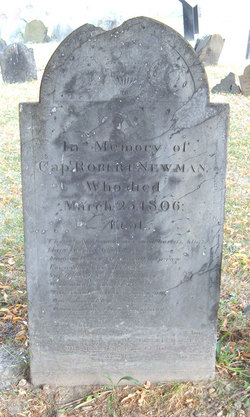
The mariner’s early-1800s gravestone at the Copp’s Hill Burying Ground displays Masonic emblems (above the word “Memory”). That stone reads:
In Memory of
Capt. ROBERT NEWMAN,
Who died
March 23, 1806;
Æt. 51.

Though Neptune’s waves and Boreas’ blasts
Have tossed me to and fro,
Now well escaped from all their rage,
I’m anchored here below.
Safely I’ll ride in triumph here,
With many of our fleet,
Till signals call to weigh again,
Our Admiral Christ to meet.
O may all those I’ve left behind
Be washed in Jesus’ blood,
And when they leave this world of sin
Be ever with their Lord.

ALSO IN MEMORY OF CAPT. ROBERT NEWMAN, JUN.
WHO DIED AT SEA Dec. 14, 1816.
The other Robert Newman living in Boston’s North End until 1804 was unlikely to have been a Freemason, I believe. He was a church sexton, a profession then associated with poverty. He didn’t command genteel authority in that society. But through the quirks of history, Newman the sexton has been posthumously made a Mason.

Tuesday, May 28, 2019

Two Robert Newmans in the North End

Map of Boston's North End, bristling with wharves, in 1769
On 13 Mar 1806, the Independent Chronicle of Boston ran this death notice:
Mr. Robert Newman, aged 51. His funeral will be from his late dwelling-house, head of Battery-Wharf, north-end, this afternoon, at 4 o’clock; which the relations and friends are requested to attend.
This was not the same Robert Newman as the man who hung the lanterns in the Old North Church on 19 Apr 1775. That Newman’s death notice had appeared in the Independent Chronicle two years earlier on 28 May 1804:
On Saturday last, Mr. Robert Newman, aged 52—for many years sexton of the North Church. He put a period to his existence with a pistol.
Those two death notices show that there were two men named Robert Newman living in Boston’s North End at the same time. I don’t know if they were related, but they weren’t part of the same household.

Those two Robert Newmans have been thoroughly confused and conflated in local history. So I’m going to try to sort them out.

The Robert Newman who died in 1806 was born in or around 1755. He enlisted in Col. Moses Little’s regiment out of Ipswich in May 1775, as shown in Massachusetts Soldiers and Sailors of the Revolutionary War. He served a few months that year. He may have also served short stints in 1778 and 1779 and then on the brigantine Pallas during the Penobscot expedition. This Newman married Esther Treadwell in Ipswich on 22 May 1778.

In September 1779 a group of men petitioned the Massachusetts Council to commission this Robert Newman as commander of a privateer ship: the Adventure out of Beverly. The 16 Mar 1780 Independent Chronicle ran a legal notice referring to “Robert Newman, commander of the armed schooner Adventure.” He turned twenty-five that year.

Robert Newman “at the North End” of Boston was appointed to administer a shipwright’s estate in 1785, according to the 26 September Boston Gazette. This was probably the mariner. He appears to have made a home in Boston while maintaining his family up on the North Shore.

In July 1790 a child of Robert Newman died in Ipswich of “fits.” On 13 Aug 1797, a four-month-old child of Robert and Esther Newman died in Newbury. One week later, four children of Robert Newman were baptized in that town at once: Robert, Sally, Thomas, and William.

The 25 Mar 1800 Newburyport Herald reported that “Mrs. Newman, consort, of Capt. Robert Newman,” had died. Newbury vital records confirm her name was Esther, and she was forty-three years old. Six years later the captain himself died in Boston.

Meanwhile, the other Robert Newman was working as the sexton of Christ Church, better known now as Old North. In addition to hanging the lanterns in April 1775, he has also appeared on Boston 1775 charging visitors to see the bodies of British officers killed in the Battle of Bunker Hill.

In May 1786 the selectmen of Boston designated twelve men as “Undertakers” and set the prices for burial, tolling a bell, alerting mourners, and “Extraordinary cases, such as putting the bodies into tar’d sheets.” Most if not all those men were sextons, and among them was Robert Newman.

On 14 June 1794 the Centinel reported that the next day Mrs. Abigail Sumner’s funeral would take place “from the house of Mr. Robert Newman, Salem Street.” That looks like part of his work as an undertaker since I can’t find any family connection.

The sexton had married Rebecca Knox in 1772, but divorced her for having an affair with “one John Skinner.” On 5 Feb 1791 the Columbian Centinel reported the death of “Mrs. Rebecca Newman, formerly the wife of Mr. Robert Newman, aged 41.” The sexton had already married again, to Mary Hammond, who would bear more of his children and settle his estate. This Robert Newman took his own life in 1804.

TOMORROW: The Freemasonry connection.

Monday, May 27, 2019

Serfin’ U.S.A. with Benjamin Franklin

Yesterday I examined the facts and logic of a recent USA Today opinion essay, “Killing the Electoral College Means Rural Americans Would Be Serfs” by Trent England. I found them unconvincing.

The portions of the essay that invoke history are more alarmist and equally slipshod. England writes:
…history shows that city dwellers have a nasty habit of taking advantage of their country cousins. Greeks enslaved whole masses of rural people, known as helots. Medieval Europe had feudalism. The Russians had their serfs.
That’s laughable, and not just because this conception of world history appears to be confined to the western half of Eurasia.

Before the Industrial Revolution, the overwhelming proportion of people in all large societies worked in agriculture. Cities were relatively small. Urban elites didn’t just head out to the countryside and enslave the people they found there. Rather, local strongmen forced the bulk of their neighbors to work the fields for them in exchange for protection. Only over time did elite families take urban dwellings as well, and only later did urban traders turn themselves into country aristocrats.

Notably, England doesn’t discuss the U.S. of A.’s own history of enslaving and oppressing people to make them work on agricultural production. In the ante-bellum period and then in the Jim Crow era, the Electoral College preserved the power of the local elites who maintained and benefited from that exploitation. Nobody looking at U.S. history should think that the Electoral College system has protected the rural Americans who actually did the work.

“The idea that every vote should count equally is attractive,” England writes. Yes, that’s why his state of Oklahoma and every other counts votes equally for local elections. I have yet to see proponents of the national Electoral College demand a similar system for their own states. The U.S. Supreme Court has even ruled that state and local elections must be based on the principle of “one person, one vote.”

England goes on:
But a quote often attributed to Benjamin Franklin famously reminds us that democracy can be “two wolves and a lamb voting on what’s for lunch.” (City dwellers who think that meat comes from the grocery store might not understand why this is such a big problem for the lamb.)
England snidely suggests that “city dwellers” don’t know where meat comes from, but really he destroys his claim to speak for rural America by treating “two wolves and a lamb” as the norm.

There are more than 5,000,000 sheep in America and fewer than 25,000 wolves. Lambs would be well off in a “one animal, one vote” democracy where sheep could easily outvote wolves. The only time wolves outnumber sheep is when they maneuver to create that situation for their own advantage. Likewise, politicians worried about losing fair votes manipulate electoral districts (gerrymandering) or cling to an old imbalanced system (the Electoral College).

Franklin never made that mistake about wolves and sheep because Franklin never said what England quotes him as saying. The line appears nowhere in the Franklin Papers at Founders Online. Wikiquote not only notes that lack of a credible source but also how the word “lunch” appeared well after Franklin’s lifetime. England’s phrase “a quote often attributed to” hints that he recognized how unreliable this attribution was but decided to use it anyway because it served his purposes.

Likewise, the present Electoral College system continues to serve the purposes of some Americans, so they’ll use any argument to make it appear to be fair, logical, or beneficial. But those arguments melt on scrutiny.

Sunday, May 26, 2019

Being More Equal Than Others in the Electoral College

The Nevada legislature just voted to join the National Popular Vote Interstate Compact, another step to ensuring the Electoral College count reflects the actual vote of us Americans. This initiative has obviously started to worry defenders of the Electoral College because they’re attacking it.

This week USA Today published an opinion piece by an activist from Oklahoma named Trent England with the attention-seeking title “Killing the Electoral College Means Rural Americans Would Be Serfs.” Its presentation of both contemporary facts and history is unconvincing.

To start with, the essay never explains how it defines “rural Americans.” Different government agencies classify parts of the country in different ways, and we Americans tend to define our own home areas differently still.

England’s discussion slips back and forth between “rural” areas and small-population states, the ones overrepresented in the Electoral College. Those aren’t the same. Some small-population states have few rural areas, like Rhode Island. All large-population states, such as California, Texas, New York, and Illinois, have significant numbers of voters living in rural areas. In most cases, those people’s votes are entirely diluted by the current Electoral College system.

Americans living in rural places, whether in small states or large, deserve to have their votes counted equally with those living in more urban areas. Of course, there are fewer rural Americans than metropolitan Americans now. The U.S. of A. has been a majority-urban country for a century, as the 1920 census showed. England has therefore taken on the challenge of showing that a minority of voters should be, in George Orwell’s words, more equal than others.

England argues that small-population states deserve disproportionate power through the Electoral College based on the production of certain commodities:

Rural America produces almost all our country’s food, as well as raw materials like metals, cotton and timber. Energy, fossil fuels but also alternatives like wind and solar come mostly from rural areas. In other words, the material inputs of modern life flow out of rural communities and into cities.
This is a selective way to measure economic output. Rather than focus on raw commodities, we might just as well ask where those materials are turned into goods with the most value. We might ask which states do the most trading with other countries, or produce the most new patents. We could measure overall economic production without privileging certain kinds. Or we could, you know, count every person’s vote equally.

A little digging into the essay’s claims about economic importance shows reasons for doubt. For instance, it states “wind and solar [energy] come mostly from rural areas,” with a link to an essay at Real Clear Energy, part of a right-of-center network of news sites now mostly owned by Forbes Media. But that essay doesn’t actually say what England claims it does. It talks (in loaded language) about how rural states and rural electric cooperatives are participating in the shift to clean energy. Somehow that’s been turned into a claim that those areas produce most such energy.

Likewise, the claim that “Rural America produces almost all our country’s food” is linked to a Vox article titled “40 Maps That Explain Food in America.” Those maps show many things, such as the typical age of farmers in different regions and how close the average McDonald’s is. None of those maps show where “almost all our country’s food” comes.

But for the sake of argument, let’s accept that certain foods, other agricultural commodities, metals, and energy are so important that the people who live in the top-producing states should get extra power in national elections. Does the Electoral College provide that? Not really.

  • Of the top five food-producing states, three (California, Texas, and Illinois) are disadvantaged by the Electoral College. This looks like a measurement of agricultural output. Including seafood and imports with the rest of our food would, of course, raise the ranking of coastal states.
  • Of the five states producing the most solar energy, four (California, North Carolina, Arizona, and Texas) are disadvantaged by the Electoral College.
  • Of the five states producing the most wind energy, three (Texas, California, and Illinois) are disadvantaged by the Electoral College.
  • Of the five states producing the most oil, two (Texas and California) are disadvantaged by the Electoral College. North Dakota recently jumped way up on this list, and if the Electoral College really rewarded such productivity it should gain more political power as well, but of course the Electoral College doesn’t do that.
  • Of the five states producing the most coal, two (Pennsylvania and Illinois) are disadvantaged by the Electoral College.
  • The essay doesn’t define what “metals” it values, but of the five states producing the most minerals, three (Arizona, Texas, and California) are disadvantaged by the Electoral College.

In sum, there’s no correlation between the current Electoral College system and extra power for “rural” Americans producing more of certain commodities. Claiming that the Electoral College protects the interest of those voters therefore seems fallacious.

TOMORROW: Lessons of history.

Saturday, May 25, 2019

“I am My Dear Marquis with the truest affection…”

portrait of the rosy-cheeked young Lafayette painted for Jefferson, now at the Massachusetts Historical Society
There was a lot of news coverage earlier this month about locating a letter from Alexander Hamilton to the Marquis de Lafayette that was stolen from the Massachusetts State Archives sometime around 1940.

Fortunately for the study of history, the archive had made a photostat of the document before it disappeared. The text of the letter was therefore available to be included in the printed edition of Hamilton’s papers and at Founders Online. That in turn led to a document dealer recognizing that the original had been stolen when it came back onto the market. Now the state is taking legal steps to get that document back.

Here’s the text of the 21 July 1780 dispatch:
My Dear Marquis

We have just received advice from New York through different channels that the enemy are making an embarkation with which they menace the French fleet and army. Fifty transports are said to have gone up the Sound to take in troops and proceed directly to Rhode Island.

The General is absent and may not return before evening. Though this may be only a demonstration yet as it may be serious, I think it best to forward it without waiting the Generals return.

We have different accounts from New York of an action in the West Indies in which the English lost several ships. I am inclined to credit them.

I am My Dear Marquis
with the truest affection
Yr. Most Obedt
A Hamilton
Aide De Camp
The letter highlights some of the relationships depicted—indeed exaggerated—in the Broadway musical Hamilton: the close friendship between these two young officers and young Hamilton’s willingness to act on Gen. George Washington’s behalf.

Another link to recent popular culture: The warning Hamilton sent on had come from the Culper Ring on Long Island, inspiration for the recent television series Turn: Washington’s Spies. The rumor about a Caribbean naval battle, which was false, had come through Maj. Benjamin Tallmadge, another character on that show.

The mystery I can’t figure out is why this letter was in the Massachusetts archives in the first place. It has nothing to do with Massachusetts.

Friday, May 24, 2019

Hogarth’s Noise Goes on Display in London

The Foundling Museum in London is mounting a new exhibit focusing on the visual artist William Hogarth in an innovative way:
Hogarth & the Art of Noise will reveal Hogarth’s innovative use of sound, introducing visitors to a previously unexplored but important aspect of his art, and further cementing his reputation as the 18th century’s most original artist.

Famed for his social commentary, no painter before or since Hogarth has made such overt use of sound as a way of communicating a narrative. Taking as its focus the artist’s masterpiece, The March of the Guards to Finchley, the exhibition unpacks the painting’s rich social, cultural and political commentary, from the Jacobite uprising and the situation for chimney boys, to the origins of God Save the King.

Using sound, wall-based interpretation, engravings, and a specially-commissioned immersive soundscape by acclaimed musician and producer Martyn Ware, the exhibition will reveal how Hogarth orchestrated the natural and man-made sounds of London, to depict the city in all its guises.
The former Foundling Hospital may seem like an odd venue for an art exhibit, but, thanks to Hogarth, it featured fund-raising art exhibits back in the eighteenth century. Hogarth also drew the institution’s original brand, designed uniforms, donated portraits, and served as a governor and “inspector of wet nurses.”

This exhibit opens today and runs through 1 September.