J. L. BELL is a Massachusetts writer who specializes in (among other things) the start of the American Revolution in and around Boston. He is particularly interested in the experiences of children in 1765-75. He has published scholarly papers and popular articles for both children and adults. He was consultant for an episode of History Detectives, and contributed to a display at Minute Man National Historic Park.

Subscribe thru Follow.it


•••••••••••••••••


Monday, January 23, 2017

John Quincy Adams’s College Entrance Exam
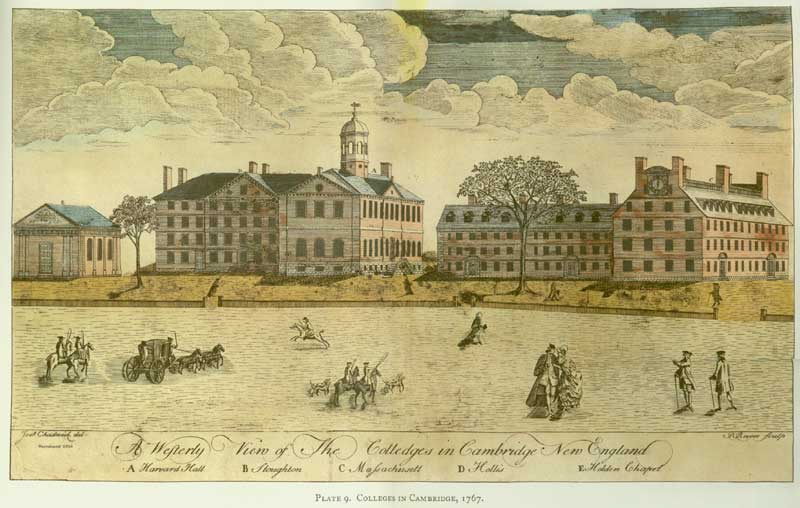
On 15 Mar 1786, John Quincy Adams finally took his entrance test for Harvard College. As I’ve quoted in recent postings, he had come back from Europe the year before to finish his education at his father’s alma mater. At age eighteen, he hoped to enter as a junior and to study law.

Here’s John Quincy’s description of the test from his diary:
Between 9 and 10 in the morning, I went to the President’s [Rev. Joseph Willard], and was there examined, before, the President, the four Tutors three Professors, and Librarian.

The first book was Horace, where Mr. [Eleazer] James the Latin Tutor told me to turn to the Carmen saeculare where I construed 3 stanza’s, and parsed the word sylvarum, but called potens a substantive.
Okay, a little slip there, but he can recover.
Mr. [Timothy Lindall] Jennison, the greek Tutor then put me to the beginning of the fourth Book of Homer; I construed Lines, but parsed wrong αλληλομς. I had then παραβληδην given me.
Uh-oh, the pressure might be getting to him.
I was then asked a few questions in [Isaac] Watts’s Logic [Logic, or The Right Use of Reason, in the Inquiry after Truth], by Mr. [John] Hale, and a considerable number in [John] Locke, on the Understanding [An Essay Concerning Human Understanding], very few of which I was able to answer.
This isn‘t looking good, is it?
The next thing was Geography, where Mr. [Nathan] Read ask’d me what was the figure of the Earth, and several other questions, some of which I answered; and others not.
He’s really going to have to catch up now.
Mr. [Samuel] Williams asked me if I had studied Euclid, and Arithmetic, after which the President conducted me to another Room, and gave me the following piece of English to turn into Latin, from the World.
There cannot certainly be an higher ridicule, than to give an air of Importance, to Amusements, if they are in themselves contemptible and void of taste, but if they are the object and care of the judicious and polite and really deserve that distinction, the conduct of them is certainly of Consequence.
Here’s that sentence published in the British essay series titled The World in 1756. A 1787 reprint identified the authors of some of those essays, but not that one. Can John Quincy pull this off?
I made it thus.
Nihil profecto risu dignior, potest esse, quam magni aestimare delectamenta, si per se despicienda sunt, atque sine sapore. At si res oblatae atque cura sunt sagacibus et artibus excultis, et revera hanc distinctionem merent, administratio eorum haud dubie utilitatis est.
(I take it from memory only, as no scholar is suffered to take a Copy of the Latin he made at his examination.)

The President then took it, was gone about ¼ of an hour, return’d, and said “you are admitted, Adams,” and gave me a paper to carry to the Steward [Caleb Gannett].
Yes! He did it!

Actually, there should have been little doubt of that outcome. John Quincy noted every mistake in his performance, but he probably did better than most applicants. He was already a well-traveled, educated, serious young man, with a father at the Court of St. James and a younger brother in a lower class. Among the gentlemen vouching for him were a friend on the faculty, Prof. Benjamin Waterhouse; Dr. Cotton Tufts; his uncle, the Rev. John Shaw; and his host in town and old employer, lawyer Francis Dana. There was no way the college would have rejected him.

We can see how the college president viewed his new student by how he arranged for him to share a room with Henry Ware, who had already graduated and was “keeping the town-school” in Cambridge—i.e., another mature young man. John Quincy wrote, ”He is very much esteemed and respected in college, and has an excellent chamber.”

As for the rest of the undergraduates, John Quincy’s diary entry also recorded this:
Spent the afternoon, and evening in College. The Sophimore Class had what is called in College, an high-go. They assembled all together in the Chamber, of one of the Class; where some of them got drunk, then sallied out and broke a number of windows for three of the Tutors, and after this sublime manoeuvre stagger’d to their chambers. Such are the great achievements of many of the sons of Harvard, such the delights of many of the students here.
He chose to return to Mr. Dana’s house that night instead of making new friends among the sophomores.

Sunday, January 22, 2017

John Quincy Adams Prepped for College

When John Quincy Adams prepared to enter Harvard College, he was not a typical college student.

At eighteen, he was older than most undergraduates in that period. He had already studied some subjects at the University of Leiden in Holland.

More important, the young man had worked and traveled in far higher circles than other teenagers, and than most Harvard professors. He’d been a diplomatic assistant to his father and then Francis Dana, the Congress’s minister to Russia. He’d seen several European capitals.

And, let’s face it, he was John Quincy Adams. His parents worried about his progress, but he was one of the smartest and more diligent young men around. Of course, there was still the formality of passing the college entrance exam.

As recorded in his diary (the diary he kept regularly until 1848), John Quincy arrived home in Massachusetts in the summer of 1785. Over the next several months, he visited various relatives, including his younger brother Charles, already at Harvard on the normal schedule.

As I quoted yesterday, John Adams had sent Prof. Benjamin Waterhouse a letter asking him to put in a good word for his eldest son. John Quincy finally connected with the man in Boston on 28 September, writing in his diary: “Upon Change I met Dr. Waterhouse; and found him the same man, he was four years, ago, when I was acquainted with him in Holland.” But to his sister Nabby he added:
I met on the exchange, Dr. Waterhouse, who has been at Providence these 6 weeks, delivering lectures upon natural Philosophy. He did not know me at first, and I was obliged to introduce myself to him. As soon as he found me out, he was as sociable as ever.
Waterhouse had lived with the Adams family in 1781, so clearly John Quincy had grown a great deal since he was fourteen.

The young man decided to enter the college at the end of April 1786, in time to take a couple of science classes. He would be ranked as a junior. That fall, John Quincy went out to Haverhill live with his aunt Elizabeth and her husband, the Rev. John Shaw, and refresh his knowledge before the entrance test.

And then the college sped up the schedule. In March John Quincy told his sister why he’d become too busy to write:
At the beginning of the year I was informed…I must come by the middle of March, in order to attend two courses of experimental philosophy. I might have waited till next commencement [in July], and then entered as senior;…but I should have missed one course of lectures. Besides, I had undertaken last fall, to be ready to enter before the class began upon natural philosophy.

When I found my time shortened, I determined to lay aside every thing else, and attend only to my present business. . . . And to enter here, it is not necessary to know any thing but what is found in a certain set of books, and I have heard it asserted, that some of the best scholars, after having taken their degrees, would not be received if they offered as freshmen, because they commonly forget those parts of learning which are required in a freshman. Since the first of January, I have not, upon an average, been four hours in a week (Sundays excepted) out of Mr. Shaw’s house.
So John Quincy had spent nearly the whole winter cramming.

TOMORROW: Entrance exam time at last.

Saturday, January 21, 2017

From Slaves to Soldiers at Rhode Island State House, 24 Jan.

On Tuesday, 24 January, the Rhode Island State House Library will host a book signing to celebrate the publication of From Slaves to Soldiers: The 1st Rhode Island Regiment in the American Revolution, by Robert A. Geake with Lorén M. Spears.

Here’s the publisher’s description of the book:
In December 1777, the Continental army was encamped at Valley Forge and faced weeks of cold and hunger, as well as the prospect of many troops leaving as their terms expired in the coming months. If the winter were especially cruel, large numbers of soldiers would face death or contemplate desertion. Plans were made to enlist more men, but as the states struggled to fill quotas for enlistment, Rhode Island general James Mitchell Varnum proposed the historic plan that a regiment of slaves might be recruited from his own state, the smallest in the union, but holding the largest population of slaves in New England.

The commander-in-chief’s approval of the plan would set in motion the forming of the 1st Rhode Island Regiment. The “black regiment,” as it came to be known, was composed of indentured servants, Narragansett Indians, and former slaves. This was not without controversy. While some in the Rhode Island Assembly and in other states railed that enlisting slaves would give the enemy the impression that not enough white men could be raised to fight the British, owners of large estates gladly offered their slaves and servants, both black and white, in lieu of a son or family member enlisting.

The regiment fought with distinction at the battle of Rhode Island, and once joined with the 2nd Rhode Island before the siege of Yorktown in 1781, it became the first integrated battalion in the nation’s history.
Robert A. Geake is the author of several books about Rhode Island history and proprietor of the rifootprints webpage. Loren M. Spears, M.Ed., is executive director of the Tomaquag Indian Memorial Museum; a veteran educator; and two-term tribal councilwoman of the Narragansett Tribe.

The Rhode Island Department of State will display items from its archives related to the Rhode Island Regiment, including the “original Regimental Book from 1781-83.”

The event will take place from 4:00 to 6:00 P.M. It is free and open to the public.

Friday, January 20, 2017

Bassett on “The American Sampler” in Medford, 22 Jan.

The Medford Historical Society and Museum is hosting an exhibit of needlework samplers from its collection with the title “Stitching and Learning.”

The society newsletter says:
Young women and children from the 16th, 17th and 18th centuries learned to sew and embroider a variety of stitches and become dexterous with the needle as they created a needlework or darning “sampler.” Good needlework was considered essential and an absolute necessity if you were wealthy or poor. Women made or supervised the making of all clothing and household goods and the decoration of these articles. It was a mark of honor to be admired for these skills.
On Sunday, 22 January, Lynne Bassett will speak at the museum on “The American Sampler: Needlework in New England, 1700-1850.” Bassett was curator of textiles and fine arts at Old Sturbridge Village for five years and is now a freelance museum curator.

Bassett is the editor of Massachusetts Quilts: Our Common Wealth and coauthor of Northern Comfort: New England’s Early Quilts, 1780-1850. She has spoken at Colonial Williamsburg, the Museum of Fine Arts, Winterthur, Historic Deerfield, and the Peabody Essex Museum, among other sites, and has been elected a fellow or member of the American Antiquarian Society, Massachusetts Historical Society, and International Quilt Study Center.

Lynne Bassett’s talk will take place at the society at 10 Governors Avenue in Medford starting at 2:00 P.M. The exhibit can be viewed on Sundays, 12 noon to 4:00 P.M., or by appointment, through 26 February.

(Shown above is a sampler made by Deborah Robins in 1750—not part of the exhibit, but an example of what young women in Boston were making in the mid-eighteenth century.)

Thursday, January 19, 2017

“I hope he will pass muster”

As John Quincy Adams planned his return to Massachusetts from Europe in 1785, with the hope of attending Harvard College, his father John wrote to one of the professors there, Benjamin Waterhouse (1754-1846).

Waterhouse had lived with the Adams family while studying medicine in Holland in the early 1780s. It was thus natural for John Adams to ask Waterhouse to look out his son, even though he was one of the college’s first professors of physic rather than of law.

As a father, Adams had some worries about John Quincy’s preparation for college. All in all, his letter reads like what a modern anxious “helicopter parent” might write to a college admissions officer, insisting that his son was a better student than he might seem and deserved some special understanding:
This Letter will be delivered you, by your old Acquaintance, John Quincy Adams, whom I beg Leave to recommend to your Attention and favour. He is anxious to Study Sometime, at your University before he begins the Study of the Law which appears at present to be the Profession of his Choice.

He must undergo an Examination, in which I Suspect he will not appear exactly what he is. in Truth there are few who take their Degrees at Colledge, who have so much Knowledge, but his Studies having been pursued by himself, on his travells without any Steady Tutor, he will be found aukward in Speaking Latin, in Prosody, in Parsing, and even perhaps in that accuracy of Pronunciation in reading orations or Poems in that Language, which is often chiefly attended to in Such Examinations.

It seems to be necessary therefore that I make this Apology for him to you, and request you to communicate it in confidence to the Gentlemen who are to examine him, and Such others as you think prudent. If you were to examine him in English and French Poetry, I know not where you would find any body his Superiour. in Roman and English History few Persons of his Age, it is rare to find a youth possessed of So much Knowledge. He has translated Virgils Æneid, Suetonious, the whole of Sallust, and Tacituss Agricola, his Germany and Several Books of his Annals, a great Part of Horace Some of Ovid and Some of Cæsars Commentaries in Writing, besides a number of Tullys orations. These he may Shew you; and altho you will find the Translations in many Places inaccurate in point of Style, as must be expected at his Age, you will See abundant Proof, that it is impossible to make those translations without Understanding his Authors and their Language very well.

In Greek his Progress has not been equal. Yet he has Studied Morcells in Aristotles Poeticks, in Plutarch’s Lives, and Lucians Dialogues, the Choice of Hercules in Xenophon, and lately he has gone through Several Books in Homers Iliad.

in Mathematicks I hope he will pass muster. in the Course of the last year, instead of playing Cards like the fashionable World I have Spent my Evenings with him. We went with some Accuracy through the Geometry in the Præceptor the Eight Books of Simpsons Euclid, in Latin and compared it Problem by Problem and Theorem by Theorem with Le Pere Dechalles in french, We went through plain Trigonometry and plain Sailing, Fennings Algebra, and the Decimal Fractions, arithmetical and Geometrical Proportions, and the Conic Sections in Wards Mathematicks.

I then attempted a Sublime Flight and endeavoured to give him some Idea of the Differential Method of Calculation of the Marquis de L’Hospital, and the Method of Fluxions and infinite Series of Sir Isaac Newton But alass it is thirty years Since I thought of Mathematicks, and I found I had lost the little I once knew, especially of these higher Branches of Geometry, So that he is as yet but a smatterer like his Father. however he has a foundation laid which will enable him with a years Attendance on the Mathematical Professor, to make the necessary Proficiency for a Degree.

He is Studious enough and emulous enough, and when he comes to mix with his new Friends and young Companions he will make his Way well enough. I hope he will be upon his Guard against those Airs of Superiority among the Schollars, which his larger Acquaintance with the World, and his manifest Superiority in the Knowledge of Some Things, may but too naturally inspire into a young Mind, and I beg of you Sir, to be his friendly Monitor, in this Respect and in all others.
It’s always remarkable to me how much John and Abigail Adams worried about John Quincy being a good scholar. With our hindsight, we know that he was one of the most studious, diligent, and at times humorless statesmen the U.S. of A. has ever produced.

COMING UP: John Quincy Adams reaches Cambridge.

Wednesday, January 18, 2017

“The Child whom you used to lead out into the common”

In April 1785, seventeen-year-old John Quincy Adams had finished his first job, as secretary and translator for American minister Francis Dana in the court of Catherine the Great.

Young J. Q. Adams returned to France, where his family was living during another diplomatic mission. He prepared to sail home to Boston and enter Harvard College.

On 27 April, John Adams wrote a letter for his son to hand to their cousin Samuel:
The Child whom you used to lead out into the common to see with detestation the British Troops and with Pleasure the Boston Militia will have the Honour to deliver you this Letter. He has since seen the Troops of most Nations in Europe, without any Ambition I hope of becoming a military Man. He thinks of the Bar and Peace and civil Life, and I hope will follow and enjoy them with less Interruption than his Father could.

If you have in Boston a virtuous Clubb, such as We used to delight and improve ourselves in, they will inspire him with Such sentiments as a young American ought to entertain, and give him less occasion for lighter Company. I think it no small Proof of his Discretion, that he chooses to go to New England rather than old [i.e., to a British university]. You and I know that it will probably be more for his Honour and his Happiness in the result but young Gentlemen of Eighteen dont always See through the same Medium with old ones of fifty.

So I am going to London [as U.S. minister to the Court of St. James]. I suppose you will threaten me with being envyed again. I have more cause to be pitied, and al[though I will] not say with Dr Cutler that “I hate [to be] pitied” I dont know why I should dread Envy.—I shall be sufficiently vexed I expect. But as Congress are about to act with Dignity I dont much fear that I shall be able to do something worth going for. If I dont I shall come home, and envy nobody, nor be envied. if they send as good a Man to Spain as they have in [John] Jay for their foreign department and will have in [Thomas] Jefferson at Versailles I shall be able to correspond in perfect Confidence with all those public Characters that I shall have most need of Assistance from and shall fear nothing.
The editors of the Adams Papers report that in his letters John Adams twice quoted “old Dr. Cutler” saying that he hated to be pitied. They posit that was an allusion to the Rev. Dr. Timothy Cutler (1684-1765), longtime minister at Christ Church (Old North) in Boston. I haven’t found any other source for the remark, nor confirmation, but Cutler was a well-known figure in New England, recognized for being haughty, so it seems like a good guess.

TOMORROW: Helicopter parenting from the land of the balloon.

Tuesday, January 17, 2017

Picking Up Pottery Pieces in Peabody

At the Early American Ceramics site, Justin W. Thomas just wrote about what he found at a site in Peabody, which in the eighteenth century was part of Danvers.

That site, Thomas knew, was once owned by a family of potters called Osborn. The business was established by a Quaker named Joseph Osborn in the late 1730s and grew over time; “there used to be multiple kilns located in this neighborhood, which were operated by multiple generations of Osborn family potters.”

In the early 1800s the family opened similar workshops in several other New England towns, expanding from Rhode Island to Maine and westward to New York. The Osborns sold the Peabody site to another pottery firm which stayed in business into the early 1900s.

That property is now mostly taken up by a senior citizen community center. Driving by, Thomas saw that a portion of it, never built on in recent decades, had been excavated to expand a parking lot. He got permission from the authorities to walk over the ground and pick up any artifacts on the surface that might be remnants of the early pottery works.

Thomas reported:
We discovered hundreds of artifacts. We found found kiln furniture, kiln bricks, wasters and sherds. I believe all of these objects are related to the Osborn Pottery instead of the businesses that operated afterwards. Collectively, I would say that these artifacts date from the circa 1740-1860 period.

I was amazed at some of the evidence that we were able to gather, which has never been tied to the Osborns before:

1) The abundance of thickly potted black-glazed wares: There were a number of thickly potted black-glazed utilitarian sherds with walls that were over one-inch thick, which appeared very-similar to black-glazed pottery that was produced in Buckley, England in the eighteenth-century. Were the Osborns trying to imitate the Buckley wares that were imported into places like Boston and Salem, Massachusetts in the 1700s? Are products in New England made by the Osborns mistaken for wares made in Buckley today?

2) Slip Decoration: It has been published in the past that the potters in Essex County, Massachusetts did not utilize a lot of slip-decoration in the eighteenth-century. However, I have found evidence that suggests otherwise. I think it is more a matter of tying slip-techniques to Essex County today that have been left unattributed or even attributed elsewhere in the past. I do not believe the Osborns have ever previously been linked to slip-decoration; although, we found accurate evidence of it yesterday.

3) Glazed Base: It has been published in the past that utilitarian red earthenware potters did not glaze bases in New England; however, I have recently proven that they did occasionally glaze bases in North Yarmouth, Maine. North Yarmouth was also a potter’s industry that was directly tied to Essex County. Yesterday, we found evidence of a black-glazed jug that was intentionally entirely glazed on the base by the Osborns. I have seen similar black-glazed bases in North Yarmouth.

4) A Fluid Glaze: We found evidence yesterday of a fluid glaze that was applied at the Osborn Pottery in Peabody. I have not seen this type of glaze previously associated with utilitarian potters in Essex County.

5) Glazes: We found an abundance of glazes yesterday that would not traditionally be tied to Essex County, Massachusetts today; although, Lura Woodside Watkins also confirms these type of Peabody (or South Danvers) glazes in Early England Potters and Their Wares. We found glazes that would normally be tied to Pennsylvania or elsewhere in New England (i.e., New Hampshire, Maine, etc.).
Thomas’s posting includes many photographs. The one above shows what he suspects might be the Osborns’ attempt to replicate thick black-glazed pottery from Britain.

Monday, January 16, 2017

Sylvanus Johnson in the Woods

As described yesterday, in 1754, at the age of six or seven Sylvanus Johnson was taken prisoner by Native Americans, probably Wabanaki, from Fort No. 4 in New Hampshire. (The image here, a detail from the photograph by Ann M. Little here, shows a young reenactor at that recreated fort.)

Sylvanus was adopted into a Native American family and remained with them for four years. The British authorities then “redeemed” him for cash, and Israel Putnam conducted him back to his family.

Johnson lived along the Connecticut River in New Hampshire for the rest of his life. He married and had children starting in the early 1770s. But Johnson always said the Native culture he experienced as a child was superior.

In his History of the Town of Rockingham, Vermont (1907), Lyman Simpson Hayes recorded traditions about “Uncle Vene” Johnson. The first is incredibly sad:
After paying the ransom, his white friends traveled a day’s journey and encamped for the night. So homesick was little Sylvanus for his forest home that he stole away in the darkness and followed the trail back to the wigwams of his masters. In doing so he had to cross a river, swimming over with his clothes tied on his head. His Indian friends would not speak to him or recognize him in any way. They had received the money demanded for his ransom and he was theirs no longer. During his whole life he so much preferred the modes of Indian life to the prevalent customs of civilization that he often expressed regret that he was ever ransomed.
Johnson lived into his eighties and was remembered in the region as quite a character.
The young men of North Walpole and Bellows Falls counted it a treat to be taken by Uncle Vene on a hunt. Often the old man would pretend to get lost almost in sight of home and keep the frightened and bewildered boys out all night in a shelter made in true Indian style. . . .

At one time he was crossing the river in his canoe, having indulged his appetite in the taverns at Bellows Falls. He was caught by the strong current and would have gone over the dam had not one of his neighbors put out in a boat and towed him to shore. The old gentleman was very indignant at being treated thus. When he was told that he would surely have gone over the dam he exclaimed, “Couldn’t I have put out a foot and braced?”
Adding more poignancy to that last story, two of Johnson’s sons drowned in the Connecticut River.

Sunday, January 15, 2017

Sylvanus Johnson “returned from captivity”

A few years ago, Ann M. Little shared this analysis of a passage, and an event, from A Narrative of the Captivity of Mrs. [Susanna] Johnson, Containing an Account of her Four Years of Suffering with the Indians and French:
First published in 1796, it told of her family’s experiences from 1754-58 as prisoners during the Seven Years War after they were captured in a raid on Fort Number Four in what’s now Charlestown, New Hampshire. Johnson relates this about the return of her son Sylvanus, whom she last saw at age six or seven. He was eleven before she saw him again:
In the October following [1758], I had the happiness to embrace my son Sylvanus; he had been above three years with the Indians, followed them in all their hunting excursions and learnt too many of their habits; to civilize him, and learn him his native language was a severe task, (136).
…In successive editions of her narrative, Susanna Johnson either gives us more details about Sylvanus’s condition, or she embroiders the story. From the 1814 third edition published after her death in 1810:
In October, 1758, I was informed that my son Sylvanus was at Northampton [Massachusetts], sick of a scald [a skin disease]. I hastened to the place, and found him in a deplorable situation; he was brought there by Major [Israel] Putnam, afterwards Gen. Putnam, with Mrs. [Jemima] How and her family, who had returned from captivity. The town of Northampton had taken the charge of him; his situation was miserable; when I found him, he had no recollection of me, but, after some conversation, he had some confused ideas of me, but no remembrance of his father. It was four years since I had seen him; he was then eleven years old. During his absence, he had entirely forgotten the English language, spoke a little broken French, but was perfect in Indian. He had been with the savages three years, and one year with the French. But his habits were somewhat Indian; he had been with them in their hunting excursions, and suffered numerous hardships; he could brandish a tomahawk or bend the bow; but these habits wore off by degrees, (130).
…The additions and changes in Susanna Johnson’s account also demonstrate the ways in which historical memory changes according to the times. Her account of her experiences in 1754-58 wasn’t published until nearly fifty years after the fact, but even then we see evidence of how the times continue to shape the story in the successive editions. By 1814, the “Indians” in the 1796 account became “the savages,” and she was much more fulsome about the injuries and changes that captivity had wrought on her young son in 1814, 1834, and perhaps successive editions too. In the later editions, what had been her “happiness to embrace [her] son Sylvanus” became a much more ambiguous account of their reunion, one that emphasized the child’s “deplorable” and “miserable” condition, as well as his trouble remembering his parents.

Henry Saunderson (among other nineteenth-century local historians) claims in his History of Charlestown, New Hampshire, that Sylvanus Johnson “so much preferred the modes of Indian life to the prevalent customs of civilization, that he often expressed regret at having been ransomed. He always maintained, and no arguments could convince him to the contrary, that the Indians were a far more moral race than the whites.” His boyhood captivity apparently had no long-term effects on his life and health, as he died at 84 in 1832, “leaving the reputation of an honest and upright man,” (458.)
Little was exploring the lives of captured children in connection with a biography she published last year, The Many Captivities of Esther Wheelwright. Like Sylvanus Johnson, Esther Wheelwright was seized at age seven and adopted into a Wabanaki family. Unlike him, Esther never returned to her family.

Instead, Esther Wheelwright became an Ursuline nun in French Canada and eventually a superior of her order. Her family in Boston tried to lure her back with bequests if she returned, and she never did. Her British heritage, while mostly forgotten, proved useful when Gen. James Wolfe captured Québec the year after Sylvanus Johnson returned to his mother.

TOMORROW: Sylvanus Johnson in the woods.

Saturday, January 14, 2017

Princeton in the Snow

I did some public history work last weekend: read in some books, participated in a meeting about this year’s Boston Massacre, drafted some Boston 1775 postings while sitting out the snow.

But I sure didn’t do what a bunch of dedicated reenactors and living historians did in central New Jersey. The Princeton Battlefield Society, Morven Museum & Garden, and Old Barracks Museum teamed with His Majesty’s 17th Regiment of Infantry, Charles Wilson Peale’s Company of Philadelphia Associators, historian Will Tatum, and other individuals to reenact the British army’s occupation of Princeton in 1776-77.

And then the snowstorm arrived. The same snow we got here in Massachusetts, but earlier. And my goodness, that was photogenic!

The image above appears in a Facebook gallery by Wilson Freeman of Drifting Focus Photography. I heartily recommend clicking through the whole gallery. If there are other online collections of photos from this event, please recommend them in the comments.

Here’s a report on the event from Kitty Calash. No fingers or toes were lost in the snow, it’s good to know. And the participants and local spectators seem to have enjoyed an unforgettable experience.

Friday, January 13, 2017

A Distant View of Roxbury During the Siege

Here’s an image from the siege of Boston preserved in the collections of the Library of Congress.

It’s a drawing labeled “View of Roxbury from the advanced guard house at the lines.” Probably created by a British army officer, it shows what the regulars looking down Boston Neck saw.

The “Road to Roxbo.” stretches off into the distance. There’s a box next to the road labeled “b”: that’s “Our advanced guard.” Further on is what looks like a picket fence and behind it “a”: “Rebbels Centinels.”

Over the hill is “Roxbury,” centered on the spire of a meetinghouse. To the right of that is the “Rebbels encampmt.” And to the left, for those of us interested in artillery, is the warning: “here the Rebbels have 4 field pieces.”

Thursday, January 12, 2017

How John Howland Fetched Water “with two pails and a hoop”

In April 1770, at age thirteen, John Howland sailed from Newport to Providence to become an apprentice to barber Benjamin Gladding.

Apprentices, especially those who had barely begun their training, were required to do household chores. Because of the neighborhood where Gladding lived, one of those chores was especially tiring, as Howland recalled:

the water in all the wells between where the Arcade now stands and the great bridge was brackish, and the water for tea and washing was brought from the east side of the river from a pump on the Fenner estate, north of the “granite block” and the old “Coffee House.” Some of the families had rain water cisterns for their chief supply; but these were few, and it fell to the lot of the boys, some of whom were negroes, for slavery was then in fashion, to go with two pails and a hoop, across the bridge for a supply.

This was the hardest service I had yet experienced. There were so many families to be supplied, that we frequently met four or five boys at the pump at the same time, and we proceeded in procession with our pails across the bridge. On the evening before washing day the process was so often repeated that the labor was exhausting. I was one of the smallest boys, and never very stout; and while I am writing this, I seem to feel the same stretch of the joints of the elbows and shoulders, and sympathy in the back, which I then experienced.

The next year, 1771, the water-logs were laid from Field’s fountain to Weybosset bridge, to the great joy of all the boys on Weybosset Point. A few years after, as more buildings began to be erected, a contract was made with Amos Atwell to sink a fountain near Rawson’s tanyard, and lay the pipes through a narrow valley, to a place where Aborn street now is. These pipes were after extended to the old long wharf.
The water pipes were of course a great technological step forward. But I was also struck by another bit of technology Howland mentioned in passing: “two pails and a hoop.” I was familiar with how people carried matching pails or buckets on a wooden yoke carved for their shoulders (and not useful for anything else), but how was a hoop involved?

I found the answer in A Small Boy in the Sixties, a memoir written by George Sturt, born in Surrey, England, in 1863, and published by the Cambridge University Press shortly after his death in 1927.
In passing, notice should be taken of the proper way of carrying water or milk in a pail. In fact it is rather easier to carry two pails than one, for the sake of balance; but in either case it is well to have something to keep the pail from knocking against your knee and splashing you. In my childhood people used a girl’s wooden hoop for this. . . . A hoop laid on two pails (between the handles of them) did not add appreciably to the weight, and, keeping them apart, made a space to walk in. Nothing could be more convenient.
An 1895 report from the Smithsonian Institution stated, “It is a common thing in the country to see the boys and women using a hogshead hoop as a spreader.” An article in the London Mechanics’ Register of 1825 describes a similar arrangement, adding a rope draped around the carrier’s shoulders. The photo above is said to have been taken in Cornwall.

Wednesday, January 11, 2017

The J.A.R. Starting the Year Off Big

Over at the Journal of the American Revolution, there have been several articles of interest this year already. And not just because they arose out of conversations involving me.

First, the organization has given its 2016 Book of the Year Award to Brothers at Arms, American Independence and the Men of France and Spain Who Saved It, by Larrie D. Ferreiro.

When I first looked at that book, I thought its marketing copy was too breathless—what student of the Revolutionary War doesn’t know that America’s ultimate victory depended on help from European governments, particularly France? But then I sampled the book, and I was impressed with the detail that Ferreiro brought to exploring that history.

Honorary mention goes to Edward G. Lengel’s First Entrepreneur: How George Washington Built His—and the Nation’s—Prosperity.

Last week the site featured one of its periodic round-robins, asking several of us contributors for short answers to some (hopefully) provocative questions. This series was:
As usual, there were a range of responses, especially from those of us who have a more narrow focus in our interests—with some lumping around particular personalities.

Finally, America’s History, L.L.C., will host its annual American Revolution Conference at Colonial Williamsburg on 24-26 March 2017. I attended last year for the first time, and enjoyed myself. Although some fine academic scholars attend, this isn’t an academic conference. In fact, it reminded me more of the fan conventions I’ve been to, except that in this case the corpus to study is real.

Tuesday, January 10, 2017

Kamensky on Copley in Medford, 18 Jan.

Here’s a passage from Jane Kamensky’s biography of John Singleton Copley, A Revolution in Color, that I quite enjoyed. This describes a period in 1774, when Copley was embarking on his long-dreamed-of Grand Tour of Europe to study art. He had picked up an Englishman named George Carter, a “failed mercer [textile dealer] lately turned painter,” as his traveling companion.
Carter romped through a barbed picaresque worthy of Cervantes, while Copley chronicled his earnest Pilgrim’s Progress. Their differing sensibilities began to chafe, at least on Carter.

“Mr. Carter [is] well versed in traveling, has the languages…is a very polite and sensible man, who has seen much of the World,” Copley told his mother. It was “an happy event[,] the having a companion,” he assured [his wife] Sukey, “by this everything goes easy.”

The very next day Carter noted: “my Companion…is a perfect dead Wait.”

As the week's stretched to months, Carter’s litany of complaints grew longer and louder. Copley was needy, “not knowing a Syllable of the Language,” yet had “so much to say in his own…that it rather Fags the Spirits.” He could be combative and even perverse, always taking “Things at the wrong End.”

He defended the untenable, arguing that “a Huckaback Towel was softer than a Barcelona Silk Handkerchief,” or that fealty to law was nobler than unforced honor. Yet he brooked disagreement poorly. Carter’s diagnoses: Copley had been too “long the Hero of each little Tale,” allowed to believe “there is Nothing that he is not Master of.” Boston was a small pond. . . .

Carter wearied, especially, of Copley’s paeans to the colonies. Every leaf, every vista, was measured against America—and found wanting: the mirror image of Copley’s letters home. American wood burned hotter than English coal. American milk tasted sweeter than French; surely the French cows “had eat dandelion.” (This after Copley had slurped eleven cups of milky tea greedily enough.)

From Toulon, near the end of September, Carter wrote,
My Companion is solacing himself that if they go on in America for an 100 Years to come as they have for 150 years past, they shall have an independent Government…Art will then be more encouraged there, great Artists would arise and that was the great object that induced him to take this Tour to Roame.

I just hinted that it was probabl[e] he might not live to see that Period; and therefore his coming to Rome, if that was the End intended to be answered, would he not be some what mistaken in the Outset?
Copley didn’t get that.

Prof. Kamensky, director of the Schlesinger Library at the Radcliffe Institute for Advanced Study at Harvard, will speak about Copley at the Royall House and Slave Quarters in Medford on Wednesday, 18 January. This event will start at 7:30 P.M. Copies of A Revolution in Color will be available for purchase and signing.

Monday, January 09, 2017

Chandler on Martin Howard in Newport, 12 Jan.

On Thursday, 12 January, the Newport Historical Society will host Abby Chandler speaking on “The Life and Times of Martin Howard.”

Howard was the rare Loyalist who before the Revolutionary War managed to tick off his Whig neighbors in two separate colonies. The event description says:
During this lecture, Dr. Chandler will explore Martin Howard’s life from his time in Newport, when he inhabited the Newport Historical Society’s Wanton-Lyman-Hazard House in the mid-eighteenth century, to his time in North Carolina where he served as the colony’s Chief Justice and his final years in London.

She will share how his political position placed him in firm opposition to many Newport residents during the 1765 Stamp Act crisis, how this led to his decision to flee his Rhode Island home after his house was attacked, his figure was hung in effigy and publicly burned.
Chandler is a professor of early American history at the University of Massachusetts Lowell, researching a book on political unrest in British North America during the 1760s. She is already the author of Law and Sexual Misconduct in New England, 1650-1750: Steering Toward England.

This program will take place at the Newport Historical Society Resource Center at 82 Touro Street,  starting at 5:30 P.M. Admission is $1 for members, $5 for others. Reserve a seat online at NewportHistory.org or call 401-841-8770.

Sunday, January 08, 2017

“A comma in the middle of a phrase”

Here’s one last posting about Angelica (Schuyler) Church, for now. In the early years of the republic, she exchanged letters with a lot of American political men, and some of those letters seem flirtatious. Among those correspondents was Thomas Jefferson, whom Church met through the artist Maria Cosway.

Some authors writing about Church’s brother-in-law Alexander Hamilton take it as a near certainty that the two of them had a sexual affair: Willard Sterne Randall in Alexander Hamilton, Arnold Rogow in Fatal Friendship, Warren Roberts in A Place in History. Other authors say they just played at flirting, or never acted on their attraction, or that it’s simply impossible to know.

Me, I’m not sure Hamilton was even in Angelica Church’s league—not when her husband John Barker Church was around to supply both money and excitement. And if they were having a secret affair, I’d think they’d be less flirtatious in the letters each probably shared with his or her spouse. But it’s impossible to know.

The Hamilton show on Broadway presents the two in-laws’ relationship as an unconsummated yearning, mostly on Angelica’s part. That comes through most in a number titled “Take a Break,” in which Angelica sings:
In a letter I received from you two weeks ago
I noticed a comma in the middle of a phrase
It changed the meaning. Did you intend this?
One stroke and you’ve consumed my waking days
It says:
“My dearest Angelica”
With a comma after “dearest.” You’ve written
“My dearest, Angelica.”
In his surviving correspondence Hamilton never wrote “My dearest Angelica,” with or without a comma. (He did write “my dear Angelica” in three letters between 1794 and 1803.)

The inspiration for that verse clearly comes from an exchange between Angelica Church and Alexander Hamilton in 1787. In the first letter, Church wrote:
You had every right my dear brother to believe that I was very inattentive not to have answered your letter; but I could not relinquish the hopes that you would be tempted to ask the reason of my Silence, which would be a certain means of obtaining the second letter when perhaps had I answered the first, I should have lost all the fine things contained in the Latter. Indeed my dear, Sir if my path was strewed with as many roses, as you have filled your letter with compliments, I should not now lament my absence from America: but even Hope is weary of doing any thing for so assiduous a votary as myself. I have so often prayed at her shrine that I am now no longer heard. Church’s head is full of Politicks, he is so desirous of making once in the British house of Commons, and where I should be happy to see him if he possessed your Eloquence.
Hamilton wrote back in December:
You ladies despise the pedantry of punctuation. There was a most critical comma in your last letter. It is my interest that it should have been designed; but I presume it was accidental. Unriddle this if you can. The proof that you do it rightly may be given by the omission or repetition of the same mistake in your next.

So Mr. Church resolves to be a parliament-man. I had rather see him a member of our new Congress; but my fervent wish always is that much success may attend all his wishes. I am sincerely attached to him as well as to yourself.
Hamilton signed that letter “Adieu ma chere, soeur” (Adieu my dear, sister), to drive home the joke about punctuation. Or was it a joke?

In any event, it was Hamilton, not Church, who read meaning into a misplaced comma and wondered what it meant about the other’s affections. Hamilton even invited Church to repeat the “the same mistake” in her next letter. If she did, that document is lost. The next letter we have is from late 1789, and Church wrote:
Adieu my dear Brother, may god bless and protect you, prays your ever affectionate Angelica ever ever yours. . . . Adieu my dear Hamilton, you said I was as dear to you as a sister keep your word, and let me have the consolation to beleive that you will never forget the promise of friendship you have vowed. A thousand embraces to my dear Betsy, she will not have so bad a night as the last
No commas out of place there, plus a mention of his wife and of “the promise of friendship…as a sister.”

Angelica Church wrote that letter just as she finished a visit to New York without her husband, and some authors think that was when she and Hamilton consummated an affair. But it’s impossible to know.

Saturday, January 07, 2017

John Barker Church: “the mere man of business”?

So was the marriage of Angelica Schuyler (shown here) and John Carter/John Barker Church happy? We don’t have a body of correspondence between them as we have for, say, John and Abigail Adams. But their marriage lasted until their deaths, and they certainly enjoyed good circumstances.

In 1780 Carter became partners with former Continental Army commissary general Jeremiah Wadsworth (1743-1804) of Connecticut as the main supplier for Gen. Rochambeau’s troops in North America. The French needed food and supplies for thousands of men.

Unlike the Continental Congress, whose paper money was rapidly losing value, France could pay in specie. Wadsworth and Carter got a cut of everything they supplied. They also gained excellent credit they could use for their other ventures, and money they could lend other businessmen. As a result, by the end of the war, Wadsworth and Carter were very rich.

In August 1782 James McHenry wrote to Alexander Hamilton from Baltimore:
Mr. Carter is the mere man of business, and I am informed has riches enough, with common management, to make the longest life very comfortable. Mrs. Carter is a fine woman. She charms in all companies. No one has seen her, of either sex, who has not been pleased with her, and she has pleased every one, chiefly by means of those qualities which make you the husband of her Sister.
The next July, the Carters and Wadsworth headed to France to collect their final payments. Sometime in 1783, Carter revealed his real name: John Barker Church. There’s no evidence of when he told his wife about that part of his past. By that fall, Benjamin Franklin and John Jay knew about it, though the couple still went by “Carter” for a few months longer.

Finally, the family headed to Britain, and at that point they came out permanently as the Churches. At the end of 1784, Abigail Adams wrote to a sister from London, “Mr. and Mrs. Church are here too, alias Cartar. Mrs. Church is a delicate little woman. As to him, his character is enough known in America.”

Back in Britain, Church quickly paid off the debts that he had left behind in 1774 and reestablished himself in business. He bought a house on Sackville Street in London. He bought a country house near Windsor. The couple entertained widely, not just among the American community—one of John Barker Church’s gambling friends was the Prince of Wales.

We might think that a rather boring, aristocratic life compared to the drama of nation-building that brother-in-law Hamilton threw himself into in America, but John Barker Church was also interested in politics. He was part of the radical Whig faction, causing George III to call his principles “avowedly enemical.” In 1787 he ran for Parliament and lost. The following year, Church took another approach: he bought a rural estate which came with a parliamentary seat, and put himself up for that seat in 1790.

By then the French Revolution was roiling Europe, and Church was decidedly on the side of reform. He opposed Britain’s war measures and hosted French exiles at the height of the Terror. In addition, he:
  • financed Charles James Fox, leader of the Whig left, with big loans he was never able to collect on.
  • bankrolled an attempt to break Lafayette out of a Prussian prison on 1792. (One of these days I’ll tell that story.)
  • helped Talleyrand sail to America in 1794 after Britain suddenly expelled him.
After six years in Parliament, Church gave up his seat, sold his estate, and headed back to the U.S. of A.

In 1797 Robert Morris went bankrupt. Church was one of his creditors, and to settle the debts he took over a great many of Morris’s western land claims. A few years later, the Churches’ oldest son Philip went to a tract in western New York and founded the town of Angelica, named after his mother. John Barker Church himself commissioned a mansion in Belmont called Belvidere.

Meanwhile, Church kept busy in the New York business world. He underwrote loans and was a director of the Manhattan Company and the Bank of North America. The Churches had eight children between 1778 and 1800, most of them living a long time. And still their life was full of drama. John Barker Church fought a duel with Aaron Burr five years before Hamilton did. In fact, Church was the family expert on affairs of honor, supplying the pair of pistols that his nephew Philip Hamilton and his brother-in-law used in their fatal confrontations.

Angelica Church died in 1814. John Barker Church returned to his native Britain and died four years later. He wasn’t a brilliant writer or political theorist, but he certainly wasn’t boring.

TOMORROW: A last word, and comma, from Hamilton.

Friday, January 06, 2017

“Even the Carters could not shut their hearts against us”

As I described yesterday, John and Angelica Carter moved from Albany, New York, to Boston in late 1777, John aiming to go into the business of supplying the Continental Army.

Another large group of people made a similar journey a few weeks later: the “Convention Army” of British and Hessian prisoners of war after the Battles of Saratoga. Gen. John Burgoyne and his troops marched to the outskirts of Boston, where Gen. William Heath and the civil authorities scrambled to find them housing.

Among those prisoners was Baroness Frederika von Massow Riedesel (shown here), wife of Gen. Friedrich Adolph Riedesel of Brunswick, and their three youngest daughters. In Albany that family stayed with Gen. Philip Schuyler. After traveling to Cambridge, the baroness looked up Angelica Carter, the Schuylers’ eldest daughter.

In her memoir, translated from the German and published in America in the early nineteenth century, the Baroness Riedesel wrote:
None of our gentlemen were allowed to go into Boston. Curiosity and desire urged me to pay a visit to Madame Carter, the daughter of General Schuyler, and I dined at her house several times.

The city, throughout, is pretty, but inhabited by violent patriots, and full of wicked people. The women, especially, were so shameless, that they regarded me with repugnance and even spit at me when I passed by them.

Madame Carter was as gentle and good as her parents, but her husband was wicked and treacherous. She came often to visit us, and also dined at our house with the other generals. We sought to show them by every means our gratitude. They seemed, also, to have much friendship for us; and yet, at the same time, this miserable Carter, when the English General [William] Howe had burned many hamlets and small towns, made the horrible proposition to the Americans to chop off the heads of our generals, salt them down in small barrels, and send over to the English one of these barrels for every hamlet or little town burned down; but this barbarous suggestion fortunately was not adopted.
I haven’t found confirmation that Carter actually said this, but the baroness clearly believed he had. And if he’d said it in her presence, even as a joke, as the wife of a general working for the British king she had every right to be alarmed.
On the 3d of June, 1778, I gave a ball and supper in celebration of the birthday of my husband. I had invited to it all the generals and officers. The Carters, also, were there. General Burgoyne sent an excuse after he had made us wait till eight o’clock in the evening. He invariably excused himself, on various pretenses, from coming to see us, until his departure for England, when he came and made me a great many apologies, but to which I made no other answer than that I should be extremely sorry if he had gone out of his way on our account.

We danced considerably, and our cook prepared us a magnificent supper of more than eighty covers. Moreover, our court-yard and garden were illuminated. As the birthday of the king of England came upon the following day, which was the fourth, it was resolved that we would not separate until his health had been drank; which was done with the most hearty attachment to his person and his interests.

Never, I believe, has ”God save the King” been sung with more enthusiasm or more genuine good will. Even both my oldest little daughters [Gustava and Frederica, ages six and four] were there, having staid up to see the illumination. All eyes were full of tears; and it seemed as if every one present was proud to have the spirit to venture to do this in the midst of our enemies. Even the Carters could not shut their hearts against us.

As soon as the company separated, we perceived that the whole house was surrounded by Americans, who, having seen so many people go into the house, and having noticed, also, the illumination, suspected that we were planning a mutiny, and if the slightest disturbance had arisen, it would have cost us dear.
The house where the Riedesels lived in Cambridge and hosted this occasion still stands on Brattle Street, though it’s been moved and remodeled.

TOMORROW: Back to the Carters’ marriage, and the unveiling of John Barker Church.

Thursday, January 05, 2017

“There is no undoing this gordian knot”

We left Angelica Schuyler and John Carter in the house of her mother’s family near Albany, New York, in July 1777.

They had just eloped and were hoping that her father, Gen. Philip Schuyler, would accept their marriage.

The couple had apparently asked the general in advance for his permission to wed, and he had refused. He complained that he knew almost nothing about Carter, a young Englishman in exile who had come to his home the year before to audit army accounts for the Continental Congress.

If Gen. Schuyler had known all about Carter—that he was really named John Barker Church, that he had left Britain to escape a scandal, that that scandal was a duel or a bankruptcy, or maybe even both—he probably wouldn’t have been any more pleased.

But there were limits to patriarchal authority, even then. Schuyler had plenty on his mind already with Gen. John Burgoyne marching an army down from Canada. He had several other daughters and sons to worry about. His wife’s family seems to have supported the young couple. So the general gave in.

In the same letter in which he revealed the marriage to William Duer, Schuyler wrote:
But as there is no undoing this gordian knot, I took what I hope you will think the prudent part: I frowned, I made them humble themselves, forgave, and called them home.
The Carters returned to the Schuyler Mansion in Albany, shown above.

In September, John Carter wrote to the Congress asking that he be replaced as one of the auditors for the Continental Army’s Northern Department. He said that “important business requires his immediate presence in Boston.” The Congress probably saw that it wouldn’t do to have a man checking the books created in part by his own father-in-law, so it quickly gave him leave to resign. The Carters moved to Boston, and John went into business supplying the army.

Gen. Schuyler didn’t forget the brief estrangement from his eldest daughter. Three years later, on 8 Apr 1780, he wrote to the young American colonel who had asked for his daughter Betsy’s hand:
Yesterday I had the pleasure to receive a line from Mrs Schuyler in answer to mine on the subject of the one you delivered me at Morris town [New Jersey]; she consents to Comply with your and her daughters wishes. You will see the Impropriety of taking the dernier pas [last step—i.e., the actual wedding] where you are. Mrs. Schuyler did not see her Eldest daughter married. That also gave me pain, and we wish not to Experience It a Second time. I shall probably be at Camp In a few days, when we will adjust all matters.
Col. Alexander Hamilton and Elizabeth Schuyler married on 14 December at the Schuyler Mansion.

TOMORROW: A glimpse of the Carters in Boston.

Wednesday, January 04, 2017

“I have found a wealthy husband”?

Folks who spotted the name of Angelica Schuyler in yesterday’s posting might immediately have thought of last year’s Broadway sensation Hamilton.

Angelica is a major supporting role in the play. Renée Elise Goldsberry first played the role and won a Tony Award for it. (Another notable performance came from Joshua Colley in the “Miscast” benefit concert, shown here; click on the picture for the video.)

In that show, Angelica is the first Schuyler sister to meet Alexander Hamilton in 1780. She steps away when she realizes her younger sister Eliza is more interested. As she explains in a number titled “Satisfied”:
I’m a girl in a world in which
My only job is to marry rich
My father has no sons so I’m the one
Who has to social climb for one
So I’m the oldest and the wittiest and the gossip in
New York City is insidious
And Alexander is penniless
Ha! That doesn’t mean I want him any less
Later Angelica marries a rich, boring man, though she’s full of silent regrets about not pursuing Hamilton. In “Non-Stop” she sings:
I am sailing off to London
I’m accompanied by someone who always pays
I have found a wealthy husband
Who will keep me in comfort for all my days
He is not a lot of fun, but there’s no one
Who can match you for turn of phrase
My Alexander
So if that’s Angelica Schuyler’s story, her elopement with the mysterious English adventurer “John Carter” (actually John Barker Church) couldn’t have lasted, right?

In fact, Schuyler family is one of the parts of history that Hamilton creator Lin-Manuel Miranda took the most liberties with. To begin with, Gen. Philip Schuyler had three sons. All three married into other wealthy, politically active Dutch New York families—the Van Rensselaers, the Ten Broecks, and the Rutsens. One became a U.S. Congressman. The family fortunes didn’t depend on Angelica’s marriage.

In notes on “Satisfied” Miranda wrote:
I actually forgot that Phillip had 15 children. But I think that my brain wanted me to forget because it’s stronger dramatically if societally she can’t marry you. And in reality, she was married when they met.

She was married when Hamilton came into the Schuyler sisters lives. Moreover, “Helpless” and “Satisfied” are a microcosm for the whole story which entirely depends on who tells it.

To me, it’s extremely effective to see the courtship from Eliza’s perspective, then rewind the whole thing and then tell it again. Angelica, while she and Hamilton are soul mates, she reads him in a second and knows she can’t marry him so she lets her sister marry him to keep him in her life. I definitely had to take a dramatic license.
But here’s the rub: In a world not centered on Alexander Hamilton, one could hardly find more drama than Angelica Schuyler deciding to run off with John Barker Church in 1777. His past was even more shadowy than Col. Hamilton’s, his behavior more dangerous, and his prospects more dubious.

TOMORROW: So will that marriage be saved?

Tuesday, January 03, 2017

“Carter and my eldest daughter ran off”

On 26 July 1776, the Continental Congress commissioned three men “to liquidate and settle the accounts in the northern department” after the unsuccessful invasion of Canada.

The three men the Congress selected were “Mr. James Milligan, Mr. John Carter, and Mr. John Wells.” I don’t know anything about Milligan and Wells, but Carter was an interesting choice for this job. He’d come to America from London less than two years before.

Obviously, the twenty-seven-year-old had convinced members of Congress that he had the accounting skills they wanted and was loyal to their cause. The New York politician William Duer, who himself had arrived from England in the early 1770s, was telling people that Carter “though young in years is an old fashioned english Whig.”

As of 31 October, according to a letter from the Congress’s auditor general to the New Hampshire assembly, the three commissioners were in Albany. There they worked closely with Gen. Philip Schuyler, the commander of the Continental Army’s Northern Department (shown above). Schuyler hadn’t gone into Canada himself, but he’d overseen the logistics of that campaign.

In March 1777, the commissioners sent the general a letter, possibly wrapping up their audit. The same month, the Congress entrusted Carter with $1,380 to deliver to Jonathan Trumbull, Jr., the deputy paymaster for the northern army. In May the Congress considered all three men’s salary, approving payment to them of $3,444—“26 July to 9th May, inclusive, 287 days, at four dollars each per day.”

That summer, Carter was back in Albany, possibly flush with Continental cash. We know that because on 3 July Gen. Schuyler wrote to Duer:
Carter and my eldest daughter [Angelica] ran off and married on the 23d inst. [i.e., of this month]. Unacquainted with his family, his connections and situation in life, the match was exceedingly disagreeable to me, and I had signified it to him.
This letter is usually interpreted as saying that the couple eloped on 23 July. But Schuyler couldn’t have written on the 3rd about an event that would surprise him three weeks later. Perhaps the couple married on 23 June, and Schuyler mistakenly wrote “inst.” instead of “ultimo”—last month. Or perhaps Schuyler wrote this letter on 30 or 31 July and Benson Lossing got the date wrong when he published it in 1873.

Right after the marriage, Angelica and John Carter went to stay with her mother’s family, the Van Rensselaers, hoping her father would change his mind. Gen. Schuyler was upset that he didn’t know about his putative new son-in-law’s “family, his connections and situation in life.” He would probably have been even more angry if he’d known that John Carter wasn’t even John Carter.

Carter’s real name was John Barker Church. He was indeed a well-born English businessman, and there are competing stories of why he’d left London:
  • According to descendants, Church feared he’d killed a man in a duel or brawl; “wishing to avoid arrest, he left his hat and broken sword in the street and fled by ship ready to sail to America.”
  • Church had gone bankrupt as a grocer (i.e., wholesaler), as shown by contemporaneous notices in the London Gazette and Gentleman’s Magazine in 1774. Later an anonymous book called The Whig Club claimed that “after several mornings spent unsuccessfully at the Stock Exchange, and as many nights passed equally unpropitiously at A——n’s coffee-house, in F—t-street [gambling], he found himself a considerable sum worse than nothing.”
  • Finally, there’s a suggestion in a letter to Gen. Horatio Gates that Church had absconded from his London partners with a huge sum in gold, “leaving his hat and sword in a London field, from which his friends were to assume that he had been murdered.” (Those are the words of Schuyler biographer Don Gerlach.)
None of those stories looked good, of course. It’s striking how Church or his family seemed to prefer the story of the duel over that of bankruptcy, but if the bankruptcy also involved embezzlement or accusations of it, that might make sense. It’s also conceivable that all stories hold some truth, that Church’s financial problems brought on violent clashes, or vice versa, with angry accusations to follow. Whether Church’s twenty-year-old bride Angelica Schuyler knew any of that history is unclear.

COMING UP: Can this marriage be saved?

Monday, January 02, 2017

The First Step in Preserving the Jason Russell House

The Massachusetts Historical Commission and the town of Arlington just granted the Arlington Historical Society a $15,000 grant to study what is necessary to preserve the Jason Russell House.

The society explains:
The Jason Russell House is listed both on the State Register of Historic Places and the National Register, and has both local and national significance as the site of the most intense fighting between retreating British soldiers and local civilians on April 19, 1775. It is currently interpreted as a historic house museum, owned and operated by the Arlington Historical Society. This captivating story is interpreted for the public through docent-led tours and a robust education program for area schools.

Not only does the Jason Russell House present the story of an important event in American history, but is also a tangible connection to the past. Successive owners did little to alter the original house. As a result, the house retains much of the original historic features, including musket ball holes from 1775.

The Society purchased the home in 1923, and has been able to maintain the home for intervening decades, however some urgent preservation needs have arisen and a considerable amount of restoration work is needed. This Study will become the core planning document, guiding and prioritizing projects, and ensuring that all conservation and rehabilitation projects are within standards for historic preservation.
More specifically, Russell built a two-room house in 1740, then added two more. “Decorative changes around the windows and front door and an ell were added in the 19th Century,” the house’s webpage says. The Russell family lived in the house until 1896, and many of its current furnishings come from them.

Sunday, January 01, 2017

“Life, liberty, land, to each other begrutch”

Here to celebrate the New Year is the verse that the newsboys of Boston’s Independent Chronicle created at the end of 1797.

It’s an interesting example of the dynamic Leon Jackson described in the essay I quoted yesterday. The boys wanted money. They appealed to their customers’ sense of charity. Yet they also represented that money as part of a gift exchange, in which they offered their donors entertainment and a blessing.
The CARRIERS
of the
INDEPENDENT CHRONICLE,
to Their
Patrons and Friends!

Independent, dependent, depending,
The CHRONICLE lads, for once, are seen bending;
Not bending like party, that’s bent on one side;
But bent like Tom Bowling who curves to the tide;
That is in plain English, or French, if you chuse;
We BEG once a year, for hat, coat, and shoes;
Not caring, as beggars, who gives us the pence;
Both Beggar and Chooser, is want of good sense.

Since Custom ordains, that good wishes must greet,
Our PATRONS and FRIENDS, in or out of a seat;
And blessings and prayers from the mill grinding rhyme,
Like mill-stone and wheel move in musical time;
We, therefore, complying with custom’s old law;
The cat-gut well rozin’d; the fiddle see saw;
Thus strike at a tune—Your CASH quick to follow;
The beast-moving bard resolv’d to beat hollow:—

And first we implore, that the world of mankind,
In FREEDOM, and PEACE may their happiness find;
Nor Briton, nor Frenchman, nor Spaniard, nor Dutch,
Life, liberty, land, to each other begrutch;
While the States of the Union and Union of States,
War, faction, plague, famine remov’d from their gates;
Belov’d; beloving, respected, and fear’d;
May last, till Time’s razor shaves off the world’s beard.

Amen, to these wishes, the world must reply;
And say you can leave us to perish and die?
To perish in stockings, and die in old shoes!
Why, who would a nine-pence, or shilling refuse?
’Tis but little we ask; that little impart
And added to prayers, we’ll bless you in heart.

CHRONICLE-OFFICE, Boston, Jan. 1, 1798.
“Tom Bowling” was the name of an archetypal British sailor as portrayed in Tobias Smollett’s Adventures of Roderick Random (1748) and a song by Charles Dibdin (1788).