J. L. BELL is a Massachusetts writer who specializes in (among other things) the start of the American Revolution in and around Boston. He is particularly interested in the experiences of children in 1765-75. He has published scholarly papers and popular articles for both children and adults. He was consultant for an episode of History Detectives, and contributed to a display at Minute Man National Historic Park.
J. L. Bell will be one of the panelists in the discussion of “A Knock at the Door: Three Centuries of Governmental Search and Seizure” at the Old State House in Boston on 4 November. How does James Otis, Jr.’s argument against the London government’s writs of assistance connect to the Fourth Amendment of the U.S. Constitution, and what is the status of that protection today?
Hear J. L. Bell “Gossiping About the Gores” at Old South Meeting House, archived by the WBGH Forum Network. (And follow along with the handout.) This talk, delivered in January 2009, follows one Boston family from the 1760s through the 1820s. Striving in society, divided by politics, and occasionally star-crossed by love, the Gores provide a lively view of life during the American Revolution.
Hear J. L. Bell discuss John Adams with Mike Pesca, host of N.P.R.’s The Bryant Park Project, in April 2008.
Check out the online exhibit about the 5th of November in Boston that J. L. Bell assembled for the Bostonian Society. People in Britain celebrated that date as Guy Fawkes’ Day, but in Boston it was “Pope-Night”—a literal riot of bigotry, violence, and giant puppets of the Pope!
J. L. Bell’s article “A Bankruptcy in Boston, 1765” appears in the fourth-quarter 2008 issue of Massachusetts Banker. You can download a copy of the entire magazine for free from this page.
J. L. Bell’s article “‘I Never Used to Go Out with a Weapon’: Law Enforcement on the Streets of Prerevolutionary Boston,” about town watchmen, British army officers, and the Boston Massacre, is available in the Dublin Seminar volume Life on the Streets and Commons.
Children in Colonial America, edited by Prof. James Marten and published by N.Y.U. Press, features J. L. Bell’s chapter “From Saucy Boys to Sons of Liberty: Politicizing Youth in Pre-Revolutionary Boston.”

Monday, July 31, 2006

Dr. John Jeffries: physician, Loyalist, aeronaut, part 3

Part 1 of this series of postings introduced Dr. John Jeffries, who, despite his family ties to Boston's establishment, became a Loyalist. Part 2 described his frustrated attempts to lobby for a higher post in London. In Feb 1783, George III officially declared his war with the new U.S. of A. over, leaving Jeffries in London as a Loyalist exile, a doctor with, apparently, a steady practice but no way to fulfill his ambitions for something greater.

Then, in June, the Montgolfier brothers launched their first large balloon in Paris. A series of technological advances quickly followed: a flight with animal passengers in September, a flight with human passengers in November, the first human flight with a hydrogen balloon in December. A small, energetic, and egocentric Frenchman named Jean Pierre Blanchard (shown above) started to imagine ways that such balloons could be steered in flight. Already republican in his politics, Blanchard thought he would find more patrons outside France, so he went to England.

The first balloon flight in Britain was performed by Vincent Lunardi in September 1784. The 18th-Century Reading Room blog offers his own account. Dr. Jeffries was intrigued. Seeing himself as a man of science, he saw a flaw in all the previous aerial voyages. Jeffries felt that ballooning could “lead…to a full investigation of the nature and properties of the atmosphere," but that published accounts of aerial voyages so far showed that the balloonists'

principal attention was turned to the facility and safety of an ascent; to the prospects below them, in their elevated situation; to the effects which so sudden a change of situation and air, might have on them personally; and to the power of ascending at pleasure, and with safety.
He wanted to put aeronautics on a more scientific, less subjective footing.

Jeffries therefore approached Blanchard with a proposition: that two men should go up together, one attending to the balloon and the other to scientific instruments and observations. Blanchard, it became clear, hated to share any glory, but he needed a patron. He was a hydrogen balloonist, as opposed to a hot-air balloonist. With modern chemistry still in its infancy in the 1780s, scientists weren't sure what exactly distinguished these two forms of buoyancy. But it was clear that hydrogen balloons went higher and stayed up longer than the Montgolfiers' early hot-air balloons. It was also clear that launching a hydrogen balloon was terribly expensive: one needed large amount of sulphuric acid and iron filings to mix and release enough hydrogen gas. And the more men and equipment the balloon had to lift, the more hydrogen was necessary.

Blanchard therefore suggested a deal. As Jeffries later wrote:
I accordingly made application to M. Blanchard to indulge me with a feat with him in his next intended voyage; which indulgence I could not obtain of him, but in consideration of one hundred guineas presented him for that purpose.
The hundred guineas was a large sum, but not the full cost of the voyage. For more money, Blanchard planned to sell tickets to the launching.

The need for a large audience, however, produced another obstacle—crowds had torn up the spectator areas when other balloons didn't take off for reasons of bad weather, not enough gas, rips in the fabric, &c. As Jeffries described it:
The disorder and mischief occasioned by two unsuccessful attempts, and the damage thereby done to individuals in their property, had made every one who had grounds of their own, or at their disposal, suitable for such an exhibition, in or near the metropolis, resolve against granting the use of them, on almost any consideration; and more than four weeks were lost in fruitless solicitations for a proper place to ascend from. . . . these disappointments were heightened by reflections on the season of the year; the small portion of day-light, which could at best be afforded us; the variableness of the weather...
Time was running out for Blanchard and Jeffries.

Finally, the pair found a location at the Rhedarium Garden in London. They scheduled their ascent for Monday, 29 November, but that day proved “uncommonly tempestuous.” The next morning they tried again. “The operation of filling the Balloon was not begun until after eleven o’clock," which was the time Jeffries hoped the balloon would be full; "it was not until after two o’clock that we began to fasten the Car to the Balloon.” The men sent up a small balloon to gauge the direction of the wind—east southeast. At 2:34 PM, the balloon lifted the car over the railing of the inflation apparatus; men pulled it down to the launch area, and Blanchard and Jeffries climbed in.

Having loaded his equipment, Jeffries reported:
we attempted again to rise; but still with cords in the hands of people on the ground: But finding that we had too much ballast in proportion to the gaz in our Balloon, after alighting for a moment, on the pent-house of the stables, on the north side of the Rhedarium, and falling off towards the west end so near, as almost to touch the buildings, M. Blanchard threw out the remaining part of our sand ballast, on which we again rose; when, after striking against the top of a chimney with so much force, as to beat off the earthen tunnels on it, (which accident, I imagine was occasioned by the wind suddenly acting on the Balloon as it first arose above the Buildings, and before it had acquired a situation to be acted on equally as to its course, or its full velocity of ascent)—at 38 minutes after two, we rose above the reach of any further terrestrial obstructions.
At last Dr. John Jeffries was flying. (See Part 4 for whether he came down.)

Sunday, July 30, 2006

Dr. John Jeffries: physician, Loyalist, aeronaut, part 2

Yesterday's post left Dr. John Jeffries on his way to London in early 1779, seeking a more lucrative post within the British military medical establishment. At that time, British government appointments still came largely through the patronage system. To rise within the administration, a man had to find a powerful sponsor and offer money, either to the appointer or to the previous holder of the office. The rewards were a nearly guaranteed income from the best posts, and the chance to make more money from lower-level appointees and from eventually selling the office.

Jeffries decided on a strategy of lobbying Benjamin Thompson, "an American, the present Favourite of Lord Germain," as he wrote in his diary. Lord George Germain was the British Secretary of State for the colonies. Thompson (pictured here) was his personal aide, a Loyalist from Massachusetts but not one whom Jeffries had met before. Sanborn Brown, Thompson's biographer, says that the doctor offered two things to win the aide's favor:

  • A collection of letters between the Rev. Dr. Samuel Cooper, one of Boston's most prominent Patriot clergymen, and such London figures as Benjamin Franklin and former governor Thomas Pownall. Jeffries had apparently pilfered these letters during a trip home to see his father. Thompson took the letters, had them handsomely bound, and presented them to King George III. They remain British government property today.
  • Mrs. Jeffries. At least, diaries record that Sarah Jeffries spent many evenings visiting Thompson without her husband during the summer of 1779.

John and Sarah Jeffries would not have been the first couple to curry favor this way. They were well acquainted with Elizabeth (Lloyd) Loring, niece and ward of the doctor's medical mentor, who had become Gen. Sir William Howe's mistress back in America. "Mrs. Loring" became notorious in letters and bawdy songs. Meanwhile, her husband, Joshua Loring, Jr., obtained several lucrative posts from Howe, apparently as a reward for his acquiescence. Even Benjamin Thompson himself was said to have obtained his high position in the British government from sexual services, to Lord Germain, or Lady Germain, or their daughters, or the whole family.

But the Jeffrieses' efforts came to nothing. Thompson rarely felt bound by unspoken agreements, or even spoken ones. Dr. John gave up, frustrated and angry, and sailed off to the navy in Savannah. Sarah died in 1780 while he was away. The doctor then returned to England and sold his post as Surgeon-General to none other than Joshua Loring, Jr.—who had no medical training, but had also reached a career dead end once Howe was no longer the main commander in North America. Philip Young's Revolutionary Ladies also notes a secret correspondence between Dr. Jeffries and Mrs. Loring in 1781.

And Benjamin Thompson went on his way, securing a cavalry command in North America just as Lord Germain's royal support was waning and thus keeping his own brillliant career alive. Eventually Thompson became Count Rumford, the celebrated scientist and inventor, Bavarian government official, and husband to Marie-Anne Lavoisier. No one played the patronage system better than he.

So in the early 1780s, Dr. John Jeffries was in England, cut off from his family in Boston, widowed with two children (in boarding schools, probably). Reportedly, a family of American Loyalists insisted he accept the gift of a carriage “as they could not be regularly attended by a physician who walked”—so his practice was solid. But Jeffries was still hungry for a way to distinguish himself. Then in June 1783 came startling news from France: the Montgolfier brothers had launched a balloon.

[Yes, Dr. Jeffries still hasn't made his aerial voyage, but there was plenty of gossip in this posting, wasn't there? And Jeffries does leave the ground in Part 3.]

Saturday, July 29, 2006

Dr. John Jeffries: physician, Loyalist, aeronaut, part 1

I'm traveling this weekend, so it seemed like a good time to discuss a notable journey by a Revolutionary Bostonian: Dr. John Jeffries's balloon trip across the English Channel in 1785. For this feat, and an earlier balloon flight in Nov 1784, Jeffries is sometimes called the first American to fly.

Jeffries was an American by birth, having been born in Boston in 1745. And he was an American when he died, back in Boston in 1819. But in 1784 he was a British subject, a Loyalist who had served in British military posts during the war. In his published account of his aerial voyages, he made his allegiance clear:

I had provided an handsome British Flag, (invidiously misrepresented the next day, in one of the public papers [i.e., newspapers], to have been the Flag of the American States)...

Jeffries was an unusual Loyalist since his father, David Jeffries, was a Boston official, town treasurer for many years before and after the Revolution. John himself went to Harvard College, earned an M.A. in 1766, and then traveled to Scotland for a quick medical degree. Back in Boston in 1769, he started to practice under the wing of Dr. James Lloyd, an Anglican who was an old friend of the British general and politician Sir William Howe.

During the Boston Massacre trial, Drs. Lloyd and Jeffries both testified for the defense. They said they had heard one of the shooting victims, Irish sailor Patrick Carr, say that the soldiers had held off shooting longer than they would have in Ireland under the same provocation. This sort of hearsay testimony would probably not be allowed in trials today (except under the Bush-Cheney administration rules for special military tribunals). But the words of a dying man carried great weight in the culture of colonial America.

Jeffries's testimony may have convinced his fellow Bostonians that he was a friend of the royal government. But his loyalties may have been clear already. He didn't participate in the political protests of the early 1770s, and in 1771 became an assistant surgeon for a Royal Navy warship while it was docked in Boston harbor. He had a family to support, having married in 1770 and fathered three children, one dying young. In 1774 he reportedly tried to offer the first lecture on anatomy in America, but was interrupted by a mob that “entered his anatomical room and carried off in triumph his subject, which was the body of a convict given him by the governor after execution.” (I haven't been able to find any contemporaneous record of such a controversy, however.)

In the mid-1800s a story circulated in Boston that just after the Revolutionary War broke out Dr. Joseph Warren paddled a canoe over to the besieged town to meet Dr. Jeffries and try to convince him to join the provincial cause. The implication is that Jeffries was such a good doctor Warren was ready to risk being captured. I don't believe it. The only source on this secret two-man meeting must have been Jeffries himself since Warren had died in 1775. There's no contemporaneous evidence for it; indeed, Paul Revere remembered Warren as trying to discourage Dr. Benjamin Church from going into Boston, as I discussed in this article. When Jeffries returned to Boston after the war, he had to win over patients, and claiming the endorsement of the great, martyred Warren would have been a sharp way to do that.

What the record shows about Dr. John Jeffries at the start of the Revolution is that he sent his wife and children to England, left with the British military for Halifax in 1776, and then won a commission as Surgeon-General of the British forces in North America. A couple of years later, wanting a higher and more lucrative position, he set off for England.

Tomorrow: in Part 2, Dr. Jeffries goes to London.

Friday, July 28, 2006

Delightful Digital Databases

I've often referred to online documents from the American Memory collection at the Library of Congress—our tax dollars at work for us! Here are a couple more commodious and useful online collections of documents from Revolutionary America, also mostly or partly supported by government grants.

Northern Illinois University is hosting a growing set of transcriptions from the American Archives assembled by Peter Force in the early 1800s. Force had a grand scheme—also supported by public money—to collect and print huge numbers of documents from every period of American history up to his own. He didn't finish, but his series on the Revolutionary period is immense, and immensely valuable. And now it's searchable by keywords.

The American Antiquarian Society in Worcester, Massachusetts, has one of the nation's finest collections of printed materials from pre-1876 America, and in the late twentieth century spearheaded efforts to create comprehensive archives of colonial and early republican newspapers and all other imprints on microfilm and microfiche. Now it's working with the Readex company to move that material into digital form with searchable text transcriptions. The cost of subscribing to the digital databases is immense—beyond an individual's reach. But I've found two ways to access the databases for a reasonable cost:

Thursday, July 27, 2006

Episode of History Detectives

After reading my profile above, you might ask, "What 'episode of History Detectives'?"

Why, this one.

You can download a transcript of that segment from the show's website. The investigation was apparently popular enough to have been parts of two episodes, in season 2 and 3, which are occasionally rerun. WGBH Kids, a Comcast cable-only channel in Massachusetts, has one episode scheduled for showings on 2 and 3 August.

Now the "investigation" of the two brass cannons on the show didn't really match the way evidence has accumulated over time about them. As constructed by the TV producers, the piece of evidence that clinches the case about the "Hancock" cannon is that it has a mate called the "Adams" in the Bunker Hill Monument. But those two cannons have been matched for decades; that wasn't the crucial discovery. In addition, if you look closely, you'll see that the documents the on-screen investigator reads at the Massachusetts Historical Society are actually faxes; I think they came from the Clements Library in Michigan. But all the facts are right, even if they're in an odd order, and the History Detectives investigation revealed some interesting technical details about the cannons. So enjoy!

Wednesday, July 26, 2006

Marginalizing rhetoric

Back in June, I posted yet another piece on Samuel Adams, this one on how he wasn't the most radical politician in America, or even in Boston. In fact, in most ways his political ideals were extremely conservative by today's standards. That entry was inspired by a posting on the Daily Kos, and its author, Buckeye Hamburger, returned the favor with a comment:

I'm curious about what you think of the rest of the blog about Adams. The lesson for the present, I think, is that those who speak out with the moral conviction and passion that is appropriate to the severity of the times are likely to be scorned as excessive and irrelevant, but they shouldn't let that discourage them. We see that today in the attempt to marginalize bloggers as hysterical and profane. And, unfortunately, it drives the fear of many contemporary political leaders who are too timid to act as forthrightly as Sam Adams did.
I think there are actually two separate situations here, visible in how the blog entry quoted descriptions of Samuel Adams from two different centuries: some from his contemporaries and some from writers of the past hundred years.

One situation is current politics—current to whatever time you're living in. It's common for partisans to go beyond arguing the issues and claim that their opponents are corrupt, irrational, dishonest, opportunistic, too high-class, too low-class, or whatever other charge they can try to stick. The most baffling of these labels in American politics, I think, is "goo-goo"—too interested in good government. I suspect that last fits with many American voters' unstated aversion to voting for anyone they sense is smarter than they are.

This form of politicking by personal attack was especially strong in the early 1700s, when after a century of uprisings and revolutions British society was just starting to formulate the idea of a "loyal opposition." (See Patricia Bonomi's The Lord Cornbury Scandal for an entertaining case study in colonial politics by gossip at the start of that century.) Such name-calling was also strong in the early American republic, when the survival of the new U.S. of A. as a republic seemed uncertain and people were still feeling out the party system. Basically, every politician in America was called corrupt or insane in some way or other, often by rivals within their own party (e.g., Timothy Pickering, John Adams, and Alexander Hamilton). It's no surprise that we can find such criticism about Samuel Adams from the 1700s, and he seems to have used the same sort of rhetoric about his opponents—though not as harshly as some of his colleagues.

So, yeah, people who don't like the Kos are going to see it and its organizers as "hysterical and profane." Just as we who disagree with prevailing views on the FreeRepublic see its partisans as dittohead zealots. Which is not to say that they aren't.

The other situation, which strikes me as more curious, is how historians and then popular writers have described Samuel Adams long after he and the issues he debated were dead and buried. Why is Adams criticized in deeply personal terms today, with his lifelong political convictions ascribed to adolescent resentments? Why do many writers describe Adams in ways that not only have little foundation in the historical record, but are actually at odds with what he wrote? Why do some historians ignore the criticisms that Adams's contemporaries actually made about him and criticize him for actions he didn't take?

I think that for many modern American writers—often politically conservative—Samuel Adams has become an embodiment of something they fear: mass movement by the politically frustrated. They ignore the evidence of Adams's own conservatism, preference for legislative maneuvers and newspaper debates, and regrets about mobs. Such writers want to believe in the same myths that Crown officials and Loyalists shared in the 1760s and 1770s: that popular unrest could not grow naturally and reasonably, and thus had to be caused by wily and ruthless individuals. Adams seems like a useful embodiment of that fear? Who embodies it today?

Tuesday, July 25, 2006

John Tileston: disabled writing teacher

John Tileston (1735-1826) taught at Boston's public writing school in the North End for sixty-five years, starting as an "usher" or assistant schoolmaster in 1754 and retiring as an octogenarian in 1819.

Before and during the Revolution, the town's three writing schools educated more boys than the two more famous and prestigious Latin Schools. For the most part, the writing-school curriculum was, literally, handwriting: learning how to use a quill pen to create dignified-looking documents in two or three genteel styles. This was an important skill in business, but it also shows how limited public schooling then was. (See Thinking with Type for more on how handwriting lessons led into modern typography.)

According to his 1887 biographer, D. C. Colesworthy, Tileston (pronounced "TILL-iss-tun") came to teach writing because a childhood injury limited the jobs he could do:

When John was an infant, he was severely burnt by falling into the fire, and the consequence was so serious an injury to one of his hands that the complete use of his fingers he never recovered. He was thus incapacitated for mechanical or other employments that required the full use of his hands. Notwithstanding this affliction the defective hand became perfectly adapted to the holding of a pen and for writing. After leaving school, at the age of fourteen, young Tileston was placed under the care of...[the master of a writing school] in Boston, where he served faithfully an apprenticeship of six or seven years.
Colesworthy mistakenly named Tileston's master as Zachariah Hicks; that man was a printer rather than a schoolteacher, the master and mentor of publisher Isaiah Thomas. Education reformer William B. Fowle, who knew Tileston personally, stated that his trainer and model was Master John Proctor of the Queen Street Writing School in central Boston. In 1761, Tileston became a schoolmaster in his own right in the North End.

Edward Everett, the less-remembered orator at Gettysburg, remembered that Tileston's hand, though disabled, was strong and hard enough to give scholars blows to the head that "would have done credit to the bill of an albatross." Corporal punishment was still considered an educational tool in the late 1700s. Everett also recalled how Tileston seized toys he found students playing with:
His long, deep desk was a perfect curiosity shop of confiscated balls, tops, penknives, marbles, and jews-harps, the accumulation of forty years.
Yet Fowle judged that "Master Tileston was not severe in his discipline, as was his great oracle, Master Proctor." Tileston was also known for wearing a powdered wig and Revolutionary-era clothing long after they had gone out of fashion.

Esther Forbes wrote about Tileston and his burned hand in her Pulitzer Prize-winning biography, Paul Revere and the World He Lived In (1942). I suspect the schoolmaster was therefore the inspiration for the injury Johnny Tremain suffers in the novel Forbes published the following year. Tileston is also memorialized in the name of a short street in Boston's North End where his school once stood.

Monday, July 24, 2006

George Washington's signing statement

Today's newspapers report that the American Bar Association's high-level, non-partisan task force examining the issue of presidential "signing statements" is firmly critical of the Bush-Cheney administration's use of the political tactic. As the Boston Globe has taken the lead in reporting, the administration (largely under the influence of VP Chief of Staff David Addington) has claimed that a chief executive can sign a bill but state that he or she isn't obligated to conform to it.

Among the historic documents those articles cite is President George Washington's commentary on his veto power. It came in a letter to Edward Pendleton, a fellow Virginian who had written with criticism of the Secretary of the Treasury—Washington's brilliant and prickly protégé Alexander Hamilton. Here’s the President's reply, quoted in full from the Library of Congress's American Memory website.

Mount Vernon, September 23, 1793.

My dear Sir:

With very sincere pleasure I received your private letter of the 11th. instant [i.e., this month]. This pleasure was not a little enhanced by your reiterated assurance of my still holding that place in your estimation which, on more occasions than one, you have given me the most flattering testimony, highly gratifying to my mind. This assurance came opportunely, as I had begun to conceive (though unable to assign a cause) that some part of my public conduct, however well meant my endeavors, had appeared unfavorable in your eyes, for you will please to recollect that, formerly you promised me, and I always expected, an annual letter from you. It is now (if my memory has not failed me) at least four years since I have had that pleasure.
Washington showed his mastery of genteel etiquette here, flattering Pendleton while also reminding the man that he hadn’t fulfilled his promise to keep in touch. The President thus got the upper hand in two ways.

Sequestered you say you are, from the World, and know little of what is transacting in it but from Newspapers. I regret this exceedingly. I wish you had more to do on the great theatre; and that your means of information were co-equal to your abilities, and the disposition I know you possess to judge properly of public measures. It would be better perhaps for that public it should be so; for be assured we have some infamous Papers, calculated for disturbing if not absolutely intended to disturb, the peace of the community.
Politicians have blamed the free press for misrepresenting policies from the beginning of the free press. And again Washington both flattered Pendleton and subtly chided him for not being more involved in politics and thus better informed.

With respect to the fiscal conduct of the S—t—y of the Tr—s—y I will say nothing; because an enquiry, more than probable, will be instituted next Session of Congress into some of the Allegations against him, which, eventually, may involve the whole; and because, if I mistake not, he will seek, rather than shrink from, an investigation. A fair opportunity will then be given to the impartial world to form a just estimate of his Acts, and probably of his motives. No one, I will venture to say, wishes more devoutly than I do that they may be probed to the bottom, be the result what it will.
Washington welcomed congressional inquiry into his administration's decisions. He didn't try to hide important policies from Congress or the public.

With the most scrupulous truth I can assure you, that your free and unreserved opinion upon any public measure of importance will always be acceptable to me, whether it respects men, or measures; and on no man do I wish it to be expressed more fully than on myself; for as I can conscientiously declare that I have no object in view incompatible with the Constitution, and the obvious interests of this Country, nor no earthly desire half as strong as that of returning to the walks of private life, so, of consequence I only wish whilst I am a Servant of the public, to know the Will of my masters, that I may govern myself accordingly.

You do me no more than Justice when you suppose that from motives of respect to the Legislature (and I might add from my interpretation of the Constitution) I give my Signature to many Bills with which my Judgment is at variance. In declaring this, however, I allude to no particular Act. From the nature of the Constitution, I must approve all the parts of a Bill, or reject it in toto. To do the latter can only be Justified upon the clean and obvious ground of propriety; and I never had such confidence in my own faculty of judging as to be over tenacious of the opinions I may have imbibed in doubtful cases.
Washington saw himself as obligated to accept an entire bill as law or to reject it entirely. He didn't believe that the President could unilaterally define which parts of a bill he could ignore, on grounds of "national security" or any other excuse.

In fact, Washington implied that his only justification for rejecting a bill is "the clean and obvious ground of propriety," not because he simply disagreed with it. Historians state that until Andrew Jackson took office, Presidents justified their rare vetoes of bills only on the grounds that they seemed unconstitutional, not simply impolitic. Congress was the legislative branch of the federal government, the branch that made the law. The President and his appointees were supposed to execute those laws, not decide on their value. Modern politicians, including most who claim loyalty to the original interpretation(s) of the Constitution, rarely stick to those distinctions.

Mrs. Washington who enjoys tolerable good health joins me most cordially in best wishes to you and Mrs. Pendleton. I wish you may live long, continue in good health and end your days as you have been wearing them away, happily and respected. Always, and most affectionately,

I remain
Yr. Obedt. Servant
Geo. Washington

Sunday, July 23, 2006

Propaganda account of Bunker Hill

On 27 October 1775, the Rev. Dr. Ezra Stiles of Newport, who became the President of Yale College in 1778, copied into his diary an item that had appeared first in the New-York Journal on 5 Oct, then in the Providence Gazette on 21 Oct. It was labeled as an “Extract of a genuine letter from an Officer on board one of the King's ships at Boston to his Friend in London, dated June 23, 1775." This letter wasn't genuine.

Looking at the article with any skepticism shows it must have been concocted for American propaganda purposes: to reassure Americans that although the New England army had nominally lost the Battle of Bunker Hill and had to retreat, really they had won, and in the most daunting fashion. As I've previously written, Stiles was a sucker for tall tales that reassured his Whig convictions.

The newspaper item said, in the voice of a British naval officer:

early on the 17th [of June, 1775]...we were immediately ordered to land some battalions, and in the mean time our great guns were fired against those who appeard to be busily employed at the battery: whether our shot did not reach far enough to create any confusion among them, or it was owing to their resolution, I cannot say; but certain it is, that the moment they discovered the landing of our troops, they formed in order of battle; and so far from retreating as we expected, they marched towards us with the utmost coolness and regularity.
All other sources agree that the provincials didn't march toward the British landing parties, but remained behind their fortifications—as wisdom dictated they should. But in reading this document it's important to know that after the Battle of Bunker Hill the provincial army was awash in recriminations and accusations of cowardice. Some officers involved in the battle had already been court-martialed, and others would be. Claiming that the Americans all behaved "with the utmost coolness and regularity" could reassure some nervous New Yorkers about the Continental Army.

Nothing could exceed the panic and apparent dislike of most of the King's troops to enter into this engagement; even at the landing, several attempted to run away, and five actually took to their heels in order to join the Americans, but were presently brought back, and two of them hung up in terrorem to [i.e., to frighten] the rest.—
This hanging of two British soldiers before the battle got into Thomas J. Fleming's Now We Are Enemies (also published as The Story of Bunker Hill) in a dramatic scene at the end of chapter 9. No contemporaneous source besides this newspaper item mentions such an event. The author of this letter invented the incident to assure Americans that British soldiers didn't like their orders and British commanders were tyrannical.

The Generals perceiving the strength and order of the Provincials, ordered a reinforcment to join the troops already landed, but before they came up, the cannonading on both sides began. The Provincials poured down like a torrent, and fought like men who had no care of their persons; they disputed every inch of ground, and their numbers were far superior to ours.
It's interesting to note that some post-war American accounts, such as that by John Greenwood, claimed that the provincials in this battle were far outnumbered by the regulars. But during the war, it was more important for propaganda to highlight popular support for the insurgency. In fact, it's hard to gauge the strength of the Americans in this battle because the real question was not how many troops were available or were ordered into the fight, but how many advanced beyond Charlestown Heights and actually engaged the enemy.

The King's troops gave way several times, and it required the utmost efforts of the Generals to rally them: at the beginning of the engagement many of them absolutely turned their backs, not expecting so hot a fire from the Americans; the latter feigned a retreat, in order as we suppose to draw our troops after them, and by that means to cut them in pieces; and we are informed that General Ward had a reserve of upwards of 4000 men for that purpose. The King's troops concluding that the Americans quitted the field through fear, pursued them under that apprehension, but did not proceed far enough to be convinced by that fatal experience, which was, as we hear, designed for them, of their mistake.
So the Americans' retreat off the hill was simply a clever ruse! Unaccountably, the British didn't fall for it.

The engagement lasted upwards of four hours, and ended infinitely to our disadvantage. The flower of our army are killed or wounded.
The Battle of Bunker Hill was a disastrous victory for the British army, with 226 dead and over 800 wounded, including many officers. But it's telling that this letter doesn't mention a single officer among those casualties, even though the reputed recipient would naturally wonder about his or her own relatives, friends, and acquaintances in the army. Most genuine letters that British officers sent home after the battle named names—lots of names.

During the engagement Charles Town was set on fire by the King's troops, in order to stop the progress of the Provincials, who, after their sham retreat, returned to attack them; but I think it was a wanton act of the King's troops, who certainly, after they had joined the main body of our army, had no occasion to take that method of retarding the return of the Americans, who, upon perceiving that General Ward stood still with his reserve, laid aside their intentions.
British cannon fire set Charlestown alight early in the battle, not during an American counterattack that escaped notice of all other observers. It's possible that this letter's author was criticizing Gen. Artemas Ward for not being more aggressive. By fall, he had been replaced as top commander by Gen. George Washington, and thus might have been fair game.

Our troops are sickly, and a great number are afflicted with the scurvy, occasioned by want of fresh provisions. I heartily wish myself with you and the rest of my friends, and the first opportunity that offers I will sell out and return [i.e., give up his officer's commission], for at the best only disgrace can arise in the service of such a cause as that in which we are engaged. The Americans are not those poltroons I myself was once taught to believe them to be; they are men of liberal and noble sentiments, their very characteristic is the love of liberty: and though I am an officer under the King of Great-Britain, I tacitly admire their resolution and perseverance against the present oppressive measures of the British government.
Stop me when you start to sense an American point of view peeping through this "genuine letter from an Officer on board one of the King's ships at Boston."

Saturday, July 22, 2006

Aronson's Real Revolution reviewed

A while back I asked on the Child_Lit listserv about history books for young readers that discuss the field as an ongoing, controversial investigation of the past, rather than simply narrating one consensus version of events. Monica Edinger of the Dalton School recommended the books of Marc Aronson. I knew Aronson first as a magazine and book editor. I knew his book on Sir Walter Ralegh [his spelling] had won awards, but I'd gotten the impression that it was a picture-book biography. In fact, Aronson writes for a high-school readership, and late last year published The Real Revolution: The Global Story of American Independence.

Aronson's book is the first I've read for any readers that explores the connection between the British Empire's conquests in India and its defeats in North America. The British East India Company seized and negotiated large parts of India for itself (not quite for Britain) in 1748-1765. The Tea Act of 1773 was designed to benefit the same company, which owned the tea destroyed in Boston harbor. That's not simply a coincidence, Aronson argues, but a symptom of how similar social and economic tensions played out differently in two parts of the world.

Aronson explores how ideology, self-interest, and personality combine to motivate people, creating a more nuanced portrait of historical individuals than many history books offer to young readers. I've previously written about the possibility of applying psychiatric insights to historical figures. Aronson doesn't shy from considering how Robert Clive's personality—and in particular the swerves "between melancholy and indefatigable determination" that strike me as matching the symptoms of manic-depressive illness—contributed to the British East India Company's financial crisis of 1773. Though Clive was cleared by a Parliamentary inquiry demanded by Col. (later Gen.) John Burgoyne, he committed suicide the next year.

The Real Revolution is also rare in telling young readers about how historians use sources and arrive at different interpretations. It evaluates source material and previous accounts for biases, use of sources, and readability. A lot of that commentary appears in the extensive endnotes. More is in the excellent captions to the illustrations, which discuss what the drawings are supposed to depict, their more or less subtle propaganda messages, and how those images came about. In most children's history books, the illustrations are a hodgepodge of old-fashioned public-domain engravings, some from well after the period they're supposed to depict. (See my complaining about one such book here.)

Aronson's main text, however, occasionally falls into the "narrating one consensus version of events" approach I described earlier—never more so than when he talks about the political conflicts in pre-Revolutionary Boston. Aronson makes his preferences clear on page 206:

For myself, I am more interested in ideas and articulate leaders than in violence and destructive mobs, no matter how planned and calculated their acts. Mobs may be the voice of the silenced people, but that voice is all too often one of rage, prejudice, and intimidation.
Of course, articulate leaders also express rage, prejudice, and intimidation too often.

This anti-crowd attitude becomes obvious in remarks about the Boston politicians who had the most popular support. Aronson says Sam (rarely Samuel) Adams was "better known...for drinking than for studying" and "never did well in any of the series of jobs he held" [127-8]. No matter that Adams was said to be a good student and earned a master's degree, that several classmates got into more documented trouble from drinking than he ever did, and that after 1765 he was a full-time office-holder, doing uncommonly well at that job. Similarly, Aronson calls John Hancock a "notorious smuggler" [131]. John Tyler's Smugglers and Patriots offers documentation for smuggling by several politically active Boston merchants, including Hancock's uncle Thomas (who died in 1764), but Hancock himself doesn't make Tyler's list. The British authorities tried Hancock for smuggling in 1768, but dropped their weak case.

With that attitude, Aronson abandons his usual recognition of at least two sides to every story when it comes to the Boston Massacre [137-8]. The first violence on King Street that night came when the British sentry, Pvt. Hugh White, clubbed a teenaged apprentice named Edward Garrick for speaking disrespectfully of an officer. Aronson uses the passive voice to implicitly pin the blame on Garrick: "a Boston boy insulted a soldier and got beaten up for it." Samuel Adams had long argued in newspapers that stationing troops in the middle of town would inevitably lead to friction and trouble. Aronson omits that view and says only: "The violence and intimidation that Adams used had its inevitable result." About the murder trials that followed, Aronson writes, "Sam's cousin John...took the unpopular case and spoke the truth." Sorry, but neither prosecution nor defense in a complicated case that ended in a split verdict had a monopoly on "the truth." Indeed, in making his argument that the shooting of Crispus Attucks, among others, was justified, Adams invoked the same sort of "prejudice" that Aronson disdains in mobs.

Aronson's global perspective also leads him to make an unusual choice in describing the start of the Revolutionary War. He never mentions Lexington & Concord (nor Bunker Hill). Once Parliament issued the so-called "Intolerable Acts" and the colonies formed the First Continental Congress, The Real Revolution implies, war was so inevitable that its actual start is trivial. The only Revolutionary War battles that Aronson names are Saratoga and the siege of Yorktown—because those had the biggest impacts on global politics.

In sum, I think The Real Revolution offers its readers a valuable perspective on U.S. history in a global context; on how individual ambitions, social movements, and government policies interact; and on how historians analyze and critically interpret accounts of the past. At the same time, I think readers should be equally critical in thinking about what this account sometimes says. Put yourself in Edward Garrick's shoes, as well as Pvt. Hugh White's.

Here are some additional links with information about The Real Revolution:

Friday, July 21, 2006

Skip Gates's new initiative over old ground

Coinciding with his own induction as a member of the Sons of the American Revolution, Harvard professor Henry Louis Gates, Jr., has announced an initiative to identify black soldiers who fought on the American side of the Revolutionary War. His goal, the Associated Press quotes him as saying, "is to enhance the awareness of the American public of the role of African-Americans in the struggle for freedom in this country." The research will be funded by Harvard's DuBois Institute, which Gates heads, and the Sons of the American Revolution, which has a natural reason for identifying all descendants of Continental Army soldiers.

This effort strikes me as worthy but not newsworthy. First of all, the newspaper dispatch's claim that African-Americans' "contributions to the nation's freedom are for the most part unrecognized and rarely appear in modern history books" must be based on very old history books. Even the 1990s cartoon show Liberty's Kids included a black worker and soldier, Moses, among its regular characters. Activists and historians have been studying African-American soldiers in Washington's army since Boston's own William C. Nell published The Colored Patriots of the American Revolution in 1855. And apparently the motivation for that research hasn't changed after 150 years; it's still aimed at making a political point about "contributions to the nation's freedom" from black Americans rather than learning about the past on its own terms.

Secondly, emphasizing the American side leaves out the bulk of black combatants in the war. As Skip Gates surely knows from such academic and television colleagues as Simon Schama, many more North Americans of African descent fought or supported the Crown side of the war, particularly in the southern campaigns. As with the Black Revolutionary War Patriots Memorial proposed for Washington, D.C., (prototype by sculptor Ed Dwight shown above), this effort is about heritage rather than history. It's about making people today feel good, not about making us understand the past more completely and accurately.

Thirdly, for the Boston theater, the historical research that Gates and the SAR have initiated—looking at pension records—was already done by George Quintal, Jr., for his National Park Service report "Patriots of Color: 'A Peculiar Beauty and Merit': African Americans and Native Americans at Battle Road and Bunker Hill".

What's new is tracking down the descendants of the Revolutionary veterans. That seems to be the main result of this study. There's no hint of publishing a database of African-American soldiers or analyzing the data to learn more about them as a group. Instead, according to the press release posted at the History News Network, "Once the research is complete, the Du Bois Institute and the SAR will advertise for descendants of these individuals and invite them to apply for membership in the SAR or the Daughters of the American Revolution (DAR)."

Where I come from, we call that "market research."

Thursday, July 20, 2006

Skimmington ride leads to death in 1764

One aspect of life in colonial America that we now find unsavory is "rough justice": communities meting out physical punishment and embarrassment on individuals viewed as sinful or disruptive. Another term for this combination of pain and shame at the hands of one's neighbors was a "skimmington ride," a term explored in detail at Michael Quinion's excellent World Wide Words site. As depicted in the plaster frieze illustrated there, a skimmington ride often included being "ridden on a wooden horse," a most painful experience for men. (That custom's also the source of our phrase "ridden out of town on a rail.") Prof. William Pencak discusses these traditions in his introduction to the anthology Riot and Revelry in Early America.

Here's an account of "rough music" from the Boston Post-Boy, 5 Nov 1764. The original is all one paragraph; in deference to ease of reading on the web, I've broken up the text wherever a period and em-dash denoted the ends of full sentences:

Since our last we have receiv’d the following more circumstantial Account of the Affair at Attleborough, viz One Jonathan Shepherdson, jun. of said place, being suspected of having an unlawful correspondence with a young woman who he had for some time entertained in his house, tho’ a married man; a number of men who lived near him, and were acquainted with his way of life, formed a resolution of punishing him for his domestic misdemeanors; and as the most suitable method to render his behaviour contemptible, they concluded to mount him upon a wooden horse, and ride him Skimmington, as a mark of indignity: They accordingly assembled for that purpose about ten days ago, disguis’d in such a manner as to prevent a discovery, but Shepherdson being resolutely bent on defence, and charging his gun with a design to shoot any who should dare to molest him, they tho’t proper to desist from their enterprize, till a more convenient opportunity.

The party being considerably augmented, they renewed their attempt, which gave birth to the melancholy consequences which followed: for on Monday the 22d ult. about sun-rise Shepherdson went into a pasture not far from his house, in order to drive home his cows, but not finding them readily, took up an arm full of wood, to carry back to his house, and returning thither, was suddenly rush’d upon and surrounded by a party of between thirty and forty men, with their faces black’d and otherways disfigured, who had concealed themselves there for effecting the scheme that had been premeditated.

A warm dispute immediately arose, and Shepherdson, still determined to defend himself, drew a long sharp knife from a sheath he had fixed in the inside of his coat, and warn’d them on their peril to keep their distance; but all this was unregarded, and in a few minutes one Benjamin Hyde, jun. advanced and seized upon him, followed by several others, when Shepherdson instantly cut him across one of his arms to the bone, and then, when clench’d together, gave the knife a violent thrust into his side, which enter’d his kidneys; this obliged him to quit his hold, and he retreated a few rods distance, into the highway, where he expired in less than fifteen minutes, without being able to speak but a few words, (which he did to a person who happened to be there present) signifying who had done the fatal deed.

Another of the company, who attempted to assist Hyde, received a bad cut, and a third came up and swore he would lose his life but he would take away the bloody weapon, and being a stout fellow, he actually got it away, but was so terribly wounded in the contest that his life is despaired of.

The whole mischief was done, in a manner, instantaneously, and did not admit of a prevention from the riotous company, who, perhaps, not dreading any bad consequences, were exulting on the prospect of gratifying their resentment; for regardless of the wounded men, it appears they persisted in their first designs, and seized Shepherdson, and carried him some distance on a rail, ‘till the sad tidings of Hyde’s death reached them, which greatly intimidated them, and they immediately dispers’d and fled, lest a discovery who they were should involve them in the difficulties their conduct had subjected them to.

Shepherdson being now left at liberty, judg’d it the most prudent measure to repair to a magistrate and surrender himself, which he did accordingly.

A jury of inquest was summon’d on the body of the deceased, who brought in a verdict, "That Benjamin Hyde, jun. was slain by Jonathan Shepherdson, jun. after a violent manner." Shepherdson is committed to Taunton gaol.

The deceased was about 36 years of age, had a wife and several children, and was esteem’d a person of an irreproachable life.
Genealogy sites of uncertain certainty indicate that Shepherdson was around thirty years old himself.

On 12 November, the Newport Mercury published a letter from Taunton, dated 1 November, that tried to draw a lesson from this case:
'Tis to be hoped the sorrowful Occurrence which happened at Attleborough, as lately mentioned, and for which Mr. Sheppardson is now confined here, will put a Check to such lawless and outrageous Proceedings, which have of late been very frequent in this Part of the Country, considering not only that it is the grossest violation of civil Society to punish any Person unheard [i.e., untried], but also fatal Disasters may attend the Perpetration of them. If those Persons who Indignation is so kindled, would take half the Pains to observe their Neighbours bad Conduct, as they do to punish it, at the Expence of public Peace, they might furnish the Authority with sufficient Evidence for a Conviction, by which they would serve the Public, gratify their own Resentments, and at the same Time be free from the fatal Disasters and legal Punishments that attend Skimmington Rioters.
The letter-writer was trying to replace community justice with the rule of law. "Rough music" traditions would gain political meaning in the years that followed, however: processions of effigies of Crown officials and carts bearing tar-and-feather victims have their roots in skimmington rides.

I haven't found newspaper accounts of what happened to Jonathan Shepherdson, Jr., when his case came to trial. Although local public opinion reviled him as an adulterer, legal precedents gave him lots of leeway to defend himself against disguised men surrounding him in or near his house in dim light.

Wednesday, July 19, 2006

Gossiping about Witches, Rakes, and Rogues

It was nice to read that G. Brenton Simons's Witches, Rakes, and Rogues: True Stories of Scam, Scandal, Murder and Mayhem, 1630-1775, has received an Award of Merit from the American Association for State and Local History.

Brenton, who's now President and CEO of the New England Historic Genealogical Society, and I met while he was working on this book at the Massachusetts Historical Society. As he notes in his notes, we quickly started gossiping about about several of the juiciest scandals of pre-Revolutionary Boston.

Witches, Rakes, and Rogues is a gossipy book, but at no cost to its historical rigor. Indeed, by using his skills and experience as a family historian, Brent has unearthed more documentation about these tales than previous published accounts, and he refrains from going beyond those documents. By "gossipy," I mean that the book focuses on individuals and events that stood out for contemporaries, with no worry about whether such tales are too atypical to matter in larger historical movements. These true stories are interesting in themselves, and that's all the justification this volume needs.

That said, Witches, Rakes, and Rogues has more than enough to make us consider how anomalous individuals might affect larger events. For instance, one of the tales Brent tells involves a powerful Boston merchant named Nathaniel Wheelwright getting conned in 1762 into seeking treasure buried under a mill. Three years after that embarrassment, Wheelwright had to declare bankruptcy, throwing the entire Boston economy into dire straits.

The Boston Post-Boy for 9 September 1765 included this advertisement:

On Tuesday the 10th of September, will be sold by Publick Vendue [i.e., auction], at the Dwelling-House late of Nathaniel Wheelwright Esq; in Green’s Lane, a great Variety of very genteel Household Furniture, among which a quantity of Plate of the newest Taste.—Also a Negro Man and Woman both valuable Servants.
There's the human cost of Wheelwright's financial mismanagement. And for months, the Boston newspapers were filled with people's bankruptcy notices as creditors called in debts. Even the mother of Dr. Joseph Warren, living on the family farm out in Roxbury, had to declare herself bankrupt. Naturally, that economic atmosphere affected how Bostonians responded to the Stamp Act, which promised to take precious hard currency out of local hands.

Tuesday, July 18, 2006

Joseph White: good speller, sickly soldier

In 1833, Joseph White of Charlestown, Massachusetts, published a little book called An Narrative of Events, as they occurred from time to time, in the Revolutionary War. (In 1956 American Heritage magazine ran an extract.) White said he wrote out his recollections of the war “at the earnest request of many Young Men.” But his memoir is hardly a stirring saga of battlefield heroics.

White first enlisted in the New England artillery regiment in May 1775. He wrote that he “had not been very long in that capacity, before the Adjutant came to me and said, I understand that you are a good speller, I told him I could spell most any word. Why cannot you come and be my Assistant said he.” (White's spelling was obviously more standardized than his punctuation.)

An adjutant was a regiment’s organizational officer. Because the artillery force was spread out around three sides of Boston, it apparently needed extra organizing work. White got “five shillings per week, outside his rations.” Plus, he had an opportunity for social mobility; as the adjutant said, “you will go right into gentlemens’ company.” White bought a spiffy military coat and started work, which turned out to be so light that he actually kept a local school for six months as well. White wrote, “I was a feather-bed soldier all this time, and slept with the Commissary-General of military stores.”

In 1776, White got assigned as an orderly sergeant, and soon saw another opportunity. While the Continental Army was encamped around New York, awaiting the British counterattack:

Three sergeants of us went to Col. Knox, & got appointed settlers for the regiment, and no Capt. could pay the men their wages, before they had our accounts. We made money fast.

Between bouts of making money, White had a pattern of being sick during major battles. During Bunker Hill:
I had a lame hand, and they would not let me go.
During the American retreat from Long Island:
I was just recovering from a dangerous sickness, went on board a row galley, and sailed up the north river, 20 miles. Sailing up, I saw heaps of peaches, of the best kind, lying under the trees; I got the capt. to send a boat ashore and get some, which he did; I eat so many, was bad as ever, and went into a barn for the hospital.
White eventually returned to his company at Fort Washington on Manhattan, but:
capt. Perkins told me, that I looked so weak, was not able to fight; that they expected to be attacked every moment. I had better go over to fort Lee, to capt. Allen, so I went.
Fort Washington was taken shortly thereafter.

White could be quite honest about trying to avoid work. Here, for instance, is his recollection of how he received another special assignment:
One night about 12 o’clock, I heard some body inquiring after me, I lay still, in hopes they would not find me, thinking some of the guard had deserted, that I had to go and get a new countersign. It poved [sic] to be Richard Frothingham, Esq. waggon-master of the army, Gen. Knox’s right hand man. He called once or twice, I answered him: Come turn out, here is an appointment for you, said he. You are appointed commissary of military stores, of General Wayne’s brigade.
But in that job, White said, he was such a stickler for regulations that “I had so much trouble for two or three weeks, I resigned it.”

In short, in his own memoir White comes across as an operator within the ranks, looking out for himself a lot of the time. He seems to have performed heroically at Trenton, helping to capture a British cannon and preserving an American one from being left behind. But at the start of 1777, he declined to reenlist. Some officers told him to expect a promotion to their ranks, apparently because of his clerical and organizational skills. But White left for home anyway.

But fifty years after the end of the war, White was a hero to the "many Young Men" of Charlestown. Shows what you can accomplish if you just live long enough.

Monday, July 17, 2006

Welcoming new eyes to Boston 1775

I'm gratified that Boston 1775 has been getting some extra attention lately.

History News Network has run an opinion piece based on my Fourth of July posting, about the Florida legislature's standards for teaching American history. My thanks to the editors there and Al Young for encouraging me to submit the article.

The latest History Carnival, hosted by Air Pollution, picked up on the essay about Lockean Revolutionaries making sure their children's feet got wet. Since I don't have a feel for how blog carnivals work, I'm gratified by the notice.

But, I must admit, Boston 1775's biggest spike in readership so far came when a couple of bulletin boards picked up the posting that said "Mount Whoredom" over and over. Same old internet.

Sunday, July 16, 2006

Conspiracy theories of the Revolution

On 19 July 1775, the Rev. Dr. Ezra Stiles of Newport devoted a fair amount of his journal to recording a story that even he (who was a sucker for these sorts of tales) had deemed "incredible":

Capt. Jno. Hansen formerly of N York now of St. Crux a Danish Settlem’t where he has a Plantation, came to N York last Week. He says in settling some Accounts at Hispaniola on a Contract for supplying the Kings Timber stores he was obliged to go to Paris—where he became intimately acquainted with the Pretender’s Secretary.

Once while he was in his Office the Secr’y removed an unsealed packet which stepping out he left on the Table. Capt. Hanson read & found it from Ld North & the Earl of Bute [present and past First Ministers of Britain]—informing that the Plan was almost finished; that the Draught of Troops for America would soon leave Engld so defenceless that the Pretender with 20 Thousd Troops might land & march all over Engld &c &c &c.

Capt. Hansen instantly escaped & absconded carrying off the Packet—came to Engld & informed Ld North that he was possessed of this secret Correspondence. Ld North offered him a pension of £1000. for Secrecy. At length he persuaded him to take up with £500 per ann. with a promise of further Provision of £500 more. Having obtained this Hansen came home to St. Cruz.

But this Spring hearing of the Battle of Lexington & find’g America deluged in War he says his Conscience affected him, knowing he was possessed of a secret which would settle the whole & bring the Authors of all the Mischief to Punishment. He accordingly came to N York & opened the matter to the Congress there, which is said to credit the Informa. & have sent Capt. Hanson to lay it before the Continental Congress.

Mr. Ledyard &c received this Acco. from the mouth of Capt. Hanson himself at N York last Friday, & told it to Capt. Warner of Newp’t yesterday, Who told it me. The Thing is incredible. Or even if true, it will come to Noth’g—because Ld North doubtless retook the Packet—& the Ministry will wink away oral Testimony, as in the Burn’g of the Dockyard, & in the Proofs of the Princess Dowager receiv’g a Million, Earl of Bute half a Million, & 2 other Cronies a quarter Million each from France for the Peace of 1763. If Hanson was wise eno’ to retain the Letters—he has it in his Power to convince & open the Eyes of the King & the Nation, & restore Tranquillity.
By the end of his entry, Stiles was seriously considering that top ministers of the British government had provoked all the trouble in America so as to tie up the army, letting the Stuart Pretender sail from France and seize power. If only Capt. Hanson had kept his documentary proof, Stiles lamented, then the whole conspiracy could be exposed and the rift between Britain and America healed.

Stiles was far from the only man of the time entertaining what looks like an outlandish conspiracy theory. After the long war, Roger Lamb, who had served as a sergeant in the British Army, started his account of the conflict with this explanation:
The French, who have for many ages been the professed and natural enemies of Britain, had long viewed, with equal envy and apprehension, the flourishing state of the colonies in North America. No doubt at present subsists, that they began immediately after the peace of Paris to carry into execution the scheme they had formed for the separation of the British colonies from the mother country, conscious that, whilst a good understanding subsisted between Great Britain and her colonies the superiority must henceforth remain for ever on the side of Britain. It was only by their disunion that France could hope to regain the station and consequence she had formerly possessed in Europe.

The first step taken by France to secure this object was to employ her secret emissaries in spreading dissatisfaction among the British colonists; and the effects produced by her machinations were precisely such as she had intended and expected. The disposition of the inhabitants of North America began gradually to alter from that warmth of attachment to the mother country which had so particularly characterized them.
"Secret emissaries" of the French spreading dissatisfaction among the colonists! A devious plan indeed, considering how unpopular the French government was in the colonies until after the war had started. Lamb, writing in Dublin for a British audience, couldn't concede that the American colonists might have felt dissatisfied all on their own.

Both these passages are examples of the conspiracy theories that floated throughout eighteenth-century British-American politics. They also seem like examples of paranoid hoohah. Looking back now, we have to wonder how anyone could take them seriously.

But of course such theories are a steady presence in our history. In a 1964 essay, Richard Hofstader dubbed this the "Paranoid Style in American Politics," and traced it back to the Bavarian Illuminati scare of the 1790s. Gordon S. Wood went further back in his 1982 essay in the William & Mary Quarterly called "Conspiracy and the Paranoid Style: Causality and Deceit in the Eighteenth Century." Hofstader was responding primarily to McCarthyist accusations. Wood, on the other hand, was looking at what created widespread "paranoid" thinking in the Revolutionary period, and I find his essay very useful in considering passages like the two above.

In a nutshell, Wood argues that gentlemen of the eighteenth century were Newtonians: they understood much of the world in terms of the laws of motion. If a ball suddenly started rolling, something must have pushed it. Similarly, if a political movement started rolling, someone must have pushed that to get it started. Gentlemen of the time had only a rudimentary understanding of how economic forces worked without people guiding them; Adam Smith didn't introduce the concept of the "invisible hand" in The Wealth of Nations until 1776.

Those gentlemen also had little experience in mass politics, thinking of governing as rich and educated men making decisions on behalf of the country. Most resisted thinking of "the mob" as having rational, economic desires underlying their angry or destructive actions. Only their fellow gentlemen thought in economic and political terms.

Finally, few men seem to have applied our concept of the "law of unintended consequences," which even now people like to invoke in regard to any initiative they oppose (and tend to neglect in regard to any initiative they support). The notion that an action could be well intended and yet produce poor and unexpected results didn't make sense in a Newtonian world.

Add all that together, and Revolutionary-era gentlemen came up with this picture:
  • If there's trouble, someone must have started it.
  • If crowds are angry, someone richer and smarter must be directing them.
  • If policies are producing harm, someone must have planned that all along.
All that was left was to identify who someone was. The Pretender? The French? Corrupt governors? Mad incendiaries?

Saturday, July 15, 2006

from Henry Wiencek to Richard Potter

Common-place offers a terrific interview with Henry Wiencek, author of The Hairstons and An Imperfect God, about his research on how George Washington managed and lived with his slaves. Wiencek also talks about an intersection that can be equally awkward: between genealogy and history.

I think the topic of Washington as a slaveholder is fascinating because of how the first President struggled with the issue all his later life (and even, in a way, beyond). Washington always wanted to do the right thing by his society's standards. But on this question what was the right thing? The way he and his relatives and his peers in Virginia all lived, or what his principles told him to try? Occasionally I help perform a presentation on Washington and slavery assembled by ranger Paul Blandford at Longfellow House that looks at Washington's words and deeds on slavery.

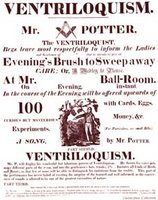
The New England population contained fewer slaves than the colonies to the south, and the plantation system didn't dominate society here. As a result, there were fewer enslaved children identified as the children of their white masters, the topic Wiencek explores in his books. One notable New England said to have that background was Richard Potter, often called the first American magician. At least, he was the first American to make a good living performing ventriloquism and conjuring on the stage.

Potter was born in Hopkinton, Massachusetts. Traditions in the magic community, exemplified in articles here and there and in this book reviewed on the Magic Cheese blog, say that Potter was the son of an enslaved servant named Dinah and Sir Charles Henry (Harry) Frankland, a British Customs official who had a country home in that town. For all sorts of reasons people might want to believe a prominent man of color was descended from a British baronet: the appeal of celebrity and transgressive gossip, racism (crediting Potter's success to noble European blood), a simple answer to who in Hopkinton had the power to impregnate an enslaved woman.

The only problem is that Potter, according to his gravestone, died in 1835 at age 52, meaning he was born in 1783. Sir Harry Frankland died in 1768.

Thursday, July 13, 2006

Abortion case in 1742 Connecticut

I didn't expect to stay so long on the topic of American Revolutionaries' religious views, but this morning I learned that Prof. Larry Cebula of Missouri Southern State has posted some more primary sources on the topic on a page called Faiths of the Founders.

Prof. Cebula is coming from an environment where many students have simply assumed the founders basically shared their own form of Christianity. To help them examine those assumptions, he's chosen several documents in which big-name founders express deistic and Unitarian views. Traditional eighteenth-century Anglicanism, Congregationalism, and Presbyterianism are therefore underrepresented relative to their dominance at the time. We should also remember the minority religions of the colonies: Quaker, Baptist, Shepardic Jewish, Moravian, Sandemanian, Native American, West African, &c. Finally, I think it might be too easy to assume that, say, a Presbyterian service of the 1800s would feel familiar to a Presbyterian today; customs and values have changed so much that it would probably be more like going into a completely new church or temple and trying to follow along.

Prof. Cebula also has a page of primary documents on A Colonial Abortion Drama. This case was first studied by Cornelia Hughes Dayton in a 1991 article for the William & Mary Quarterly. In 1742, Sarah Grosvenor of Pomfret, Connecticut, died, apparently from the effects of a combined medicinal-surgical abortion that had produced a miscarriage. Four years later, Grosvenor's sexual partner, Amasa Davis, and the abortion provider, Dr. John Hallowell of Killingley, were indicted for her murder.

Prof. Cebula has posted the grand jury indictment, written testimony, jury verdict, and notes on what became of the principal figures in the case. I won't give away the ending of the story since the point of his webpage is for visitors to use the documents to figure out what happened for themselves.

But here are some observations:

  • This example of abortion in colonial America would never have come to light without the court case. If Grosvenor had survived and/or if the families had decided to keep the situation private, there would have been no public record to examine. Davis and Hallowell were tried to killing Grosvenor, not for inducing the miscarriage.
  • It was quite common for couples like Grosvenor and Davis to conceive a child before marrying. Indeed, in the mid-1700s historians have counted 30% of New England couples' first children being born within seven months of their marriage. That number is considerably higher than for the late 1600s, telling me that the oppressive moral regime of the Puritans did affect people's private behavior.
  • In eighteenth-century New England, if a young unmarried woman became pregnant, the father-to-be was expected to marry her. Then they'd have as many more children as they could, with little said about the circumstances of the first pregnancy. In some cases, such as Ebenezer Richardson, the father-to-be couldn't marry the mother-to-be because he already had a wife. Amasa Davis was unusual in being free to marry Sarah Grosvenor, but refusing.
  • The four-year lag between Grosvenor's death and the legal move is intriguing—as is the jury's focus on Dr. Hallowell. In cases like these, I wonder if there was some knowledge in the community that didn't get into the legal record. For instance, had Grosvenor's family become upset by Davis's behavior in the years after she died? Had townspeople come to distrust Hallowell as a doctor? We'll never know.
[Special apologies to Prof. Cebula and anyone from Missouri Southern State University, Mississippi State University, Mississippi Southern University {which may not even exist}, and the states of Missouri and Mississippi, especially the southern parts, for getting them mixed up twice. Up here we pronounce any long state beginning with M as "Massachusetts."]

Wednesday, July 12, 2006

Founders and Faiths

Apropos of yesterday's post about George Washington's religious beliefs, I've seen a flurry of books about the religious views of Revolutionary leaders. Publishers Weekly says that more are on the way. Here's a sampling, along with the magazine's evaluations:

  • Michael and Jana Novak, Washington's God (Basic Books, 2006). Authors: "well-known conservative thinker" and daughter. PW: "At times, the Novaks' starry-eyed admiration of the man pushes this book over the bounds of biography into hagiography."
  • Jon Meacham, American Gospel: God, the Founding Fathers, and the Making of a Nation (Random House, 2006). Author: "Newsweek editor." PW: "Meacham's remarkable grasp of the intricacies and achievements of a nascent nation is well worth the cover price, though his consideration of Reagan feels like that of an apologist."
  • David L. Holmes, The Faiths of the Founding Fathers (Oxford University Press, 2006). Author: "religion scholar." PW: "Despite its strong points..., the desiccating tone is one of technical scholarship that may turn off casual readers looking for a narrative history of this hot-button issue."
  • Brooke Allen, Moral Minority: Our Skeptical Founding Fathers (Ivan R. Dee, 2006). Author: contributor to The Nation. PW: "Allen's sparring partners are, of course, those representatives of the religious right who claim that America was founded as a Christian nation. Unfortunately, they are not likely to read this book, and those readers already generally inclined to agree with Allen—including most serious students of American history—won't learn anything new."
  • Newt Gingrich, Rediscovering God in America: Reflections on the Role of Faith in Our Nation's History and Future (Integrity, 2006). Author: ousted Speaker of the House. PW: "He trots out quotations from founding fathers that suggest their allegiance to Christianity, or at least to theism, but conveniently ignores evidence that some of these men—particularly Benjamin Franklin and Thomas Jefferson—believed religion should have little, if any, role in the nation's government."
As the reviews indicate, most of these books aren't really about the religious beliefs of America's founding generation. They're about claiming the stars of that generation for one side or the other in the modern "culture war." One problem with that approach is Revolutionary America had its own "culture wars" before, during, and after the real war. It's hard to believe now, but the question of whether the Anglican Church would appoint bishops for America was a major concern for Bostonians in the 1760s, as the now virtually uninterpretable political cartoon above shows. Religion and social issues got caught up in the political conflict, and both Patriots and Loyalists had clerical voices declaring that God was on their side.

The founders of the U.S. of A. didn't have a single view of faith, or even (given their ethnic similarity) a tight knot of views. They had various religious ideas. One trend that's struck me in studying the Revolution is how the conflict forced New England Congregationalists to open their minds to other views. In 1823 William Tudor, Jr., son of one of John Adams's law clerks, described Samuel Adams this way:
There was some tinge of bigotry and narrowness, both in his religion and politics. He was a strict calvinist; and probably, no individual of his day had so much of the feelings of the ancient puritans, as he possessed. . . . His religious tenets…made him loath the very name of the English church.
During the debate over the Boston Massacre verdicts, Adams tried to discount the dying words of victim Patrick Carr because the man had probably been a Catholic. Adams didn't write them, but the Suffolk Resolves drafted by Dr. Joseph Warren show the same prejudice against Catholics. So did New England's Pope Night processions, of course. In the 1770s, Boston had no Catholic church, and no doubt supported Britain's restrictions on Catholics' political rights.

Yet Adams and his Congregationalist colleagues learned to work with local Anglican Whigs and with Dr. Thomas Young, an outspoken deist. (Young in fact wrote most of Reason the Only Oracle of Man, which his old friend Ethan Allen published after the Revolution, and which then became known as "Ethan Allen's Bible.") Adams knew that his and his region's reputation for religious bigotry would be a drawback at the First Continental Congress. He therefore nominated an Anglican minister, Jacob Duché, to open the Congress with prayer—a political move to show that he could practice religious tolerance (by the strandards of the time). But that wasn't enough to reassure religious minorities. On 14 October 1774, his second cousin John remembered, the Massachusetts delegates were confronted by:
a great Number of Quakers seated at the long Table with their broad brimmed Beavers on their Heads. We were invited to Seats among them: and informed that they had received Complaints from some Anabaptists and some Friends in Massachusetts against certain Laws of that Province, restrictive of the Liberty of Conscience.
Samuel Adams tried to mollify those Quakers, but the "certain Laws" they spoke had become a liability. When John Adams drafted a constitution for Massachusetts, he included freedom of worship.

Soon, of course, the French allies arrived in America, and anti-Catholicism became anti-patriotic. By the end of the war, Boston was a more religiously tolerant place (though still bigoted and theocratic by modern standards). Pope Night celebrations had disappeared. The Episcopal Church was constituted. Catholics and Jews moved into town and maintained their faiths. A Catholic congregation had taken over the abandoned Huguenot meeting-house on School Street. New England's pro-Congregationalism laws survived to become a political issue in the Jefferson administration and beyond, but the establishment was dwindling. The founding generation had realized that, in order to accomplish things in a large, diverse, democratic society, they needed to accept many views of the universe.

Tuesday, July 11, 2006

George Washington's faith in Providence

At Positive Liberty, Jonathan Rowe takes a hard look at evidence that politically active minister D. James Kennedy recently used to argue that George Washington was a prayerful Christian. As Rowe points out, Kennedy's conclusion relied on two shaky anecdotes and a manuscript that evangelists have tried to attribute to Washington but isn't even in his handwriting. On his website, Paul M. Bessell has assembled the judgments of several historians on Washington's religious habits.

I think it's also useful to look at Washington's own words and deeds. He was a vestryman in his local Anglican church, yet on 15 August 1787 he wrote to his close friend Lafayette that he didn't feel any form of faith to be superior:

I am not less ardent in my wish that you may succeed in your plan of toleration in religious matters. Being no bigot myself to any mode of worship, I am disposed to indulge the professors of Christianity in the church, that road to Heaven, which to them shall seem the most direct plainest easiest and least liable to exception.
[This quotation, and all others unless I mention another source, comes from the George Washington Papers at the Library of Congress website.]

Washington did believe in a deity, and often referred to this God's workings as "Providence," "the Divine Will," or "fate." Biographer Douglas Southall Freeman pointed out that Washington could speak of this force as "He," "she," or "it," depending on his antecedent. When friends went through difficult experiences, he advised them to submit to Providence, as in this 1773 letter to a friend whose niece had died:
The ways of Providence being inscrutable, and the justice of it not to be scanned by the shallow eye of humanity, not to be counteracted by the utmost efforts of human power and wisdom, resignation, and, as far as the strength of our reason and religion can carry us, a cheerful acquiescence to the Divine Will is what we are to aim.
[That quotation comes from James Thomas Flexner's biography, 1:244.]

Washington didn't counsel people to pray to God for intervention or comfort. Instead, he advised them to accept what Providence would supply. That philosophy is textbook deism. The distinction between faith in the existence of God and praying to God seems to be lost on many writers today, such as Thomas Fleming in his brief discussion of religion in Washington's Secret War.

Washington didn't seek divine intervention in political matters. On 23 March 1793, in the middle of his presidency, he wrote to former aide David Humphreys:
If it can be esteemed a happiness to live in an age productive of great and interesting events, we of the present age are very highly favored. The rapidity of national revolutions appear no less astonishing, than their magnitude. In what they will terminate, is known only to the great ruler of events; and confiding in his wisdom and goodness, we may safely trust the issue to him, without perplexing ourselves to seek for that, which is beyond human ken; only taking care to perform the parts assigned us, in a way that reason and our own consciences approve of.
The surest moral guidance Washington saw was "reason and our own consciences."

D. James Kennedy might be gratified to read this letter of 28 August 1762, to Martha Washington's brother-in-law Burwell Bassett [Flexner, 1:237]:
I was favored with your epistle wrote on a certain 25th of July when you ought to have been at church, praying as becomes every good Christian man who has as much to answer for as you have. Strange it is that you will be so blind to truth that the enlightening sounds of the Gospel cannot reach your ear, nor examples awaken you to a sense of goodness. Could you but behold with what religious zeal I hie me to church every Lord's day, it would do your heart good, and fill it, I hope, with equal fluency.
But if we look at what Washington actually did on Sundays, it becomes clear that in this letter he's just joking with a genteel friend about their mutual lack of churchgoing. No daily diary for 1762 survives, but Washington's other diaries from the decade show that when he was home at Mount Vernon he didn't "hie me to church every Lord's day," but spent more Sundays riding and writing letters. Of the four Sundays in February 1768, Washington noted in his diary that he was at home for three of them and on the fourth "went up to Mr. Robt. Alexanders in order to meet Mr. B. Fairfax & others a fox Huntg." In the whole year he went to church fifteen times, mostly when he was traveling.

That brings me to an aspect of Washington's religious practice which might trouble both sides of today's cultural debate: those who want to see him as a prayerful Christian like themselves and those who want to seem him as a shining example of deism. Even as Washington showed little interest in churchgoing and prayer, he treated those outward, visible aspects of religion as important to his public image. When he was on the road or living in the capital as President, he often went to a local church—i.e., he made sure that people saw him paying respect to religion. Concern for his public image was so deeply ingrained in Washington's sense of self that, really, how people viewed him was his sense of self.

As a military officer, Washington also urged his soldiers to follow religious rituals. In the French & Indian War, he sought a chaplain for his Virginia unit, writing, "we may at least have the show if we are said to want the substance of godliness." [Flexner, 1:154-5] Later, as commander-in-chief of the Continental Army, he often ordered his men to attend church services. For example, on 12 April 1777 his general orders read:
All the troops in Morristown, except the Guards, are to attend divine worship to morrow morning at the second Bell; the officers commanding Corps, are to take especial care, that their men appear clean, and decent, and that they are to march in proper order to the place of worship.
Again, Washington seems more concerned with outward appearance—cleanliness and marching—than with the men's spiritual condition. I can't help but wonder if Washington thought religious rituals and rules were important in helping common men maintain their morals, but that he as a gentleman could be guided by his reason and conscience.

Monday, July 10, 2006

Revolutionary parenting advice: cold baths & bare feet

Josiah Quincy, future mayor of Boston and president of Harvard College, was born in Boston in 1772. After his father, the fiery cross-eyed lawyer of the same name, left town on a last-ditch political mission to Britain in late 1774, Josiah's mother took him to his grandparents' home in Braintree. There she set up what seems like an odd ritual:

Mrs. Quincy caused her son, when not more than three years old, to be taken from his warm bed, in winter as well as summer, and carried down to a cellar-kitchen, and there dipped three times in a tub of water cold from the pump. She also brought him up in utter indifference to wet feet,—usually the terror of anxious mammas,—in which he used to say that he sat more than half the time during his boyhood, and without suffering any ill consequences.

One child who didn't share Quincy's equanimity about cold feet was Mary Palmer, born in 1775. During the war her family also moved to Braintree, closer to her grandparents, and she remembered similar experiences: “My parents, especially my mother,...began that winter by letting us all run out upon the first snow and ice without shoes or stockings, intending to make us hardy and proof against the cold.” The Palmers weren't kids playing barefoot on a warm or even a cool day, like the young reenactor pictured above, at Hartwell Tavern in Minute Man National Historical Park.

Nor was the Palmer family poor at that time. Like young Josiah, Mary and her siblings were raised in the upper crust of Braintree society. Abigail Quincy and Elizabeth and John Palmer were all loving parents, trying to give their offspring the best possible upbringing. And who offered the finest advice of the day? Both Josiah and Mary reported that their mothers were following John Locke (1632-1704).

We think of Locke as a political philosopher whose ideas of natural rights and men coming together to form governments inspired the Declaration of Independence. But in pre-Revolutionary Boston he was apparently just as respected for his advice on raising and educating children in Some Thoughts Concerning Education (1692). Locke's stature as a parenting expert was not hurt by the fact that he was a lifelong bachelor who never had children of his own. He came by his opinions through tutoring other people's sons and through reading.

In particular, Locke was impressed by what classical historians wrote about the Scythians:
The first thing to be taken care of, is, that children be not too warmly clad or cover'd, winter or summer. The face when we are born, is no less tender than any other part of the body. 'Tis use alone hardens it, and makes it more able to endure the cold. And therefore the Scythian philosopher gave a very significant answer to the Athenian, who wonder'd how he could go naked in frost and snow. How, said the Scythian, can you endure your face expos'd to the sharp winter air? My face is us'd to it, said the Athenian. Think me all face, reply'd the Scythian. Our bodies will endure any thing, that from the beginning they are accustom'd to.
Those lightly-clad Scythians lived around the Black Sea. Climatic and topographical differences didn't deter Locke from cajoling parents:
Give me leave therefore to advise you not to fence too carefully against the cold of this our climate. There are those in England, who wear the same clothes winter and summer, and that without any inconvenience, or more sense of cold than others find. But if the mother will needs have an allowance for frost and snow, for fear of harm, and the father, for fear of censure, be sure let not his winter clothing be too warm: And amongst other things, remember, that when nature has so well covered his head with hair, and strengthen'd it with a year or two's age, that he can run about by day without a cap, it is best that by night a child should also lie without one; there being nothing that more exposes to headaches, colds, catarrhs, coughs, and several other diseases, than keeping the head warm.
Locke went on at greatest length about the value of cold, wet feet:
I will also advise his feet to be wash'd every day in cold water, and to have his shoes so thin, that they might leak and let in water, whenever he comes near it. Here, I fear I shall have the mistress and maids too against me. One will think it too filthy, and the other perhaps too much pains, to make clean his stockings. But yet truth will have it, that his health is much more worth than all such considerations, and ten times as much more. And he that considers how mischievous and mortal a thing taking wet in the feet is, to those who have been bred nicely, will wish he had, with the poor people's children, gone bare-foot, who, by that means, come to be so reconcil'd by custom to wet in their feet, that they take no more cold or harm by it, than if they were wet in their hands. And what is it, I pray, that makes this great difference between the hands and the feet in others, but only custom? I doubt not, but if a man from his cradle had been always us'd to go bare-foot, whilst his hands were constantly wrapt up in warm mittins, and cover'd with hand-shoes, as the Dutch call gloves; I doubt not, I say, but such a custom would make taking wet in his hands as dangerous to him, as now taking wet in their feet is to great many others. The way to prevent this, is, to have his shoes made so as to leak water, and his feet wash'd constantly every day in cold water. It is recommendable for its cleanliness; but that which I aim at in it, is health; and therefore I limit it not precisely to any time of the day. I have known it us'd every night with very good success, and that all the winter, without the omitting it so much as one night in extreme cold weather; when thick ice cover'd the water, the child bathed his legs and feet in it, though he was of an age not big enough to rub and wipe them himself, and when he began this custom was puling and very tender. But the great end being to harden those parts by a frequent and familiar use of cold water, and thereby to prevent the mischiefs that usually attend accidental taking wet in the feet in those who are bred otherwise, I think it may be left to the prudence and convenience of the parents, to chuse either night or morning. The time I deem indifferent, so the thing be effectually done.

How common was it for Lockean parents to subject their children to cold baths and wet shoes? As I wrote above, the Quincy and Palmer families both lived in Braintree, and raised their children about the same time. Abigail and John Adams were part of the same set, related by marriage and friendship to both Quincys and Palmers. But I haven't found John Quincy Adams writing about childhood wet feet and cold baths the same way. Perhaps he escaped this treatment by being raised a few years earlier. Perhaps Abigail and John were less anxious than their neighbors about following the latest parenting trends.

Sunday, July 09, 2006

John Adams on a Sunday in July

Here’s one of my favorite entries in John Adams’s diary, which can be perused in its entirety at the Massachusetts Historical Society’s website. It is 1 July 1770. Adams is on his way to the northeastern part of the province of Massachusetts, which is today the state of Maine. And because it’s Sunday, he can’t ride further or do business, so he catches up on the local gossip.

What I love about this diary entry is how Adams struggles with how he wants to present himself on the page, and in doing so reveals so much more. The young lawyer hopes to be writing for the ages, hopes that a “Biographer” will look back on this document to see what was occupying his mind. Yet his attention keeps being drawn to animals: a runaway mare, the children’s strange pet crow.

Finally Adams settles down to writing about what he thinks gentlemen should write about: politics, that day’s sermon, science, and more politics. The “Prerogative Side” are supporters of the royal government. Adams’s innkeeper Woodbridge, a “high Son” of Liberty, thinks that those men are too protective of their royal appointments (“Commissions”) and privileges. Woodridge is unsure about the political firmness of James Gowen, a new appointment to the Governor's Council from Sagadahock, the part of Maine east of the Kennebec.

The latest political squabble up north was about "Thanks to the 92 Antirescinders"—whether the town wanted to express support for the members of the Massachusetts House who had defied the royal governor and refused to rescind the circular letter of February 1768. Symbolic issues like that divided the local society, even making Woodbridge happy that one of his genteel rivals was "running distracted."

Arose early at Paul Dudley Woodbridge's. A cloudy morning. Took a Walk to the Pasture, to see how my Horse fared. Saw my old Friend and Classmate David Sewall walking in his Garden. My little mare had provided for herself by leaping out of a bare Pasture into a neighbouring Lott of mowing Ground, and had filled herself, with Grass and Water. These are important Materials for History no doubt. My Biographer will scarcely introduce my little Mare, and her Adventures in quest of Feed and Water.

The Children of the House have got a young Crow, a Sight I never saw before. The Head and Bill are monstrous, the leggs long and sprawling. But the young Crow and the little mare are objects, that will not interest Posterity.

Landlord says David Sewall is not of the Liberty Side. The Moultons, Lymans, and Sewalls, and Sayward, are all [smudge] of the Prerogative Side.—They are afraid of their Commissions—and rather than hazard them, they would ruin the Country. We had a fair Tryal of them when we met to return Thanks to the 92 Antirescinders. None of them voted for it, tho none of them, but Sayward and his Bookkeeper had Courage enough to hold up his Hand, when the Vote was put the Contrary Way.

This same Landlord I find is a high Son. He has upon his Sign Board, Entertainment for the Sons of Liberty, under the Portrait of Mr. Pitt.—Thus the Spirit of Liberty circulates thro every minute Artery of the Province.

Heard Mr. Lyman all day. They have 4. deacons and Three Elders in this Church. Bradbury is an Elder, and Sayward is a Deacon. Lyman preached from "which Things the Angells desire to look into."

Drank Coffee at home, with Mr. Farnum, who came in to see me, and then went to D. Sewalls where I spent an Hour, with Farnum, Winthrop and Sewall and when I came away took a View of the Comet, which was then near the North Star—a large, bright Nucleus, in the Center of a nebulous Circle.

Came home, and took a Pipe after Supper with Landlord who is a staunch, zealous Son of Liberty. He speaks doubtfully of the new Councillor Gowing of Kittery. Says he always runs away till he sees how a Thing will go. Says he will lean to the other Side. Says, that He, (the Landlord) loves Peace, And should be very glad to have the Matter settled upon friendly Terms, without Bloodshed, but he would venture his own Life, and spend all he had in the World before he would give up.

He gives a sad Account of the Opposition and Persecution he has suffered from the Tories, for his Zeal and Firmness against their Schemes. Says they, i.e. the Moultons, Sewalls and Lymans, contrived every Way to thwart, vex, and distress him, and have got 1000 st[erling] from him at least, but he says that Providence has seemed to frown upon them, one running distracted and another &c., and has favoured him in Ways that he did not foresee.
The Comet that John Adams saw in Maine is no doubt the same that young John Greenwood remembered seeing in Boston when he was ten years old.

Saturday, July 08, 2006

Nathaniel Tracy serves frogs for dinner

Samuel Breck was born in Boston in 1771. Later his family moved to Philadelphia, and after his death his memoirs were published there. That book contains some delightful anecdotes about the Revolution, no doubt a bit polished by repeated tellings.

Here are Breck's remarks on the reception of the French fleet in Boston after the king of France started to formally support the American independence movement. France had of course been the enemy for British colonists since the late 1600s. Patriots complained that the London ministry was becoming as tyrannical as "France or haughty Spain." As late as the fall of 1774, New England buzzed with rumors that the Crown would bring "the French" down from Québec to oppress them.

And then Silas Deane, Benjamin Franklin, and Pierre Augustin Caron de Beaumarchais forged an alliance between the new U.S. of A. and France. Suddenly the French were no longer enemies, but helpers. The anti-Catholic Pope Night holiday disappeared. Indeed, just after the war a Roman Catholic church with a French priest even opened in Boston on the corner of School Street and modern Washington Street (where the Irish Famine Memorial now, um, stands).

But old stereotypes die hard, as Breck recalled.

Every vulgar story told by John Bull about Frenchmen living on salad and frogs was implicitly believed by Brother Jonathan, even by men of education and the first standing in society. When, therefore, the first French squadron arrived in Boston, the whole town, most of whom had never seen a Frenchman, ran to the wharves to catch a peep at the gaunt, half-starved, soup-maigre crews. How much were my good townsmen astonished when they beheld plump, portly officers and strong, vigorous sailors!
This apparently refers to the arrival of French transports in Boston in May 1781. Those ships brought about 6,300 soldiers who would march north to the siege of Yorktown.

That same year, Newburyport privateer owner and merchant Nathaniel Tracy had bought a mansion in Cambridge that had been confiscated from the Loyalist John Vassall. (That mansion is now known as Longfellow House, a National Park Service site open for tours Wednesday through Sunday for the rest of the summer.) He decided to host the French naval officers and consul.
Mr. Nathaniel Tracy, who lived in a beautiful villa at Cambridge, made a great feast for the admiral and his officers. Everything was furnished that could be had in the country to ornament and give variety to the entertainment. My father was one of the guests, and told me often after that two large tureens of soup were placed at the ends of the table. The admiral sat on the right of Tracy, and Monsieur de l’Etombe on the left. L’Etombe was consul of France, resident at Boston. Tracy filled a plate with soup, which went to the admiral, and the next was handed to the consul. As soon as L’Etombe put his spoon into his plate he fished up a large frog, just as green and perfect as if he had hopped from the pond into the tureen. Not knowing at first what it was, he seized it by one of its hind legs, and, holding it up in view of the whole company, discovered that it was a full-grown frog. As soon as he had thoroughly inspected it, and made himself sure of the matter, he exclaimed, "Ah! mon Dieu! un grenouille!" then, turning to the gentleman next to him, gave him the frog. He received it, and passed it round the table. Thus the poor crapaud made the tour from hand to hand until it reached the admiral. The company, convulsed with laughter, examined the soup-plates as the servants brought them, and in each was to be found a frog. The uproar was universal. Meantime Tracy kept his ladle going, wondering what his outlandish guests meant by such extravagant. merriment. "What’s the matter?" asked he, and, raising his head, surveyed the frogs dangling by a leg in all directions. "Why don’t they eat them?" he exclaimed. "If they knew the confounded trouble I had to catch them in order to treat them to a dish of their own country, they would find that with me, at least, it was no joking matter." Thus was poor Tracy deceived by vulgar prejudice and common report. He…had caused all the swamps of Cambridge to be searched in order to furnish them with a generous supply of what be believed to be in France a standing national dish.

Friday, July 07, 2006

One fine way to spend a fine Saturday

More free historic walking tours of Cambridge on Saturday, 8 July!

Boston boys and their ghosts

On the first anniversary of the Boston Massacre, Paul Revere displayed a picture of Christopher “Seider’s pale ghost” in a window of his new home in the North End. Gentlemen orating about the Massacre invoked the ghosts of the five people killed at that event. But for many young Bostonians, ghosts weren’t just metaphors, but quite real.

“The people of New England at that time pretty generally believed in hobgoblins and spirits, that is the children at least did,” North End boy John Greenwood (born 1760) later wrote in his memoir. Greenwood discussed this belief in the context of the region’s old Puritan tales:

While I was at school the [political] troubles commenced, and I recollect very well of hearing the superstitious accounts which were circulated around: people were certain a war was about to take place, for a great blazing comet had appeared and armies of soldiery had been seen fighting in the clouds overhead; and it was said that the day of judgment was at hand, when the moon would turn into blood and the world be set on fire. These dismal stories became so often repeated that the boys thought nothing of them, considering that such events must come in the course of nature. For my part, all I wished was that a church which stood by the side of my father’s garden would fall on me at the time these terrible things happened, and crush me to death at once, so as to be out of pain quick.

Benjamin Russell (born 1761) certainly believed in ghosts one memorable night before the Revolutionary War, as he later told his printing colleague Joseph T. Buckingham:
It was a part of my duty as an assistant in the domestic affairs of the family, to have the care of the cow. One evening, after it was quite dark, I was driving the cow to her pasturage,—the common. Passing by the burial-ground, adjoining the Stone Chapel, I saw several lights that appeared to be springing from the earth, among the graves and immediately sinking again to the ground, or expiring. . . . I left the cow to find her way to the common, or wherever else she pleased, and ran home.
Russell’s father led him back to the graveyard and showed him that the lights came from “a sexton, up to his shoulders in a grave, throwing out, as he proceeded in digging, bones and fragments of rotten coffins. The phosphorus in the decaying wood, blended with the peculiar state of the atmosphere, presented the appearance that had completely unstrung my nerves.”

As for Greenwood, he actually hoped to see one particular ghost in 1770:
I remember what is called the ‘Boston Massacre,’ when the British troops fired upon the inhabitants and killed seven [actually five] of them, one of whom was my father’s apprentice, a lad eighteen years of age, named Samuel Maverick. I was his bedfellow, and after his death I used to go to bed in the dark on purpose to see his spirit, for I was so fond of him and he of me that I was sure it would not hurt me.

Thursday, July 06, 2006

Common-Place & the Electoral College

The online magazine Common-place is one of the most interesting places for historical writing about early America, connecting academic historians, school teachers, and interested citizens. It just announced its summer 2006 contents.

This issue includes a not entirely complimentary review by Jeff Broadwater of The Failure of the Founding Fathers: Jefferson, Marshall, and the Rise of Presidential Democracy, by Bruce Ackerman. The review starts:

Bruce Ackerman takes seriously a phenomenon Americans often seem to overlook: the rapid evolution of a political system radically different from the one anticipated by the framers of the Constitution. Ackerman argues...that the Constitution’s procedures for electing a president were particularly ill suited to the realities of American politics and that the election of 1800 exposed these inadequacies.
I think the flaws in the original system for choosing a chief executive officer for the U.S. of A. were clear even before that. In this regard, the Constitution never worked the way its framers wanted.

Sure, the original system produced the election of George Washington in 1789 and 1792. But that was hardly a surprise. Once Washington was willing to enter national politics, any manner of choosing a leader short of drawing straws would have selected him for the top post:
  • A king? Most Americans would probably have been willing, considering that they'd grown up under a monarchy. They'd have assured themselves that their constitution held more safeguards against tyranny than Britain's had, and trusted Washington to avoid its temptations. To his credit, he was willing to forgo royal power and try something new.
  • A presiding officer for a congress of state delegations? That was the role of the presidents of the Congress under the Articles of Confederation, and the chairmen before that. And the Constitutional Convention elected Washington to just that position.
  • A head of the executive branch, chosen by electors meeting separately in each state after being chosen by various means, each man casting two equal votes, and then forwarding all names to Congress to count and make the final determination by state delegations if necessary? That's how the Electoral College did work, unwieldy as it was.
But of course the founders were trying to design a system that would work after Washington had died or was otherwise unavailable. It got its first test in 1796. And what happened? The system produced something the Constitutional Conveners had wanted desperately to avoid: a party battle. Thomas Jefferson and James Madison had used a trip north to form an alliance with Aaron Burr and other anti-Federalists. John Adams, as Vice President, was the default choice of the Federalists. I think history has shown that in American plurality-takes-the-office elections, with no parliament, the system evolves into two dominant parties. Sometimes a third party becomes strong enough to affect the outcome, but usually (as in 1860, 1912, 2000, and other years) not in the way its proponents want.

Furthermore, because of how the Constitution originally defined the Vice President as the Electoral College runner-up, Adams had Jefferson as his VP. In modern terms, that would be like Al Gore trying to govern as elected while Dick Cheney presided over the Senate. After four years of tense cooperation, the country's two top office-holders ran against each other again in 1800.

That time, Jefferson won. (Not because of the popular vote, but because the Electoral College gave more weight to states with lots of enslaved people, as Garry Wills discussed.) But then the election system really broke down: Jefferson and Burr got equal Electoral votes because Electors could not distinguish their votes for President and Vice President. The choice between running mates went to the House, where the Federalists still held the balance of power.

Many scholars think that the Constitutional Convention expected the Electoral College to produce a majority only rarely. Therefore, the House would usually make the final choice of President and Vice President. That system never took hold. Instead, after the election of 1800 the party maneuvering in and among House delegations got even worse.

It's no wonder that Congress soon passed the Twelfth Amendment, changing the way the U.S. of A. chose its President and Vice President. This was the first revision to the processes that the Constitution laid out; the preceding eleven amendments stated rights or clarified jurisdictions, but didn't change what had been written. In other words, the original presidential election system had crashed and burned, and founders like James Madison knew it.

It's too bad that the revised system retained indirect elections through the non-representative Electoral College. Since then, a handful of administrations failed in "deriving their just Powers from the Consent of the Governed," as the Declaration of Independence states. This is one area where American respect for the founders has gotten in the way of American principles.

For folks who like to follow the public memory of the Revolution, the same issue of Common-place includes Steven Biel's article about Parson Weems' Fable, the painting by Grant Wood that spoofs young George Washington, Charles Willson Peale, Mason Weems, and cherry trees, all at once.

Wednesday, July 05, 2006

Old view from Old South

Last month, and yet only last week, I mentioned a special tour up the steeple of the Old South Meeting-House.

So how did that tour end up?

It ended up like this.


And here's the spooky part: Bostonians have been able to look down from Old South on that small brick building now known as the Old Corner Bookstore for over 250 years—since before George Washington was born. The shop below was built in 1712 (for an apothecary), and Old South in 1729.

Tuesday, July 04, 2006

Florida reconstructs the Declaration of Independence

Last month Florida governor Jeb Bush signed a law revising teaching standards in the state's public schools in ways that have caused some dismay among historians. (PDF file here.) At the top of the list of what will be taught is:

(a) The history and content of the Declaration of Independence, including national sovereignty, natural law, self-evident truth, equality of all persons, limited government, popular sovereignty, and inalienable rights of life, liberty, and property, and how they form the philosophical foundation of our government.
Later (in section f) the law adds:
American history shall be viewed as factual, not as constructed, shall be viewed as knowable, teachable, and testable, and shall be defined as the creation of a new nation based largely on the universal principles stated in the Declaration of Independence.

This law is, of course, a construction of U.S. history. The words "shall be viewed" show that, even as lawmakers insist on one interpretation of American history, they acknowledge others. In fact, we can see how the Florida legislature has constructed a particular understanding of the past by looking at its presentation of the Declaration of Independence.
  • "All men are created equal" has become "equality of all persons." Following the 19th Amendment and the feminist movement, modern Americans interpret the Declaration's word "men" to mean "adult humans." But that's a construction—in fact, a reconstruction—of most founders' obvious understanding, based on their actions, that those rights belonged to adult white males.
  • "life, liberty, and the pursuit of happiness" has become "life, liberty, and property." Many eighteenth-century documents did highlight the threesome of life, liberty, and property. One example is the "Rights of the Colonists" issued by Boston's town meeting on 20 Nov 1772, based on a draft by Samuel Adams. But the Declaration never uses the word "property." The Florida law uses it twice in three pages and never uses "happiness," which hints at what matters to these modern legislators.
  • "limited government" must be reconciled with the first three complaints about King George III in the Declaration: "He has refused his Assent to Laws. . . . He has forbidden his Governors to pass Laws. . . . He has refused to pass other Laws..." Congress said that Americans wanted more laws than the king and his ministers would allow. In other parts of the Declaration, of course, Congress complained about too many royal regulations. So, as with a lot of "limited government" advocacy, we have to look at exactly what sort of law and limits the advocates want. In general, people want less government authority over themselves and more over others.
  • "national sovereignty" and "popular sovereignty": How has the legislature constructed these as separate items? How does the state define "national"? Or "popular"? Since Congress went on to adopt the Articles of Confederation and Perpetual Union, which starts, "Each state retains its sovereignty...," those founders apparently felt they were representing multiple sovereign nations. According to the law, "American history...shall be defined as the creation of a new nation," and presumably that nation is still being created since American history continues to pile up. So when does "national sovereignty" kick in?
  • How does Florida fit into its own official picture of the past? It stayed part of the British Empire until the end of the Revolutionary War, when it returned to the Spanish Empire before being purchased and conquered by the U.S. of A. decades later. Therefore, it wasn't party to the Declaration of Independence, and the people living there didn't have a chance to demonstrate "national sovereignty" or "popular sovereignty," either. In 1861 the state government seceded from the U.S. of A., constructing a different "new nation" for a brief period. The clause in the law about teaching "The history of the state" says simply, "The history of the state." There are no values-laden interpretations about how Florida's history fits with "the universal principles stated in the Declaration of Independence." It just does because those are universal principles—the government tells us so.
The Florida law's summation of the philosophical basis of the Declaration of Independence isn't bad. But by pretending that there are no conflicts inherent in those principles or in how people put them into practice, the state government has constructed a particular picture of the past. That may make history more "testable," which is such a vital quality in modern American education. But it sets students up for a very bad understanding of history. Claiming that history isn't constructed is like claiming that literature isn't interpreted, or that science isn't based on hypotheses.

What other topics does the Florida law mandate teaching, and what do they tell us about the legislature's construction of the past and present? The categories are:
  • (b) The U.S. Constitution.
  • (c) "arguments in support of adopting our republican form of government, as they are embodied in the most important of the Federalist Papers." This construction omits the 1780s arguments in support of the previous republican form of government, under the Articles of Confederation. Florida children may never learn about that debate since the Articles aren't mentioned in the state law. And will this Bush administration in Florida decide that Federalist 69 is among the "most important"?
  • (d) Flag education. Look at all the items this purely symbolic topic precedes.
  • (e) Civil government from federal to district level.
  • (f) "The history of the United States, including the period of discovery, early colonies, the War for Independence, the Civil War, the expansion of the United States to its present boundaries, the world wars, and the civil rights movement to the present." Topics left out of the mandate as constructed: industrialization and technology, the labor movement, immigration and immigration restrictions, the Cold War, religious changes, social reform movements, and the effects of the environment on human affairs. (And what have I left out?) In addition, the delicate word "expansion" hides the fact that the U.S. reached its present boundaries largely through wars.
  • (g) The Nazi Holocaust.
  • (h) African-American history. This must include "the political conflicts that led to the development of slavery." At History News Network, David Davisson points out, "As far as I'm aware slavery existed before our earliest known written history and continues to exist today. What political conflicts led to the development of slavery?" To which Darren Michael Peterson replies, "I would assume that the part about the political conflicts prior to slavery is the attempt to defray guilt based upon the slaves really being prisoners sold to the white man."
  • (i) Principles of agriculture.
  • (j) Effects of alcoholic liquors and narcotics.
  • (k) "Kindness to animals." In potential conflict with point (i), of course.
  • (l) Florida history. As mentioned above, Florida became part of the U.S. of A. after conquest and ethnic cleansing of the Seminole population. But kids don't need to worry about conflicting voices—this law never mentions North America's native peoples.
  • (m) Conservation of natural resources. Which might also come into conflict with principle (i).
  • (n) Health education. This clause puts "the benefits of sexual abstinence" ahead of all these other health topics: "injury prevention and safety; nutrition; personal health; prevention and control of disease; and substance use and abuse." That last item is apparently separate from point (j). The next section of the law says any student can opt out of learning about reproductive health; there is no explicit exemption for any other topic.
  • (o) Anything else the state or district school boards prescribe. The "&c." clause.
  • (p) OOPS! We forgot "The study of Hispanic contributions to the United States."
  • (q) OOPS again! We left out half the population: "The study of women’s contributions to the United States."
  • (r) "The nature and importance of free enterprise to the United States economy." But not any study of economic regulation, including mercantilism in the age of discovery, property laws, patent and copyright laws, labor laws, unemployment and Social Security insurance, safety laws, the Federal Reserve system, laws mandating conservation as specified in point (m), &c.
  • (s) "A character-development program in the elementary schools." First on the list of what such a program should stress is "patriotism," implying that's more important to character than, say, empathy for other people. Also on the list: "respect for authority, life, liberty, and personal property." Not on the list: critical thinking. Indeed, the words "think," "thought," and "reasoning" don't appear anywhere in the law.
  • (t) "sacrifices that veterans have made." And the constructed reason for including this topic is not historical accuracy or gratitude, but "In order to encourage patriotism."

I've long felt that if schools teach American history accurately, including the fact that there are different ways of viewing the past, the U.S. of A. will get the respect it deserves. Florida's lawmakers obviously don't have the same faith.

Monday, July 03, 2006

Ezekiel Goldthwait: fireworks victim

Ezekiel Goldthwait was born on 28 Mar 1767 and admitted to the South Latin School in Boston in 1779. Entrance at the age of twelve was late for a boy; scholars usually started at the Latin School at seven. But the war might have disrupted Ezekiel's schooling, and he might have been studying elsewhere.

Young Ezekiel didn't last long at Boston Latin, however. The town's public schools had sessions every day but Sunday, but on Thursdays and Saturdays the masters dismissed the boys in mid-morning. One Saturday young Ezekiel used his free time to buy fireworks "at a place called the Laboratory, where squibs were sold to the boys," according to Henry F. Jenks's Catalogue of the Boston Latin School, published in 1886. "Laboratory" was the period term for where artillerists assembled their explosive shells and gunpowder cartridges. There was a Continental Army Laboratory at Springfield, Massachusetts, during the Revolutionary War, which eventually grew into the Springfield Armory.

Back to Ezekiel buying his fireworks:

He procured some and put them in his pocket, where they exploded and burned him so badly, that he died after several weeks of intense suffering.
See another cautionary tale from the 19th century at City Record and Boston News-Journal. Let's be careful out there.

Sunday, July 02, 2006

John Adams on "the great anniversary Festival"

On 3 July 1776, John Adams wrote home to his wife Abigail, excited that the Continental Congress had finally voted for independence the day before. He said:

The Second Day of July 1776, will be the most memorable Epocha, in the History of America. I am apt to believe that it will be celebrated, by succeeding Generations, as the great anniversary Festival. It ought to be commemorated, as the Day of Deliverance by solemn Acts of Devotion to God Almighty. It ought to be solemnized with Pomp and Parade, with Shews, Games, Sports, Guns, Bells, Bonfires and Illuminations from one End of this Continent to the other from this Time forward forever more.

You will think me transported with Enthusiasm but I am not.—I am well aware of the Toil and Blood and Treasure, that it will cost Us to maintain this Declaration, and support and defend these States.—Yet through all the Gloom I can see the Rays of ravishing Light and Glory. I can see that the End is more than worth all the Means. And that Posterity will tryumph in that Days Transaction, even altho We should rue it, which I trust in God We shall not.

But, of course, we don't celebrate the 2nd of July that way. We celebrate the 4th. And people started celebrating the 4th soon after Adams wrote. In 1783, for example, Boston changed the date of its annual oration from the 5th of March, anniversary of the Boston Massacre, to the 4th of July; the wound of the Massacre had been healed by independence, town fathers implied.

So why do we celebrate the 4th of July? Because that's the anniversary of Congress's public declaration of why it had adopted independence two days before. The declaration in its many printed versions of the 1700s (hardly anyone saw the signed manuscript or a facsimile of it until fifty or more years later) usually started out, "In Congress, July 4, 1776." That dateline couldn't help but cement the 4th of July in people's minds.

And in a way the shift of focus from the 2nd to the 4th makes sense. The legal move of voting for independence in a closed legislature isn't so republican as the people's adoption of independence for themselves.

Saturday, July 01, 2006

Israel Remmington: five-foot-tall giant

In late 1772, "Ezra Gleason, a Student in Physick," issued The Massachusetts Calendar, an almanac for the coming year. Its cover featured a crude woodcut picture of a stout barefoot boy with a cane. By turning the page curious readers found this explanation:

A short account of the very remarkable BOY, or young GIANT, whose amazing size as well as strange features has attracted the attention of multitudes that have beheld him, who is thought by them to be the greatest curiosity of the kind ever seen in America.

ISRAEL REMMINGTON was born in the town of Hingham, about 20 miles distant from Boston, in the year 1758 which is the place of his residence; he is about five feet of heighth, and is remarkably strong, weighs upwards of 200 weight, has five fingers and a thumb on each hand, and six toes on each foot. It is thought if this Lad should continue to increase in heighth and size at such an amazing rate as he has within these few years, he will be ten feet high, and will weigh 4 or 500 weight by the time he is 21 years of age. One remarkable circumstance relating to the Mother of this youth ought not to be omitted here, as it is given by herself, Mrs. Remmington says she has had five children, three of whom were born with five fingers and a thumb on each hand, and six toes on each foot. A figure of said Boy may be seen in the first page

Hingham, Nov. 1772
J. T.
He is expected at Concert-Hall in a few days.

On 7 Dec 1772, the Boston Evening-Post picked up most of this text, starting, “We hear there is a very remarkable young Boy,..,” and ending, “It is said he is expected in Town in a few Days.” That report in turn was reprinted word for word in the 10 Dec 1772 Boston News-Letter, the 21 Dec 1772 New-York Gazette and Weekly Mercury, and 21 Dec 1772 Newport Mercury. However, no newspaper ever reported that people in Boston had actually seen young Remmington.

I came across a copy of the 1773 Massachusetts Calendar yesterday at the New England Historic Genealogical Society, so I used the resources there to find out more about Israel Remmington. The only person of that name recorded in Hingham, according to George Lincoln's town genealogies, was born 16 Aug 1754—not in 1758. His parents, Elisha and Leah, did have five children as of 1772. The record is silent on their fingers and toes.

If Israel Remmington was born in 1754, he was eighteen years old in late 1772, making his height and weight less impressive. He would have had to grow at an even more "amazing rate" to be ten foot high by age twenty-one. Indeed, however round this teenager was (at an estimated 200 pounds), being "about five feet of heighth" doesn't really seem to warrant the label "giant."

But there are those fingers and toes to factor in. With their Puritan heritage, New Englanders well knew the biblical verse 1 Chronicles 20:6:
There was again war at Gath, where there was a man of great stature, whose fingers and toes were twenty-four, six on each hand, and six on each foot; and he also was born to the giant.
So for them having twenty-four digits might well have turned a five-foot-tall boy into a "giant."

Israel Remmington of Hingham died on 19 Feb 1800, age forty-five.