A while back I promised to complete the story of Newton Prince, a black businessman in Boston—at least as much as I’ve been able to find out. My earlier entries on him:
In his personal life, Prince married Phillis Binn, a free black woman, on 26 March 1767. The Rev. Dr. Joseph Sewall
married them in the
Old South Meeting-House, where Prince was a member.
Gilbert Deblois, a prominent
merchant and part-owner of the building called Concert Hall, wrote on 10 Mar 1781:
Mr. Newton Prince & his Wife, where [sic] for many Years, Inhabitants of Boston, New England, and Supported themselves there with Reputation in the Pastrycook branch by attending & Cooking at most of the Public Entertainments &c.
Prince himself wrote that “during a series of Years [he] supported himself & family in a decent & comfortable way.”
In his new book
Rough Crossings,
Simon Schama presents Prince as a contrast to Crispus Attucks, now often celebrated as an American hero:
But the story of Newton Prince, the black barber who testified on behalf of the redcoats is, unsurprisingly, much less well known. For his temerity, Prince was tarred and feathered by infuriated Patriots, so naturally in 1776 he opted for General Howe and as evacuated with the British.
I think Schama’s in error. And not just because Prince wasn’t a barber. (That was a common profession for black men.) I suspect Schama read too much into what Newton Prince told the British government in September 1780.
At that time, Prince was applying for financial support from the Crown as a Loyalist. That process required presenting evidence that one had been loyal to the royal government before and during the Revolutionary War, and suffered for that loyalty. Prince described himself as having been
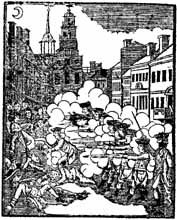
a principle Evidence on behalf of the Crown, wherein Captn. Preston of the 29th: Regmts of Foot was plantiffe [actually, defendant]; the Inhabitants, (such as were not attach’d to Government) deserted him, & Enter’d into associations, to utterly destroy him, by Tarring & Feathering him, a mode of punishment peculiar to themselves.
[This quotation and the one from Deblois above come from Prince's file at the British National Archives/PRO: Audit Office 13/75, 282-7.]
I suspect Schama or his researchers saw that passage and interpreted it to mean that a mob had actually tarred and feathered Prince. But I think crowds
threatened Prince, along with other people they perceived as working-class servants of the royal government. I have three reasons for my conclusion:
- Prince doesn't actually describe suffering a physical attack, as other tar-and-feathers victims did.
- His character witnesses, including Deblois and Sir William Pepperell, Bart., don't describe him as suffering such an attack, either.
- Tar-and-feathering was a public punishment. Crown officials and even newspapers took notice of it, but there's no documentation of such an attack on a black man in Boston.
Prince instead emphasized his
economic losses from leaving Boston: his shop, his stock, and the value of debts that he’d never be able to collect. In March 1776, the Prince family had gone to Halifax, along with the rest of Boston’s evacuees. There Newton supported himself by working for Deblois, probably as a cook or other house servant.
Later the Princes sailed to London. By the early 1780s, Prince was running a coal and chandler’s shop in the capital of the British Empire. (The word
“chandler” can mean either "candlemaker" or "retailer of provisions and supplies," usually for ships. Prince was probably the latter.)
His wife was in poor health in 1783 when he applied for temporary assistance—though again, he might have emphasized that detail to bolster his need for assistance. This wife may have been Phillis, or he may have remarried; the file does not state her given name.
The Loyalists Commission granted Newton Prince an annual pension of £10. Not a large amount, as those grants went, but a steady supplemental income for a working man. According to Alfred Jones’s
The Loyalists of Massachusetts, Prince collected his pension until he died in 1819.