J. L. BELL is a Massachusetts writer who specializes in (among other things) the start of the American Revolution in and around Boston. He is particularly interested in the experiences of children in 1765-75. He has published scholarly papers and popular articles for both children and adults. He was consultant for an episode of History Detectives, and contributed to a display at Minute Man National Historic Park.
J. L. Bell will be one of the panelists in the discussion of “A Knock at the Door: Three Centuries of Governmental Search and Seizure” at the Old State House in Boston on 4 November. How does James Otis, Jr.’s argument against the London government’s writs of assistance connect to the Fourth Amendment of the U.S. Constitution, and what is the status of that protection today?
Hear J. L. Bell “Gossiping About the Gores” at Old South Meeting House, archived by the WBGH Forum Network. (And follow along with the handout.) This talk, delivered in January 2009, follows one Boston family from the 1760s through the 1820s. Striving in society, divided by politics, and occasionally star-crossed by love, the Gores provide a lively view of life during the American Revolution.
Hear J. L. Bell discuss John Adams with Mike Pesca, host of N.P.R.’s The Bryant Park Project, in April 2008.
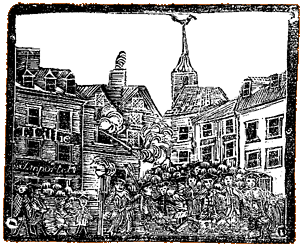
Check out the online exhibit about the 5th of November in Boston that J. L. Bell assembled for the Bostonian Society. People in Britain celebrated that date as Guy Fawkes’ Day, but in Boston it was “Pope-Night”—a literal riot of bigotry, violence, and giant puppets of the Pope!
J. L. Bell’s article “A Bankruptcy in Boston, 1765” appears in the fourth-quarter 2008 issue of Massachusetts Banker. You can download a copy of the entire magazine for free from this page.
J. L. Bell’s article “‘I Never Used to Go Out with a Weapon’: Law Enforcement on the Streets of Prerevolutionary Boston,” about town watchmen, British army officers, and the Boston Massacre, is available in the Dublin Seminar volume Life on the Streets and Commons.
Children in Colonial America, edited by Prof. James Marten and published by N.Y.U. Press, features J. L. Bell’s chapter “From Saucy Boys to Sons of Liberty: Politicizing Youth in Pre-Revolutionary Boston.”

Wednesday, February 28, 2007

Boston Massacre Weekend at the Old State House

Next Monday will be the 237th anniversary of the Boston Massacre, which took place on Monday, 5 March 1770, about one block from the Town House. That building, now called the Old State House, is the headquarters and museum of the Bostonian Society. Starting tomorrow it will host a series of events commemorating the Boston Massacre. Here’s the schedule they sent me.

Thursday, 1 March, 6:30
Suffolk University professor Robert Allison begins the annual commemoration with a talk on his short new book, The Boston Massacre. Discussion and refreshments. Free.

Friday, 2 March, 11:00 and 2:00
“Witness to a Massacre,” a short play presented by The Freedom Trail Foundation. Richard Palmes, the man defense attorney John Adams called “the most material witness to the Boston Massacre”, presents his version of the notorious event. Discussion. Free with museum admission.

Saturday, 3 March, 11:00 and 2:00
Young visitors will be the stars in a reenactment of the Boston Massacre, led by rangers from the Adams National Historical Park. Fun for the whole family! Free; on the mall outside of the Old State House.
11:30 and 2:30
Watch patriot lawyers John Adams and Josiah Quincy defend the British soldiers accused of murdering Bostonians while Samuel Quincy prosecutes inside the historic Old State House. Self-defense or cold-blooded murder? Audience members act as jurors for this celebrated case. Program led by rangers from the Adams National Historical Park. Free with museum admission.

Sunday, 4 March, 1:30
Discover the connection between ropemaking and the Boston Massacre. Watch rope being made and learn about the importance of rope and ropemaking in revolutionary Boston. Appropriate for age 6 and up. Free with museum admission.

Monday, 5 March, 11:00 and 2:00
“Witness to a Massacre” reprise—see above
5:30 and 6:30
Noted reenactor David Connor portrays Revere, talking about his involvement with the Boston Massacre and his famous engraving. Free with museum admission.
8:00 P.M.
Boston Massacre Reenactment. See the event that sparked the Revolution! The Massachusetts Council of Minutemen and Militia and His Majesty’s 5th regiment of Foot will reenact the famous incident outside the Old State House. Light refreshments after the event in the Old State House. Free.

Tuesday, February 27, 2007

John Piemont: wigmaker, tavern-keeper, assailant?

John Piemont was born in 1717 or so. He was later referred to as “a Frenchman,” so he probably came to Boston from France or French Canada. I can’t find anything else about Piemont’s life before late 1759, when he advertised in the Boston News-Letter that he was working out of Peter Smith’s house on Union Street. In any event, his trail grows clearer at the end of that year.

On 20 Oct 1762, John Piemont married Hannah Crosby (born in Jan 1739) at Christ Church (now called Old North). They had four children baptized at King’s Chapel: Hannah (1763), John (1766), Elizabeth Murray (1767), and Thomas (1769). In Feb 1766, the couple also sponsored the baptism of John’s apprentice Thomas Allen.

In the 1760s Piemont established himself as a wigmaker on King Street in Boston, one of the town’s busiest streets. In 1767, for example, he sold a bag wig to James Bowdoin, one of the town’s leading merchants and Whigs, but he also served Lt. Gov. Thomas Hutchinson, leader of the court party. In the summer of 1766, Dr. Joseph Warren visited Piemont’s home twice and sold him medicine for a “Servt.,” which was colonial Boston’s usual euphemism for a slave. In 1769, Piemont sold tickets for a fireworks artist and hosted a confectioner—both these men had French names, so he may have been helping out his countrymen.

That same year, according to Pvt. John Timmons of the 29th regiment, Piemont participated in an assault on him. On 28 July 1770, Pvt. Timmons swore to this deposition before the chief justice of New Jersey:

That on the Fourteenth June, One Thousand Seven Hundred and Sixty Nine, he had the Main Guard [i.e., was on sentry duty] in Boston, and between the Hours of Nine and Ten O’Clock at Night, was Knocked down in the Street, by the Blow of a Stone, or Brickbatt, as this Deponant Supposes, and after he Recover’d Himself, he heard a Woman shout Murder, & said the Rogues that struck this Deponant was gone up that way, Pointing towards the South Meeting House, upon which word she was pushed down, and Damn’d for a whore to Keep Silance,

this Deponant then persued according to her Directions, and turning the Corner of the Meeting House, was met by three persons armed with Clubs, who Gave this Deponant a blow on the Forehead, which Knocked him down and Cut him very much, that on this Deponant attempting to rise to Defend himself, they Gave this Deponant another most Desperate Cut on the head, which Rendered this Deponant incapable of helping Himself, and Quite Sensless, they afterwards most Terably Kicked this Deponant, and Dragged him along the Streets but hearing the Main Guard was coming, they left this Deponant for Dead, upon which one Mr. Winslow an Inhabitant, ordered this Deponant to be carried into a House, and Sent for the Docter of the Fourteenth Regiment, who Dressed this Deponant’s wounds, and with a great Deal of Difficulty stopt the Blood,

The Docter at the Same time Asked Mr. Winslow, if those Villians could not be found out, Mr. Winslow told the Doctor, they should be found out, and the Next Morning Mr. Winslow and Mr. [Harrison] Gray (Provincial Treasurer) informed this Deponent of three of the Men they knew, which were John Reed, Josiah Davis, & John Paymount all three Wigmakers and Inhabitants of Boston, and advised this Deponant, to take the Civil law of them, upon which this Deponant applyed to Justice [Edmund] Quincey, when after informing him of the abuse Received, the said Justice advised this Deponant to drop it, if the said Reed, Davis and Paymount would make the Deponant any Restitution, telling this Deponant, it would put Him to more expense then he could afford saying they might postpone it from Court, to Court, upon which this Deponant Imagined the Said Justice Mean’d to baffle him, and insisted for a Warrant, which the said Justice Refused at that time, telling this Deponant he had too Much business in hand, and Desired this Deponant to Come in the Evening, which he accordingly did,

The Said Justice then advised this Deponant to make it up, and said he would send for Mr. Davis, to whome he had Given a Warrant against this Deponant, after this Deponant had left his, the Said Justices House in the Morning, Which this Deponant Refused. Desireing the Said Justice again to Grant a Warrant, which the Chief Justice Refused a Second time, on pretence of Business, Upon which this Deponant, apply’d to two other Magistrates Justice Deney [Francis Dana?] & Justice [John] Hill who both put this Deponant off with Excuses of the same Nature, nor could this Deponant Gett any Satisfaction, for the Injury he had Received, and further Saith not.
There were many brawls like this between soldiers and locals in 1768 and 1769. Some Boston magistrates, including Quincy, Dana, and Hill, did discourage British soldiers from taking legal action after these fights, and put obstacles in their way. Crown authorities took Pvt. Timmons’s deposition, along with scores of others, in mid-1770 in order to document how badly Boston had treated those soldiers.

However, the notion of Piemont assaulting a soldier like this doesn’t add up for me. It seems a bit extreme for a fifty-two-year-old man. It also seems odd that Winslow and Gray were able to track down the soldier’s mysterious assailants overnight. In fact, I can’t track down wigmakers named John Reed and Josiah Davis at all.

Most important, this assault doesn’t fit with how we know Piemont was running his wigmaking business in 1769-70. Not only did he serve royal officials and British army officers, but in March 1770 he was employing Pvt. Patrick Dines of the 29th regiment. Soldiers were allowed to moonlight in order to earn extra cash; this produced some resentment among local workers, but employers like Piemont probably liked a larger labor pool.

Furthermore, within five years Massachusetts Patriots were whispering that Piemont was a Tory. In June 1773, he announced that he was quitting the wigmaking business and moving to Danvers, where he opened a tavern. John Adams stayed there in June 1774. Three days after the Revolutionary War began, a committee from Danvers put the following certificate in the Essex Gazette:
This may certify, That about two years ago Mr. John Piemont came to dwell in the Town of Danvers, and was well recommended by the Selectmen of the Town of Boston, and though some Persons have called him a Tory, to his great Damage, yet we as a Committee of Inspection for the Town of Danvers, have carefully examined into Mr. Piemont’s character, and are fully satisfied that he is a friend to us in the common cause of our country, and we hope all our friends will treat him as such, and call upon him for Entertainment, as he keeps a large public House in said Danvers.
People in Salem probably whispered about Piemont’s loyalties because he was a stranger to town, a foreigner, and an Anglican. But if he’d been such a fervent Whig as to attack a soldier on duty, why did neighbors have any doubt about his politics?

Of course, the historical record is full of holes. I can imagine reasons why Piemont might have attacked Pvt. Timmons in 1769 yet employed Pvt. Dines in 1770. But I must also entertain another reason why Timmons named Piemont as his assailant.

Pvt. Timmons knew that his superiors were gathering depositions as a response to the Boston Massacre of March 1770. And, as I’ll discuss later this week, apprentices from Piemont’s shop helped to instigate that event. [Yes, you thought this was yet another post about wigs, but it’s actually about the Massacre.] So Timmons might have thought that his superiors would be pleased with information that could exonerate his companions back in Boston—such as a tale of a violent barber.

As for Piemont, he was still in Danvers in 1776 when he billed the new state for “supplies to the provincial army.” In 1783 he was keeping an inn in Ipswich, and lost his barn and one cow in a fire; the next year, he assured customers that he could once again stable their horses. By 1789, according to Boston’s first business directory, John Piemont was back in Boston. Indeed, he was back on King Street, now renamed State Street. He was retailing liquor that year, and in October 1791 he took over the Eastern Coffee House (again advertising “Good Stabling for Horses”).

John Piemont died in Boston on 15 Sept 1802, aged 85. The Columbian Centinel said that he would be buried out of his home on Ann Street, and “the Brethren of the Ancient and Honorable Fraternity of Masons (of which he has been an able and eminent Member) are invited to attend.” His wife and all four children survived him.


A Birthday Tribute (of Sorts) to H. W. Longfellow

Today is the bicentennial of American poet Henry Wadsworth Longfellow, born in Portland on 26 Feb 1807. He was the U.S. of A.’s most widely read, memorized, and parodied poet in the late nineteenth century, when people reread and quoted poetry to express their emotions the way we now recall recordings of popular songs.

Along with friends like Hawthorne and Emerson, Longfellow helped to create the first American literary canon, adapting European epic and ballad forms to tell such North American stories as The Song of Hiawatha (Native Americans), Evangeline (Acadians expelled from Canada to Louisiana), “The Courtship of Miles Standish” (Plymouth settlers), and, most famously, “Paul Revere’s Ride” (the first day of the Revolution).

It thus seems a most opportune day to point to “The Misplaced Bones of William Dawes,” by Timothy Abbott at Walking the Berkshires, inspired by Sunday’s Boston 1775 posting about the remains of Paul Revere’s companion during their interrupted ride from Lexington to Concord early in the morning of 19 April 1775. Longfellow parody lives!

Monday, February 26, 2007

The Funeral of Christopher Seider

Today is the 237th anniversary of the funeral of Christopher Seider, a young servant killed by a Customs official during a riot in February 1770. Boston’s Whigs made as much of the boy’s death as they could, portraying him as a martyr for liberty and a victim of tyranny. Several newspapers ran this notice:

he will be buried from his father’s house in Frog Lane [now Boylston Street], opposite to Liberty Tree, this afternoon; when all the friends of Liberty may have an opportunity of paying their last respects to the remains of this little hero and first martyr to the noble cause, whose manly spirit (after the accident happened) appeared in his discreet answers to his Doctor, his thanks to the clergyman who prayed with him, and the firmness of mind he showed when he first saw his parents, and while he underwent the great distress of bodily pain, and with which he met the king of terrors. . . .
The 1 March 1770 Boston News-Letter described the funeral procession this way:
It began about three o’clock from Liberty Tree, (the dwelling-house of the parents of the deceased being but a little distance from thence), the boys from several schools, supposed to be between four and five hundred, preceded the corpse in couples.

After the sorrowful relatives and particular friends of the youth, followed many of the principal gentlemen and a great number of other respectable inhabitants of this town, by computation exceeding thirteen hundred: about thirty chariots, chaises, etc., closed the procession. Throughout the whole there appeared the greater solemnity and good order, and by as numerous a train as was ever known here.
The velvet pall that covered the small coffin had a Latin inscription:
Latet Anguis in Herba.
Hoeret Lateris lethalis Armada.
Innocentia nusquam in tuta.

(The serpent lurks in the grass. [A quote from Virgil’s Third Eclogue]
The fatal dart is thrown.
Innocence is nowhere safe.)
As the procession passed Liberty Tree, people could read these Biblical comments on boards nailed to the elm:
Thou shalt take no satisfaction of the life of a murderer. He shall surely be put to death.
Though hand join hand, the wicked shall not pass unpunished.
The first line is from Numbers 35, the second Proverbs 16. (Congregationalist Boston did not rely on the Anglican church’s King James translation.)

John Adams, having ridden to Boston from legal business in Weymouth, wrote in his diary:
When I came into Town, I saw a vast Collection of People, near Liberty Tree — enquired and found the funeral of the Child, lately kill’d by [Ebenezer] Richardson was to be attended. Went into Mr. Rowes, and warmed me, and then went out with him to the Funeral, a vast Number of Boys walked before the Coffin, a vast Number of Women and Men after it, and a Number of Carriages. My Eyes never beheld such a funeral. The Procession extended further than can be well imagined.

This Shewes, there are many more Lives to spend if wanted in the Service of their Country.

It Shews, too that the Faction [i.e., the royal appointees that Adams and his fellow Whigs thought were angling for power] is not yet expiring — that the Ardor of the People is not to be quelled by the Slaughter of one Child and the Wounding of another.
Merchant John Rowe wrote in his diary, “I am very sure two thousand people attended his funerall.” The Rev. William Gordon later reported that the procession was a quarter-mile long.

Showing less sympathy, Gov. Thomas Hutchinson would write in his History of the Province of Massachusetts Bay:
The boy that was killed was the son of a poor German. A grand funeral was, however, judged very proper for him.

Sunday, February 25, 2007

William Dawes, Jr., Found in Jamaica Plain?

Today’s Boston Globe breaks the story that the remains of militia organizer and midnight rider William Dawes, Jr., might be in the Forest Hills Cemetery in Jamaica Plain rather than (as modern guidebooks state) the burying-ground next to King’s Chapel in downtown Boston.

Historical tour guide Al Maze recently discovered a document putting Dawes in Forest Hills, the article says. His suggestion has support from local historian Charles Bahne, also quoted in the article, who tipped me off about this possibility a couple of weeks ago.

Maze hasn’t found the record of Dawes’s original burial in 1799. Instead, he found a record from Forest Hills indicating that one body interred in the May family area was “William Dawes Mar. 30, 1882 In Tomb, Died 1799. . . . These remains removed from Boylston Street Burial Grounds.” Why would Dawes be buried with the May family? Because his first wife was Mehitable May.

As for Dawes’s original interment, the “Boylston Street Burial Grounds” is a late-nineteenth-century term for the Central Burying-Ground on the south side of Boston Common, shown above. It expanded in the 1790s as the cemeteries close to the center of Boston filled up, so that would have been a logical place for a man of Dawes’s class to be interred at the time.

According to Bahne, the public identification of the Dawes family tomb in the King’s Chapel burying-ground with the rider dates only from 1899, when the Sons of the American Revolution was eager to identify Patriots’ resting-places. As I noted in my first article about Christopher Seider, the SAR’s monuments, while helping to preserve the memories of many historical figures, don’t always identify them and their whereabouts correctly.

Another factor in the possible confusion was how many generations in a family had the same name. The Revolutionary leader Samuel Adams was the son of a Samuel Adams and the father of another Samuel Adams. The same goes for Paul Revere, John Hancock, and other men of the time. William Dawes’s father was named William, and his first son was named William, so it might have been easy to see that name on a document and assume it referred to the most famous William. But only one died in 1799.

Saturday, February 24, 2007

William Molineux Saves Ebenezer Richardson's Neck

When Ebenezer Richardson shot Christopher Seider from his window on 22 Feb 1770, the Bostonians watching were naturally upset. Richardson was already unpopular, and shooting an eleven-year-old in broad daylight didn’t improve his image, even though a mob of boys was attacking his house. A witness taking notes for the Crown said:

they Rang the Brick meeting bell as if for fire which soon Collected a vast Concourse of people, who broke down the side of his house & when they had made a breach wide enough several entered & took Richardson & one Wilmot who assisted him, seized him and his companion George Wilmot, and marched them outside.
Wilmot, a sailor for the Customs service, quickly gave up, protesting that his gun was defective and couldn’t have fired even if he’d tried. Richardson, in contrast, had briefly fended off the crowd with a cutlass, shouting about the wounded boys, “Damn their blood! I don’t care what I’ve done!” Some in the mob prepared to hang Richardson right there, even though those two boys were still alive.

By this time the merchant William Molineux had arrived on the scene. He was one of the most radical Whigs in Boston, shocking even fellow gentlemen with his extreme comments. (Gentlemen were never supposed to be extreme.) For example, after a meeting of merchants on nonimportation on 12 Jan 1770, the Crown informant reported:
Many were disgusted at Mollyneaux’s violent proposals particularly at a speech made at the meeting at which the vote against [Joseph] Green [Theophilus] Lillie &c was pass’d, wherein he declared that were it not for the Law he would with his own hands put to Death any person who should presume to open their goods [i.e., sell goods they had imported and then stored]
At another of the big nonimportation meetings that month, Molineux proposed that the whole crowd visit two importers at their father’s house. However, their father was Thomas Hutchinson, lieutenant governor and acting governor. Young lawyer Josiah Quincy, Jr., warned dramatically that such an action was a trap, that confronting the representative of the king that way could be taken as treason. Molineux agreed to a small committee instead, but then several upper-class gentlemen declined to serve on it.

The informant described the dramatic result:
It would be impossible Sir to describe the looks of Mollineaux when he found so many had deserted him, he drew his hand across his Throat, and declar’d he was ready to Die that Minute, that for his part he scorn’d to have any thing more to do with them, and then immediately Jump’d down from his Seat among the People with a view to march off, upon this Dr. [Thomas] Young ascended a Form [i.e., a bench], and in the most earnest manner beg’d him for Gods sake to stay, otherwise their Plan would be entirely overthrown, with much perswasion and a great deal of pulling, he was at last fix’d in his former Seat
(Another source quotes Dr. Young this way: “Stop Mr. Molineux, stop Mr. Molineux...If Mr. Molineux leaves us we are forever undone, this day is the last dawn of liberty we shall ever see.” Young was much cheerier than Molineux, but equally hyperbolic.)

Earlier in February 1770, witnesses saw Molineux looking on with approval the first time that boys had picketed an importer’s store. And he may well have known Christopher Seider personally; the boy worked in the household of wealthy widow Grizzell Apthorp, and Molineux was the Boston agent for the business of her eldest son.

Yet when the mob threatened to kill Richardson, Molineux waded into the crowd, insisting that they let the law take its course. Gov. Hutchinson himself reported that Molineux managed to calm the people and lead the prisoners to Justice John Ruddock. That North End magistrate, also a fervent Whig, decided to take the prisoners to Faneuil Hall, where four other justices gathered. In front of the large crowd, they questioned the two men, charging Richardson with a dangerous assault and Wilmot as his accessory.

Then the justices sent the two prisoners to Boston’s jail in the custody of some town constables. Ordinarily those officials delivered writs and seized property; they really weren’t prepared to be police officers or marshals. The mob once again tried to string Richardson up on his way to jail:
it was with difficulty that they got Richardson there, the mob endeavouring to put a rope about his Neck & take him from the Constables to execute him themselves, but was prevented by some leading men of the popular side.
At last, thanks to Molineux and his Whig colleagues, Richardson was safely behind bars. After Christopher Seider died that evening, the charges against him were upgraded to murder. The superior court was due to open on Monday, 13 March.

Thursday, February 22, 2007

Boston's First Revolutionary Death, 237 Years Ago

For a couple of days I’ve been discussing how in early 1770 Boston was aboil with conflict over a “nonimportation” of goods from Britain to protest the Townshend duties. Most of the town supported this boycott, and Whigs were pressuring the handful of merchants and shopkeepers who refused to sign on.

Part of that pressure in early February were crowds of boys marching outside importers’ stores; these protests appeared every Thursday morning when there was no school. On 22 Feb 1770, these young Whigs focused their attention on small merchant Theophilus Lillie. They set up their “Pageantry” on Union Street: a hand pointing to his shop with the word IMPORTER, and an effigy of Lillie’s head on a pole.

Along came Ebenezer Richardson, a Customs service employee. As I described in a New England Ancestors article available online, Richardson had become notorious in his home town of Woburn for having impregnated his wife’s sister and letting blame fall on the town’s minister for several months. He then moved to Boston and made his living as a confidential informer, first for the Attorney General and then for the Customs service. When that work was exposed in the early 1760s, Richardson became even more unpopular, and started to work openly for Customs since no one else would employ him.

The Customs establishment opposed the nonimportation movement, and Richardson apparently took it upon himself to break up the boys’ protest of Lillie’s shop. First he tried to persuade two farmers in Boston for market day to knock down the carved head with their wagons. The drivers refused. Whig gentlemen watching the action laughed at Richardson’s efforts. He stomped off to his nearby home, shouting, “Perjury! Perjury!”

It’s unclear what Richardson was referring to, but, as the Boston Evening-Post reported, “The Boys on hearing the words began to gather round, and call him an informer.” Richardson and his wife Kezia (the same woman he had impregnated and eventually married years before) shooed them away. The boys said, “they would not, Kings high Way”—meaning they had every right to be on the street.

Richardson flourished a stick. The boys ran around “with the squeeling and noise they usually make on such occasion,” said the newspaper. The young mob, now numbering at least “60 or 70 Boys,” left Lillie’s shop and started pelting Richardson’s house with “Limon Peels,” witnesses later testified. The boys hit Kezia Richardson with an egg. Someone inside the house tossed out a brickbat, striking a sailor. He threw it back through a window.

A low-level Customs employee named George Wilmot came to the house and offered help. According to one of the Richardsons’ daughters, “Wilmot asked [my father] if he had any Gun.” Both men armed themselves with muskets.

Richardson came out his front door and yelled at the boys, “as sure as there was a G[od] in heaven, he’d blow a Lane thro ’em.” He “snapped” his gun—firing it with powder but no ball, like a blank shot. The boys scattered and came back again, no longer tossing “light rubbish of one kind or another” but throwing stones through windows.

Richardson reappeared with his musket at an upper window. The boys continued to throw rocks. Richardson fired his musket again. This time he had loaded it with buckshot pellets, “about the bigness of large peas.”

Some of those pellets sliced through the baggy pants of a sailor named Robert Patterson. A few pierced the right hand and thigh of a nineteen-year-old painter named Sammy Gore. Eleven pieces flew into the chest of Christopher Seider, a servant boy just about eleven years old, who was “stooping to take up a Stone.”

The wounded boys were taken into a nearby house. As the violence continued outside, Dr. Joseph Warren, Dr. Thomas Young, and other surgeons examined them. Christopher’s chest was gradually filling with blood. People brought his parents, poor German immigrants, from their little home at the far end of Boston Common. Clergymen came to pray with the family. Christopher Seider died around nine o’clock on the night of 22 February, the first death of Boston’s Revolutionary conflict.

Restoring Gen. Washington, His Tent, and His Speech

George Washington was born on 11 February 1732, according to the calendar. But that was the Julian calendar, which the British Empire was still using because the more accurate Gregorian calendar had the misfortune to be favored by the Roman Catholic church. By the time Britain and its colonies adjusted their calendars to match the rest of western Europe in 1752, there was an eleven-day difference. Washington therefore recalculated his birthday as 22 February, and that’s the date we still treat as Washington’s “real” birthday.

To observe that occasion, here are links to three news stories about remembrances of the man.
It turns out the Metropolitan Museum of Art isn’t the only institution restoring its painting of Gen. George Washington crossing the Delaware. Boston’s Museum of Fine Arts has people working on Thomas Sully’s “Passage of the Delaware” (1819), shown above. Because of its size, the Boston Globe says, the painting will be conserved in its gallery, and museum visitors can watch the work progress.

The New York Times reported that a strip of linen cloth owned by Yale and on loan at Mount Vernon, said to be from one of the general’s campaign tents, perfectly matched a hole in the campaign tent once on display at Valley Forge. While that tent now appears to be white linen, as shown in a 1909 photograph, close examination of the cloth suggests it originally had blue stripes. The tent will be displayed again when the American Revolution Center in Valley Forge opens.

Finally, the Washington Post reported on how the Maryland state archives is celebrating its acquisition of Washington’s draft of his speech resigning his commission as commander-in-chief in Annapolis on 23 Dec 1783.

Wednesday, February 21, 2007

Theophilus Lillie: shopkeeper, importer, seeker of liberty

Theophilus Lillie was born in Boston on 18 August 1730, and at the age of twenty-seven married a shopkeeper named Ann Barker. Under the laws of the time, her property became his (in the absence of a prenuptial agreement like those Elizabeth Murray Campbell secured before her second and third marriages). In 1758 Lillie advertised himself as a dry-goods retailer “on Middle Street, near Mr. Pemberton’s meeting-house”—modern Hanover Street in the North End.

Lillie wasn’t known for being politically active, but in late 1769 he took a stand on the most volatile issue of the day: he told Whig merchants and politicians that he would no longer sign onto the “nonimportation” boycott of goods from Britain, that he’d agreed in the first place only because of unfair pressure. In January 1770, Boston’s town meeting responded by condemning Lillie and the other “importers.” Newspapers published their names, as in the clipping shown here, and urged people not to do any business with them.

In the 15 January Boston Chronicle (which supported the royal government, and was supported by it), Lillie responded with one of the strongest statements of the right to resist local crowd pressure, turning the Whigs’ rhetoric about liberty and not being represented in Parliament on its head:

Upon the whole, I cannot help saying—although I have never entered far into the mysteries of government, having applied myself to my shop and my business—that it always seemed strange to me that people who contend so much for civil and religious liberty should be so ready to deprive others of their natural liberty; that men who are guarding against being subject to laws which they never gave their consent in person or by their representative should at the same time make laws, and in the most effectual manner execute them upon me and others, to which laws I am sure I never gave my consent either in person or by my representative.

But what is still more hard, they are laws made to punish me after I have committed the offence; for when I sent for my goods, I was told nobody would be compelled to subscribe; after they came I was required to store them. This is no degree answered the end of the subscription, which was to distress the manufacturers in England. Now, my storing my goods could never do this; the mischief was done when the goods were bought in England; and it was too late to help it. My storing my goods might be considered, therefore, as punishment for an offence before the law for punishing it was made.

If one set of private subjects may at any time take upon themselves to punish another set of private subjects just when they please, it’s such a sort of government as I never heard of before; and according to my poor notion of government, this is one of the principal things which government is designed to prevent; and I own I had rather be a slave under one master (for I know who he is I may perhaps be able to please him) than a slave to a hundred or more whom I don’t know where to find, nor what they will expect of me.
American Whigs were basically fighting for a collective or community liberty: the power for a colony or town to choose their own laws by a majority vote. Lillie, in contrast, was writing about his individual liberty against that majority and the government they elected.

Naturally, Lillie’s newspaper essay attracted attention to him. In a letter dated 24 January 1770, Crown informant George Mason wrote that on the 16th a large committee of Whigs “waited on Mr. Lillie” to ask whether he intended to comply with most voters’ wishes and stop importing. He answered “that they had already ruined him in his Business and if they now wanted his Life they might take it when they pleas’d.” On 22 February 1770 boys set up their effigies and picket lines outside his shop. (Tomorrow I’ll describe what happened during that first protest.)

Sometime after April 1770, when there was another protest outside his shop, and when the provincial tax lists were compiled the next year, Lillie and his wife closed their shop and moved to Oxford, in Worcester County. When the war began, Lillie and his wife had moved back to Boston, and they evacuated with the British military in March 1776. He died in Halifax that spring. As far as we can tell, Lillie had no children; the only other hint about their household is that Ann Lillie made special bequests in 1791 to a black servant named Caesar.

Tuesday, February 20, 2007

February 1770: Boston's Boycott Heats Up

As the year 1769 closed, Boston’s Whigs were eager to strengthen their “nonimportation” movement—a boycott on most goods from Britain. Their goal was to pressure British merchants to use their political leverage to make Parliament repeal the Townshend duties.

A handful of merchants and small shopkeepers, most politically aligned with the royal governor, had never signed onto the nonimportation pledge, or wanted to end their participation. In January 1770, Boston’s town meeting voted to declare those businesspeople “Enemies of their Country.” They listed John Bernard and Nathaniel Rogers, both relatives of royal governors; merchants James and Patrick McMasters, printer John Mein, and shopkeepers Ame (Amy) and Elizabeth Cumings, all recent Scottish immigrants; small merchants Theophilus Lillie and John Taylor; brazier William Jackson; Israel Williams of Hatfield; and Henry Barnes of Marlborough.

In early February, some Whigs decided to take the protests straight to the offenders’ doors. An informant reporting to the Customs office wrote this report dated 8 Feb 1770, which is now at Harvard’s Houghton Library:

about 10 oClock in the forenoon, a board was stuck up, on the Town pump, with a Hand painted on it, pointing to Mr. Jacksons Shop and below, the word Importer, in Large Letters.—

this affair drew the attention of the boys, and Country people, who flock’d about it, in great numbers; the Boys insulting Every body who went in, or out of the Shop, by Hissing and pelting them with Dirt.—
The informant later added, “thursday is the principal market day, and also on that day all the schools are Vacant.” Town schools had only a short morning session on Thursdays, letting out about ten o’clock so the boys could attend a public lecture, a sort of extra sermon for the week; Harry Otis recalled that no boys ever did. Thursdays were also a day when rural farmers brought goods into town and bought their supplies, so it was a good day for a public protest.

Why did the crowd focus first on William Jackson? Why did someone print special handbills about not doing business with him (shown above)? Jackson’s shop was a landmark close to the Town House in the center of town, with the well-known sign of a “brazen head.” I also wonder how popular he had been in Boston since his earlier shop was the source of a fire that burned a big swath of the town in 1760.

The report continued:
Jackson made several attempts to take it Down, but was Repulsed by a Number of Idle people, who were standing by, with Clubs and Sticks in their Hands, however about one oClock it was taken away, by those who put it up, and the Crow’d dispersed first taking care to bespatter, all Jacksons windows over, with mudd and dirt—

During this Exhibition a Number of considerable Merchants Stood at a Little distance, and seemed highly pleased with what was going on, and Mr. M[olineu]x took Care to distinguish himself in a particular manner—
William Molineux was among the most important of Boston’s Whigs at this time, and probably the most paradoxical. He was a merchant deep in business with Crown supporters, a native Englishman, and an Anglican (at least formally—some critics said that he was a deist). Men with those qualities were more likely to side with the Crown than with the Whigs. Yet Molineux not only opposed the royal governor, but he became one of the most radical Whigs, a gentleman leading crowds in the streets or, as in this case, looking on with approval.

It’s unclear who instigated this first protest, but by the following Thursday the boys themselves were taking the initiative. They produced the sort of insulting effigies they were used to carting about on Pope Night. On 15 February, the Crown informant reported:
Between the 8th & this date, most of the Importers had their Windows broke their Signs defaced, and many other marks of Resentment— . . .

The Exhibition the same as last week with addition of the Effegies of some of the Importers, and below was wrote, that the Effegies of four [Customs] Commissioners, five of their understrappers, with some people on the other side the water [i.e., in Britain] where [sic—were] to make their appearance on Liberty Tree the week following—

four soldiers of the 14th. Regt. attempted to take it down, but where bear of [i.e., were borne off] and one of them much Hurt.
This political conflict was turning violent, and the army was unofficially being drawn in.

Monday, February 19, 2007

George W. Offers Encouragement to Insurgents

In observing Presidents’ Day at Mount Vernon today, George W. Bush said:

On the field of battle, Washington's forces were facing a mighty empire, and the odds against them were overwhelming. The ragged Continental Army lost more battles than it won, suffered waves of desertions, and stood on the brink of disaster many times. Yet George Washington's calm hand and determination kept the cause of independence and the principles of our Declaration alive. . . . In the end, General Washington understood that the Revolutionary War was a test of wills, and his will was unbreakable.
Obviously, he was trying to make a case for the Bush-Cheney administration’s own will/stubbornness. But he’s apparently so incapable of seeing the world from anyone else’s perspective that he didn’t notice that his historical analogy offers more encouragement for people who feel they’re “facing a mighty empire” in an uphill battle for their independence and principles today. In other words, the people fighting Bush.

Studying Washington and Adams

For Presidents’ Day, here’s a link to a New York Times article about the recreation of an ornate frame for Emanuel Leutze’s monumental painting of “Washington Crossing the Delaware” at the Metropolitan Museum of Art in New York. The painting is so large that it will have to be restored in its gallery, and the new frame constructed around it. That frame, with an eagle carved on top, is based on one now lost but recorded in a Mathew Brady photograph. And where did Leutze paint his scene? Dusseldorf, of course.

Moving on to the second U.S. President, the deadline for community-college teachers to apply for a National Endowment for the Humanities Landmarks Workshop on Encountering John Adams: Braintree and Boston” is 15 March 2007. There will be two sessions: 8-14 July and 15-21 July. Here’s more detail on the workshop from the website:

The workshop is devoted to studying John Adams’s life and thought as revealed in the letters, essays and documents he wrote, the marginal notes he made in the books he read, the homes he lived in and the artifacts he collected. Reading his words and considering his deeds in his very own physical surroundings helps us to understand his frame of mind and recognize the great difficulties and challenges he faced.

We read the Massachusetts Constitution in the room in which he drafted it; climb Penns Hill and look out at Boston harbor from the same spot where Abigail Adams watched the battle of Bunker Hill and described it in letters to him; sit in the small kitchen in which John hosted meetings of revolutionary leaders; and inspect the art works he acquired abroad and treat them as clues regarding the impact that European culture had upon his thoughts and feelings.

In addition to intensive work at the Adams National Historical Park, participants do hands-on research activities at the Massachusetts Historical Society which houses the Adams Papers, the Massachusetts Archives which houses the Massachusetts Constitution and documents relating to its ratification, and the Boston Public Library which houses his personal library. Four seminar meetings provide a thread of analytic and chronological continuity and integrate the specific lessons learned at the landmarks.

The workshop is a collaboration between the Boston College Political Science Department and The Adams National Historical Park. Participants will live at Boston College but much of your day will be spent at the different Adams-related landmarks in the greater Boston area.Both full-time and adjunct faculty for any discipline may apply. Participants will receive a $500 stipend to help cover travel expenses books, food and lodging. Travel subsidies of $300 for those living more than 50 miles away and $100 for those living less than 50 miles away will be provided.

Sunday, February 18, 2007

Chumly Children

Some adult in the Cholmondeley (originally Malpas) family here needs to be watching the boy on the right. I know the grownups are busy having their portrait painted, but that leaves only the other boy on the alert, and he’s just egging his little brother on. Soon there will be tears.

This 1732 painting is from the Tate Britain museum’s current exhibition on William Hogarth (1697-1764), the English painter, engraver, and leader of the art world. The best way to visit the exhibit from afar seems to be through the Room by Room guide. When not traveling to museums this painting’s on display in Houghton Hall, the stately home of the Marquess of Cholmondeley.

For two of Hogarth’s famous satirical sequences, first painted and then rendered in best-selling engravings, check out Sir John Soane’s Museum. In fact, check out that wonderful museum anyway—especially if you’re in London.

Saturday, February 17, 2007

More on Washington’s Visit to Easton, Pennsylvania

Last week I made several postings about the legend of Gen. George Washington learning about Hanukkah at Valley Forge. As that series drew to a close, I had the unforeseen chance to examine one of the sources involved, held in the Dorot Jewish Division of the New York Public Library. So I’m quoting some more material here for the sake of a more complete record.

This book is Consider the Years: The Story of the Jewish Community of Easton, 1752-1942, by Joshua Trachtenberg, published in 1944 in a run of 300 copies by the Centennial Committee of Temple Brith Sholom of Easton, Pennsylvania. Local histories often retell stories of local importance without skeptical scrutiny, and histories focusing on a particular family, business, or sect can be even more credulous. But this book struck me as above average for such a history. Trachtenberg had done a lot of research in primary sources, he included transcripts of many of those sources, and (most important) he was willing to acknowledge ways that his deductions could be wrong.

Earlier I quoted John Adams as saying that Easton contained some “Dutch Jews” in the Revolutionary period. According to Consider the Years, Louisa B. Hart wrote that her father Michael was from Germany, and Trachtenberg concluded that he was Ashkenazic (he celebrates Hart’s marriage to his second wife, who was Sephardic, as a union of the two main branches of European Jewish culture). Michael Hart would not have been the only German settler in Pennsylvania to be labeled “Dutch” instead of “Deutsch”; that’s where our term “Pennsylvania Dutch Country” comes from.

Michael Hart married his first wife Leah in 1773, when he was thirty-four years old and she nineteen. Trachtenberg laments that very little is known about her beyond the information on her tombstone. So it’s possible that she was Ashkenazic also, and thus aware of latkes, discussed earlier. But this book doesn’t mention her cooking.

About the fabled Washington visit, Trachtenberg writes on page 71:

No more telling tribute to his [Michael Hart’s] position in the community could be desired than the unique privilege—unique for Easton, at any rate—that fell to his lot during this period, of entertaining the Commander in Chief in his home. Whether this happened on Washington’s first or second visit to the town, both very brief (in 1778 and 1782), the family tradition does not say.
This book doesn’t seem to offer any documentary evidence for those two Washington visits; perhaps Trachtenberg relied on a previous local history. In a footnote on page 311 he settles on 1778 as the most likely year because “Reverend George A. Creitz has pointed out to me that Washington’s itinerary left room for a luncheon stop in Easton on his earlier visit, in 1778, rather than on the later date.” Creitz was pastor of the First Evangelical and Reformed Church of Easton. (It’s marvelous what you can learn from Google.)

It’s not clear what part of Washington’s itinerary for 1778 those men were examining. The general’s papers show that he was aware of Easton and had rearguard troops stationed there. The town preserves traditions that he visited the Bachmann Tavern (above) and what’s now the First United Church of Christ. But the dates for those visits are still unclear to me.

Trachtenberg wasn’t troubled by such lack of information:
But there seems to be no reason to doubt the authenticity of the tradition itself, that George Washington was Michael Hart’s guest at lunch in the house on the public square. The chair which the great man then occupied was preserved in the family until quite late in the nineteenth century.

This was, perhaps, a unique experience for General Washington as well as for his host. Hart was a strictly observant Jew, who, on his daughter’s testimony, unfailingly adhered to the minutiae of Sabbath and festival observance, and to the dietary laws “although he was compelled to be his own shochet.” Tradition has placed the Father of his country in many an out-of-the-way spot, but probably nowhere but at Michael Hart’s was he privileged to enjoy a Kosher meal.
For this paragraph Trachtenberg cites the Louisa B. Hart writings published in the Jewish Record, 11 Oct 1878, and Henry S. Morais’s The Jews of Philadelphia, which I quoted earlier. It’s a sign of when he wrote that he treated the word “kosher” as foreign.

The following page states:
A further circumstantial detail of this family tradition lends it special credibility. We cite it here in the chronicler’s words: “The generous guest of the excellent Jew would not bid his entertainers farewell without leaving behind him some token of good-will; the monetary value of the silver coins which he slipped into the hands of Mr. Hart’s three sons was nothing to them, compared with the glory of a personal remembrance from the celebrated chief. As may be imagined, these precious bits of silver were laid away with the other family valuables in the strong-box, but unfortunately, sometime after, the dwelling was entered by thieves, and the boys’ treasures were carried off with the other silver.”
The book provides no citation for this paragraph, but I suspect that Trachtenberg expected his readers to recognize that his “chronicler” was once again Louisa B. Hart in the Jewish Record. It certainly reads like her style. She was, after all, a Sunday school teacher.

Neither Hart nor Trachtenberg says anything about Hanukkah in connection with Washington’s visit. Unlike later writers, they don’t tie the coins to the gelt tradition, they don’t have Leah making latkes, and they don’t mention a menorah. All those details are interpretations, interpolations, and overlays on Hart’s account, which itself is a secondhand family tradition.

The story of the silver coins is, of course, unprovable: even if those coins had survived, how could we be sure that Washington had given them to the Hart boys? And I think we should also consider the children’s ages. Leah gave birth to her eldest son, Naphtali, in 1774. It would have been biologically possible for her to have had Jacob and Simeon by 1778, with colonial women’s births usually spaced two or more years apart because of breastfeeding.

But would Washington have given silver coins to an infant and a toddler? He had no biological children of his own, but surely he understood the danger of choking—not to mention the danger of his gesture being meaningless or scary to the coins’ recipients. Furthermore, Louisa B. Hart doesn’t seem to have written this anecdote about such tiny boys; she writes of their feelings of glory, meaning they had to understand who Washington was. In sum, I think this anecdote points to a later date for Washington’s visit than 1778. But then I’m not sure any such visit took place.

Friday, February 16, 2007

Accounting for New England Ancestors

The Holiday 2006 issue of New England Ancestors magazine, from the New England Historic Genealogical Society, has an article titled “Cataloging unidentified account books,” by Timothy G. X. Salls, which is now available online. This article examines one item from the N.E.H.G.S.’s archives: an account book.

Such a document can be valuable for showing commercial relationships, cycles of business and debt, availability of certain goods, &c. But if you have no way to put an account book in its original context, it looks like a maddening string of names and numbers. Salls explains how clues in this book let him identify its original user and glean a bit of his story.

This book, it appears, was owned by Henry Quincy (1727-1780), son of the prominent Boston magistrate Edmund Quincy. He was first cousin to the lawyers Josiah Quincy, Jr., and Samuel Quincy. His sister Dorothy married governor John Hancock, his sister Esther married provincial attorney general Jonathan Sewall, and his sister Sarah married militia general William Greenleaf. According to this account book, in 1774-75 Henry’s customers included several British army officers. He seems to have stayed out of politics (especially after financial reverses in 1766).

The Revolutionary War didn’t go well for Henry Quincy. Salls writes:

The six unnumbered pages are the most interesting since they contain an “Account of furniture & their cost & value left in the dwelling house of Henry Quincy also an account of stock in his warehouse left by him when he by permission of General Gage with his family left his possessions in Boston May 6th 1775”.
After the war began, there was, naturally, a rush to get out of the besieged town. You didn’t want cannonballs falling on your head. Of course, once you had left, who would look after your home and business property?

Paul Revere’s wife left his eldest son, fifteen-year-old Paul, Jr., to look after the family’s North End shop. Years later former British soldier John Moies recalled how “I was desired of John Andrews to go into Mr. Samuel Elliot's Store in Wilsons Lane and to watch there” as the military prepared to evacuate in March 1776. In Henry Quincy’s case, the best he could do was take an inventory of everything he left behind.
The four-page inventory was valued at £261:4:9 and sworn before Justice of the Peace John Foster in Providence on December 28, 1776. The fifth unnumbered page notes that in March 1775 Henry Quincy left “one box containing books & accts of every denomination in his own private concerns” dating from 1748; “two boxes of my father Salter’s [i.e., belonging to the father of his first wife, Mary Salter] books & papers including Mr & Mrs Powndings books accts & other domestick papers as well foreign; one large trunk of Edmd Quincy’s papers, receipts, bills, & letters foreign & domestick”; and in his warehouse a “blue painted chest on wheels with the late compy of Edmd & Josa Quincy’s accts & books of every sort as well as their foreign & domestick papers.”

A note at the bottom of the page states that Henry returned to Boston on April 17, 1776, “to collect what effects might be left & found my house emptied of every thing, my warehouse as well, not a floor to the store from the roof to the cellar all carried off or destroy’d.”

Thursday, February 15, 2007

The Problem with Elihu Yale's Potrait

The Hartford Courant has reported that Yale University will remove a portrait of early benefactor Elihu Yale (1649-1721) from a meeting room because it “shows the wealthy merchant being waited on by a black man with a silver collar around his neck—an unmistakable symbol of bondage.” The college will hang another of its many portraits of Mr. Yale instead. (It seems there isn’t a big market for them outside New Haven.)

The problematic portrait isn’t on public view, nor can I find it on Yale’s website. (ADDENDUM: Until the alumni magazine reported on this move, that is; the image on the left comes from that magazine’s site.) The painting hung in an administrative building, in the room used by the board of trustees for their occasional meetings. Apparently undergraduate Tom Frampton took a photograph of the painting after slipping away from a press conference a couple of years ago.

(Frampton also slipped into the 2004 Republican National Convention in New York and was arrested by the Secret Service as he yelled at Vice President Dick Cheney. As happened with well over 90% of other protesters arrested during that convention, prosecutors later dropped all charges against Frampton.)

Frampton’s photo has circulated as Yale and other old Ivy League colleges discuss how to address their historical links to slavery in America. Several of Yale’s residential colleges (its fancy word for dorms) are named for men who either held slaves or made pro-slavery arguments in the early republic. Brown University issued a lengthy report on slavery in its history in October 2006. Many other institutions founded in the colonial period, especially by or for the wealthiest men in American society, have connections to slavery—as the Hartford Courant (published since 1764) even reported about itself.

Ironically, there’s no evidence that Elihu Yale ever owned African slaves or participated in that trade. He was born in Boston, but left at the age of four and never returned to North America. So why did someone paint an enslaved man into this portrait? I think the answer lies far away—on a different continent.

Mr. Yale spent most of his career in India, serving as governor of the British East India Company’s outpost at Fort St. George in Madras (Chennai) from 1687 to 1694. That was his most prominent public post. It would make sense, therefore, for a formal portrait of the man to allude to that work. The window behind him shows ships in a harbor, a reference to trading. A better reproduction might show whether that port is Indian.

I wonder if the kneeling figure in Mr. Yale’s portrait was meant to represent not an enslaved African but a subservient Indian—perhaps enslaved, perhaps not. I don’t know enough about Indian society at that time to guess at his level of freedom. The unknown artist may have intended that man as a symbol of Mr. Yale’s wealth, or as a symbol of a conquered region, but almost certainly not as an individual.

The portraitist may not have known or cared how to distinguish an Indian from an African, but the kneeling man wears a long banyan-like robe rather than European-style livery, as in portraits of American slaveholders. I suspect we North Americans might be assuming too quickly that that man represents the form of subservience we’re most familiar with.

As for the what to do with the portrait, I think the real problem was how it was hidden away to all but Yale’s governing body and some staff. As with the university’s Calhoun College (named for the ante-bellum Senate’s major defender of slavery) and other old names and artifacts, it seems wiser to display it as a reminder to students of how easily otherwise charitable people accepted an exploitative system when it benefited them.

Wednesday, February 14, 2007

Thinking Blogger: not a contradiction in terms?

My first meme! Apparently that’s blogger talk for “chain letter I actually welcome since it gives me something to write about.” Three days ago Ilker Yoldas created this graphic for what he called “Blogs That Make Me Think,” and yesterday Prof. David Parker at Another History Blog honored Boston 1775 with that label. So now it’s up to me, if I choose to accept this mission, to name five blogs that truly deserve the honor.

So I decided to define my criteria.

I considered blogs that have repeatedly caught me up short as they showed me someone else’s thinking or made me rethink my own opinions. And five that came to mind are...

Civil War Memory by Kevin M. Levin goes deep into our Civil War, not just the one fought in the U.S. of A. from 1861 to 1865 but also the one fought in our culture for the ensuing century and a half.

Monica Edinger is a teacher at a private elementary school in New York, teaching both history and literature. Her Educating Alice ranges over a variety of pedagogical and critical challenges.

Michael Quinion’s World Wide Words predates the blog era, and most people would probably identify it as an online newsletter with a web archive. Treat the website as a blog that sees all its postings about English words and phrases, old and new, once every seven days, and you won’t be disappointed.

Drawer Geeks, hosted by Greg Hardin, invites artists to reimagine a different American icon weekly; the variety of results makes me see those figures in new ways. Each picture is worth a thousand words, after all. (BlueSky Studios Challenge is a similar weekly challenge for the animation artists at Blue Sky Studios.)

Finally, Walking the Berkshires by Tim Abbott is an informed personal study of environment, history, and family from the other side of this state—sharp, quirky, and occasionally nettlesome.

Tuesday, February 13, 2007

Documents for Sale and Col. William Burbeck

A while back author Don Hagist reminded me of the online auctions at EarlyAmerican.com, which often include Revolutionary items, including powder horns, buttons, pamphlets, books, and documents.

For example, one item recently on the block was a manuscript describing a “New manner of forming a company in order of Battalion, as practiced by the Independent Companies in Boston”. This is a guide to militia drill, with a diagram, for a captain, two lieutenants, and four sergeants.

Another was a list of Massachusetts non-commissioned officers and men raised for the defense of the Castle and Governors Island in Boston harbor, made out by Col. William Burbeck of the state militia in 1782.

In the middle of 1775, Burbeck was second-in-command of the American artillery regiment under Col. Richard Gridley. He probably had more experience with explosives than anyone else in Massachusetts outside the Royal Artillery, having worked at the Castle William fort for several years while it housed first militia troops and later regiments from the British army. Burbeck was also Boston’s fireworks expert. He was at the Castle when the war began in 1775, and reportedly escaped to the provincial lines in a canoe.

In late 1775, Gen. George Washington and the Continental Congress replaced Gridley with Col. Henry Knox, a much younger man whose highest previous rank was a lieutenant in the Boston grenadier company. Other aspiring officers, such as Thomas Crafts, Jr., seem to have resented Knox’s sudden promotion. Burbeck continued to serve in the regiment until the British military sailed away in March 1776.

Then Washington ordered most of the Continental artillery to move south to New York, where he anticipated another attack. On 12 April, Burbeck wrote to Knox:

I see, by your instructions from his Excellency, I am ordered to New-York directly. When I came out of Boston, the [Massachusetts] Provincial Congress voted me one hundred and fifty pounds during the war, and four shillings sterling a day for life. It would be ungenerous for me to leave their service, as they have provided so well for me. If I leave their service, the four shillings a day is lost to me. As I am advanced in years, I am unwilling to part with it.

I am not able to set out directly to New-York, because I am finishing the drafts for cannon, mortars, and carriages, for the Province.

I hope, sir, the above will excuse me for not complying with your orders.
Burbeck thus left his high post in the American artillery, preferring to remain in Massachusetts working for the state’s guaranteed salary and pension. (Two of his sons, Edward and Henry, remained Continental Army artillery officers; Henry eventually succeeded to Col. Gridley’s post as Chief Engineer of the U.S. Army.)

I suspect Burbeck may not have been happy continuing as Knox’s second-in-command; artillery officers seem especially touchy about relative rank. It was under that state authority as a militia commander that he wrote the document on sale this month.

Monday, February 12, 2007

Malachy Field: horse doctor

On 26 August 1765, this advertisement appeared in the Boston Gazette, offering a glimpse of the large-animal veterinary practice in late colonial America:

Malachy Field takes this Opportunity of acquainting the Publick, that he undertakes to cure all Disorders incident to Horses, if curable, viz., Strains of all Kinds, the Mange or Scab Fistula, and Gangrain Wounds of all kinds, Melanders and Selanders, Colds, Coughs, Worms of all kinds, Consumptions, the Anticor, Sickheart, sick Spleen, the Yellows, evil Habit of the Body, Strangles; he likewise undertakes the breaking and managing of young Cattle, for the Bitt and Snaffle, nicking and setting their Tails to the greatest Advantage.

Said Field has made this Branch his Study upwards of 20 Years, in foreign Countries; and is so confident of his Abilities and Knowledge in the internal and external Diseases of Horses, that he intended to make no Demands for his Attendance or Trouble, except [i.e., unless] he performs such Cures as he undertakes.

Said Field designs to lodge the first and third Week of each Month at Mr. Coleman’s, at the Sign of General Wolfe near the Market House; the second and last at Mr. Charles Connor’s, at the Queen’s Head Roxbury.

He likewise will undertake the preparing and ordering Horses for Races, by physicking, sweating and giving such Pills as will effectually strengthen the Animal and preserve his Wind.
On 22 Feb 1768, Field advertised again in the Gazette, saying he was living “at Capt. Conner’s near the Mill-Bridge,” then the border of Boston’s North End. I suspect he usually stayed at inns with stables, where he could meet the most clients and treat the most patients.

Sunday, February 11, 2007

NY Library's Picture Collection Online

I had an excellent research trip to the New York Public Library last week, so I'm more than pleased to highlight one of its public resources: the Mid-Manhattan Library Picture Collection Online. According to an article about the collection, it was started in 1914 to serve Manhattan’s publishing industry, which was asking the librarians for visual references of all sorts. Thirty thousand of those images have been digitized and put into a searchable database for anyone to consult. Many relate to the American Revolution (even those events that took place outside New York).

Unfortunately, few of these images come with dates or information on their original publication. Every so often one can glimpse something like the name of artist Howard Pyle and “1892” penciled at the bottom of this drawing of Tories. But usually there’s no clue about the source. And since all the engravings look old, folks (especially young folks, and textbook publishers) might be tempted to treat them as coming from the period they illustrate.

But, with the exception of a couple of reprints, these images reflect the nineteenth-century view of the Revolution and life in America. We can find obviously anachronistic details, like the military uniforms in this picture of the siege of Boston. (Only in the 1800s did military hats become that vertical.) This delightful print of Boston’s schoolboys petitioning Gen. Gage about their “coasting” hill shows the wrong general. (See this Boston 1775 entry for the actual sources from 1775.)

Nevertheless, this database is an interesting way to see different perspectives on the same event. For example, one image of Bunker Hill focuses on Gen. Israel Putnam, another on African-American soldier Peter Salem, and another on the American line as a collective.

Even more interesting are the various ways that artists portrayed the Boston Massacre. The earliest and most famous image of this event was created by Henry Pelham (and copied by Paul Revere) in 1770; while clearly propagandistic, it’s also the only one that can serve as a historical source about the location. Some later artists produced variations of that image, more or less dramatic. The Abolitionist cause made the part-African sailor Crispus Attucks more prominent in their portrayals of the event. By the late 1800s some artists emphasized the violent crowd; in this rare picture, which I’d never seen before, the soldiers aren’t even visible behind the stick-wielding mob.

Saturday, February 10, 2007

What Washington Really Said About Jews

To understand how George Washington viewed Jews and their place in America, we don’t need unreliable oral traditions; we can consult the historical record.

On 17 Aug 1790 Moses Seixas presented President George Washington with a laudatory address on behalf of the Jewish community of Newport, Rhode Island. (Newport’s Touro Synagogue appears at right.) Seixas wrote:

Deprived as we heretofore have been of the invaluable rights of free citizens, we now (with a deep sense of gratitude to the Almighty disposer of all events) behold a government erected by the Majesty of the People—a Government which to bigotry gives no sanction, to persecution no assistance, but generously affording to All liberty of conscience and immunities of Citizenship, deeming every one, of whatever Nation, tongue, or language, equal parts of the great governmental machine.
Washington replied on 18 August, looking back on the war and constitutional uncertainty:
The reflection on the days of difficulty and danger which are past is rendered the more sweet, from a consciousness that they are succeeded by days of uncommon prosperity and security. If we have wisdom to make the best use of the advantages with which we are now favored, we cannot fail, under the just administration of a good Government, to become a great and a happy people.

The Citizens of the United States of America have a right to applaud themselves for having given to mankind examples of an enlarged and liberal policy: a policy worthy of imitation. All possess alike liberty of conscience and immunities of citizenship. It is now no more that toleration is spoken of, as if it was by the indulgence of one class of people, that another enjoyed the exercise of their inherent natural rights. For happily the Government of the United States, which gives to bigotry no sanction, to persecution no assistance requires only that they who live under its protection should demean themselves as good citizens, in giving it on all occasions their effectual support.

It would be inconsistent with the frankness of my character not to avow that I am pleased with your favorable opinion of my Administration, and fervent wishes for my felicity. May the Children of the Stock of Abraham, who dwell in this land, continue to merit and enjoy the good will of the other Inhabitants; while every one shall sit in safety under his own vine and figtree, and there shall be none to make him afraid. May the father of all mercies scatter light and not darkness in our paths, and make us all in our several vocations useful here, and in his own due time and way everlastingly happy.
This is a forward-looking attitude, more so than respecting Jews for being “children of the prophets,” as the legend of Hanukkah at Valley Forge emphasizes. Washington rejected the religious system that had dominated in Europe for well over a millennium: some form of Christianity being a state’s official religion while Jews and others were occasionally “tolerated.” Instead, in his America people’s “inherent natural rights” meant that no form of religious thought or behavior was privileged above any other.

Both letters were published immediately and republished many times since. Such public addresses to government officials and the replies were a common way for those officials to express political positions when gentlemen were not supposed to engage in aggressive politicking.

RETROSPECTIVE: The posting that started this all.

Friday, February 09, 2007

Heritage Versus History

At the end of Hanukkah at Valley Forge, author Stephen Krensky acknowledges its shaky historical foundation by starting his author’s note like this:

This story of George Washington and Hanukkah is based on facts, but the tale itself must be taken on faith.
Now “faith” can be a synonym for religion, and there’s no doubt that the legend of Hanukkah at Valley Forge has spread through religious channels. I. Harold Sharfman, author of Jews on the Frontier, was a rabbi. His main sources were rabbis: Joshua Trachtenberg, author of Consider the Years; and David Hollander, who told him the anecdote about Washington. Several of the other writers who have retold this tale were rabbis. Even Louisa B. Hart, who wrote about George Washington having visited her father’s house, was known for being “untiring in her devotion to the religious education of the young,” according to JewishEncyclopedia.com.

But I sense a different meaning in Krensky’s phrase “must be taken on faith”: an acknowledgment that accepting this story requires an act of mental will to leap over the gaps in the evidence. But what does one get in return?

Often believing in what isn’t or can’t be documented is more powerful than believing in what can be. Anyone can believe that Washington was at Valley Forge in 1777-78; indeed, given the strength of the evidence, we have to believe that statement or be considered irrational. But to believe that Washington learned about Hanukkah at Valley Forge when there’s no evidence of that—that act of will may help to define a person’s values or group identity.

History—the events of the past, or the study of them—is often in conflict with our society's need for heritage—a way of looking at or recreating the past that serves current cultural or psychological needs. Heritage might tell us that, say, our group is special or that our current customs are deeply rooted in the past. David Lowenthal’s essay Fabricating Memory” explores this distinction further:
Heritage uses historical traces and tells historical tales. But these tales and traces are stitched into fables closed to critical scrutiny. Heritage is immune to criticism because it is not erudition but catechism—not checkable fact but credulous allegiance. Heritage is not a testable or even plausible version of our past; it is a declaration of faith in that past. . . .

...heritage restricts messages to an elect group whose private property it is. History tells all who will listen what has happened and how things came to be as they are. Heritage passes on exclusive myths of origin and endurance, endowing us alone with prestige and purpose. It benefits us by being withheld from others.
Heritage is defined, controlled, and ultimately taken on faith. History continues to flop about, to seep into corners and bubble up where it’s not wanted. Heritage often comes to us in neat stories. History just keeps coming.

In John Patrick Shanley’s play Doubt, which just opened in Boston, one character says: “Truth tends to make a bad sermon. It’s very confusing and has no clear conclusion.” Substitute “history” for “truth” there, and perhaps “story” for “sermon,” and the wisdom is just as clear.

TOMORROW: Washington’s real words of support for American Jews.

Thursday, February 08, 2007

Seeing Fiction as Fact

The dust jacket for Stephen Krensky’s Hanukkah at Valley Forge refers to it as a “fictionalized version of a poignant historical anecdote.” That acknowledges how Krensky had to invent or reshape some details, but it also implies that there was solid historical documentation to begin with. The note about sources I quoted on Monday carries the same message. Yet the story has very little foundation at all: no contemporary support, no version predating the mid-1900s.

There’s a lot to like in Hanukkah at Valley Forge. Greg Harlin’s artwork is glowing, with striking visual contrasts between the wintry nighttime at Valley Forge and the sun-soaked Israeli desert. Krensky’s text makes Washington a human rather than an icon (while still taking advantage of his iconic status). By using our common memory of the Revolution, the book brings new energy to explaining the Maccabees’ revolt against the Romans, and thus brings out the original meaning of Hanukkah, before gifts, dreidls, and gelt. But it’s a fable using a historical figure, not a historical account.

The Library of Congress has catalogued the book under various categories of Fiction (e.g., “United States -- History -- Revolution, 1775-1783 -- Juvenile fiction”). But in most libraries it will be filed in the special “Holidays” section, where the line between fable and fact isn’t so clear.

People concerned about that distinction have a good reason to worry. A Boston Globe article on the book’s publication last December said:

Through his research, Krensky said, he believes that his fictional book fits in with the character of what is known about Washington and could have been true.

In his author’s note at the end of the book, Krensky writes, “This story . . . is based on facts, but the tale itself must be taken on faith.” He cites an unsubstantiated secondary source as the basis of the book.

This is disturbing to Jonathan Sarna, the Joseph H. and Belle R. Braun professor of American Jewish history at Brandeis University and author of the landmark book American Judaism.

Sarna cautioned that there is no factual basis for the story, and in the interest of historical accuracy, he expressed concern that this tale, which is turning up on websites, will be mistaken for fact.
Reviews of Hanukkah at Valley Forge show that people were impressed by its supposed historical basis. Publishers Weekly’s starred review said the book’s creators were “Basing their story on a true incident (explained in an endnote),...” Roberta Rosenberg at BlogCritics.com wrote, “Sound far-fetched? Surprisingly, the answer is no. Based on the diary entries of Louisa Hart,...” Childrenslit.com reported the author’s note “specifically details the facts on which the informative and inspirational story is based.” Booklist said the book is “appropriate for both history classes and religious groups.” I wonder if those reviewers would have had the same response to the book if they hadn’t accepted the Valley Forge anecdote as basically factual.

As a children’s book from a major publisher bearing awards and good reviews, Hanukkah at Valley Forge will now pass that anecdote on to a new generation. Its version of the tale will probably become the canonical account, driving away most of those competing versions. Children will hear this story presented as based on solid fact—which means they’ll take it as fact. And, as I discussed in my paper on “grandmothers’ tales” of the Revolution, when we grow up believing certain stories, our minds tend to cling to those stories in adulthood, regardless of the evidence for or against them. They become part of how we see the past.

TOMORROW: Heritage versus history.

Wednesday, February 07, 2007

Washington’s Hanukkah: An Oral Tradition

In his recent picture book Hanukkah at Valley Forge, Stephen Krensky gives a main source for his story of Gen. George Washington learning about that Jewish festival, and that book in turn cites as its main source a rabbi’s sermon from 1955. Then, as I discussed yesterday, the trail goes cold.

But Rabbi David Hollander isn’t the only person who’s talked or written about Washington meeting a Jewish soldier at Valley Forge. The web has captured several other examples—so many, in fact, that it’s possible to triangulate among those versions to find the details they share, which hint at a common source. I think that internal evidence points to an oral tradition that started sometime in the mid-2oth century and then spread among rabbis and Jewish writers, details changing along the way.

I suspect I. Harold Sharfman, author of Jews on the Frontier (1977) picked up this tradition and researched hard to squeeze the tale into documented facts about Washington. In Joshua Trachtenberg’s history of Jews in Easton, Pennsylvania, he found a family that claimed a visit from the general. By writing his account around the Hart family, Sharfman melded documented facts about their home, their unconfirmable family tradition, and the too-good-to-pass-by tale of a soldier at Valley Forge. In his notes he even suggested a candidate for that Jewish soldier, presumably a name off Continental Army rolls: “That soldier may have been Private Asher Pollock of the Second Rhode Island Battalion.”

Some versions on the web are Sharfman’s account in simplified form, such as this story by Rabbi Dan Grossman from 1998. Ronald Gerson’s newspaper column even states that the soldier was definitely Pvt. Pollock. They almost certainly derive in some fashion from Jews on the Frontier.

However, other versions describe a similar conversation between Gen. Washington and a Jewish private from Poland, even including similar phrases, but differ with Sharfman’s in significant ways. It seems implausible that these other writers would have read Jews on the Frontier and then neglected the specific details that make its account seem credible. Therefore, I think Sharfman’s tale and those others derive from a common ancestor.

All the tales start with Gen. Washington startling a Jewish soldier from Poland by asking why he is crying. The soldier predicts success for the Continental Army. That impresses the general because, he says, the Jewish man descends from the Biblical prophets. Washington asks about the private’s odd candlestick and learns about Hanukkah. Some versions (but not Sharfman’s) end with a motif common in Washington legends: the general makes a surprise return visit after the war.

Versions differ markedly on the name of the private and the date of his meetings with Washington. And none matches Sharfman’s in making sure the story is in accord with easily confirmed historical facts.

For example, at some point Rabbi Yehuda Mandelcorn left an account written in the voice of the private, whom he named as Jeremiah Greenman. That account (which ends, “This is a true story”) says Washington met Greenman at Valley Forge in 1775 and then revisited him as President in 1776. Washington and his army first camped in Valley Forge in 1777-78. Washington became President in 1789.

In 2000 Rabbi Shmuel Choueka told the story without naming the private. He said Washington’s visited the man again “on Broome Street in New York” during Hanukkah in 1778. New York was occupied by the British military from late 1776 to 1783.

Another version also mentions Broome Street, leaving out dates and names, and adds a medal for the soldier because of his actions at “the Battle of Valley Forge” in 1776. There was never fighting at Valley Forge; it was a winter encampment.

Linda Spitzer’s retelling of a version from Time for My Soul, by Annette and Eugene Labovitz (Northvale, N.J.: Jason Aronson, 1987), offers another first-person account, this time in the voice of a soldier named “Jacob Lipinsky.” He receives a “Medal of Honor” from Gen. Washington, and celebrates by dancing the hora. The Medal of Honor was created during the U.S. Civil War, and the hora is a Romanian folk dance popularized in Israeli kibbutzim in the mid-1900s.

In 2005, “chava” told USHistory.org:

I am looking for information regarding catain isaac israel.he was at valley forge and legend has it that his lighting of a chanukah menorah there led to a conversation that encouraged washington not to surrender. i have found that he did exsist and was there but i can fond no official recor of his menorah or the medalion washington suposedly gave him after the war.
So clearly there’s another version circulating linked to the name “Capt. Isaac Israel.”

Someone at the Harbor Unitarian Universalist Church reported finding the story in a book titled Jewish Holidays and Festivals. (It doesn’t appear in the book of that name by Ben M. Edidin, but might be in the one by Isidor Margolis, Sidney L. Markowitz, and John Teppich, or yet another by Deborah Ross.) The Jewish Legends website reports that similar stories appear in Rabbi Dov Brezak’s Chinuch in Turbulent Times (2002) and Zev Roth’s Monsey-Kiryat Sefer Express (2000).

Not all these writers claim that the story, or every detail they describe, is historically accurate. Regardless, the story clearly has meaning for all the people who have heard it and passed it on. That meaning resides in the details that change little from one telling to the next:
  • a Polish Jew fleeing oppression and finding it in the U.S. of A.
  • the inspirational power of the Hanukkah story
  • Washington’s respect for and debt to Jewish support
  • perhaps an emphasis on the Jewish prophetic tradition
Forging a link to Washington has been a common way for Americans—whether individuals, families, or ethnic groups; whether excluded or politically ambitious—to set themselves squarely within our national heritage. Louisa B. Hart was far from the only nineteenth-century figure to report that Washington had honored her ancestors with a visit (see the descendants of Betsy Ross, Sybil Ludington, John Honyman, &c.). The Christian parson Mason Weems made unsubstantiated claims about Washington praying at Valley Forge (as shown in the popular print above) well over a hundred years before this Hanukkah tradition appeared. Telling myths about George Washington is as American as Washington himself.

I think the Valley Forge Hanukkah tales started to circulate in the 1900s because they reflect the experiences of recent American Jews, not those of the eighteenth century or even Louisa Hart’s time. Polish Jews didn’t seek refuge in America in large numbers until the late nineteenth and early twentieth centuries. Hanukkah wasn’t that big a deal in Judaism until twentieth-century American Jews developed a gift-giving holiday to match Christmas. The tale of Hanukkah at Valley Forge takes familiar aspects of recent American Judaism—Polish refugee, menorah—and plants them at the nation’s founding. No wonder the story has spread so widely.

TOMORROW: Does a factual gloss make fiction more appealing?

Tuesday, February 06, 2007

The Legend of Hanukkah at Easton

Yesterday I started to examine the historical basis for Stephen Krensky’s recent picture book, Hanukkah at Valley Forge. Of the two sources he cites, one merely states that at an uncertain time George Washington visited the family of Michael Hart in Easton, Pennsylvania.

Krensky’s main source for his Valley Forge tale is therefore I. Harold Sharfman’s Jews on the Frontier (Chicago: Henry Regnery Company, 1977). That book tells the story in detail on pages 65-7. In this posting I’ll quote all its factual statements about the episode along with my commentary.

On December 21, 1778,...General Washington was en route from Valley Forge to an army base in Middlebrook, New Jersey, pausing that day at Easton by the forks of the Delaware, 30 miles north of the capital. His itinerary allowed for luncheon.
Sharfman cites the Fitzgerald edition of Washington’s writings for his itinerary. However, the George Washington Papers online at the Library of Congress report, “Washington reached Middlebrook on December 11.” He issued general orders from that camp on 21 December. “Washington left Middlebrook on December 22, and arrived at Philadelphia that same day.” Looking at a map shows that Easton is many miles off the route from Valley Forge to Middlebrook, or from Middlebrook to Philadelphia. Therefore, it’s impossible for this account’s date to be correct, and unlikely for Washington to have traveled through Easton at all that busy month.

The word “luncheon” would be an anachronism for the eighteenth century. (Neither it nor “lunch” appears in the online edition of Washington’s writings.) In the 1700s, Americans ate “dinner” in the middle of the day and “supper” in the evening. Like other authors before him, Sharfman picked up that word from Louisa B. Hart’s nineteenth-century recollection, and it reflects how she didn’t write from firsthand knowledge.
He [Washington] was welcomed at the home of Corporal Michael Hart, the peacetime Indian trader, now agent of David Franks, who was supplying British prisoners held nearby.

Hart’s house was a two-story stone building on the southeast corner of the public square, directly opposite the courthouse. His general store was on the first floor, his residence on the second. Michael Hart’s wife, Leah, prepared a kosher meal, probably complete with latkes (pancakes) in honor of the Hanukah festival, it being the sixth day of the holiday. Stepdaughter Louisa Hart would proudly record in her diary...
Sharfman then quotes the same two sentences from Louisa B. Hart that appear in Isaac Markens’s The Hebrews in America and other sources I cited yesterday. As I discussed then, it’s not clear to me that Louisa wrote about this event in a diary, she certainly couldn’t have recorded it at the time, and the passage doesn’t seem to mention Hanukkah.

Jews on the Frontier refers to Louisa Hart as Leah Hart’s “stepdaughter” because Leah died, Michael remarried, and Louisa was born to his next wife. Krensky picked up that word in Hanukkah at Valley Forge but erroneously refers to Louisa as Michael Hart’s stepdaughter. As shown by their shared surname, she was his daughter.

One of Sharfman’s sources is Consider the Years: The Story of the Jewish Community at Easton, 1752-1942, by Joshua Trachtenberg, which says that Michael Hart’s father came from Holland. John Adams went through Easton in January 1777 and told his wife Abigail, “Here are some Dutch Jews.” Like most Jews in America at that time, the Harts were culturally Sephardic rather than Ashkenazi, from Eastern Europe. This is significant because latkes are an Ashkenazi dish; even the word is of Slavic origin. A 2001 article in the Jewish Journal stated, “among Sephardic Jews, potato latkes are about as common as Easter eggs.”

Nonetheless, Sharfman slides from saying the meal was “probably complete with latkes” above to stating that the Michael Hart spoke of the dish:
Michael wished the general well in his future campaigns, expressing the hope that he, like the Maccabeans of old, would hammer and level the enemy as symbolized in the flattened pancakes enjoyed on the holiday. He also told of the custom of distributing coins to children to play games of chance. . . .

The commander-in-chief presented the three young Hart sons, the eldest but four years old, with silver coins. These became treasured mementos to the Harts, even as the chair occupied by George Washington became an honored piece of furniture.
The detail of Washington giving coins to the Hart boys appears in Consider the Years, but as far as I can tell the book doesn’t link them to Hanukkah or the tradition of gelt. (I’m working from Google Books’s “snippet views” there.) The chair is mentioned in Morais’s The Jews of Philadelphia, quoted yesterday. I haven’t found any source that says those artifacts still exist; it would be interesting to know if they can be dated to the 1770s.
General Washington told the Harts how the Hanukah festival had inspired him during the previous year, when encamped at Valley forge morale had sunk to its lowest ebb. . . . It was at that period of gloom and despair that a young Jewish private tendered the General a ray of hope.

The soldier had emigrated from Poland, where he and his people suffered misery and degradation, to the new strange America. . . .
Again, very few, if any, Jews from Eastern Europe are documented in America during the Revolution.
It was the night of December 25, 1777. Christmas Day had been observed glumly and after eating their rations the men were bedded down for the night—all except the Jew. In a corner of the drafty wooden shack that served as their barracks, as quietly as possible, he lit his menorah...

It was the night of the 25th day of Kislev on his Hebrew calendar, the first night of Hanukah.
Christmas and the first night of Hanukkah did indeed fall on the same date in 1777.
Suddenly a hand touched his shoulder and a voice asked, “Why do you cry, son?”

Looking up, the soldier saw General Washington himself making the rounds that evening—for it was also Christmas—an aide in the background.

“Actually, I am not crying,” the soldier replied. “I’m praying with tears for your victory.”

“And what is this strange lamp?” asked his commander.

“This is my Hanukah lamp,” and the young man related briefly the ancient story—how long ago a small bedraggled but patriotic army routed a huge and powerful foe.

“You are a Jew, a son of the Prophets and you say we will be victorious?” the general declared, his eyes fixed on the flickering flames of the menorah.

“Yes,” the soldier unhesitatingly replied. “The God of Israel who helped the Maccabeans will help to build here a land of freedom for the oppressed.”

To the Harts, General Washington recalled on his luncheon visit when Hanukah was again celebrated, that the warmth of the glowing candlelight and the words of optimism and courage on that darkest night at Valley Forge uplifted him and gave him the fortitude to fight against all odds for victory.
Sharfman’s account states the exact words of the soldier and Washington. What’s his source for such detail? The notes in Jews on the Frontier say:
This story appeared in a sermon by Rabbi David Hollander of Mount Eden Synagogue, Bronx, New York, in the Tercentenary Year 1955. [A 2003 photo of Rabbi Hollander appears above.] He gave as its source the Hebrew/Israel publication, Dvir, Tel Aviv, 1954, but I have not been able to locate either that episode or its source. It is ascribed to “tradition.”
In other words, Krensky’s main source acknowledged that there’s no contemporary source for its tale of Washington and Hanukkah, or anything close to it. We have a “tradition,” a publication that can’t be found, and a sermon preached over 150 years after the events it described. Sharfman’s historical statements don’t match the record of Washington’s activities, nor the likely details of the Harts’ culture.

TOMORROW: Competing Versions of the Same Legend
ADDENDUM: Considering Consider the Years

Monday, February 05, 2007

The Legend of Hanukkah at Valley Forge

Last year Dutton published a picture book titled Hanukkah at Valley Forge, by Lexington author Stephen Krensky and illustrator Greg Harlin. It tells the story of the Maccabees’ rebellion against the Roman Empire alongside a story of George Washington hearing that tale in the winter of 1777-78, as his own rebellion was at a difficult point. The book has won the 2007 Sydney Taylor Book Award in the Younger Readers category from the Association of Jewish Libraries.

I heard Krensky speak about this book at the Foundation for Children's Books before its publication. He acknowledged that the historical documentation for the tale is iffy, but thought it was too good to ignore.

In the back of the book itself, Krensky summarized the historical basis for his Valley Forge tale with this note:

This story of George Washington and Hanukkah is based on facts, but the tale itself must be taken on faith. It is known that in December 1778, Washington had lunch at the home of Michael Hart, a Jewish merchant in Easton, Pennsylvania (cited in Jacob Rader Marcus’s United States Jewry 1776-1985). It was in the middle of Hanukkah, and when Hart began to explain the holiday to the general, Washington replied that he knew it already. He then told the merchant and his family of meeting the Polish soldier at Valley Forge the year before. It was Hart's stepdaughter Louisa who reportedly committed the story to her diary (which was later recounted in Rabbi I. Harold Sharfman’s Jews on the Frontier).
I’ve looked up both of those sources, and think the evidence for this story is even weaker than Krensky’s note acknowledges.

J. R. Marcus’s United States Jewry is a four-volume history published by Wayne State University Press in 1989. The first volume mentions the Hart family on page 562:
Van Buren had a number of Jewish admirers, among them Samuel Hart, of Philadelphia, brother of the well-known communal worker Louisa B. Hart; their father, Michael Hart, the Easton pioneer, had once entertained Washington as he passed through town.
Marcus doesn’t state that “in December 1778, Washington had lunch at the home of Michael Hart,” as Krensky implies. United States Jewry attaches no date to the general’s encounter with the Hart family. In that regard Marcus follows his source for the remark about Washington: “A Memoir of Louisa B. Hart with Extracts from the Diary and Letters,” published in the weekly newspaper The Jewish Record, 11 Oct 1878–3 Jan 1879.

And is that source reliable? A little research reveals that Louisa Hart never saw George Washington at her father’s house. She was born in 1803 to Michael Hart’s second wife, and Washington died in 1799. Louisa Hart therefore relied on secondhand information for whatever she wrote about Washington.

I haven’t seen the original publication of Hart’s writings, which came four years after her death, but I’ve gotten as close as Isaac Markens’s The Hebrews in America, published in 1888. It says:
It was at his [Michael Hart’s] house that Washington accepted an invitation to lunch while tarrying for a few hours in the town. The late Miss Louisa B. Hart, his daughter, thus proudly records the event in her diary: “Let it be remembered that Michael Hart was a Jew, practically, pious, a Jew reverencing and strictly observant of the Sabbath and Festivals; dietary laws were also adhered to, although he was compelled to be his own Shochet. Mark well that he, Washington, the then honored as first in peace, first in war, and first in the hearts of his countrymen, even during a short sojourn became for the hour the guest of the worthy Jew.”
Six years later, Henry S. Morais wrote in The Jews of Philadelphia:
Of Michael Hart, the father, it is said that on a certain occasion Washington lunched with him. The fact is thus recorded in Miss Louisa B. Hart’s “Diary”: [Morais quotes the same passage with slight differences in punctuation and a definition of Shochet as “(he who slaughters animals for Jews’ food).”] . . . Miss Hart afterwards preserved, with care, the chair then occupied by Washington at her father’s house, and the Rev. Dr. Morais [presumably Sabato Morais (1823-1897), and most likely a relative of the author] remembers distinctly having seen this at the lady’s residence.
The same two sentences by Louisa B. Hart were also quoted in Simon Wolf’s American Jew as a Patriot, Soldier, and Citizen, published in 1895. (All these texts are available through Google Book.)

None of these four historians—Marcus, Markens, Morais, and Wolf—quoted Hart on any other detail about the Washington visit, such as the year of the event and whether it coincided with Hanukkah. That strongly implies that Hart didn’t record any information of that sort. Washington traveled through Pennsylvania many times in his life, not just in 1778, so we mustn’t assume.

Citing Hart’s “diary” carries the implication that she recorded her family’s encounter with Washington shortly after it happened, and for a private audience rather than the public. But Hart wrote decades later. And it seems odd to see “Let it be remembered” and “Mark well” in a private diary; those are phrases addressed to an audience. Hart’s writings were titled “Extracts from the Diary and Letters,” and Morais put quotes around the word “Diary” to signal it was an abbreviation for that long title. I suspect that the quoted passage comes from one of Hart’s letters or prepared talks, and would have to be evaluated in that context. In any event, it has nothing to say about Valley Forge or Hanukkah, so for the main source we must look elsewhere.

TOMORROW: Examining Krensky’s other cited source, Jews on the Frontier.

Sunday, February 04, 2007

Tasteless Dirty Joke from 231 Years Ago

On Friday I quoted Al Young’s message on how the British forces on Long Island became notorious for raping young women—at least notorious among Americans. That reputation may have started soon after they landed in the region in the fall of 1776, judging by their behavior and attitude toward the local citizens.

Here’s part of a letter from Francis Rawdon, Lord Hastings, then a captain among the British army’s Engineers, to his uncle back in Britain:

The fair nymphs of this isle are in wonderful tribulation, as the fresh meat our men have got here have made them as riotous as satyrs. A girl cannot step into the bushes to pluck a rose without running the most imminent risk of being ravished, and they are so little accustomed to these vigorous methods that they don’t bear them with the proper resignation, and of consequence we have the most entertaining courts-martial every day. . . .

A girl of this island made a complaint the other day to Lord Percy of her being deflowered, as she said, by some grenadiers. Lord Percy asked her how she knew them to be grenadiers, as it happened in the dark. “Oh, good God,” cried she, “they could be nothing else, and if your Lordship will examine I am sure you will find it so.”
To get the joke, we must recall that grenadiers were on average larger than regular soldiers. And then of course we must look very serious because jokes of this sort are not funny.

The quotation comes from The Battle of Brooklyn, 1776, by John J. Gallagher. The picture comes from NNDB.com’s entry for Lord Hastings.

Saturday, February 03, 2007

NEHGS Hosts African American Genealogy Seminar

The New England Historic Geneaological Society is hosting an African American Genealogical Research Seminar next Saturday, 10 Feb 2007, at its headquarters in Boston. The event announcement says:

This day-long seminar will be useful for those just getting started with their African American family research as well as for those who have been pursuing their research for quite some time. In addition to four substantive lectures the seminar includes two hours for personal research assisted by NEHGS staff genealogists in the renowned library.
Speakers will cover:
  • Getting Started with 20th-Century Resources
  • Discovering Slave Ancestors, with blogger Kenyatta D. Berry
  • Researching African Americans in Pre-Civil War New England
  • African American Manuscript Resources at the NEHGS
The event runs from 8:45 AM to 5:00 PM, with a break for people to find lunch. The cost is $75. A PDF registration form can be downloaded here.

Sarah Bishop and Hair

I was going to stay away from the topic of hair for a long while. Really, I was. But as I noodled about the story of hermitess Sarah Bishop yesterday, I couldn’t help noticing how the cover artists for Scott O’Dell’s young adult novel about her had depicted her tresses.


The hardcover edition from Houghton Mifflin to the left is from 1980.


I think the cover at right is the first mass-market paperback edition, from the early 1980s.


And below is a detail of the paperback edition on the market since 1988.In each case, young Sarah wears her hair in a way fashionable at the time that cover was published, but with no resemblance to Revolutionary styles. The hardcover artist at least popped a cap on her head—all respectable British-American women and girls wore caps in public in the 1700s. And when that hairstyle was the norm, perhaps only people attuned to changing fashion would have noticed something amiss. But from our perspective twenty-seven years later, the cap and those Breck Girl bangs make Sarah Bishop look like a surly young Holiday Inn waitress from 1980.

If you’ll be reenacting at Battle Road this April, the folks at the Hive can help ensure this doesn’t happen to you.

Friday, February 02, 2007

Sarah Bishop: finding the context

Yesterday’s posting about Sarah Bishop, the “Hermitess of West Mountain,” prompted some good questions from Boston 1775 readers. I’d noted that the earliest account of her life was published while Bishop was still living in a cave (pictured at right) near the Connecticut-New York border, and it says nothing about her suffering from British attacks during the Revolutionary War. Instead, it says, “she always discovered an unusual antipathy to men.” Thirty years after her death, however, being “cruelly treated by a British officer” or privateers became the standard explanation for Bishop’s reclusive lifestyle.

slskenyon wrote:

I think there are other possible reasons why this "contemporary" account should be "read" within its own time. I think you will be hard-pressed to find any account anywhere--even in private diary entries--of someone having experienced a rape of any kind.
And Alfred F . Young wrote in an email:
Long Island was overrun with British soldiers who had an established high level of rapes. She was (by tradition) a beautiful woman (with high expectations of landing a good catch). If she was raped and especially if she bore a child, she would have been disgraced. . . . She could have been traumatized and fled far away from the British and men (North Salem would do) and spent her life in a cave.
Al’s book Masquerade, about Deborah Sampson Gannett, discusses cases of young women using men’s clothes to flee such disgrace.

I assayed the context of the 1804 description of Bishop by looking up the word “rape” in American newspapers that year. And the first thing that search revealed was that “rape” is also a crop, part of the word “grape,” and close enough to a lot of other words and phrases (like “rope” and “escape”) to confuse the OCR program that created the digital database.

So I sampled the 900+ results—checking about 20-25% of the entries. Most were false positives, but several did refer to the violent crime.
  • On 3 Jan, The Farmer’s Cabinet of Middlebury, Vermont, reported the arrest of Samuel Baker Bump for having “committed a rape on the body of a female child, of the age of four or five years, and daughter of Amos Coggswell of...Coventry.”
  • The next day, the Portsmouth Weekly Wanderer described a father in Machias, Maine, setting fire to the jail to kill a young man who had “attempted rape on a young lady of 15 years of age.”
  • The New York Daily Advertiser for 14 April described the conviction of a Kentuckian named Richard Tomlinson “for a rape, committed on his own niece.” That account was later picked up in the New Hampshire Gazette.
  • In July, several Massachusetts newspapers reported on the capture of “the villain who committed the rape and murder on the body of Miss Sally Tolbot, of Canton.”
  • The 23 Aug Otsego Herald ran what looks like a bad joke from Dublin about a “ravished fair one” and “a rape.” On 15 Nov, the same paper ran a story from North Carolina about the conviction of a man “for attempting to commit a rape on the wife of Nathaniel Morgan.”
  • Finally, by looking up “ravish” I found that on 1 May The Hive of Northampton reported about the arraignment of soldier Micah Welch for “an attempt to ravish a female child under the age of nine years.”
Newspaper printers of 1804 don’t appear to have shied away from the word “rape” or mentions of that crime. There are some possible signs of printers shielding rape victims from the public eye: in the only account that names the victim, that woman is dead. However, four other articles offer enough detail for people to identify the victim (e.g., the four- or five-year-old daughter of Amos Coggswell of Coventry).

Legal authorities sometimes trod delicately by casting some rapes as attempted rapes. I’ve read that prosecutors or juries could decide on this charge because of the difficulty of proving the harsher crime and/or a wish to avoid punishing the rapist with death. Perhaps printers used the same sidestep to shield a victim from stigma. But clearly some of these newspapers said that rapes had occurred. And at least in these published accounts (we don’t know what didn’t make the newspapers), the newspapers reflect sympathy rather than disgrace for the victim.

In fact, printers seem to have been more squeamish about the word “rape” in 1839, the date of the account of Sarah Bishop that said she was “cruelly used.” Even though the U.S. had more and longer newspapers by then, the same digital database kicks out only 110 appearances of the word “rape” that year (only a few having anything to do with the crime).

So it looks like the 1804 writer could have reported that Sarah Bishop had been raped during the Revolutionary War, or hinted at some crime or mistreatment as the 1839 writer delicately did. Indeed, with many Americans in 1804 still remembering the years of warfare around New York, such an account would have cast Bishop as the victim of a shared national enemy. But the contemporary writer didn’t do so. Instead, he or she connected Bishop’s odd behavior to antipathies she had exhibited from an early age.

Perhaps the later writer had more information about Bishop, and felt comfortable hinting at it long after her death. But I think it’s also possible that writer was offering an explanation that made more sense in the context of 1839.

Thursday, February 01, 2007

Sarah Bishop: cave-dwelling recluse

By way of the 11th Carnival of Bad History, of all things, I learned about Walking the Berkshires’s posting on Sarah Bishop, the Hermit of West Mountain straddling Ridgefield, Connecticut, and North Salem, New York.

Bishop was turned into a romantic figure by writers in her own time and since (including Newbery-winning novelist Scott O’Dell, in the book at right). In 1839, the New England Gazetteer reported:

She lived on Long Island at the time of the Revolutionary war. Her father’s house was burned by the British, and she was cruelly treated by a British officer. She then left society and wandered among the mountains near this part of the state: she found a kind of cave near Ridgefield, where she resided till about the time of her death, which took place in 1810.
Later accounts say Bishop was forced to serve the crew aboard a British privateer. Some websites list her among female pirates. Linda Grant DePauw’s Seafaring Women interpreted this account more realistically to present Bishop as a victim of rape and, possibly, post-traumatic stress syndrome.

But when did that explanation of her behavior arise? The Democrat of Boston published an essay about Bishop, “The Hermitess of North Salem,” on 22 Sept 1804, crediting a Poughkeepsie newspaper as the source. That article suggested a different history for her reclusiveness:
Sarah Bishop, (for this was the name of this Hermitess) is a person of about fifty years of age. About thirty years ago [i.e., 1774] she was a young lady of considerable beauty, a competent share of mental endowments, and education; She was possessed of a handsome fortune, but she was of a tender of delicate constitution, and enjoyed but a low degree of health; and could hardly be comfortable without constant recourse to medicine, and careful attendance; and added to this, she always discovered an unusual antipathy to men; and was often heard to say that she had no dread of any animal on earth but man. Disgusted with them, and consequently with the world, about twenty-three years ago [i.e., about 1781], she withdrew herself from all human society...
This early account makes no mention of wartime trauma or years on a British ship. Instead, it implies that Bishop’s “delicate constitution,” “low degree of health,” and “constant recourse to medicine” appeared before or early in the Revolutionary War—and she always showed an “unusual antipathy to men.”

Of course it’s possible that Bishop developed her “unusual antipathy” because of trauma during the war, and the Poughkeepsie writer either didn’t know about that event or chose to keep it secret. But we humans have a tendency to seek a reason for people’s mental or emotional difficulties—such as finding an event to explain why Bishop came to dread men so much. (The case of James Otis, Jr., offers another example.) But we also know that such behavior can arise from brain chemistry, not from an outside cause. So there may be more—or less—to the story of Sarah Bishop to discover.