J. L. BELL is a Massachusetts writer who specializes in (among other things) the start of the American Revolution in and around Boston. He is particularly interested in the experiences of children in 1765-75. He has published scholarly papers and popular articles for both children and adults. He was consultant for an episode of History Detectives, and contributed to a display at Minute Man National Historic Park.

Subscribe thru Follow.it


•••••••••••••••••


Saturday, January 23, 2016

Robert Whitehill and the Campaign for a Bill of Rights

Robert Whitehill (1738-1813) was a farmer and politician from central Pennsylvania. He was in the group of democrats who created the state’s 1776 constitution, which started with a Declaration of Rights.

When Pennsylvania held a convention to decide whether to ratify the new U.S. Constitution of 1787, Whitehill opposed it, not wanting a stronger national government. He cited the lack of a Declaration or Bill of Rights on the federal level as a reason to vote against the new document, reading a petition from his home county specifying such rights. (He apparently wrote the petition.)

The Pennsylvanian convention’s delegates disagreed with Whitehill’s position, and some felt he was out of line suggesting such changes. The state approved the Constitution on 12 Dec 1787, delegates voting 46-23. Though that was a big majority, the votes in Delaware and New Jersey that same month were unanimous in favor of the new document, so that was the biggest opposition so far outside of Rhode Island.

Whitehill and twenty of his colleagues then issued a minority report and dissent, putting that petition into print. By that time, George Mason’s objections to the Constitution were already in print, and newspapers were publishing many essays about the issue.

The ratification process continued to roll through the U.S. until a close vote in the Massachusetts ratifying convention: 187-168. That vote was the result of a compromise allowing the dissenters to specify amendments they wanted to see. The Massachusetts objections said little about individual rights and were therefore not based on Whitehill’s or Mason’s main arguments.

When New Hampshire ratified the Constitution in June, nine of the thirteen states had assented to it. Under the rules the Constitutional Convention had stated and the Continental Congress approved, that meant the document was officially accepted. However, it got a big boost when Virginia, the biggest state, approved later in June with its own list of recommended amendments.

At that point, Whitehill realized that the Constitution would take effect. But he, and other opponents, still wanted to see a Declaration of Rights. So Whitehill and other dissenters in Cumberland County, Pennsylvania, gathered at James Bell’s tavern in what’s now Silver Spring Township.

They drafted this circular letter to like-minded men in other counties:
East Pennsborough, Cumberland, July 3, 1788.

SIR:

That ten states have already unexpectedly, without amending, ratified the constitution proposed for the government of these United States, cannot have escaped the notice of the friends of liberty. That the way is prepared for the full organization of the government, with all its foreseen and consequent dangers, is too evident, and unless prudent steps be taken to combine the friends to amendments in some plan in which they may confidently draw together, and exert their power in unison, the liberty of the American citizens must lie at the discretion of Congress, and most probably posterity become slaves to the officers of government.

The means adopted and proposed by a meeting of delegates from the townships of this county for preventing the alleged evils, and also the calamities of a civil war, are, as may be observed in perusing the proceedings of the said meeting herewith transmitted, to request such persons as shall be judged fit within the counties, respectively, to use their influence to obtain a meeting of delegates from each township, to take into consideration the necessity of amending the constitution of these United States, and for that purpose to nominate and appoint a number of delegates to represent the county in a general conference of the counties of this commonwealth, to be held at Harrisburg on the third day of September next, then and there to devise such amendments, and such mode of obtaining them, as in the wisdom of the delegates shall be judged most satisfactory and expedient.

A law will, no doubt, be soon enacted by the General Assembly for electing eight members to represent this state in the new Congress. It will, therefore, be expedient to have proper persons put in nomination by the delegates in conference, being the most likely method of directing the voices of the electors to the same object and of obtaining the desired end.

The society, of which you are chairman, is requested to call a meeting agreeable to the foregoing designs, and lay before the delegates the proceedings of this county, to the intent that the state may unite in casting off the yoke of slavery, and once more establish union and liberty.

By order of the meeting, I am with real esteem, sir,
Your most obedient servant,

BENJAMIN BLYTH, Chairman.
The letter didn’t mention a “Bill of Rights,” but that was the biggest change its authors wanted.

And that letter provides what significance in political history that partially demolished stone building beside the Harrisburg Pike has. It was where the men of Cumberland County called for a larger meeting of Pennsylvanians to organize a campaign for constitutional amendments and likeminded U.S. Congress candidates.

With Whitehill’s own estate gone (though noted with a historical marker), I think we can definitely say that the James Bell Tavern is the most important site in the campaign for the U.S. Bill of Rights in Cumberland County, Pennsylvania. Whether it’s the most important such site in Pennsylvania as a whole is another question. And on a national scale it’s just one of many places where people advocated for changes to the U.S. Constitution. The push for what became our Bill of Rights was a mass political movement, not the product of any single man or event.

It’s sometimes said (by Pennsylvanian authors) that James Madison drew on Whitehill’s writing when he proposed the Bill of Rights in the Congress in late 1789. However, his language came mostly from the Virginian convention, and it was influenced most by a fellow Virginian, George Mason.

TOMORROW: And what happened to that language, anyway?

Friday, January 22, 2016

The Father of the Bill of Rights

If we Google “Father of the Bill of Rights,” the name that pops up more than any other is George Mason of Virginia.

It’s true that ExplorePAHistory says of Robert Whitehill, “it is not too much of an exaggeration to call him the father of the Bill of Rights.” That formulation reminds me of Boston Globe columnist Alex Beam’s argument that the basic meaning of the word “arguably” is “even I don’t really believe this.” It’s no surprise that Whitehill, like that website, was Pennsylvanian.

Mason is often credited as “Father of the [U.S.] Bill of Rights” because he:
  • drafted one of its major precedents, the Virginia Declaration of Rights of 1776.
  • advocated adding clauses on individual and state rights to the Constitution during the drafting convention on 12 Sept 1787. (Massachusetts’s Elbridge Gerry proposed such a declaration and Mason seconded it.)
  • refused to sign the final document after that proposal lost by a whopping 10-0. (Gerry refused, too, as did Luther Martin of Maryland.)
  • published a pamphlet about how a Declaration of Rights should be part of the Constitution.
  • proposed calling for a Declaration of Rights at the Virginia ratifying convention.
  • sent those clauses to John Lamb in New York for that state’s convention.
  • somehow also provided the model for the proposals from North Carolina and Rhode Island, too.
  • was the author James Madison drew on when he made a formal proposal of amendments in the U.S. Congress on 8 June 1789.
All of which adds up to a mighty strong claim that Mason was the individual most responsible for those proposals.

TOMORROW: So what did Robert Whitehill do? And what does that have to do with that partly demolished tavern in central Pennsylvania?

Thursday, January 21, 2016

Birthplaces of the Bill of Rights

Where was the Bill of Rights born?

In Parliament in 1689, as a codification of the Glorious Revolution that deposed King James II and brought his daughter Mary and her husband, Prince William of Orange, to the throne of England, Wales, and Scotland.

Here’s the text of that bill from the Avalon Project at Yale Law School. It’s official title was “An Act Declaring the Rights and Liberties of the Subject and Settling the Succession of the Crown.”

A little over a century passed between that law and the Amendments to the U.S. Constitution that we Americans call the Bill of Rights, but it’s clearly the inspiration. Look, for instance, at this clause in the English law:
excessive bail ought not to be required, nor excessive fines imposed, nor cruel and unusual punishments inflicted;
And Amendment VIII:
Excessive bail shall not be required, nor excessive fines imposed, nor cruel and unusual punishments inflicted.
When British-Americans of the late eighteenth century talked about the Bill of Rights, this is the document they had in mind. We Americans like to believe we invented everything, but in this case we inherited the concept and the terminology from Britain.

So where was the American Bill of Rights born?

In the various state conventions that wrote new constitutions for the states as they broke away from Britain and afterward. For example:
When Americans considered strengthening the national government in 1787, one common concern was what that might mean to the rights that their state constitutions had guaranteed.

TOMORROW: “Father of the Bill of Rights”?

Wednesday, January 20, 2016

Preserving the Truth about the James Bell Tavern

I’ve seen a lot of news stories about the interrupted demolition of a stone building on the Harrisburg Pike in Silver Spring Township, Pennsylvania.

Most recently this building was Stone House Autos, and before that it was Stone House Computers, but back in the 1780s it was a tavern run by a man named James Bell.

Historical preservationists got upset enough about this demolition that the owner stopped the process partway through. That might give the owners and locals a chance to consider their options.

Unfortunately, the story that’s being spread around the web has a lot of overstatements. The latest version appeared on the Daily Mail website, and it’s riddled full of errors. The building was not called the City Tavern. The demolition was not done “accidentally” or by mistake, but with a permit and plans. And then there’s this sentence:
It was in this cozy watering hole built in 1780 that Adams, Washington et al had seminal discussions before finally drawing up the Bill of Rights.
Adams, Washington et al” were never at James Bell’s tavern, and they weren’t the authors or proponents of the Bill of Rights. There’s no value in preserving a historic building if we’re just going to tell lies about its history.

These reports from Pennlive and the Cumberland Sentinel are better grounded. They make clear that local authorities chose not to protect the stone building in the 1990s. They didn’t follow through on seeking a listing on the National Register of Historic Places. They didn’t list the site as one that needed protection under the local zoning ordinance. So if there was a mistake involved in this demolition, it was a mistake in judgment over twenty years ago.

Now what about the building might qualify it for listing as historically significant? Pennlive’s version:
It was at the tavern on July 3, 1788, with pending ratification of the new federal constitution at hand, that a band of Cumberland Countians led by Robert Whitehill, Benjamin Blythe and others declared the need for changes in the document before they could accept it.
And the local Cumberland Sentinel’s:
According to meeting minutes obtained by Musser, the 1788 Stony Ridge Convention held at the former James Bell Tavern was attended by Benjamin Blythe, one of Shippensburg’s first settlers, and Robert Whitehill of Cumberland County. Whitehill is noted as the “Father of the Bill of Rights,” according to ExplorePAHistory.com, with its conception reportedly happening at that meeting at the Bell Tavern.
Some news stories have therefore called that tavern the “Birthplace of the Bill of Rights.”

That’s not a label with a lot of history. Which is to say, I can’t find a single source that applies that phrase to this stone building before the last two months. The usual claimant to the “Birthplace of the Bill of Rights” is the church in Eastchester, New York, where a local election in 1733 got reported by John Peter Zenger in a way that led to a court case strengthening freedom of the press. That’s just one right, so I don’t think that site has a strong claim to the label, either.

TOMORROW: So where was the Bill of Rights born?

Tuesday, January 19, 2016

“What have we got, a republic or a monarchy?”

Yesterday I had a Twitter discussion about a well-known anecdote about the Constitution—whether it was equally well-founded in documents, less well-founded in reminiscences, or most likely myth.

In this, case, the story falls into the first category. James McHenry, who started the Revolutionary War as an army surgeon and ended up as one of Gen. George Washington’s aides, represented Maryland at the Constitutional Convention. He kept a diary during those weeks, and in 1906 the American Historical Review published that document. Yale’s Avalon Project put the transcript online.

Here is McHenry’s entry for 18 Sept 1787, the day after the convention’s sent its work to the Continental Congress and lifted its secrecy rule:
A lady asked Dr. [Benjamin] Franklin Well Doctor what have we got a republic or a monarchy. A republic replied the Doctor if you can keep it.
In a footnote McHenry added, “The lady here aluded to was Mrs. Powel of Philada.”

That almost certainly meant Elizabeth Powel (1743-1830), wife of the once and future mayor of Philadelphia, Samuel Powel. She was an active political hostess. Mount Vernon gives her credit for helping to convince Washington he should run for a second term as President. In 1808 a friend wrote that Powel
will animate and give a brilliancy to the whole Conversation, you know the uncommon command she has of Language and her ideas flow with rapidity . . . I sometimes think her Patriotism causes too much Anxiety. Female politicians are always ridiculed by the other Sex.
Above is Powel’s portrait, subject of a 2006 article/booklet by David W. Maxey, published by the American Philosophical Society.

Monday, January 18, 2016

No Birthday Cake for George Washington

This month Scholastic published a book about Hercules, the Washingtons’ cook at Mount Vernon and Philadelphia in the 1790s.

And this week Scholastic decided to pull that book from circulation. As The Guardian reported:
A Birthday Cake for George Washington was released on 5 January and had been strongly criticized for its upbeat images and story of Washington’s cook, the slave Hercules, and his daughter, Delia.

“While we have great respect for the integrity and scholarship of the author, illustrator and editor, we believe that, without more historical background on the evils of slavery than this book for younger children can provide, the book may give a false impression of the reality of the lives of slaves and therefore should be withdrawn,” the publisher said in a statement. . . .

While notes in A Birthday Cake for George Washington from author Ramin Ganeshram and illustrator Vanessa Brantley-Newton pointed out the historical context of the 18th-century story and that Hercules eventually escaped, some critics faulted Ganeshram and Brantley-Newton for leaving out those details from the main narrative. . . .

The trade publication School Library Journal called the book “highly problematic” and recommended against its purchase. Another trade journal, Kirkus Reviews, labeled the book “an incomplete, even dishonest treatment of slavery”.
One notable detail about this publication is that the book’s editor, Andrea Davis Pinkney, is one of the industry’s most respected and active African-American editors and champions of black authors and artists. She has published many books about African-American history, including slavery. Both the author and the illustrator of the book are women of color.

Last year there was a big controversy in the children’s book world about how another picture book, A Fine Dessert, depicted a moment in the lives of a mother and child enslaved in ante-bellum South Carolina. (I wrote about an early presage of that controversy but didn’t anticipate what developed.) By that time, A Birthday Cake for George Washington was probably too far along in production to be changed in major ways.

Pinkney and her colleagues clearly anticipated some complaints about how the new book portrayed slavery and prepared online essays explaining their choices. That makes Scholastic’s decision to reverse course and pull the book—on a weekend, yet—even more striking.

Sunday, January 17, 2016

Elkanah Watson’s “embryo military duties”

I’m skeptical about a bunch of the stories Elkanah Watson told in his memoir, Men and Times of the Revolution, but I like this early anecdote of growing up in Plymouth:
I remained at the ordinary common-school until the age of fourteen. This school was kept by Alexander Scammel and Peleg Wadsworth, both afterwards distinguished officers in the revolutionary army. In common with the other patriotic spirits of the age, they evidently saw the approach of the coming tempest. I remember them as early as 1771, intently studying military tactics, and have often seen them engaged in a garden adjoining my father’s, drilling each other.

They formed the boys into a military company, and our school soon had the air of a miniature arsenal, with our wooden guns and tin bayonets suspended around the walls. At twelve o’clock, the word was given, “to arms,” and each he seized his gun; then, led by either Scammel or Wadsworth, we were taught military evolutions, and marched over hills, through swamps, often in the rain, in the performance of these embryo military duties. A sad and impressive commentary upon the effect of these early influences, is afforded by the fact that half this company perished in the conflicts of the Revolution.

Scammel was tall in person, exceeding six feet, slender and active. He was kind and benevolent in his feelings, and deeply beloved by his pupils. He was eminently distinguished during the Revolution for his conduct and bravery. In 1777, he was very conspicuous at the battle of Saratoga, leading his regiment of the New-Hampshire troops, in a desperate charge upon Burgoyne’s lines. At the siege of Yorktown, he held the important station of Adjutant-General to Washington’s army, and there fell in a reconnoisance upon the British works.
Actually, Scammell (shown above) had resigned as adjutant earlier in 1781 to take up a battlefield command. But otherwise Watson had accurate information about him.

Saturday, January 16, 2016

The Powder Horn’s Alexander Hamilton

The most laughable eighteenth-century-related news story of the past week was the sale of the powder horn shown above on the basis that it was owned by Alexander Hamilton, U.S. Secretary of the Treasury. That particular report even states, “Hamilton would have carried a powder horn everywhere, though it’s not clear if this was the powder horn he had when he was killed in a duel with Aarron [sic] Burr in 1804.”

This powder horn does say “ALEXANDER HAMILTON.” It also says, “1773” and “First when when came to Ohio.”

The famous Alexander Hamilton was nowhere near the Ohio River Basin in 1773. I don’t think he ever went that far west until the Whiskey Rebellion, over twenty years later. In 1773 Hamilton was living in Elizabethtown, New Jersey, preparing for college and then attending college in New York City. He was seeking to become a cultured young gentleman merchant. That did not mean carrying around a powder horn like a frontier hunter.

The only way that Alexander Hamilton would be the most likely owner of this powder horn (assuming it’s entirely genuine to begin with) is if he were the only Alexander Hamilton in North America in that period. And he wasn’t.

There was at least one Alexander Hamilton living in Augusta County, Virginia, at the time. Augusta County was Virginia's western frontier, and, under Virginia law, it basically contained all of North America not otherwise assigned. There had to be a commission to sort out the competing claims of Virginia and Pennsylvania to the Ohio Valley by extending the Mason-Dixon Line further west.

The most prominent Alexander Hamilton of Augusta County was a lieutenant in a 1758 expedition against the Shawnee nation. He shows up in a bunch of real estate and legal transactions. (Someone a century ago appears to have gone through the state record books, copied out every item involving someone with a Celtic surname, and published those records alone.) We can find mentions of that man in 1765 and 1774.

There’s even a genealogy published seventeen years ago titled Alexander Hamilton (c1725-c1796) of Augusta and Bath Counties, Virginia, by Woodrow Clay Hamilton, Jr.

A younger Alexander Hamilton, perhaps a son of that man, was called out with the militia three times during the Revolutionary War.

Either of those Alexander Hamiltons were much closer to the Ohio in 1773, and much more likely to carve or carry a decorative powder horn, than the Alexander Hamilton who entered King’s College on Manhattan that year.

Instead of finding those references and playing the odds, the powder horn’s previous owner created an elaborate symbology of what the horn’s carving represented, based on the assumption that it had to belong to the future Secretary of the Treasury. For instance, that line about Ohio?
The phrase “First when came to Ohio” which Richman says “reads like the Iliad, projected Hamilton’s triumphant return from frontier fighting.”

This is a reference to the [Francis] Bacon aphorism: “First the amendment of their own minds. For the removal of the impediments of the mind will sooner clear the passages of fortune than the obtaining fortune will remove the impediments of the mind.” Richman notes that the “elegant sentence structure [is] similar to ‘When in the course of human events,’” the first line of the Declaration of Independence.
Wishful thinking is strong. This powder horn even got its own website, registered in 2007, and has been on display in an N.R.A.-owned museum. The owner offered it for sale through Heritage Auctions in 2009, with a top estimate of $8,500, but evidently bids didn’t meet the reserve price because it was back in the same man’s hands the next year.

Of course, that was before Hamilton became the hottest ticket on Broadway. And the horn’s new value? Over $115,000.

Friday, January 15, 2016

Book Prizes from the A.H.A.

At their meeting earlier this month, the members of the American Historical Association announced the winners of their awards for books, other media, and teaching.

The Littleton-Griswold Prize for book on “the history of U.S. law and society (broadly defined)” went to a book about pre-Revolutionary Boston: Robert Love’s Warnings: Searching for Strangers in Colonial Boston, by Cornelia H. Dayton of the University of Connecticut, Storrs, and Sharon V. Salinger of the University of California, Irvine.

I’ve mentioned this book before, but here’s the publisher’s description:
In colonial America, the system of “warning out” was distinctive to New England, a way for a community to regulate those to whom it would extend welfare. Robert Love’s Warnings animates this nearly forgotten aspect of colonial life, richly detailing the moral and legal basis of the practice and the religious and humanistic vision of those who enforced it.

Historians Cornelia H. Dayton and Sharon V. Salinger follow one otherwise obscure town clerk, Robert Love, as he walked through Boston’s streets to tell sojourners, “in His Majesty’s Name,” that they were warned to depart the town in fourteen days. This declaration meant not that newcomers literally had to leave, but that they could not claim legal settlement or rely on town poor relief. Warned youths and adults could reside, work, marry, or buy a house in the city. If they became needy, their relief was paid for by the province treasurer. Warning thus functioned as a registration system, encouraging the flow of labor and protecting town coffers.

Between 1765 and 1774, Robert Love warned four thousand itinerants, including youthful migrant workers, demobilized British soldiers, recently exiled Acadians, and women following the redcoats who occupied Boston in 1768. Appointed warner at age sixty-eight owing to his unusual capacity for remembering faces, Love kept meticulous records of the sojourners he spoke to, including where they lodged and whether they were lame, ragged, drunk, impudent, homeless, or begging. Through these documents, Dayton and Salinger reconstruct the biographies of travelers, exploring why so many people were on the move throughout the British Atlantic and why they came to Boston. With a fresh interpretation of the role that warning played in Boston’s civic structure and street life, Robert Love’s Warnings reveals the complex legal, social, and political landscape of New England in the decade before the Revolution.
In addition, here are some other prize-winners covering eighteenth-century America.

Freedom’s Mirror: Cuba and Haiti in the Age of Revolution, by Ada Ferrer of New York University, won the Friedrich Katz Prize in Latin American and Caribbean history and the Wesley-Logan Prize in African diaspora history, and shared the James A. Rawley Prize for the integration of Atlantic worlds before the twentieth century.

Final Passages: The Intercolonial Slave Trade of British America, 1619–1807, by Gregory E. O’Malley of the University of California at Santa Cruz, shared the Rawley Prize and won the Morris D. Forkosch Prize in the field of British, British Imperial, or British Commonwealth history since 1485.

The Empire of Necessity: Slavery, Freedom, and Deception in the New World, by Greg Grandin of New York University, shared the Albert J. Beveridge Award on the history of the United States, Latin America, or Canada, from 1492 to the present.

Thursday, January 14, 2016

Looking Forward to Grand Forage 1778

The Road to Concord will be one of the first two books from the Journal of the American Revolution’s series with Westholme Publishing.

The first title to appear will be Grand Forage 1778: The Battleground Around New York City, by Todd W. Braisted. You should already know about Todd’s website on Loyalist units in the Revolutionary War.

After two years of defeats and reverses, 1778 was a year of success for George Washington and the Continental Army. France had entered the war as the ally of the United States, the British had evacuated Philadelphia, and the redcoats had been fought to a standstill at the Battle of Monmouth.

While the combined French-American effort to capture Newport was unsuccessful, it lead to intelligence from British-held New York that indicated a massive troop movement was imminent. British officers were selling their horses and laying in supplies for their men. Scores of empty naval transports were arriving in the city. British commissioners from London were offering peace, granting a redress of every grievance expressed in 1775. Spies repeatedly reported conversations of officers talking of leaving. To George Washington, and many others, it appeared the British would evacuate New York City, and the Revolutionary War might be nearing a successful conclusion.

Then, on September 23, 1778, six thousand British troops erupted into neighboring Bergen County, New Jersey, followed the next day by three thousand others surging northward into Westchester County, New York. Washington now faced a British Army stronger than Burgoyne’s at Saratoga the previous year. What, in the face of all intelligence to the contrary, had changed with the British?

Through period letters, reports, newspapers, journals, pension applications, and other manuscripts from archives in the United States, Canada, United Kingdom, and Germany, the complete picture of Britain’s last great push around New York City can now be told. The strategic situation of Britain’s tenuous hold in America is intermixed with the tactical views of the soldiers in the field and the local inhabitants, who only saw events through their narrow vantage points.

This is the first publication to properly narrate the events of this period as one campaign. Grand Forage 1778: The Battleground Around New York City explores the battles, skirmishes, and maneuvers that left George Washington and Sir Henry Clinton playing a deadly game of chess in the lower Hudson Valley as a prelude to the British invasion of the Southern colonies.

Todd W. Braisted is a past president of the Bergen County Historical Society, an honorary vice-president of the United Empire Loyalist Association of Canada, and a Fellow of the Company of Military Historians. He has authored numerous articles and books on the American Revolution, and has appeared on such shows as PBS’s History Detectives.

To preorder a copy from Amazon, click on the cover image above or on this link.

Wednesday, January 13, 2016

Announcing The Road to Concord

I’m pleased to announce my new book, to be published later this year: The Road to Concord: How Four Stolen Cannon Ignited the Revolutionary War.

In the early spring of 1775, on a farm in Concord, Massachusetts, British army spies located four brass cannon belonging to Boston’s colonial militia that had gone missing months before. British general Thomas Gage had been searching for them, both to stymie New England’s growing rebellion and to erase the embarrassment of having let cannon disappear from armories under redcoat guard.

Anxious to regain those weapons, he drew up plans for his troops to march nineteen miles into unfriendly territory. The Massachusetts Patriots, meanwhile, prepared to thwart the general’s mission. There was one goal Gage and his enemies shared: for different reasons, they all wanted to keep the stolen cannon as secret as possible. Both sides succeeded well enough that the full story has never appeared until now.

The Road to Concord: How Four Stolen Cannon Ignited the Revolutionary War reveals a new dimension to the start of America’s War for Independence by tracing the spark of its first battle back to little-known events beginning in September 1774. The author relates how radical Patriots secured those four cannon and smuggled them out of Boston, and how Gage sent out spies and search parties to track them down.

Drawing on archives in the United States, United Kingdom, and Canada, the book creates a lively, original, and deeply documented picture of a society perched on the brink of war.

Click on the image above or this link to pre-order the book from Amazon. Meanwhile, I’m staying busy making sure it’s as readable as possible.

Tuesday, January 12, 2016

Lectures on the Contested Northeast at Deerfield

Historic Deerfield is presenting a series of free monthly lectures this winter on the theme of “In Harm’s Way: Conflict and Captivity before the French and Indian War.”

Deerfield is of course the site of a famous raid on a British frontier settlement by more than 300 allied French, Canadian, and Native soldiers in 1704.

These talks commemorate that raid by “exploring conflicts, alliances and contested territories in the Northeast throughout the later 17th and early 18th centuries.”

Sunday, 24 January, 2:00 P.M.
“Rethinking King Philip’s War in the Connecticut River Valley: Pushing Beyond Old Assumptions”
Peter Thomas, Retired Associate Research Professor of Anthropology, University of Vermont

Sunday, 28 February, 2:00 P.M.
“Raiding and Captive Taking along the New England and New York Borders 1688-1748”
Kevin Sweeney, Professor of American Studies and History, Amherst College

Sunday, 20 March, 2:00 P.M.
“Colonization and Captivity in Native Space”
Lisa Brooks, Associate Professor of English and American Studies, Amherst College

Sunday, 24 April, 2:00 P.M.
“The Line of Forts: An Eighteenth-Century DEW Line
Michael Coe, Professor Emeritus, Yale University

All these talks will take place at the Deerfield Community Center, 16 Memorial Street, in Old Deerfield.

The Flynt Center of Early New England Life will be open on Saturdays and Sundays from January through April. The seasonal admission is $7 Adults, $5 Youth (ages 6-17), and free for visitors under six, members, and Deerfield residents. Historic Deerfield’s museum houses are closed during the winter.

Monday, January 11, 2016

Tracking the Officers of the Royal Artillery

This might be an interesting online resource for people who research the officers of the Royal Artillery in the late eighteenth and early nineteenth centuries.

In 1815 Elizabeth Delahoy printed a List of Officers of the Royal Regiment of Artillery, as They Stood in the Year 1763, with a Continuation to the Present Time. That listed all the officers, their dates of promotion, and “Remarks” on their retirements and/or deaths. While this publication lists such men as the regiment’s “Veterinary Surgeons,” it doesn’t seem to include the Engineers.

A copy of that book owned by the Oxford University libraries was digitized by Google. In that copy, the owner added handwritten comments on officers’ promotions and fates through 1827 or so, including such information as the size of a man’s pension. The book appears to have been designed for people to use it that way, with lots of blank space, so there may be similar copies in other collections.

Sunday, January 10, 2016

Dr. Jeffries’s Hat

Last week the anniversary of the first balloon crossing of the English Channel by Jean-Pierre Blanchard and Dr. John Jeffries, a Boston native, got a lot of attention on the web.

There was an article about making a similar journey by Dr. Tom Crouch of the Smithsonian Air & Space Museum, who’s working on a book about Jeffries. His past books include The Eagle Aloft: Two Centuries of the Balloon in America.

And the Houghton Library at Harvard pulled out the hat that Jeffries wore on his first balloon trip and when he had his portrait made. It turns out to be cut from a jaguar pelt.

My father looked at the Houghton material decades back, and he told me it included a fabric sample from the balloon. I didn’t see that when I looked at the documents in the last fifteen years, but I see that’s now a separate collection. Glad it didn’t float away.

My version of the Channel-crossing story from 2006 starts here.

Saturday, January 09, 2016

Making and Wearing Leather Breeches

There appear to be a lot of changes happening at Colonial Williamsburg now. Some pandering (Halloween celebration, skating rink), some ordinary revamping (new restaurant at the Lodge), and some just puzzling.

In the last category is the change of the site’s magazine from the Colonial Williamsburg Journal to Trend and Tradition.

The last, and first, issue of Trend and Tradition includes an article by Ben Swenson on Colonial Williamsburg’s leather breeches initiative. Unfortunately, this is not one of the articles that can be accessed through the history.org website because I think a lot of folks who make reenactment garments would find it interesting.

The major points:
  • “Leather breeches were as common in the 18th century as blue jeans are in the 21st.”
  • “The modern tools that now exist to re-create 18th-century costumes on a large scale can’t accommodate the properties of leather.”
  • “all the breeches produced in the 18th century were made from the hides of deer or other wild game, which were processed differently from shoe or belt leather.”
  • “The leather is similar to other fabrics in some ways, but there are just enough differences to throw you off.” —artificer intern Emma Cross
  • Good leather breeches are “snug at first, but are pliable enough to stretch, giving everyone’s moving parts a range of motion.”
  • “They could resist the punishment of a snag or repeated wear-and-tear that might rip gentler fabric.”
The article notes several type of men who wore leather breeches, and I’ll add a detail from Samuel Eliot Morison’s biography of his ancestor Harrison Gray Otis. Little Harry came from one of the town’s genteel families and he attended the South Latin School in the 1770s. He wore leather breeches, too: “Every year, on Guy Fawkes’ day, a new pair of leather breeches was given him, and reserved for ‘best’ so long as the breeches of the previous vintage held out.”

Here are a couple more articles about leather breeches from Two Nerdy History Girls and Making History, which is also the source of this handsome image.

Friday, January 08, 2016

Open House at the Golden Ball Tavern, 10 Jan.

On Sunday, 10 January, the Golden Ball Tavern in Weston will hold the first in a series of “Second Sunday” Open Houses running each month through June.

From 1:00 to 3:00 P.M. this Sunday, guides will lead tours of the site and answer questions about the museum. The event is “free, open to the public, and family-friendly!”

Capt. William Brown and Ens. Henry DeBerniere certainly found it friendly while they were scouting the countryside dressed as civilian surveyors for Gen. Thomas Gage in February 1774. Here’s part of their report:
we stopped at a tavern at the sign of the golden ball, with an intention to get a drink and so proceed; but upon our going in the landlord pleased us so much, as he was not inquisitive, that we resolved to lye there that night; so we ordered some fire to be made in the room we were in, and a little after to get us some coffee; he told us we might have what we pleased, either tea or coffee.

We immediately found out with whom we were, and were not a little pleased to find, on some conversation, that he was a friend to government; he told us that he had been very ill-used by them some time before; but that since he had shewed them that he was not to be bullied, they had left him pretty quiet.
The Golden Ball’s landlord at the time, Isaac Jones, had attracted the wrath of his neighbors by selling tea. And he was still doing it! His offer of tea or coffee alerted the British officers that he would be friendly to them. Of course, by partaking of his hospitality they marked themselves as suspicious outsiders.

Thursday, January 07, 2016

Smoking Little Josiah

Nobody likes going through the T.S.A. scanners at airports, but it could be worse. We could have to go into a small smoky room to be fumigated. At three years old.

Here’s mayor and Harvard president Josiah Quincy’s earliest memory, from 1775, when he was three. It was early in the siege of 1775-76, when his mother, Abigail (Phillips) Quincy got permission to leave Boston with him:
It was my lot to be with my mother and her two sisters in that carriage. The following fact probably impressed my childish fancy, and was the occasion of my remembering it. The small-pox was then in Boston, and was at that day the terror of the country. At the line which separates Boston and Roxbury there were troops stationed, and a sentry-box on the east side of the street erected. At this point the carriage was stopped, all its inmates made to descend and enter the sentry-box successively. On each side of the box was a small platform, round which each of the inmates was compelled to walk, and remain until our clothes were thoroughly fumigated with the fumes of brimstone cast upon a body of coals in the centre of the box. This operation was required to prevent infection.
And I’m sure it worked great.

Quincy also told this story at a meeting of the Massachusetts Historical Society on 10 Dec 1857.

Since that was Quincy’s earliest memory, and his namesake father died in the spring of 1775 after months in Britain, that means Quincy had no memories of his father. Only memorabilia.

Wednesday, January 06, 2016

Taking the Measure of the Holyoke Family

At Two Nerdy History Girls, Isabella Bradford highlighted a weighty image from Harvard University’s new online collection of colonial materials.

In his almanac for the new year of 1748, thirteen-year-old John Holyoke wrote down the weights of all the members of his family’s household as of 8 January. Here is what that page looked like after it was transcribed and published.

John’s list of weights started with his father, the Rev. Edward Holyoke (1689-1769, shown here), president of Harvard College since 1737, weighing in at 234.5 pounds.

The Holyoke genealogy shows that this was a blended family, formed in 1742. The college president was on his third marriage with several children from the second. His wife Mary had children from her first marriage.

The others John listed were:
  • “Mother”: Mary (Whipple Epes) Holyoke (d. 1790, aged 92 years old). She was actually John’s stepmother.
  • “Peggy”: Margaret Holyoke (1726-1792), who two years later married John Mascarene (1722-1779), later a Customs official in Salem.
  • “Betty Hol[yoke].”: Elizabeth Holyoke (1732-1821), daughter from the president’s first marriage.
  • “John”: The note-taker, nearly fourteen and 93 pounds. He entered Harvard later that year but died five years later.
  • “Sam’l”: Samuel Epes (1733-1760), son of the mother’s first marriage and only 88 pounds. He became a lawyer and died in his twenties. In August 1746 these two boys went into Boston for school, presumably at one of the grammar schools to prepare for college.
  • “Anna”: Also called Nancy Holyoke (1735-1812).
  • “Betty Epes”: Elizabeth Epes, daughter of the mother’s first marriage, born in 1736.
  • “Priscilla”: Priscilla Holyoke (1739-1782).
  • “Mary”: Mary Holyoke (1742-1753), only child of the present marriage, she died five years later.
  • “Deb Foster”: On 4 Oct 1734, Holyoke wrote in his diary, “Deborah Foster came to live with us.” The editor of the family diaries identified her as “the hired girl,” though at 159 pounds she must have been a grown woman. Sometimes her last name was spelled Forster. On 24 July 1750, she went to Marblehead, and a few months later “Deborah Dwelly came to live with us.”
  • “Juba”: An enslaved black servant. On 20 Aug 1744 she took “Johny” into Boston by foot. That moment and her weight seem to be the only time she was mentioned by name in the family diaries.
The president’s oldest son Edward Augustus “Neddy” Holyoke (1728-1829) was no longer in the household. On 22 Aug 1747 he had gone to Ipswich to study medicine from Dr. Thomas Berry.

Tuesday, January 05, 2016

The Great Truth about Augustus C. Buell

I enjoyed Justin Shatwell’s Yankee Magazine article on Augustus C. Buell, author of a two-volume biography of John Paul Jones, Paul Jones, Founder of the American Navy: A History, published in two volumes in 1900.
Buell was a talented writer and the book was a gripping read, chock full of sea battles, romance, and general daring-do. The New York Tribune praised it as “a perfect biography.” It turns out it’s easy to write a great history when you’re making most of it up.

Buell’s lies went unnoticed for several years. To a casual observer the book seemed legit. Buell gave sources for much of his material. It wasn’t until 1905 that people realized he was citing documents that existed only in his imagination. As Samuel Eliot Morison, a later (and legitimate) biographer of John Paul Jones, would write, “He found it easier to write Jones’s letters himself than to use the genuine ones in the Library of Congress, which he never visited.” . . .

Buell never heard these barbs. He died in 1904, a year before an expose in the New York Times revealed the majority of his malfeasance and labeled his book, “the most audacious historical forgery every put upon a credulous public.” When he passed, he was still a star. He published three more biographies, each similarly embroidered with his own inventions, as well as a memoir of his time in the Union Army during the Civil War, which for a time was praised as the best first-person account of the Battle of Gettysburg until it was revealed that he joined the army several weeks after it was fought.
Buell’s book is now available everywhere in digital form, of course. That means more people have a chance to stumble on it and be fooled, but the same technology means it’s also very easy to find over a century of denunciations of Buell’s lies.

One of Buell’s inventions outran his critics, however. According to this 2004 article in Naval History Magazine, published by the U.S. Naval Institute, John Paul Jones’s “Qualifications of a Naval Officer” was Buell’s invention. He “had rewritten some of Jones’s letters and created other documents to offer turn-of-the-century naval officers a model of modern professionalism.”

That text has accrued so much tradition that it continues to be taught to U.S. Naval Academy students. Early this century, the Commandant of Midshipmen changed the attribution of those words to “Written by Augustus C. Buell in 1900 to reflect his views of John Paul Jones.” The U.S. Naval Academy’s website now credits those words as “Compiled by Augustus C. Buell from letters written by John Paul Jones,” which doesn’t seem quite so accurate.

Monday, January 04, 2016

“He shall not be tho’t disagreeable by any Lady”

In Customs and Fashions in Old New England (1894), Alice Morse Earle wrote that this advertisement appeared in the Boston Evening-Post on 23 Feb 1759:

To the LADIES.

ANY young Lady, between the Age of Eighteen and Twenty-three of a middling Stature; brown Hair; regular Features, and with a lively brisk Eye: of good Morals, and not tinctur’d with any Thing that may sully so distinguishable a Form; possessed of 3 or 400l. entirely at her own Disposal, and where there will be no necessity of going thro’ the tiresome Talk of addressing Parents or Guardians for their Consent: such an one, by leaving a Line directed for A. W. at the British Coffee House in Kingstreet, appointing where an Interview may be had, will meet with a Person who flatters himself he shall not be tho’t disagreeable by any Lady answering the above description.

N. B. Profound Secrecy will be observ’d. No trifling Answers will be regarded.
Boston, Feb. 23, 1759.
Since then, the text of the ad has been requoted in many books, often said to be an example of an early singles ad. Unfortunately, Earle’s reference was erroneous.

Though the advertisement is dated “Feb. 23” at the bottom, it actually appeared in the issue of the Boston Evening-Post published on February 26.

We’re happy to clear up that confusion. (We also corrected the capitals and punctuation.)

This newspaper item has a literary pedigree as well. Nathaniel Hawthorne alluded to it in his essay “Old News,” published in the New-England Magazine in 1835. He posited that the author was “a threadbare lieutenant of foot.”

I wonder if the ad was placed to tease an “A. W.” who frequented the British Coffee-House, lampooning his expressed tastes.

Sunday, January 03, 2016

Peter Hasenclever and His Ironworks

Yesterday’s posting introduced Peter Hasenclever, manager of a big ironworks in New Jersey from 1764 to 1769. This extensive article at Immigrant Entrepreneurship tells a lot more about him.

Hasenclever was born in the German city of Remscheid in 1716 and as a young businessman worked in many parts of Europe. In 1763 he moved to London and began to promote a scheme to mine and refine iron in New Jersey. A year later he was in America to set up the manufactory.

A relative recruited miners and other specialized workers in Germany to come to America, their passages paid in exchange for years of work. In the 16 June 1766 New-York Mercury Hasenclever advertised for nine workers who had run away from his employment, asking for them to be “secur’d in any of his Majesty’s Goals.”

In his History of Printing in America, Isaiah Thomas wrote that newspaper hawker Lawrence Sweeny told New York officials that the anti-Stamp Act Constitutional Courant was printed “At Peter Hassenclever’s iron-works, please your honor.”

Hasenclever’s letters show he was opposed to the Stamp Act. Whether he had anything to do with that fake newspaper is uncertain. He might have provided printers James Parker and William Goddard with workspace, he might have provided financial support, or he might have been a convenient red herring.

Thomas also wrote:
Peter Hassenclever was a wealthy German, well known as the owner of extensive iron works in Newjersey. Afterward, other publications of a like kind frequently appeared with an imprint—“Printed at Peter Hassenclever’s iron-works.”
“Frequently” is an overstatement at best. Not one publication with that line has been identified.

The ironworks did not succeed as the investors hoped, and Hasenclever fell out with his partners in 1769. He slipped away to Charleston, then sailed back to Europe. Lawsuits over the American enterprise dragged on in British courts. In 1773, after publishing a pamphlet to promote his side of the story, Hasenclever moved to Silesia in Prussia.

Hasenclever promoted connections to America both before and after the War for Independence, but King Frederick II was uninterested. The businessman died in 1793. Six months later, the Chancery Court in London issued a final ruling for his side in the dispute over the ironworks.

Saturday, January 02, 2016

The Mysterious Constitutional Courant

Yesterday’s posting introduced Lawrence Sweeny, a New York newspaper carrier. He played a small but significant role in promoting resistance to the Stamp Act in 1765.

In September of that year, after protests against the Stamp Act had erupted in Boston and Newport, a fake newspaper called the Constitutional Courant appeared in New York. It was dated 21 Sept 1765, and said to be “Printed by Andrew Marvel, at the Sign of the Bribe refused on Constitution-Hill, North-America.” The Princeton University library displays its front page.

Isaiah Thomas later wrote that the Constitutional Courant was really printed in Woodridge, New Jersey, by William Goddard (1740-1815). After being trained in New Haven and New York, Goddard had run a newspaper in Providence until that spring, and the next year he tried Philadelphia. Crown officials reported hearing that James Parker (1714-1770) owned that press and, as a postmaster, sent copies to other cities.

The “newspaper” contained three anti-Stamp Act essays signed with three different pseudonyms and a brief mention of the recent change in government in London. Reportedly the established New York printers had turned down those essays because they were too incendiary. Hence the need for a special printing and secrecy.

In an exhaustive article published by the Colonial Society of Massachusetts, Albert Matthews reported that there were at least two reprints of the Constitutional Courant, presumably from other presses responding to local demand. One of those reprints probably occurred in Boston since the 7 October Boston Evening-Post quoted one essay and told readers, “we hear, it will soon be republished.”

Lawrence Sweeny was one of the people who sold the Constitutional Courant on the streets of New York. According to Thomas, royal officials called him in and demanded to know where that paper had been printed. “Sweeney, as he had been instructed, answered, ‘At Peter Hassenclever’s ironworks, please your honor.’” Peter Hasenclever had come to America in 1764 to manage an extensive iron-manufacturing enterprise in New Jersey.

The masthead of the Constitutional Courant was the first reappearance of Benjamin Franklin’s “Join or Die” snake since 1754, when he created the image to promote colonial cooperation and the Albany Plan. From then on, the snake promoted a united American front against new measures from London instead of against external enemies. Printers pulled out those snake woodcuts again in 1774 as the conflict with London heated up.

Friday, January 01, 2016

“Happy Years to the Sons of LIBERTY”

Since there’s no better time to quote carrier verses about the Stamp Act than now, the sestercentennial of the period when that law remained a hot topic in North American politics, here’s another example.

This one comes from New York and is credited to a well known newspaper seller there—Lawrence Sweeny, not a young apprentice but a grown man from Ireland.
New Year’s
ODE
For the YEAR 1766,
Being actually dictated,
BY
LAWRENCE SWINNEY,
Carrier of News, Enemy to Stamps, a Friend to the Constitution, and an Englishman every Inch.

I AM against the Stamp Act;
If it takes Place, I’m ruined for ever.
C———’s Coach and J———’s House!
Lord Colvil, General Murray!
I’m in Debt to the Doctors,
And never a Farthing to pay.
The Weather is severely cold.
I have the Rheumatism in my Leg,
And but little Hay for my little Horse,
And if Famine should stamp him to Death,
More than half my Fortune in gone!
What shall I say for the Boys of New-York?
Happy Years to the Sons of LIBERTY.

Ding Dong.
Ding Dong.
Long live the KING,
The KING live long.
But the DEVIL may Shoot,
Wicked G————l and B——.
Well, that certainly has the sound of something someone might dictate, especially late at night in a tavern. But what’s it all about?

At the bottom “G————l and B———” are clearly George Grenville and Lord Bute, the prime minister who proposed the Stamp Act and his predecessor who didn’t but still got blamed for it all over North America.

“C———’s Coach” refers to Lt. Gov. Cadwallader Colden’s coach, fed to a bonfire during New York’s anti-Stamp Act protest on 1 Nov 1765. “J———’s House” refers to the house rented by Maj. Thomas James and torn apart by rioters that night.

“Lord Colvil” must be Adm. Lord Colville, the man in charge of the Royal Navy in North America at that time. He was based in Halifax, not New York, but as the new year began he was threatening to have the navy seize any ship trying to leave harbor without the correct papers.

“General Murray” was Gen. James Murray, governor of Quebec. He doesn’t seem to have had anything to do with the Stamp Act in New York. But his accommodation of the French Canadians—the vast majority of the people he governed—was making him unpopular with the English settlers up in Canada.

The names of Colville and Murray would have been especially resonant for Sweeny since they were both commanders during the recent Seven Years’ War. According to an article in the Magazine of American History in 1877, the news carrier became known as “Bloody News” Sweeny for his habit of shouting out that phrase to sell newspapers during the war.

Finally, Sweeny is studied today as an early example of Irish-American humor and pride. For example, the American Antiquarian Society has featured the New Year’s verse he distributed in 1769, which is proudly and loudly Irish. That makes the 1766 handbill’s phrase “an Englishman every Inch” somewhat problematic. I take that as Sweeny’s claim to all the rights of Englishmen, including not having a Stamp Tax foisted upon you (even though by that year Englishmen had been paying a Stamp Tax for decades).

TOMORROW: Sweeny against the Stamp Act.

Thursday, December 31, 2015

“The old Year is past”

Continuing a Boston 1775 tradition, here is a “carrier address” from the turn of the year 1766. That was a bit of poetry that printers’ workers wrote, printed, and carried around in their quest for tips at the start of a new year.

New-Year’s Wish
From the Carrier of the Boston Post-Boy, &c.

GEN’ROUS Customers, I run
To serve you as I begun,
With the freshest of News from the Press;
In Hot, and in Cold,
With News, new and old
I readily shall you address.
Ah! the Times are hard,
But we’ll pay no regard
To the Stamps, Mobs, Devils, or Popes;
The freedom of Press
Will gain the Success,
And fully Accomplish our Hopes.---
The old Year is past,
The new come at last;
I wish you full Bumpers, and Bowls,
With every Thing good,
Which serveth for Food
For your Bodies, as well as your Souls,
Then while you are Eating,
And each other greeting,
With Things which you richly enjoy,
Pray freely dispense
Of some Shillings or Pence,
To your faithfull unwearied Boy.

Wednesday, December 30, 2015

Revisiting Richard Stockton in Princeton

Way back in 2008, I wrote a series of postings about Richard Stockton, who voted for and signed the Declaration of Independence as a Continental Congress delegate from New Jersey. Then, around the end of November 1776, the Crown forces captured him.

As I discussed at length, a legend grew up in the early 1800s, supplemented with imaginary details in subsequent decades, that the royal authorities mistreated Stockton in jail, ruined his health, and left him in poverty. In fact, eighteenth-century records show that Stockton spent a few weeks in captivity at most, left considerable property for his son, and was said by his son-in-law Dr. Benjamin Rush to have “fully recovered” from his detention before dying of an oral cancer.

In 2009, Todd Braisted shared a document confirming how briefly Stockton was in custody. (Look for Todd’s book about the war around occupied New York, The Grand Forage of 1778: The Revolutionary War’s Forgotten Campaign, coming early next year from Westholme.)

A while back I came across more evidence that Stockton had returned to regular business by mid-1777. College business, at least—he was a neighbor and trustee of Princeton College.

That source is the published edition of A Brief Narrative of the Ravages of the British and Hessians at Princeton in 1776-1777, an anonymous manuscript dated 18 Apr 1777. Toward the end the editor, Varnum Lansing Collins, wrote this footnote:
In his warmth [about British army damage to Princeton College and the Presbyterian Meeting House] the author loses sight of the fact that the first two of these edifices had suffered probably as much damage from the American soldiery as from the British and Hessian. The church had been used by both armies. . . .

The minutes of the Trustees of the College of New Jersey for September, 1776, record the fact that Dr. [John] Witherspoon was to move in Congress “that troops shall not hereafter be quartered in the College.” And three months to a day after our unknown author penned his last paragraph [dated 18 Apr 1777], Dr. Witherspoon, Dr. Elihu Spencer and Richard Stockton, Esq., a committee from the Board of Trustees of the College, presented a petition to Congress praying that no Continental troops be allowed hereafter to enter the College or to use it as a barracks.

The petition recites that every party of provincials marching through Princeton takes possession of the building, and partly through wantonness and partly under pretence of not being supplied with firewood “are daily committing the greatest ravages upon the Building, in breaking up the floors, and burning every piece of wood they can cut out of it.”
Collins reported that the petition was in the manuscripts of the Continental Congress.

Thus, within half a year of his release from supposedly torturous conditions under the British army, Stockton was signing a complaint about damage done by the Continental Army.

Tuesday, December 29, 2015

Decoration for a Dormitory Wall

Josiah Quincy, Jr., sailed to Great Britain in September 1774, hoping to make connections with London Whigs and convince them to help overturn the Coercive Acts. Quincy didn’t succeed, and he died on 26 Apr 1775 near the end of his return voyage.

Quincy left behind one child, his namesake son born in 1772. That Josiah Quincy attended Harvard College from 1786 to 1790. According to his descendants, “almost the sole ornament” in his dorm room was a print that his father had probably bought in London on that trip.

The mezzotint was titled “A Political Lesson,” created by John Dixon and published by John Bowles on 7 Sept 1774. It shows a gentleman being thrown from a horse on the road from Boston to Salem, his hard head cracking the milestone.

Eliza Susan Quincy understood the rider to be Lord North, whose government had decreed in early 1774 that the Massachusetts General Court should be convened in Salem instead of Boston. The British Museum’s curator thought the man might be Gen. Thomas Gage, who was tasked with carrying out that policy; the man isn’t wearing a general’s uniform, though. I don’t think the face looks like either man, but quite possibly a politically aware viewer in 1774 London would have recognized immediately who he was supposed to be.

Josiah Quincy’s copy of the print is at the Massachusetts Historical Society. The image above comes from the Library of Congress.

Monday, December 28, 2015

Hannah Adams, Comic Book Heroine

The Massachusetts historian and author Hannah Adams (1755-1831) made an appearance in Wonder Woman, #28, published in 1946. She was the focus of a backup feature called “The Wonder Women of History,” and here it is.

Furthermore, it looks like the same story features a cameo by an (unrecognizable and anachronistically dressed) Dr. John Jeffries. His balloon trip across the English Channel might deserve a comics treatment of its own.

Sunday, December 27, 2015

The Crown Informant Inside Old South

Last week I cited a report about the November-December 1773 public meetings inside the Old South Meeting-House. Labeled “Proceedings of Ye Body Respecting the Tea,” that was created for the royal government soon after the Boston Tea Party.

Whoever wrote that report had obviously been in those meetings listening to Bostonians discussing what they should do about the East India Company’s tea and taking notes on who said what. The document is in the British National Archives.

When L. F. S. Upton first published a transcription of that report in the William and Mary Quarterly in 1965, he wrote that it was unsigned. But he added that other documents in the same handwriting were marked with the name “Colman,” and noted that the last royal Attorney General of Massachusetts, Jonathan Sewall, had cousins named Benjamin and William Colman. They stayed in New England during the war while Sewall and other Loyalists left.

This month I came across this webpage by family historian Robert Sewell offering a similar but not identical transcription. (For example, the surname of ship owner Francis Rotch is rendered as “Botch.”) Sewell wrote that that text is “copied from the Journal of Charles Randolph Montgomerie Sewell.” He was Jonathan Sewall’s great-grandson, and lived in Canada from 1829 to 1876.

Don Corbly printed that transcription in this self-published book in 2009 with a little more background information, probably from the family: Charles R. M. Sewell “recorded a great deal of family history in his Journal circa 1850, including Jonathan [Sewall]’s journal of the actions taken during the Boston Tea Party.” Several details in those introductory paragraphs are wrong, however.

I doubt Jonathan Sewall was in Old South during the tea meetings. By 1773 he was well known as an officer in the royal government, responsible for prosecuting major crimes. His presence at Old South would have attracted attention.

But because Sewall was the Attorney General of the province, it makes sense for him to have asked a cousin to attend those meetings and report back, and/or to have a copy of that report in his papers while another copy was sent to London. So this might be a further clue as to the identity of the man taking notes in Old South.

Saturday, December 26, 2015

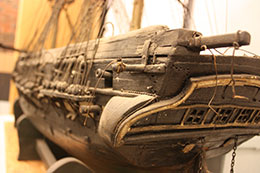
“Masters of Miniature” at the U.S.S. Constitution Museum

The U.S.S. Constitution Museum has extended the time of its ship model show called “Masters of Miniature.”

Originally scheduled to end 2 Jan 2016, the exhibit will now be up through early March. This vacation week might still be an ideal time for families to visit.

Presented with the USS Constitution Model Shipwright Guild, this show features ship models from many eras and marine painting by members of the American Society of Marine Artists. Members of the model guild are often on hand to answer questions about the work on display. There’s a scavenger hunt and hands-on activities.

The U.S.S. Constitution Museum in Charlestown is open daily, 10:00 A.M. to 5:00 P.M. except New Year’s Day. Admission is by donation.

Friday, December 25, 2015

A Christmas Visit with the Franklin Family

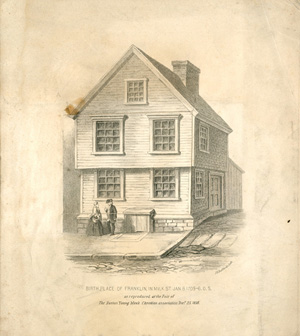
On Christmas in 1858, the Boston Young Men’s Christian Association displayed a replica of the birthplace of Benjamin Franklin on Milk Street. At that point the actual building had been gone for well over forty years.

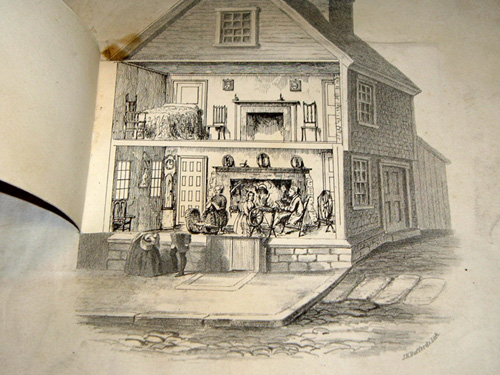
This is a digital rendering of a photograph of a lithograph of that replica of that house, courtesy of the Library Company of Philadelphia.

The L.C.P. website explains:
For the admission price of 15 cents, a visitor to the bazaar could see a recreation of the building facade, bed chamber, and sitting room of the birthplace of Boston native son Franklin. The lithograph was one of two executed by Boston lithographer J. H. Bufford for the exposition’s daily circular “Spirit of the Fair.” . . .

The rooms, recreated from designs provided by Boston antiquary Dr. Nathaniel Bradstreet Shurtleff, contained furnishings “of undoubted antiquity” from local individuals to replicate a quaint domestic setting.
The lithograph was designed with a flap that opens up, not unlike an advent calendar or Christmas card, to display the interior of the Franklin house. On the ground floor, members of the family read, spin, and knit while baby Benjamin lies in a cradle—again reminiscent of a certain common Christmas scene.

Three years earlier, Bufford published this lithograph of the Boston Massacre focusing on Crispus Attucks, from a drawing by William L. Champney.