J. L. BELL is a Massachusetts writer who specializes in (among other things) the start of the American Revolution in and around Boston. He is particularly interested in the experiences of children in 1765-75. He has published scholarly papers and popular articles for both children and adults. He was consultant for an episode of History Detectives, and contributed to a display at Minute Man National Historic Park.

Subscribe thru Follow.it


•••••••••••••••••


Friday, August 10, 2018

A Stormy Voyage from Fiction to Biography

Susanna Rowson died in 1824, having spent the last half of her life writing and teaching in greater Boston. Her novel Charlotte Temple was still selling, and her sequel Charlotte’s Daughter, or The Three Orphans came out posthumously in 1828.

In 1870 the Rev. Elias Nason wrote a biography of Rowson. He took up her invitation to read passages from Rebecca as first-hand accounts of her own experiences. Thus, Nason described the author’s passage to America this way, citing the novel:
The voyage was long and perilous. The brig encountered the fearful storms and contrary winds of that inclement season, and the provisions failing, each passenger was finally put upon an allowance of a single biscuit, and a half a pint of water per day. Mrs. Rowson often spoke in after life of the intense thirst she then experienced, and of her bitter disappointment, when her father, with a tearful eye, presented her a cup of wine instead of water. Her faithful nurse subsisted many days on half of her own scanty allowance, affectionately reserving the other portion for her beloved Susanna, should they be reduced to a more terrible necessity.

Having thus been driven to and fro by wintry storms for many weeks, and having endured the pangs of famine to the last extremity, their hearts were overwhelmed with joy when the sweet cry of “Land ahead!” was heard late in the afternoon of the 28th of January, 1767. They were approaching Boston harbor, and anticipating quick relief from their protracted sufferings; but a severer trial yet awaited them. The wind rose suddenly; the night fell darkling over the ill-fated vessel; the sleet encased the ropes in ice; the sailors were benumbed with cold; the brig became unmanageable; and to add to their dismay, they lost sight of the beacon at the entrance of the harbor, and were drifting hopelessly in amongst the rocks and breakers.

At ten o’clock that dreadful night, their fears were realized. Suddenly the vessel struck a rock. It proved to be upon that long, low point running out north-westwardly from Lovell’s island, opposite Ram’s head, in Boston harbor. The floods came beating violently over deck, and there, all through that long, cold, dreary, stormy night, the little weather-beaten company remained in agony, anticipating instant death.

But the good brig held together; and when the tide receded in the morning, the kind people of the island wading into the sea and placing a ladder against the side of the vessel, received the passengers and conducted them safely to the land; the rounds of the ladder, however, being soon covered with ice, Lieut. [William] Haswell did not dare to risk his little daughter on them; and so, fastening a strong cord round her waist, he swung her out over the bulwarks of the brig into the arms of a stout old sailor, standing up to his waist in the water to receive her.
Nason recognized that not every detail in the novel applied to little Susanna Haswell. The young girl in the novel was seven years old; Susanna was only five. The girl traveled with two older brothers as well as her widowed father; Susanna’s only family at this time was her father, a retired naval lieutenant.

In other details, however, Nason was too quick to accept the novel’s details. Rebecca describes the girl traveling with a “nurse,” and that word also appears in the biography. But in Boston’s records of who came ashore, the Haswells are listed as bringing a “Maid,” which isn’t quite so genteel.

Most significant, Mason adopted the date that appeared in Rebecca. The novel stated that its heroine reached mainland Boston on “the thirtieth of January, 1767.” Nason therefore calculated that the crew had sighted land “late in the afternoon of the 28th of January, 1767.” But both dates were off.

TOMORROW: When the Haswells really arrived.

Thursday, August 09, 2018

“In a situation similar to the one described here”

In 1814 Susanna Rowson had her novel The Fille de Chambre republished in Boston, giving it the new title Rebecca. She added an introductory chapter and footnotes that highlighted the autobiographical aspects of the story because she, like every good fiction writer, had stolen from real life.

In the chapter relating Rebecca’s passage to America, Rowson’s notes make clear that she was the model not of the heroine but of a young girl along for the ride. Describing how provisions ran low while the ship was at sea, she wrote:
Mr. Seward had on board the ship with him, besides two fine boys, the one fourteen, the other twelve years old, a charming little girl scarcely seven. Mrs Seward had been dead some years, and the child was accompanied by her nurse. The chief anguish this faithful servant felt was in contemplating her little charge, and thinking how she was to be preserved; indeed, to such a height did her affection rise, that she voluntarily deprived herself of part of the very small portion allotted her, that she might lay it by against a time of more eminent necessity for this darling of her heart.
The footnote to that paragraph stated:
This was a fact, the dear woman who accompanied the author in her first voyage across the Atlantic actually lived, for many days, on half a biscuit a day, to reserve the other moiety [half] for her.
After describing a similar kindness from a seaman, the third-person narration breaks into this paean:
Exalted humanity, noble, disinterested sailor, may you ever experience from your fellow creatures the same benevolence that expands and elevates your own heart. May your days be many, and your prosperity equal to your deserts.
And as if that didn’t break the spell of the fictional world enough, a footnote added:
This apostrophe is the genuine emotion of gratitude, the author having, in a situation similar to the one described here, experienced relief bestowed in the same disinterested manner.
Rowson thus argued for the genuineness of her fiction—even if not all the details were accurate.

TOMORROW: The passage from fiction to nonfiction.

Wednesday, August 08, 2018

“A new world was now opened to Rebecca…”

Susanna Rowson was America’s first blockbuster novelist, achieving lasting success with her fourth fiction, Charlotte: a Tale of Truth (1790), later retitled Charlotte Temple.

In 1792 Rowson published The Fille de Chambre (chambermaid), later retitled Rebecca, or The Fille de Chambre. It features a detailed and dramatic description of a voyage to America in the 1760s:

The day after Rebecca entered Miss Abthorpe’s service she set off for London, where she was to join Mr Seward’s family, who were to embark on board the same ship with her, and under whose protection she was to proceed to New-England. It was late in September when they arrived in town, and a variety of incidents detained them till the middle of October, so that they had but an untoward prospect before them, when so late in the season they embarked at Deal, on board a brig bound for Boston.

A fair wind presently took them out of the channel, and they flattered themselves with a prosperous voyage; but these flattering appearances were soon reversed, for the wind suddenly changed, rising almost to a hurricane, so that it was impossible to pursue their intended course, or return to port, and they continued tossing about in the Atlantic till the latter end of December, and then had not half made their passage, though their provisions
were so exhausted that they were obliged to live on a very small allowance of bread; of the water and salt meat which they had, together with a few pease, they were extremely careful.
After some anecdotes about the crossing (which I’ll return to), the ship finally reaches Massachusetts Bay. But by now it’s in the middle of winter.
The port of Boston is situated in such a manner, that, after having made land, six or seven hours good sailing will take a vessel into safe harbor, so that our weary voyagers began to think of landing that evening, however late it might be when they arrived;—but as the night came on, the wind increased, accompanied by snow and sleet; the cold at the same time being intense, it froze as it fell, and in a very short period the ropes about the ship were so incased in ice that they became immovable; the darkness increased, and to add to their distress, they lost sight of the light-house at the entrance of the harbor.

Their situation now was imminently dangerous; driving before the wind, among a multitude of rocks and breakers, without the least chance of avoiding them; to be shipwrecked in the very sight of home, was a painful trial indeed, yet this was what all expected, and for which all endeavored to prepare themselves with patient resignation.

About ten o’clock all their fears were realized, and a sudden shock convinced them they had struck on some rocks. The ensuing scene from that time till seven the next morning is better imagined than described, for till that time they had no prospect of relief, but continued beating on the rocks, the waves washing over them, and expecting momentary dissolution.

As the day-light advanced they discovered the island, from which the reef ran, to be inhabited. Several muskets were immediately discharged, and signals hung out, and about eight o’clock they discovered people coming to their assistance. It was impossible to bring a boat near the vessel, but the tide beginning to leave her, the men waded into the water, and placed a ladder against her side, down which the fear of immediate death gave Miss Abthorpe and Rebecca courage to descend; but what were the feelings of Mr. Seward, when he found the impossibility of his little daughter’s going down, so dangerous was it rendered by the ice that enveloped the steps of the ladder, and whence, if she fell, she must have been dashed to pieces, or lost among the rocks; nor did he dare to venture to descend himself with her in his arms, lest a false step or slip might destroy them both. But there was not time for much deliberation, as it was absolutely necessary to leave the ship before the tide returned.

At length an old sailor offered an expedient which was thought feasible; and the agitated parent fastened a strong cord round the waist of his child, by which he lowered her down the side of the vessel; the old sailor caught her in his arms, and bore her exultingly to the shore.

A new world was now opened to Rebecca, who, when she was a little recovered, beheld with astonishment how every object was bound in the frigid chains of winter.—The harbor which she could see from the house on the island, was one continued sheet of ice. The face of the country was entirely covered with snow, and from the appearance of all around she could form no probable hope of getting to colonel Abthorpe’s till the genial influence of spring should unbind their fetters; but in this she was agreeably mistaken, for the inhabitants of those cold climes being accustomed to the weather, were quick in expedients to facilitate their conveyance from one place to another.

The very next morning a boat was procured, and men placed at the head to break the ice as they proceeded. By two o’clock on the thirtieth of January, 1767, our heroine found herself once more on terra firma, comfortably seated at a large fire, in colonel Abthorpe’s parlor; for during the voyage Miss Abthorpe had conceived such an esteem for her, that she insisted on her being considered as a friend and sister, and her parents had too high a respect for their daughter, to wish to contradict so laudable a desire.
The Abthorpe family was no doubt inspired by the Apthorps, probably the wealthiest family in pre-Revolutionary Boston.

The Apthorps were even more an inspiration for America’s very first fiction blockbuster, William Hill Brown’s one-off The Power of Sympathy (1789). The young lawyer Perez Morton married Susan Wentworth Apthorp in 1781, then seduced her younger sister Frances. After becoming pregnant, Frances Apthorp committed suicide in 1788. That situation just cried out for a roman à clef. But unlike Rowson, Brown never published another novel.

TOMORROW: How Rowson drew on her own memories.

Tuesday, August 07, 2018

Interesting Podcasts of Late

I’ve listened to some particularly interesting podcast episodes in the last few days, so I thought I’d share pointers to them.

At the top of the list, Conversations at the Washington Library featured Joe Stoltz speaking with Brenda Parker, a character interpreter at Mount Vernon. As an African-American woman, Parker portrays the roles of several workers enslaved to George and Martha Washington. Those women are documented through their work and families but their own voices were never recorded.

This interview reveals how Parker came to that job and the sensitivities she needs to do it well. Parker explains that, even with her theatrical training and experience, she started work at Mount Vernon as a waitress in the restaurant. She and her husband had kids to feed and send to college, and food service provided a steadier income than character interpretation, at least at the starting level.

It struck me how the life experiences Parker describes bringing to her roles, particularly being a mother, make her a better interpreter than a recent college graduate would have been. (The photo above shows Parker in character, from this profile.)

At New Books Network, Rebekah Buchanan interviewed M. J. Rymsza-Pawlowska, author of History Comes Alive: Public History and Popular Culture in the 1970s. Their conversation isn’t about Revolutionary history but about how the nation remembered that Revolutionary history in a particular time. I have vivid memories of the Bicentennial, and I’m now involved in Revolution 250’s activities for the Sestercentennial, so I was drawn into the backstage nuances of this topic. Wish there were more about fire hydrants, though.

I haven’t listened to the Age of Jackson podcast before because that’s not Revolutionary America. (I might even argue that’s when the American Founding was decisively over and a new reshaping began.) But my ear was caught by Daniel Gullotta talking to Gregory D. Smithers about his book The Cherokee Diaspora: An Indigenous History of Migration, Resettlement, and Identity. The story begins when the the Cherokee were an Iroquoian-speaking people in the midst of suspicious tribes from other cultures, then extends well beyond the “Trail of Tears,” as the Cherokee nations are one of the largest Native American ethnic groupings today. Also interesting is that both Smithers and Gullotta are Australian—they even share an alma mater.

Finally, on Ben Franklin’s World, Liz Covart spoke to Garrett Cloer, Supervisory Park Ranger at the Longfellow House–Washington’s Headquarters National Historic Site. Liz was once an National Park Service ranger while Garrett has been with the agency for nine years, including service at Minute Man and Independence parks before he came to Cambridge. They could thus talk about the place of smaller urban parks in the N.P.S. I knew most of the history here already, but Garrett did a masterful job of summing it up and making the case for a visit this summer.

Monday, August 06, 2018

Videos from History Camp Boston 2018

The History List has just posted a video of my session at History Camp Boston last month on the arrival of British soldiers in 1768.

Before we get to my talk, though, the video shows a History Camp tradition of going around the room so all the attendees can introduce themselves and their interests in history. In earlier years, we did this in a plenary session with everyone. This year’s Boston convention was too large for that, so we did it after dispersing to the lecture halls for the opening sessions. That part of the video is a useful answer to the question “What sort of people do you meet at History Camp?”

The History List has also posted videos of several other sessions made throughout that day. Those that might be of particular interest for Boston 1775 readers include:
Here’s the playlist of all the 2018 sessions on YouTube, including those about other historical periods.

Sunday, August 05, 2018

Abbass on the Search for the Endeavour in Bristol, 7 Aug.

On Tuesday, 7 August, Dr. Kathy Abbass of the Rhode Island Marine Archaeology Project will speak in Bristol, Rhode Island, on “The American Revolution, the U.S. Navy, and Why It Is So Hard to Find Capt. Cook’s Endeavour in Newport Harbor.”

As reported back in 2016, leaders of the organization believed that there was an 80% or higher chance that the Royal Navy ship Capt. James Cook sailed around the world still lies scuttled in Newport harbor under a different name.

The event announcement notes that 2018 is the sestercentennial of when Capt. Cook and his crew set out from England. R.I.M.A.P. hopes to use this year to explore the harbor with partners from the Australian National Maritime Museum.

That announcement explains the challenges of identifying the Endeavour among all the other eighteenth-century vessels sunk in the area, given all the other activity that’s happened since:
Cook’s Endeavour Bark was one of 13 vessels scuttled in Newport’s Outer Harbor in the days before the August 1778 Battle of Rhode Island in the American Revolution. Then named the Lord Sandwich, this transport had carried German troops to North America in 1776, she was used as a prison ship in Newport Harbor to secure Patriots in 1777, and she was part of the blockade to protect the British in Newport from the threatening French fleet in 1778.

Documents make it clear that the British had no intention of raising the ships sunk in the Outer Harbor, although they did raise vessels elsewhere before they abandoned Rhode Island in 1779. In 1780 the French arrived and their sailors retrieved materials from the transports before they marched to Yorktown the following year. Providence businessmen bought the rights to all of the abandoned British property, and their local salvage efforts further disturbed the Newport wrecks.
But even bigger damage to the sunken ship might have been caused by U.S. Navy divers in training in the late nineteenth century, followed by military and commercial development of the shoreline in the twentieth. All told, R.I.M.A.P. doesn’t expect to find much of the Endeavour that relates to Capt. Cook’s voyage. But there could be material reflecting its last missions in the American War that would help make that ship structure stand out from others.

This talk is scheduled to take place from 6:30 to 8:00 P.M. in the Rogers Public Library, 525 Hope Street in Bristol. It is free and open to the public.

[The photograph above shows a replica of Cook’s Endeavour sailing in New Zealand.]

Saturday, August 04, 2018

2018 Seminar at Fort Ticonderoga, 21-23 Sept.

The 2018 Fort Ticonderoga Seminar on the American Revolution is coming up on 21-23 September 2018. This is the fifteenth annual seminar in that august and scenic location.

Sessions on the schedule are:
  • “‘Why does the Almighty strike down the tree with lightning?’: The Sullivan Campaign of 1779, William Tecumseh Sherman, and the Creation of Memory,” Dean Bruno, North Carolina State University.
  • “The White Sands of Freedom: The Patriot-Spanish Alliance to Capture British West Florida,” Brady J. Crytzer, Robert Morris University.
  • “‘Live in love with, and in the exercise of kindness to my fellow-soldiers’: The Continental Army as America’s First Band of Brothers,” Rachel Engl, Lehigh University.
  • “The Court-Martial of Paul Revere,” Michael Greenburg.
  • “A Coat Not My Own: Uniform Substitution in the Revolutionary Era,” Matthew Keagle, Fort Ticonderoga.
  • “General Charles Lee in New York: Confronting Tories as well as the Boundaries of Military Authority,” Timothy Leech, Ohio State University.
  • “Cook’s and Latimer’s Connecticut Militia Battalions and the Battles of Saratoga,” Eric Schnitzer, Saratoga National Historical Park.
  • “John Trumbull’s Revolution in the North Country,” Paul Staiti, Mount Holyoke College.
  • “‘This Horrid Trade of Blood’: The Revolutionary Transformation of Anthony Wayne,” Mary Stockwell.
  • “‘Convinced of the Necessity of preventing…Anarchy and Confusion’: Benedict Arnold’s Declaration of Principles and Its Place in Early Revolutionary History,” Richard M. Strum, Fort Ticonderoga.
Last year’s seminar attracted about 120 people.

Fort Ti has also issued its call for papers for next year’s seminar, to be held 20-22 September 2019, saying:
The 250th anniversary of the American War of Independence looms on the horizon, but the anniversary of the political, social, and military events of the broader American Revolution are already upon us. Reflecting on the antecedents to the War itself may help scholars and historians to frame new approaches and contextualize the period better in the coming years.

The Fort Ticonderoga Museum seeks proposals for new research on this critical period of the 18th century from a variety of perspectives and participants. Established scholars, graduate students, and others are encouraged to submit abstracts of papers broadly addressing the origins, conduct, or repercussions of the War for American Independence. We are especially interested in topics and approaches that engage the international nature of the conflict, representing the variety of peoples and places involved.

We welcome interdisciplinary backgrounds and approaches covering the period from the 1760s to the 1780s. Papers may include or engage:
  • Material Culture
  • Biographical Analysis
  • Social and Cultural Histories
  • Global Theatres of War
  • Archaeological Studies
  • Indigenous Perspectives
Sessions are 30 minutes in length followed by 10 minutes for audience questions. Fort Ticonderoga may provide speakers with partial travel reimbursement.
To be considered as a presenter in 2019, sent a 300-word abstract and c.v. by 1 September 2018 to Richard M. Strum, Director of Academic Programs.

Friday, August 03, 2018

Taiato, Boy Explorer

Last month the British Library’s blog highlighted the short life of Taiato (spellings vary), a boy from Tahiti who sailed on Capt. James Cook’s Endeavour for a few months in 1770.

The Tahitian navigator and priest Tupaia brought Taiato, estimated to be twelve years old, aboard the ship in July. His most prominent moment in Cook’s log came on 15 October off the coast of New Zealand. Modern Maps project manager Huw Rowlands relates:
The Endeavour had only sighted land a few days before, but already a great deal had happened. [Joseph] Banks described 9 October as ‘the most disagreable day My life has yet seen’. An estimated nine Māori had already been shot dead, and the Endeavour had acquired virtually no fresh supplies of food and water in the nearly two months since they left the Society Islands.

As the crew started to trade for fish with Māori in canoes alongside the ship, a many-layered event unfolded. Cook tried to trade some red cloth for a Māori cloak, but no sooner was the cloth in the trader’s hand, than he sat down in the canoe, which calmly withdrew. After a brief discussion amongst themselves, the Māori approached again. This time however they had other ambitions.

As the ship’s surgeon [William Brougham] Monkhouse recorded: ‘we were attending to the coming up of the great war Canoe when all on a sudden an Alarm was given that one of the fishermen had pulled Tupaia’s boy into the boat – they instantly put off, and the great Canoe, as if the scheme had been preconcerted, immediately put themselves in a fighting posture ready to defend the other boat and stood ready to receive the boy from them. Our astonishment at so unexpected a trick is not to be described’.

The Endeavour’s crew, and particularly Tupaia, were outraged and shots were immediately fired at the Māori, fatally wounding several, and securing Taiato’s escape.
Unfortunately, Taiato lived only a few more weeks. On 9 November he died at Batavia, a base of the Dutch East India Company, which is now Jakarta. The navigator Tupaia was mournful and, already sick, died a few days later. Many authors presume the disease was tuberculosis.

Naturalist Sydney Parkinson wrote that during his illness, Taiato repeated, “Tyau mate oee,” which he translated as, “My friends, I am dying.” However, in Language Contact in the Early Colonial Pacific, Emanuel J. Drechsel posited that the boy actually said, “Taio mate ’ohi,” meaning, “Friend dying diarrhea.”

Thursday, August 02, 2018

Whatever Happened to Spado?

Longtime Boston 1775 readers may recall when Gen. Charles Lee’s dog Spado (sometimes spelled Spada) first came to public attention.

John Adams wrote a letter to his wife mentioning some of the British general’s eccentricities: “He is a queer Creature—But you must love his Dogs if you love him…” Through the poor choices of Benjamin Hitchborn, that letter fell into the hands of the royal authorities, who gleefully published it to embarrass their enemies.

Abigail Adams therefore went to Medford Cambridge to mend fences with Gen. Lee. As part of that cordial visit, the general had Spado jump up on a chair and present his paw for Mrs. Adams to shake.

About a year later, Lee was captured in New Jersey. Spado wasn’t with the general at the time—or if he was, the British raiders knew enough not to bring Spado along.

Evidently Lee’s friends undertook to send Spado to the estate that the general had purchased in Virginia (now eastern West Virginia). I don’t think the dog had spent much time there, but it was the peripatetic Lee’s only home in North America.

But something went wrong. On 11 Feb 1777 this advertisement appeared in Dunlap’s Maryland Gazette, published in Baltimore:
TWENTY DOLLARS REWARD.

LOST or STOLEN, a very remarkable black shaggy dog of the Pomerania breed, called SPADO. He belongs to our brave but unfortunate GENERAL LEE, and was seen in the possession of a person who called himself JOSEPH BLOCK, at Wright’s Ferry, on Susquehanna, about the 25th of December last.

It is supposed that BLOCK who pretended to have undertaken to carry him to Berkeley county, Virginia, has parted with him for a trifling consideration, or lost him on the road.

Whoever gives information where the said dog may be had, or will bring him to the persons hereafter named, shall on the dog’s being produced, receive the above reward and no questions asked.

Robert Morris, Esq; Philadelphia; Jo. Nourse, at the War-Office in Baltimore; or James Nourse, Berkeley county, Virginia.
The same ad appeared in the Maryland Journal a week later and in several more issues of John Dunlap’s newspaper.

For a financial comparison, the same page of the Maryland Journal offered a $20 reward for each of three Continental Army deserters. For animals, the promised rewards included $4 for three head of cattle, $3 for an eight-year-old horse, and $8 for a colt. So the reward for Spado was unusually high.

Some of those Maryland newspapers made their way north because on 9 March Abigail Adams wrote to her husband:
I see by the news papers you sent me that Spado is lost. I mourn for him. If you know any thing of His Master pray Let me hear, what treatment he meets with, where he is confined &c.
On 7 March and for a couple of weeks thereafter, Alexander Purdie’s Virginia Gazette published the same advertising notice with slight punctuation differences, this one asking people with the dog to contact William Finnie in Williamsburg. Finnie (1739–1804) was a quartermaster during the war and the city’s mayor shortly afterward.

But evidently Spado was gone for good. When Gen. Lee was finally released from captivity in the spring of 1778, his best companion was not there to greet him. And he was never as cheerful afterward.

Wednesday, August 01, 2018

In Captivity with Gen. Charles Lee

Gen. Charles Lee was captured in New Jersey on 13 Dec 1776.

On 28 Jan 1777 he wrote from British-occupied New York to Robert Morris in Philadelphia:
I am extremely obliged to you for your kindness and attention—the money for the bill I am told I shall get to-day—I have nothing to request at present but that you will write to Mr. Nourse to take care of what belongs to me—and if that my servant Guiseppe is well enough you will send him and desire him to bring the Dogs with him as I am much in want of their Company—God bless you My respects to Mrs. Morris
“Guiseppe” was Giuseppe Minghini, an Italian whom Lee had hired as a personal servant while he was traveling in Europe. The general was asking Minghini to join him in captivity—and to bring the dogs as well.

It might not be surprising that Minghini didn’t immediately set out. Lee was still in New York on 4 April, and he renewed his instructions directly to the Italian:
If your health permits I desire you will without a moments delay set out for this place—your establishment & fortune depend on your compliance—bring with you as many summer cloaths as you can silk stockings, linnen wastecoats and breeches tights, boots and a new hat—some books likewise particularly Ainsworth’s [Latin] Dictionary & the six french books, l’histoire politique—if any of the Dogs are with you bring them. Mr. Rob Morris will furnish you with the necessary money. Addio—come immediately
Minghini brought one dog to keep Lee company until the trio was finally released on 21 Apr 1778. By then the general had also picked up a mistress whom Elias Boudinot called “a miserable dirty hussy…(a British Sergeants Wife).”

One might think that Minghini brought the general’s his favorite pet, Mr. Spado, but that dog wasn’t available.

TOMORROW: What happened to Spado?

Tuesday, July 31, 2018

The Last Years of Baron de Steuben

When we left the retired general Friedrich Wilhelm von Steuben, usually then known as Baron de Steuben, his first postwar housemates had left him as well.

Those were three of his former military aides: Benjamin Walker, James Fairlie, and William North. In the mid-1780s they all got married and set up their own households. That left the baron at loose ends in New York, living beyond his means.

Steuben enjoyed the company of young men—but not all young men. Sometime during the 1780s two nephews visited Steuben from Prussia. The baron quickly came to dislike them, especially because they expected him to provide their fare and living expenses (after all, he had written letters boasting of his success in America). They went home.

In the late 1780s the baron showered gifts on his butler, who North thought was a “worthless rascal” being dressed up as a “beau.” For a while in 1791 Steuben lived at Walker’s house.

In the spring of 1792, however, the baron set up a household at 32 Broadway and collected a new pair of companions. The first was John W. Mulligan (1774-1862), son of New York tailor and wartime spy Hercules Mulligan. A recent Columbia graduate, Mulligan started to study the law in the office of Alexander Hamilton but then took the job of Baron de Steuben’s secretary.

The next arrival was Charles Adams (1770-1800), son of John and Abigail Adams, another aspiring attorney. In April 1792, Adams told his mother about Steuben: “He is the best man in the world I sincerely beleive.” In a letter dated 8 Oct 1792, Charles Adams described how the baron had invited him to move in:
The Baron returned from Steuben [his town in upstate New York] last week and I had intended to procure lodgings at some private boarding house, but when I mentioned to him my intention, he took me kindly by the hand “My dear Adams said he When your sister went from New York I invited you to come to my house, at least till you could find more convenient and pleasant Lodgings; I then had not the pleasure of a long acquaintance with you, but I was pleased that in our little society we could be of mutual advantage to each other, and that our improvements in the French language and in other branches of literature would render my table the seat of improvement and pleasure.

[“]I have since you have been here formed a very great and sincere friendship for you. You must now allow me the right of friendship; Indeed you must not leave me. What is it? Is there any thing you do not like? Is any thing inconvenient? I wish I could give you a better apartment, but the house will not aford it.[”]

I told him there was not a desire I could form but what was accomplished in his house; but that I did not think it proper that I should any longer take advantage of a kindness I had not a right to expect.

[“]And will you not then allow me to be any longer your friend and patron? You must not make such objections. It is not from any favor I can ever expect from your father. I am not rich, nor am I poor: and thank God I have enough to live well and comfortably upon; your being here does not make any difference in my expences. I love you, and will never consent that our little society should be broken, untill you give me more sufficient reasons for it.[”]

To this affectionate and fatherly address, I could only reply that I would do any thing he wished and would not leave him if he was opposed to my doing so. My dear Mamma there is something in this man that is more than mortal.
On 31 Jan 1793 Adams wrote to his father:
The Baron returned [from Philadelphia] on teusday his visit has been of service to him He said to me upon sitting down to supper that evening “I thank God my dear Charles that I am not a Great man and that I am once more permitted to set down at my little round table with Mulligan and yourself enjoy more real satisfaction than the pomp of this world can afford.” 
However, that situation was financially unsustainable. Steuben decided to move to his country estate, where life was cheaper. He headed out there in May 1793 and again in the spring of 1794. Vice President Adams understood the baron intended “there to reside for the Remainder of his Days.” Mulligan moved with him, still in the role of secretary.

On 12 Feb 1794, before leaving the city, Baron de Steuben made his third and final will (P.D.F. download). He had decided to “exclude my relations in Europe”—those nephews. Instead, he would “adopt my Friends and former Aid Des Camps Benjamin Walker and William North as my Children and make them sole devisees of all my Estates therein.” So they shared a financial inheritance which they probably would have had to sort out anyway.

Steuben left swords and other specific bequests to North and Walker. He left Mulligan “the whole of my library Maps and Charts and the sum of Two Thousand five hundred Dollars to complete it.” He assigned a year’s wages and clothes to his servants. Charles Adams, who was staying in the city to study for the bar, was a witness to the will. Another was Charles Williamson (1758-1808), a former British army officer who emigrated to America to promote land investments and the interests of the British Empire.

On 22 September, Charles Adams wrote to his mother:
On the fourteenth of October I shall set out for Albany The earnest solicitations of the Baron have drawn a promise from me to spend a few days with him at his solitude after I have passed my Counsellors examination. I have always lamented that you have so little acquaintance with this excellent man I never have know a more noble character and his affection for me calls forth every sentiment of gratitude which can exist in my breast.
In November Adams’s father happily reported that Charles was “at Steuben after an Examination at Albany and an honourable Admission to the Rank of Counciller at Law.” But out on the baron’s estate, things were going poorly.

Early in the morning of 26 November, the general suffered a stroke. A biographer who relied on Mulligan’s memories wrote that a servant came to fetch him from another building:
Mulligan at once ran through the snow to his room, and found him in agony. Steuben appeared to have suffered much, and could only articulate a few words, “Do n’t be alarmed, my son,” which were his last.
This account didn’t mention Charles Adams, but he must have been in the area because he wrote to his father (in a letter that no longer exists) that Steuben had suffered a “Palsy.” William North hurried over from his home in Duanesburg, and a doctor arrived.

But Steuben never regained consciousness. He died on 28 Nov 1794. Mulligan and North picked out his burial place “an eighth of a mile north of the house, on a hill in the midst of a wood.” Ten years later the baron’s remains were moved to the present gravesite.

Charles Adams married in 1795 but died only five years later, having drunk himself to death. John W. Mulligan around the same time wed a woman from Kentucky; they had nine children. He lived until 1862, thus witnessing the end of the Revolutionary War and the start of the Civil War.

[The statuary shown above, labeled “Military Instruction,” consists of an ancient warrior displaying a sword perilously close to a nearly naked young man. It’s part of the monument to Steuben in Lafayette Park, Washington, D.C. The baron would have loved it.]

Monday, July 30, 2018

Steuben, Walker, and North (and Fairlie)

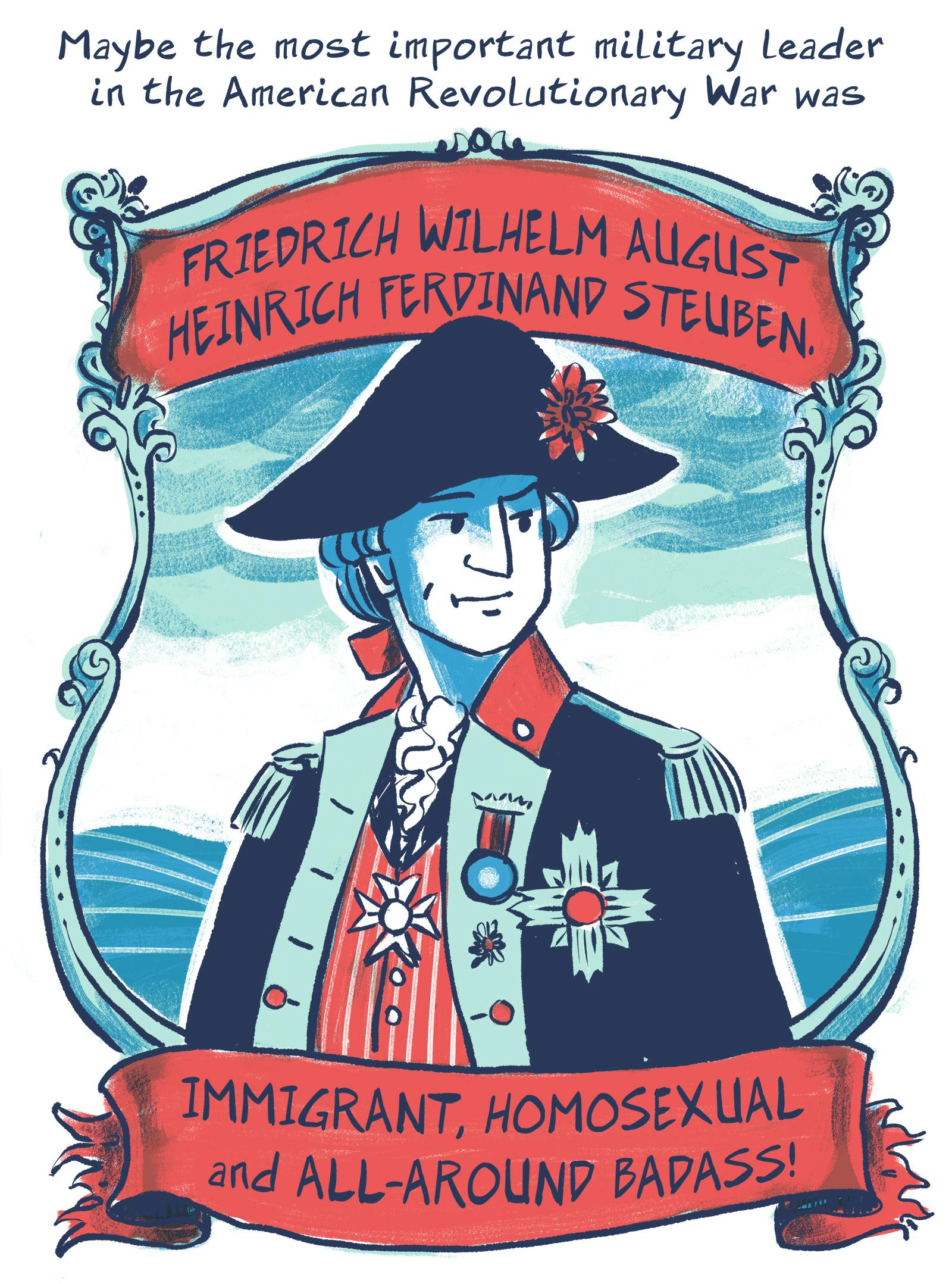
For the last few days I’ve been discussing statements about Gen. Friedrich Wilhelm von Steuben’s sexuality made in this comic published by The Nib. I think there’s good evidence for Steuben being gay, but there are also a lot of errors floating around. To whit:

“President George Washington rewarded his prize general with an estate in Valley Forge, the site of perhaps his greatest military victory.”

The source for that misstatement is probably this article by Mark Segal, or one of many like it making a similar error. That article shares a timeline of the baron’s war activity and then says, “Washington rewarded von Steuben with a house at Valley Forge…” That can easily be interpreted as a grant after the war by the first President. But there was no such gift.

Gen. Washington assigned the baron a house within the Valley Forge encampment in 1777-78. That wasn’t a lifelong grant of real estate. It wasn’t a reward for service since, after all, Steuben had just arrived. That house was just where the new general and his staff could live so snow wouldn’t fall on their heads.

Baron de Steuben did receive some grants of real estate after the war in recognition of his service to the new republic. The Continental Congress offered western lands to any officer meeting certain terms, but the baron also got special gifts. His holdings are a bit hard to suss out, not least because he overstated them in his wills. But it looks like his major properties were:
  • rented houses in New York City where he lived in the 1780s.
  • an estate that New Jersey confiscated from a Loyalist family and granted the baron in 1783 on the condition that he live there, not rent it out. He spent considerable time and money fixing it up, receiving full title in 1788—and a month later he sold it to pay off debts.
  • a large amount of land granted by New York in Oneida County. In 1792 that area was even named the town of Steuben.
None of the general’s real estate was in Valley Forge.

Lastly, Valley Forge was the site of an army camp, not a battle and thus not a “military victory.”

“Steuben spent his finals [sic] years with two younger men he had served with in the war: Captain Benjamin Walker and Brigadier General William North. Who later became a US Senator.

“He adopted both as his ‘sons’, but speculation about their relationship remains.”

While this statement acknowledges ambiguity in the historical evidence, it simplifies and skews the facts of Baron de Steuben’s life and of the lives of Walker and North. Steuben did live with those men for a while after the war. He did write in his final will that he wished to “adopt [them] as my Children.” However, those two former aides left the baron’s household to get married in the 1780s, so he didn’t spend his “final years” with them. Here’s the more complex story.

At Valley Forge, Steuben picked up three aides de camp: Benjamin Walker (1753-1818), William North (1755-1836), and James Fairlie (c. 1757-1830). He became very close to them all. In the first will the baron wrote after coming to America, dated 28 May 1781 (P.D.F. download), he bequeathed £1,050 to each of those three men. (He also left half that sum to two Frenchmen who had accompanied him to America, Peter Stephen Duponceau and Capt. Louis de Pontière, and to Pierre Augustin Caron de Beaumarchais, the diplomatic fixer and playwright who helped him connect with American envoys in Paris.) But Steuben’s main heir was a nephew back in Germany, whom he wanted to renounce his baronial title, emigrate to America, and become a republican.

In Male-Male Intimacy in Early America: Beyond Romantic Friendships, William E. Benemann describes a web of shifting relationships among Gen. de Steuben and his military aides: North and Fairlie as a couple before North realizes he likes Walker more and they become intimate, and then Steuben becomes infatuated with both North and Walker, but Walker strings the general along for favors while North is truly affectionate, though more like a son to a father… All this in only two years of those men being in the same military family. And with, frankly, very little textual support for such a level of detail.

But the evidence is clear that Steuben, North, Walker, and Fairlie became very close. Though assignments took them in different directions in the last years of the war, afterward they reunited and lived in the baron’s house on the outskirts of New York City.

That last decade of Steuben’s life is particularly significant to the question of his sexuality because it’s the only period when he wasn’t serving in an army or in a court and thus could live as he chose—or as close to that as circumstances allowed. And what Gen. Steuben wanted to do was spend his time in the company of young men. He used his martial celebrity to sponsor militia units and military academies. For money, he borrowed a lot and sought rewards for his wartime service.

Steuben, then in his fifties, was happy in his bachelor lifestyle. His young friends, however, took more traditional paths in their society. First Walker married a Quaker girl named Molly and set up his own household. Around 1786 Steuben, North, and Fairlie all had their portraits painted by Ralph Earl while he was locked up in debtors’ prison, but later that year Fairlie married and moved to Albany. The next year, with the baron’s help, North married Mary Duane, daughter of the city mayor; they eventually had six children.

Walker, North, and Fairlie all lived for many decades as prominent members of New York’s political class—not leading politicians but lawyers, civil servants, and occasional officeholders. North would be elected to the New York legislature and appointed for a few months to the U.S. Senate. In the early 1800s Walker would serve one term in the U.S. House of Representatives.

Walker and North remained close to Baron de Steuben once they married, but more like grown sons looking after a failing father—failing in the financial sense. They tried to cajole the baron into not spending so much and to cajole Congress or state governments into granting him more support. The letters that have been preserved don’t say much about physical intimacy, but there’s clearly fondness on all sides.

Meanwhile, Baron de Steuben found some new young friends.

TOMORROW: The baron’s last years.

[The photo above shows relief portraits of Walker and North on the monument to Steuben in Washington, D.C.]

Sunday, July 29, 2018

“The abominable rumor which accused Steuben”

Here’s the continuing discussion about what we know and don’t know about Gen. Friedrich Wilhelm von Steuben’s sexuality, keyed to statements in a recent comic at The Nib.

“Rumors about Steuben’s ‘tastes’ were common knowledge, and reported in the American press.”

It would be good to see examples of such American newspaper reports. To my knowledge no one has found any. And that’s significant to how “openly” Baron de Steuben lived as a gay man and how much his American neighbors accepted him.

Now it’s conceivable that such articles are lurking in the big newspaper databases with asterisks and allusions making them hard to spot. But no one researching Steuben has cited such a report, and I’ve kept my eyes open for such a finding.

The most open discussion of Steuben’s sexuality in print in the eighteenth century was an article published in Germany in 1796, two years after the baron’s death. Christoph Daniel Ebeling (1741-1817) was a professor in Hamburg and a fan of the American republic. In his Amerikanisches Magazin he wrote an article (“Nachrichten von den Lebensumständen des Baron von Steuben”) which John Macauley Palmer translated as saying:
Just who it was who spread abroad the abominable rumor which accused Steuben of a crime the suspicion of which, at another more exalted court [i.e., Frederick the Great’s] at that time (as formerly among the Greeks), would hardly have aroused such attention, has not become publicly known.
I couldn’t find any American newspaper or magazine mentioning Ebeling’s article in the decades after it was published.

And of course Ebeling did his best to imply the “abominable rumor” was untrue, spread by Steuben’s clerical enemies and eventually rejected by right-thinking people. Which is not exactly the same thing as stating flatly that it was untrue.

“One story claimed that Von Steuben loved to host cocktail nights for his favorite cadets. No clothing allowed.”

The ultimate source for this statement is the memoir of Peter Stephen Duponceau, a young Frenchman who accompanied Baron de Steuben to America in 1777 (and actually paid for their passage). Duponceau served unsuccessfully as a staff officer during the war and more happily as a linguist in Pennsylvania after it. Late in life he wrote about Valley Forge:
Once, with the Baron’s permission, his aids invited a number of young officers to dine at our quarters, on condition that none should be admitted that had on a whole pair of breeches. This was of course understood as pars pro toto [the part for the whole]; but torn clothes were an indispensable requisite for admission, and in this the guests were very rare not to fail. The dinner took place; the guests clubbed their rations; and we feasted sumptuously on tough beef steaks and potatoes, with hickory nuts for our dessert. In lieu of wine, we had some kind of spirits, with which we made salamanders; that is to say, after filling our glasses,, we set the liquor on fire, and drank it up, flame and all. Such a set of ragged, and, at the same time, merry fellows, were never before brought together. The Baron loved to speak of that dinner, and of his sans-culottes, as he called us.
The point of this gathering was that those young Continental Army officers were wearing torn uniforms and eating “tough beef steaks” because their pay and supplies were so meager. It was a bonding experience. Notably, Duponceau recalled the idea coming from Steuben’s aides, not the general himself.

Now that gathering might have been titillating for some; certainly we’d interpret an anecdote about young women having to wear torn clothing to a party through the lens of sexuality. But as to the accuracy of the statement from the comic above, if people have to wear torn clothing to a party, then that party is not “No clothing allowed.” And since this happened “once,” it’s not evidence Steuben made a habit of hosting such events—however fondly he remembered that one occasion.

Also, an eighteenth-century midday dinner does not constitute “cocktail nights.”

TOMORROW: The baron in retirement.

Saturday, July 28, 2018

A Letter of Recommendation for the Baron de Steuben

Yesterday I started to analyze evidence about Gen. Friedrich Wilhelm von Steuben’s sexuality. In sum, I think that evidence strongly suggests he was gay, but it’s not nearly as definite as popular articles have recently claimed.

I’m drawing from the draft of an essay I started years ago, somewhat abashed that I’m pulling it off my hard drive in response to a cartoon. Nevertheless, here’s the second installment of replies to claims in that cartoon.

“Franklin knew about Von Steuben’s past, but still decided to write a letter of recommendation to George Washington.”

There’s no evidence Benjamin Franklin knew about the allegations of child-molesting or homosexuality against Steuben in the principality of Hohenzollern-Hechingen. That statement rests on the assumptions that (a) that gossip reached Paris by September 1777, and (b) Franklin heard it. But actual evidence would be some document showing that Franklin knew more facts than he let on.

In fact, the evidence we have suggests Franklin knew less. Here’s the letter that he and his fellow envoy  Silas Deane sent to Gen. George Washington on 4 Sept 1777, recommending Steuben for a role in the Continental Army. The diplomats wrote:
The Gentleman who will have the Honour of waiting upon you with this Letter is the Baron de Steuben, lately a Lieutenant General in the King of Prussia’s Service, whom he attended in all his Campaigns, being his Aide Camp, Quartermaster General, &c. He goes to America with a true Zeal for our Cause, and a View of engaging in it and rendring it all the Service in his Power.
Steuben had never been “a Lieutenant General in the King of Prussia’s Service” or a “Quartermaster General.” He had indeed been an aide de camp to Frederick the Great for a while, but his highest Prussian army rank was captain. He’d been working in the civil government of a small German state since 1764.

I have to add that there’s nothing in Steuben’s European career to suggest he had “a true Zeal” for America or republican government, unlike some other Old World officers offering their services. He had personal reasons, both legal and financial, for sailing thousands of miles from home.

Where did Franklin and Deane get their information about Steuben? They dropped the names of two French high officials: “Mr Le Comte de Vergennes,” the foreign minister and spymaster, and “Mr Le Comte de St Germain,” the minister of war. St. Germain especially admired the Prussian military, and his attempts to reform the French army along those lines ran into such opposition that he resigned later that September.

But most of the American diplomats’ information probably came from Steuben himself. And he was a habitual liar. In John Macauley Palmer’s 1937 biography there’s an index entry for “Steuben…, his fictitous autobiography, 2-5, 53, 85-6, 103-108, 305, 407.” And those pages don’t even include all of his false claims to have become become a lieutenant general in Europe (e.g., 97, 138).

Palmer viewed Steuben as indispensable to American independence, and he didn’t want to believe that his hero lied as he offered his services to the young nation. In fact, when Palmer considered that possibility early in his research, he was ready to set aside the project. He wrote:
My first reaction upon discovering that my hero was a systematic, circumstantial and deliberate liar, was one both of disgust and disappointment. I was disposed to proceed no further with my book. Here was, indeed, a golden opportunity for a debunker or a muckraker, but that sensational role made no appeal to me. 
But eventually Palmer came up with a way to explain the discrepancy between the baron’s actual résumé and what Franklin and Deane wrote about him: Franklin came up with the lie. 

This approach depended on Franklin’s status in American culture and memory. We accept him as a trickster. From his teen-aged essays as “Silence Dogood” to his false supplement for a Boston newspaper printed at Passy and how we remember the oil in his cane, we enjoy stories of Franklin fooling people. We don’t tell such stories about Washington, Adams, or Hamilton, and Jefferson’s duplicity still gets people angry.

In the case of Steuben, Palmer decided that the baron didn’t make any false claims about his career to Franklin (who was supposedly too smart to fall for such lies, anyhow). Instead, Franklin was so smart that he made up those falsehoods himself. He recognized how useful Baron de Steuben would be near the top of the Continental Army. Therefore, he ensured that Gen. Washington and the Continental Congress would treat this newcomer as a man of invaluable experience who deserved top rank by harmlessly—even helpfully—inflating his Prussian credentials.

As for the hapless Silas Deane, Palmer blamed him for falsely claiming to have seen documents to confirm the baron’s credentials—a deception that, unlike Franklin’s, he couldn’t forgive. Palmer didn’t present the simpler possibility that Steuben had fooled Deane. The baron appears to have flashed papers and described their contents at his first meeting with the American envoys, but never handed them over; at the second meeting he said that, alas, he had left those documents behind.

Thus, Palmer rejected the evidence that Baron de Steuben was gay and argued that he was—if only at this crucial moment—honest about his past. Many later authors who accept that Steuben was gay have adopted Palmer’s conclusion that he was also honest. But if there’s one thing we can say for sure about the baron, it’s that he told a lot of lies about himself.

The simplest explanation for the glowing recommendation that Franklin and Deane sent to Gen. Washington is that they actually believed what Steuben had told them about his brilliant career. And the simplest explanation for why Franklin didn’t write anything about the baron being gay is not that he covered up that fact but that the baron didn’t tell him.

TOMORROW: Gen. Steuben in the Continental Army.

Friday, July 27, 2018

What Do We Know about Gen. de Steuben’s Sexuality?

Last month The Nib published Josh Trujillo and Levi Hastings’s comic about Gen. Friedrich Wilhelm von Steuben as a gay man.

I found it inaccurate at several spots. Yet the core message—that Steuben was both important to the Continental Army’s success and sexually attracted to other men—is almost certainly correct. It’s just that a lot of the details, especially those supporting that conclusion, are wildly exaggerated.

Most of the evidence about the Baron de Steuben’s sexuality appears in John Macauley Palmer’s 1937 biography, General von Steuben. Palmer admired Steuben greatly and disliked the idea of the baron being gay, so he tried hard to refute the evidence, leaving logical circles in the ground as he spun. But he did publish the relevant sources in English translation.

Many of the original European documents were probably destroyed in World War 2, along with others that might have been helpful. It’s therefore unlikely that we’ll find new evidence from Steuben’s lifetime. But we can do a better job than Palmer of interpreting those documents and spotting the most likely conclusions.

This comic instead overstates the evidence in various ways. It doesn’t cite sources but appears to have been based on articles written for American newspapers, magazines, and websites over the past twenty-five years since Randy Shilts’s Conduct Unbecoming focused attention on Steuben as a gay man.

I’ll go through the statements I think are exaggerated.

“Steuben lived openly as a homosexual before the term was even invented.”

It’s true that the word “homosexual” was coined in 1868. More important (as Trujillo and Hastings later acknowledge), people’s understanding of sexuality and expectations of how gay men behave were different in the Baron de Steuben’s lifetime and in our own. So what does it mean to say he “lived openly as a homosexual”?

Gen. de Steuben was a lifelong bachelor. He didn’t marry a woman while having affairs with men, as it was and is said of his monarch Frederick the Great of Prussia, Frederick’s brother Prince Henry, and Lord George Germain in Britain. The baron’s title was too new, his estate too small, to make a direct heir necessary. In that respect, Steuben was more like Horace Walpole or Charles Paxton.

But neither is there any evidence of Gen. de Steuben claiming a longtime partner or expressing sexual interest in males. When he set up a household with a young man late in life, he presented that man as his secretary.

Some of Gen. de Steuben’s letters express affection for other men more plainly than 20th-century male correspondents did, but there are similar letters between eighteenth-century men who had active heterosexual lives. Even in the baron’s circle, there’s a lot of joshing about young ladies, whether sincere or not.

So the comic’s statement that Steuben “lived openly as a homosexual” is highly questionable at best.

“Steuben was expelled from Germany on charges of sodomy.”

There was of course no political entity called “Germany” in Steuben’s lifetime. He was born in Prussia, but in the late 1760s and early 1770s he was a powerful government minister in the small principality of Hohenzollern-Hechingen. And then suddenly he wasn’t.

The baron met with American envoys Silas Deane and Benjamin Franklin in Paris in the summer of 1777, but they couldn’t promise him a rank and good pay in the Continental Army. He instead sought a position in Baden. An official from that small country wrote to the prince of Hohenzollern-Hechingen on 13 Aug 1777:
It has come to me from different sources that M. de Steuben is accused of having taken familiarities with young boys which the laws forbid and punish severely. I have even been informed that that is the reason why M. de Steuben was obliged to leave Hechingen and that the clergy of your country intend to prosecute him by law as soon as he may establish himself anywhere.
That’s the principal contemporaneous evidence for Gen. de Steuben’s homosexuality. We might even say the baron wasn’t accused of “sodomy” but of molesting children (in the original French, “d’avoir pris avec de jeunes garçons des familiaritiés, que les Loix defendent & punissent sévérément”). Again, the period’s understanding of sexual behavior is significant: the Prussian court appears to have revived the classical Greek admiration of adolescent boys as a noble way of expressing homosexual desire.

About five days after this letter was drafted, Steuben was back in Paris, over 300 miles away. Now he was quite interested in the Americans’ offer. By 4 September the baron had signed on to their cause, on 10 September he left Paris for Marseilles, and on 26 September he sailed for America, never to return.

All that said, no one has found evidence that Baron de Steuben faced formal “charges of sodomy” or that he was officially “expelled” from any country. Palmer even argued that the real problem in Hohenzollern-Hechingen was a budget crunch, and that the accusations of sexual misconduct were trumped up by Steuben’s court enemies—though he offered no evidence for such enmity. But the most likely explanation is that Baron de Steuben left his post and then Europe under a cloud because of those accusations of sexual misconduct, thus removing himself in a bid to keep the scandal as quiet as possible.

So again, The Nib’s comic takes the incomplete, somewhat murky evidence from Steuben’s lifetime and offers readers a definite statement reflecting modern expectations.

TOMORROW: What Franklin, Washington, and others knew.

Thursday, July 26, 2018

A Door into the Past

This week I got a look at the Bostonian Society’s new exhibit “Through the Keyhole” and its attendant short play, “Cato and Dolly.”

The starting-point for both exhibit and play is the door of the Hancock mansion on Beacon Hill, preserved when that 1737 building was destroyed in 1863. (The land that the mansion sat on is now occupied by a wing of the Massachusetts State House, but its initial replacement consisted of luxury townhouses in the newer taste.)

The Bostonian Society has exhibited the Hancock door in its Old State House Museum off and on over the years, but for the last couple of decades it was in storage. The society partnered with the preservation carpentry department at the North Bennet Street School to conserve the original door and create a setting for it.

(When I first heard about this project online, I got the impression that the school’s students were building a replica of the original door. In fact, they were recreating the original doorway based on measured drawings from 1863. That structure serves as a frame and support for the actual door.)

While that work was going on, the society also went to playwright Patrick Gabridge and director Courtney O’Connor, who had created the play Blood on the Snow for the Council Chamber of the Old State House two years ago. Their challenge: produce an interesting drama inspired by the door, incorporating the door—but no one could touch the door! It is, after all, a museum artifact.

Blood on the Snow immerses the audience in the events that took place inside the Old State House on the day after the Boston Massacre. It takes place in a somewhat sped-up real time without many obvious theatrical artifices.

In contrast, the actors in “Cato and Dolly” address viewers directly, take on different roles by donning and doffing hats, and portray moments in the title characters’ lives over half a century from the 1760s to the 1810s. The North Bennet Street School’s frame includes lots of bare wood, a carpenters’ choice that also reminds us of the constructed quality of this drama.

The play’s main characters are Cato Hancock, who began working for Thomas Hancock as an enslaved child, served his widow Lydia and nephew John, and finally returned to the house as a free middle-aged man; and Dorothy (Quincy) Hancock (Scott), fiancée, wife, and widow of Gov. Hancock. The cast I saw was Stephen Sampson as Cato (as well as Lafayette, James Scott, and others) and Becca A. Lewis as Dolly (as well as John and others), but three other people are playing those roles at other performances.

The result is a sort of smaller, earlier, and Bostonian version of Driving Miss Daisy, exploring America’s historical color line through the lives of an employer and an (at times coerced) employee. While the play discusses such major events as the fight at Lexington and the ratification of the U.S. Constitution, it’s most affecting when the drama focuses on the two people in front of us.

Thus, I don’t recall the play ever mentioning the Massachusetts court decisions that made slavery unenforceable in the state, a moment in Hancock’s first stint as governor. But it delves into the difficulties of Cato’s status—Thomas and Lydia Hancock each freed Cato in their wills, but only conditionally, and the opportunities for a black man remained constricted in the early republic.

Likewise, the “Through the Keyhole” exhibit highlights the theme of how past lives are recorded and recalled, particularly those of people without the access to wealth and power like John Hancock. Paradoxically, it does this through artifacts preserved because they’re associated with John Hancock.

Since the Bostonian Society became the city’s attic during the Colonial Revival, it owns a miscellany of objects and papers once in the mansion on Beacon Hill. Items on display in “Through the Keyhole” include Thomas Hancock’s indenture to a bookseller, the family Bible, and a copper teapot. And, of course, the front door.

“Through the Keyhole” is part of the Old State House’s exhibits through September at least. Performances of “Cato and Dolly” take place every Monday, Wednesday, and Saturday at 11:00 A.M. and 12:30 and 2:00 P.M., thus offering a chance to sit out the height of the summer sun. Each performance runs about half an hour, and the show is suitable for all ages (though attendees should be prepared for sad moments). A seat at the show is included in museum admission.

Wednesday, July 25, 2018

British Political Cartoons of Boston Under Attack

Above is a political cartoon from the Boston Public Library’s online collection.

It’s titled “Virtual Representation,” and I haven’t seen it reproduced like other Revolutionary political art. One factor is that it’s been colored, making it harder for printers to copy. The British Museum has an uncolored print that might be easier to read.

In her 1935 Catalogue of Political and Personal Satires in the British Museum, M. Dorothy George wrote:
This contrast is an attack on the Quebec Act and on the punitive measures taken against Massachusetts for the Boston tea-party. The attack on the Quebec Act as the establishment of Roman Catholicism in Canada is further stressed by the figures of the monk and of France

The words of Bute and the action of the Speaker indicate that America was being taxed for the benefit of England, while the title derides the theory that the colonists, like Englishmen without the franchise, were “virtually represented” in the House of Commons.
George guessed that the same artist produced the cartoon called “The Scotch Butchery.” I think that artwork shows more professional training in the posing of the human figures, the rendering of the sky, and the like.

Nevertheless, the two cartoons share a number of features. The principal villain of both is the Earl of Bute, prime minister in the early 1760s and tutor of the future King George III before that. Bute had been out of power and retired from politics for over a decade when these cartoons were published. Nonetheless, he was still a convenient villain for British Whigs because he was a Scotsman, easily depicted in a tartan and kilt.

Another common element is the destruction of Boston. In “Virtual Representation” the town is in flames while Catholic Québec enjoys royal protection. In “The Scotch Butchery,” Bute and others preside as “The English Fleet with Scotch Commanders” bombards the town.

“Virtual Representation” was published in early April 1775, before the war began and well before anyone in London heard about the fighting. The exact date of “The Scotch Butchery” is less clear, but neither cartoon appears to have been inspired by specific actual events. Instead, these incendiary images were created to rile up America’s supporters in Britain, showing the worst that could happen as if it already had.

Tuesday, July 24, 2018

Searching for Margaret Corbin

Now this is a lede:
Revolutionary War hero Margaret “Captain Molly” Corbin was long thought to be buried beneath her granite monument at the U.S. Military Academy at West Point, New York. The Daughters of the American Revolution moved her remains there in 1926 from an unmarked grave nearby. But it’s now clear they removed the wrong remains.
That’s from Michael Hill’s dispatch for the Associated Press.

Corbin is known from decisions by the Pennsylvania government and the Continental Congress in June 1779 to provide her with financial support. The paperwork surrounding that grant describes her as:
Margaret Corbin, who was wounded and disabled in the attack on Fort Washington whilst she heroically filled the post of her husband who was killed by her side serving a piece of artillery
Because of her wound, a 1780 report said, she was “deprived of the use of one arm.” Which for me raises questions about the statements that she worked as an army nurse until 1783. The original Congress documents don’t mention such service.

To confuse matters further, nineteenth-century authors amalgamated Corbin’s story with the legend of “Molly Pitcher,” though that tall tale grew from the Battle of Monmouth in 1778, two years after Corbin lost her husband and the use of her arm.

Corbin retired to the vicinity of West Point. In 1786 and 1787 Maj. George Fleming, in command at that army outpost, reported to Secretary of War Henry Knox about arranging for locals to board “Captain Molly” and supplying her with clothing. “Molly is such a disagreeable object to take care of,” the major said.

But sentiment and nostalgia for the Revolutionary generation won out, and by the mid-1800s Margaret “Captain Molly” Corbin was being recalled as a hero, with a growing set of anecdotal legends. In the first wave of American feminism authors lionized her as the first woman to receive a U.S. military pension.

Back to the A.P. dispatch:
Corbin died in 1800 at the age of 48 and was buried in a modest grave, likely near West Point. By the time the DAR decided to honor Corbin with a reburial in 1926, any marker on the 126-year-old grave was gone.

Relying in part on passed-down information from locals, the DAR pinpointed Corbin's grave a few miles south of West Point near a cedar stump on the old riverside estate of banker J. P. Morgan. The disinterred remains were placed in a silk-lined casket and driven by hearse to the storied cemetery in West Point and a new monument depicting Corbin beside her cannon.

End of story. Until October 2016.

Excavators working near the monument accidentally disturbed the grave, starting a chain of events that led to high-tech tests on the exhumed remains. Tests showed the skeletal remains belonged to a male, probably one who lived in the 19th century.
The monument was rededicated this spring, but it’s now more symbolic of women’s contributions to the U.S. of A. than an actual grave marker.