J. L. BELL is a Massachusetts writer who specializes in (among other things) the start of the American Revolution in and around Boston. He is particularly interested in the experiences of children in 1765-75. He has published scholarly papers and popular articles for both children and adults. He was consultant for an episode of History Detectives, and contributed to a display at Minute Man National Historic Park.

Subscribe thru Follow.it


•••••••••••••••••


Monday, February 07, 2022

“Got intelligence of their whole design”
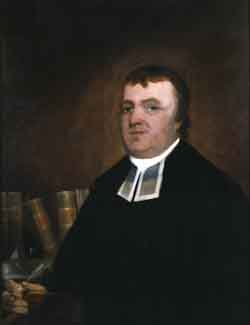
Getting back to the question of who told the Boston Patriots about the British army march to Concord, the first historian to gather evidence on that question was the Rev. Jeremy Belknap (1744–1798, shown here), founder of the Massachusetts Historical Society.

Indeed, Belknap recorded information so early that it might not even qualify as historical.

In the fall of 1775 Belknap visited the Continental Army camps around Boston, checking on the New Hampshire troops and observing the siege. He kept a diary during that trip, published by the M.H.S. in 1860.

A few days after returning to his town of Dover, New Hampshire, Belknap added this entry dated 25 October to his travel diary:
Mr. Waters informed me, that the design of the regular troops, when they marched out of Boston the night of April 18, was discovered to Dr. [Joseph] Warren by a person kept in pay for that purpose. That they had a design upon the stores at Concord the week before, and dressed victuals for their men; but, by the dressing an extraordinary quantity in the barracks, the design was discovered. They then marched out only as far as Watertown, as they had frequently done before in the day-time, for an airing, and returned before night.

But, on the night of April 18, they took every imaginable precaution to prevent a discovery. Their meat was dressed on board a transport-ship in the harbor. Their men were not apprised of the design, till, just as it was time to march, they were waked up by the sergeants putting their hands on them, and whispering gently to them; and were even conducted by a back-way out of the barracks, without the knowledge of their comrades, and without the observation of the sentries.

They walked through the street with the utmost silence. It being about ten o’clock, no sound was heard but of their feet; a dog, happening to bark, was instantly killed with a bayonet. They proceeded to the beach under the new powder-house,—the most unfrequented part of the town; and there embarked on board the boats, which had their oars muffled to prevent a noise, and landed on Phips’s Farm, where they were met by the infamous Capt. Beeman, and conducted to Concord.

Notwithstanding all this secrecy, the following circumstances contributed to their discovery. Numbers of people were jealous, and kept a vigilant eye upon them. It was observed, that, two days before, general orders were given out that the light infantry and grenadiers should be excused from duty. The boats were observed to be launched from the transports. In the afternoon of April 18, an uncommon number of officers were seen walking up and down the Long Wharf; and a party of nine rode out of town with their blue surtouts, and passed through Cambridge just before night, riding very slowly; and, being followed by a person who suspected some bad design, they damned him, and told him not to keep so near them. Late in the evening, a light-infantry man was seen in a retail shop with his accoutrements on.

These circumstances being communicated to Dr. Warren, he applied to the person who had been retained, and got intelligence of their whole design; which was to seize [Samuel] Adams and [John] Hancock, who were at Lexington, and burn the stores at Concord. Two expresses were immediately despatched thither, who passed by the guards on the Neck just before a sergeant arrived with orders to stop passengers. Another messenger went over Charlestown Ferry; so that the alarm was given several hours before the troops arrived at Lexington.
Historians have treated this source with skepticism. In fact, despite Belknap’s record being available in a leading historical journal since before the Civil War, almost no book has discussed the “person kept in pay” by Dr. Warren and his colleagues.

There seem to be two problems with that part of the story. First, I can’t help but suspect that American authors felt an ideological aversion to the idea of the Patriots bribing an informant. It was much more reassuring to stress the unity and perspicacity of Bostonians watching the soldiers prepare. And imagining Thomas Gage betrayed by his wife, or Margaret Gage torn by conflicting allegiances to husband and country of birth, is more dramatic.

That distaste opened the door to being skeptical about this account on grounds of provenance. How would this otherwise unidentified “Mr. Waters” in Dover, New Hampshire, have any reliable information on Dr. Warren’s secret source down in Boston? Was this statement anything more than well-traveled camp gossip festooned with unconfirmable claims?

David Hackett Fischer used Belknap’s statement in Paul Revere’s Ride, but only partially. He accepted that Dr. Warren “applied to” his best-placed source late on 18 April after hearing from other sources and before sending out William Dawes and Paul Revere, the “Two expresses.” But Fischer set aside the detail about “a person kept in pay” and instead focused on the possibility that that source was Margaret Gage.

In a 2014 article, Derek W. Beck, author of Igniting the American Revolution, discussed this source and concluded, “Mr. Waters’s statement sounds like an American concoction.” Unsupported by other evidence and judged against more reliable sources, Beck decided, this story reflected Waters’s wish to look like he had inside info and Belknap’s wish to believe him. 

To make this account into useful evidence, we need to answer questions like: Who was Belknap’s acquaintance, the mysterious “Mr. Waters”? Did this person really have connections in Boston’s Patriot leadership? Can any specific, non-public details of this account be confirmed by other sources? And does answering those questions lead us any closer to identifying the “person who had been retained”?

Answering those questions might require spending years studying small details of Revolutionary New England, looking at a plethora of sources both print and digital, and being crazy enough to think they matter.

TOMORROW: You rang?

Sunday, February 06, 2022

Spreading the Story of Benjamin Lay

Benjamin Lay (1682-1759) was one of the most unusual people in Britain’s early eighteenth-century American colonies.

Lay was only a little over four feet tall and hunchbacked, though fit enough to work as a sailor. He became a vegetarian and lived in caves. He owned hundreds of books, and he published scores of pamphlets, mostly jeremiads about social ills.

Born into an English Quaker family, Lay first encountered slavery on a large scale on Barbados. After that, he became a vocal abolitionist. At the time, the Society of Friends hadn’t yet adopted that position, much less Lay’s unwillingness to compromise on or shut up about it. 

After moving to Pennsylvania in 1731, Lay joined the Abington Friends Meeting, but that didn’t last. In 1737 he had Benjamin Franklin print his pamphlet All Slave Keepers That Keep the Innocent in Bondage, Apostates. As the modern meeting says on its website:
Benjamin Lay was written out of membership at Abington Monthly Meeting on the thirtieth day, eleventh month, 1737 (which by the Quaker calendar, while the Julian calendar was in use, would have been January 30, 1738), because his zealous actions were considered disruptive.

It is now known that at least two of the Friends who led the discernment about writing Benjamin Lay out of membership in the Society of Friends were slave-owners and were likely targeted by Benjamin Lay’s anti-slavery activism. Benjamin Lay was disowned decades before Quakers were disowned for being slave-owners.
Abolitionists such as Dr. Benjamin Rush, Roberts Vaux, and Lydia Maria Child wrote biographies of Lay in the early 1800s. Many featured portraits ultimately derived from a painting, shown above, that Deborah Franklin commissioned from William Williams (1727-1791) as a gift for her husband. But when slavery was no longer a burning political issue, Benjamin Lay became obscure again.

During the Bicentennial, that portrait was spotted at an auction and recognized. It was restored for the National Portrait Gallery. Nonetheless, Lay remained a footnote, occasionally profiled in an article or short entry in a larger book.

In 2010 Alexander Lagos, Joseph Lagos, and Steve Walker made Benjamin Lay a character in their two-volume Sons of Liberty graphic novel, a superhero story set in pre-Revolutionary Pennsylvania. Frankly, I didn’t think it was a good comic, but an uncompromising abolitionist dwarf mentor fit right into the genre.

Seven years later, Marcus Rediker published the first modern scholarly biography of the man, The Fearless Benjamin Lay: The Quaker Dwarf Who Became the First Revolutionary Abolitionist. He spoke at the Abington Friends Meeting, part of an effort coordinated with the organization to repudiate the disowning of 1737 and honor Lay for his egalitarianism. The meeting’s website details the results.

Rediker has now collaborated with David Lester and Paul Buhle to produce a graphic biography, Prophet Against Slavery, ensuring the memory of Benjamin Lay will continue to spread.

Saturday, February 05, 2022

Public Occurrences, Both Foreign and Domestic

Last month on H-Net, Tristan Stubbs reviewed D. H. Robinson’s The Idea of Europe and the Origins of the American Revolution, published in 2020 by Oxford University Press.

Stubbs wrote:
…this highly impressive work offers a genuinely new paradigm through which to view the years leading up to 1776. Americans made the fateful decision to secede not for the economic reasons offered over a century ago by Charles Beard and the Progressive historians; they were not the “radicals” drawn by Gordon S. Wood; and their motivations cannot be ascribed solely to civic republican ideals of virtue and liberty favored by the “canonical intellectual histories” of Bernard Bailyn and J. G. A. Pocock.

Instead, Americans had seen themselves for a long time before the Declaration of Independence as intimately connected to European geopolitics, took a deep interest in the balance of power across the ocean, and were disappointed by the metropolitan Tory government’s failure to shoulder its responsibilities in defending continental liberties against the overweening power of France and Spain. . . .

it spends an impressive amount of time on the effect on metropolitan and colonial opinions of Sweden’s 1772 reversal to absolutism and of the British government’s failure to support the Republic of Corsica against what colonists viewed as French attempts to impose Catholic “universal monarchy” not only on that Mediterranean island but throughout the French sphere of influence—including in America.
This hypothesis truly does seem like a “new paradigm,” in that I hadn’t considered inadequate protection from Catholic empires to be a major concern for the Americans resisting Crown measures from 1765 to 1775.

There would be at least a great irony if colonists adopted independence due to fear of France and Spain given how the young U.S. of A. soon allied with France and Spain. And then felt threatened by Spain/Napoleonic France as well as Britain on its new borders without the protection of a large empire.

To be sure, the Revolution in New England was fueled by suspicion of popery and ended with national freedom of religion, and the war in large slaveholding states was fueled by fear of slave uprisings and ended with slavery coming to an end in other parts of the country. So a paradoxical outcome doesn’t negate a possible cause of the conflict.

But the idea that colonial American discourse about European geopolitics strongly influenced resistance to Parliament’s new taxes and royal officials seems very tenuous. Ebenezer Mackintosh named a son after Corsican independence leader Pasquale Paoli and Loyalists claimed that William Molineux wanted “Paoli” as a nickname himself, but I really don’t see the farmers of Hampshire County shutting down their courthouse because they felt the London government hadn’t supported Paoli’s Corsican cause enough six years before. (Indeed, it was well known the British Crown granted Paoli a pension, supporting him as an asset against France.)

Today we Americans live in a much more democratic society, meaning more people are involved in political decisions. We’re privy to more news from around the world. Our economy is more globalized, as are our military forces. By all measures we should be more concerned with international relations than eighteenth-century farmers. And yet foreign policy is rarely a big factor in our politics, so was it a factor in theirs?

Robinson’s argument appears to rest on what he calls “the discursive evidence,” the same body of evidence that he says should also rule out historical hypotheses about the Revolution based on “relations between classes and genders...racism and material cultures.”

As Stubbs writes, “the discourse under investigation here was led primarily by white, male, anglophone professionals.” And in this case “professionals” appears to mean the sliver of educated, usually wealthy white men who wrote essays for the newspapers.

I have no doubt those essays used contemporary Sweden as an example of the danger of autocracy, the same way they used the Stuart monarchs and the Roman emperors. But I doubt those writings from such a narrow, well, class really got at all the forces driving political change at the time. And I’m skeptical that developments well outside the British Empire motivated colonial Americans to rebel as much as “pocketbook issues.” 

Friday, February 04, 2022

Digitizing Dr. Johnson

For a long time I’ve been fond of the online version of Samuel Johnson’s Dictionary. I even recommended it in a Journal of the American Revolution roundup.

And then the original site, which offered page images and highlights, turned into a completely searchable database. Even better! (Though I do miss the page images.)

Public Books has just published an essay by Carmen Faye Mathes, who was a “Co-Principal Investigator” in the total digitization effort, about the peculiar challenges of that work.
How you go about bringing a historical dictionary online is that, first, you stop really reading the entries. You have other work to do, like adding XML tags; comparing modern transcriptions against page images of Johnson’s original; and digitally cropping each entry so as to include an original image next to each transcribed entry—before concluding that, with at least 41,684 unique words, there must be a way to automate this.

The result is that even when I would exclaim over a new-to-me word (“Did you know that ‘pulverulence’ means an ‘abundance of dust’?”), it was never in the context of actually using the word—only proofing it, rendering it, clipping it, highlighting it, making it findable. Johnson defines lexicographer—a writer of dictionaries—as “a harmless drudge.” But I have come to relate to Johnson as more of a long-distance runner: an athlete whose particular facility lies in the way he marathons forth even as it pains him.
And then there’s the question of Johnson’s prodigious memory—how fallible was it?
When it comes to tracing the provenance of Johnson’s literary quotations—there are approximately 115,000 of them—the thing that felt most like a discovery was catching the lexicographer in a mistake. We wanted our online dictionary to make it possible to search for all the times Johnson cites particular authors or sources. So, we needed to ask, when Johnson says these lines belong to Shakespeare, do they?

Sometimes quotations would be followed by the title of the play, including act and scene, and sometimes merely by “Sh.” Johnson likes to condense longer quotations to save space. How close is his adumbrated version to the original? These and other, similar questions motivated our investigations. We needed to make the quotations discoverable by first discovering them ourselves.

Why don’t you start checking the accuracy of all the times Johnson quotes John Milton? seemed like as good a place as any to begin. When a spreadsheet with 12,000 supposed Milton quotations arrived in my inbox, my heart sank, but my ego accepted the challenge. I hit the jackpot almost immediately. In the entry for Autumnal, Johnson quotes Milton: “Thou shalt not long / Rule in the clouds; like an autumnal star, / Or light’ning, thou shalt fall.” He gives the source: “Milt. Par. Lost, b. iv. l. 620.” A few seconds later, the internet revealed the error: this is a quotation from Paradise Regained (1671), not the more famous Paradise Lost (1667).
And finally there’s that citation of Pamela that’s still floating out there, untethered to a text.

Thursday, February 03, 2022

Hagist on “British Soldiers in Concord,” 6 Feb.

On Saturday, 6 February, the Friends of Minute Man Park will host the group’s annual winter lecture online, featuring Don N. Hagist speaking on “The British Soldiers who Came to Concord.”

The event description says:
Some 700 red-coated soldiers marched from Boston to Concord on April 19, 1775. Who were the men in those uniforms? This talk will describe the ages, places of birth, background, and eventual fate of the British sergeants, corporals, drummers, fifers, and private soldiers who fought in the opening conflict of the Revolutionary War. Meet some of the individuals who enlisted in the British army and came to America to insure peace, only to find themselves thrust into war.
Don Hagist will no doubt be sharing the research from his latest book, These Distinguished Corps: British Grenadier and Light Infantry Battalions in the American Revolution. (Follow that link to order an autographed copy from Books on the Square in Providence.) All the soldiers who reached Concord were from those elite “flank companies.”

Don is the editor of the Journal of the American Revolution and author of several previous books on the British army during the Revolutionary War, including Noble Volunteers: The British Soldiers who Fought the American Revolution (2020), British Soldiers, American War: Voices of the American Revolution (2012), and A British Soldier’s Story: Roger Lamb’s Narrative of the American Revolution (2004). He’s also written about the Continental side, as in The Revolution’s Last Men: The Soldiers Behind the Photographs (2015).

This program is free for anyone who registers in advance. It will start at 2:00 P.M. on Saturday.

Wednesday, February 02, 2022

Why Must Margaret Gage Be the “One Person Only”?

As I wrote a couple of days back, since 1881 authors have discussed whether Margaret Gage might have divulged her husband’s plan for the April 1775 march to Concord to the Patriots, allowing them to send alerts into the countryside.

And the strongest piece of evidence for that hypothesis has remained an anecdote published in 1794, about Gen. Thomas Gage saying he’d revealed his plan to “one person only” before Col. Percy.

Why did it take a century for authors to interpret that story as pointing to Mrs. Gage? Why did it take another century before a major author argued that the story was more than jealous army officers sniping unfairly at the general’s wife?

One factor in the rise of this hypothesis might be Henry W. Longfellow’s publication of “Paul Revere’s Ride” in 1860. That poem was an enormous success, turning Paul Revere into a household name and making a fictionalized version of his activity on 18-19 Apr 1775 into a national myth. Details of that ride, including who alerted the Patriots to Gage’s plan, came to appear more significant.

Another factor was a shift from celebrating collective action to spotlighting individuals. Earlier histories of the Revolution took groups as their heroes: the Tea Party (at first a set of men, not an event), the Minutemen on Lexington common and at the North Bridge, and so on. Thinking of dozens of anonymous Bostonians observing clues about the British troops and combining that information fit the picture of collective action. But when our stories focus on crucial individuals, people want to know the identity of those individuals.

Most important, I now think, was the effect of feminism. The model of the companionate marriage promoted the assumption that a husband and wife would discuss important matters, even if those fell within the traditional male or female sphere of action. As the push for women’s rights and suffrage gained steam over the 1800s, it became clear that women were interested in politics. Even people who opposed granting women the vote described them as able to express themselves through discussion with their husbands, whose vote represented the whole family.

That environment meant there seemed to be a clear answer to the question of who the “one person only” Gen. Gage had discussed his secret plan with. Who else would that be but his wife Margaret? Who else could Percy and Charles Stedman, the former army officer who recorded that story, have been implying it was? The general’s closest confidante in all things, even military and political, must have been Margaret Gage.

In fact, we know people can have close, loving marriages and yet avoid sharing professional secrets. Today hundreds of thousands of people are preserving the confidentiality of their clients and patients when they tell their spouses about their workday. Lots of people toil deep in national security and other sensitive fields and don’t discuss details of their work at home, their loved ones understanding that that’s part of the job. Why must the Gages have been different?

Indeed, given what we know about expectations of male and female roles in the eighteenth-century British society, it was probably quicker for Thomas Gage to assume he wouldn’t discuss military strategy with his wife, and easier for Margaret Gage to accept that, than it was for authors of the late nineteenth century and later to picture such a relationship.

Furthermore, assuming that Margaret Gage was the only person Thomas discussed his expedition with requires believing he developed that plan and made all the arrangements for it without any staff help. The march to Concord involved 800 soldiers from eleven different regiments, supplemented by over a dozen scouts on horseback, equipped and supplied for a full day’s march, moved out of Boston in coordination with the navy. Did Gen. Gage write all those orders by himself?

We know that Gage didn’t tell his second-in-command, Gen. Frederick Haldimand, about the upcoming march; Haldimand learned about it the next day while being shaved. We know Gage didn’t tell his third-in-command, Col. Percy, until the evening of 18 April. But what about his adjutant, or chief administrative officer, Maj. Stephen Kemble (shown above)? That man’s job was to help the general carry out his military plans. What about Gage’s personal secretary, Samuel Kemble?

If that surname looks familiar, that’s because the Kembles were Margaret Gage’s brothers. The fact that the general gave his brothers-in-law high positions was one thing junior army officers complained about. But for Gen. Gage, keeping those arrangements within the family probably felt more secure. Stephen Kemble had worked closely with Gage since 1772, even traveling with him to Britain the following year. It looks like Samuel Kemble was a more recent addition to the staff, having been a merchant in New York.

In Spies, Patriots, and Traitors, Kenneth Daigler argues that the Kemble brothers’ positions actually support the idea that Margaret Gage was the most likely leaker. Even if the general’s “one person only” was one of those aides, Daigler writes, that Kemble could have told his sister, who could have told the Patriots. I think that skips over the more obvious suspects.

Let’s line up the usual points that people use to accuse Margaret Gage and consider all the Kemble siblings in Boston at the time.
  • Born and raised in America—Margaret, Stephen, Samuel
  • Expressed regret at the strife in North America—Margaret
  • Said to exercise too much influence over Gen. Gage—Margaret, Stephen, Samuel
  • Involved in making military plans—Stephen, maybe Samuel
  • Estranged from Gage after the war began—no one (Margaret had two children and a long married life with the retired general; Stephen remained on duty in America but maintained a very friendly correspondence with his former boss)
  • Settled in the U.S. of A. after the war—Stephen
That’s four items pointing to Stephen versus three to Margaret.

To be clear, I think it’s likely that Gen. Gage worked with Lt. Col. Stephen Kemble to prepare the march to Concord, but I don’t think Kemble informed the Patriots about that planning. I doubt the Boston Patriots needed a high-level source in the general’s household. They had been on edge about army raids for weapons since September 1774, and that April they were also already worried about arrests. It was impossible for the army to hide all its preparations for an expedition inside the crowded town. And out in the countryside Gage’s advance scouts, army officers dispatched to prevent alarm riders from getting through, ended up actually alerting locals along the march route that something was up.

Nonetheless, I am going to identify someone described as a crucial intelligence source in 1775.

COMING UP: The earliest source.

Tuesday, February 01, 2022

“Betrayed on this occasion and upon many other later ones”

So far as I can tell, no new evidence about Margaret Gage and her husband Gen. Thomas Gage’s secret plans came to light in the twentieth century, from either British or American sources.

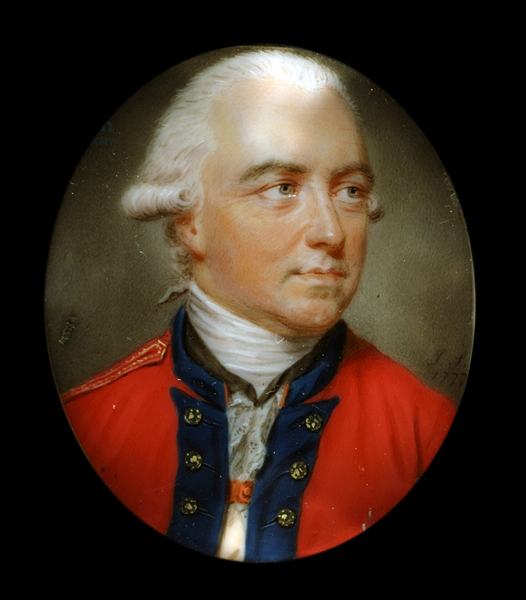
In the 1940s John R. Alden examined the papers of Gen. Henry Clinton (shown here) for General Gage in America. Though he concluded that the theory of Margaret Gage’s betrayal was dead wrong, Alden acknowledged, “Henry Clinton positively asserts that Gage was betrayed on this occasion and upon many other later ones.”

Had Clinton named his commander’s wife or offered specific details about this first betrayer, Alden would surely have included that fact. But a broad complaint of betrayal is a far cry from evidence against any specific person.

In Paul Revere’s Ride, David Hackett Fischer listed Clinton among witnesses in favor of Margaret Gage being a crucial leaker. Fischer wrote:
Many British officers, including Lord Percy and General Henry Clinton, believed that General Gage was “betrayed on this occasion” by someone very dear to him. Some strongly suspected his wife.
The citation for those sentences is “Henry Clinton, note, n.d., Clinton Papers, WCL [Clements Library]; quoted in Alden, Gage, 244.”

That suggests the phase “betrayed on this occasion” came directly from an undated note in Clinton’s papers. In fact, despite the phrase “quoted in Alden,” those were actually Alden’s own words. Neither Percy, nor Clinton, nor any other army officer is on record as voicing suspicion that Margaret Gage or “someone very dear” to the commander leaked his plans.

There have been a couple of books about Clinton since Alden wrote, and the Clements Library is digitizing his papers. So it’s possible someone has found or will find more definite evidence in that source. Since Clinton didn’t arrive in Boston until May 1775, however, it wouldn’t be first-hand information.

Other material could come to light, of course. But for now, the strongest evidence pointing to Margaret Gage as the Patriots’ source is still that anecdote published by Charles Stedman back in 1794, Gen. Gage telling Percy he’d discussed the Concord expedition with “one person only.”

But why would that person be Margaret Gage?

TOMORROW: How assumptions changed.

Monday, January 31, 2022

“One of the flings of the time upon Mrs. Gage”

I went looking for the first author to argue that Margaret Gage betrayed her husband, Gen. Thomas Gage, by revealing his plan for the march to Concord in April 1775.

Instead, I found a series of authors, mostly American, denying the likelihood of that event and blaming the very idea on carping British army officers.

The earliest example I’ve seen so far is the Rev. Edward Everett Hale in The Memorial History of Boston (1881):

The General said that his confidence had been betrayed, for that he had communicated his design to only one person beside Lord Percy. This is one of the flings of the time upon Mrs. Gage, who was American born. The English officers who disliked Gage were fond of saying that she betrayed his secrets. But in this case, after eight hundred men were embarked for Cambridge, ten Boston men on the Common might well have known it; and the cannon at Concord were a very natural aim.
The Rev. Henry Belcher came closest to accepting the idea in The First American Civil War (1911):
Entertainments at Province House, where Madam Gage presided with the social adroitness and tact of a lady of high New Jersey family, were crowded with uniformed men from both fleet and camp. Yet suspicion attended this lady as being not too loyal to her husband’s party and to the King. It was hinted that the Governor was uxorious, and had no secrets from his wife, who passed word to the spies swarming outside.
After quoting local merchant John Andrews on officers complaining Gage was “partial to the inhabitants,” Belcher wrote, “The Governor’s partiality is alleged to have been largely due to his wife.” Belcher didn’t make any effort to refute those allegations, but he didn’t explicitly adopt them, either.

In the same year, Allen French’s The Siege of Boston echoed Hale while adding another motive for the officers to spread the rumor—to deny “Yankee shrewdness”:
The student of the time sees in this story a side-thrust at Mrs. Gage, on whom, as an American, the officers were ready to blame the knowledge of secrets which were gained by Yankee shrewdness alone. In this case we have seen that it was Gage that betrayed himself to the eyes of [Paul] Revere’s volunteer watch.
Fourteen years later, French wrote in his sesquicentennial The Day of Lexington and Concord:
It has been frequently said that the “one person only” was the general’s wife who told his plans to the Americans. A basis for this conjecture has been seen in the statement in Reverend William Gordon’s “History”, that “a daughter of liberty, unequally yoked in point of politics”, had previously sent warning to Adams in Lexington. But this was not necessarily Mrs. Gage, nor was Stedman’s “one person only” necessarily a woman. No other hint has come down that Mrs. Gage was untrue to her husband’s fortunes. It is wiser to leave such a speculation to those who like romance, and find the true explanation of the discovery of Gage’s plans in more natural causes.
Nonetheless, when Esther Forbes wrote Paul Revere and the World He Lived In in 1942, she uncritically repeated a basic premise of the theory, that Thomas Gage had shared his top-secret military plan with Margaret: “Only two people were told the destination of the regulars—Lord Percy and Gage’s own wife.”

In a note, Forbes explained: “The story is that Gage believed it was his American wife who had betrayed him, she being, as an early historian has it, ‘unequally yoked in point of politics’ to her famous husband. This version seems to be gossip started by Gage’s own officers, who did not like him and wanted to throw suspicion upon him and his wife.” She did not, however, cite specific examples.

The story was thus still in the air in 1948 when John R. Alden published General Gage in America. He wrote:
One question which has been posed again and again and which some writers have attempted to answer must be treated here, for it involves the loyalty of Margaret Gage to Britain and to her own husband. It has often been stated that Margaret Gage may have furnished information of the general’s plans for April 19 to the American leaders.
Alden provided the strongest counterargument yet, while also acknowledging that Gen. Henry Clinton, whose papers were yet unpublished, had written that Gage was betrayed in some way.

Unless another argument comes to light, the first historian to really point the finger at Mrs. Gage, not just to say that British army officers did so, was David H. Fischer in Paul Revere‘s Ride (1994). Even before that book, however, the idea of Margaret Gage as the Patriots’ source had endured for decades despite no one prominently speaking up for it.

TOMORROW: The curious appeal of a spurious idea.

Sunday, January 30, 2022

Considering the Quaker Way of Business

Earlier this month Robynne Rogers Healey’s review of Esther Sahle’s Quakers in the British Atlantic World, c. 1660-1800 appeared on H-Net.

Nineteenth-century American culture viewed Quaker merchants as unusually successful and moral. Sahle’s book, Healey writes, “challenges the narrative of Quaker exceptionalism—the idea that Quakers’ success in business was a result of unique Quaker structures and business practices, or ‘because, so the story goes, they were Quakers.’”

In fact, the formal ethos of Quaker business networks wasn’t unusual. “Placing Quaker and non-Quaker prescriptive business literature side by side, Sahle reveals their similarity if not their sameness: both shared concerns about debts, taxes, and fraud, all of which were believed to be born out of covetousness; both called upon identical verses of scripture to support their admonitions; and both employed the same metaphors to communicate their message.”

But perhaps Quakers enforced those rules more strictly than other merchants? In the latter half of the period Sahle studied, the Society of Friends underwent a number of significant changes that historians have dubbed the “Quaker Reformation.” Among those changes was a “dramatic increase in disownments after 1750” in both London and Philadelphia.

But I have trouble sorting out the chronology of cause and effect as described in the review:
While Sahle accepts that the transformation of eighteenth-century Quakerism began as a religious reformation in the 1740s, she asserts that dramatic change accelerated in mid-century in response to a series of political conflicts in Pennsylvania that harmed the Society’s public reputation. Disputes between Thomas Penn, the proprietor, and the Quaker-led Assembly during the Seven Years’ War resulted in Quakers becoming the scapegoat for General [Edward] Braddock’s defeat at Fort Duquesne in 1755. Public faith in Quakers deteriorated over the course of the war and during Pontiac’s War that immediately followed [1763–1766], especially after Quakers joined the militia mustered to protect Philadelphia from the Paxton Boys [early 1764].

The Paxton pamphlet war dealt a decisive blow to the Society of Friends’ reputation. The pamphlets crafted an image of Quakers as self-interested, duplicitous pacifists motivated solely by money and power; they refused defense funding for their non-Quaker fellow colonists but resorted to violence if they themselves were threatened. This was not the Friends’ first pamphlet war, but it was one they did not win.
With Quakers threatened by accusations of dishonesty and avarice, Sahle argues, leaders tightened their internal discipline, “especially against infractions that brought dishonor on the Society—financial dishonesty, fighting, and slaveholding.”

I’m unconvinced that events of the 1760s brought about a change that scholars trace to 1750 or earlier. Furthermore, the review notes that most disownments weren’t prompted by violations of business ethics, such as defaulting on debt. Instead, “Violations of the marriage discipline accounted for almost half of the disownments between 1750 and 1800.” Disowning people for marrying outside the sect (as happened with, for example, Betsy Ross) would certainly promote more coherent unity among those left. But it doesn’t seem like it would solve a local public-relations problem.

Saturday, January 29, 2022

“The Poor, frozen in their Houses”

Like every American, I grew up hearing stories about the Continental Army’s hard winter at Valley Forge.

In fact, my most viral tweet was a snarky comment on Valley Forge National Historical Park having to close for winter weather. More than 2,000 “likes” showed how many people got that little joke.

However, Revolutionary War history buffs know that the winter of 1779-1780, when the Continentals camped in Morristown, was much harsher. Colder temperatures, more snow. But fewer deaths in camp because the army had learned more about building warm cabins and preserving public health.

Not until I read this essay by Blake McGready from the Gotham Center for New York City History did I think about how people experienced that same harsh weather inside British-held New York. Already reliant on ships to bring in food and firewood, how did the Crown authorities manage when the harbor was blocked up with ice?

Here’s a bitter taste of McGready’s article:
The winter’s fuel shortage, in particular, underscored the city’s geographic isolation, shaped British military and political strategy, and caused environmental transformations. In order to provide New Yorkers sufficient fuel, the British relied on their military outposts at Staten Island and Paulus Hook. But the unprecedented ice blocked the city’s access to timberlands beyond Manhattan.

New York required six hundred cords to warm the city a week, and at times, the British only counted seventy in their reserves. “We often hear of the Deaths of the Poor, frozen in their Houses,” [William] Smith reported. A rebel newspaper claimed that New Yorkers “are so necessitated for fuel, that near 100 of them have perished during this inclement season for want thereof.”

In order to sustain the meager supply, soldiers saw their fuel rations reduced multiple times. The commandant restricted the operations of distilleries for lack of wood. Military officials purchased old ships and hulks to distribute the wood to soldiers and the poor. Profiteering abounded in timber-rich areas. Staten Islanders reportedly hoarded fuel in order to raise the price, a practice that ended when authorities seized roughly 1000 cords.
An environmental historian, McGready also explores how the weather affected food supplies, sanitation, and even animal hunting grounds. 

Somehow a detailed article about dealing with rough winter weather seemed appropriate today.

(Wilson Freeman captured the photograph above during a reenactment at Princeton a few years back and shared it on his Daily Reenactor page. Also well worth a look.)

Friday, January 28, 2022

Black New Englanders Rescued from Out-of-State Enslavement

The natural-rights argument of the Revolutionary War inspired the New England states to end slavery or at least start phasing it out.

However, with most of the U.S. of A. and all of the territories around the Caribbean still gobbling up enslaved labor, there was a terrible ongoing market for people of African heritage who couldn’t prove they were free.

This month brought two online articles about black New Englanders being dragged away from their homes in the first years after independence, and how the new state governments responded.

At Small State, Big History, Christian McBurney discusses a dispute that began in early 1779 when John Rice came from North Carolina to Rhode Island and bought an enslaved woman named Abigail and three of her children. Rice then hired local farmer Lodowick Stanton to drive his new human property in a wagon to Connecticut. Apparently Abigail communicated her fears to Stanton before the caravan stopped at his house. McBurney writes:
The next morning Rice awoke and was informed that Abigail and her daughters were nowhere to be found. Stanton was not a good liar. At first he said that they had all gone to Block Island. Then he blamed [neighbor] John Cross for their disappearance.

In a petition Rice later submitted to the General Assembly, he stated: “In making enquiry for his Negroes, [he] has great reasons to believe that a number of people had combined against him to deprive him of his property.” In addition, Rice wrote that he “was informed his person was in danger if he . . . pursued after” Abigail and her children. Stanton and likely John Cross, among others, kept Abigail and her children hidden at their own expense for several weeks.
The Rhode Island legislature ultimately sided with Abigail. It passed a law that took no property from Rhode Island slaveholders but barred the sale of people out of state without their consent (unless a court held the enslaved person had “become notoriously unfaithful and villainous”). That slavery-limiting law has received little attention, overshadowed by the gradual emancipation law that Rhode Island enacted five years later. As for Abigail and her children, they evidently remained in the state, but their individual fates can’t be tracked.

McBurney’s next book is Dark Voyage: An American Privateer’s War on Britain’s African Slave Trade, about the wartime cruise of the Marlborough to attack British shipping along the African coast.

At the Massachusetts Historical Society’s Beehive blog, Benjamin D. Remillard shared “What then are our Lives and Lebeties worth”: The 18th Century Kidnapping Case that Shook Boston”:
Cato Newell…was a twenty-three-year-old baker from Charlestown, MA, when he enlisted alongside the rebels after the violence at Lexington and Concord. Boston’s Wenham Carey was a bit older by comparison, enlisting multiple times for short periods when he was already in his thirties. Luke (or Luck) Russell, meanwhile, while not a veteran, is believed to have been a member of Prince Hall’s growing African Freemason Lodge.

Life after the war, however, did not come without risks. Newell, Carey, and Russell discovered this for themselves when they were hired by a man named Avery to make boat repairs in February 1788. They travelled to Boston Harbor’s Long Island, where their employer directed the trio below deck to begin their work. After locking away his human cargo, the ship’s captain set sail for warmer waters.

It was not long before word of the abduction reached the men’s families. Writing from Charlestown, they decried the capture of those “three unhappy Africans,” and insisted that their loved ones were “justly intitled” to “the protection of the laws and government which they have contributed to support.”
The three men’s families, Hall, local Quakers, and others raised an outcry about this abduction. The Massachusetts establishment, led by Gov. John Hancock, responded with a new law and diplomatic correspondence. The situation was resolved happily by July 1788.

Thursday, January 27, 2022

“The General himself in his wife’s cloaths”

Looking back over the sources about Thomas and Margaret Gage that came to light in the late 1800s, as quoted yesterday, reveals some clear patterns.

Some of Gen. Gage’s junior officers really didn’t like how he handled the crisis in Massachusetts. To be sure, Gage wasn’t the only commander in history to inspire such contempt. And he definitely didn’t manage the crisis successfully.

The letter from Margaret Gage’s friend makes it likely that she did express regret that a bloody civil war was breaking out in North America. Again, she was not unique in dreading that event. Almost everybody said a war would be horrible—with most adding that therefore the other side should back down.

Above all, it’s striking how much ideas of gender played into the criticism of the Gages. John Andrews wrote that army officers called Gen. Gage “an Old Woman” because he was too lenient on the locals. When Margaret Gage arrived in Portsmouth, England, in September 1775, the St. James’s Chronicle newspaper printed this snarky comment:

We are assured that it is not General Gage’s wife who is arrived from Boston, but the General himself in his wife’s cloaths. His wife is left behind, invested with the supreme command, and will prove a much more formidable enemy to the Americans than her husband, who has been beaten twice abroad and every day grows more and more contemptible at home.
I quote that from Herbert Hughes’s Chronicle of Chester (1975).

Some of the Gages’ critics complained that Margaret thrust herself into Thomas’s affairs. “He was governed by his wife,” groused Maj. James Wemyss. She “said she hoped her husband would never be the instrument of sacrificing the lives of her countrymen,” whispered Whitshed Keene. Her brothers and brother-in-law got positions on the general’s staff that could have gone to other officers (including those who passed on complaints about her).

But others criticized Mrs. Gage for showing too much feminine desire—encouraging her friends to organize a ball inside Boston, wearing a daring turquerie-style gown in her painting by Copley, which that anonymous engraver in 1776 appears to have caricatured by portraying her bare-breasted. As a woman, Margaret was vulnerable to criticism from both sides.

Another way gender played a role in this story is that being a woman probably did allow Margaret Gage to express her sadness about the coming conflict, to lament the big loss of life at Bunker Hill and sympathize with the divided loyalties of Janet Montgomery. An eighteenth-century gentleman like Thomas Gage, or like John Adams, was supposed to keep his emotions in check. Mrs. Gage was freer to say she wished her husband didn’t have to kill Americans than he was.

But no critical contemporaries accused Margaret Gage of betraying her husband and the Crown. No one said she befriended Massachusetts Patriots in the one year she lived in the province, much less forged close connections. 

Nonetheless, by the first decades of the twentieth century the idea developed that Margaret Gage had leaked her husband’s plan for the march to Concord to the Patriots. And of course, if she really did that, she would have kept it secret, so there would be very little evidence for us to find.

COMING UP: A treacherous hypothesis. 

Wednesday, January 26, 2022

“What a dreadful apprehension for a wife”

When the eminent historian George Bancroft discussed Thomas Gage’s April 1775 decision-making in 1860, he wrote that the general was just too wishy-washy to carry out his orders from London:
Gage was neither fit to reconcile nor to subdue. By his mild temper and love of society, he gained the good-will of his boon companions, and escaped personal enmities; but in earnest business he inspired neither confidence nor fear. Though his disposition was far from being malignant, he was so poor in spirit and so weak of will, so dull in his perceptions and so unsettled in his opinions, that he was sure to follow the worst advice, and vacillate between smooth words of concession and merciless severity.

He had promised the king that with four regiments he would play the “lion,” and troops beyond his requisition were hourly expected. His instructions enjoined upon him the seizure and condign punishment of Samuel Adams, [John] Hancock, Joseph Warren, and other leading patriots; but he stood in such dread of them that he never so much as attempted their arrest.
Bancroft didn’t suggest that Gen. Gage was lenient because he was influenced by his American wife, Margaret

(My own theory about Gage is that he aimed for the provincial artillery supplies rather than Patriot leaders in order to save himself from embarrassment before his superiors. See The Road to Concord for the full argument.)

In the decades that followed Bancroft’s magisterial history of the U.S. of A., more sources came into print, many of them from Britain. Those cast a different light on Gen. Gage. It turned out contemporary critics in both London and Boston thought he was being lenient. And we got more gossip about Margaret Gage. Here are those passages in order of their appearance in print.

Boston merchant John Andrews, writing a private letter in March 1775, published in 1866:
…it seems the officers and soldiers are a good deal disaffected towards the Governor, thinking, I suppose, that he is partial to the inhabitants, many of the latter have made no scruples to call him an Old Woman.
Capt. John Barker of the 4th Regiment was one of those officers who thought Gage was too accommodating to the locals. In his diary he called the commander “Tommy” a couple of times. Barker’s entry for 12 Jan 1775, as published in the Atlantic Monthly in 1877, was also snarky about the general’s wife:
Yesterday even. was a Ball by subscription; seven of each Corps was the number fix’d, and the Ladies were invited by the managers; this scheme was proposed by Mrs. G—e, and carried into execution by her favorites; by which she enjoyed a dance and an opportunity of seeing her friends at no expense.
Maj. James Wemyss of the British army assessed dozens of commanders in the war (Gage by reputation, not personal experience), and his comments were transcribed by historian Jared Sparks. This paragraph was published by 1879:
Lieut.-General Gage, a commander-in-chief of moderate abilities, but altogether deficient in military knowledge. Timid and undecided on every emergency, he was very unfit to command at a time of resistance and approaching rebellion to the mother country. He was governed by his wife, a handsome American; her brothers and relations held all the staff appointments in the army, and were, with less abilities, as weak characters as himself. To the great joy of the army, he went to England soon after the disastrous attack at Bunker Hill.
That’s the transcription published in a footnote in William Cullen Bryant and Sidney Howard Gay’s A Popular History of the United States in 1879, and two years later in the Proceedings of the American Antiquarian Society. Gene Procknow, author of William Hunter - Finding Free Speech: A British Soldier’s Son Who Became an Early American, has looked at the original document in the Sparks Manuscripts and produced a more accurate transcription here. The basic sentiment remains the same.

The British engineer Capt. John Montresor (shown above) wrote this note during the war, as published by the New-York Historical Society in 1882:
Should the American Colonies (after all) be lost to Great Britain, it may be attributed to a variety of unfortunate circumstances and Blunders, &c., viz. General Gage having all his Cabinet papers, Ministers’ Letters, &c., and his Correspondence all stole out of a large Closet, or Wardrobe, up one pair of Stairs on the Landing at the Government House at Boston…1775.
Gage’s voluminous papers, apparently intact, sailed home with him and are now at the Clements Library in Ann Arbor, Michigan. Montresor’s complaint therefore reflects what he thought of Gage more than the actual whereabouts of the general’s papers.

Former Massachusetts governor Thomas Hutchinson in his diary on 27 July 1775, published 1884:
Mr. Keene called: complains of Gage: says his lady has said she hoped her husband would never be the instrument of sacrificing the lives of her countrymen. I doubted it. He said he did not, but did not chuse to be quoted for it.
Whitshed Keene was a former British army officer, Member of Parliament, and a brother-in-law of Lord Dartmouth, the Secretary of State.

Finally, in 1899 the British government published text from an unsigned letter that someone in Perth Amboy, New Jersey, had sent to Margaret Gage on 1 Nov 1775. That mail had been intercepted by the British government back during the war and stored in the Home Office files. Gage’s friend or relative wrote:
I have heard some good news, which is that [Gen. Richard] Montgomery is with his whole army cut to pieces or taken by Genl. [Guy] Carleton. God grant it be true! and yet I shudder. I recollect with horror the bloody scene at Charlestown. Poor Jennet [Montgomery]! I have been told that she charged Montgomery to avoid, at any rate, being taken prisoner. A cord, I suppose, she apprehended would finish his exploits.

What a dreadful apprehension for a wife; let either side conquer, what heartfelt woe must it occasion! This puts me in mind of a conversation you and I had the day after that dreadful one, when you thought the lines so expressive:
The Sun’s o’ercast with blood; fair day, adieu!
Which is the side that I must go withal?
I am with both; each army hath a hand,
And in their rage,—I having hold of both,—
They whirl asunder, and dismember me.
And again:
Whoever wins, on that side shall I lose
Assured loss, before the match be played.
Those are lines from Shakespeare’s King John, spoken by Lady Blanch as she feels torn between her husband on one side of a war and her family on another.

Richard Montgomery was a retired British army officer who had joined the Continental Army and was leading the attack on Québec. He hadn’t been “cut to pieces” yet, but he would be. Janet Montgomery lived on for decades in New York as the celebrated widow of an American military martyr.

TOMORROW: What do we make of these sources?

Tuesday, January 25, 2022

“The attempt had for several weeks been expected”

In the first half of the nineteenth century, American historians continued to write about the start of the Revolutionary War, of course.

But those authors didn’t dig into the question of whether someone close to Gen. Thomas Gage had leaked his plan for a march to Concord, as hinted by the passage from Charles Stedman’s book that I quoted yesterday.

Around the fiftieth anniversary of the event, there was a back-and-forth between Elias Phinney of Lexington and Ezra Ripley of Concord over where militiamen returned the first significant fire at the redcoats. That dispute produced eyewitness testimony from aged veterans, revealing that both towns were on alert well before the Patriot alarm riders from Boston arrived because of previous reports about British activity and the sight of army officers on horseback.

Likewise, James T. Austin’s Life of Elbridge Gerry (1828) offered evidence that members of the committee of safety were watching for Gage to act. It included documents confirming how the British army officers that Gage sent out to stop alarm riders actually provoked an alarm.

In his History of the Siege of Boston (1849), the Charlestown historian Richard Frothingham published Richard Devens’s description of the committee’s activity and of the lights in Old North Church as seen from the opposite shore. That account lined up well with Revere’s.

Frothingham quoted Stedman’s story but not the detail of Gen. Gage telling only one other person besides Col. Percy about his plan. Instead, he emphasized how Massachusetts Patriots had gathered multiple signs that the army was about to act even as the general considered his planning secret.

As a result, the most authoritative American historian of the time, George Bancroft (shown above), presented events this way in his 1860 History of the United States from the Discovery of the American Continent:
On the afternoon of the day on which the provincial congress of Massachusetts adjourned, Gage took the light infantry and grenadiers off duty, and secretly prepared an expedition to destroy the colony’s stores at Concord. But the attempt had for several weeks been expected; a strict watch had been kept; and signals were concerted to announce the first movement of troops for the country. Samuel Adams and [John] Hancock, who had not yet left Lexington for Philadelphia, received a timely message from [Dr. Joseph] Warren, and in consequence, the committee of safety removed a part of the public stores and secreted the cannon.

On Tuesday the eighteenth, ten or more sergeants in disguise dispersed themselves through Cambridge and further west, to intercept all communication. In the following night, the grenadiers and light infantry, not less than eight hundred in number, the flower of the army at Boston, commanded by the incompetent Lieutenant Colonel [Francis] Smith, crossed in the boats of the transport ships from the foot of the common to East Cambridge. There they received a day’s provisions, and near midnight, after wading through wet marshes, that are now covered by a stately town, they took the road through West Cambridge to Concord.

“They will miss their aim,” said one of a party who observed their departure. “What aim?” asked Lord Percy, who overheard the remark. “Why, the cannon at Concord,” was the answer. Percy hastened to Gage, who instantly directed that no one should be suffered to leave the town. But Warren had already, at ten o’clock, despatched William Dawes through Roxbury to Lexington, and at the same time desired Paul Revere to set off by way of Charlestown.

Revere stopped only to engage a friend to raise the concerted signals, and five minutes before the sentinels received the order to prevent it, two friends rowed him past the Somerset man of war across Charles river. All was still, as suited the hour. The ship was winding with the young flood; the waning moon just peered above a clear horizon; while from a couple of lanterns in the tower of the North Church, the beacon streamed to the neighboring towns, as fast as light could travel.
Quite dramatically rendered, and Bancroft skipped right over the question of whether anyone leaked Gage’s orders.

TOMORROW: New sources and new suspicions.

Monday, January 24, 2022

“The general said that his confidence had been betrayed”

Earlier this month I noted the American Revolution Institute’s article about a likely caricature of Gen. Thomas and Margaret Gage published in London in 1776.

Comments on that post raised the question of when historians started to consider the possibility that Margaret Gage had betrayed her husband by leaking his plans for the 18 Apr 1775 expedition to Concord to the Patriots.

Not that anyone involved in that discussion believed that theory. Rather, we were just wondering when it arose and what evidence, if any, supported it.

By the end of the eighteenth century there were three readily available printed sources speaking to this question. The first was the Rev. William Gordon’s History of the Rise, Progress, and Establishment, of the Independence of the United States of America, published in London in 1788. Gordon knew the Boston Whigs well and was particularly close to Samuel Adams. He wrote of April 1775:
The grenadier and light infantry companies were taken off duty, upon the plea of learning a new exercise, which made the Bostonians jealous that there was some scheme on foot. A daughter of liberty, unequally yoked in point of politics, sent word, by a trusty hand, to Mr. Samuel Adams, residing in company with Mr. [John] Hancock, at Lexington, about thirteen miles from Charlestown, that the troops were coming out in a few days. Upon this their friends at Boston were advised to move out their plate, &c. and the committee of safety voted [18 April], “that all the ammunition be deposited in nine different towns. . .”

Mr. Adams inferred from the number to be employed, that these [military stores] were the objects, and not himself and Mr. Hancock, who might more easily be seized in a private way, by a few armed individuals, than by a large body of troops, that must march for miles together under the eyes of the public. . . .

When the corps was nearly ready to proceed upon the expedition, Dr. [Joseph] Warren, by a mere accident, had notice of it just in time to send messengers over the Neck and across the ferry, on to Lexington, before the orders for preventing every person’s quitting the town were executed.
I quoted from the 1801 edition, which differs a little in punctuation but not wording from the original.

Gordon described two pieces of information reaching two different Patriots. First, Adams outside Boston heard from a sympathetic woman with a Loyalist husband that a march would happen “in a few days.” There’s no clear hint that woman had inside information; instead, Gordon pointed to the orders for the flank companies, which lots of people heard about.

The Patriot leadership had already acted on that advice when Warren “by a mere accident” heard the march was imminent just in time to send messengers—we now know these were William Dawes and Paul Revere—out to Lexington.

From the British side, former officer Charles Stedman’s 1794 History of the Origin, Progress, and Termination of the American War confirmed that Gen. Gage was focused on Concord and tried to keep the mission secret:
In war there is nothing that so much avails as secresy of design and celerity of execution: Nor, on the contrary, so hurtful as unnecessary openness and procrastination. General Gage on the evening of the eighteenth of April told lord Percy, that he intended to send a detachment to seize the stores at Concord, and to give the command to colonel [Francis] Smith, ”who knew that he was to go, but not where.” He meant it to be a secret expedition, and begged of lord Percy to keep it a profound secret.

As this nobleman was passing from the general’s quarters home to his own, perceiving eight or ten men conversing together on the common, he made up to them; when one of the men said—“The British troops have marched, but they will miss their aim.”

“What aim?“ said lord Percy.

“Why,” the man replied, ”the cannon at Concord.”

Lord Percy immediately returned on his steps, and acquainted general Gage, not without marks of surprize and disapprobation, of what he had just heard. The general said that his confidence had been betrayed, for that he had communicated his design to one person only besides his lordship.
I broke Stedman’s single long paragraph into shorter paragraphs for easier reading.

Clearly Col. Percy was Stedman’s source for this story. And clearly Percy believed Gage’s plans had leaked, presumably through that “one person” (or maybe Gage hadn’t been as circumspect as he claimed).

Gage and Percy might not have guessed correctly about a leak. The man speaking on the Common might have been speculating about what the British goal was, based on the number of soldiers who were departing. After all, Adams had reportedly made the same guess.

One more early printed source was Paul Revere’s letter to the Rev. Dr. Jeremy Belknap about the opening of the war, published in the Massachusetts Historical Society’s Collections series in 1798:
The Saturday night preceding the 19th of April, about 12 o’clock at night, the boats belonging to the transports were all launched, and carried under the sterns of the men of war. (They had been previously hauled up and repaired.) We likewise found that the grenadiers and light Infantry were all taken off duty.

From these movements, we expected something serious was to be transacted. On Tuesday evening, the 18th, it was observed, that a number of soldiers were marching towards the bottom of the Common. About 10 o’clock, Dr. Warren sent in great haste for me, and begged that I would imediately set off for Lexington, where Messrs. Hancock and Adams were, and acquaint them of the movement, and that it was thought they were the objects. When I got to Dr. Warren’s house, I found he had sent an express by land to Lexington—a Mr. William Dawes.
Belknap cleaned up some of Revere’s spellings before publishing. See the original here. Revere’s letter was reprinted in the Worcester Magazine and Historical Journal in 1826 and in the New England Magazine in 1832.

Thus, before the turn of the nineteenth century historians had sources close to the action revealing that:
  • The commander and second-in-command of the British troops thought the secret plan for the march had leaked, despite only three people knowing about it.
  • Bostonians had actually been talking about the likely plan for days, based on publicly visible signs; Samuel Adams had deduced the general’s goal; and the committee of safety was acting on that warning.
  • Warren sent Dawes and Revere to Lexington based on the mistaken idea that “the objects” of the march were Adams and Hancock; in other words, whatever last-minute information the doctor received “by a mere accident,” that source did not tell him that Gage was focused on Concord.

TOMORROW: The view from the mid-1800s.

Sunday, January 23, 2022

Two Attacks on George III’s Coach

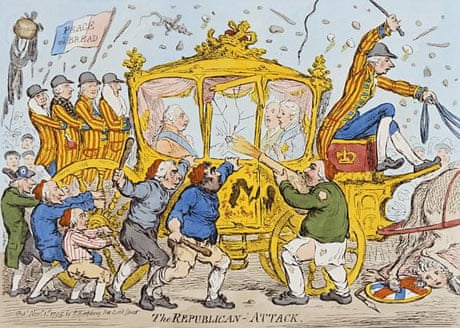
Last week I wrote about George III’s gilded coach, and how some Londoners stoned it in October 1795.

It turns out this wasn’t the first time a crowd had attacked that royal coach. Or was it?

The Georgian Lords Twitter account led me to this passage from the diary of Queen Charlotte on 21 Jan 1794:
To Day the Kg. went to Open the Parliament about 3 a Clock. in going there were two attempts made at throwing a Stone at the Kg. the first broke the Side Glass of the Coach, & the Second was thrown from behind & fell over the Coachmans Head.
You can view the actual diary page here.

On 24 January the Oracle newspaper, also called Bell’s New World, stated:
some daring ruffian threw a stone at his Majesty…which broke the coach window. We have not yet had the pleasure to hear of the villain’s apprehension.
However, the Times of London had reported on 23 January:
Tuesday, as his Majesty was going in state to the House of Peers, one of the halberts of the Yeomen struck against the window of the King’s coach and smashed it. Happily no mischief was occasioned, but the circumstances gave rise to a report of some madman having thrown a stone at the window, which we are happy to contradict.
Was the queen correct in recording an attack on the royal coach? It looks like she wasn’t there, but of course she would have heard from the king. It certainly looks like he was convinced people had attacked him with stones.

And yet a leading establishment newspaper assured the public that the “report” circulating was mistaken, that there was no “madman” or “ruffian” to hunt down—let alone two. Publicizing an assault when there was no way to find the criminal would probably have only made the authorities look ineffectual.

In contrast, the government took quite public action when people threw stones at the king’s coach toward the end of the following year, on 29 Oct 1795. Parliament undertook an immediate investigation. The questioning of witnesses was transcribed and later published. Two men were charged:
  • Edward Collins, “Keeper of an Eating-house,” accused by an eyewitness of throwing a stone at the king, a crime of high treason.
  • Kidd Wake, journeyman printer, heard to shout “No war!” but not seen to throw anything, and thus charged with “a misdemeanor in hissing and hooting the king in a riotous manner.”
The authorities also offered a £1000 reward for information about any other rioters, but it doesn’t look like anyone came forward.

The ministry under William Pitt took advantage of the moment to press two bills, one “for the Safety and Preservation of His Majesty’s Person and Government” and the other “for the More Effectually Preventing Seditious Meetings and Assemblies.” Those laws let the British government crack down on opponents of its war policy.

Kidd Wake went on trial in February 1796, and his fate can be seen in the title of a publication he offered for sixpence in 1801: The Case of Kidd Wake: Being a Narrative of His Sufferings, During Five Years Confinement!!! In Glocester Penitentiary House: for Hooting, Hissing, and Calling Out No War! as His Majesty was Passing in State. Among Wake’s reported sufferings was contracting tapeworms. He died in a wagon accident in 1807.

As for Edward Collins, he was eventually released without trial, but I’ve found no report on that development in the mainstream British news media. It’s tempting to say he had served his purpose for the ministry.

Saturday, January 22, 2022

“Big Chill” Lectures at Historic Deerfield

Historic Deerfield is observing the winter season with a series of online lectures on the theme of “The Big Chill: Early Environmental Histories of Climate Change.” The first takes place tomorrow, followed by one in each of the next two months.

The series description says:
From a centuries-long Little Ice Age to the global aftermath of the largest volcanic eruption in the last 10,000 years, this year’s series is devoted to early environmental histories and their impact on people and places. Join us for three virtual webinars this winter exploring how North American Indigenous communities and European colonizers understood and experienced the plunging temperatures and deep freezes, catastrophic flooding, and severe droughts and famine that became part of cultural memory and identity.
Here are the individual lectures—

Sunday, 23 January, 2:00 P.M.
“The Problem of Climate in Early Colonial History”
Presented by Sam White, Ohio State University

Sunday, 27 February, 2:00 P.M.
“Tambora: The Eruption that Changed the World” [in 1815]
Presented by Gillen D’Arcy Wood, University of Illinois

Sunday, 27 March, 2:00 P.M.
“Snow Cover and Winter Knowledge of the Little Ice Age”
Presented by Thomas M. Wickman, Trinity College, author of Snowshoe Country: An Environmental and Cultural History of Winter in the Early American Northeast

People who register in advance can watch these lecture live via Zoom and/or watch them for two weeks afterwards. These talks are free, but donating to or becoming a member of Historic Deerfield while enjoying these public programs would be a warm gesture.

Friday, January 21, 2022

Two New Artistic Depictions of Revolutionary Stories


Naden Rowe teaches history at an “American” middle school overseas. He occasionally parodies popular songs with new lyrics to explain some part of his lessons.

Last year he reworked “drivers license” by Olivia Rodrigo and Dan Nigro into “Act of Violence,” narrating the Boston Massacre from the perspective of a teen-aged girl in Boston.

Rowe turned to a nearby singer who goes by the name Nyah (here’s her Tiktok feed) to record the new lyrics.

Then a sixth-grader dubbed Yakuza Baby asked to make an animated video for the song, using the Paul Revere engraving combined with new art.

All in all, it’s very impressive. Rowe’s song rightly depicts the first violence of the night on King Street coming from a soldier, analyzes what feelings the propaganda print would produce, and highlights the event’s ambiguities. Nyah’s vocal performance is affecting. And Yakuza Baby’s animation effects are varied and striking.

Another creator who caught my attention this week on Twitter was Sean Dermond, who shared “Mrs. Benedict Arnold,” an online picture book. It provides his take on the story of Peggy Shippen using cutouts within paper dioramas, a technique that reminds me of the 1970s Paddington television series. Handsome draftsmanship and photography under pandemic conditions. Check it out on Dermond’s webpage.

Thursday, January 20, 2022

The Passing of Dr. Jenn Steenshorne

The Selected Papers of John Jay project at Columbia University just published its seventh and final printed volume, covering the years 1799 to 1829.

The project is also converting those volumes into a digital edition. A couple of years ago, the National Archives’ Founders Online website added those documents to its database, which symbolically elevates Jay to the top tier of Founders along with Washington, Franklin, Jefferson, Adams, Hamilton, and Madison.

After all, Jay was a strong voice in the Continental Congress, U.S. minister to Spain, signer of the Treaty of Paris, Confederation secretary of foreign affairs, contributor to the “Federalist” essays, first Chief Justice of the U.S. Supreme Court, negotiator of a crucial and controversial treaty with Great Britain, and governor of New York for six years.

The completion of The Selected Papers of John Jay was tinged with sadness this month as word spread that one long-time editor on the project, Jennifer Steenshorne, had died suddenly of Covid-19. On 28 December she tweeted, “Just took a home Covid test. Positive. I’ve had two shots, so not so bad aside from the exhaustion and cough.” However, the next day she added, “My Covid Cough makes me feel like I have been slammed in the ribs by baseball bats.” Three days later, she died.

Dr. Steenshorne was a warm presence among academic historians on Twitter, so her loss produced a real outpouring of sadness. I never met her, but I liked spotting the avatar of “Dr. JE Steenshorne, Harborer of Cats” (shown above). I knew her comments would be smart and kind. Scrolling back, I saw that my birthday gifts in 2020 included her reply to one of my silly tweets about British clerics’ overblown sleeves (not that she knew it was my birthday).

New York University colleague George Platt wrote:
Besides her many professional accomplishments, Jennifer was a supportive colleague and great friend to many of us, and was always ready with a precisely relevant fact from her encyclopedic knowledge of New York City. Her vast array of interests ranged from fashion and design (having worked for Perry Ellis), to music (having interned with Electra Records), to horse racing, and public health. She brewed stouts and porters. A fan of the Rolling Stones, she worked for jazz legends Max Roach and Dizzy Gillespie. . . . She also published on topics as diverse as cemetery removal in Manhattan, and James Bond films.
In 2018, Steenshorne became director and editor-in-chief of the Washington Papers. Colleagues at the University of Virginia Press lamented:
Beyond conferring about John Jay, George Washington, and the founding generation, we recall lively discussions about such wide-ranging figures as Ann Cary Randolph Morris, George Templeton Strong, and Joseph Urban—wonderful conversations that made evident the breadth of her knowledge and her interests, from the substantive role of women in the early republic to the rigors of the Civil War era to the design of Ziegfeld’s Follies. She will be missed.
Steenshorne’s husband, Brant M. Vogel, was a co-editor at the Jay Papers. He just announced that on Friday, 21 January, from 6:00 to 9:00 P.M. the Jazz Alternatives show on WKCR will play a tribute show to Dr. Jenn Steenshorne. Anyone can tune in at http://wkcr.org.