J. L. BELL is a Massachusetts writer who specializes in (among other things) the start of the American Revolution in and around Boston. He is particularly interested in the experiences of children in 1765-75. He has published scholarly papers and popular articles for both children and adults. He was consultant for an episode of History Detectives, and contributed to a display at Minute Man National Historic Park.

Subscribe thru Follow.it


•••••••••••••••••


Monday, November 21, 2022

“Quite exasperated with your conduct relating to your amour”
As the year 1750 began, it was more than three years since Andrew Pepperrell and Hannah Waldo had become engaged, over a full year since their intentions had been formally announced in Kittery, Maine.

Since their fathers were two of the richest, most prominent men in Massachusetts, their relationship was big news all that time. 

Andrew and Hannah had both turned twenty in 1746, young for marriage. But by 1750 they would both turn twenty-four, they still weren’t married, and the talk became more pointed.

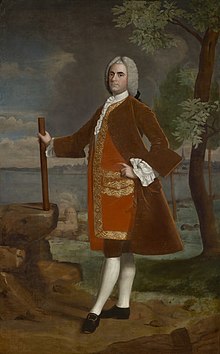
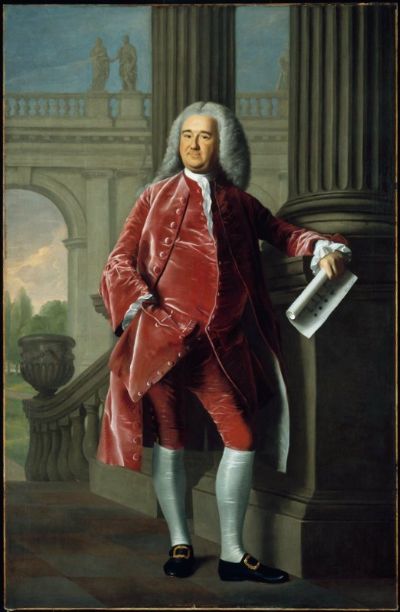
Andrew’s brother-in-law Nathaniel Sparhawk (shown here) wrote to Sir William Pepperrell in London on 8 Mar 1750: “The love affair between Andrew Pepperrell and Miss Waldo, now of four years’ duration, is still pending, much to the annoyance of both families as well as trying to the patience of the young lady.”

Other gentlemen told Pepperrell that he couldn’t keep putting off the wedding. The older merchant Stephen Minot, who was related to the Waldos, wrote to him on 3 June 1750:
I hope, my friend, it will not be long before we have the pleasure of seeing you in town to disappoint the enemies as well as to complete the approaching pleasure which you have in view, in enjoying the society of so charming and desirable a lady as is Miss Hannah. I beg leave only to add, that could you be fully acquainted with the steady and proper behavior in your long absence (amid the ill-natured queries of the world with respect to each of you) it would ever heighten your affections for her, and endear her to you as it has done to me, and all her relations and friends here. I really wish each of you, as I believe you will be, happy, if it shall please God to bring you together in the matrimonial state.
On 14 August, Andrew’s first cousin William Tyler wrote to him about a visit to Boston by another first cousin, Joel Whittemore. “His wig was powdered to the life,” Tyler said, and at the Sunday afternoon church service “he sat and stood looking first this way and then that way to find out Miss Hannah.” (She wasn’t there.) Was that just a silly story, or a nudge that other young men might be interested in her?

Sparhawk visited Andrew Pepperrell in Maine late that summer, and on returning to Boston wrote back on 11 September:
I…have not had time to deliver your letter, or to see your lady. Let me take the liberty to inform you that the country, especially the more worthy and better part of it, are very much alarmed at, and appear quite exasperated with your conduct relating to your amour, and your friends and those that are much attached to your father and family, are greatly concerned about you, being fully of opinion that if the matter drops through and you lie justly under the imputation of it, that your character is irretrievably lost. I am sorry to say so much, but a tender concern for you obliges me.

You can’t imagine how I was attacked in a large company of gentlemen and ladies at Salem, where I was invited to spend the evening on Sunday; and what you may imagine will pass still for a justification of your conduct, that you “intend nothing but honor in the case, and will be along soon” is perfectly ridiculed.

I find you must be published again if you marry in this province, and if you intend ever to marry the lady, my advice to you is, by all means to be republished and to finish the matter at once, unless you can prevail on the lady to meet you at Ipswich, and from there proceed to Hampton [New Hampshire], which is very much questioned, though when I know your intentions it may be attempted, if there is occasion, from your ascertaining the lady’s mind and her friend’s, that you will be quite punctual, and agree to the arrangement in case she is good enough to comply. But I cannot add further than that I feel a real concern for your welfare and the support of your honor.
Massachusetts couples who were eloping from their families, or who needed to marry in a hurry, went over the border to New Hampshire. Of course, that wasn’t the most respectable sort of wedding. But by this time, Sparhawk and the Waldos were ready for anything.

All that pressure forced Andrew Pepperrell to finally make a move. He agreed to a wedding in Boston on a specified date.

TOMORROW: Can this marriage be saved?

Sunday, November 20, 2022

“Your wish that the alliance between our son and your daughter were completed”

As I quoted yesterday, in early 1748 the Maine grandees Sir William Pepperrell and Samuel Waldo exchanged letters reassuring each other that their children wanted to get married.

Andrew Pepperrell’s long delay in setting a date with Hannah Waldo was starting to cause talk in Boston, as Samuel Waldo hinted in a 20 March letter:
I hope all impediments to a consummation will soon end in their mutual happiness, and to the satisfaction of their respective friends, as well as the mortification of those who are foes to every one. . . . though I have no reason to suspect his honor in the pending affair, yet the delay (the consequence of which is not to be foreseen) must be very disagreeable to us. Your own concern for the issue of it will excuse my anxiety for the future welfare as well as present peace and honor of my daughter, toward which it is my duty to contribute my best endeavors.
Hannah’s sister Lucy Waldo had married Isaac Winslow; they and their children appear above in a portrait by Joseph Blackburn now at Boston’s Museum of Fine Arts. Winslow wrote from Boston several times that spring passing on his sister-in-law Hannah’s regards to the man who was supposed to marry her, as on 9 May:
I had the pleasure of drinking your health last evening at my father Waldo’s, about 10 o’clock. It was at that time when your dear Miss Hannah drank the toast, with the usual becoming blush on her countenance. She desired me to send you her compliments
Winslow also suggested various trips between Boston and Kittery that would bring the young people together. But Andrew Pepperrell never suggested a firm date for those trips, either.

Finally on 3 Sept 1748, the engagement was formally announced in the Kittery meetinghouse. Usually that meant the wedding was only weeks away.

But then Andrew complained of a lingering fever. And he undertook a new shipping project. His father wrote on 16 December, “If Andrew would go and be married, I would willingly undertake one winter journey more; but he has got a vessel which he will endeavor to fit out this winter, contrary to my advice, which I am afraid will make him sick again.”

Waldo replied:
I should think that could stand in no competition with the grand affair of a settlement for life, which he has been now nearly two years engaged in, and it gives me no small concern, as the honor of either of the parties, as well as my own, are engaged therein, it should be seemingly in suspense; the many rascally stories that are industriously bruited gives great amusement to some ill-natured persons among us, and no small chagrin to the friends of either party.
Still the months dragged on. On 20 Feb 1749, Winslow wrote to his father-in-law Waldo, who was then in London:
The affair with Mr. P———ll & Miss remains much as you left It I have hitherto omitted saying any Thing of it as I’ve been at a Loss what to say; & Miss Hannah has been of Opinion yt. it was best to be silent on ye. Affair at present. Every post almost has brot. some apology for his not coming & Mr. [Nathaniel] Sparhawk still thinks favourably of him; A short time must I think determine his Intentions
The next month, Sir William wrote to Waldo:
Mrs. Pepperrell joins with me in your wish that the alliance between our son and your daughter were completed, which I do think would be a satisfaction to all their friends, and a means of putting a stop to the talk of their enemies, as there are none without some. As I have often urged him to finish the affair, and he has declined to let me know the time designated, I have no thoughts of mentioning it to him again.
But other people were definitely still talking about the situation.

TOMORROW: Clustering around young Andrew.

Saturday, November 19, 2022

“The long talked of affair between Mr. Pepperrell and my daughter”

As I wrote yesterday, Sir William Pepperrell, baronet, and Samuel Waldo, militia brigadier and great proprietor, were pleased when their children, Andrew and Hannah respectively, became engaged in 1746.

Presumably they remained happy in 1747.

By early 1748, with no wedding date set, the gentlemen began to worry. At the time, Waldo was in Boston while Sir William was up at his house in Kittery, Maine, said to be the grandest in the district. (It’s shown above, courtesy of Buildings of New England.) That separation meant we have the ability to read their conversation about the family situation.

According to Usher Parsons’s biography of Pepperrell, on 9 Jan 1748 Waldo wrote to him:
As to the long talked of affair between Mr. Pepperrell and my daughter, I am at a loss what to think about it. You know matches are made in heaven, and what’s appointed must be. It is not best for any to be overanxious, but to govern with prudence, on which head no caution is necessary to you. I am very much obliged to Lady Pepperrell as well as yourself for your good liking of my daughter, and more especially that she should become yours. The proposed union gave me great pleasure, and the more so as I knew she could not fail to be happy in your family, and I promised myself it was not in her power to misbehave. I had never, Sir, any reason to doubt of yours or your lady’s heartiness in the affair, but if there be not a mutual good liking between the young people, it will not be best they should come together. But I leave the affair to them.

I am, by yours, confirmed in my former sentiments, that you had done very handsomely for your son. Above a twelvemonth ago, I think it was, I had a conversation with him when I proposed a speedy issue to the business, and assured him my intentions as to the future well-being of my daughter were not contracted. He declared himself in a very genteel and generous manner. The sum you mention is large; part of it is probably laid out upon his house. Some misfortunes he has met with in trade, and possibly he may think that the improvement of the remainder may not be a sufficient sum to support upon as your son. I had some difficulty on this head myself before marriage. I got what I could from my father, and trusted Providence for the rest. My daughter is very well and presents her duty to you and Lady Pepperrell.
The next month, Waldo assured his friend again:
I am obliged to you, Sir, and Lady Pepperrell for your good liking of the proposed alliance between our families; nothing can be more agreeable to me, and it would be an additional satisfaction could there be a speedy consummation. It has been long enough pending for the young people to know, not only their own, but each other’s mind. My good liking to it they have both of them been long acquainted with. Till lately I flattered myself that before I embarked for Europe, which I hope will be soon, (though not before I make you a visit to Kittery,) the proposed alliance would be finished.
Pepperrell wrote back on 15 March:
I observe by your letter that you are exceedingly surprised that I did not know the reason that the family affair, so long pending, was delayed; but what I wrote you is certainly true; and if ever my son will do an ill thing I cannot help it, nor ever can or will pretend to justify it; and if he never marries I will never say so much to him about it as I have said. I do think, so far as I have been enabled, that I have discharged my duty to him.

It is certain that he has laid out upwards of ten thousand pounds in a house, contrary to what I should have advised, but considerable of that I gave him, beside the twenty-eight thousand I mentioned, and my design was, that if he should marry, I should give him land that would be an immediate income, but if he does not, I look upon myself to be the best judge how to dispose of my estate, and shall act accordingly as long as it shall please the Most High to preserve my reason and senses.

It is true that he has met with considerable losses in his trade, but from what I know, his interest sent abroad is safe, that he has upwards of thirty thousand pounds, old tenor, in trade; considering that he has wharves, warehouses, etc., fitted to his hand, I think it is a handsome fitting out, and if he behave himself well, as long as I am able I shall be doing for him.

I always thought that you would be doing all in your power for all your children, and I know that you are able; but as every thing in this life is uncertain, if Providence should order it that you could not give Miss Hannah any thing, I say if this should be the case (though I hope it never will), I should be freely willing my son should marry her, and I cannot think he will ever be happy in this life if he don’t, nor can expect a blessing; but I hope he soon will, and not expose himself and friends to unfriendly remarks. If you knew the trouble it gives me to write, you would readily excuse me from enlarging.

Mrs. Pepperrell joins with me in best respects to yourself and family, and in particular to Miss Hannah.
The two gentlemen thus acknowledged that money was a factor—a big factor—in a genteel marriage, but they promised each other that their children would have enough to be comfortable. As long as there was “a mutual good liking between the young people.”

TOMORROW: The young people.

Friday, November 18, 2022

Hannah Waldo, Patent Heiress

Hannah Waldo was born in Boston on 21 Nov 1726 and baptized in the town’s First Meetinghouse. She was the daughter of Lucy and Samuel Waldo (shown here).

Samuel Waldo was a merchant who went into land speculation in a big way. In 1729, when Hannah was two years old, he acquired the controlling interest in a big land grant in Maine.

That royal grant had changed hands for many decades because simply having permission from London to claim land didn’t mean a person could actually exercise any control over it.

Waldo also bought a big land grant in Nova Scotia, but that claim was on shaky legal grounds. He spent a fair amount of the 1730s in London, arguing unsuccessfully for that patent and recruiting people to settle on his Maine (main?) claim.

One obstacle to British settlements on what became known as the Waldo Patent was danger from the French and the Native nations allied with them, or just uninterested in losing their territory. Starting in 1740, Waldo promoted a plan to attack the French fortification at Louisbourg to remove that threat.

When Britain finally went to war against France, Gov. William Shirley authorized that military expedition. William Pepperrell was the commander-in-chief, and Samuel Waldo, who had served under Pepperrell in the top ranks of Maine’s militia, was commissioned a brigadier general, second in command of the land forces.

As I discussed yesterday, that expedition was a big success. By the end of 1745, Massachusetts’s military captured the French outpost for the British Empire (though the British Empire decided to give it back in exchange for Madras). Pepperrell was made a baronet. Waldo was addressed as “general” for the rest of his life, and he could step up his efforts to recruit settlers for his land.

Among the people who came to the Waldo Patent in the next few years, before another war broke out, were Georg Frederich Seiter and Christine Salome Hartwick. They would marry and have children, including Christopher Seider. But that’s getting away from Hannah Waldo’s story.

The Waldo and Pepperell families were well acquainted. The general’s son Samuel, Jr., was in the same class at Harvard College as the baronet’s son, Andrew. Furthermore, in 1742 the baronet’s daughter, Elizabeth, had married Nathaniel Sparhawk, a son of Hannah and Samuel, Jr.’s step-grandmother through a second marriage.

In 1746, Hannah Waldo and Andrew Pepperrell became engaged. Andrew was seen as quite a catch. Writing ninety years later, Usher Parsons said: “his comely person and polished manners were a passport to the best circles; and his heirship to a fortune and a baronetcy placed him in the highest social position.”

Sir William and Gen. Waldo were both pleased with this engagement, which would bring together the district’s two leading families (with the Sparhawks tied in as a bonus). The actual wedding date was to be named later when Andrew finished building his house.

And that proved to be a problem.

TOMORROW: Waiting for a wedding.

Thursday, November 17, 2022

How Andrew Pepperrell Became Heir to a Baronetcy

Andrew Pepperell was born on 4 Jan 1726 and grew up as the only son of the Maine-based merchant William Pepperrell (shown here) and his wife Mary.

When Andrew went to Harvard College in 1743, his parents moved to Boston to be closer to him. And also so William could participate in the Council.

Over in Cambridge, Andrew Pepperrell quickly got into trouble with David Phips, son of the lieutenant governor and later himself sheriff of Middlesex County. They were fined for “an extravagant drinking Frolick and afterward in making indecent Noises, in the College Yard and in Town, and that late at Night.”

Nevertheless, both Pepperrell and Phips ranked second in their respective classes, simply on the basis of their fathers’ social stature.

After graduating, Andrew Pepperrell became his father’s business partner while also working on his M.A. Meanwhile, as King George’s War began, William Pepperrell was among the gentlemen arguing for an expedition against the French fortress at Louisbourg.

That expedition set off in April 1745. Pepperrell was the commander-in-chief. Though some Royal Navy warships sailed in support, this was primarily a Massachusetts military enterprise. To many people’s surprise, it was a big success. After a six-week siege, Pepperrell and his men forced the French garrison to surrender.

In 1746, William Pepperrell received a singular honor from the Crown: he was made a baronet, or hereditary knight. Indeed, he was the only American ever made a baronet. That meant Andrew was the heir to a title, as well as a growing fortune.

Andrew Pepperrell was already investing his share of that fortune. Not always speculating wisely, his father thought, though he did make money in ship-building. One particular project was a large mansion house in Maine near his parents’ estate. The younger Pepperrell imported both labor and furnishings for this grand building.

As an impetus for that construction, it appears, in 1746 at the age of twenty Andrew Pepperrell engaged to marry a young woman named Hannah Waldo.

TOMORROW: The lucky lady.

Wednesday, November 16, 2022

The Sight, Sound, and Taste of Battle

Minute Man National Historical Park just published Thompson Dasher’s article “Enlightened Senses: A Sensory History of April 19, 1775.”

After a discussion of how Enlightenment philosophers portrayed our sensory powers, it analyzes the reminiscences of three people involved in the Battle of Lexington and Concord by focusing tightly on their perceptions:
  • Lexington militiaman Elijah Sanderson on what he saw and (because of smoke) couldn’t see during the fighting on his town common. 
  • Rebecca Fiske’s memory of hearing gunfire as the British army column and the provincial pursuers moved back through Lexington in the afternoon.
  • Ens. Jeremy Lister’s account of small tastes of food and drink he begged after he was wounded at Concord’s North Bridge and traveled back to safety in Boston. 
Back in 2006 I wrote about a historiographical trend of articles and books focusing on the senses, then including Richard C. Rath’s How Early America Sounded and Elaine Forman Crane’s article “‘I Have Suffer’d Much Today’: The Defining Force of Pain in Early America.”

Dasher’s article cites the more recent The Sensational Past: How the Enlightenment Changed the Way We Use Our Senses by Carolyn Purnell, which looks like a distillation of that scholarship.

I’m still underwhelmed by the new insights produced by this approach. There doesn’t seem to be much new in realizing that the Boston Massacre was loud, or eighteenth-century battlefields smoky, or water wet. The link between philosophical discussions of senses and how people actually experienced a moment still feel attenuated. (Crane’s article is an exception.)

But this approach does encourage keen attention to the immediate experiences of individual actors. That alone brings more life to historical moments. The power of an article like Dasher’s is how it allows or presses us to reimagine the events of 19 April through the eyes, ears, and mouth of particular people.

(The photo above comes from a smoke-filled reenactment of frontier skirmishes at Wilderness Road State Park in Virginia, courtesy of the state’s Department of Conservation and Recreation.)

Tuesday, November 15, 2022

Meeting of the Body of the People in Old South, 16 Dec.

Revolutionary Spaces is relaunching its Boston Tea Party reenactment this year, in anticipation of 2023’s Sestercentennial event. Today is the last day to buy tickets at the early discount.

Old South Meeting House was the site of the big public protest meetings that started in November 1773 and led up to the destruction of the tea.

On Friday, 16 December, that extended debate over what to do about the taxed tea will be recreated in the same space where thousands of Bostonians gathered in 1773. The museum’s announcement says:
Join Revolutionary Spaces at Old South Meeting House for the return of the reenactment of the Meeting of the Body of the People! Meet iconic Bostonians whose vigorous debate led to the destruction of tea in 1773, as well as other personalities whose contributions shaped colonial Boston. Experience this moment in time in the room where it happened!

Doors open at 5:00 PM for a pop-up tea shop at Old South’s museum store. Come early and meet the Ladies of Boston and other colonial characters you might recognize to learn about what life was like leading up to the Revolution. Ticket holders can enjoy tastes of Revolutionary Spaces’ tea and snag their own box for a special price. Exclusive tea tasting hosted by Revolutionary Spaces’ member community and The Tea Can Company!

In special appreciation of our member community, all Revolutionary Spaces members will also receive one complimentary barrel mug and SAVE 40% off regular retail prices on all tea sold in the museum store during the night of the event.
The meeting reenactment is scheduled to start at 6:30 P.M. I might have something to do with launching it; after several years of serving as narrator for the Boston Massacre reenactments, I’ve been invited to move up three years and be the unseen voice of the Tea Party meetings.

Tickets to the “Meeting of the Body of the People” include access to both of Revolutionary Spaces’ sites, the Old State House and Old South Meeting House, from Friday, 16 December, through Sunday, 18 December.

The early prices are $24 for adults, $20 for people aged 65 and older or aged 13 and younger, and $18 for members of Revolutionary Spaces. After 15 November, the prices will go up.

Monday, November 14, 2022

The Legacy of Sharon Ann Burnston

This weekend I heard the sad news that Sharon Ann Burnston had died.

Sharon was a mainstay of the New England Revolutionary reenacting community, enthusiastic about living history, scholarly rigor, and what other people were researching. Even when her health limited her mobility, she was a presence at major events.

Sharon had degrees in anthropology and experience on archeological digs. Her most eye-catching academic work was “Babies in the Well: An Insight into Deviant Behavior in 18th Century Philadelphia,” published in the Pennsylvania Magazine of History and Biography in 1982 and later in the volume In Remembrance: Archaeology and Death, edited by David Poirier and Nicholas Bellantoni. 

Starting with collections in Pennsylvania, Sharon studied colonial clothing and made herself an expert on what people wore and how to recreate those garments. Her book Fitting and Proper: 18th Century Clothing from the Collection of the Chester County Historical Society is a small book with a big influence.

Sally Queen Associates shares one sample of Sharon’s clothing research, an analysis of a quilted petticoat. On her website are similar articles, such as her discussion of a gown that came down from Deborah Sampson.

Several museums drew on Sharon’s expertise in clothing and other textiles. So did theatrical productions, and even Hollywood entertainment, not always concerned about historical accuracy; she designed the civilian garments Barry Bostwick wore in playing George Washington in two 1980s miniseries. After moving to New England she helped to develop guidelines for women’s and children’s clothing at reenactments, sharing patterns and advice and leading by example.

A native of Brooklyn, Sharon was proud of her Jewish heritage. That faith inspired her interest in social justice, her concern about prejudices, and the colonial seders she organized.

Sharon Burnston’s family has announced that people may make donations in her name to the Colonial Pennsylvania Plantation, the non-profit living history museum and farm in the Delaware Valley where she volunteered and worked for many years.

Sunday, November 13, 2022

Visiting the World of Ignatius Sancho

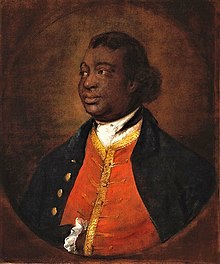
This spring, a team at Northeastern University launched a web project called “Ignatius Sancho’s London.”

The opening page explains:
This project showcases evidence about the life and times of Ignatius Sancho, one of the eighteenth century’s most important Black Britons. Born enslaved, Sancho came to occupy a unique position in London society that straddled the elite social worlds of the aristocracy and the everyday life of the city. These experiences are narrated in The Letters of the Late Ignatius Sancho, an African (1782), an amazing collection that reveals a man who was at once a husband, father, entrepreneur, musician, abolitionist, literary writer - and the first documented Black person to vote in a parliamentary election.

The interactive maps below reveal Sancho’s world as never before. It is a close-knit place, with Sancho observing events from his shop in the heart of Westminster and occupying a prominent role on London’s streets and social scene. But his life and letters show how Black people and voices travelled throughout the country, permeating society at every layer. The maps reveal a world connected to other transformative events shaping the life of the nation and the rest of the globe - from slavery and abolition to the rise of industry and empire…
An article about the project reports that one challenge for the professors and students working on it arose from a section of Sancho’s own book, published posthumously:
The page-and-a-half-long biography has long been accepted as fact when it comes to Sancho’s life. However, the team found, the account is largely based on stereotypes and riddled with inaccuracies.

“The biography that was written at the time basically conformed to the genre of what an amazing Black life should have been,” [Prof. Olly] Ayers says.

That means the team had little foundation on which to build their timeline, and were instead tasked with disproving what was there. According to the biography, Sancho was born on a slave ship in the Middle Passage, but, Ayers says, the group found that “it’s highly unlikely.” They also question the portion of his biography that says he gambled away his inheritance, as he was still working for the Montagus during the period in question.
Use the toggles in the upper right corner of the map to reveal the locations of events in Ignatius Sancho and his family’s lives, and the lives of other prominent black Londoners. Or read the storymap to learn more about him, the people and places he encountered, and the development of this project.

Saturday, November 12, 2022

Seeking John Morey in Roxbury

There were two generations of men named John Morey (also spelled Mory) in Roxbury.

The first John Morey was born in 1687 and married a woman named Hannah. They had several children, including a baby named John in 1736 who died early and another named John born on 23 Jan 1738. The couple’s daughters married into the Pierpoint and Turrell families.

This John Morey became prominent and wealthy. In 1734 he served as one of the two coroners of Suffolk County. As of 1741, he was using the suffix “Esq.” in a newspaper advertisement. In 1745 and 1753, Morey took in poor teenagers under indenture from the Boston Overseers of the Poor.

Morey also owned enslaved people. According to Hannah Mather Crocker, he was the owner of a mason named John Marcy, whom he hired out for jobs in Boston. Marcy was evangelized by hearing the Rev. George Whitefield, joined the Rev. John Moorhead’s church, married an enslaved servant of Lt. Gov. William Dummer, and eventually gained his freedom.

That John Morey died in 1771. He left an estate valued at almost £3,400. It included a large farm and lots of livestock, but also an eight-day clock, a map of the city of London, and five books—more luxury goods than an ordinary farmer had. He was labeled a “Gentleman” in his son’s newspaper advertisement settling the estate.

Also on that 1771 estate inventory were:
  • …a Nego [sic] Boy Named Cato about 12 Years Old…[valued at £]32.0.0
  • …a Negro Garl About 11 Years Old…26.13.4
  • …Ditto Named Bino About 7 Years Old…16.0.0
  • …Ditto Named Zippra an Inferm garl…6.0.0
It looks like the clock went to the West Roxbury meetinghouse. At least, the publication of an 1853 sermon referred to the meetinghouse having that clock with Morey’s name as donor on it. The church also received a silver baptismal basin in 1774; I’m guessing that was given by the younger John Morey but at the behest of his father.

Back in 1768, that second-generation John Morey had turned thirty and married Mary Cheney, born in 1743. The following year, that couple had their first baby, a son they naturally named John. He was followed by Hannah in 1771, Ebenezer Cheaney in 1774, and Susannah in 1776.

Mary’s father was Ebenezer Cheney (1699–1780) of Roxbury. His will left her considerable real estate in Middleborough. The couple prepared to move south. On 2 Oct 1783 John Morey advertised in the Independent Chronicle to sell “A very valuable Farm in Roxbury…containing one hundred and fifty Acres,” plus “Salt Marsh” and “near twenty Acres of good Wood Land.” Interested parties could speak with Morey or three of his neighbors, one being Eleazer Weld, Esq. Morey also called in his debts.

In March and April 1785, four Boston newspapers ran identically worded advertisements announcing the sale “By Publick Vendue [i.e., auction], on the premises, the Monday the 25th day of April next, The valuable FARM of Mr. John Morey, lying in Roxbury.” Reflecting the postwar economic situation, this ad said:
N.B. The payment will be made easy to purchasers, as the whole sum will not be immediately wanted, and government securities will be taken at their common rate of discount.
This time people could inquire of Weld and two other neighbors, but Morey was no longer said to be living on the property.

The facts of John Morey’s life shed a little light on the sale/indenture of the boy named Dick Morey in July 1785, discussed yesterday. For one thing, Morey was leaving that child behind in Roxbury as he moved to a new farm in Middleborough. David Stoddard Greenough paid him £5 for Dick’s next sixteen years, less than the value of a seven-year-old girl for life back in 1771. 

More ominously, it looks like that enslaved girl named Bino whom Morey inherited in 1771 was probably the mother he called “my Negro servant Binah” in 1785. She had given birth around 1780 when she was about sixteen years old. We don’t know who the father was, but he was white since Bino was listed as “a Negro Garl” and her son as “a Molatto Boy.” The list of possible fathers has to start with John Morey himself.

Finally, the Eleazer Weld who helped in selling the Morey farm was also one of the magistrates who affirmed Dick Morey’s indenture in 1787.

John Morey died in Middleborough in 1800, his widow Mary in 1821.

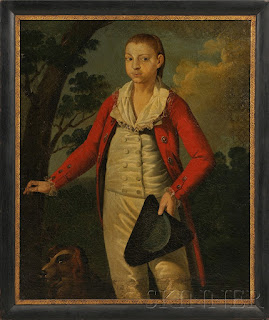
David S. Greenough and his wife Anna had a son (shown above) in the Loring Greenough House in 1787. Anna also had one surviving child from her first marriage. Those boys presumably grew up with Dick Morey as a household servant or farm hand in between their ages but not in their class.

However, I haven’t found any record of Dick Morey past those two documents from 1785–1787.

Friday, November 11, 2022

Dick Morey “in the Capacity of a Servant”

As I mentioned yesterday, David Stoddard Greenough, the lawyer and landowner who took control of what’s now the Loring Greenough House in Jamaica Plain, secured the labor of a small black boy in 1785.

The Massachusetts Historical Society shares the documents of that transaction on its website.

That happened a couple of years after Massachusetts’s highest court rendered chattel slavery unenforceable in the commonwealth. However, another widespread system of unpaid labor continued to be in force: indenturing apprentices.

Parents with teenagers, particularly boys, voluntarily entered into those agreements to provide the children with training they could use to establish themselves in professions and support themselves and their families as adults. The master didn’t pay the young worker but was responsible for feeding, clothing, sheltering, and medicining him.

In addition, local law provided for a town’s selectmen or Overseers of the Poor to indenture children born to unwed mothers or whose families couldn’t support them. Those indentured boys and girls might be separated from their relatives, treated as servants, taught lesser skills, and turned out with few resources to fend for themselves when they came of age. But, society felt, this was better than letting them starve.

In July 1785 Greenough paid £5 to John Morey of Roxbury for a little boy’s labor. The bill of sale leaves no doubt that this deal treated little Dick as property:
I do hereby acknowledge Do give, grant, & sell unto him the said David, his Heirs or assigns a Molatto Boy of Five years Old called and known by the Name of Dick who was Born in my House of my Negro servant Binah. to live with and serve him the said David, his Heirs, or assigns in the Capacity of a Servant untill he shall attain to the Age of Twenty one Years & I do hereby renounce and foreverquit claim to him the said David all right & title I now have or ever had to the said Molotto Boy
Unlike the sales records for enslaved people, however, that document put a sixteen-year limit on Greenough’s claim. It acknowledged that Dick would eventually be an adult and therefore free.

In September 1786 Greenough (who was, after all, a lawyer) put his relationship to “Dick Morey” on a different legal basis, more solid under the new Massachusetts law. Using a standard printed form, the selectmen of Roxbury indentured the boy to Greenough.

To do so, the men producing this contract had to cross out the parts of the form about how Dick “doth voluntarily and of his own free Will and Accord, and with the Consent of his” parents, bind himself to Greenough. The boy was too young to enter such an agreement. His mother, Binah, wasn’t mentioned at all; she may have been dead, absent, or shunted aside.

Greenough promised to teach Dick “the Art, Trade or Calling of a Farmer,” suggesting the boy was supposed to work around the Roxbury estate. That was basic, not specialized, training. But with an indenture Greenough did make a legal, handwritten promise to supply “good and sufficient meat, Drink, washing, Lodging & Clothing” for the next fifteen years. Again, that was more than slave owners ever had to promise.

These documents are thus evidence of Massachusetts’s transition away from legalized slavery. One possible interpretation is that Greenough found a way around the court’s decision to exploit a vulnerable child for sixteen years. Another is that he and the Roxbury selectmen used the legal tools of their society to secure a home for little Dick until he became an adult. And in fact both those readings could be true.

TOMORROW: The Morey household.

Thursday, November 10, 2022

Archeology at the Loring-Greenough House

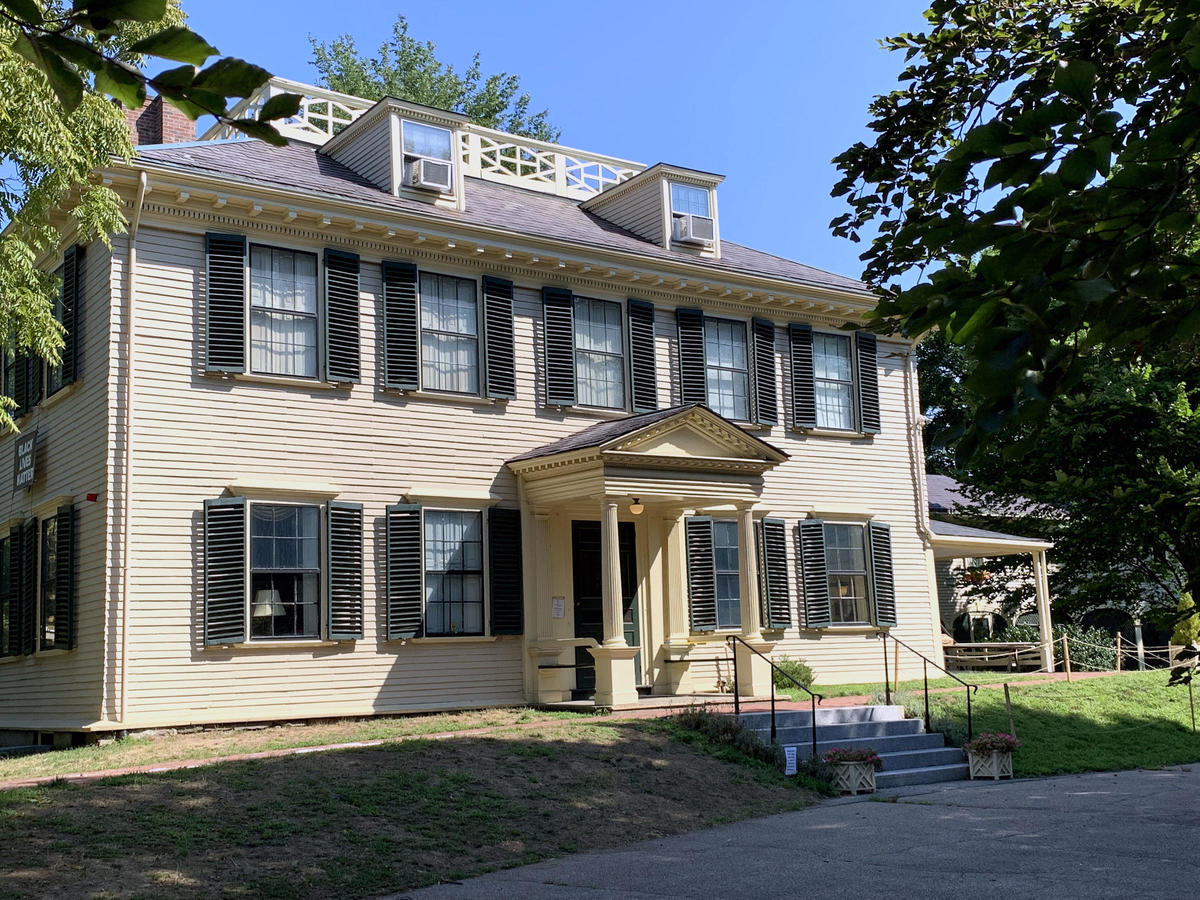
This week the city of Boston’s archaeology program is undertaking a dig at the Loring Greenhough House in Jamaica Plain.

According to the city’s announcement, “The goal of this project will be to survey the basement of the house’s early 19th century summer kitchen and areas of the door yard ahead of planned improvements.”

On Facebook the team elucidated:
Ahead of plans to lower the floor of the basement under the 1811 summer kitchen, we will conduct an archaeological investigation on the use and functions of that space so no potential cultural deposits are impacted by these improvements.

The kitchen basement where we will be digging has three chambers: the western chamber labeled on historic plans as being part of a cistern, the center chamber containing the main supporting arch for the building extension and sitting directly under the fireplace in the kitchen above, and the eastern chamber which is accessible by a small doorway and may have been used for smoking food. We also want to determine if there are any pre-kitchen deposits or features that survived the creation of the basement.
Many people have used the site over the centuries:
  • Indigenous Massachusett people left stone tools found in previous surveys.
  • The Polley family were the first English people to build a home on the property, in the 1650s.
  • Joshua Cheever, a Boston selectman from the North End, bought the Polley house in 1746; it’s unclear whether that became his country house or an investment property.
  • Joshua Loring, who gained the rank of commodore in King George’s War, purchased the property, tore down the earlier building, and commissioned the Georgian mansion that survives today.
  • After the Lorings left as Loyalists, the provincial and Continental Army used the deserted house for barracks and a hospital during the siege of Boston.
  • The state confiscated the property and sold it to the widow Anna Doane, who then married lawyer David Stoddard Greenough.
The team wrote:
Previous archaeological surveys of the Loring Greenough property don’t mention the presence of enslaved individuals on the property. We plan to address this by sharing their stories and hopefully locating deposits within the south yard that date to the pre-1785 time period when there is documentary evidence of enslaved people at the house.
Cheever and Loring are known to have owned slaves while Stoddard set up an indenture for a small child born into slavery (as I’ll discuss tomorrow).

Early this week came this update:
We think that the parged [mortar-covered brick] surface to the west was the bottom of the cistern, which basically took up a whole third of the basement! That means that the brick wall was the only thing holding back thousands of gallons of water from the rest of the basement.
People can visit the Loring-Greenough House from 9:00 A.M. to 4:00 P.M. on weekdays to see the archaeologists at work.

Wednesday, November 09, 2022

“No beings in human shape could resemble each other less”

And still speaking of Horace Walpole, Lady Louisa Stuart, daughter of the Earl of Bute, had more to say about him.

In 1837, Lady Louisa wrote in the introduction to a volume of her grandmother Lady Mary Wortley Montagu’s letters and works:
In a word, Horace Walpole himself was generally supposed to be the son of Carr Lord Hervey, and Sir Robert not to be ignorant of it. One striking circumstance was visible to the naked eye; no beings in human shape could resemble each other less than the two passing for father and son; and while their reverse of personal likeness provoked a malicious whisper. Sir Robert’s marked neglect of Horace in his infancy tended to confirm it.
All that would have happened well before Lady Louisa was born in 1757, so she was recording previous generations’ gossip.

The story starts with the rise of a couple of politicians in the last decades of the Stuart dynasty. John Hervey (1665–1751) followed his father into Parliament, then became Baron Hervey in 1703 and Earl of Bristol in 1714. By his first wife he had a son named Carr Hervey in 1691, and by his second a son named John Hervey in 1696.

After Hervey became Earl of Bristol, his eldest son and heir received the courtesy title of Lord Hervey based on the father’s lesser peerage. That meant Carr Hervey was called Lord Hervey from 1714 until his death in 1723. At that point the younger John Hervey became his father’s eldest son and thus also Lord Hervey until his own death in 1743. In fact, through a special law John Lord Hervey got to be Baron Hervey in the House of Lords all on his own in 1733. But he never inherited his long-lived father’s earldom; instead, the second Earl of Bristol was his son.

John Lord Hervey was a major figure during Walpole’s years in power, as a Member of Parliament, a political writer, and a close friend and then enemy of Frederick, Prince of Wales, father of George III. Thus, when people remembered “Lord Hervey,” they usually meant him. Carr Lord Hervey didn’t leave such a big mark.

Meanwhile, Robert Walpole (1676–1745) was climbing the political ranks as a Whig. He joined Parliament in 1701, served as chancellor of the exchequer 1715–1717, and then dominated Britain as prime minister from 1721 to 1742. He was knighted in 1725. As part of his exit deal, Walpole was kicked up into the House of Lords as the first Earl of Orford.

Robert Walpole married Catherine Shorter in 1700. They had four children soon after marriage, then none for eleven years until Horace appeared in 1717. By the late 1720s Sir Robert was living openly with his mistress, Maria Skerritt, and their affair probably began earlier. In 1737 Catherine Walpole died. Sir Robert then married Maria, but she died in 1739. Their daughter was retroactively made legitimate and became Lady Mary Walpole.

According to the rumor that Lady Louisa Stuart set down, Catherine Walpole had given up on her marriage because of her husband’s infidelities and took her own lover in Carr Lord Hervey. Horace Walpole was supposedly the result of that affair.

It’s true that Sir Robert Walpole and Horace Walpole didn’t look much alike. Sir Robert had a square chin while Horace always had a long, lean face. However, the one surviving portrait of Carr Lord Hervey (shown above) depicts him as a youth with a completely round face, even less like Horace’s.

When people talked about how Horace Walpole resembled Lord Hervey, they usually end up pointing to the younger and more famous John Lord Hervey, not the paternity candidate. In particular, authors have pointed out two major similarities.

First, both Baron Hervey and Horace Walpole wrote gossipy, iconoclastic memoirs about the politics of their day. Hervey’s memoirs were so juicy that the family suppressed their publication until 1848. Therefore, unless he got a secret peek at that manuscript (and, even more improbably, managed to leave no record of that peek), Horace Walpole couldn’t have used the Hervey memoir as a model for his own.

The second similarity, which authors found different ways to express, is that both John Lord Hervey and Horace Walpole were queer.

For Hervey, this took the form of sex with both men and women. He had eight children with his wife; affairs with Anne Vane and perhaps Princess Caroline; infatuations or affairs with Henry Fox, Stephen Fox, Count Francesco Algarotti, and perhaps Prince Frederick. Lady Mary Wortley Montagu, another likely lover, declared, “this world consisted of men, women, and Herveys.”

Horace Walpole appears to have been attracted only to men, and it’s unclear whether he had any happy sexual relationships. He did have close friendships with many women, but they were all either married or uninterested in men. People saw Walpole as effeminate. The novelist Laetitia Matilda Hawkins recalled:
His entrance into a room was in that style of affected delicacy, which fashion had made almost natural, chapeau bras between his hands as if he wished to compress it, or under his arm; knees bent, and feet on tip-toe, as if afraid of a wet floor.
Thus, when Horace Walpole scholar Peter Cunningham wrote in 1861, “he was unlike a Walpole, and in every respect, figure and formation of mind, very like a Hervey,” he meant mostly that neither Horace Walpole nor John Lord Hervey were straight.

But how significant was that supposed similarity to the question of Horace’s paternity? Baron Hervey was the putative father’s half-brother. There was only a thin genetic connection between him and Horace Walpole, so their resemblances were likely no more than coincidence.

On the other hand, Horace Walpole was such a gossip that it’s only fair to have this sort of discussion about him.

Tuesday, November 08, 2022

Horace Walpole at Ten Years Old

Speaking of Horace Walpole, last week I received a packet of postcards from Strawberry Hill, that gentleman’s British estate, in thanks for supporting a fundraising initiative.

The Antiques Trade Gazette told the story:
The Strawberry Hill Trust appealed for help to buy the painting by William Hogarth (1697-1784). Walpole – the 4th Earl of Orford (1717-97) – lived at the Twickenham house and the portrait was on loan there from a private collection.

The trust had an opportunity to buy the painting from the private collection as it has been offered to the nation in lieu of death duties.

However, the painting had been valued at more than the tax due which meant there was a £230,000 funding gap.

The National Heritage Memorial Fund donated £115,000 and the Art Fund has given £90,000. The remaining £25,000 was raised via the Art Fund’s crowdfunding platform, Art Happens. . . .

The trust said the picture was of “exceptional interest” as it is the earliest surviving oil portrait of Walpole; a rare and significant example of Hogarth’s early mature pictorial work; the earliest-known commissioned picture of an identifiable sitter by Hogarth and his first-known portrait of a child. The painting was commissioned by Horace’s father, Sir Robert Walpole (1676-1745), the first British prime minister, when his youngest son was aged 10 and a pupil at Eton.
The portrait can now be viewed at Strawberry Hill. One day I’ll go there and feel pride in contributing to that display.

At Museum Crush, Richard Moss wrote on article on “Decoding the Hogarth portrait of the young Horace Walpole.” The boy points to a sundial indicating the number ten, his age. One of the many spaniels he loved over his lifetime runs below. And he looks fabulous in his embroidered blue waistcoat.

But that article doesn’t note what might be the most significant aspect of this portrait: it signaled that his father was actually interested in him at last. As Horace was growing up, his parents were estranged. Horace lived with his mother while, from 1723 on, his father kept house with Maria Skerritt, eventually his second wife. According to Lady Louisa Stuart (1757–1851), a daughter of the Earl of Bute, “Sir Robert Walpole took scarcely any notice of him, till his proficiency at Eton school, when a lad of some standing, drew his attention…” And that’s when the portrait was made.

Monday, November 07, 2022

“Whitmore, usually a courtier, spoke for the Opposition”

Here’s a brief return to the series of postings about George III’s speech to Parliament on 31 Oct 1776 and the Whig opposition’s responses to it.

As I composed those, I was relying on the close-to-official record of the legislature’s debate, the Parliamentary Register published by John Almon.

I supplemented that with comments from Horace Walpole’s Journal of the Reign of King George the Third, from the Year 1771 to 1783. Walpole was the son of Britain’s first prime minister and a keen political observer.

Not until I got back from a trip was I able to confirm an odd detail: Walpole (shown here) recorded one more Member of Parliament speaking in the debate than the Parliamentary Register. His précis included:
Mr. [Thomas] Whitmore, usually a courtier, spoke for the Opposition; asked if the Houses had any terms to propose to the Americans?—if they had, what terms? Were the present measures Lord North’s, or were they forced upon him?
Whitmore didn’t make that volume of the Register at all, despite questioning Lord North—or because he usually didn’t.

By “usually a courtier,” I believe Walpole meant that Whitmore was normally part of Britain’s “court party,” a pejorative term for those supporting those in power in London. (Their opponents called themselves the “country party.” American Whigs often used the same terms since they were an acceptable way of discussing factional political organizing.)

I’m not sure who Whitmore was implicating when he asked if someone had “forced” the prime minister to adopt his American policy.

Later, in 1784, Whitmore was part of the St. Alban’s Tavern group, a caucus of members urging an alliance between William Pitt the Younger and Charles James Fox. Those legislators presented themselves as independent of parties, and apparently that’s how Whitmore was also acting back in 1776.

Sunday, November 06, 2022

“Run over a Boy’s head & he died instantly”

Yesterday I quoted the portion of the article in Richard Draper’s Boston News-Letter for 8 Nov 1764 discussing how kids these days were too violent and divisive in the way they celebrated Pope Night.

That article also complained about the link between that year’s rowdiness and the death of a little child:
It was tho’t this [brawling] would have been prevented on Monday last, by a melancholy Accident which happened just as one of the Stages at the North-End was setting off, a Child of Mr. Brown’s, about 5 Years of Age, falling down, one of the Wheels went over his Head, and kill’d him instantly; but this did not prevent the Rabble from executing their Design.—

In the Afternoon the Magistrates and other Officers of the Town went to the respective Places of their Rendezvous, and demolished their Stages, to prevent any Disorders, which they did without Opposition: Notwithstanding, as soon as it was dark, they collected again, and mended their Stages, which being done they prepared for a Battle, and about 8 o’Clock the two Parties met near the Mill-Bridge, where they fought with Clubs, Staves, Brick-bats, &c. for about half an Hour, when those of the South-End gained a compleat Victory, carrying off not only their own, but also their Antagonists Stages, &c. which they burnt on Boston Neck.

In the Fray many were much bruis’d and wounded in their Heads and Arms, some dangerously; and a few of those who were so curious as to be Spectators, did not come off so well as they could wish; tho’ many would have fared worse had it not been a Moon-light Evening.
We have a couple of other sources on Pope Night in 1764. The merchant John Rowe wrote in his diary:
A sorrowful accident happened this forenoon at the North End—the wheel of the carriage that the Pope was fixed on run over a Boy’s head & he died instantly. The Sheriff, Justices, Officers of the Militia were ordered to destroy both So & North End Popes. In the afternoon they got the North End Pope pulled to pieces, they went to the So End but could not Conquer upon which the South End people brought out their pope & went in Triumph to the Northward and at the Mill Bridge a Battle begun between the people of Both Parts of the Town. The North End people having repaired their pope, but the South End people got the Battle (many were hurt & bruised on both sides) & Brought away the North End pope & burnt Both of them at the Gallows on the Neck. Several thousand people following them, hallowing &ct.
The young printer John Boyle wrote in his “Journal of Occurrences,” perhaps based on the newspaper report and perhaps on his own knowledge:
A Child of Mr. Brown’s at the North-End was run over by one of the Wheels of the North-End Pope and Killed on the Spot. Many others were wounded in the evening.
I’ve looked for a more official record of this boy’s death to know his name and age, but without success. (It would of course be easier if the family wasn’t named Brown.)

Importantly, this child wasn’t killed during the brawling over the wagons, as many mentions of this sad event (including some of my own) have said. Instead, the accident happened “just as one of the Stages at the North-End was setting off.” That wagon was still in friendly territory, not yet menaced by South-Enders and hours before the big fight. The boy died because of crowding or carelessness, not violence.

The News-Letter dispatch didn’t criticize the brawlers for causing the child’s death, only for the poor taste to proceed with their rumble after it happened, and against the orders of town leaders.

Nonetheless, the death of the child in 1764 was and continues to be cited as contributing to the replacement of the usual processions and brawl in 1765. Probably it did play a role, in that after the destruction of Lt. Gov. Thomas Hutchinson’s house in August, Boston’s political leaders insisted the town had to be on its best behavior. The gangs wouldn’t stop for the Brown child, but they would stop to show their united and peaceful disapproval of the Stamp Act.

Saturday, November 05, 2022

“Those that are concerned in this Pageantry make a Party-Affair thereof”

The 8 Nov 1764 Boston News-Letter included this commentary on how the town had come to celebrate the 5th of November:
Monday last being the Anniversary of the Commemoration of the Preservation of the British Nation from the Popish Plot, the Guns at Castle William and at the Batteries in Town were fired at One o’Clock.

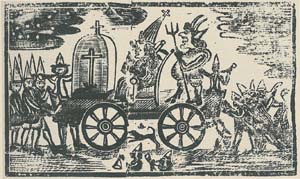
It was formerly a Custom on these Annniversaries for the lower Class of the People to celebrate the Evening in a Manner peculiar to themselves, by having carved Images erected on Stages, representing the Pope, his Attendant &c. and there were generally carried thro’ the Streets by Negroes and other Servants, that the Minds of the Vulgar might be impress’d with a sense of their Deliverance from Popery, and Money was generally given to regale themselves in the Evening when they burnt the Images.——

But of late those that are concerned in this Pageantry make a Party-Affair thereof, and instead of celebrating the Evening agreeably, the Champions at both Ends of the Town prepare to engage each other in Battle, under the Denomination of South End & North End.— . . .

It should be noted that these Parties do no subsist much as any other Time.
This article was probably written to put Boston in the best possible light for readers, both locally and in other towns. It may therefore not be correct in all its implications.

First, the custom of moving around effigies of the Pope, Devil, and others wasn’t peculiar to Boston. Most New England ports and many British towns observed Pope Night the same way (though they might have different names for the holidays). There were giant effigies, often on wagons; appeals for money; and a bonfire after dark.

The dismissal of the celebrants as “the lower Class of the People,” “Negroes and other Servants” (probably meaning apprentices), and “the Vulgar” disguised how broadly the population participated in Pope Night. Even if genteel men didn’t join the crowds, their treats funded the activity. Women and girls watched and might have helped the preparations.

Perhaps the biggest question is whether the North End–South End divide really did disappear on most other occasions, as the newspaper claimed. We know that there were separate North End and South End Caucuses in town politics in the early 1770s, though they tried to work together. According to Henry Adams, a version of that rivalry (turned into a fight between the Boston Latin School students and every other boy) persisted until the mid-1800s.

In one important respect, the New-Letter report seems accurate: only in Boston did the Pope Night celebrants divide into neighborhood gangs and end the night with a head-bashing rumble. Joshua Coffin’s detailed 1835 account of the event in Newburyport, for instance, mentioned nothing of the sort. That town’s young men and boys all worked together.

The News-Letter implied that this neighborhood brawling was a recent development, added on top of the genral rowdiness of procession and pageantry. But how recent? The intra-town fight was reported in a newspaper as early as 1745, or before at least some of the brawlers of 1764 were born.

The 1764 celebration was actually fatal—but was that the fault of the gangs?

TOMORROW: The first death.

Friday, November 04, 2022

Abigail Adams Statue Unveiling in Quincy, 5 Nov.

Back in May, I reported on the city of Quincy’s decision to commission a statue of Abigail Adams to fit with the statues of her husband John Adams and their friend John Hancock in the park near city hall.

The new Abigail Adams statue will be unveiled on Saturday, 5 November, with a public ceremony starting at 11:00 A.M. The scheduled speakers include:
  • Danielle Allen, professor of political philosophy at Harvard University and author of Our Declaration: A Reading of the Declaration of Independence in Defense of Equality.
  • Catherine Allgor, president of the Massachusetts Historical Society and author of Parlor Politics: In Which the Ladies of Washington Help Build a City and a Government
The artist commissioned to create all these figures is sculptor Sergey Eylanbekov, a graduate of the Surikov Art Institute in Moscow who now lives on Long Island, New York.

The picture above, by Robert Bosworth for the Quincy Sun, hints at how Eylanbekov portrayed Adams, but one must go to Quincy for the first glimpse of the full figure.

The city also owns an older statue of Abigail Adams and her eldest son, John Quincy Adams, on a different scale by the late Lloyd Lillie. The city plans to install that somewhere in Marrymount Park.

I can’t resist quoting Abigail Adams’s own taste in statuary, from a letter she wrote in 1785 from Paris describing the estate the young U.S. of A. had provided the family as diplomats:
The garden has a number of statues and figures, but there is none which pleases me more than one of a Boy who has robed a bird of her nest of young; which he holds in one hand and in the other the old bird, who has laid hold of his finger with her Bill and is biteing it furiously, so that the countanance of the lad is in great distress between the fear of loosing the young and the pain of his finger.
I looked for statues of that subject and couldn’t find any exact matches.

Thursday, November 03, 2022

“How would those advantages accrue to us, if America was conquered?”

The last major speech in the House of Commons on 31 Oct 1776 about the American War came from Charles James Fox, an opposition Whig (but one who didn’t get along well with some other Whigs).

Fox spoke at length about what had brought on the war, how badly the ministry had executed it, and, at the end, how it could not win:
What have been the advantages of America to this kingdom? Extent of trade, increase of commercial advantages, and a numerous people growing up in the same ideas and sentiments as ourselves.---

Now, Sir, how would those advantages accrue to us, if America was conquered? Not one of them. Such a possession of America must be secured by a standing army; and that, let me observe, must be a very considerable army.

Consider, Sir, that that army must be cut off from the intercourse of social liberty here, and accustomed, in every instance, to bow down and break the spirits of men, to trample on the rights, and to live on the spoils cruelly wrung from the sweat and labour of their fellow subjects;---such an army, employed for such purposes, and paid by such means, for supporting such principles, would be a very proper instrument to effect points of a greater, or at least more favourite importance nearer home; points, perhaps, very unfavourable to the liberties of this country.
Horace Walpole later wrote about this occasion:
Charles Fox answered Lord George [Germain] in one of his finest and most animated orations, and with severity to the answered person. He made Lord North’s conciliatory proposition be read, which, he said, his Lordship seemed to have forgotten, and he declared he thought it better to abandon America than attempt to conquer it.

Mr. [Edward] Gibbon, author of the “Roman History,” a very good judge, and, being on the Court side, an impartial one, told me he never heard a more masterly speech than Fox’s in his life; and he said he observed [Edward] Thurlow and [Alexander] Wedderburne, the Attorney and Solicitor Generals, complimenting which should answer it, and, at last, both declining it.
That left only one member interesting in speaking, the government opponent Gen. Henry Seymour Conway. He said he respected King George III but opposed the speech he had delivered on behalf the ministry.

The Commons then voted on whether to amend the response to that speech proposed by supporters of the government. The vote was 242 in favor of Lord North’s position, 87 against. (A second vote followed, close to midnight: 232 to 83. The House of Lords had a similar debate, which the government won 82 to 26.)

In sum, for all the speeches, answered and unanswered; for all the wit and telling points; for all the Parliamentary Register reports favoring the Whigs, Lord North’s government carried the day because it had an almost 3-to-1 advantage in Parliament. The opposition’s rhetoric and logic and being ultimately right about the American War were no match for the party that had the most votes in the room.

Something to remember as we proceed through our own election season.

[ADDENDUM: It turns out the Parliamentary Register left out a speaker that Walpole recorded. I added his remarks here.]

Wednesday, November 02, 2022

“Men in that kind of situation are not very prone to a change of government.”

As Parliament’s 31 Oct 1776 debate over the American War went on, the next speaker was Sir Herbert Mackworth, recently made a baronet.

The Parliamentary Register described his speech this way:
Sir Herbert Mackworth professed himself to be one of the independent country gentlemen, and declared, he feared that matters were much misrepresented; that he did not like to hear gentlemen so ready to find a plea for the Americans on every occasion, and even when they were beat, to hunt after a reason to shew that they could not avoid it, and that some particular circumstances occasioned it.

He said, he was ever most clearly against that House attempting to tax America, as America was not represented in that House; but he thought it highly necessary to maintain the right; and that it was but reasonable America should contribute something in return for the millions she had cost this country. He spoke highly in favour of some of the gentlemen in opposition, but applauded the ministry; finally declaring, that as an antient Briton, he felt for the honour of his country, and therefore wished her success; not but he would be glad that a proper treaty for reconciliation was on foot, and he owned he cared not whether it was with rebels in arms or without them.
If you’re unsure about how Sir Herbert came down on the issues at hand, the recorder took pains to clarify: “He was against the amendment.” In other words, for how to respond to the king’s speech, he supported Lord North’s government.

Thomas Townshend, a Whig, made several points about the king’s speech, among them:
There is, I think, one part of the speech which mentions a discovery of the original designs of the leaders of the Americans. In God’s name, who made them leaders? How came they to be so? If you force men together by oppression, they will form into bodies, and chuse leaders. Mr. [John] Hancock was a merchant of credit and opulence when this unhappy business first broke out. Men in that kind of situation are not very prone to a change of government.
In his wide-ranging speech, Townshend at one point noted that the prime minister had left the chamber.

Lord North returned and spoke at length—the first government supporter to get more than a paragraph in this Parliamentary Register. He started by expressing surprise at Townshend trying to make something of how he had left the chamber for “ten minutes, on a pressing business.” Among the minister’s other responses:
It has been more than once objected this night, that I have, since the commencement of the present troubles, held back such information as became necessary for you to know, in order the better to be able to decide upon measures proper to be pursued, relative to America.

Nothing can be more unjust and ill-founded than this charge. I have been ready at all times to communicate to this House every possible information that could be given with safety. I repeat with safety, because the very bad and mischievous consequences of disclosing the full contents of letters, with the writers’ names, has been already severely proved, and would, in the present situation of affairs, not only be impolitic, but might be to the last degree dangerous, if not fatal, to the persons immediately concerned.
He might have been referring to the leaks of letters from Gov. Francis Bernard, Gov. Thomas Hutchinson, and other royal officials in America.

Col. Isaac Barré, who had coined the term “Sons of Liberty” back in 1765, responded by stating that he believed Lord North was assiduous in attending debates. But he demanded to know “What powers were General [William] and Lord [Richard] Howe invested with as his Majesty’s Commissioners to treat with America?”

Lord North replied that the Howes’ commission had been published for everyone to see in the London Gazette, the government organ. Barré then pulled out a copy of the 5 Aug New-York Gazette and read a lengthy report of the Howes’ interactions with Gen. George Washington, suggesting more was going on.

Barré and North had another exchange over the threat of war with France and Spain, and whether certain warships were “nearly manned” or “partly manned.”

The Parliamentary Register quoted Barré saying, “Recall, therefore, your fleets and armies from America, and leave the brave colonists to the enjoyment of their liberty.”
This created a louder laugh than the former among the occupiers of the several official benches; which irritated the Colonel so much, that he reprehended the treasury-bench in terms of great asperity; he arraigned them with a want of manners, and declared, he thought professed courtiers had been better bred.
Barré wound up by suggesting Adm. Augustus Keppel be put in charge of the fleet. Keppel himself then made some remarks about the European powers’ naval readiness. (He wasn’t given an active command until 1778.)

Lord George Germain, secretary of state for North America (shown above), spoke to several points the opposition had raised, including:
As to the propositions which General Howe made to General Washington, they prove clearly, as the Americans themselves state the matter, that General Howe was eager for the means of peace and conciliation; but Washington against them. However, General Howe will doubtless be able to put New-York at the mercy of the King; after which the legislature will be restored, and an opportunity will thereby be given for the well affected to declare themselves, who are ready to make proper submission.
Germain was in no mood for compromise.

TOMORROW: Concluding remarks and the vote.

Tuesday, November 01, 2022

“You then possessed the capital of North America, Boston”

After King George III had opened Parliament on 31 Oct 1776 with the speech quoted yesterday, the House of Commons debated how to respond.

Richard Aldworth-Griffin proposed to thank the monarch with an address echoing all the points he and the government ministers had delivered. George Finch-Hatton seconded that motion.

Then the opposition seized the opportunity to express their views on the American War and how the ministry was carrying it out. At the time, most parliamentary opponents were clustered around the Marquess of Rockingham, who had been prime minister briefly in the 1760s.

The first to speak was Lord John Cavendish, who proffered the opposition’s draft address. His whole speech was longer than the king’s and made several points like this:
Every act which has been proposed as a means of procuring peace and submission, has become a new cause of war and revolt; and we now find ourselves almost inextricably involved in a bloody and expensive civil war; which, besides exhausting at present the strength of all his Majesty’s dominions, exposing our allies to the designs of their and our enemies, and leaving this kingdom in a most perilous situation, threatens, in its issue, the most deplorable calamities to the whole British race.
The Marquess of Granby seconded that. (According to Horace Walpole, Granby was supposed to have offered the motion, “but his youthful diffidence got the better.”) Though both Lord John and Granby had aristocratic titles, they weren’t members of the House of Lords. The first was the younger brother of a duke, the latter the son of a duke. They were thus both eligible to serve in the House of Commons.

George Johnstone, former governor of West Florida (shown above), then got blunt and personal:
The minister’s speech he declared to be an entire compound of hypocrisy. It made his Majesty talk of peace, at the very moment when not only all Europe, but this kingdom, gave the most evident appearances of preparation for war. In short, it was like a deceptious mirror reflecting a false image of truth. That part of it which talked of giving the Americans law and liberty, he conceived to be a mere turn of wit and humour, which would not bear a serious interpretation. It was an insidious hypocritical speech that held out law and liberty at the point of the sword.
George Wombwell, a government supporter and director of the East India Company, replied to one of Johnstone’s points, about sailors being impressed for the Royal Navy, by insisting that “no press was better conducted than the present.” The printed report on the debate stated: “He censured the Americans as a bragging, cowardly banditti, &c.”

The Parliamentary Register for this year was published by printer John Almon, and he leaned decidedly toward the Whigs. One result of that, I suspect, was that opposition speeches were recorded more fully than speeches in favor of the government. Wombwell’s remarks were summarized in four lines and “&c.” while Johnstone’s filled a page and a half.

The next speaker was John Wilkes, and he got six pages. Among his remarks to the government:
Nothing decisive can follow from the late successful affair on Long Island, no more than from the defeat at Sullivan’s Island. New York will probably fall into your hands, but your situation will in that case be scarcely mended since the last year, for you then possessed the capital of North America, Boston. Is that great and important town advantageously exchanged for New York? I forgot that we still possess the fishing hamlet of Halifax.
The Hon. Temple Luttrell, son of an earl, offered a speech full of historical allusions both ancient and modern. He insisted:
It is a very unfair argument to alledge that the Americans fight for independency---You must be sensible, Sir, that the only way to straighten a bow is to wrest it with vigour to an opposite curve: the acts of this legislature affecting the colonists were so warped from rectitude, that their only chance to recover a right line of justice was by proceeding to contrary extremities, to announce disunion and absolute freedom. . . .

If you empower the commissioners in America [Adm. Richard Howe and Gen. Sir William Howe] to propose peace on equitable conditions, offer to restore their charters, and relinquish the unsustainable claim of taxation with a good grace---even now while your armies figure in the field, under hitherto triumphant generals---and I make no doubt, but by so laudable a step, you will obtain from your colonies, through the Howe’s, as fair and magnanimous an answer, as that which was sent from the Falerii to the Roman senate, by the great Camillus---“The Romans in having preferred justice to conquest, have taught us to be satisfied with submission instead of liberty.”
The supporters of the American cause were thus not much better informed about the state of the new U.S. of A. than the government ministers. They believed the Declaration of Independence was just a bargaining position and might yet be withdrawn.

TOMORROW: The debate rolls on.