J. L. BELL is a Massachusetts writer who specializes in (among other things) the start of the American Revolution in and around Boston. He is particularly interested in the experiences of children in 1765-75. He has published scholarly papers and popular articles for both children and adults. He was consultant for an episode of History Detectives, and contributed to a display at Minute Man National Historic Park.

Subscribe thru Follow.it


•••••••••••••••••


Tuesday, April 03, 2012

“Large promises had been held out to Knox…”

Yesterday I quoted the passage from Noah Brooks’s 1900 biography of Henry Knox in which he wrote, “Large promises were held out to young Knox to induce him to take a commission in the royal cause; he was regarded as too desirable a man to be lost from the military service of the King.”

Brooks didn’t cite a source or evidence for that statement. He also used the vague passive voice: “promises were held out,” “he was regarded.” That suggests he was working from equally vague and perhaps wishful traditions rather than documents.

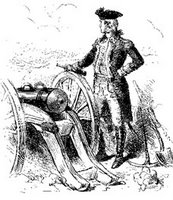
North Callahan extrapolated from Brooks’s passage in his 1958 biography of the artillery general, writing that Knox received an offer of a British army commission “through the influence of Thomas Flucker,” his father-in-law (shown above). Subsequent authors repeated the same statement, relying on Callahan and Brooks.

But what was the basis of Brooks’s statement? I looked for confirming evidence in the first biography of Knox, published by Francis S. Drake in 1873. He wrote even more vaguely, and without citing sources:
Large promises had been held out to Knox to induce him to follow the royal standard, as it was thought of consequence to prevent so talented a young man from attaching himself to the provincials; but his patriotism was as sincere as it was ardent, and he did not for a moment hesitate, but embarked heart and hand in the patriot cause.
Interestingly, two years before that, Horatio Bateman’s Biographies of Two Hundred and Fifty Distinguished National Men began its entry on Knox by saying:
He married the daughter of a staunch loyalist, and was an officer in the British army when the struggle of the Revolution commenced. . . .
We know that’s wrong. It suggests that there was a long tradition in New England of saying that Knox turned away from opportunities on the royalist side because he supported the Whigs. But it also shows that tradition was hazy and liable to exaggeration.

I’m skeptical that the Flucker family actually arranged for an army commission for Knox. Such a regular army commission was a big deal, and a big expense, and it should have left a thicker paper trail. Promises of a higher rank in the Massachusetts military seem more likely, and well within Flucker’s reach as the province’s royal secretary. But even then there’s no evidence of how solid such promises were, or what Knox’s immediate response was.

COMING UP: Henry Knox and five chests of tea.

Monday, April 02, 2012

The Mystery of Henry Knox’s “Boy Soldiers”

In his 1900 biography of Henry Knox, Noah Brooks wrote of the connections that the young bookseller’s 1774 marriage brought him:
Lucy Flucker’s only brother [Thomas, Jr.] was a lieutenant in the British Army, and, while he was serving the cause of the King, his newly made brother-in-law was zealously studying the art of war and schooling himself for the service into which he was so soon to enter. Large promises were held out to young Knox to induce him to take a commission in the royal cause; he was regarded as too desirable a man to be lost from the military service of the King. The British officer who had observed with admiration the evolutions of the artillery company of which Knox was second in command, and had said that a country which produced such “boy soldiers” as he could not readily be brought under subjection, only gave voice to the sentiment that pervaded the ranks of the determined colonists.
In fact, Knox was never “second in command” of an artillery company in Boston’s militia; he was second in command of a grenadier company. Brooks’s biography has a lot of unreliable statements like that, which makes me wary of accepting its statements without confirmation.

So what confirmation does the Brooks biography offer about Knox being offered “a commission in the royal cause,” and a British officer praising his “boy soldiers”? Actually, Brooks doesn’t usually cite sources.

For the second part of that question, a Google Books search led to Cyrus Eaton’s History of Thomaston, Rockland, and South Thomaston, Maine, published in 1865. It stated:
[Knox] was at the early age of eighteen chosen one of the commanding officers of a company of grenadiers composed of young Bostonians, so distinguished for its martial appearance and the precision of its evolutions that it received the most flattering encomium from a British officer of high distinction. This officer’s prediction that “a country that produced such boy soldiers, cannot long be held in subjection,” was soon verified.
Unfortunately, Eaton didn’t cite a source for that anecdote, either. It appears to have been a tradition in Maine, where Knox lived after the war, rather than in Boston. Which is a bit odd since any such event would have taken place in Boston and pleased Bostonians, and later generations of Bostonians were never shy about publishing praise of their ancestors.

TOMORROW: And Knox’s royal commission?

Sunday, April 01, 2012

Account of the Wonderful Centaur

This clipping from the Gentlemen’s Magazine of 1 Apr 1751 comes courtesy of the University of Otago’s online exhibit on that magazine.

Saturday, March 31, 2012

Two Upcoming Events in Lincoln

At 2:45 P.M. on Saturday, 7 April, the Lincoln Minute Men and Minute Man National Historical Park will host the annual Paul Revere Capture Ceremony. I understand that Henry Wadsworth Longfellow will attempt to read his “Paul Revere’s Ride” while people portraying Paul Revere, William Dawes, Dr. Samuel Prescott, Mary Hartwell, and others will offer corrections and additions. There will also be music and musket fire. This event takes place at the outdoor site of the capture (shown above, courtesy of the Paul Revere House), and is for all ages.

Three days later, on Tuesday, 10 April, the group hosts its annual Battle at North Bridge Lecture. I’ll address the group on the topic of “What Did the British Hope to Find in Concord on April 19th?” Most accounts of the start of the Revolutionary War in April 1775 say that Gen. Thomas Gage sent troops to Concord to search for “military stores.” Research shows that Gage was hoping to find specific weapons and that the “arms race” to secure those weapons started back in September 1774. That starts at 7:30 P.M.

To observe that event, I’ve revamped the Boston 1775 website by creating separate pages about my upcoming and past speaking engagements, publications, and web appearances. Those pages now contain the links the used to fill the top of the right-hand column. I’ve headlined those pages “Elsewhere” since I do occasionally come out from behind the keyboard.

Friday, March 30, 2012

Pauline Maier Talks Ratification in Lexington, 30 Mar.

Tonight the Lexington Historical Society hosts Prof. Pauline Maier speaking on how the states ratified the Constitution, the topic of her recent book Ratification: The People Debate the Constitution, 1787-1788.

On 10 Dec 1787, the town of Lexington had a meeting to respond to the call for a convention to respond to the proposed new federal structure for the U.S. of A. The upshot:

The Town then made choice of Benjamin Brown Esqr. to represent them in the State Convention to be held at the State House in Boston on the Second Wednesday of January next to give their Assent & ratification to a Constitution or Frame of Government for the United States of America as reported by the Continental Convention begun & held at Philadelphia, in May, 1787—
Benjamin Brown (1720-1802) was a farmer and deacon of the local congregation. He had been a selectman, member of the town’s committee of correspondence, and representative to the Massachusetts General Court and Massachusetts Provincial Congress. (He was also father of Solomon Brown, who Boston 1775 notes was quite significant in the start of the war.) The Wisconsin Historical Society displays a nearly unreadable image of Brown’s official documentation as a delegate.

The Lexington town records don’t seem to include complex or wary instructions for Deacon Brown. In that town at least, there seems to have been little discussion of whether Americans should or should not “give their Assent & ratification” to the new Constitution. Brown appears in the official record of the convention in Boston (at the Federal Street meetinghouse, not the State House) only once, voting yea at the end. But there was a lot more drama evident elsewhere.

Maier’s talk on that saga will begin at 8:00 P.M. in the Lexington Depot Building and 13 Depot Square. There will be coffee and cookies, and book sales and signing.

Thursday, March 29, 2012

Saving Private Barnes at the M.H.S., 3 Apr.

And speaking of the question of divided loyalties at the Massachusetts Historical Society, next week on Tuesday, 3 April, the society will host a session of the Boston Area Early American History Seminar where participants will discuss Prof. Len Travers’s paper “The Court-Martial of Private Barnes.”
Months after the French capitulation at the end of the French and Indian War, a young Massachusetts man, Joshua Barnes, was discovered still in the company of his Wabenaki captors. He had been taken more than four years earlier while on patrol along Lake George. Now, Barnes was arrested and faced trial for treason before a British army court-martial.

Was he, as the court insisted, a renegade who had willingly adopted Native life and taken up arms against his king? The testimony of both Barnes and the witnesses against him suggest something different: that hostage stress response, known today as Stockholm Syndrome, may better explain the behavior that led to his arrest.

This paper, digested from a draft chapter for a proposed book, will be a departure from familiar “fate of the captive” narratives, which generally assume a storyline of assimilation into Native societies, “failure” to assimilate, or redemption.
The seminar starts at 5:15 P.M. In order to gauge the size of the room and the number of cookies needed, the society asks that people reserve a space in advance. Copies of the paper are usually available to read at the M.H.S. before the discussion.

(Image above courtesy of the Lake George R.V. Park.)

Wednesday, March 28, 2012

Secrets of the Federal Street Theatre

Today the Massachusetts Historical Society opens a new exhibit on the first public theater in Boston, a matter of great controversy back in 1794. The society’s Events webpage says:
“The First Seasons of the Federal Street Theatre, 1794-1798” documents the battle over the Federal Street Theatre through playbills from early performances as well as the letters and publications of supporters and opponents of public theater in Boston. The M.H.S. show is a satellite display of an exhibition titled “Forgotten Chapters of Boston’s Literary History” on display at the Boston Public Library.
The Federal Street Theatre exhibit will be on view through 30 July, and is free to people visiting on 10:00 to 4:00 on weekdays.

The first manager of that theater was John Steele Tyler, older brother of the playwright and jurist Royall Tyler. And his history is even slippier than his little brother’s. John Steele Tyler was a major early in the Revolutionary War, then a lieutenant colonel in the Massachusetts forces during the Penobscot expedition. In 1780, he sailed to Europe with John Trumbull, another former American officer, who wanted to study painting.

Tyler and Trumbull were sharing rooms in London late that year when Benjamin Thompson, secretary to Secretary of State Lord George Germain (and slipperiest of all), ordered their arrest as suspected spies. Loyalist friends warned Tyler, and he slipped away to France while Trumbull went to jail. The next year, Tyler wrote to Germain saying that the French alliance had turned him against the American cause and that he’d defect to the Crown for £1,000.

That letter didn’t come to light until Lewis Einstein’s book Divided Loyalties in 1933, so Tyler was able to return to America in the 1780s with a solid reputation. Privately John Adams called him “a detestible Specimen” (for unknown reasons), but publicly Tyler was an upstanding veteran and businessman. Family tradition says he’d even undertaken spy missions for Gen. George Washington. And perhaps that’s what Tyler really was up to in London. But that family’s voluminous traditions are sometimes contradictory and self-serving.

In any event, Tyler’s outward respectability made him a good public face for the institution that broke Boston’s long-standing taboo against theater.

(The image of the Federal Street Theatre above comes from the Boston Public Library’s Flickr collection.)

Tuesday, March 27, 2012

America’s First Flying Machine?

The 13 Nov 1775 New York Gazette included the following notice:

The FLYING MACHINE
That plies between Hackinsack and Hoebuck, intends after the Fifth of November Instant, to drive but twice a Week, Tuesdays and Saturdays. To set off from Hackinsack between Seven and Eight in the Morning, and return from Hoebuck at Two in the Afternoon.
ANDREW VAN BUSKIRK.
As with John Childs’s promise to fly from Old North Church in 1755, this predated the first balloon flights, much less the first airplanes. There was therefore no confusion about what a “flying machine” might be. It was a fast, light coach.

Alas, that also makes the Continental Army’s “flying camp” a lot more prosaic.

Monday, March 26, 2012

A Look at Revolutionary Roxbury

This month I stumbled onto the blog Fort Hill History, created by Jason Turgeon to explore the history of that part of Roxbury.

As the posting “Roxbury During the Siege of Boston” explains, the area took its name from the hill fortified during the siege. Turgeon writes:
The lower fort stood until 1836, when Alvah Kittredge was building his now-famous house and decided to remove some of the ramparts. While the work was underway Aaron Willard, who with his brother Simon dominated the American clockmaking scene and started the industrialization of Roxbury, stopped by and told Kittredge about a day 60 years earlier when he had helped to dig the lower fort. Willard, then a 16-year-old fifer, had slept at his workplace and been rudely awoken by a 24-pound cannon ball tossed by the British into his newly constructed earthen wall. He pointed out the spot where he thought the ball must have landed and Kittredge’s workers were actually able to find the ball! It remained in the Kittredge family as a souvenir, and perhaps it still remains somewhere in a Roxbury basement.
That anecdote appeared in Francis S. Drake’s The Town of Roxbury (1878). Drake also printed the sketch of the fort above, saying it came from Josiah Benton’s powder horn. I recently examined two other powder horns from the siege, and I suspect this was more a representation of the fort than an accurate plan. Those curved, tapering surfaces were darn hard to draw on.

Fort Hill History also offers a round-up of local maps drawn on flat surfaces, probably more carefully matched to scale.

Turgeon in turn pointed to Walking the Post Road, an online account by Gary Denton of Jamaica Plain about following the old routes to New York. Lots of photographs of old milestones, including the many set up by Massachusetts judge Paul Dudley.

Sunday, March 25, 2012

Examined by the Medical Committee

In 1775, James Thacher of Barnstable was a twenty-one-year-old medical trainee eager to work for the provincial army (just as it was officially becoming the Continental Army). Years later, he adapted his journal into a memoir and left this recollection of how he applied for the position of regimental surgeon’s mate:
I proceeded, July the 3d, with alacrity to the seat of [the Massachusetts Provincial] Congress [in Watertown]. I was not disappointed in my interview with Mr. [James] Warren; my letter procured for me a favorable and polite reception. He honored me with his friendship and kind assistance, and introduced me to his lady, whose father’s family and my own have for many years been on terms of friendly intercourse.

The office which I solicit is one in the medical department, in the provincial hospital at Cambridge. A medical board, consisting of Drs. [Samuel] Holton [of Danvers, 1738-1816] and [John] Taylor [of Lunenberg and Fitchburg, born about 1734], are appointed to examine the candidates; and they added my name to the list for examination, on the 10th instant [i.e., of this month]. This state of suspense continuing several days, excites in my mind much anxiety and solicitude, apprehending that my stock of medical knowledge, when scanned by a learned committee, may be deemed inadequate, and all my hopes be blasted. . . .

On the day appointed, the medical candidates, sixteen in number, were summoned before the board for examination. This business occupied about four hours; the subjects were anatomy, physiology, surgery and medicine. It was not long after, that I was happily relieved from suspense, by receiving the sanction and acceptance of the board, with some acceptable instructions relative to the faithful discharge of duty, and the humane treatment of those soldiers who may have the misfortune to require my assistance.

Six of our number were privately rejected as being found unqualified. The examination was in a considerable degree close and severe, which occasioned not a little agitation in our ranks. But it was on another occasion, as I am told, that a candidate under examination was agitated into a state of perspiration, and being required to describe the mode of treatment in rheumatism, among other remedies he would promote a sweat, and being asked how he would effect this with his patient, after some hesitation he replied, “I would have him examined by a medical committee.”
On 15 July Thacher started work under Dr. John Warren, brother of the late Dr. Joseph Warren, at the main army hospital. That building is shown above in photo by Roger Wollstadt, via Flickr under a Creative Commons license. It was still legally owned by Penelope Vassall, a Loyalist widow. (The cars are from a more recent century.) For more on that house, see Historic Buildings of Massachusetts.

Saturday, March 24, 2012

Searching for the Continental Congress in American Memory

The American Memory Collection at the Library of Congress website is a national treasure. And sometimes it’s a real pain.

Say you want to look up material on the Continental Congress. If you go to the “Browse Collections” page, you might spot the link under “Government, Law” for “Continental Congress.” But clicking on that link brings you to the collection for “Documents from the Continental Congress and the Constitutional Convention, 1774-1789,” which are the political broadsides printed and distributed in that period.

That “Continental Congress” link doesn’t offer the option of the “A Century of Lawmaking for a New Nation” page, which links to the official Journals of the Continental Congress and the useful Letters of Delegates to the Continental Congress, as well as later printed records of national legislatures.

And that’s not the end of the fun. Let’s say you want to read about what happened in the Congress on a certain day. Ask to “Browse” the Journals of the Continental Congress, choose the appropriate volume or year, and the site offers you:
  • the text of the first page of the printed volume,
  • the first contents page of that volume, or
  • the index for that volume.
Only by clicking onto a page and choosing the “Navigator” link underneath its text will you find a handy date-by-date navigator for your chosen volume of the Journals. And you might discover that the Congress was careful about keeping controversies and disagreements out of its official records.

So let’s try browsing the Letters of Delegates, which report more gossip. Each volume will give you a chronological stack of letters with no dates at all. You have to click randomly and then probe up and down to home in on a particular date.

Once you’ve found a letter from a particular date, or a Journals entry, there’s usually a handy “link to date-related documents”—other items created on that same date within that part of the American Memory collection. That can take you over to the other collection, for example.

Again, this mass of information, freely available and fully searchable, is a national treasure. But you have to learn its quirks and how to get around them.

Friday, March 23, 2012

Rogers-Stokes on Massachusetts’s Political Unity, 29 Mar.


On Thursday, 29 March, the North End Historical Society will present a talk by Dr. Lori Rogers-Stokes on Boston’s alliance with rural Massachusetts towns during the political crisis of 1774.

The added Customs duties that the London government had levied starting in 1767 directly affected the merchants of Boston and other ports, but had less impact on rural communities. Similarly, the farmers of Massachusetts had little interaction with the royal soldiers stationed in Boston in 1768-1770. While there were other grievances in their colonists’ dispute with London, those were probably the most irritating issues. As a result, the capital’s Whigs were unsure of how much support the rest of the colony would provide as their confrontation with royal officials heated up.

Rogers-Stokes, a member of the Board of Directors of the Arlington Historical Society and a member of the Society of Early Americanists, will discuss how Boston and rural towns united in resistance to expanded royal privilege. The event description says:

She will elaborate on the remarkable and unique political consciousness of average citizens in Massachusetts towns, both large and small. “To understand the events of the 1770s…we have to look at the long history of political engagement and the very early embrace of democracy” in the Bay State, according to Rogers-Stokes. “The partnership between Boston and the towns was unique in colonial America and was a deciding factor in the road to war.”
As a scholar from Arlington, Rogers-Stokes will naturally discuss that village’s place on the road from Boston to Concord, where the Massachusetts Provincial Congress met in April 1775.

This talk will begin “sharply at 6 P.M.” in the Sacred Heart Church Hall at 9 Sun Court Street in Boston’s North End. It’s free and open to the public, but space is limited, so call 617-680-3829 or email to reserve a seat.

Thursday, March 22, 2012

Fish Scales, Tea Saucers, and Changing Habits

Early this month the Boston Globe ran Gail Beckerman’s interview with Prof. Paul Mullins, president of the Society for Historical Archaeology, on learning about the development of American consumer habits through artifacts:
We actually have a lot of archeological data that speak to food consumption....Fish is actually a good example. It’s one of those things that you find in the Chesapeake, in Baltimore, D.C., and Virginia. We see lots and lots of fish scales early on in the 18th century into mid-century and then the scales kind of disappear and then we only see fish bones, and that’s probably a transition from buying things in the street to going to stores, because when you get into the store you are having the fish already pre-cleaned. . . .

By the 18th century and the Revolution, one of the things that is happening is the development of a marketplace you or I would recognize, with a fair amount of mass-produced goods and class distinctions and patterns. And some things that are in every household begin to appear. Tea consumption is a really good example. And that’s something that’s very easy for us to see archeologically because we see the introduction of teacups and spoons. We also have probate inventories so we can look at what people have at the time of their death. Tea starts as a relatively elite activity but it very rapidly becomes something every American is participating in, but often in idiosyncratic ways. Some people drink out of saucers, some drink out of very fine Chinese porcelain, some folks drink out of fabulous-looking English ceramics with big tea services.
At Williamsburg Marketplace, a commercial website of Colonial Williamsburg, product manager and former curator Liza Gusler answers a question about drinking tea from a saucer:
From my research in Virginia documents and British prints and paintings, I suspect that some people of lower social rank drank from saucers, but that an 18th-century “Miss Etiquette” would not consider it “the done thing.” There is a satirical print called “Lady Nightcap at Breakfast” that shows a young woman sipping from a saucer. Her costume hints that “Lady Nightcap” might not be received for tea in the best London drawing rooms. I've never seen someone sipping from a saucer in more formal period “conversation” paintings, which often depict gentry families or parties taking tea.
The cup and saucer above, from mid-eighteenth-century France, come courtesy of artist and antiques dealer Andrew Hopkins. The picture shows how many saucers of the time were more like little bowls than like flat little plates—much easier to drink from. As “Lady Nightcap” demonstrates.

Wednesday, March 21, 2012

B.C. History of Religion Conference, 30-31 March

At the end of this month, Boston College hosts its biennial conference on the history of religion. Here are the sessions that appear to pertain to the study of eighteenth-century America.

Friday, 30 March

Keynote Address, 2:00–3:30 P.M., Francis Thompson Room, John J. Burns Library

Jon Butler, Howard R. Lamar Professor of American Studies, History & Religious Studies, Yale University: “When Religion Counts and When it Doesn’t: How do Historians Know?”

Panel Session One, 4:00–5:30 P.M.

Panel A: “African Americans and Religion in Massachusetts,” Room 202, Gasson Hall
  • Richard J. Boles, George Washington University: “‘A Free Negro Who Also Owned the Covenant With Us’: African Americans in Massachusetts Religious History”
  • Gloria McCahon Whiting, Harvard University: “That You May Become Good Christians: Religion and Slave Family Life in Early Massachusetts”
  • Jared Hardesty, Boston College: “Taught my Benighted Soul to Understand: African Slaves, Protestant Christianity, and Resistance in Eighteenth Century Boston”
Moderator/Commentator: Joanne Pope Melish, University of Kentucky

Panel D: “Teaching the Subjects: Religion and Education in the Early British Empire,” Room 210, Gasson Hall
  • Karen Sonnelitter, Purdue University: “The Politics of Religious Charity in Eighteenth Century Ireland: The Incorporated Society for Promoting English Protestant Schools”
  • Craig Gallagher, Boston College: “Prelacy or Presbytery? Religion and Education in the Early Modern British Kingdoms”
  • Scott McDermott, Saint Louis University: “The New England Praying Indians as Participants in Transatlantic Religious and Scientific Dialogue”
Moderator/Commentator: Malcolm Smuts, University of Massachusetts-Boston

Saturday, 31 March

Panel Session Two, 8:45–10:15 A.M.

Panel D: “Gender, Politics, and Female Leadership among Early Quakers and Methodists,” Room 210, Gasson Hall
  • Sarah Crabtree, Fairleigh Dickinson University: “From New York: Hannah Barnard and the Irish Rebellion of 1798”
  • Anne M. Lawrence, Fairfield University: “Jarena Lee’s Calling: Female Preaching in the Early African Methodist Episcopal Church”
  • Janet Moore Lindman, Rowan University: “Testimony in Action: Anne Emlen’s Political Challenge to the American Revolutionary War”
Moderator/Commentator: Lynn Lyerly, Boston College

Registration costs $25, which covers some meals.

Tuesday, March 20, 2012

Romney’s False Picture of the Founders

According to Mitt Romney’s website, yesterday he delivered an economic policy speech that stated:
The Founding Fathers wrote that we are endowed by our Creator with the freedom to pursue happiness. In America, we would have economic freedom, just as we would have political and religious freedom. Here, we would not be limited by the circumstance of birth nor directed by the supposedly informed hand of government.  We would be free to pursue happiness as we wish.

The Founders were convinced that millions of people, all freely choosing their individual occupations and enterprises, all pursuing their individual dreams, would produce great prosperity. 
This picture of the beliefs of America’s founding generation’s beliefs is wrong—in some ways so wrong as to be offensive.

In the American economic and social structure of the early republic, millions of Americans were “limited by the circumstances of birth” because by law they were slaves. Millions more were limited by being women under the property laws of the time. The “hand of government” constrained the economic freedom of most American adults. And the elite men at the Continental Congress, Constitutional Convention, and U.S. Congress supported that system because they benefited from the inequality.

It’s quite possible to praise those rich white politicians, an overwhelming number of them slaveowners, for formulating ideals of equality and freedom while also acknowledging the obvious fact that most of them were unable to fathom, much less act upon, the full implications of those ideals.

But that’s not what Romney and his speechwriters did. Instead, they said the “Founders were convinced” of a vision of society that they clearly didn’t pursue. Romney’s repeated use of the word “all” as he discussed Americans “freely choosing their individual occupations and enterprises” in the Founders’ vision simply disregards all Americans who were not white and not male.

And that’s not even going into the issue of how much early Americans expected government to manage the economy. Boston’s selectmen determined the size and price of bread loaves, for goodness’ sake!

Monday, March 19, 2012

“Saving Shirley Place” at the West End Museum, 27 Mar.


A year or two after the conquest of the French fortress at Louisbourg, Massachusetts governor William Shirley started to build a fine mansion for himself in Roxbury. Shirley’s mansion passed through many other hands, including the medically trained pair of Gov. William Eustis. It also moved around a bit on the hill where it stands. And slowly it deteriorated.

About a century ago, Bostonians formed the Shirley-Eustis House Association to preserve the building, one of the few remaining private homes of royal governors in the U.S. of A. It took a federal grant in 1970 to fund the restoration of the exterior, followed by interior work in the 1980s. Like any old house, it needs ongoing upkeep and care to survive.

On 27 March, historical architect Fredric Detwiller will speak about “Saving Shirley Place” as part of the West End Museum’s series on historic preservation. This event is free, and runs from 6:30 to 8:00 P.M.

The photograph at top shows the Shirley-Eustis House sometime after 1933, part of this government survey of historic buildings catalogued at the LIbrary of Congress. The building looks much better now.

Sunday, March 18, 2012

Friary at the Shirley-Eustis House, 25 March


On Sunday, 25 March, at 2:00 P.M., Donald Friary will speak at the Shirley-Eustis House on “Louisbourg: Defense for New France, Offense to New England.” Friary is President of the Colonial Society of Massachusetts and Director Emeritus of Historic Deerfield.

The event announcement says:

The great French fortress at Louisbourg had its beginnings only at the end of Queen Anne’s War in 1713, when France’s oldest North American settlement, Acadia, and its capital at Port Royal, had fallen to the British, along with the fishing settlements on the French shore of Newfoundland. The royal government at Paris knew that entrance to the St. Lawrence must be guarded, and built Louisbourg as a symbol not only to protect its interests, but to frighten English settlers all along the North Atlantic seaboard.
Gov. William Shirley launched a successful Massachusetts campaign against the fortress at Louisbourg in 1745. At the end of that war (called King George’s War in North America but the War of the Austrian Succession in Europe and later, since there were so many King Georges with so many wars), the British government returned the territory to France.

Less than a decade later those same two empires went to war again, and the men of Massachusetts got to say, “I told you so.” This time the attack on Louisburg was under the direction of the regular British army. In the Revolutionary period New Englanders looked back to the 1745 campaign, the high point of Massachusetts’s military history thirty years before, as evidence that they could match military professionals in the field.

This event is sponsored by the Shirley-Eustis House Association. Admission is $5 for members, $10 for the public, and there will be refreshments.

TOMORROW: How Gov. Shirley celebrated his victory.

Saturday, March 17, 2012

Age of Fracture Wins a Bancroft Prize

I’m stepping a couple of centuries out of my usual period to state my pleasure that among the winners of this year’s Bancroft Prize for studies of the history or diplomacy of the Americas is Daniel T. Rodgers for Age of Fracture.

Rodgers—or Uncle Dan, as I’ve always called him—is Henry Charles Lea Professor of History at Princeton University. His specialty is intellectual history of the past century and a half, gradually moving toward the present. Age of Fracture examines changes in political, economic, and social thinking in the 1980s.

Uncle Dan also contributed to the study of early America through his paper “Republicanism: The Career of a Concept” in the Journal of American History in 1992. That’s a meta-analysis about how small-r republicanism became such a hot topic in discussions of nearly all aspects of life in the early U.S. of A.

As long as I’m on book prizes, I’ll mention the three finalists for the 2012 George Washington Book Prize, recognizing “best books on the nation’s founding era, especially those that have the potential to advance broad public understanding of American history”:
Finally, Liberty’s Exiles recently received the National Book Critics Circle prize for non-fiction.

Friday, March 16, 2012

After John Callender’s Court-Martial

Thanks to everyone who came out to my talk about the early Continental artillery at Longfellow House–Washington’s Headquarters last night.

Among the episodes I related was Capt. John Callender’s court-martial on the charge of “Cowardice” at Bunker Hill. Five days after arriving in Cambridge, Gen. George Washington affirmed that Callender should be booted out of the army.

I was determined to avoid doing what every version of that story I’ve seen does, and go on to describe how Callender traveled to New York in the fall of 1776 as a volunteer “cadet” in Capt. John Johnson’s artillery company.

I steeled myself not to say that when Johnson and his lieutenant were wounded in the Battle of Brooklyn, Callender took command of that company until the British captured him and the other survivors.

And that after his release, Callender received a captain-lieutenant’s commission in the Continental artillery dated 1 Jan 1777 and served to the end of the war.

So you may well read that about Capt.-Lt. John Callender. But you didn’t hear it from me.

Thursday, March 15, 2012

The Continentals’ Big Cannon

In 1871, Horatio Bateman’s Biographies of Two Hundred and Fifty Distinguished National Men said this about Henry Knox:
When young Knox presented himself at Washington’s headquarters, our army was destitute of cannon, without which he felt that it was impossible to cope with the British forces.
This claim, that the Continental Army had no artillery until Knox brought some back from the Lake Champlain forts, pops up in a lot popular sources, though few historians who’ve studied the record make the same mistake.

Many sources show that the Massachusetts Committee of Safety began to collect artillery pieces for an army in the fall of 1774. Their agents sought cannon from ships, shore batteries, militia armories, and hardware stores. In early April 1775, James Warren wrote to his wife from Concord, “This town is full of cannon…” During the Battle of Bunker Hill, four American artillery companies deployed with eight field-pieces, though by the end of the day they had lost five.

Knox’s trek to Crown Point and Fort Ticonderoga in the winter of 1775-76 certainly added to the Continental Army’s artillery. He and his men brought back forty-three cannon, including one brass 24-pounder and eleven 18-pounders, one brass and ten iron.

(Cannon were designated by the weight of the largest ball they could throw; thus, a 24-pounder could propel an iron ball weighing twenty-four pounds. The mouth of a 24-pounder was nearly six inches wide. For more on Revolutionary-era artillery, check out this page from Yorktown.)

Even so, the Continental Army already had guns of that size. Here’s an entry from the journal of Pvt. Samuel Bixby, stationed in Roxbury:
July 1st [1775]. Saturday. We are fortifying on all sides, and making it strong as possible around the Fort. We have two 24 lbs. Cannon, & forty balls to each. We have hauled apple trees, with limbs trimmed sharp & pointing outward from the Fort. We finished one platform, & placed the Cannon on it just at night, and then fired two balls into Boston.
Knox helped to lay out that fortification, which attracted praise from Gen. George Washington and Gen. Charles Lee four days later.

Pvt. Bixby mentioned “the 24 pounder in the Great Fort above the meeting house” again on 2 August, and on 21 September wrote, “We fired from the lower fort with our 18 pounder.” On 6 October he wrote:
6th. Frid. About 9 o’c. A.M. we flung two 18 lb balls into Boston from the lower fort, just to let them know where to find us, for which the enemy returned 90 shots.
Clearly the Continentals were outgunned by the Royal Artillery, and had a lot less gunpowder and shot to use. But it’s a myth to say that Washington’s troops had no guns or even no heavy guns until Col. Knox got back from Fort Ticonderoga.

I’ll have more to say about the myths and realities of the Continental artillery tonight at Longfellow House–Washington’s Headquarters National Historic Site.