J. L. BELL is a Massachusetts writer who specializes in (among other things) the start of the American Revolution in and around Boston. He is particularly interested in the experiences of children in 1765-75. He has published scholarly papers and popular articles for both children and adults. He was consultant for an episode of History Detectives, and contributed to a display at Minute Man National Historic Park.

Subscribe thru Follow.it


•••••••••••••••••


Tuesday, June 10, 2014

A Season of Turn

The A.M.C. television series Turn reached the end of its first season Sunday, and I filed my review of that episode at Den of Geek. Earlier in the week the website published my article on Maj. Richard Hewlett, which I wrote before guessing that the Battle of Setauket, New York, would provide the climax for the season.

My whole collection of writing about the show is linked from here. I tried to avoid spoiling the big revelations in each episode in case you’re still catching up. Also, check out Rachel Smith’s Turn to a Historian blog for excellent analysis of the historical facts behind—in many cases, almost invisible in the distance behind—the show.

Early on in the show’s run I had to reconcile myself to the many historical liberties the show’s creators had taken, from launching the Culper Ring in 1776 to giving two principal characters anachronistic bushy beards as a way to signal they stood outside ordinary norms and differentiate them from the other men. There are so many deviations from the historical record or historiographical questions to point out that those essays could fill a season unto themselves.

But I realized that simply noting those changes was not unlike pointing out that Bucky Barnes died while trying to stop Baron Zemo’s rocket, and not by falling off a train as in the new Captain America movies. That may be true—hey, it is true—but not in the “Marvel movie continuity.”

Similarly, it seemed wiser to consider the Turn continuity to reflect a different universe from the real one. The same characters were playing the same basic roles in the same basic storylines, but they looked different, the timeline was changed, and knowledge about one world didn’t necessarily apply in the other. Given the cast-limiting budget, the show’s production values, use of period music, and generally strong performances kept it generally entertaining.

My biggest disappointment with Turn, therefore, wasn’t with the historical accuracy but with the way some characters’ motivations seemed to shift as the plot demanded. The character at the center, Abe Woodhull, is obviously torn in several directions—politically, romantically, familially. But his choices remained so opaque that, for instance, his getting involved in a duel seemed to be driven more by the producers’ thought that a duel would be dramatic than by anything we’d seen Abe do up to that point. Secondary characters worked better since they could be “flat,” in E. M. Forster’s formulation, and maintain their motivation.

It’s not clear whether there will be a second season of Turn. Certainly there’s plenty of inspiration available: Gen. Benedict Arnold’s name keeps coming up, and we haven’t yet seen the spy inside New York City who operated as “Samuel Culper, Jr.” The show could also shift its focus to Philadelphia in 1777-78 with another set of spies; Benjamin Tallmadge and John André were there, too. But to get to do any of that Turn has to satisfy viewers with good character-driven drama.

Monday, June 09, 2014

Touring Revolutionary Worcester, 21 June

Preservation Worcester is offering a ninety-minute bus tour of the city’s Revolutionary sites on the afternoon of Saturday, 21 June. This is part of Worcester’s commemoration of the role it played in breaking down royal rule in Massachusetts in 1774, months before the Revolutionary War began (though after the similar closing of courts in western counties and shortly after the Powder Alarm).

The event’s description says:
In September of 1774, when the closing of the Worcester County Court House ousted British rule forever, Worcester looked nothing like it does today. Let this tour introduce you to historical sites and figures of the period (both famous and little known) and recreate in your mind’s eye the spirit of that long-ago era.

Visit the monument to Revolutionary Patriot Timothy Bigelow on Worcester Common [shown here]. See the site of the 1774 ousting of Crown-appointed officials from the Worcester County Court House. View the reconstructed building where those historic events took place. Visit the Georgian style home of Patriot Stephen Salisbury. View the ample Paine farmhouse, “The Oaks,” which Loyalist Judge Timothy Paine was building at the time of the 1774 closing of the courts. Enjoy lemonade and cookies served by the Daughters of the American Revolution while visiting its gardens and grounds. Finally, at Rural Cemetery, view the Paine and Salisbury family plots and the tomb of Patriot printer Isaiah Thomas.
This tour is recommended for adults only. Tickets are $10 apiece, and reservations are required. The bus will begin at 2:30 P.M. at Preservation Worcester at 10 Cedar Street; there is parking available nearby. Contact the organization for more information.

Sunday, June 08, 2014

Talk on Philip Ashton, Castaway, in Boston, 19 June

On Thursday, 19 June, Gregory N. Flemming will speak at the Massachusetts Historical Society about his new book At the Point of a Cutlass: The Pirate Capture, Bold Escape, and Lonely Exile of Philip Ashton.

In an essay for the M.H.S. blog, Flemming wrote about his main source:
Tucked away in the archives of the Massachusetts Historical Society Library are two small, leather-bound volumes printed nearly 300 years ago. These small tracts, titled Ashton’s Memorial, reveal an incredible story—the first-hand account of a Massachusetts fisherman named Philip Ashton who was captured by pirates in 1722 and then escaped and lived as a castaway on an uninhabited Caribbean island for nearly two years. Ashton’s Memorial is a rare description of a voyage aboard a pirate ship during the peak of Atlantic piracy and it reveals rich new details about the crew, captures, and nearly-fatal mishaps.

The Society may hold the only surviving copy of the original 1725 printing of Ashton’s Memorial in Boston. There are original editions from a second printing of Ashton’s Memorial, published in London in 1726, at both the Massachusetts Historical Society and the British Library. The second printing is nearly identical to the first, except the title page uses the descriptor “An Authentick Account” instead of “An History” and includes three lines of text that were omitted from the Boston printing, apparently due to a typesetting error.

Ashton’s narrative was compiled by his minister, John Barnard of the First Church in Marblehead, Massachusetts. The fact that the book was published in London a year after it was printed in Boston speaks to the popularity of the story at the time. In fact, Ashton’s Memorial may have been read in London by Daniel Defoe, who had a lifelong interest in piracy, castaways, and the maritime world. A leading scholar of Defoe’s work, Manual Schonhorn, has compared Defoe’s writings before and after Ashton’s Memorial was published and concludes that Defoe incorporated new details from Ashton’s story—never published anywhere else—in his next novel.
That last part confused me, so I went hunting for buried bibliography. Defoe published the first edition of Robinson Crusoe in 1719, before Ashton’s misadventures. By 1720 Defoe had published the last two Crusoe adventures and his pirate novel Captain Singleton. So in what book did he draw on Ashton’s account?

Two possibilities are The Four Years Voyages of Capt. George Roberts (1726) and the second volume of A General History of the Robberies and Murders of the Most Notorious Pyrates (1728). Both books, published under different names, have been attributed to Defoe. In 1972 Manuel Schonhorn prepared an edition of Pyrates that credits Defoe as pseudonymous author.

However, other scholars dispute those attributions. In Republic of Pirates, the Maine author Colin Woodard reports that more recent researchers have argued that journalist Nathaniel Mist most likely wrote Pyrates. And the British Dictionary of National Biography deemed The Four Years Voyages as likely the product of “some humble and incompetent imitator of Defoe.” Still, Ashton’s details could have shown up in those books.

Flemming’s lecture will start at noon, and is free and open to the public.

Saturday, June 07, 2014

“‘Illuminati Morse’ as he is now called”

New England Federalists were happy to link Jeffersonians with the democratic, anti-religious, and French Illuminati (no matter that the order was actually Bavarian). At the end of his article on the birth of the Illuminati myth, Mike Jay writes:
In an overheated political milieu where accusations of treason were hurled from both sides, [John Robison’s] Proofs of a Conspiracy was seized on eagerly by the Federalists as evidence of the hidden agenda that lurked behind fine-sounding slogans such as democracy, the abolition of slavery and the rights of man. Robison’s words were repeated endlessly in New England pulpits and pamphlets through 1798 and 1799, and [Thomas] Jefferson was publicly accused of being a member of [Adam] Weishaupt’s Order.
One of the loudest voices promoting this idea was the Rev. Jedidiah Morse (1761-1826, shown above) of Charlestown, who was also a leading textbook author. A strong Federalist and Congregationalist, he seized on Robison’s book as proof of a worldwide conspiracy against traditional politics and religion.

On the national fast day of 9 May 1798, Morse preached a sermon based on Robison’s book. He returned to that topic for Thanksgiving on 29 November and for the next national fast on 29 Apr 1799, publishing all three sermons for wider consumption. (It’s notable that Morse didn’t deliver these messages during his regular church services. It’s also notable that in between those dates, on 25 June 1798, he spoke to the Massachusetts Grand Lodge of Freemasons, not mentioning the Illuminati, at least overtly.)

Other speakers pushed back against Morse’s charges, particularly men already in the Jeffersonian camp, such as the Rev. William Bentley of Salem. But the most effective response to Morse came from John Cosens Ogden (1751-1800), an itinerant Episcopal priest with the zeal of a convert (from Presbyterianism).

In 1799 Ogden published a pamphlet titled A View of the New-England Illuminati; Who are Indefatigably Engaged in Destroying the Religion and Government of the United States, under a feigned regard for their safety, and under an impious abuse of true religion. It wasn’t the Jeffersonians who were secretly Illuminati, Ogden wrote—it was the New England Federalists who were pointing fingers at other people.

On 31 Jan 1800, Vice President Jefferson wrote to James Madison—not his political ally but the Episcopal bishop of Virginia with the same name—about the conspiracy theories:
I have lately by accident got a sight of a single volume, (the 3d.) of the Abbé [Augustin] Barruel’s ‘Antisocial conspiracy,’ which gives me the first idea I have ever had of what is meant by the Illuminatism, against which ‘illuminati Morse’ as he is now called, and his ecclesiastical & monarchical associates have been making such a hue & cry.

Barruel’s own parts of the book are perfectly the ravings of a Bedlamite. but he quotes largely from Wishaupt whom he considers as the founder of what he calls the order. . . . Wishaupt seems to be an enthusiastic Philanthropist. he is among those (as you know the excellent [Richard] Price and [Joseph] Priestly also are) who believe in the indefinite perfectibility of man. he thinks he may in time be rendered so perfect that he will be able to govern himself in every circumstance so as to injure none, to do all the good he can, to leave government no occasion to exercise their powers over him, & of course to render political government useless. this, you know is Godwin’s doctrine, and this is what Robinson, Barruel & Morse have called a conspiracy against all government
With both sides of the political divide using the term “Illuminati” to tar the other, it became part of the American political lexicon. It survives in many conspiracy theories, still reading like the ravings of Bedlamites.

Friday, June 06, 2014

George Washington Encounters the Illuminati

Yesterday I quoted from Mike Jay’s article on the birth of the Illuminati conspiracy in an overheated jeremiad by the Scottish professor John Robison. His 1797 book Proofs of a Conspiracy against all the Religions and Governments of Europe also found readers in the young U.S. of A., with local editions published the following year.

On 22 Aug 1798, a German-born minister in Maryland named George William Snyder (sometimes spelled Schneyder or Schneider) sent a copy of Robison’s book to retired President George Washington. Snyder, who himself had just published The Age of Reason Unreasonable to counter Thomas Paine, offered this explanation:
It was some Time since that a Book fell into my Hands entituled “Proofs of a Conspiracy &c. by John Robison,” which gives a full Account of a Society of Freemasons, that distinguishes itself by the Name “of Illuminati,” whose Plan is to overturn all Government and all Religion, even natural; and who endeavour to eradicate every Idea of a Supreme Being, and distinguish Man from Beast by his Shape only. A Thought suggested itself to me, that some of the Lodges in the United States might have caught the Infection, and might cooperate with the Illuminati or the Jacobine Club in France. Fauchet is mentioned by Robison as a zealous Member: and who can doubt of Genet and Adet? Have not these their Confidants in this Country? They use the same Expressions and are generally Men of no Religion. Upon serious Reflection I was led to think that it might be within your Power to prevent the horrid Plan from corrupting the Brethren of the English Lodge over which you preside.

I send you the “Proof of a Conspiracy &c.” which, I doubt not, will give you Satisfaction and afford you Matter for a Train of Ideas, that may operate to our national Felicity. If, however, you have already perused the Book, it will not, I trust, be disagreeable to you that I have presumed to address you with this Letter and the Book accompanying it. It proceeded from the Sincerity of my Heart and my ardent Wishes for the common Good.
Washington replied on 25 September, saying:
I have heard much of the nefarious, & dangerous plan, & doctrines of the Illuminati, but never saw the Book until you were pleased to send it to me. The same causes which have prevented my acknowledging the receipt of your letter, have prevented my reading the Book, hitherto; namely—the multiplicity of matters which pressed upon me before, & the debilitated state in which I was left after, a severe fever had been removed. And which allows me to add little more now, than thanks for your kind wishes and favourable sentiments, except to correct an error you have run into, of my Presiding over the English lodges in this Country. The fact is, I preside over none, nor have I been in one more than once or twice, within the last thirty years. I believe notwithstandings, that none of the Lodges in this Country are contaminated with the principles ascribed to the Society of the Illuminati.
While awaiting that reply, the eager Snyder sent another warning on 1 October:
…the Democratic-Societies…appeared to me to be a Branch of that Order, though many Members may be entirely ignorant of the Plan. Those Men who are so much attached to French Principles, have all the Marks of Jacobinism. They first cast off all religious Restraints, and then became fit for perpetrating every Act of Inhumanity.
Snyder also told Washington that he’d had extracts from Robison’s book published in Maryland newspapers. Washington put an end to the exchange on 24 October:
It was not my intention to doubt that, the Doctrines of the Iluminati, and principles of Jacobinism had not spread in the United States. On the contrary, no one is more fully satisfied of this fact than I am.

The idea I meant to convey, was, that I did not believe that the Lodges of Free Masons in this Country had, as Societies, endeavoured to propagate the diabolical tenets of the first, or the pernicious principles of the latter (if they are susceptible of seperation). That Individuals of them may have done it, and that the founder, or instrument employed to found, the Democratic Societies in the United States, may have had these objects—and actually had a seperation of the People from their Government in view, is too evident to be questioned.
Washington had already denounced the Democratic Societies in 1794 after the Whiskey Rebellion, which he saw as instigated by such groups. (I’m not sure whom he saw as “the founder, or instrument employed to found,” of those organizations.)

Nevertheless, though Washington hadn’t been an active member of Freemasons’ lodges for decades, he defended them. It’s always easier to believe paranoid conspiracy theories about your opponents than about your friends, after all.

TOMORROW: The Illuminati in American politics.

Thursday, June 05, 2014

Illuminating the Illuminati Myth

I quite enjoyed Mike Jay’s recent article at Public Domain Review on the birth of our understanding of the Illuminati. The crucial text was the subtly titled Proofs of a Conspiracy against all the Religions and Governments of Europe, published in 1797 by Prof. John Robison of Edinburgh (shown here).

Jay, also author of A Visionary Madness: The Case of James Tilly Matthews and the Influencing Machine, writes:
Robison’s vast conspiracy needed an imposing figurehead, a role for which Adam Weishaupt, the founder of the Bavarian Order of the Illuminati, seemed on the surface to be an unpromising candidate. Obsessive and domineering, Weishaupt had from the beginning found difficulty in attracting members to his secret society, where they were expected to adopt mystical pseudonyms chosen by him, jump through the hoops of his strict initiatic grades – Novice and Minerval, Illuminatus Minor and Major, Dirigens and Magus – and take up subservient roles in his grandiose but unfocused crusade for world domination. After 1784, when the Order had been exposed and banned by the Elector of Bavaria, Weishaupt had exiled himself to Gotha in central Germany, since when he appeared to have done little beyond producing a series of morose and self-justifying memoirs of his adventures.
As for Robison himself:
In 1785 he had begun to suffer from a mysterious medical condition, a severe and painful spasm of the groin: it seemed to emanate from beneath his testicles, but its precise origin baffled the most distinguished doctors of Edinburgh and London. Racked with pain and frequently bed-ridden, by the late 1790s he had become a withdrawn and isolated figure; he was using opium frequently, a regime which according to some of his acquaintances made him vulnerable to melancholy, confusion and paranoia. As the successive crises of the French Revolution shook Britain, the panic was particularly intense in Scotland, where ministers and judges whipped up constant rumours of fifth columnists and secret Jacobin cells. . . .

The physical sciences were in the grip of another French revolution, led by Antoine Lavoisier. During the 1780s Lavoisier had overthrown the chemistry of the previous century with his discovery of oxygen, from which he had been able to establish new theories of combustion and to begin the process of reducing all material substances to a basic table of elements. Lavoisier’s revolution had split British chemistry: some recognised that his technically brilliant experiments had transformed the science of matter, but for others his new and foreign terminology was, like the French metric system and the revolutionary Year Zero, an arrogant attempt to wipe away the accumulated wisdom of the ages and to eliminate the role of God. The old system of chemistry, with its mysterious forms of energy and its languages of essences and principles, had readily contained the idea of a life-force and the mysterious breath of the divine; but in Lavoisier’s cold new world, matter was reduced to inert building-blocks manipulated by the measurable forces of pressure and temperature.

Robison had never accepted the French theories, and by 1797 had worked the new chemistry deep into his Illuminatist plot. For him, Lavoisier – along with Britain’s most famous experimental chemist, the dissenting minister Joseph Priestley – was a master Illuminist, working in concert with infiltrated Masonic lodges to spread the doctrine of materialism that would underlie the new atheist world order. Madame Lavoisier’s famous salons, at which the leading Continental philosophes met, were now revealed by Robison to have been the venues for sacreligious rites where the hostess, dressed in the ceremonial robes of an occult priestess, ritually burned the texts of the old chemistry.
I can’t resist noting that after Lavoisier’s death during the Terror, his widow went on to marry Woburn’s own Benjamin Thompson, Count Rumford. (That marriage couldn’t be saved.)

TOMORROW: Warnings about the Illuminati come to America.

Wednesday, June 04, 2014

Washington “discovered to be of the Female Sex”

On 25 Jan 1783 both the London Daily Advertiser and the Whitehall Evening Post printed an item they said had come from the 11 November Pennsylvania Gazette by way of the Dublin Register. It told readers:
A Discovery has lately been made on this Continent that will astonish the whole World. Our great and excellent General Washington is actually discovered to be of the Female Sex. This important secret was revealed by the Lady who lived with the General as a Wife these 30 years, and died the 6th instant at the General’s seat in Virginia, to the Clergyman who attended her. What is extraordinary, the Lady knew the Circumstance previous to the Ceremony of Marriage, and both agreed to live together from Motives of the most refined Friendship.

Perhaps there are fewer Instances in Female Nature of such rigid Chastity than of manly Fortitude. The famous Hannah Snell served as a private Soldier in the British Army and was present at many Battles and Sieges in the late War. The Chevalier d’Eon was a Captain of Dragoons, Knight of the Royal and Military Order of St. Louis, and Ambassador from tho Most Christian King to his Britannick Majesty, and made herself celebrated by her repeated Challenges to the Compte de Guerchy, her Successor in the Employ. In more antient Times France nearly recovered her Empire from the Hands of the British Regency by the astonishing Bravery of the Maid of Orleans; and now the Rights of America have been asserted and her Independence established through the amazing Fortitude of a Woman. Perhaps it is fortunate that this Circumstance was not known at a more early Period of the Contest.
In fact, there’s no record of an eighteenth-century Irish newspaper called the Dublin Register. The Pennsylvania Gazette didn’t publish on 11 Nov 1782. No article like this has been found in any American newspaper. And of course Martha Washington (shown above) hadn’t died.

The Whitehall Evening Post had probably copied the article from the Daily Advertiser, which may have originated the story or may have been duped. The far less reputable Rambler’s Magazine picked up the tidbit for its March issue, adding the cartoon of “Mrs. General Washington” that I shared here.

After that, the story faded, but the Chevalier d’Eon clipped a copy and kept it in a scrapbook along with other items mentioning him, favorably or unfavorably.

(Thanks to commenter John Johnson for the pointer.)

Tuesday, June 03, 2014

Benjamin Russell Saved from Lightning

Benjamin Russell (1761-1845) was the publisher of the Columbian Centinel, Boston’s most powerful Federalist newspaper, and an employer or mentor of many printers in the early republic. He had great influence in state politics and even held political office himself.

In shifting from the printing press, where a man literally got his hands dirty, to offices traditionally reserved for gentlemen, Russell followed in the path of Benjamin Franklin. In fact, Russell might have owed not only his career but his life to Franklin.

The Printer Boy, or How Benjamin Franklin Made His Mark, authored by William Makepeace Thayer (1820-1898) in 1864, includes this anecdote about Russell as a lad:

A very little knowledge of electricity once saved the life of Benjamin Russell in his youth. He was an eminent citizen of Boston, born in the year 1761, and in his younger years he had learned from the writings of Franklin, who had become a philosopher, that it was dangerous to take shelter, during a thunder-shower, under a tree, or in a building not protected with lightning-rods.

One day, in company with several associates, he was overtaken by a tempest, and some of the number proposed that they should take shelter under a large tree near by, while others advised to enter a neighbouring barn. But young Russell opposed both plans, and counselled going under a large projecting rock as the safest place.

The result showed that a little knowledge of electricity was of great service to him; for both the barn and the tree were struck by lightning.
Obviously, Thayer or someone he spoke to had heard this tale from Russell. Alas, the surviving story doesn’t say how old Benjamin and his friends were when they had this experience.

Monday, June 02, 2014

Bosse on Massachusetts Maps in Lexington, 7 June

On Saturday, 7 June, the Scottish Rite Masonic Museum & Library in Lexington will host a lecture by David Bosse, Librarian and Curator of Maps at Historic Deerfield, on “Map and Chart Publishing in Boston in the Eighteenth Century.”

For most of the century, Boston’s market for maps wasn’t big enough to support full-time professionals. Men from other fields tried their hand at making, updating, and publishing local maps.

After the Revolution, military veteran Osgood Carleton established himself as a leading American geographer. The description of this talk says, “From his shop on Oliver’s Dock in Boston, he published navigation and mathematics textbooks as well as maps of Boston, Massachusetts, the District of Maine, New Hampshire, the United States, nautical charts, and a marine atlas, in addition to running a school for navigation, mathematics, and cartography.”

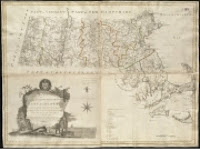
In 1794 Carleton got the Massachusetts legislature’s approval for an “Accurate Map of the Commonwealth of Massachusetts,” shown above. Not that that approval came up with all the cash he needed. Carleton had to raise most of his financing from private subscriptions. Then, the lecture description says, “The complex undertaking became frought with problems when not all Massachusetts towns were able to complete accurate new surveys of the lands within their bounds.” Eventually Carleton did publish a map, of course. But how accurate was it?

Bosse is Librarian of Historic Deerfield and the Pocumtuck Valley Memorial Association, and curator of maps at Historic Deerfield. He was previously a curator at the Clements Library and Newberry Library, and he published articles in Mapping Boston (M.I.T. Press, 1999), the journal Cartographica, and the online journal Coordinates.

This lecture is scheduled to start at 2:00 P.M. It’s free and open to the public.

Sunday, June 01, 2014

“Building a Handsome Church” in Essex County, 7 June

On 7 June, the Peabody Essex Museum in Salem will host a symposium titled “Building A Handsome Church”: St. Michael’s, Marblehead, 1714. It will bring together “historians, architects, architectural historians, ecclesiastical scholars, and the general public” to discuss the 300-year-old Anglican church and its place in Marblehead history. St. Michael’s is the oldest Episcopal congregation in New England holding services in its original building.

The chair of the symposium is Donald R. Friary, President of the Colonial Society of Massachusetts and historian of religion and architecture in colonial America. Speakers include:
  • Robert L. Howie, Jr., St. Michael’s Church Historian emeritus and Chair of the Tercentenary Committee.
  • Stuart P. Feld, President, Hirschl & Galleries, Inc., on “St. Michael’s Marblehead—From Widener Library at Harvard to London and Amsterdam and Back.”
  • Christopher P. Magra, Associate Professor of History, University of Tennessee, on “‘Extravagance, Intemperance, Negligence in Religion, and Disorderliness’: Marblehead, the Early Years.”
  • David D. Hall, Bartlett Research Professor of New England Church History, Harvard Divinity School, on “Reliving the Past or Fashioning a Different Future?: Anglicanism and Puritanism in Eighteenth-Century New England.”
  • Carl Lounsbury, Senior Architectural Historian, Colonial Williamsburg Foundation and College of William and Mary, discussing “The Church of England’s First Colonial Buildings: Virginia, 1608-1714.”
  • Louis P. Nelson, Associate Professor of Architectural History and Associate Dean for Research and International Programs, University of Virginia, who will speak about “St. Michael's, Marblehead: A Case Study in Atlantic Anglicanism.”
A panel of three local historians—Howie, social and cultural historian Judy Anderson, and town historian Bette Hunt—will help place the St. Michael’s experience in the context of the Church of England throughout colonial America.

This symposium will run from 9:00 A.M. to 5:00 P.M. The $75.00 registration fee includes a box lunch and afternoon tours of the church, including access to its crypt, belfry, and archives. There will be a reception at the end of the day. There’s limited space, but registrations might still be available through the St. Michael’s Church Tercentenary year website, which also has information on concerts, lectures, community events, and special religious services.

Saturday, May 31, 2014

Talk on German Prisoners in Washington, D.C., 4 June

On Wednesday, 4 June, the Society of the Cincinnati’s Anderson House museum and library in Washington, D.C., will host a talk by Daniel Krebs on “German Prisoners During the American Revolution.” Out of about 37,000 Crown soldiers hired from German states, about 5,400 became prisoners of war in America.

The event description says:
Drawing primarily on research in German military records, Dr. Krebs brings to life the soldiers’ experiences in captivity by discussing prison conditions in detail and addressing both the American approach to war prisoners and the prisoners’ responses. The talk will last approximately 45 minutes, with time for questions at the end.
Krebs is an associate professor of history at the University of Louisville. After his talk he’ll sign copies of his book, A Generous and Merciful Enemy: Life for German Prisoners of War During the American Revolution.

This HistoryNet review of his book says:
Krebs’ principal conclusion is that the German prisoners of war came to play a significant role in the American hinterland. For one thing they continued to receive pay from their units, and their dependence on purchasing sustenance from outside sources, access to which their captors made readily available, fueled the local economies. Over the course of the conflict German prisoners were hired to work on farms in Pennsylvania, at saltworks in Maryland and ironworks in New Jersey.

They were also used as political instruments against communities reluctant to support the revolution, as happened in Lebanon, Pa., in 1777 and 1778, when an influx of hundreds of German prisoners prompted local Moravians to change their stance from pacifism or loyalty to the crown to dependence upon the militia and Continental Army guards for protection. Great numbers of those same captives married local women and ended up settling permanently in the States after the war.
This talk will start at 6:00 P.M., and is free and open to the public.

Friday, May 30, 2014

The Second Amendment’s Historic Moment

In considering the Second Amendment, I think it’s valuable to recognize the unusual historical moment in which it was enacted.

Whig political philosophy had long warned against a large “standing army”—i.e., the sort of military we now have—as likely to oppress people’s natural rights during peacetime. The Whig view of the world saw a broad-based militia–something we don’t have now—as the obviously superior alternative.

At the end of the Revolutionary War, it looked possible for the U.S. of A. to achieve that Whiggish vision. Spain and France were allies, and Britain had agreed to peace terms. Spurred by a lousy economy, the Congress disbanded its Continental Navy and sold off all its ships.

On 2 June 1784, the Congress also ordered the Continental Army to disband, stating (in language proposed by Elbridge Gerry) that:
standing armies in time of peace are inconsistent with the principles of republican government, dangerous to the liberties of a free people, and generally converted into destructive engines for establishing despotism.
The next day, it established a single federal regiment consisting of “eight companies of infantry, and two of artillery,” under a lieutenant colonel. That was the entire military strength of the government of the U.S. of A. in the late 1780s.

The Constitutional Convention wrote a document to strengthen the central government, and state ratifying conventions responded with Whiggish warnings. Look at the clauses against standing armies in Virginia’s ratification, for example. And that’s when a national army barely existed. When Congress drafted the Second Amendment in 1789, the country truly was depending on “a well-regulated militia” for its defense and was confident that was almost all it needed.

But the country also wanted land. Americans moving west quickly came into conflict with the Native nations allied as the Western Confederacy. The U.S. regiment and hundreds of local militia moved against those communities, but in a series of fights in October 1790 that American army was soundly defeated.

The Congress was still committed to the idea of a small standing army, authorizing a second federal regiment but only at low pay and only for six months. Once again American regulars moved west, along with a larger militia force. And on 4 Nov 1791 they were wiped out. Out of about 1,000 fighting men, nearly 900 were killed, wounded, or captured. One-quarter of the small U.S. Army was gone overnight.

President George Washington was already skeptical about militia systems. During the Revolutionary War he had argued long and hard for a stronger federal army and longer enlistment periods—i.e., a standing army. In 1792 the Congress started to expand the U.S. Army and also passed laws exercising more control over the state militias. America’s full Whiggish experiment was over. But the Second Amendment (and the rest of the original Constitution and Bill of Rights) are products of that brief period.

[The image above appears in George Ironstrack’s recent essay on the 4 Nov 1791 battle from the Myaamia (Miami) perspective.]

Thursday, May 29, 2014

William Hogeland on the Second Amendment

With the American public once again focused for a time on how our policies enable crazy men to easily obtain guns, William Hogeland, author of The Whiskey Rebellion: George Washington, Alexander Hamilton, and the Frontier Rebels Who Challenged America’s Newfound Sovereignty, wrote a thought-provoking editorial for Alternet arguing that debates over the U.S. Constitution’s Second Amendment are bound to end in a muddle:
The realpolitik in which the Second Amendment was framed, during the first U.S. Congress of 1789, involves some unedifying but illuminating features. The amendment was a response to the federal government's power over state and local militias, as set out in Article I, Section 8, of the Constitution. That provision had been among the most hard-fought at the Constitutional Convention of 1787. Delegates committed to state sovereignty feared—rightly enough—that if the federal government were empowered to control the state militias, states would lose sovereignty.

In that elemental debate lay the beginning of a perennial American disingenuousness regarding arms and rights. Delegates led by James Madison wanted to create a national government, directly acting on and protecting all citizens, throughout all states. To achieve it, they had to play down how entirely they wanted it, how nearly utter the states’ loss of power would be. Madison’s convention notes show Madison himself, along with other nationalists, minimizing the impact of the federal militia power in order to soothe certain delegates’ fears of losing state sovereignty.

As we know, the nationalists got what they wanted. Despite concessions to their opponents’ ideas about state sovereignty, we became a nation. And critical to that achievement was the constitutional provision giving the federal government control of states’ military institutions.

So when amending the Constitution, Madison continued to prevaricate. Former antifederalists in Congress and the state legislatures still resented the federal power to control militias; they were hoping to use the amendment process to regain some military control and thus retain some sovereignty. In the Second Amendment, Madison tried to defeat those hopes by placating them without really addressing them. The amendment gestures vaguely at state sovereignty in a way intended to make little practical sense. . . .

We argue fiercely today about the intended relationship between the famous opening phrase (“A well regulated militia, being necessary to the security of a free state,”) and the famous main clause (“the right of the people to keep and bear arms, shall not be infringed”). But it’s fruitless to try to nail down that relationship, to hope to prove for good and all that the opening phrase is or is not a preamble, or that a preamble does or does not determine the meaning of a main text, or that a “being” phrase means something different from or identical to a “whereas” clause.

The sentence is weak. The weakness is deliberate.
Madison was, after all, one of the republic’s smartest politicians. He steered the amendment-writing process as much as he could so the results didn’t impede too greatly on his vision for the federal government at that time. It’s striking how little resemblance there is between the amendments proposed by state ratifying conventions in 1787-88 and those that came out of the first federal Congress. (Here, for instance, are the assurances New York wanted.)

TOMORROW: The Second Amendment’s historic moment.

Wednesday, May 28, 2014

The Mysteries of Dido Belle’s Portrait

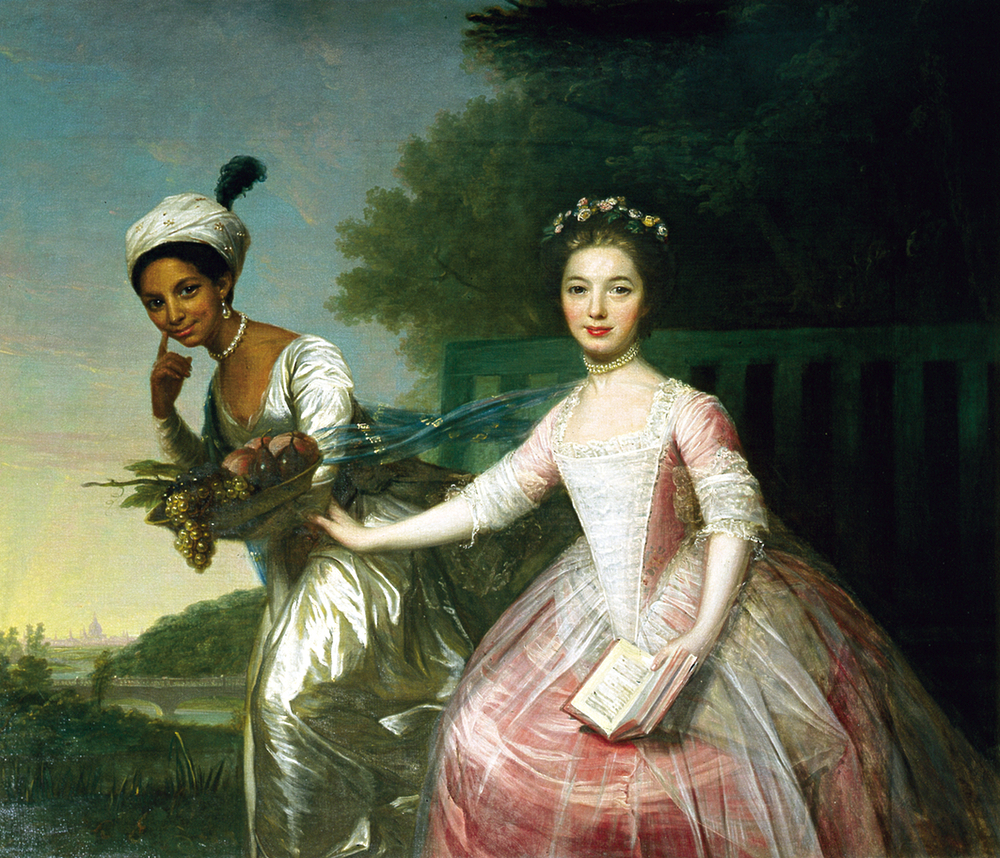
Yesterday’s Guardian contained an article by Stuart Jeffries about the painting of Dido Elizabeth Belle and Lady Elizabeth Murray that inspired the new movie Belle.

This painting was once attributed to Johann Zoffany but is now considered to be by an unknown artist, making its interpretation harder. In particular, the article quotes differing theories on why Dido is posed the way she is:
Why does Dido look as if she’s rushing past her cousin on an errand? For [novelist Caitlin] Davies, one possibility is that this started as a single portrait. “It looks like the portrait of Elizabeth came first and then someone wanted the two young women together, so Dido was added. The touch between them can seem awkward – is Elizabeth pushing her away? But perhaps the painter just kept Elizabeth as she was, with one arm held out.” . . .

Mario Valdes, a US historian of the African diaspora, suggests that her turban may be part of an attempt to Indianise Dido. Between 1770 and 1771, he points out, her father served as His Britannic Majesty’s Minister Plenipotentiary in India. What does that have to do with Dido’s gesture? “One interpretation is that she is pointing to the difference in complexion between herself and her cousin,” says Valdes. “But I would argue that a far more sophisticated approach is at play.”

There is a sculpture that shows Krishna in a similar pose, Valdes explains, and a story that he was once slapped by a female deity for taking on the appearance of her sister and her husband. When this sister tried to console him, he smiled, pointed to his bruised cheek, and exclaimed: “She has shown that all three of us are one and the same.” Valdes says: “What Dido’s pose apparently proclaims, therefore, is that she and her cousin share the same humanity and innate worthiness.”
As the article notes, there’s no evidence to suggest the artist or other people connected to the painting knew about that Hindu myth. Dido Elizabeth Belle was not apparently close to her father, with his Indian connection. Furthermore, it was already common for British artists to depict black servants in turbans.

The article mentions how some souvenirs of the painting crop it to show Dido alone. Once her upper body is tilted upright, she appears rather like many other women in period portraits, posed as if seated behind a symbolic platter of fruit. Other paintings show women touching their faces in the same manner.

The dual portrait thus seems to be two rather standard formal portraits of young women, combined in a way to show the social (and ethnic) divide between them yet also depicting their friendship. The artist undoubtedly knew the trope of placing a black servant in the background of a portrait as a generic symbol of wealth, but (was) pushed into unexplored territory of depicting a black individual treated fondly as a member of the family. Hence Lady Elizabeth reaching back to touch Dido’s arm. The result is awkward, but the unknown artist was doing something without precedent.

(The Guardian article misstates the name of Thomas Hutchinson, the former Massachusetts governor quoted here about Dido Belle.)

Tuesday, May 27, 2014

The Challenge of Carter’s Grove

I first visited Colonial Williamsburg a little over twenty years ago. [It appears that folks in Virginia think they had something to do with the Revolution as well. Who knew?]

One of the things I most enjoyed about that trip was visiting Carter’s Grove, a plantation mansion some distance from the restored village. And a big part of that site’s appeal was figuring out the story behind it.

It seemed clear that Colonial Williamsburg acquired that property in 1969 only because one of the Rockefellers on its board insisted. Other folks in the institution felt saddled with this white elephant of an estate, its main building so altered from its original in the early 1900s that it was impossible to interpret it accurately as a colonial structure.

But then it turned out that the grounds included one of the most significant archeological sites of the British settlement of North America: Martin’s Hundred, or Wolstenholme Town. Colonial Williamsburg archeologists ended up doing many years of work there, and its curators created a museum for the artifacts and preserved the site.

As for the house itself, it was still an interpretive headache. The main outbuildings had been connected to the mansion and the whole house expanded, so it no longer had the size or profile of a genuine Georgian home. When I went, Colonial Williamsburg had come up with three solutions. An outdoor tour highlighted those architectural changes. The grounds had been equipped with barns, enclosures, and livestock to show the lives and work of enslaved farmworkers.

Finally there was the interior of the house, interpreted to display the Colonial Revival and how Americans thought about and celebrated the Revolutionary period in the early 1900s. But that proved a challenge for visitors. Most tourists came wanting to see how Revolutionary America looked. Being shown how our recent ancestors thought Revolutionary America looked, or should have looked, or would have looked if those people had had the benefit of iceboxes and sewing machines, was just confusing. In 2003 Colonial Williamsburg shut the site to figure out what it was doing.

Four years and one hurricane later, the organization sold the mansion to a dot-com millionaire for over $15 million, most in a loan to the new owner. However, as the Washington Post reported, he never moved in. Within a few more years he announced that he couldn’t keep making payments on the loan. There was a lot of concern about whether the house was falling apart.

Government agencies intervened, and a trustee was appointed to handle the property. This spring the Carter’s Grove mansion went back on the market. And when the auction ended last week, the winning bid was from…Colonial Williamsburg.

According to the modern Virginia Gazette, “Colonial Williamsburg bid $7.4 million, which is equivalent to the balance it is owed on the property.” Thus, the institution received about $7 million and ended up with the same property as before, but probably has to spend a lot to restore it. And it’s still unclear how to interpret the property for the public.

Monday, May 26, 2014

Mum Bett Presentations at Royall House, 31 May

On Saturday, 31 May, the Royall House and Slave Quarters in Medford will host two performances of “One Minute’s Freedom: The Story of Mum Bett” by storyteller Tammy Denease.

This presentation introduces children aged seven and up to Elizabeth Freeman, a woman who helped end slavery in Massachusetts by suing for her freedom in 1781. Her lawyer was Theodore Sedgewick (1746-1813), and she worked for him after becoming free. In 1853 Bentley’s Miscellany published an essay by his daughter Catherine Sedgewick which described Freeman this way:
Mum-Bett’s character was composed of few but strong elements. Action was the law of her nature, and conscious of superiority to all around her, she felt servitude intolerable. It was not the work—work was play to her. Her power of execution was marvellous. Nor was it awe of her kind master, or fear of her despotic mistress, but it was the galling of the harness, the irresistible longing for liberty. I have heard her say, with an emphatic shake of the head peculiar to her: “Any time, any time while I was a slave, if one minute’s freedom had been offered to me, and I had been told I must die at the end of that minute, I would have taken it—just to stand one minute on God’s airth a free woman—I would.”

It was soon after the close of the revolutionary war, that she chanced at the village “meeting house,” in Sheffield, to hear the Declaration of Independence read. She went the next day to the office of Mr. Theodore Sedgewick, then in the beginning of his honourable political and legal career. “Sir,” said she, “I heard that paper read yesterday, that says, ‘all men are born equal,[’] and that every man has a right to freedom. I am not a dumb critter; won’t the law give me my freedom?” I can imagine her upright form, as she stood dilating with her fresh hope based on the declaration of an intrinsic, inalienable right. Such a resolve as hers is like God’s messengers—wind, snow, and hail— irresistible.
This program about Freeman is supported by Historic New England and the Medford Arts Council. The performances will start at 11:00 A.M. and 3:00 P.M. and last about 45 minutes. The mansion and slave quarters will be open to visitors in between. Admission is free, but registration is required; email Programs@RoyallHouse.org for tickets.

Sunday, May 25, 2014

Discovery in the Archives—What Does That Mean?

I’m hoping to visit Britain’s National Archives this week, so it seems like a good time to note this interesting blog post from Jo Pugh, on staff there, about what it means to “discover” documents in an archive:

In January of this year, the Guardian reported that a researcher had ‘chanced’ upon unpublished letters by Mary Shelley. The researcher called it ‘a lucky find’ but their luck was a matter of preparation meeting opportunity: the letters were in Essex Record Office and had been spotted online (the Guardian called it ‘an unpromising website’ which is just mean). The implication was that this was discovery via Google. Again the comments were lively: ‘funny sort of “discovery” when the letters were in a public record office, have been catalogued by an archivist, and put in an online search engine’, wrote Technopeasant. ‘This was catalogued and described and ready for the researcher without any particular effort. Any credit for “discovery” goes to the archivist’, insisted Kate 2468.

But I don’t agree. What lost cities and found documents have in common is that someone other than their creators (or residents) comes to understand that they exist. Joshua Ranger has suggested a thing ‘cannot be lost if no one is missing it’ and went as far as to argue that tales of ‘discovery’ harm the archival profession because they imply we’re not doing our jobs. This seems rather alarmist. Does interest and excitement cause harm? The implication in his argument is that if archivists weren’t goofing off drinking tea and building state of the art digital preservation environments we’d see to it that everything could be found, is permanently available and then nothing would be discovered.

I have to say that this thought depresses me. The day all collections are completely digitised (to do this in Europe would cost billions so I’m not panicked) will be simultaneously cool and a bit dull. But it won’t stop discovery because discovery is an intellectual process. People will still find new knowledge in collections even if they aren’t physically discovering new documents. Because it isn’t objects, documents or films which change, it is our state of knowledge about them. This is true of a lot of discovery – gravity was working perfectly well before Isaac Newton noticed it.
Back in 2011, I was happy to refer to my finding a broadside that matched the description of what was in Christopher Seider’s pocket when he died as a “discovery.” Of course it was a discovery for me since I’d been looking for such a document for years. As N.B.C. used to advertise their Friends reruns in the 1990s, “If you haven’t seen it, it’s new to you!”

But of course the existence of that document wasn’t a discovery to whatever fine archivist had examined and accurately catalogued it. I made that point last year in regard to an unpublished poem by Jupiter Hammon that a professor “discovered” by having his students ask university librarians for available information on Jupiter Hammon manuscripts.

So what can constitute a widely significant “discovery” of a properly catalogued document? I think it lies in such a document’s historical significance. Of course, that significance might be debatable. And the distinction between discovering a document and spotlighting its importance can easily be lost in university press releases or news reports.

Saturday, May 24, 2014

Tristam Shandy in Its Time and In Our Time

B.B.C. Radio’s In Our Time podcast (one of my favorites) tackled Laurence Sterne’s landmark novel Tristram Shandy this spring. The book was a popular sensation after it started to appear in 1759 and still feels far ahead of its time.

Among the novel’s fans in America was Nathanael Greene. He made allusions to the book in his letters, and he imitated characters. According to Greene’s grandson and biographer:
his brothers, to the day of their death, could never mention Tristram Shandy without dilating upon the exquisite comicality of his impersonation of Dr. Slop.
In July 1775, Greene became a brigadier general in the Continental Army assigned to serve under Gen. Charles Lee. Lee was not only the most respected military professional in the Continental Army, but he was also a good friend of Sterne. The two men had even published verse together. Imagine Greene’s feelings about getting a new boss like that.

Friday, May 23, 2014

Mrs. General Washington

This image comes courtesy of the Library of Congress. The New York Public Library states that it appeared in the 1 Apr 1783 issue of The Rambler’s Magazine; or, The annals of gallantry, glee, pleasure, and the bon ton; calculated for the entertainment of the polite world; and to furnish the man of pleasure with a most delicious banquet of amorous, Bacchanalian, whimsical, humorous, theatrical and polite entertainment. What we today call a “men’s magazine.” So of course it showed George Washington in a dress.

Thursday, May 22, 2014

Popping Up on the Freedom Trail: A Kickstarter Campaign

Denise D. Price is an artist and paper engineer in Cambridge who’s started a Kickstarter campaign for The Freedom Trail Pop-Up Book.

The book promises “16 architecturally accurate pop ups, profiles of each of the five historic weathervanes along the trail and written history about landmarks like the U.S.S. Constitution and the Old South Meeting House.” Other highlights:
  • A fully three dimensional, two-page pop-up of the Massachusetts State House
  • Old Corner Bookstore illustration with moveable sign 1717 to 1826
  • A pop-up interpretation of Paul Revere’s [actually Henry Pelham’s] etching of the Boston Massacre
The Freedom Trail Foundation has permitted Price to use its brand for this project.

Pop-up books have to be assembled by hand, making them particularly expensive. Usually this work is done in Latin America; fifteen years ago, Cali, Colombia, was a worldwide center of the field, and it might still be.

Price has budgeted the first printing of her book, consisting of 5,000 copies, to cost $52,500, and that’s her Kickstarter goal. The campaign runs through the end of June.