J. L. BELL is a Massachusetts writer who specializes in (among other things) the start of the American Revolution in and around Boston. He is particularly interested in the experiences of children in 1765-75. He has published scholarly papers and popular articles for both children and adults. He was consultant for an episode of History Detectives, and contributed to a display at Minute Man National Historic Park.

Subscribe thru Follow.it


•••••••••••••••••


Wednesday, June 07, 2017

Wheels and What They’re Worth

Elisabeth Meier of the Winterthur Program in American Material Culture just wrote on learning about the art and mystery of the wheelwright at Colonial Williamsburg:
I’d already been passed by several carriages in Williamsburg, and each time, I’d had no idea how much specialized knowledge was rolling by under the bright coats of paint—which, incidentally, the wheelwrights also mix. Underneath that paint, the wood is specially chosen for the task it serves. The hubs are elm, because the tight, twisted grain resists splitting even when the spokes are driven in. Colonial wheelwrights also used oak and black gum. The spokes themselves are oak, a hard, durable wood that rives well and, therefore, can be shaped quickly. The fellies, which make up the wooden rim of the wheel, can be oak, ash, or elm. These are protected from the stress of passing over rough roads by iron rims that can be replaced relatively easily, thus prolonging the life of the wheel and the minimizing the expense of maintaining a vehicle.

…eighteenth-century wheels were beautifully engineered so that use would strengthen rather than weaken them. To start with, the mortises that the spokes in the hub are cut on an angle, so that the joint gets progressively tighter as the spokes are driven in. But this alone wouldn’t save a wheel from loosening under the constant jostling from horses and uneven roads. To avoid that, wheels have a concave shape, or ‘dish,’ built into them. The dish helps focus the forces on the wheel inwards, so that the joints would be driven together over time rather than being shaken apart. However, this only works if the wheel touches the ground at a right angle, meaning that the hubs also have to be angled. The result gives carts and carriages something of a flamboyant look—something I will no longer interpret as artistic license!

Wheelwrights were essential craftsmen in any community, and their craft supported much of the mobility that enabled the consolidation of England, and later America, in the eighteenth century. As a result the huge demand for wheels, wheelwrights on both sides of the Atlantic could count on purchasing timber that had been pre-processed into rough hubs, spokes, and fellies, considerably cutting down on the labor needed to shape a wheel. However, processes that were efficient for wheelwrights were often at odds with the needs of newly empowered governments and the infrastructure they were beginning to build. Public roads were a case in point. For wheelwrights, it was cheapest and easiest to nail on an iron rim in pieces, or strakes, using large bolts, but these bolts were tough on road surfaces. Continuous iron rims, or tire irons, were easier on pavement, but it took considerably more fuel and space to heat them evenly enough to fit around a wheel.
I gained a new respect for wheels in researching The Road to Concord. In 1774, the Massachusetts Provincial Congress’s Committee of Safety and Supplies set out to build an artillery force. Between politically supportive merchants, shore batteries, and the Boston’s militia gunhouses, they gathered dozens of cannon by early the next year. But those guns needed field carriages to roll across the countryside and maneuver around battlefields. And field carriages needed good, strong wheels.

As Meier’s essay shows, wheels were complex artifacts requiring skilled labor. Gun carriages were specialized vehicles, assembled by blacksmiths from iron and wood. What’s more, many of the cannon were damaged and needed special mounting. All that work was expensive. As a result, putting guns on carriages proved to be a chokepoint for Massachusetts’s Patriot committees, both at the provincial level and for towns that had decided to form their own artillery companies.

And that made the effort vulnerable. When Dr. Benjamin Church first sent intelligence to Gen. Thomas Gage, his information was mostly about blacksmiths making gun carriages—which blacksmiths and where. Days later, Lt. Col. Alexander Leslie nearly intercepted a bunch of cannon at Robert Foster’s smithy in Salem, where they were being mounted. When fighting finally broke out on 19 Apr 1775, the provincials didn’t take any cannon into battle—perhaps because none was fully ready.

Tuesday, June 06, 2017

Archeological Discoveries at Valley Forge

Atlas Obscura just reported on a striking discovery at Valley Forge. Specifically, on property next to Valley Forge National Park, when Daniel M. Sivilich (author of Musket Ball and Small Shot Identification, discussed here) was overseeing an archeology dig for the Battlefield Restoration & Archaeological Volunteer Organization (B.R.A.V.O.).

Quickly, one of the volunteers, who use metal detectors to locate artifacts and guide excavations, located a nine-pound cannonball hidden underneath a walking path. “He was so excited,” says Sivilich. “But he was the man of the day for about five minutes.” Bill Hermstedt, a long-time volunteer and charter member of BRAVO, also found something new—a bayonet. And then another. The signal from the detector told him that there was a lot more metal down there.

When archaeologists methodically opened the ground, they found a cache of 30 bayonets, stacked together—a remarkable find for a Revolutionary War encampment.
Though the bayonets stand out among the artifacts discovered at this site, the archaeologists and BRAVO volunteers made other intriguing finds there as well. There was a musket ball that had been turned into a die with Roman numerals on its faces, and a particularly rare U.S.A. uniform button featuring stylized lettering and the year 1777. Only a handful of other such buttons have been found in the archaeological record.
The photo above was taken by Glen Gunther, and comes courtesy of B.R.A.V.O. and Atlas Obscura.

Monday, June 05, 2017

Colonial Newspaper Advertising Rates

In 1884 the U.S. Census Office published a report called “The Newspaper and Periodical Press” by S. N. D. North, who would become a leading statistician.

That essay offers answers to some difficult questions about the business of newspaper publishing in colonial America, starting with how much it cost to insert an advertisement:
In the colonial press it was rarely that a newspaper made any publication of advertising rates, it being customary to announce, instead, that advertisements would be “taken in” at “reasonable rates” or a “moderate price”. The inference is fair that the early printers were glad to get what they could for this kind of business, and it is certain that no such thing as a fixed standard of advertising rates was ever arrived at among them.

Some illustrations may be given: The Virginia Gazette announced that “advertisements of moderate length would be inserted for 3 shillings the first week and 2 shillings each week after”. [I looked in William Park’s Virginia Gazette in 1737, William Hunter’s paper of the same name in 1751, Purdie and Dixon’s rival paper of the same name in 1766, and William Rind’s rival paper in 1771—I found the same price information in all of them.]

The Maryland Gazette [in 1752] promised to publish “advertisements of moderate length for 5 shillings the first week and 1 shilling each time after, and long ones in proportion”. The New Jersey Gazette, as late as 1777, inserted “advertisements of moderate length for 7 shillings 6 pence for the first week, 2 shillings 6 pence for every continuance, and long ones in proportion”. 
Only in Philadelphia before the revolution was advertising a source of considerable profit to publishers. In both Bradford’s and [Benjamin] Franklin’s [Pennsylvania Gazette] papers it became such.
It’s not clear how North reached that last conclusion about profitability. I’m not even sure what North meant by “Bradford’s” paper since there were two printers in colonial Philadelphia named Bradford (Andrew and his nephew William) and they each published a newspaper (the American Weekly Mercury and the Pennsylvania Journal).

Knowing that the phrase “moderate length” was standard in announcements of advertising prices allowed me to find some additional examples from colonial American newspapers:
  • Hugh Gaine’s New-York Mercury, 1756: 5 shillings.
  • William Weyman’s New-York Gazette, 1759: 5 shillings.
  • John Holt’s New-York Journal, 1766: 5 shillings first week, 1s. for each further.
  • John Dunlap’s Pennsylvania Packet as announced in other newspapers, 1771: “Three Shillings each for one week, and One Shilling for each continuance”
  • John Carter’s Providence Gazette, 1771: “(accompanied with the Pay)…three Weeks for Four Shillings Lawful, and Ninepence for each Week after”.
  • James Davis’s North-Carolina Gazette, 1775: 3s. the first week, 2s. for each further week, same as the Virginia Gazette.
  • Samuel Loudon’s New-York Packet, 1776: 5s. for four weeks.
And what about Boston? When the Boston News-Letter was launched in 1704, its publisher promised advertising rates “from Twelve-Pence to Five Shillings, & not to exceed.” That’s a big range, with no statement about the size of ad or how long it would run. And I couldn’t find any Boston newspapers publicizing their advertising prices for the next seventy-two years.

UP AHEAD: More advertising rates.

Sunday, June 04, 2017

Studying the Settlement of Nova Scotia

The L.R. Wilson Institute for Canadian History recently announced the winner of its first Viv Nelles Essay Prize for best paper in the field.

The honoree is Alexandra Montgomery, graduate student at the University of Pennsylvania, for “Philadelphia’s Plantations: The Great Nova Scotian Land Boom and Reimagining the British Empire Between the Wars, 1763-1775.”

Montgomery explained her research in this blog posting:
As an American born kid growing up in Halifax, the question of why that chunk of land stayed British while the rest of the colonies to the south declared independence was something of a puzzle. I became even more confused when I learned that most of the people who lived there at the outbreak of the Revolution were New Englanders, a group of people who my trips to Boston and Connecticut to visit family had convinced me had been waiting to rebel practically since the Mayflower made landfall.

As I got older and started to study the history of North America more seriously, my understandings grew much more nuanced. But I discovered that many historians puzzled over the same problem I had. It turned out that there were many theories for Nova Scotia’s loyalty: a supposed culture of neutrality, a lack of connections to the rest of the continent, a heavy British military presence, and Anglo Nova Scotia’s markedly different relationship to the imperial center have all been cited as possible explanations.

Yet, in my own work I’ve become more and more interested in a slightly different question. What kinds of alternate futures did people imagine for the region? What did people—British, French, and Indigenous—think and hope was possible?

I want to take the opportunity of this blog post to explore these questions through a perhaps unlikely figure, Alexander McNutt. McNutt was born in Ulster, grew up in backcountry Virginia, and gained notoriety in the 1760s as a promoter and land agent working in and around Nova Scotia. McNutt was responsible for bringing several hundred white Protestant families into the colony at a time when such settlers were being courted by the province and the Board of Trade.

McNutt’s plans, however, were much bigger: he claimed to have contacts throughout North America and Europe, an army of agents, and contracts with thousands of prospective settlers. McNutt talked his way into massive reserves, and then set off a craze in Nova Scotian lands in Philadelphia which roped in the likes of Benjamin Franklin and Anthony Wayne. At the height of his influence, on one day in 1765 he and his associates were granted nearly 1.5 million acres of Nova Scotian land. Yet by the end of the decade his career and his finances were in tatters and his grants were revoked.
When war broke out in North America, McNutt sided with the rebellious American colonies, corresponding with the Continental Congress about bringing Nova Scotia into their coalition. He arrived in Massachusetts in 1778. But being on the winning side of the war meant McNutt lost the settlement he had organized to the north.

Saturday, June 03, 2017

“Revolutionary War National Parks” Panel in Lexington, 7 June

On Wednesday, 7 June, I’ll be part of a panel discussion in Lexington on “Revolutionary War National Parks: Treasures Worth Protecting in Massachusetts.” This event is co-sponsored by the National Parks Conservation Association, the Lexington Chamber of Commerce, and the Pew Charitable Trusts.

The evening will start with a screening of the N.P.C.A.’s short film on the assets at Minute Man National Historical Park and other Massachusetts Revolutionary sites, including Longfellow House–Washington’s Headquarters in Cambridge.

The discussion that follows will focus on the historic and economic importance of Revolutionary War national parks and the benefits they bring to local communities.

The moderator for that discussion will be Jayne Gordon, a public historian who has led education and preservation efforts at many area sites and organizations. In addition to myself, representing the Friends of Longfellow House–Washington’s Headquarters, the panelists will be:
  • Prof. Bob Allison, Suffolk University and author of numerous books
  • Paul O’Shaughnessy, Friends of Minute Man National Historical Park and longtime British army reenactor
  • Prof. Bob Gross, formerly of the University of Connecticut and author of The Minutemen and Their World
This free event is scheduled to run from 5:30 to 7:30 P.M. at the Cary Memorial Library in Lexington; here are directions. Light refreshments will be available. To register for this event, go to this page.

Friday, June 02, 2017

The French Lady Who Discomfited John Adams

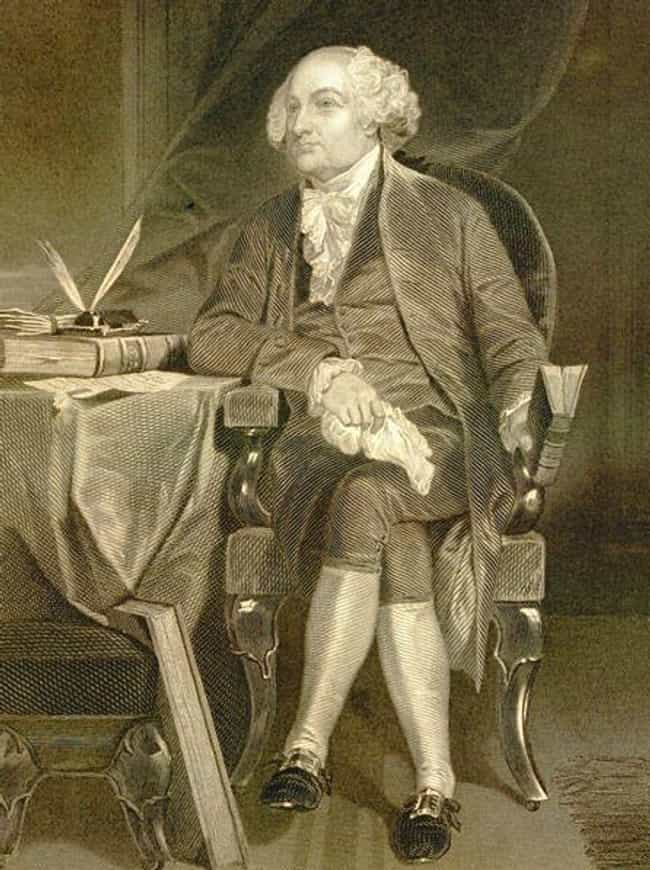
As I related yesterday, in April 1778 a French lady disconcerted John Adams by asking him how Adam and Eve knew how to have sex.

When he recorded that experience decades later, Adams identified his questioner simply as “One of the most elegant Ladies at Table, young and handsome,…married to a Gentleman in the Company.”

But evidently he told his wife Abigail the same story when he went home to Braintree for a few months the following year. Because on 13 Nov 1780 Abigail wrote back to him:
I recollect your story to Madam Le Texel upon the Nature and power of Attraction and think it much more probable to unite Souls than Bodies.
The Adams papers don’t mention any couple named “Le Texel.” But the editors of those papers note that at Bordeaux Adams spent a lot of time with Pierre Texier or Le Texier, a merchant with Amsterdam connections. Indeed, on 3 Apr 1778 Adams and Texier had a long discussion about America’s prospects as a nation.

This genealogy site says that Texier’s wife at that time was the former Suzanne François. They had married in Holland in 1767 and had had at least four children when Mr. Adams came through Bordeaux. So the woman who disconcerted John Adams with her question was Mme. Suzanne Texier.

Incidentally, the only surviving child of Pierre Texier’s first marriage, daughter Jeanne, married in 1785 at age twenty to an American named Jonathan Jones. Jones’s mother was a Mifflin from Philadelphia, where he had been born in 1748. Settling in Bordeaux, he wrote letters to Thomas Jefferson when he was the American minister to France and was still a respected merchant in 1811.

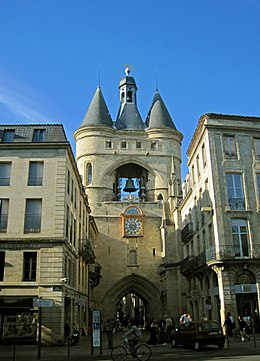
[The picture above shows the Grosse Cloche at Bordeaux; the belfry was built in the fifteenth century, but the bell was cast in 1775, just a few years before Adams and Jones arrived in the city.]

Thursday, June 01, 2017

John Adams and “the Art of lying together”

In his autobiography, John Adams recorded this anecdote under the heading of 2 April 1778. He was then in Bordeaux, France, on his first trip to Paris as a diplomat for the new U.S. of A.
One of the most elegant Ladies at Table, young and handsome, tho married to a Gentleman in the Company, was pleased to Address her discourse to me. Mr. [John] Bondfield [a Canadian who had joined the American cause] must interpret the Speech which he did in these Words “Mr. Adams, by your Name I conclude you are descended from the first Man and Woman, and probably in your family may be preserved the tradition which may resolve a difficulty which I could never explain. I never could understand how the first Couple found out the Art of lying together?”

Whether her phrase was L’Art de se coucher ensemble, or any other more energetic, I know not, but Mr. Bondfield rendered it by that I have mentioned.

To me, whose Acquaintance with Women had been confined to America, where the manners of the Ladies were universally characterised at that time by Modesty, Delicacy and Dignity, this question was surprizing and shocking: but although I believe at first I blushed, I was determined not to be disconcerted. I thought it would be as well for once to set a brazen face against a brazen face and answer a fool according to her folly, and accordingly composing my countenance into an Ironical Gravity I answered her “Madame My Family resembles the first Couple both in the name and in their frailties so much that I have no doubt We are descended from that in Paradise. But the Subject was perfectly understood by Us, whether by tradition I could not tell: I rather thought it was by Instinct, for there was a Physical quality in Us resembling the Power of Electricity or of the Magnet, by which when a Pair approached within a striking distance they flew together like the Needle to the Pole or like two Objects in electric Experiments.”

When this Answer was explained to her, she replied “Well I know not how it was, but this I know it is a very happy Shock.”

I should have added “in a lawfull Way” after “a striking distance,” but if I had her Ladyship and all the Company would only have thought it Pedantry and Bigottry.

This is a decent Story in comparison with many which I heard in Bourdeaux, in the short time I remained there, concerning married Ladies of Fashion and reputation.
Charles Francis Adams omitted the whole story when he edited his grandfather’s writings for publication in the middle of the Victorian era.

But John had shared the tale with his wife Abigail, and that lets us identify the French lady who so discomfited the Yankee diplomat.

TOMORROW: “One of the most elegant Ladies at Table.”

Wednesday, May 31, 2017

Breakfast with Charles Lee and Spado

On 31 May 1776, Samuel Johnston wrote a letter to his sister Hannah Iredell from Halifax, North Carolina, describing what people were talking about in that town.
Instead of politics, the general topic of conversation in this place is horses, a subject which, though apparently perfectly understood, and repeatedly talked over, seems never to be exhausted.

When I first came up Gen. [Charles] Lee and his dogs had entirely supplanted the horses; a number of little anecdotes are told of them—among others, the general will not suffer Spado to eat bacon for breakfast (a practice very general both with gentlemen and ladies in this part of the country) lest it should make him stupid—

this piece of satire, however, has not prejudiced him in their good opinion: he is considered as a very polite, well-bred, and sensible gentleman by every one I have heard speak of him, making allowances for a few oddities, which all great men are indulged in, and which were not so many as they had reason, from report, to expect.
The Continental Congress had put Charles Lee in charge of the Southern Department on 1 May. He wrote from Williamsburg, Virginia, that he planned to set out for Halifax on 12 May, and he was there from the 20th to the 24th. Then he moved further south, reaching Charleston in early June.

Lee took command in South Carolina, unifying the Continental and militia forces and strengthening the port’s defenses. On 28 June Gen. Henry Clinton’s redcoats tried to take Fort Sullivan and failed. Soon afterwards, the Congress declared independence from Britain. That was the high point of the American cause for several more years, and Lee shared credit with Gen. George Washington for driving the British army out of the thirteen new states.

Johnston’s letter preserves a moment when Americans were still enthusiastic about Gen. Lee, forgiving his oddities, such as those dogs, and calling him “a very polite, well-bred, and sensible gentleman.” That reputation wouldn’t survive his rivalry with Washington. In the next century it’s hard to find any American historian writing about Lee as positively as Americans in 1776.

Tuesday, May 30, 2017

Isaiah Thomas and a Woman of Pleasure

In 1786, the London bookseller Thomas Evans wrote to Isaiah Thomas, who had finally established himself as a printer in Worcester: “The Memoirs of a W. of P. which if you must have, [I] must beg you will apply to some of the Captains coming here, as it is an article I do not send my Customers if I can possibly avoid it.”

John Cleland’s erotic novel The Memoirs of a Woman of Pleasure, also known as Fanny Hill, had been published in London in 1748-49 by “G. Fenton,” otherwise unknown. On 11 Dec 1752, Garrat Noel advertised that book for sale in the New-York Gazette; its title appeared at the end of a long list of books that started with “Bibles.” By that point, however, Cleland and the reputed printers had been prosecuted for obscenity, and the publication driven underground.

Which is not to say Fanny Hill had disappeared—there were several British editions over the next thirty years, but most were still credited to “G. Fenton” since the authorities could do nothing to him.

Did Thomas ever get his hands on the book? He definitely did, as the American Antiquarian Society’s Past Is Present blog showed a few years back.
…the marbled boards…covering AAS’s copy of Jonas Hanway’s Advice from Farmer Trueman to His Daughter Mary…are actually unbound, unused copies of John Cleland’s quite vicious Memoirs of a Woman of Pleasure (popularly known as Fanny Hill).

Marcus McCorison, AAS President Emeritus, bibliographer, and author of an essay on early American printing of Fanny Hill, has pointed to the “curious juxtaposition of pious works” bound with such risquĂ© words. Perhaps an impertinent binder, with a supply of marbled Fanny Hill sheets at his side and a Hanway book to bind, covered this copy of Advice From Farmer Trueman. The binder may never have thought that the marbling would wear away, expose Cleland’s words, and reveal the binder to be quite the ironist.
That posting goes on to note that McCorison also found that “In 1814, AAS founder Isaiah Thomas bound many of his newspapers in pages from Fanny Hill.” So Thomas had copies.

McCorison argued that those papers came from an edition of the novel printed in northern New England around 1813, once again credited to “G. Fenton.” In 1817 the printer Anson Whipple of Walpole, New Hampshire, had 293 copies of Fanny Hill in stock. The following year, someone complained to the governor of New Hampshire about copies being sold there, and over the next few years authorities in Massachusetts and New York prosecuted half a dozen men for selling copies of the book.

And who had bankrolled Anson Whipple in his printing business, sent him stock to sell, and remained his senior partner until 1817? None other than his father-in-law, Isaiah Thomas. Some book historians therefore think Thomas was secretly involved in publishing Fanny Hill for American readers after all.

Monday, May 29, 2017

A Celebration in North Stratford, Connecticut

On 5 June 1783 the Vermont Gazette of Bennington published an “Extract of a letter from Stratford, in Connecticut, dated May 27, 1783.” It read:
Yesterday the inhabitants of North Stratford convened for a rejoicing for the memorable declaration of peace and American independence.

At one o’clock they assembled at the meeting house, where the Rev. Mr. [James] Beebee made an excellent prayer, before and after which singing was performed with great accuracy. Mr. LEWIS BEEBEE, a student in Yale College, delivered a very elegant Oration on the first discovery and settlement of this country, the occasion of the unnatural war and the various strategems made use of by the enemy to subjugate these states, after which a suitable anthem was performed.

The ladies were then invited to partake of a refreshment provided for them, and about 200 gentlemen and ladies took their seats. The militia performed many manoeuvres, and went through the prepared firing by platoons and street firings with great exactness, after which a stage was set in the midst of the concourse of people, and the following toasts were drank, viz.

1st. The United States in Congress assembled.

2d. General Washington, the Officers and soldiers under his command.

3d. Our faithful and illustrious allies.

4th. The friendly powers of Europe.

5th. The Governor and Company of the State of Connecticut.

6th. May the peace prove glorious to America and last forever.

7th. May tyranny and despotism sink, and rise no more.

8th, May war prove an admonition to Great Britain, and the present peace teach its inhabitants their true interests.

9th. The Navy of the United States of America.

10th, May our trade and navigation extend to both the Indies, and the balance in our favour.

11th, May the union of these American States be perpetual and uninterrupted.

12th, May the American Flag be a scourge to tyrants.

13th. May the virtuous daughters of America bestow their favors only on those who have courage to defend them.

14th. May Vermont be received into the federal union, & the Green Mountain Boys flourish.

After each toast a cannon was discharged. The greatest decency and decorum, was observed throughout the whole.
The item was signed “AARON HAWLEY, Toast-master.” (At least I think that’s the final word. The page from this newspaper that made it onto microfilm isn’t complete.)

Another description of the day, differing in wording, small details, and the order of two toasts, appears between quotation marks in Samuel Orcutt’s A History of the Old Town of Stratford and the City of Bridgeport (1886). Orcutt stated no source, but he might have quoted a Connecticut newspaper I haven’t located.

The toasts provide a snapshot of what that New England village—North Stratford became the town of Trumbull in 1797—hoped for as the Revolutionary War officially ended. The fourteenth toast for Vermont, and the letter sent there describing the event, reflect Connecticut’s close ties to that territory. Later historians have connected this late-May celebration with Memorial Day, but the emphasis is different.

(The photograph above shows the Joseph Plumb house in Trumbull, built around 1780.)

Sunday, May 28, 2017

“Curnul putnum Com & ordered us down”

Here’s the rest of Pvt. James Stevens’s account of his Andover company’s fight along the Chelsea shore on this date in 1775.

When we left Stevens on the night of 27 May 1775, the Royal Navy schooner Diana had run aground near the ferry landing on the north side of Boston harbor.
Sunday ye 28 this morning a bout day thay [i.e., British sailors] come with thare barjes to bord the sconer

Curnul [Israel] putnum Com & ordered us down to the whoife & we fired so that thay retreted back to the sloup

our men run down & fired [i.e., set fire to] the sconer & it burnt very fast

the slup begun to to of [“to tow off”]

in about three qurters of a our after it was sot on fire the magersene Blod up [give it a minute…it’ll come…“magazine blowed up”!] & blod out some plunder

thay fired from Nodles oiland on us sun about an our hy

we are retreted back to our packs & gout our Brekfust

the slups drad of to Boston

there was of our men wounded fore & non cild [“none killed”!]

after the fier was gon down the men went & got out the plunder out of the rack [“wreck”]

in the afternune there come down about fore hundred men to relieve us & there was of us about a hundred & twenty men of us

tords night thay got tems & cared a lode of to Cambridge

we staid all night

Munday ye 29 this morning we went down to the sconer & got out som more of the plunder we staed about while the afternune & then set of for Cambridg we got up to Cambridg about dusk being very much feteged
News of this small but clear victory arrived in Philadelphia just as the Continental Congress was considering the New England colonies’ invitation to take control of their army. The reports of Putnam’s aggressive leadership during the fight prompted the Congress to make him a major general, moving him above more senior colleagues such as John Thomas and Joseph Spencer. That caused kerfuffles for Gen. George Washington to sort out when he arrived in Cambridge in July.

As it turned out, the fight off Chelsea was the last Continental victory Putnam got to see. He remained with the army until he suffered a stroke in 1779, but he was never again present for a win.

Saturday, May 27, 2017

Pvt. James Stevens Goes into the Chelsea Fight

On 27 May 1775, the New England army went into their first sustained fight against the British military since the Battle of Lexington and Concord.

That skirmish has been overshadowed by larger and more consequential battles in the previous and next months. It was initially called the fight at Chelsea or the fight over Noddle’s Island, and decades later a local historian tried to elevate it to the Battle of Chelsea Creek.

Here’s the start of a battle report from Pvt. James Stevens of Andover, whose company fought from the mainland:
Saterday ye [27] this morning I was Cald on feteg

we went & workd in the forenune we Come hom to diner & there was a perty agoing of sumer [“a party going off somewhere”] but where I cant tel

we got redy to go & there Com a expres that the regerlers was a landing some said at miskit [“Mystic” or Medford] but we marcht to miskit & then we herd that thay was at Chelsy

we marcht very fast we got dow[n] within a quarter of a mile of the fery & then halted & our ofisers went to louk out to place the canon

thay went round by the water while thay come in sight of the sconer when as son as the regerlers [actually Royal Navy marines] saw our men thay fired on them

then the firing Begun on boath sides & fired very worm

there come a man & ordered us over a nol rit into the mouths of the [British] canon

we got on to the top of the nol & the grap shot & canon bauls com so thik that we retreted back to the rode & then marcht down to the fery

the regerlers shouted very much

our men got the canon & plast them & gave them tow or three guns sids and the firing set in so[me] masure & there was a terrabel cry a monst the regerlers

thay fired wonc & a wile all night

about ten aclok the sconer run on to the wais & stuk fast

there come a slup for hur relief

thay left the sconur
Of course, Royal Navy commanders was not happy about leaving H.M.S. Diana aground near the Winnimisset ferry landing. Stevens’s commanders rightly expected that the British would be back the next morning for their ship.

TOMORROW: The fighting continues.

Friday, May 26, 2017

Looking through Jefferson’s Eyes

Another provocative recent article about the eighteenth century is Maurizio Valsania’s “French Hovels, Slave Cabins, and the Limits of Jefferson’s Eyes” on the Oxford University Press blog.

Valsania, a professor of American history at the University of Torino, writes of Thomas Jefferson:
Jefferson’s powerful eyes constantly dissected and analyzed: especially for scientific reasons, Jefferson spied on people’s lives. He always wanted to see, and to see firsthand. During his famous tour of southern France and northern Italy in the spring of 1787, he saw examples of misery and wretchedness—especially where lower classes were concerned. He had entered the shacks of French peasants incognito. To peep into people’s dwellings was for Jefferson the best method to assess their identity and evaluate their circumstances. “You must ferret the people out of their hovels as I have done,” Jefferson wrote to his friend Lafayette, “look into their kettles, eat their bread, loll on their beds under pretence of resting yourself, but in fact to find if they are soft.”

Most likely, this Jeffersonian method of spying did more than just provide reliable sociological data: it enhanced his empathy. Reading this letter to Lafayette, the reader gets the impression that Jefferson drew himself closer to these hapless human beings, pitying them and caring for their conditions, seeing them for who they actually were. But in other ways, Jefferson’s eyes were blind: did he ever actually see his slaves’ cabins? Did he ever ferret slaves out of their shackles to observe and meditate about their condition?

Most of Jefferson’s slaves were confined in cramped living quarters, leading lives undoubtedly worse than those led by French peasants. But there is no clear trace of empathy on the part of Jefferson for his slaves. His correspondence, his memorandum books, and especially his farm book show us how Jefferson consistently saw his slaves—at least the huge majority of them. Black bodies are usually crouched to perform vile doings; they are dirty, their faces often bear a hideous grin, and their countenance is disfigured by hard labor. By and large, Jefferson covered black bodies in “negro cloth,” rough osnaburgs, coarse duffels, or bristly mixtures of hemp and cotton.

In respect to African-American slaves, Jefferson’s eyes were myopic at best. Perhaps this was a personal fault, or perhaps this eighteenth-century man was simply hindered by the peculiar institution in which he was reared. But some slaves at Monticello led deliberate lives and exerted a lot of effort to appear different. In the slave cabins on Mulberry Row, especially those occupied by the large Hemings family, we catch a glimpse of what kind of differentiated selves Jefferson’s luckier “servants” were trying to preserve.
Valsano then quotes Jefferson’s youngest great-grandchild describing one Hemings family she had visited as a little child, recalling their “white counterpane and ruffled pillow cases,” their “little table with it’s [sic] clean white cloth, and a shelf over it, on which stood an old fashioned band box with wall paper covering, representing dogs running.”

I checked those reminiscences, set down in 1889, to see if that descendant might be seeking to mitigate how Jefferson and his immediate family treated their slaves. But they show no sign of that; that great-granddaughter was simply preserving a vibrant memory she had seen with her young, unclouded eyes.

Thursday, May 25, 2017

The Downfall of James Otis

Earlier this month the Smithsonian magazine website shared Erick Trickey’s article on James Otis, Jr.—“Why the Colonies’ Most Galvanizing Patriot Never Became a Founding Father.”

In the 1760s, only Patrick Henry and John Dickinson rivaled Otis as a leading voice for resistance to Crown policies—as advocate for the Boston merchants in the writs of assistance case; as a pamphleteer; and as a politician at the head of Boston’s town meeting, the Massachusetts General Court, and the Stamp Act Congress of 1765.

Trickey writes:
All that defiance damaged Otis’ marriage. Ruth, a loyalist, disagreed with her husband’s politics. “He mentioned his wife—said she was a good wife, too good for him—but she was a Tory,” John Adams wrote in his diary. “She gave him certain lectures.” Meanwhile, as tensions rose in Boston, Otis worried that the colonies would soon reach a boiling point. “The times are dark and trying,” he told legislators in 1769. “We may soon be called on in turn to act or to suffer.”

His words proved all too true. That summer, he learned that the four British customs commissioners [actually only four of the five] in Boston had complained about him in letters to London. Enraged, he accused them of slander in a local newspaper. They were “superlative blockheads,” he wrote, threatening to “break [the] head” of commissioner John Robinson. The next night, Otis found Robinson at the British Coffee House near Boston’s Long Wharf and demanded “a gentleman’s satisfaction.” Robinson grabbed Otis by the nose, and the two men fought with canes and fists. The many loyalists in the coffee house pushed and pulled Otis and shouted for his death. British officers stood by and watched.

Otis was left bleeding. Months later, he still had a deep scar; “You could lay a finger in it,” John Adams recalled. The trauma unhinged his already fragile psyche. He started drinking heavily, expressing regret for opposing the British, and wandering Boston’s streets.
The fight between Otis and Robinson always makes me think of dueling, though New England men of their generation weren’t actually good at that practice. The nose grab, the beating with a cane—those were ways one gentleman showed contempt for another, implying he wasn’t on the same social level. In this case, each man tried to mete out the same treatment at the same time. Otis got the worst of the moment, but Robinson had to leave America.

Wednesday, May 24, 2017

Jean Fritz’s Revolution

The author Jean Fritz died earlier this month at the age of 101. Obituaries in the New York Times and Washington Post described how she was born and raised in China, a daughter of American missionaries, and started to research her country’s history from afar.

Fritz most widely read books are biographies of famous Americans, many of them from the Revolutionary period, for young readers. Those books took various forms, but most were short and well illustrated by some of the industry’s rising stars. The first batch was published into the Bicentennial but proved popular and solidly researched enough to remain in print for decades, even as standards for juvenile nonfiction became more demanding:
  • And Then What Happened, Paul Revere? (1973)
  • Why Don’t You Get a Horse, Sam Adams? (1974)
  • Will You Sign Here, John Hancock? (1975)
  • Where Was Patrick Henry on the 29th of May? (1975)
  • Can’t You Make Them Behave, King George? (1976)
  • Shh! We’re Writing the Constitution (1976)
  • Traitor: The Case of Benedict Arnold (1981)
  • What’s the Big Idea, Ben Franklin? (1988)
  • The Great Little Madison (1989)
  • George Washington’s Mother (1992)
  • Why Not Lafayette? (1999)
  • Alexander Hamilton: The Outsider (2011)
Early in her career Fritz also wrote three historical novels for children touching on the eighteenth century:
  • The Cabin Faced West (1958) about frontier Pennsylvania in 1784, with a cameo appearance by Washington.
  • Early Thunder (1967), set in Salem just before the Revolutionary War begins.
  • George Washington’s Breakfast (1969), dramatizing the process of historical research.
In this interview by schoolchildren, Fritz told how one of those novels led to one of her biographies:
I had written Early Thunder, which was a fictional story that took place in Salem, Massachusetts, right before the Revolution. It was around the time of the bicentennial. And a TV station called me and they wanted to make it into a movie. But they changed their minds because there was no chase in the story! So I thought of the story of Benedict Arnold, and there was a chase in that story, so I decided to tell it.
Finally, Fritz’s only book for adults was Cast for a Revolution: Some American Friends and Enemies, 1728–1814 (1972), about Mercy Warren and her circle.

Tuesday, May 23, 2017

Architecture Seminar at Redwood Library, 10 June

The Redwood Library and Athenaeum in Newport, Rhode Island, is hosting its annual seminar on Saturday, 10 June. This year’s gathering is on the theme of “Colonial Classics: The Redwood Library & American Architecture in the 18th Century.”

The scheduled speakers include:
  • Caroline Culp, Stanford University, “Peter Harrison and the Redwood Library”
  • Fabio Barry, Stanford University, “Jefferson’s Trans-Plantation at Monticello: Antiquity and Anxiety”
  • Mario Bevilacqua, University of Florence, “Piranesi in Eighteenth-Century America: Ancient Models for the New Nation”
  • Carl R. Lounsbury, College of William and Mary, “Metropolitan Prototypes and Provincial Filters: Public Building in Eighteenth-Century British America”
Peter Harrison designed the library itself to be impressive from the harbor. He also designed other notable buildings in Rhode Island and, if we accept the breathless credits of the Colonial Revival period, all around New England. But most likely Harrison was just one of many builders bringing Georgian design standards to America.

As the A4 Architecture Inc. blog explains, the diagram at top comes from Palladio’s Fourth Book of Architecture. The photo shows the part of the Redwood Library that Harrison designed. There are…similarities.

The seminar will begin at 1:30 P.M. Tickets are $60 per person. For reservations, or call 401-847-0292, ext. 117.

Monday, May 22, 2017

“It was easy to discover that he was a curious Character“

Yesterday I quoted Abigail Adams’s description of visiting Carisbrooke Castle in England in 1788.

That passage from her travel account continues:
We returnd to Newport to dine. After dinner a Gentleman introduced himself to us by the Name of Sharp. Professed himself a warm and zealous Friend to America. After some little conversation in which it was easy to discover that he was a curious Character he requested that we would do him the Honour to go to his House and drink Tea. We endeavourd [to] excuse ourselves, but he would insist upon it, and we accordingly accepted.

He carried us home and introduced to us an aged Father of 90 Years, a very surprizing old Gentleman who tho deaf appeard to retain his understanding perfectly. Mrs. Sharp his Lady appeard to be an amiable woman tho not greatly accustomed to company. The two young Ladies soon made their appearence, the Youngest about 17 very Beautifull. The eldest might have been thought Handsome, if she had not quite spoild herself by affectation. By aiming at politeness she overshot her mark, and faild in that Symplicity of manners which is the principal ornament of a Female Character.

This Family were very civil, polite and Friendly to us during our stay at Cowes. We drank Tea with them on the Sunday following and by their most pressing invitation we dined with them the tuesday following. Mr. Sharp is a poet, a man of reading and appears to possess a good mind and Heart and enthusiastick in favor of America. He collected a number of his Friends to dine with us all of whom were equally well disposed to our Country and had always Reprobated the war against us.
The Adams Papers doesn’t identify this man, but I suspect he was William Sharp, Jr., author of the poem “Sincerity” (1763) and A Rumble from Newport to Cowes, in the Isle of Wight (1784). The latter book has this to say about the recent American war:
O passing fate of things below!
No Immortality they know:
Change will on all her marks inscribe,
Except the ministerial Tribe,
And their vile Masters; they ne’er range;
To Pelf still true, they never change.
Be curs’d their arts and selfish ends
Who sink to foes and separate friends:
Where are the flags that once display’d
The blessings of a mutual trade: Where
Where are the crowded wharfs which own’d
America’s chaste produce round:
Discharg’d to give the state their pay,
Before they shap’d a distant way.
Yeah, it’s all like that. I think Abigail was lucky to get away without hearing more.

A footnote on this passage explains: “The CAROLINA trade was a great article at Cowes, many thousand barrels of Rice being unloaded here every season, and repack’d for market; after paying duty, afforded much employment and profit.” So Sharp felt the “ministerial Tribe” had damaged the local economy by disrupting trade with America for their own “selfish ends.” And he and his fellow Isle of White Whigs had opposed Lord North’s policy toward the American colonies.

The picture above comes from the frontispiece of Sharp’s 1784 poetry book. It shows the landscape of the Isle of Wight between the port of Cowes and the central town of Newport, a scene that Adams herself probably saw four years later.

Sunday, May 21, 2017

Visiting Carisbrooke Castle with Abigail Adams

Earlier this year author Jaime Mormann sent me an email noting a passage from Abigail Adams’s account of her travels in Great Britain while she was wife of the U.S. Minister.

In the spring of 1788 Adams went to the Isle of Wight off England’s southern coast:
On tuesday we went to Newport in order to visit Carisbrook Castle. This is a very ancient Ruins. The first account of it in English History is in the year 1513. This is the castle where Charles the first was kept a prisoner and they shew you the window from whence he attempted to escape.

In this castle is a well of such a depth that the water is drawn from it by an ass walking in a wheel like a turn spit dog. The woman who shew it to us told us it was 300 feet deep. It is Beautifully stoned and in as good order as if finishd but yesterday. She lighted paper and threw [it] down to shew us its depth and dropping in a pin, it resounded as tho a large stone had been thrown in. We went to the Top of the citidal which commands a most extensive prospect.
Mormann added:
Out of curiosity, I checked to see if the castle still holds tours as it did in 1788. Sure enough (’cause England is awesome like that), they still do. Their website even features many of the things Abigail mentions in her journal entry.
Including the asses! (Now carefully called donkeys.)

TOMORROW: More of Abigail Adams’s experience of Newport, England.

Saturday, May 20, 2017

“Clothing & Character” Symposium in Lexington, 3-4 June

Hallie Larkin and Stephanie Smith at the Sign of the Golden Scissors, along with Larissa Sasgen and Sandy Spector, are organizing their first symposium, titled “18th Century: Clothing & Character in Context.”

This event will explore clothing, material culture, and character development for interpreters of the 1700s. It is scheduled to take place in Lexington, Massachusetts, on the weekend of 3-4 June 2017.

Expert speakers are coming from Virginia, New Jersey, and New York, as well as many parts of New England. Presentations scheduled for Saturday include:
  • Matthew Brenckle, “Dock Workers, Sailors & Fishermen: Making a Living in 18th-Century Boston.”
  • Will Tatum, “Men’s Clothing in New England 1760-1770: The Hallmarks of Fashion Prior to the War of Independence.”
  • Hallie Larkin & Stephanie Smith, “18th-Century Textiles for Colonial Clothing: Making Choices in the Modern Marketplace.”
  • John Nichols, “Hide Fashion: Leather Breeches, Common Wear out of Common Materials.”
  • Lynne Zacek Bassett, “‘Idle Hands are the Devil’s Workshop’: 18th-Century Needlework in New England.”
  • Niel Vincent De Marino, “Setting the Table: Interpreting and Presenting Food in the 18th-Century Manner.”
  • Gregory Theberge, “Beyond the Musket: Utilizing Documented Material Culture to Enhance Your Impression.”
Hands-on workshops scheduled for Sunday are:
  • Roy Najecki, “Make a Cartridge Box.”
  • Sharon Burnston & Kirsten Hammerstrom, “Inhabiting the Clothes.”
  • Larissa Sasgen & MelĂ©na Streitman, “Where Are the Primary Sources?”
  • Niel Vincent De Marino, “Cutting a Proper 18th-Century Figure.”
  • Larissa Sasgen, “The Right Hair for the Right Cap” and “Styling Men’s Wigs in the Neatest Manner.”
  • Stephanie Smith & Victoria Brenckle, “Do This—Not That!: Quick and Easy Fixes” (two workshops, for women and for men).
  • Hallie Larkin, “Introduction to 18th-Century Whitework” and “18th-Century Quilted Petticoats Inside and Out.”
Registration for Saturday, 3 June, costs $85 and includes a boxed lunch and snacks. For the Sunday workshops, a morning or afternoon session costs $50, or $90 for both, with an additional materials fee for some workshops. See the brochure (P.D.F. download) for all details.

Friday, May 19, 2017

Joseph Pope’s Orrery in “The Philosophy Chamber”

Eventually, Joseph Pope’s orrery went to Harvard College. I’ll tell that story in more detail sometime, but today I’m highlighting how the machine is on display once more as part of the Harvard Art Museums’ new exhibit, “The Philosophy Chamber: Art and Science in Harvard’s Teaching Cabinet, 1766–1820.”

As this Harvard Gazette article explains, the Philosophy Chamber housed the college’s finest scientific instruments, biological and anthropological specimens, and artistic treasures in the early republic. The new exhibit is an attempt to recreate that assemblage.
The exhibition features more than 100 works displayed in four thematic sections, including a loose reconstruction of the Philosophy Chamber itself. Included are full-length portraits by John Singleton Copley; exceptional examples of Native Hawaiian feather work and carving by indigenous artists of the Northwest Coast; a dazzling, large-scale orrery (a model of the solar system) by Joseph Pope; mezzotints after the work of expatriate American artists; and Stephen Sewall’s mural-sized copy of the Wampanoag inscription on the landmark known as Dighton Rock, an 11-foot boulder located in Berkley, Massachusetts. The objects are drawn from a number of private, academic, and public collections in the United States and the United Kingdom…
The exhibit opens today. In conjunction with it, on Tuesday, 23 May, at 3:00 P.M., Prof. Jane Kamensky will deliver a free lecture about Copley’s experiences in pre-Revolutionary Boston.

On the following two days, 24-25 May, admission to the museums, and this exhibit, is free. Of course, those days are also Harvard University’s Class Day and Commencement, so Cambridge might be a little crowded.