J. L. BELL is a Massachusetts writer who specializes in (among other things) the start of the American Revolution in and around Boston. He is particularly interested in the experiences of children in 1765-75. He has published scholarly papers and popular articles for both children and adults. He was consultant for an episode of History Detectives, and contributed to a display at Minute Man National Historic Park.
J. L. Bell will be one of the panelists in the discussion of “A Knock at the Door: Three Centuries of Governmental Search and Seizure” at the Old State House in Boston on 4 November. How does James Otis, Jr.’s argument against the London government’s writs of assistance connect to the Fourth Amendment of the U.S. Constitution, and what is the status of that protection today?
Hear J. L. Bell “Gossiping About the Gores” at Old South Meeting House, archived by the WBGH Forum Network. (And follow along with the handout.) This talk, delivered in January 2009, follows one Boston family from the 1760s through the 1820s. Striving in society, divided by politics, and occasionally star-crossed by love, the Gores provide a lively view of life during the American Revolution.
Hear J. L. Bell discuss John Adams with Mike Pesca, host of N.P.R.’s The Bryant Park Project, in April 2008.
Check out the online exhibit about the 5th of November in Boston that J. L. Bell assembled for the Bostonian Society. People in Britain celebrated that date as Guy Fawkes’ Day, but in Boston it was “Pope-Night”—a literal riot of bigotry, violence, and giant puppets of the Pope!
J. L. Bell’s article “A Bankruptcy in Boston, 1765” appears in the fourth-quarter 2008 issue of Massachusetts Banker. You can download a copy of the entire magazine for free from this page.
J. L. Bell’s article “‘I Never Used to Go Out with a Weapon’: Law Enforcement on the Streets of Prerevolutionary Boston,” about town watchmen, British army officers, and the Boston Massacre, is available in the Dublin Seminar volume Life on the Streets and Commons.
Children in Colonial America, edited by Prof. James Marten and published by N.Y.U. Press, features J. L. Bell’s chapter “From Saucy Boys to Sons of Liberty: Politicizing Youth in Pre-Revolutionary Boston.”

Friday, February 29, 2008

“Alarming Apprehensions” and the Mysterious Dr. Gilson

Boston selectman Timothy Newell must have been nervous when he started his last diary entry for February 1776 with “Thursday 25th.” As the person who transcribed this document for the Massachusetts Historical Society’s Collections series noted, the 25th was a Sunday. Context indicates that Newell probably wrote this entry on Thursday the 29th:

From the accounts of Dr. Gilson, and some others Deserters from the Continental army, great preparations were making to attack the Town,—caused very alarming apprehensions and distress of the Inhabitants.
Newell had stayed in Boston not because he supported the Crown but because he felt a responsibility to guard the town from the damages of war. Now the Continental artillery was preparing to bombard Boston, as Gen. George Washington had described days before.

After reading this diary entry, I wondered who “Dr. Gilson” was. Newell called him a deserter, and deserters are always interesting. But it took a lot of digging to find even a little about the man. His name doesn’t appear on the list of colonial Boston’s physicians published by the Colonial Society of Massachusetts, for example. Fortunately, we now have Google.

On 19 Apr 1764, while Boston was under threat from a smallpox epidemic, the selectmen summoned every physician in the area to discuss how they were treating patients and inoculating people safely. “Dr. Samuel Gilston” was one of the doctors who did not attend that meeting.

Jacob Rader Marcus’s compilation of documents from the eighteenth century on the topic of American Jewry offers a very good clue about the man. (Only Google Books allowed me to find this.) In 1770 Aaron Isaacs of East Hampton, Long Island, wrote to a Newport businessman that “Docter Gilston” owed him money. He added, “He is a docter and neavel offesur at Nantucket.” Gilson might therefore have been working as a ship’s doctor for the Royal Navy.

Isaacs (1724-1798) was born in Hamburg, moved to Long Island, and eventually converted from Judaism to Presbyterianism. His daughter Sarah married a Cape Cod man named William Payne, and their son John Howard Payne wrote “Home, Sweet Home.” But I digress.

Then the war broke out. If Dr. Gilston had ties to the navy and to Nantucket, which was known for its Loyalism, the Whig authorities in Massachusetts might well have seen him as an enemy. So they locked him up. William Pynchon of Salem wrote in his diary on 29 Feb 1776, the same day Newell heard the upsetting rumors:
News came that Dr. Gilson and others broke out of Plymouth jail and got into Boston; and by advices from Dr. Eliot and Mr. Payson that the Regulars at B[oston]. are preparing to quit the town; and from others that the Provincials are busy in preparing to bombard the town, and to erect works for that end on the hill at Dorchester, near the Neck.
Dr. Eliot was probably the Rev. Dr. Andrew Eliot, one of the Congregationalist ministers who had stayed in occupied Boston. Mr. Payson was probably the Rev. Phillips Payson of Chelsea.

Dr. Gilston was not on the list of civilians evacuated from Boston in 1776, nor was he listed as an absentee by the state in 1778. Instead of leaving, he appears to have returned to Nantucket and become part of that community’s struggle to stay out of the fighting that followed.

I found two more glimpses of the doctor during the war. In 1779, a Nantucket man named Thomas Jenkins complained to the Massachusetts Council about five islanders trying to aid the British military and summoning their “predatory fleet” to the island. Jenkins wrote, “Dr. Samuel Gilston will prove this confession.” Gilston signed this complaint as a witness.

In addition, Dr. James Thacher’s Military Journal recorded some gossip about the British general Richard Prescott, who had been captured and exchanged:
After the general was exchanged, and he resumed his command on the island, the inhabitants of Nantucket deputed Dr. Gilston to negotiate some concerns with General Prescott, in behalf of the town. Prescott treated the Doctor very cavalierly, and gave as the cause, that the Doctor looked so like that d—d landlord, who horsewhipped him in Connecticut, that he could not treat him with civility.
The islanders might have chosen Dr. Gilston to be their liaison with Gen. Prescott because he had old ties with the British military.

I’ve also found indications that a boy named “Gilson” entered Boston’s South Latin School in July 1773, as noted by assistant teacher James Lovell, and that Roland Gilson was later a physician on Nantucket. Was this Dr. Samuel Gilston’s son, sent to Boston for a classical education and then taking over his father’s practice?

(Thumbnail map of Nantucket above, actually drawn in the 1940s, courtesy of Rev. A. K. M. Adam’s blog.)

ADDENDUM: Thanks to reader Tom Macy, I’ve found much more about this doctor. It turns out he preferred to spell his last name “Gelston.”

Thursday, February 28, 2008

Recovering the Memory of Crispus Attucks

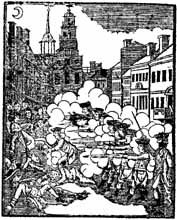
Yesterday I quoted the inaccurate account of the Boston Massacre that William Tudor, Jr., published in 1823. The following year, a Boston printer advertised a new edition of the transcript of the soldiers’ trial, which was more detailed and accurate, though still incomplete. This had been printed in 1771 and again in 1807, but Tudor had apparently not consulted it.

Every so often ante-bellum printers would reprint other documents related to the Massacre which named its victims. Some newspapers ran John Hancock’s commemorative oration in 1813, 1818, and 1820. Others in 1837 and 1840 reprinted the first reports on the shootings from the New London Gazette. Boston’s official report on the event, A Short Narrative of the Horrid Massacre..., reappeared for the first time in 1849.

However, it looks like a major impetus for recovering and publicizing the details of the Boston Massacre was the Abolitionist movement. Bostonians remembered, however dimly, that one of the shooting victims had some African ancestry. A Retrospect of the Boston Tea-Party, published in 1834, quoted nonagenarian George R. T. Hewes identifying one of the dead men as “Attuck, a molatto.”

In 1835, Hewes sat down for more interviews with a Boston attorney and journalist named Benjamin Bussey Thatcher. He was an Abolitionist who advocated colonizing Liberia with newly free black Americans. The year before he had published a Memoir of Phillis Wheatley, a Native African and a Slave, the first biography of that poet. Thatcher was also interested in Native Americans, writing about their traditions.

The book Thatcher wrote based on the recollections of Hewes and other old men, Traits of the Tea-Party, mentioned Attucks as a mulatto and, probably less accurately, a “Nantucket Indian.” That may have been enough to awaken interest in the Massacre among Thatcher’s fellow Abolitionists.

However, writers had few sources to rely on, especially outside Boston. As a result, it took a while for them to identify Attucks properly. The 21 Aug 1848 issue of the Abolitionist newspaper The North Star, published in Rochester, printed the address of H. W. Johnson at the “First of August Celebration.” (Abolitionists celebrated the date that slavery was ended in the British Empire.) Speaking of a person fleeing slavery, Johnson said:

he may go to Faneuil Hall, that old cradle of liberty, that once rocked with the loud shouts of freedom and equal rights, where once was heard the voice of Adams and Hancock, and their compatriots of revolutionary times—that sacred spot from within whose walls was borne away the mangled form of that brave black man, Benjamin Attucks, from whose veins flowed the first drop of blood that mingled with American soil, in defence of American liberty—even there he finds no protection.
On 5 Feb 1852, Frederick Douglass’ Paper, also published in Rochester, reported:
On the 5th of March, 1851, a petition was presented to the Massachusetts Legislature; asking an appropriation of $1,500 for erecting a monument to the memory of Christopher Attucks, the first martyr in the Boston massacre of 5th March, 1770.
This petition was denied, but not on the grounds that the man was really named Crispus.

Probably the most prominent reference to Attucks by the wrong name came in the Rev. Theodore Parker’s 12 Apr 1852 address “The Boston Kidnapping,” about the arrest and rendition of a man fleeing slavery:
The chief kidnappers surround Mr. Simms with a troop of policemen, armed with naked words; that troop was attended by a larger crew of some two hundred policemen, armed with clubs.

They conducted him, weeping as he went, toward the water-side; they passed under the eaves of the old State House, which had rocked with the eloquence of James Otis, and shaken beneath the manly tread of both the Adamses, whom the cannon at the door could not terrify, and whose steps awakened the nation.

They took him on the spot where, eighty-one years before, the ground had drunk in the African blood of Christopher Attucks, shed by white men on the fifth of March; brother’s blood which did not cry in vain.

They took him by the spot where the citizens of Massachusetts—some of their descendants were again at the place—scattered the taxed tea of Great Britain to the waters and the winds...
Although Johnson, Parker, and other Abolitionists didn’t have all the facts about Crispus Attucks, they knew that invoking him tied their cause to the hallowed fight for American independence.

Problems Getting Through

According to Wired’s Danger Room:

The Air Force is tightening restrictions on which blogs its troops can read, cutting off access to just about any independent site with the word “blog” in its web address.
This includes all websites with a “blogspot” U.R.L. unless specifically exempted from the filter.

I’ve also had difficulty sending emails that include the term “blogspot” to folks at Harvard. There the problem seems to be an overeager spam filter.

The term “Revolutionary” doesn’t seem to bother either institution’s software.

Wednesday, February 27, 2008

Misremembering the Massacre in 1823

In 1823, William Tudor, Jr., wrote The Life of James Otis, of Massachusetts, the first major biography of a figure from Boston’s pre-Revolutionary political turmoil. This is what that book had to say about the Boston Massacre:

The presence of the troops in Boston had now produced one of the effects, which had been foretold by those persons, who had deprecated their being sent to the country. The feelings of reserve and ill-will towards the army, which pervaded the whole community, often led to quarrels and fighting between the soldiers and some of the labouring classes.

The troops behaved well generally, though in many instances individuals were insulted by them, and some few cases of outrage and wounding unarmed persons occurred. Yet in looking at the chronicles of those days, where no event of this kind was either omitted or palliated, they seem to have been under good discipline, and to have demeaned themselves as well as could have been expected, when it is remembered, that they were quartered among a people who always met them with aversion.

At length a quarrel arose, from an insulting answer given by a black man to a soldier. A battle ensued, in which the soldier after beating the negro, was, for an insolent answer to the fellow’s master, beaten himself in turn. Afterwards, when several of his comrades engaged in the dispute, they were also worsted, and being bent on revenge, they reinforced their numbers to renew the struggle on another day, which was promptly followed by the people, till the whole town became agitated by the disturbance.

In this state of things, a dispute occurred between the guards stationed in State-street [then King Street], and some men and boys to the number of eighty or a hundred, who had assembled in the street. A sergeant’s guard, in passing to relieve a centinel at the custom house, pushed or struck some of the people with their muskets, and immediately they began to pelt them with snow balls, stones, or any missiles they could find. Captain Preston was in command of the guard, and he directed the soldiers to fire in self defence. About eighteen or twenty were killed and wounded.
It’s remarkable how inaccurate this account was, considering that some Bostonians alive in 1823 could still remember the event. Furthermore, Tudor had access to important sources. His father had been one of John Adams’s law clerks in 1770. Adams himself was urging the young man to write about Otis and sending him reminiscences. Those circumstances suggest that this was how Tudor and his circle wanted to remember the Massacre.

Among the inaccuracies:
  • The fight at John Gray’s ropewalk did not start because of “an insulting answer given by a black man to a soldier.” It started because of an insulting answer given by a white man to a solider. We even know that white man’s name: William Green. Tudor’s account shifted the blame for the ruckus to a black man with a “master,” absolving the free white population of causing any trouble.
  • Saying that “A sergeant’s guard [was] passing to relieve a centinel at the custom house” implies that those soldiers just happened by King Street in their regular march through the town when one sentry replaced another. Cpl. William Wemms and his squad of grenadier privates came to the Customs office because Pvt. Hugh White, the sentry there, had sent a man running for reinforcements. That squad didn’t make any friends by how they arrived, pushing and pricking people with their bayonets. But White thought the crowd was already violent.
  • Capt. Thomas Preston didn’t order the soldiers to fire in self-defense. His attorneys—Adams, Robert Auchmuty, and Josiah Quincy, Jr.—made the case that he had never given such orders. Indeed, one of the privates, Edward Montgomery, later told one of those lawyers (most likely Auchmuty) that he had been the man who yelled, “Fire!”
  • There were five Bostonians killed, six if we count Christopher Monk, who died years later after suffering a crippling injury. The first newspaper accounts listed five more as wounded. Eleven is a long way from “eighteen or twenty” victims.
For nearly twenty years after the Massacre, Boston commissioned a public oration each 5th of March to commemorate the event. That tradition faded after Massachusetts adopted the Constitution, to be replaced by an oration on the 4th of July. This passage from Tudor’s book shows how much Bostonians then forgot about the Massacre in the next thirty-five years.

Tuesday, February 26, 2008

Washington Lays Plans for Dorchester

Having been dissuaded by a Council of War from ordering an all-out assault on Boston across the ice in late February 1776, Gen. George Washington moved on to Plan B: mounting heavy artillery on Dorchester Heights. On the 26th, he sent this message to the Massachusetts Council, then exercising executive power in the province:

As I am making all possible preparation to take possession of the Heights of Dorchester (which I expect I shall be able to accomplish by the latter end of this Week). It is expected that this, if any thing can, will bring the Enemy out of Boston to oppose, as at Charlestown [i.e., the Battle of Bunker Hill], our Erecting any Works there.—

To weaken our Lines on the North side of Cambridge River, to strengthen those of Dorchester, before any movement is made that way by the Enemy, may neither be consistent with prudence or good policy, and to delay it till after an Attack is begun would be too late, as the Contest will soon be decided for or against us after this happens.

Under this state of the Matter and to avoid putting an affair of so much Importance to a doubtful Issue, when under Providence, it may be reduced to a certainty; I submit it to the Wisdom of your Board; whether it might not be best to direct the Militia of certain Towns most contiguous to Dorchester and Roxbury, to repair to the Lines at those places with their Arms, Ammunition and Accourtrements instantly upon a Signal given.

If you approve of this, you will please to fix with General [John] Thomas (who waits on you for that purpose) upon the Signal to be given and Issue your Notices Accordingly.
The photo above shows Gen. Thomas’s headquarters in Roxbury. At the beginning of the war, Thomas and the other top officers in the southern half of the siege lines tended to act somewhat independently of Cambridge headquarters. They sat down to discuss all the orders that came from north of the Charles River. One of Washington’s challenges soon after he arrived was to establish stronger connections with the officers and men in that portion of the army. Now they would be the main support of the Continental artillery’s attack on the British.

Monday, February 25, 2008

What We Know About Crispus Attucks

Aside from legal documents and newspaper reports surrounding the Boston Massacre, the only information we have about Crispus Attucks from the eighteenth century is an advertisement that ran in the Boston Gazette on 1 Oct 1750.

It reads:

RAN-away from his Master William Brown of Framingham, on the 30th of Sept. last, a Molatto Fellow, about 27 Years of Age, named Crispas, 6 Feet two Inches high, short curl’d Hair, his Knees nearer together than common; had on a light colour’d Bearskin Coat, plain brown Fustian Jacket, or brown all-Wool one, new Buckskin Breeches, blue Yarn Stockings, and a check’d woollen Shirt.

Whoever shall take up said Run-away, and convey him to his abovesaid Master, shall have ten Pounds, old Tenor Reward, and all necessary Charges paid. And all Masters of Vessels and others, are hereby caution’d against concealing or carrying off said Servant on Penalty of the Law. Boston, October 2, 1750.
On 13 and 20 November, Brown bought space in the Gazette again, shortening the ad by four lines. He dropped the pro forma warning to sea captions, as well as a few more words here and there. He added that Crispas was “well set.”

Of course, in the middle of the 1700s the Boston newspaper ran many notices for runaway slaves, apprentices, and indentured servants. Why do most historians accept that this ad referred to Crispus Attucks, killed on 5 Mar 1770? Because that dead man was also said to be an unusually tall, husky “mulatto” from Framingham, and Crispas/Crispus was not a common name. The odds that two men met that description seems small. Of course, we also want more information about Attucks.

Researchers spotted this ad in the mid-1800s, part of a burst of new interest in Attucks as the nation fought over rights for African-Americans. As writers noted right away, Brown’s estimate of his enslaved worker’s age meant that Attucks was in his mid-forties when he was killed, and not a rowdy young man.

Sunday, February 24, 2008

The Mysteries of Crispus Attucks

As we look ahead to this year’s anniversary and reenactment of the Boston Massacre (announcements to come), today’s Boston Globe ran an article headlined “Two towns claim Crispus Attucks.” Its main point is how very little we know about Crispus Attucks, the best known victim of the Massacre. We can’t even be sure whether he lived in what is now Framingham or Natick.

In fact, I think we know even less than the article states. Michele Morgan Bolton reported:

historians continue to debate the historic role of this son of an African slave father and Natick Praying Indian mother in the bloody skirmish with the British.
I don’t believe we have any solid evidence about Attucks’s parents. Because he was apparently enslaved as a young man, he was probably born into slavery. That would mean that his mother was enslaved, but his father may have been free. If young Crispus inherited the surname Attucks from his father, the man was likely a Natick Indian—the word means “little deer” in the native language. However, some enslaved children with surnames inherited them from their mothers, as in the case of Sally Hemings’s children.

It seems significant that this description of Attucks’s parents—African father, Native Christian mother—matches what’s in Dharathula Millender’s biography of Crispus Attucks. Many eager readers have taken that book as genealogically reliable, but it’s fictionalized biography for young readers.

The article continues:
A 1972 “Negro History Bulletin” stated that Attucks was believed to have been a slave in Framingham who lived with his family in a cellar hole on what is now Route 9, near Route 30.
This refers to Bill Belton’s article “The Indian Heritage of Crispus Attucks,” which in turn cites J. H. Temple’s 1887 History of Framingham. That book states:
Crispus Attucks...was a mulatto, born near the Framingham town line, a short distance to the eastward of the state Arsenal. The old cellar-hole where the Attucks family lived is still visible. He was probably a descendant of John Auttuck, an Indian, who was taken prisoner and executed at the same time with Capt. Tom, in June, 1676. Probably the family had intermarried with negroes who were slaves, and as the offspring of such marriages were held to be slaves, he inherited their condition, although it seems likely that the blood of three races coursed through his veins. He had been bought by Dea. William Brown of Framingham, as early as 1747.
Note the repeated use of “probably.” Temple felt Attucks was “probably” descended from John Auttuck. But can we assume his family used surnames the same way English colonists did, passing them down along male lines? Was Attucks a rare name in the community? (There were people in Framingham surnamed “Peterattucks” in the early 1700s.) Why assume Crispus was a direct descendant of John, except that both were recorded by the authorities?

As for Temple’s date of 1747, The Negro in the American Rebellion, published in Boston in 1867 by William Wells Brown (no relation to the Framingham deacon), also said that Brown owned Attucks in that year. But neither book offered documentation. We do have clear evidence that Brown claimed Attucks in 1750, when he placed an advertisement in the Boston Gazette reporting that his enslaved worker “Crispas” had freed himself.

The Globe article continues:
All accounts agree Attucks excelled as a cattle and horse trader and was a valued employee of William Brown, a grist-mill owner. But after attempts to buy his freedom failed, Attucks, at 27, is believed to have fled to sea in 1750. Some believe he sailed on a whaler off Nantucket. Or was it the China trade, by way of the Bahamas?

According to lore, Attucks reappeared just before the massacre, likely finding dock work as a rope maker. But trouble was already flaring between the British “lobster backs” and colonists, culminating in the deadly confrontation outside the Customs House on March 5, 1770, that kicked off the American Revolution.
Our only account of Attucks’s skill as a livestock trader comes from an unidentified descendant of William Brown whom Temple questioned in 1887. There’s no record of him trying to buy his freedom or working in Boston’s rope-making industry. The “China trade” didn’t exist until after the Revolution, when American merchants needed to find markets outside the British Empire. The term “lobster backs” appears to be an anachronism.

There is one indication that Attucks worked on a New Bedford whaling ship, but that account raises as many questions about the man as it answers. Traits of the Tea-Party (1835) credits a Boston barber named William Pierce with this information:
Attucks..., he says, was a Nantucket Indian, belonging on board a whale-ship of Mr. Folger’s, then in the harbor...
Pierce also told the author that he had never seen Attucks before the night of the Massacre, so he was recalling secondhand information. In 1770, Boston’s newspapers reported that Attucks was “lately belonging to New-Providence, and was here in order to go for North-Carolina”—nothing about Nantucket. So Pierce might have heard the wrong facts or become confused over sixty-five years.

American culture has come to see Crispus Attucks as a hero, martyr, and very important person. But he had to live his life in the shadows—as a slave, a runaway, and a hard-working sailor. Now we’re almost desperate for information about him, and grasp at almost any statement as if it were reliable. But we still know very little.

Saturday, February 23, 2008

Recognition for Individual History Blogs

I was so busy at the end of 2007 that I completely missed that Boston 1775 was nominated for Best Individual History Blog at History News Network’s Cliopatria.

Congratulations to Kevin Levin at Civil War Memory for earning that Individual Blog award, as well as Caleb Crain at Steamboats Are Ruining Everything, honored for Best Writing. I enjoy visiting both regularly. Here’s the announcement of all the award winners.

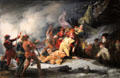
Also, my thanks for the nomination to Tim Abbott at Walking the Berkshires, which has lots of delectable history postings as well. In particular, I’ll point folks to this series on John Trumbull’s painting of The Death of General Montgomery in the Attack on Quebec:

Visit the original painting at Yale.

Friday, February 22, 2008

Washington’s Thanks for Birthday Wishes

This was a “George Washington week” at Boston 1775, and today is the anniversary (in a way) of his actual birthday. So it seems appropriate to quote the general’s response to Rochambeau, his French ally, on 24 Feb 1781:

The flattering distinction paid to the anniversary of my birth-day is an honor for which I dare not attempt to express my gratitude. I confide in your Excellency’s sensibility to interpret my feelings for this, and for the obliging manner in which you are pleased to announce it.
Washington was actually born on 11 Feb 1731/2 Old Style, according to the calendar the British Empire used at that time. However, that was the Julian calendar, and the year was still reckoned to start in March. According to the more accurate (but papal) Gregorian calendar, that day was 22 Feb 1732. Washington adopted that as his birth date in 1752 when the British Empire finally accepted the “New Style” as better.

(Very pink portrait of President Washington from the Library of Congress.)

Thursday, February 21, 2008

New Books on Washington and Knox

Earlier this week, the Boston Globe’s unofficial Revolutionary War correspondent, Michael Kenney, reviewed two new books about American generals. One was This Glorious Struggle, the collection of George Washington’s wartime correspondence by Edward G. Lengel that I commented on back here.

The other book was new to me: Henry Knox: Visionary General of the American Revolution, by Mark Puls. Knox holds a lot of interest for me, as a Boston teenager of the 1760s, a Boston Massacre witness, an artillerist, a possible confidential source, and a man who made the jump from trade apprentice to the genteel ranks. The last major biography of him, by North Callahan, came out in 1958, and was more popular than scholarly. (The postwar Knox was also a big figure in Alan Taylor’s Liberty Men and Great Proprietors, but by that time of his life he was a big figure in all ways.)

Kenney’s review calls Knox

the Boston bookseller who had studied the artillery texts that arrived in shipments of books from London and devised the audacious plan to haul cannon captured at Fort Ticonderoga through the New England winter to Boston. In “Henry Knox,” this visionary general has now received an admirable and long-needed biography by independent historian Mark Puls.

Knox’s self-taught tactical skills proved valuable again at the crossing of the Delaware to engage the British at Trenton in December 1776 and again when he served as artillery commander at Yorktown.
Knox was also at Washington’s side at some of the Continental Army’s worst defeats, of course. I believe he was almost captured when the British army took New York.

I was a little surprised at the word “visionary” in this book’s subtitle since I had the impression that Knox’s major strength was personality, not strategy. Kenney explains:
While Knox had made his name as an artilleryman, he had grown up on Boston’s waterfront and as Washington’s secretary of war after 1789 saw the need to build a navy able to compete with those of England and France. Realizing that the new nation “could not afford [their] large, expensive battleships,” writes Puls, he backed the controversial designs by Joshua Humphreys that produced the legendary six frigates led by the USS Constitution.
Some modern histories of the Revolution present the 1775-76 winter as Knox’s main obstacle in transporting heavy cannons from Fort Ticonderoga to the Boston siege lines. But the newly appointed colonel and his contemporaries understood that winter was often the best time to move heavy goods across land. Sleds could travel faster over roads covered with snow and ice than wooden wagons could travel those same roads in other parts of the year. Winter was when lumbermen brought their heavy logs to the coast and farmers took their crops and goods to town. Another example of how eighteenth-century life adapted to the natural environment.

Wednesday, February 20, 2008

Another Despotically Ruled Statist Force?

For Presidents Day, the Ludwig von Mises Institute chose to share the essay “Generalissimo Washington: How He Crushed the Spirit of Liberty,” by anarchist/libertarian economist Murray N. Rothbard (1926-1995). Its approach to George Washington:

His only campaign in 1775 was internal rather than external; it was directed against the American army as he found it, and was designed to extirpate the spirit of liberty pervading this unusually individualistic and democratic army of militiamen. In short, Washington set out to transform a people’s army, uniquely suited for a libertarian revolution, into another orthodox and despotically ruled statist force after the familiar European model.
This essay got picked up by libertarian blogs everywhere. It offers a rarely voiced opinion of Washington, but I wasn’t won over to the notion that American militias could have won the Revolutionary War without the formation of the Continental Army.

The text came out of a four-volume history called Conceived in Liberty, which Rothbard published around the Bicentennial. The institute’s website describes that as:
a detailed account of American colonial history that stressed the libertarian antecedents of the American Revolution. As usual, he challenged mainstream opinion. He had little use for New England Puritanism, and the virtues and military leadership of George Washington did not impress him. For Rothbard, the Articles of Confederation were not an overly weak arrangement that needed to be replaced by the more centrally focused Constitution. Quite the contrary, the Articles themselves allowed too much central control.
What did Rothbard like about the American Revolution? In an interview sometime during America’s Vietnam War, Rothbard said:
Charles Lee...was the brilliant Revolutionary theorist who was the second in command to George Washington for the first few years of the American Revolution. He was a British soldier of fortune and libertarian and wandered all over the world picking up military insights. As soon as the American Revolution broke out, Lee rushed to the United States to help out in the war effort, and was made second in command.

Lee set the pattern for the American victory, not Washington – well, I won’t go into that, but Lee set the pattern by pointing out that the American Revolution could only succeed as a people’s war from below – a guerrilla struggle, it you will – against the superior fire power of the British government. The government’s lacking the essential popular support, the guerrillas therefore become the people, and people became the guerrillas in the old battle grounds of Lexington and Concord, which victories were the first great American guerrilla action.
Lee had the right idea for winning the war, though he came to it rather late. In 1775-76, he was helping Washington discipline and reorganize the army at Boston. In addition, Lee never inspired the loyalty that his commander did. The Library of Congress website describes Lee this way:
The eccentric General Charles Lee was known for his slovenly appearance, and coarse language, and was rarely seen without his dogs.

Born in England, Lee fought for the Americans during the Revolution; he was particularly valued for his previous experience in the British army. Captured by the British in 1776 while dallying in a tavern, Lee was released in time to lead a command at the Battle of Monmouth (June 28, 1778), during which he ordered a sudden and inexplicable retreat. Publicly reprimanded by General George Washington, Lee was eventually court-martialed and suspended from service for disobedience and misbehavior.
Click on the thumbnail above for a closer look at this London caricature of Gen. Lee, said to actually be the best likeness of him ever created.

Tuesday, February 19, 2008

George Washington Did and Didn’t Sleep Here

On 17 February, the Boston Globe published Patricia Burns’s travel article on the George Washington House in Barbados, shown at left.

The future President traveled to that Caribbean island in 1751 at the age of nineteen to visit his older brother Lawrence, who was renting this house and dying of fever. George stayed for only a couple of months. That seems almost negligible, but it was the only time Washington ever left what would become the U.S. of A. (He traveled further west into Native territories than most of his contemporaries, but the country eventually swallowed those lands.) A non-profit organization in Barbados has restored the house and is promoting it as a historical site for tourists, especially Americans.

Four days earlier, the Globe’s cooking pages published an article that mentioned a house in Hampton Falls, New Hampshire, where Washington also supposedly slept. Except in that case, there’s no evidence to support the tradition. The article reported:

The old adage “George Washington slept here” is probably not true in most cases. But Mary Dumont...grew up in a house where the first president of the United States actually did spend an evening. He wasn’t president at the time; he was commander of the Continental Army when he bunked overnight at Governor Meshech Weare’s home in Hampton Falls, N.H. The year was 1775 and Washington would become the nation’s first president 14 years later. . . .

To tell the whole truth about Washington’s visit to the Weare house, Dumont says that apparently the general stayed at the house but didn’t actually sleep. The poor man had a toothache that kept him up that night.
Meschech Weare was the first chief executive, or “president,” of New Hampshire. He was also the state’s chief justice and chaired its Council and Committee of Safety. Because of those duties, Weare corresponded with Washington throughout the Revolutionary War. However, contrary to the timing stated in the article, Weare didn’t assume any office akin to governor office until early 1776.

Furthermore, Washington never stayed in Weare’s home in Hampton Falls, or even visited the state during the siege of Boston. William S. Baker tracked the commander-in-chief’s travels day by day from June 1775 to December 1783 for his Itinerary of General Washington, published in 1892. And Washington didn’t make it to New Hampshire until 1789.

That year, Washington was touring all the United States as their new President. (A sort of royal progress, but of course we mustn’t call it that.) On 31 October, he arrived in Hampton Falls, as commemorated on this historic marker. (The marker gives the right date; the web transcription says 1798.) Weare had died in 1786, but New Hampshire’s new president, other state officials, and militia units met the President to escort him to Portsmouth. SeacoastNH.com quotes all of Washington’s diary entries from that trip. They don’t mention Hampton Falls by name, but that was the town at the Massachusetts border.

As you can see from the diary, Washington reached Portsmouth at 3:00 on the 31st. He never slept in any house in Hampton Falls. He may not even have entered one.

The story that Mary Dumont heard growing up in Weare’s house is probably like a lot of other undocumented tales of Washington: a combination of misunderstanding and wishful stretching of the evidence, motivated by patriotism and other values, local pride, real-estate values, and a wish to inspire young people.

And Dumont apparently found the legend of Washington’s visit (dental ails or not) very inspiring. The stories we grow up with, especially those we hear from relatives at an early age, stick with us forever. And if that’s what it takes to create what sounds like a fabulous brownie sundae, I’m all for it.

(Thanks to Boston 1775 reader Robert C. Mitchell for alerting me to the New Hampshire story.)

Monday, February 18, 2008

Washington’s Attack That Never Was

On 18 Feb 1776, Gen. George Washington sent the following report to the Continental Congress in Philadelphia:

The late freezing Weather having formed some pretty strong Ice from Dorchester point to Boston neck, and from Roxbury to the Common, thereby affording a more expanded and consequently a less dangerous Approach to the Town, I could not help thinking, notwithstanding the Militia were not all come In, and we had little or no Powder to begin our Operation by a regular Cannonade and Bombardment, that a bold and resolute assault upon the Troops in Boston with such Men as we had (for it could not take many Men to guard our own Lines, at a time when the Enemy were attacked in all Quarters) might be crowned with success...
The result of this plan is so well known as to be almost cliché. Most Americans carry mental images of militiamen marching across the white expanse, breaking into a charge as they neared Boston Common; of the British artillery skipping shells and cannonballs across the ice, trying to break the surface. Often those images are based on later works of art, such as Emanuel Leutze’s monumental “Washington Crossing the Charles” (he used artistic license to show the general riding his horse across the ice). Military tacticians still debate the street-by-street fighting in the South End, what looked like the royalists’ last stand on the docks, and that sudden turn of events...

Well, no, none of that happened. (The painting above is actually “Washington’s March Through the Jerseys,” created in the early 1900s by Jean Leon Gerome Ferris. For a larger reproduction and historical background, visit the Washington Association of New Jersey.)

Instead, careful to follow Congress’s instructions, Washington called his generals together for a Council of War on 16 February. And those generals told him that his plan wouldn’t work. The commander’s report back to Congress continued:
The Result will appear in the Inclosed Council of War, and being almost unanimous, I must suppose to be right although, from a thorough conviction of the necessity of attempting something against the Ministerial Troops, before a Reinforcement should arrive and while we were favour’d with the Ice, I was not only ready, but willing and desirous of making the Assault; under a firm hope, if the Men would have stood by me, of a favourable Issue, notwithstanding the Enemy’s advantage of Ground Artillery, &ca.
The other generals felt the Continentals didn’t have enough soldiers, guns, and gunpowder to carry off such a big assault. They noted that the British military had strong fortifications, and artillery both on land and on their warships. Washington’s arguments in favor of action were that:
  • The Continentals had 8,800 men ready for duty, with 1,400 militiamen easily summoned. The British fighting force, in contrast, was “not above 5,000”—and it was important to strike before reinforcements arrived.
  • The alternative for the Americans was a cannonade, but they didn’t have enough powder and would damage the town worse than the enemy.
  • “that a stroke well aim’d at this critical juncture might put a final end to the War and restore Peace and tranquility so much to be wished for.”
The last point strikes me as the most important for Washington. He wanted to do something. He’d overseen the siege for more than seven months. He’d reorganized the Continental Army, launched privateers, sent troops off to Canada (which turned out badly), but not caused any serious damage to the British command in Boston. He’d already proposed assaults on the fortified town in September and January.

Washington still thought success (and fame) would come from defeating and capturing the royal military. He hadn’t yet realized that he was leading an insurgency, which would succeed by wearing down that military and the taxpaying class back in Britain until they didn’t see enough at stake to continue the American war.

Washington was so eager to strike a dramatic blow, in fact, that he was willing to disregard his own observation on 1 February (quoted back here) that his troops “will not March boldly up to a Work—or stand exposed in a plain.” Or stand exposed on ice, his generals might have told him.

Sunday, February 17, 2008

More Questions on the “Grand Union Flag”

Back in January I wrote a couple of posts about the flag that the Continental Army raised in Cambridge in early January 1776. Gen. George Washington referred to that banner in a letter as “the union flag.”

By the late 1800s, that phrase had evolved into “the Grand Union Flag,” which became the standard label for the design pictured at right: a banner with the British union flag as a canton and thirteen red and white stripes.

This month, flag scholar Peter Ansoff alerted me to “The Flag on Prospect Hill,” an article he wrote for the 2006 issue of the journal Raven, published by the North American Vexillological Association. The nicely illustrated article is available for downloading at the top of this index. Peter argues that the flag Washington watched go up in January 1776 “was not, in fact, the so-called ‘Grand Union’, but simply a British Union flag.”

Interesting. I strongly agree with Peter that in early 1776 the Continental Congress and army commanders still saw and presented themselves as fighting for traditional British liberties, not yet for American independence.

At the same time, people within the siege lines saw the 2 Jan 1776 flag-raising as significant, implying it represented some change from whatever banner they had seen flying on Prospect Hill before. Even Washington, without describing the flag itself, said that “the day...gave being to the new army,” and the flag was raised “in compliment to the United Colonies.” So he was trying to signal something “new,” whether or not the signal itself was new.

Of the two witnesses in the British forces, a sea-captain said the “union flag” was a change from an “entirely red” banner. Lt. William Carter of the 40th Regiment wrote that the Continentals “hoisted a union flag (above the continental with the thirteen stripes).” Peter writes, “it seems fairly clear from [Carter’s] phrasing that he is talking about a Union Flag flying above another, striped flag,” as opposed to a Union canton over stripes within the same banner.

However, that begs the question of what “the continental with the thirteen stripes” would have been. Peter notes that by January 1776 the Continental Congress had planned a naval ensign that Richard Henry Lee described as “a Jack [sic] with the Union flag, and striped red and white in the field”—in other words, the “Grand Union.” But he feels that flag hadn’t yet made its way to Cambridge headquarters yet. It’s not mentioned in Washington’s correspondence with the Congress.

Definitely more for flag scholars to think about.

Saturday, February 16, 2008

The Glorious Struggle over Punctuation

Yesterday I visited the Massachusetts Historical Society for a talk by Edward Lengel, compiler of the new book This Glorious Struggle: George Washington’s Revolutionary War Letters and Associate Editor at the ongoing Papers of George Washington project at the University of Virginia.

Just to be cheeky, I asked what was new and valuable about that documentary project, given that Washington was not only first in the hearts of his countrymen, but also first in the list of Americans whose papers get transcribed and published in massive multi-volume editions. Lengel described how the current project, when completed in another couple of decades, will produce an edition that:

  • contains more of Washington’s writings than earlier collections, simply because more letters have come to light.
  • contains letters and other material sent to Washington, thus providing both a better picture of what he was thinking about and a wider picture of the society and events around him.
  • more closely adheres to the original documents in spelling, punctuation, and other details.
None of that came as a surprise, but, with questions occasionally raised about financing these long-term documentary projects, it’s good to understand their benefits.

As an example of changing standards in transcribing documents, here’s a passage from Washington’s letter to his friend and sometime aide Joseph Reed dated 1 Feb 1776, as transcribed in Life and Correspondence of Joseph Reed, published in 1847.
The account given of the behaviour of the men under General [Richard] Montgomery is exactly consonant to the opinion I had formed of these people [New Englanders], and such as they will exhibit abundant proofs of in similar cases whenever called upon.

Place them behind a parapet, a breast-work, stone-wall, or any thing that will afford them a shelter, and from their knowledge of a fire-lock, they will give a good account of their enemy; but I am as well convinced as if I had seen it, that they will not march boldly up to a work, or stand exposed in a plain, and yet, if we are furnished with the means, and the weather will afford us a passage, and we can get in men (for these three things are necessary) something must be attempted.

The men must be brought to face danger; they cannot always have an entrenchment, or a stone-wall as a safeguard or shield, and it is of essential importance that the [British] troops in Boston should be destroyed if possible, before they can be reinforced or remove.
(All words in brackets are my own additions for clarity. As usual, I’ve added paragraph breaks for easier online reading. All these sentences and more came within a single paragraph in Washington’s letter.)

The same passage, according to the Papers of George Washington and Lengel’s book, reflects the document at the John Carter Brown Library in Providence and modern transcription standards. It starts like this:
The Acct given of the behaviour of the Men under Genl Montgomerie is exactly consonant to the opinion I had form’d of these People, and such as they will exhibit abundant proofs of in similar cases whenever called upon—Place them behind a Parapet—a Breast Work—Stone Wall—or anything that will afford them Shelter, and from their knowledge of a Firelock, they will give a good Account of their Enemy, but I am as well convinced as if I had seen it, that they will not March boldly up to a Work—or stand exposed in a plain...
The same words, but with capital letters and punctuation regularized to 1847 standards.

This Glorious Struggle contains letters Washington wrote from 1775 to 1783, including material on military and political matters and personal and business correspondence. It starts with the general’s address to the Continental Congress on accepting the post of commander-in-chief, and ends with his address on resigning.

Friday, February 15, 2008

Touring Washington’s Headquarters on Washington’s Birthday

Next Friday, 22 February, will be George Washington’s actual birthday. The Longfellow National Historic Site is observing the occasion by offering free tours of the general’s 1775-76 headquarters to the public all day.

Longfellow House in Cambridge was built in 1759 by John Vassall, a wealthy young Loyalist. He and his family moved to Boston in September 1774 after it became clear that royal authority no longer extended beyond the border of the capital, and they later left the country. During the first few months of the war, the empty Vassall mansion was used as a barracks by Col. John Glover’s regiment from Marblehead.

Then in July 1775, the new commander-in-chief moved in. Over the next several months, the Vassall house was where Washington conferred with his generals, met with members of the Continental Congress (including Benjamin Franklin), sent subordinates such as Benedict Arnold and Henry Knox on their missions north and west, received a leader of his Oneida allies, reorganized the Continental Army, and made his final plans to drive the British army from the province. Over the course of the Revolutionary War, Washington had his headquarters at Longfellow House longer than any other location except Newburgh, New York, at the end of the conflict.

The Cambridge house was later owned by:

Longfellow descendants gave the property to the National Park Service, and it’s now a National Historic Site.

Longfellow House is at 105 Brattle Street in Cambridge, a short walk from Harvard Square. Tours will start at 10:30 and 11:30 A.M., and on the hour from 1:00 to 4:00 P.M. All tours will be led by National Park Service rangers or trained volunteers, and for this day will focus on Washington’s tenure in the House. There is a limit of fifteen people per tour, so call 617-876-4491 to reserve slots.

Thursday, February 14, 2008

“My Valentine Was an Old Country Plow-Joger”

On 14 Feb 1772, Boston schoolgirl Anna Green Winslow wrote this report in her daily letter to her mother:

Valentine day. — My cousin Sally reeled off a 10 knot skane of yarn today. My valentine was an old country plow-joger. The yarn was of my spinning. Aunt says it will do for filling. Aunt also says niece is a whimsical child.
There are three themes twisted together here. One is Valentine’s Day. The antiquarian and author who published Winslow’s letters, Alice Morse Earle, explained:
In England at that date, and for a century previous, the first person of the opposite sex seen in the morning was the observer’s valentine. We find Madam Pepys lying in bed for a long time one St. Valentine’s morning with eyes tightly closed, lest she see one of the painters who was gilding her new mantelpiece, and be forced to have him for her valentine.
So the first man Anna saw was an old farmer.

The second theme is Anna and her cousin’s spinning, which had taken on a political dimension as Boston’s Whigs urged people to increase local production instead of importing goods from Britain. Girls of Sally and Anna’s age, even upper-class ones, were encouraged to learn how to spin for the cause.

The third theme is the wit of the women in this family: Anna’s aunt, Elizabeth Storer; Anna’s mother; and Anna herself. She could appreciate a good line even at her own expense. Thus, all three women could chuckle over what it meant for Anna’s beginner-level yarn to be good for “filling”—it was too lumpy or thick to work as anything else. And Anna didn’t seem to mind telling her mother that Aunt Storer had said she was “whimsical.”

Wednesday, February 13, 2008

Attack Across the Ice on Dorchester Neck

On 13 Feb 1776, Boston selectman Timothy Newell recorded a surprising raid by British troops against the sparse Continental forces in the part of Dorchester that stuck out into the harbor.

This night a large body of the Troops about 3. oclock set off on the Ice from the fortification, landed at Dorchester Neck and set fire to all the houses and barns, brot. off six prisoners who were Centinels.

Colo. [Alexander] Lesslie from the Castle, assisted with the Troops there, and returned at seven o’clock—No engagement ensued—The Provincials guards run off.
The next day, Gen. William Howe commended the raid’s commanders and soldiers for their work:
The Commander in Chief desires to return his thanks to Coll. Leslie & Major [Thomas] Musgrave, for their planning & Conducting the Service of last night, & to the Officers & Soldiers of the detachment under their Command for their Spirited behaviour on the Occasion. He also highly approves of the alacrity of the troops in general last night, & of their Soldier like manner in getting under Arms without the least noise or confusion. Such Steady behaviour plainly indicates the powerfull supperiority they must ever preserve over the unnatural enemy we have to contend with, when an opportunity shall offer to determine it.
The following day, Howe added some concrete rewards to his praise:
Major Musgrave will give in a return to the D[eputy]. Q[uarte]r M[aste]r Gen[era]l, of the Detachment that was under his Command on the Morning of the 14th including the men that carried the Biers and Artilly., likewise those Artillery men that were with Colonel Leslie, that they may receive a pair of Shoes and Stockens each.

Coll. Leslie will give a return of the Detachment of the 64th for the same purpose.

The Corps to attend to morrow Morning to receive a proportion of Onions from the Commissary General, at the place where they receive Potatoes.
On the American side, Gen. George Washington tried to downplay the raid’s effect in his report to the Continental Congress, dated 14 Feb 1776:
Last night a party of Regulars, said to be about 500, landed on Dorchester Neck and burnt some of the Houses there, which were of no value to us, nor would they have been, unless we take post there, they then might have been of some service. A Detachment went after them, as soon as the fire was discovered, but before it could arrive, they had executed their plan and made their retreat.
He did not mention the captured sentinels.

Some interesting things about this event:
  • The cold, which typically sent eighteenth-century armies into barracks until spring, had here created new opportunities. Normally Boston was connected to the mainland only by the narrow Neck (modern Washington Street runs along it). But with shallow parts of the harbor frozen over, each army could reach the other’s territory more easily.
  • Both armies had now focused their attention on Dorchester Heights, an area of high ground that neither had yet occupied. The British tried to make the Dorchester peninsula harder for the Continentals to hold by burning houses and other cover, but they didn’t try to hold that land for themselves.
In the following weeks, both those factors would become part of the endgame of the Boston siege. Also, after the winter under siege, new shoes, stockings, and onions were considered a valuable reward for the soldiers who carried out this raid.

Today’s picture is a wax relief portrait of Thomas Musgrave, who was made a colonel in August 1776 and distinguished himself at the Battle of Germantown the following year. Eventually he became a general and a knight. This item and many other handsome historical portraits in the same medium are available from WaxPortraits.com.

Monday, February 11, 2008

Oscar Marion: The Disney Version

To the left is yet another popular image of Gen. Francis Marion having a meal in the wilderness during the Revolutionary War. Except this time he’s being portrayed by Leslie Nielsen (on the left, before his hair turned white) in Walt Disney’s Swamp Fox adventures, first broadcast 1959-1961. This image comes UltimateDisney.com, where nostalgic folks can order a D.V.D. of those episodes.

Marion’s enslaved servant Oscar was a regular character in that series and sang its theme song, recounting Marion’s exploits. The actor who played that part was credited as “Smoki Whitfield,” though he appeared in other movies and TV shows as Robert or Jordan Whitfield. He had a long Hollywood career, but most of his roles were as porters or African sidekicks, such as Eli in the Bomba the Jungle Boy series.

Whitfield’s screen name “Smoki” fits into a pattern for African-American actors of the time. Many white Hollywood actors adopted professional names that hid or changed their ethnic background, as when Emmanuel Goldenberg became Edward G. Robinson. But many black Hollywood actors, particularly males, worked under names that emphasized or ironically played off their ethnicity and the stereotypes associated with it. The most famous was Lincoln Perry as Stepin Fetchit, but others included Willie Best as Sleep ’n’ Eat, Fred Toones as Snowflake, and Spencer Bell as G. Howe Black.

And at last I get to my point: American culture didn’t forget Gen. Marion’s enslaved servant Oscar. Rather, the culture fit that historical individual into reassuring molds that changed along with mainstream society’s values. First came the loyal, subservient servitor visible in nineteenth-century paintings and books. Then came the Disney Company’s friendly supporting character and quaint musical entertainer. Given that pattern, praising Marion’s “devoted and selfless consecration to the service of our country” in a Senate ceremony could simply shift the man into another reassuring mold—exemplary African-American patriot—without bringing us closer to understanding his real experiences.

Genealogist Tina C. Jones started to research Gen. Marion’s enslaved workers to find clues to such experiences; some of her ancestors were captive on that slave-labor plantation. Calling our attention to the black servants in paintings of Marion should help us think about what those figures represented. Reminding us that throughout the Revolution Gen. Marion was served by a real individual kept in bondage should spur us to consider what that man’s life might have been like. But we shouldn’t take the symbol for the man.

In its article on the Dec 2006 Senate ceremony about John Blake White’s painting of Marion, the Washington Post stated of the black cook, “He has had his name restored.” And indeed names are significant. Jones’s research seems to have spurred recent authors to refer to the man as “Oscar Marion” rather than “faithful servant Oscar.”

Of course, not all enslaved people shared a surname with their owners. Notable exceptions included:

In reading about Jones’s research, I still can’t tell if she’s found documents or direct descendants referring to “Oscar Marion.” It’s certainly possible that the man thought of himself that way. It’s also possible that we very much want to think of him that way.

Bill to Add Barrett’s Farm to Minute Man Park

Today’s Boston Globe reports on a historical preservation effort that I support for both scholarly and personal reasons: the attempt to add the James Barrett house in Concord to the Minute Man National Historical Park. Reporter Peter Schworm wrote:

Three centuries have weathered the Colonial home’s timber beams, rusted its door hinges, and faded its King of Prussia marble hearth. The home’s original floorboards, 23-inch-wide hardwood planks, have buckled.

But little has changed in the muster room where Barrett, a colonel in the Colonial militia, met with John [actually Samuel] Adams, John Hancock, Paul Revere, and other patriots in the days before the Battle of Lexington and Concord. History reveres those men as founding fathers yet scarcely remembers Barrett and his farm, which was also a massive munitions hold that provoked the British march to Concord that April morning in 1775.

The British arrived too late.

Colonists had already armed themselves with the weapons and made their way to Old North Bridge, where the American Revolution began.
There are some problematic details in that last sentence, and not just because folks from Lexington have their own ideas about “where the American Revolution began.” That sentence makes it sound like the militiamen who fought at the North Bridge picked up their weapons from Barrett.

That seems unlikely since the whole point of the militia system is that individual citizens owned their own muskets and other basic weaponry. Barrett was guarding supplies that belonged to the Massachusetts Provincial Congress and were to be used collectively: artillery, shovels and tents for camps, replenishments of gunpowder and musket balls. The royal authorities in Boston could make the case that those supplies were part of a rebellion against the Crown.

As the Globe reports:
“Everyone knows that Paul Revere rode out to Concord to warn that the British were coming,” said Jim Cunningham, a Lincoln resident who is managing the restoration of the farmhouse.

“But why were they coming? For munitions that were hidden right here at this farm. This was their objective.” . . .

British spies had learned that Barrett, a leader of the Middlesex Militia, had amassed an impressive arsenal of guns, powder, and ammunition on his farm. Of particular concern were four cannons the colonists had stolen from British troops in Boston.
That’s my research—the connection between artillery pieces that disappeared in Boston in September 1774, the British march on Concord in April 1775, and one cannon on display in Concord today. So I of course would love to see the Barrett site become part of Minute Man Park. It was the end of the British march in both meanings of the term: the farthest point and the objective. Though there was no actual fighting on Barrett’s farm, it was the reason the British army came to Concord.

Adding to a national park requires an act of Congress. Rep. Marty Meehan introduced the Minute Man National Historical Park Boundary Revision Act (H.R. 2815) last June; his successor, Rep. Niki Tsongas, has taken up the issue. Sen. Ted Kennedy introduced a similar bill with the specifics filled in (S. 2513) on behalf of himself and Sen. John Kerry in December. Once it passes, there will probably have to be a private fundraising effort since the federal government’s fiscal deficits have grown so much since 2000.

(Photo by Dominic Chavez/Globe Staff. I’ll get back to Oscar Marion tomorrow.)

Sunday, February 10, 2008

The Literature of Oscar Marion

The incident in the life of Gen. Francis Marion (shown here, courtesy of NNDB.com) that John Blake White depicted in his “General [Francis] Marion Inviting a British Officer to Share His Meal” was first reported in Mason Weems’s Life of General Francis Marion, published in 1805. Weems is best known for his biography of Gen. George Washington, which included such enduring but completely unconfirmable legends as Washington chopping at a cherry tree and praying in the snow at Valley Forge.

In the eighteenth chapter of his Marion biography, Weems included a long anecdote about a young British officer visiting Marion in his camp for a conference. The American general invites the officer to share his dinner, which turns out to be roasted sweet potatoes on platters of tree bark. Impressed by the partisans’ dedication to the cause of independence, the officer returns to his commander, Col. Watson; praises the enemy; and eventually resigns from the army. You can read the text in an 1852 edition through Google Books.

That anecdote did not name the British officer or explain how the author came by his information. Weems did not mention an enslaved man named Oscar accompanying Marion. Instead, as he described the scene, a soldier named Tom was roasting the potatoes.

The figure of Oscar Marion entered the literary record in A Sketch of the Life of Brig. Gen. Francis Marion, published in 1821 by William Dobein James (1764-1830). This book described a different dinner in Marion’s camp, not with a British officer but with the author himself:

At this place, the author had, (in the absence of his father,) the honour to be invited to dine with the general. The dinner was set before the company by the General’s servant, Oscar, partly on a pine log and partly on the ground; it was lean beef, without salt, and sweet potatoes. The author had left a small pot of boiled homminy in his camp, and requested leave of his host to send for it; and the proposal was gladly acquiesced in, gladly. The hominy had salt in it, and proved, although eaten out of the pot, a most acceptable repast. The general said but little, and that was chiefly what a son would be most likely to be gratified by, in the praise of his father. They had nothing to drink but bad water; and all the company appeared to be rather grave.
White produced his painting of Marion’s camp about the same time that James wrote his book. The artist may have combined the two published descriptions of Marion’s camp dinners to show Oscar making sweet potatoes for the British officer. He may have relied on his own unknown sources of information about Oscar. Or he may never have read about or met Oscar, and simply depicted a generic black servant for the general.

James mentioned Oscar one other time in his book, while describing Marion’s retirement to his slave-labor plantation at the end of the war: “His faithful servant Oscar, who had accompanied him through all his difficulties, always received high marks of his favour.” What marks those are James didn’t say. Unlike Washington’s bodyservant, William Lee, Oscar was never formally freed. By applying the term “faithful” to Oscar in one of two mentions, James’s book scores what I’ll call a “faithful quotient” (F.Q.) of 50%.

William Gilmore Simms’s The Life of Francis Marion (1844) also mentions Oscar twice. The first is an imperfect but basically accurate quotation of James’s anecdote. The second passage describes how Marion dealt with the property he had used during the war:
He had preserved carefully, as memorials of an eventful history, his marquee, camp bed, and cooking utensils, just as he had done while in the Brigade, during the last twelve months of his military life. These were carefully taken with him; and, with his faithful servant Oscar, and his two sumpter mules, were still the companions of his wanderings.
Like James, Simms had an F.Q. of 50%.

Subsequent biographies of Francis Marion drew heavily on those first three. In 1959, for example, Prof. Robert Duncan Bass published Swamp Fox: The Life and Campaigns of General Francis Marion. Bass was a literary scholar, not a historian, and his book had no footnotes. Reviewing a newer biography of Marion in The History Teacher in 1975, historian George Athan Billias criticized Bass and his predecessors for having “relied on dubious secondary sources, legends, and traditions.”

Nevertheless, Bass’s book found a large audience and became the principal source of Walt Disney’s Swamp Fox adventures, televised from 1959 to 1961. (I’ll discuss that adaptation tomorrow.) In the midst of America’s civil-rights movement, Bass mentioned Marion’s servant Oscar on five pages. Three describe the man as “faithful,” for an F.Q. of 60%.

Saturday, February 09, 2008

Collecting Possible Images of Oscar Marion

Yesterday I linked to an image of John Blake White’s painting of “General [Francis] Marion Inviting a British Officer to Share His Meal,” in a discussion of how best to acknowledge the place of the general’s enslaved servant Oscar in history.

It turns out that White made several copies of that scene, and one came into the collection of Boston’s Museum of Fine Arts. It’s not on display but can be viewed through the museum’s website—which includes a close-up feature.

White’s image was reproduced in other ways over the years:

Before photography, artwork was reproduced by other artists working by hand, and they introduced variations in the image. The images above differ in how, and how well, they depict the black serving man at the left of the composition—lately identified as Gen. Marion’s enslaved servant Oscar. His face appears more or less caricatured in different images. Some versions seem to emphasize the detail that he’s spilling liquid from his ladle onto the table; in others, that detail is hard to spot. Some pictures show the man picking up sweet potatoes, but in the Currier & Ives print he’s grabbing a piece of firewood.

Another figure who varies stands behind Marion’s left shoulder, one hand over a horse’s neck. In White’s painting he, too, in black. The Currier & Ives print makes him a generic black man while another print shows his skin tone not much different from the other men in the background. In the small bank note images, that figure is barely visible at all. It’s not clear why this figure could not be identified as Oscar Marion, except that he’s less prominent.

Another painter who depicted Francis Marion was William Ranney (1813-1857). He was born in Connecticut, spent his adolescence in North Carolina, studied in New York City, volunteered for the Texas War for Independence, and finally settled in New Jersey. His Marion paintings date from about 1850. Unlike White, he never claimed to have met Marion as a boy.

Ranney’s “Marion Crossing the Pedee” is now at the Amon Carter Museum in Fort Worth. It, too, has been reproduced in engravings and lithographs, such as these from the Library of Congress collection. There’s also a small study for the painting at the Greenville County Museum of Art.

Like White, Ranney depicted Marion with black servants. There are two black men in this boat. One is easy to pick out: he’s the only man who’s rowing. (Let me say that again. He’s the only man who’s rowing.) The other stands near the front of the boat holding the horses, looking ahead somewhat vacantly while all the other men in that area are turned toward their mounted commanders.

Finally, Ranney produced a painting now titled “Marion and His Men” (thumbnail above), which shows a mounted black man near the front of the column might cement that assignment. This is the most vigorous, least subservient depiction of an African-American in all these paintings. He’s not stooping, relegated to the background, or shown as incompetent. Still, of all the figures in the image, he alone has his sleeves rolled up, indicating that he’s from a laboring class.

Why Is the Town of Boston Now Shut Up?

The Eighteenth-Century Reading Room blog offers a look at Connecticut governor Jonathan Trumbull’s 28 Apr 1775 letter to Gov. Thomas Gage, and Gage’s 3 May reply. Both letters were composed for public consumption, trying to grab the moral high ground after the Battle of Lexington and Concord. Basically, Trumbull asked, Why are you acting as if there were a war going on? And Gage answered, Why are you writing as if there weren’t?

Connecticut and Rhode Island were alone among Britain’s North American colonies in electing their governors. Massachusetts had had the same system at first settlement, but was later turned into a “royal” province. That meant its governor, like those in all the other colonies but its southern neighbors, was appointed by the ministry in London. The Connecticut and Rhode Island governors were therefore more independent of the Crown and more beholden to popular opinion. Trumbull kept right on being elected governor as Connecticut became independent.

Friday, February 08, 2008

Further Thoughts on the Figure of Oscar Marion

Back in December 2006, I linked to a news report about a U.S. Senate ceremony about John Blake White’s painting “General Marion Inviting a British Officer to Share His Meal,” and specifically about the identification of a black serving man in that painting as Oscar Marion.

I took issue with the ceremony’s description of that man’s “devoted and selfless consecration to the service of our country,” on the grounds that we don’t know his real desires and motivations because he was enslaved. He was forced to serve Gen. Francis Marion, and thus forced to serve the U.S. of A. While Oscar Marion might have supported the American cause if he’d been free, to imply that he made a free choice to do so seems to erase his individuality rather than reclaim it.

My next few posts will follow up on some historical questions surrounding the figure of Oscar Marion. First, I’ll note that other writers reacted to the 2006 ceremony with questions similar to mine. On his blog entitled Acting White, James C. Collier wrote:

It pings odd that a black slave, with no rights as the property of another, should be posthumously elevated to the distinction of patriot. A patriot is someone who gives of themselves, freely and clearly, for a cause they believe in. Could Oscar Marion, slave of General Francis Marion, freely decided to support a regime that kept him in bondage? Jose would probably say no-way.

This is not to declare that Mr. Marion’s family should not either be proud of him or want his face, on a painting in the Capitol building, to have a name, for all to see.

But what is really going on here? We are equating being an exemplary slave with being a patriot worthy of presidential honor, and in doing so we ignore that undermining their masters was the highest, and perhaps most noble, form of battle slaves could undertake in their quest for freedom.
I don’t think that “undermining their masters” was necessarily the quickest or most successful route to freedom for enslaved people; I think that choice depended on the circumstances. It seems clear, however, that for Oscar Marion there was no such route. He died in slavery.

Jabari Asim, senior editor of Washington Post Book World and a syndicated columnist for the Washington Post Writers Group, stated:
Experts believe White created the painting between 1815 and 1825, a period when the portrayal of African-Americans began to decline almost completely into caricature. Oscar Marion, by comparison, received a very dignified treatment. Although his facial features were not deliberately exaggerated—as was typical of the time—his kneeling posture makes his lowly stature clear.

In that regard, White’s painting is part of a well-established tradition: He is shown kneeling while everyone else is shown standing. . . .

We know little of Oscar Marion’s life other than what Jones has unearthed, and we certainly don’t know what he was thinking on days like the one preserved in White’s painting.

But I suspect [Ralph] Ellison’s words probably aren’t far off: “When they approach me they see only my surroundings, themselves, or figments of their imagination—indeed, everything and anything except me.”
Of course, rejecting reassuring assumptions about Oscar Marion doesn’t negate the value of genealogist Tina C. Jones’s work in seeking all the information that survives about the real man. A year ago, the Association for the Study of African American Life and History at Howard University made her the first non-academic recipient of a “people’s award” for her research.

TOMORROW: Boston’s own image of Oscar Marion.

Thursday, February 07, 2008

“Such Is Her Regard for You”

This afternoon I was at the Massachusetts Historical Society, studying the print edition of its Robert Treat Paine Papers. A couple of letters from the second volume struck me as shedding unusual light on Paine’s marriage to Sally Cobb.

Bob and Sally married on 15 Mar 1770. He was a lawyer in his late thirties, prominent enough for the town of Boston to hire him the next month to be a special prosecutor in the trials of Ebenezer Richardson and the Boston Massacre defendants. She was about thirty, daughter of a Taunton iron manufacturer and tavern owner.

Bob Paine wrote to his sister from Plymouth on 17 May of the same year (yes, the same year):

Dear Eunice,

I have just time to inform you that last Monday [14 May] 5 oClock P.M. my Sally brought forth a remarkable fine Boy having Endured a natural Regular uncommonly tedious & painful Travail for 21 hours. The poor Girl endured beyond description.

I left her very comfortable being obliged to come here to Court, & yesterday heard she was well, but I have not yet recovered from the distress of my Anxiety. The Boy weigh’d between 12 & 14 lbs.

Pray give my Love to Mrs. Cranch & Mrs. Adams & inform ’em of this matter. Hoping yr. Welfare I am yr. married father Brother

R. T. Paine
“Mrs. Adams” was Abigail Adams, and “Mrs. Cranch” was her older sister Mary. The big new baby, named Robert, grew up to become a lawyer like his father, but he died at twenty-eight of yellow fever. (His younger brother Thomas then took the name “Robert Treat Paine. Jr.”)

A young lady from Boston named Abigail Tailor was visiting Sally Paine in Taunton on 5 Sept 1770, while Bob Paine was in Boston on legal business. She wrote to ask him to stop by her mother’s house and pick up a cloak “in case it should be Cold when she returns to Boston.” Tailor then added:
Mrs. Paine was so disconsolate in your absence she was Determin’d to have something that belong’d to you so got your plad Gownd & laid it as Close to her as she possible could, such is her regard for you, I think she justly Merits yours
The Paines were married for forty-four years, until Bob’s death in 1814. Sally died two years later.

Wednesday, February 06, 2008

Capt. McDonald Manages His Company

Here are more extracts from the letterbook of Capt. Alexander McDonald, as transcribed and made available to all on AmericanRevolution.org. The last installment quoted McDonald’s letters seeking a higher rank for himself, and oh-by-the-way an officer’s commission for his twelve-year-old son. At the time, he was helping to organize a company of Scottish and other Loyalists into a British army regiment, eventually called the Royal Highland Emigrants or 84th Regiment of Foot.

Here’s how McDonald said he dealt with his non-commissioned officers. On 15 Nov 1775, he wrote from Halifax to Maj. John Small in Boston:

I am sorry to tell you Serjt SinClair Serjt McArthur and one Corpl McQuinn a rascal I inlisted here all three Highlanders are the most unruly drunken rascals I have in the whole recruits and I was obliged to Lay hands on McMillan even before I brought him to some order.

McArthur and SinClair fought the other day and were both Confined after they got Sober was kept one night in the guard I gave them both a severe reprimand and desired them to forgive one another and Make friends. McArthur insisted on a Court Martial. I told them they may both depend on being broke and may be receive Corporal punishment besides when I told them what A pretty figure two highland Serjeants would shew to all the rascals in this place stripped at the whipping post after being broke and I swore to them by a most violent oath that it Certainly would be the Case if they did not forgive one another and promise never to be guilty of the Like again

finding I was in Earnest and their honours touched up a Litle they thought proper to Setle Matters amongst themselves and are now upon their good behaviour.
A military company of the time required drummers to beat out signals during training and maneuvers. The Loyalist Institute offers the 12 June 1775 orders from Gen. Thomas Gage for organizing the regiment in ten companies, each with “two Drums.” On 9 Jan 1776, Capt. McDonald told Maj. Small, “I want much a drum Major and two or three drums” for his company in Halifax. McDonald seems to have gotten the job of recruiting and training drummers for the whole regiment. In a letter dated 27 January, McDonald updated the major on his progress:
I have picked out fourteen boys to be Drummers. I have got two Drumms from Mr Buckley the Secretary of the province and I am about hiring the Drummer that acts as Drum Major of the 65th to teach these boys, but he Says that Each of them Should have a Drumm and then he would teach the whole with the Same Ease as one.
The thumbnail picture above leads to the King’s Orange Rangers photo gallery, which includes images of reenactments undertaken with the recreated Royal Highland Emigrants.

Tuesday, February 05, 2008

James Otis’s Lessons in Human Nature

As Massachusetts and many other states vote today, it seems like a good time to take another look at politicking in pre-Revolutionary Boston, as portrayed in William Tudor’s 1823 biography of James Otis, Jr.

This passage recounts a conversation that lawyer had with a “gentleman of great shrewdness and capacity, who was one of the delegates” to the Massachusetts General Court when Otis was first elected in 1761. Three men fit that description, all merchants:

  • John Phillips, who died in 1763
  • Thomas Cushing, who was Speaker of the Massachusetts House during the 1760s and early 1770s, and later a delegate to the Continental Congress and a Lieutenant Governor
  • the elder Royall Tyler, who held other Boston offices as well
Tudor also wrote that this gentleman “was chosen from the House to the Council,” moving into the upper house of the legislature. Of the three delegates, only Tyler made that shift before the Revolution, which implies he was the subject of this anecdote.

Reportedly, the gentleman told Otis:
“You will never succeed in the General Court.”

“Not succeed! and why not pray?”

“Why, Mr. Otis, you have ten times the learning, and much greater abilities than I have, but you know nothing of human nature.”

“Indeed! I wish you would give me some lessons.”

“Be patient and I will do so with pleasure. In the first place what meeting do you go to?”

“Dr. Sewall’s [i.e., Old South Meeting-house]”

“Very well, you must stand up in sermon time, you must look devout and deeply attentive: Do you have family prayers?”

“No.”

“It were well if you did: what does your family consist of?”

“Why only four or five commonly, but at this time I have in addition one of Dr. Sewall’s saints, who is a nurse of my wife.”

“Ah! that is the very thing: you must talk religion with her in a serious manner, you must have family prayers at least once while she is in your house: that woman can do you more harm or more good than any other person; she will spread your fame throughout the congregation.

“I can also tell you, by way of example, some of the steps I take: two or three weeks before an election comes in, I send to the cooper and get all my casks put in order: I say nothing about the number of hoops. I send to the mason and have some job done to the hearths or the chimnies: I have the carpenter in to make some repairs in the roof or the wood house: I often go down to the ship yards about eleven o’clock, and enter into conversation with them. They all vote for me.”
Tudor went on to write that after this gentleman ascended to the Council, he stopped making so many “friendly visits” to the shipyards. The next time he showed up, one man remarked “that since he had got into the Council, he did not come to see them so often.”

The expert politician reportedly answered, “O yes, that was true, but my time was so taken up; and then you know, it is the House of Representatives, that chooses the Council.” He no longer needed the town meeting’s votes.

Monday, February 04, 2008

An Alarm as Occasioned a Great Blustering

In early February 1776, it appears, Boston selectman Timothy Newell was startled by the sound of artillery. Which seems odd since he was stuck inside a besieged town that was the main battleground of a civil war. But I think his surprise tells us something about warfare in the eighteenth century

On the 2nd, Newell wrote in his diary:

Just at 11 oclock at night, some wanton soldier or officer fired a bomb from the battery, at New Boston, which bursted in the air, did no harm, but made such an alarm as occasioned a great blustering.
“New Boston” was the western wing of the peninsula, nearest to Cambridge, where the Americans had their headquarters.

On the 4th he wrote:
At half past nine in the evening, 3 cannon fired from the lines at Charlestown and a number of small arms at the Soldiers pulling down the Mills—say two men killed and one wounded. The next day many cannon fired.
The “Mills” were powered by the tides in the Charles River estuary.

I suspect what made these events notable for Newell—guns fired during a war!—was the time of year. February was the middle of winter, and eighteenth-century armies usually sat out that season. The British army was mostly concerned with keeping warm and fed. The Americans probably had enough food, but also hunkered down in their barracks. In his 1849 History of the Siege of Boston, Richard Frothingham wrote, “Through the month of February,...no enterprise of importance was undertaken.”

Sunday, February 03, 2008

New Rule! No Football Games in the Streets

On 25 Nov 1657, the selectmen of Boston issued a new rule about a pressing public concern:

For as much as sundry Complaints are made that severall persons have Received hurt by boyes and young men playing at foot ball in the streets; these are therefore to Injoyne that none be found at that game in any of the streets, Lanes, or Inclosures of this town, under the pœnalty of twenty shillings for every such offence.
The selectmen immediately went on to issue another rule about people “buing out of servants tymes and redeeming others from Engagments,” and then letting those now free people become burdens on the government. The selectmen warned “that what ever person or persons they soe sett att Liberty they are to see after their Imployment, and to secure the Town from any charge that might otherwise be ocasioned by such.” In both cases, the town fathers were concerned with too much freedom.

The rule against playing football in Boston’s streets was still in effect over a century later on 3 Jan 1787, when the selectmen issued another warning:
The Selectmen recommend to the several Masters of the public Schools, that they make their respective Scholars acquainted with the By Laws forbidding to throw Snow Balls and play Foot Balls in the Street and any other of those Laws that concern their Scholars
The game of football has changed greatly, but local authorities are still worried about football-related rowdiness in the streets today. Let’s enjoy the game sensibly.

Saturday, February 02, 2008

How He Made Himself So Important

One of the more curious curios of pre-Revolutionary Boston is a broadside titled “The CONVERSATION of two Persons under a Window on Monday Evening the 23d of March.” The dialogue that follows is about a town meeting, which indicates the date of the printing: the only year when Bostonians met on Monday, 23 March, was 1767.

The dialogue focuses on a politician referred to as “Pug Sly.” One surviving copy of this broadside has a handwritten note identifying that character as Royall Tyler—not the playwright, novelist, and jurist who took that name as he came of age, but his father. The senior Royall Tyler held several respected offices in Boston, including Fireward, Overseer of the Poor, and Representative to the General Court. By 1767 he was being elected each year to the Governor’s Council, where he was one of the more radical Whig voices.

The broadside describes how “Pug Sly” built his political popularity. It’s obviously a hostile portrait, but also some of our best evidence about how politicians won elections in this period when they weren’t supposed to openly campaign. One of the broadside’s voices says:

When quite young, how did he work himself into the Corcas; and was knowing to all their transactions: and whenever he found there was to be a change of [town] officers, he would as a fawning sycophant, let them know they were to be chose in office; so as to take the merit of it to himself: that some was made to believe that “PUG’s interest alone was all the Town.”

And every one that did not sacrifice to him, he would (to use his own word) give them a trip: and at this game there is not his equal. His thirst for honor, has put him upon the most dirty actions that a reasonable being is capable of:

I once ask’d him how he made himself so important. “Why, says he, I’ll tell you. To some I cry: some I coax: to some I scold: and put on an important appearance of friendship to all. As to the mechanicks; I take my rounds, turn in about eleven o’clock; and mix in with the conversation, and nothing will take them fellows in like it. When there is to be an engine supper [i.e., banquet of a volunteer firefighting company], I lay a plan to be invited; and they fix me at the head of the table, and pay me as much homage as a demi-god: You would sometimes laugh your soul out, if you was to see how I work them poor toads.

[“]As to those in higher life, I put on a sabbady [serious, Sabbath-Day] face; frequently apply to them for advice; sometimes upon affairs of great importance. I suppose (now under the rose) I have been to fifty, to ask advice about making my will. I have taken my pipe in the evening, collected the neighbours, set an affair on foot only to see how far I could carry it; and when I have got it to the pitch I wanted it, then I lower’d, and set it down just where I found it.”
As this election year proceds, I’ll quote more political advice attributed to “Pug Sly” and the elder Royall Tyler.

Friday, February 01, 2008

Love Letters to Be Read in Westford, 9 February

Dan Lacroix at the Westford Museum has sent out this announcement:

On Saturday, February 9th, starting at 7:30 P.M., the Westford Museum will host “Love Letters: The Intimate Correspondence of John and Abigail Adams,” just in time for Valentine’s Day.

The correspondence between John and Abigail Adams over their months and years of separation gives us unparalleled insight into one of the world’s great love affairs. The fact that this love affair took place at such a critical time in America’s history is most remarkable! Reenactors Tom Macy and Pat Bridgman bring the Adamses’ letters to life as the audience is brought from 1764 and the beginnings of their courtship, to 1777 when John is preparing to leave for France. Learn more about these iconic personalities as they reveal their homely pleasure in their children and their farm, their deepest hopes for their nation, and their undying love and respect for one another.

Special Valentine’s refreshments will be served. Tickets are $12 per person ($20 per couple for Westford Historical Society members). Contact the Museum at 978-692-5550 or by email to buy tickets.
As an advance taste, here’s how John, signing himself “Philander,” opened a letter dated 20 Apr 1763 to Abigail, his “Diana,” who was living in Weymouth:
Love sweetens Life, and Life sometimes destroys Love. Beauty is desirable and Deformity detestible; Therefore Beauty is not Deformity nor Deformity, Beauty. Hope springs eternal in the human Breast, I hope to be happyer next Fall than I am at present, and this Hope makes me happyer now than I should be without it.–

I am at Braintree but I wish I was at Weymouth! What strange Revolutions take Place in our Breasts, and what curious Vicissitudes in every Part of human Life. This summer I shall like Weymouth better than Braintree but something prompts me to believe I shall like Braintree next Winter better than Weymouth.
What would be different about “Braintree next Winter”? I suspect that John and Abigail had started to talk about getting married then, or maybe Abigail was simply planning a long visit to her sister there. John underwent smallpox inoculation in early 1764, requiring a period of separation (lots of letters), and Abigail married him at last on 25 October.

All the letters between Abigail and John are available in the Massachusetts Historical Society’s Adams Electronic Archive. A new print collection, titled My Dearest Friend, was just published.