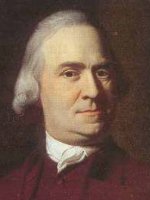
J. L. BELL is a Massachusetts writer who specializes in (among other things) the start of the American Revolution in and around Boston. He is particularly interested in the experiences of children in 1765-75. He has published scholarly papers and popular articles for both children and adults. He was consultant for an episode of History Detectives, and contributed to a display at Minute Man National Historic Park.
J. L. Bell will be one of the panelists in the discussion of “A Knock at the Door: Three Centuries of Governmental Search and Seizure” at the Old State House in Boston on 4 November. How does James Otis, Jr.’s argument against the London government’s writs of assistance connect to the Fourth Amendment of the U.S. Constitution, and what is the status of that protection today?
Hear J. L. Bell “Gossiping About the Gores” at Old South Meeting House, archived by the WBGH Forum Network. (And follow along with the handout.) This talk, delivered in January 2009, follows one Boston family from the 1760s through the 1820s. Striving in society, divided by politics, and occasionally star-crossed by love, the Gores provide a lively view of life during the American Revolution.
Hear J. L. Bell discuss John Adams with Mike Pesca, host of N.P.R.’s The Bryant Park Project, in April 2008.
Check out the online exhibit about the 5th of November in Boston that J. L. Bell assembled for the Bostonian Society. People in Britain celebrated that date as Guy Fawkes’ Day, but in Boston it was “Pope-Night”—a literal riot of bigotry, violence, and giant puppets of the Pope!
J. L. Bell’s article “A Bankruptcy in Boston, 1765” appears in the fourth-quarter 2008 issue of Massachusetts Banker. You can download a copy of the entire magazine for free from this page.
J. L. Bell’s article “‘I Never Used to Go Out with a Weapon’: Law Enforcement on the Streets of Prerevolutionary Boston,” about town watchmen, British army officers, and the Boston Massacre, is available in the Dublin Seminar volume Life on the Streets and Commons.
Children in Colonial America, edited by Prof. James Marten and published by N.Y.U. Press, features J. L. Bell’s chapter “From Saucy Boys to Sons of Liberty: Politicizing Youth in Pre-Revolutionary Boston.”

Tuesday, September 30, 2008

A Tragedy Acted in Colonial Boston?

The Boston Chronicle, published by Scottish immigrants John Mein and John Fleeming, was the only Massachusetts newspaper that strongly supported the royal government in 1769-70, when Boston’s Whig politicians were promoting a “non-importation” boycott of goods from Britain. Speaking up for Customs enforcement wasn’t easy. Mein was run out of town in October after he published a pamphlet insulting some Whig merchants and offered evidence that they’d imported goods themselves.

In early 1770, Mein was thought to be lying low in the barracks at Castle William while Fleeming and his apprentices, probably including John Howe, kept putting out the newspaper. The Chronicle appeared on Thursdays, which was also a day when the town’s schools let out early. In January, many boys started to use that free afternoon to picket the shops of people who had refused to sign the non-importation agreement.

On 1 Feb 1770, this curious notice appeared in the Chronicle:

Intended speedily to be acted
By a Company of young Tragedians,
A TRAGEDY
(Not acted here these seventy-eight years,)
called the
W I T C H E S,
With many Alterations and Improvements.

The scenery, decorations, &c. for the exhibition to be entirely new, and supplied by Messieurs J——n, L——, B——d and Company.

N.B. Notice will be given for the Rehersal, by ringing of the Town bells, when the Actors are desired to meet at FUNNY-HALL.—But as the young Gentlemen have lately been interrupted at some of their Rehearsals by the intrusion of Improper persons, it is desired that NONE but such as are to be REAL Actors will attend, and that NO ONE will presume to go behind the scenes without a TICKET from the Managers.

The names of the Managers, to whom Gentlemen may apply, with the Dramatis Personae, will be in a future Advertisement.
This advertisement used the phrasing that gentlemen would have recognized from theatrical advertisements in other newspapers—papers from outside New England. Boston had no theater, and still barred any type of theatrical entertainment. Therefore, that language would have immediately caught people’s attention. And I think this is how they decoded it.

The “company of young Tragedians” referred to the schoolboy picketers. The reference to a tragedy called “The Witches” acted out in 1692 was a clear allusion to the Salem witch trials, implying that the boys were engaging in the same behavior as the witch-hunters.

“Messieurs J——n, L——, B——d and Company” were William Jackson, Theophilus Lillie, and John Bernard, merchants who had continued to sell imported goods. Bernard was also the eldest son of Sir Francis Bernard, the recently departed royal governor. In January, the Boston town meeting had condemned those three men and others, as shown in the ad above from the Boston Gazette. Boys had begun picketing Jackson’s brass shop that month, and would move on to Lillie’s dry-goods shop in February.

Bostonians rang the “Town bells” when they wanted to draw a crowd—either to fight a fire or, as this item hints, start a riot. “Funny Hall” is clearly Faneuil Hall, seat of the town government.

And in the sarcastic rhetoric of the ad, “Improper persons” had earlier tried to break up the boys’ picket lines while “the Managers” had supported and—by implication—directed them. In the final line, the Chronicle’s printers threatened to name those managers.

TOMORROW: What Revolutionary Bostonians thoughts about “the witches.”

Monday, September 29, 2008

“Very much pleas’d with thoughts of having the Small pox”

Last week while I was at the Massachusetts Historical Society, I continued perusing of the third volume of The Papers of Robert Treat Paine, which the society published in 2005. Here’s a bit from a letter that Sally Paine sent to her husband from Taunton on 18 Aug 1776, while he was away at the Second Continental Congress in Philadelphia:

You desire’d me to write what my destines ware about the Small pox. Our Justices are to meet this week to determine Where the Hospital Shall be

if it Should be in a pleasant place & the docter think proper for me to have it I Shall go & three of the Children. I Should not think of having it ware it not for the Children but I Chuse to be with them. . . .

Bobe [i.e., Bobby] & Sally Send duty & are very much pleas’d with thoughts of having the Small pox & Tommy promises to be very good if he may goe.
I had to read that over two or three times to be sure. The Paines were discussing smallpox inoculation, of course, but at the time the treatment really did involve deliberately contracting the disease and hoping it was a mild case, not causing permanent disfigurement or death. But I guess the kids thought that would be exciting. Bobby Paine was born in 1770, Sally in 1772, and Tommy in 1773. All lived to adulthood.

Sunday, September 28, 2008

Rock On

A while back, Brad Paisley Jeff Pasley at the Publick Occurrences blog on Common-place posted a couple of items about American rock bands with names recalling the colonial period and early republic.

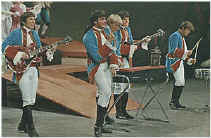
Everybody knows about Paul Revere and the Raiders (or should)—a hard-rocking band out of Idaho by way of Portland, Oregon. They came by their Revolutionary name honestly: their co-founder and keyboards player was really named Paul Revere. (He was also raised as a Mennonite, which I suspect was a rarity among rock and roll musicians.) The other co-founder was vocalist and sax player Mark Lindsay.

The Raiders started to wear historical costumes about the time they signed with Columbia Records, which was trying to get into youth music. At first, Revere and company rented some topcoats from a costume store. Those went over so well with their audiences, especially as part of or in contrast to their antic stage choreography, that they commissioned whole outfits for themselves, including colonial-revival three-cornered hats.

The group’s visual dimension, their sense of a rock-and-roll show as all-around wild entertainment, caught the attention of Dick Clark. In 1965 Paul Revere and the Raiders became the stars of his new television show, Where the Action Is. They got featured in teen magazines. And that promotion finally made their records start selling nationally. In that respect, the Raiders prefigured the Monkees, Archies, Partridge Family, and other T.V.-based rock groups.

That pop success in turn meant the increasingly influential rock critics of the late 1960s disdained the band, even though its members had spent years playing in clubs and released several good songs. In 1969 Lindsay left for a more fulfilling solo career. The band dropped Revere’s name to become the Raiders and in 1971 had their first #1 hit—a political protest song. Of course, “Indian Reservation (The Lament of the Cherokee Reservation Indian)” protested an event of 1838.

As for more obscure rock bands with names from early American history, Pasley and his Common-place correspondents found:

I’d like to see a battle of the bands between the 1971 Raiders and the Andrew Jackson Jihad.

Saturday, September 27, 2008

What’s So Important about Barrett’s Farm?

On Monday, the U.S. House passed the Minute Man National Historical Park Boundary Revision Act, authorizing the Department of the Interior to purchase more land for that national park in Concord. I wrote about this bill back in February.

The land that park managers and local supporters have in mind is the farm that belonged in 1775 to James Barrett, colonel in the Middlesex County militia. The Massachusetts Provincial Congress had commissioned him to collect weapons and other military supplies, which he hid on his farm and on his willing neighbors’ property.

What weapons? Barrett left no records, but Gen. Thomas Gage developed a detailed picture of what was out there. Some spy in the Concord area was communicating with him, and on 8 Mar 1775 the general wrote down the following list.

Four brass Cannon, & Two Cohorns or Mortars (so call’d by the Peasantry) Conceal’d at Mr: B——, (Lately chose or appointed Minute Colo.) Suppos’d to be deposited in his Cellar.—The Calibre of these pieces of Ordnance is not exactly ascertained, but reported to be only Diminutive.

Two pieces of Iron Ordnance (Suppos’d to be 4 or 6 pounders) are mounted, (On carriages said to be very indifferent) in the Courthouse & watch’d at Night, hitherto by a Slender Guard of Minute men.—

Eight more pieces of Iron Ordnance were this day (Le 8 de Mois de Mars) convey’d to Concord from L——— [Lexington? Lincoln? Lancaster?] (where they had been deposited a few days preceeding their Last removal;—Two of the Eight appeard to be Smaller than the rest & about three or four pounders—These last mentioned were met at a small distance from C——— in three Carts there were no appurtenances, but it was said that carriages were made or making at Salem & soon to follow.—

It is conjectured & reported that a Large quantity of [artillery] Cartridges are now preparing at Ch——n [Charlestown]; of Different Sizes, & numbered in order to distribute & distinguish properly.—A Large quantity of Duck [cloth] is also said to be bought up which is said to be & now fabricating these also into Tents.—

It is said with certainty 7 Tons of powder (equal to 13000 net or 280 barells,) is collected at C——d—The greatest part Lodg’d at one Whitings one of together with some small arms near the entrance into the Co[ncord] Vilage on the Road from hence—on the right hand, a White plasterd house, with a Small Yard in front & a Raild fence—a store adjoining the house contains the Powder.—
The list went on to describe where Barrett had arranged to hide small arms, flour, pork, and peas. This portion concluded: “Two Capital Roads Lead to C[oncord]—— one from the Ferry through Cambridge & Lexington—The other through WaterTown & part of Weston—22 miles distant the former only 19. Gage used this intelligence when drawing up orders for the march to Concord on 18-19 April. His soldiers took the shorter route. The main goal of that march—the furthest that British soldiers traveled—was James Barrett’s farm.

That’s why this site would be a most appropriate addition to the national park.

(Photo by Dominic Chavez/Boston Globe Staff.)

Friday, September 26, 2008

Samuel Adams Destroys His Letters

On 17 Sept 1777, six days after the Battle of Brandywine, Samuel Adams wrote to James Warren back in Massachusetts:

The Enemy were left Masters of the Field, but by all Accounts the Advantage was on our side. [Gen. William] Howe and his Army remain near the Field of Battle. They have had much to do in dressing their wounded and burying their dead. General Washington retreated over the Schuilkil to Germantown a few Miles above this City, where he recruited his Soldiers.

He has since recrossed the River and is posted on the Lancaster Road about 12 Miles distant from the Enemy. His Troops are in high Spirits and eager for Action. We soon expect another Battle. May Heaven favor our righteous Cause and grant us compleat Victory! Both the Armies are about 26 Miles from this Place. A Wish for the New England Militia would be fruitless. I hope we shall do the Business without them.
Adams was far too optimistic. The Continental troops had been beaten badly, their commanders outmaneuvered, and their casualties more than twice as high as the British. On 26 September, the Crown forces under Howe marched into Philadelphia, meeting no resistance. Adams and his colleagues in the Continental Congress had fled from the city.

Despite his tough talk, Adams had apparently prepared for such close calls by regularly burning his sensitive correspondence. His cousin John Adams wrote, in a letter to William Tudor, Jr., dated 5 June 1817:
I have seen him, at Mrs. Yard’s [boardinghouse] in Philadelphia, when he was about to leave Congress, cut up with his scissors whole bundles of letters into atoms that could never be reunited, and throw them out of the window, to be scattered by the winds. This was in summer, when he had no fire; in winter he threw whole handfuls into the fire. As we were on terms of perfect intimacy, I have joked him, perhaps rudely, upon his anxious caution. His answer was, “Whatever becomes of me, my friends shall never suffer by my negligence.”
The Congress regrouped in Lancaster and then York, Pennsylvania. Washington found a winter encampment at Valley Forge. After word of the American victory at Saratoga, Samuel Adams began to think that perhaps Gen. Horatio Gates would do a better job as commander-in-chief. I think it’s interesting how as late as 17 September he still expressed confidence in Washington.

Thursday, September 25, 2008

Driving the Battle of Brandywine

Last year I had the pleasure of following this Battle of Brandywine driving tour. Although there’s a Brandywine Battlefield Park, with a nice gift-shop staff, that land is only a small part of the area in southeastern Pennsylvania where the British and American armies fought on 11 Sept 1777. You need a car to take it all in.

The Battle of Brandywine involved 29,000 soldiers, more than any other land battle during the Revolutionary War. Both armies were personally led by their commanders-in-chief, Gen. William Howe and Gen. George Washington. The battle resulted in the British army taking Philadelphia, the U.S. of A.’s largest city and de facto capital (despite John Adams’s confidence that wouldn’t happen). After that, sixty percent of the Continental Army melted away, and Washington had to find winter quarters at Valley Forge.

Obviously, the Brandywine battle was a very significant event. So why doesn’t the park contain more of the battlefield? Why isn’t it a federal park? Why don’t we hear more about the Battle of Brandywine?

Well, the Americans lost. Big. Howe completely outmaneuvered Washington by sending Gen. Cornwallis north to cross the Brandywine at places that Loyalist scouts knew (one of them shown above) but that the American commanders had overlooked. The driving tour is a great way to understand the scope and geography of that move.

There are a few historical monuments along the way: obelisks raised where American officers fell, or a division held out for an hour, or troops made a heroic retreat. But at the end of the day there wasn’t much for the Continentals to celebrate. They had lost a lot of their artillery. Gen. Nathanael Greene estimated that his side suffered about 1,350 men killed, wounded, and captured (compared to the Crown forces’ 600). But even that casualty figure is an estimate; the Americans seem to have been so demoralized and disorganized by the battle that they never made a careful count of their losses.

TOMORROW: Samuel Adams’s reaction in Philadelphia.

Wednesday, September 24, 2008

John Adams Sits Tight in Philadelphia

On 23 Aug 1777, John Adams wrote home to Abigail about the British military’s approach to Philadelphia, where the Continental Congress was meeting:

It is now no longer a Secret, where Mr. [Gen. William] Hows Fleet is. We have authentic Intelligence that it is arrived, at the Head of Cheasopeak Bay, above the River Petapsco upon which the Town of Baltimore stands.

I wish I could describe to you the Geography of this Country, so as to give you an Adequate Idea of the Situation of the two great Bays of Cheasopeak and Delaware, because it would enable you to form a Conjecture, concerning the Object, he aims at.—

The Distance across Land from the Heads of these Bays is but small, and forms an Istmus, below which is a large Peninsula comprehending the Counties of Accomack and Northampton in Virginia, the Counties of Somersett and Worcester in Maryland, and the Counties of Kent and Sussex on Delaware. His March by Land to Philadelphia, may be about sixty or seventy Miles. I think there can be no doubt that he aims at this Place, and he has taken this Voyage of six Weeks, long enough to have gone to London, merely to avoid an Army in his Rear.

He found he could not march this Way from Somersett Court House, without leaving G. Washington in his Rear.

We have called out the Militia of Virginia, Maryland, Delaware, and Pensilvania, to oppose him, and G. Washington is handy enough, to meet him, and as G. Washington saved Philadelphia last Winter, by crossing the Delaware and marching to Morristown, and so getting in the Rear of Howe, so I conjecture he will still find Means to get in his Rear between him and Cheasapeak Bay.

You may now sit under your own Vine, and have none to make you afraid.—I sent off my Man and Horse at an unlucky Time, but, if We should be obliged to remove from hence, We shall not go far.
Adams was apparently sure that Howe feared having Washington “in his rear.” But wouldn’t that mean no Continental troops between the British army and Philadelphia? I might not have been so confident.

TOMORROW: Revisiting the Battle of Brandywine.

(German map of the 1777 Philadelphia campaign above from Wikipedia.)

Tuesday, September 23, 2008

Warren in Worcester, 25 Sept 2008

Also on Thursday, 25 September, the American Antiquarian Society in Worcester is hosting a lecture by author Nancy Rubin Stuart based on her new book, The Muse of the Revolution: The Secret Pen of Mercy Otis Warren and the Founding of a Nation. The description:

Mercy Otis Warren was also the fiery wife of Massachusetts patriot James Warren, the mother of five sons, and friend and close colleague to John and Abigail Adams. Warren secretly authored anti-British plays during the Revolution, penned an influential pamphlet arguing for a Bill of Rights, and authored The History of the Rise, Progress and Termination of the American Revolution.
Warren also produced a mind-bogglingly impressive piece of embroidery now at the Pilgrim Hall museum in Plymouth, so I’ve come to think of her as Revolutionary New England’s “woman who does everything more beautifully than you.”

Stuart has written biographies about spiritualist Maggie Fox, industrialist Marjorie Merriweather Post, and monarch Isabella of Castile.

B.A.E.A.H.S. Starts Up Again, 25 Sept 2008

Every year the Massachusetts Historical Society hosts a series of academic discussions under the unacronymable name of the Boston Area Early American History Seminar. The new season starts up this Thursday, 25 September, at 5:15 P.M.

Prof. T. H. Breen of Northwestern University has shared a paper titled “It Rained Cats and Dogs the Day the Revolution Began: How a Strange London Publication Transformed the American Political Landscape in 1775.” The original, less intriguing subtitle, which indicates Breen’s larger project, is “Political Ideology and Popular Mobilization on the Eve of American Independence.” His most recent book was The Marketplace of Revolution; here’s a review by Prof. Alan Taylor at Powell’s Books.

Some scholarly functions start with an author reading his or her paper aloud. Not in this seminar series—which makes reviewing the paper in advance at the M.H.S. more useful. Breen will offer just a few remarks on what questions he’s hoping to answer, and then Prof. Richard D. Brown of the University of Connecticut will comment on what he’s actually written so far. Discussion then becomes general. Usually there are cookies.

Here’s a complete list of the upcoming year’s seminars in this series.

Monday, September 22, 2008

Medical Lecture in Medway

Boston 1775 reader Graeme Marsden alerted me to this event at the end of the month:

Pills, Potions, Poultices: A Re-enactment of Revolutionary War Doctor Elisha Skinner. Come see Edwin Page portray Dr. Elisha Skinner [1742-1827], regimental surgeon for the Massachusetts Xth Regiment of the Continental Line.

You will learn what sort of anesthesia was used to perform surgery, why infant mortality was so high and how to use an 18th-century remedy to cure your next headache. You will most certainly come away with a greater appreciation for 21st-century health care.
This reenactment/lecture will take place on Tuesday, 30 September 2008, starting at 7:30 P.M., at the Medway Senior Center. The Medway Historical Society promises refreshments for anyone who has an appetite left, and “plenty of free parking.”

Sunday, September 21, 2008

Looking for Mrs. Hannah Winslow

Late last week, Thomas B. Allen, author of George Washington, Spymaster and other history books, asked if I had any ideas about the identity of a woman named among the civilians who evacuated Boston with the British military in March 1776.

The British authorities made a list of all heads of household and the number of people in their parties, about a thousand total. This list was published by the Massachusetts Historical Society and elsewhere. One section in the Ws looks like this:

Winslow, Isaac, 11
Winslow, Pelham, 1
Winslow, John, 4
Winslow, Mrs. Hannah, 4
Winslow, Edward, 1
Who was “Mrs. Hannah Winslow”? Was she a widow, or for some reason not traveling with her husband? And why couldn’t she have had a less common first name than “Hannah,” and a less common last name than “Winslow”?

I did some research and sent off my guess: that she was the wife of Customs collector Edward Winslow, Sr., who was under house arrest in Plymouth. Then I settled down to present the evidence for that guess in this posting. But as I did more research in period newspapers, I came across another candidate. In fact, a more promising candidate.

So, with apologies to Mr. Allen for my email, here’s who I now suspect Mrs. Hannah Winslow was. I’m relying mostly on Eva Phillips Boyd’s article on the Loring family, available from the Jamaica Plain Historical Society

Hannah Loring was born in on 15 Dec 1742 to Commodore Joshua Loring, Sr. In 1760, the family moved into a big house in Jamaica Plain. Three years later, on 26 Dec 1763, Hannah married Joshua Winslow, about to turn twenty-eight and a busy partner in his father’s mercantile firm. John Singleton Copley painted a portrait of the bride showing off her lace, now at the Detroit Institute of Arts.

The young Joshua Winslow took over his father’s place in the family firm in 1767, and in 1773 became one of the tea consignees—the merchants designated in London to receive and resell East India Company tea. He deferred to his colleagues (most of whom were also relatives) and didn’t take a prominent role in defying the tea boycott or trying to get the tea landed. Nevertheless, the political confrontation over that tea put Winslow squarely on the side of the royal government.

On 20 Mar 1775, as the province rolled toward war, Joshua Winslow died. The 23 March Boston News-Letter ran this notice:
Last Monday Afternoon, departed this Life, after a short Illness, in the 39th Year of his Age, Mr. Joshua Winslow, Merchant of this Town:—

A Man in whom was united, almost every useful Accomplishment of Life: To a chearful benevolent Disposition was joined a sound and penetrating Judgment, which enabled him to discharge the various Duties of his Station, to the general Approbation of Mankind; and we trust to his own inward Peace. . . .

As a Husband, he was tender and affectionate: As a Parent kind and indulgent: As a Master, humane and compassionate: As a Friend, faithful and sincere. . . .

He has left a sorrowful Widow and six Children. His Funeral is to be this Afternoon, at which Time the Friends of the Deceased are desired to attend.
Winslow’s death was a shock to his family and friends. On 3 April, Henry Pelham wrote to Copley, his half-brother:
Mr. Joshua Winslow, Commodore Loring’s Son-in-Law was abroad [i.e., out of doors] the 16 of Last Month, and on the 23d was an inhabitant of the silent Tomb.
Hannah was a widow at thirty-three.

A little less than a year later, the refugee list indicates, “Mrs. Hannah Winslow” departed Boston in a party of four. Where were the other three children? Some might have traveled with their Loring grandparents, and some might have died. Some might even have stayed, though I’m not sure where.

The 15 Mar 1777 Freeman’s Journal, published in Boston, printed a long list of Loyalist refugees and where they were reportedly settling. “Mrs. Winslow Widow to Joshua Winslow” is named among the refugees still at Halifax. According to Boyd’s article, Hannah Winslow died in Canada in 1785.

Saturday, September 20, 2008

After John Trumbull

Someone recently sent me this image via the LiveJournal group scans_daily. It comes from Marvel’s easy-to-read comic book Spidey Super Stories—the issue published in July 1976, of course.

Friday, September 19, 2008

More Links on Richard and Annis Stockton

It turns out I’m not the only person writing about Richard Stockton this month. Boston 1775 reader Bill Welsch alerted me to Donald Johnstone Peck’s “New Jersey’s Darkest Hour” in the debut issue of Garden State Legacy, an online magazine of New Jersey history. You can download Peck’s article in P.D.F. form from that website. It offers much more context for Stockton’s choices in 1776-77. Other articles in the magazine discuss whether “urban spelunking” is a way to explore history and how two state authors popularized astronomy, so it’s quite wide-ranging.

Another online resource about the Stocktons comes from the OurStory Project, hosted by Bergen County Technical Schools. Its resources on the Revolutionary War in New Jersey include a “Poem for Washington.” That link brings a P.D.F. file of material from the New Jersey Historical Society: an image from a Stockton family commonplace book with the first lines of a poem by Annis Stockton (shown above), plus background information.

Annis Stockton, Richard’s wife, apparently wrote this poem in honor of Gen. George Washington soon after his victories at Trenton and Princeton in December 1776 and January 1777. Since she lived in Princeton, those battles were very important to her. She probably shared the poem with her friends, but didn’t have it published until ten years later, in the Columbian Magazine for January 1787.

The P.D.F. download contains only the first lines of the poem, and they’re not precisely transcribed. The full text appears in Carla Mulford’s collection of Stockton’s poetry, titled Only for the Eye of a Friend. Washington had obviously inspired Stockton to work in the epic mode, starting with an invocation:

The muse affrighted at the clash of arms,
And all the dire calamities of war,
From Morven’s peaceful shade has long retir’d,
And left her faithful votary to mourn,
In sighs not number’d, o’er her native land.
Dear native land! whom George’s hostile slaves,
Have drenched with blood and spread destruction round.
But thou[,] my country’s better genius comes[,]
Heroic Washington[,] and aid my song!
The reference to “George’s hostile slaves” didn’t mean Washington and his actual slaves, but George III and the soldiers working for him.

Thursday, September 18, 2008

Richard Stockton and the Creation of a Legend

Within twelve months from the spring of 1776 to the spring of 1777, Judge Richard Stockton of New Jersey went from advocate of American autonomy within the British Empire to Continental Congress delegate to signer of the Declaration of Independence to captive of the British military to subject reaffirming his loyalty to the British Empire and retiring from the independence movement.

Stockton’s oath of loyalty to Britain, attested to in letters of the time, explains why after he died in 1781 his family and minister didn’t even mention his weeks in captivity: that period was an embarrassment rather than a source of pride. That history also explains why people told a less than complimentary anecdote about how Stockton wasn’t chosen to be New Jersey’s governor in 1776, and why the Rev. William Gordon felt safe publishing that story in 1788. The judge wasn’t a revered figure, though he also wasn’t reviled.

Then time passed. Stockton’s widow, Annis, developed a reputation as a patriotic poet and correspondent of George Washington. Their eldest son, also named Richard Stockton (shown above), became the first U.S. Attorney for New Jersey. The couple’s other children were respectable local figures. In the 1820s, the U.S. of A. looked ahead to the fiftieth anniversary of the Declaration of Independence, with special reverence for that document’s signers.

Some of the Stocktons’ children were still alive in that decade. During the Revolutionary War, they had been old enough to understand what their father had experienced and done. Even if he hadn’t told them everything, they must have heard important details. Those aged children might have supplied the details of Stockton’s life in Biography of the Signers of the Declaration of Independence—or those details might have come from the next generation, raised on tales of their grandparents.

Whoever the family sources were, the Richard Stockton story of the 1820s came out as a tale of martyrdom to the cause of American liberty. That biography linked Stockton’s imprisonment, his departure from politics, and his death to make one smooth, heroic narrative. He was so patriotic that treacherous Loyalists made a special bid to capture him and treated him badly, so admired that the Congress made a special effort to get him released. The British treatment was so cruel that he couldn’t go back to working for the cause he was still committed to, so cruel that it killed him before the war was over. Not only did that story skip over the embarrassing bits, but it gave Stockton’s life a more coherent meaning by tying everything together as cause and effect.

It shouldn’t surprise us that the Stockton family created this story and believed it whole-heartedly after the first generation. (Even his children might have convinced themselves it had to be true.) Similarly, historians who focused on New Jersey were prone to retell the tale.

But American authors from outside the family and the state also accepted the Stockton legend uncritically, and some even added more details about his suffering. Historians found evidence of Stockton’s oath to the Crown, and the legend still survived. And not just in the “Price They Paid” essay and similar mythologies. Look on the websites of the Richard Stockton College of New Jersey (opened in 1971), the Morven Institute of Freedom, and even the National Park Service, and you won’t find any hint of the more complex tale. (Princeton University’s page on Stockton is a commendable exception, and after some editorial back-and-forth Wikipedia is more reliable than the Columbia Electronic Encyclopedia.)

Many Americans apparently haven’t liked learning that one signer of the country’s founding document later renounced it—and then changed his mind under pressure again. And people of all nations tend to prefer a tidy, admirable legend to more messy human history.

We can see the same thing happening right now with John S. McCain’s biography, and that’s not even over. McCain’s imprisonment in North Vietnam in 1967-73 is well documented, not just because we have lots of papers and video footage, but also through his own memoirs (written with longtime aide Mark Salter). McCain was held in prison for years, much longer than Stockton; suffered much worse treatment; and instead of retiring has served in public office for decades. That’s all beyond dispute. You wouldn’t think anyone would see a need to embellish that story.

Yet, as Peter S. Canellos wrote in the Boston Globe earlier this week, former senator Fred Thompson misrepresented McCain’s history in his speech at the Republican National Convention:

Thompson twisted one of McCain’s most moving revelations—how, while a badly injured POW, he provided some unimportant information to the enemy but felt so disgusted that he wanted to kill himself—into its opposite. “He was offered medical care for his injuries if he would give up military information,” Thompson declared in a sonorous tone. “John McCain said ‘no’.”
Politifact.com called Thompson’s account “false,” noting “he contradicts statements McCain made in his bestselling autobiography.” In fact, McCain made the information-for-medical-care offer to his captors, though not sincerely. He told them he’d talk if they took him to a hospital, secretly planning not to go through with that bargain, and then felt ashamed for compromising even that much. Later, McCain signed an anti-American statement; even though everyone recognized that was a product of torture, he still felt embarrassed.

Thompson’s speech simplified McCain’s real, human history into a false tale of pure heroism, apparently more suitable for prime-time television. And that change was apparently approved by the McCain campaign. It was one of many falsehoods the candidate and his team have told lately, so it was easily overlooked, but it’s the most ironic since it addresses McCain’s personal sense of honor, the quality that he at one point was running on.

Is it any wonder that Richard Stockton’s story—less heroic to begin with, directly tied to the sacred Declaration, and spottily documented—has been embellished and preserved in amber by people who want to admire a Founding Father without doubt?

Wednesday, September 17, 2008

Richard Stockton’s Complex Story

I’ve been analyzing the legend of Richard Stockton, often said to be the only signer of the Declaration of Independence to be taken prisoner solely for signing that document. Most biographies of Stockton say that the British authorities treated him harshly, leaving him a broken man who died shortly afterwards. That version of Stockton’s life leaves out several awkward historical details:

A contrary image of Stockton has therefore developed. David H. Fischer’s Washington’s Crossing refers to him only as a prominent example of someone who “turned his coat” and switched sides during the war. I think that portrait is better grounded in facts than the traditional one, but too harsh in assessing the man.

First of all, to say Stockton became a turncoat by abandoning the Continental Congress leaves out the British point of view. He had already broken his oath of loyalty to the British Empire—as had every other American government and militia official who joined the independence movement. When Stockton accepted a seat on New Jersey’s high court from Gov. William Franklin in 1774, he swore to serve King George III. Yet two years later the judge was signing his name to a document that pledged “our Lives, our Fortunes, and our sacred Honour” to the cause of breaking away from that king.

Then around the start of 1777 Stockton accepted the British commanders’ offer of pardon and signed an oath that took this form:
I, A. B., do promise and declare, that I will remain in a peaceable obedience to his Majesty, and will not take up arms, nor encourage others to take up arms, in opposition to his authority.
And finally at the end of 1777 Stockton swore yet another oath of loyalty to the state of New Jersey.

We can agree that Stockton’s promises of obedience were flimsy, subject to whatever pressure he was feeling at the time. But at the same time I think he was genuinely torn between the empire and the republic. Stockton’s December 1774 proposal on the imperial crisis shows that he would have been happy to remain a British subject under the king as long as the North American colonies had more autonomy. (Most Americans would probably have agreed with that position at the time.) He came to the side of independence at nearly the last minute, after he arrived at the Congress in June 1776.

Furthermore, though Stockton kept swearing allegiance to whatever authority was pressing him at the time, it’s clear that he was under the most pressure of all after his arrest in late 1776. That imprisonment was neither as long nor as painful as later authors have said, but it must have been a shock to his system. As a genteel attorney and judge, he was used to dealing with men who were held in jail—not to being in a “common jail” himself. Cold and lack of good food aside, the hardest part of being imprisoned for Stockton was probably lack of control and uncertainty about his fate. He was a high-born, intellectual gentleman, and he was at others’ mercy.

In late 1776 the infant U.S. of A. appeared to be in the same dire straits. The Crown forces had pushed the Continental Army out of New York and New Jersey. Until the Battles of Trenton and Princeton, weeks after Stockton’s capture, they seemed unstoppable. Hundreds of other New Jersey men swore loyalty to the British king in that period. Those circumstances make Stockton’s choice easier to understand. He appears to have favored American independence, but wasn’t fervent enough to stick to it when it looked like a really lousy idea.

Furthermore, I think it’s significant that there’s no evidence that Stockton offered aid to the British military. In the fall of 1776, just before he was captured, the judge had been busy helping to organize the Continental defenses around Fort Ticonderoga. I haven’t come across any hints that he gave the British commanders sensitive information about that topic.

On returning home, Stockton interpreted his oath as a promise not to help the American side. However, close family members continued to support the independence movement. His son-in-law Dr. Benjamin Rush was a Congress delegate in 1776-77 and a top medical officer in the Continental Army in 1777-78. His brother-in-law (through both wife and sister) Elias Boudinot was commmissary general of prisoners 1776-79 and delegate to Congress off and on from 1778 to 1783. On 4 July 1780, the New Jersey Gazette published a story about ladies raising money for the Continental Army, and it listed “Mrs. R. Stockton” among those with “well known patriotism.” (I should note that the extended Stockton family also contained some Crown supporters as well.)

So I don’t think it’s accurate to say Stockton became a turncoat in 1777, meaning that he switched sides. Rather, I suspect the judge decided, for the sake of his emotional health, to get out of the game altogether. He spent the rest of his life on the sidelines.

TOMORROW: How legends are born.

Tuesday, September 16, 2008

Richard Stockton’s Plan to Save the Empire

I’ve written a number of items about Richard Stockton, the Continental Congress delegate from New Jersey who was captured by Crown forces at the end of 1776 and, in exchange for his freedom, promised to leave the independence movement. In this post I’m going to go back about eighteen months before New Jersey sent Stockton to the Congress.

In 1774, Stockton was a new judge on New Jersey’s highest court, formerly a Council member and highly respected lawyer. And he was worried about civil war. The First Continental Congress had met in Philadelphia that fall, issuing a call to boycott British imports. Gen. Thomas Gage was gathering military forces in Boston, determined to enforce the Massachusetts Government Act and quash the rebellion there.

On 12 December, Stockton sat down and wrote a document for William Legge, the Earl of Dartmouth (shown here, courtesy of Colonial Williamsburg), the London government’s Secretary of State overseeing North America. It appears that Stockton sent his document to a London merchant named Samuel Smith to pass on to the government. (This was not the Rev. Samuel S. Smith who preached at his funeral.) The judge’s grandson supplied a copy to the Historical Magazine, which published it in 1868. The document first warned Dartmouth and his colleagues of the colonists’ military strength and then suggested a peaceful way to resolve the political disputes.

An Expedient for the Settlement of the American Disputes humbly submitted to the consideration of his Majesty’s Ministers by an American

The State of American Affairs is so truly alarming at this time, that every real friend to the British Empire ought to suggest every probable expedient that occurs to him for the accommodation of the unhappy disputes between Great Britain and the Colonies.——to give the following suggestions their due weight; it must be premised——

1st. That the several North American Colonies, from New Hampshire to South Carolina inclusive [Newfoundland, Nova Scotia, Canada, Georgia, and the Floridas had not sent delegates to the First Continental Congress], are able to furnish 500,000 fighting men: who are in general as fit for service as the English Militia, and many of them much more so, having been in actual service the last war.

2dly. That the great body of the people in these several Colonies are now (even to the astonishment of many Colonists themselves) perfectly united in a determinate opposition to the authority of the British Parliament, as to all internal Taxation.

3dly. That there is not the least remaining doubt, if the British Government should proceed to put the late Acts of Parliament respecting the Massachusetts Bay (or any other Acts which involve the Idea of an abso–uncontroulable power in the British Parliament over the Colonies) into execution, by force; but that the assd. Colonies would unite in attempting to repel force by force.——

To which may be added, what is as well or perhaps better known in Great Britain than in America, to wit,

4thly. That the certain consequences of this unnatural War will be dreadful to both Great Britain and America: and the probable effects thereof may be fatal to the whole British Empire.

Matters standing thus; and the three first propositions above premised being founded upon the most indubitable facts of which the writer of this, from his general acquaintance with America, is perhaps as competent a judge as any man whatever. It is humbly proposed to the Consideration of his Majesty’s Ministers, whether it would not be proper

1st. That a royal Instruction be immediately obtained, and sent over to the several Governors of the North American Colonies, requiring them forthwith to recommend it to their several Assemblies to pass, and to give their own assent to an Act which may be passed by the Legislatures of the several Provinces, empowering certain Commissioners therein to be named, to repair to England; with power to confer with his Majesty's Ministers or with Commissioners to be appointed by Act of Parliament, respecting the grand points in dispute between Great Britain and America; and finally to determine thereupon.

2dly. That to prevent all disputes in future the sd. American Commissioners be also impowered to confer and agree with the British Commissioners respecting the future government and regulation of the Colonies; either by framing One general System of Government for all the Colonies on the Continent, similar to the British, Or by making some material alterations in the present mode of provincial Government. In either of which systems, some effectual provision may be made for the adequate support of the American Government by the Americans themselves: And also for the payment of all such sums of money as may become due from America to Great Britain for the assistance of her Fleet and Army. These determinations of the sd. Commissioners to be subjected nevertheless to such alteration as the wisdom of his Majesty and his Parliament of Great Britain may make therein; and as shall be agreed to by the several provincial Legislatures.

3dly. That upon such Instructions being given to the several Governors, his Majesty be advised in his royal clemency to recommend it to his Parliament to suspend the operation of the Boston Port Act until the determination of the sd. Commissioners shall be had.

The Author of the above hints offers them with all humility, and with great diffidence of his own abilities, on so great and national a question. But some expedient must be immediately fallen upon, or we shall be involved in a civil war the most obstinate awful and tremendous that perhaps ever occurred since the Creation of the world.

He will esteem it a signal blessing of divine providence, conferred upon him, if any one Idea he hath suggested may be of any use at this dreadful Crisis: And if otherwise, he will at least be able to comfort himself with the uprightness of his intentions in this feeble attempt: and with the assurance that it can do no harm either to himself, or any other person.
This was a wealthy, well-connected lawyer’s solution to the troubles: colonial commissioners—no doubt chosen from the top of the political and legal class—talking with equivalent gentlemen in London and working out a compromise.

Although Stockton signaled he was open to other suggestions, he envisioned a system in which the American colonies would be basically self-governing within the British Empire, responsible only for paying the London government a fair price for military protection. The American colonies would have “One general System of Government...similar to the British,” which sounds like a North American parliament that worked with the king the same way the Parliament in London did. Most American colonists would probably have been satisfied with that resolution.

But the London Parliament would never have gone for it. The previous century and a half of British political history was all about Parliament establishing itself as the most powerful governmental institution—more powerful even than the monarch in whose name it acted. Parliament had deposed and executed Charles I, chased James II out of Britain, and passed over the Stuart claimants to bring in the Hanoverians. The legislature was so successful that George III, though more active in choosing government ministers than his successors would be, saw his job as working with Parliament.

Stockton’s scheme would have created a similar but independent parliament in North America, parallel to the one in London. And a future monarch, British politicians feared, might play one source of legislative power and revenue off against the other, thus potentially regaining the upper hand over both. The Parliament in London had to be the sovereign power in the British Empire.

So nothing ever came of Stockton’s proposal. I’m not even sure Lord Dartmouth ever saw it. But this document shows how in 1774 Stockton wished to find a way to preserve both American self-government and the British Empire.

TOMORROW: Richard Stockton, turncoat?

Monday, September 15, 2008

Friary on Punch Drinking, 29 Sept 2008

Here’s a lecture announcement from the New England Historic Genealogical Society that caught my eye—and my tastebuds:

One Bowl More and Then: Punch Drinking in Colonial America
Monday, September 29, 2008, 6:00 PM
Donald Friary, president of the Colonial Society of Massachusetts and director emeritus of Historic Deerfield, will present an entertaining and informative talk on the history of punch drinking in Colonial America.
This talk will take place at the N.E.H.G.S.’s headquarters at 101 Newbury Street in Boston, and is free to the public.

The punch bowl above belonged to Ebenezer Stevens and is in the Metropolitan Museum of Art in New York. Read about it here.

I’ll close with a quote from David Hansen’s article on “The First Corps of Cadets of Boston,” published by the Bostonian Society in 1944. The Cadets were an upper-class militia unit that reconstituted itself in the mid-1780s.
Parading on the unpaved streets of those days meant clouds of dust and the white uniforms worn by the Cadets required cleaning. This was usually done with bread crumbs by lady friends, and as kid gloves were scarce, a pair of gloves was the usual reward. One lady remarked that after cleaning a uniform she usually smelled of brandy punch.

Sunday, September 14, 2008

A Medical Poet and a “Cancer Quack”

Dr. Lemuel Hopkins (1750-1801) was born and trained in Waterbury, Connecticut. He served briefly in the Revolutionary War, his early biographies say—without specifying how. In 1784 Hopkins moved to Hartford and became one of that town’s conservative wits, publishing essays and verse.

Hopkins’s most famous poem is a response to traveling cancer specialists like the Pope family, who advertised their cures in newspapers.

A Patient Killed by a Cancer Quack

Here lies a fool, flat on his back,
The victim of a cancer quack,
Who lost his money and his life,
By plaister, caustic and the knife.
The case was this—a pimple rose,
South-east a little of his nose;
Which daily redden’d and grew bigger,
As too much drinking gave it vigor;
A score of gossips soon ensure
Full threescore different modes of cure;
But yet the full-fed pimple still
Defied all petticoated skill;
When fortune led him to peruse
A hand-bill in the weekly news;
Sign’d by six fools of different sorts,
All cured of cancers made of warts;
Who recommend, with due submission,
This cancer-monger as magician;
Fear wing’d his flight to find the quack,
And prove his cancer-curing knack;
But on his way he found another,—
A second advertising brother:
But as much like him as an owl
Is unlike every handsome fowl;
Whose fame had raised as broad a fog,
And of the two the greater hog:
Who used a still more magic plaister,
That sweat forsooth, and cured the faster.
This doctor view’d, with moony eyes
And scowl’d-up face, the pimple’s size;
Then christen’d it in solemn answer,
And cried, “this pimple’s name is cancer.
But courage, friend, I see you’re pale,
My sweating plaisters never fail;
I’ve sweated hundreds out with ease,
With roots as long as maple trees;
And never fail’d in all my trials—
Behold these samples here in vials!
Preserved to show my wondrous merits,
Just as my liver is—in spirits.
For twenty joes the cure is done—”
The bargain struck, the plaister on,
Which gnaw’d the cancer at its leisure,
And pain’d his face above all measure.
But still the pimple spread the faster,
And swell’d, like toad that meets disaster.
Thus foil’d, the doctor gravely swore,
It was a right-rose cancer sore;
Then stuck his probe beneath the beard,
And show’d him where the leaves appear’d;
And raised the patient’s drooping spirits,
By praising up the plaister’s merits.—
Quoth he, “The roots now scarcely stick—
I’ll fetch her out like crab or tick;
And make it rendezvous, next trial,
With six more plagues, in my old vial.”
Then purged him pale with jalap drastic,
And next applied the infernal caustic.
But yet, this semblance bright of hell
Served but to make the patient yell;
And, gnawing on with fiery pace,
Devour’d one broadside of his face—
“Courage, ’tis done,” the doctor cried,
And quick the incision knife applied:
That with three cuts made such a hole,
Out flew the patient’s tortured soul!

Go, readers, gentle, eke and simple,
If you have wart, or corn, or pimple;
To quack infallible apply;
Here’s room enough for you to lie.
His skill triumphant still prevails,
For death’s a cure that never fails.
I’m not sure this poem helped anybody, but writing it probably made Dr. Hopkins feel better.

Saturday, September 13, 2008

A Cancer Case from 1799

On 2 Aug 1802, the Connecticut Courant newspaper ran this article by Capt. Samuel Hall, then sixty-seven years old and living in East Haddam. He described Dr. John Pope, born in Boston in 1769 to John and Hannah Pope, a Quaker couple who had both listed themselves in town directories as “cancer doctors.”

About the year 1789, when living in Plainfield, in the state of Connecticut, I discovered a small spot on the calf of one of my legs, from which I soon began to experience considerable inconvenience. This spot gradually and regularly increased, till a malignant tumour formed under it, and the surface became covered with a dry scab.

The sore now became virulent and troublesome, and I applied for medical assistance. The best advice that could be obtained in that vicinity was improved; but without any beneficial effect. Eminent practitioners were procured from some distance from my residence: They pronounced the disorder a cancer; and applied every method of cure within their knowledge, yet all their exertions were vain, every mode of treatment proved ineffectual, and every experiment failed. My disorder increased to an alarming degree, baffling all medical skill, and my case becoming desperate, my physician totally gave me over and declared that I must die.

I then resigned all expectation of being restored, settled my earthly affairs, and gave myself up for a speedy dissolution. While I lay principally confined to my bed in hopeless anguish, suffering in my imagination the approaches of death, I was informed of Doct. John Pope of Providence, who it was said was eminently skilled in the cure of cancers. I was advised by my friends, one in particular (Mr. Smith, who had experienced the cure of the same disorder) to make immediate application to Doct. Pope for assistance. . . .

I accordingly applied to him on the 14th of June, 1799. The Doctor examined my complaint, but gave me small encouragement of relieving me. He considered the cancer as having advanced to such a state of inveteracy, and so radically fixed in my constitution, as to have become very doubtful of cure; and it was with reluctance that he attempted the cure at all.

The tumour had now become so enormously increased as to be full as big as a four pound shot [i.e., cannonball], the surface entirely ulcerated, and was declared by every one to be a perfect rose cancer. My ancle, leg, knee and thigh were so much swollen as to be almost twice their natural size; and below my knee nearly all the way of a bigness. My leg was of a dark purple, very angry, and covered with watry blisters and scabs, which extended above my knee. My appetite was lost, my body emaciated, and my constitution so much impaired, that when I arrived at Providence, it was with extreme difficulty that I could support myself on my feet.

I was in this situation when Doct. Pope undertook the cure. By his attention and skill, I was, to the astonishment of every one, in about four months entirely cured of the cancer, and restored to my natural health. The tumour and the virulence of the cancer became totally dispelled, and my blood so entirely purged of all cancerous humors, that I have since enjoyed my health in as great perfection as at any time previous to the first appearance of the cancer.

I consider not only the health, but the life which I now enjoy, under God to be wholly owing to the skill and attention of Doctor Pope. To his care I shall therefore recommend all persons who are in danger of the fate, from which I have been thus surprizingly rescued.
Unfortunately, Hall didn’t describe Dr. Pope’s treatment—probably because the doctor wanted to keep those methods proprietary.

In Medical Common Sense (1868), Dr. Edward B. Foote wrote:
a rose cancer...looks at first very like a rose-bud, and, as it enlarges, opens and expands like a rose. This generally attacks the womb, vagina, and nose, but may locate in any other part of the system. It is very painful, and sometimes grows to an immense size.
These days, we don’t have to wait for cancers to appear outside the body, but try to catch and treat them at the cellular level. As a result, the medical terminology has changed, and cancers are identified by the types of cells they grow from, not by their outer appearance.

Capt. Samuel Hall, formerly of Plainfield, lived another decade and died at age seventy-eight in Brutus, New York, according to the 5 July 1813 Connecticut Mirror.

TOMORROW: A traditional physician responds to a cancer doctor.

Friday, September 12, 2008

John and Hannah Pope: cancer specialists

Writing about Richard Stockton dying of cancer in 1781 reminded me that I had some information about a cancer specialist on my hard drive. A few years ago, historian Clayton Cramer came across an entry in the 1800 Boston town directory for “Hannah Pope, cancer doctor.” He wrote about that fact on his blog, and later mentioned it on an email list we both subscribe to.

So I did some checking in my resources. Several Boston newspapers noted the death of Hannah Pope in March 1805. The first was the New England Palladium, which identified her as widow of Dr. John Pope, aged 61, “a member of the Society of Friends and exemplary in her virtues,” and up until quite recently living at 63 Newbury Street. (Bostonians started numbering their houses after the war.)

Knowing Pope was a Friend led me to check George Selleck’s Quakers in Boston, which contains a complete list of the town’s Quakers in 1774. In that year John and Hannah Pope were members of the Society of Friends, along with John’s parents and uncles and Hannah’s father, James Raymer. John was four years older than his wife. They had a son named John and a daughter named Hannah. John Pope was described as a surveyor as well as a doctor, and indeed in 1785 he advertised that he taught surveying, mathematics, and other skills in the evening.

According to Peter Benes’s article on itinerant healers in the Medicine and Healing volume of the Dublin Seminar for New England Folklife, the Boston directory for 1789 listed Dr. John Pope as a specialist in “cancers and malignant ulcers” as well as “school-master and surgeon.” He claimed to have been curing people since 1768 with an external “Plaister” and an internal “Balsamic Elixir.”

Hannah Pope must have carried on her husband’s profession after his death, also calling herself a “cancer doctor.” The Quakers were unusually respectful of women’s abilities (for the times), and perhaps that gave Hannah the impetus to operate on her own. (She was never called “Dr. Hannah Pope,” though.) The couple’s sons John (b. 1769), Samuel (b. 1781), and Benjamin (b. 1783) all followed in the field, advertising their skills in Providence and Hartford in the early 1800s.

TOMORROW: Cancer treatment in 1799.

Thursday, September 11, 2008

What the Founding Fathers Set Up

American politicians always try to evoke the “founders” or “founding fathers” of the U.S. of A. to argue for their policies, or simply to reinforce their patriotism. I think those eighteenth-century gentlemen would actually be struck speechless by today’s issues, not to mention today’s technology, clothing, and general egalitarianism. And if you don’t look too hard, it’s possible to invoke their words or actions to support nearly anything.

That said, politicians’ remarks on the founders can still be useful to judging how they think. Do they show a respect for historical facts? Do they show the ability to think logically and critically, to identify important principles and recognize difficult truths instead of easy falsehoods?

One cogent example of a reference to America’s founders appeared in this 8 Sept 2008 dispatch from the presidential campaign trail, written by Peter Slevin for the Washington Post:

Sen. Barack Obama delivered an impassioned defense of the Constitution and the rights of terrorism suspects tonight, striking back at one of the biggest applause lines in Republican vice presidential nominee Sarah Palin’s speech to the GOP convention.

It was in St. Paul last week that Palin drew raucous cheers when she delivered this put-down of Obama: “Al-Qaeda terrorists still plot to inflict catastrophic harm on America and he’s worried that someone won’t read them their rights.”

Obama had a few problems with that.

“First of all, you don’t even get to read them their rights until you catch ’em,” Obama said here, drawing laughs from 1,500 supporters in a high school gymnasium. “They should spend more time trying to catch Osama bin Laden and we can worry about the next steps later.”

If the plotters of the Sept. 11 attacks are in the government's sights, Obama went on, they should be targeted and killed.

“My position has always been clear: If you’ve got a terrorist, take him out,” Obama said. “Anybody who was involved in 9/11, take ’em out.”

But Obama, who taught constitutional law at the University of Chicago for more than a decade, said captured suspects deserve to file writs of habeas corpus.

Calling it “the foundation of Anglo-American law,” he said the principle “says very simply: If the government grabs you, then you have the right to at least ask, ‘Why was I grabbed?’ And say, ‘Maybe you’ve got the wrong person.’” . . .

“The reason that you have this principle is not to be soft on terrorism. It’s because that’s who we are. That’s what we’re protecting,” Obama said, his voice growing louder and the crowd rising to its feet to cheer. “Don’t mock the Constitution. Don’t make fun of it. Don’t suggest that it’s not American to abide by what the founding fathers set up. It’s worked pretty well for over 200 years.”
As a contrast, here’s vice presidential candidate Sarah Palin’s invocation of the founders in a response to a questionnaire from the hard-right Eagle Forum Alaska during her run for governor in 2006. (After this exchange received national attention, the webpage was deleted, but it survives on an archive site.)
11. Are you offended by the phrase “Under God” in the Pledge of Allegiance? Why or why not?

SP: Not on your life. If it was good enough for the founding fathers, its good enough for me and I’ll fight in defense of our Pledge of Allegiance.
The phrase “under God” was added to the pledge in 1954. Francis Bellamy wrote the rest of the pledge in 1892. The founding fathers never heard it.

Photo above by jimbowen0306 on Flickr. This one’s neat, too.

Wednesday, September 10, 2008

Calculating Richard Stockton’s Losses

In mid-1776, when he was elected to the Continental Congress, Judge Richard Stockton was living on his estate in Princeton, New Jersey, which his poetically inclined wife Annis had named Morven. The picture above shows the mansion at the center of that land. In the eighteenth century its wings were only one storey tall, and those classical porches are undoubtedly additions as well, but it was still a big, handsome house.

I’ve been discussing Stockton’s experience after being captured by Loyalists in late 1776. What happened to his house? The British army was marching down through New Jersey that fall. On 29 November, the Ten Crucial Days timeline says, Princeton College closed and Stockton left town. According to his entry in the Biography of the Signers of the Declaration of Independence, he moved “his wife and younger children“ into another county. Elizabeth Ellet’s profile of Annis Stockton in The Women of the American Revolution says, “His eldest son, Richard, then a boy twelve years of age, with an old family servant, remained in the house.” The “servant,” according to modern historians, was probably enslaved. This genealogy webpage lists Richard’s siblings, including some older sisters.

The American army retreated through Princeton in the first week of December, and the British arrived on the 7th. A week later, Gen. William Howe ordered his British and Hessian troops to go into winter quarters where they were. According to Washington’s Crossing, by David H. Fischer, a group of dragoons (mounted infantry) took over Morven. Presumably young Richard had rejoined his mother and siblings by this point, but that’s not clear.

Gen. George Washington led the American forces in a surprise counterattack at Trenton on 25-26 Dec 1776, changing the military situation in southern New Jersey. Gen. Cornwallis arrived at Morven late on the night of 1-2 Jan 1777 and slept a few hours there—just long enough that it gets remembered as “Cornwallis’s headquarters.” There was another battle at Trenton, and on 3 January the two armies met at the Battle of Princeton. The British lost and moved to New Brunswick, eventually leaving most of the state.

The Stocktons apparently returned home to Morven in January, finding widespread damage. The earliest source on damage there that I’ve found is a letter from the couple’s son-in-law, Dr. Benjamin Rush, stating that the judge had been “plundered of all his household furniture and stock by the British army.” However, before the Battle of Princeton some Americans had heard rumors of Stockton swearing loyalty to the king. Might some of the looting have been done by resentful Continental troops?

In any event, the damage to Morven became a big part of the Stockton family’s memory of the war. In speaking to historians, they emphasized how much property the judge had lost. The Biography of the Signers, written in the early 1820s, stated:

His fortune, which had been ample, was greatly diminished, both by the depreciation of the continental currency, and the wanton depredations of the British army. His papers and library, one of the best possessed by any private citizen at that period, were burned; his domestic animals, (particularly his fine stock of horses,) and almost all his personal property, were plundered or destroyed, and his farm laid waste.

Mr. Stockton now found himself the proprietor of a little more than his devastated lands, and was compelled to have recourse to the temporary aid of some of his friends, whose losses had been less extensive, for a present supply of such articles of necessity as were essential to relieve the pressure of absolute suffering.
Ellet’s history, published in 1840, adds more detail:
The house was pillaged, the horses and stock were driven away, and the estate was laid waste. The furniture was converted into fire-wood; the old wine, stored in the cellar, was drunk up, and the valuable library, with all the papers of Mr. Stockton, committed to the flames. The house became for some time the headquarters of the British general.

The [silver] plate and other valuable articles belonging to the family had been packed in three boxes and buried in the woods, at some distance from the mansion. Through treachery—it is said—the place of concealment was discovered by the soldiers, and two of the boxes were disinterred and rifled of their rich contents. The remaining one escaped their search and was restored to the family. The daughter of Mrs. Stockton residing in Princeton, has in her possession several pieces of silver that were in this box, and are now, of course, highly valued.

She has also two portraits—one of Mr. Stockton and the other of his wife, which were in the house when occupied by the British, and found among some rubbish after their departure. Both were pierced through with bayonets. Some years since, they were entirely restored by the modern process, and now occupy their honored place in Mrs. Field’s house. The portrait of Mr. Stockton is a very fine one, and understood to have been painted by [John Singleton] Copley.
Those descriptions are no doubt the basis of modern statements about Stockton’s financial suffering—but those statements go even further. For instance, in 2000 Boston Globe columnist Jeff Jacoby wrote, “His family lived on charity for the rest of their lives.” (Yes, I found a copy of his essay online.) The Morven Institute of Freedom, which is named for Stockton’s estate but has no connection to it, states that Stockton
died a pauper as the British had destroyed and burned most of his wealth. It only was after the war that his family regained the land where stood the home that had been lost by their father.
His UShistory.org biography says:
He lost all of his extensive library, writings, and all of his property during the British invasion. He died a pauper in Princeton at the age of 51 [actually 50].
None of those essays acknowledge Stockton’s oath of loyalty to the Crown. Instead, they stretch the sources to build up the legend of him as a martyr for American independence.

Stockton’s descendants didn’t describe long-lasting poverty. The Biography reported that Stockton needed “temporary aid” from friends immediately after his return, not that he lived on their charity for the next four years. Some of the books that say all of Stockton’s papers were burned also go on to quote from his letters. If Stockton suffered from the “depreciation of the continental currency” later in the war, that means he must have accumulated some of that currency along the way. Primary sources indicate that at the end of April 1777 Stockton was shopping for new furniture.

Furthermore, later Stocktons were just as proud to show off the nice things they had inherited from their Revolutionary ancestors as to imply that those ancestors had been wiped out by the nasty British. About that furniture? Thomas Allen Glenn wrote in Some Colonial Mansions and Those Who Lived in Them that in 1899 Maj. Samuel Witham Stockton of Princeton owned “Many rare old pieces of mahogany furniture, relics of Colonial Morven,...together with many of the family portraits.” So either some furniture from “Colonial Morven” was not burned, or the family had enough money after Stockton’s imprisonment to buy mahogany. (As for those portraits, they’re not by Copley; in the mid-1800s, practically every eighteenth-century American portrait got labeled as a Copley.)

All in all, it seems clear that there was looting and damage at Morven in December 1776 and January 1777, with books stolen or burned and the dragoons taking away all the good horses. But the Stockton family was rich, with lots of land and connections, so they had a financial cushion under them. They continued to enjoy an upper-class life.

The younger Richard Stockton graduated from Princeton College on 29 Sept 1779, delivering the English oration “on the principles of true heroism.” When the judge died in 1781, young Richard inherited Morven—which wouldn’t have been possible if the estate were tied up in debts. (The Morven Institute’s statement that the family reacquired the land must be based on trying to reconcile a belief that Judge Stockton lost everything with the fact that the family continued to live on that estate for two more generations.)

Morven was in such good shape that widow Annis Stockton hosted Gen. Washington there on 28 Aug 1781 and several times in 1783. She reportedly served dinner on “china, which is of the dark-blue willow-ware pattern” and remained in the family for at least another century.

And the mansion’s still there, as the photograph above shows. Morven served as the official residence of the state’s governors from 1945 to 1981, and is now “a museum and public garden showcasing the cultural heritage of New Jersey.”

COMING UP: Summing up Richard Stockton’s story.

Tuesday, September 09, 2008

The Ordeal of Richard Stockton

I’ve discussed the length of Judge Richard Stockton’s imprisonment by the British in 1776-77 (about two and a half months, tops), and what his family left out of their telling of the story in the 1820s (that he’d accepted the British commanders’ amnesty and dropped out of the Revolutionary struggle). Now I’ll consider what sources tell us about the conditions he endured while he was in custody.

From 1776-77, we have the complaints from Dr. Benjamin Rush, delegate to the Continental Congress, and from Congress itself. In late December 1776, Rush said he’d heard that the judge, his father-in-law, was suffering “many indignities & hardships from the enemy from which not only his rank, but his being a man ought to exempt him.” The Congress recorded complaints that their colleague had been “ignominiously thrown into a common goal” and “confined in a Common Jail.”

Those reports said nothing about physical abuse. Instead, they focused on the horrible possibility that the judge wasn’t being treated like a gentleman because “his rank” should exempt him from “a Common Jail.” He had been, after all, one of New Jersey’s high court judges under the king, and more recently a signer of the Declaration of Independence.

Congress expressed the same concern in other ways. A message to Gen. George Washington on 9 Jan 1777, one paragraph after asking him to find out more about Stockton’s situation, had this to say about the fate of other prisoners:

As you will have Occasion to send in a Flag to Genl [William] Howe we beg leave to suggest the propriety of writing to Lord [Richard] Howe respecting the Ill usage our prisoners suffer onboard the Prison Ships in New York and particularly we cou’d wish his Lordship to be informed that the Officers & Seamen taken onboard British Merchant Ships have not been considered as prisoners of War in this place, but have always been left at liberty to dispose of themselves as they thought proper without restraint, and have very generally got passages to different parts of Europe.

On the Contrary we find such of our People as are taken onboard Merchant Vessells are either made to work onboard the Men of War or detained onboard the prison Ships under intollerable Ill usage & no distinction between Master, Mates, Foremast Men & Negroes which surely is an unnecessary cruelty on Men who are taken from an innocent pursuit of a Maintainance in that line in which they were bred.
Congressmen, being from the nation’s elite, were especially concerned with maintaining the line between gentlemen and ordinary men. They viewed making “no distinction between Master, Mates, Foremast Men & Negroes...[as] an unnecessary cruelty” to prisoners taken at sea. But they weren’t alone in having that value system. Last month I wrote about how deference to gentlemen permeated eighteenth-century society, something that separates us from them.

I should note that American authorities also put gentlemen into common jails. For example, when searching for information about Richard Stockton in online sources, I kept coming across references to a Loyalist named Joseph Stockton. On 29 July 1776, the independent New Jersey legislature ordered:
That Joseph Stockton be committed to the common Jail of Somerset, the keeper whereof is hereby commanded to receive him into his custody, and to keep him in close confinement until the further order of this Convention, or future Legislature of this State.
Both Joseph and Richard Stockton lived in Somerset County, so they must have known each other; I haven’t been able to figure out how they were related.

It’s possible that the Loyalist and British authorities were physically mistreating Richard Stockton in December 1776, and the Congress didn’t know about it and therefore didn’t complain. However, as I noted last week, Stockton’s minister and wife said nothing about such mistreatment when he died in 1781. Perhaps they thought that doing so would only remind people of how he’d accepted the British amnesty. Perhaps they thought it would be impolitic to speak of a month or two of suffering when the British still held thousands of prisoners of war in New York. And perhaps they didn’t have anything to say about such mistreatment.

Only in the 1820s, in communicating to the authors of the Biography of the Signers of the Declaration of Independence, did Stockton’s family describe him suffering physically. They still spoke of the indignities of not being treated as gentleman: “ignominiously consigned to the common prison, and without the least regard for his rank, age, and delicate health.” But they also specified some types of severe treatment:
  • The judge was “exposed to the severity of extremely cold weather” while in jail.
  • He was once “left more than twenty-four hours without food.”
  • The food was bad, and the servings were too small. I know that sounds like a Catskills joke, but the family really did report “a very coarse and limited supply” of food.
Again, I’ll note that Loyalist prisoners complained of cold in American jails. In fact, a prisoner named Stockton did. The Continental Congress record for 25 Oct 1777 contains a complaint from “W. Stockton and others, prisoners in Carlisle gaol,...representing the uncomfortableness of the gaol, on account of the windows not being glazed.” In both cases, those hardships might have been produced by neglect or lack of resources; eighteenth-century jails were awful places. There’s no clear evidence that the jailers were choosing to make individual prisoners suffer—unlike the U.S. of A.’s recent use of extremes of hot and cold as an interrogation technique.

The Biography of the Signers description of Stockton’s ordeal is also notable for what it doesn’t include. There’s no mention of him being “brutally beaten” by the Loyalists or British, as T. R. Fehrenbach and other recent authors described. Writers added that detail later, possibly because being “consigned to the common prison, and without the least regard for his rank,” didn’t sound all that horrible as our values changed.

In the 1820s, the Stockton family said that Stockton continued to suffer the effects of British abuse after his release. His exposure to cold in 1776, they said, “laid the foundation of the disease which terminated his existence in 1781,” over four years later. However, on 8 Nov 1779 Stockton’s son-in-law Dr. Rush had written:
Our worthy friend Mr. Stockton continues to mend. All his physicians agree now in pronouncing his recovery complete.
I’m not sure whether Rush was speaking of his father-in-law’s recovery from his ordeal in jail, or his recovery from an illness that had arisen in the meantime. In any event, in 1779 he was apparently well enough to ride out for business at Somerset courthouse.

In that year, Stockton developed an oral cancer of some sort. He died in March 1781. I don’t know of a medical connection between exposure to cold and cancer, and suspect that tobacco or genes were bigger factors in Stockton’s death.

TOMORROW: What happened to Stockton’s property?

Monday, September 08, 2008

End of a Reading Room

Boston 1775 notes with sadness the end of new entries at the Eighteenth-Century Reading Room blog.

Primary Sources on Richard Stockton

So what do documents from 1776 and 1777 tell us about Richard Stockton, signer of the Declaration of Independence, and what he experienced as a British captive? How might those primary sources help to explain the discrepancies between what his family and friends said about him when he died in 1781 and the family tradition that was published in the 1820s?

In mid-1776, official records say, Richard Stockton was elected a delegate to the Continental Congress from the state of New Jersey. He arrived in Philadelphia in time to take part in the vote on independence, then was part of a committee to inspect Fort Ticonderoga. When he returned to New Jersey, the British army under Gen. William Howe was pushing down through that state toward Philadelphia.

According to Stockton’s entry in the Biography of the Signers of the Declaration of Independence, a squad of Loyalists captured him on 30 Nov 1776. The 8 July 1778 New Jersey Gazette reported that a jury had convicted Cyrenus Van Mater of “giving information to the enemy, and thereby being the cause of their taking the Hon. Richard Stockton, Esq. and John Covenhoven, Esq. in the month of December, 1776.” (By the time that article was printed, though, the British army had raided Monmouth County and rescued Van Mater from jail.) So let’s guess that Stockton was grabbed on the night of 30 Nov–1 Dec 1776, or thereabouts.

All the following quotations come from Letters of Delegates to Congress, 1774-1789, part of the Library of Congress’s American Memory website. I haven’t figured out how to link directly to particular documents in that collection, however, so I’m relying on other links when I can find them.

Dr. Benjamin Rush of Philadelphia (shown above), who had married Stockton’s daughter, wrote to Richard Henry Lee, a fellow Congress delegate, on 30 December:

I have heard from good Authority that my much hon[ore]d father in law who is now a prisoner with Gen Howe suffers many indignities & hardships from the enemy from which not only his rank, but his being a man ought to exempt him. I wish you would propose to Congress to pass a resolution in his favor
However, members in Congress were worrying over another rumor about Stockton. Word had reached Philadelphia that he had sworn off the American cause under the terms of a general amnesty offered by Gen. Howe and Adm. Richard Howe. On 26 Dec 1776, Elbridge Gerry wrote home to Massachusetts, possibly to James Warren, saying:
Judge Stockton of the Jersies who was also a Member of Congress has sued for pardon. I wish every timid Whig or pretended Whig in America would pursue the same plan, as their weak & ineffectual system of politics has been the Cause of every Misfortune that we have suffered.
The Congress wasn’t officially ready to accept that rumor as truth. On 3 Jan 1777, it made a formal complaint about how Stockton had “been ignominiously thrown into a common goal [jail].” Three days later John Hancock as chairman wrote to Gen. George Washington that while negotiating with the British over military prisoners he should “make Enquiry whether the Report which Congress have heard of Mr. Stockton’s being confined in a Common Jail by the Enemy, has any Truth in it, or not.” Congress’s Executive Committee told Washington on 9 Jan 1777: “We suppose the Report about Mr Stockton to be totally false but your Excellency will no doubt know that matter perfectly.” I’m not sure which “report” worried them more—Stockton being in a common jail or him asking the British commanders for a pardon.

Some latter-day sources say Stockton was released in a prisoner exchange, but those usually leave a paper trail and there isn’t any evidence of one in his case. Rather, it appears that the British authorities simply set the judge free. That was part of the Howe brothers’ amnesty policy. If gentlemen gave their word they wouldn’t take up arms against the British Empire again, they were free to go on “parole.” (If they did rejoin the Continental army and got recaptured, then they were liable to be hanged.)

By early February—or after less than three months in captivity—Stockton was back home in Princeton. On the 8th a fellow delegate, Abraham Clark, was seeking a replacement for him in Congress because “Mr. Stockton by his late proceedure cannot Act.” The next day, Hancock told Robert Treat Paine, “Stockton it is said, & truly, has Rec’d General How’s protection.” On 15 February, the New Jersey legislature received the judge’s formal resignation as delegate to the Continental Congress.

On 17 March, another New Jersey delegate, John Witherspoon, wrote to his son:
Judge Stockton is not very well in health & much spoken against for his Conduct. He Signed Howes declaration & also gave his Word of honour that he would not meddle in the least in American affairs during the War.

Mrs. Cochran was sent to the Enemies Lines by a flag of Truce and when Mr. Cochran came out to meet his wife he said to the Officers that went with the flag that Judge Stockton had brought Evidence to General Howe to prove that he was on his Way to seek a protection when he was taken. This he denies to be true yet many credit it but Mr. Cochrans known quarrel with him makes it very doubtful to candid Persons.
“Mr. Cochran” appears to be Richard Cochran, a Scotsman who settled in New Jersey in 1764 and was an early Loyalist. Even setting aside his story, which Witherspoon clearly wanted to do, the Gerry letter above shows that Stockton had been in Crown custody for less than a month before people in Philadelphia heard that he had forsworn the independence movement. How long Stockton was in a jail cell is unclear, but he was definitely back home in less than three months. By 29 April Stockton was apparently shopping for furniture.

At the end of 1777, the New Jersey government summoned Stockton to take another oath of allegiance, this time to the independent state. Finding the record of this oath in the late 1800s forced historians to notice the reports of Stockton’s promise to Howe in early 1777. In the end, however, most authors simply incorporated those events into the established story of Stockton’s terrible suffering: now they wrote that the British had treated him so badly that just to survive he’d had to swear allegiance to the Crown, so badly that he had to leave the independence fight because of poor health.

Not every author has accepted the usual story of Richard Stockton’s martyrdom. Leonard Lundin wrote of the judge’s “temporary apostasy” in Cockpit of the Revolution in 1940, while still accepting that his imprisonment led to his death. Frederick Bernays Wiener wrote a balanced, less than idolatrous article about Stockton in American Heritage in 1975. In Washington’s Crossing David Hackett Fischer may even be a little too critical, citing Stockton only as an American who “turned his coat” when the British army looked like it was winning. I think the situation is in some ways more complex, and in some ways simpler.

TOMORROW: How badly did the British authorities treat Richard Stockton?

Sunday, September 07, 2008

“Families of Western Massachusetts,” 20 Sept 2008

The New England Historical Genealogical Society is hosting a one-day conference on “Families of Western Massachusetts in 1790” on 20 Sept 2008 at the University of Massachusetts, Amherst.

The N.E.H.G.S.’s announcement says:

Western Massachusetts was a crossroads of migration. The transient nature of families in this area, especially during the post-revolutionary years, makes western Massachusetts a major target area for thorough genealogical treatment. In 1790 the population of Berkshire County was 30,291 and Hampshire County was 59,681, making a total of just under 90,000—slightly larger than all of Vermont and comparable to the population of Maine.

Join Michael J. Leclerc and Christopher C. Child, editors of the upcoming N.E.H.G.S. publication Western Massachusetts Families in 1790 for a day-long program examining the history of western Massachusetts and hear how you can contribute to this exciting new book series.
Session topics include “General Migrations to Western Massachusetts,” “Western Mass and the Revolutionary War,” “Researching in Western Massachusetts,” and “Using the Corbin Collection.” Here is the PDF registration form.

Dissecting the Corpus in Connecticut

It looks like there are still a lot of details to be worked out, but on 18-20 September the University of Connecticut’s History Department will host a graduate-student conference on “Corpus Americanus: Deciphering Bodies in Early America.” The program includes:

  • Nathan Perl-Rosenthal & Victoria Philips Geduld, Columbia University: “The Power of a Minuet: Social Dance and Political Hierarchy in Revolutionary America, ca. 1760s-1790s”
  • Samantha Hall Dorsey, Winterthur Program in American Material Culture: “The Physical Philosophy of Stays in Eighteenth-Century America”
  • Lauren Gray, Florida State University: “Women Rightly Instructed About Their Bodies: Science, Religion, and Gender in Eighteenth-Century New England”
The American Antiquarian Society co-sponsors this event. There’s no charge to register, though one can buy into the dinner on Thursday night.

Saturday, September 06, 2008

Richard Stockton Recently Remembered

As I quoted on Thursday, the Biography of the Signers of the Declaration of Independence, published in the 1820s, described how Richard Stockton of Princeton, New Jersey, was captured by Crown forces, imprisoned under brutal conditions, and released in such poor health that he could do no more political work. He died a few years later of the effects of his captivity, the authors wrote. And I noted yesterday how that narrative must have reflected how Stockton’s descendants described events in the early nineteenth century.

As late as 1820, however, Stockton’s imprisonment wasn’t central to the national memory of him. That year, a number of newspapers, including the Portsmouth Oracle on 8 July, published a column of short biographies of the men who signed the Declaration. The entry on Stockton said simply:

A judge, and member of the council of the Province. In 1776 he had an equal number of votes in the first balloting for governor of the state with Mr. Livingston, who was subsequently chosen: died March, 1781.
Stockton’s near-election had appeared in the published record of the New Jersey legislature and in the Rev. William Gordon’s history of the Revolution, as quoted here, so it was public rather than family knowledge.

The only private information printed about Stockton before the Biography of the Signers appeared in the sermon that the Rev. Samuel Smith preached at his funeral in 1781. That sermon was published along with two odes by widow Annis Boudinot Stockton, a well known Patriot poet. (The thumbnail picture of her above comes courtesy of New Jersey Public Television and Radio.) Needless to say, that pamphlet had nothing but good things to say about Richard Stockton.

All that pamphlet stated about Stockton’s experiences in the Revolutionary War was:
The office of a judge of the province was never filled with more integrity and learning than it was by him, for several years before the revolution. Since that period he hath represented New-Jersey with dignity in the Congress of the United States. But a declining health and a constitution worn out with application and with service obliged him, shortly after, to retire from the line of publick duty, and hath at length dismissed him from the world.
That’s all very vague, with no dates. And not a word about Stockton’s arrest or captivity as the cause of his health problems. If anything, Smith implied that Stockton had worn himself out working for New Jersey. The death notice that appeared in the Pennsylvania Packet on 10 Mar 1781 says even less.

The pamphlet offered these details about Stockton’s death:
For nearly two years [i.e., since 1779], he bore, with the utmost constancy and patience, a disorder that makes us tremble only to think of it. With most exquisite pain it preyed upon him, till it had eaten its way into the passages by which life is sustained...

[Footnote:] The disorder of which Mr. Stockton died was a cancer in the neck, and for many months the pain was so extreme that he could not enjoy the smallest repose but by the help of anodyne medicines.
There’s a slightly different account in John Frelinghuysen Hageman’s History of Princeton and Its Institutions (1879), which appears to be based on local traditions:
His health became impaired; and after riding on a cold day to Somerset [County] Court, his lip was cracked just at the parting, being so severely chapped that it resulted in a cancerous affection which terminated his life. Surgical operations and incisions proved useless. He suffered intensely; and died at Morven, his residence in Princeton, February 28, 1781.
Putting the pieces together, it looks like Stockton died of some kind of oral cancer which first appeared in 1779, probably while he was out conducting some legal business. It seems unlikely that being imprisoned could lead to a cancer.

More important, why didn’t Stockton’s family and friends publish anything about his jailing in 1781? Clearly it’s time to look at some primary sources.

COMING UP: Looking at some primary sources.

Friday, September 05, 2008

Weighing the Evidence on Richard Stockton

Yesterday I quoted from the entry on Richard Stockton in Biography of the Signers of the Declaration of Independence in the 1820s. That nine-volume series seems to have been the first attempt to create a reference guide to all fifty-six of those men, reflecting growing interest as the fiftieth anniversary of the Declaration came closer.

It’s clear that the authors consulted Richard Stockton’s family about him. They wrote about his youth and domestic life, and compared his appearance to a portrait the family owned. However, I don’t see the authors acknowledging the family as a main source.

Indeed, at one point they obscured the connection. The Stockton entry reports:

It has been remarked by Dr. Benjamin Rush, who was a member of the same congress, that Mr. Stockton was silent during the first stages of this momentous discussion [on independence], listening with thoughtful and respectful attention to the arguments that were offered by the supporters and opponents of the important measure then under consideration.
Rush was married to Stockton’s daughter Julia.

It’s no surprise that the resulting entry was uniformly laudatory. Here, for instance, is the story of how Stockton nearly became the first governor of an independent New Jersey at the end of August 1776:
William Livingston and Mr. Stockton were the first republican candidates for the office of governor. On the first ballot they received an equal number of votes, but, as the emergency of the crisis required an immediate nomination, the friends of Mr. Stockton were induced to acquiesce in the final election of his competitor. He was, however, immediately chosen, by a unanimous vote, chief justice of the state, which office he declined.
The Biography of the Signers told readers that Stockton lost this election only because his friends had recognized “the emergency of the crisis” and done the right thing. However, in 1788 the Rev. William Gordon (shown above) had written this in his history of the Revolution:
The New Jersey legislature, in the following September [sic], chose William Livingston esq; a gentleman of the law and of first-rate abilities, to be their governor. There was an equal number of votes for him and Mr. Stockton; but the latter having just at the moment, refused to furnish his team or horses for the service of the public, and the legislature coming to the knowledge of it, the choice of Mr. Livingston took place immediately.
The Biography insisted that Gordon’s story “is manifestly undeserving of credit, and would imply a deficiency of patriotism on the part of Mr. Stockton, which never existed.”

The official record of this session of the New Jersey legislature is sparse and offers no confirmation one way or the other. It simply records the tie vote on 30 Aug 1776, and the election of Livingston as governor and Stockton as Chief Justice the next day. I can’t help noting, however, that the Biography entry acknowledged that Stockton still had a “fine stock of horses” at his estate two months later.

Gordon’s anecdote may not be true. It may not even be his—the publishing history of his book is tangled. But that story is evidence that in the 1770s (when he wrote) and 1780s (when he published) people were willing to criticize Stockton in print. Forty years later the Biography authors, influenced by the judge’s family, rejected any detail that might “imply a deficiency of patriotism.” And that must have affected how they described Stockton’s imprisonment by the British authorities.

TOMORROW: Working back to 1781.

Craft Demonstrations at Job Lane House, 6 Sept 2008

The Friends of the Job Lane House in Bedford, Massachusetts, are hosting their tenth annual Colonial Demonstrator Faire tomorrow, 6 Sept 2008, from 10:00 A.M. to 3:00 P.M. There will tours of the 1713 house and demonstrations of colonial-era crafts. The cost is $2.00 per person, with proceeds going to the museum.

ADDENDUM: See comment. This year’s event has been canceled because of an awful weather forecast.

Thursday, September 04, 2008

The Martyrdom of Richard Stockton

In June 1776, the New Jersey convention elected Richard Stockton (1730-1781) as a delegate to the Continental Congress. He was one of the colony’s leading attorneys, and under the Crown had received appointments to the governor’s Council and the high court.

Stockton arrived in Philadelphia in time to take part in the debate about independence. Initially cautious, he became convinced that the colonies had to break from Britain, and was one of the fifty-six men who signed the Declaration of Independence. In the next few months, he was active in the Congress’s efforts to build up its army, traveling north to inspect Fort Ticonderoga.

In the fall of 1776, the British military returned to the thirteen colonies in overwhelming force and swept Gen. George Washington’s troops off Long Island, out of New York City, and down through New Jersey. A squad of Loyalists took Stockton prisoner and turned him over to the royal authorities. As a result, Stockton is one of the prominent figures in the essays that discuss how much the Declaration’s signers suffered for their beliefs.

In a 1965 essay for American Legion magazine, T. R. Fehrenbach wrote:

Stockton, a State supreme court justice, had rushed back to his estate, Morven, near Princeton, in an effort to evacuate his wife and children. The Stockton family found refuge with friends—but a Tory sympathizer betrayed them. Judge Stockton was pulled from bed in the night and brutally beaten by the arresting soldiers. Then he was thrown into a common jail, where he was deliberately starved.

A horrified Congress finally arranged for Stockton’s parole, but not before his health was ruined. Finally the judge was released as an invalid who could no longer harm the British cause. He went back to Morven. He found the estate looted, his furniture and all his personal possessions burned, his library, the finest private library in America, destroyed. His horses had been stolen, and even the hiding place of the family silver had been bullied out of the servants. The house itself still stood; eventually it was to become the official residence of New Jersey’s Governors.

Richard Stockton did not live to see the triumph of the Revolution. He soon died, and his family was forced to live off charity.
A very similar, less detailed passage appears in the essay Rush Limbaugh attributes to his father.

The short, often-circulated article “The Price They Paid” doesn’t mention Stockton by name, but some of the essays analyzing it refer to him:
  • Prof. E. Brooke Harlowe: “Five signers were indeed captured by the British, but not necessarily as traitors. Richard Stockton (NJ) was the only one who was probably captured and imprisoned just for having signed the Declaration of Independence.”
  • Snopes.com: “Richard Stockton of New Jersey was the only signer taken prisoner specifically because of his status as a signatory to the Declaration, ‘dragged from his bed by night’ by local Tories after he had evacuated his family from New Jersey, and imprisoned in New York City’s infamous Provost Jail like a common criminal.”
Where does all that information come from? The phrase “dragged from his bed at night” appears in Stockton’s entry in the nine-volume Biography of the Signers of the Declaration of Independence, compiled by John Sanderson and Richard Waln, Jr., and published in the early 1820s. Its full account reads:
On the thirtieth of November, he was, together with his friend and compatriot John Covenhoven, at whose house he resided, unfortunately captured by a party of refugee royalists, through the treachery of a man acquainted with the place of his temporary residence, dragged from his bed by night, stripped and plundered of his property, and carried by the way of [Perth] Amboy to New York.

At Amboy he was exposed to the severity of extremely cold weather, in the common gaol, which barbarity, together with his subsequent treatment in New York, laid the foundation of the disease which terminated his existence in 1781. On his removal to New York, he was ignominiously consigned to the common prison, and without the least regard for his rank, age, and delicate health, for some time treated with unusual severity. He was not only deprived of the comforts, but the necessaries of life, having been left more than twenty-four hours without food, and afterward afforded a very coarse and limited supply.

The inhuman treatment which he received, so repugnant to the principles of civilized warfare, and so intolerable to an individual who had been accustomed to all the comforts and delicacies of life, depressed his spirits and seriously affected his health.
Apart from the dates when Stockton was captured and when he died, however, the Biography of the Signers offers few specifics about his activity from 1777 to 1781. The book states no sources for its information, either.

Later authors added details and made connections that aren’t in the Biography of the Signers entry. For example, that early source says nothing about Stockton being “brutally beaten,” as Fehrenbach wrote. Several writers in the late 1800s said that the Congress’s resolution on Stockton’s behalf in early January 1777 secured his release, possibly in an exchange for prisoners that the Americans held, but no one gave the date for that release or exchange. This UShistory.org site even says, “He was not released until several years later, badly treated and in very poor condition.”

All accounts agree that Stockton never recovered from his horrid confinement. William Nelson’s New Jersey Biographical and Genealogical Notes, published in 1916, stated: “When released his health was hopelessly shattered, and he was an invalid until relieved by death, February 28, 1781, at Princeton.” The National Cyclopaedia of American Biography, published in 1904, declared that Stockton “died as much a martyr to the cause of independence as if he had received a mortal wound in battle.”

TOMORROW: How reliable are those statements?

(Come on, regular Boston 1775 readers. You know where this is going.)

Wednesday, September 03, 2008

John Nutting Finds Work in Boston

Yesterday I described carpenter John Nutting’s decision in September 1774 to leave Cambridge, where he had been born in 1740, and take refuge in Boston, under the protection of the British troops. Soon afterwards, he brought his wife and several children into Boston, too.

Many of those troops needed barracks. Some were living in public buildings, some in tents on Boston Common—and the winter was coming on. (Contrary to a popular misconception, families weren’t forced to host soldiers in their homes under the Quartering Act.) The quartermaster rented some unused warehouses and distilleries, as his predecessor had in 1768, but had to find space for many more regiments.

Gen. Thomas Gage proposed building new barracks for the men. The Boston selectmen tried to make that as difficult as possible, resolving on 24 Sept 1774:

that should the mechanicks or other inhabitants of this town assist the troops by furnishing them with artificers labourers or materials of any kind to build barracks or other places of accommodation for the troops, they will probably incur the displeasure of their brethren, who may withhold their contributions for the relief of the town, and deem them as enemies to the rights and liberties of America, by furnishing the troops with conveniences for their residence and accommodation in this town.
It’s not that the selectmen wanted the soldiers living all over Boston. Rather, they wanted those soldiers moved to the barracks at Castle William on an island in the harbor, or someplace else inconvenient. American Whigs believed that showing the royal authorities how united the people were in opposing the troops and Parliament’s new laws could convince the London government to back down.

John Nutting was a carpenter who had built houses in both Cambridge and around Penobscot Bay. He knew other men with building skills. He needed work. So, as he later told a delegation from the Loyalists Commission:
he undertook the building Barracks, &c. & brought 40 men from the Country to work for the Troops. . . . At this time no workmen were to be had at Boston, & his conduct in procuring workmen & carrying on the public works made him so disagreeable to the people of Boston, that he could not stir without a guard.
Another of Nutting’s submission to the Loyalists Commission provided a more detailed account:
Several members of the Rebel Committee called on him and used every perswasion and promised every advantage to induce him to quit the King’s Works; but after finding their Entreaties without effect they proceeded to Violence;

a Mob the next day having concealed themselves, seized on your Memorialist on his Way from thence to his Lodgings in Boston and after almost killing him put him on board a Boat under charge of Four men with directions to convey him to Cambridge to be examined by the Committee then sitting there;

but, fortunately for your Memorialist, thro’ perswasion and a small consideration they were prevailed on to set him at Liberty near Cambridge from whence he returned to his Duty at the Lines; in passing from whence to his Lodgings or otherways, General Gage was pleased in future to furnish him with a Party of Men to protect him from the Insults of the Inhabitants.
Nutting added that he “continued in the Public Works about Six Weeks before the evacuation of Boston.” I suspect he left for his land in Maine at that time because his name doesn’t appear on the list of locals who evacuated with the British military in March 1776.

Nutting was unusual among those Loyalists, as I think he recognized when he later described himself as “the first person of an American that entered into the King’s service when the troubles began.” By that he probably meant that few people with old New England, Congregationalist roots were going to work for the Crown in 1774.

But once Nutting had thrown his lot in with the king, he didn’t go back. He was formally banished by the Massachusetts General Court in 1778. Nutting continued to work for the Crown through the war and finally settled in Newport (now Brooklyn), Nova Scotia, where he died in 1800.

Tuesday, September 02, 2008

John Nutting: Loyalist Carpenter

This is the anniversary of the Powder Alarm, the brief uprising of New England militiamen in 1774 that presaged the Battle of Lexington and Concord the following April. One of the men caught up in that event was John Nutting (1740-1800), a Cambridge carpenter and militia officer. The local historian Samuel Francis Batchelder published an article about Nutting in 1912.

Nutting was born into a poor branch of an old New England family, and trained as a housewright. He married his master’s daughter Mary Walton and started having children with her in 1762, having bought land on the east side of what’s now Massachusetts Avenue opposite Waterhouse Street, very close to Cambridge Common. In the 1760s he did a substantial £140 worth of work on Elmwood, the mansion of future lieutenant governor Thomas Oliver (shown here).

Nutting also invested in land and houses up at Penobscot Bay in Maine, and got himself overextended financially about 1770. He mortgaged his Cambridge properties and stopped making payments for his pew in the Congregationalist meeting-house. Early in 1774, Nutting joined Christ Church—one of only a few Anglican churches in the province.

Because Nutting had served in the Massachusetts militia during the French & Indian War, first marching west at age seventeen, it was natural for his neighbors to choose him as a militia officer. His new religious affiliation might have made him seem reliable to Crown officials; the relatively few Anglicans in Middlesex County were clearly more supportive of the royal government than the Congregationalist majority. And that combination of circumstances put Nutting in a delicate position.

In the late summer of 1774, as large crowds closed western county court sessions and held meetings in defiance of the Massachusetts Government Act, Gov. Thomas Gage decided he had to take control of the province’s supply of gunpowder stored in a stone tower in what is now Somerville. This is Nutting’s account of what happened to him next.

He was quiet until August, 1774, when he was required by Colonel [David] Phipps [who was also Middlesex County sheriff] to assist him in removing the gun Powder from Cambridge to Boston [on 1 September], which he did, although the Mob, desired & insisted that as an officer of Militia he should prevent the ordnance stores from being moved.

This conduct made him very obnoxious to his Countrymen—he was obliged to fly to Boston
Nutting didn’t state exactly when he left Cambridge, at least not in this testimony to Commissioners who visited Canada in 1785 to interview Loyalists. But the Powder Alarm involved up to 4,000 men crowding into Cambridge on 2 Sept 1774 and demanding apologies from everyone who was assisting the royal governor. That event revealed that Gage no longer exercised any authority in Massachusetts beyond the gates of Boston. And unlike Phipps, Oliver, and other high officials, Nutting wasn’t protected by the society’s traditional deference to gentlemen. It looked like a good time for a “precipitous Retreat.”

TOMORROW: John Nutting finds work in Boston.

Monday, September 01, 2008

Focusing on “Men of Means”

Yesterday I argued that, contrary to the focus of the widely circulated “Price They Paid” essay, the Continental Congress delegates who signed the Declaration of Independence were less likely to suffer pain and death than the ordinary American soldiers of the Revolutionary War. But that essay (in its various versions) isn’t just about physical suffering. It spends far more space on how signers lost property because of the war.

Because the delegates came from the richest class of their community, their homes were most attractive as headquarters for British commanders, their farms had the most supplies for foraging armies, and they owned the most ships that could be captured at sea. But those men also had the most money and contacts to fall back on. There was a lot of economic upheaval during the war and shortly afterwards, but many poorer Americans suffered as badly or worse than the signers.

Furthermore, few if any versions of the essay acknowledge that for many signers the biggest wartime property loss came in the form of escaped slaves. Simply bringing up that topic forces the question of who paid a higher price, especially in relation to what they got in return: the fifty-six signers or the thousands of people they held captive over the years?

“The Price They Paid” justifies its focus on privileged gentlemen by arguing that, because those men had the most, they the most to lose in rebelling against the Crown:

These were not wild-eyed, rabble-rousing ruffians. There were soft-spoken men of means and education. They had security, but they valued liberty more. . . . They gave us an independent America. Can we keep it?
By saying the signers men “gave us an independent America,” the essay presents American independence as a gift from five dozen privileged individuals, rather than the creation of hundreds of thousands of people working together, sometimes guided by that elite and sometimes pushing that elite along. Even if writers revise the essay’s phrasing to avoid factual errors, a narrow focus on the signers still carries the same elitist message.

The Rush Limbaugh version, drawing on T. R. Fehrenbach, is more explicitly ideological, saying of the signers:
They simply asked for the status quo. It was change they resisted. It was equality with the mother country they desired. It was taxation with representation they sought. They were all conservatives, yet they rebelled.

It was principle, not property, that had brought these men to Philadelphia.
Of course, “no taxation without representation” is a principle about property. Taxation is always about property. And since the wealthy and powerful always resist changes to their wealth and power, that impulse wasn’t what made America’s Revolution unusual or important.

Rather, I think the special factor was how circumstances made the wealthy and powerful unite with the bulk of the population to create new forms of government that almost guaranteed further change. By the time Andrew Jackson left the Presidency (the last Revolutionary War veteran to hold that office), the U.S. of A. had become more democratic in ways that would have surprised, perhaps even appalled, most of those conservative men of means in Philadelphia.

The American political right finds a lot to like in this essay, as shown by the men who’ve promulgated different versions—Paul Harvey, Strom Thurmond, Limbaugh, Oliver North, Jonah Goldberg, Jeff Jacoby—and the websites where it pops up. “The Price They Paid” makes heroes of the “men of means” while ignoring the price paid by small farmers, sailors, craftsmen, and of course enslaved workers. There are clear parallels between how this essay demands our admiration for Revolutionary America’s elite and their (exaggerated) suffering during the war, and the present political campaign on behalf of a son and grandson of admirals, husband of a multimillionaire heiress, champion of conservative programs to preserve the social and economic status quo, based largely on his (well documented) suffering during a war.

COMING UP: The specific case of signer Richard Stockton.