






Samuel Adams and Slavery: The Private Man
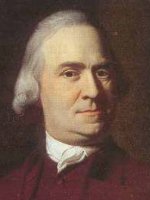 Though Samuel Adams was cautious about pushing for the abolition of slavery as a politician, as I discussed yesterday, he seems to have been firm in his private behavior. At least, that’s how his descendant and biographer William V. Wells described him.
When Samuel remarried, his second wife Elizabeth was given an enslaved woman named Surry. He reportedly insisted that “A slave can not live in my house; if she comes she must be free.” It’s unclear whether the family formally freed Surry at that time; they were apparently still writing out emancipation papers many years later.
However, Adams’s letters showed that he cared about Surry as a member of his household. When he was in Philadelphia in 1775 and worried about his family getting out of British-occupied Boston, he remembered her in his letters to his wife:
- 17 June: “I wish to hear that my Son and honest Surry were releasd from their Confinement in that Town.”
- 28 June: “Let me know where good old Surry is.”
- 30 July: “Tell Job and Surry that I do not forget them.”
[ADDENDUM: In 2020, eleven years after this blog post was published, the Schuyler Mansion in New York published a report documenting how Alexander Hamilton did own slaves, contrary to assertions of recent biographers. See the discussion and links here.]

7 comments:
never owned anyone else: what does else mean in that sentence?
It means those three people never owned other human beings.
having an African domestic servant in antebellum Boston was the Northeast equivalent of owning a slave although with comparatively better treatment than the Southern enslaved Africans. John Adams despite his stance against institutional slavery still participated in a system of African subservience in colonial New England. He wasn't any better or any worse than his white counterparts. This is sematics and logic gymnastics to absolve Euro Americans from taking part in this terrible system of enslavement- North and South
This posting is about Samuel Adams, and the comment refers to John Adams, which doesn't suggest a careful reading.
This posting doesn't claim that Samuel and Elizabeth Adams merely had "an African domestic servant"; it says they "did hold title to Surry" under Massachusetts law. That's not "the Northeast equivalent of owning a slave." That was actually owning a slave. (Which some preceding writers had missed about Adams.)
This posting is also the fourth of a series about Samuel Adams, Surry, and slavery, examining the sources we have from different angles. I don't think they proffer “sema[n]tics and logic gymnastics to absolve Euro Americans." Those postings discuss how the sources on Surry might be distorted by the Adams descendants' wish to present their ancestor in the best light, how African-Americans feared being abandoned in old age, and how Adams's legislative efforts against slavery were always limited and compromised.
the article clearly says John adams didn’t own people, like the comment points out that is wrong, idk maybe it was hard for you to read that part.. Alexander Hamilton also owned people, not the articles fault on that one but still incorrect
Yes, when I wrote this posting in 2009, the common wisdom (from Ron Chernow’s biography) was that Alexander Hamilton became revolted by the institution of slavery as he saw it in the Caribbean and never participated after coming to the mainland.
New research has produced evidence that strongly suggests Hamilton owned some enslaved people after marrying into the Schuyler family and definitely facilitated slave sales.
I’m planning an analysis of the arguments on that issue, but that will take more time.
For people who believe that John (not Samuel) Adams owned slaves, please share the evidence.
John’s wife Abigail grew up in a household with slaves. She didn’t like the practice. In later life she hired the free the black woman who raised her, Phoebe Abdee, to help keep house in Braintree. In 1798 Abigail referred to spending a quiet Thanksgiving with “Pheby the only surviving Parent I have.”
Post a Comment