J. L. BELL is a Massachusetts writer who specializes in (among other things) the start of the American Revolution in and around Boston. He is particularly interested in the experiences of children in 1765-75. He has published scholarly papers and popular articles for both children and adults. He was consultant for an episode of History Detectives, and contributed to a display at Minute Man National Historic Park.
J. L. Bell will be one of the panelists in the discussion of “A Knock at the Door: Three Centuries of Governmental Search and Seizure” at the Old State House in Boston on 4 November. How does James Otis, Jr.’s argument against the London government’s writs of assistance connect to the Fourth Amendment of the U.S. Constitution, and what is the status of that protection today?
Hear J. L. Bell “Gossiping About the Gores” at Old South Meeting House, archived by the WBGH Forum Network. (And follow along with the handout.) This talk, delivered in January 2009, follows one Boston family from the 1760s through the 1820s. Striving in society, divided by politics, and occasionally star-crossed by love, the Gores provide a lively view of life during the American Revolution.
Hear J. L. Bell discuss John Adams with Mike Pesca, host of N.P.R.’s The Bryant Park Project, in April 2008.
Check out the online exhibit about the 5th of November in Boston that J. L. Bell assembled for the Bostonian Society. People in Britain celebrated that date as Guy Fawkes’ Day, but in Boston it was “Pope-Night”—a literal riot of bigotry, violence, and giant puppets of the Pope!
J. L. Bell’s article “A Bankruptcy in Boston, 1765” appears in the fourth-quarter 2008 issue of Massachusetts Banker. You can download a copy of the entire magazine for free from this page.
J. L. Bell’s article “‘I Never Used to Go Out with a Weapon’: Law Enforcement on the Streets of Prerevolutionary Boston,” about town watchmen, British army officers, and the Boston Massacre, is available in the Dublin Seminar volume Life on the Streets and Commons.
Children in Colonial America, edited by Prof. James Marten and published by N.Y.U. Press, features J. L. Bell’s chapter “From Saucy Boys to Sons of Liberty: Politicizing Youth in Pre-Revolutionary Boston.”

Sunday, May 31, 2009

Waves of Paine

During my latest postings on Thomas Paine, Prof. Harvey J. Kaye alerted me to the 200th anniversary of Paine’s death, coming up on 8 June 2009. He also sent me a link to this Bill Moyers television show about Paine from last year, in which the two men discuss Kaye’s book Thomas Paine and the Promise of America.

Observing the same anniversary, Kenneth W. Burchell sent me news of his article on Paine in the June/July issue of Free Inquiry magazine, from the Council for Secular Humanism. Ken is also bringing Paine to Twitter.

Earlier I mentioned Ken’s new six-volume collection of responses to Paine and his ideas, titled Thomas Paine and America, 1776–1809. It collects facsimiles of early pamphlets and books discussing Paine’s essays, “digitally cleaned and enhanced,” as well as “a general introduction, headnotes, endnotes and a consolidated index.” Order before 30 June, and the price is only $765!

I can’t resist pointing out an irony in the historiography of Paine. His fans often complain that he’s been neglected, written out of the nation’s history. And yet Americans have never stopped writing about him. Not always favorably, to be sure, but we can look back on a steady stream of new editions, biographies, and analyses of Paine’s thought.

Saturday, May 30, 2009

“We the People...in order to...Establish Justice”

The first U.S. Supreme Court consisted of six rich white men, three of them named John and two James. The sixth was Massachusetts’s own William Cushing (shown here, courtesy of the Supreme Court Historical Society). President George Washington chose those men not just for their judicial wisdom but for their diversity. In other words, they represented the rich white men of every region.

I think we can all agree that, despite their geographic breadth, those men shared unexamined assumptions and convictions on many legal, constitutional, and social questions of the day. Poor, black, Native, and female Americans had quite different experiences, and different outlooks. In fact, we might even agree that a poor, black, Native American, or female justice would have brought the first court a better sense of justice as we understand it than six men from the young nation’s elite.

The current debate over the nomination of Judge Sonia Sotomayor to that court is focusing in part on whether there’s still a difference of perspective between rich white men and other Americans. In 2001, Sotomayor delivered a public lecture that touched on this point. The whole text has been reprinted in the New York Times, though a lot of commentators have preferred to quote (or misquote) a single sentence. The passage starts this way:

Justice [Sandra Day] O’Connor has often been cited as saying that a wise old man and wise old woman will reach the same conclusion in deciding cases. I am not so sure Justice O’Connor is the author of that line since Professor [Judith] Resnik attributes that line to Supreme Court Justice Coyle.
Caring about the correct attribution of quotations! Already I like her.

Contra this transcript, the actual attribution should be to the late Minnesota Supreme Court Justice M. Jeanne Coyne. In her remarks on joining the Supreme Court in 1993, Justice Ruth Bader Ginsburg cited O’Connor quoting Coyne. Ginsburg repeated the line again this year, but she added: “But there are perceptions that we have because we are women. It’s a subtle influence. We can be sensitive to things that are said in draft opinions that (male justices) are not aware can be offensive.”

And O’Connor just told Publishers Weekly:
I was terribly disappointed when I retired in 2006 not to be replaced by a woman. We have to remember that slightly more than 50 percent of us in this country have two X chromosomes and I think it doesn’t hurt to look at our national institutions and see women represented. I don’t think two females on the Supreme Court is enough, but it is certainly better than one.
In sum, though Ginsburg and O’Connor quote Coyne, they don’t agree that American men and women share the same experiences, perceptions, or judgments. They don’t agree that a court consisting almost entirely of men can represent the whole country as well as if that group contained more than one woman.

In her speech, Sotomayor agreed with O’Connor and Ginsburg, and described her different perspective arising not just from being a woman, but also from being a Puerto Rican:
I am also not so sure that I agree with the statement. First, as Professor Martha Minow has noted, there can never be a universal definition of wise. Second, I would hope that a wise Latina woman with the richness of her experiences would more often than not reach a better conclusion than a white male who hasn’t lived that life.

Let us not forget that wise men like Oliver Wendell Holmes and Justice [Benjamin] Cardozo voted on cases which upheld both sex and race discrimination in our society. Until 1972, no Supreme Court case ever upheld the claim of a woman in a gender discrimination case. I, like Professor [Stephen L.] Carter, believe that we should not be so myopic as to believe that others of different experiences or backgrounds are incapable of understanding the values and needs of people from a different group. Many are so capable. As Judge [Miriam Goldman] Cedarbaum pointed out to me, nine white men on the Supreme Court in the past have done so on many occasions and on many issues including Brown.

However, to understand takes time and effort, something that not all people are willing to give. For others, their experiences limit their ability to understand the experiences of others. Other simply do not care. Hence, one must accept the proposition that a difference there will be by the presence of women and people of color on the bench. Personal experiences affect the facts that judges choose to see.
People seeking a reason to oppose Sotomayor’s nomination have jumped on the adjective “Latina” and ignored the adjective “wise.” Wisdom consists in large part of gaining perspective through experience and empathy, and that “takes time and effort.”

Let’s consider Chief Justice John Roberts, the youngest member of the current Supreme Court—also younger than Sotomayor by half a year. He grew up within the nation’s elite: his father an executive, his education at an all-male private school which he argued should remain all-male. Though he and Sotomayor (and the President who nominated her) went to Ivy League universities and law schools, thanks to our modern meritocracy, that was the first time Roberts’s life paralleled that of a poor Puerto Rican girl from the Bronx.

Does Roberts’s background reflect his judicial decisions? Earlier this month Jeffrey Toobin wrote in The New Yorker:
In every major case since he became the nation’s seventeenth Chief Justice, Roberts has sided with the prosecution over the defendant, the state over the condemned, the executive branch over the legislative, and the corporate defendant over the individual plaintiff.
Every major case. Roberts appears far more predictable, and his decisions, whatever their reasoning, far more reflective of his class background, than we can say for Sotomayor.

Demographically, except for being Catholic, Roberts would have fit right into the first Supreme Court—he even has the most popular first name. Sotomayor clearly wouldn’t have. But a non-British woman from a poor family would surely have broadened that court’s outlook. It would most likely have, as I argued above, given that court a stronger sense of true justice.

And why wouldn’t the same apply to today’s Supreme Court? The only way the justices’ backgrounds wouldn’t affect their perspectives would be if growing up non-white, female, and poor in twentieth-century America was much the same as growing up white, male, and rich. I’d like to see someone try to argue that case.

Friday, May 29, 2009

Upcoming Events in Lexington

On Saturday, 30 May, from noon to 3:00, the Minute Man National Historical Park and its Friends is hosting its free Family Day activities: historic games, kite-flying, marching, singing, and other fun for kids. And it looks like the weather will be ideal.

In addition, I now have a title for Prof. David Glassberg’s lecture on 10 June at the park’s Lexington visitor center (mentioned back here): “Senses of History: The Place of the Past in American Life.”

Upcoming Events in Charlestown

These two events are coming up at the Bunker Hill Museum, 43 Monument Square in Charlestown. Sponsored by the Charlestown Historical Society, they’re free and open to the public. If you can park.

Weapons of the Revolution on Sunday, 31 May 2009, at 2:00 P.M.
William Baldwin, private in Gardner’s Regiment/Charlestown Militia Company, will introduce infantry longarms and accoutrements from the Revolutionary era. He will show examples of firelocks, bayonets, and edged weaponry, both antique as well as contemporary reproductions.

Meet Dr. Joseph Warren on Thursday, 11 June 2009, at 7:00 P.M.
Michael LePage will portray this leader of the Sons of Liberty, who on 18 Apr 1775 dispatched Paul Revere and William Dawes out of Boston to warn of the pending army march, and later died on the slope of Bunker Hill. After Dr. Warren speaks, there will be an opportunity for discussion.

And of course 17 June is Bunker Hill Day.

Penelope Russell: “a very industrious, active woman”

Yesterday I discussed how, contrary to later reports, Penelope Russell didn’t succeed her husband Ezekiel as publisher of The Censor since he outlived that magazine by almost a quarter-century. But Penelope almost certainly helped Ezekiel to print that magazine, as recalled by a fellow Boston printer, Isaiah Thomas.

In his History of Printing in America, Thomas wrote:

Ezekiel Russell was born in Boston, and served an apprenticeship with his brother, Joseph Russell, the partner of John Green [in printing the Boston Post-Boy]. In 1765, he began printing with Thomas Furber, at Portsmouth, New Hampshire, under the firm of Furber & Russell. Not succeeding in business, they dissolved their partnership, and Russell returned to Boston.

He worked with various printers until 1769, when he procured a press and a few types. With these he printed on his own account, in a house near Concert Hall. He afterward removed to Union street, where to the business of printing he added that of an auctioneer, which he soon quitted, and adhered to printing. Excepting an edition of Watts’s Psalms, he published nothing of more consequence than pamphlets, most of which were small.

In November, 1771, he began a political publication entitled The Censor. This paper was supported, during the short period of its existence, by those who were in the interest of the British government.
Friends of the royal government sponsored the Censor in an attempt to counteract all the Whig essays appearing in Boston’s biggest newspapers. In other words, it was the voice of Loyalism. This fact never seems to arise in items describing Penelope Russell as an early American female printer.

That said, the Russells don’t seem to have been committed Loyalists. They apparently took the Censor job because they needed the money. Ezekiel’s brother Joseph went to Canada with the British military in 1776, but Ezekiel and Penelope stayed in Massachusetts. Thomas tried to trace all the places that the Russells set up shop, but I’m not sure he timed their moves exactly:
Russell afterward removed to Salem, and attempted the publication of a newspaper, but did not succeed. He again removed, and went to Danvers, and printed in a house known by the name of the Bell tavern. In a few years he returned once more to Boston; and, finally, took his stand in Essex street, near the spot on which grew the great elms, one of which was then standing, and was called Liberty tree. Here he printed and sold ballads, and published whole and half sheet pamphlets for peddlers. In these small articles his trade principally consisted, and afforded him a very decent support.
Among the items Russell issued was Phillis Wheatley’s elegy on the Rev. George Whitefield. In 1773 he printed four enslaved men’s petition for an end to slavery, again probably for the money rather than a sign of his political commitment. Late that year he printed a pamphlet against the tea protests, which was condemned by a Boston town meeting and may well have led to his decision to relocate to Salem in early 1774. In the summer of 1776 Russell was still in Salem, and got the contract to print copies of the Declaration of Independence for every town in the new state.

Russell probably moved back to Boston and settled on Essex Street only after Liberty Tree was cut down. He didn’t advertise or label any publications as being printed near the tree when it was famous, but in the 1790s used such identifications as “Printed by E. Russell, next Liberty-Stump.”

And as for Penelope:
The wife of Russell was indeed an “help meet for him.” She was a very industrious, active woman; and assisted her husband in the printing house. A young woman who lived in Russell’s family sometimes invoked the muse, and wrote ballads on recent tragical events, which being immediately printed, and set off with wooden cuts of coffins, etc., had frequently “a considerable run.”
Josiah Snow’s account (quoted yesterday) credited those ballads to Penelope Russell herself, even saying she could compose them while she set the type. Perhaps Thomas’s phrase “A young woman who lived in Russell’s family” was a coy way of alluding to Penelope without pointing the finger directly. Or perhaps Ezekiel Russell’s struggling shop was kept afloat by the work of two young women instead of just one.

The broadside I discussed
back here and show above was one of that shop’s coffin-decorated poetic creations. It was “Printed and Sold next to the Writing-School, on Queen Street,” the same address Russell used in newspaper ads in late 1769 and 1770.

Ezekiel Russell died in September 1796 “after a lingering illness” at the age of fifty-three. Thomas reported that Penelope Russell “continued the business.” But he didn’t give her a separate biographical entry in his book, and he didn’t record when she died.

ADDENDUM: New documentation on Penelope Russell’s business transactions.

Thursday, May 28, 2009

Penelope Russell and The Censor

Penelope Russell of Boston is listed in many books and websites as one of the first female printers in the U.S. of A. All these citations seem to funnel back to the first volume of The History of Woman Suffrage (1881), which included this statement:

Penelope Russell printed The Censor in Boston, Mass., in 1771. She set her own type, and was such a ready compositor as to set up her editorials without written copy, while working at her case. The most tragical and interesting events were thus recorded by her.
Matilda Joslyn Gage (shown here, courtesy of the National Park Service) wrote that volume’s chapter on female printers, though she later complained that her coauthors, Elizabeth Cady Stanton and Susan B. Anthony, rewrote all her material and pushed her out of the creation of the following volumes.

Gage went on to publish her more radical feminist ideas in Woman, Church, and State (1893), but her biggest contribution to American letters was encouraging her son-in-law L. Frank Baum to write down those fairy stories he was telling the children.

Gage’s remark about Penelope Russell has no citation, but with Google’s help I traced it back through early feminist pamphlets and general-interest magazines to what may be the ur-source: an article by Josiah Snow of Rochester titled “Early Printers, Male and Female”, dated 11 Jan 1847 and published in a History of the Press of Western New-York:
Penelope Russell succeeded her husband in printing the “Censor,” at Boston, in 1771. She was a very industrious and active woman. She not only set type, but while at her case, invoked her muse and put up type on tragical events, in an interesting manner, without any written copy.
Obviously Snow was passing on professional lore; he wouldn’t have seen Russell at work seventy-five years earlier. And some details got mangled along the way.

The Censor was indeed printed in Boston from 23 Nov 1771 to 2 May 1772. However, at the time Penelope Russell’s husband Ezekiel was very much alive, and listed on the magazine’s masthead as its publisher. He was, indeed, still in his late twenties. Only after Ezekiel died in September 1796 did Penelope Russell succeed him as head of the print shop.

TOMORROW: Isaiah Thomas on Ezekiel and Penelope Russell—and he actually knew them.

Wednesday, May 27, 2009

“Defining Freedom,” July 2009

The American Antiquarian Society in Worcester and the Massachusetts Historical Society in Boston are teaming up with the Worcester public schools and state Department of Education to offer a teacher seminar on the theme of personal and community liberty:

Defining Freedom examines how Americans conceived and promoted both individual and communal liberties and responsibilities from 1763 through 1863. The project seeks to create a series of professional development experiences in which participating teachers will examine the imperial crisis, the American Revolution, the Early Republic, the antebellum period, and the Civil War.

These historic events will be placed in relation to the broad themes of the evolution of the concepts of personal freedom, individual responsibility and respect for human dignity, and the growth and impact of centralized state power. During these time periods, popular thinking about personal freedom, individual responsibility, and respect for human dignity evolved to drastically expand the distribution of political and social power among the people, even as the power and scope of state and federal governments increased. Additionally, various minorities sought to gain the full rights and privileges of American citizenship only to be thwarted in their attempts.
The seminar runs 22-23 and 28-30 July, and here’s more information.

Tuesday, May 26, 2009

Who Wrote, “When He Fell, Liberty Wept”?

While vetting a manuscript this month, I came across another questionable quotation. I think it first appeared in Thomas J. Fleming’s Now We Are Enemies (also published as The Battle of Bunker Hill) and Liberty!, and can be viewed in this essay by Kenneth C. Davis:

Abigail Adams mournfully wrote to husband John: “Not all the havoc and devastation they have made has wounded me like the death of [Dr. Joseph] Warren. We want him in the Senate; we want him in his profession; we want him in the field. We mourn for the citizen, the senator, the physician, and the warrior. When he fell, liberty wept.”
But here’s the letter from Abigail Adams in which the start of that quotation appears, and it doesn’t include that last sentence about liberty weeping. Instead, the passage reads (in Adams’s original spellings):
Not all the havock and devastation they have made, has wounded me like the death of Warren. We wanted him in the Senate, we want him in his profession, we want him in the field. We mourn for the citizen, the senator, the physician and the Warriour. May we have others raised up in his room.
The regularized spellings and punctuation are our clue that the first quotation derives from a book that used the 1840 transcription of Adams’s letters, edited by her grandson to look more grammatically and punctually correct, rather than the recent Adams Papers editions.

So what happened? A little Google Booking pinpoints the problem exactly. On page 521 of his Life and Times of Joseph Warren, published in 1865, Richard Frothingham strung together a series of laments about Warren’s death. This is what that page looked like.
As you see, Frothingham didn’t separate each quotation with quote marks. Instead, he had one pair of marks around the whole bunch, and a superscript footnote number after each. There’s a number 4 at the end of Abigail Adams’s actual words. And there’s a separate number 5 for the sentence “When he fell, liberty wept” and what follows, attributing them to a manuscript by S. A. Wells.

Who was Wells? He was Samuel Adams’s grandson, born in 1787 and dying in 1840. His “Biographical Sketch of General Joseph Warren” was published posthumously in 1857, attributed to “A Bostonian.” Frothingham might have been quoting from the manuscript Wells had created about his grandfather, which William A. Wells completed and published in 1865.

Monday, May 25, 2009

Who Said, “Guard against Ignorance and Remain Free”?

Here’s another founding-era quotation that you can find all over the internet. For obvious reasons, it’s a particular favorite of librarians and conspiracy theorists.

If a nation expects to be ignorant and free in a state of civilization, it expects what never was and never will be. . . . If we are to guard against ignorance and remain free, it is the responsibility of every American to be informed.
These sentences are attributed to Thomas Jefferson, and some writers go so far as to cite his letter to Charles Yancey on 6 Jan 1816.

But, as one can see by reading the letter, only the first sentence appears in it. Where did the rest of the quotation come from?

Those words turn out to be from another President—Ronald Reagan. In a statement issued for National Library Week in 1981, and published in U.S. government reports that year, he said:
If we are to guard against ignorance and remain free, as Jefferson cautioned, it is the responsibility of every American to be informed.
So Reagan alluded to Jefferson’s comment, and even dropped his predecessor’s name in the middle of the sentence, before making his own point. But within four years, writers had removed Reagan’s citation, stuck the sentences together (usually with an ellipsis between), and attributed the whole combination to Jefferson. And a lot of those early distortions of the quotation appeared, alas, in library newsletters.

This is one of a whole slew of spurious quotations from Jefferson on Monticello’s Jefferson Encyclopedia, which is an interesting use of the wiki format by a historic institution.

Sunday, May 24, 2009

And Your Host for This Evening...

The Lexington Historical Society is offering a sneak preview of some of its new orientation video, “The Day the Revolution Began.” I understand that the final version will have more battle scenes and, presumably, no balloons saying, “Enter your text here.” It will have its local premiere on 13 June.

And who is this film’s “celebrity narrator”—the historical figure who welcomes viewers and, presumably, makes them want to spend more time visiting Lexington with him? None other than that jolly elf John Adams!

But wasn’t Adams notorious for being cantankerous with guests? Doesn’t he already have a big share of a certain national park in Quincy, where he actually lived? And didn’t he insist on the following?

The Revolution was in the minds of the people, and this was effected, from 1760 to 1775, in the course of fifteen years before a drop of blood was shed at Lexington.
But of course Adams was lately the hero of his own miniseries. So now we think we know him, admire him, perhaps even see some of our cantankerous selves in him. So he’s the face of The Day the Revolution Began.

David McCullough has a lot to answer for. But it’s nice to see this film snatch a fine title away from an awful book.

Saturday, May 23, 2009

“The Number Was Read in the Camp”

As I described yesterday, back in January I started poking around for the source of the statement from many authors over many decades that Gen. George Washington ordered the start of Thomas Paine’s American Crisis to be read to the whole Continental Army shortly before the Battle of Trenton. The earliest description of that event that I found came from George Lippard, who was far from a reliable source. But I didn’t feel confident about labeling the whole story a myth because I don’t know the sources on Paine well.

So I called in a favor from the expert on Revolutionary America’s response to Paine’s writing, Ken Burchell. Pickering & Chatto is about to publish his six-volume series on just that topic. Ken directed me to James Cheetham’s 1809 biography of Paine, which has this to say:

When the colonists drooped, he [Paine] revived them with a Crisis. The first of these numbers he published early in December, 1776. The object of it was good, the method excellent, and the language, suited to the depressed spirits of the army, of public bodies, and of private citizens, cheering.

Washington, defeated on Long-Island, had retreated to New York, and been driven with great loss from Forts Washington and Lee. The gallant little army, overwhelmed with a rapid succession of misfortunes, was dwindling away, and all seemed to be over with the cause when scarcely a blow had been struck. “These,” said the Crisis, “are the times that try mens’ souls. The summer soldier and the sunshine patriot will, in this crisis, shrink from the service of his country; but he that stands it NOW deserves the love and thanks of man and woman. Tyranny, like hell, is not easily conquered; yet we have this consolation with us, that the harder the conflict the more glorious the triumph; what we obtain too cheap we esteem too lightly.”

The number was read in the camp, to every corporal’s guard, and in the army and out of it had more than the intended effect. The convention of New York, reduced by dispersion, occasioned by alarm, to nine members, was rallied and reanimated. Militia-men, who, already tired of the war, were straggling from the army, returned. Hope succeeded to despair, cheerfulness to gloom, and firmness to irresolution. To the confidence which it inspired may be attributed much of the brilliant little affair which in the same month followed at Trenton.
That passage seems reliable for a couple of reasons. First, it was well within the lifetime of men who had served in the Continental Army in 1776. Second, Cheetham wasn’t a fervent admirer of Paine—not anymore. He’d come to hate the man’s religious writings, and, as Appleton’s Encyclopedia said, his Paine biography was even “inspired by enmity.” So his praise for Paine’s contributions to American independence fell into the category of “reluctant testimony.”

I therefore think it’s safe to say that a lot of the Continental Army under Washington read the American Crisis in late 1776. Furthermore, Cheetham’s statement that those words were heard by “every corporal’s guard” implies that there were orders from the top. Certainly lots of later authors assumed that meaning. But I know of no documentation for such an order. And Cheetham may have written with a bit of exaggeration to paint a picture of how many soldiers read the Crisis.

The retelling of this story by later authors follows the same path as the development of a far more outlandish legend about how Paine wrote Common Sense. Starting from the testimony of Dr. Benjamin Rush (another early admirer of Paine who came to dislike his religious writings), that tale diluted evidence that Americans were already talking about independence in favor of a story of Continental Congress delegates and eventually Washington himself asking Paine to lead the people to their idea.

In the case of the Crisis, lots of soldiers probably took it upon themselves to read and discuss the essay. They were, after all, a big part of Paine’s intended audience, and some must have known him personally since he’d just traveled with the army through New Jersey. But by the mid-1800s the standard American history depicted Gen. Washington pressing Paine’s writing onto the common soldier.

Friday, May 22, 2009

“Behold the Crisis Read by Every Corporal”

Back on Inauguration Day, I noted how President Obama had invoked the story of “the father of our nation” ordering Thomas Paine’s Crisis to be read to his troops. Boston 1775 reader David Churchill Barrow wrote to me of his fondness for that historical picture, yet astutely added: “But do we have solid historical evidence for this, or is it merely a satisfying myth?”

Certainly the story of Gen. George Washington having the army read Paine’s words in December 1776 is well established. In fact, publishers have been using it to sell reprints of the Crisis for well over a century. In 1861, J. P. Mendum of The Boston Investigator was advertising “The Crisis; being a Series of Pamphlets, in sixteen numbers, by Thomas Paine, written during the American Revolution, and, by the orders of General Washington, read to each regiment of the army as they were published (clothbound, price 40 cents).” Here’s an 1877 edition of The Crisis published with that blurb right on the title page.

But where did that story come from? I couldn’t find anything earlier than George Lippard’s Washington and His Generals, published in 1847. And let’s just say that book didn’t attempt a scholarly tone:

Yes, in the dark days of ’76, when the soldiers of Washington tracked their footsteps on the soil of Trenton, in the snows of Princeton—there, first among the heroes and patriots, there, unflinching in the hour of defeat, writing his “Crisis,” by the light of the camp-fire, was the Author-Hero. THOMAS PAINE!

Yes, look yonder—behold the Crisis read by every Corporal in the army of Washington, read to the listening group of soldiers—look what joy, what hope, what energy, gleams over those veteran faces, as words like these break on their ears:

“These are the times that try men’s souls! The summer soldier and the sunshine patriot, will in this Crisis, shrink from the service of his country; but he that stands it Now, deserves the love and thanks of man and woman. Tyranny like hell, is not easily conquered; yet we have this consolation with us, that the harder the conflict, the more glorious the triumph!—”

Do not words like these stir up the blood?

Yet can you imagine their effect, when read to groups of starved and bleeding soldiers, by the dim watch-fire, in the cold air of the winter dawn?

Such words as these stirred up the starved Continentals to the attack on Trenton, and there, in the dawn of glorious morning, George Washington, standing sword in hand, over the dead body of the Hessian [Col. Johann] Ralle, confessed the magic influence of the Author-Hero, Thomas Paine!
Furthermore, George Lippard, a fan and protĂ©gĂ© of Edgar A. Poe, is one of the great mythologizers of the Revolution. He loved to write about Washington’s experiences in and around Philadelphia—even experiences that Lippard imagined as happening after Washington had died. But some of Lippard’s fiction wasn’t recognized as such by later readers. For example, he’s mostly responsible for the Revolutionary associations of the Liberty Bell, since he wrote that it cracked in 1776 as people rang it to signal the Declaration of Independence.

I couldn’t find any mention of The Crisis in Washington’s general orders, much less instructions for it to be read to the whole Continental Army.

So, I began to wonder, had Lippard made up this scene of “the Crisis read by every Corporal in the army of Washington, read to the listening group of soldiers”? And had that scene duped one later generation after another until the story came from the mouth of Washington’s latest presidential successor?

TOMORROW: Asking an expert.

Thursday, May 21, 2009

Paine ”Immediately Began His Famous Pamphlet”

Yesterday I quoted an 1876-77 description of how Thomas Paine wrote Common Sense which had everything going for it but accuracy. It appears to have been an overly dramatized version of Dr. Benjamin Rush’s account of that moment, from a letter to Paine’s biographer James Cheetham dated 17 July 1809. Rush’s recollection is, of course, Rushcentric:

About the year 1775, I read a short essay with which I was much pleased, in one of Bradford’s [news]papers, against the slavery of the Africans in our country, and which, I was informed, was written by Thomas Paine. This excited my curiosity to be better acquainted with him. We met soon afterwards at Mr. Aitkins’ bookstore, where I did homage to his principles and his pen on the subject of the enslaved Africans. He told me that it was the first piece he had ever published here.

When the subject of American Independence began to be agitated in conversation, I observed the publick mind to be loaded with an immense mass of prejudice and error relative to it. Something appeared to be wanting, to remove them beyond the ordinary short and cold addresses of newpaper publications. At this time I called upon Mr. Paine, and suggested to him the propriety of preparing our citizens for a perpetual separation of our country from Great Britain, by means of a work of such length as would obviate all the objections to it. He seized the idea with avidity, and immediately began his famous pamphlet in favour of that measure.

He read the sheets to me at my house as he composed them. When he had finished them, I advised him to put them into the hands of Dr. [Benjamin] Franklin, Samuel Adams, and the late Judge [James] Wilson, assuring him, at the same time, that they all held the same opinions that he had defended. The first of those gentlemen saw the manuscript, and I believe the second, but Judge Wilson being from home when Mr. Paine called upon him, it was not subjected to his inspection. No addition was made to it by Dr. Franklin, but a passage was struck out, or omitted in printing it, which I conceived to be the most striking in it. It was the following—“A greater absurdity cannot be conceived of, than three millions of people running to their sea coast every time a ship arrives from London, to know what portion of liberty they should enjoy.”

A title only was wanted for this pamphlet before it was committed to the press. Mr. Paine proposed to call it “Plain Truth.” I objected to it and suggested the title of “Common Sense.” This was instantly adopted, and nothing now remained, but to find a printer who had boldness enough to publish it. At that time there was a certain Robert Bell, an intelligent Scotch bookseller and printer in Philadelphia, whom I knew to be as high toned as Mr. Paine upon the subject of American Independence. I mentioned the pamphlet to him, and he at once consented to run the risk of publishing it. The author and the printer were immediately brought together, and “Common Sense” burst from the press of the latter in a few days, with an effect which has rarely been produced by types and paper in any age or country.
This is a top-down way of telling the story: a small set of smart gentlemen cajoling the populace into considering independence. Yet Dr. Rush started by stating that “the subject of American Independence” had already begun “to be agitated in conversation”—by whom?

In Thomas Paine’s American Ideology, Alfred Owen Aldridge noted that a month after Common Sense appeared, Franklin was still guessing at its author in a letter to Gen. Charles Lee. Therefore, Aldridge concludes, Paine must not have shown the essay to Franklin in advance. Paine later claimed that he showed his material to no one before it went to press, but of course his recall could have been Painecentric.

Rush’s letter didn’t mention that the Loyalist James Chalmers grabbed the title Plain Truth for a pamphlet responding to Common Sense. I imagine Paine gritting his teeth when he saw that, even as his sales were soaring.

TOMORROW: Another legend of Thomas Paine—one we all heard in January.

Wednesday, May 20, 2009

“At This Critical Moment, Paine Enters”?

The following passage appears in The Life of Thomas Paine, by Calvin Blanchard, published in 1877. It is, however, an extremely close rewrite of part of Marcus A. Casey’s “A Plea for a Patriot,” published in The Galaxy magazine in May 1876. It describes the writing of Common Sense:

At the close of the year 1775, when the American Revolution had progressed as far as the battles of Lexington and Bunker Hill, John Adams, Benjamin Rush, Benjamin Franklin, and George Washington, had met together to read the terrible dispatches they had received. Having done which, they pause in gloom and silence. Presently Franklin speaks: “What,” he asks, “is to be the end of all this? Is it to obtain justice of Great Britain, to change the ministry, to soften a tax? Or is it for”——He paused; the word independence yet choked the bravest throat that sought to utter it.

At this critical moment, Paine enters. Franklin introduces him and he takes his seat. He well knows the cause of the prevailing gloom, and breaks the deep silence thus: “These States of America must be independent of England. That is the only solution of this question!” They all rise to their feet at this political blasphemy. But, nothing daunted, he goes on; his eye lights up with patriotic fire as he paints the glorious destiny which America, considering her vast resources, ought to achieve, and adjures them to lend their influence to rescue the Western Continent from the absurd, unnatural, and unprogressive predicament of being governed by a small island, three thousand miles off. Washington leaped forward, and taking both his hands, besought him to publish these views in a book.

Paine went to his room, seized his pen, lost sight of every other object, toiled incessantly, and in December, 1775, the work entitled Common Sense, which caused the Declaration of Independence, and brought both people and their leaders face to face with the work they had to accomplish, was sent forth on its mission.
Very dramatic, but total bunk. Adams, Rush, Franklin, Washington, and Paine were never all together in late 1775. Washington was in Cambridge, where Franklin visited him in for a week in October and Adams briefly the following winter. Rush and Paine spent the whole period in greater Philadelphia. Washington learned of Common Sense in late January, possibly first in a letter from Gen. Charles Lee.

Casey and Blanchard both went on to quote Dr. Rush’s description of the public response to Common Sense—which appeared in a letter recalling how Paine had come to write it. Rush never mentioned Washington as being involved. But some personal contact with the Father of Our Country—in this case, a physical contact, a literal laying-on of hands—is a common ingredient in nineteenth-century Revolutionary legends. And Casey and Blanchard apparently preferred to print the legend.

TOMORROW: Dr. Rush’s own account of how Paine wrote Common Sense.

Tuesday, May 19, 2009

Remembering Robert Rogers

In today’s Boston Globe, Michael Kenney reviews War on the Run: The Epic Story of Robert Rogers and the Conquest of America's First Frontier, by John F. Ross. The reviewer admits:

Rogers has been a heroic figure for this reader since first encountering him some 60 years ago in Kenneth Roberts’s classic 1937 novel, Northwest Passage.
Roberts’s story indeed reinvigorated Rogers’s legacy in America. Or, as the Dictionary of Canadian Biography says:
The considerable Rogers cult that has been in evidence in the United States during the last generation probably owes a good deal to K. L. Roberts’ popular historical novel...
After all, American culture doesn’t usually admire Loyalist officers. Especially one apparently involved in capturing another national hero—in this case, Nathan Hale. (Whether Hale deserves his prominence in American lore is another question.)

Both Roberts’s novel and Ross’s new book focus on Rogers’s part in the British Empire’s wars against the French and some Native American nations during the 1750s and 1760s. That means they can describe the high points of the man’s life and avoid the iffy decades that followed till his death in 1795.

Many accounts of Rogers’s career note that he began to drink heavily, which must have contributed to his erratic behavior. But he was courting trouble even in his early twenties, when he was arrested in New Hampshire for leading a counterfeiting ring. He never seems to have done well playing by the rules. The mid-century frontier wars may simply have created the environment in which Robert Rogers flourished.

Monday, May 18, 2009

Seven Founders

Last week guest blogger Ray Raphael laid out a challenge: Choose seven people to follow through the entire American Revolution whose stories, when combined, would tell the whole of that political, military, and social change.

I shared my thoughts, and Boston 1775 readers rose to the challenge with many more suggestions. I also promised to reveal the folks whom Ray chose to follow in Founders: The People Who Brought You a Nation, and here they are:

Choosing these particular people allowed Ray to play them off each other. For example, Dr. Young was one of the most radical and democratic politicians of the period while Laurens was fundamentally conservative. Warren strenuously opposed Morris, who in turn distrusted Young.

Washington, Martin, and Bigelow were all in the army at Valley Forge and Yorktown, but, holding different ranks, experienced the war in different ways. Morris and Laurens were very important figures in the civil government while Warren and Young wrote political essays and exercised behind-the-scenes influence. Washington, Morris, and Bigelow all invested in land development after the war; Martin was one of the small farmers who settled on such newly developed land. Only one of these people didn’t live to see Britain acknowledge American independence.

Sunday, May 17, 2009

Do You Recognize This Person?

This is a detail from a lesser-known portrait of a better-known figure from Revolutionary history. In fact, this individual is one of the most easily recognized people in all of American history—but our image of the person comes from a different point in life. Can you guess who it is?

The full portrait and name of the subject appear here.

The original painting is in the collection of Harvard University, a donation from Dr. John Collins Warren. [Ooh, is that a clue?]

Saturday, May 16, 2009

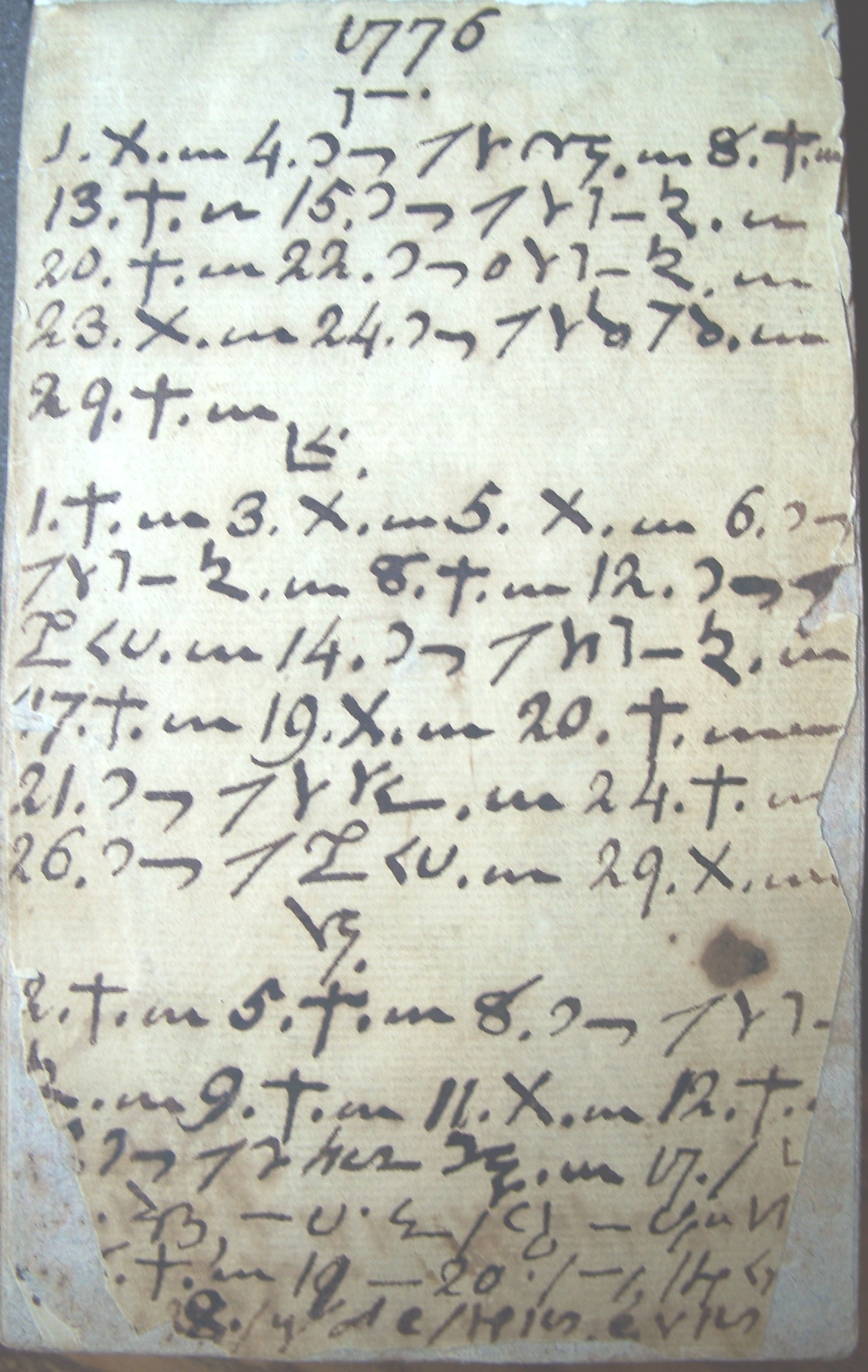
A Close Look at a Ciphered Diary

Jeremy Dibbell (of PhiloBiblos) has convinced his colleagues at the Massachusetts Historical Society to launch its own blog, the Beehive. One intriguing entry this week displays some pages from Manuscript Sbd-133: “Anonymous cipher diary, 1776-1795.” Jeremy explains:

It is a small bound volume containing ciphered or shorthand notations broken down by years, months, and days, with long entries on one side of the sheets and shorter entries on the opposite side. The writer used Arabic numerals, so tracking years and dates is possible, and the notations for each month are evident from the entries. Beyond that, the contents are almost a complete mystery (and since the years covered by the diary are of some considerable interest, I’ve long thought it would be fascinating to try and puzzle this out).
Samuel Pepys’s diary was once thought to be in an unbreakable cipher, but that turned out (after one scholar had spent years breaking it) to be a shorthand published at the time. So, Jeremy asks, is this code actually a standard eighteenth-century shorthand?

Which brings me to the Beehive’s next entry. Google Books strikes again. More will, no doubt, be revealed in the coming days. We just have to hope the entries say more than: October 5. Rainy. 6th. Rainy. 7th. Some sun, then rain. 8th. What news from the south! Rain.

Other examples of coded documents from the period include Dr. Benjamin Church’s secret letters into Boston; teams of Patriots cracked his simple substitution cipher in a few days. Then there’s the Rev. Jonathan Fisher (1767-1847), a Maine minister who devised his own phonetic code and recorded all his sermons and diaries in it.

Friday, May 15, 2009

Mutiny Aboard the Tyrannicide, 17 May

Here’s an announcement from the Beverly, Massachusetts, library about a free talk scheduled for this Sunday, 17 May, at 2:00 P.M.:

In November of 1776, Captain John Fisk of the brigantine Tyrannicide set sail from Salem in search of British merchantmen. Crewed, in part, by local Beverly, Gloucester and Salem men, the events of this voyage were lost in the mists of time until speaker Dennis Ahern started reading the logbook of their voyage. This is the story of that voyage, the story of a mutiny on board one of America’s first commissioned warships.
The Tyrannicide was actually commissioned by Massachusetts, as part of the state’s own navy. There’s a little of this story in Paul A. Gilje’s article “The Meaning of Freedom for Waterfront Workers” in Devising Liberty: Preserving and Creating Freedom in the New American Republic.

The “Partners in Preservation” Competition

The National Trust for Historic Preservation and American Express have a program called “Partners in Preservation,” which invites the public to vote online for which historic sites deserve funding.

In fact, we can vote repeatedly, once a day—though only for two more days. For that audience-participation feature, this funding program was dubbed “Preservation Idol” in the Boston Globe last week.

In the current competition for sites in Massachusetts, those which date back to Revolutionary times are:

As of this writing, the site with the most votes is...a carousel in Hull.

The site that receives the most votes will get a guaranteed $100,000. Another $900,000 will be divided among the other sites by the program’s administrators; it’s unclear how much weight they’ll put on the popular voting in making that decision.

The program is not without controversy. A Founding Director of the Historic House Trust of New York City commented at Philanthropy Today that such competition was “repulsive”:
all sites have a special niche, cultural or historic importance, relevance, and they all deserve grants. Shame on NTHP & Am Ex for turning them into competitors instead of collaborators.
I suspect that the program was designed to get just this sort of publicity and draw people into thinking about historic preservation. But it does turn the enterprise into a popularity contest. Not that popularity wasn’t part of the preservation movement from the beginning; this just formalizes the process.

Thursday, May 14, 2009

Privateers and Patriots

From the On Point radio show earlier in the week:

Plus a link to another recent book on the war at sea, James Nelson’s Washington’s Secret Navy.

Nicolson to Unveil Francis Bernard Papers

Colin Nicolson has sent news of the first volume of The Papers of Francis Bernard: Governor of Colonial Massachusetts, 1760-1769. It covers the years 1759 to 1763, when Bernard arrived in Boston as the new governor. The announcement says:

This 544-page book reveals much new evidence about the Town of Boston and the Province of Massachusetts at the end of the last French and Indian War. [Bernard’s] correspondence with Lord Jeffrey Amherst, his reports to the Board of Trade in London, his messages to royal officials on both sides of the ocean tell us of a maturing society and economy in a growing conflict with its mother country.
Many of these documents haven’t been published before.

When Bernard (1712-1779) arrived in Massachusetts, he came from two successful years as governor of New Jersey. His Bay Colony predecessors, William Shirley and Thomas Pownall, were both popular locally, and people appear to have seen the same potential in Bernard.

But the new governor sided with the London government in one dispute after another. Soon after he arrived, George II died, and the Boston merchant community seized on the chance to challenge the legality of writs of assistance, used for searching for smuggled goods. Bernard also alienated the rising lawyer James Otis, Jr., by passing over Otis’s father for a seat on the high court in favor of Thomas Hutchinson. Otis therefore resigned his royal post, allied himself with the merchants, and became the political leader of the Boston Whigs.

In the late 1760s, during the resistance to the Stamp Act and Townshend duties, Bernard sent his superiors many complaints about Massachusetts politics, riots, and how the colonial constitution should be changed. Whigs in London leaked those documents, causing Bostonians to view their governor as not simply a political obstacle but a back-stabber. When Bernard sailed out of Boston harbor in 1769, the town had a spontaneous public celebration. Still, Massachusetts remembers this governor in the name of Bernardston, which he modestly approved in 1762.

Nicolson, a Lecturer on U.S. History at the University of Stirling in Scotland, is author of The “Infamas Govener”: Francis Bernard and the Origins of the American Revolution. He’ll celebrate the launch of the Bernard Papers series on Thursday, 21 May 2009, at 5:30 P.M. at the Colonial Society of Massachusetts, 87 Mount Vernon Street, Boston.

Wednesday, May 13, 2009

Detwiller Surveys “Liberty Road,” 21 May

Longfellow National Historic Site in Cambridge has been celebrating the 250th anniversary of its construction with a series of lectures. I spoke in March, for example, about John Vassall, the man who commissioned that mansion and then moved out suddenly in September 1774.

On Thursday, 21 May, at 6:30 P.M., the site will host a photographic lecture by someone who really knows about the region’s Georgian architecture: Frederic C. Detwiller, architect and historic preservation planner of New England Landmarks.

Rick’s lecture will be titled “Liberty Road: Building a Revolution,” and will illustrate the literal “buildup” to the American Revolution by examining homes and landmarks erected by people on both sides of the political conflict. Among the topics he’ll build on:

  • The Vassall-Craigie-Longfellow House (shown above), including its role as the first headquarters of Gen. George Washington.
  • Other homes and buildings along “Tory Row” in Cambridge and beyond.
  • The social clubs, fraternal groups, and spies whose activities reflected the differing values of the time.
  • Public architecture such as the original Faneuil Hall and Hollis Hall at Harvard.
  • Vanished landmarks like Gov. Thomas Hutchinson’s Milton mansion.
  • The revival of eighteenth-century styles in Colonial Revival architecture.
This free event honors the memory of architectural historian Margaret Henderson Floyd, a founding member of the Friends of the Longfellow House. It will be held in the Longfellow Carriage House, behind the mansion at 105 Brattle Street. To reserve a space, call Longfellow National Historic Site at 617-876-4491.

Tuesday, May 12, 2009

More Suggestions for Whom to Follow through the Revolution

On Monday, guest blogger Ray Raphael asked which eighteenth-century Americans you might follow to tell the story of the overall Revolution. I shared some of my ideas this morning.

Boston 1775 reader David Churchill Barrow braved the challenge and suggested:

  • Nathaniel Greene: Lapsed Quaker, so perhaps there was some struggle of conscience, or a rebellion against upbringing. Saw and influenced the war in both the north and the south. Washington would have wanted him as his own replacement, should he have gone down in the fight.
  • Benedict Arnold: Saw the war from both sides. Snubbed early hero. Very complex character, and again with a family background that may have inspired him for both good and bad. He and Peggy were an “it” couple, Like Brad Pitt and whoever today.
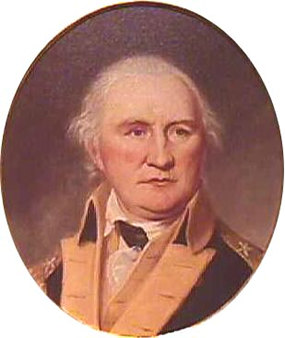
  • Daniel Morgan [shown here]: Coolest and most mysterious character of them all. Makes Davy Crockett look like a mere piker.
  • William Lee (Washington’s valet): Personal perspective from inside the inner circle. Also an African-American point of view.
  • Andrew Jackson (as a boy): How the hardships of the war had lasting effects.
Ooh—a young person’s experience! Intriguing. And good coverage of the crucial southern theater.

In addition, Bloomfield Bob commented:
I, for one, hope James Otis is a character! I'd love to learn more about this guy.
Otis is indeed a fascinating character, but his story really ends before the war begins. Though he lived to 1783, Otis was so mentally unstable after 1770 that the Boston Whigs had to worry about him more than the Crown. The best modern discussion of him appears in John J. Waters’s The Otis Family in Provincial and Revolutionary Massachusetts (1968).

More suggestions and comments welcome!

Individuals to Follow through the Revolution?

Yesterday Ray Raphael described a challenge he set for himself: find a bunch of individuals to follow through the Revolution whose stories could also tell the story of the founding of the U.S. of A. He chose seven people. As a proud owner of a copy of the resulting book, Founders, I can’t fault those choices. But just for fun, I can second-guess them.

Ray wrote that George Washington is virtually a given. So naturally, to be perverse, I have to question that conclusion. Henry Knox (shown here, later in life) spent nearly the whole war at Washington’s side, so it would be possible to follow the Continental Army’s top command through his eyes rather than through the commander’s. And Knox would bring some further advantages:

  • He was present at the Boston Massacre and may have been a crucial informer for Paul Revere just before the war.
  • After Washington’s first farewell in 1783, Knox became Secretary of War for the Confederation while the commander went home to Mount Vernon.
  • Knox’s alarmist letter to Washington about Shays’ rebellion convinced the older man to throw his prestige behind a movement for a new constitution.
  • Knox served as Secretary of War again under President Washington.
  • Knox’s personal story from fatherless apprentice bookseller to general, large landowner in Maine, and founder of the Society of the Cincinnati exemplifies the social mobility possible in the Revolution.
Following Nathanael Greene offers some of the same possibilities: involvement in prewar conflicts (Greene was probably involved in the Gaspee incident of 1772) and social mobility. In addition, his handling of the Continental forces in the southern states was crucial to the end of the war. Greene’s support for black soldiers is interesting, as is his turn to being a southerner with his own slave-labor plantation.

Such a book would need to follow someone deeply involved in running the American government—i.e., the Continental Congress—during and shortly after the war. My perverse suggestion for that figure is James Lovell. Son and assistant of the Loyalist master of Boston’s South Latin School, he was a Whig politics newspaper essayist and orator. The British military arrested him as a spy in 1775 after officers found his letters on Dr. Joseph Warren’s body. He was reportedly taken to Halifax in chains.

After James Lovell was exchanged and returned to Massachusetts, the state elected him to the Congress. He supported Gen. Horatio Gates over Washington in 1777, and wound up virtually running American foreign policy and intelligence efforts since no one else wanted those responsibilities so badly. His father and siblings were in exile, and his illegitimate son was in the Continental Army. For added interest, in Philadelphia he reportedly roomed in a brothel while his wife and children were back home in Boston. On the down side, Lovell’s a hard man to understand—John Adams reportedly paced the floor in Holland, trying to figure out what his official instructions meant—and to sympathize with.

Another potentially exemplary character is Thomas Machin, a British veteran who ended up as a captain in the American engineering corps. He oversaw the effort to build a chain of obstacles across the Hudson River to prevent the Royal Navy from sailing too far north—a major industrial undertaking in a sparsely settled area. Later Machin was one of the artillery officers who accompanied Gen. John Sullivan on an expedition against the Crown’s Native American allies in upper New York. And, as a kicker, the standard story of Machin before joining the Continental Army in 1776 is a lie; this immigrant (or his descendants) reinvented his life in the New World.

For a southern perspective, I might consider John Laurens: son of a bigwig in Congress, young Continental Army officer, proponent of emancipation, prisoner of war, diplomat, and army officer again. Regardless of what far one concludes that Laurens went with Alexander Hamilton, the close relationship of those two young men shows how military service shaped them.

Esther de Berdt ReedA book like this needs at least one female figure. Since most women, even those who became involved in political causes, stuck close to their homes, I’d look for candidates in the Middle and Southern states where most of the fighting was. Those women saw the most of, and suffered the most from, the war.

One possibility would be Esther Reed of Pennsylvania: wife of a Continental Congress delegate, military officer, and governor (shown here). In 1777 she had to flee from her home. Three years later she organized an effort to support the army, struggling against both wartime shortages and Washington’s expectations for women.

Another candidate is Annis Boudinot Stockton of New Jersey, who became a refugee in 1776. She wrote some political poetry, and had a close-up look at developments in the government through her brother, Elias Boudinot; son-in-law, Dr. Benjamin Rush; and husband, Richard Stockton. Unfortunately, little of her writing is very personal.

And of course a book like this needs to reflect the American enlisted man’s experience. One possibility would be to stitch together three or four people’s accounts of serving in the ranks, both to cover the waterfront and to emphasize how the army was composed of many men working together rather than individuals standing out on their own. (Yes, that goes against the very idea of focusing on individuals that Ray set out to try.)

Among the soldiers who left enough personal material to follow might be fifer and private John Greenwood, privateer sailor and prisoner of war Ebenezer Fox, and soldier’s wife and camp helper Sarah Osborn. Adding dragoon Boyrereau Brinch to that mix would mean bringing in the rarely documented African-American soldier’s experience.

Folks might notice that a lot of my choices lean toward people from greater Boston, simply because I know that region best. In addition, my list leaves out some really obvious candidates. I didn’t pick any of the people Ray Raphael followed in Founders, even if they’d be my first choices as well—which is a good clue to the names he actually picked.


Monday, May 11, 2009

Choosing Seven Characters to Tell a Revolution

Today Boston 1775 welcomes author Ray Raphael as a guest blogger, discussing how he approached his latest book on the American Revolution.

All of us who live part of our lives in Revolutionary America have a story to tell, a journey. My path has taken me from the under-reported common people (People’s History of the American Revolution) to the amazingly forgotten Massachusetts Revolution of 1774 (First American Revolution) to a realization that what we choose to remember (and what we therefore forget) is unduly shaped by narrative demands, nation-forming, and ideological slant (Founding Myths). From there, though, I found myself at a crossroads: should I just throw up my hands and admit that good stories are bound to distort history, or should I try my hand at weaving an honest national narrative that is more genuinely true to the people and spirit of the times?

Any good story, we all know, requires lead characters, and that has been part of the problem, for we hear from grade school on that a handful of very special men bequeathed us a nation. We in the Revolutionary War community understand how limiting and destructive that is. But can we do any better? Could we possibly choose a different set of individuals to anchor a broader tale, one that is more representative yet still personal and intimate?

That’s what I tried to do in Founders: The People Who Brought You a Nation. I’ve chosen seven diverse characters, some high and some low, from different classes and regions and ways of thinking, who had a strong impact on the American Revolution and the shaping of the young nation. By interweaving these real-life stories, I hoped to access some of the deeper meanings—and also reveal the concrete, local, and very personal experiences of real people of those times.

Clearly, the selection of characters in this experiment determines the shape of the story, so my choices for the lead roles were critical. I looked over dozens of contenders and finally settled on my cast. In some sense it was arbitrary, but in another sense not, for there were serious criteria to consider:

  • Candidates needed a written record to follow over an extended period of time.
  • They had to appear and reappear at critical junctures so they could anchor the larger story.
  • Their stories needed to overlap in some way, at least thematically and preferably in actual events, so we could gain multiple perspectives.
  • They had to reveal that power passed both ways during the Revolution, from the bottom up and from the top down.
Are you with me so far? If so, given these parameters, whom would YOU choose for this experiment?

One of the characters is a given: George Washington. There is absolutely no way we can tell the larger story of the war and the nation’s founding without him. We know this. But who else?

Try this: Transport yourself to December of 1781, after the battle of Yorktown, and imagine you are pondering the historical significance of the amazing drama that has encompassed America. Which individuals, you wonder, will stand out in stories told by future historians? In other words, try to forget what happened since and ask, as a person of that time: who are the most powerful and significant players in these grand events?

I asked myself that question, and that’s how I came up with another of my central characters. One man, virtually unknown today, was undoubtedly the most powerful non-military figure in Revolutionary America. Like George Washington, he had to be in the story, for nobody else could play his role.

Beyond that, though, the choices were many. I needed to include people who were not high and mighty, for surely such folks carried their fair share. I made my final selections, and you can judge for yourselves whether these true Americans lead us to new corners, help us understand the multiple perspectives of the Revolution, and above all, make those times spring to live for us today.

But I don’t want to prejudice the case. Please “try this at home,” before looking at my book or hearing my spiel. Then, we can share and discuss our choices and reasons. There are no “correct” answers, but some choices are better than others to the degree that they open the inquiry, and all choices, I contend, will help expand the narrow textbook version that simply cannot represent the whole. We owe it to ourselves and our country to think outside that box, because until all the stories are told, we cannot sit back and say, “This is who we are as a nation.”

I’ve got a copy of Founders, so I know which people Ray chose. But tomorrow I’ll ponder how I might have tackled the same task differently (just to be perverse), and I’ll post all the suggestions and commentary you folks share. And later in the week we’ll reveal the six individuals beyond Washington that Ray focused on.

Ray Raphael will be speaking on
Founders and signing copies at three historic sites in Massachusetts this week: After that, Ray’s schedule will take him to Saratoga National Historical Park on the 17th, Independence National Historical Park and Valley Forge National Historical Park on the 21st, and the Politics & Prose bookstore in Washington, D.C., on the 22nd.

Sunday, May 10, 2009

October 1780: The Deadliest Month

The Newfoundland Hurricane of September 1775, latterly dubbed the “Independence Hurricane,” killed an estimated 4,000 people—but it wasn’t the deadliest Atlantic hurricane during the Revolutionary War.

On 6 Sept 1776, a hurricane hit the French island of Guadeloupe and killed about 6,000 people. And that wasn’t the deadliest of the period, either.

The era’s worst storm was the Great Hurricane of 1780, which roared across the Caribbean on 10-16 October. It reportedly knocked down every tree and every house on Barbados, and damaged every fort. About 4,500 people died on that island.

At Port Castries on Saint Lucia, rough seas destroyed Admiral George Rodney’s Royal Navy fleet. A ship landed on the port’s hospital and totaled the building. About 6,000 people died.

A fleet of forty French ships involved in the war in America capsized off Martinique, with the loss of about 4,000 soldiers. The 25-foot storm surge on that island killed about 9,000 more people. Another storm surge on Saint Eustatius took 4,000 more lives.

There was heavy damage on many other Caribbean islands, and historians estimate the total deaths as 20,000 to 27,500 people within one week.

As a comparison, the total number of American fighters dying during the entire Revolutionary War from all causes (most dying in camps or prisons) is about 25,000. Historians think the total number of British military deaths is about 44,000.

The Great Hurricane of 1780 was not only the deadliest storm of the Revolutionary War, but the deadliest hurricane ever in Atlantic history. And two other storms caused 1,000 deaths apiece in the same month.

Saturday, May 09, 2009

Fires Big and Small

On Tuesday, 12 May, the Lincoln Minute Men will host a slide show and lecture by John Horrigan on “Great Fires of the American Revolution.”

Among the New England towns he’ll talk about are Concord, scorched a little during the army raid on 19 Apr 1775; Charlestown destroyed during the Battle of Bunker Hill; what’s now Falmouth, Maine, under attack by the Royal Navy in October 1775; and New London, Connecticut, burned during Gen. Benedict Arnold’s 1781 attack. Outside the region he’ll visit Norfolk, Charleston, and New York. Most of those fires were deliberately set since flame was the eighteenth century’s most potent weapon.

This free event will take place in Bemis Hall at 15 Bedford Road in Lincoln, starting at 7:30 P.M.

Storms with Revolutionary Consequences

The September 1775 hurricane that got dubbed the “hurricane of independence” didn’t actually affect the course of the Revolutionary War. But other storms did.

Boston, 5 Mar 1776. Having spotted the new Continental Army artillery batteries on Dorchester Heights, Gen. William Howe ordered an amphibious assault on that peninsula. But, as Boston selectman Timothy Newell recorded, “a Hurrycane, or terrible sudden storm,” arrived, battering the boats and rendering firelocks useless. The general called off the attack. By the time the weather cleared, the American position was too strong, and Howe chose to evacuate Boston, ending the war’s oldest campaign with an American victory.

Trenton, 25 Dec 1776. Because of freezing temperatures and a mix of sleet, snow and icy rain, the Hessian troops at Trenton felt secure enough to pull back their picket sentries. Desperate for a victory, Gen. George Washington led columns of Continental Army soldiers across the icy Delaware River under cover of that same storm. Though not all the American forces managed to get across, those that did routed the Hessians and broke a long string of demoralizing battlefield losses.

Newport, 11-12 Aug 1778. A French fleet and an American army were supposed to collaborate on driving the British military out of Rhode Island. Adm. d’Estaing chose instead to engage the British fleet. Then a heavy storm hit the area, scattering and damaging the French ships. D’Estaing headed to Boston for repairs rather than try another attack, and the British drove back an American advance at the end of the month. Newport remained in British hands.

Yorktown, 16-17 Oct 1781. In a desperate move, Gen. Cornwallis started to have men ferried across the James River from Yorktown to Gloucester Point to counterattack the French and American forces. But after the first trip, the general wrote, “the weather from being moderate and calm, changed to a most violent storm of wind and rain,” and scattered the British boats. With no other options, the next day the British commander opened negotiations with Gen. Washington to surrender.

And there are probably other examples as well, especially when it came to the war at sea. Plus, long-term meteorological or environmental events, such as famine in India, the loss of good farmland in New England, and a dip in the “little Ice Age,” probably had even bigger long-term effects.

TOMORROW: The biggest storm of all.

[The portrait of D’Estaing above comes from this webpage describing how Haitian soldiers fought alongside Americans at Savannah.]

Friday, May 08, 2009

Thick and Stormy

These days, we track storms and hurricanes with planes, radar, and satellites. We all have experience watching big storms pass over Caribbean islands and head for the U.S. mainland, gaining alphabetical and increasingly inclusive names along the way.

Before radio, however, storms seemed to blow out of nowhere. People couldn’t track a hurricane at sea in real time. Any ship lucky enough to survive an encounter with such a storm would limp into port after the storm itself had arrived or passed by. Only in retrospect might scientists string together a series of reports from various islands, ships, and seaboards and posit that they were all about the same storm.

There’s just such a series of reports of bad weather from the late summer of 1775, starting in Santo Domingo and the Outer Banks of North Carolina in late August and then moving to Williamsburg, Annapolis, Philadelphia, New York, and Boston in early September. But the British colony hit worst by far was Newfoundland, where 4,000 people died on 9-11 Sept 1775, mostly fishermen. Waters rose so high there, in fact, that some latter-day scientists suggested there was an undersea earthquake and tsunami, though no one reported shaking.

That storm was labeled the “Independence Hurricane of 1775” in David M. Ludlum’s Early American Hurricanes, 1492-1870. The label might be older, but I haven’t found it in earlier books. It doesn’t seem appropriate to name Canada’s deadliest natural disaster after a political development in the U.S. of A., but that’s cultural imperialism for you.

Tony Williams heard about that storm on television, got intrigued, and started researching it. The result was a book published last year, Hurricane of Independence: The Untold Story of the Deadly Storm at the Deciding Moment of the American Revolution. It tracks the 1775 storm that from its appearance off Santo Domingo to rainstorms in Newfoundland on 4-5 September.

And then the book argues that a second, more destructive hurricane hit Newfoundland a few days later, causing all those deaths—more than 90% of the total. The first hurricane, Williams posits, kept going north from Philadelphia and blew itself out in upstate New York and Upper Canada. So we might have a use for both labels: America’s “Independence Hurricane” and Canada’s “Newfoundland Hurricane of 1775.”

Hurricane of Independence attempts to justify its title by tying the meteorology to the development of the American independence movement. For instance, Chapter 15 is titled “General Washington Battles the British and the Weather.” There’s an ongoing discussion of how Washington and his contemporaries thought of “providence,” a way of thinking about both natural and political events that seemed beyond humans’ control.

The problem with that approach is that this hurricane really didn’t affect the American independence movement. Its biggest impact on the war? A Royal Navy ship called the Otter was washed ashore in Hampton, Virginia, and some locals plundered and burned it.

There was rain in Philadelphia, but the Continental Congress wasn’t in session and that city didn’t see any deaths. In the main military theater around Boston, here’s how the weather played out according to the diary of Pvt. Caleb Haskell of Newburyport:

September 3rd, Sunday.—This morning there was a storm of rain. In the afternoon had several shells thrown at us from Bunker's Hill. Our guard killed and 15 of the enemy.

September 4th, Monday.—This morning is thick and stormy. Clears off pleasant in the afternoon.

September 5th, Tuesday.—A pleasant morning after a long storm. All still here. At night I went on guard at P[rospect]. Hill.
Big whoop.

On the 11th Haskell left with Gen. Benedict Arnold on his march north through the Maine wilderness. In October that column encountered terrible weather, but the “independence hurricane” was long gone.

It’s also difficult to see how early September 1775 was “the Deciding Moment of the American Revolution,” as the book’s subtitle would have it. That was about five months after the war had started, three months after the Congress had adopted the army around Boston and sent Washington north, and half a year before the colonies moved toward independence. What big events occurred in that month, and how did the storm affect them?

Hurricane of Independence spends many pages on quick summaries of what led up to the Revolutionary War, which are generally what we find in many other books. (One glitch: Page 178 mixes up Dr. Samuel Prescott with Col. William Prescott.) But I didn’t see evidence that the hurricane(s) of September 1775 affected even one American’s thinking about the political conflict, or for that matter about providence.

In sum, the old label “hurricane of independence” seems more hysterical than historical. That storm happened to hit a number of American ports near independence, and got a great publicity boost about two centuries later. Williams didn’t come up with the “independence” label, but it was what intrigued him about the topic, so he was stuck with it. He might have been better off setting it aside and looking at how some storms really did shape the Revolutionary War.

TOMORROW: How some storms really did shape the Revolutionary War.

Thursday, May 07, 2009

Benjamin Franklin: Lefty or Righty?

Back at this posting, a long-time Boston 1775 reader asked whether Benjamin Franklin was left-handed, as portrayed (by Howard Da Silva) in the movie 1776 and as stated on many websites.

In the book Right Hand, Left Hand, Chris McManus considers the evidence. In 1779 Franklin wrote an essay titled “A Petition of the Left Hand,” which laments the neglect of the sinister. Of course, Franklin also wrote a “Petition of the Letter Z” (1768), and no one argues that we should assume he spelled his name with a Z.

In 1762, Mason Chamberlin (1727-1787) painted Franklin from life, as shown here. This portrait is now at the Philadelphia Museum of Art, though this image comes from a Smithsonian webpage. And it shows Franklin holding a quill in his right hand.

Of course, a painting isn’t a photograph; it reflects how the artist chooses to portray the subject. And it’s possible that Franklin learned to write this way even though he was naturally a lefty. But until folks find better evidence, it looks like Benjamin Franklin was right-handed.

Wednesday, May 06, 2009

Seeking Meaning in Tea Parties

Prof. Benjamin Carp of Tufts is at work on a thorough new study of the Boston Tea Party. He’s been mulling over the connections and disconnects between that 1773 crowd action and the recent political protests that invoke it. It’s been interesting to watch his considerations evolve.

On 10 April he wrote on the Publick Occurrences blog:

I think the easiest thing to do would be to start picking out all the bad historical analogies and use it as an excuse to guffaw at the “Tea Party” movement that’s scheduled to demonstrate on April 15, 2009 (tax filing day). But I’m not going to do that–instead I’m going to try and be even-handed about this, and see if there’s anything to this grassroots conservative invocation of the Boston Tea Party.

Unfortunately, the ideology behind all of this seems rather vague. . . . There’s not much there: the protesters are in favor of “basic free-market principles” and “freedom.” (Well, me too!) The site doesn’t say how the government is ignoring the Constitution, exactly–and if you dig a little further, it all goes back to Rick Santelli’s displeasure with the stimulus plan and the budget.
I believe Santelli’s displeasure actually focused on a single aspect of the Obama administration’s economic policy—the plan to keep people from losing their homes when they can pay only part of their mortgage bills. I doubt he would have gotten much support from his audience of Chicago commodities traders if he’d widened his criticism to, say, the vastly more expensive financial-industry bailouts. (Which is not to say that others didn’t protest those bailouts, at the “tea party” events and elsewhere.)

Ben shared further thoughts on 19 April in the Washington Post after observing one protest in New York:
Although I study early American history, I wasn’t trying to check the protesters’ creative interpretations against my footnotes. Instead, I tried to appreciate the bizarre nature of a day that began for me with work on a chapter on tea boycotts for my new book and ended with a modern crowd’s interpretation of the historical period I study. It was a great reminder that the original Tea Party had made this civilized re-enactment possible and, ultimately, anti-climactic by comparison. . . .

In Boston in 1773, the men who boarded the tea ships had to conceal their identity or risk punishment—perhaps even being hanged for treason. Last week, the merry protesters chatted with journalists about their complaints, then folded up their “Welcome to the Second American Revolution” signs and went home. The original Tea Party had helped make free speech possible, but these modern protests didn't seem likely to change the world just yet.
That editorial also had the most to say about historical parallels—and historical perpendiculars—between the issues of 1773 and today. Back then, Parliament deemed the East India Company too big to fail, for instance. But the fundamental disconnect is that today we have a representative government with wide public support. “Taxation without representation” is no longer a national issue. In addition, the current economic crisis affects far more than a single well-connected company.

Most recently, on 23 April, Ben wrote at the Oxford University Press blog:
it’s true that many (though not all) of the conservative protesters were invoking the “tea party” mostly as empty symbolism and not as an explicit historical parallel. But such unthinking (not to say cheap) symbolism can be potentially dangerous. After all, the actual perpetrators of the Boston Tea Party destroyed over £9000 worth of goods (the equivalent of between $1 and $2 million dollars in today’s money), and this was after weeks of threatening the British tea agents at their homes and places of business.

Perhaps we might agree today that the colonists were forced to resort to violence and destruction because they suffered under a “tyrannical” empire that ignored their arguments—but in a representative government, we have other alternatives. Despite the signs calling for “tarring and feathering,” in New York City, the strong police presence probably discouraged any real thoughts of violence. But will those protesters who were calling for “rebellion” be content with civil disobedience in the future? . . .

Certainly the tea party protests weren’t primarily populated by hate groups or domestic terrorists—but we still might want to be wary of “heritage” groups who take their revolutionary rhetoric too far. There were plenty of angry left-wing groups when the left was out of power, and now there are plenty of angry right-wing groups now that the right finds itself out in the cold. The vast majority of this anger will never be channeled into violence; but when protesters begin using “tea party” talk, we have to hope they’re not taking the analogy to an extreme.
I think American extremists are no different from any other American political group in seeking to link their causes and methods to the nation’s founders. But the shift to a republic produced a fundamental disconnect between the Revolutionaries and the dissatisfied voters of later generations. After 1776, American white men with property could no longer complain they had no say in their government. Well, they could still complain, and some do, but those complaints hold less water than a teacup.

Tuesday, May 05, 2009

Another Mistaken Quotation

And speaking of ersatz Samuel Adams quotations, here’s another one that’s been spread around:

When the government fears the people, there is liberty. When the people fear the government, there is tyranny.
The Oklahoma City bomber Timothy McVeigh had a bumper sticker with this statement in his possession when he was arrested. I can’t tell if that sticker attributed those words to any particular political thinker, but people writing about McVeigh said they came from Adams.

Other writers, however, give credit to Thomas Jefferson (shown here) and to Thomas Paine.

In fact, the quote appears to be a modern derivation of these words from Amos Pinchot, a Progressive who turned to the right in the late 1930s:
Today, the nations of the world may be divided into two classes—the nations in which the government fears the people, and the nations in which the people fear the government. It is the New Deal’s tragedy that it is moving this country into the second class.
H. L. Mencken picked that up in his 1942 New History of Quotations on Historical Principles. Prof. Gary Dean Best quoted Pinchot in Peddling Panaceas and The Retreat from Liberalism, two histories of twentieth-century U.S. economics.

Some webpages credit Pinchot but transform his name into Pinochet, who really knew how to make the people fear the government.

Monday, May 04, 2009

Samuel Adams and “Brush Fires in People’s Minds”

In February, Brendan Steinhauser, an organizer for the FreedomWorks lobbying organization, posted advice on “How to Start Your Own Tea Party Protest,” and invited people to contact him at FreedomWorks for more advice. For some people, the result would be a spontaneous, grass-roots protest.

Steinhauser closed those postings with a picture of the torch-bearing mob of Springfield, apparently to show respect for populist politics, and what he claimed was a quotation from Samuel Adams:

It does not require a majority to prevail, but rather an irate, tireless minority keen to set brush fires in people’s minds.
Steinhauser is far from alone in crediting those words to Samuel Adams. They appear on a variety of political websites, from both the left and the right, and in several titles on Google Books, all but one published in the last ten years. (The outlier is a study of Sudanese politics dated to 1990, of all things.) Among the books that include this Adams quotation is Bob Gingrich’s Founding Fathers Vs. History Revisionists, which makes what follows amusingly ironic.

One place that sentence about “an irate, tireless minority” doesn’t appear is in the published writings of Samuel Adams. In fact, my Oxford English Dictionary’s earliest citation of the term “brush fire” is dated 1850, decades after Adams’s death. Its first use of the phrase as a political metaphor is from 1947.

The quotation is not only inaccurate, but it misrepresents Adams’s political situation. He usually led the majority in Boston’s town meeting and in the Massachusetts legislature. He rarely needed to win the majority over to his principles; rather, his challenge was convincing people to follow his plans for action. Therefore, he called over and over for unity, resolve, and mutual sacrifice from the majority, not “an irate, tireless minority keen to set fires.”

Sunday, May 03, 2009

Sampling of Events in May

Here are some of the upcoming Revolutionary-history events in greater Boston which have caught my eye.

Thursday, 7 May, 5:15 P.M.
Eliga H. Gould, University of New Hampshire
“An Empire of Peace: The International Origins of the American Revolution”

This is part of the Massachusetts Historical Society’s Boston Area Early American History Seminar. Participants are invited to read Gould’s (44-page) paper in advance. Maya Jasanoff of Harvard University will comment on it, Gould will respond, and then there will be an open discussion about the questions he has raised.

Tuesday, 12 May, 6:00 P.M.
Nina Zannieri, Executive Director of the Paul Revere House
“Myth and Memory: The Legacy of Paul Revere

This lecture at the Massachusetts Historical Society is co-sponsored by the Concord Free Public Library and Minute Man National Historical Park. It’s part of the Minute Man Anniversary Lecture Series celebrating the 50th anniversary of that national park. There will be refreshments beforehand at 5:30 P.M.

Thursday, 14 May, 7:00 P.M.
Ray Raphael, author of Founders: The People Who Brought You a Nation
A book talk and signing at the Minute Man N.H.P. Visitor Center in Lexington. Raphael’s previous books include The First American Revolution (discussed here and here), Founding Myths, and A People’s History of the American Revolution.

Wednesday, 20 May, 12:00 P.M.
Jennifer Egloff, New York University
“Popular Numeracy in Early Modern England and British North America”

This is one of the Massachusetts Historical Society’s “Brown Bag Lunches”: a scholar working in that archive discusses the questions she’s researching, along with practical challenges, methodological issues, and preliminary findings. Everyone else eats lunch and discusses the speaker’s work while she becomes more and more hungry.

Wednesday, 10 June, 7:00 P.M.
David Glassberg, University of Massachusetts-Amherst
Minute Man Lecture

Another lecture on the heritage of the Minute Man National Historical Park, this time in its Visitor Center in Lexington. At least that’s what the flyer I got in the mail says—nothing’s on the website yet. Looks like the title hasn’t been decided yet, either, but Glassberg’s research focuses on “popular historical consciousness in America as represented in politics, culture, and the environment.”

Saturday, May 02, 2009

A Long-Running Revolutionary War Comic

Today is Free Comic Book Day, so I’m featuring another Revolutionary War comic, brought to my attention by Boston 1775 reader Judith Cataldo. This series appeared at different rates from 1966 to 2000—in Italy, of all places.

Il Comandante Mark seems to have been the Italian fumetti version of DC Comics’s Tomahawk, a frontier warrior. Here is a website devoted to him—in Italian, naturally.

This is the most detailed description of the comic I could find in English. The translation mixes up our Revolutionary War with our Civil War, but then Comandante Mark’s costume mixes up the centuries as well. (And the American Revolution was a civil war.) The story begins in 1966:

Pietro Sartoris, Dario Guzzon and Giovanni Sinchetto, or better known has the EsseGesse trio, proposed to Sergio Bonelli a project regarding...a leader of a valiant group of patriots: the Comandante Mark (Commander Mark).

Mark is a French nobleman, as a child he was shipwrecked thanks to the English, but survived when a patriot saved him; he was than raised by a tribe of Native American Indians. His adoptive father teaches him fighting and fencing, as well as the values of liberty, loyalty and defending those oppressed. Following his father’s hanging, Mark becomes the leader of a group of patriots: the Lupi dell’Ontario (Ontario’s Wolves). They fight against the hated Giubbe Rosse (Red Coats) in an idealistic universe that’s severely split into good and bad guys.
The facts that there would have been no distinction between “the English” and “a patriot” when Mark was a shipwrecked child, and that Ontario remained British throughout the war and for decades afterward, might give us pause about this comic’s historical accuracy.
Mark also has two inseparable stooges, the often main characters of comic relief: Mister Bluff and Gufo Triste. The first is an always happy individual from a mysterious past, the second, is an Indian who’s always intent in predicting misfortune and fighting against Flok, Mister Bluff’s dog. Mark also has a fiancĂ©e, the blond Betty who he’ll eventually marry...
The fumetti covers indicate that Mark he took time away from redcoats to fight a samurai, a tiger, and ghosts. I would, too, if I were saddled with “inseparable stooges.”

Here are entries on Comandante Mark at the Italian version of Wikipedia and Cartoni Online. In 1971 the comic inspired a Turkish movie called Captain Swing.

Friday, May 01, 2009

“Loyalism” Conference in Maine, 4-7 June

The University of Main at Orono will host a conference on “Loyalism and the Revolutionary Atlantic World” on 4-7 June 2009. The keynote speakers are:

  • Robert Calhoon, Emeritus Professor of History, University of North Carolina, Greensboro
  • Philip Gould, Professor of English, Brown University
  • Maya Jasanoff, Associate Professor of History, Harvard University
I see papers on the Rev. Dr. Mather Byles and James Murray, prominent friends of the royal government in Boston, and recognize such speakers as Todd Braisted of the Institute for Advanced Loyalist Studies. Registration deadline is 15 May.

The image above shows an encampment of Loyalists in Johnstown, Ontario, in 1784.