J. L. BELL is a Massachusetts writer who specializes in (among other things) the start of the American Revolution in and around Boston. He is particularly interested in the experiences of children in 1765-75. He has published scholarly papers and popular articles for both children and adults. He was consultant for an episode of History Detectives, and contributed to a display at Minute Man National Historic Park.

Subscribe thru Follow.it


•••••••••••••••••


Showing posts with label John André. Show all posts

Wednesday, April 03, 2024

James Smither, Engraver of Philadelphia

The 18 Apr 1768 Pennsylvania Chronicle included this advertisement:
James Smither, Engraver,
At the first house in Third Street, from the Cross Keys, Corner of Chestnut-Street, Philadelphia,
PERFORMS all manner of ENGRAVING in Gold, Silver, Copper, Steel, and all other Metals—Coats of Arms, and Seals, done in the neatest Manner. Likewise cuts Stamps, Brands, and metal Cuts for Printers, and ornamental Tools for Bookbinders. He also ornaments Guns and Pistols, both engraving and inlaying Silver, at the most REASONABLE RATES.
Smither had come from Britain, where he reportedly worked for a while in the Tower of London engraving guns for the government.

In January 1769, Smither proposed to start a drawing school for “young gentlemen and ladies.”

Meanwhile, he was also doing a wide range of engraving jobs, including:
In October 1775, the colony was at war, and it needed to print more money. Pennsylvania hired Smither to engrave another series of notes, issued through April 1776.

In the fall of 1777, the British army took Philadelphia.

By May 1778, Smither was engraving the tickets for the Meschianza, Maj. John André’s elaborate ball and theatrical tournament for army officers and wealthy Loyalists.

But that may not have been the only job James Smither did for the royal authorities in Philadelphia. On 11 April, Thomas Paine wrote to Henry Laurens, then president of the Second Continental Congress, about counterfeiters. He made this proposal:
As Forgery is a Sin against all men alike and reprobated by all Civil Nations. Query, would it not be right to require of General [William] Howe, the Persons of Smithers and others in Philadelphia suspected of this Crime; and if he or any other Commander, continues to conceal or protect them in such practices, that in such case the Congress will Consider the Crime as the Act of the Commander in Chief.
The idea that the Congress could ask Gen. Howe to hand over anyone suspected of forging Continental or state notes was ludicrous, but no one ever said Thomas Paine wasn’t visionary.

On 18 June, the British army pulled out of Philadelphia, heading across New Jersey back to New York. James Smither probably went with them. In 1778 the Pennsylvania council put him on a long list of people who had “willingly aided and assisted the enemies of this state,” and at the end of the war it seized his property.

TOMORROW: Meeting Maj. Donkin.

Tuesday, March 29, 2022

“By the assistance of a 355”

I liked this Smithsonian article throwing cold water on the idea that the Culper spy ring included a woman known as “355.”

As Bill Bleyer writes, the number 355 was in the ring’s codebook as the symbol for “lady,” but that number appears on the record of the spy network only once:
Of the 193 surviving letters written by members of the ring, only one contains a reference to any woman. A coded letter from chief spy [Abraham] Woodhull to [Gen. George] Washington, dated August 15, 1779, includes this sentence: “I intend to visit 727 [Culper code for New York] before long and think by the assistance of a 355 [lady in the code] of my acquaintance, shall be able to outwit them all.”
There’s no evidence of how this lady might help Woodhull, what her real or putative relationship to him was, or what came of that visit—if it ever took place. We do know the codebook had different entries for “lady,” “woman” (701), and “servant” (599), indicating that Woodhull referred to an upper-class woman.

Woodhull and other long-time agents had pseudonyms because they made many appearances in the letters. There was no pseudonym for a woman, and, again, this is the only mention of a 355.

Bleyer discusses the various ways authors have imagined “355” while claiming to write nonfiction. Morton Pennypacker, who first identified the Culper codebook and figured out the ring members, described a lady who was “Townsend’s mistress…arrested, imprisoned on the infamous British prison ship Jersey and given birth to Townsend’s illegitimate son onboard before dying.”

In their book with no citations, Fox talking head Brian Kilmeade and writer Don Yaeger placed “355 in the social circle of British spymaster and legendary party-thrower John André.“ Once again, she ends up on the Jersey. As historian Todd Braisted has noted, we have the names of everyone detained on the Jersey because the Royal Navy kept careful records, and there were no women.

In Washington’s Spies, Alexander Rose portrayed Anna Strong as active in spying out of Setauket, New York. Pennypacker had been the first to bring Strong’s name into the story, printing family lore about her signaling Patriot boats with her laundry in a way I’ve never understood the logic of. Strong was related to Woodhull. But the evidence she took part in spying is beyond thin, much less that she was the 355 of August 1779.

Claire Bellerjeau in Espionage and Enslavement in the Revolution: The True Story of Robert Townsend and Elizabeth proposed that 355 was a woman who escaped slavery on Long Island named Elizabeth or Liss. But the only mention of “a 355 of my acquaintance” came from Woodhull while that woman had been enslaved to the family of another Culper ring spy, Robert Townsend. Also, an upper-class white man like Woodhull wouldn’t identify Elizabeth as a lady.

The many stories about 355 reflect our own society’s wish to imagine an active, daring female spy—and to solve the mystery of that number.

Monday, October 18, 2021

Joyful News from Saratoga

On 18 Oct 1777, Gen. George Washington issued joyous general orders to the Continental Army outside Philadelphia:
The General has his happiness completed relative to the successes of our northern Army. On the 14th instant, General [John] Burgoyne, and his whole Army, surrendered themselves prisoners of war

Let every face brighten, and every heart expand with grateful Joy and praise to the supreme disposer of all events, who has granted us this signal success—The Chaplains of the army are to prepare short discourses, suited to the joyful occasion to deliver to their several corps and brigades at 5 O’clock this afternoon—

immediately after which, Thirteen pieces of cannon are to be discharged at the park of artillery, to be followed by a feu-de-joy with blank cartridges, or powder, by every brigade and corps of the army, beginning on the right of the front line, and running on to the left of it, and then instantly beginning on the left of the 2nd line, and running to the right of it where it is to end—The Major General of the day will superintend and regulate the feu-de-joy.
According to Col. Timothy Pickering, the chaplains’ sermons were forestalled by a report that “the enemy were marching towards us,” so the soldiers had to muster for battle instead. But “the enemy pretty soon went back to their quarters.”

The evening celebration went on. Over on the British side, Maj. John André wrote in his journal, “at sunset firing was heard in the direction of the Rebel Encampment. This was a feu-de-joie on account of the taking of General Burgoyne and the Northern Army.”

(A feu-de-joie involved soldiers firing their muskets in rapid succession to make a long ratatat-tat-tat sound.)

Washington was especially pleased with that news because his own army was still reeling from losses at Brandywine, Paoli, and Germantown. He had just heard from Gen. Israel Putnam about British forces storming up the Hudson. The last letter he’d received from Gen. Horatio Gates indicated that Gen. Burgoyne’s campaign was still a threat.

Thus, the commander-in-chief was delighted when Putnam passed on a note from Gen. George Clinton in Albany dated 15 October:
Last Night at 8 OClock the capitulation whereby Genl Burgoyne and whole Army surrenderd themselves Prisoners of war was sign’d, and this morning they are to march out towards the river above fish Creek with the honors of war (and there ground their Arms) they are from thence to be marched to Massachusets Bay. We congratulate you on this happy event, and remain yrs &c.
In fact, that report was premature. Burgoyne and Gates started talks on 14 October, but it took three days before the British and Hessian soldiers actually surrendered. All the while, Gates was worrying about whether Crown reinforcements might arrive and change Burgoyne’s mind.

Now technically we could say Washington’s army didn’t jump the gun because the British army did surrender on 17 October, one day before the celebrations in Pennsylvania. But Washington was still operating on false information.

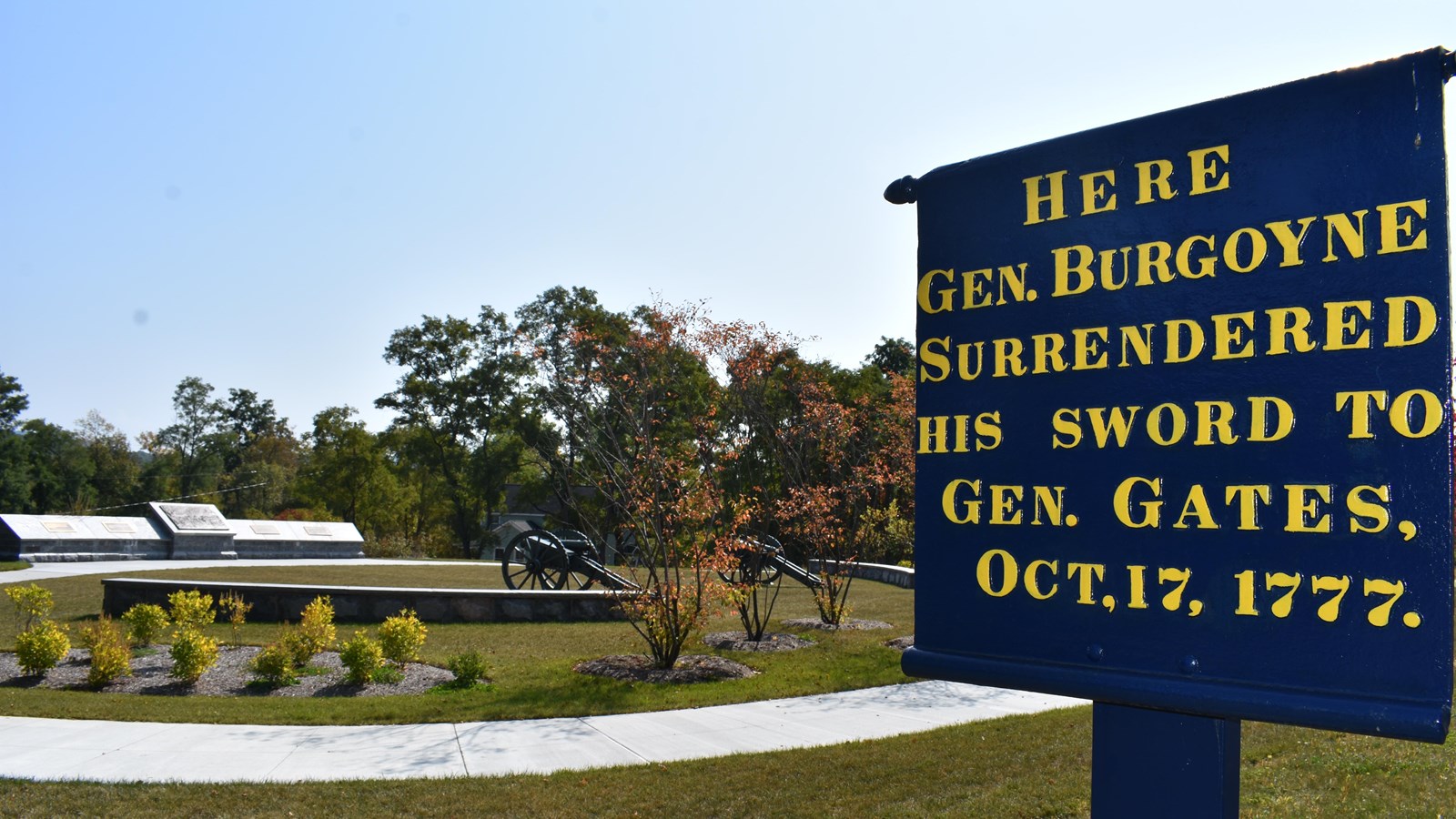
Discussing Saratoga gives me leave to note that the national park there has a new Chief of Interpretation starting today. Garrett Cloer previously worked at Minute Man National Historical Park, Independence National Historical Park, and Longfellow House–Washington’s Headquarters National Historical Site, all places with serious Revolutionary history, in addition to his latest posting at the Herbert Hoover Birthplace in Iowa. He’ll be a real asset to Saratoga.

The photo above shows the Saratoga surrender site, which will soon also become part of the national park there. For the past two years that landscape has been managed and upgraded by the Friends of Saratoga Battlefield.

Sunday, April 02, 2017

The Tragedy of André

Speaking of William Dunlap’s tragedy André, my friend John W. Kennedy has created an online text of that play by transcribing the 1798 edition and annotating it. You can find it all here.

Kennedy writes:
William Dunlap (1766–1839) dominated American theatre in his day as no one else ever did but David Belasco. He was born in Perth Amboy, and the family later moved to New York City. There is a pretty, but questionable, legend to the effect that he may have seen some of the theatrical productions in occupied New York in which John André had a hand.

He traveled to England in 1784 to study with Benjamin West, as was practically de rigueur for aspiring young American painters, but seems to have chiefly fallen in love with the theatre there. Upon his return to America in 1787, his first thought was to write an imitation of Royall Tyler’s hit, The Contrast, and Dunlap’s The Modest Soldier or Love in New York was accepted, though never produced.

But he continued to write, and was soon successful enough to be asked in 1796 to become managing partner in the Old American Company, so called because it was the return of the American Company, founded in 1752, which had retreated to the West Indies in 1778 after Congress had outlawed theatrical performances as incompatible with the war effort. André is one of the plays of this portion of his career.
The result was a tragedy with a “curiously Greek construction—it is written in scenes for two or three, places all the physical activity offstage, takes place in only a few hours’ time, and really wants only a chorus to be perfectly Athenian.”

Dunlap’s blank-verse text is accompanied by several supplemental texts:
Here’s a sample from the play, as the character identified only as “the General” laments in Act 5 that he must let Maj. André’s execution proceed:
O what keen struggles must I undergo!
Unbless’d estate! to have the power to pardon;
The court’s stern sentence to remit;—give life;—
Feel the strong wish to use such blessed power;
Yet know that circumstances strong as fate
Forbid to obey the impulse. O, I feel
That man should never shed the blood of man.
And here’s a discussion by Elfin Vogel and Michael Bettencourt of the challenges of staging André.

Wednesday, July 27, 2016

“What Comes Next?” on Turn: Washington‘s Spies

Yesterday the A.M.C. television channel announced that it had ordered ten more episodes of Turn: Washington’s Spies to make up a fourth and final season of the show.

Though the series hasn’t earned stellar ratings or awards, it attracts a steady audience of the young and middle-aged consumers that advertisers like. There’s definitely an online community of fans, though I can’t say how its size compares to others.

I’ve reviewed every episode of Turn for Den of Geek, and you can revisit my assessments here. If you haven’t watched the show, in each weekly review I tried to avoid giving away the biggest surprises of the latest episode, but I couldn’t keep the turns concealed in succeeding weeks. But of course anyone with a cursory knowledge of the Revolutionary War has a good idea about how the story of Gen. Benedict Arnold and Maj. John André worked out.

Last month, as the world awaited news of whether there would be a fourth season, I wrote an additional essay for Den of Geek on “What Comes Next?” Having brought us to the end of André’s rope, does Turn have somewhere else to go? I wrote:
U.S. history certainly provides such a story in the events of 1781. (Season 3 appears to have concluded in the winter of 1777-78, but Turn has always played loose with actual chronology, so the show could jump ahead as needed.) Throughout the first months of 1781, Gen. Henry Clinton inside New York and Gen. George Washington outside jockeyed for advantage. Late that summer, Washington concluded that he could strike a decisive blow against the British army by moving most of his army with Gen. Rochambeau’s French troops south to Virginia to attack the British general Cornwallis at Yorktown.

That decision was preceded by months of espionage work, offering plenty of work for Maj. Benjamin Tallmadge and Oliver De Lancey, the New York-born British army officer who succeeded André as adjutant-general. Washington asked his agents for clues to whether Clinton would send more troops south or mount a major attack from the city. Likewise, Clinton’s intelligence staff wanted to know when Washington would make a move. Both sides tried to feed false information across the lines and made feints to deceive, distract, or draw off the other side.

To keep the Americans busy in the north, Clinton ordered none other than Brig. Gen. Arnold to lead a raid on New London, Connecticut. As a site of Continental naval operations, that coastal town was a legitimate target. That didn’t stop Americans from complaining that Arnold was driven by resentment toward the state where he had grown up. For Turn’s hotheaded Arnold, that motivation could be a real factor.
Check out that essay for further thoughts on how Turn’s other regular characters could fit into those events and on some aspects of the Revolutionary War that the show hasn’t explored thoroughly.

Monday, March 11, 2013

Two Lectures in One Week

Thanks to the Friends of Minute Man National Park and their guests for coming out to my talk yesterday on Gen. George Washington’s espionage efforts and surprises in the first year of the Revolutionary War. It was gratifying to see such a turnout. (Nothing I like better than helping volunteers scramble to put out more chairs.)

The question-and-answer session was thought-provoking as usual. Among the topics we discussed were:
  • Did Margaret Gage disclose her husband’s military secrets to Dr. Joseph Warren? (Check out the link to her name for my thoughts in detail.)
  • How did New Englanders react to the signs of Dr. Benjamin Church’s treachery? (Patriots were astonished, Patriots’ wives less so since he had already betrayed his wife, and Bostonians rioted when it looked like he was going to be exchanged.)
  • Did Maj. John André leave any descendants in the U.S. of A.? (He died a bachelor, and several modern authors have concluded that he was gay, so I’m guessing not.)
I’m always impressed by how well people in this area know Revolutionary history.

My next talk is this Thursday, 14 March, at Longfellow House–Washington’s Headquarters National Historic Site in Cambridge at 6:00 P.M. The topic is “George Washington, Crisis Manager: The Shaky Start-Up of the Continental Army Headquarters.”

When Washington arrived in Massachusetts in July 1775, he took on responsibility for an army that was supposed to include 20,000 men. That was larger than any group he had administered before, larger by more than an order of magnitude. He had to find the right people and the right systems to manage that force. I plan to talk about the aides Washington ended up with, the methods they used, and the lessons they learned.

To reserve a space for that lecture, email the rangers at Longfellow House–Washington’s Headquarters. Be aware that there’s very little public parking nearby, especially with the latest snow. (Photo above by Len Edgerly in 2006.)