J. L. BELL is a Massachusetts writer who specializes in (among other things) the start of the American Revolution in and around Boston. He is particularly interested in the experiences of children in 1765-75. He has published scholarly papers and popular articles for both children and adults. He was consultant for an episode of History Detectives, and contributed to a display at Minute Man National Historic Park.

Subscribe thru Follow.it


•••••••••••••••••


Tuesday, December 11, 2007

Rebels Rising: The Five-City Tour

The National Book Critics Circle just released a survey that found 68.5% of its respondents feel that “anyone mentioned in the acknowledgments of a book” should be barred from reviewing it. Since my name appears in the Rebels Rising: Cities and the American Revolution, this is not a review. It’s just a discussion of the book.

Then again, Dave Hoffman at Concurring Opinions invited Benjamin L. Carp to write a “review” of Rebels Rising, and Ben’s name is on the cover, as the author. So we bloggers are still working out our own standards.

In Rebels Rising, Ben Carp explores the approach of the American Revolution in the five largest settlements in British North America. For each seaport, the book looks at a different aspect of life and thus analyzes different historical sources, political pressures, and slices of the population.

The chapter on Boston focuses on its waterfront: economy, culture, politics. As Ben points out, the ocean was part of everyone’s life on the Shawmut peninsula, even they didn’t directly work in the maritime trades. “From the tip of the North End to the Boston Neck was about two miles, and no point in Boston was more than half a mile from the water.”

The chapter on New York looks at that city’s changes through what happened in taverns. Again Ben makes a mighty strong case for that approach:

The province [of New York] consumed about 1,119,000 gallons of rum in 1770. This was 6.7 gallons of rum per New Yorker annually—a slightly skewed figure since some of the rum went to New Jersey. Still, New Yorkers probably drank rum at a higher rate than other Americans, who each drank 4.2 gallons of rum on average that year or more than seven one-ounce shots every day. . . .

With 365 liquor licenses issued in the twelve months following March 1771, a ratio of one tavern or retailer for approximately every sixty city residents (or one for every thirteen adult white men), New York had around double the number of drinking establishments per capita than other large colonial American cities.
The book studies Newport, Rhode Island, through its religious frictions, drawing especially on the rich diaries and letters of the Rev. Dr. Ezra Stiles. The papers of Henry Laurens open a window into the drawings rooms of Charleston, South Carolina, and an analysis of household management there. The last major chapter considers how Philadelphians tussled over their public spaces—their legislative chamber and the open yard outside—and thus over sources of political authority.

The result is a detailed, grounded look at one aspect of life in each seaport before the Revolutionary War—but only one aspect. As an example of how this works, Rebels Rising discusses Paul Revere as a small businessman who lived near the waterfront. It doesn’t discuss his career as a luxury craftsman, serving gentlemen but not (at first) considered one of them. It leaves aside his experiences as a war veteran and militia officer, a member of the St. Andrew’s Lodge of Freemasons, and an occasional engraver and thus political journalist. The book introduces Samuel Adams early in his career protesting naval impressment, a grievance of Boston’s waterfront community, but it doesn’t discuss other activities that helped politicize him, such as the Land Bank controversy and his work as a tax collector.

It would have been possible to apply any of the four other themes to Boston:
  • Taverns: The coffee-house fight between James Otis and John Robinson, meetings in the Green Dragon, &c. (Of course, David Conroy’s In Public Houses already traces about how Massachusetts taverns became political centers in the 1700s.)
  • Religion: Boston’s Congregationalist clergy was complaining loudly about a possible Anglican bishop while Crown supporters complained that those ministers comprised a “black regiment” preaching resistance.
  • Households: The nonimportation struggle made consumption into a political issue, then a conflict which eventually led to loss of life.
  • Space: Alongside the official Town House and Faneuil Hall government buildings, Boston politicians used Old South Meeting-House for extra-large meetings, plus the open space of the streets and under Liberty Tree.
We could probably apply each of the five approaches to each of the five cities. Of course, Rebels Rising never claims that there’s only one way to approach each location. It just shows that how each approach works in its designated city to yield insights into the overall movement. This one book thus encapsulates five different ways of looking at the approach of the Revolution, and offers a quick introduction to five distinct American places.

And I sense that Rebels Rising was designed to display that range. Though it certainly doesn’t read like a monograph, this book grew out of Ben Carp’s doctoral dissertation, which was supposed to show what he could do after however many years of training. And it showed he could do multiple forms of historical analysis in multiple geographic areas—mighty impressive.

In a way this book reminds me of John Singleton Copley’s famous portrait of his half-brother, Henry Pelham, and a squirrel, which is now at the Museum of Fine Arts. Copley painted that not for a patron but to exhibit in London and thereby establish his talents. It was his “masterpiece,” proving his range of skills. And the painting reflects that purpose. Copley is telling viewers, Look! I can paint a fine portrait! I can also paint a flying squirrel—bet you haven’t seen that! I can paint a fine metal chain! I can paint a glass of water! I can paint satin cloth! I can paint the reflections of all that stuff in a polished wood table! You want a portrait? I can paint it!

Monday, December 10, 2007

Founding Fathers in Houses and Taverns

On Friday evening I went to George Washington’s Cambridge headquarters for a book talk by Hugh Howard, author of Houses of the Founding Fathers, which also features many color photographs by Roger Straus III. This oversize illustrated (i.e., “coffee table”) book offers a tour of surviving Georgian and Federal mansions connected to the first generation of Americans.

How do we define “Founding Fathers”? There are the men at the Second Continental Congress, of course, and the Constitutional Convention. And important generals, such as Henry Knox. But that still didn’t produce enough buildings to fill a book. Howard and Straus’s challenge was not just to find the houses of historically significant people, but houses that were still photogenic.

From his towering perspective (he’s very tall), Howard cast a wider net. He included the houses where Gen. George Washington slept for a significant time, such as Longfellow House or the Ford Mansion in Morristown. And then there are the mansions of regional Patriot leaders. For instance, the cover shows wonderful Drayton Hall in Charleston, South Carolina; it was home to William Henry Drayton, president of the South Carolina Provincial Congress and Continental Congress delegate for a year.

Among the Massachusetts houses that Howard featured in the book and in his talk is the Marblehead mansion of Col. Jeremiah Lee. The Marblehead Museum & Historical Society offers an online slide show of the house and actual tours from June through October. It’s an unusually large North American Georgian mansion, with seven windows across its front.

Like Drayton, Col. Lee was notable within his province but had limited influence elsewhere, dying during the war. Lee was a Marblehead merchant, militia commander, and member of the Massachusetts Provincial Congress’s Committee on Supplies, which before April 1775 was gathering military equipment for the militia in case there would be war. David Mason, the Salem painter chosen by the Provincial Congress in November 1774 to collect ordnance, recorded receiving money from Lee twice.

On 18 Apr 1775, Lee attended a joint meeting of the Committee on Supplies and the Committee of Safety at a tavern in Menotomy, now Arlington. When the meeting broke up, he and two other men from Marblehead, Elbridge Gerry and Azor Orne, decided to stay the night. Richard Devens of Charlestown later wrote:

After we had finished the business of the day, we adjourned to meet at Woburn on the morrow,—left to lodge at Newell’s [the tavern], Gerry, Orne, and Lee. Mr. [Abraham] Watson and myself came off in my chaise at sunset.

On the road we met a great number of B[ritish]. O[fficers]. and their servants on horseback, who had dined that day at Cambridge. We rode some way after we met them, and then turned back and rode through them, went and informed our friends at Newell’s. We stopped there till they [the officers] came up and rode by. We then left our friends, and I came home, after leaving Mr. Watson at his house.
The province was abuzz with rumors that the London government had ordered Gen. Thomas Gage to arrest leaders of the rebellion—and those rumors were pretty much true. Even though Devens and Watson had passed through the British officers twice with no trouble, the committee men were nervous about being detained. Gerry sent a warning to John Hancock and Samuel Adams, then staying at Lexington.

Later that evening, a long column of British troops passed the tavern. Lee, Gerry, and Orne got out of bed to watch. Suddenly they perceived some soldiers from that column coming toward the tavern. Half-dressed, the three men dashed out the back door and threw themselves down in a field, hoping the stalks of the previous year’s crop would hide them. They remained on the ground for about an hour before they decided it was safe to return to the building.

Lee, who had just turned 54, took sick and died on 10 May. His family and friends blamed the fright, exertion, and cold of that night.

Here’s the sad irony: the British troops weren’t seeking to arrest anyone on the Committee on Supplies. An 1828 biography of Gerry, who became a controversial governor of Massachusetts, claimed:
Every apartment of the house was searched for the members of the rebel congress; even the beds in which they had lain were examined. But their property, and among other things a valuable watch of Mr. Gerry’s, which was under his pillow, was not disturbed.
But Gage’s orders for that march say nothing about arresting Provincial Congress members or searching buildings before the column reached Concord. None of the several British officers who left accounts of the night wrote anything about such a search on the way west. I don’t know of any contemporary evidence to support that biography’s statement.

I rather suspect that if any British soldiers came to that tavern door on 18 April, they wanted nothing more than a drink of water or other refreshment, and that they never searched the building or the committee men’s room. I think that Lee, Gerry, and Orne could have stayed inside the whole night without being disturbed, and Lee might have lived in his Marblehead mansion for many more years.

Sunday, December 09, 2007

Shotted Dead Great Hamilton

William Hogeland’s essay “Inventing Alexander Hamilton” in the Boston Review makes interesting reading. It takes strong issue with what a couple of recent books have said about Hamilton’s influence on America.

Many historians agree with Hogeland that Hamilton was highly ambitious, with the energy and political skills to succeed at most of those ambitions. So Hogeland’s picture of a young man on the make rings true:

Hamilton’s correspondence during and after the [1782 Newburgh] crisis reveals a young man working assiduously to cover every bet: he subtly adjusted his solicitation of [George] Washington when it became obvious the great man wouldn’t play; he didn’t scruple to criticize, even partly rat out, his fellow conspirators; and he confessed to Washington certain aspects of his own participation in the conspiracy, while covering up others; in one letter draft he even crossed out a reference to it. A reader of this richly entertaining bob-and-weave can only stand in awe of Hamilton’s conjuring a role as Washington’s congressional informant and confidant from participation in a treasonous conspiracy. He set up his entire career!
On Hamilton’s economic policies, Hogeland seems to start from the the Whiskey Rebellion, on which he’s written a book, and then to trace back the policies that prompted it.
For Hamilton, shoring up and concentrating bondholders’ wealth meant paying that income with funds drawn not from the small bondholding class but from a tax collected from the large class of people who would never own a bond. And he structured the tax around aspects of the distilling process itself, so that big-time distillers (industrialists, members of the bondholding class) would be charged a lower tax while small-time producers (people engaged in a wide variety of work as farmers and artisans, with whiskeymaking often their sole source of cash and credit) would be charged a substantially higher tax, in many cases a crushing one. . . .

Thus did the first federal domestic tax—linchpin to Hamilton’s finance plan, culmination of nationalists’ decade-long efforts to unite the country, first step in making the American economy a global competitor—operate regressively, comprehensively, and deliberately.
As for the value of economic mobility, as Hamilton himself had enjoyed as a fatherless island boy arriving in New York from St Croix in 1772:
It’s more likely that Hamilton believed exceptional, bright boys like him should erupt like meteors across the night sky. Blending creative genius with an almost mad degree of thoroughness and tenacity, he strove to dominate everyone he encountered, a quality that brought enormous success but also marred his life and may have shortened it.

The idea that Hamilton spent his career trying to create conditions for replicating such a rise seems fantastic. One searches his letters and public statements in vain for thoughtful reflection on ordinary families’ economic struggles or respect for their goals and hopes for their children’s betterment. He is unconcerned about using government power to encourage the rise of laborer’s descendants and would not have related upward mobility to democracy—a dirty word to Hamilton.
Yet do those criticisms of Hamilton really refute the recent authors’ suggestion that “today’s America is not Jeffersonian but Hamiltonian—a blend of high finance, central banking, federal strength, industrialization, and global power.” Or do they simply offer more evidence for it?

Saturday, December 08, 2007

Samuel Adams's "Masterly Stroke of Policy"

Earlier this week Mitt Romney, former governor and then critic of Massachusetts, gave a speech about religion and politics that concluded with this Revolutionary anecdote:

Recall the early days of the first Continental Congress in Philadelphia, during the fall of 1774. With Boston occupied by British troops, there were rumors of imminent hostilities and fears of an impending war. In this time of peril, someone suggested that they pray. But there were objections. “They were too divided in religious sentiment,” what with Episcopalians and Quakers, Anabaptists and Congregationalists, Presbyterians and Catholics.

Then Sam Adams rose, and said he would hear a prayer from anyone of piety and good character, as long as they were a patriot.
Romney and his speechwriters no doubt based their description of that event on John Adams’s letter home to Abigail, dated 16 Sept 1774, or other writers’ retellings of it:
When the Congress first met, Mr. [Thomas] Cushing made a Motion, that it should be opened with Prayer. It was opposed by Mr. [John] Jay of N. York and Mr. [Edward] Rutledge of South Carolina, because we were so divided in religious Sentiments, some Episcopalians, some Quakers, some Anabaptists, some Presbyterians and some Congregationalists, so that We could not join in the same Act of Worship.

Mr. S[amuel]. Adams arose and said he was no Bigot, and could hear a Prayer from a Gentleman of Piety and Virtue, who was at the same Time a Friend to his Country. He was a Stranger in Phyladelphia, but had heard that Mr. [Jacob] Duche (Dushay they pronounce it) deserved that Character, and therefore he moved that Mr. Duche, an episcopal Clergyman, might be desired, to read Prayers to the Congress, tomorrow Morning.

The Motion was seconded and passed in the Affirmative. Mr. [Peyton] Randolph our President, waited on Mr. Duche, and received for Answer that if his Health would permit, he certainly would. Accordingly next Morning he appeared with his Clerk and in his Pontificallibus, and read several Prayers, in the established Form; and then read the Collect for the seventh day of September, which was the Thirty fifth Psalm.

You must remember this was the next Morning after we heard the horrible Rumour, of the Cannonade of Boston.—I never saw a greater Effect upon an Audience. It seemed as if Heaven had ordained that Psalm to be read on that Morning.

After this Mr. Duche, unexpected to every Body struck out into an extemporary Prayer, which filled the Bosom of every Man present. I must confess I never heard a better Prayer or one, so well pronounced. Episcopalian as he is, Dr. [Samuel] Cooper himself never prayed with such fervour, such Ardor, such Earnestness and Pathos, and in Language so elegant and sublime—for America, for the Congress, for The Province of Massachusetts Bay, and especially the Town of Boston. It has had an excellent Effect upon every Body here.

I must beg you to read that Psalm. If there was any Faith in the sortes Virgilianae, or sortes Homericae, or especially the Sortes biblicae, it would be thought providential.

It will amuse your Friends to read this Letter and the 35th. Psalm to them. Read it to your Father and Mr. Wibirt.—I wonder what our Braintree Churchmen would think of this?—Mr. Duche is one of the most ingenious Men, and best Characters, and greatest orators in the Episcopal order, upon this Continent—Yet a Zealous Friend of Liberty and his Country.
But that wasn’t the first time John Adams had written about this moment. His first allusion to it appeared in his diary on 10 September:
Mr. Reed [George Read of Delaware?] returned with Mr. [Samuel] Adams and me to our Lodgings, and a very social, agreable and communicative Evening We had.

He says We never were guilty of a more Masterly Stroke of Policy, than in moving that Mr. Duche might read Prayers, it has had a very good Effect, &c. He says the Sentiments of People here, are growing more and more favourable every day.
The phrase “Masterly Stroke of Policy” reveals that the cousins’ agreeable colleague saw Samuel’s proposal as a political act. Why? And what was the background of this moment?

First of all, it was almost certainly a setup. Thomas Cushing and Samuel Adams went way back. Cushing had been Adams’s boss in his early, unrewarding attempt at a mercantile career. In the Massachusetts General Court, Cushing was Speaker and Adams was Clerk. Adams must have known that Cushing would propose opening the congress with a prayer, and had probably prepared what he was going to say in response.

The Massachusetts delegates had arrived in Philadelphia with a reputation of being Congregationalist zealots who oppressed minority religions in their region, including the Quaker, Anglican, and Baptist faiths. Some people feared the New England Congregationalists might push the rest of the American colonies into civil war, like the English Puritans of the 1640s. Adams seized (or created) this chance to show that “he was no Bigot” precisely because a lot of the men around him suspected he was a bigot.

And in some ways Samuel Adams definitely was. He was suspicious of the Anglican Church and downright hostile to Catholicism. But on the latter point, so was the rest of Congress. Romney was wrong to claim that the First Continental Congress included “Catholics”; there were no Catholic delegates in the room. It was a bunch of Protestant men congratulating themselves on being so open-minded as to listen to a Protestant prayer.

On 14 Oct 1774, that same Congress issued a Declaration and Resolves listing this among Parliament’s “infringements and violations of the rights of the colonists”:
establishing the Roman Catholic religion, in the province of Quebec, abolishing the equitable system of English laws, and erecting a tyranny there, to the great danger (from so total a dissimilarity of religion, law and government) of the neighboring British colonies, by the assistance of whose blood and treasure the said country was conquered from France.
The First Continental Congress’s attitude toward religious diversity was clearly limited. They believed that making Catholicism the established church in a separate province populated mainly by Catholics somehow endangered them and infringed on their rights.

Some more ironies of this situation:
  • The same John Jay who spoke against starting the Congress with a prayer also called the U.S. of A. a “Christian nation” in an 1816 letter, and is therefore often cited by people who wish to enforce that belief.
  • The “the horrible Rumour, of the Cannonade of Boston,” that made Duche’s prayers so resonant turned out to be completely false. (This was the same rumor that prompted the Powder Alarm.)
  • Adams’s letter shows that he knew his Congregationalist friends and family back in Massachusetts would be surprised that an Anglican like Duche could ardently support the Patriot cause. He urged Abigail to share his praise for the minister with her father, the Rev. William Smith, and the north Braintree minister, the Rev. Anthony Wibird. When he wrote, “I wonder what our Braintree Churchmen would think of this?” Adams alluded to his Anglican neighbors, who mostly leaned toward the Crown. In sum, Adams’s letter says as much about division and suspicion along religious/political lines as it does about unity and tolerance in the early nation.
  • A month after Adams’s letter, on 14 October, the Massachusetts delegates were surprised to find themselves in a tense meeting with local Quakers and two New England Baptists about “certain Laws of that Province [Massachusetts], restrictive of the Liberty of Conscience.” Anglicans might have become less suspicious of Massachusetts after Samuel Adams’s masterstroke, but people from minority faiths back in New England still knew that the government favored one church over all others.
And a final irony appears in John Adams’s last mention of Duche to Abigail, in a letter dated 25 Oct 1777. At the time, the British military under Gen. William Howe had taken Philadelphia, driving the Congress to York. John wrote:
This Town is a small one, not larger than Plymouth. — There are in it, two German Churches, the one Lutheran, the other Calvinistical. The Congregations are pretty numerous, and their Attendance upon public Worship is decent. It is remarkable that the Germans, wherever they are found, are carefull to maintain the public Worship, which is more than can be said of the other Denominations of Christians, this Way. There is one Church here erected by the joint Contributions of Episcopalians and Presbyterians, but the Minister, who is a Missionary, is confined for Toryism, so that they have had for a long Time no publick Worship

Congress have appointed two Chaplains, Mr. [William] White and Mr. [George] Duffield, the former of whom an Episcopalian is arrived and opens Congress with Prayers every Day. The latter is expected every Hour.

Mr. Duche I am sorry to inform you has turned out an Apostate and a Traytor. Poor Man! I pitty his Weakness, and detest his Wickedness.
The Rev. Mr. Duche (shown above, courtesy of the University of Pennsylvania) had asked Gen. George Washington to stop resisting the British military. When that letter became public, Duche fled to Britain, was convicted of treason against Pennsylvania, and had all his American property confiscated.

Friday, December 07, 2007

Endeavour’d to Escape by Flight

According to Boston selectman Timothy Newell’s diary, most of the military action around the town in early December 1775 was taking place at sea. On the 7th he wrote:

A Brigt. Privateer called the Washington brot. in here Martindale, Captain, with six carriage guns and seventy five men taken by the Fowey man of war. The People sent to England in a man of war.
The same day, Capt. John Barker of the 4th Regiment recorded in his diary:
The Fowey brought in a Privateer; she carried 10 six pounders and 8 swivels and had 75 Men; she made no resistance but endeavour’d to escape by flight.
Capt. Sion Martindale was from Rhode Island, though his ship Washington had been outfitted in Plymouth harbor. He had spent many weeks requesting more sails, guns, crewmen, even a fife and drum, and had finally sailed on 28 November. The ship quickly returned with a small sloop that had been disabled by lightning, but captain and crew got into a dispute about how the value of that prize would be distributed.

Threatened with replacement, Capt. Martindale sailed again on 2 December. The next day, H.M.S. Fowey chased down the Washington, and Martindale surrendered without firing a shot. He was probably the captured ship’s captain that Lt. William Feilding said had seen British ordnance on Cambridge common.

In mid-December, the Washington’s crew were put on board H.M.S. Tartar along with Ethan Allen and other American prisoners from Quebec, and sent to England. About half of the 74 crewmen quickly died of smallpox, and another 15 were recruited or impressed into the Royal Navy. In February 1776, the remaining 21, including Capt. Martindale, were shipped to Halifax to be exchanged for British prisoners.

Martindale escaped from the Halifax jail, along with several other men, and made his way to Maine. On 8 Sept 1776, Gen. Nathanael Greene wrote to the President of the Continental Congress:
This will be handed you by Captain Sion Martindale and Lieutenant Moses Turner, that were taken in the brig Washington, in Boston Bay, last Fall. They were sent home prisoners to England and ordered back to Halifax, where they were confined in gaol for some time; at last they found means to cut a passage out, and made their escape, and have got safe home. . . .

They apply to Congress for their wages and rations due during their captivity. They also apply for an allowance for the losses they met with, and for several advancements they made for the brig Washington and the crew, during the time they were fitting for the cruise; all which, doubtless, the Congress will take under consideration, and grant what justice and equity entitle them to.

They all belonged to the Rhode-Island regiments, and while they were under my command, they discharged their duty as became good and faithful officers. How they behaved after they entered on board the brig Washington, I am not able to say. They are men who have families, and no means of support for them but their industry.
Capt. Martindale got some pay and took up shore-based military duty for a while as captain of the fort at Bristol, but in 1779 he was once again commanding a privateer, this time the Bradford, out of Providence.

On 8 Dec 1775, the day after Timothy Newell recorded the Washington’s capture by the British, he was able to report more captures by the Americans:
Three Ships, from London, Glasgow and Liverpool, with stores for the army—a Brigt. from Antigua with Rum, taken by the whale boats &c. in our Bay.
What strikes me about these events is how close the privateer war was to shore at that time. I used to imagine ships cruising for weeks or months, but these guys were sailing for just a few days before coming back into port, lucky or unlucky.

Thursday, December 06, 2007

Arrival of the French Neutrals

This weekend the New England Historic Genealogical Society on Newbury Street in Boston will host a lecture on the deportation of French nationals from Acadia after the British conquered the region (for the second time) in 1755. Here are the particulars:

The Acadian Deportation
Saturday, December 8, 2007, 10:00 a.m.
Lucie LeBlanc Consentino, author and owner of the website the Acadian & French Canadian Ancestral Home, will speak about the forced deportation of Acadians from Nova Scotia during the Great Diaspora between 1755 and 1763.
At its largest, the region of Acadia included parts of the Canadian Maritime provinces of Nova Scotia, New Brunswick, and Prince Edward Island and what is now Maine. Over the 1700s, the British Empire sliced segments of that region from France: Nova Scotia (minus Cape Breton Island) in 1713, the fortress of Louisbourg in 1745 and again in 1755, and eventually all of French Canada in 1763.

For the first half of that century ethnic French families could remain in British territories by promising to remain neutral in the imperial wars. As late as the Massachusetts census of 1765, the tally sheets still had a column for “French neutrals.” I believe the men in that category weren’t expected to serve in the militia against invaders (who, most British colonists assumed, were going to be French anyway).

In 1755, with a global war about to start, the British colonial governors instituted a new policy toward the ethnic French: expulsion from the land around the fortress at Louisbourg. On 11 August, Gov. Charles Lawrence (shown above, courtesy of CyberAcadie.com) issued these orders:
That the Inhabitants may not have it in their power to return to this Province nor to join in strengthening the French of Canada in Louisbourg; it is resolved that they shall be dispersed among his Majesty’s Colonies upon the Continent of America.

For this purpose Transports are ordered to be sent from Boston to Annapolis to ship on board one thousand persons reckoning two persons to a ton, and for Chignecto, transports have been taken up here to carry off the Inhabitants of that place; and for those of the District around Mines Bason Transports are in from Boston. . . .

Upon the arrival of the vessels from Boston in the Bason of Annapolis as many of the Inhabitants of Annapolis District as can be collected by any means, particularly the heads of families and young men, are to be shipped on board of them at the above rate of two persons to a ton, or as near it as possible.
Boston was designated to receive two hundred or more Acadian deportees; eventually more than a thousand arrived in Massachusetts as British authorities widened their deportation orders. By the end of the Seven Years’ War, it is estimated, more than 10,000 French colonists had been moved out of Acadia. About a third went to France and a slightly larger number resettled in other parts of what is now Canada. Many of the deportees brought to Britain’s older Atlantic colonies eventually made their way to the territory of Louisiana.

The Acadian expulsion inspired Henry W. Longfellow’s 1847 poem Evangeline, which in turn helped inspire new ethnic pride among people of Acadian ancestry. In 1884 the Second Acadian National Convention, held on Prince Edward Island, adopted an Acadian flag based on the French tricolor—which the Acadians had never actually lived under.

Wednesday, December 05, 2007

Illustrating Mohawk Country

Yesterday I started to describe my approval of Journey into Mohawk Country, a comics adaptation of Harmen Meyndertsz van den Bogaert’s report on a trading trip from Holland’s small colony in North America to several Mohawk towns in 1634.

George O’Connor’s illustrations of that text have little in common with the art in other nonfiction historical comics I discussed earlier: no painterly renditions of famous faces, no traditional comic-book action. And I think that style adds greatly to the book.

O’Connor’s sketchbook pages, shared on his publisher’s website, show how he started drawing the Dutchmen in a more realistic comics form, but came around to a “cartoony” image of the characters. Here’s one resulting page, as Van den Bogaert’s insist he accompany them to a religious ceremony:
The publisher offers more sample pages on its website. (A page spread late in the book is in a slightly different style, representing Van den Bogaert’s hopeful vision of a prosperous future through simpler drawings and a pastel palette.)

O’Connor’s chosen style fits the many visual jokes that he’s created to build off of, run parallel to, or even undercut Van den Bogaert’s serious text. The combination of jokes and cartoony art means we can’t forget that O’Connor isn’t providing a “you are there” peek at historical events. Rather, he’s offering his artistic interpretation of Van den Bogaert’s document, informed by research but not claiming to be authoritative. The illustrations force us to think about the relationship between what happened and what got written down, between historical events and historical sources. And that’s a vital part of the study of history.

In the lower left panel above, Van den Bogaert’s companions are playing rock-paper-scissors to decide who has to go with him to the Mohawks’ ceremony. I have no idea if seventeenth-century Dutchmen played this game (and neither does the Straight Dope). In reality, Van den Bogaert might have simply ordered one man to come along; all he says is, “I took Jeronimus with me.” Had O’Connor showed that bit of business in a realistic visual style, like other comics, he would have implied that these Dutchmen definitely played rock-paper-scissors. But when we see the men are cartoons, we understand that O’Connor is offering us an entertaining notion of what those men might have done and can ourselves entertain other possibilities.

One potentially problematic element of Journey into Mohawk Country is its depiction of the Mohawks. O’Connor’s sketchbooks show how he researched the visual elements of seventeenth-century Iroquois culture. He depicts some customs, such as lacrosse and the snake game, that Van den Bogaert’s report doesn’t mention. O’Connor also worked to create a variety of faces for the main Mohawk actors and the many “extras.”

Nonetheless, we mostly see the Mohawks as Van den Bogaert and his fellow Dutchmen did: they’re foreign, often intimidating, hard to interpret, insistent on their customs. (And why not? Their villages were a lot better off than the Dutch settlements.) I wrote before about how a comics biography of Washington portrayed Native Americans as violent stereotypes. The Natives in Journey into Mohawk Country are much more varied: different characters are friendly, amorous, suspicious, angry, insistent, standoffish, &c.

Still, we don’t hear the Mohawks’ voices or see their actions except through Van den Bogaert’s words—just as in the historical document. The Natives remain largely mystifying and unpredictable to the Dutchmen, even though one brings back a new girlfriend. And while it’s possible that some readers might come away from Journey into Mohawk Country thinking of the Mohawks as mystifying and unpredictable, I hope that O’Connor’s method of playing art against text will remind most of us about what doesn’t get into the written record—about how there were thousands of individuals in Mohawk Country in 1634 whom Van den Bogaert never got to know and whom we can no longer know.

In the end, O’Connor’s story is not about the Mohawks. It’s about how journeying to them might have changed Van den Bogaert and his companions, as summed up in these drawings before and after the trip. Van den Bogaert has lost his hat, Jeronimus has traded away his coat, the men’s shoes are scuffed—but the real change is that they’ve lost some complacency about their familiar way of life. And that’s what good historical interpretations can also do.

Tuesday, December 04, 2007

Getting into Mohawk Country

Earlier this fall I discussed some nonfiction comics about the American Revolution, mostly published for the school-library market. I thought that the format has good potential to communicate the facts and processes of history, but that most of the examples I saw had flaws: poor art research, dubious sources, one-sidedness, &c.

Today I’ll highlight a nonfiction historical comic that I really liked—even though it has nothing to do with the Revolutionary War. Journey into Mohawk Country was created by artist George O’Connor and published last year by First Second. Its text is the report of a young Dutch colonist named Harmen Meyndertsz van den Bogaert about his 1634 trip to several Mohawk communities, trying to promote trade between them and New Amsterdam.

That doesn’t seem like very dramatic fodder for a comic book: no fistfights or cannon fire. But O’Connor uses the comics form to fill out the bald details of Van den Bogaert’s words. For instance, these panels give us a more visceral understanding of the difficulties of this winter journey.
At another point, Van den Bogaert and his party are stymied by a river. O’Connor frames the scene with their faces peeking over the bottom of the frame, conveying how they imagine being up to their noses in that water.

The fourteen sample pages from the publisher show other ways that O’Connor used his visual imagination to dig into what’s essentially a bureaucratic report and bring out the possible emotions of the young man who wrote it. It’s one thing for the document to mention how Van den Bogaert cut one of his companion’s legs to relieve swelling; it’s another to see the knife.

In the panels above, O’Connor highlighted the words, “I hope that everything shall succeed,” by giving them a panel of their own. The bandaged leg in the background and Van den Bogaert’s pause before writing makes that innocuous formula more meaningful for us as readers.

By focusing his book on Van den Bogaert’s report, O’Connor replicates what historical researchers do most of the time: interpreting documents in an attempt to understand the past. In that regard, Journey into Mohawk Country has the advantage of being based on a recent translation of the Dutch report. O’Connor didn’t have to deal with the period spellings, punctuation, and word usage that make documents in English from 1634, or even a century and a half later, a challenge to read. But with careful editing, comics could give the same treatment to, say, testimony from witnesses at the Boston Massacre.

TOMORROW: Why I like this comic’s visual style.

Monday, December 03, 2007

Smallpox at Point Shirley?

On 3 Dec 1775, Boston selectman Timothy Newell recorded the British authorities’ second removal of poor inhabitants from the besieged town to Winthrop:

A Transport Ship sailed for Point Shirley, with about three hundred Inhabitants.
The provincials weren’t entirely happy to see these refugees, however. Indeed, in fine eighteenth-century fashion, they immediately suspected that their enemy was up to something. Some of those people were sick, and the American authorities soon concluded that the British had deliberately sent out people infected with the smallpox virus to spread the disease among the besieging army.

On 5 December, Gen. George Washington wrote:
By recent information from Boston, General [William] Howe is going to send out a number of the inhabitants, in order as it is thought to make room for his expected reinforcements; there is one part of the information that I can hardly give Credit to, A Sailor says that a Number of these coming out have been inoculated with design of Spreading the Small pox through this Country and Camp.
On 6 December the Massachusetts Council made this vote:
Whereas, a Committee has been appointed by this Court to provide for, and remove such of the Inhabitants of Boston, as may be sent from thence to Point-Shirley, or other places, as also to make use of every precaution necessary to prevent a communication of the Small-Pox to other parts of this Colony, which appears to be the intention of our enemies.

Resolved, That the said Committee be, and hereby are directed and empowered to impress (if it should be found necessary) a sufficient number of Carriages for the removal of such of said inhabitants, and their effects, as shall have been sufficiently smoked and cleansed [processes meant to stop whatever spread the smallpox], to such towns as the Committee shall judge proper, giving them certificates that they are of the poor of Boston, and quite free from infection;

and it is recommended to the Committee that they retain at Point-Shirley such of said inhabitants as they shall apprehend may have been in the way of receiving the Small-Pox, for such a space of lime as may be necessary to determine whether they had the infection, taking care that they are supplied with such quantities of Provisions, Wood, &c., as they judge will be sufficient to keep them from suffering.

It is further recommended to said Committee to provide, if they see occasion, suitable houses as Hospitals for the reception of those persons who may be taken with the Small-Pox, or shall appear to have the symptoms of the distemper, as, also, to engage a Physician or Physicians to attend the sick, if required, and to place sufficient guards at the infected houses to prevent a promiscuous passing or repassing to and from said houses.
Fortunately, there was already a smallpox hospital at Point Shirley, from a big regional outbreak of 1764. In this period, “hospital” didn’t mean a specialized building with all the medical equipment we expect today. It was basically any large building which could contain beds for a lot of sick people away from everyone else—which was basically the best that medicine had to offer.

Writing from Malden on 10 December, Thomas Crafts, Jr., told William Cooper:
The small-pox has broke out in two families that came out of Boston in the first vessels. Two persons have it at Point Shirley, and one at Malden. I thought it my duty to acquaint you of it, as soon as possible. Beg you would lay it before the General Court, that they may take the best measures to prevent the spreading of that distemper at this alarming crisis of our publick affairs. As it is impossible to get wood carried to Point Shirley, the meeting house there being of no service and rotten, if we might not have orders to pull that down for their immediate supply of fires.
On 12 December the legislative committee designated to consider Crafts’s letter resolved:
That the Committee at said Point Shirley be, and they hereby are, directed to make use of any old decayed stores, barns, or fish-houses, as fuel for the relief of the sick and distressed, and if necessary, to take down any publick building there for the purpose aforesaid; said Committee to render an account of their proceedings to this Court.

And they are further directed to use their utmost endeavours to prevent the spreading of the small-pox, and make proper representation of the state of such persons as are put under their care, to this Court, whenever they find there is occasion therefor;

and that Captain [Jedidiah] Foster [shown above, courtesy of Quaboag Regional High School] and Captain Searl be a Committee to repair immediately to Point Shirley, and cause such buildings, as may be thought necessary to be taken down for fuel, to be appraised, and take any measures, and give any directions that shall appear to them necessary to aid the Committee now there in procuring wood and in preventing the spreading of the small-pox.
As winter approached, people were tearing down buildings both inside Boston and out for firewood.

Sunday, December 02, 2007

Snowball Fight in Harvard Yard

This afternoon I escorted a tour group through Gen. George Washington’s Cambridge headquarters, and one of the Concordant Volunteers’ young interpreters described life with the commander-in-chief, including the following anecdote. Since there’s snow forecast for this evening, it seems doubly appropriate for today.

The story comes from Israel Trask, born in or around Gloucester in 1765. His father was a lieutenant in an Essex County regiment, and in some early version of Take Your Child to Work Day decided that Israel, who had turned ten years old in February 1775, should come along with him to the war.

Israel’s duties were, he later wrote, “the care of the baggage and the property of the mess. When the officers were called on duty, which was daily the case, either to mount guard, or fatigue duties in fortifying the camp,...my duty alternately was to take the edibles prepared at the mess to the officers on duty, which in some instance [were] miles distant.”

In the winter of 1775-76 the regiment was moved into one of the buildings of Harvard Yard. And then some new soldiers arrived from outside New England. Trask recalled:

A day or two preceding the incident I am about to relate, a rifle corps had come into camp from Virginia, made up of recruits from the backwoods and mountains of that state, in a uniform dress totally different from that of the regiments raised on the seaboard and interior of New England. Their white linen frocks, ruffled and fringed, excited the curiosity of the whole army, particularly to the Marblehead regiment, who were always full of fun and mischief.
In his 1960 biography of Col. John Glover, head of the Marblehead regiment, George A. Billias suggests that the Virginians in turn scorned the fact that Glover’s soldiers included some blacks.
[The Marblehead men] looked with scorn on such an rustic uniform when compared to their own round jackets and fishers’ trousers, [and they] directly confronted from fifty to an hundred of the riflemen who were viewing the college buildings.

Their first manifestations were ridicule and derision, which the riflemen bore with more patience than their wont, but resort being made to snow, which then covered the ground, these soft missives were interchanged but a few minutes before both parties closed, and a fierce struggle commenced with biting and gouging on the one part, and knockdown on the other part with as much apparent fury as the most deadly enmity could create. Reinforced by their friends, in less than five minutes more than a thousand combatants were on the field, struggling for the mastery.

At this juncture General Washington made his appearance, whether by accident or design I never knew. I only saw him and his colored servant [possibly Will Lee], both mounted. With the spring of a deer, he leaped from his saddle, threw the reins of his bridle into the hands of his servant, and rushed into the thickest of the melee, with an iron grip seized two tall, brawny, athletic, savage-looking riflemen by the throat, keeping them at arm’s length, alternately shaking and talking to them.

In this position the eye of the belligerents caught sight of the general. Its effect on them was instantaneous flight at the top of their speed in all directions from the scene of the conflict. Less than fifteen minutes time had elapsed from the commencement of the row before the general and his two criminals were the only occupants of the field of action.
I’m struck by the fact that Washington grabbed two of his fellow Virginians, not two locals or one each from the home and away teams. He might have wanted to show he wouldn’t be guided by regional loyalties, or expected better from his fellow colonists.

Israel Trask went on to serve on various privateers between the ages of twelve and seventeen, then went into business and politics in Gloucester. He related this story as part of his application for a federal pension in the 1830s. It must have become publicly known because Washington Irving quoted it in his biography of Washington, published in the late 1850s. Trask was also quoted in David Humphreys’s 1817 pamphlet about the Gloucester Sea Serpent.

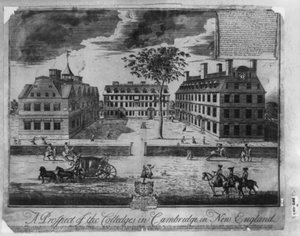
(The image of a 1740 engraving of Harvard College above is from Wikipedia.)

Saturday, December 01, 2007

Perceptions Matter, and Perceptions Linger

I recently read She Would Not Be Moved, by Herbert Kohl, which discusses how elementary-school textbooks, reading books, and lesson plans discuss Rosa Parks and the Montgomery bus boycott of 1955-56. Kohl naturally takes issue with school presentations that show blacks and whites both protesting against segregated buses, or a quick ending to the confrontation. But he’s also upset by how many books continue portray Parks as a tired seamstress.

Calling Parks a seamstress is accurate—she worked in the tailoring department of a department store. But it’s not complete. Parks was also a trained political organizer, secretary of the local chapter of the National Association for the Advancement of Colored People for over ten years. She had participated in discussions of the bus segregation problem and helped prepare the African-American community to boycott the bus lines. That full story has now been well told in recent histories of the civil rights movement.

However, that story was not publicized at the time. On 23 Feb 1956, the New York Times ran a front-page article about the boycott, with a photograph of Parks being arrested for helping to organize it, and on 22 March referred to her in an update on the protest. Both times the paper called her a “seamstress.” Although the Times mentioned N.A.A.C.P. leaders involved in the bus boycott, it didn’t note that Parks was active in the organization. I suspect that other non-segregationist newspapers reported much the same, and I suspect that’s how Parks and her colleagues wanted it. They made her story more universal by presenting her as a tired working woman, not a well prepared political activist.

Even within African-American families, the story of Parks as a tired seamstress dominated for years. In an article for Time magazine in 1999, Rita Dove wrote of hearing that simple version from early childhood, and only later learning the complexities. It is, after all, a good story with a clear moral and a happy ending. Kohl’s book says nothing about the press coverage of the Montgomery bus boycott in 1956 and how that probably affected later descriptions of events to kids, so I think it misses a crucial part of the historiography. Perceptions do matter, and they can last a long time.

This situation came back to me this week when I took notes on the diary of Joseph Secomb, published in 1921 in the Danvers Historical Society Collections. Secomb started his report on 19 Apr 1775 by transcribing an account of the Battle of Lexington from the Essex Gazette; it placed all the blame on the British soldiers, saying they attacked the locals without provocation. Secomb then wrote:

After halting awhile they retreated again and kept on firing upon our men, Pillaging almost every house they Passed by breaking and destroying Doors, Windows, Glasses, &c. and carrying off clothing and other valuable Effects: Burnt some houses. It appeared to be their Design to burn & destroy all before them and nothing but our vigorous Pursuit (under Providence) prevented their infernal Purposes from being put in execution.

But the savage Barbarity exercised upon the Bodies of our unfortunate Brethren who fell, is almost incredible. Not content with shooting down the unarmed aged and infirm they disregarded the cries of the wounded, killing them without mercy and mangling their Bodies in the most shocking manner as they Retreated back to Charlestown.

We had seven men belonging to Danvers killed & a number belonging to other Towns but ye number of the Regulars was far greater. We have the Pleasure to say that notwithstanding the highest Provocation given by the Enemy not one Instance of Cruelty that we have hard of, was committed by our victorious Militia; but listening to the Merciful Dictates of the Christian Religion they breathed higher Sentiments of Humanity.
Of course, the British soldiers at Lexington and Concord had a very different view of events. They had seen and heard American militiamen gathering before the confrontation at Lexington, a detail that Patriot newspapers left out. Most British soldiers believed that an American had fired first. The companies at the North Bridge in Concord had seen a large body of provincials march toward them before they opened fire.

Furthermore, the best documented case of “Barbarity exercised upon the Bodies” on 19 Apr 1775 was committed by a Concord youth, Ammi White, on a wounded regular. He struck the man in the head with his hatchet, finishing him off. Other British soldiers who then saw that corpse came to believe it had been scalped.

With over two hundred years of perspective, most historians now agree it’s unclear who fired the first shot at Lexington. They describe the outbreak of fighting at the North Bridge as the culmination of growing aggression and fears from both sides. It took several decades for the story of Ammi White to get into American history books, but writers now acknowledge that unsavory wrinkle of a complex story.

But Joseph Secomb didn’t know those things in 1775. He relied on his newspaper, reports from his neighbors, and his understanding of the royal government’s actions over the preceding several months. So did thousands of other Americans of 1776, which helps to explain how the fighting on 19 April united so many British colonists against the Crown. Even after New Englanders began to acknowledge their preparation for military action, it took decades before American writers abandoned the story of an unprovoked British attack in Lexington and barbarous behavior in the retreat from Concord.

It will also take some years before all elementary-school books stop emphasizing Rosa Parks’s job as a seamstress and also discuss her work as a political organizer. Both are significant, but one got into the historical record ahead of the other.

Friday, November 30, 2007

What the Americans Found on the Nancy

Yesterday I described the capture of the British brig Nancy by a New England privateer in late November 1775. When the Americans discovered the weapons on that ship, “jubilant” is not too strong a word for their reaction. Gen. William Heath wrote in his diary on 30 Nov 1775:

Intelligence was received from Cape Ann, that a vessel from England, laden with warlike stores, had been taken and brought into that place. There was on board one 13 inch brass mortar, 2000 stand of arms, 100,000 flints, 32 tons of leaden ball, &c. &c. A fortunate capture for the Americans!
Those weapons were soon moved to Cambridge, and Col. Stephen Moylan wrote:
Such universal joy ran through the whole camp as if each grasped victory in his hand; to crown the glorious scene, there intervened one truly ridiculous, which was Old Put [Gen. Israel Putnam] mounted on the large mortar, which was fixed in its bed for the occasion, with a bottle of rum in his hand, standing parson to christen, while god-father Mifflin gave it the name of Congress.
Thomas Mifflin (shown above, courtesy of the U.S. Army Transportation Museum) was then Quartermaster-General of the Continental Army. In June 1776, he would be succeeded by none other than Col. Moylan.

Dr. James Thacher, an army surgeon, later explained the reason for such excitement:
Before our privateers had fortunately captured some prizes with cannon and other ordnance, our army before Boston had, I believe, only four small brass cannon, and a few old honey-comb iron pieces, with their trunnions broken off. . . . Had the enemy been made acquainted with our situation, the consequences might have been exceedingly distressing.
By the day after Heath heard about the Nancy, news of the capture had filtered into Boston, where selectman Timothy Newell recorded:
A large Brigt. with ordnance stores, a very valuable prize from London taken by Captn. [John] Manly in a Schooner Privateer from Beverly.
Lt. William Feilding wrote to his relative and patron, the 6th Earl of Denbigh, on 12 Dec 1775:
In my last I informed your Lordship the apprehension we were in for fear of the Ordnance Brigg was taken and am sorry to Acquaint your Lordship that by Accounts from the Rebels, she was Taken a few days before the Boyne sail’d. . . .

The Captain [of a privateer captured in the first week of December] says he saw the sea Morter (which was on Board the Ordnance Brigg) at Cambridge Common the Thursday before he was taken; and that from the Information of the Master, he was sent out to sea for a Powder Ship, which we have heard nothing of as yet. A deserter who came in a few days since, Says he saw all the Ordnance Stores safe Lodg’d at Cambridge last week.
On 19 Jan 1776, Feilding added that British officers expected the Americans to mount their new mortars on high ground at Phipps’ Farm, across the Charles River from Boston, “and endeavour to Burn the Town.”

Thursday, November 29, 2007

The Lee Captures the Nancy

As engineer Col. Archibald Robertson prepared to leave London for the theater of war in Massachusetts in July 1775, he asked Viscount Townshend, Master-General of the Ordnance, to arrange for a convoy of warships to protect the “several Ordnance transports with Artillery stores and men” from rebel attacks at sea.

However, Gen. Frederick Haldimand, who was just back from Boston, assured his army superiors, including Gen. Jeffery Amherst, that there were no American cruisers to worry about and plenty of Royal Navy ships around Massachusetts Bay. So the British military added no special protection to this transport fleet. Robertson felt a little vindication when he spotted “a Rebel privateer” as he arrived in Boston on 8 November in a fleet of twelve ships.

That ship may or may not have been the Lee, commanded by Capt. John Manley (1733-1793) of Marblehead. Before the war it had been the schooner Two Brothers, owned by Thomas Stevens; it had been renamed in honor of Gen. Charles Lee.

In any event, on 29 Nov 1775, Capt. Manley’s Lee captured one of the ordnance brigs from London, the Nancy, off Cape Ann. Col. Robertson’s fear had been realized.

In January 1776, Manley was named commodore of the small fleet of privateers Gen. George Washington had urged New Englanders to create; later he received the third U.S. naval commission as captain when the Continental Congress got around to adopting the same idea. During the war Manley and his crews captured ten British vessels and helped in seizing five more, while being captured and imprisoned three times. The engraving above comes from the Surface Navy Association’s Hall of Fame. (We hope his sword was in its scabbard.)

TOMORROW: What the Nancy was carrying.

Wednesday, November 28, 2007

Visual and Textual Worlds of Children

I’m taking the opportunity to pass on a call for papers from the American Antiquarian Society:

Home, School, Play, Work: The Visual and Textual Worlds of Children
Conference: 14-15 Nov 2008, at the American Antiquarian Society, Worcester, Massachusetts.

The Center for Historic American Visual Culture and the Program in the History of the Book in American Culture at the American Antiquarian Society seek papers that explore the visual and textual worlds of children in America from 1700 to 1900.

We welcome proposals that address the creation, circulation, and reception of print, manuscript, and other materials produced for, by, or about children. Submissions may address any aspect of eighteenth- and nineteenth-century textual, visual, or material culture that relate to the experience or representation of childhood.

Suggested topics include popular prints for or of children, board and card games, children’s book illustration, visual aspects of children’s books and magazines, early photography and children, performing children (theater, dance, the circus), dolls and puppets, child workers in art and printing industries, images of children and race, representations of childhood sexuality, the architecture of childhood spaces (schoolrooms, nurseries), children’s clothing, children’s appropriation of commodities, children’s handiwork (samplers, dolls, toys), and theories of visuality or textuality and childhood.

Please send a one-page proposal for a 20-minute paper and a brief C.V. to Georgia B. Barnhill, Director of the Center for Historic American Visual Culture, by 10 Jan 2008.
See this page for Barnhill’s email address, more detail, and any updates.

The A.A.S. has a significant collection of early American children’s literature. The organization’s founder, Isaiah Thomas, contributed to this field by reprinting many of John Newbery’s pioneering British children’s books—albeit not with Newbery’s formal authorization. The A.A.S. reading room was also where Esther Forbes, author of Johnny Tremain, did much of her research alongside her principal assistant (her mother).

Tuesday, November 27, 2007

Tempting Away British Musicians in 1778

Gen. John Burgoyne led a British army south from Canada in 1777, but met defeat at the Battles of Bennington and Saratoga. The thousands of prisoners of war became known as the “Convention Army,” after their terms of surrender. For about a year these troops were held in camps outside Boston while the two governments argued over who was breaking that agreement.

That reversed the geographic situation from that of 1774-76, when there were thousands of British soldiers inside Boston. During that earlier stretch, officers struggled to keep enlisted men from deserting to the provincials outside town. In 1777-78, disaffected British soldiers slipped into Boston in order to defect.

Among the officers in Burgoyne’s army was Lt. Thomas Anburey of the 24th Regiment. In 1789 he edited his letters home into a book titled Travels Through the Interior Parts of America, 1776-1781, which spends as much time on natural history as political disputes. He closed his letter dated 20 May 1778 with these anecdotes about deserters from among the Crown’s regimental musicians, who were mostly drummers and fifers:

I am sorry to inform you that the Americans are too successful in enticing our soldiers to desert; a few days since the whole band of the sixty-second regiment, excepting the Master, deserted in a body, and are now playing to an American regiment in Boston. . . .

You will be pleased with a noble and animated saying of a little drum-boy, not ten years old: this boy’s father, who belonged to our regiment, some time since deserted into Boston, and has been as nigh as he could venture with safety to our barracks, to entice or seize his son, and take him with him; but finding it in vain he sent an American to entreat him to go to his father, when the little fellow replied, “No; tell my father, if he is such a rascal as to desert his King and country, his son won’t; he has fed at their expence, and will die in their service.”
If this anecdote is true, this “drum-boy” was the youngest I’ve read about in the British service. Since drums were an eighteenth-century army’s signal corps, commanders wanted reliable men in that job. But of course if this boy was already traveling with his father’s regiment, they’d want to get some good out of feeding him. And he was apparently more loyal to his regiment than to his father.

The rope-tension drum shown above is available from Cooperman.

Monday, November 26, 2007

Veterans Moving West

At the Northwest History blog he shares with Bill Youngs, Prof. Larry Cebula has written an interesting essay about Revolutionary War veterans who ended up moving west—as far west as Oregon, in the case of William Cannon (1755-1854). Larry writes:

The life and the grave of William Cannon illustrate the speed of the conquest of the American West. A man who grew up in the Virginia of Washington and Jefferson and served his country in the Revolution also settled on the Pacific coast and helped bring one of the last major parts of the west under American control.
Among the individual men I’ve researched, the one buried furthest west from Massachusetts is Thompson Maxwell (1742-c. 1833). He was born in Bedford of a couple who had emigrated from Ireland, and started his military career by 1760, during the French & Indian War. Maxwell married and moved to New Hampshire in the 1760s. He later claimed to have been involved in the Boston Tea Party, the Battle of Lexington and Concord, and the Battle of Bunker Hill; there’s some evidence to put him at each of those events, though it’s not definite and the combination seems like an awful lot to believe. But Maxwell definitely served in the Continental Army for much of the war. Settling in Buckland, Massachusetts, he served as his town’s delegate to the state’s constitutional convention and General Court.

Then Maxwell moved west to Ohio—perhaps because his farm failed, perhaps because he wanted more. At age seventy he served in yet another war. Unfortunately, he was part of the garrison at Fort Detroit that Gen. William Hull surrendered to the British in August 1812. Maxwell was paroled because of his age, but did not receive a warm welcome back home. He later stated:
a mob, irritated by Hull’s pusillanimity, misjudging my patriotic efforts, and denouncing all parties concerned in the late disasters at Detroit, rally and gather about my habitation, burn my house, destroy my property, and, barely clothed, I escape for my life through a corn-field by night. . . .

[The following February] I am advised to leave the army. I was unjustly accused by Capt. Robinson, as a dangerous enemy and a tory, etc., in Hull’s surrender.
Later Maxwell returned to the army and became “barracks master” at Fort Detroit in the late 1810s. He died near Detroit, over ninety years old.

Maxwell and even Cannon might not be the farthest-flung Revolutionary War veterans, however. What about men who had sailed on privateers during the war, then joined the China Trade that American merchants developed after they were cut off from the markets of the British Empire? Are they buried along the Oregon coast, in east Asia, or deep in the Pacific?

For that matter, what about the British soldiers who fought in the Revolution and might then have been posted to imperial posts in India, South America, Africa, or practically any other part of the growing Empire?

(Thumbnail photo above of a New Hampshire historic marker from Marc Nozell via Flickr under a Creative Commons attribution license.)

Sunday, November 25, 2007

Charges "to a Dog" and "to Trouble"

Baron Frederick William Augustus von Steuben arrived in Portsmouth, New Hampshire, on 1 Dec 1777 with his young French aides and a servant. In Europe the baron had been told that the American army wore scarlet, so he had secured uniforms in that color for himself and his companions. The locals immediately assumed they were British officers.

That confusion explained away, the Europeans headed south to Boston. Steuben's teen-aged translator, Peter Stephen Duponceau, later wrote to his granddaughter about their stay in that town:

We lodged as boarders at the house of a Mrs. Downe, the widow of a British officer, a respectable lady, with two beautiful and amiable daughters, the oldest Miss Betsy, about 19, and the youngest Miss Sally 16 years of age. There were no other boarders in the house but Baron Steuben and his family, and we were kindly and hospitably treated.

The bill at parting was very moderate, but there were two items in it which excited the anger of the good Baron, and made him ejaculate more than once, diable! diable! and Tertifle! The first of these charges was “to a dog,” which, in my opinion was a very just, and correct one. The Baron had brought with him his favourite dog Azor, a fine large Italian grey hound, who ate as much as any one of us. Why the charge was objected to, I cannot well conceive; it is probable that in Germany dogs go every where scot free.

The other charge was rather extraordinary, but under the circumstances a very just one. It was “to trouble.” I cannot recollect how much the charge amounted to, but it appeared to me very moderate. Only fancy to yourself an old German Baron, with a large brilliant star on his breast, a German servant attending him, and three French aid-de-camps, and a large spoiled Italian dog. None of all that company could speak a word of English except your grandfather, who was not a grave old man, as he is at present, but loved his share of fun when it went round.

We gave trouble enough to the good lady, and though I see in her charge much naiveté, I cannot perceive in it a symptom of avarice. As she had a little of what is, I do not know why, called Yankee cunning, she would have dropped these charges, and obtained her end by swelling a little, the more usual ones. . . .

In Mrs. Downe’s family to which came frequently female visitors,...I did not fail to take advantage of my fortunate situation, being the only person in our company who could speak the language of the country; I interpreted it as true as in duty bound, between the Baron and the old lady, and transmitted sometimes a few compliments from him to the young ones, but I left my brother beaux to shift for themselves. There they stood, or sat like Indians, and could talk only by signs. But the ladies had not studied Hieroglyphics, and I had the field all to myself. O! those were delightful times!
Italian greyhound portrait courtesy of Italian-Greyhound.net and Pet Action Shots.

Saturday, November 24, 2007

Transport Ship to Point Shirley

As winter approached, the British authorities inside besieged Boston tried to remove civilians who didn’t want to be there and would only add to the difficulty of keeping the garrison and Loyalist families fed and warm. Selectman Timothy Newell recorded one of their actions in his journal on 24 Nov 1775:

A transport Ship carried about 400 of our Inhabitants to Point Shirley [in Winthrop]. One poor Dutch woman attempted to carry with her about 60 dollars. Morrison the deserter seized them and carried them to the town Major. Ten dollars was stopped by him.
This was the third time that Newell complained about John Morrison.

On 28 November, Gen. George Washington reported to the Continental Congress:
About 300 Men, Women and Children of the poor Inhabitants of Boston, came out to Point Shirley last Friday, they have brought their Household furniture, but unprovided of every other necessary of Life: I have recommended them to the attention of the Committee of the Honorable Council of this Province, now sitting at Water Town.
The Council was the upper house of the Massachusetts legislature. With the royal government broken down, it had taken executive authority in the province. And now it was responsible for the poor refugees from Boston.

Friday, November 23, 2007

Looking Back at the Latest WMQ Reviews

Here are links to pertinent book reviews in the latest issue of the William & Mary Quarterly. Check out the contents page, or click below to bring them through as PDF files:

The full names in the lines above are the reviewers, the surnames the book authors who did the hard work. None of the Bells are relations.

And of course I must mention that the July issue’s reviews include Barry Levy’s evaluation of Children in Colonial America, edited by James Marten. (“J. L. Bell persuasively analyzes the central role that independent children played in patriotic Boston mobs before the Revolution”—have I mentioned that before?)

Thursday, November 22, 2007

Samuel Adams’s Marital Advice

On 22 Nov 1780, Samuel Adams sent a letter from Philadelphia to Thomas Wells of Boston:

when I was last in Boston…I then consented that you should form the most intimate Connection with the dear Girl whom I pride myself in calling my Daughter. I did this with Caution and Deliberation; and having done it, I am now led to contemplate the Relation in which I am myself to stand with you, and I can [hardly] forbear the same Stile in this Letter, which I should take the Liberty to use if I was writing to her.

The Marriage State was designd to complete the Sum of human Happiness in this Life. It some times proves otherwise; but this is owing to the Parties themselves, who either rush into it without due Consideration, or fail in point of Discretion in their Conduct towards each other afterwards. It requires Judgment on both Sides, to conduct with exact Propriety; for though it is acknowledgd, that the Superiority is & ought to be in the Man, yet as the Management of a Family in many Instances necessarily devolves on the Woman, it is difficult always to determine the Line between the Authority of the one & the Subordination of the other.

Perhaps the Advice of the good Bishop of St. Asaph on another Occasion, might be adopted on this, and that is, not to govern too much. When the married Couple strictly observe the great Rules of Honor & Justice towards each other, Differences, if any happen, between them, must proceed from small & trifling Circumstances. Of what Consequence is it, whether a Turkey is brought on the Table boild or roasted? And yet, how often are the Passions sufferd to interfere in such mighty Disputes, till the Tempers of both become so sowerd, that they can scarcely look upon each other with any tolerable Degree of good Humor.
I dug this quote out of the hard drive because I liked Adams's remark about turkey. I was delighted to see that he wrote this letter 227 years ago today.

Wednesday, November 21, 2007

Peter Duponceau Meets Samuel Adams

Peter Stephen Duponceau was born in France in 1760 as Pierre Etienne du Ponceau. His family, genteel but impoverished, pushed him into a church career because of his proficiency as a scholar, but in his mid-teens he ran away to Paris.

In 1777, du Ponceau met Baron Friedrich Wilhelm Augustus von Steuben, a former officer of the Prussian army and out-of-work courtier. Benjamin Franklin and Silas Deane were trying to recruit Steuben for the Continental Army, believing him to have been a general for Frederick the Great. Steuben initially turned them down because they didn’t offer enough money, but then a sex scandal gave him a strong reason to get out of Europe. Du Ponceau was expert in English, enamored of republicanism, and up for adventure, so the baron took him on as a translator and aide.

As it turned out, du Ponceau made a terrible military officer: utterly inexperienced, near-sighted, comically absent-minded, and sickly. He was, however, committed to the new U.S. of A. He settled in Philadelphia after the war, Americanized his name, and became a very good linguist and lawyer.

In 1836 Duponceau began to relate his Revolutionary experiences in letters to a colleague named Robert Walsh and then to his granddaughter. These letters have been reprinted in the Pennsylvania Magazine of History and Biography. Here is Duponceau’s recollection of his conversations with Samuel Adams in early 1778:

I shall never forget the compliment paid me by Samuel Adams on his discovering my Republican principles. “Where,” said he to me, “did you learn all that?”

“In France,” replied I.

“In France! that is impossible.” Then, recovering himself, he added, “Well, because a man was born in a stable, it is no reason why he should be a horse.” I thought to myself, that in matters of compliment they ordered these things better in France.
Adams, as a good traditional Yankee, viewed France as a big barrel of papist despotism.
Speaking of Samuel Adams I remember something of him that let me into the little jealousies that then existed between some of the great men of the day. I sat next to him at a dinner given by Govr. [John] Hancock to Baron Steuben, and happened, by mistake, to call him Mr. John Adams.

“Sir,” said he, looking sternly at me, “I would have you know that there is a very great difference between Mr. Samuel Adams (striking his breast and laying a strong emphasis on the word Samuel) and Mr. John Adams.”

I was afterwards on my guard addressing people by their Christian names.
John Adams also occasionally had to deal with people who thought he was Samuel. Although Duponceau recalled this mix-up as an example of “little jealousies,” the Adams cousins, who weren’t shy about expressing their resentments, almost always had good things to say about each other.