J. L. BELL is a Massachusetts writer who specializes in (among other things) the start of the American Revolution in and around Boston. He is particularly interested in the experiences of children in 1765-75. He has published scholarly papers and popular articles for both children and adults. He was consultant for an episode of History Detectives, and contributed to a display at Minute Man National Historic Park.

Subscribe thru Follow.it


•••••••••••••••••


Monday, August 26, 2013

At Home with Mary Washington

At Boston 1775 headquarters we’ve been reading Where the Cherry Tree Grew: The Story of Ferry Farm, George Washington’s Boyhood Home, about the history and archeology of the farm where George Washington grew up and his mother, Mary, continued to live until 1772.

Along the way author Philip Levy explores the many legends that have grown up around Washington’s youth and how a lot of us still want them to be true. To interest reporters in the site during the excavations, he told them, “If the story of the cherry tree were true, it would have happened here.” What really happened there, he argues, is interesting in its own right.

The story includes buildings like Washington’s “Surveying Office” that went up well after his lifetime, a house found through archeology with great excitement but then dated to before the Washingtons, and a landscape that changed greatly along with the nearby Rappahannock River.

Yesterday was the anniversary of Mary Washington’s death in 1789. One of the Mount Vernon Twitter feeds linked to this article by Laura J. Galke from the Fredericksburg Free Lance-Star about how she’s remembered:
“[C]rude and illiterate,” “self-centered,” “slovenly” and a “veteran complainer” were just a few of the adjectives that Ron Chernow used to describe Mary in his 2010 book, “Washington: A Life.”

He went on to suggest that she suffered from “some mild form of dementia.”

This, despite a 1789 letter penned by George Washington himself after the death of his mother that stated that she possessed “the full enjoyment of her mental faculties and as much bodily strength as usually falls to the lot of four score.” . . .

Mary Washington remained a widow, a decision that some have criticized. Yet there were real consequences for Mary and her children had she married a second time. Her children and their land would have come under the control of their stepfather: He could construct buildings on their plantations, put up fences, take down fences and keep the plantations’ proceeds.

It was not uncommon for children to be split up between family members upon the death of the father, but Mary kept the family together. Financially, this was challenging since the money generated by their two largest plantations and by the mine was no longer part of the family’s revenue after her husband’s death.
We have rather little information about Mary Washington, despite her son being so important in American history. Authors have therefore used her as a vessel for their times’ conception of motherhood. She was nearly sainted in the nineteenth century: Benson Lossing even titled the book he wrote about her and her daughter-in-law Mary and Martha.

Then in the twentieth century, around the same time psychiatrists were saddling mothers with the blame for autism and schizophrenia, Mary Washington became a burden and a shrew. Now Galke is making a case for her as a sort of career woman managing her family’s economic resources.

Sunday, August 25, 2013

Four Hundred Years of Furnishings

Eleven different historical institutions are collaborating to explore the traditions and business of furniture-making in Massachusetts. The initiative is called “Four Centuries of Massachusetts Furniture.”

There was a symposium at Winterthur this spring, but the action really heats up with events in September at the Museum of Fine Arts, the Fuller Crafts Museum, the Concord Museum, and elsewhere. There will be many more such talks and exhibits through December 2014. And for home-decorating ideas, check out the website’s highlights page.

This image is the Rev. Cotton Mather’s childhood highchair, which Nan Wolverton discussed in the latest Common-place. “Wear along the rear posts and on the ball turnings of the tiered finials are telltale signs of the chair’s use as a walker,” she writes. The footrest and rod across the front that kept babies from falling out are missing, but the rest of the chair is a proud possession of the American Antiquarian Society.

Saturday, August 24, 2013

Princeton Battle Lecture in Arlington, Va., 4 Sept.

On Wednesday, 4 September, the the American Revolution Round Table of the District of Columbia will host an illustrated lecture by Wade P. Catts titled “As great a piece of Generalship as ever was performed: Reinterpretation of the Battle of Princeton, 3 January 1777.”

The group’s announcement says:
This illustrated lecture will present new information and in some cases, reinterpretation, of the battle of Princeton. The culminating battle of the “Ten Crucial Days,” Princeton was a remarkable military maneuver that had far-reaching results for the American cause, and a major setback for the Crown. Undertaken by the Princeton Battlefield Society and funded by a grant from the American Battlefield Protection Program, the recently completed study utilizes historical records, maps, topography, GIS, and archeology to examine the battlefield.
Catts is historic preservation consultant based in Pennsylvania who served the Princeton project as a historical archeologist. He’s worked on many other Revolutionary War sites as well.

“Piece of generalship” was a popular eighteenth-century expression for what we’d now call a clever strategy. On 7 Jan 1777, Stephen Moylan, volunteering as one of Gen. George Washington’s aides after a short, terrible tenure as quartermaster general, wrote to Robert Morris describing the battle:
By Heavens, it was the best piece of generalship I ever read or heard of. An enemy, within musket shot of us [at Trenton], determined, and only waiting for daylight, to make a vigourous attack. We stole a march, got to Princeton, defeated, and almost totally ruined, three of the best regiments in the British service; made all their schemes upon Philadelphia, for this season, abortive; put them into such a consternation, that if we only had five hundred fresh men, there is very little doubt but we should have destroyed all their stores and baggage, at Brunswick, of course, oblige them to leave the Jerseys, (this they must do)…
The British didn’t leave New Jersey, but they withdrew to the north of the state for the rest of the winter. The Trenton and Princeton victories cheered American Patriots, especially after the bigger British victories around New York, and helped the new republic last into the new year.

The ARRT of DC meets at the Fort Myer Officers Club in Arlington, Virginia, four times a year. See the website for more information on attending or joining. In November, the group will welcome Don N. Hagist, author of British Soldiers, American War: Voices of the American Revolution, 1775-1781.

Friday, August 23, 2013

“Exempted from all trainings”

Yesterday I quoted a 1707 Massachusetts law written to plug a supposed hole in the province’s militia law. Here’s part of that 1693 militia law, stating who didn’t have to show up for seasonal drills:

[Sect. 12] That the persons hereafter named be exempted from all trainings, viz:

the members of the council, the representatives for the time being, the secretary, justices of the peace, president, fellows, students, and servants of Harvard Colledge exempted by colledge charter, masters of art, ministers, elders and deacons of churches, sheriffs, allowed physitians or chirurgions, and profest schoolmasters; all such as have had [military] commissions, and served as field officers or captains, lieutenants or ensignes; coroners, treasurers, attourney-general, deputy sheriffs, clerks of courts, constables, constant ferrymen, and one miller to each grist mill; officers imployed in and about their majesties’ revenues; all masters of vessels of thirty tuns and upwards, usually imployed beyond sea; and constant herdsmen, lame persons or otherwise disabled in body (producing certificate thereof from two able chirurgions), indians and negro’s.

[Sect. 13] That the persons hereafter named be and hereby are exempted from military watches and wardings; viz., the members of the council, secretary, representatives for the time being, president, fellows, students of Harvard Colledge, and the gentlemen belonging to the governour’s guard, ministers and elders of churches, allowed phisitians and chyrurgeons, constables, constant ferrymen, and one miller to each grist mill.
Men not required to turn out for regular militia training thus included:
  • The very top of society, including the legislators who enacted this law and other high officials, anyone who had earned an M.A., ministers and doctors, and gentlemen who had already served as officers in the militia and therefore couldn’t be expected to just go back into the ranks.
  • Men who couldn’t be spared from their particular work, such as herdsmen and ferrymen.
  • The disabled, as long as they brought the required doctors’ notes.
  • The very bottom of society: blacks and Native Americans.
It makes sense for the legislature not to want to arm and train men of color who had plenty of reasons to be upset at the dominant society. But I see a couple of other reasons that white men of property didn’t want to drill with blacks and Natives. By the mid-1700s and probably earlier, militia drills were social occasions as much as military practice. In addition, militiamen elected their own company officers. Including men of color in those social rituals would grant them forms of equality and influence, and the upper classes weren’t going for that.

Interestingly, section 26 of the same law stated: “That all persons exempted by this law from trainings shall, notwithstanding, be provided with arms and ammunition compleat, upon the same penalty as those that are obliged to train.”

Despite the passive voice, that clause required men to supply their own arms suitable for military service. That section was probably aimed at the upper-class white men who, though they didn’t have to turn out to drill like ordinary farmers and craftsmen, were still expected to serve in a military emergency.

But the way the law was written suggests that it required blacks and Indians to own guns and ammunition even though they were exempt from militia discipline. And I can’t imagine that’s what the legislature had in mind.

One big question about provincial Massachusetts’s militia laws is how closely they were enforced. As I noted yesterday, by 1775 black and Native men were participating in town militia companies alongside white men. And I don’t know of records showing widespread fines for not coming to militia drills or showing up without all the equipment this law required. The very detailed militia law was probably an expression of the ideal rather than a reflection of how people actually did things.

Thursday, August 22, 2013

“Impowred to order and require so many days’ work yearly”

At a meeting at Minute Man National Historical Park yesterday, I mentioned a colonial Massachusetts law requiring free blacks to work on roads. I promised to track down that reference and decided also to highlight it here.

In 1707, the Massachusetts General Court took note of what its constituents—i.e., white men—considered an injustice. For decades all blacks and Native Americans had been excluded from regular militia training. But what about free black men? They had the protection of the militia without contributing to it. That question hadn’t arisen before, suggesting that the free black community had grown enough to warrant legislative attention.

So the General Court passed “An Act for the Regulating of Free Negro’s, &c.” in 1707:

Whereas, in the several towns and precincts within this province, there are several free negro’s and molatto’s, able of body and fit for labour, who are not charged with trainings, watchings and other services required of her majesty’s subjects, whereof they have share in the benefit,—

Be it enacted by His Excellency the Governour, Council and Representatives in General Court assembled, and by the authority, of the same,

[Sect. 1.] That the selectmen of each town or precinct be and hereby are impowred to order and require so many days’ work yearly, of each free male negro or molatto, able of body, dwelling within such town or precinct, in repairing of the highways, cleansing the streets, or other service, for the common benefit of the place, as, at the discretion of the selectmen, may be judged an equivalent to the services performed by others, as aforesaid.

[Sect. 2.] And every negro or molatto as aforesaid, being duely warned by the selectmen or other person appointed by them that shall neglect or refuse to attend and perform the labour and service, at the place and time as he is directed, shall forfeit and pay, to the use of the poor of such town or precinct, five shillings per diem for each day’s neglect of his duty in that respect.

And be it further enacted,

[Sect. 3.] That all free male negro’s or molatto’s, of the age of sixteen years and upward, able of body, in case of alarm, shall make their appearance at the parade of the military company of the precinct wherein they dwell, and attend such service, as the first commission officer of such company shall direct, during the time the company continues in armes, on pain of forfeiting the sum of twenty shillings to the use of the company, or performing eight day’s labour as aforesaid, without reasonable excuse, made and accepted, for not attending. And be it further enacted,

[Sect. 4.] That every free negro or molatto, who shall harbor or entertain any negro or molatto servant [i.e., slave] in his or her house without the leave and consent of their respective masters or mistresses, shall forfeit and pay the sum of five shillings to the use of the poor of the town, for each offence.

[Sect. 5.] And if any negro or molatto, as aforesaid, shall be unable to pay his or her fine, or shall neglect or refuse to attend the labour assign’d him as aforesaid, any of her majesty’s justices, upon complaint thereof made, are hereby impowred to commit such delinquent to the house of correction, there to receive the discipline of the house, and to be kept to hard labour double the number of days assign’d him to work as aforesaid, or as is the sum of his or her fine, at the rate of one shilling per diem. {Passed June 12; published July 4.
Here’s the law as published in 1759, and here’s the text on the state archives’ website.

The Boston selectmen tried to exact this labor from free black men from 1707 through 1767, as shown in this example. A special town meeting during the siege tried to do the same. As I read those records, it looks like the special rules for free blacks became increasingly unenforceable.

The records of other towns in Massachusetts might show whether their selectmen used the same power. We know that as of April 1775 many rural militia companies included African-American and Native American men alongside whites, though the old laws were still on the books.

TOMORROW: More militia exemptions.

Wednesday, August 21, 2013

The Drama of Dr. Byles

Also in the new Common-place is Edward M. Griffin’s dramatically written article about the experiences of the Rev. Dr. Mather Byles (shown here). Byles was the Boston Congregationalist minister closest to the royal government—yet he also remained in Boston after the British evacuation.

“A Loyalist Guarded, Re-guarded, and Disregarded: The Two Trials of Mather Byles the Elder” identifies this moment as crucial to how the Patriot public came to view Byles:
Within four days after the battle [of Lexington and Concord], this rumor swirled through Boston: the king’s troops admitted firing first. Lieutenant [Thomas] Hawkshaw had said so to the elder Reverend Mather Byles and the Boston merchant Gilbert Deblois.

Hawkshaw, an officer of Hugh Earl Percy’s 5th Regiment of Foot, scoffed at the rumor, issuing a sworn statement that “the Country People” had fired first, but on the streets of Boston, residents muttered about a cover-up. Hadn’t the lieutenant privately said otherwise to Byles and Deblois? Pressed on the issue, Byles and Deblois, each a prominent citizen and a Loyalist supporter of the Crown, responded with their own sworn declaration that they, “the only two Gentlemen of the Town, who have visited Lieut. Hawkshaw since his being brought into Boston, both declare that, neither of them had the least Conversation with Lt. Hawkshawe upon the Subject of the Affair of Wednesday last the 19th April; + particularly, that They nor Either of Them ever heard Lt. Hawkshaw say that the King’s Troops had fired first upon the Country People.”

Hawkshaw had been wounded on the road near Lexington. Could anyone believe that when Byles and Deblois had visited him they simply passed the time in pleasant conversation without ever discussing the previous week’s armed confrontation between British troops and rebellious locals? But the two gentlemen swore that they had not asked about the first shot. And that put Mather Byles Sr. in the thick of it.
Of course, Patriots already disliked how close Byles was with royal officials, and his insistence on not discussing politics took on new meaning in a highly political time.

The long article has some glitches. The Loyalist judge Peter Oliver coined the term “black Regiment” for James Otis’s clerical supporters; that wasn’t Otis’s own term. Thomas Crafts was not sheriff of Suffolk County when he bellowed the Declaration of Independence out the State House window; he was helping the sheriff, the more soft-spoken William Greenleaf.

More important, the article retells many amusing anecdotes about Byles—and there are a lot of those stories because Byles was such a big personality and known for his jokes. But some of those tales were recorded decades after all the supposed witnesses had died. Griffin not only accepts them without question (at least in this online format), but also elaborates on them in dramatic detail. See, for example, his retelling of the encounter between Byles and Col. Henry Knox in March 1776. Do we really know all that?

Tuesday, August 20, 2013

A Look at Loyalist Ladies from Common-place

Common-place has a couple of new articles on Loyalists in the American Revolution. The first is from Prof. Kacy Tillman at the University of Tampa: “What is a Female Loyalist?”
Female Loyalists, like their male counterparts, are typically defined as being ideologically opposed to separating from Great Britain, but their inability to vote, fight, or legislate complicates how we understand their political affiliation. Many Loyalist women were persecuted because of familial ties to other Loyalists, and not because of their own political opinions, in part because eighteenth-century society did not view women as political creatures.

Early in the Revolution, women with Loyalist husbands could claim neutrality, since they could not own property or sign oaths of loyalty. Under coverture—the legal doctrine that held that a woman’s legal rights were subsumed by her husband’s upon marriage—husbands assumed a political position on their wives’ behalf, which rendered women politically invisible. Sometimes, this invisibility worked in their favor. Women (both Loyalists and Rebels) were allowed to take food, clothing, and letters across enemy lines—even into prisons—because they were not considered a threat.

Letters written by Loyalist women during the war show that such women were considered (and considered themselves) Loyalists not only if they verbally supported independence from or war with England, but also if they married a Loyalist, imported and sold British goods, resisted edicts from Committees of Safety or other local militias, delivered intelligence for the British, declared pacifism, and/or fled occupied cities to live with other Loyalist exiles.
Tillman discusses Elizabeth Inman (shown above), Christian Barnes, Sarah Deming (1722-1788), and Ann Hulton as Boston-area women whose lives were affected by their, or their families’, political loyalties. All were from the upper class, probably a reflection of which women left papers for us to read.

However, the article doesn’t make clear that Inman never left Massachusetts, even after Patriot newspapers had named her as suspicious. Her husband Ralph, older brother James Murray, and many friends like Christian Barnes and the Cumings sisters were definitely Loyalists, but was she? Or was she more wedded to her property than to any ideology?

And I don’t think Deming counts as a Loyalist at all, though some of her Winslow relatives were and she expressed concern for them. Tillman quotes two of Deming’s accounts of fleeing Boston in April 1775, but not the part of her journal that complains about more British troops arriving in the town and states her determination ”to git out of their reach.” All the more evidence that it’s hard to determine the political leanings of people whom society tried to keep out of politics.

Monday, August 19, 2013

Ceremony for Noah Wiswall of Newton, 7 Sept.

Noah Wiswall of Newton was born in 1699, but age didn’t stop him from turning out during the militia alarm on 19 Apr 1775. In his Life of the Rev. Joseph Grafton, Late Pastor of the First Baptist Church, Newton, MS. (1849), S. F. Smith recorded this tradition from a descendant:

After the companies of men, including his own sons, had gone towards Cambridge, he started on foot and alone to follow them, on the day of the battle of Lexington, saying, “I wish to see what the boys are doing.”

Standing with some Americans not far from the field, three British soldiers came in sight. He immediately pointed them out to his companions, saying, “if you aim at the middle one, you will hit one of the three.” The American did so and was successful; the other two fled.

But that which was remarkable is that as he held out his hand to point towards the Britons, a ball fired from some quarter passed directly through it. He coolly bound up the hand with his handkerchief, picked up the gun of the fallen regular, and returned home with it as a trophy.
Francis Jackson’s History of the Early Settlement of Newton, published five years later, quotes that anecdote and adds of Wiswall:
He was Selectman three years; one of the early Baptists in Newton, having been bap. 1754, and one of the founders of the Baptist Ch. in Newton, 1780. The first meetings of the Ch. were held at his dwelling house [near Crystal Lake]. He gave the land on which their first M. H. was erected. . . .

He was then [in 1775] 76 years old: It may seem incredible that a man of his years could have performed the march and endured the fatigues of that day, but the roll of the East Newton company, in the battle of Lexington, now in the office of the Sec. of State, of Mass., and sworn to by the Capt. of that company, before Judge Fuller, shows that he was with the company, and not only he, but Ebenezer Parker, then 78 years old, and Dea. Jonas Stone, Dea. David Stone, Dea. William Bowles, and several other aged men, were volunteers in the ranks of the company on that day.
Wiswall was the only Newton man whom the Massachusetts Provincial Congress listed as wounded on the first day of the war. He survived the whole war and died in 1786.

On 7 September, there will be a ceremony at the Wiswall Tomb in Newton’s South Burying Ground on Winchester Street. This is meant to honor Wiswall and disabled American veterans (though I don’t see anything in the traditions to suggest that Wiswall considered himself disabled by his wound). The event is open to the public, and Gardner’s Regiment of reenactors will be among the honor guards.

Sunday, August 18, 2013

A Remarkable Instance

Early last week I shared some predictions about John Hancock and Dr. Joseph Warren that didn’t turn out to be that far-sighted since there’s no evidence they were written before the late 1800s.

This post is about another forecast of significant activity by a man who came to prominence in the American Revolution—in this case George Washington.

On 17 Aug 1755, the Rev. Samuel Davies addressed a company of Virginia troops. It was a little more than a month after Native and French soldiers had devastated the expedition of Gen. Edward Braddock in the Pennsylvania wilderness. Virginians were anticipating a longer, bigger campaign, and Davis titled his sermon “Religion and Patriotism the Constituents of a Good Soldier.”

The minister had that sermon published the next year in Philadelphia, and then a London printer put out an edition as well. Here’s the title page of the London printing:

Davies told the new soldiers before him:
Our Continent is like to become the Seat of War; and we, for the future (till the sundry European Nations that have planted Colonies in it, have fixed their Boundaries by the Sword) have no other Way left to defend our Rights and Privileges. And has God been pleased to diffuse some Sparks of this Martial Fire through our Country? I hope he has: And though it has been almost extinguished by so long a Peace [Britain hadn’t been at war against France since 1748, or a whole seven years], and a Deluge of Luxury and Pleasure, now I hope it begins to kindle: And may I not produce you my Brethren, who are engaged in this Expedition, as Instances of it?
Davies meant that rhetorical question to inspire his audience. In the printed version he added a footnote to that passage, as shown on page 12.
As a remarkable Instance of this, I may point out to the Public that heroic Youth Col. Washington, whom I cannot but hope Providence has hitherto preserved in so signal a Manner, for some important Service to his Country.
Davies was referring to how Washington had survived Braddock’s defeat without being killed or even wounded. The day before he spoke, Gov. Robert Dinwiddie had commissioned the ambitious young planter as colonel in charge of all the Virginia troops. By the time Davies published his sermon, he knew that he was recruiting men who would fight under Washington.

Col. Washington stepped down from his military post at the end of 1758. Davies became president of the college at Princeton the next year, and then died in 1761 (five weeks after delivering a New Year’s sermon with the repeated refrain, “This year you may die…”). It’s not clear whether Davies considered that Washington had by then rendered “some important Service to his Country” worthy of his providential preservation.

Washington must have seen this sermon circulating in Virginia. He was probably flattered by it, perhaps intimidated. In late 1777, a London admirer sent him another copy. Davies’s prediction was a lot to live up to, especially in that gloomy season.

One last note: in 1791 Davies’s son introduced himself to President Washington by writing: “I am the Son of a Prophet, whose prediction with respect to yourself hath been remarkably verified—I am much, very much in want of an office of profit…”

Saturday, August 17, 2013

“Liberty or Loyalty?” in Quincy, 17 Aug

Today Adams National Historical Park hosts an event called “Liberty or Loyalty?” focusing on American colonists who supported the Crown during the Revolutionary War. The Boston Globe reported:
While widely depicted as enemy collaborators, Loyalists were often ordinary Americans who suffered for their beliefs, losing their homes, livelihood, and even family, according to historians who want to set the record straight.

Tom Tringale, a member of McAlpin’s Corps of Loyal American Volunteers, a Revolutionary War reenactment group on the British side that will camp out at the park, goes even further.

“I want to get people to give the Loyalists a hug,” said Tringale, 28, a Quincy resident who been a historical reenactor from childhood. “Americans are in denial about the Loyalists.”

From the point of view of the status quo, the pro-British Tories were “loyal” to their government while the patriots were treasonous “rebels,” he noted.

“So we were the good guys,” Tringale said. “What we are going to do is talk about how the Loyalists were forced from their homes in Boston.” Loyalists formed military units such as McAlpin’s Corps, who served as guides to British General John Burgoyne in Canada and upstate New York.

“The public is honestly in denial,” Tringale said. “They see the Loyalists as traitors. . . . These people were not like Thomas Hutchinson,” the colony’s wealthy governor in the early 1770s, he said. “These were simple farmers, blacksmiths, shoemakers, who thought it was safer to be with the king. Our intention is to get the Loyalists a fair shake in American history.”
The mansion at the center of the Adams park, where the second and sixth Presidents lived during the last half of their lives, was originally home to part of the Vassall family. (Another member of that family built the Cambridge house that became Washington’s headquarters, now also a National Park Service site.)

Also at the event are Quincy resident Norma Jane Langford, who wrote a booklet on “The Tory Trail” of other Loyalist sites in greater Boston, and Nancy Rubin Stuart, author of Defiant Brides, about two young women from Loyalist families—Lucy Flucker and Peggy Shippen—who married American generals and ended up on different sides of the war and different sides of the ocean.

I’m not convinced there’s still as much denial or hostility toward Loyalists as the Globe article suggests. So much time has passed, and the issues of the Revolutionary War have receded so far, that the American public is far more willing to consider the Loyalist point of view than the losing side of more recent wars.

Friday, August 16, 2013

Remembering Pauline Maier

David Sehat published a lovely reminiscence of the late Pauline Maier on the U.S. Intellectual History blog:
I once asked her what she thought of the Neo-Whig label and she responded, somewhat puzzled, “Why does an interest in the assumptions of the people I study merit that label?” I’ll leave that question for others.

But it’s her intellectual generosity combined with a keen intellectual insight that I most appreciated about her. She provided a model of the mind. Although she engaged in serious debates that had real public ramifications and had great publishing success, she was not in any way arrogant or stuffy. She stayed close to her sources, asked questions of them without over-interrogation, and listened empathetically to what they were telling her.

During her talk at the 2011 USIH Conference, she praised the reporters of the ratification debates who, she said, often sat in the back of the hall or in the balcony straining to hear, in sometimes hot or even sweltering conditions, but who nevertheless tried to faithfully reproduce the debate for their posterity. I liked that she went out of her way to express admiration for people who had been dead for two centuries but whose work had made hers possible. That attitude of humility and intellectual community came through almost all of my interactions with her.
More historians’ reminiscences appear at All Things Liberty.

The Massachusetts Institute of Technology, where Pauline had been the William Kenan, Jr., Professor of History, issued a press release announcing her death that closed this way:
“Her scholarship, perspective, personality and dedication made her a remarkable MIT citizen,” former MIT President Charles M. Vest said. ”Her historical writing displayed first-rate research but also was highly accessible and readable. I used to kid her because she once gave a lecture at the University of Virginia (‘Mr. Jefferson’s University’), the thesis of which was that Jefferson is our most overrated president. Now that is sticking your neck out.”
The New York Times chose to make part of that anecdote the focus of its obituary’s headline: ”Pauline Maier, Historian Who Described Jefferson as ‘Overrated,’ Dies at 75”. But the paper didn’t say anything about the trip to Charlottesville, which was Vest’s main point. Instead, it quoted a National Review writer sniffing, “We know nothing that would deny Jefferson the principal credit,” which distorted Pauline’s thesis in American Scripture: not that Thomas Jefferson wasn’t the principal writer of the Declaration of Independence, but that its ideas were expressed in various forms all across America in 1776 instead of springing from his brain alone.

That prompted some historians on Twitter to object that the Times was reducing Pauline’s long and fruitful career to simple iconoclasm. They wanted to see something more like the Washington Post’s choice of headline a day later: “Pauline Maier, historian of American Revolution, dies at 75”. (So far as I can tell, the Boston Globe hasn’t posted an obituary yet, which says more about the state of Pauline’s home-town newspaper than about her position in the field.)

Some of those historians lobbied the Times to change its headline, which put them in the odd position of historians trying to change the historical record. I think it might be better to let Pauline’s work and the encomia of her colleagues speak for themselves, and the Times’s difficulty with categorizing academics’ work speak for itself. After all, earlier in the summer it headlined Edmund Morgan’s obituary with ”Historian Who Shed Light on Puritans,” leaving out large swaths of his career.

Thursday, August 15, 2013

The Lessons of Bunker Hill for Gen. Washington

In preparing my presentation on the Battle of Bunker Hill earlier this month, I nearly came to the conclusion that Gen. George Washington took two lessons, one good and one bad, from what he heard about that battle. By “nearly” I mean those thoughts occurred to me too late to articulate in my talk, so I’m throwing them out now.

The first lesson was the value of preparation. New England troops moved onto the Charlestown peninsula on the evening of 16 June 1775 in haste, fearing that the British army was about to make a similar move. As a result, there was a lot left to arrange.

Col. Richard Gridley, Col. William Prescott, and Gen. Israel Putnam spent significant time discussing which hill to fortify. None of Gridley’s American artillery units went onto the peninsula until the next morning; one company discovered its gunpowder cartridges wouldn’t fit inside its cannons. Several regiments came onto the field on 17 June, but Prescott and Putnam were frustrated at the lack of reinforcements for the redoubt, leaving the same men who had spent all night digging that fortification to defend it.

In contrast, Gen. Washington and his staff meticulously planned the move onto the Dorchester peninsula in March 1776. Geography and the frozen ground made that a bigger challenge, solved in part by Col. Rufus Putnam’s idea to use pre-fabricated fortifications to provide cover while the men dug in. But Washington also made sure the artillery was moved in the night and well supplied. Fresh troops came onto the peninsula before daybreak. The Continental troops on Dorchester heights were in much better position for a fight than the troops in Charlestown nine months before.

However, Washington also took the lesson from Bunker Hill that he should seek to draw the British army into a big battle so that the Continental soldiers could kill and wound a lot of them. Throughout the siege of Boston the new commander kept proposing ways to storm the British positions. Washington agreed to Gen. Artemas Ward’s Dorchester strategy only after all the other generals had voted against his own plan, and only because he hoped that the British would finally come out for the big battle he wanted.

When Gen. William Howe cut short his attack on Dorchester and instead sailed away, Washington wrote to a friend in Virginia, “I can scarce forbear lamenting the disappointment as we were prepared for them at all points.”

For the next two years Washington and some of his generals kept pursuing the Bunker Hill strategy, trying to draw Howe into a deadly attack. The American commander did get the big battles he wanted—at Brooklyn, at Harlem Heights and White Plains, at Brandywine. But of course Gen. Howe won those battles, and the big casualties were on the American side.

Not until the Valley Forge winter of 1777-78 did Gen. Washington drop his quest for a big, decisive battle and become what his new artillery commander Henry Knox called “our Fabian commander.” Washington never oversaw a battle like Bunker Hill, with such high numbers of the enemy killed and wounded, but he had finally realized he didn’t have to.

Wednesday, August 14, 2013

Pauline Maier from Resistance to Ratification

On Monday morning M.I.T. professor Pauline Maier died at age seventy-five. She was one of the leading historians of the American Revolution in the last half-century. I met Pauline through seminars and committees around Boston, and she was always an enthusiastic and provocative thinker.

Pauline’s early book From Resistance to Rebellion: Colonial Radicals and the Development of American Opposition to Britain, 1765-1776 strongly shaped my understanding of Revolutionary thinking. It connects the protests in North America in the 1760s to the actions of British Whigs in the same period, and showed how the colonial leaders’ argument for securing British rights evolved into an argument for breaking from Britain.

History News Network said Pauline was “one of the formative ‘neo-Whig’ historians of the American Revolution, along with Gordon Wood and Edmund Morgan.” However, she always emphasized the broad American population rather than just the intellectual leaders. For example, in an excellent review for the Journal of Interdisciplinary History of Hiller B. Zobel’s also-excellent The Boston Massacre in 1970, she criticized how that book presents Samuel Adams as manipulating the people of Boston, removing their own autonomy.

Pauline’s American Scripture: Making the Declaration of Independence highlighted the scores of documents making the case for independence all over the colonies before the Continental Congress got around to their Declaration of Independence. In Ratification: The People Debate the Constitution, 1787-1788 she skipped over the elite, secret Convention in favor of a deep study of the process by which state conventions and legislatures debated and ultimately adopted the new Constitution.

Teaching at M.I.T., where most students arrive focused on science rather than history, probably piqued Pauline’s interest in reaching beyond academia to the public and using technology to do so. She coauthored a textbook that discussed American history through the prism of inventions. She helped to develop the 2004 videogame Revolution and designed one of the early online courses in American history. C-SPAN has videos of Pauline discussing her last book and her whole body of work.

Tuesday, August 13, 2013

What Lay Behind Dr. Joseph Warren’s Horoscope

Yesterday I quoted a horoscope for John Hancock signed by Roger Rintoul of London in 1760. It surfaced in 1904 and was published several years later. A couple of years after that, John W. Farrell came into possession of a horoscope of Dr. Joseph Warren. Reportedly “found in a bookstore in St. Louis,” it was dated 1743 and signed Roger Elwes.

Like the Hancock horoscope, this document was uncannily accurate about Warren’s future—particularly striking since the future doctor was only two years old as of the horoscope’s date. Elwes wrote:

Two yeeres before the firste decade of the natives life Saturn shall transmit the place of hys ruling planet mercury which shall implicate advantage to ye native from studie or knowledge of the arts or sciences. It is not clearly shown that the native shall make due and careful use of these advantages altho Jupiter is well Configurated in ye ascendant implicates that hee shall obtaine honour & esteeme in a certaine propter capacity. In or about ye yeere 1768 Saturn shalle transitte the playce of the Sun and this is implicative of some strong contention with magistrates or men in power in that yeere. Untoe this native presageth a violent configuration of the malefics forboden onward. Ye aspect of hylig or giver of life forms a quartile or opposition with each other. these malignent raies are implicative that the natives life is threatend at different times & seasons but averted by occasions showing strong & dignifyd aspects.
And so on.

John W. Farrell got hold of the Hancock horoscope and compared the two. He concluded, “Although this one is dated some seventeen years earlier and the family name in the signature is different, the handwriting is so similar that they appear to have been written by the same person.”

Farrell then removed the antique paper on which the Warren horoscope was written from the board on which it was mounted. The other side of that page was a sheet of music published in or after 1786. That was, of course, eleven years after Warren had died, making the predictive quality of the horoscope much less impressive.

Indeed, one might even suspect that someone had obtained antique paper, written out horoscopes of famous Patriots in an exaggerated archaic language, and signed fictitious names to those documents!

Since Farrell published his findings, we’ve heard nothing more about either the Hancock or Warren horoscopes.

Monday, August 12, 2013

Hancock’s Horoscope: “free from unbenign radiations of infortunes”

In 1904 The Literary Collector announced that a dealer called Libbie & Company was selling the autograph collection of Prof. Vincenzo Botta and his wife, highlighted by a horoscope for John Hancock cast by Roger Rintoul of London in 1760. The next year, Publishers Weekly reported:
Ginn & Co. have brought out in neat pamphlet form the horoscope of John Hancock, made in 1760. when he was about twenty years old, by Roger Rintoul, of London. . . . The Boston offices of Ginn & Co. stand on the site of the old John Hancock dwelling.
In 1916 the Bostonian Society Proceedings published the same document. Rintoul’s foresighted forecast:
Sign Capricorn. Under this sign native should excel in diplomacy, and have far-reaching ideas, hasty and impulsive, proud, high-minded and determined, and live much on externals and vain show. Diseases indigestion and melancholia. The sun in the second house (M. C.) in good aspect with Jupiter in the radix free from unbenign radiations of infortunes.

The geniture shows an unimportant and quiet life for over two decades, the native will then journey on the seas. The Lord of the 4th in a fixed sign at about age 28 gives wealth by means of the father or aged person and the revolutional ascendant being in the place of the Dragons head in the radix gives at this time honour & worldly esteem of position. And further at this time he shall have conflict with the powers by the malefic rays of Saturn. And further the native at this period is subject to danger of death or disease—the malignancy of the aspect heightens the violence of the means. But as the part of Fortune falls in the same degree as the radix it hath implication of influence averting the danger altogether.

After 10 decades of life in which the native who hath much pride and desire for fine living will attayne still greater honour and preferment the geniture showeth sicknesse still followeth the subject and that he hath great irritability of temper e’en to his best friends. About the age of 35 the native will take wife but showeth no child. The moon falling in the same hyleg in the radical figure of birth gives a violent configuration of the malefics and operates nearly half a decade from his access to dignitys operates at this time to affect the natives life from which he will die implicating from great weaknesse.
Aside from the “10 decades of life,” this description generally matches Hancock’s biography. In his early twenties he did “journey on the seas” to London. He inherited his uncle’s business at age twenty-seven and also came into “honour & worldly esteem of position.” He married at age thirty-eight. Dolly Hancock bore two children, but both died young.

TOMORROW: Another Revolutionary Boston horoscope.

Sunday, August 11, 2013

George Washington and the Fish House Punch

Yesterday’s rerun of Wait Wait…Don’t Tell Me! on N.P.R. reminded me that I wanted to look into a story its host had told about George Washington: that he went on a “three-day bender” on Fish House Punch, the favored drink of the Philadelphia gentlemen’s club variously known as the Schuylkill Fishing Company and the State in Schuylkill. Well, that’s the way that comedy game show put it. The Philadelphia Inquirer stated the case this way in 1992:
In 1787, George Washington was an honored guest at the club and no doubt sampled the punch. After he made an entry in his diary that he was en route to dine at the Fish House, his diary remains suspiciously blank for the next three days.
I’ve found references to that story as early as 1974. The 9 June 1975 New Yorker quoted a member of the club telling the same story, complete with the three-day gap in his diary—but no specific dates.

The club’s own History of the Schuylkill Fishing Company, published in 1889, states that members invited Washington to dine with them on 14 June 1787. They might have chosen that date because it was twelve years after the Continental Congress had voted to form the Continental Army. Or it might just have been convenient.

Washington was in Philadelphia that summer for the Constitutional Convention, and he kept a sparely-written diary of how he spent his time. The Pennsylvania Magazine of History and Biography published a transcript of that journal in 1889. Back at home in Mount Vernon, Washington copied those entries with a little editing into his main series of diaries, which can be read at Founders Online. Neither version shows any gap at all in the June entries, or in any other summer month.

Furthermore, Washington’s diary suggests he didn’t accept the Schuylkill Fishing Company’s invitation. His entry for 14 June says:
Dined at Major Moores (after being in Convention) and spent the evening at my own lodgings.
The editors posit that was Thomas Lloyd Moore, a major in the Continental Army. He wasn’t a member of the Schuylkill club.

On 30 June, Washington recorded that he:
Dined with a Club at Springsbury—consisting of several associated families of the City—the Gentlemen of which meet every Saturday accompanied by the females of the families every other Saturday.
This was the Cold Spring Club at Springettsbury. He went there again on 11 and 25 August and 8 September. The journal shows Washington dined out with other local social groups as well.

From 30 July through 4 August, Washington took two out-of-town fishing trips with Robert Morris, Gouverneur Morris, and others. (He also went back to Valley Forge to look around: “Visited all the Works, wch. were in Ruins; and the Incampments in woods where the ground had not been cultivated.”) So Washington did fish. But I don’t see any record confirming the story that Washington visited with the Schuylkill Fishing Company in 1787 or sampled its Fish House Punch, much less felt under the weather for three days afterward.

Usually the burden of proof for historical stories rests on those telling them: they should provide evidence that events happened as they describe. Because of all the gaps in the historical record, skeptics needn’t prove something didn’t happen. But in this case the very records that proponents of the Fish House Punch story point to—Washington’s diaries for 1787—actually appear to disprove that legend.

Saturday, August 10, 2013

What Lies Beneath Our Feet

Yet another archeology story, this one from DNAinfo.com’s New York news site:

Workers digging in the Financial District last week unearthed a trove of liquor bottles more than 200 years old — some still intact and corked — underneath a 15-foot stretch of Fulton Street at the corner of Titanic Park and Water Street.

Over two days, they uncovered more than one hundred 18th-century bottles of booze buried seven feet under ground, said Alyssa Loorya, an archaeologist whose firm Chrysalis Archaeology has been overseeing the Department of Design and Construction’s excavation of the area to install new water mains.

“We were pretty amazed,” Loorya said. “We’ve found thousands of artifacts during the project, including liquor bottles, but never this many bottles all at once.”

Loorya said the bottles, which still need to be washed and examined, were likely from the late 18th century, and part of the landfill used to extend Fulton Street towards the East River.
No alcohol remained in any of the bottles, even those still corked.

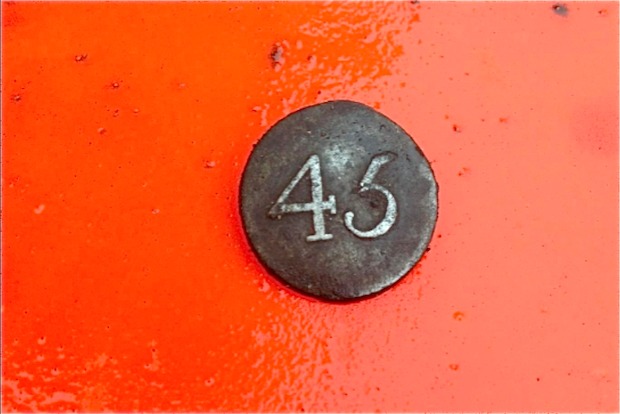
Two years ago DNAinfo.com reported on the discovery of a well in the same area. And the latest story includes the image of another find, a button from the 45th Regiment.

That story’s mention of landfills reminded me of this graphic from the Boston Globe earlier in the week, showing how a 7.5' flood at high tide would affect the city.

Central Boston would pretty much revert to its shoreline of 250 years ago, before we started filling in the shallow parts of the harbor. The Back Bay would once again be a bay, and Faneuil Hall would be on the waterfront.

Friday, August 09, 2013

Alexander Gilles Edits His Hymnal

Glenda Goodman reported this find at Trinity College’s library on the Junto blog in July, but it didn’t really hit me until Slate Vault picked up on it (and posted bigger images).

A man named Alexander Gilles went through a copy of Isaac Watts’s Psalms of David Imitated in the Language of the New Testament and changed every reference to royalty and Britain so the hymns fit better with the republican values of the new U.S. of A.

Gilles used an edition of Watts published by Scottish immigrant John Hodgson in Boston in 1772. Many of his changes, Goodman reports, match those in an edition issued by John Mycall of Newburyport in 1781; a “committee of ministers” edited that version for Mycall, another immigrant bookseller. But Gilles went further, looking not just for words like “Britain” and “king” but also for ideological or geographic details.

When lines seemed too British, Gilles composed new ones, so:
He bids the ocean round thee flow
Not bars of brass could guard thee so.
became:
He bids the seas before thee stand
To guard against yon distant land.
That “distant land” was, presumably, Watts’s own country.

In the 1800s Congress considered petitions for pensions from Alexander Gillis, an “officer of the Revolution,” and his children. He lived in New York and, according to one of those documents, had been “an Indian spy.” I don’t know if he could have been the man who edited this hymnal. But he didn’t get a pension.

Thursday, August 08, 2013

Who’s Got the Button?

This is turning into archeology week at Boston 1775, but here’s another story about a recent find. The Williamsburg Yorktown Daily reports that young teen Finney Lynch found a button with the markings of the 85ème Regiment Saintonge, one of the French units that served in the siege of Yorktown:
The rain on June 24 did more than just water the plants. It likely loosed a Revolutionary War-era button from a bank of land after more than 230 years, planting it in full view of an eighth-grade archaeology camper.

As Finney Lynch, an eighth-grade student at The Covenant School in Charlottesville, walked the path from the Archer Cottage next to Cornwallis’ Cave at Yorktown to the Watermen’s Museum on June 25, she spotted a button in the muddy ground.

“I picked it up and didn’t think it was anything at all,” Lynch said.

She gave the button to the Watermen’s Museum Archaeology Camp leader Jason Lunze, and he knew what she had found: an 18th-century button made of copper alloy, like bronze, from the Revolutionary War. . . .

“I have buttons in my own dresser that do not look as good as this button does in person,” said the Watermen’s Museum Executive Director Dr. David Niebuhr.
The article goes on to explain how the button will be preserved for study and display.

I’m surprised that a button survived in such good shape after more than two hundred years “in close proximity to the water” and was spotted simply lying on the muddy ground—by someone at an archeology camp, yet. Rain can unearth artifacts like those flints in Concord, but I’m used to thinking of metal buttons appearing in more concerted digs like this one at Colonial Williamsburg.

I can’t help but wonder if members of Massachusetts’s own Regiment Saintonge reenactors have been in that area.

Wednesday, August 07, 2013

Farewell to Two Historical Gentlemen

The community of historical interpreters in Massachusetts is mourning two gentlemen who died this week.

Among other personas, Thomas Macy portrayed John Adams at many venues, often performing a two-person epistolary play with Patricia Bridgman as Abigail. For years Tom wanted to bring that Adams portrayal to Washington’s Headquarters, and as part of last month’s reenactment he was able to portray Adams’s meeting with Gen. George Washington.

Tom also wrote a short book called The Hannah and the Nautilus: The Beginning of the American Revolution at Sea, published by the Beverly Historical Society in 2002. It’s a detailed study of one of the first naval skirmishes of the Revolutionary War, which took place off Beverly’s coast in September 1775.

In Boston, Bob Jolly was one of the Freedom Trail Players for several years. He was a pioneer in portraying a little-known citizen of Revolutionary Boston rather than a celebrated name, an approach that allows visitors to consider events through the eyes of an ordinary person.

Bob’s character was Nathaniel Balch, a handsome hatter who was a close friend of Gov. John Hancock. Balch seems to have had the personality of a nightclub comic, making him a good match for Bob, who was also an actor and performer of Gilbert & Sullivan operettas.

Tom came from Nantucket, Bob from Louisiana, but both found new homes and new friends in the world of local historical interpretation.

Tuesday, August 06, 2013

Digging in the North End

Yesterday’s Boston Globe offered a progress report on a little dig in Boston’s North End. As part of a renovation project, the Old North Church’s, they invited the city’s archeology department to excavate the back yard of the Ebenezer Clough house, built around 1715.

The result:
During two weeks of digging, Bagley and a crew of volunteers collected tens of thousands of items from the 1700s. The haul included long-ago leftovers of everyday life: animal bones, doll parts, and uncounted chips and fragments of dishes and cups that archeologists hope will reveal more about how Bostonians lived as a bustling city sprang up around them.

“They literally would have just thrown these out the window,” Bagley said of a time when the backyard served as a personal landfill. “This will tell a lot about what people were eating, what toys they were using, and what else was going in the backyard.”

The dig also will give archeologists the rare chance to study a North End site untouched by development. From its beginnings as a pasture, this tiny plot of earth at 21 Unity St. has never been built upon, Bagley said. . . .

The finds include porcelain from China, children’s marbles, a cow or pig tooth, German stoneware, pipe stems, and a ceramic fragment decorated with a painted thistle, possibly from Scotland. Archeologists even found a rat’s skeleton.
In the early 1800s the building became an apartment house, or tenement, owned by upholsterer Moses Grant (1744-1817), one of the guys involved in the pre-Revolutionary events I focus on.

The Globe also offered a slide show of the dig. The overhead image above comes from that collection by staff photographer Pat Greenhouse.

Monday, August 05, 2013

In Like Flints

Earlier this year I missed this article by Joel Bohy at the Skinner, Inc., auction house about a large deposit of musket flints in Concord, in a field above the North Bridge. Joel makes the case that those flints are a relic of 19 Apr 1775:
…over 150 years later, Concord resident and archeologist Benjamin Smith found many of those flints, resting in that same pasture, known today as the musterfield. Smith didn’t set out to uncover a part of American military history. He was a collector of Native American objects, and noticed in the fall of 1934 that the site had been plowed for the first time in his memory.

As he searched the area, he found seven English musket flints. That evening it rained quite heavily, and the next day Smith searched again. In a speech he wrote for the Concord Patriots Day ceremonies in 1961, he stated:

“The following day the field was revisited. Gun flints seemed to be everywhere and they stood out against the dark, wet ground like glittering jewels. Thirty-seven more were recovered that day and it was by then clearly apparent that, after making allowance for the natural disturbance of the plowing and the fact that the men may not have discarded the flints in the same manner, they occurred in two long lines about fifty feet apart and running N.E. to Southwest across the slop of the hillside, roughly facing the North Bridge roadway.”

Within the next few years he had found a total of one hundred dropped flints. About seventy of those now reside in the collections of the Concord Museum.
Joel is working with the museum and other local institutions on a big exhibit about the Battle of Lexington and Concord in 2014, which will include many locally collected artifacts like these. I can hardly wait!

Sunday, August 04, 2013

Sgt. Fargo and Gen. Washington’s “Indignation and Shame”

Musket Firing 1As I introduced back here, in 1775 Moses Fargo was a sergeant in Col. Samuel Holden Parsons’s Connecticut regiment during the siege of Boston. He was ordered to keep an orderly book, copying down the orders for each day as they were dictated to him—which allowed for idiosyncratic spelling. Here’s Sgt. Fargo’s entry for 4 Aug 1775:

it with Indignation and Shame the Genll observes that notwithstanding the Repeated orders which have Ben Given to pervent the Firing of guns in and about the Camp that it is Daily and hourly Pratised

That Contrary to all orders Stragling Soldiers Do steal past the Guards and Fire at a distance Where there is not the Least posabilty of hurting the Enamy and Where there is no other End answerd but to waist there amunition and Expose themselfs to the Redicule of the Enamy and keep there own Camp harised by Frecquent & Continuel alarms to the hurt and Deterement of Every Good Soldier who is thereby Disturbed of his Natural Rest and at Length will Never be able to Distingush Between the Real and the Fals alarmes

for that Reson the Gen’l Forbids in the most perremtory maner any Person or Persons whatsoever under any Pertence to Pass the out Guards unless autherised by the Commanding officer of that part of the Lines Signafyed in Riting which must be Shewed to the officers of the Guard in there Posts any Person Offending in this Perticuler will be Considered in no other Light then a Common Enamy and the guards will have orders To fire on them as Such the Commanding officer of Every Regmt. is to Derict that Every man in his Regmt. is Made accquanted with these orders to the End that no one may plead Ignorance and that all may be aprisd with the Consiquences of Disobediance the Colo. of Regmts and the Commanding officers of Cores to order the Role of Each Company to be Called twice a Day and Every mans Amunition to Examined at Evening Role Calling and Such as are Found Difficant are to be Confined the Guards are to Aprehend all Persons Near there Posts whether towns people or Soldiers
Of course, Gen. George Washington’s “indignation and shame” was just a cover story. Or rather, he probably felt indignant and ashamed, but not because the men were firing at the enemy.

Rather, as Gen. John Sullivan’s letter reveals, the day before headquarters issued the orders above, Washington had learned that the army had significantly less gunpowder than he had been told. All that talk about “the ridicule of the enemy” and a “good soldier…disturbed of his natural rest” was meant to stop the men from using up powder while keeping the supply crisis secret from the British.

The Connecticut Historical Society published Fargo’s orderly book in 1899. It transcribed the countersign password as “Iceland,” but other sources say it was “Ireland.” For the sake of Sgt. Fargo and his company, I hope he actually wrote that right.

(Photograph above by Erin and Lance Willett via Flickr under a Creative Commons license.)

Saturday, August 03, 2013

Looking for Loyalists in All the Wrong Places?

At All Things Liberty: The Journal of the American Revolution, Elizabeth M. Covart has contributed a series of articles on the interpretation of Loyalism in Boston’s Harborfest activities this year.

Among the sites Liz visited was the Old South Meeting House, which encourages visitors to help reenact the debate over the issues raised by the new tea tax of 1773. That church was the site of huge protest meetings in November and December, with thousands of people showing up to express their opposition to landing the tea and paying the tax. How many people showed up in 1773 to support the new Crown policy? Practically no one.

Our best source on the actual discussions at the tea meetings is a memo titled “Proceedings of ye Body respecting the Tea,” which L. F. S. Upton published in the William & Mary Quarterly in 1965. It was written by someone present at the tea meetings in November and December 1773. Similar reports in the same handwriting are marked “Colman,” suggesting the observer was Benjamin or William Colman, either way a cousin of Massachusetts Attorney General Jonathan Sewall.

The end of this report listed the eight “chief Speakers at the Meetings”: Samuel Adams, John Hancock, Dr. Joseph Warren, Dr. Thomas Young, Josiah Quincy, William Phillips, William Cooper, and William Molineux. Those men cover the political spectrum from radical Whig to deeply committed Whig. There was not much debate.

The tea meetings at Old South in late 1773 were not official town meetings, though they were conducted along similar lines. They were special meetings called to protest the tea tax. No one had to attend. Some friends of the royal government probably saw going to those meetings as lending them legitimacy that they didn’t deserve. Others might have gone and found the anti-tea sentiment so strong that they kept from speaking out.

The Colman report described just a few future Loyalists speaking at these meetings, and in limited ways. On 30 November Stephen Greenleaf, sheriff of Suffolk County, came in with a letter from Gov. Thomas Hutchinson (also father of two tea importers), “requiring him to read a Proclamation for them to disperse.” He read that proclamation to “a confused Noise and a general Hissing.” And then the gathering voted to ignore it. Greenleaf evidently went away again. He lost his job as sheriff in independent Massachusetts (his younger brother William took over), but he never left Boston.

John Singleton Copley also appeared. But he didn’t argue that loyalty to the British Empire should outweigh local economic needs, or that the principle of “no taxation without representation” could be safely bent for a small tax on one imported product. Instead, he came to the meeting as a representative of his new wife’s family, the Clarkes, who had imported a lot of the tea. He just asked for a guarantee of their safety if they returned to town, as the people had demanded. Later he returned to say that the tea consignees “thought it not prudent and would serve no valuable Purpose to appear at the Meeting.” Copley went away, apparently satisfied with his job as a go-between. He would sail to Britain the next year and live there for the rest of his life.

Francis Rotch, whose family owned the Dartmouth, was in and out of the meetings a lot. But he didn’t argue for the necessity of obeying Parliament’s laws, or the value of paying taxes for public services, or the divine right of kings. The Rotches were Quakers from Dartmouth, Massachusetts, and they kept out of Boston politics. Francis Rotch simply pleaded with the crowd not to do things that would cause his ship to be damaged or confiscated. Rotch spent the war in London, thus qualifying as a Loyalist, but in these meetings he spoke from a neutral perspective as a man caught in the middle.

John Timmins appeared as agent for the cargo on the Beaver and briefly promised that he wouldn’t unload the tea. Timmins also moved to England during the war.

Finally, there was John Rowe, wealthy merchant and part-owner of the Eleanor. Some people in the crowd identified him as “a good Tory” when he arrived. So what arguments did he make?

he expressed his Sorrow that any Vessel of his should be concerned in bringing any of that detestable and obnoxious Commodity, (Tea)” and seeing the Audience were pleased with what he had said, he proceeded and among other Things he asked, “Whether a little Salt Water would not do it good, or whether Salt Water would not make as good Tea as fresh.” And when he had done speaking and at several other Expressions in his Speech, the People testified their Applause by Shouting Clapping etc.
The report author heard crowd members saying quietly that “Mr. Rowe had now become a good Man and they should soon make all the Rest of the Tories turn to their Side as Mr. Rowe had done.”

Rowe went home that night and wrote bitterly in his diary but didn’t record his own words. Clearly he had been cowed by the people, or perhaps just eager for their approval. And in fact he managed to last out Bostonians’ distrust to remain in town through the war, eventually even becoming a representative to the Massachusetts General Court.

If the reenactments of the tea meetings followed that record as a script, the audience wouldn’t hear Loyalist political arguments. In Rowe’s case, we’d be hard put to distinguish his words from those of the most radical Whigs. (Indeed, Bostonians remembered Rowe as being the first to publicly raise the possibility of getting rid of the tea into the ocean. That may have helped his political career.)

I think Old South does good work by making sure visitors are exposed to a debate on the issues surrounding the tea in 1773. That can’t happen unless someone speaks up in favor of the British government. That viewpoint is all the more valuable in being less familiar to most modern Americans, and thus more effective at making us think in new ways. But in providing a forum for the Loyalists’ political positions, today’s Old South is offering a much broader spectrum of voices than people heard in that same space in late 1773.

Friday, August 02, 2013

New Directions in the Study of Sugar, 24-27 October

On 24-27 October, the John Carter Brown Library in Providence will host a conference titled “Beyond Sweetness: New Histories of Sugar in the Early Atlantic World.”

The conference announcement email said:
The centrality of sugar to the development of the early Atlantic world is now well known. Sugar was the ‘green gold’ that planters across the Americas staked their fortunes on, and it was the commodity that became linked in bittersweet fashion to the rise of the Atlantic slave trade. Producing unprecedented quantities of sugar through their enforced labor, Africans on plantations helped transform life not only in the colonies but also in Europe, where consumers incorporated the luxury into their everyday rituals and routines. 
And another announcement added:
“Beyond Sweetness: New Histories of Sugar in the Early Atlantic World” will evaluate the current state of scholarship on sugar, as well as move beyond it by considering alternative consumer cultures and economies. Given its importance, sugar as a topic still pervades scholarship on the Americas and has been treated in many recent works about the Caribbean, Brazil, and other regions. This conference thus will serve as an occasion for the assessment of new directions in the study of sugar.
Alongside the conference, the library will host an exhibition titled “Sugar and the Visual Imagination in the Atlantic World, c. 1650-1840.”

Here’s the full program. Online registration for this event costs $54, or $38 for students. I’m not sure what sort of snacks the conference will provide, but I’d be very disappointed if they aren’t sugary.

Thursday, August 01, 2013

“They continued playing several hours”

The image above was the only signature of John Hancock that I was studying last night.

In the spirit of that activity, I’m pointing to a B.B.C. item from June repeating a report from the 19 Sept 1749 Whitehall Evening Post of England:
On Tuesday last, his Royal Highness the Prince of Wales, and Lord Middlesex, played at Bass-Ball, at Walton in Surry; notwithstanding the weather was extreme bad, they continued playing several hours.
Frederick Louis, Prince of Wales (1707-1751), was the eldest son of George II and the father of George III. Though heir to the throne, he never became king, in part because of a sports injury.

The Earl of Middlesex (1711-1769) was, like the Prince of Wales, estranged from his father. The two men were also both keen cricket fans. The earl’s younger brother became Lord George Germain, leading proponent and strategist of the American war.