J. L. BELL is a Massachusetts writer who specializes in (among other things) the start of the American Revolution in and around Boston. He is particularly interested in the experiences of children in 1765-75. He has published scholarly papers and popular articles for both children and adults. He was consultant for an episode of History Detectives, and contributed to a display at Minute Man National Historic Park.

Subscribe thru Follow.it


•••••••••••••••••


Friday, October 25, 2013

It’s Electrifying!

In September 1966, General Electric hosted its Fifth Annual Utility Executives Conference in Williamsburg, Virginia. Those businessmen (and perhaps a few women) came with their wives (and perhaps a couple of husbands) for a three-day meeting. This was one year after a big blackout, so the company wanted to reassure their clients about electrical power.

At the time large corporations like G.E. still had a special tradition for closing such meetings: high-class musical entertainment for the assembled couples. Companies often commissioned an entire small-cast musical comedy featuring Broadway talent.

For this 1966 gathering, G.E. had hired the songwriters John Kander, Fred Ebb, and Walter Marks. Kander and Ebb already had a hit on Broadway with Flora the Red Menace and were working on Cabaret. Marks had written the songs for the 1964 Broadway show Bajour.

And for General Electric’s Utility Executives Conference in Colonial Williamsburg? The natural theme was…Benjamin Franklin’s discoveries about electricity! Well, that was the starting point, at least.

The result was Go Fly a Kite, a show following a utility executive and his wife named, naturally, George and Martha. (Martha was played by Mary Louise Wilson, a Flora alum who would win a Tony forty years later.) After the opening number “Welcome to Williamsburg,” a leprechaun named Poor Richard appears in a tricorn and breeches and ushers George and Martha, as the song says, “Through a Magic Door” to meet Franklin.

Later songs lay out the challenges facing power executives: hillbillies who want to generate their own power (“Makin’ Our Own”), anti-nuclear power protesters (“Atom and Evil”), sons who have become folk-pop singers (“That Great Big a-Go-Go in the Sky”). But they also offer the solutions to George’s problems: Power Distribution Management (“P.D.M. Can Do”) and high-voltage direct current (“Be Direct with Me”)!

Go Fly a Kite was recorded as a double LP and sent to all the utility executives as a souvenir of their visit to Williamsburg. Over a quarter-century later, a television writer named Steve Young came across a copy in a used-record store and took it home, wondering what it was. With help from the nascent web, he learned that this show was just a taste of the forgotten theatrical genre called the “industrial musical.”

Steve and a fellow collector named Sport Murphy have now written a guide to such albums titled Everything’s Coming Up Profits: The Golden Age of Industrial Musicals. It catalogues scores of these little-seen shows from the 1950s through the 1970s with plot synopses, images from record sleeves, quotes from lyrics, profiles of talent, and more.

Okay, so this book’s link to the Revolution, or even to remembering the Revolution, is tenuous. But Steve’s a great friend and a son of Pepperell. The book’s a hoot, and industrial musicals are a thick slice of exceptional Americana that historians of the late 20th century should know about.

Steve and Sport have launched the industrialmusicals.com website with streaming audio so you can listen to a rotating selection of songs. If you want to revive Go Fly a Kite alone, WFMU offers recordings of the entire score. There’s an abbreviated version on YouTube courtesy of Schenectady’s Museum of Innovation and Science.

Thursday, October 24, 2013

Communication Protocols in the Revolution

Protocols of Liberty: Communication Innovation and the American Revolution is an unusual study of America’s break from Britain. Author William B. Warner is a professor of English, not history, at the University of California, Santa Barbara. His previous books have covered such topics as the rise of the novel in British culture. A book he co-edited, This Is Enlightenment, was an attempt to break away from the “cultural studies” approach to that era in favor of a “history of mediation.”

Protocols of Liberty likewise emphasizes the Whigs’ networks of communication, focusing on:

  • standing committees of correspondence started by the Boston town meeting in 1772;
  • the “popular declaration” as a new form of political literature culminating in the Declaration of Independence; and
  • the newspaper and postal system that spread those messages.
Eventually, the book argues, the American Whigs enjoyed an unprecedented non-hierarchical widespread communications network centered at the Continental Congress in Philadelphia.

In taking this approach, Warner emphasizes the act and forms of communication as much as or more than the content or context of those communications. The book often pauses to analyze the definitions and roots of words or to “translate” period statements into the language of modern communication. There are charts and tables to show the development or spread of particular messages.

Though Warner sets his book apart from “founders’ histories” and “intellectual histories,” it’s almost entirely focused on public messages from governmental and quasi-governmental bodies—i.e., elite men discussing events in the most cerebral terms. Thus, we read more about the royal commission that investigated the Gaspee attack and Whig responses to it than about the attack itself. The book mentions from afar the inflammatory rumors that spread west during the “Powder Alarm,” but that type of informal, in-person (and inaccurate) communication doesn’t get nearly as much space as the deliberations of Virginia gentlemen in Williamsburg in the summer of 1774.

Protocols of Liberty focuses on communication by the American Whigs, casting their political opponents as reactive and ineffectual. Warner paints a fine portrait of Gov. Thomas Hutchinson orating on the British constitution in early 1773, confident that his speech to the Massachusetts General Court would settle matters. I wish the book had also discussed whether Hutchinson felt he merely had to win over those legislators and their elite circles or whether he, too, expected his words to be effective through newspapers and other publications.

The royal Customs office supported the Boston Post-Boy, and the provincial administration favored the Boston News-Letter, guaranteeing friendly coverage. The book doesn’t mention the anti-Whig Boston Chronicle (forced out of business in 1770), and The Censor, the magazine that friends of government commissioned, appears only in a footnote. Why weren’t these pro-government publications as successful as those that leaned toward resistance?

By highlighting the Whigs’ successes, the book makes their triumph seem inevitable and their innovations significant. But the Whigs also stumbled. The book opens with Samuel Adams and the people of Boston responding to the Massacre in March 1770. That spring a captain offered to carry the town’s version of the event to London on a special ship, and the town meeting declined to pay the expense. As a result, the town got scooped by royal officials. In 1775 the Massachusetts Provincial Congress remembered that lesson and sent the Quero racing to England with the first accounts of Lexington and Concord. What were the limits on the Whigs’ approach to communications?

Even within the topic of messaging, Protocols of Liberty often feels bloodless. Paul Revere shows up as one of the Boston activists, an engraver and courier who brought the Suffolk Resolves to Philadelphia in September 1774—but not as the rider who raced to warn the New Hampshire Whigs about a navy ship headed to Fort William and Mary in December 1774 and who alerted Lexington in April 1775. While discussing the post-rider system, the book doesn’t discuss the news of war spread by Isaac Bissell and colleagues in April 1775. The fighting itself takes place off stage as the action moves to Philadelphia and ends with the Declaration’s dissemination across thirteen colonies free of British soldiers.

Protocols of Liberty updates Bicentennial-era studies like Richard D. Brown’s Revolutionary Politics in Massachusetts and David Ammerman’s In a Common Cause with today’s emphasis on information and social networks. Warner highlights some neglected events, like how the Massachusetts legislature responded to Hutchinson in 1773 with what ministers in London judged a “Declaration of Independence.” But this approach necessarily neglects other aspects of the American Revolution. As a result, I think Protocols of Liberty will end up classified among intellectual histories of the era, albeit not focused on ideology but on forms of political argument.

To explore the book further, visit its website.

Wednesday, October 23, 2013

New Study of Dr. Benjamin Church

John A. Nagy has written two books on espionage in the Revolutionary War: Invisible Ink: Spycraft of the American Revolution and Spies in the Continental Capital: Espionage Across Pennsylvania During the American Revolution.

For his third, he turned to the first notable Patriot to be revealed (somewhat) as secretly slipping information to the Crown: Dr. Benjamin Church, Spy: A Case of Espionage on the Eve of the American Revolution.

I say “somewhat” because Gen. George Washington and Massachusetts General Court couldn’t come up with ironclad proof of Church’s treachery. He admitted to sending his brother-in-law John Fleeming a letter in cipher that described the Continental Army in detail. But that description overstated the American strength. Did Church actually believe the figures he wrote? Was he communicating in some previously arranged code? Or was he playing a double game, trying to bluff the British out of attacking the Continental siege lines?

In the end, the American authorities couldn’t answer those questions solidly enough to convict Church of spying. (It didn’t help that the Continental Congress’s committee to write regulations for the army, originally chaired by Washington, hadn’t taken the possibility of such betrayal into account.) The Congress ordered Church confined without trial, tried to exchange him for a British officer, and finally sent him into exile.

The Revolutionary generation wrote a lot about Church, but much of it seems rooted in guesswork tinged by hindsight rather than hard evidence. Research over the past hundred years, especially after Gen. Thomas Gage’s intelligence files became available, has shed more light on the doctor’s activities. It’s clear now that Church was disclosing sensitive information to Gage before the war began. But how long before? How much did he reveal? What were his motives, and did they change?

John Nagy has gone back over all the evidence that’s come out about Church. This is the first commercial book to use my study’s revelation that Dr. Church’s mistress, who betrayed him under pressure from Gen. Washington, was most likely Mary (Butler) Wenwood of Marblehead, estranged wife of Newport baker Godfrey Wenwood. The book is sure to be thorough.

And who knows? More information may yet surface. At his blog Ed Witek has just shared images of the doctor’s younger brother Edward and his family. Edward is the doctor’s only close blood relative for whom we have a portrait, so peering at his face is the closest we’ll probably come to looking Dr. Benjamin Church in the eyes.

Tuesday, October 22, 2013

Brian Deming on “Why Boston?”

Brian Deming is author of Boston and the Dawn of American Independence. That new book explores why so many Bostonians felt the need to revolt in 1775. Deming, a journalist and novelist, began this book while living in Boston, and he sent this guest blogger essay from his new home in Toronto.

In 1760 the people of Boston felt themselves proudly British and could hardly imagine independence. Then, over just 15 years, anger against British authorities boiled up, producing riots, the Boston Massacre, the Boston Tea Party, and then war.

What were the factors that made Boston the center of such discontent?

First, the nature of Boston’s economy. For Boston merchants to prosper, they needed more than New England fish and lumber to trade. So, they cultivated trade with the West Indies. Fish and lumber went to the islands in exchange for sugar and molasses. Molasses, shipped to Boston, was distilled into rum, which became a reliable trade commodity.

Thus wedded economically to the West Indies, Boston yelped louder than most American ports when Britain in the 1760s began enforcing long-neglected laws related to imports from those islands.

Second, Boston’s history of orchestrated violence. Boston had knocked heads with authorities well before the Stamp Act riots and the Boston Massacre. Less than a century before, riots sent the governor packing back to Britain. In the 1740s, riots forced a British admiral to return American men snatched off Boston streets to fill out navy crews. For years, Boston tolerated the Pope Day mayhem, when gangs from the North and South Ends of Boston paraded and fought on November 5.

The Stamp Act riots, the tar and featherings, and the Tea Party emerged from a culture that acknowledged the legitimacy of street violence as a tool of last resort.

Third, religion. By 1760, the force of Puritanism, so important in molding Boston’s character, was on the retreat as other denominations made inroads in the community.

Boston Puritans, who by this time called themselves Congregationalists, grudgingly tolerated other Protestant sects. But they suspected that the Church of England, hand in hand with British authorities, was plotting to dominate religious life in New England. Bostonians pointed to Church of England efforts a proselytizing in nearby Cambridge, for example. This undercurrent of distrust eroded confidence in British authorities and made it easier for Bostonians to choose rebellion.

Fourth, the toxic and polarized world of Boston politics. By the time of the Tea Party, in 1773, the political mood in Boston was so poisoned that no compromise was possible. In other ports where the controversial tea was shipped, authorities and patriots managed to work out an arrangement to avoid a head-on collision. But in Boston, both sides were dug in. Trust and good will had long vanished.

At the center of this nastiness was Thomas Hutchinson, Massachusetts governor at the time of the Tea Party. Hutchinson, a flawed but well-meaning man, was mostly a victim of events set in motion by others and circumstances that spun out of his control.

In the early 1760s, Thomas Hutchinson was a popular and highly respected figure. But even then, Hutchinson had enemies, including Sam Adams, whose father was ruined after the failure of a banking scheme that Hutchinson had opposed.

Grudges against Hutchinson added up over the years as members of the Hutchinson and Oliver families, intertwined by marriage and trusted by the governor, gobbled up most of the plum government jobs.

By filling so many posts, the Hutchinsons, Olivers, and their friends planted bitter seeds of resentment and shut out of the government moderate men sympathetic to the patriot faction, men who might have found middle ground in times of crisis. Furthermore, these family ties and friendships tended to isolate Hutchinson and his allies from the rest of the community, making them deaf to arguments on the other side of the political divide, and similarly making it less likely for the patriots to listen to moderate voices on the Tory side.

It didn’t help that Hutchinson had his own grudges against the patriot side—like the looting of his mansion during the Stamp Act crisis. By the time of the crisis on the eve of the Tea Party, finding compromise was impossible. The tea went in the harbor, and events snowballed from there.

For more information about Boston and the Dawn of American Independence, check out its webpage. Thanks, Brian!

Monday, October 21, 2013

Two National Book Award Nominees

The National Book Awards finalists in the Nonfiction category include two books anchored in the eighteenth century.

The Book of Ages: The Life and Opinions of Jane Franklin is Jill Lepore’s biography of Benjamin Franklin’s baby sister. Jane Mecom remained in Boston raising a working-class family while her brother climbed the business, political, and scientific ladder to gentility and then legend. Here’s a review by Mary Beth Norton in the New York Times Book Review. And here’s Mary Ellen Lennon’s thoughtful analysis of how Lepore pulled a biography out of a limited amount of material at the U.S. Intellectual History network.

The Internal Enemy: Slavery and War in Virginia, 1772-1832 is Alan Taylor’s study of how the oldest and largest British colony in North America (and for a while the largest state) dealt with the threat of enslaved workers rising up or escaping to the enemy in wartime. Though the book starts with Dunmore’s War and the Revolution, much of it concerns the War of 1812 and scares and uprisings in the early republic. In a review behind the Wall Street Journal’s paywall, Mark M. Smith called the book “impressively researched and beautifully crafted.” Here’s Roy Rogers’s review at The Junto.

For the rest of this week I plan to post about more new books that touch on the American Revolution.

Sunday, October 20, 2013

A Love Story at the A.A.S., 22 Oct.

Yesterday I quoted an anecdote from The Life of James Otis, published by William Tudor, Jr., in 1823. It described a young woman in Boston offering succor to British soldiers wounded at the Battle of Bunker Hill, causing them to assume wrongly that she supported the cause they were fighting for.

That story stuck with me, but I didn’t expect to find out who the unnamed young woman was. Last week I learned from books published by later generations of the same family that the woman was William Tudor, Jr.’s own mother, then Delia Jarvis.

And there turned out to be another detail Tudor had kept out of his 1823 book: Delia Jarvis was from a Loyalist family. Her later descendants were open, even celebratory, about that detail at the end of the 1800s. They said that Jarvis had insisted on hosting a tea party even after the beverage had become political anathema. They reported that her future husband addressed her in letters as “my fair loyalist.”

The senior William Tudor was joking a bit, signing himself “your faithful rebel” while working as the Continental Army’s first judge advocate general. He eventually won his bride over to his political side, the family said. But the couple’s son hadn’t suggested any split loyalties for her in 1823, when public feelings about Loyalists might still have been raw.

On Tuesday, 22 October, the American Antiquarian Society will host a talk on those love letters between William Tudor and Delia Jarvis. Mary C. Kelley will speak on “‘While Pen, Ink & Paper Can Be Had’: Reading and Writing in a Time of Revolution”:
Instead of the typical focus on the famed trio of Adams, Jefferson, and Franklin, this lecture looks at the American Revolution through the eyes of two relatively unknown individuals. A son and a daughter of families who counted themselves members of Boston’s elite, William Tudor, who served in the Continental Army, and Delia Jarvis, a Loyalist whom he was courting, forged their relationship in a world of divisive turmoil and radical change. A remarkably rich transatlantic literary culture that remained intact in an increasingly embattled world served as their vehicle. This program will explore not only the letters and the lives of Tudor and Jarvis, but also the fiction and poetry on which these individuals relied as they navigated their way through the momentous events of the struggle for independence.
Tudor was one of John Adams’s law clerks during the Boston Massacre trial. After his military service he took on Massachusetts state offices and hosted the meeting that founded the Massachusetts Historical Society, which now holds those letters.

Kelley is the Ruth Bordin Collegiate Professor of History, American Culture, and Women’s Studies at the University of Michigan. She’s written and edited books on the Beecher sisters, Margaret Fuller, Catharine Maria Sedgwick, and other nineteenth-century American women. Her paper on the Tudor-Jarvis correspondence appeared in Early American Studies.

Kelley’s talk is scheduled to start at 7:00 P.M. It’s free and open to the public.

(The image above shows a portrait of Delia Tudor auctioned by Sotheby’s in 2005. It was painted by John Wesley Jarvis, a British-born portraitist who doesn’t seem to have been a close relation to the sitter.)

Saturday, October 19, 2013

Delia Jarvis and the Battle of Bunker Hill

In The Life of James Otis, of Massachusetts (1823), William Tudor, Jr., included this anecdote about the Battle of Bunker Hill in a footnote:
The anxiety and various emotions of the people of Boston, on this occasion, had a highly dramatic kind of interest. Those who sided with the British troops began to see even in the duration of this battle, the possibility that they had taken the wrong side, and that they might become exiles from their country. While those whose whole soul was with their countrymen, were in dreadful apprehension for their friends, in a contest, the severity of which was shewn by the destruction of so many of their enemies.

After the battle had continued for some time, a young person living in Boston, possessed of very keen and generous feelings, bordering a little perhaps on the romantic, as was natural to her age, sex, and lively imagination, finding that many of the wounded troops brought over from the field of action were carried by her residence, mixed a quantity of refreshing beverage, and with a female domestic by her side, stood at the door and offered it to the sufferers as they were borne along, burning with fever and parched with thirst.

Several of them grateful for the kindness, gave her, as they thought, consolation, by assuring her of the destruction of her countrymen. One young officer said, “never mind it my brave young lady, we have peppered ’em well, depend upon it.” Her dearest feelings, deeply interested in the opposite camp, were thus unintentionally lacerated, while she was pouring oil and wine into their wounds.
This week I came across more versions of that anecdote which reveal that the “young person living in Boston” was Tudor’s own mother. A granddaughter later wrote that said she had not just given drink to the soldiers but also “had them brought in and attended and comforted as best she could.”

All the while, this young woman, born Delia Jarvis, was reportedly worrying for her future husband, the young lawyer William Tudor, who was with the provincial army. Delia Tudor would outlive her husband and son and see the Bunker Hill Monument dedicated in 1843.

According to the introductory material in Deacon Tudor’s Diary (1896), yet another book published by the same family, the “refreshing beverage” that Jarvis gave to the soldiers was tea. I wouldn’t have guessed that from the description.

TOMORROW: Another detail left out of the 1823 anecdote.

(The picture above is one of several from the late 1800s that show Bostonians anxiously watching the Battle of Bunker Hill across the Charles River. This example appeared in Harper’s Weekly in 1875 and comes courtesy of the Boston Public Library and Wikipedia.)

Friday, October 18, 2013

“King George’s Stamp Act Tea”

This funny-pages version of the Boston Tea Party appeared in newspapers in 1904 and is reproduced in Peter Maresca’s new book Society Is Nix: Gleeful Anarchy at the Dawn of The American Comic Strip 1895-1915.

It starts with King George giving his Stamp Act to Lord North, which prompts Boston housewives to break their teacups at Liberty Tree. And at the end the American eagle is born. Okay, that’s a historical hodgepodge, but at least the graphics are striking.

Maresca’s Sunday Press Books collects and reprints early comics at their original size, even larger than today’s newspapers (and much larger than today’s newspaper comics). In these early decades, editors and artists were still working out what to do with the form, so they were trying all sorts of things that look crazy to us today. The Atlantic offered some more previews of this collection.

Thursday, October 17, 2013

Tonight Only: Grenadier’s Caps in Providence

Tonight from 5:00 to 8:00 P.M., the John Brown House Museum in Providence is displaying two eighteenth-century grenadier’s caps from the collections of the Rhode Island Historical Society.

The exhibit announcement says:
Together, they tell the story of Rhode Island’s evolution from colonial outpost to independent state. The older of the two caps, now thought to date to the 1740s, is likely of British make, and is one of a handful of known early 18th-century Grenadier’s caps. This cap has recently been conserved and on display in the Bostonian Society’s just-closed exhibition, “1763: A Revolutionary Peace.”

The second cap is a Rhode Island cap, worn by a member of the Providence Grenadier Company. In October 1774, the company was chartered by the Rhode Island General Assembly, and the cap’s front panel reveals how much had changed since the 1740s. Boldly painted on the front of the Providence cap are symbols of empire and sedition. Above the British lion is Rhode Island’s anchor and motto of Hope. Between them a banner proclaims, “God And Our Rights.”
As of late 1774, American Patriots were still basing their claim for autonomy on what they understood as traditional British rights, still viewing themselves as loyal to the British constitution and king—indeed, more loyal than the royal officials and government ministers in London who had instituted policies they disliked. Hence the combination of British and local symbols.

The Rhode Island cap requires conservation work, and the British cap is going into dark storage for six months in accordance with modern standards for displaying historic textiles. So this is a rare chance to see them both for a while.

The John Brown House is at 52 Power Street in Providence. This event is free. More information on the conservation process appeared in the Providence Journal.

Wednesday, October 16, 2013

Biographers at the B.P.L. This Week

The Boston Public Library is hosting back-to-back talks by two authors who have written about the lives of women in eighteenth-century America.

On Wednesday, 16 October (that’s tonight), Nancy Rubin Stuart will speak about her book Defiant Brides: The Untold Story of Two Revolutionary-Era Women and the Radical Men They Married. Her subjects are Peggy Shippen, who married Gen. Benedict Arnold, and Lucy Flucker, who married Boston bookseller Henry Knox, later a general himself. That event starts at 6:00 P.M. in the Commonwealth Salon.

The next night, Jill Lepore will speak on Book of Ages: The Life and Opinions of Jane Franklin. This Boston woman, whose married name was Jane Mecom, was the baby sister of Benjamin Franklin. While Peggy Shippen and Lucy Flucker came from wealthy families and married prominent men, Jane Mecom came from the mechanic class and never gained gentility like her brother. Yet the siblings remained close throughout their long lives, exchanging letters and visits.

Carl Van Doren published the first book on Jane Mecom more than sixty years ago, so she’s due for a reassessment. The library’s event description says this new biography draws on “a collection of little-studied material, including documents, objects, and portraits discovered recently.” Lepore is the David Woods Kemper ’41 Professor of American History at Harvard University and a staff writer at The New Yorker. Her talk, which starts in the Abbey Room at 6:00 P.M., is co-sponsored by the Massachusetts Historical Society.

Tuesday, October 15, 2013

Coopting the Pine Tree Flag

Andrew Sullivan’s Daily Dish highlighted the meaning of the “Appeal to Heaven” motto in the photo above from this weekend’s “Million Vet March” demonstration by, oh, hundreds of people in Washington, D.C.

As I quoted back here (and here), that banner is based on descriptions of a flag that Connecticut troops raised outside Boston in July 1775. It was flown by the Continental Army’s ill-fated floating batteries and then by the armed schooners Gen. George Washington sent to sea in the fall. The motto “Appeal to Heaven” (in some sources “An Appeal to Heaven”) was John Locke’s euphemism for armed revolution.

The same demonstration involved waving a Confederate flag outside the White House, haranguing the White House security staff, and a speaker demanding that our twice-elected President “put the Quran down” and resign.

Shameful displays like that are sullying the Revolutionary-era flags people bring to those rallies. As one of Sullivan’s readers wrote in identifying the banner above:
Alas, just like the Gadsden flag and it’s famous “Don’t Tread on Me” snake, it has now been appropriated by the Tea Party movement. I am a liberal Democrat who used to regularly fly those historic flags outside my home on the Fourth of July to commemorate the American Revolution – when there was a real, not imagined and hysterical, reason for revolt – but now I’m afraid I have to confine them to the closet. The idea that my neighbors might affiliate me with these crazies is too much to bear.
It should be easy to have a political demonstration without also demonstrating bigotry, and without threatening to overthrow the republic that the Revolution established.

Monday, October 14, 2013

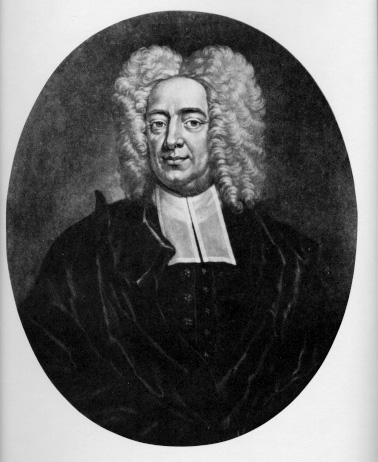
A Day with Cotton Mather

I recall seeing a newspaper letter refer to the Rev. Cotton Mather as a “Founder” and thinking, “Come on! Not every old American guy was a ‘Founder’.”

Mather’s life fell between the settlement of New England, which we here of course claim as a foundation of the U.S. of A., and the Revolution that actually formed the new republic. He got to see the waning of his father’s Puritan order but not the flowering of the Enlightenment, and he may have been happier in either of those intellectual eras than in his own.

The Congregational Library in Boston is hosting a conference on 18 October called ”Mather Redux: New Perspectives on Cotton Mather.” It offers this enticement:
Understanding Mather’s legacy is a key to uncovering much about early America and the nation that follows. For the first time in North America eminent scholars and historians will be brought together to examine the complex historical figure, Cotton Mather. Join them as they create a revised and relevant portrait of the much maligned preacher and his time.
The following morning there will be a walking tour of the North End that ends at the Mather family tomb on Copp’s Hill.

The précis of the speakers’ presentations suggest they want to reclaim Cotton Mather from his unflattering stereotype and recreate the Boston and British Empire of his lifetime. Yet we may not be able to help measuring him against the eras we know better. For example, one presentation is called “Cotton Mather’s Declaration of Independence”:
David Levin, a literature professor at Stanford, made the case several decades ago that Cotton Mather’s role in Boston’s Glorious Revolution was comparable to Thomas Jefferson and his pattern of thought similar to the Declaration of Independence. Rick Kennedy [professor of history at Point Loma Nazarene University in San Diego] will revisit this notion showing where it is true, but also showing where it is incomplete.
This event is open to the public. Registration through EventBrite costs $50 and includes morning pastries but no lunch.

Sunday, October 13, 2013

Brumwell on Washington in Cambridge, 18 Oct.

At 6:00 P.M. on Friday, 18 October, Stephen Brumwell, author of George Washington: Gentleman Warrior, may speak at the Cambridge estate that was Gen. Washington’s headquarters from July 1775 to April 1776.

Brumwell is a British military historian who lives in the Netherlands. His earlier books include Redcoats, on British soldiers in the French and Indian War; White Devil, about Robert Rogers; and Paths of Glory, about Gen. James Wolfe.

Brumwell’s study of Washington focuses on his military career in the 1750s and how he returned to that work in his forties as commander-in-chief of the Continental Army. It emphasizes how Washington looked to British models of both genteel behavior and military organization. Earlier this year Brumwell won the Washington Book Prize from Washington College, the Gilder Lehrman Institute, and Mount Vernon.

I wrote that Brumwell may speak on Friday because that venue, Longfellow House–Washington’s Headquarters National Historic Site, is part of the National Park Service. If the House Republican caucus can agree to fund our federal government again, then Brumwell’s talk and book-signing will go ahead as planned. If not, then the site will remain closed and its staff furloughed. Call 617-876-4491 to confirm that the event will take place as scheduled and to reserve a seat.

Brumwell is also scheduled to speak at Old South Meeting House on the preceding night starting at 6:30. That building is a local non-profit, not affected directly by the national gridlock, so it remains open. Both talks are free.

Saturday, October 12, 2013

Bound to Listen

Three things about bookbinding I hadn’t thought about until I listened to Harmony Hunter’s discussion with master craftsman Bruce Plumley on Colonial Williamsburg’s podcasts:
  • Bookbinding predates printing by centuries.
  • In a provincial capital like Williamsburg, 80% of a bookbinder’s sales came from one type of book: blank ledgers.
  • Paint on the edge of the bound white pages helped to hide the inevitable soiling of use.
Each Colonial Williamsburg podcast is an interview ten to twenty minutes long. Some are about eighteenth-century crafts on display at the museum village, others cover recent developments in the early history of Virginia. They’re aimed at the general public, so the host always starts from a basic level of knowledge. The production values are, of course, top-notch. (I particularly enjoyed listening to bookbinder Plumley’s accent.)

Friday, October 11, 2013

Invincible Looking Pretty Vincible

The Portsmouth News just reported:
The remains of HMS Invincible are among many national treasures that English Heritage says need better protection.

HMS Invincible was originally a 74-gun French warship, launched in 1744 and captured by the British Navy at the Battle of Finisterre in 1747.

She lies at the sandbanks running along the coast of Portsmouth, after running aground and sinking in 1798.

HMS Invincible is a protected wreck site, but it has now been deemed at risk because monitoring has revealed significant parts of the wreck are becoming exposed due to lowering seabed levels.
Wikipedia says the Invincible wasn’t looking too good when it was captured, as shown above. It was also a more advanced design than any ship in the Royal Navy of the time, so it was very helpful to British ship designers over the next couple of decades.

I didn’t understand how the seabed could be lowering, so I looked for more information on the ship’s present whereabouts. English Heritage says it was discovered relatively recently:
Horse Tail Sand comprises a relatively flat featureless sand bank composed of fine to medium sand with a limited silt component. The wreck was discovered there on the 5 May 1979 by Arthur Mack, a local fisherman, when his fishing nets became caught on an obstruction. Returning to the site with two divers, the site was investigated throughout the summer and various artefacts were raised.
(That last sentence has what we might call a bobbing modifier.)
A wide range of objects have been recovered and only a sample is held by Chatham Historic Dockyard. The remainder were sold at auctions held by Sotheby’s and included sandglasses, leather and wooden buckets, powder barrels and magazine tools, utensils, shovels, brushes, small arms, hand grenades, buttons, rigging and rope.
So it looks like the seabed at that site has been eroding, or lowering, for some time. Thirty-five years ago enough silt had washed away to expose the wreck. And now more of the ship’s remains are being exposed, and possibly damaged. At least that’s my amateur reading. Any commentary from experts in eighteenth-century marine archeology is welcome.

Thursday, October 10, 2013

The Long List of Rules for the Long S

I’ve occasionally thought about writing a post on the “long s” of eighteenth-century (and earlier) typography. That’s the lowercase character Å¿ (or Å¿ when italicized). To unfamiliar eyes, it looks so like an f that many people, and O.C.R. programs, think people actually spelled with extra fs and try to transcribe words that way.

Andrew West at Babelstone has created a comprehensive guide to the use of the long s, not just in English over time but also in other European languages. Furthermore, in some periods English printers also followed exceptional rules for Å¿ based on what letters it came before or after.

Here are West’s simple rules for English:

  • short s is used at the end of a word (e.g. hiscomplainsÅ¿ucceÅ¿s)
  • short s is used before an apostrophe (e.g. clos’dus’d)
  • short s is used before the letter f (e.g. Å¿atisfaction, misfortune, transfuÅ¿e, transfix, transfer, Å¿ucceÅ¿sful)
  • short s is used after the letter f (e.g. offset), although not if the word is hyphenated (e.g. off-Å¿et) [see Short S before and after F for details]
  • short s is used before the letter b in books published during the 17th century and the first half of the 18th century (e.g. husbandShaftsbury), but long s is used in books published during the second half of the 18th century (e.g. huÅ¿bandShaftÅ¿bury) [see Short S before B and K for details]
  • short s is used before the letter k in books published during the 17th century and the first half of the 18th century (e.g. skinask, risk, masked), but long s is used in books published during the second half of the 18th century (e.g. Å¿kinaÅ¿kriÅ¿kmaÅ¿ked) [see Short S before B and K for details]
  • Compound words with the first element ending in double s and the second element beginning with s are normally and correctly written with a dividing hyphen (e.g. CroÅ¿s-Å¿titchCroÅ¿s-Å¿taff), but very occasionally may be written as a single word, in which case the middle letter s is written short (e.g. CroÅ¿sÅ¿titchcroÅ¿sÅ¿taff).
  • long s is used initially and medially except for the exceptions noted above (e.g. Å¿onguÅ¿epreÅ¿sÅ¿ubÅ¿titute)
  • long s is used before a hyphen at a line break (e.g. neceÅ¿-Å¿arypleaÅ¿-ed), even when it would normally be a short s (e.g. ShaftÅ¿-bury and huÅ¿-band in a book where Shaftsbury and husband are normal), although exceptions do occur (e.g. Mans-field)
  • double s is normally written as double long s medially and as long s followed by short s finally (e.g. poſſeÅ¿spoſſeſſion), although in some late 18th and early 19th century books a different rule is applied, reflecting contemporary usage in handwriting, in which long s is used exclusively before short s medially and finally [see Rules for Long S in some late 18th and early 19th century books for details]
  • short s is used before a hyphen in compound words with the first element ending in the letter s (e.g. croÅ¿s-piececroÅ¿s-examinationPreÅ¿s-workbird’s-neÅ¿t)
  • long s is maintained in abbreviations such as Å¿. for Å¿ubÅ¿tantive, and GeneÅ¿. for GeneÅ¿is (this rule means that it is practically impossible to implement fully correct automatic contextual substitution of long s at the font level)
Imagine being a printer’s apprentice trying to keep that all straight! No wonder the character was phased out around 1800.

(Hat tip to John Overholt for tweeting about that Babelstone page.)

Wednesday, October 09, 2013

The Long Fight over Franklin’s Library

Yesterday I described the arrival of a set of books in Franklin, Massachusetts, the result of a financial gift from Benjamin Franklin (and a donation in kind from his friend and conduit, the Rev. Richard Price). The town’s minister, the Rev. Nathaniel Emmons, later recalled that gift in his memoir:
My own congregation had a pretty parish library, when I was settled among them; and in the year 1786, Dr. Franklin presented them a donation of some of the most celebrated English authors. By these means I generally had a supply of all those kinds of books which were necessary and useful to a divine; and I never wished for others, because I meant to confine my studies to my own profession, and not waste time in acquiring mere speculative knowledge.
Note that Emmons was treating the books as his own. He kept them proudly in his parsonage. He consulted them. And he apparently made them available to members of his congregation—but only to them.

That was the basis of a new controversy. Had Dr. Franklin donated those books to the church or the whole town? Massachusetts still had a Congregationalist establishment, obliterating the line between church and state. Emmons was conservative theologically and politically, insisting on the privileges of his traditional, Trinitarian, and Calvinist ministry.

In June 1789, according to an 1879 town history, the town of Franklin instructed Emmons to lend out the books “according to the directions in the letter accompanying said library.” But conveniently, that letter had disappeared. On 20 Nov 1790 the town voted that the books should be available “to the inhabitants of the town at large until the town shall order otherwise.” That’s the town’s basis for claiming it has the oldest public lending library in the U.S. of A.

The town’s Congregationalist ministers continued to have custody of the books, but they were supposed to let anyone consult or borrow them. Gradually those titles became less interesting to people as other books and reading material proliferated in the early 1800s. By 1840, a town committee discovered, Franklin’s original library had been “stowed away in its venerable book-case in a barn.” Sixteen years later, another investigation led to the formation of a Library Association to preserve and manage those volumes.

In 1869 two citizens volunteered $100 each for a new library, and some town natives who had moved out and become rich sent back more donations. Locals then formed the Franklin Library Association as a “stock company,” which took charge of what remained of the Franklin books. Finally the whole library was turned over to the town, which promised an annual appropriation ($400 at first) and the “dog money”—fees for dog licenses. Presently the remaining titles bought for Dr. Franklin—now well over 200 years old—are on display in the town’s Ray Memorial Library Building.

Tuesday, October 08, 2013

Franklin’s Library for Franklin

The Boston Globe just reported on “an old-fashioned turf war” between the city of Franklin’s public library and the private non-profit group that sells used books to benefit that library. I suspect the roots of that dispute might be related to last year’s report of the city cutting its library budget so much that it was decertified by the state.

Franklin claims to have the “oldest public lending library in the country,” dating back to 1792, but that, too, was a matter of dispute. The Darby Free Library in Pennsylvania also claims to be the nation’s oldest, dating from 1743. And Boston says it has “The nation's oldest public library system, established in 1848.”

What’s the basis for Franklin’s claim? As the town website explains, in 1778 the Massachusetts General Court approved the formation of new town that had grown out of Wrentham. Originally it was to be named Exeter, but that name changed to Franklin to honor the eminent statesman and scientist Benjamin Franklin. And then the inhabitants hit up the man for money.

Working through Franklin’s great-nephew Jonathan Williams (1751-1815), Franklin the town asked Franklin the man for a donation toward a bell for the town’s church. Benjamin Franklin, as so often, thought he had a better idea. On 18 Mar 1785, he wrote from Passy, France, to his friend Richard Price (1723-1791, shown above), a British dissenting clergyman with connections to political radicals and supporters of America:
My Nephew, Mr. Williams, will have the honour of delivering you this Line. It is to request from you a List of a few good Books to the Value of about Twenty-five Pounds, such as are most proper to inculcate Principles of sound Religion and just Government. A new Town in the State of Massachusetts, having done me the honour of naming itself after me, and proposing to build a Steeple to their Meeting House if I would give them a Bell, I have advis’d the sparing themselves the Expence of a Steeple at present, and that they would accept of Books instead of a Bell, Sense being preferable to Sound. These are therefore intended as the Commencement of a little Parochial Library, for the Use of a Society of intelligent respectable Farmers, such as our Country People generally consist of. Besides your own Works I would only mention, on the Recommendation of my Sister, [Samuel] Stennet’s Discourses on personal Religion, which may be one Book of the Number, if you know it and approve of it.
(Franklin’s sister, Jane Mecom, is the subject of a new biography by Jill Lepore.)

Price wrote back on 3 June 1785 saying that Williams had visited him:
I have, according to your desire, furnished him with a list of such books on religion and government as I think some of the best, and added a present to the parish that is to bear your name, of such of my own publications as I think, may not be unsuitable. Should this be the commencement of parochial libraries in the States, it will do great good.
This is said to be a list of the titles Franklin’s money went to—plus several of Price’s own works:
Clark’s Works; Hoadley’s Works; Barrow’s Works; Ridgeley’s Works; Locke’s Works; Sydney’s Works; Montesquieu’s Spirit of the Laws; Blackstone’s Commentaries; Watson’s Tracts; Newton on the Prophecies; Law on Religion; Priestley’s Institutes; Priestley’s Corruptions; Price and Priestly; Lyndsey’s Apology; Lyndsey’s Sequel; Abernethy’s Sermons; Duchal’s Sermons; Price’s Morals; Price on Providence; Price on Liberty; Price’s Sermons; Price on the Christian Scheme; Needham’s Free State; West & Lyttleton on the Resurrection; Stennet’s Sermons; Addison’s Evidences; Gordon’s Tacitus; Backus’s History; Lardner on the Logos; Watts’s Orthodoxy and Charity; Doddridge’s Life; Fordyce’s Sermons; Life of Cromwell; Fulfilling of the Scriptures; Watts on the Passions; Watts’s Logic; Christian History; Prideaux’s Connections; Cooper on Predestination; Cambridge Platform; Burkett on Personal Reformation; Barnard’s Sermons; History of the Rebellion; Janeway’s Life; American Preacher; Thomas’s Laws of Massachusetts; American Constitutions; Young’s Night Thoughts; Pilgrim’s Progress; Life of Baron Trench; Erskine’s Sermons; The Spectator, etc.
For Britain, that might have been a pretty radical set of theologies. But for New England, it was well in line with Calvinist thinking.

In 1786, the young town’s minister, the Rev. Nathaniel Emmons (1745-1840), preached about the newly arrived books. His sermon was published as “The dignity of man: A discourse addressed to the congregation in Franklin, upon the occasion of their receiving from Dr. Franklin, the mark of his respect in a rich donation of books, appropriated to the use of a parish-library.” Read it here; Emmons gets onto the value of reading and study about halfway through.

TOMORROW: But was that a public library?

Monday, October 07, 2013

Stand With the Park Service

Kevin Levin of Civil War Memory used this icon yesterday on a posting titled “I Stand With the Park Service.”

It refers to how Rep. Randy Neugebauer of Texas berated a National Park Service ranger for trying to carry out her assignment to close the World War 2 Memorial in Washington. Why had she received those orders? Because Neugebauer and his colleagues in the House Republican Caucus are trying to use the federal government’s new fiscal year to negate the 2012 election.

As many folks pointed out, Neugebauer was partly responsible for closing that monument, and was still receiving his hefty salary. The ranger was not responsible, and was working without pay to ensure that monument remained safe. But in Neugebauer’s mind he was justified in saying that she “should be ashamed.”

The right wing of the Republican House made that monument a battleground for the cameras, insisting on Tuesday morning that it be opened for a delegation of World War 2 veterans from Mississippi (curiously, an all-white delegation from a state that was 49% African-American in 1940). The charity that had flown those veterans to Washington had nothing but praise for the N.P.S., but Neugebauer and others on the right attacked the agency with accusations and conspiracy theories lacking both sense and evidence.

According to rulings late in the Carter administration, and thus in effect for more than thirty years, it’s illegal for federal employees to work without Congressional authorization and funding. The only exceptions are for people whose work is deemed essential to our health and safety. I’m very fond of visiting national parks, especially those related to the Revolution, but I’d never claim that activity was essential to my health. Furthermore, many national parks have dangerous or fragile areas. Public monuments are subject to vandalism and littering. Therefore, the N.P.S. shuts down all but security operations during federal government closures.

Like other federal agencies, the N.P.S. had to announce its contingency plan in advance (P.D.F. download). That report indicates that over 21,000 agency employees have been furloughed. Those who remain are dedicated public servants working to preserve our shared heritage and resources despite not being paid. And they’re just a small part of the overall federal workforce barred from doing the jobs this Congress had until September demanded that they do.

If Republicans in Congress and the voters who support them really feel that it’s better to close the federal government than to provide people with health insurance, then they should accept the consequences of that choice and stay away from national parks and other federal facilities. Instead, many insist on maintaining all the benefits they usually enjoy (with no promise to pay for them) and blame others for the inconveniences their actions have brought on us all.

Sunday, October 06, 2013

Early American Economics in Philadelphia, 24-25 Oct.

The Library Company of Philadelphia is hosting a free conference on 24-25 October on the theme of “Ligaments: Everyday Connections of Colonial Economies.” The society’s webpage for this event explains:
How did ordinary colonial people accomplish the daily buying and selling, producing and exchanging, that sustained their households? How did colonial traders put a ship of goods together, protect goods moving into foreign Atlantic empires, and communicate effectively with strangers during the early modern era? What kinds of skills and resources did ordinary colonists need in order to survive in local market places? How did merchants in early modern port towns make connections with distant ports?

This conference will explore the practical linkages and mutual obligations that were made from individual to individual in the economies of local North American places, and across the boundaries of frontiers and empires. Whether a widow tavern keeper in Montreal, or a merchant in Veracruz, or a stone mason in Charleston, imperial subjects had to know how to make a sale, evaluate forms of money, judge a neighbor’s reliability, set the value of goods.

How did colonists gain the expertise to write business letters, dun their debtors, acquire marine insurance, charter ships, or negotiate with bills of exchange brokers? How did they forge economic friendships and dispute misunderstandings and willful deceit? The conference will explore these and other connective sinews of skill and knowledge among colonists of all classes and cultures across European empires.
Fifteen scholars will present papers, which should be circulated in draft soon. The program, registration form, and information about accommodations are available through the conference website.

The Library Company was co-founded in 1731 by Benjamin Franklin. Its Program in Early American Economy and Society, which has organized this conference, reflects Franklin’s interests as a businessman keen to connect the far-flung parts of Britain’s Atlantic Empire.

Saturday, October 05, 2013

Another Detail of Robert v. Godfrey Wainwood

Among the documents displayed in the Historical Society of Pennsylvania’s “Preserving American Freedom” website is abolitionist Thomas Robinson’s 1788 record of oppressed African-Americans in Rhode Island. Robinson labeled his notes “9 mo,” suggesting he was a Quaker. He evidently had ties to both Rhode Island and Philadelphia.

The first case in Robinson’s notes is:
Robert, a negro man, held as a slave by Godfrey Wainwood, was captured in the late war at virginia by the French and brought here by them, the vessell he was taken in was burnt, and without his being libeled, was sold as a slave.—He denies that he was a slave in Virginia.
I discussed the dispute between Wainwood and Robert back here. Wainwood, or Wenwood, was an immigrant from Prussia who had played a crucial role in exposing the espionage of Dr. Benjamin Church in 1775. Brown University has a more detailed webpage on Robert’s case, including transcripts of the legal documents and minutes of the abolitionist society meetings.

One interesting detail from Robinson’s note is how it shows Robert complaining about his servitude to a sympathetic ear in the fall of 1788. That was months before he stole Wainwood’s copy of their contract and ran away in May 1789, setting off their court case.

Also, while the standard story says Robert had been enslaved in Port Royal, Virginia, where his parents remained, Robinson wrote that Robert “denies that he was a slave in Virginia.” Of course, Robert had freed himself practically, if not legally, when he escaped from his original master. And the laws of Rhode Island gave him an incentive to claim free status.

Friday, October 04, 2013

John Dickinson and the Shift to Republican Freedom

Another essay on the Historical Society of Pennsylvania’s “Preserving American Freedom” website is “Declaring Independence, Establishing a Republic” by the late Pauline Maier. She wrote:
Independence did not make the American Revolution revolutionary. That, as Thomas Paine later explained, depended upon the Americans’ establishing a new system of government. Their decision to found a republic owed much to Paine’s argument in Common Sense (January 1776) that Britain’s much-praised, unwritten constitution was flawed by two major errors: monarchy and hereditary rule. British freedom, Paine insisted, depended only upon the “republican” part of its government—the elected House of Commons. By mid-1776, the Americans had had enough of earthly kings and discovered, to their surprise, that the people best able to govern them with respect for their rights were themselves.

The main features of American government evolved primarily on the state level through a series of constitutions written from 1776 to the 1780s. The country’s central government underwent a similar transformation. The First and Second Continental Congresses were impermanent bodies, formed under duress. With independence in the offing, a more permanent form of alliance became necessary, and on June 12, 1776, Congress appointed a thirteen-man committee chaired by Pennsylvania’s John Dickinson to draft a plan of confederation. Not much is known about the workings of the Dickinson committee except that it was dominated by Dickinson, who prepared a draft confederation whose “quaeries” (or questions) and extensive editorial changes suggest the complexity of that task and show the extensive alterations made either by Dickinson himself or on the insistence of other committee members.

The committee submitted a new and more finished version to Congress on July 12, 1776. Congress did not send the (much revised) Articles of Confederation to the states until November 1777. And only in March 1781, some seven months before the battle of Yorktown, did the Articles receive the required unanimous consent of the states and go into effect. Already newspaper essayists were calling the confederation inadequate for the needs of the Union.
Also from Dickinson’s papers, the exhibit includes his draft of the Stamp Act Congress’s petition in 1765 and one of the documents by which he freed his many slaves between 1777 and 1786.

Given its Philadelphia-centered collections, it’s natural that Dickinson stands tall on the H.S.P.’s website. But he really was very important in Revolutionary politics, though now remembered most for his opposition to independence in July 1776.

Thursday, October 03, 2013

“Preserving American Freedom” from the Historical Society of Pennsylvania

Preserving American Freedom is “a digital history exhibit that explores the complicated history of American freedom through 50 documents in the collections of the Historical Society of Pennsylvania.”

In addition to those documents, the exhibit includes eight essays about American ideas of freedom in different eras. In the introductory essay, “The Contested History of American Freedom,” Eric Foner writes:
The early settlers of Great Britain’s North American colonies brought with them long-standing ideas about freedom, some of them quite unfamiliar today. To them, freedom was not a single idea but a collection of distinct rights and privileges that depended on one’s nationality and social status. “Liberties” meant formal, specific privileges—such as self-government or the right to practice a particular trade—many of which were enjoyed by only a small segment of the population. . . .

The struggles in England that culminated in the Civil War of the 1640s and, half a century later, the Glorious Revolution, gave new meanings to freedom. Alongside the idea of “liberties” that applied only to some groups arose the notion of the “rights of Englishmen” that applied to all.
Or at least all English men.
Resistance to British efforts to raise revenues in America began not as a demand for independence but as a defense, in colonial eyes, of the rights of Englishmen. The Stamp Act Congress of 1765 condemned the principle of taxation without representation by asserting that residents of the colonies were entitled to “all the inherent rights and liberties” of “subjects within the Kingdom of Great Britain.” But the Revolution ended up transforming these rights—by definition a parochial set of entitlements that did not apply to other peoples—into a universal concept. The rights of Englishmen became the rights of man.

The struggle for independence gave birth to a definition of American nationhood and national mission that persists to this day—an idea closely linked to freedom, for the new nation defined itself as a unique embodiment of liberty in a world overrun with oppression. This sense of American uniqueness—of the United States as an example to the rest of the world of the superiority of free institutions—remains alive and well even today as a central part of our political culture. Over time, it has made the United States an example, inspiring democratic movements in other countries, and has provided justification for American interference in the affairs of other countries in the name of bringing them freedom.
The loyal Boston 1775 reader who first pointed me to this site saw that sort of rhetoric and all the prominent mentions of the project’s corporate sponsor and wondered how solid the history was. The essayists are top-notch historians. The sort of “American exceptionalism” Foner writes about is the version of the progressive left—that the U.S. of A. has a legacy of moving toward equality and democracy to live up to, as opposed to a divine fiat to stand over the rest of the world.

TOMORROW: A prominent Pennsylvanian.

Wednesday, October 02, 2013

The Consul’s Coat

Next month Augusta Auctions in New York will offer this fine red broadcloth cutaway coat along with tan buckskin britches, which belonged to Thomas McDonogh, Britain’s first consul in Boston. The auctioneer’s webpage shows several more images of the garments.

The most detailed profile of McDonogh that I could find appears in The Wentworth Genealogy:

He is represented as having been the private Secretary of Gov. John Wentworth [of New Hampshire]. Correspondence preserved amply proves that they bore the most intimate relations to each other, and that Mr. McDonogh adhered to the Governor’s person, as well as his cause, until he left Portsmouth, N. H.

He was born in Sligo, Co. of Sligo, Ireland. After leaving Portsmouth, N.H., he married Harriot, daughter of Roper and Rachel (Burnett) Dawson. Both her parents were born in England, but the father died on Staten Island, New York, 14 June, 1771, and it is believed that her mother lived there at the time of the marriage. . . .

Some time prior to 1800, Mr. McDonogh was appointed British Consul at Boston, which office he held until his death, in 1805, aged about sixty-five. He was buried at Milton, Mass., in the tomb of his son-in-law, the late Hon. Peter O. Thatcher [1776-1843]. When the Duke of Kent (Queen Victoria’s father), and…Charles-Mary Wentworth visited the United States, they made their headquarters at his hospitable mansion.
At the time of that writing in 1870, Thomas McDonogh’s unmarried daughter Caroline owned portraits of him and his wife.

Which makes me think that seeing the consul’s coat is all well and good, but it’s on a modern dress form without a head. That makes it hard to picture how the outfit originally appeared. If only there was a period image of this garment being worn.

Oh, hey.


This image of McDonogh’s portrait comes from the website of William Vareika Fine Arts in Newport.

Tuesday, October 01, 2013

“The Norman Rockwell of Things”

The summer installment of Common-place included Abigail Walthausen’s article “An Americana of Tools and Manners: Eric Sloane’s Nostalgia.”

I enjoyed finding several of Eric Sloane’s books as a teenager and bought reprints later. I became a little wary of their claims of authority without clear citations, but nonetheless they’ve definitely shaped my thinking about early rural America.

Walthausen’s article starts with a surprise: Sloane was born in New York City as Everard Hinrichs. He derived the new surname Sloane from an art-school acquaintance, the first name Eric from the middle of “America.”

Walthausen goes on to consider Sloane’s influence on how we Americans perceived our past, especially during the Bicentennial (which coincided with my boyhood):
Following an early series of books that focused on depicting weather, with Our Vanishing Landscape, published in 1955, Sloane embarked on a career rooted in a full embrace of early American (and primarily New England) history and material culture. These publications helped set the stage for many of the celebrations of the U.S. bicentennial in 1976—celebrations that were full of reenactments, historical restorations, and nostalgia (whereas the centennial celebrations a century earlier had been primarily focused on progress). . . .

Unlike the 1876 Centennial Exposition in Philadelphia, the bicentennial had no central fair. Instead, the country exploded with local festivals, many of them emphasizing an antic or “old timey” quaintness. Much of the material culture that accompanied the bicentennial focused on artifacts of the colonial period, stripped of their classical symbolism and replaced with more ephemeral signifiers. The founding fathers were far less likely to be represented as marble busts, as they were on the centennial stock certificate; instead, the visual emphasis of bicentennial depictions often fell on the novelty of their breeches and buckles, and the ruffled cap of Betsy Ross. . . .

While Sloane did not approve of the vast commercial opportunism of the bicentennial, as he complained in his 1973 text The Spirits of ’76, he had already spent decades publishing books that claimed that there was greatness to be found in the lost artifacts and attitudes of America’s past.
Walthausen calls Sloane “the Norman Rockwell of things, of technology and industry.” And, though it’s not emphasized in the article, that was really the agricultural technology of the Northeast. Old-fashioned fishing and ships’ gear, the tools for farming rice and cotton, the equipment of the western cattle rancher—those American artifacts Sloane left to other artists.

The Eric Sloane Museum in Kent, Connecticut, preserves some of Sloane’s art and antique tools, and a building (described variously as a cabin or a barn) that he built to match the one in his Diary of an Early American Boy. It’s open Thursdays to Sundays through 27 October.

(Back in 2008 I reported seeing a footnote in a scholarly book stating that the manuscript on which Sloane based Diary of an Early American Boy was at the Pocumtuck Valley Memorial Association in Deerfield. I haven’t gone there to confirm that, nor can I find any confirmation online.)