J. L. BELL is a Massachusetts writer who specializes in (among other things) the start of the American Revolution in and around Boston. He is particularly interested in the experiences of children in 1765-75. He has published scholarly papers and popular articles for both children and adults. He was consultant for an episode of History Detectives, and contributed to a display at Minute Man National Historic Park.

Subscribe thru Follow.it


•••••••••••••••••


Tuesday, August 26, 2014

Wire-Worker Adams at Boston’s Last Town Meetings
The wire-worker Samuel Adams was a prominent character in nineteenth-century Boston, as Kathryn Griffith described in her recent profile for the Bostonian Society.

He started the century as town crier before going into the business of manufacturing screens and other wire objects. Later he became an indefatigable voice on the political left.

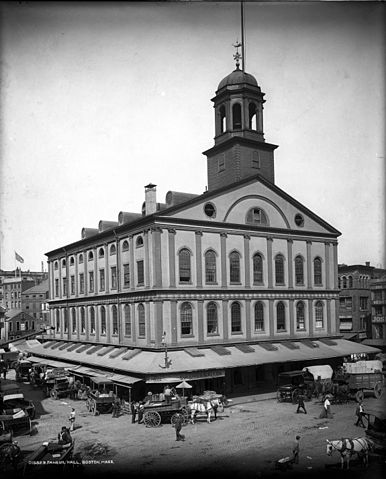
In 1884 James Mascarene Hubbard delivered a paper to the Bostonian Society about Boston’s transition from town to city in the early 1820s. His description of a town meeting in Faneuil Hall over the turn of the year 1822 offers glimpses of this Samuel Adams, as filtered through the Daily Advertiser:
[On whether to relabel Boston as a city.] Finally a hearing was obtained for Mr. Samuel Adams, wire-worker, that is, a maker of rat-traps, and late town-crier, who made a characteristic speech amid malicious “cries of Louder” although the orator appeared to labor excessively at his lungs. His opening words were, “Fellow citizens, you must consider me as on the brink of an eternal world,“ [Adams was then in his early sixties, but he would live three more decades] and the burden of his speech was, “Names is nothing. Only let us have Boston, and I care not what you call it.” Later on in the debate, which from this time took a more serious turn, he “rose and moved that the word ‘Boston’ be added to the word ‘city,’” to the great merriment of the assembly. . . .

[On what to call the new city’s top official.] Mr. Adams made a fresh appearance in the character of a New England Dogberry. “He was opposed to the term Mayor. A mare is a horse, and he had as lief be called a horse or an ass as a mare. He preferred the name President. There was dignity in the sound. He should count it an honor to be called President, but had he the wisdom of Solomon and the riches of the East, he would not accept the office to be called a Mare.” . . .

[On whether to hold elections in the neighborhoods or at Faneuil Hall.] As the irrepressible Adams puts it: “Many persons can’t attend here. For instance a journeyman who is in your employ. They feel so delicate in your employ, they are afraid of offending you. They are the sinners [sinews] of the State.” . . .

On the clause authorizing the City Council to sell or lease the property of the city,…Mr. Adams [was heard] to say, among other things, that “a new set of men might get together under the capacity of selling city property.” . . .

Our final quotation shall be from a speech by Mr. Adams, whose office as Town-crier seems to have given him a power and persistence of lungs which no cries of “Question” could overcome. “I would examine the act,” he exclaimed; “Like David of old, I would not give sleep to my eyes nor slumber to my eyelids until I had pondered it well. I have done it, have lain awake all night ruminating on these here things.”
Hubbard suggested that Adams belonged in a group he called ”mushroom town-meeting orators, and weak heads.” He showed more respect for upper-class figures, including such men as Benjamin Russell, William Tudor, James T. Austin, future mayor Josiah Quincy, and S. A. Wells, descendant and biographer of the other Samuel Adams.

Boston’s business elite had been pushing to incorporate the town as a city like New York since the early 1700s. The populace had long pushed back, preferring the town-meeting form of government, which didn’t turn over power to just a few elected men.

Wire-worker Adams appears to have been suspicious about concentrating power, to judge by his support for neighborhood elections and poorly expressed worry about a conspiracy to sell public property. But he also seems to have been fairly resigned to the change. Boston had grown to more than 40,000 people, nearly three times its size when he was a boy, and a city charter may have seemed necessary.

Ironically, by 1835 the term “wire-worker“ became a synonym for “wire-puller”—someone who manipulated politics or government from behind the scenes. Samuel Adams was a real wire-worker, and he never seems to have held significant power, despite all his efforts.

TOMORROW: What did this Samuel Adams do in the Revolution?

Monday, August 25, 2014

Samuel Adams the Wire-worker

In two postings on the Bostonian Society’s blog, Kathryn Griffith just profiled Samuel Adams the wire-worker, source of the striped cloth in the society’s collection that’s become known as the “Liberty Tree Flag.”

Harris wrote about this man:
Samuel Adams was born in 1759, reportedly in the North End, to a book-binder named Benjamin Adams and his wife Abigail. Samuel had an older brother, Abraham, who became a leather-dresser and a well-respected citizen. Samuel married Catharine Fenno in Boston in 1781. They had 8 children together, including a son named for Benjamin Franklin, and a daughter, also Catharine, who married William Fenno, and through whose descendents the flag passed to John Fernald.

Adams moved around quite a bit according to the Boston city directories and the advertisements he placed in newspapers. He had several occupations during his lifetime; in fact it seems he came late to wire-working. In the 1790s Adams owned a wharf at the end of Cross Street from which he sold various goods. In the early 1800s he became the town crier, and printed a number of interesting advertisements announcing things he had found throughout the town. As a wire worker, his business was known as the Sign of the Flying Man and Fender Manufactory, and his advertisements included beautiful designs of his work. His work in wire also earned him the nickname, “Rat-Trap Adams,” by which he was known affectionately (or not, depending on the source).
Because Adams was a minor public figure, his nineteenth-century life is fairly well documented. Indeed, his death in 1855 was reported across the country. One California newspaper ran this notice:
Death of a Veteran Citizen.—Mr. Samuel Adams, one of the oldest inhabitants of Boston, died at his residence on the 21st March, at the advanced age of about 96 years. The Traveller says: “He was a witness, and no doubt sometimes a participant, in the many exciting street scenes which occurred in Boston previous to the actual commencement of hostilities. He had in his possession as a relic of those glorious days, a flag which was hoisted on the liberty pole near Essex street, and which has of late been frequently displayed in this city. Mr. Adams was a mechanic—a wire worker by trade, and followed his business until within a few years. In religious matters he was an atheist, and in olden times a close attendant upon all town meetings and public gatherings, where his rather ultra democratic sentiments caused his opponents to taunt him with being a ‘French Jacobin.’”
Unfortunately, this Samuel Adams’s eighteenth-century activities, and his connection to Liberty Tree, are much less certain.

TOMORROW: Young Samuel Adams.

Sunday, August 24, 2014

What Will Happen with the Sawin House?

Back in 2012, I noted that there was a discussion about tearing down the Sawin House in Natick.

The oldest parts of that building are said to date back to 1696 and the first English settlers in that town, which was originally set aside for Native American converts to Christianity. The building also has a connection to the Lexington Alarm, though that’s more tenuous.

The house is now inside a MassAudubon wildlife sanctuary, and that organization says that preserving the structure is not within its mission.

This past week Brian Benson reported for the local newspaper that the Natick selectmen had deadlocked over competing proposals and would probably turn the question over to the full town meeting.
The Historical Society has proposed taking materials from the Sawin House, which is on South Street in MassAudubon’s Broadmoor Wildlife Sanctuary, and reconstructing in Shaw Park on Rte. 16 a section of the home resembling its appearance when Europeans settled the area.

But, the proposal has sparked controversy with some people arguing the society’s plan would take the home out of its historical landscape and take away open space. Others have said it would help showcase the town’s history and protect part of a building that could otherwise continue to deteriorate.
The plan to move the house would alter the use of Shaw Park and alter the historic structure from how it exists today, and those changes would require approval from various levels of government. That’s unlikely to happen unless the community reaches a consensus on what it wants. But it doesn’t appear to be an easy question.

Saturday, August 23, 2014

Half a Million Steps Along the Freedom Trail

Big congratulations to Charles Bahne for reaching the “half a million copies in print” milestone with his Compete Guide to Boston’s Freedom Trail!

This paperback is not only a thorough and affordable little guide to Boston’s most famous historic sites from the Revolutionary and Federalist eras, but it’s also a fine example of micro-publishing. Charlie saw the need for such a book years ago while instructing tourists about the Freedom Trail, and he created the first edition before computers and the internet and print-on-demand made self-publishing as easy as it is today.

Now in its fourth edition with color illustrations, The Complete Guide to Boston’s Freedom Trail has survived into the world of smartphones and apps. Of course, it’s very light, has a larger reading surface than a phone, and needs no electricity. The book is available through Boston shops, the big online booksellers, and this local website.

Friday, August 22, 2014

Politics of the Doctors’ Riot

The New York doctors’ riot of 1788 arose from a popular emotional response to medical students’ grave-robbing and disrespectful treatment of corpses. But it also had a clear political component.

Those students tended to take bodies from the cemeteries for the poor and powerless, particularly the Negro burying-ground and the potters’ field, both outside the city limits. When African-Americans started guarding their large cemetery at night, some historians say, the grave-robbing switched to smaller private burying-grounds, again concentrating on those for the poor. But it wasn’t until white bodies began to disappear that the city’s laboring class rose up.

Most accounts say the attack on the Columbia medical school was led by a mason who had just lost his wife—both figuratively and literally. But none preserves that man’s name, nor the names of the five members of the mob who died. All our detailed accounts come from upper-class citizens who showed more sympathy for the cause of anatomical study than for the rioters’ passions. Their narratives may not be fully accurate, but they certainly show how the elite viewed “popular rage,” and they established the storyline for future chroniclers.

One political result of the riot was a New York law passed in 1789 providing for the corpses of executed convicts to be dissected. The practice remained distasteful to many people, however, especially those whose families were too poor to benefit from medical education or the treatments that proponents of dissection promised. In 1790 some medical students responded to that social pressure by forming what became the New York Dispensary to provide free medicines to the poor; it received a legal charter from the state in 1795.

It’s tempting to ask what effect the New York riots of mid-April 1788 had on the debate over ratifying the new U.S. Constitution. The Continental Congress had left Philadelphia in 1783 because of an uprising there. The Regulation movement in Massachusetts, which authorities dubbed Shays’ Rebellion, had prompted the Constitutional Convention. And just as states were debating the resulting plan for a new government, New York City was roiled with more unrest. Did the doctors’ riot make America’s political leaders fear that they had to act quickly or the U.S. of A. would crumble into anarchy?

I haven’t found evidence of that episode having a direct effect on the ratification debate. At one point authors speculated that John Jay’s injury during the riots had kept him from writing more of the “Publius” essays with Alexander Hamilton and James Madison, but it appears that those essays (now known as The Federalist Papers) were finished weeks before the riot. By June, when New York’s ratifying convention began, Jay had recovered.

The New York legislature had already decided to hold that convention in Poughkeepsie, well away from the capital. The delegates chose Gov. George Clinton to chair that convention; he’d led the efforts to suppress the riot, but he remained an Anti-Federalist, opposed to a stronger national government.

In the end, the New York convention wasn’t that decisive anyhow. After their first week of meetings in June, the delegates got word that New Hampshire had become the ninth state to ratify the new document, meaning that under its own rules (Article VII), it would take effect. Then Virginia ratified as well. New York’s opponents therefore focused on demanding a Bill of Rights and other amendments, getting the most they could out of the situation. Clinton and others abstained from voting, and the proposal passed. So instead of being a significant event in U.S. constitutional history, the doctors’ riot is recalled as a curious social incident.

Thursday, August 21, 2014

Chasing Down the Obnoxious Dr. Hicks

The New York doctors’ riot of April 1788, most chroniclers agree, was set off by a doctor named John Hicks making a tasteless and ill-timed joke about a corpse he was dissecting.

Identifying that man is complicated by the fact that two men named John Hicks practiced medicine in New York City in the late 1700s.

One, working out of Magazine Street, had been a “supernumerary mate” at the army hospital in 1783. On 15 Apr 1788, immediately after the riot, this “John Hicks, Sr.,” swore publicly that he hadn’t been in the hospital since that year and had no connection to any dissection. He was trying to distinguish himself from the real culprit, a medical student with a similar name.

John Brovort Hicks was born about 1768. He was actually the second person with that name; his older brother had died young, immortalized in a mourning ring. John B. Hicks was thus twenty years old during the doctors’ riot.

Hicks didn’t end up in the besieged jail with some other doctors. According to William Alexander Duer, he had fled on his own to the house of a former surgeon general of the Continental Army:
The obnoxious Dr. Hicks fled in the first instance to Dr. [John] Cochran’s, nearly opposite Trinity Church. Relying for protection upon the general respect in which Dr. Cochran was held, and that from his having relinquished practice, his house would escape search. But the mob had an intimation of Hicks’s retreat, and searched the house from cellar to garret, without success. They even opened the scuttle and looked out upon the roof, without perceiving the Doctor, who lay perdue [i.e., concealed] behind the chimney of the next house, suffering probably under a more violent sudorific [i.e., drug that induces sweating] than he ever ventured to administer to a patient.
That same story might have been what the Virginian William Heth heard when he wrote that one medical student “took refuge up a chimney.”

Young Hicks survived to complete his medical training. In 1792 he put a notice in the newspaper that he had successfully operated on a stone—a gallstone or kidney stone—at the City Hospital. The next year Columbia granted him an “M.D.” In 1796 Hicks and some colleagues got the mayor of New York to bar a supposedly unqualified doctor from practicing; Alexander Hamilton represented that other doctor and got the mayor’s order quashed.

In August 1797 Hicks and one of those colleagues had to advertise in the newspapers after dissected body parts were found in a sack in the river. They acknowledged that that corpse was a man named John Young, but since he had just been hanged for murder, under a new law he was eligible for dissection. The surgeons insisted that they had anatomized Young “in as decent and secret a manner as the nature of the business would admit of.” (As secret as any activity in what they called their “Anatomical Theater.”) But “the persons to whom the remains of the body were committed to be interred”—probably medical students—had tossed the pieces in the water and neglected to weigh down the bag.

Dr. John B. Hicks was thus involved in two public scandals involving dissected corpses within ten years. In one of those incidents, his insulting behavior had resulted in a riot. In the other, he was simply careless. And yet Hicks remained a respected physician. It probably didn’t hurt that he came from the city’s upper class: his late father, Whitehead Hicks, had been mayor of New York for the decade before the Revolution.

On 2 Oct 1798, in the midst of a yellow fever epidemic, the Daily Advertiser reported Hicks’s death. It lamented his
indefatigable zeal & pursuit to administer relief to the poor and distressed in this trying hour of distress and melancholy, and for which he would receive no compensation. But alas! he falls a devoted victim himself to the prevailing epidemic. . . . He was possessed of a truly philanthropic spirit, and his principal study was to do good. In him the poor have lost a valuable friend, and the public a useful member of society.
Hicks left a wife and at least one child.

TOMORROW: The political side of the doctors’ riot.

Wednesday, August 20, 2014

A Child’s Memories of the Doctors’ Riot of 1788

A few days back I mentioned William Alexander Duer’s New-York as it Was, During the Latter Part of the Last Century, published in 1849.

Duer (shown here in a copy of a daguerreotype) was born in 1780, son of the British-born Patriot politician William Duer and grandson of the Continental general William Alexander, Lord Stirling.

Duer called the doctors’ riot of 1788 the “public occurrence that made the earliest, if not the deepest impression upon my memory.”

His retellings of events included details he couldn’t have been privy to at the time, and thus must have heard secondhand or taken from previous accounts. But he also described some dramatic moments that he or his family personally witnessed, recalled with the enthusiasm of a seven-year-old.

For example, the clash of an upper-class militia company on horseback and the crowd:
Never shall I forget the charge I saw made upon a body of the rioters by [Capt. John] Stakes’s light-horse. From our residence opposite St. Paul’s, I first perceived the troop as it debouched from Fair, now Fulton-street, and attacked the masses collected at the entrance of the “fields,” whence they were soon scattered, some of them retreating into the church-yard,—driven sword in hand through the portico, by the troopers striking right and left with the backs of their sabres.
And the wounding and care of Gen. Steuben:
The Baron de Steuben was struck by a stone which knocked him down, inflicted a flesh wound upon his forehead, and wrought a sudden change in the compassionate feelings he had previously entertained towards the mob. At the moment of receiving it, he was earnestly remonstrating with the Governor against ordering the militia to fire on the people; but, as soon as he was struck, the Baron’s benevolence deserted him, and as he fell he lustily cried out, “fire! Governor, fire!”

[Footnote:] Upon the occasion mentioned in the text, he was brought bleeding into my father’s house, accompanied by most of the cortege which had assembled at the gaol, and there being no surgeon to be had, my mother [Catherine Duer] staunched his wound, of which the old soldier made very light, and bound up his head. After his departure, Governor [George] Clinton amused the company by relating the above anecdote.
Duer thus left us both a delicious story about Steuben and the provenance for it: from Gov. Clinton to his mother and thence to him.

Another eyewitness, not so young, was William Dunlap (1766-1839), whose history of New York was posthumously published in 1840. He wrote that during the doctors’ riot, “The house of Sir John Temple, the British consul, in Queen Street, was with difficulty saved. It was said ‘Sir John’ was misinterpreted ‘Surgeon.’”

Temple was James Bowdoin’s son-in-law, a friendly Customs official in Boston before the Revolution, and the most likely conduit for Gov. Thomas Hutchinson’s letters to Benjamin Franklin. However, I can’t find any confirmation from Temple’s published papers for his house being mobbed in 1788.

TOMORROW: What about the medical student who started all the trouble?

Tuesday, August 19, 2014

Fight at the New York City Jail

When we left off William Heth’s account of the New York doctors’ riot of April 1788, the anti-dissection crowd had started to attack the city jail, where some anatomy teachers and students had taken refuge. Heth wrote:

The militia were ordered out, small parties were sent to disperse them [the rioters], but they instantly disarmed those attachments, broke their guns to peices, arid made them scamper to save their lives.

The evening advanced apace, and the affair became very serious. The Governor [George Clinton, shown here], after trudging about all day, first with the mob in the morning, endeavouring to pacify and accommodate, and in the afternoon to assemble a body respectable enough to preserve the goal [i.e., jail] and to restore peace and good order, advanced about dusk with a number of the Citizens, but without any kind of order or without any other than a few side arms and canes, while the Adjutant-Gen’l of the militia [Nicholas Fish], about 300 yards in his rear, led up in very good order about 150 men, tho’ not more than half with firearms, among whom were many gentlemen of the city and strangers, volunteers.

This body were not long before the goal before the bricks and stones from the mob provoked several to fire, and perhaps their might, on the whole, have been 60 guns discharged, but this is mere guess. This body made their way into the goal where a party remained all night, but a sally of 60 or 70 were defeated. Three of the mob were killed on the spot, and one has since died of his wounds, and several were wounded. One of them was bayonetted on attempting to force into a window of the prison which he saw filled with armed men, a proof of the astonishing lengths to which popular rage will sometimes carry men.

Numbers on the Governor’s side, besides himself, are severely bruised. Baron Steuben rec’d a wound just above the corner of his left eye and nose, from which he lost a great deal of blood. Mr. [John] Jay got his Scull almost cracked, and are both now laid up. Gen’l [John] Armstrong has got a bruised leg, but is able to go out.

Yesterday the militia turned out again, and made a respectable appearance, and paraded about exceedingly, both Horse and Foot, but it must be observed that the enemy were not be heard of.

In truth numbers who were in the mob on Monday evening turned out yesterday to support government.
It looks like “Gen’l Armstrong” was John Armstrong, Jr. (1758-1843), adjutant general of Pennsylvania and central figure in the so-called “Newburgh Conspiracy.” He was in New York as a delegate to the Continental Congress, and would soon settle in that state.

According to a letter from John Jay’s wife Sarah to her mother, it took a while for doctors “to decide whether his brain was injur’d or not.” While they debated, the doctors bled him, of course. Jay recovered.

TOMORROW: Treating the baron’s injury.

Monday, August 18, 2014

A Virginian on New York’s Doctors’ Riot

In the spring of 1788 a Virginia planter and retired colonel named William Heth (1750–1807) was in New York, commissioned by his state as a negotiator with the young national government on ceding Virginia’s claims to western lands.

While in New York, Heth witnessed parts of the doctors’ riot that I mentioned yesterday. On 16 April he sent a private letter to the Virginia governor, Edmund Randolph, describing that event:
We have been in a state of great tumult for a day or two past—the causes of which, as well as I can digest them from various accounts, are as follows:

The young Students of Physic have for some time past been loudly complained of for their very frequent and wanton trespasses in the burial ground of this City. The Corpse of a young gentleman from the West Indias was lately taken up, the grave left open, and the funeral clothing scattered about. A very handsome and much-esteemed young lady of good connections was also recently carry’d off. These, with various other acts of a similar kind, inflamed the minds of people exceedingly, and the young members of the faculty, as well as the Mansions of the dead, have been closely watched.

On Sunday last, as some people were strolling by the Hospital, they discovered a something hanging up at one of the windows which excited their curiosity, and making use of a stick to Satisfy that curiosity, part of a man’s arm or leg tumbled out upon them. The cry of barbarity, &c., was soon spread; the young sons of Galen fled in every direction; one took refuge up a chimney. The mob rais’d and the Hospital appartments were ransacked. In the Anatomy-room were found three fresh bodies, one boiling in a kettle and two others cuting up, with certain parts of the two sexes hanging up in a most brutal position.

These circumstances, together with the wanton and apparent inhuman complexion of the room, exasperated the mob beyond all bounds, to the total destruction of every anatomy in the Hospital, one of which was of so much value and utility that it is justly esteemed a great public loss, having been prepared in a way which costs much time and attention and requires great skill to accomplish.

On Monday morning the mob assembled again, and increased thro’ the day to an alarming size. Vengeance was denounced against the faculty in general, but more particularly against certain individuals. Not a man of the profession thought himself safe. An innocent person got beat and abused for being only dressed in black.

Two of the young tribe were unfortunate enough to fall into their hands, but the Mayor [James Duane, shown above] obtained them upon a promise of sending them to gaol—a measure to which in their rage they submitted, not reflecting that sending them to goal would secure them from their violence and resentment, and therefore, as soon as they found themselves thus defeated in their furious intentions respecting their captives, they repaired to the goal and commenced their attack (with all that intemperance and folly which ever marks the conduct of people assembled in that way), vainly endeavouring to break in, when they could do nothing more than break windows, &c., which they will be taxed to repair.
TOMORROW: The jail under attack, and the militia called out.

Sunday, August 17, 2014

The New York Doctors’ Riot of 1788

In January 2011 the Lancet published a brief article about protests in 1788 over how medical students in New York dug up corpses from the burying-grounds for dissection training.

Through juxtaposition that article suggests that the city’s African-American community, their petitions and newspaper letters ignored, finally rioted over the practice in April 1788. But this New York Magazine article on the same events makes clear that the riot occurred only after “students began digging up white graves, too.”

From the Lancet:
In April, 1788, a group of children playing outside the New York Hospital ventured near [Dr. Richard] Bayley’s rooms where a student named John Hicks was dissecting an arm. Hicks is said to have waved the arm out the window at the children, including one small boy who had recently lost his mother. Hicks supposedly called to the child: “This is your mother’s arm! I just dug it up!” The youngster ran home, his father enlisted help to exhume his wife’s coffin, which was found to be empty—and the riot was on.

Citizens began to mass around the hospital building. Hicks, with other medical students and professors, beat a hasty retreat. By the time the mob broke in, the hospital was abandoned except for [Dr. Wright] Post and four senior medical students, all determined to save a valuable collection of anatomy specimens accumulated over many years. But they were outnumbered, and although not harmed themselves all the specimens were taken and destroyed.

James Thacher, a physician who witnessed the riot, described it in his memoirs: “The concourse assembled on this occasion was immense, and some of the mob having forced their way into the dissecting-room, several human bodies were found in various states of mutilation. Enraged at this discovery, they seized upon the fragments, as heads, legs and arms, and exposed them from the windows and doors to public view, with horrid imprecations.”
Though the article doesn’t note this fact, most of its details about the start of the riot ultimately come from William Alexander Duer’s New-York as it Was, During the Latter Part of the Last Century, published in 1849.

Dr. James Thacher didn’t in fact witness the riot; he was home in Plymouth in 1788. Thacher wrote the passage quoted above for the section on the history of medicine in New York in his American Medical Biography (1828). That book includes the word “memoirs” in its subtitle because it contains memoirs—i.e., profiles—of eminent American physicians.

In that book Thacher described the career of Dr. Richard Bayley, in whose rooms the controversial dissection took place. Not only did Bayley train in Britain, but he returned there in the autumn of 1775 and then came back to America as a British army surgeon. Thacher wrote that taking that position had been “a step of necessity rather than of inclination,” and that Bayley resigned in 1777. Nevertheless, Dr. Bayley stayed in British-occupied New York throughout the war.

Evidently an experienced surgeon (known particularly for his treatment of the croup) was valuable enough to the community that Bayley felt he could stay in New York at the end of the war. His reputation also survived the doctors’ riot, and he became a Columbia University medical professor. Dr. Bayley died in 1801 of yellow fever. (His daughter Elizabeth Ann is better known as Mother Seton.)

TOMORROW: A real eyewitness account from April 1788.

Saturday, August 16, 2014

News from Newport

The Newport Historical Society is commemorating the city’s Stamp Act protests of late August 1765.

The society has created an online timeline of the protests, where the above clipping from the Newport Mercury comes from. The three effigies represented stamp agent (and Rhode Island attorney general) Augustus Johnston and two men who had written in favor of the law and stronger central authority, Dr. Thomas Moffatt and lawyer Martin Howard.

Today at 11:00 A.M., the Newport History Tours collaboration offers a walking tour titled “The Stamp Act Riot and the Road to Revolution,” going past some of the sites involved in those protests. That costs $15 per person; call 401-841-8770 to see if there are still spaces.

Next Saturday, 23 August, starting at 1:00 P.M., a team of reenactors will stroll the Old Quarter of Newport, chatting with visitors about the new Stamp Act. In the late afternoon those pedestrians will congregate in front of the Colony House on Washington Square, and the action will escalate into a riot. Perhaps some houses will be mobbed, as in 1765.

Attending the outdoor reenactment is free, though the society welcomes any donations. Immediately afterward, from 5:00 to 7:00 P.M., the society with host a Stamp Act party; admission to that is $25, or $20 for members, and presumably there will be no mobbing.

Friday, August 15, 2014

The Legend of Mme. Jumel

Ben Carp alerted me to this gossipy Gothamist article by Danielle Oteri about Eliza Jumel, long-time owner of the Morris-Jumel Mansion in the Washington Heights area of Manhattan. A taste:
Eliza Jumel’s New York Times obituary [from 1865] states that her mother died shortly after giving birth and that she was placed in the care of “a good woman, and many clergymen visited her comparatively humble dwelling, so that the early years of the little one were passed amid good influences.”

In fact, Eliza “Betsy” Bowen was born in either 1773 or 1775 to a mother who worked as a prostitute for a black madam in a Providence, Rhode Island brothel.

Though the means of her ascent aren’t entirely clear, Jumel left Providence in the early 1790s for New York, then a town of 60,000 people. She worked as an actress, and seems to have used her considerable wit and beauty to gain access to many of the city’s elite.

However, her obituary claims that Eliza was brought into these circles when she eloped to New York with Col. P. Croix; that she attended the inauguration of George Washington, was best friends with Benedict Arnold’s wife, and inspired Patrick Henry to fall in love with her. The obituary also claims she was present at the first session of the Continental Congress in 1774, which would have made her exceedingly distinguished for a 1-year old.
Jumel did have some genuine top Revolutionary connections. Her house, abandoned by its Loyalist owner, was Gen. Washington’s headquarters for a short time in 1776. Her second (documented) husband was Aaron Burr; when that marriage soured, she had the dramatic sense to hire Alexander Hamilton’s son as her attorney.

Thursday, August 14, 2014

Furnishing Lectures in September

Next month the Paul Revere Memorial Association is sponsoring a series of lectures on “18th-Century Massachusetts Furniture: Form, Function & Fabrication,” to take place in the Old South Meeting House. Each event starts at 6:30 on a Wednesday evening.

3 September
High-Style Craftsmanship and Patronage in Marblehead on the Eve of Independence
Known more for its pivotal role in the American Revolution and its exceptional legacy of early American architecture, Marblehead also has a noteworthy but relatively unfamiliar heritage of furniture craftsmanship. Judy Anderson, Principal, Marblehead Architectural Heritage, will show how, in contrast to the clamor and boisterousness of the working harbor front, Marblehead cabinetmakers and clockmakers produced high-style furniture for a clientele that comprised more than thirty merchants in Massachusetts’ celebrated Atlantic codfish trade.
10 September
Seat of Empire: Refurnishing Boston’s Historic Council Chamber
The Council Chamber in Boston’s Town House (now the Old State House), where the Royal Governor of Massachusetts met with members of his Council, was once an important administrative center for the British Empire in North America. This historic room has recently been returned to its appearance during the 1760s, when the fate of the British Empire turned on the decisions made within its walls. Dr. Nathaniel Sheidley, Historian and Director of Public History at the Bostonian Society, will describe how, thanks to an unprecedented collaboration between the Bostonian Society and North Bennet Street School, visitors can now sit in the Governor’s chair and thumb through reproduction documents at the Council table.
17 September
Restrained Elegance: Boston Furniture in the Rococo Style
Bostonians in the mid-eighteenth century only cautiously embraced the lively international “modern” style that collectors have come to call “Chippendale” and art historians the “rococo.” Nevertheless, some Boston cabinetmakers and carvers, such as George Bright, John Cogswell, and John Welch, created masterworks in this ornamental, curvilinear mode that owes its name to the Englishman Thomas Chippendale and his influential book of designs. Using objects from important public and private collections, Gerald W. R. Ward, Senior Consulting Curator, Museum of Fine Arts, Boston, will examine Boston rococo furniture in the context of its heyday in Boston in the 1760s and 1770s.
24 September
The Best Workman in the Shop: Cabinetmaker William Monroe of Concord, Massachusetts
In June 1800, 21-year-old cabinetmaker William Munroe arrived in Concord with a set of tools and $3.40 in cash. Forty years later he proudly recorded having more than $20,000 in assets, a remarkable achievement for a craftsman. Concord Museum Curator David F. Wood will describe how, influenced by fashion and international politics and motivated by self-esteem and good food, William Munroe steered a path through the treacherous economic landscape of Federal New England and along the way helped make some of the most beautiful clocks the new nation ever produced.
All these talks are free and open to the public.

Wednesday, August 13, 2014

Benjamin Franklin Leaves Boston in Style

Among the first generation of leading American statesmen, Benjamin Franklin is often said to be the only one who was ever in bondage to another person. Sure, he was an apprentice with a limited time until he became free, and his master was his older brother James, but he still chafed at that status.

Paradoxically, Benjamin was formally identified as the publisher of the New England Courant, a ruse to get around the authorities’ ban on James issuing a newspaper. But James was master of the shop.

Benjamin started to talk about working somewhere else. James reportedly went to the other printers in Boston and warned them not to hire his brother. Benjamin then started to talk about going to New York instead.

In Franklin’s autobiography, he described how he made it out of Boston this way:
I determin’d on the Point, but my Father now siding with my Brother, I was sensible that, if I attempted to go openly, Means would be used to prevent me. My Friend [John] Collins, therefore, undertook to manage a little for me. He agreed with the Captain of a New York Sloop for my Passage, under the Notion of my being a young Acquaintance of his that had got a naughty Girl with Child, whose Friends would compel me to marry her, and therefore I could not appear or come away publicly.

So I sold some of my Books to raise a little Money, Was taken on board privately, and as we had a fair Wind, in three Days I found myself in New York, near three hundred Miles from Home, a Boy of but seventeen, without the least Recommendation to or Knowledge of any Person in the Place, and with very little Money in my Pocket.
Such a classy start for the future Founder.

William Temple Franklin published the autobiography after his grandfather’s death, he substituted “had an intrigue with a girl of bad character” for “got a naughty Girl with Child.” That doesn’t really address the fact that it takes two to be naughty in that fashion. Furthermore, once he settled in Philadelphia, Benjamin proved himself fully capable of doing just what his friend Collins had described him doing back in Boston.

(Collins eventually followed Franklin to Philadelphia, but their friendship didn’t last.)

Tuesday, August 12, 2014

Dispatch from the Green Dragon

I’m typing this in a coffee house in Carlsbad, California. But not just any coffee house—the one attached to the Green Dragon Tavern and Museum.

I reported on the plans for this complex and its opening last year. So when I made plans for a convention in San Diego, I included time to drive forty minutes up the coast to south Carlsbad and check it out for myself.

I went thinking I’d find something fairly kitschy: a replica of the original Green Dragon (as depicted by John Johnson) tacked onto a California strip mall.

And in fact the site is in an area of strip malls. Next door is a car wash with a lovely Southwestern tile roof, as seen in the background of this photo. The first thing one sees getting off that exit from I-5 is a giant windmill attached to a motel.

But the Green Dragon Tavern and Museum is a more extensive and substantive enterprise than I’d expected. In size, it’s not just part of a strip mall—it’s an entire strip mall’s worth of structures. The part made to look like the original tavern is the main restaurant dining room, two levels high, and the coffee shop and bookstore. On the far side are a series of meeting rooms for special dinners.

And in between is a museum devoted to the owner’s interests in New England history, particularly the Revolution but starting in Plymouth Colony and including the Salem Witch Trials. The displays include replicas of significant documents and many original artifacts bearing the signatures of famous historical figures: legal documents signed by Samuel Sewall, Thomas Hutchinson, John Adams, and Robert Treat Paine, for example.

Throughout the building are framed copies of early American newspapers, mostly from the last two decades of the eighteenth century. And by throughout, I mean throughout. The hall to one set of restrooms, for example, includes a 1783 issue of the Providence Gazette and two issues of Benjamin Russell’s Columbian Centinel from the early 1790s. In another issue of the Centinel I spotted a big advertisement from Samuel Gore, one of “my guys.”

Amidst those genuine period documents are reproductions of nineteenth-century popular art, posters of the most famous Founders, postcard photographs of national monuments, and so on. So there’s definitely the potential for hagiographic kitsch. But the quotations on those Founder posters all have citations to particular documents (which is more than some folks can provide). There’s a display clearly explaining the eighteenth-century long s to visitors. Some of the labels discuss how American historiography or commemoration has changed over time.

I quibble with some of the historical statements I see in the displays or literature. I don’t think of the Sons of Liberty as a “secret society” but rather an amorphous political label like “Tea Party” or “Occupy Movement.” I don’t think “Paul Revere departed the Green Dragon Tavern for his famous ride,” though he definitely spent a lot of time there. But for me the list of quibbles is small.

The bookstore attached to the coffee shop includes a lot of popular titles for both kids and adults, focusing mostly on the Founders (and including some I think are flawed). However, the selection includes ground-breaking biographies from academics, including Woody Holton on Abigail Adams and Jill Lepore on Jane Mecom. And I can’t complain about any store carrying Reporting the Revolutionary War, with two essays by me.

The restaurant has wood paneling and a fireplace, but it’s not trying to be a period site (at least at lunchtime). There are multiple televisions tuned to sports channels. The menu may have sandwiches named after Boston Revolutionaries, but they’re all California cuisine, heavy on the avocado.

Overall, the Green Dragon Tavern and Museum is a solid little private museum with a significant number of print artifacts to examine, particularly newspapers. In its emphasis on the most prominent Founders, their signatures, and genealogy, its sensibility is old-fashioned, but within that sensibility the standards are high. The site is a very short drive off I-5, so I feel confident recommending it to folks traveling between San Diego and Los Angeles and seeking a genuine taste of the Revolutionary Era (as well as California cuisine).

Monday, August 11, 2014

Celebrating Benjamin Thompson

On Sunday, 17 August, the Rumford Birthplace Museum in Woburn will celebrate two anniversaries:

  • the 300th of the construction of the house’s oldest rooms.
  • the 200th of the death of the man who made that house famous enough to be preserved: Benjamin Thompson, later Count Rumford.
Thompson is one of our favorite Revolutionary characters here at Boston 1775.

As part of the day’s celebrations, a member of His Majesty’s 10th Regiment reenacting unit, Lincoln Clark III, will portray Thompson describing his military actions with the King’s American Dragoons late in the Revolutionary War. (Presumably this Thompson will keep his activity as a spy in 1775 under wraps.)

Living history interpreter Dean Howarth will describe Thompson’s achievements as a scientist. (His equally impressive achievements as a social climber, civil administrator, and roué will probably wait for another year.)

There will also be presentations on items and displays in the house, including “an old artifact that was stolen, located, disappeared, found, and used for scrap.” And there will be a demonstration of eighteenth-century social dance.

Since Thompson was a Loyalist who rose high within the British government and army, the museum is particularly interested in having people who portray the king’s supporters at the anniversary. The event is scheduled to last from 2:00 to 4:00 P.M.

Sunday, August 10, 2014

Cockburn’s Cure

Westminster Abbey explains:
William Cockburn, a wealthy physician of St James Street Westminster, was buried in the middle aisle of the nave of Westminster Abbey, near the entrance to the Choir, on 24 November 1739, aged 70. He has no monument or marker. His first wife, a widow called Mary de Baudisson, was buried on 12 July 1728.

He was born in 1669 and educated in Edinburgh and Leiden. Nothing is known of his parents. In London he had a wealthy patron and published several books on physic. He was a member of the Royal College of Physicians and physician to the Royal Navy's blue squadron. His secret remedy for dysentry made his fortune.

In 1729 he married secondly Lady Mary Fielding, daughter of the Earl of Denbigh. The story goes that on a visit to Lady Mary he found her weeping saying she could no longer afford to live in the town and would have to go into the country away from her friends. He said he hoped he was one of her friends, and she agreed, and he said “if an old man and £50,000 can be acceptable to you, you may put off your journey...”. After ten days they were married. He was elected a Fellow of the Royal Society and was physician to Greenwich Hospital.
But really.

Saturday, August 09, 2014

Founders’ Favorite Quotations, part 3

Here’s the final run of “quotations” from America’s founders as chosen by some current tech company founders earlier this year. I put “quotations” in quotation marks because not all of them are, in fact, quotations from the people said to have said them.

I’m not holding these sayings to the original standards of punctuation, capitalization, or spelling, but I do want to see all the same words in the same order for them to qualify as quotations.

“Tyranny, like hell, is not easily conquered; yet we have this consolation with us, that the harder the conflict, the more glorious the triumph.” –Thomas Paine
From Paine’s The American Crisis.

“I have but one lamp by which my feet are guided, and that is the lamp of experience.” –Patrick Henry
From Henry’s 23 Mar 1775 speech to the Virginia Convention, the same that includes the phrase “Give me liberty or give me death”—at least as reconstructed by Henry’s biographer William Wirt in 1817. But a lot of Henry’s contemporaries thought Wirt’s work was bogus.

“Fear is the passion of slaves.” –Patrick Henry
Henry said this in a speech to Virginia’s ratifying convention in 1788. At the time he was arguing against the new U.S Constitution.

“The circulation of confidence is better than the circulation of money.” –James Madison
Madison said this in a speech to Virginia’s ratifying convention in 1788. At the time he was arguing for the new U.S. Constitution.

“Things may come to those who wait, but only the things left by those who hustle.” –Abraham Lincoln
This use of the word “hustle” would have been anachronistic for Lincoln, and he was, again, not a Founder.

“Happily for America, happily, we trust, for the whole human race, we pursued a new and more noble course: We accomplished a revolution which has no parallel in the annals of human society.” –James Madison
Madison wrote something like this in The Federalist, Number 14, in 1787. However, this misquotation says “we pursued” and “We accomplished” when Madison wrote “they,” referring to “the leaders of the revolution.” Madison was only twenty-four when the Revolutionary War began and didn’t claim to be a leader of that movement.

“Tell me and I forget, teach me and I may remember, involve me and I learn.” –Benjamin Franklin
Oh, please—that’s not eighteenth-century style. This appears to be a modern translation of a Chinese proverb, but that could be a myth as well.

“Lost time is never found again.” –Benjamin Franklin
Poor Richard’s Almanac for 1748. Franklin later elaborated on this sentence in “The Way to Wealth,” so I’m willing to give him credit even if he had a habit of quoting old sayings.

“The advancement and diffusion of knowledge is the only guardian of true liberty.” –James Madison
Someone took a longer sentence that Madison wrote to a friend in 1825 and stitched together this short sentence; at the very least there should be an ellipsis mark after “knowledge.”

“Diligence is the mother of good luck.” –Benjamin Franklin
Poor Richard’s Almanac for 1736. But the Oxford Dictionary of Quotations dates it to the late 1500s.

Out of these ten statements, five are correctly attributed to prominent American Founders, though one of those attributions has been debated since it appeared. Two more are significantly changed from what a man wrote, one is a much older saying, and two are falsehoods.

So what have we learned? First, for generations Americans have been attributing pithy things to Benjamin Franklin that he didn’t write or didn’t originate. More recently, we’ve been doing the same with Thomas Jefferson—not just on political matters but also lifestyle wisdom.

Finally, as the dueling speeches from Henry and Madison about the Constitution show, we can’t expect to treat the Founders as a single bloc of wise folk when they had hearty disagreements and temperamental differences among them.

Friday, August 08, 2014

Founders’ Favorite Quotations, part 2

As I explained yesterday, last month a website publishing for the technology world asked more than three dozen company founders to share their favorite quotations from America’s Founders.

Some of those were actual quotations from America’s Founders. Others, not so much. But we’re entering a good stretch.

“We have it in our power to begin the world over again.” –Thomas Paine
From Paine’s Common Sense.

“Perseverance and spirit have done wonders in all ages.” –George Washington
Washington to Gen. Philip Schuyler, 20 Aug 1775.

“Well done is better than well said.” –Benjamin Franklin
This saying appeared in Poor Richard’s Almanac for 1737. However, it’s likely that someone else has written this before Franklin. He copied a lot of the sayings in his almanacs straight out of published books when he wanted to fill space on a page. Americans like to attribute those quotations to him, but in fact he was usually quoting someone else.

“To be good and to do good is all we have to do.” –John Adams
Adams to his daughter Abigail, 17 Mar 1777.

“Those who would give up essential liberty to purchase a little temporary safety deserve neither liberty nor safety.” –Benjamin Franklin
Franklin writing for the Pennsylvania assembly, 11 Nov 1755.

“Beware of rashness, but with energy, and sleepless vigilance, go forward, and give us victories.” –Abraham Lincoln
Lincoln to Gen. Joseph Hooker, 26 Jan 1863—but Lincoln was not actually a Founder.

“Keep thy shop, and thy shop will keep thee.” –Benjamin Franklin
Poor Richard’s Almanac for 1735. But published previously in 1605 and (with “your” instead of “thy”) 1712.

“Determine never to be idle. No person will have occasion to complain of the want of time who never loses any. It is wonderful how much may be done if we are always doing.” –Thomas Jefferson
Jefferson to his daughter Martha, 5 May 1787, while he was in Marseilles.

“I’m a great believer in luck, and I find the harder I work, the more I have of it.” –Thomas Jefferson
False, according to Monticello.

“A strong body makes the mind strong. As to the species of exercises, I advise the gun. While this gives moderate exercise to the body, it gives boldness, enterprise and independence to the mind…Let your gun therefore be your constant companion of your walks.” –Thomas Jefferson
Jefferson to his nephew Peter Carr, 19 Aug 1785, while he was in Paris.

“We should not look back unless it is to derive useful lessons from past errors, and for the purpose of profiting by dearly bought experience.” –George Washington
Washington to John Armstrong, 26 Mar 1781, though he actually wrote, “We ought not to look back…”

“That government is best which governs least.” –Thomas Jefferson
False, according to Monticello.

“Whenever you do something, act as if all the world were watching.” –Thomas Jefferson
Not found in Founders Online or other authorities or all of Google Books. Nor a thought that fits well with Jefferson’s private behavior, which he liked to keep private.

“Early to bed, early to rise makes a man healthy, wealthy, and wise.” –Benjamin Franklin
Poor Richard’s Almanac for 1735. But in print as early as 1639.

So out of these fourteen items, seven are traceable to eighteenth-century American writings (though one is slightly misquoted). Three were published by Franklin, though he didn’t coin two and may not have coined any; three are falsehoods about Jefferson; and one is from a man born in 1809.

TOMORROW: The final batch, plus wrestling with Wirt.

Thursday, August 07, 2014

Founders’ Favorite Quotations, part 1

Last month, Ronald Barba rounded up tech company founders’ favorite quotations from America’s Founders. But are all those quotations authentic enough to invest in? Let’s audit that list.

“The purpose of money is to purchase the freedom to pursue that which was useful and interesting.” –Benjamin Franklin
This is a quotation from H. W. Brands’s 2000 biography of Franklin, not from Franklin himself.

“If a man empties his purse into his head, no one can take it from him.” –Benjamin Franklin
Attributed to Franklin as early as 1849, but not traceable to any specific work by him.

“Here sir, the people govern.” –Alexander Hamilton
Hamilton in 1788, arguing for ratification of the U.S. Constitution in New York. By “here” he was not referring to the U.S. of A. as a whole. He was speaking about the House of Representatives as opposed to the Senate, which was then to be elected by state legislatures—i.e., not by the people.

“Energy and persistence conquer all things.” –Benjamin Franklin
Attributed to Franklin in the 1890s, after it had appeared as a maxim in school textbooks with no credited coiner.

“Those who stand for nothing fall for anything.” –Alexander Hamilton
Actually said by the British journalist Alex Hamilton in a 1978 radio broadcast and published later that year. Other people had previously said much the same with different wording.

“A free people [claim] their rights as derived from the laws of nature, and not as the gift of their chief magistrate.” –Thomas Jefferson
Derived from a longer sentence in Jefferson’s draft of proposed instructions to Virginia’s delegates to the First Continental Congress in 1774, published in a pamphlet titled A Summary View of the Rights of British America.

“By failing to prepare you are preparing to fail.” –Benjamin Franklin
Not from Franklin, though attributed to him since around the Bicentennial.

“I like the dreams of the future better than the history of the past.” –Thomas Jefferson
Jefferson to John Adams, 1 Aug 1816.

Finally a quotation of a complete sentence, correctly attributed and not taken out of context! That makes two out of eight so far. On that note, I’ll stop for today.

TOMORROW: More quotations, and the Poor Richard problem.

Wednesday, August 06, 2014

Boston’s Long Journalism History

A Boston 1775 reader alerted me to last month’s announcement from Emerson University that the Society of Professional Journalists has named the city of Boston a National Historic Site in Journalism.

Prof. Manny Paraschos of Emerson’s Journalism Department pushed for this designation, based on a series of American newspaper firsts in the city, starting with the first newspaper in North America (Publick Occurrences, 1690), the first newspaper in North America to last more than one issue (Boston News-Letter, 1704-1776), and the second lasting North American newspaper (Boston Gazette, 1719-1798).

By the Revolution, several other American cities had newspapers, and some had more than one. However, Boston still clearly had more newspapers per capita than the larger ports of Philadelphia and New York.

Paraschos’s website includes a map developed by his students of the Boston Journalism Trail. Items 1 through 16 cover the eighteenth century.

Tuesday, August 05, 2014

Digging for Shays

The Burlington Free Press just ran an Associated Press story (also picked up by the Boston Globe and Wall Street Journal) about a high-school teacher’s archeological dig in Sandgate, Vermont, with roots in post-Revolutionary America:
On the south side of a mountain in Sandgate, Steve Butz and his students from Cambridge High School are unearthing what he and townspeople believe was the hideout of Daniel Shays, a former Continental Army captain who fled Massachusetts in 1787 after leading a fight against harsh economic policies.

“Everybody around here would be quick to tell you that’s Shays’ village,” said Jean Eisenhart, who has lived in Sandgate for almost 30 years. “It’s local lore.”

Historical documents, including a land transaction, prove Shays lived in Sandgate, but the exact location has never been verified. Butz hopes the dig will be able to pinpoint where Shays and his men made their home. . . .

Shays stayed in the state for about two years, then left, eventually settling in New York after he and the other rebels received pardons. Some of his followers remained in Vermont.

Butz said the settlement was later abandoned and the buildings burned in around 1810. That’s consistent with what other historical records say was an epidemic — there’s no indication of what disease — that swept the area, killing many.

Town records indicate the area was never settled again. It was owned by a succession of timber companies that would occasionally log the area in the intervening two centuries.
Here’s the Shays Settlement Project Facebook page. The image above shows a “Bronze, 18th century ornamental crotal bell” recovered at the site.

Monday, August 04, 2014

The “Adams” Cannon Relieved from Its Post

Today the Boston National Historical Park has closed the steps to the top of the Bunker Hill Monument in order to remove an item that’s been in the chamber atop that stone tower since the 1840s.

That artifact is the “Adams“ cannon, shown at right. Until the 1970s, a matching gun called the “Hancock” also hung in that chamber.

One legend says that park personnel came in one day in that decade and discovered the “Hancock” half-buried in the ground outside the stone tower. Evidently vandals had pulled it off the wall and thrown it out one of the narrow windows, and it embedded itself in the earth.

I’m not convinced that was possible, but it’s clear that the authorities did take the “Hancock” to a safer place: a Metropolitan District Commission police station. At the time, that state agency looked after the monument.

Then the cannon dropped out of sight for several years until an M.D.C. clean-up uncovered it under a pile of bicycles—or so I’ve heard. Once that office recognized what the “Hancock” was, they turned it over to the National Park Service, which had in the meantime become the custodian of the monument. The cannon went into “preservation storage” at the Charlestown Navy Yard.

And there it remained undisturbed for another several years until, well, I came along. One of my first focused research projects about the Revolutionary War was on those two small cannon and another pair used by the Boston militia just before the war. I put together the documents to show that they disappeared from armories in Boston under redcoat guard in September 1774, were smuggled out of town to Dorchester by early 1775, and then moved to James Barrett’s farm in Concord, where Gen. Thomas Gage got word of them again.

That research connected the “Hancock” cannon to Minute Man National Historical Park, soon to incorporate Barrett’s farm. Folks at the park, Concord’s Save Our Heritage group, and History Detectives decided to act on the story. The Bunker Hill Memorial Association agreed to let the “Hancock” go on display out in Concord. It’s still there in the M.M.N.H.P. visitor center.

I don’t know what’s planned for the “Adams” after it’s conserved. There’s now a very good museum near the Bunker Hill Monument, and perhaps it could go there. Those guns have no connection to the battle in Charlestown, but they were definitely part of the start of the war, and the Adams has been attached to the Monument for over 160 years.

Sunday, August 03, 2014

Revolutionary War Comic Coming in 2015

Last month the Nerdist website announced that in April 2015 Dark Horse Comics will launch the comic book Rebels, which “will explore the lives of soldiers, ordinary colonists, and the extraordinary men and women that lived and died during the Revolutionary War era.”

The series was conceived by scripter Brian Wood, and the art will come primarily from the Italian illustrator Andrea Mutti and American-Irish colorist Jordie Bellaire.

Wood created the series Northlanders, about Vikings, which Vertigo published from 2007 to 2012. The Nerdist says:
Wood has proven that he is no stranger to taking a piece of history, modern or ancient, and putting it under the microscope. When it came to tackling a new piece of historical fiction, it was a no-brainer that he wanted to shine a light on the American Revolution. “I’ve had the idea for AGES to write an Ethan Allen story,” Wood explained, “and I made a couple attempts at a screenplay trying to tell a very epic, visceral Ridley Scott type of story about the guy. I couldn’t quite figure it out but its been in the back of my head all this time.”
But Allen won’t be the main character for the whole series. Wood will follow the model of his Northlanders, which told a series of separate stories about different Vikings over the centuries. The scale of Rebels will be smaller, with all the tales set during America’s Revolutionary fight, but there will once again be a variety of characters and conflicts.

Saturday, August 02, 2014

First-Person Holder

Noah J. Nelson of Turnstyle via the Huffington Post recently profiled a new videogame—or is that the right term?
Thralled is an interactive experience about a runaway slave in 18th-century Brazil who becomes traumatized over the disappearance of her baby boy,” [Miguel] Oliveira told me as we met in the University of Southern California’s Doheny Memorial Library in the week leading up to this year’s Electronic Entertainment Expo. “So the whole experience is about going through a historic representation of her memories and trying to find out what happened to the kid.” . . .

A game controller is used to guide the character Isaura through the Brazilian wilderness. As part of the story she carries her infant son, and a critical part of solving puzzles includes pressing the button that gets her to hold her child closer. This calms his cries, and prevents her from being discovered by a phantom that stalks her.

“You’re holding the baby yourself, in a way. By interacting with the character in such a way, by guiding and helping the character through those motions you’re really in it in a different way than in a novel or a film.”

Thralled also differs from game experiences in its intent. Others seek to entertain or educate, while Oliveira chases a different “e” word: empathy.

“It’s really an exploration of the relationship between mother and son, within this larger context of slavery and an exploration of how slavery—or what the extreme circumstances of slavery put this person through—affects that relationship.”

Thralled began as Oliveira’s senior thesis project, and was showcased at the annual Demo Day the Interactive Media & Games program puts on at the university. There it was seen by Ouya’s head of developer relations Kellee Santiago, one of the luminaries of the indie game scene. Santiago offered Oliveira a chance to create a fully realized version of the game in exchange for an exclusivity deal with Ouya.
The impetus for the game grew from Oliveira’s thinking about the history of his native country, Brazil. But of course the same scenario played out in the U.S. of A., on a somewhat smaller scale.

Friday, August 01, 2014

Searching for Mrs. Seaver

Yesterday I quoted from the page of the Hopkinton meetinghouse records shown above, photographed this week for the New York Times:
February 26th. 1763. The Church met at the meeting-house (pursuant to adjournment) and unanimously Voted, That the Charge brought against Mrs. Seaver, appear’d to them to be Sufficiently prov’d; and that therefore they could not Consent to her owning the Covenant, and receiving Baptism for her Child.
Who was Mrs. Seaver? What was the charge against her? Obviously her Hopkinton neighbors were convinced she’d done something wrong—but what?

The first place I went looking for Mrs. Seaver was in those same Hopkinton meetinghouse records—the part published within the vital records of Hopkinton for genealogists. They show that on 11 Sept 1763, or six and a half months later the church vote, two children of Moses “Sever” were baptized in that meetinghouse: Nabby and Amos Carril. A third Seaver baby, named Moses, was baptized in October 1765. The mother of those children isn’t named, but other baptism records from the same decade also omit the mother’s name, so that may not be significant.

The Westboro birth records say that Abigail (Nabby) Seaver was born 8 Mar 1761, so she was two and a half years old when she was baptized in Hopkinton. That delay points to her mother being the “Mrs. Seaver” whom the Hopkinton church didn’t want to admit.

It looks like Mrs. Seaver was born Lucy Carril(l) in Hopkinton in November 1737. On 21 Aug 1755, she married nineteen-year-old Hezekiah Johnson of Southboro, according to records from Hopkinton. This Johnson genealogy says Hezekiah died near Albany during the war against the French in 1756.

The Johnsons had a child named Miriam. Westboro records say she was born on 28 May 1756. But she was baptized on 5 September in Hopkinton, listed as “child of Lucy” with no father named. Evidently Hezekiah was no longer alive, or no longer present.

In May 1758, Lucy Johnson remarried to Moses Sever or Seaver, as recorded in the Hopkinton and Westboro records. Their first child, Lucia, was baptized in Framingham the following March. In 1762 they were living in Sudbury. During that period Lucy gave birth to Nabby, Amos Carrill, and Moses.

Sadly, according to this webpage, as of 1766 the family consisted of “Moses Sever from Hopkinton, his wife Lucy, Lucy’s daughter Merriam Johnson, and his daughter Naby.” So it looks like three of those five children died very young.

By that year, Moses and Lucy Seaver had gone back to Westboro, and they finally seem to have achieved some stability there. They remained in that town for the birth of three more boys and a girl, all of whom lived to adulthood. Moses Seaver died in 1809 or 1810. Lucy died in 1816.

What was “the Charge brought against Mrs. Seaver” that the Hopkinton church felt should bar her from admission? I couldn’t find a clear answer. One might lurk within the meetinghouse records, though more often such details were left out.

One common problem was sex outside of—usually before—marriage. For example, the Seavers’ first child, Lucia, might have been born well within nine months of their wedding. The surviving records don’t tell us her birthdate, so it’s possible the Seavers took her to Framingham to be baptized some months after she arrived.

Eighteenth-century New England congregations were quite used to dealing with brides who had been pregnant at the altar. They usually required one or both parents to admit that they had strayed before they were admitted into church membership, thus allowing their children to be baptized. And after that no one cared. Was that what ultimately happened in this case? Or was Lucy (Carrill Johnson) Seaver denying some greater scandal?