J. L. BELL is a Massachusetts writer who specializes in (among other things) the start of the American Revolution in and around Boston. He is particularly interested in the experiences of children in 1765-75. He has published scholarly papers and popular articles for both children and adults. He was consultant for an episode of History Detectives, and contributed to a display at Minute Man National Historic Park.

Subscribe thru Follow.it


•••••••••••••••••


Monday, July 20, 2015

The Fight from the Other Side

For the past few days I’ve been quoting an 1835 account written from the perspective of a young British officer captured in Boston harbor in June 1776.

That article names “Colonel Crofts” as the American official who took charge of him and his fellow prisoners. I wondered if that was Thomas Crafts, colonel in charge of Massachusetts’s artillery force (show here).

As it happens, we also have an “Extract of a Letter from an Officer in the Colony Train, at Nantasket, under the Command of Col. Crafts, to his Friend in Boston, June 17, 1776,” describing that capture from the opposite direction. It was published in the 20 June 1776 Continental Journal.

Before quoting that, I should mention that Crafts’s regiment was stocked with Boston businessmen active in prewar politics, so the opening of the letter drops a lot of familiar names:
My dear Friend,

I promis’d to give you a short account of our transactions—We embarked with a part of Col. [Thomas] Marshall’s and [Josiah] Whitney’s Regiment late on Thursday evening for the lower harbour, under the Command of Major [Paul] Revere. The whole expedition directed by General [Benjamin] LINCOLN, Capt. [James] Swan for Petticks Island, Major Revere and Capt. [Thomas] Melvill for Nantasket: Capt. [Joseph] Balch for Hoff’s Neck and Capt. [Jonathan W.] Edes for Moonhead, and Capt. [Edward] Burbeck of the Continental Train with 500 men for Long-Island Head.—
The troops’ first mission was to fire cannon at the British warships still hanging around the harbor. They drove off that force, leaving no one to warn incoming British ships that the port had changed hands.
On Sunday afternoon we saw a ship and a Brigt. standing in for the Light-House channel, chased and fir’d upon by 4 privateers, who frequently exchang’d broad sides. We suppos’d them to be part of the Scotch fleet, got every man to his quarters, and carried one 18-pounder to point alderson, on purpose to hinder their retreat, should they get into the road, opposite where we had 3 18 pounders. About 5 o’clock the privateers left them and stood for the southward, when the ship and Brig crouded all their sail for the channel.

Our orders were not to fire till the last got a breast of us. In tacking she got aground just under our cannon; when we hail’d her to strike to this Colony: They refus’d, and we fired one 18-pounder loaded with round and cannister shot, when she struck and cried out for quarters. We order’d the boat and captain on shore, and then fired at the ship; but being quite dark, we suppos’d she had struck. By this time the privateers came up. A Capt. of the Highlanders, in the Brigt’s boat came on shore. Sometime after the ship got under way, and stood for the narrows; when a fine privateer Brigt. commanded by Capt. [Seth] Harding of New Haven, (who we hear came in this bay on purpose to meet our old friend Darson) and 5 Schooners gave chase.

The Brig came a long side, when a hot engagement ensu’d which lasted three quarters of an hour, when the ship struck. The Brigt floating took the advantage of the confusion and attempted to follow, both supposing the enemy in possession of Boston. We found them from Scotland, with highlanders to join General Howe. The ship had on board 114, the Brigt. 74. The former lost in the engagement Major Menzies, 8 privates, and 13 wounded. The latter 1 killed by the privateers in the day:—The privateer Brigt, had 3 wounded, one suppos’d mortally.
The mention of Maj. Robert Menzies’s death confirms that this was the same ship and the same fight.

TOMORROW: Capt. Harding’s luck.

Sunday, July 19, 2015

Escape from Connecticut?

The further the British officer’s story printed in the United Service Journal in 1835 goes on, the more melodramatic and less credible it becomes.

At first the narrative sticks pretty closely to the documented experiences of the officers of the 71st Regiment. They were still prisoners in Boston at the end of 1776. But with the Continental Army suffering reverses and rumors that Gen. Charles Lee was being treated badly in Crown custody (he wasn’t), their conditions changed. Instead of letting Lt. Col. Archibald Campbell walk around Boston on parole, the Massachusetts authorities sent him out to the county jail in Concord—conditions he complained about to Gen. George Washington.

The experiences of Campbell’s subalterns are less well documented. This account says that the narrator and a fellow captured officer, “Captain Menzies,” were marched out to Lexington, ”a pretty village, built round a large green or common, in which were a church, an inn, and a blacksmith’s forge.” The two men had already started to talk about escaping.
We had…gone so far as to provide ourselves with disguises; with sailors’ dresses, rough jackets and trousers, such as were worn by the fishermen along the coast, and would therefore, we trusted, some day or another, do us good service. Havresacks also had been procured, in which a change of linen and provisions might be stowed away; and, above all, we had purchased, with a view of guarding against the worst, clasp-knives, with blades six inches in length.
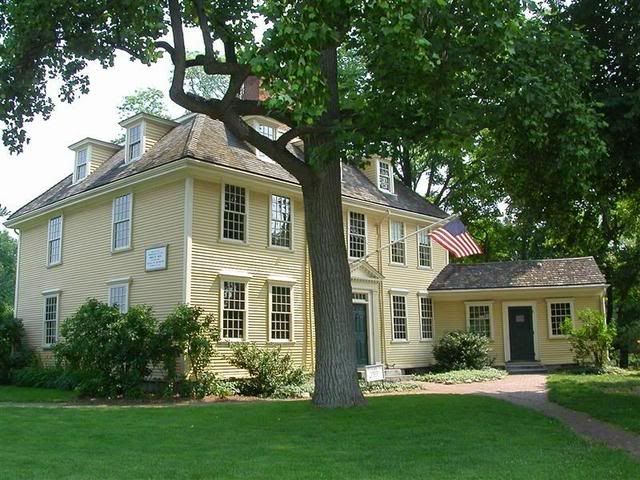
Confined upstairs in that Lexington inn (we know there was more than one tavern in the town, but let’s assume it was Buckman’s Tavern, shown above), the officers got the lieutenant, sergeant, and corporal in their guard drunk over dinner.
It was now past midnight; and the silence which prevailed elsewhere gave notice that the people of the house, and probably the troops on duty, were all fast asleep. . . . Menzies passed on tiptoe towards the door, into the staple of which, so as to keep the latch from being lifted, he quietly thrust a knife. Meanwhile I stole to the window, and threw it open.

The night was as dark as pitch; so dark indeed, as to render fruitless every endeavour to ascertain how far we were from the ground. There was not a star in the heavens; and over the village swept a low moaning wind, the sure prelude to a storm. In some respects all this was in our favour: the excessive darkness would help to baffle pursuit were we fairly in flight, and the wind would probably drown whatever noise we might make in descending. But to descend in total ignorance both of the spot which was to receive us and of the position of the sentinels, whom we could not doubt the officer had planted, was what we should have hesitated about doing had a less urgent necessity driven us on.
The author makes the jump, and in good literary fashion the narrative breaks there, to resume in the following issue.

The second installment of this account (which is the third in the magazine’s “Traditions of the American War of Independence” series) picks up from that moment with the narrator realizing he’s badly hurt his ankle. He and Menzies hide from pursuers in the woods, get separated crossing a deep stream and reunited, and overpower a suspicious rural couple. There are long passages on the narrator’s despair about his ankle and the experience of being alone in the forest. There’s a great deal of male bonding between the narrator and Menzies.

Alas, we have Lt. Col. Campbell’s letter listing all the officers who fell into the Bostonians’ hands in June 1776, and that list includes no captain named Menzies. (Maj. Robert Menzies died in the fight when the transport ships were captured.) So our author has either forgotten his companion’s name, disguised his identity, or made it all up.

Other details defy confirmation. The account quotes from a paper describing the two escapees for American pursuers: “One considerably taller than the other; dressed in frieze jackets and trowsers; supposed to pass themselves off as seafaring men.” I’ve found no runaway ad with those phrases, but the account doesn’t say that was a published advertisement, and it’s easy to excuse the author from remembering the exact words.

Likewise, the geography remains murky. The narrator apparently thought he was in Connecticut soon after escaping, yet mentions “Holleston,” “Providence River,” and “Daubeny.” Are those odd details the result of imperfect knowledge and memory, or was the writer just making things up?

And then things get really weird. The narrator and Menzies are recaptured by American “riflemen,” along with an old man named Simcoe accused of being a Loyalist. With the narrator’s ankle still painful, he’s put into a wagon for the ride back to Boston. But then Indians and the Loyalist’s son burst from the woods to rescue them, killing and scalping all the American guards. Finally, the narrator and Menzies make it to New York. By that point, it seems more clear, whoever was penning the account was simply looking to entertain a British readership.

And was that the only point of this account all along?

TOMORROW: Back to the fight in Boston harbor.

Saturday, July 18, 2015

“A proceeding which we could not but regard as traitorous”

Yesterday’s installment from the 1835 United Service Journal article ended with the unnamed, and perhaps fictional or composite, author becoming a prisoner in Boston. He and comrades in His Majesty’s 71st Regiment had sailed into Boston harbor in June 1776 thinking the town was still held by the British.

The officers were reportedly put into the town jail for a night, but then the American “Governor” came to relieve them. The writer recalled this man as “Colonel Crofts,” and I’m trying to figure out if that’s an imperfect memory of Thomas Crafts, prewar political activist and colonel in charge of the Massachusetts artillery force in 1776.

Here’s the part of the account that first caught my eye, its description of days leading up to 18 July 1776 in Boston:
We gave our word of honour that we would not attempt to pass beyond a certain distance out of Boston, till the privilege of parole should be withdrawn, or an exchange of prisoners effected; and we became, in consequence, as much masters of our own time as was consistent with a moderate degree of surveillance. Besides, the kindness of Colonel Crofts did not end here: he caused excellent quarters to be assigned to us in the houses of certain families who were suspected of a leaning in favour of the royal cause; and he issued orders that our wants should be duly attended to, and the utmost respect paid to our persons. Here then, we were, prisoners at large, in a town famous, above all in the New World, for its hostility to the English, yet well treated both by the civil and military authorities; and with a fair prospect of spending our days among them till a war, just begun, should be brought, one way or another, to its close. . . .

Meanwhile we found what amusement we could in wandering over the town, and visiting the positions of Bunker’s Hill, Breed’s Hill, Dorchester, Charleston, and other points rendered memorable as the scene of recent operations. Among these, nothing struck us more forcibly than the site of the encampment which the Americans first occupied after the skirmish of Lexington. Many huts were yet standing in regular lanes or streets which crossed one another at right angles; and it was easy to perceive, that the same ingenuity which they were in the habit of exercising in the construction of their rude dwellings in the woods had been applied by the rebel heroes to the formation of their bivouac. We were forced to admit, while examining their lines, that in the use of the spade and the pickaxe—implements of war not less formidable than the musket and the cannon—our men would be no match for an enemy so skilful.

In this manner a whole month wore itself out, and listless indifference was beginning to mark the bearing of some, when an event befel which so far stood us in stead, that it furnished us, for awhile, with a subject of conversation. On the 17th of July, the British officers on parole received each a card from the Governor, requesting the honour of his attendance at a specified hour on the morrow, in the Town Hall. As rumours were already afloat touching the decided step that had been taken at Philadelphia, we were not without a suspicion as to the purport of this meeting; and we hesitated for a while, as to the propriety of giving the sanction of our countenance to a proceeding which we could not but regard as traitorous. Curiosity, however, got the better of scruples, which, to say the truth, were not very well founded; and it was resolved, after a brief consultation, that the invitation ought to be accepted.

Accordingly, at the hour appointed, we set out, arrayed in the full-dress uniform of our corps, and became witnesses to a spectacle which excited even in us feelings it would not, perhaps, be very easy to be defined. As we passed through the town, we found it thronged in all quarters with persons of every age, and both sexes. All were in their holiday suits, every eye beamed with delight, and every tongue was in rapid motion. King-street, Queen-street, and the other streets adjoining the Council Chamber, were lined with detachments from two battalions of infantry, tolerably well equipped; while in front of the jail, a brigade of artillery was drawn up, the gunners standing by their pieces with lighted matches; nor, to do them justice, was there any admixture of insolence in the joy which seemed to animate all classes.

Whether our lengthened residence among them, and the anxiety which we displayed never wantonly to offend their prejudices, had secured their esteem, or whether they considered it beneath the dignity of a grave people standing in a position so critical, to vent their spleen upon individuals entirely at their mercy, I do not know; but the marked respect with which we were treated both by soldiers and civilians could not be misunderstood. The very crowd opened a lane for us up to the door of the Hall, and the troops gave us, as we mounted the steps, the salute due to officers of our rank.

On entering the Hall we found it occupied by functionaries, military, civil, and ecclesiastical; among whom the same good humour and excitement prevailed, as among the people out of doors. They received us with great frankness and cordiality, and allotted to us such stations as enabled us to witness the whole of the ceremony, which was as simple as the most republican taste could have desired. Exactly as the clock struck one, Colonel Crofts, who occupied the chair, rose, and silence being obtained, read aloud the celebrated Declaration, which announced to the world that the tie of allegiance and protection which had so long held Britain and her North American colonies together, was for ever separated. This being finished, the gentlemen stood up, and each repeating the words as they were spoken by an officer, swore to uphold, at the sacrifice of life, the rights of his country.

Meanwhile, the town-clerk read from a balcony the Declaration of Independence to the crowd; at the close of which, a shout, begun in the Hall, passed like an electric spark to the streets, which rang with loud huzzas, the slow and measured boom of cannon, and the rattle of musketry. The batteries on Fort Hill, Dorchester Neck, the Castle, Nantucket, and Long Island, each saluted with thirteen guns—the artillery in the town fired thirteen rounds, and the infantry, scattered into thirteen divisions, poured forth thirteen volleys—all corresponding to the number of States which formed the Union.

What followed may be described in a few words. There was a banquet in the Council Chamber, where all the richer citizens appeared—where much wine was drunk, and many appropriate toasts given. Large quantities of liquor were distributed among the mob, whose patriotism of course grew more and more warm at every draught; and when night closed in, the darkness was effectually dispelled by a general and, what was termed then, a splendid illumination. I need not say that we neither joined, nor were expected to join, in any of the festivities. Having sufficiently gratified our curiosity, we returned to our lodgings, and passed the remainder of the evening in a frame of mind, such as our humiliating and irksome situation might be expected to produce.
According to a 21 July letter from Abigail Adams and the 25 July New-England Chronicle, Thomas Crafts did take a major part in the official reading of the Declaration of Independence, starting exactly at one o’clock on this date in 1776. The thirteen-gun salutes, the many toasts—they’re also in the published record.

But the 22 July Boston Gazette and 25 July Continental Journal said the “Sheriff of the County of Suffolk,” who was William Greenleaf, did the reading, as the Council had officially requested. An October 1841 letter from the sheriff’s son Daniel explained that he had asked Crafts to help out because he had a “weak voice,” and the colonel repeated each phrase in a bellow for the benefit of the crowd below.

In that case, the author of this account seems to have mixed up the two men, having the colonel read the Declaration inside the chamber and a “town clerk” then repeat it (as a whole?) to the crowd. Again, this purported reminiscence is a frustrating mix of nearly accurate detail and discrepancies.

TOMORROW: The story continues.

Friday, July 17, 2015

“Colonel Campbell reluctantly gave the word to strike”

If you kept track of the dates in yesterday’s extract from the United Service Journal in 1835, you noticed that the His Majesty’s 71st Regiment of Foot sailed from Scotland on 21 Apr 1776, after the Crown had evacuated Boston but before news of that event had time to reach Britain.

Therefore, when two of the ships carrying the 71st’s Highlanders reached Boston harbor, the guns of Castle William fired on them. Because that fort was now in American hands.

We pick up that account as the writer describes his British military companions coming to the same realization. Note, however, that the story starts with an anachronism that casts doubt on whether this memoir is authentic or reliable in its details. The U.S. of A. didn’t adopt the “thirteen stripes with the thirteen stars” as its national emblem until more than a year after the 71st Regiment reached Boston.
“By G–d,” exclaimed the skipper, “that is no union jack,”—and no union jack was it, sure enough. The thirteen stripes with the thirteen stars ornamented the flag-staff—a piece of coarse buntin having been slowly run up while the cannon were firing; and we were taught to our sorrow that we had laid ourselves in a position which admirably suited us to act as a mark for the inexperienced of the enemy’s gunners to practise upon.

Thick and fast came now the rebel shot, against which we had nothing in the world to oppose; for our miserable 4-pounders were too light to make an impression even on a fieldwork, and our distance from the shore was too great to permit of musketry being made available. Neither were our chances of escape at all satisfactory. The breeze had died wholly away, so that our sails, had we hoisted them, would have hung useless as gossamer-webs from the masts; while the run of the tide gave us the comfortable assurance that, in the event of our cable being cut, we should be carried directly ashore, under the very muzzles of the guns which now played upon us. . . .

Repeatedly the ship was hulled, and our mainmast, severely wounded in two places, threatened, should a third shot take effect, to go by the board; yet only three men had fallen, of whom one was a sailor. Though galled and annoyed, therefore, we did not think of surrendering; when, suddenly, a numerous flotilla, consisting of schooners, launches, and row-boats of the most formidable size, put off from the town. Onwards they came, and our glasses soon made us aware that they were all crowded with men; nor did many minutes elapse ere ample proof was given that most of the craft had cannon. They took up a position in line exactly abaft our beam; and while the shore battery raked us from stem to stern, they poured whole volleys of round and grape across our quarter.

Our commandant [Lt. Col. Archibald Campbell, shown above], so far from giving way under this accumulation of evils, seemed to take courage from it. He caused the ship’s guns to be traversed aft, and answered the enemy’s salute with admirable spirit, though, as the event proved, to but little purpose. But such a combat could not long be maintained. Seeing that our fire produced no visible effect, and perceiving that his men began to fall fast around him; warned also by the skipper, that the transport was so riddled as to render it impossible for her to float after the tide should have turned, Colonel Campbell reluctantly gave the word to strike; and our flag, which had hitherto floated both at the peak and from the mainmast head, was, with inexpressible mortification, hauled down. We shrugged up our shoulders as we gazed on one another, and felt that we were prisoners. . . .

Whether the smoke which, in a dead calm, rolled off heavily from the ship, obscured us, or whether, as in the bitterness of our chagrin, we were inclined to believe, the enemy saw, without regarding, our condition, I cannot tell; but for several minutes after all opposition on our part had ceased, they continued their fire. Shot after shot struck us, till there arose at last a wild cry, in which all ranks participated, that it would be better to perish like men, with arms in our hands, than thus stand idly to be mowed down by those who seemed determined to give no quarter. “Out with the boats!” was now heard from various quarters. “The island is not far off: let us make a dash at the battery; and if we cannot carry it, let us at all events sell our lives as dearly as we can.” But the utter hopelessness of such an attempt did not escape Colonel Campbell’s consideration. He therefore exerted himself to soothe his irritated followers, and sending most of them below, continued himself to walk the deck with the utmost composure.

When a fortress or a ship surrenders, it is in accordance with the laws of war, that all the arms, stores, and military implements contained in it, shall be handed over, exactly as they are, to the conquerors. Of this we were well aware; nor, when we hauled down our flag, was there the slightest intention on the part of any one on board to contravene the custom. But furious, at what they regarded as a wanton disregard of the dictates of humanity, our soldiers no sooner found themselves below, than they ran to the arm-racks. In five minutes there was not a musket there of which the stock was not broken across. The belts, cartouchboxes, and bayonets likewise were caught up, and all, together with the fragments of the firelocks, were cast into the sea.

Had Colonel Campbell been aware of what was going on, he would have doubtless put a stop to it; for he was a strict disciplinarian as well as a man of rigid honour; but the work of destruction went forward so rapidly, that long ere a whisper reached him there remained nothing further to be done. When, however, the enraged soldiers made a movement to throw the cannon likewise overboard, he withstood them; nor would he permit a particle of the spare ammunition in store to be injured. But his fair dealing in this instance was wasted: he saved the ship’s guns, it is true, but he did not succeed in creating a belief among the Americans that he was not a party to the destruction of the men’s muskets.

The enemy had continued their cannonade about a quarter of an hour, and several of our comrades had fallen under it, when they seemed to have discovered all at once, that our colours were not flying. The firing accordingly ceased; and a boat pushing ahead of their line, approached within hail to demand whether we had surrendered. We replied of course in the affirmative; upon which a signal was hung out for the flotilla to advance. The whole moved forward till they surrounded us on all hands, and sending their boarders over the chains, our decks were crowded with people, whose dress and language equally gave proof that they belonged to no regular service, naval or military. Such a cut-throat looking crew never indeed came together, except under the bloody flag of some fierce rover. There were landsmen in round frocks, with carving-knives stuck by their sides in place of daggers; there were militia men in all manner of dresses, armed with long duck-guns; and there were seamen—hardy and brave I do not doubt—but as ferocious in their bearing as if piracy were their profession, and life and death matters of no importance where interest came in the way. The latter were chiefly equipped with pistols and cutlasses, which they brandished with an air of insolent triumph, as uncalled for as it was unbecoming. . . .

Finally, they drove us, like a herd of oxen, on board of their small craft, and sent us, without a single article of baggage, to be towed in the schooners into Boston. This done, they plundered the transport of everything contained in it, whether of public property or belonging to individuals; and finding on examination that it would not float, they summed up all by setting it on fire.

As there was a strong tide against us, and the schooners overloaded with heavy cannon went much by the head, our progress towards the landing place proved slow; indeed the sun had set some time ere we gained the extreme edge of the Long Wharf. To say the truth, we experienced little mortification at the circumstance. Though not without curiosity as to the appearance of a town in which we had anticipated a very different reception, we were content to postpone its gratification, rather than become in open day, objects of impertinent remark to the rabble, who, we could not doubt, were assembled to greet us. Nor were we deceived in this expectation. The whole extent of the wharf was crowded with men, women, and children, all on foot to witness the arrival of the British prisoners, and all anxious to testify by their hootings and yells, how cordial was the abhorrence in which they held us. Through that crowd we were marched, our guards, as it appeared to us, being more anxious to exhibit the trophies of their own valour, than to protect the captives from insult; and having passed several streets, some of them tolerably capacious, we arrived ere long at a massy building which we were given to understand was the common jail. Into it the officers were thrust; while the men were moved off to a meeting-house hard by, where, under the close surveillance of a military guard, they passed the night. . . .

In this comfortless manner the night wore away, what little sleep any of us obtained being snatched upon the bare boards; but the morrow brought with it a change of circumstances considerably for the better. As if ashamed of the conduct of his subalterns, Colonel Thomas Crofts, the Governor of the place, sent his Aide-de-camp to assure us, that nothing but the lateness of the hour at which we arrived would have induced him to permit our being lodged in prison even for a single night; and that he was now ready either to release us on the customary terms, or to transfer us to a more commodious as well as respectable place of safe-keeping. We were at the same time invited to become his guests at breakfast; and offered every accommodation in the way of money and apparel of which we might stand in need.
There was no “Governor” in Massachusetts in 1776. The highest-ranking authorities were probably James Bowdoin, president of the Council, and Gen. Nathanael Greene, mopping up after the siege.

However, Thomas Crafts was the colonel in charge of the Massachusetts artillery force. That meant he was in charge of the cannon at Castle William and prominent in public affairs (as we’ll see tomorrow). So the account’s mention of “Thomas Crofts” is close enough to seem authentic, yet unlikely to have come from published historical sources. The colonel’s “Aide-de-camp’ might have been his young brother-in-law, Christopher Gore, who served as regimental clerk in that year.

Lt. Col. Campbell’s period as a prisoner is fairly well documented. Soon after he and the two transports full of soldiers were captured, he wrote letters to his superiors and family. One of Campbell’s dispatches was published in 1776.

This article from the United Service Journal is generally in accord with Campbell’s report. It’s conceivable that that was because the article’s author used Campbell’s letter and other available documents as source material. But there are also enough deviations and new details, such as the destroyed muskets and Col. “Crofts,” to suggest the writer was relying on personal memory. How reliable that memory was is another question.

TOMORROW: A town celebration.

Thursday, July 16, 2015

“This is a rough reception.”

I’ve been wrestling with the authenticity, if any, of a certain recollection of the Revolutionary War. It purported to be the account of a young officer in His Majesty’s 71st Regiment of Foot.

When the text first saw print in the February 1835 issue of the United Service Journal, a magazine for veterans of the British armed services, the editors prefaced it with these words:
We have this month the satisfaction of presenting to our readers the first portion of a narrative, which comprehends not only some striking historical details, but a good deal of stirring adventure. The original is contained in a series of letters addressed by the author to his sister, with which we have taken no other liberty than here and there to alter an expression, and to omit the customary head and tail pieces of epistolary communications. We do not know whether there be any members of the old 71st Regiment now alive, but if there be, the name of the writer, which we are requested to conceal, will be no secret to them. For ourselves we lament that any restrictions in this respect should be imposed on us, where none, we are quite sure, can be necessary. But all men have their prejudices.
That certainly suggests the editors had worked from original, contemporaneous documents. Of course, they could have lied. Or the officer or his sister or descendant could have sent them copies said to be accurate but actually augmented.

There are long sections of the document full of literary, even Romantic, descriptions that I don’t see in other officers’ letters to other sisters. Yet there are also accurate details that seem like they would only come from authentic source material, and errors unlikely to crop up if the writer was consulting books of history and geography to add verisimilitude.

In any event, the narrative begins:
On the 21st of April, 1776, the Frazer Highlanders—then numbered as the 71st regiment of the line—embarked at Greenock on board of a fleet destined for North America. . . . I had then the honour to rank as a lieutenant in the 7lst, having, like most of my brother officers, raised men for my commission. . . . The latter were excellent, nothing, indeed, could be superior for the recruits, having been collected chiefly from the lands of their chief, were, with few exceptions, young, able-bodied, and full of attachment to their superiors, whom, for the most part, they followed from motives of hereditary affection. But the former was, according to the criterion of the Horse Guards, bad enough. As a battalion, indeed, we knew nothing. Not only were we ignorant of the most common field-movements, but the very manual and platoon exercise was strange to us. . . .

[On board ship] The greater portion of every fine day was devoted to giving the men some knowledge of such portions of their duty as could be explained to them on board of ship. In the first place they were trained to obey the word of command when uttered in English—a language of which, when they first joined, they knew nothing. In the next place, they were taught to face, and wheel, and even to march, to handle their arms with gracefulness, and to fire; while occasionally an attempt was made to deploy from such a column as the narrow quarter-deck of a transport would admit of, into such a line as was compatible with a rolling sea. I must confess that the result of the latter manoeuvre was generally to set both men and officers laughing, and that, after repeated trials, it was laid aside. . . .

Time passed, and on the 16th of June, almost two months from the date of our embarkation on the Clyde, the look-out seamen, from the mast-head, greeted our ears with the joyful tidings of land on the larboard bow. . . . The shores of North America are, in almost all directions, singularly low and uninteresting, and the point towards which we were steering differed little in this respect from other portions of coast; for the land hung for some time cloud-like over the water, and when it did assume a definite form, it was that of low sand-hills loosely covered with pines. This, however, gradually changed its character, till Cape Cod, with its sharp promontory, had been left behind; after which the rocks and islets, which lie scattered in beautiful disorder through Boston Bay, rose one by one into view. By-and-by Long Island pushed itself forward, like an advanced guard to the town, which covered, in a somewhat straggling manner, the tongue of a peninsula; and, finally, we found ourselves under a dying breeze, and with a tide running strongly against us, in the centre of Nantucket Roads. There, at the distance of three quarters of a mile from a redoubt or battery that protected the island, we cast anchor; happy in the assurance that ere four-and-twenty hours should have run their course, we should be snugly settled beside our comrades on terra firma.

It had been remarked by some of us, while the vessel held her course, not without surprise, that matters were not altogether in the condition which we had expected to witness in such a place as Boston Bay. No light cruisers had met us as we approached the Cape, nor, as far as we could discern, were there any symptoms of a fleet either in the inner or the outer harbour. When we looked again to the telegraph station, we could discover no movement indicating the vigilance of those who kept it, or denoting that a strange sail was in sight. The might of the battery also slumbered, and our ensign received no salute. This was curious enough, for the customs of the Service required that, in time of war, no vessel should cast anchor in a British roadstead till her name should have been made known, and the object of her coming notified. . . .

The men were clustering in the forecastle, and the officers leaning over the taffrail, with glasses turned towards the town, when a flash from the battery on the island, followed by an instantaneous report, caused us to look up. We had scarce done so, when a ball, after touching the water once or twice in its course, buried itself in a swell of the sea, just under our stern. We stared with astonishment one upon another, for the signal—if such it was—had been very awkwardly managed; but ere a Word had been exchanged, another and another gun was fired, the shots from which passed some ahead, some far over, and one right through the shrouds, so as to cut away several of the ratlins. “This is a rough reception,” said our commanding officer [Lt. Col. Archibald Campbell]; “and devil take me if I don’t see into it.”
Yes, there will always be a Scotland.

The mention of a “telegraph station” is a big clue that not all of this text dates from the 1770s, whatever the magazine editors said. The word “telegraph” entered English in the 1790s. It originally referred to a sort of mechanical semaphore system, and Boston had one in the early 1800s—meaning a “telegraph station” might have appeared on a map of that time along with the other features named in the account. But if the writer had a map in front of him or her, why do we see “Nantucket Roads” instead of “Nantasket Roads”?

TOMORROW: The 71st Regiment lands at last.

Wednesday, July 15, 2015

The Rise and Fall of Boston’s Tide Mills

The small West End Museum in Boston just opened a small exhibit about “Tide Power in Colonial Boston.” On Tuesday, 21 July, at 6:00 P.M. the museum will host a reception for that show. Both exhibit and reception are free and open to the public.

The event announcement says:
Tide Power in Colonial Boston explores the mechanisms of the mills and trades they supported. Historical maps illustrate the role of Boston’s topography in the construction of the mills and the demand for land-making which contributed to their downfall.

The rise and fall of tides have been harnessed for energy since Roman times. The earliest known tide mills date back to sixth-century Ireland. As the tides come in, sea water enters into a reservoir called a mill pond. When the tides recede, the stored water is released to turn a water wheel which powers the mill.

Around 1630, a settler named Crabtree attempted to extend an island in Boston’s North Cove—approximately where Causeway Street is today—to build a dam and form a tidal mill pond. The task proved to be too much for one person, so he soon abandoned the project. Thirteen years later, Henry Symons and five associates were granted the rights to the Cove on the condition that they construct a mill pond and erect one or more mills. They succeeded and, for the next 150 years, no fewer than five tide mills operated there.
The Mill Pond appears just below the compass on the map above, a major feature of colonial Boston. The mill creek that connected that pond to the inner harbor also served to define the North End, or at least the North End Gang’s territory. Benjamin Franklin wrote in his autobiography about playing beside the Mill Pond. The Baptist Meetinghouses were built along its edge to make adult baptism easier.

But with population and economic growth after independence, Boston needed land more than it needed tidal power. In 1797 a consortium proposed filling in the Mill Pond to make new land. It took ten years before the government approved that change, and more than twenty before the project was done. The West End Museum exhibit tells that whole story, concluding with a next-generation, never-realized plan to dam the Back Bay and create more tide mills—another project overwhelmed by the demand for real estate.

“Tide Power in Colonial Boston” will be up until 19 September. Visitors can view it during the museum’s regular hours, which are noon to 5:00 P.M. Tuesday through Friday and 11:00 A.M. to 4:00 P.M. on Saturdays. The West End Museum is at 150 Standiford Street.

In addition, the Massachusetts Historical Commission has an online exhibit about archeological finds at the site of the old Mill Pond.

Tuesday, July 14, 2015

Mount Vernon’s Key to Crowd Control

This spring I visited Mount Vernon for the first time in several years. I was impressed with the expansion of the site, with a new research library, museum and education center, and agricultural buildings.

Indeed, our visit to the Washingtons’ mansion was probably the most disappointing part of the excursion. Of course, everyone visiting the site feels a need to go into the mansion, which produces a steady crowd in the entrance porches. We probably spent more time outside the mansion waiting in one line or another than inside.

There were docents in most rooms, each with a very short spiel—about a minute and a half—to repeat with little variation for each knot of visitors. Meaning that we’re supposed to spend only about two minutes in each space.

In the entry hall, mounted on a wall within a glass case, was the large iron key shown above. I recognized it from web images as the key to the Bastille, stormed by the people of Paris on this date in 1789. Lafayette sent that key to George Washington as a tribute for helping to inspiring the French Revolution. It was bigger than I expected.

To my surprise, the docent in that room didn’t mention the key. So I asked in a clear, carrying voice, “Is that the key to the Bastille?”

“Yes, it is,” said the docent, in a tone that struck me as implying:
  • she was fairly certain that I already knew the answer. (Yes, I’m one of those visitors.)
  • she wasn’t planning to elaborate on the key’s history.
  • it was time for us to move on to the next room, thank you.
Mind you, all the Mount Vernon docents were friendly and hard-working. I’ve done shorter stints as a museum interpreter, and I’d get cranky if I had to deliver basically the same speech every three minutes.

When we came out of the mansion, I heard another visitor praise the last docent for managing so many people on a busy day. “Oh, this isn’t busy,” the docent replied. And she was no doubt right. That day wasn’t on a weekend or holiday, and it didn’t offer a special event or particularly nice weather. But there were still plenty of people to move through the house.

Monday, July 13, 2015

Reviews of Revolutions without Borders

Earlier this month H-Net published Bryan Rindfleisch’s review of Revolutions without Borders: The Call to Liberty in the Atlantic World by Janet L. Polasky, which looks at the multiple revolutions on both sides of the Atlantic in the late 1700s.

Polasky’s scope includes not just the now-well-studied American, French, and Haitian Revolutions, but “the Genevan Revolution of 1782, the Dutch Patriot movement in 1787, the Belgian Revolution of 1787-89, the Wolfe Tone rebellion in Ireland (1798), and the Freetown Revolution of 1800.”

Rindfleisch says, “Polasky provides a grand synthesis of the many and disparate struggles and revolts against monarchical authority and aristocratic privilege that erupted during the late eighteenth century, all of which were interconnected and related to one another.” In this telling those connections are both literary and individual:
Out of this wave of revolutions emerged what Polasky calls “itinerant revolutionaries”—a large group of individuals, both men and women—who moved about on the Atlantic stage and gravitated toward the various upheavals of the late eighteenth century, thereby linking those revolutionary struggles together.

Take for example the case of Gerrit Paape, an earthenware painter of humble origins in Amsterdam, who—infected with the republican ideals of the American Revolution—reinvented himself as a poet, novelist, and revolutionary in the Dutch provinces in 1787. Although Prussian forces ultimately crushed this Dutch Patriot movement, Paape fled to the nearby Belgian provinces where he joined a second revolutionary movement that sought to undermine Austrian control of Belgian territories and peoples. And for a brief time in 1789, Paape and his fellow revolutionaries succeeded in emulating their American counterparts, creating the “United States of Belgium” and successfully repelling Austrian invasions.

But in 1790, the Belgian provinces were ultimately overrun by European empires and monarchies that desperately sought to stem the revolutionary tide. Yet again, Paape fled to another revolutionary scene, this time in France, where he fell in with like-minded radicals who created a French republic. Subsequently, in 1795, Paape returned home to the Dutch provinces, bringing up the rear of the French armies that liberated those territories from monarchical control, where Paape joined the “Batavian Revolution” that established a Dutch republic.
Telling such stories means likewise jumping among nations, languages, and archives. Polasky organized the first part of her book not chronologically but according to different forms of discourse, which have also become different historical sources: political pamphlets, revolutionaries’ narratives and memoirs, newspapers and the rumors they spread along with hard news, novels presenting modern ideas, and family correspondence.

Polasky even writes, “This book could be read as an extended essay on sources,” but Tom Cutterham said at the Junto blog:
Polasky’s book is delightfully unencumbered by visible theoretical apparatus or historiographical call-backs. Most of the time, it’s a series of linked stories that pull us, in vaguely chronological order, back and forth across the Atlantic and the Alps, with excursions south to Sierra Leone and east to Warsaw.
Rindfleisch notes that Polasky’s narrative doesn’t extend to Latin America in the early 1800s, as many studies of the “Atlantic Revolutions” do. But with transnational figures like Bolivar active there, it looks like someone could pick up the threads and go there.

In the end, Cutterham sees many stories of failure, as the most dedicated internationalists saw their romantic ideals overpowered by larger nation-states:
Ironically, the cause of most of these failures was their clash with successful revolutionary states, namely France. As much as American and French revolutionaries inspired imitators, they also soon came to fear them and attempt to control them—as Polasky points out, it was governments in these new states that brought the age of revolution to an end.
The ideals of worldwide republicanism fell before a new focus on nationalism—which brings us back to why so many scholars have studied these upheavals separately.

Sunday, July 12, 2015

The Meaning of the Whitesboro Seal

This is the seal of the village of Whitesboro, New York. It got a lot of attention this month because it appears to show a white frontiersman choking a Native American. All to represent a place called “Whitesboro.”

Village officials insist the seal isn’t about white people conquering Indians. The village is truly named after an early American settler named Hugh White (1733-1812), who moved to the region from Middletown, Connecticut, in 1784.

During the war White had invested in a privateer. Other sources say he was a commissary to the Continental Army or even a captain, but I haven’t found any independent evidence to confirm those statements.

The village seal shows White wrestling a Native man—a friendly wrestling match, it’s said. In 1838 William Tracy published this story in Notices of Men and Events Connected with the Early History of Oneida County:
Another anecdote of Judge White, may not be uninteresting in this connection. An Oneida chief, of rather an athletic form, was one day present at his house with a number of his companions, and at length, for amusement, the party commenced wrestling. After a number of trials had been made, the chief came forward and challenged the settler to a clench with him.

This was done in a manner, and with a degree of braggadocio, which convinced him, that if he refused to encounter him it would subject him to the constant inconvenience of being brow beaten by the Indian, and cost him the trouble of being believed a coward. In early manhood he had been a wrestler, but he had now become quite corpulent, and for years unused to any athletic feats. He felt conscious, however, of great personal strength, and he concluded, that even should he be thrown, yet as a choice of evils, the being thrown would be a lesser one than the acquiring a character of cowardice by declining.

He therefore accepted the challenge and took hold with the Indian, and by a fortunate trip, succeeded almost instantly in throwing him. As he saw him falling, in order to prevent the necessity of ever making another trial of his powers, and of receiving any new challenge, he contrived to fall with all his weight, he then constituting an avoirdupois of some 250 lbs., and as heavily as possible, upon the Indian. The weight, for an instant, drove all breath from the poor fellow’s body; and it was some moments before he could get up. At length he slowly arose, shrugged his shoulders with an emphatic—“Ugh! you good fellow, too much!”

I need not add, that he was never again challenged to wrestle with an Indian.
Whitesboro has used an illustration of that story on its seal since the 1890s or earlier.

In 2009 the Utica Observer-Dispatch noted that ten years before a mayor had proposed changing the seal to something less likely to cause offense. Furthermore, some Native Americans had complained about the image twenty years before that—or earlier. The newspaper added:
Whitesboro historian Judy Mallozzi said the current seal was adopted sometime in the 1970s after the village was sued by an Indian group over the depiction at that time.

“The hands of Hugh White were on his neck area,” she said of the earlier image. “So after the lawsuit, it was determined it’s part of our history, so we didn’t have to stop using the seal. We just had to move it, so it’s down on his shoulders.”
Curiously, images of the previous seal show that the new version moved White’s hands closer to the other man’s neck.

So does the Whitesboro, New York, seal reflect a history of white men overpowering Natives by force or simple weight and taking their land? No more than the existence of Whitesboro, and New York, and the U.S. of A. Which is to say, of course it does.

This particular cartoon represents one cross-cultural experience that White and his family chose to remember as a friendly moment. Indeed, the Oneida were allies of the U.S. of A. during the Revolution and in the years immediately after. But given the larger history of colonial European and American appropriation of Native territory, it’s very hard to interpret that image as just about a wrestling match between two community leaders.

Saturday, July 11, 2015

Putting Together a Puzzle in Ipswich

This is a story from Christchurch Mansion, a historic house museum in Ipswich, England, as reported by the B.B.C. and the Ipswich Star.

Among the items in that museum is a Delft puzzle jug, dated to about 1785. This ceramic vessel has three spouts so reportedly “when tipped it is a matter of chance which spout the water or wine will pour from.” So much fun at drunken parties! Puzzle jugs of this age and quality can fetch £2,000 at auction.

Last summer a family visited Christchurch Mansion—the museum isn’t saying exactly when. At the time the jug was displayed on “a low window ledge.”

By the end of that visit, the puzzle jug looked like this, and a five-year-old boy was extremely sorry for having accidentally knocked it over.
Over the last year, museum “duty officer” Carrie Willis (in background above), under the direction of conservation officer Bob Entwistle, reassembled the jug’s sixty-five pieces. This summer the restored jug went on display at the Ipswich Art School Gallery.

In addition, Christchurch Mansion put out a call through the British media to the family who’d had such a disastrous visit—obviously the museum hadn’t taken down their names at the time. The museum staff wanted the little boy to know that the damage had been repaired.

This month the museum was able to announce that the boy’s mother had gotten in touch to say the family was “thrilled” to know the jug was looking like its old self. The family is, however, remaining anonymous.

Friday, July 10, 2015

L’Hermione in Maine

The Hermione’s last stop in the U.S. of A. this trip will be in Castine, Maine, on 14-15 July. That’s right—the French crew gets to spend Bastille Day in Maine.

The Castine Historical Society has a raft of events planned for this weekend and the two days next week when the Hermione will be in the harbor. Those include museum exhibits, Revolutionary War reenactments, musical concerts, art projects, and parades on both land and water. (Plus that Gene Kelly movie again.)

The lectures over the course of those days include:
  • Liam Riordan, University of Maine, “Why the French Were Essential for the American Revolution, and Why We Should Care.”
  • Lou McNally, University of Maine, “Sailing and Surviving in the Weather of the 1780s.”
  • Laura Auricchio, author, “The Marquis: Lafayette Revisited.”
  • Paul Mayewski, University of Maine, “Timing Is Everything: Weather, Climate and the Course of Civilization.”
  • Curt Viebranz, Mount Vernon, “The Marquis de Lafayette and General Washington.”
After that, L’Hermione sails on to Nova Scotia, where there doesn’t appear to be anything planned. Not even the Gene Kelly movie.

Thursday, July 09, 2015

The Flags of L’Hermione

As we continue our coverage of the North American visit of L’Hermione, here’s a dispatch from Peter Ansoff, who visited the French ship during its stop in Alxandria, Virginia. Boston 1775 readers may recall that Peter is one of our vexillological advisors.

Naturally, I was interested to see what sort of flags she displayed. As you can see, the display was slightly unorthodox—the modern French national ensign on the staff and a U.S. 13-star ensign at the gaff. (Normally a visiting ship flies the courtesy flag of the host nation on the fore or main masts.) The choice of the modern ensign instead of the old Royal ensign may have been drive by legal considerations.

I was intrigued to see that they decided on a U.S. ensign with red, white and blue stripes. There are a handful of descriptions and contemporary images of red/white/blue striped flags, and I believe just about all of them involve American ships that were outfitted in France, or descriptions from the US representatives in France. It looks like somebody in the Hermione organization may have made the connection.
The French tricolor is anachronistic for 1780, but it may be appropriate for Lafayette’s ship since he gets credit for turning that combination of colors into the French national emblem.

Thanks, Peter!

Wednesday, July 08, 2015

Selig on the Path from L’Hermione to Yorktown, 11 July

The Shirley-Eustis House in Roxbury is welcoming the French ship Hermione on 11 July with a lecture by Robert A. Selig titled “En Avant on Water and on Land: Lafayette, L’Hermione and the Washington-Rochambeau Revolutionary Route.”
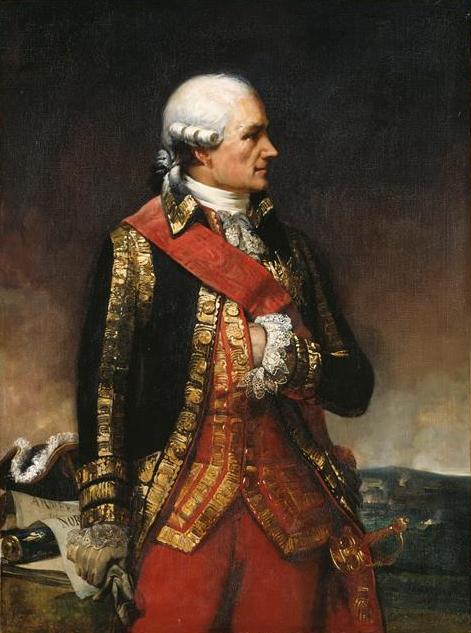
On 28 April 1780, l’Hermione with the marquis de Lafayette on board sailed into Boston Harbor with news that the comte de Rochambeau [shown here] was on his way with enough French troops to decide the outcome of the American War of Independence.

In June 1781, Rochambeau’s troops joined their American allies under General Washington for the march to Yorktown where Lafayette was already waiting for them. L’Hermione joined them in late September. Their travels form the Washington Rochambeau Revolutionary Route National Historic Trail.
Selig is the National Park Service’s project historian for that historic trail. His talk thus ties together the Hermione’s crossing with Lafayette in 1780 to the decisive campaign of the next year.

That lecture starts at 2:00 and is free to all. There’s parking on the streets around the mansion.

Just before the lecture, the Shirley-Eustis House will host a special reception from 12:30 to 1:45 P.M. Tickets for that fundraising event are $25 per person, and space is limited. To reserve a space, call 617-442-2275 or email governorshirley@gmail.com.

Tuesday, July 07, 2015

“Lafayette: An American Icon” in Boston

The French tall ship Hermione is scheduled to arrive here in Boston on Saturday, 11 July, and to stay for the weekend.

The welcoming events include a parade of reenactors, public tours of the ship, church bells tolling, crafts demonstrations on the Greenway, and the screening of a Gene Kelly film at the Museum of Fine Arts. The last seems like a bit of a stretch, especially since Lafayette didn’t like dancing.

Already the Boston Athenæum has been hosting an exhibit titled “Lafayette: An American Icon.” Curator David Dearinger wrote:
Born into one of France’s wealthiest and most prestigious families, Marie Joseph Paul Yves Roch Gilbert du Motier de La Fayette (1757-1834) dreamed of becoming a champion of freedom and a hero of chivalric proportions. . . .

Beginning in 1777, when he left France for America to offer assistance in the American Revolution, he enthralled his countrymen and earned the adoration of the rebellious Americans. Within a year, George Washington thought of the young Frenchman as an adopted son, Lafayette considered himself to be a “citizen of two worlds,” and American patriots commonly referred to him as “Our Marquis.” Lafayette’s fame was assured when he went back to France in 1779 to plead the American cause—and subsequently returned to America with the French government’s promise of troops, ships, and financial support. This alliance turned the tide of the American Revolution and eventually led to the British surrender at Yorktown, Virginia, a historic event in which Lafayette participated.

The Boston Athenæum celebrates Lafayette and his role in the founding of the new United States with an exhibition of portraits and other images of Lafayette (paintings, sculptures, and engravings) as well as a small selection of contemporary documents, manuscripts, and maps. The exhibition is inspired by the recent historic reconstruction of Hermione, the frigate that brought Lafayette back to America in 1780. That ship, with its game-changing news, made landfall in Boston in April of that year.
I have to point out that Lafayette’s news in 1780 was that France was sending more forces. The French navy had already been active off North America for nearly two years at that point. Bostonians had seen thousands of French sailors. L’Hermione was thus neither the ship that first brought Lafayette to America nor the ship that brought news of the French alliance. But it was a grand ship, and its replica is said to be “the largest and most authentically built Tall Ship in the last 150 years.”

The “An American Icon” exhibition includes the statue shown above, “Jean-Antoine Houdon’s great bust of Lafayette, acquired by the Athenæum in 1828 from Thomas Jefferson’s descendants.” Alongside it are works from several other major American museums and libraries,

In the Boston Globe, Mark Feeney wrote of two of the later portraits:
In Samuel F.B. Morse’s painting, of 1825, sapling has matured into oak. The dashing young nobleman who had looked so boyish (and slightly supercilious) hasn’t just aged but thickened. Lafayette has the look of a character out of Balzac, and not necessarily a virtuous one. In contrast, Rembrandt Peale — son of Charles Willson Peale — painted him that same year looking considerably more avuncular, even rather sweet.
The exhibit will be at the Athenaeum until 27 September. Admission is free for members, $5 for everyone else.

Monday, July 06, 2015

L’Hermione and the French in Newport

For the last month, L’Hermione, the replica of the ship that carried the Marquis de Lafayette (back) to the U.S. of A. in 1780, has been working its way up the coast to New England. There have been conferences and exhibits in Virginia and New York, and soon it will be our turn.

L’Hermione will reach Newport, Rhode Island, on 8 July. The Newport Historical Society is hosting an exhibit called “Fraternité: The French in Newport,” in two parts:
  • At the Colony House on Washington Square, the society has already opened a display about “French participation during the American Revolution in Rhode Island.”
  • Debuting on 8 July at the Museum of Newport History, on the second floor of the Brick Market at 127 Thames Street, a second display will highlight the relationship between Daniel Lyman, a Continental Army officer from Newport, and Lafayette.
The “Fraternité” exhibit will run through October. Admission is free on weekdays, though donations are welcome. On weekends and holidays, the display at the Colony House is part of that site’s regular tour, which costs $8 for people not already members of the Newport Historical Society.

On Thursday, 9 July, the society will sponsor “Illuminating the American Revolution,” a free living-history program focused on preparations for the illumination that took place after the arrival of French troops in July 1780. Newport officials required residents to light candles in their windows to welcome those allies. However, many New Englanders were still suspicious of the French after decades of enmity under the Crown. This program will take place 11:00 A.M. to 2:00 P.M. at the Colony House.

Finally, on Saturday, 11 July (after L’Hermione will have sailed on), the society is offering a walking tour on “The French in Newport.” Roughly 12,000 French soldiers and sailors passed through and lived around the port during the late Revolutionary War, and that force was crucial to American independence. This tour will depart from the Brick Market at 11:00 A.M. It costs $15 per person, $10 for Newport Historical Society members. To register, call the museum at 401-841-8770.

Sunday, July 05, 2015

Dr. Franklin’s Invitation in 1779

When Benjamin Franklin was the American minister to France, he set up a small press at his home in Passy in order to print government documents, mostly forms with blanks to fill in. Later he used the same equipment to publish humorous pamphlets for friends, a fake newspaper page for propaganda, and broadsides. His teen-aged grandson Benjamin Franklin Bache trained on the press in the early 1780s.

The earliest dated document surviving from the Passy press is this invitation to a celebration of American independence on 5 July 1779. The fourth of July fell on a Sunday that year, so Franklin scheduled his celebration for the next day. He probably invited the local American community and influential French sympathizers, but the entire invitation is in English, even the “R.S.V.P.” 

Saturday, July 04, 2015

Celebrating the Fourth of July in 1777

John Adams wrote this letter from Philadelphia to his daughter Abigail, then about to turn twelve, on 5 July 1777:
Yesterday, being the anniversary of American Independence, was celebrated here with a festivity and ceremony becoming the occasion.

I am too old to delight in pretty descriptions, if I had a talent for them, otherwise a picture might be drawn, which would please the fancy of a Whig, at least.

The thought of taking any notice of this day, was not conceived, until the second of this month, and it was not mentioned until the third. It was too late to have a sermon, as every one wished, so this must be deferred another year.

Congress determined to adjourn over that day, and to dine together. The general officers and others in town were invited, after the President [Thomas Wharton, Jr.] and Council, and Board of War of this State.

In the morning the Delaware frigate, several large gallies, and other continental armed vessels, the Pennsylvania ship and row gallies and guard boats, were all hawled off in the river, and several of them beautifully dressed in the colours of all nations, displayed about upon the masts, yards, and rigging.

At one o’clock the ships were all manned, that is, the men were all ordered aloft, and arranged upon the tops, yards, and shrowds, making a striking appearance—of companies of men drawn up in order, in the air.

Then I went on board the Delaware, with the President [Wharton again? or John Hancock, head of the Marine Committee] and several gentlemen of the Marine Committee, soon after which we were saluted with a discharge of thirteen guns, which was followed by thirteen others, from each other armed vessel in the river; then the gallies followed the fire, and after them the guard boats. Then the President and company returned in the barge to the shore, and were saluted with three cheers, from every ship, galley, and boat in the river. The wharves and shores, were lined with a vast concourse of people, all shouting and huzzaing, in a manner which gave great joy to every friend to this country, and the utmost terror and dismay to every lurking tory.

At three we went to dinner, and were very agreeably entertained with excellent company, good cheer, fine music from the band of a taken at Trenton, and continual vollies between every toast, from a company of soldiers drawn up in Second-street before the city tavern, where we dined. The toasts were in honour of our country, and the heroes who have fallen in their pious efforts to defend her. After this, two troops of light-horse, raised in Maryland, accidentally here in their way to camp, were paraded through Second-street, after them a train of artillery, and then about a thousand infantry, now in this city on their march to camp, from North Carolina. All these marched into the common, where they went through their firings and manoeuvres; but I did not follow them.

In the evening, I was walking about the streets for a little fresh air and exercise, and was surprised to find the whole city lighting up their candles at the windows. I walked most of the evening, and I think it was the most splendid illumination I ever saw; a few surly houses were dark; but the lights were very universal. Considering the lateness of the design and the suddenness of the execution, I was amazed at the universal joy and alacrity that was discovered, and at the brilliancy and splendour of every part of this joyful exhibition.

I had forgot the ringing of bells all day and evening, and the bonfires in the streets, and the fireworks played off.
Even when the seat of government nearly forgot to celebrate the first anniversary of independence, there were fireworks.

Friday, July 03, 2015

Newspaper Scoop of the Year 1776

On 3 July 1776, the Pennsylvania Gazette ran this item at the top of its local news:
Yesterday the CONTINENTAL CONGRESS declared the UNITED COLONIES FREE and INDEPENDENT STATES.
Last year the Deseret News called this “America’s 238-year-old tweet.” We might also think of it as a leak since the Congress was still working on its Declaration. The only tweet out of Carpenters’ Hall should have been “#amwriting”.

After that scoop, the Gazette immediately turned to more ominous shipping news:
Yesterday Captain [William] Meston, late of the snow Dickenson, of this port, arrived here from Bristol, but last from the West-Indies.—He sailed from this place last February, bound for Nantz, but the Mate, assisted by the crew, seized and confined the Captain on the coast of Portugal, and then altered their course for London.

The southerly winds driving them into Bristol Channel, they arrived at Bristol, the 8th of April, when the mate proposed to set off immediately for London, with all the letters and papers on board, for the inspection of Government. The vessel was detained at Bristol, till the determination of Government concerning her should be known.
The Congress had commissioned Meston to carry flour to France and trade it for gunpowder, weapons, and cloth. Needless to say, he couldn’t carry out that mission. So this wasn’t an auspicious start for the free and independent states.

Thursday, July 02, 2015

John Goddard: “constant in service of the Province”

Back in April, I quoted from the diary of John Goddard (1730-1816) of Brookline, recording how he carted military supplies out to Concord for the Massachusetts Provincial Congress’s Committee on Supplies just before the outbreak of the Revolutionary War.

Goddard’s work for the army continued after that break, as preserved in the same notebook:
April 22nd 1775—to supping and Breakfasting twelve Men and four oxen. £0:7:4

24. to dining 4 Men
to entertaining teames and men that brought Canteens 0:2:0

May 2d, 1775.
Delivered to the Commasary at the Store in Camebridge
Sixteen Bushels of potatoes £1:8.9 [etc. etc.]

May 2 for Entertainment for Carter with ordinance stores 0:1:0

May 22. Began to be constant in service of the Province Myself.

June 2, 1775. to load of flour and porke from Watertown 0:7:0
2 to Carting Catrage paper from Brookline to Watertown 0:4:0

June 3 to Carting load canteens to Camebridge 0:6:0

June 5. for going to Camebridge with team for ammunition 0:5.0

June 27. 1775. to one days work of two hands and teams Drawing tree to the brestwork 0-14-0

July 7, 1775. To hand and team carting stons to the well in the fort at Brookline 0-6-0

1775. Octr. 3. To a days work carting together Bombs & Balls for Colo. [William] Burbeck To 1/2 day’s work removing Powder from my own house to ye Magazine in Jamaica Plain.
Burbeck was the second-in-command of the artillery regiment.

A different partial transcription appears in Nathaniel Goddard: A Boston Merchant, 1767-1853 (1906), by Henry G. Pickering. It includes “July 19, 1775. To cart and tent poles and Baggage [“Also gabeons”] for Colonel [Timothy] Danielson’s Rigement 0..14..0”.

On August 9, Gen. George Washington’s orders included: “Mr. John Goddard is appointed by the Commander-in-Chief, Wagon-Master General to the Army of the twelve United Colonies, and is to be obeyed as such.”

Wednesday, July 01, 2015

Daniel George, Teen-Aged Almanac Maker

Daniel George was born in Haverhill, Massachusetts, on 16 Dec 1757, son of David and Anne (Cottle) George. He was the second boy named Daniel born to that couple, indicating that the first had died young. He had both older and younger siblings of both sexes.

From infancy Daniel was “a Cripple,” possibly having cerebral palsy. That made life as a farmer almost unthinkable. But the boy’s mind was sharp, and he took to mathematics and then astronomy. In 1775, Daniel prepared an almanac for the upcoming year, calculating the movements of the Sun and Moon and the tides for eastern Massachusetts.

On 26 August, Daniel George and his father visited the Rev. Samuel Williams (1743-1817) of Bradford. Williams was known for his scientific investigations, including two trips to observe the transit of Venus in the 1760s.

Williams talked with the teenager and wrote a recommendation of him to the printer Ezekiel Russell, then in Salem:
Mr. David George, of Haverhill, is now with me; he has brought his son Daniel, who appears to be a singular object of pity and compassion. But with all the disorders of body under which he labors, his mind does not seem to have been at all affected. He has composed an Almanack, which, as far as I have inspected it, seems to be equal to other compositions of that kind; and perhaps from the singular situation of the Author, bids fair to engage the popular attention. If it would be consistent with your business and interest to print it, it would be an act of kindness to the distressed, and a great encouragement to a rising Genius, in early years laboring under uncommon disadvantages, but yet bidding fair for very considerable improvements.—

I write this from motives of compassion to the unhappy Cripple, and because I really think his talents may be of use to mankind if encouraged. How far this will be consistent with your interest is not for me to say. But if you can favor the productions of a Cripple, in the seventeenth year of his age, it must not only give pleasure to him, but to the benevolent and humane who wish success to the ingenious, and comfort to the wretched.
Russell was open to new authors: he was the first printer to engage to issue Phillis Wheatley’s book, before she went to London, and he routinely published other female poets, such as Hannah Wheaton. In part that was because Russell was never a very successful printer, so he and his wife were often scrounging for business.

Russell engaged to print George’s Cambridge Almanack; or, the Essex Calendar. For the Year of our Redemption, 1776. Being Leap-Year, the Sixteenth of the Reign of George III. To make sure customers realized what a remarkable production it was, he credited it “By Daniel George, a Student in Astronomy at Haverhill, in the County of Essex, who is now in the Seventeenth [sic] Year of his Age, and has been a Cripple from his Infancy.” And he printed Williams’s letter at the front.

In his own introduction, dated September 1775, Daniel added:
This, however, my public-spirited Friends and Countrymen, you will be certain of, by becoming a Purchaser of my Almanack, you are helping one who is not able, or perhaps ever will have it in his power to help himself; which motive alone may be a sufficient incitement to a generous mind, even should your expectations with regard to my calculations, be in some measure disappointed.
But he then turned to the patriotic material he’d chosen to include, such as “A Narrative of the excursion and ravages of the King’s troops, under the command of Gen. [Thomas] Gage, on the 19th of April, 1775; . . . This concise and much admired narrative is said to be drawn up by the reverend and patriotic Mr. G——n, of the third parish in Roxbury.” (I believe that’s one of our earliest pieces of evidence that the Rev. William Gordon drafted that report for the Massachusetts Provincial Congress.)

The calendar pages inside highlighted such anniversaries as:
  • “Feb. 21 [actually 22]. Christopher Snyder, aged 14 [actually about eleven], cruelly massacred in Boston, by Ebenezer Richardson, the noted informer. He was the first Martyr to American Liberty.”
  • “March 5. Boston massacre.”
  • “April 19. Concord Fight, 1775, when began the bloody civil war in America, by the British Troops.”
  • “June 17. Bloody battle of Charlestown, where were killed and wounded 324 provincials, 1,450 regulars; there were destroyed in Charlestown by the latter 1 meeting-house, 350 dwelling-houses, and 150 other buildings.”
  • “Dec. 16. E. I. Tea destroyed in Boston, 1773.”
And all for only “6 cop.”

George’s Almanac sold well enough that Russell issued a second edition with added content: a “Narrative of the Bunker-Hill Fight” and “A Poem On The Late Gen. [Joseph] Warren.” But wait—there was more! The extra page also included “An Acrostic On Gen. Warren” (the same one I quoted here) and a woodcut portrait of the late doctor (shown above).

The next year Daniel, still a teenager, prepared an almanac for 1777 for new printers in Boston and Newburyport. Having established his name, he continued to publish almanacs into adulthood. Sometime in the mid-1780s he moved to what is now Portland, Maine, and eventually became a newspaper publisher.

In The History of the Press of Maine (1872), H. W. Richardson wrote:
George was a remarkable character. He is described as a man of genius, but so exceedingly deformed that he had to be moved from place to place in a small carriage, drawn by a servant. He came here in 1784 or ’5 from Newburyport, where he had published almanacs, as he afterwards did here. He was a printer, but kept school in Portland, and had also a small bookstore in Fish, now Exchange, street. In 1800 he became the sole owner of the Herald.
George “died suddenly at Portland” on 4 Feb 1804, age forty-six, having seen and accomplished much more than anyone expected back in 1758, the year when the George family probably realized that their new baby had a physical disability.