J. L. BELL is a Massachusetts writer who specializes in (among other things) the start of the American Revolution in and around Boston. He is particularly interested in the experiences of children in 1765-75. He has published scholarly papers and popular articles for both children and adults. He was consultant for an episode of History Detectives, and contributed to a display at Minute Man National Historic Park.

Subscribe thru Follow.it


•••••••••••••••••


Tuesday, July 19, 2016

Taking Stock of Richard Stockton

Back in 2008 I wrote a series of postings about Richard Stockton, a judge from New Jersey who signed the Declaration of Independence in August 1776. Four months later he was in the custody of the British army.

As I discussed in my first posting, the standard story of Stockton for the past century and a half matches this passage from the Society of the Descendants of the Signers of the Declaration of Independence:
Judge Richard Stockton was the only signer to be put in irons, starved and imprisoned under brutal conditions by the British four months after signing the Declaration of Independence.
He reportedly became ill, returned home to find his estate ruined, and died poor and sick as a result of his imprisonment.

My postings pointed out that after Stockton’s release his contemporaries, family members, and clergy didn’t speak of the British army treating him cruelly. (His colleagues did worry while he was in custody in December 1776 and they had little information.) Instead, as soon as Stockton came home, fellow members of the Continental Congress wrote ruefully about how he had “sued for pardon” and “Rec’d General How’s protection.” He resigned from the Congress; rebuilt his health, estate, and legal career; and died of an oral cancer in 1781.

In 2009 Loyalist expert Todd Braisted, now author of Grand Forage 1778, provided a gun with at least a wisp of smoke coming from it: a document showing that Adm. Lord Richard Howe and Gen. Sir William Howe had granted Stockton “a full pardon” by 29 Dec 1776. That cut the judge’s time in enemy hands to less than a month. It also strongly suggested he had reached some sort of deal with the Howes—if not a loyalty oath to the Crown then (as I rather suspect) an agreement between gentlemen to sit out the war.

My articles also discussed how the legend of Stockton’s suffering blossomed in the early 1800s as the fiftieth anniversary of the Declaration approached. They really took off in the latter part of that century, despite some evidence to contradict the story and no solid evidence for its more extreme claims. That story turned Stockton into one of New Jersey’s most honored heroes, namesake of Stockton University and subject of a statue in the U.S. Capitol.

Christian McBurney has now rounded up all that material about Stockton and more in an article at the Journal of the American Revolution titled “Was Richard Stockton a Hero?” McBurney has become an expert on captures during the Revolutionary War, the topic of his books Kidnapping the Enemy: The Special Operations to Capture Generals Charles Lee & Richard Prescott and Abductions in the American Revolution: Attempts to Kidnap George Washington, Benedict Arnold, and Other Military and Civilian Leaders. The latter book covers the Stockton capture.

McBurney’s article concludes:
To summarize, I believe Richard Stockton showed great courage in signing the Declaration of Independence. For that reason, and for other work he performed as a Patriot, I believe he is a hero of the American Revolution. But because strong evidence indicates that he signed an oath of allegiance to the Crown, I do not believe he should be celebrated as one of New Jersey’s greatest heroes.
There will no doubt be pushback from fans, descendants, and others invested in the story of Richard Stockton as a martyr for independence.

Monday, July 18, 2016

Visit the History List for Signed Books and More

The History List is an online resource of events at historical sites, tours, reenactments, conferences—whatever organizations choose to list.

You can visit the site to see what’s coming up in your state or sign up for one of its weekly mailing lists for your area.

The History List site is also the only place online now where you can now buy a pre-signed copy of The Road to Concord. All the profits from those sales support the History List.

The site’s shop offers a miscellany of history-celebrating T-shirts, books, and other products, including Sam Forman’s biography of Dr. Joseph Warren, also autographed.

Lee Wright at the History List is also the organizer and proponent of History Camps. At the end of this month I’ll be one of the speakers at History Camp Pioneer Valley, talking about on rural Massachusetts’s uprising against royal rule months before the Revolutionary War began; that event is now sold out with a waitlist. The next History Camp after that is in Denver.

Sunday, July 17, 2016

Jerks, Shockers, and Lucky Dogs at the J.A.R.

The Journal of the American Revolution has just concluded one of its popular group interviews, in which chief editor Todd Andrlik asks a bunch of us contributors for our opinions on various questions. Sometimes we agree, sometimes there are almost as many answers as respondents.

This week the questions were:
The J.A.R. also recently opened an online shop selling unique Revolutionary-themed T-shirts, posters, and books, including The Road to Concord.

Saturday, July 16, 2016

Behind Blood on the Snow

The Summer 2016 issue of Humanities, the magazine of the National Endowment for the Humanities, includes a short article by me about Blood on the Snow, the play that the Bostonian Society commissioned and hosted this spring.

As I noted back in early May, this play was produced within the same walls as the events it fictionalizes: the Massachusetts Council’s discussion of how to respond to the Boston Massacre.

For readers from out of town, the article offers some more detail:
One of the Old State House’s main rooms was designed for the governor to meet with his council, the gentlemen selected to advise the royal appointee but often at odds with him. In recent years, the museum refurnished the Council Chamber using inventories from the mid 1700s. Visitors can sit in the governor’s upholstered chair at the long wooden table and examine reproductions of official documents. Nat Sheidley, the society’s historian, came to view the space as “a set that wanted to be peopled.”

But how? The Old State House already uses other methods of bringing history to life: a program of costumed interpreters called “Revolutionary Characters” and an annual outdoor reenactment of the massacre by dedicated volunteers. As he considered possibilities, Sheidley was struck by Boston’s response to the marathon bombing of 2013. Exploring how the community reacted to an earlier calamity could move the Council Chamber beyond politics to show “human beings living through the trauma.”

To dramatize that moment, Sheidley had to find the right playwright. Patrick Gabridge brought experience in writing dramas about historical events and for specific sites. Just as important, he came with a background in producing plays and had many contacts in Boston theater. He could assess the dramatic potential of the Council Chamber and recruit director Courtney O’Connor and a cast of ten.
Read more about the results, and the potential for similar projects elsewhere, here.

Friday, July 15, 2016

When Minutemen Marched into Marshfield

So in 1775 there were a hundred British soldiers stationed in Marshfield, mostly on the estate of Nathaniel Ray Thomas. Their commander was Capt. Nisbet Balfour of the 4th Regiment.

And on the morning of 20 April, according to Isaac Thomas (who was nine years old at the time), the Marshfield militia was summoned by musket shots and drum.

I wouldn’t just leave the story there, would I?

The colonel of the Plymouth County militia was Theophilus Cotton (detail of his gravestone shown above, courtesy of Find-a-Grave). We have many documents about militia companies that he commanded that day, such as this roster from Hanson. That’s because the men who turned out in April 1775 expected to be paid, so the Massachusetts government asked for and kept paperwork with their names and days of service.

However, we don’t have, to my knowledge, contemporaneous narratives of what happened in Marshfield, from either the locals or the British troops. Instead, we have accounts written decades later by the historians of nearby towns, based and focused on the activities of men from those towns.

Dr. James Thacher’s History of the Town of Plymouth (1832) relates two detailed and flattering anecdotes about how Plymouth’s “watchful sons of liberty” intimidated British officers visiting from Marshfield. As for the military activity in Marshfield, he wrote:

Capt. Balfour, with his company remained at Marshfield for several weeks unmolested, but the day after Lexington battle, governor [Thomas] Gage, apprised of their danger, took off his troops, by water, to Boston.

At this period minute companies were organized in town, and immediately on hearing of the bloodshed at Lexington, Col. Theophilus Cotton, of this town, marched to Marshfield with a detachment of militia under his command. There were at the same time about sixty fishing vessels with their crews on board at anchor in Plymouth harbor. The fishermen voluntarily left their vessels, and speedily marched to Marshfield with their arms, resolutely determined to attack the company of British troops. When arrived at Marshfield, their numbers had increased to near one thousand men, collected from the different towns, burning with the feelings of revenge: they might have surrounded and captured the whole company before they could get to their vessels, but were restrained by Col. Cotton, who it is said had received no orders for the attack.
A more detailed account appeared seventeen more years on in Justin Winsor’s History of Duxbury (1849):
Immediately after the news arrived of the bloodshed at Lexington, Col. Cotton with his regiment formed for an attack on Balfour’s party. On the 20th Col. Cotton and Maj. [Ebenezer] Sprout met in Duxbury, at Col. Briggs Alden’s for consultation. Maj. Judah Alden, who was in Rhode Island when the news came of the fight, had just returned, having ridden all day on horseback, and soon after learning the circumstances of the case, he met Cato, a negro who had been sent by Capt. Balfour to ascertain the numbers of the men who were marching against him. Maj. Alden suspecting his design, told him to tell Balfour, they were coming in a host after him, and dismissed him.

Col. Cotton again returned to Plymouth; and, about 7 o’clock, on the morning of the 21st, marched for Marshfield with a portion of his regiment, consisting of the Plymouth company under Capt. [Thomas] Mayhew, the Kingston under Capt. Peleg Wadsworth, and the Duxbury under Capt. Geo. Partridge. They proceeded to Col. Anthony Thomas’ [sic], about a mile N. W. of Capt. John Thomas’, where were Balfour’s troops.

At this juncture Col. Cotton and Lt. Col. Alden held a long conference, as to the course to be taken. At noon there were assembled about 500 men, including the crews of many fishing vessels in the harbor. In the afternoon Capt. [Earl] Clapp’s company from Rochester and Capt. [Jesse] Harlow’s from Plympton arrived. Capt. Peleg Wadsworth was greatly dissatisfied with the delay, and moved forward his company until within a short distance of the enemy, and then halted as his numbers were too small to venture an attack.

About 3 o’clock, P. M., two sloops hove in sight and anchored off the Brant rock. Balfour then conveyed his company through the Cut river [Green Harbor] in boats, and reaching the sloops soon sailed for Boston, leaving however several sentinels behind to watch the movements of the Americans, who also set guards for the night.

The British watch finally left and in going to their boats, they passed one of the American sentry posts, where were stationed Blanie Phillips, and Jacob Dingley, both of Duxbury. Dingley was seized, and conveyed to their boat, when they concluded to release him. Phillips escaped, fired his gun, and gave an alarm, which roused the country for many miles around.

Balfour, it is reported, said that if he had been attacked, he should have surrendered without a gun. In their hurry to escape they left much of their camp equipage behind.
That final detail is the sort that always makes me skeptical: no source for information from the other side of the war, flattering to the author and readers as local descendants. In the following sentences Winsor cited “an inhabitant of Duxbury” whom Balfour spoke with in New York later in the war, so it’s possible the captain told that person. But it’s also possible that’s what the Plymouth County men told themselves.

With Capt. Balfour and the regulars went Nathaniel Ray Thomas, who settled in Nova Scotia, and possibly some other Marshfield Loyalists. His Patriot son John regained the mansion at the center of the estate after the war. Later Daniel Webster bought that house and enlarged it, creating the Victorian structure which (after a fire) is now reproduced on the property. Locals point out that could have been the site of the second battle of the Revolutionary War.

Thursday, July 14, 2016

A Child’s View of the Revolution in Marshfield

In his History of Shipbuilding on North River, Plymouth County, Massachusetts (1889), L. Vernon Briggs recorded some recollections he remembered hearing from Isaac Thomas (1765-1859) of Marshfield.

Isaac was nine years old when the Revolutionary War began. His father Zenas was one of the men who signed the letter complaining about the town’s official condemnation of the Boston Tea Party in 1774. (Zenas Thomas was, therefore, protesting the protest against a protest.)

Briggs wrote of young Isaac:
On Dec. 20, 1774 he beheld and followed with boyish curiosity the Queen’s Guards commanded by Capt. [Nisbet] Balfour as they marched by the common, where his school room was situated, on their way from North River to their destined quarters at the mansion house of Nathaniel Ray Thomas. He often spoke of the brightness of their bayonets as they glittered in that midday sun of one of the mildest days that the annals of past Decembers have recorded.
Actually, that arrival occurred on 23 Jan 1775. But it still should have been cold. As for “the Queen’s Guards,” that seems to be poetic license; those hundred soldiers in Marshfield were drafted from several regiments in Boston.
He also, on the morning succeeding the battle of Lexington, witnessed Capt. William Thomas and his young kinsman as they ascended to the summit of the hill, and saw him discharge the three alarm guns while his attendant beat the drum, which was the concerted signal to acquaint the surrounding inhabitants of the commencement of hostilities.

He saw the burning of the obnoxious tea on the height which yet bears its name, and saw the torch touched to the fire fated pile by that devoted Whig, Jeremiah Low.
That tea-burning happened in December 1773, shortly after the Tea Party.
He was fond of relating descriptions of the olden school room.
Surely ’twas a rustic school-room
All unplastered there it stood,
Broad and deep its ancient hearthstone
Where they rolled the logs of wood;
Coarse the furniture within it,
Diamond lattices for light,
Cross-legged table for the master
Where he did the copies write.
I haven’t found a source for those lines aside from Isaac Thomas.

TOMORROW: Withdrawal from Marshfield.

Wednesday, July 13, 2016

Rev. Ebenezer Thompson, Minister to the Marshfield Loyalists

Ebenezer Thompson was born in West Haven, Connecticut, in 1712. He graduated from Yale College in 1733, married the following March, and then did what Yale graduates weren’t supposed to do: start worshipping in the Church of England. In fact, in 1743 Thompson took holy orders in England, becoming an ordained Anglican minister.

At that time the Church of England considered most of New England to be missionary territory, hostile or indifferent to the established denomination. The Society for the Propagation of the Gospel in Foreign Parts (seal shown here) paid ministers to take posts there since the congregations were too small to support them.

The S.P.G. sent Thompson to Scituate, Massachusetts, at the end of 1743 with a salary of £40 per year. His job was not only to serve Anglicans in that town, where St. Andrew’s Church had been built in 1731, but also to proselytize in the neighboring towns.

In November 1748 Thompson wrote back to his employer:
I beg leave to acquaint the Venerable Society that by the blessing of God on my sincere Endeavours, the Church of England continues to increase in these parts, and people in general begin to conceive a much better opinion of it than they had when I first came here. The good people of Marshfield have so far finished the new Church that on Sunday the 18th of September last, I preached in it to a large Congregation and administered the Sacrament of the Lord’s Supper to 18 regular Communicants. I hope the Honorable Society will be pleased to favour this new Church with a Bible and Prayer Book.
Thompson’s reports back to the S.P.G. appear to be almost the only records of Marshfield’s first Anglican church, called Trinity. The presence of that place of worship was a big change for the community. Marshfield was one of Massachusetts’s oldest settlements, its earliest English inhabitants defining themselves by not being Anglican. When Thompson reported performing a service in nearby Plymouth in 1755, he added, “although the town had been settled more than 120 years, the Liturgy of the Church of England had never before been used in public.”

By 1754 Thompson was preaching “once a Month to the New Church at Marshfield, where, and at his own Church of Scituate he has the Pleasure to see the neigbouring Indians come frequently to Church.” Four years later the S.P.G. understood his three churches “at Scituate, Marshfield, and Bridgewater” to be “in a flourishing and encreasing State.” He received a raise to £50 per year.

In March 1760 Thompson reported that his three congregations “live among themselves and with the Dissenters their Neighbours in Friendship and Love; some of whom, of various Denominations, observing the Order and Regularity of our Church, begin to have a much better Opinion thereof than heretofore.” As of 1763 he counted “700 Families of various Persuasions” in those towns, “50 of which profess themselves of the Church of England, and attend the publick Worship with Seriousness, Decency and Devotion.” He had forty-seven white communicants and three Indians, and preached once every five weeks in Marshfield.

Thompson’s Anglican community continued to grow through conversions. In 1771 the minister wrote, “there has been added to the Church four families of good reputation from among the Dissenters.” In 1774 the S.P.G. understood, “The Rev. Mr. Thompson's congregation at Scituate and Marshfield have received an addition of 8 families from the Dissenters.” The Anglican communicants were up to 57 people in 1774, the year that Marshfield had its open political split.

Clearly most of Thompson’s adherents were in Scituate, but it appears some of the most prominent were in Marshfield. Without surviving church records, I can’t say for sure which of Marshfield’s political leaders became Anglican. Cynthia Hagar Krusell’s 1976 pamphlet Of Tea and Tories says the White and Little families did, and Loyalist leader Nathaniel Ray Thomas was definitely C. of E. after he settled in Nova Scotia in 1776.

In the early 1770s the S.P.G. reported, “The Rev. Mr. Thompson Missionary at Scituate and Marshfield, informs the Society that there is more harmony than formerly between his People and the Dissenters.” But that denominational difference was probably significant in the split of 1774. The Anglican ministers of New England were among the strongest proponents of remaining loyal to the government of the king, who was also the head of their church. Thompson’s work was a likely factor in how Marshfield had more Loyalists, and more fervent Loyalists, than nearby towns—even Scituate.

The Rev. Mr. Thompson died on 2 Dec 1775, after the outbreak of the Revolutionary War. In reporting his death to the S.P.G. the following April, the Rev. Edward Winslow of Braintree said:
He continued firm to his principles to the last. In the support of them, and of his duty to the Church, he met with some harsh treatment, under which he gave substantial evidence of a truly Christian temper, as he also did under a long and painful exercise from bodily infirmities.
The Rev. Dr. Henry Caner of Boston’s King’s Chapel wrote, “It is said that his death was partly owing to bodily disorder, and partly to some uncivil treatment from the rebels in his neighbourhood.” An 1899 book went further: “Being a Royalist he felt it imperative upon him, during the Revolution, to continue praying for the King and was imprisoned therefor, dying from the accompanying exposure.” That was too far, in fact—there are no records of Thompson’s imprisonment. But political stress probably contributed to Thompson’s death at sixty-three.

Thompson’s widow stayed in Scituate and died there in 1813 at the age of ninety-nine. After 1775 the Anglican church in Marshfield lacked both a minister and enough parishioners to remain open. Not until decades later did Trinity Church have a significant presence in the town again.

TOMORROW: A child’s view of Marshfield’s Revolution.

Tuesday, July 12, 2016

The Mystery of Marshfield’s “many ill disposed people”

I’ve been tracing the political back-and-forth in Marshfield, Massachusetts, often labeled a “Tory town” but more clearly a split town.

When the story left off, the Patriot faction was in the ascendancy. Loyalist leader Nathaniel Ray Thomas had been chased out of Marshfield by crowds from the neighboring communities. As its legislative representative the town had replaced Loyalist Abijah White with a moderate Whig, town clerk and treasurer Nehemiah Thomas. A public meeting had then approved sending him to the extralegal Massachusetts Provincial Congress.

But that wasn’t the end of the seesawing. In January 1775 Abijah White and four other citizens of Marshfield, all also named White, plus five men from neighboring Scituate “In behalf of ourselves and our Associates” wrote to the royal governor, Gen. Thomas Gage:
We the Subscribers Inhabitants of Scituate and Marshfield, being loyall Subjects of his Majesty King George the Third, desireous of Supporting his Crown, & dignity and the Laws of Great Brittain, But being insulted, our persons and property’s threatned by many ill disposed people, who declare their intention of Assembling in great numbers to Attack & destroy us and many others among us who are determined as far as in us lies to Support the Laws of the Realm, and repel by force every unlawfull Attempt to destroy his Majestys good Government over us, Desire we may be Assisted with One Hundred of his Majestys troops to repair to Marshfield as Soon as conveniently may (or such number as may be thought proper) by whose Assistance we will to the Utmost of our power repel and resist any violent or rebellious attempt that may be made against us, or any other of his Majesty’s loyall & peaceable Subjects whom we can protect there are about two Hundred & forty in Marshfield & Scituate who are loyally disposed & who we have good reason to believe will stand forth in Support of his Majestys Government:
That brings us back to the moment when I started this series of posts, the arrival of Capt. Nisbet Balfour and one hundred soldiers, two drummers, four corporals, four sergeants, and three subaltern officers in Marshfield on 23 Jan 1775.

It’s unclear to me whether Nathaniel Ray Thomas was back on his large farm by that time or came back with the troops. In any event, he hosted most of the hundred soldiers while others lived at a nearby tavern belonging to a man the Boston Evening-Post called “Tory White.”

And that tilted the political seesaw once again. As I quoted back here, in February the Loyalists had the numbers to control the town meeting, and they voted official thanks to Gage and Adm. Samuel Graves for providing military support. Sixty-four men left in the minority could do no more than issue a public protest. That’s how the situation remained when the war began.

What were the tensions underlying Marshfield’s split? As of October 1765, the town had appeared united against the Stamp Act, calling it “so terrible a calamity as threatens this Province” and urging its representative to respect the Stamp Act Congress in New York. (Marshfield also condemned “the late riotous proceedings in the town of Boston,” but even Boston was embarrassed about those.) The committee who drew up that anti-Crown message included future Loyalists Abijah White and Nathaniel Ray Thomas as well as future Whig Nehemiah Thomas. So whatever divided the town so deeply and evenly appears to have happened in the next eight years.

Unlike in some other communities I’ve seen, this conflict wasn’t between people whose ancestors had joined the Puritan migration of the early 1600s and other families who had arrived more recently and thus felt a tighter tie to Britain. All the men involved had ancestors among the town’s earliest English settlers.

Nor did this political divide seem to reflect old feuds between families. Certainly family networks were involved in each side’s organizing—as in, for instance, all those Whites asking for troops. But other members of that family were Patriots, such as Benjamin White, who took the responsibility of hiding the town militia company’s gunpowder away from those regulars at his house near the town border.

Likewise, the old Little and Winslow families had politically active members on both sides of the conflict. Nathaniel Ray Thomas and Nehemiah Thomas actually descended from two different early settlers surnamed Thomas, but all the families had intermarried, so it looks very hard to draw lines between them.

Geography played some role in the disagreements. Like a lot of old Massachusetts towns, Marshfield had more than one village by this point, and people living in one spot clamored not to have to go all the way to the old town center for worship, town meetings, and school. A second Congregational meeting had been established in the northern part of town in 1738, called the “Chapel of Ease.”

I mentioned how a proposal to annex part of Scituate, to the west, had become an area of contention between almost evenly matched parties in the early 1770s. Sometime in 1774 the town voted that “one-half of the annual town meeting for the future shall be held & kept at the North meeting house.” In contrast, when Marshfield voted to participate in the Provincial Congress, the body met “at the South meeting house.” And the people who protested the town’s thank-you message to Gen. Gage complained that meeting had been “held in a part of the Town where a Town Meeting was never before had.”

Yet there doesn’t seem to have been one neighborhood where all the Loyalists lived. Crown supporters Nathaniel Ray Thomas and Dr. Isaac Winslow lived in the south part of town, as did Whig Nehemiah Thomas and radical young men like Benjamin White.

The weather may have been a factor in which party won votes at town meetings, especially if that factor was combined with having to travel longer. Generally the pro-Crown party prevailed at meetings held in January through March while the pro-Whig party won votes from June through October. But that might be just an artifact of incomplete records and turbulent years.

TOMORROW: Was the Rev. Ebenezer Thompson a factor in Marshfield’s split?

Monday, July 11, 2016

The Political Seesaw in 1774 Marshfield

As the year 1774 began, the Loyalist party in Marshfield was on top, pushing through a town-meeting resolution disapproving of the destruction of tea in Boston harbor the previous month. (And implicitly of the burning of tea in Marshfield itself.)

The town’s representative to the Massachusetts General Court, Abijah White, leaned toward the Crown; he made sure that resolution was published in the Boston papers. White’s fellow selectmen, Dr. Isaac Winslow and Ephraim Little, were also Loyalists. And behind them was Nathaniel Ray Thomas, whose estate was said to be the largest in Plymouth County.

But already those men were reported to be worried about violent opposition from their neighbors. A letter from Duxbury dated 5 February and appearing in the 14 February Boston Gazette claimed:

We hear from Marshfield that the puissant A[bijah] W[hite] Esq. lately went into a neighbor’s house and being seated, tho’ very uneasy, he was inquired of what made him so, when he instantly arose and drew forth a Sword, (being formerly a valiant Soldier) declaring he would make Day-light shine thro’ ’em, but what he would carry his Point, giving as a Reason, that he was afraid of his Life without being arm’d, tho’ never assaulted. Being thus accout’red, one Day on going to his Barn, his Cattle being affrighted, and taking him to be a Stranger, surrounded him, and we hear ’twas with Difficulty that he escaped with his Life and the Loss of his Sword.
Within months, however, the imperial government’s response to the same Boston Tea Party prompted a popular response that reversed the situation in Marshfield. First came the Boston Port Bill and the return of the British army to Boston. Then came the Massachusetts Government Act, permanently changing the province’s constitution in ways large and small.

Along with the latter law came London’s list of members of the new Massachusetts Council, appointed rather than elected. And among those gentlemen, chosen for their loyalty to the royal government, was Nathaniel Ray Thomas. He took his oath of office in Salem on 16 Aug 1774.

Already the Massachusetts people were rising up against those new measures, starting in the western part of the province. That opposition took two main forms: preventing the county courts from opening and trying to intimidate Councilors into resigning. In both types of action, men turned out in their militia units. That was an easy way for them to organize and maintain discipline, a demonstration of how they represented the bulk of the people, and an implicit threat of force.

On 2 September the “Powder Alarm” took place in Cambridge, a response to Gen. Thomas Gage‘s securing militia gunpowder and cannon for the Crown. Thousands of Middlesex County men marched into town and demanded the resignation of two Councilors from Cambridge, as well as Lt. Gov. Thomas Oliver (whose resignation was so clearly coerced that no one believed it—see the opening chapters of The Road to Concord for more detail).

That emboldened the Whigs of Plymouth County, and on 6 September crowds from several towns around Marshfield headed for Nathaniel Ray Thomas’s large house, determined to force him to resign from the Council. The 12 September Boston Gazette reported:
We hear from the County of Plymouth, that last Wednesday upwards of 2000 of the substantial Yeomanry, collected from the several Towns of Plymouth, Hanover, and Pembroke, repaired to the House of Nathaniel Ray Thomas of Marshfield, one of the new Council; but he having had some previous Intimation of the intended Visit of the People, he thought it unsafe to remain even in Marshfield, and accordingly fled the night before with all Speed to the city of Refuge.
With Councilor Thomas gone and other Loyalists perhaps cowed, Marshfield’s town meeting flipped. Later in September the town elected moderate Whig Nehemiah Thomas instead of Abijah White to represent it at the General Court. In October the men of Marshfield met again in the south meetinghouse and confirmed that their town clerk should take a seat in the Provincial Congress, disregarding any complaints about its legality.

TOMORROW: The seesaw tilts again.

Sunday, July 10, 2016

Was Marshfield a Tory Town?

Because Marshfield officially voted to thank Gov. Thomas Gage for sending troops in the winter of 1775, it got a lasting reputation as a “Tory town.”

And indeed Marshfield had many more Loyalists than neighboring towns. Or at least the creation of its Association meant it had more visible, undeniable Loyalists. Men who would have remained quiet in other communities put their names on papers supporting the Crown in Marshfield.

But there was also a vocal minority against those troops, so I’d say it wasn’t so much a Tory town as a politically split town. And that was notable in itself.

New England communities liked consensus. Men were supposed to debate and consider measures thoroughly, but when it came time to vote one side was supposed to win decisively—not just by a “trifling” margin. Town clerks tended not to even record vote counts, and they took other steps to play down disagreements in the public record.

In contrast, the men of Marshfield had been split almost evenly for at least a few years. In June 1772 the town considered whether to annex a section of Scituate called “Two Mile” and rejected the idea. But the following March men from Scituate brought up the proposal again, and the town meeting voted to consider the idea—“there being 50 votes for it, and 49 against,” town clerk, treasurer, and deacon Nehemiah Thomas recorded. (The actual annexation didn’t take place until after the war.)

During the tea crisis of late 1773, Nehemiah Thomas led the town elders in confiscating tea before it could cause trouble. A couple of days after the Boston Tea Party, more radical Whigs demanded that tea—some sources say took it from Thomas’s house while he was away—and publicly burned it. The site of that burning is now Tea Rock Hill, shown above. So there was definitely a strong anti-tea faction in town.

Yet at the end of January 1774, the pro-Crown selectmen called a town meeting, as reported by the Boston News-Letter. Under the leadership of Nathaniel Ray Thomas (who asked for special permission to express his own opinion, not just moderate), that meeting resolved:
This Town taking into Consideration the late tumultuous and as we think illegal Proceedings in the Town of Boston in the Detention and Destruction of the Teas belonging to the East-India Company, which we apprehend will effect our Properties if not our Liberties, think it our indispensible Duty to show our Disapprobation of such Measures and Proceedings
The Boston Gazette responded on 7 February, “We are informed that the Resolves of the Town of Marshfield were carried by a Majority of only one Vote; and we soon expect a more intelligible account of the Meeting than has yet been given in a public paper.” And one week later fifty-one men from Marshfield, including clerk Nehemiah Thomas, signed a protest, also published in the Gazette:
…they say that the measures and proceedings in the town of Boston in the detention & destruction of the teas, belonging to the East India Co. are illegal, unjust & of a dangerous tendency, against which we take the liberty to protest. . . .

The occasion of this our protest has given us great uneasiness & we are confident those extraordinary resolves would not have taken place but by the insinuations of a certain gentleman who seems willing his constituents should share in the resentment of the whole country, which he has incurred by his conduct in a public character. We mean not to countenance riotous and disorderly conduct, but, being convinced that liberty is the life and happiness of a community, we are determined to contribute to our last mite in its defence against the machinations of assuming, arbitrary men, who, stimulated with a lust of dominion & unrighteous gain are ever studying to subjugate this free people.
Marshfield’s political arguments were already spilling out into the Boston newspapers before any British troops arrived.

TOMORROW: The political seesaw of late 1774.

[Above is the rarely visited historical marker on Marshfield’s Tea Rock Hill, photographed by Patrick Browne. His Historical Digression blog offers a thorough discussion of the Marshfield tea-burning, as well as the “almost battle” of Marshfield.]

Saturday, July 09, 2016

London’s Response to the Marshfield Loyalists

In February 1775 Gen. Thomas Gage received the thanks of the town of Marshfield, or at least of the Loyalist majority at that February town meeting, for stationing British soldiers in that town.

The royal governor responded as protocol demanded: he sent back a public letter of gratitude, praising the citizens’ initiative “at a Time when Treason and Rebellion is making such hasty Strides to overturn our most excellent Constitution, and spread Ruin and Destruction through the Province.” Likewise, Adm. Samuel Graves thanked the town for its loyalty.

Back in January, Gage had reported to his superiors in London how he had sent troops to Marshfield and expected good results. He might even have started to turn the political tide, regaining some control over Massachusetts outside of Boston.

Marshfield came up as Parliament debated further steps to pacify New England. Former governor Thomas Hutchinson (shown above) visited the House of Lords on the afternoon of 16 March. In his diary he recorded that one of the colonies’ strongest supporters, Lord Camden
upbraided the Ministry with being pleased with every appearance of concession from the Americans: a little town of Marshfield had desired soldiers from Gage; he thought it was an inland town, and that 100 men had marched 40 miles into the country without being destroyed: but, alas! it appears by the map to be a town upon the sea coast, to which the men were sent by water—a town which had six of Mr Hutchinson’s Justices in it.

Upon mentioning my name, most of the Bishops, and many Lords who sat with their backs to me, turned about and looked in my face. It happened that I never made a Justice in that town whilst I was in the Government.
Two days later, Hutchinson complained to Jonathan Sewall in unusually emotional terms about Lord Camden’s remark:
I am a little angry wth him for asserting that the departure of the little town of Marshfield from the confederacy was owing to Mr Hutchinson’s having made six Justices there, wch. brought the eyes of the Lords upon me, who, I doubt not, believed him, though it happens unluckily for him that I never made a Justice in that town. Our American patr[iots] hardly exceed him in boldly asserting, to say the least, what he knows not to be true (you may transpose not if you will) to support his cause.

Ld Suffolk spake very well. Ld Mansf. was silent, but looked with sovereign contempt upon his adversary. Attending two or three debates in the H. of L. has lessened the high opinion I had formed of the dignity of it when I was in England before.
On 30 March, Parliament passed the New England Restraining Act, designed to apply economic pressure to the whole region in the same way the Boston Port Bill was squeezing Boston. That law limited both trade and fishing out of New England ports. However, it made a couple of exceptions, such as:
XI. Provided also, and be it enacted by the authority aforesaid, That nothing in this Act contained respecting the Fisheries carried on by his Majesty’s subjects in North America, shall extend, or be construed to extend, to any Ship or Vessel being the property of any of the inhabitants of the Townships of Marshfield and Scituate, in the Province of Massachusetts Bay, employed in or carrying on the Mackerel, Shad, and Alewife Fisheries only, if the Master or other person having the charge of any such Ship or Vessel as aforesaid, shall produce a Certificate, under the hand and seal of the Governour or Commander-in-Chief of the Province of Massachusetts Bay, setting forth that such Ship or Vessel, (expressing her name and the name of her Master, and describing her built and burthen) is the whole and entire property of his Majesty’s subjects of the said Townships of Marshfield and Scituate, and was the property of one or more of them, on or before the twenty-fifth day of March, in the year one thousand seven hundred and seventy-five, which Certificate or Certificates such Governour or Commander-in-Chief is hereby authorized and required to grant.
Thus, Parliament viewed Marshfield and its neighbor to the north—the one part of Massachusetts that appeared to have welcomed the king’s troops—as not part of the rebellion.

TOMORROW: Was Marshfield a “Tory town”?

Friday, July 08, 2016

Marshfield Voters “greatly aggrieved at the conduct of the said Town”

As I described yesterday, in February 1775 Marshfield’s Loyalist selectmen led a town meeting in voting to publicly thank Gen. Thomas Gage and Adm. Samuel Graves for providing them with military assistance.

At the time there slightly more than one hundred regulars barracked in the town, and a Royal Navy gunship off shore.

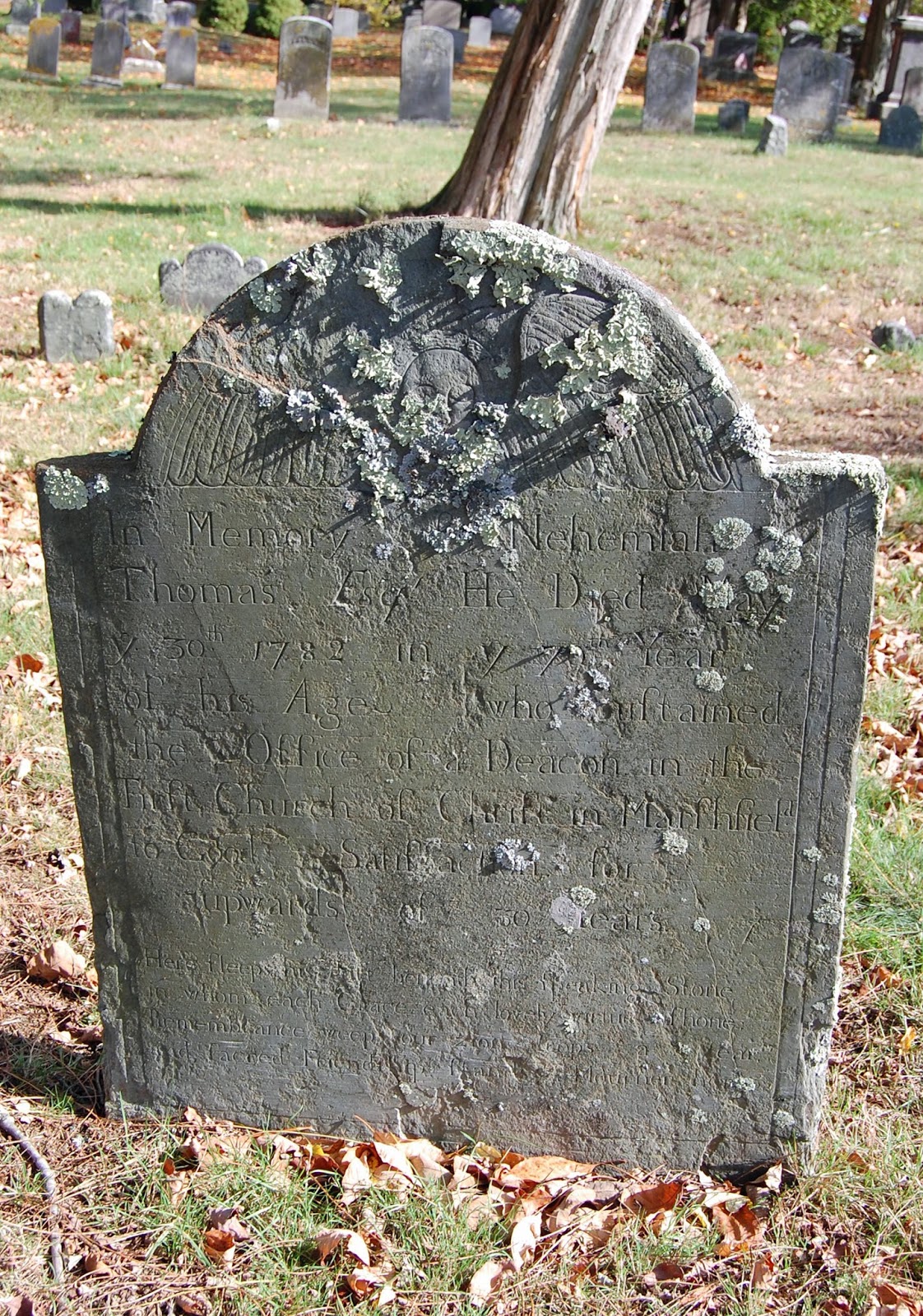
As town clerk, Nehemiah Thomas (represented here by his gravestone, courtesy of Find-a-Grave) kept the record of that meeting, but he wasn’t a Loyalist. He was the town’s representative at the Massachusetts Provincial Congress that the meeting formally objected to. Thomas was most likely one of the sixty-four local men who signed a public protest against those proceedings:
We, the subscribers, inhabitants of the Town of Marshfield, being greatly aggrieved at the conduct of the said Town at their late meeting, on the 20th of February last, and sensible of the high colouring which the Tories never fail to bestow on every thing that turns in their favour, think ourselves obliged in duty to our King, our country, ourselves, and posterity, to remonstrate and declare,

First, That it is our opinion, that the Selectmen of the Town of Marshfield, with a design to answer a purpose, having previously raised the State Bill, which increased the number of voters in the Tory, more than in the Whig interest, so far availed themselves of it, that in the choice of a Moderator, who happened to be a Tory, there appeared about twenty-six or twenty-seven more Tory than Whig voters.

Secondly, that contrary to our minds, the Selectmen and others, inhabitants of this Town, have petitioned his Excellency, agreeable to a late Parliament Act, for leave to hold a meeting here (a thing so contrary to the general sense of the people in this Province) without the knowledge or advice of many in this Town.

Thirdly, That the vote which passed in the negative, whether the Town will adhere to, and abide by the Resolves of the Continental and Provincial Congresses, or any illegal assemblies whatsoever, we think was craftily drawn, and put as if these Congresses were illegal, when we suppose the present situation of our publick affairs makes them both legal and necessary.

Fourthly, That the Town voted thanks should be returned to General Gage and Admiral Graves, for their ready and kind interposition, assistance and protection, from further insults and abuses, with which we are continually threatened, when we do not know or believe that any of the inhabitants of this Town are threatened with insults and abuses.

Lastly, That the Selectmen gave but a single day’s warning for the said Meeting; ordered it to be held in a part of the Town where a Town Meeting was never before had, and that information was not given in the notification of the design of said Meeting.
In sum, those men wrote, the system had been rigged. Patriot newspapers made sure that protest got out to the public. However, it didn’t have the legal weight of the town meeting’s resolutions and communications. Marshfield remained the only Loyalist bastion of Massachusetts outside of Boston.

TOMORROW: London takes notice.

Thursday, July 07, 2016

Marshfield Town Meeting “penetrated with the highest sense of gratitude”

In February 1775 Marshfield’s Loyalist community was feeling emboldened by the presence of a hundred British regulars, and perhaps upset by the complaints from neighboring towns about those troops.

At that time, local historian Lysander Salmon Richards later wrote, Marshfield had only three selectmen: Dr. Isaac Winslow, Abijah White, and Ephraim Little. And they were all in the Loyalist camp.

Thus, those men could call an official town meeting on the terms they chose. Which started with applying to Gen. Thomas Gage for permission to hold such a meeting. The Massachusetts Government Act had forbidden towns from meeting more than once a year without the royal governor’s approval, which was a big strike at local self-government and thus a big grievance for the Patriot side.

According to Boston businessman Harbottle Dorr, Marshfield was the first town to approach the governor under the new law. Most towns were either claiming to meet by adjournment from a previous session or just gathering without official sanction.

Marshfield’s meeting took place on 20 February. The attendees chose Dr. Winslow to moderate. The records of that meeting say:
A vote was put to know the mind of the Town, whether they will adhere to, and abide by the Resolves and Recommendations of the Continental and Provincial Congresses, or any illegal assemblies whatsoever? and it passed in the negative.

Secondly, The vote was put to know the mind of the Town, whether they will return their thanks to General Gage, and Admiral [Samuel] Graves, for their ready and kind interposition, assistance, and protection from further insults and abuses with which we are continually threatened? and it passed in the affirmative.

Thirdly, They voted that a Committee be chosen to draw up and send the same to General Gage, and Admiral Graves, said Committee consisting of 23 persons.
Dr. Winslow chaired that large committee and probably drafted the addresses in the home he had recently inherited. (That home is shown above; now the 1699 Winslow House, I’m speaking there this evening.) Marshfield’s address to Gen. Gage matches the neighboring towns’ complaint in its high-flying rhetoric:
We, the Inhabitants of Marshfield, in legal Town Meeting assembled, this 20th day of February, 1775, beg leave to return your Excellency our most grateful acknowledgments for your seasonable assistance and protection, in sending a detachment of his Majesty’s Troops to secure and defend the loyal people of this Town, from the threats and violence of an infatuated and misguided people. We assure your Excellency (whatever may have been surmised to the contrary) that there were sufficient ground and reasons for making application; and we are fully convinced that this movement has preserved and promoted, not only the peace and tranquillity of this Town in particular, but of the County in general; owing, in great degree, to the prudence, firmness, and good conduct of Captain [Nisbet] Balfour, who, with pleasure as well as justice we say it, has done every thing in his power to obtain those laudable ends and purposes.

Thankfully we acknowledge our obligations to our Sovereign, for his great goodness and wisdom, in placing at the head of affairs, in this Province, in this day of difficulty, confusion, and discord, a gentleman of your Excellency’s well known humanity, moderation, capacity and intrepidity, and shall constantly implore the Supreme Governour of the universe to assist and direct you in the faithful discharge of the various functions of your exalted station, with fidelity to your King, with honour to yourself, and with happiness to the people committed to your charge.

With pleasure we embrace this opportunity of expressing our detestation and abhorrence of all assemblies and combinations of men (by whatever specious name they may call themselves) who have or shall rebelliously attempt to alter or oppose the wise Constitution and Government of Great Britain.

Furthermore, we beg leave to inform your Excellency, that in the most critical and dangerous times, we have always manifested and preserved our loyalty to the King, and obedience to his laws; carefully avoided all constitutional covenants and engagements whatsoever, that might warp us from our duty to our God, our King, and country; and as we are determined to persevere in the same course, we flatter ourselves that our endeavours and exertions will meet with our most gracious Sovereign’s approbation, as well as your Excellency’s, and that under his and your gentle and humane government and kind protection, we may peaceably and quietly sit under our own vines and fig-trees, and have none to molest or make us afraid.
(Fans of Hamilton will recall how George Washington also liked to quote Micah 4:4.)

The address to Adm. Graves was shorter but similar in tone:
We, the Inhabitants of Marshfield, in Town Meeting legally assembled, the 20th of February, A.D. 1775, penetrated with the highest sense of gratitude, present our sincere and hearty thanks to you sir, for your ready compliance with a request of a number of our inhabitants, in ordering an armed Vessel to protect and defend us from the lawless insults and abuses with which we were threatened by numbers of seditious and evil-minded people, for no other reason (that we can conceive) but our loyalty to the best of Kings, and firm adherence to the laws of Government. With hearts replete with gratitude, we contemplate the paternal care and goodness of our most gracious Sovereign, in the appointment of a gentlemen to command his Navy in America, at this critical juncture, whose duty, inclination, and abilities, so happily coincide to answer the good purposes of his department.

Permit us to acquaint your Honour, that we have always endeavoured to comport ourselves, and regulate our conduct agreeable to the laws of England and this country; that we have not been guilty of any riots or illegal assemblies, or adopted or subscribed any unconstitutional resolves, covenants, or combinations whatsoever, but have constantly and uniformly borne, our testimony against such measures and proceedings; that it is our serious intention and firm resolution to respect the English Constitution; and demean ourselves like true, loyal and obedient subjects, by doing which we apprehend we shall entitle ourselves to the continued protection of our most gracious King, your Honour, and every friend to peace and good Government.
Dr. Winslow and his Loyalist colleagues weren’t the only men at that meeting, however. Marshfield’s longtime town clerk, Nehemiah Thomas, also attended to keep the official record. And he surely didn’t like what was going on.

TOMORROW: The Patriot party objects.

Wednesday, July 06, 2016

A Plymouth County Protest “as if written with a sunbeam”

The letters I quoted yesterday described the arrival of about a hundred British soldiers in Marshfield on 23 Jan 1775, sent by Gen. Thomas Gage to support the local Loyalists. Those letters also reported that Patriots in the region had started to muster against those troops but hung back.

Instead, the nearby communities protested through their civil representatives and some high-flying rhetoric. They sent a letter to the governor that was published in the 27 Feb 1775 Boston Evening-Post:

We, his majesty’s loyal subjects, selectmen of the several towns of Plymouth, Kingston, Duxbury, Pembroke, Hanover, and Scituate, deeply affected with a sense of the increasing dangers and calamities which menace one of the most promising countries upon earth with political excision, cannot but lament, that, while we are endeavoring to preserve peace and maintain the authority of the laws, at a period when the bonds of government are relaxed, by violent infractions on the charter of the province, our enemies are practising every insidious stratagem to seduce the people into acts of violence and outrage.

We beg leave to address your excellency, on a subject which excites our apprehensions extremely: and, in the representation of facts, we promise to pay that sacred regard to truth, which, had our adversaries observed, we flatter ourselves, it would have precluded the necessity of our addressing your excellency, on this occasion.

We are informed, from good authority, that a number of people from Marshfield and Scituate, have made application to your excellency, soliciting the aid of a detachment of his majesty’s troops, for the security and protection of themselves and properties. That their fears and intimidation were entirely groundless, that no design or plan of molestation, was formed against them, or existed but in their own imaginations, their own declarations, and their actions, which have a more striking language, abundantly demonstrate.

Several men of unquestionable veracity, residing in the town of Marshfield, have solemnly called God to witness, before one of his majesty’s justices of the peace, that they not only never heard of any intention to disturb the complainants, but repeatedly saw them after they pretended to be under apprehensions of danger, attending to their private affairs, without arms, and even after they had lodged their arms a few miles from their respective houses. They frequently declared, in conversation with the deponents, that they were not apprehensive of receiving any injury in their persons or properties, and one of them, who is a minor, as many of them are, being persuaded to save his life by adjoining himself to the petitioners, but afterwards abandoning them by the request of his father, deposeth, in like solemn manner, that he was under no intimidation himself, nor did he ever hear any one of them say that he was.

It appears as evident, as if written with a sunbeam, from the general tenor of the testimony, which we are willing to lay before your excellency if desired, that their expressions of fear, were a fallacious pretext, dictated by the inveterate enemies of our constitution, to induce your excellency to send troops into the country, to augment the difficulties of our situation, already very distressing; and, what confirms this truth, if it needs any confirmation, is, the assiduity and pains which we have taken to investigate it. We have industriously scrutinized into the cause of this alarm, and cannot find that it has the least foundation in reality.

All that we have in view in this address is, to lay before your excellency a true state of facts, and to remove that opprobrium, which this movement of the military reflects on this country: and as a spirit of enmity and falsehood is prevalent in the country, and as every thing which comes from a gentleman of your excellency’s exalted station naturally acquires great weight and importance, we earnestly entreat your excellency to search into the grounds of every report, previous to giving your assent to it.
(This transcription was published in the journals of the Massachusetts Provincial Congress with 1800s spellings and punctuation. A contemporaneous printing is preserved in the Harbottle Dorr newspaper collection.)

Those towns also petitioned to the Massachusetts Provincial Congress, which on 15 February voted:
That the Congress do highly approve of the vigilance and activity of the selectmen and the committees of correspondence of the several towns of Plymouth, Kingston, Duxbury, Pembroke, Hanover, and Scituate, in detecting the falsehoods and malicious artifices of certain persons belonging to Marshfield and Scituate, not respectable either in their numbers or their characters, who are, with great reason, supposed to have been the persons who prevailed upon General Gage to take the imprudent step, of sending a number of the king’s troops into Marshfield, under pretence of protecting them: whereby great and just offence has been given to the good people of this province, as very fatal consequences must have arisen therefrom, if the same malevolent spirit which seems to have influenced them, had actuated the inhabitants of the neighboring towns; or if the same indiscretion which betrayed the general into the unwarrantable measure of sending the troops, had led this people to destroy them.
At this point the Massachusetts Patriots were anxious to deny or play down any reports of violence and intimidation, presenting themselves to the world as peaceful citizens. The Boston Gazette’s first comment on the troops in Marshfield carried a similar message.

No matter that there had indeed been some documented incidents of violence in the Massachusetts countryside. Or that fear of crowds had driven many supporters of the Crown out of their home towns and into Boston. Or that the Provincial Congress was secretly, as I discuss in The Road to Concord, gathering cannon.

TOMORROW: The Marshfield town meeting.

Tuesday, July 05, 2016

Marshfield’s Special Spot on the Road to Concord, 7 July

On Thursday, 7 July, I’ll speak on “The Road to Concord: How Massachusetts Moved Toward War in 1774-75” at the Winslow House in Marshfield. There will be a book signing and light refreshments afterwards. Admission is $5 for members of the Historic Winslow House Association, $7 for others. If you’re on the South Shore, please come!

In The Road to Concord, and in my talks about it, I say that after the “Powder Alarm” on 2 Sept 1774, Gen. Thomas Gage’s authority as royal governor of Massachusetts stopped at the gates of Boston. That was of course more than seven months before actual war broke out.

In the fall of 1774 Gage held power in Boston and in nearby Castle William. In every other town of the province, people were free to ignore the Massachusetts Government Act, and they did. They kept the courts closed and the Provincial Congress open, and there was almost nothing the governor could do about it.

There was one exception to that pattern, however. In 1775 Gen. Gage wrested back some control over Marshfield, a coastal town in Plymouth County.

That episode started with a call by Timothy Ruggles, a former speaker of the Massachusetts House and militia general, for men to form a military Association to support the royal government. A large contingent of Loyalists from Marshfield answered that call, led by Nathaniel Ray Thomas, one of the mandamus Council. A letter sent from Boston on 26 Jan 1775 described how folks in the neighboring towns responded in turn:
About a week ago, one hundred and fifty of the principal inhabitants of the Town of Marshfield entered into General Ruggles’s Association against the Liberty plan. When this was known at Plymouth, the faction there threatened to come down in a body and make them recant, or drive them off their farms; on this the Marshfield Associators sent an express to General Gage, to acquaint him with their situation and determination, and to beg his support.
On 23 January, the governor detached Capt. Nisbet Balfour of the 4th Regiment to support the Marshfield Loyalists. The letter described him as bringing “three Subalterns, and a hundred private men,” plus “three hundred stand of Arms for the use of the gentlemen of Marshfield.” Those companies landed near the mouth of the North River and moved into buildings on Thomas’s estate.

The next day, one of those supporters reported on the regulars’ arrival in a letter which James Rivington later printed in his newspaper in New York:
Two hundred of the principal inhabitants of this loyal Town, insulted and intimidated by the licentious spirit that unhappily has been prevalent amongst the lower ranks, of people in the Massachusetts Government, having applied to the Governour for a detachment of his Majesty’s Troops to assist in preserving the peace, and to check the insupportable insolence of the disaffected and turbulent, were happily relieved by the appearance of Captain Balfour’s party, consisting of one hundred Soldiers, who were joyfully received by the Loyalists.

Upon their arrival, the valour of the Minute-Men was called forth by [Samuel] Adams’s crew; they were accordingly mustered, and to the unspeakable confusion of the enemies of our happy Constitution, no more than twelve persons presented themselves to bear Arms against the Lord’s anointed. It was necessary that some apology should be made for the scanty appearance of their volunteers, and they coloured it over with a declaration that “had the party sent to Marshfield consisted of half a dozen Battalions, it might have been worth their attention to meet and engage them; but a day would come when the courage of their Minute host would be able to clear the country of all their enemies, howsoever formidable in numbers.”

The King’s Troops are very comfortably accommodated, and preserve the most exact discipline; and now every faithful subject to his King dare freely utter his thoughts, drink his Tea, and kill his Sheep as profusely as he pleases.
The Patriot movement was encouraging Americans to make as much wool as possible so as to supply American spinners and weavers and cut down the need for imported cloth. Killing a sheep for meat had therefore become a political act.

On 27 January, Gen. Gage reported to the Earl of Dartmouth in London:
The town of Marshfield, with part of that of Scituate, having been lately under terrors…from the threats of their neighbours, for having formed some associations amongst themselves, applied to me for protection; and I have sent a detachment of one hundred men to their relief. It is the first instance of an application to government for assistance, which the faction has ever tried to persuade the people they would never obtain, but be left to themselves.
Three weeks later he confidently added, “The sending a detachment to Marshfield has had a good effect in that quarter of the country, and I hope will encourage other places, where oppression is felt, to make applications of the same nature.”

TOMORROW: Protests from the neighboring towns.

Monday, July 04, 2016

“We hold these truths to be sacred & undeniable”

On this Independence Day, Boston 1775 pauses to recall these stirring words:
When in the course of human events it becomes necessary for a people to advance from that subordination in which they have hitherto remained, & to assume among the powers of the earth the equal & independant station to which the laws of nature & of nature’s god entitle them, a decent respect to the opinions of mankind requires that they should declare the causes which impel them to the change.

We hold these truths to be sacred & undeniable; that all men are created equal & independant, that from that equal creation they derive rights inherent & inalienable, among which are the preservation of life, & liberty, & the pursuit of happiness; that to secure these ends, governments are instituted among men, deriving their just powers from the consent of the governed;

that whenever any form of government shall become destructive of these ends, it is the right of the people to alter or to abolish it, & to institute new government, laying it’s foundation on such principles & organising it’s powers in such form, as to them shall seem most likely to effect their safety & happiness.

prudence indeed will dictate that governments long established should not be changed for light & transient causes: and accordingly all experience hath shewn that mankind are more disposed to suffer while evils are sufferable, than to right themselves by abolishing the forms to which they are accustomed. but when a long train of abuses & usurpations, begun at a distinguished period, & pursuing invariably the same object, evinces a design to subject them to arbitrary power, it is their right, it is their duty, to throw off such government & to provide new guards for their future security.

such has been the patient sufferance of these colonies; & such is now the necessity which constrains them to expunge their former systems of government. the history of his present majesty, is a history of unremitting injuries and usurpations, among which no one fact stands single or solitary to contradict the uniform tenor of the rest, all of which have in direct object the establishment of an absolute tyranny over these states. to prove this, let facts be submitted to a candid world, for the truth of which we pledge a faith yet unsullied by falsehood.
The possessive “it’s,” the “independant” spelling, and eschewal of capital letters are clues that these words came unedited from the pen of Thomas Jefferson. This is how his draft of the Declaration of Independence began, as reconstructed from the manuscripts he proudly preserved.

Sunday, July 03, 2016

New Words from Richard Henry Lee

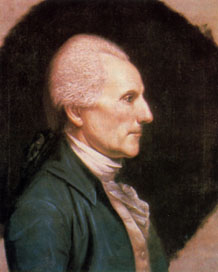
The American Antiquarian Society just announced that retiree Kathy Major, back in the archive as a volunteer, had identified three previously unknown letters from Richard Henry Lee.

Lee is best recalled for having proposed independence at the Continental Congress in 1776, but he was active from the Stamp Act crisis of 1765 (on both sides) to presiding over the Congress in 1784-85 to the first U.S. Senate in 1789.

The society’s blog explains:
The letters were donated to AAS almost thirty years ago by Mrs. Allan Carr McIntyre of Watertown, Massachusetts, and contain much valuable information about the military progress (or lack thereof) of the American Revolution from 1776 to 1778. Written in Philadelphia, all three were addressed to Col. John Page (1744-1808), then serving as lieutenant governor of Virginia.
Lee wrote the letters on 23 Sept 1776, 10 Oct 1777, and 7 Sept 1778. Those dates were, respectively, soon after the Battle of Brooklyn, soon after the Battles of Brandywine and Germantown, and soon after the Battle of Rhode Island. In other words, not at high points of the war from the American side.

Yet Lee emphasized the positive. Despite the “northern militias…immensely expensive and utterly useless,” he wrote, the Continental Army was ready to stop the British forces at Harlem Heights (which it did, but only for a couple of weeks). “We heard yesterday from Lake Champlain and have the pleasure to find things there in a safe situation for this Campaign at least,” that 1776 letter concluded.

In 1777 Lee treated Germantown as a near-victory, but he was writing from York, Pennsylvania, because the Congress had had to flee from Philadelphia. The Valley Forge winter was ahead. (News of Saratoga hadn’t reached York yet or Lee would surely have emphasized it.)

About the 1778 fighting in Rhode Island, Lee wrote, “Victory declared in our favor, the enemy being driven from the field in great disorder.” Of course the goal of the American campaign had been to drive the British out of Newport, and the British were still there. But victory was declared.

Saturday, July 02, 2016

Looking and Listening to Gainsborough House

Gainsborough House in Sudbury, Suffolk, England, is the late-medieval brick house where the painter Thomas Gainsborough was born in 1727.

It’s now a museum dedicated to the painter and his work. The house recently announced that its collection of artwork, manuscripts, painting tools, and other artifacts is viewable online. (Notably, that database of British art is on a Swiss system through Zetcom.ch.)

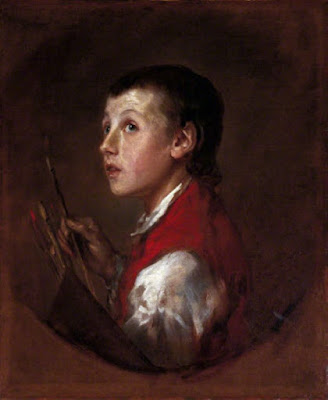
Many of the museum’s items are prints and engravings derived from Gainsborough’s paintings, but the museum also houses a few originals. One, on loan from its owner, is this portrait created around 1769 and known as “The Pitminster Boy.”

In a travel article for the Telegraph, Fiona Bruce wrote this picture is “believed to be of Gainsborough’s assistant during a sketching trip in Somerset.”
A young boy in a red waistcoat looks up and out of the frame, alert, watchful, holding his master’s brushes and pulling one out ready for use, presumably the brush Gainsborough needs for the next strokes of the portrait.
Many scholars think this was one of the four paintings that Gainsborough sent to the first Royal Academy exhibition in London in 1769, described in the catalogue only as a “boy’s head.”

But that’s not the only digitization of the Gainsborough House’s collection folks can enjoy on the web. In her “Gainsborough Project,” The artist Emily Godden has created “sonifications” of the cracks in a handful of paintings, including the right hand of “The Pitminster Boy.” She explains:
The process begins using a graphics tablet to draw out the lines/cracks formed over time as a result of the deterioration of the paintings at Gainsborough’s House. These drawings focus on the hands in the paintings and have been drawn in Adobe Photoshop CS6 and are then exported as bitmap prints to be imported into bespoke software. Through a process of plotting the pixels from the bitmap files the software uses a means of pixel feedback to construct grids from the pixels to plot out waveforms, which are then output as .wav files which can then be listened to.

This processing of data within the project allows a mediation to occur through data use and re-use which challenges typical expectations of image and media reproduction. Instead of merely exploiting the serial nature of print I have applied a haptic approach to the textures felt in the sound as being representative of the spaces that the sound has been extracted from. A feedback loop is established and the data transposed into a new form to create a state of flux.

The sonification of the intangible leads the sound files to act and function as prints which isolate the visual sense to engage in a haptic materiality which explores the vicissitudes of listening within virtual realities over the spatiality of Gainsborough’s House.
I think the boy’s expression says it all.

Friday, July 01, 2016

Here Comes the General

From the diary of Pvt. James Stevens of Andover, camped on the north side of the siege lines around Boston in 1775.

Saterday July the 1

I wos releived of a gard about nine a Clok

I went on to Chil [probably Charlestown] to see the fort

there wos won funeral

we preaded to receive the new jeneral Washington but he did not com

Sunday ye 2

this morning we preaded to receive the new jeneral

it raind & we wos dismesd

the jenral com in about nune

there wos no meting in the afternune

I went to the colridg & herd a sarmen from Psams the 71 in the morning

there wos a firing from roxbry

the regerlers burnt won hous

our men fired on them three tims

Munday ye 3

nothing hapeng extrorderly we preaded thre times

I went up on to the hil
This is one of the contemporaneous documents that helped historians discard the notion of Gen. George Wasington assuming his command in front of a large portion of the now-Continental Army lined up on Cambridge common on 3 July 1775, as Currier & Ives illustrated above.

Washington actually took command from Gen. Artemas Ward the previous afternoon, soon after his arrival, and there was “nothing hapeng extrorderly” on the 3rd.