J. L. BELL is a Massachusetts writer who specializes in (among other things) the start of the American Revolution in and around Boston. He is particularly interested in the experiences of children in 1765-75. He has published scholarly papers and popular articles for both children and adults. He was consultant for an episode of History Detectives, and contributed to a display at Minute Man National Historic Park.

Subscribe thru Follow.it


•••••••••••••••••


Monday, July 23, 2018

“Evidence that his country was once as ours is”

In 1838 a contributor to the Southern Literary Messenger who signed himself (or, less likely, herself) “J.A.” set out to fill column inches by describing two “Relics of the Olden Time,” as the headline had it. Both were in the hands of “A gentleman in the county of Albemarle,” Virginia.

The first was a copy of Henry Pelham’s engraving of the Boston Massacre, shown here. The second was a copy of Green and Russell’s Boston Post-Boy for 27 June 1768, with news of John Wilkes’s election in London, the Circular Letter, and the Virginia House of Burgesses’ response to it.

But it’s clear from the space the correspondent devoted that the real interest lay in that newspaper’s advertisements about escaped slaves and slave sales. The magazine quoted three ads in full, concluding with this one, which ran in the other Boston newspapers as well:
On Thursday next, 30th Inst, at Three O’clock Afternoon, Will be sold by Public Vendue, at the Auction Room in Queen Street, A Variety of GOODS, among which are, Irish Linnens, Calicoes, Lutestrings, black Sattins, black corded Silk, stripe Hollands, Kenting Handkerchiefs, Scotch Threads, Dowlass, Duroys, Druggets, Breeches Patterns, Men’s and Women’s fine Cotton Hose, Felt Hats, Men’s and Women’s Saddles, Portmanteaus, Housings and Holsters, Cases with 15 Bottles, a Cask of very good Indigo; also a Negro Girl, 13 years old.
J. Russel, Auctioneer.

At Private SALE, Two Pipes of Sterling Madeira, a Negro Man 40 years of age, a Boy of 14, and two Girls about 12 Years of Age, a second-hand Chaise and Harness, and sundry riding Habits, trimm’d with Gold and Silver Lace.
“J.A.” then commented:
Men, boys, and girls, classed among ‘GOODS’s!!–and this, not in New Orleans—not in Charleston—not in Richmond: but in Boston!

‘But,’ some “philanthropist” may say, on seeing this evidence that his country was once as ours is, ‘we have put away that evil from us. We declared a general emancipation in 1780.’

And how many of that species of GOODS did Massachusetts have, at that time? Why, not quite five thousand. Virginia has little, if any fewer than five HUNDRED thousand: just an hundred for one! How could she follow the example of her northern sister? Other considerations, make the contrast, and the impossibility, yet more striking: the difference of climate; and the inmensely greater disproportion of the whites to the blacks (in Massachusetts sixty to one; in Virginia not two to one.)

The facts here presented are designed to rebuke only the intermeddlers—not the rational and forbearing part—of the northern people. I am among those who believe the latter sort to be a majority there; not only in numbers, but still more in virtue and intelligence.
I believe today we’d call that article “trolling.”

Sunday, July 22, 2018

Counterfeiting along the Borderlands

Last April Brian Barrett published an interesting article on the New York History Blog about a legal dispute between Massachusetts and New York on the eve of the Revolutionary War.

The underlying issue was people in western Massachusetts making and passing counterfeit New York currency. One of the men caught up in the trouble was a West Stockbridge farmer named Ichabod Miller.
On December 20, 1772 at two in the morning, Ichabod Miller and his family were awoken by Albany County Deputy Sheriff Daniel Davids knocking down the door. Miller lived close to the New York-Massachusetts border, but on the Mass. side of the line. He later testified that in arresting him for counterfeiting, the Deputy Sheriff and his five-man posse smashed open his door with an axe, and shackled and removed him to the jail in Albany, where he contracted smallpox.

At the time, New York asserted jurisdiction over all residents west of the Connecticut River, part of a long-standing dispute between New York, Connecticut, and Massachusetts (and what would become Vermont). During examination by the King’s Attorney, Ichabod Miller invoked Massachusetts’ authority in the case. The King’s Attorney responded: “God Damn your Authority.” The King’s Attorney told Miller he would get a Massachusetts authority to endorse the Miller warrant after the fact. . . .

On March 9, 1773, the Pittsfield Inferior Court found against the Albany Posse and in favor of Ichabod Miller. The finding was that the posse assaulted, beat, wounded and abused Miller for a period of three weeks. He was awarded 150 pounds in damages, but the case was continued. On August 17, the court specified that only defendants Joshua Root, Icabod Squire Jr. and Abajiah Root were responsible for the damages, but again the case was continued.

A separate complaint filed by Miller against Joshua and Abajiah Root was presented in Inferior Court on March 1, 1774 and the jury awarded Miller an additional 45 pounds plus costs. Miller walked away empty handed again however, as the award was appealed to the Supreme Court in Northampton, MA.
Unfortunately for Miller, his case didn’t get though the entire Massachusetts system before Patriot crowds forced the county courts to close in the late summer of 1774 as a protest against the Coercive Acts. Lawsuits remained closed for the rest of the war, and when the courts reopened so much of society had changed that Miller’s case was moot.

Barrett’s article details several other men who were much deeper into the counterfeit scheme than Miller, who might even have been innocent.

Saturday, July 21, 2018

“A Woman of Good Understanding” at Faneuil Hall

On 21 July 1769, Eunice Paine wrote to her brother, Robert Treat Paine, about a preacher she had just seen at Boston’s Faneuil Hall.

The speaker was Rachel Wilson (1722-1775) from Kendal, England. Wilson was a Quaker, evangelizing a faith that a century earlier would have exposed her to capital punishment. But times had changed. Boston now had a small permanent Quaker meeting, and people were more curious about what a traveling preacher had to say.

The merchant John Rowe estimated the audience who came out to hear Wilson as “at Least Twelve hundred people.” Paine was impressed by how the visitor maintained her composure in front of so many:
’Twas a very crouded assembly but Perfect order maintain’d. Everything was Novel to me—the approach of a woman into a Desk Dash’d me I cou’d hardly look up but I soon found She felt none of those perturbations from the Gaze of a Gaping multitude which I pity’d.

Shes a Gracefull woman & has attain’d a very modest assurance. She spoke clear & Loud Eno’ to be heard distinctly into the Entry. Her Language is very Polite & no doubt her mind is Zealously bent on doing good, her Exhortations to seek the Truth & Court that Light which Evidenith the truth were Lenthy & towards the close workt up to Poesy & produced a tune Not unlike an anthem—her fluency gains the applause She receives for these, nothing like method, & many are her repetitions to my Ear tiresome.

I learnt but one thing new which was an Exposition on the Parable of the woman who hid her Leaven in 3 measures of meal till the whole was Leavened this she says represent the Compound of man Soul, Body, and mind in which the spirit of God is hid & shou’d be kept Close, the man being inactive as meal till animated by the spirit as the meal with Leaven.

After the Exhortation she rested, rose to Conclude with Prayer which was short & pertinent. She then thanked the Audience for their Decent attendance & reprove’d the Levity she observed in some few faces in a very Polite & kind manner & in the Apostles words Blessed the assembly & dismissd us.

A great Number of the Gentlemen of the town with their Ladys shook hands with her. Mr. [James] Otis Desire’d the men to go out to Leave room for the women to retire Comfortably & that they woud be orderly for the Honour of the town, twas done to his mind and Saving the Excessive heat of so crouded a place there was no inconvenience.
Rowe was also favorably impressed: “She seems to be a Woman of Good Understanding.” On 27 July, Robert Treat Paine followed his sister’s example and went to hear Wilson preach.

Rachel Wilson had been speaking to crowds about the Quaker faith since she was a teenager. She and her husband back in England had also raised nine children. In 1768 and 1769 she traveled through the North American colonies; her diary of that experience is now at Haverford College. Wilson died near London on 18 Mar 1775.

Wilson appears in many books about Quaker missionaries in the eighteenth century, and there’s also a book just about her.

Friday, July 20, 2018

The Beggar’s Opera Comes to Lexington, 11 Aug.

In December 1750 the New-York Gazette announced performances of John Gay’s The Beggar’s Opera at the Nassau Street Theatre. That was, theater historians say, the first musical play staged in America. It had already been popular in Britain for twenty-two years.

On 6 May 1751, the New York players announced their “last Time playing the Beggar’s Opera this season” on the upcoming Monday. In the same advertisement they asked if anyone had a copy of a comedy called The Intriguing Chambermaid which they could borrow.

New England, with its Puritan roots, was much more resistant to theater. Opera had to sneak in under the guise of uplifting musical concerts, not full-fledged productions. On 16 Sept 1769 the Providence Gazette announced a “reading” of The Beggar’s Opera in which “All the songs will be sung.”

In Boston, the Deblois family—Anglican and Loyalist—pushed the boundaries for musical entertainment, especially after the arrival of a large number of British army officers in 1768. On 23 Mar 1770 the merchant John Rowe wrote in his diary:
In the evening I went to the Concert Hall to hear Mr [James] Joan read the Beggars Opera & sing the Songs. He read but indifferently but Sung in Taste. there were upwards one hundred people there.
That provides a precedent of sorts for an event at the Lexington Historical Society on Saturday, 11 August. The organization will host “a bawdy singalong and a presentation of The Beggar’s Opera,” as abridged by Diane Taraz, founder of the society’s Colonial Singers.

This concert will take place starting at 7:00 P.M. at the Depot in the center of town. Tickets cost $15-20. There will be snacks, non-alcoholic beverages, and an open bar, so attendees must be over age 21.

Thursday, July 19, 2018

A Taste of the Rev. Ebenezer Parkman’s Diary

Here’s another nifty new online resource on eighteenth-century New England: the diary of the Rev. Ebenezer Parkman (1703-1782) of Westboro, Massachusetts.

It’s part of a larger Westborough Public Library project to make Parkman’s church and family papers available. The diary, which covers sixty-five years, was transcribed by Holy Cross professor Ross W. Beales, Jr., who’s written many papers on it. (Versions have also been published by the Westborough Historical Society and in the American Antiquarian Society Proceedings.)

The other members of the project team include James Cooper of New England’s Hidden Histories and Anthony T. Vaver of the Westborough Library and Executed Today (not that Parkman ever was).

The diary website appears to be built on a blogging platform, with a day for each entry and its footnotes. That allows one to search for names and to look at an entire month of entries at once.

I went to find the month of August 1752, which I’d read about in one of Ross Beales’s articles for the Dublin Seminar for New England Folklife.

That was a bad month for the Rev. Mr. Parkman because he was ill. “I had an exceeding poor Night. Feverish, profusely Sweating, and extreme faint,” reads the first diary entry he managed to write that month, on 16 August. Indeed, Parkman felt so sick that he wasn’t able to preach that Sunday or the next (and the replacement he had lined up finked out on him).

On 22 August Parkman wrote:
A pritty good Night for Sleep, and yet this morning full of pain chiefly in my left Hip, Shoulder and Foot. Great Frost last Night. Dr. [Samuel] Scammell came while I was at Dinner.

P.M. pains increase exceedingly especially in my left Shoulder. May God almighty sustain me and prepare me for his sovereign Will. My little Samuel a Twelve Month old. May he be born again in the Blessed Spirit of God!

The Evening and night were most distressing with pain that ceased not, no not in any Situation whatever, a Circumstance which I have not, I think, at any Time had till now. I put on a Blister upon the upper part of my arm
Parkman’s doctor diagnosed both rheumatism and gout. Aside from the blisters he applied, the minister reported taking “A portion of Rhubarb,” which seemed to do some good. Later, he wrote, “My wife stills a miscellany of Meat, Herbs, Roots, seeds etc. by the Doctor’s Direction.” A fellow minister sent an unnamed “remedy,” and a neighbor brought “some bak’d Bear with Sauce which I could Eat of.”

There was another remedy as well. Remember “little Samuel,” who turned one year old on 22 August? Two days later, his father wrote, “Child carry’d away to be wean’d at t’other House.” New England families often physically separated a mother and child to make weaning easier, or at least more certain. The Parkman family tended to wean babies between twelve and eighteen months, so this was a little on the early side.

Hannah Parkman, the minister’s second wife, stayed home to treat her husband. In addition to distilling that mix the doctor prescribed, on 26 August Ebenezer wrote: “My wife tends me o’nights and supply’s me with Breast-Milk.” So that was why they had to send the baby away.

Wednesday, July 18, 2018

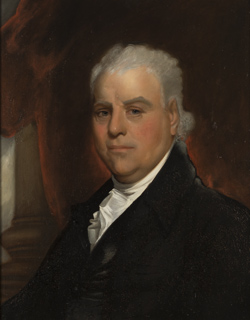
Thoughts on the Powdered Wig

When we picture Europe or its North American colonies in the 1700s, we usually think of men in white wigs. Such men appear in most of the images we have from that period (which of course lean toward showing the upper class as they wanted to appear).

What’s more, the fashion for white wigs got confined to the eighteenth century, not evolving the way the modern three-piece suit traces back to the gentlemen’s garb of the 1700s. So white wigs now seem not only emblems of an antique style but very, very strange.

Having one’s perfectly good hair shaved in order to wear an expensive wig covered in white powder was not only common but practically required in the mid-1700s. People like George Washington had their natural hair powdered to achieve the same look for formal appearances. Upper-class boys got their heads shaved for wigs as they came of age. (One reason this habit is so alien to us is that our culture values looking young and back then people were trying to look like distinguished older men.)

The style didn’t affect only upper-class males. The most fashionable women also powdered their hair. Middling men with social aspirations invested in wigs, though I think they tended to avoid the white powder to avoid appearing too uppity. And British soldiers comprised a large class of working-class men also powdering their hair on a regular schedule.

At Regency History Rachel Knowles traced the story of white hair powder:

Louis XIII (1601-1643) also had a hair problem—he started to go bald at a young age. To hide his baldness, he started to wear a long haired wig and, unsurprisingly, his courtiers soon followed suit. The fashion spread to England and was adopted by Charles II (1630-85) and his court.

The rarest and most expensive wigs were white. As a result, people put white powder on their wigs in order to make them look as white as possible. People also used white powder on their hair. It intensified the blondeness of very fair hair but made darker hair look grey, the shade depending on the natural hair colour. . . .

Hair powder was made from flour or starch and varied considerably in quality, with the best powders being made from highly refined starch.

Although white was the most popular colour, other shades were also used, including brown, grey, orange, pink, red, blue and violet. . . .

In 1795, [the younger William] Pitt introduced a new tax on hair powder. Those wishing to use hair powder had to obtain an annual certificate for the privilege at a cost of one guinea. There was an outcry against the expense of this licence and the tax did not have quite the effect that Pitt had hoped for.

There was already a move toward more natural hairstyles and many people chose to abandon their hair powder altogether rather than spend a guinea on a licence. The tax never brought in the anticipated revenues; it simply hastened the demise of the fashion for hair powder.
Lots more detail at that post.

As for the wigs themselves, Geri Walton offered a taxonomy of styles that evolved over the decades:
Besides the tie-wig, the bob-wig (minor and major) also became popular in the 1700s. It arrived on the scene during George II’s reign. What made this wig popular was it “was a direct imitation of the natural hair, and was used chiefly by the commonalty. The ’prentice minor bob was close and short; the citizen’s bob major, or Sunday buckle, had several rows of curls.”[4]

The macaronis similarly introduced a toupee that was supposed to be natural. It had “a large queue, which required the hair to be very long to be fashionable. The wig, having been made to imitate natural hair, became in its turn the model, and the natural hair was [soon] arranged to imitate the wig.”[5]

In France, bag wigs were called Peruqes à la Regencé. They came into fashion when the Duke of Orléans was serving as regent (1715-1723) to King Louis XV. Bag wigs came into vogue in England [a] little later, around 1730. When they first appeared there, they were not as popular as other style of wigs because these wigs were claimed to have originated with French servants, “who tied up their hair in a black leather bag as a speedy way of dressing it, and keep it out of the way, flowing curls being thought out of place for a man waiting at table.”[6] Bag wigs got their name because they were exactly that, a bagged wig. In England, the long hair at the back of the wig was placed in a black silk bag. Then the ribbons attached to the bag were pulled to the front and tied in a bow, known as a “solitaire.”

Various wigs remained popular throughout the 1700s, and almost every profession had their own peculiar wig, with “the oddest appellations … given to them.”[11] One author noted, that each profession seem to chose a perwig that best expressed its function. For instance, “The caricatures of the period represent[ed by] full-fledged lawyers with a towering frontlet and a long bag at the back tied in the middle; while students of the university … [sported] a wig flat on the top, to accommodate their stiff cornered hats, and a great bag like a lawyer’s at the back.”[12]
Again, more detail at that site.

All told, an eighteenth-century person could look at a bewigged man and pick up information about his profession, wealth, and personal style. Which of course was the point. We no longer understand that visual language, making the habit all the more strange.

Tuesday, July 17, 2018

Dr. Thacher’s Diagnoses

On 7 June 1780, Dr. James Thacher served as a Continental Army surgeon during the Battle of Springfield, New Jersey. In his diary, published decades later, Thacher described one casualty like this:
In the heat of the action, some soldiers brought to me in a blanket, Captain Lieutenant [Alexander] Thompson of the artillery, who had received a most formidable wound, a cannon ball having passed through both his thighs near the knee joint. With painful anxiety, the poor man inquired if I would amputate both his thighs; sparing his feelings, I evaded his inquiry, and directed him to be carried to the hospital tent in the rear, where he would receive the attention of the surgeons. "All that a man hath will he give for his life." He expired in a few hours.
After the battle, Gen. Nathanael Greene reported to the commander-in-chief: "The Artillery under the command of Lt Colonel [Thomas] Forest was well served—I have only to regret the loss of Capt. Lt Thompson who fell at the side of his piece by a cannon ball."

Dr. Thacher recalled having to leave another casualty of the British artillery fire:
While advancing against the enemy, my attention was directed to a wounded soldier in the field. I dismounted and left my horse at a rail fence, it was not long before a cannon ball shattered a rail within a few feet of my horse, and some soldiers were sent to take charge of the wounded man, and to tell me it was time to retire.

I now perceived that our party had retreated, and our regiment had passed me. I immediately mounted and applied spurs to my horse, that I might gain the front of our regiment. Colonel [Henry] Jackson being in the rear, smiled as I passed him; but as my duty did not require my exposure, I felt at liberty to seek a place of safety.

It may be considered a singular circumstance, that the soldier above mentioned was wounded by the wind of a cannon ball. His arm was fractured above the elbow, without the smallest perceptible injury to his clothes, or contusion or discoloration of the skin. He made no complaint, but I observed he was feeble and a little confused in his mind. He received proper attention, but expired the next day. The idea of injury by the wind of a ball, I learn, is not new, instances of the kind have, it is said, occured in naval battles, and are almost constantly attended with fatal effects.
As for other soldiers, Thacher noted another curious condition:
Our troops in camp are in general healthy, but we are troubled with many perplexing instances of indisposition, occasioned by absence from home, called by Dr. [William] Cullen nostalgia, or home sickness. This complaint is frequent among the militia, and recruits from New England. They become dull and melancholy, with loss of appetite, restless nights, and great weakness. In some instances they become so hypochondriacal as to be proper subjects for the hospital. This disease is in many instances cured by the raillery of the old soldiers, but is generally suspended by a constant and active engagement of the mind, as by the drill exercise, camp discipline, and by uncommon anxiety, occasioned by the prospect of a battle.
As at summer camp, staying busy helped alleviate homesickness. As did the prospect of being hit, or even nearly hit, with a cannon ball.

Monday, July 16, 2018

The Confiscation of John McWhorter’s Gun

On 16 July 1775, the Taunton Patriot leader David Cobb (shown here, courtesy of the Massachusetts Historical Society) wrote to his brother-in-law, Robert Treat Paine, about the Battle of Bunker Hill, smaller skirmishes, and a local conflict:
John McWhorter from a trifling incident that happen’d in the Weymouth Alarm, in which I was oblig’d to take his Gun by force, has wag’d an eternal war with the Neighbourhood and now lives in a surly, morose, malicious, damn’d Scotch looking manner without conversing with his Family or Friends.
John McWhorter was a big man in Taunton. He owned a tavern where John Rowe visited (calling him “McQuarters”), the local Sons of Liberty reportedly met, and attorney and near neighbor Daniel Leonard supped after his wife died. It contained upscale tea tables and was still referred to as “McWhorter’s Inn” years after his death—probably because his wife kept it running most of the time. McWhorter also owned at least one slave, and he had interests in shipping.

Most important for the war effort, McWhorter was part-owner of an ironworks in Stoughton. (David Cobb’s father had also been in the iron business.) Responding to a resolution of the Massachusetts Provincial Congress in February 1775, Stoughton’s committee of inspection
stopped upwards of a Ton of Iron, the Property of John McWhorter of Taunton, by seizing and storing the same in the Town of Stoughton, which Iron they had every probable Reason to suspect was designed for the Use of the British Army.
Whether or not that suspicion was accurate, as war approached people clearly regarded McWhorter as a potential Loyalist. And he no doubt perceived Patriot officials as infringing on his property.

That was the situation when there was an alarm about the Royal Navy threatening Weymouth in the summer of 1775. With many of the region’s fighting men off at the siege of Boston, the task of defending the coast fell to militia companies, including the men of Taunton. A “trifling incident” during that tense time prompted Cobb to confiscate McWhorter’s musket.

In December 1776 Taunton’s militia commander noted that McWhorter was one of twenty men on the town’s “alarm list” who hadn’t turned out to protect Rhode Island from the return of the British military. Of course, McWhorter couldn’t have turned out for militia service if Cobb still had his gun.

McWhorter’s feuds continued. On 5 May 1777 the town’s committee of correspondence considered “the verbal complaint of Mr. [John?] Porter [a committee member] respecting the abuse he received from Mr. McWhorter[;] after hearing both parties, the Chairman was desired to give Mr. McWhorter a reprimand which was accordingly done.”

Back in 1776 the Stoughton committee had sold the confiscated iron, offering McWhorter “24s. per Hundred for said Iron, and Interest from the Time it was seized and stored.” But he refused and sued the committee members for “£486, Lawful Money.”

Just before the case was to be tried in June 1779, the committee brought the Massachusetts General Court into the dispute. In September the legislature ordered the Stoughton committee to pay £30.7s.4p. for the iron—basically the initial offer, nowhere close to what McWhorter had demanded.

John McWhorter stayed in Taunton through the war and died in 1800. By then he had probably reconciled himself to his neighbors and they to him, but people might still have been surly and morose.

Sunday, July 15, 2018

A Call for Studies of Biography and Celebrity in the 1700s

Prof. Kristina Straub of Carnegie Mellon University and Prof. Nora Nachumi of Yeshiva University have issued a call for contributions to a scholarly volume entitled "Making Stars: Biography and Eighteenth-Century Celebrity."

They say:
A celebrity is not a person, exactly, but a construct established through the public discourse and representation that we now think of as celebrity culture. During the long eighteenth century, biography was key to an earlier form of celebrity culture that anticipates what we experience as modern celebrity.

This volume proposes to explore the relationship between biography and celebrity in the long eighteenth century. In inviting essays, we keep that relationship open to definition: are biography and celebrity mutually constitutive? Does one drive the other? Are there contradictions as well as connections between biography as a genre and the celebrity culture that is manifest in a wide range of print, visual materials, and embodied performances? Similarly, we maintain an open definition of celebrity to include the many different variations in the period: theatrical, criminal, aristocratic, royal, and even the freakish.

We welcome work that clarifies and gives nuance to the prehistory of the celebrity bio as a genre and that thinks about ways in which particular material and ideological conditions shaped the formal and experiential effects of celebrity during the period roughly between 1660 and 1830. Essays might focus, for example, on comparing biography’s relationship to celebrity representation in other genres and media; a specific challenge or problem posed by a person or text or a particular form of representation; or contested representational forms.

We also are interested in work that grows out of or reflects on the process of writing a modern biography of an eighteenth-century celebrity. How do biographies create celebrity? How do various rhetorics of biographical discourse contest or refuse celebrity? How might attention to the formal rhetorics of biographical studies provide us new ways to think about celebrity culture in the long eighteenth century and conversely how might the terms of celebrity studies allow us new insights into biography? What case studies allow us to see the constitutive work of celebrity and biography in action?
The editors invite abstracts 300-400 words long, accompanied by capsule biographies of the authors no more than 150 words long, by 15 Sept 2018. Material should be sent to both ks3t@andrew.cmu.edu and nachumi@yu.edu.

Saturday, July 14, 2018

Online Collections of Engravings and Samplers

Here are a couple of online databases of visual interest.

The Anderson House library of the Society of the Cincinnati in Washington, D.C., has created an online collection of engravings and prints from and relating to the Revolutionary War. The website explains its contents:
Works of art on paper featuring engravings of Revolutionary War battle scenes, allegorical and commemorative prints, and portraits of original members of the Society of the Cincinnati. A significant collection of satirical prints includes caricatures of major figures on all sides during the Revolutionary War and political cartoons of relevant events of the longer Revolutionary era from the Seven Years' War through the War of 1812.

Highlights include: an extremely rare wartime mezzotint of George Washington by Charles Willson Peale; a pair of rebus letters skewering the Carlisle Peace commission; and images of leaders such as George III, John Wilkes, the marquis de Lafayette, and Louis XVI.
The website format lets viewers magnify the images to study details.

Turning from warfare to the domestic sphere, the Sampler Consortium unveiled the Sampler Archive, an online searchable database of American schoolgirl samplers and related embroideries. The archive begins with material from the Winterthur Museum, the D.A.R. Museum, and the Rhode Island Historical Society. Images from a dozen other collections and recent events will follow.

The samplers are catalogued with detailed information on their physical characteristics, history of the maker and her family, and provenance. The collection can be browsed according to the contributor, type of object, maker's age, place, and date.

As an example, the sampler shown above bears the name of "Nancy Tucker aged 8 1791." Curators at the D.A.R. Museum think it may have been made in Essex County, Massachusetts. Below an alphabet it bears the motto:
This Work In Hand my Friend may hav
When I am Dead And in My Grave
Which may have been meant well but rather reminds me of the dire warnings against theft that schoolboys used to write in their schoolbooks.

Friday, July 13, 2018

Watching the Native Northeast Portal Grow

The Native Northeast Portal is still in early development but offers great promise. It addresses the challenge of how many primary-source documents about New England Native communities are unpublished, scattered, and difficult to access. As the website explains:
The Portal represents a scholarly critical edition of New England Native American primary source materials gathered presently from the partner institutions into one robust virtual collection, where the items are digitized, transcribed, annotated, and edited to the highest academic standards and then made freely available over the Internet, using open-source software. By providing annotated transcriptions, the Project’s editors provide the Series users with useful information within a well-researched and balanced context necessary to understand the complexities of the historical record.
As an example of this portal's resources, here's a petition from Jonathan Capen seeking the release of Isaac Williams from the Suffolk County jail in December 1776. Crisp images of the document with the Council's response written on it are accompanied by a transcription and a map showing the pertinent location.

Other sources fill out the story. Williams was "a Molatto" from Dedham who enlisted in Capt. Joseph Guild's company in May 1775 and served until the end of the year. Early that November Williams married Elizabeth Will, a member of the Punkapoag community in Stoughton.

Williams must have reenlisted in the Continental Army or was drafted for it in some way because on 14 Aug 1776 he was listed as a deserter from Guild's company. He was then said to be twenty-three years old and 5'10" tall. The army still listed him as coming from Dedham.

Apparently Williams had gone to his wife in Stoughton because the selectmen of that town had him arrested as a deserter and put in the Suffolk County jail. (That didn't mean the jail in Boston since Suffolk County then included all of modern Norfolk County.)

Capen was the agent for the Punkapoag community in its dealings with the government, so he petitioned on behalf of Elizabeth Williams. Capen wrote that her young husband was "in a very poor State of Health," which might well be why he had left the army. The Massachusetts Council approved that petition and ordered the selectmen to release Williams.

As for the end of Williams's story, I'm pleased to report that he recovered. According to genealogists David Allen Lambert and Jennifer Pustz, he lived until 1831. The Stoughton Historical Society owns the pieces of his gravestone. Elizabeth Williams lived until 1848, long enough to apply for a pension as a Continental Army widow. (Her application doesn't mention any service or arrest in 1776.) Among the people supporting the Williams pension claim with a shaky signature was Jonathan Capen, evidently the elderly son of the man who filed the 1776 petition.

Thursday, July 12, 2018

A Free Peek into the American Ancestors Databases

Since I'm on the road this week, I'm going to highlight some online databases that have caught my eye.

The New England Historical Genealogical Society has announced that all the databases at its American Ancestors website will be free through Tuesday, 17 July. People need to sign in as guest members to access the back issues of the New England Historic Genealogical Register, the Suffolk County probate records, biographies of the Massachusetts Society of the Cincinnati, the world's largest database of Mayflower descendants, Boston's Catholic records starting in 1789, and much more.

This is of course a push to induce people researching their ancestors to get hooked on those N.E.H.G.S. databases and become regular members. And that online access really is useful. Just this month I looked up the probate inventory of a Continental Navy veteran, discovering that he owned no real estate but a quarter of a ship and 3,000 pounds of coffee. He was, I conclude, a merchant captain who died unexpectedly before that last cargo was sold.

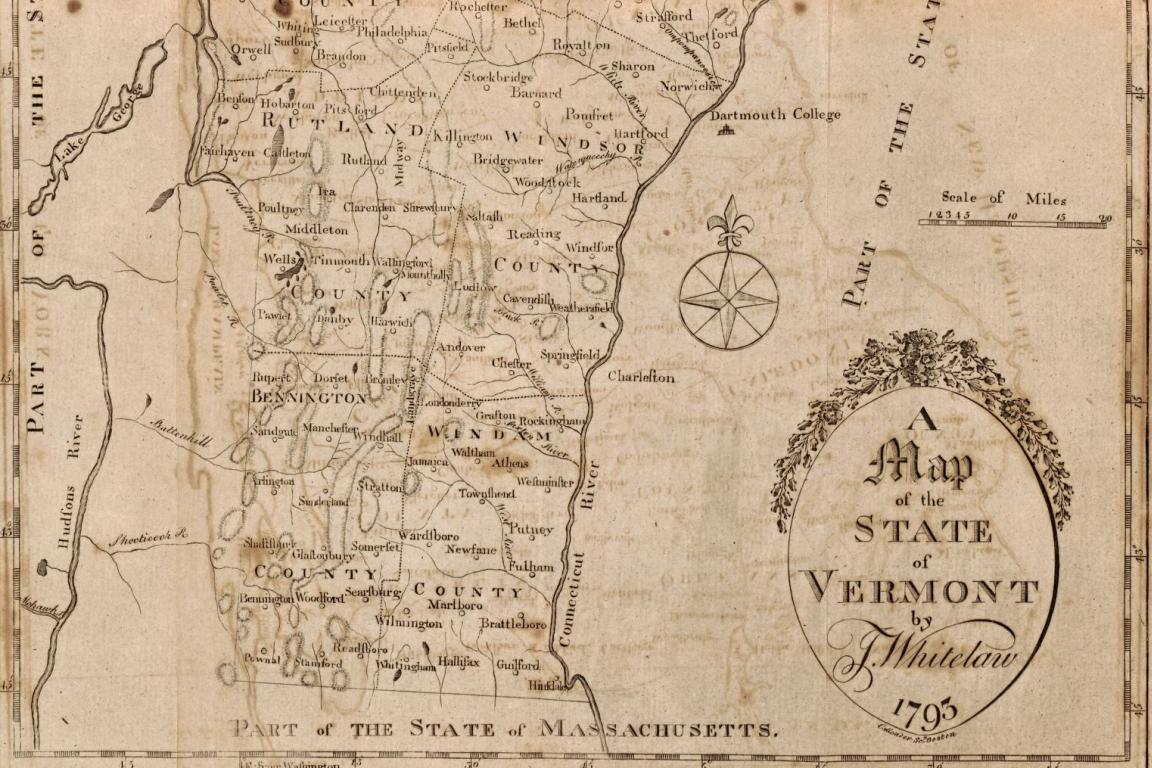
Among the N.E.H.G.S. databases available is the Early Vermont Settlers, 1700-1784 project directed by Scott Andrew Bartley. This week the society added 74 new profiles of heads of families from Hartland, Springfield, Hartford, and other towns in Windsor County, Vermont. For info on exactly who those people are, see these blog posts.

Wednesday, July 11, 2018

Representing Washington in Cambridge, 14 July

On Saturday, 14 July, the Longfellow House–Washington’s Headquarters National Historic Site in Cambridge will welcome three guests representing Gen. George Washington in different ways.

Washington used that Georgian mansion, originally built by friend of government John Vassall, from mid-July 1775 to early April 1776. Martha Washington joined him there in December. In those months the commander-in-chief made plans to reorganize the Continental Army for a wider campaign (including a reversal of his initial decision not to enlist any black soldiers), launched unusual attacks on the Crown at sea and in Canada, and learned crucial lessons about using his staff, working with civil governments, managing intelligence and counterintelligence, and more.

From noon to 4:00 P.M., John Koopman will portray Gen. Washington at the site, and Sandy Spector will join him as Martha. Visitors can converse with the Washingtons and ask questions about their wartime experiences, take and/or pose in photographs, play historic games, and enjoy other activities. Koopman plays the title role in Mount Vernon’s short movie “Washington’s War,” now available through various streaming services. (Alas, this presentation lacks the “snow” that falls in the Mount Vernon theater during winter scenes.)

From 1:00 to 2:00 P.M., Roxane Orgill will read from and speak about her new book Siege: How General Washington Kicked the British Out of Boston and Launched a Revolution. This is a novel in verse about Washington’s time in Cambridge. Though written with young people in mind, it evokes the difficult moments and decisions for all readers. Orgill is the author of the Boston Globe–Horn Book Award winner Jazz Day: The Making of a Famous Photograph, and other books.

At 2:30, a National Park Service ranger will lead a “Road to Revolution” walking tour of nearby sites involved in the “Powder Alarm,” the siege of Boston, the housing of the Convention Army, and other moments in the move toward American independence.

All these events are free and open to the public, as are tours of the mansion. The Longfellow–Washington site is at 105 Brattle Street, only half a mile from Harvard Square. Parking in this part of Cambridge is extremely limited, so plan to walk.

Tuesday, July 10, 2018

Rehabbing Colonial Massachusetts’s Granite Positioning System

The Massachusetts Department of Transportation recently announced the completion of its project to preserve the remaining milestones along the old Upper Boston Post Road.

Those stones were initially put in place as early as 1729 by rich men vying for political acclaim, such as justice Paul Dudley (1675-1751), soon to be chief justice. In 1767 the Massachusetts Council ordered more markers. Traffic, urban growth, and highway projects have moved or removed a lot of the stones so that by 1971 only forty were still around to be listed in the National Register.

In 2011, a marker in Brighton was damaged by a truck. That prompted the Transportation Department to explore conserving all the known remaining milestones. In 2014, the Watertown firm Daedalus Inc. was contracted to survey and preserve the markers. The company identified twenty-nine stones that needed repairs, cleaning, cracks filled, resetting, and/or moving back to their original locations. That work is now complete.

The department’s blog post contains a complete list of the surviving markers and their locations. As an example, here’s a stretch of stones in central Massachusetts:
  • Milestone Marker #35 is located at Dean Park on Main Street in Shrewsbury. This granite marker is inscribed with “Boston 35 Springfield 65 Albany 165”.
  • Milestone Marker #43 is located on Main Street at the I-290 ramp in Shrewsbury. This granite marker is carved with the inscription “43 Mile to Boston”. Marker #43 has been moved to a more accessible location on the Shrewsbury Town Common adjacent to Main Street.
  • Milestone Marker #47 is located on Lincoln Street in Worcester. This brownstone marker is carved with the inscription “47 Miles from Boston 50 Springfield”.
  • Milestone Marker #48 was formerly located at the Worcester Historical Society, but, as part of the project, has been reset at Wheaton Square Park on Salisbury Street in Worcester. This brownstone marker is carved with the inscription “48 Miles from Boston”.
  • Milestone Marker #53 is located on Main Street in Leicester. This brownstone marker is carved with the inscription “53 Mile from Boston”.
  • Milestone Marker #54 was formerly located inside the Leicester Public Library, but has been relocated to Washburn Square in Leicester, which is within the vicinity of its original site. This brownstone marker is carved with the inscription “54 Miles from Boston”.
Markers 56 to 74 (the numbers indicating the miles to Boston) have all survived. In contrast, only one marker to the west of that stretch remains, and it was moved into the Springfield Armory Museum.

For more about Massachusetts milestones, see this guest blogger post from Charles Bahne.

Monday, July 09, 2018

The World War of 1778 to 1783

An exhibit on “The American Revolution: A World War” just opened at the Smithsonian’s National Museum of American History. There is also a website showing some of the artifacts.

This exhibit focuses on the siege of Yorktown which, when we count sailors as well as troops on land, involved more Frenchmen than Americans.

Among the items on display are paintings of The Siege of Yorktown and The Surrender of Yorktown, both from 1786, and a Charles Willson Peale portrait of George Washington from the early 1780s. All three originally hung in the Comte de Rochambeau’s chamber as a reminder of his partnership with the American general. This is the first time the canvases have been together in more than two centuries.

Shown here is another early artistic celebration of the Franco-American alliance: a French porcelain figurine from the 1780s of King Louis XVI and diplomat Benjamin Franklin.

This exhibit is scheduled to remain on view until next July.

Sunday, July 08, 2018

Robert Burns’s “damn’d melange of fretfulness and melancholy”

Last month the B.B.C. reported on a published paper by Moira Hansen, Daniel J. Smith, and Gerard Carruthers about the moods of Robert Burns (P.D.F. download).

Specifically, the paper is titled “Mood Disorder in the Personal Correspondence of Robert Burns: Testing a Novel Interdisciplinary Approach.” Hansen is a graduate student at the University of Glasgow’s College of Arts while Smith is a Professor of Psychiatry and Carruthers co-director of the Centre for Robert Burns Studies.

As for the “Testing” aspect, it’s important to note that people have been writing about Burns’s periods of depression since, well, Burns. He described himself in November 1793 as feeling “altogether Novemberish, a damn’d melange of fretfulness and melancholy…my soul flouncing & fluttering.” Since his first biographer, Burns scholars have debated the causal links between his moods, his art, and his drinking. In the past few decades scholars have come back to interpreting Burns through the lens of psychological depression.

This team of researchers used Burns’s letters from November 1793 (and lack of letters in the following month) as a benchmark for depression. They had an independent party choose three random points elsewhere in the poet’s correspondence for further assessment and comparison—apparently by Hansen. As for the method of analysis:
Any of these symptoms [manic, hypomanic and depressive] might be evidenced in the text of the letters by a range of features including, but not limited to: explicit discussion; descriptive and figurative language; allusion; tone; coherence of flow of ideas; and length and quantity of letters written in any given period.
I wish the paper had more detail about the measurement of those qualities and how the researchers avoided subjective judgments.

The researchers concluded that there’s ”evidence to suggest Burns' mood cycled between depression and hypomania.” But really, I think, this was a test whether their methodology matched what they and others already knew. The real disputes here are probably whether (a) scholars can reputably diagnose mental disorders over a wide chronological and cultural gap, and (b) whether such conclusions are meaningful to the literary work.

This paper is part of a larger project with its own website. Hansen will go into more detail on Burns’s changing moods, how they affected his behavior and relations with others, and how they affected his poetry. She has the advantage of a large body of writing, collected early and kept reasonably intact. Can the method work with figures whose correspondence was not so assiduously assembled?

Saturday, July 07, 2018

Reviewing the “Townshend Moment”

A few weeks back, I attended a talk at the Colonial Society of Massachusetts by Prof. Patrick Griffin about his new book, The Townshend Moment: The Making of Empire and Revolution in the Eighteenth Century.

Here’s a review of The Townshend Moment by William Anthony Hay for the Claremont Review of Books.

Griffin posits that the rise of power in 1767 of two brothers—George and Charles Townshend—was a crucial juncture in the late-eighteenth-century British Empire. George, who had succeeded to the title of Viscount Townshend in 1764, took the job of Lord Lieutenant of Ireland. Simultaneously, Charles became Chancellor of the Exchequer and the government’s principal voice in the House of Commons.

Though the Townshends consulted closely with each other, they had grown up apart and were quite different men. Hay summarizes:
The brothers were the scions of a failed aristocratic marriage. After their parents separated, the eldest, George, was raised by his father while their mother raised Charles. George, “brave, clever and not devoid of good feeling,” was intemperate in his judgements, impatient with authority, and exaggerated his superiors’ faults. Charles’s talent matched his ambition, but Griffin describes him as fickle, uncertain which political faction to join, and thereby unwilling to be pinned down. The confident and well-connected brothers relied on each other almost exclusively.
In 1767 the goal they shared was to strengthen the authority of the London government over its dependent territories, both across the Irish Sea and across the Atlantic.

The Townshend Act(s), named after Charles, not only instituted tariffs on certain goods shipped to North America but also established that the primary purpose of those funds was to pay salaries for royal appointees in North America, this insulating them from local popular pressure. Charles Townshend died suddenly in late 1767, but the British government remained committed to that model, despite widespread protest from American colonists.

George, Lord Townshend, also ran into opposition from the local legislature—in his case, the Irish parliament. He clearly felt it didn’t deserve as much deference as the Parliament in London. He lasted five years in that job, returning to Ireland in 1773 to fight a duel with an Irish peer. After that, Lord Townshend amassed additional offices, military titles, and a higher peerage but never seems to have exercised as much authority again.

Given the brothers’ short tenure, I’m not sure how influential the Townshends really were. How far ahead of other British ministers were they, and how much did the programs they instituted depend on them? Indeed, the Townshends’ biggest influence appears to have been the antithesis to their plans—the pushback from locals who felt these new rules turned them into second-class subjects.

Hay concludes his review by noting the eventual results of the “Townshend moment” in 1767:
Neither Townshend brother would have intended the ultimate outcomes of their reform projects. Instead of rationalizing empire to make it more governable, those efforts challenged the underlying assumptions that had sustained order. Their reforms unearthed frustrations that ended up pulling the periphery of empire apart. Lord Townshend, who lived until 1807, saw the colonies win their independence. Irish patriots gained fragile autonomy in 1782, but failed to resolve contradictions in their own regime that made it ungovernable. Union with Britain in 1800 traded the fragile autonomy for the benefits of full participation.
Still, it’s always valuable to consider America’s Revolutionary conflict from the perspective of the British government and the men, however briefly, at its head.

Friday, July 06, 2018

The Final Fate of the Cerberus

Boston 1775 has periodically passed on news about the final resting-place of some Royal Navy ships notable in the Revolution:
Here’s another ship in that catalogue.

H.M.S. Cerberus famously arrived in Boston in May 1775 carrying three generals to assist Gov. Thomas Gage: William Howe, John Burgoyne, and Henry Clinton. A frigate named after a mythological three-headed monster could hardly have been a better gift for Patriot propagandists.

(The Earl of Sandwich, frequent First Lord of the Admiralty, liked naming warships after figures from classical mythology. Though he wasn’t in that office in 1758 when the Cerberus was launched, his preference had taken hold.)

The Cerberus was involved in the fight over Noddle’s Island and the Battle of Bunker Hill before returning to Britain with news of that disastrous victory. By the end of the year the warship was back along the American coast, patrolling east of New York’s Long Island. It helped the British military take over Newport in December 1776.

On 14 Aug 1777, the submarine inventor David Bushnell targeted the Cerberus off New London, Connecticut, with another invention: the floating mine. However, some of the warship’s sailors spotted one of Bushnell’s explosive barrels and hauled it aboard their boat. The device went off, killing three and wounding one.

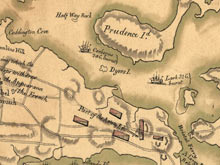
In July 1778 H.M.S. Cerberus was back in Narragansett Bay when the first French fleet arrived. After several days of maneuvering, on 5 August it and three other frigates were chased down by two much larger French warships. The British captains chose to run their vessels aground and set them on fire rather than let them be captured.

In the 1970s a graduate student in archeology discovered the wreck of the Cerberus off Prudence Island. Very little of the frigate was left. That site is now protected by federal law.

Thursday, July 05, 2018

Call for Essays on Eighteenth-Century Protest

Yvonne Fuentes of the University of West Georgia and Marc Malin of Randolph-Macon College have issued a call for essays for a scholarly anthology on the topic “Protest in the Long Eighteenth Century.”

This project stems from a panel at the 2018 meeting of the American Society for Eighteenth-Century Studies titled “They Were Warned, and yet They Persisted.” The conference invitation listed examples of popular protest, opposition, and resistance, such as food riots in England, France, and Spain; the Esquilache Riots in Madrid triggered by “new” policies on hats and coats; and the attacks on silk weavers’ looms in Spitalfields, London.

The presentations examined the causes of the protests, as well as the ways in which common artifacts such as poles, trees, drums, conchs, pamphlets, songs, and other alternative media of communication may operated as flashpoints for conflict.

A week before the conference, an editor contacted Fuentes and Malin to discuss expanding the session into an edited volume. Their goal now is to gather a collection of strong academic and research-oriented interdisciplinary essays on the theme. The volume would include between ten and fifteen essays (7,500-8,000 words including notes) distributed in chapters that explore topics such as:
  • the myths of placid tranquility
  • the contested right of protest
  • the legality of and theories on protest
  • strategies and goals of protest
  • the culture of protest and reaction
  • popular protests and unpopular policies
  • riots and riot control
  • audiences and targets of protest
  • allies and coconspirators
  • collusion and complicity
  • intersectionality
  • transatlantic and transnational boundaries
  • rural and urban forms of resistance and noncompliance
  • verbal and non-verbal means and mediums of protest
  • the limits of satire and parody
  • food and food prices as cause and means of protest
  • clothing, apparel, and fashion as means and provokers of protest
  • art, music, dance as forms of protest and resistance
  • environmental conflicts and social protest
  • common property and communal use of land
  • other forms, causes, artifacts, means of resistance
Fuentes and Malin invite authors from diverse backgrounds, fields, and approaches to submit proposals by 31 Aug 2018. Each proposal should consist of a 500-word abstract describing the topic and approach to the overarching theme, and the author’s condensed two-page curriculum vitae. Send that material to both yfuentes@westga.edu and mmalin@rmc.edu with the subject line: “VOLUME ON PROTEST + [your surname]”.

Wednesday, July 04, 2018

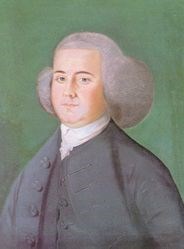
John Adams and America’s First Fourth

As many people know, John Adams lauded the Continental Congress’s vote for independence by writing home, “The Second Day of July 1776, will be the most memorable Epocha, in the History of America.”

Adams didn’t realize that the Congress’s public Declaration of why it had voted that way—a document he was contributing to—would end up being much more prominent than the actual vote and thus define independence in the American people’s minds.

I wondered how long it took for Americans, and for Adams in particular, to adopt 4 July as the important anniversary. And the answer is: not long at all.

On 5 July 1777 Adams wrote to his preteen daughter Nabby:
Yesterday, being the anniversary of American Independence, was celebrated here with a festivity and ceremony becoming the occasion. . . .

The thought of taking any notice of this day, was not conceived, until the second of this month, and it was not mentioned until the third. It was too late to have a sermon, as every one wished, so this must be deferred another year.

Congress determined to adjourn over that day, and to dine together. The general officers and others in town were invited, after the President [Thomas Wharton, Jr.] and Council, and Board of War of this State.

In the morning the Delaware frigate, several large gallies, and other continental armed vessels, the Pennsylvania ship and row gallies and guard boats, were all hawled off in the river, and several of them beautifully dressed in the colours of all nations, displayed about upon the masts, yards, and rigging.

At one o’clock the ships were all manned, that is, the men were all ordered aloft, and arranged upon the tops, yards, and shrowds, making a striking appearance—of companies of men drawn up in order, in the air.

Then I went on board the Delaware, with the President [Wharton again? or John Hancock, head of the Marine Committee] and several gentlemen of the Marine Committee, soon after which we were saluted with a discharge of thirteen guns, which was followed by thirteen others, from each other armed vessel in the river; then the gallies followed the fire, and after them the guard boats. Then the President and company returned in the barge to the shore, and were saluted with three cheers, from every ship, galley, and boat in the river. The wharves and shores, were lined with a vast concourse of people, all shouting and huzzaing, in a manner which gave great joy to every friend to this country, and the utmost terror and dismay to every lurking tory.

At three we went to dinner, and were very agreeably entertained with excellent company, good cheer, fine music from the band of Hes­sians taken at Trenton, and continual vollies between every toast, from a company of soldiers drawn up in Second-street before the city tavern, where we dined. The toasts were in honour of our country, and the heroes who have fallen in their pious efforts to defend her.

After this, two troops of light-horse, raised in Maryland, accidentally here in their way to camp, were paraded through Second-street, after them a train of artillery, and then about a thousand infantry, now in this city on their march to camp, from North Carolina. All these marched into the common, where they went through their firings and manoeuvres; but I did not follow them.

In the evening, I was walking about the streets for a little fresh air and exercise, and was surprised to find the whole city lighting up their candles at the windows. I walked most of the evening, and I think it was the most splendid illumination I ever saw; a few surly houses were dark; but the lights were very universal. Considering the lateness of the design and the suddenness of the execution, I was amazed at the universal joy and alacrity that was discovered, and at the brilliancy and splendour of every part of this joyful exhibition.

I had forgot the ringing of bells all day and evening, and the bonfires in the streets, and the fireworks played off.

Had General Howe been here in disguise, or his master, this show would have given them the heart-ache.
So as early as 1777 John Adams was calling the 4th of July “the anniversary of American Independence.” And for once, he wasn’t the grumpiest member of the Congress. The Connecticut delegate William Williams (shown above) wrote to Gov. Jonathan Trumbull the same day:
Yesterday was in my opinion poorly spent in celebrating the anniversary of the Declaration of Independance, but to avoid singularity and Reflection upon my dear Colony, I thot it my Duty to attend the public Entertainment; a great Expenditure of Liquor, Powder etc. took up the Day, and of Candles thro the City good part of the night. I suppose and I conclude much Tory unilluminated Glass will want replacing etc.
Within there months Gen. William Howe was in Philadelphia, as Adams had only imagined. The Continental Congress and Pennsylvania government had fled to Lancaster. And the U.S.S. Delaware was in British hands.

Tuesday, July 03, 2018

The Rise of John Adams, Boston Lawyer

Between the Liberty riot and the controversy over the Circular Letter, I had to neglect another significant Revolutionary development in June 1768: the entrance of John Adams into Boston politics.

Adams grew up in Braintree and returned to that town to establish his family and legal career. Because of how the Massachusetts Superior Court traveled from county to county, he visited Boston regularly. He had clients there, and he was friends with such significant figures as his cousin Samuel Adams and rising Crown supporter Jonathan Sewall. But for most of the 1760s Adams was a country lawyer, and he liked it that way.

Adams’s earliest public writing was an essay in the 14 Mar 1763 Boston Evening-Post signed “Humphrey Ploughjogger.” Writing in a rustic dialect, Adams lamented the political quarrels in Boston. A second “Ploughjogger” essay said that raising hemp was more important than factional politics. Adams responded to himself in the 18 July Boston Gazette using more genteel language and the new pseudonym “U,” agreeing that agriculture was more productive than arguing in the newspapers.

In August 1765 Adams sent the Gazette a long essay on the history of British law that Edes and Gill printed in installments with no title or signature. When Thomas Hollis republished that essay in London, he titled it A Dissertation on the Canon and Feudal Law. That work drew Adams closer to the political issues of the day, but he was still viewing them from a distance.

In September 1765 stamped paper arrived in Boston, producing a crisis point. Adams made his first direct contribution to the Patriot political argument by drafting his town’s instructions to its General Court representative to resist the Stamp Act. As toned down by Adams’s neighbors, the “Braintree Instructions” were printed in Boston newspapers. Contrary to what Adams wrote decades later, they didn’t really stand out from or influence the instructions from other towns. But that document did draw Adams into formal politics, and in 1766 he became one of Braintree’s selectmen.

In early 1768, Adams decided to move into Boston to advance his legal career. According to his not-always-reliable autobiography:
My Friends in Boston, were very urgent with me to remove into Town. I was afraid of my health: but they urged so many Reasons and insisted on it so much that being determined at last to hazard the Experiment, I wrote a Letter to the Town of Braintree declining an Election as one of their Select Men, and removed in a Week or two
He rented a white house on Brattle Street for himself, Abigail, their two children (Nabby and John Quincy), and servants.

The events of June 1768 yanked Adams into Boston politicking. First, on 6 June he was put on a “Committee of the Sons of Liberty” who initiated a correspondence with John Wilkes, the London radical leader.

A few days later came the Liberty seizure and riot. A long town meeting channeled the energy of that uproar into formal political actions. On 15 June, Adams was named to a seven-man committee to instruct Boston’s representatives to the General Court about how to respond. The other members were Dr. Joseph Warren, Richard Dana, Dr. Benjamin Church, John Rowe, Henderson Inches, and Edward Payne. Much later, Adams recalled:
I was solicited to go to the Town Meetings and harrangue there. This I constantly refused. My Friend Dr. Warren the most frequently urged me to this: My Answer to him always was “That way madness lies.” . . . Although I had never attended a Meeting the Town was pleased to choose me upon their Committee to draw up Instructions to their Representatives
Now those representatives were:
  • James Otis, Jr., moderator of that town meeting.
  • Samuel Adams, on a committee that had just drafted a resolution against the Liberty seizure for the town.
  • John Hancock, an interested party in the Liberty case.
  • Thomas Cushing, speaker of the house and a moderate only by Boston standards.
Those men really didn’t need instructions about how to vote. Rather, the instructions were meant for public consumption.

John Adams is credited as the main author of the document that his committee delivered on 17 June. However, he drew on the draft from his cousin’s committee, and his colleagues had input into the final wording of the instructions. Adams later wrote, “there is nothing extraordinary in them of matter or Style, they will sufficiently shew the sense of the Public at that time.” The document protested the Townshend Act, the Liberty seizure, and the impressment of sailors. Boston’s political leaders liked the result enough to ask Adams to draft the next set of instructions in the spring of 1769.

Also in 1768, Hancock, who had known Adams since they were both boys in Braintree, hired him to contest the Liberty seizure in court. It’s not clear when Adams took up that case because the records are spotty. He may have filed Hancock’s first legal responses in July, and he definitely handled the proceedings in Admiralty Court in November. With the Whigs sending one-sided dispatches about the case to newspapers in other ports, the Liberty seizure became a widely reported American grievance, and Adams became one of Boston’s most prominent attorneys.


Monday, July 02, 2018

Hogeland and Newton on Hamilton in New York

On Thursday, 12 July, the author William Hogeland will speak at the Federal Hall Monument in New York City.

Hogeland’s topic will be “The Hamilton Scheme: Enemies and Allies in the Creation of an American Economy.” This midday talk is part of a series cohosted by the Museum of American Finance and the Alexander Hamilton Awareness Society titled “CelebrateHAMILTON 2018,” but it may not be that celebratory.

Hogeland will speak on how Alexander Hamilton’s national financial plan worked, why the public remains generally unaware of the details, and why opponents such as Thomas Jefferson, James Madison, and Albert Gallatin couldn't fully dismantle it during sixteen years of Republican administration.

He promises to address these questions:
  • What was the Hamilton scheme anyway?
  • Why did Hamilton himself find the scheme so thrilling?
  • What were the astonishing, even unsettling measures he was willing—eager!—to take in its service?
  • Why don’t Americans know anything about how our founding economy worked?
  • Who were the populists who opposed the scheme, and what did they do about it?
There will be time for discussion.

Hogeland is the author of an essay in Historians on Hamilton (Rutgers University Press, 2018), Founding Finance, The Whiskey Rebellion, and most recently Autumn of the Black Snake. His next book will be on Hamilton.

This talk will take place from 12:30 to 1:30 P.M. at Federal Hall National Monument, 26 Wall Street. It is free and open to the public (which Hamilton wasn’t always).

The very next afternoon—Friday, 13 July—Michael E. Newton, author of Alexander Hamilton: The Formative Years, will speak at the same venue on the topic “Son of a Whore?: The Extramarital Affair of Alexander Hamilton’s Mother.” Drawing on his finding of court records from St. Croix in old Gothic Danish script, Newton will discuss the real details of Rachel Faucett’s extramarital affair. Was her estranged husband’s characterization fair and accurate?

Newton’s Federal Hall talk is also part of the “CelebrateHAMILTON” series, and it’s more likely to laud the man himself. This talk is also free, with questions and reception to follow.

Sunday, July 01, 2018

A Big Week for Folks who Love Boston History

Today the Printing Office of Edes & Gill opens in a new location: inside Faneuil Hall.

I met proprietor Gary Gregory when his main business was the Lessons on Liberty walking tours, but he was already interested in printer Benjamin Edes. Then he acquired an antique printing press and taught himself such skills of setting lead type by hand and printing engraved images.

Soon Gary opened a print shop in the North End, recruited and trained smart staff, and over six years gave thousands of visitors a look at how political broadsides were created in the 1700s. When he lost that spot, folks worried about the future of Edes & Gill. But Gary and his press have landed at one of the political and commercial centers of Revolutionary Boston.

The Edes & Gill print shop reopens just in time for Boston Harborfest, which runs through 5 July. Many historical sites and organizations are participating, including Boston by Foot with its Johnny Tremain and other tours, Old North Church with its ColonialFest, King’s Chapel, and the Freedom Trail. Ordinarily Harborfest is scheduled for Independence Day weekend. But with Independence Day falling squarely in the middle of this week, that gives us more days to celebrate, right?

This week will finish with a bang at History Camp Boston, held once more at Suffolk University’s Law School building on Tremont Street. I’ll speak at this event, as I have every year since Lee Wright of The History List launched History Camp. This year my topic will be “The Redcoats Have Come,” about the British soldiers who poured into the town in October 1768 and how locals responded to them.

Lots of other fine speakers and researchers are scheduled to be at History Camp, too, including none other than Gary Gregory.