J. L. BELL is a Massachusetts writer who specializes in (among other things) the start of the American Revolution in and around Boston. He is particularly interested in the experiences of children in 1765-75. He has published scholarly papers and popular articles for both children and adults. He was consultant for an episode of History Detectives, and contributed to a display at Minute Man National Historic Park.

Subscribe thru Follow.it


•••••••••••••••••


Thursday, February 11, 2021

Mounting Expenses for Four Towns

This posting continues the analysis of a 3 Feb 1775 letter that I started quoting yesterday, from men in four different towns to the Massachusetts Provincial Congress’s committee of safety.

Yesterday’s extract shows the letter was about eight cannon purchased by William Molineux in Boston in the fall of 1774. Somehow the Patriots got those guns out to Watertown. And then…
…and after Some time Information was given yt it was desired that Watertown & the Neighboring Towns would mount them & git them Ready for emediate Service which is now Nearly Compleated (Viz, two by Watertown, two by Concord two by Lexington, & two by Weston[)],…
The Patriots weren’t just spreading those cannon around to make them harder for the British army to confiscate them. They were also spreading around the heavy expense of mounting and equipping those guns so they could be used in battle.

Artillery pieces themselves were big metal tubes, with a wide hole at one end and a very narrow hole near the other. On board ships and in shore batteries and fortifications, they were mounted on heavy, solid, small-wheeled carriages, and most if not all of those had been left behind.

To become ”field-pieces” suitable for a moving army, those cannon needed to be mounted on large-wheeled carriages that were both strong and maneuverable. Gun crews also needed rammers, swabs, worms, and other tools for loading and maintaining those guns. To “git them Ready for emediate Service” would require the best work of wheelwrights, blacksmiths, carpenters, and other craftsmen.

On 17 October, the Watertown town meeting considered the challenge:
Then the Question was put whether the town will mount & Equip two pieces of Cannon now lodged in the Town at their own Charge and it past in the affeirmative.—

Then it was Voted to Choose three persons a Committe to git Said work don
The cost “to git Said work don” became an issue. The selectmen called another town meeting on 21 November to consider how “to Grant money to pay for the two Carriages to the two pieces of Cannon that were ordered to be procured at the Expence of the town.” The men of Watertown voted to allocate £20 for those carriages, and only £15 for their schools.

Concord followed a similar course, as its town records (transcript now online) show. On 15 October the selectmen called a meeting with the top item being: “To See if the Town will Mount the Cannon brout into this Town by the Committee of Correspondance, and also Provide ammunition for Said Cannon agreeable to the Request of Said Committee.”

That meeting took place on 24 October, and the townspeople agreed that “the Selectmen take the Care that the Cannon brought into this Town by the Committee of Correspondance be Mounted at the Expence of the Town and that there be provided one hundred pound weight of Cannon Ball 4 pound Each Ball, and two hundred weight of Grape Shot, and Seven half Barrels of powder.” How was Concord to pay for all that? From tax revenues collected by the town constables but not yet forwarded to the provincial treasurer, Harrison Gray.

Lexington held its vote early the next month, as Alexander Cain has recounted:
On November 3, 1774, the town selectmen relented and announced the issue would be addressed at the next town meeting. Specifically, “Upon a request of a numbre of Inhabitants to see if the Town will fetch two small pieces of cannon from Watertown, offered by said Town for the use of the Company in this Towne.”

A week later, the town approved the purchase of two guns. “Voted. . . to bring the two pieces of Cannon (mentioned in the warrant) from Watertown & mount them, at the at the Town charge.”

After approving the purchase of two cannons, in true Yankee fashion, the residents voted to create a committee to explore the cheapest methods of mounting of the guns on carriages and building of ammunition boxes. “That a Comtee of three persons go to Watertown & see what the cost of mounting sd pieces will be & whether the carriages cannot be made by work men in this town”
Lexington men didn’t go to Watertown and actually pick up those guns until after 28 November, though.

Weston’s published town records recorded only one meeting in all of 1774, on 13 January. With militia colonel Elisha Jones in the chair, the town voted “by a very great majority” to reject the idea of forming a committee of correspondence. And yet, by the end of the year, Jones had fled into Boston as a Loyalist and the man who had made that proposal was overseeing two cannon at the expense of the town.

TOMORROW: The signatories.

(The picture above shows the Watertown meetinghouse, site of town meetings.)

Wednesday, February 10, 2021

Searching for Mr. Molineux’s Cannon

Last month I wrote about William Molineux obtaining eight cannon for the Massachusetts resistance in the last weeks before he died on 22 Oct 1774.

When I did, Joel Bohy of Bruneau & Co. and Antiques Roadshow, a truly dedicated local and living historian, sent me a letter from the Massachusetts state archives showing what happened to those guns.

Dated 3 Feb 1775, this letter was addressed to the Massachusetts Provincial Congress’s committee of supply by four men from four different towns. It began:
We the Subscribers beg leave to Inform the Gentlemen of the Committe of Supply, that there was eight peices of Cannon Sent to Watertown last Fall & Committed to the care of ye Selectmen of Said town and Some time after they were informed they were under the Direction of the late Mr. Molinux,…
How Molineux and his Sons of Liberty got those guns past the army sentries on the Neck we still don’t know, but here’s confirmation they were in the hands of the Patriots by the fall of 1774.

Indeed, people had started talking about cannon in Watertown soon after the “Powder Alarm” on 2 September and the people of Charlestown removing the cannon from their shore battery five days later.

On 13 September, Customs Commissioner Henry Hulton wrote to a friend about the Patriots’ military preparations: “The people for their part are all arming, melting their lead into bullets, and draging Cannon into the Country.” From the timing that appears to refer to the Charlestown guns. In a postwar memoir Hulton wrote about how people had “secretly removed several Cannon from Boston, and dragged them into the Country beyond Watertown.” I suspect that when Hulton looked back he conglomerated several instances of cannon movement in the fall of 1774, but it’s notable that he remembered Watertown as a transport point.

Patriots expected the royal military to respond. On Sunday, 18 September, soldiers of the 38th Regiment of Foot turned out for inspection with knapsacks, suggesting they would be away from their barracks for midday dinner. Those men were actually ordered out to help built fortifications as Gen. Thomas Gage strengthened the town’s defenses. But the Boston merchant John Andrews described the local reaction in a letter:
[That] manoeuvre rais’d a suspicion in some people’s minds (who were more credulous than wise) that they were going to Watertown after the cannon: which, by being often told, came to be believ’d, and the committee here sent to inform their brethren of Charlestown, which broke up their morning service and induc’d them to proceed to Cambridge, and from thence to Watertown, alarming all as they went, to be prepar’d and ready to act upon the defensive, if attack’d.
Andrews’s phrasing suggests he’d been told there actually were cannon in Watertown, but even if he was just repeating “a suspicion in some people’s minds,” that was a good guess. Because by early October 1774, Molineux’s cannon were there, and the townspeople had to decide what to do with them.

TOMORROW: Mounting costs.

Tuesday, February 09, 2021

Losing Sight of William Molineux—Live Chat

From the Transactions of the Colonial Society of Massachusetts:
A Stated Meeting of the Society was held at the house of the American Academy of Arts and Sciences, No. 28 Newbury Street, Boston, on Thursday, January 28, 1926, at three o’clock in the afternoon, the President, Samuel Eliot Morison, Ph.D., in the chair.

The Records of the last Stated Meeting were read and approved.

Mr. George P. Anderson spoke on William Molineux (1717–1774), a militant Boston Patriot, giving a biographical account of him and pointing out his connection with the political activities of the time.

[FOOTNOTE: Mr. Anderson’s paper will be printed in the Transactions of a future meeting.]
Alas, no such paper was ever published by the Colonial Society or elsewhere.

According to this finding aid from the University of Vermont, Anderson also “collected transcripts, chronology, notes, photocopies, articles, and other research on Thomas Young, an important figure in the American Revolution and the early history of Vermont, for a biography that was never published.” Again, alas.

Other scholars have studied Young, but Molineux has kept out of focus, in large part because he didn’t leave a body of written work. Indeed, when his public-works spinning venture prompted one of those long, drawn-out newspaper arguments in the early 1770s, someone else (maybe Young) wrote the articles on Molineux’s side. 

But we can’t understand Boston politics between 1767 and the end of 1774 without factoring in Molineux. I had a very long chapter about him and his untimely death in The Road to Concord, but it overloaded the book, so I took it out. Hopefully, it will evade the curse of Anderson’s paper and pop up somewhere else.

Tonight I’m scheduled to chat about Molineux with Jason on the Founder of the Day livestream, going live on Youtube at 8:15 Eastern time. We’ll see if I can control myself. Molineux couldn’t always do that.

Monday, February 08, 2021

“The First BIBLE ever printed in America”?

As I quoted yesterday, Isaiah Thomas grew up as an apprentice printer hearing stories about how his master, Zechariah Fowle, had helped to secretly print a New Testament in the late 1740s.

Thomas also heard about a complete Bible completed by another Boston printing partnership, also surreptitiously, by 1752.

However, it’s worth noting that in his History of Printing in America (1810), Thomas admitted about the New Testament publication, “I have heard that the fact has been disputed.” While he claimed John Hancock had owned a copy of the full Bible, he couldn’t point to any extant examples or describe how they might be recognized.

Indeed, in 1770 another Boston printer publicly denied the existence of any previous American-made Bible. The 3 Dec 1770 Boston Evening-Post included a large advertisement that began:
The First BIBLE ever printed in America.

PROPOSALS
For printing by Subscription, in a most beautiful and elegant Manner, in two large Volumes Folio.
The HOLY BIBLE,
Containing the OLD and NEW TESTAMENTS,
Or a FAMILY BIBLE,
With Annotations and Parallel Scriptures.
By the late Rev. SAMUEL CLARK, A.M.
The following paragraphs promised large and elegant type and paper manufactured in America—or “superfine Imperial Paper” for those few ready to pay double for extra quality. The book was to be delivered in seventy installments of five pages each, starting two weeks after three hundred people had subscribed.

The printer making this offer was John Fleeming, late of the Boston Chronicle, now working out of “his PRINTING OFFICE, in Newbury-street, nearly opposite the WHITE-HORSE Tavern, Boston.” He had married Alice Church in August and was probably looking for a way to support a family.

The annotator Samuel Clarke (1626-1701) had been a Nonconformist minister in Britain who first published his edition of the Bible in 1690. That book was reprinted in Glasgow in 1765, which is probably how Fleeming, a Scotsman, got the text. The Rev. George Whitefield praised Clarke’s work, and of course Americans widely admired Whitefield. Indeed, almost half of Fleeming’s advertisement was a quotation from Whitefield.

Within the next two months, the same ad appeared in many other New England newspapers and in New York. However, Fleeming must not have collected the subscriptions he hoped for. In modern terms, his Kickstarter campaign failed. That edition was never published.

In 1782 the Philadelphia printer Robert Aitken likewise announced that he would print the first English Bible in America. And he actually completed the job that September. The Continental Congress and George Washington both praised the enterprise. Many copies survive.

Obviously Fleeming and Aitken didn’t acknowledge the editions that Isaiah Thomas had heard about. Thomas would have said that was because the Kneeland and Green Bible, and the Rogers and Fowle New Testament that preceded it, had been disguised as London publications in order to get around a special grant to certain British printers.

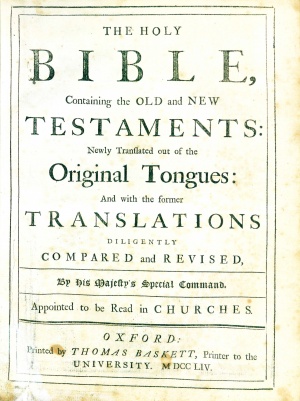
In different writings Thomas specified that the Boston Bible appeared in 1749 and carried the imprint “London: Printed by Mark Baskett, Printer to the King’s Most Excellent Majesty”—but that man didn’t start publishing Bibles until the 1760s. Was this a mistake for Thomas Baskett, who did issue Bibles in the 1740s? Or is its main significance as evidence that Thomas hadn’t actually seen the Bible he believed did exist?

Many book collectors have searched for the fake Baskett Bible that was actually printed in Boston. Presumably this means finding a Bible with a London Baskett imprint but with typography that didn’t match copies known in Britain.

However, only one candidate for such a book has been found, surfacing in 1895, according to an article in the Boston Globe. Three decades later, Dr. Charles L. Nichols’s close examination showed that was actually a genuine Baskett Bible from 1763 that someone had altered by removing one volume’s title page and clumsily changing the date on the other to 1752. See his findings delivered to the Colonial Society of Massachusetts.

Nonetheless, as Nichols stated in a follow-up paper for the American Antiquarian Society (P.D.F. download), he remained convinced that there was a Bible published surreptitiously in Boston, even if Thomas didn’t have all the details right.

Subsequent scholars, including Randolph C. Adams in The Colophon in 1935 and Harry Miller Lydenberg in the Papers of the Bibliographical Society of America in 1954, were more skeptical. They concluded that Thomas’s report was simply wrong.

Perhaps the digitization of books will produce the anomalous copy of a Baskett Bible that collectors have sought. More likely, however, Zechariah Fowle just lied to little Isaiah about how he’d labored long and hard over a secret publication of the Bible.

Sunday, February 07, 2021

London Imprints on Boston Bibles?


In 1756 the Boston Overseers of the Poor indentured Isaiah Thomas as an apprentice to the printer Zechariah Fowle (1724-1776). He was seven years old and didn’t yet know how to read.

Isaiah’s father had died, and his mother apparently felt she couldn’t support him by herself. The Overseers were used to finding masters for children in that situation.

As he grew up, Isaiah listened to stories from Fowle, from other printers, and from a former printer named Gamaliel Rogers (1685-1775) who ran a nearby bookshop. About Rogers he later wrote:
I went frequently to his shop, when a minor. He knew that I lived with a printer, and for this, or some other reason, was very kind to me; he gave me some books of his printing; and, what was of more value to me, good advice.
Isaiah developed less respect for Fowle, whom he came to see as lazy, not “enterprising” like some earlier printers. Thomas himself was quite enterprising—releasing himself early from his apprenticeship, cajoling his former master into co-publishing the Massachusetts Spy, and finally building a lucrative publishing network in the new republic.

Among the stories young Isaiah heard were tales of the surreptitious printing of a New Testament and of a Bible in Boston just a few years before he entered the profession. In his 1810 History of Printing in America, Thomas wrote:
[Samuel] Kneeland [1696-1769] and [Timothy] Green [1703-1763] printed, principally for Daniel Henchman [1689-1761, bookseller], an edition of the Bible in small 4to. This was the first Bible printed, in the English language, in America.

It was carried through the press as privately as possible, and had the London imprint of the copy from which it was reprinted, viz. “London: Printed by Mark Baskett, Printer to the King’s Most Excellent Majesty,” in order to prevent a prosecution from those, in England and Scotland, who published the Bible by a patent from the crown; or, Cum privilegio, as did the English universities of Oxford and Cambridge.

When I was an apprentice, I often heard those who had assisted at the case and press in printing this Bible, make mention of the fact. The late governor [John] Hancock was related to Henchman, and knew the particulars of the transaction. He possessed a copy of this impression.

As it has a London imprint, at this day it can be distinguished from an English edition, of the same date, only by those who are acquainted with the niceties of typography. This Bible issued from the press about the time that the partnership of Kneeland and Green expired [which was in 1752]. The edition was not large; I have been informed that it did not exceed seven or eight hundred copies.

Not long after the time that this impression of the Bible came from the press, an edition of the New Testament, in duodecimo, was printed by [Gamaliel] Rogers and [Daniel] Fowle [1715-1787], for those at whose expense it was issued. Both the Bible and the Testament were well executed. These were heavy undertakings for that day, but Henchman was a man of property; and, it is said, that several other principal booksellers, in Boston, were concerned with him in this business.

The credit of this edition of the Testament was, for the reason I have mentioned, transferred to the king’s printer, in London, by the insertion of his imprint. . . .

Zechariah Fowle [brother of Daniel], with whom I served my apprenticeship, as well as several others, repeatedly mentioned to me this edition of the Testament. He was, at the time, a journeyman with Rogers and Fowle, and worked at the press. He informed, that on account of the weakness of his constitution, he greatly injured his health by the performance. Privacy in the business was necessary; and as few hands were intrusted with the secret, the press work was, as he thought, very laborious. I mention these minute circumstances in proof that an edition of the Testament did issue from the office of Rogers and Fowle, because I have heard that the fact has been disputed.
Elsewhere in the same edition Thomas said Rogers and Fowle printed “about two thousand copies” of their New Testament before Kneeland and Green printed their Bible. In the 1874 edition of Thomas’s history, incorporating his notes, the passage above was amended to state that chronology.

Among his papers at the American Antiquarian Society, Thomas also left multiple lists of books published in Boston before the Revolutionary War. Under the date 1749 one of those lists include a “Bible containing the Old and New Testament (this had a London imprint about 1749 or 1750).”

When in 1770 some Boston printers wanted to sell copies of the Short Narrative of the Horrid Massacre despite the town ordering them not to, they had undoubtedly heard the same stories as Isaiah Thomas. They knew the trick of putting a fake London title page on a book to make it appear aboveboard.

The Bibles that Thomas described being printed in Boston around 1750 went completely undetected. In fact, those books might never have existed.

TOMORROW: The hunt for Boston’s phantom Bibles.

Saturday, February 06, 2021

A Short Narrative “from the London Edition”?

On 16 July 1770, six days after the Boston town meeting reaffirmed its ban on selling copies of its Short Narrative of the Horrid Massacre locally, this advertisement appeared in the Boston Evening-Post:

Next WEDNESDAY will be Published,
[from the London Edition]
And to be Sold at the Printing-Office in Milk Street,
A NARRATIVE of the last horrid MASSACRE, in BOSTON, perpetrated in the Evening of the 5th of March 1770, by Soldiers of the 29th Regiment; which with the 14th Regiment were then Quartered there: some OBSERVATIONS on the STATE OF THINGS prior to that CATASTROPHE.
The printers on Milk Street were John Kneeland and Seth Adams, both trained by the former’s father. Isaiah Thomas wrote of them, “They were three or four years in the business, and printed chiefly for the booksellers.”

That ad seems to promise a completely new printing of the report, getting around the ban as a reprint of a book from London. No copy of that edition survives, however, so the town authorities may have squelched it.

Nevertheless, some Bostonians did obtain unauthorized copies of the Short Narrative, including the hatter Harbottle Dorr, who eventually bound his with his newspapers. We can examine it here, courtesy of the Massachusetts Historical Society. And if we look closely, we see some curious details.

The title page of Dorr’s copy says it was printed for William Bingley in London, based on Edes & Gill’s original edition.
However, the type doesn’t exactly match the Bingley edition, which is now on Google Books.
The letter forms and spacing are ever so slightly different, and Dorr’s copy says “Messirs. EDES and GILL” instead of “Messrs. EDES and GILL.”

Then let’s skip ahead to page 25. The last line on Dorr’s copy is “These assailants, who issued from Murray’s” with the addition of a D (to signal the signature) and the first word on the next page, “barracks.”
Bingley’s edition actually had another line on that page: “barracks (so called) after attacking and wound-” And no D.
If we now turn to page 25 of an Edes & Gill copy, we see that it makes a perfect match for Dorr’s page 25.
There are other little differences between the two editions said to be printed by Bingley. For example, the top of page 33 says “His honour’s” in the London copy, “His Honor’s” in Dorr’s copy and in the Edes & Gill original.

Some printer had taken copies of the latest pages printed by Edes & Gill, removed the Boston title page at the front, and substituted a title page designed to look as much as possible like the Bingley edition from London.

The resulting copies could thus be sold to Bostonians as imports. Edes & Gill presumably got some money for the printed pages they were sitting on. People like Dorr could finally buy a copy for themselves. And just a few genuine Bingley editions shipped to America were turned into many more.

This subterfuge was noted by Thomas Randolph Adams in a bibliography published by the Colonial Society of Massachusetts in 1966. He cited copies of the ersatz London edition then at the Boston Public Library, the Boston Athenaeum, the Huntington Library, the Library of Congress, and Harvard and Yale Universities, so quite a few were made. I first read about this subterfuge in a booklet from the Boston Public Library.

TOMORROW: Where did the Boston printers learn that trick?

Friday, February 05, 2021

“The printed Narratives of the late horred Massacre”

This week I watched an online talk by Robert Darnton about his new book Pirating and Publishing: The Book Trade in the Age of Enlightenment. He described various stratagems printers and booksellers used to get around two stifling forces in ancien régime France: censorship by the government and monopoly by Paris’s licensed printers and booksellers. 

That topic made me think of another event from 1770 Boston in that I didn’t mention on its Sestercentennial anniversary, in part because it was kept low-key to avoid attracting too much attention.

Compared to France, the late-1700s British Empire had very free publishing laws. But in March 1770 the Boston town meeting imposed a specific bookselling ban: it commissioned Benjamin Edes and John Gill and the Fleet brothers to print the Short Narrative of the Horrid Massacre, but forbade them from selling copies locally.

The town itself dispatched copies of that report to Britain. William Molineux sent a copy to Robert Treat Paine to help him prepare for the trials. Copies were shipped to other colonial ports. But the Boston Whigs wanted to avoid any complaints that the report had prejudiced the Suffolk County jury pool against the Boston Massacre defendants, so they banned local sales.

After copies of the Short Narrative reached London, Whiggish printers there produced their own editions to satisfy public interest. William Bingley approximated the Boston publication’s layout. Edward and Charles Dilly, working with John Almon, commissioned a copy of the engraved image of the shooting made by Henry Pelham and Paul Revere and added that as a frontispiece, as shown above.

By July 1770, copies of those British editions had arrived back in Boston, along with evidence of other responses to the Massacre in London, such as Capt. Thomas Preston’s “Case,” the Fair Account of the Late Unhappy Disturbance, and Andrew Oliver’s description of the actions of Massachusetts Council. Those got most of the attention from top local Whigs, but the printers had their own interest.

At a 10 July town meeting, the Short Narrative’s original printers noted that, since the London edition was circulating, the jury pool was already tainted with no local getting any benefit. The town considered “A Motion made that the printed Narratives of the late horred Massacre, which had been retained by order of the Town in the hands of the Committee; may now be sold by the Printers.”

Town clerk William Cooper’s notes say it “Passed in the Narrative”—a slip of the pen for “Negative.” In other words, the printers had to keep sitting on their costly investment in paper and labor.

TOMORROW: Getting to market anyway.

Thursday, February 04, 2021

The Records of Congregationalists of Color

Under the project title of “New England’s Hidden Histories,” the Congregational Library and Archives has been digitizing the records of early churches and related documents.

The library has just announced the publication of a finding aid for material across that digitized collection which illuminate the religious lives of people of African and indigenous descent.

The introductory text by Prof. Richard J. Boles of Oklahoma State University explains:
Though historians have long recognized that the early Congregationalists’ missionary impulse led them to establish Native American “praying towns,” and that some Congregational churches included Black, Native, and mixed-race parishioners, including people enslaved by white parishioners and clergy, the experiences of these underrepresented populations have received relatively scant scholarly attention. In fact, the participation of Black and Indigenous people in early American Congregational churches was both significant and longstanding, as were their contributions to Congregationalism as church members, lay preachers, and ordained ministers. . . .

During the colonial era, African Americans and American Indians participated in numerous predominantly-white Congregational churches through baptism, communion, public worship, singing, catechism classes, and other shared religious activities. Their participation was usually in the context of colonization and enslavement or bonded servitude, but some Black and Indigenous peoples had spiritual as well as practical reasons (such as access to education) for affiliating with these churches.

During the widespread religious revivals of the early 1740s, some Narragansett, Pequot, Mohegan, Niantic, Wampanoag, and other Indigenous peoples attended and participated in majority-white Congregational churches. Additionally, many Black people, enslaved and free, affiliated with both evangelical-leaning and more traditional Congregational churches throughout the eighteenth century. The manuscript church records digitized by New England’s Hidden Histories are essential for understanding the religious affiliations of Black and Indigenous peoples because published vital records and nineteenth-century church directories commonly omitted information about eighteenth-century Black and Indian church members.

Partly because they faced prejudice from white Christians, including segregated seating and proscriptions against voting and holding leadership positions, Black and Indigenous people in New England increasingly began to form their own Congregational churches. For example, dozens of Narragansett men and women in the early 1740s joined Joseph Park’s Congregational church in Westerly, Rhode Island, but about 1749, most of them left this church and founded their own congregation under the leadership of Samuel Niles (Narragansett). African Americans slowly grained freedom from slavery in New England after the 1780s, and in the early nineteenth century, they founded Congregational churches in Newport, RI, Portland, ME, and New Haven, CT.
The guide is divided into six categories:
  • Firsthand Writings by BIPOC (Black, Indigenous, and other people of color), including the Rev. Lemuel Haynes, shown above.
  • BIPOC Churches and Institutions
  • Indigenous-Focused Records
  • BIPOC in Majority-White Church Records
  • Antislavery and Abolitionist Materials
  • Further Reading
These documents have not been transcribed but can be read on the “New England’s Hidden Histories” website.

Wednesday, February 03, 2021

The Battle for Young’s House

Yesterday I recounted the British army’s march in February 1780 from their lines at King’s Bridge, New York, up to Joseph Young’s farmhouse in White Plains.

The Continental Army had moved into that stone house and used it as a base to impede food shipments into British-occupied New York. That winter, the outpost was under the command of Lt. Col. Joseph Thompson of Brimfield.

According to Gen. William Heath’s report on the fighting, Thompson had five companies under him, led by Capt. Abraham Watson of Cambridge, Capt. Moses Roberts of Marlborough, Capt. Orringh Stoddard of Stockbridge, Capt.-Lt. Michael Farley of Ipswich, and Capt. James Cooper of Taunton. During the night, those companies were spread out two miles and more on each side of the house.

At about nine o’clock on the morning of 3 February a mounted scout named Campbell told Thompson that he’d spotted Crown horsemen about two miles away. The lieutenant colonel decided to maintain his position and sent orders for the companies to consolidate with him.

The British force came closer. In the morning’s first exchange of fire, the Loyalist mounted troops overran and captured a sergeant and eight men serving as a forward guard. Then the horsemen came in sight of the stone house. As Watson, Roberts, and Stoddard’s companies drew up in the garden, British guard units appeared, about two hundred strong.

Heath reported:
Our Troops preserved their order and did not fire untill Some time after the Enemy began; when they received orders to fire the Enemy immediately Scattered, availing themselves of Trees and the Ground, of which, it must be acknowleged, they very judiciously took the advantage, Springing from one tree & place to another, and constantly gaining Ground—
On the British side, Ens. George Eld described a “a spirited & brisk conflict of firing, during which time our detachment formed more collectedly than at the first advance was possible to effect, from the depth of the snow.” Then “the Light Infantry Horn sounded the charge.”

Lt. Col. Chapple Norton’s British companies advanced from multiple directions. Heath wrote: “their fire being directed both against the front and flank of our Troops—and, a number being kill’d & wounded they broke, Some retreating up the road, others into the House, from the doors & windows of which they fired on the Enemy.” The remaining two Continental companies arrived and fired from a distance two or three times, but to little effect.

As Americans fled into the woods, horsemen charged after them. Heath later wrote of “Mayhew, a pedler, well known in Massachusetts,” who veered off the road into the snow, “almost up to his hips.” Two riders charged down his path. He called out to ask if they would ”give him quarter”—let him surrender.

“Yes, you dog, we will quarter you,” the pursuers reportedly answered. Mayhew turned and shot at the first rider. The man shouted, “The rascal has broke my leg!" Both the horsemen turned around. Mayhew waited a few moments, waded out to the road, and got back to the Continental lines.

Back at Young’s house, the Crown forces swarmed over the grounds. Lt. Col. Thompson surrendered. Fourteen of his men were dead, including Capt. Roberts, and seventeen were wounded, some badly. More of the British column, including the Hessian companies, arrived to help corraling nearly a hundred prisoners.

Ens. Eld wrote in his diary: “The house was fired & many of the enemy who had retreated for security to the cellars were crushed in the burning ruins.” However, American and other British sources on the scene don’t mention men being caught in the flames. Instead, Norton ordered the buildings burned to prevent them from being used again.

Casualty reports vary, but it appears the British suffered five dead in all and eighteen wounded. They had successfully pushed the nearest Continental outpost back to “the Quaker church on King’s Street,” according to Maj. Carl Leopold Baurmeister of the Hessians. Lt. Col. Norton’s gamble to proceed with the mission had paid off.

Leaving Young’s house and outbuilding in flames, the redcoats began the twenty-mile trek back through the winter landscape to their lines. This time they could use the roads. They left up to a dozen of the worst wounded prisoners at houses along the way to avoid being slowed down. Lt. George Mathew wrote with pride, “we marched a good forty-six miles in twenty-four hours, in deep snow, and across the country to avoid giving the alarm. . . . We left Kingsbridge at ten o’clock one night, and returned about the same hour the next.”

Once all the Crown soldiers were gone, Continentals ventured back out to the site to collect and bury the dead and then withdraw again. The photograph above, courtesy of M. A. Kleen, shows the 1923 memorial standing near the site of the mass grave for those soldiers.

Tuesday, February 02, 2021

Marching Over Twenty Miles through the Snow

On Friday, 2 Feb 1780, the British army holding New York City set out to attack a Continental outpost that had become troublesome.

Charles Stedman described the situation this way in 1794:
The enemy having established a post at [Joseph] Young’s House, in the neighbourhood of the White Plains, which greatly annoyed the provincial loyalists, as well as the British army, by the interception of cattle and provisions intended to be brought to New York, it became an object of importance with the governor [Lord Tryon] and commander of his majesty’s troops [Gen. Henry Clinton], if possible, to dislodge that party, consisting of about three hundred men.
Maj. Gen. Edward Mathew, who was in command at the forward position of King’s Bridge, assigned this mission to Lt. Col. Chapple Norton of the 2nd Foot Guards. Norton was given command of the grenadier and light infantry companies of the Guards’ 1st and 2nd regiments, two Hessian companies, two three-pounder cannon with their crews, a contingent of Jäger scouts, and forty horsemen from Col. James De Lancey’s Loyalist regiment, many of them familiar with the area. In all, the force consisted of well over 500 men.

Young’s house was a little more than twenty miles away across the snowy landscape. Gen. Mathew therefore arranged for sleighs to be brought to his base. Stedman wrote about Norton’s response:
The colonel, though highly gratified by this command, and unwilling to say any thing that might seem to retard the service, or throw difficulties in the way of the intended expedition, yet thought it his duty to point out the improbability of the sleighs answering the purpose
In response, Mathew gave Norton the freedom—and responsibility—to decide how to proceed based on conditions in the field.

According to Mathew’s nineteen-year-old nephew and aide-de-camp, Lt. George Mathew, the raiding party “left Kingsbridge at ten o’clock one night.” They set a course “across the country to avoid giving the alarm, which we should have done by going by the road.”

“The night was dark,” Ens. George Eld wrote in his diary. But as for the sleighs, “these conveyances were immediately quitted, for the cold was too intense to remain inactive, nor was it possible for the horses to get through the snow.”

The snow, up to two feet deep, also blocked the cannon carriages. According to Stedman, Norton “was therefore obliged to leave the guns and with them a guard sufficient to ensure their return.” The colonel estimated his troops ”were yet short of three Miles from Kingsbridge” in a report Todd W. Braisted quoted at the Journal of the American Revolution.

Lt. Mathew described another set of obstacles:
This being a very stony country, and the stones at this time being covered with snow, threw our men down often. Another thing, which tires very much on a long march, is getting over rails, which is the only fence used in this country. The pioneers took them down until they were tired, and were left behind.
The slow progress threw off Norton’s plan. As Lt. Mathew wrote, ”The intention was to have surprised them by night.” But, Stedman stated, “At sun rise they learned from the guides that they were yet seven miles short of the enemy’s post.”

Lt. Col. Norton reviewed the situation. Stedman wrote:
Their situation was, now, not a little embarrassing. As the guns, intended to open the doors of the stone house, were left behind, to surprise the enemy was impossible. To proceed, and not to carry the point, would be to expose the detachment, in their return, already fatigued with a long and toilsome march, to be harassed for the space of twenty miles, by an enemy in force, fresh, and with a perfect knowledge of the country.

In these circumstances, the colonel, unwilling to return without accomplishing some object that might answer the expectation of those who had placed their confidence in him, determined, at all events, to march to the enemy's post, and then act according to circumstances
In sum, the colonel saw all the difficulties and dangers ahead and decided to go forward anyway because it would have been too embarrassing to turn around.

About two miles from Young’s house, Norton ordered his cavalry to advance and surround the site, but the snow was too deep to allow that. The Crown forces arrived within sight of Young’s house “two hours after daybreak,” Mathew recalled. Since there was “a fine, open country about the house,” the Continentals spotted the British coming.

Some of the British, at least. Officers guessed that only about two hundred of the Crown soldiers were on the scene by this point. Almost half the guards and the Hessian companies had fallen behind.

And in front of them, the British saw a stone house, “strongly & advantageously situated,” and more than two hundred Continental soldiers, “judiciously disposed to annoy or prevent the attack.”

TOMORROW: Shots fired.

Monday, February 01, 2021

“Quite in the Land of Amaze

Yesterday we left Israel Putnam at noon on Saturday, 3 Sept 1774, sending letters to many other Connecticut militia officers, passing on dire news he had heard about Boston.

Putnam himself set off toward Boston on horseback with his local militia regiment, becoming part of what was later called the “Powder Alarm.” Meanwhile, his dispatches made their way across the colony.

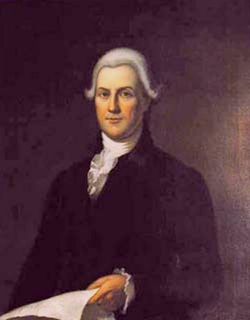
The Middletown lawyer Titus Hosmer (1736-1780, shown here) left a detailed and dramatic account of the response along the Connecticut River south of Hartford in a letter to Silas Deane, apparently written on Sunday, 4 September:
This morning quite early I was call’d out of my bed by the Sheriff: “Where’s the Town Stock?

I honestly own’d there was not a pound of powder in my keeping; as for Ball and Flints they need not fear; but for Heaven’s sake, says I, what means this? Is Boston in action?

“O yes, terrible News; I suppose before this Boston is in ashes.”

My God! is it possible! But after a little more spit,—he show’d me a letter from Putnam; (by this time the people gathered from all quarters like a snowball;) the contents—was something—but, to puzzle any one, sufficient. The purport was, Boston was in action by the “troops sending out to seize all the powder in the country, especially at Framingham [sic] about 20 miles from Boston; which when discovered occasion’d the country people to collect and offer to rescue the powder. Six of the country people were shot dead at the very time, and many wounded—an Artillery planted at the Neck—the Ships were heard to fire all night of a Friday.”

Observe, this came from Windham by a Farmington man that was late from Boston. We expected Expresses every hour. Previous to this collection at yours and my house, which was a large collection from all parts of the parish, Mr. Sheriff had sent Loomis off for Mid[dletow]n.

Much was said; some were for pushing on to aid ’em at once; so much was said, I was obliged to send to Mr. Alsop a Wagon for powder, which he was good enough to let me have, and at this time it was friendly to me—for you are very sensible right or wrong we are obliged in some measure to follow the cry of the many.

A number went to Hartford for further intelligence. By this time a number were up from Rockyhill, but agreed to wait a little longer as further News seemed very requisite. At nine all dispers’d to their several homes, but every one very anxious, you may easily judge.

At 12 o’clock news from Hartford was nearly thus: ”Benjn. [sic] Brattle at Cambridge, a high tory, had petitioned [Gen. Thomas] Gage for troops to protect him at his house, which Gage granted; a mob gathered and demand of Brattle to renounce his toryism or whatever you may term it; but after a short parley the troop fired, kill’d some right out, a large numr. wounded. No news from the town itself.”

This, with many circumstances, leave us quite in the land of amaze—for the improbability that this should happen on Friday, and an Express follow on to overtake Hyde just before he came into Hartford, and Hyde not able to go any further, makes the whole a matter of doubt—but the town is in great ferment; some of this opinion, some of that, as various as the wind: but, as I observ’d before, all wear a dejected countenance, but resolved, if required, to pursue on. It’s said the Eastern people are already gone on arm’d—some from Farmington, and elsewhere. Great Heaven, where will these unhappy, truly melancholy affairs end!
The upper-class, educated, well-connected Hosmer was being pushed along by his yeoman neighbors. The society held him in enough high esteem to give him the responsibility of storing “Ball and Flints,” but he felt he had to defer to their fervor to add gunpowder and roll cartridges. Then the lack of confirmation from the usual official news carrier made people wonder if the original rumor was correct.

By the time the people of central Connecticut were having those conversations, Putnam had discovered that the rumor wasn’t correct. The royal army hadn’t fired on anyone. The navy hadn’t laid Boston in ashes. He turned around and led his men back to their farms.

But the alarm continued to ripple south through the colonies. Peter Force’s American Archives quotes a letter from New York describing Putnam’s news arriving there on 5 September. “Colonel Putnam, upon this advice, alarmed the whole country, and requiring them to arm themselves and take the road to Boston, which they actually did, insomuch that the Post says that the roads were covered with people.” But more accurate news followed.

Nonetheless, New England was soon on a war footing. I focused The Road to Concord on events in Massachusetts, but Connecticut, with its elected governor, had more freedom for official action. In October, the colonial assembly commissioned Putnam lieutenant-colonel of a regiment drawn from Windham County. People even began to speak of him as a potential general of a resistance army.

Sunday, January 31, 2021

Israel Putnam and ”an express from Boston”

engraved portrait of Israel PutnamOn 1 Sept 1774, British soldiers acting on orders of Gen. Thomas Gage took control of province-owned gunpowder stored in Charlestown (now Somerville) and two cannon used by a Cambridge militia company.

As governor and thus captain-general of the Massachusetts militia, Gage had the authority to issue that order. But coming on top of the Massachusetts Government Act the previous month, the move looked to local white men like another step toward depriving them of their traditional rights.

That evening there were some disturbances in Cambridge outside the house of William Brattle, the militia general who had prompted Gage’s move, and Jonathan Sewall, the royal attorney general. But eventually everyone went home, especially after Esther Sewall treated the crowd around her home to a round of drinks.

News of the event still spread, and the farther it got from Cambridge, the more dire it became. People were hearing there had been a second Massacre, or worse. The outer towns in Middlesex County were alarmed enough to send thousands of militiamen streaming into Cambridge the next day—a confrontation that historians later dubbed the “Powder Alarm.” (The first two chapters of The Road to Concord describe those two days in September 1774, which I argue is when Massachusetts’s resistance turned into revolution.)

Though there was still no violence in Cambridge, the rumors from 1 September continued to spread faster than that corrective good news. The alarm reached Israel Putnam (shown above) in Pomfret, Connecticut, in the late morning of Saturday, 3 September.

Putnam had extensive military experience in the Seven Years’ War, both with Rogers’ Rangers in the west and on the 1762 expedition to Cuba. He ranked as a colonel in the Connecticut militia. And on 3 September he saw his job as mobilizing that militia to help Massachusetts.

Putnam sent letters to men in other part of Connecticut, and he dashed off a special note to his neighbor Godfrey Malbone. We met Malbone last year in connection with the Anglican church he built in his largely Congregationalist corner of Connecticut.

Malbone had also reached the rank of colonel in the militia, mostly on the basis of his wealth. But he didn’t come from an old New England family, he’d spent some years at the University of Oxford, and he didn’t much care for his Yankee neighbors.

According to the Connecticut Historical Society, Putnam wrote to Malbone:

Saturday, 12 p.m.

Dear Sir. I have this minute had an express from Boston that the fight between Boston and Regulars [began] last night at sunset, the cannon began to and continued playing all night, and they beg for help,—and don’t you think it is time to go?

I am, Sir, your most obedient servant,
Israel Putnam
Malbone’s reply was short:
Go to the devil
TOMORROW: Connecticut on the march.

Saturday, January 30, 2021

Online Architecture History Courses from Marblehead and Deerfield

This week I heard about two online courses on New England architecture being taught in the coming weeks.

For the Marblehead Museum, Judy Anderson will speak about “The Architectural History of Marblehead” and how the town’s buildings reflect its development over 350 years. Anderson has delivered versions of these talks at the museum and for the town, and now she’s going digital.

This course will take place over four Wednesdays, 10:00 to 11:30 A.M., with this schedule:
  • 3 February: British settlement in 1629 and boom town through the 1760s
  • 10 February: Georgian style developing across the 1700s until the economy crashed during the war
  • 17 February: Post-Revolution “Federal” style, the 1830s recovery, and Abbot Hall cornerstone laid in 1876
  • 24 February: Major fires in 1877 and 1888, the town as a resort, post-World War development
The sessions will explore topics like why Marblehead streets and houses look the way they do, the major defining elements of each architectural period and style, and how economic conditions and national events affected the town’s houses.

The cost for this course is $60, or $50 for Marblehead Museum members. Register at this webpage.

In March, Eric Gradoia, Historic Deerfield’s Director of Historic Preservation, will explore “The Vernacular Architecture of Early New England” for that museum.

These talks will trace the evolution of the dwelling house with respect to architectural trends, advances in technology, and social customs. Gradoia will focus on vernacular architecture: common buildings, purpose-built, that employ local building traditions and materials in their construction.

Each session will cover a distinct period from the seventeenth to the mid-nineteenth century. Talks will cover typical house forms, building plans, construction practices, and architectural details unique to each period, along with discussions on such broader themes as architectural treatise and print material, the transition from craft-based building practices to machine-manufactured materials, and design movements and public tastes.

This course will also take place on Wednesdays, but from 6:00 to 8:00 P.M.:
  • 3 March: First Period: English Tradition and the New World Dwelling
  • 10 March: Georgian Architecture: New England Classicism and the Rural Residence
  • 17 March: Federal Architecture: The Refined and Elegant House
  • 24 March: Greek Revival and Picturesque Architecture: Building in the Age of Technology
Gradoia will present live via Zoom webinar, with a link sent to registrants prior to the event. Recordings will be available to registrants for up to 30 days after each session.

The cost for this Historic Deerfield course is $125, $110 for members, and $80 for students. Register online at this page.

Friday, January 29, 2021

“Lodged in part pay for the said Cannon”

In September and October 1774, as I describe in The Road to Concord, Gen. Thomas Gage’s royal government and the Patriots in and around Boston engaged in an “arms race”: racing to grab every cannon and mortar they could.

The Crown took two small cannon from the Cambridge militia, the guns on Governor’s Island, and the stock of hardware merchant Joseph Scott.

In the same weeks, Patriots emptied the Charlestown battery, removed a “great gun” from along the Dorchester shore, and spirited four brass cannon out of the two gunhouses of the Boston militia train.

The Royal Navy spiked all the guns in the town’s North Battery, but locals said they would clear those. Someone tried to float a boat loaded with guns up the Charles River, but it got stuck on the dam that formed the Mill Pond and the navy seized it.

That was the period when the Boston Patriot firebrand William Molineux sent his son John to take four iron cannon out of a stable in West Boston owned by Duncan Ingraham, who a couple of years before had moved out to Concord with his new wife.

As I’ve been quoting, in 1791 Ingraham petitioned the Massachusetts General Court, of which he’d recently been a member, to compensate him for those cannon. He specified the amount this way:
Your Memorialist prays that he may be allowed for the aforesaid Cannon the aforesaid Sum of ninety six pounds, after deducting therefrom thirteen pounds six shillings & Eight pence which was lodged in part pay for the said Cannon at the Store of Duncan Ingraham Junr. as your memorialist has since been informed by said Mollineux
So William Molineux didn’t just take the guns; he left a down payment for them equal to a sixth of £80. (Where Molineux got his money and how much was actually his is a whole other question, linked to his sudden death on 22 October.) It’s not clear how Patriots slipped these weapons out of town, but they used various ways to smuggle military goods past the army guards on the Neck.

Ingraham wrote that he hadn’t known about Molineux’s payment at the time, and perhaps not until shortly before his petition. That hints at a rift between the merchant captain and his namesake son. In 1774 they were on different political sides: Duncan, Jr., spoke for the Cadets in their dispute with Gen. Gage over having John Hancock as their colonel while Duncan, Sr., was considered a Tory by his Concord neighbors. The older man’s new wife might also have been an issue. Whatever the reason, his son didn’t tell him about making a deal with Molineux, perhaps for years.

Even after deducting that first payment, Ingraham asked Massachusetts for more than £82. In March 1792, the General Court voted to grant him only £58.13s.4d. Do the math, and the legislature’s committee decided that Ingraham’s four cannon were worth only £72.

Thursday, January 28, 2021

“I was requested by my Father to go to the Stable”

As I described yesterday, in 1791 Duncan Ingraham asked the Massachusetts government to compensate him for property taken from him before the Revolutionary War.

Specifically, Ingraham wanted to be paid for “four, four pound iron Cannon of the value ninety six pounds.” (A “four pound” cannon didn’t weigh or cost four pounds; rather, it shot a cannonball that weighed four pounds.)

To support that claim, Ingraham attached an affidavit from dry goods merchant John Molineux (1753-1794) which said:
I John Molineux of Boston in the County of Suffolk & Commonwealth of Massachusetts, declare, that according to the best of my remembrance, some time in the Month of October in the Year 1774, I was requested by my Father to go to the Stable, belonging to the House of Capt. Ingraham at West Boston, with two Teams, & take from thence two Pair Cannon, which was accordingly done, & conveyed into the Country, & beleive they were taken by Authority
Molineux’s father was the hardware merchant William Molineux, who had been at the forefront of the Boston resistance, pushing into confrontations, since about 1767. Ingraham was thus the second Boston businessman, after Joseph Webb, to formally claim that William Molineux had taken cannon from him for the use of the Massachusetts Provincial Congress.

That October 1774 date is significant. The congress convened for the first time on 7 October. Then delegates debated how best to oppose the royal authorities. Not until 20 October did the shadow legislature formally take up the question of “what is necessary to be now done for the defence and safety of the province,” and it took another week before the body appointed a committee to start buying military supplies.

That means Molineux was collecting cannon—which have no peacetime use—for the Provincial Congress before that legislature officially voted to prepare for war. We know Molineux must have acted before that 27 October vote because he died on 22 October.

Nonetheless, in 1792 the official state legislature paid Duncan Ingraham for his four iron cannon, recognizing that they had become part of the Patriots’ artillery force. Molineux probably jumped the gun, or in fact several guns, but retroactively the government agreed that he’d acted “by Authority.”

TOMORROW: How much money did Ingraham get?

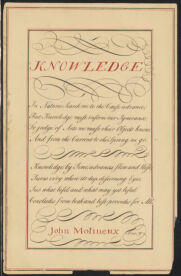
(The image above is a handwriting specimen that John Molineux produced in the 1760s for his writing-school master, Abiah Holbrook, now in the Harvard University library collection.)

Wednesday, January 27, 2021

“Severall Cannon the property of said Ingraham”

As I described yesterday, my suggestion in The Road to Concord that the people of Concord divested the Loyalist-leaning Duncan Ingraham of four cannon in October 1774 caught the eye of Robert A. Gross, dean of Concord scholars.

I based my guess on brief mentions in the Massachusetts house of representatives’ published records of Ingraham petitioning to be compensated for those cannon in 1778 and 1791. His first attempt was unsuccessful; there was a war on, and, even though Ingraham hadn’t gone over to the enemy and had even served a short time as a militia officer, people may still have had their suspicions about him.

In 1788 Ingraham worked his way into his neighbors’ graces to be elected to the Massachusetts house himself. He served three terms, forming connections that made it easier for him to lobby for his cause. In March 1792 the state granted him £58.13s.4d. for the cannon.

Behind the legislature’s officially reported petitions and votes were more documents, not published but (we hope) saved in the Massachusetts Archives. Bob Gross asked John Hannigan, curator at the state archives, what papers survived from Ingraham. It turned out his 1778 petition and supporting documents were tossed out at some point, but the 1791 request remains. And those papers offer more detail about how the merchant captain lost control of his cannon.

I’d assumed that since Duncan Ingraham moved to Concord in 1772, he brought all his property—including stray artillery—with him. Thus, the cannon must have been confiscated in Concord. But it turns out he left a lot behind in Boston. Which makes sense since the traditional use for such small, privately owned cannon was to arm merchant ships during wartime, and the closer the guns were to a port the more valuable they were—as long as Ingraham had a business agent he could trust in town.

The affidavits Ingraham collected to support his 1791 petition show that back in 1774 he still owned a house in Boston that he rented to Samuel Breck (1747-1809), a young merchant (and father of the Samuel Breck whose childhood experiences I’ve cited).

Breck’s partner in a business at the “Corner of Greene’s Wharf” was Benjamin Hammatt, Jr. (1746-1829). The partnership dissolved in 1778, and the Brecks eventually moved to Philadelphia, but Hammatt remained in Boston and was available to testify in 1791. He wrote:
severall Cannon the property of said Ingraham were conveyed away from the Stable of said House, and I fully believe by the Authority and for the Use of the State.
So Ingraham lost his cannon from a stable he’d rented out in Boston, not in Concord.

TOMORROW: Just who “conveyed away” those cannon?

[The image above is a detail of Duncan Ingraham’s gravestone.]

Tuesday, January 26, 2021

Digging Deeper into Duncan Ingraham

There are two big mysteries in my book The Road to Concord. The first is how in September 1774 Boston Patriots managed to get two cannon out of a locked militia armory with redcoat soldiers standing guard at the front door and an entire regiment camped across the street.

The second mystery is who in Concord was sending Gen. Thomas Gage detailed reports on the artillery and other military supplies that the Massachusetts Provincial Congress’s agents were amassing in that town in March and April 1775. That one I didn’t find a definite answer to.

In writing the book, I listed the retired merchant captain Duncan Ingraham as a possible suspect. As for what might have motivated him, I wrote about his tussles with the Patriots over artillery:
Some of those four-pounders [in Concord] came from Concord resident Duncan Ingraham, who in 1778 petitioned the legislature “that he may be paid for four Four-pound Cannon, which were taken for the public Service in October 1774.” Ingraham was a merchant captain who had settled in Concord with his new wife just the year before. Those cannon might therefore have been property left over from his maritime career. Ingraham was not a Patriot. He refused to participate in boycotts of British imports, he was ready to hold court sessions as a justice of the peace, and he hosted British army officers at dinner. The people of Concord showed their disapproval of this new arrival by hanging a sheep’s head and guts on his chaise. They also confiscated his property: on January 3, 1775, Dr. Joseph Lee wrote in his diary, “The mob unloaded Capt. Ingraham’s Bords that were to go to Boston,” where they might have been used by the army to build barracks. It seems likely that the community seized Ingraham’s four cannon for the public good.
That suggestion caught the attention of Robert Gross, the expert on Concord. In fact, I’d studied his Bicentennial classic The Minutemen and Their World to learn more about the town and locals like Ingraham, Dr. Lee, and James Barrett and his family. Look for his new study of Concord’s next greatest generation, The Transcendentalists and Their World, later this year. 

With the help of John Hannigan, curator (and the expert on Revolutionary documents) at the Massachusetts Archives, Bob Gross sought out the documents supporting Ingraham’s 1778 and 1791 petitions for compensation. They show that my guess about who took Ingraham’s cannon was mistaken—the people of Concord didn’t do that. Instead, the people of Boston did.

And like so many other radical acts in Boston between 1768 and 1774, William Molineux was in the thick of it.

TOMORROW: The cannon Duncan Ingraham left behind.

Monday, January 25, 2021

Hagist and Johnson on History Author Talks, 26 Jan.

Tomorrow’s History Author Talk features three scholars who’ve written about the British army and its effects on the civilian population of the colonies. The session has the theme of “All the King’s Men Who Tried to Put British America Back Together Again.”

The first featured author is Don Hagist, expert on the British enlisted men and editor of the Journal of the American Revolution. He’ll discuss his latest book, Noble Volunteers: The British Soldiers Who Fought the American Revolution.

Joining in the conversation will be Donald F. Johnson, author of Occupied America: British Military Rule and the Experience of Revolution. Johnson is a professor of history at North Dakota State University. His study focuses on the ports that the British military held for extended periods of the Revolutionary War: Boston (1774-1776), New York (1776-1783), Newport (1776-1779), Philadelphia (1777-1778), Savannah (1779-1782), and Charleston (1780-1783).

Moderating the conversation will be Todd Braisted, himself the author of Grand Forage 1778: The Battleground Around New York City and an expert on the Loyalist armed forces in the war. He’ll represent the Bergen County (New Jersey) Historical Society Historic New Bridge Landing.

As I recall, these conversations usually begin with short prepared presentations by the two featured artists followed by questions from the moderator. They can be viewed on Roger Williams’s History Author Talks website without preregistration and are archived there later. The live session is scheduled to start on Tuesday, 26 January, at 7:00 P.M.

Sunday, January 24, 2021

A Chat with D. Brenton Simons

Last month I had the pleasure of chatting on video with D. Brenton Simons, president of the New England Historical and Genealogical Society, and Christian Di Spigna, author of Founding Martyr.

The conversation, set up by the Dr. Joseph Warren Historical Society, focused on Simons’s work as a genealogist and head of the nation’s oldest genealogical research library. We used connections to Joseph Warren to illuminate those topics.

For instance, I asked Simons to talk about one of the episodes from his well researched and entertaining book Witches, Rakes, and Rogues that led up to the 1765 bankruptcy of merchant Nathaniel Wheelwright. That failure influenced Warren in two ways: his mother was one of the many other people who also had to declare bankruptcy, and Warren himself ended up administering the Wheelwright estate for the probate court.

This interview was recorded on video (though I think the audio is all one really needs), and posted both in the Dr. Joseph Warren Historical Society’s series of interviews and in the N.E.H.G.S.’s new “Antiquarto” conversations with Simons.

Saturday, January 23, 2021

“Contested Elections” and “Difficult Transitions”

Back on 6 January, both the Massachusetts Historical Society and Revolutionary Spaces had online panel discussions planned about the past examples of difficult Presidential transitions in American history.

That was a timely topic, but no one realized how timely. That morning, the President defeated at the polls and in the Electoral College told a crowd of his supporters:
We’re going to have to fight much harder and Mike Pence is going to have to come through for us. If he doesn’t, that will be a sad day for our country because you’re sworn to uphold our constitution. Now it is up to Congress to confront this egregious assault on our democracy. After this, we’re going to walk down and I’ll be there with you. . . .
The President then left. He watched on television as his supporters mobbed the Capitol and threatened his Vice President, taking no action to stop the violence for hours. Five people died in that riot.

Understandably, both local historical societies postponed their panel discussions on 6 January. But in the following week they proceeded with those events as Congress finished the ritual of totaling electoral votes and then impeached the President again for his abuse of power.

Now we can watch both discussions online. They cover some of the early transitions as John Adams and Thomas Jefferson contested the Presidency. At that time, politicians still espoused the ideal of not forming political parties but blamed the other side for forming one first. The 1820s contests between John Quincy Adams and Andrew Jackson also get attention.

The most contested U.S. election of all was of course in 1860, when one side refused to accept democratic defeat and started a civil war. That event can be bookended with another contested election in 1876, which led to the federal government ending Reconstruction attempts to protect the rights and persons of black citizens in the former Confederacy.

At the Massachusetts Historical Society, the theme of the panel was “‘At Noon on the 20th Day of January’: Contested Elections in American History” and the participants were:
  • Joanne B. Freeman, Yale University
  • Peter S. Onuf, University of Virginia
  • Rachel A. Shelden, Penn State University
  • Erik B. Alexander, Southern Illinois University
  • Ted Widmer, Macaulay Honors College, moderator
Watch here.

At Revolutionary Spaces, the theme was “Difficult Transitions” and the participants were:
  • Joseph Ellis, Mount Holyoke College
  • Eric Rauchway, University of California, Davis
  • Amber Roessner, University of Tennessee, Knoxville
  • David Greenberg, Rutgers University
  • Matthew Wilding, Revolutionary Spaces, moderator
Watch here.

And let’s make some reforms to lessen the chance of having to go through this again.

Friday, January 22, 2021

Wayside Inn Foundation Events, 26 Jan. and 2 Feb.

The Wayside Inn Foundation, the nonprofit wing of Longfellow’s Wayside Inn in Sudbury, will host two online events in the next couple of weeks.

Tuesday, 26 January, 7:00 P.M.
“Sudbury’s Patriots of Color and the World of the American Revolution”

Benjamin Remillard, a graduate student at the University of New Hampshire, will discuss his most recent research about the Battles of Lexington and Concord, the enlistment of men of color representing Sudbury after those battles, and the later lives of veterans of color.

Remillard has taught history at several universities throughout New England, including Regis College, Mass. Bay Community College, and U.N.H., and has co-led service trips to the Cheyenne River Reservation in South Dakota. He has also published and presented papers on various aspects of early American history, including indigenous memorialization efforts on Boston Harbor’s Deer Island and in Mystic, Connecticut.

Access to this program costs $10, or $5 for Wayside Inn Foundation members. Register online here.

Tuesday, 2 February, 7:00 P.M.
“Taverns of the American Revolution”

This event is a book talk, a cocktail-making demonstration, and a virtual road trip to the surviving taverns of the thirteen original colonies.

Adrian Covert, author of Taverns of the American Revolution: The Battles, Booze, and Barrooms of the Revolutionary War, will present the research that led to his book about the public houses that played a role in shaping the American Revolution and can still be visited today, including Longfellow’s Wayside Inn.

“To drink at a surviving tavern of the American Revolution is to interact with history on an entirely different level,” says Covert. In discovering these places, he adds, “The best part of surviving taverns of the American Revolution is that for them history hasn’t stopped. These aren’t museums, these are 250-year-old conversations about politics, culture, food and life.” Several of those historic places are within a short driving distance of Boston.

Via video, attendees will also learn from bartender David Gordon how to make the Wayside Inn’s signature historic cocktails, the Coow Woow and Stonewall, or a new non-alcoholic beverage, the Prancing Red Horse.

‍Access to this program costs $10, or $5 for Wayside Inn Foundation members, students, and restaurant workers and bartenders. People aged 21 or older may purchase Cocktail Kits for $15. People may also purchase Mocktail kits for $5. Those kits include the recipes and ingredients needed to make the beverages. Beverage kits may be picked up from the Wayside Inn on Saturday, 30 January, between 10:00 A.M. and noon, or by appointment. Register online here.

Copies of Adrian Covert’s Taverns of the American Revolution may be purchased in advance via online booksellers or the Mount Vernon Gift Shop.

For more information about the Wayside Inn Foundation, including membership and its Fund for Diverse Programming, e-mail TWIF@wayside.org.