J. L. BELL is a Massachusetts writer who specializes in (among other things) the start of the American Revolution in and around Boston. He is particularly interested in the experiences of children in 1765-75. He has published scholarly papers and popular articles for both children and adults. He was consultant for an episode of History Detectives, and contributed to a display at Minute Man National Historic Park.

Subscribe thru Follow.it


•••••••••••••••••


Saturday, January 20, 2024

“Doctor HALL JACKSON has had the Care of this Lad”

Yesterday we left sea captain Sylvanus Lowell near death after he was caught at the wrong end of a cannon on Cat Island in Marblehead’s harbor.

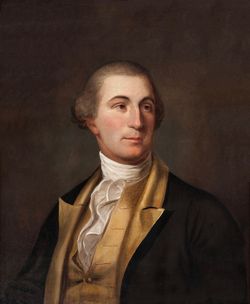
Fortunately for Lowell, that island had become a smallpox inoculation hospital, and a surgeon was nearby: Dr. Hall Jackson (1739–1797, shown here).

Jackson had trained under his father, Dr. Clement Jackson, and then in London. He normally practiced in Portsmouth, New Hampshire, but traveled to the Boston area to inoculate people.

Jackson also presented himself as an expert on amputations. The 26 Feb 1768 New-Hampshire Gazette reported that he had just cut off both legs of “a young Lad of 17 Years of Age, belonging to Hampton,” who had suffered frostbite “in crossing Winnipiscokee Pond.” A week later, the same newspaper assured readers that boy was “in a fine Way of Recovery.”

The same 3 March issue then reported another case:
The Servant Boy of Mr. Gibbs…ran away from his Master, and secreted himself on board a Vessel in the Harbour in order to go off, but she not sailing so soon as was expected, he lay on board three Days & Nights, the Weather being extremly cold, he froze in such a Manner that he lost Part of both Feet immediately;

about a Week after he was seiz’d with those terrible Symptoms the Lock’d Jaw, and convulsive Cramp, he lay near three Weeks stiff and immoveable, no Force that could be apply’d would bend one Joint of his Body, nor could the Edge of the thinest Knife be forced between his Teeth:

the Nerves and Tendons of the remaining Parts of one Foot being bare, with violent and almost constant Spasms in the same Leg, it was tho’t adviseable to take it off, which gave him immediate Relief; his bad Symptoms are gone off, and he is so far recovered as to astonish every one who has seen him.———

We hear this Lad took in eighteen Days one Ounce two Drams of solid Opium, besides a large Quantity of Musk, notwithstanding which, he did not sleep one Hour in twenty-four during the whole Time.
Again, Dr. Hall Jackson cared for that boy and performed the amputations.

The Countway Library at Harvard Medical School has a letter Jackson wrote in 1771 to the father of a boy named Andrew Card, recommending that the boy’s leg be removed because of “several holes in his knee which discharge, and cause great pain.”

Andrew was actually under the care of another Portsmouth physician, Dr. Joshua Brackett (1733–1802), but Jackson offered his and his father’s surgical services free of charge. He wrote: “I believe that you would much rather trust your child under such an operation, to those, who have perform’d it fifty times, than to one who is altogether unused to the Business.” (He also asked the Cards to keep his offer secret from Brackett out of collegial courtesy.)

In the early 1770s, newspapers reported on surgeries by Dr. Hall Jackson to restore people’s sight. He felt compelled to advertise in the 13 Apr 1772 Boston Gazette that he only performed surgery on “the Cataract and contracted Iris.” Nonetheless, ocular experience was helpful in treating Capt. Lowell, who had also suffered injuries to the eye.

TOMORROW: Dr. Jackson and the New Hampshire troops.

Friday, January 19, 2024

“We have not yet heard of his being dead…”

In late 1773 and early 1774, Marblehead and surrounding towns were concerned and then convulsed with the new private smallpox hospital on Cat Island.

I haven’t written anything about the Essex Hospital because of:
  • other events at that time, like the destruction of certain tea in Boston harbor.
  • other events at this time, which kept me too busy to tackle more series.
  • a thorough discussion of the whole episode by Andrew Wehrman in his New England Quarterly article “The Siege of ‘Castle Pox’” and his book The Contagion of Liberty.
I like to add to stories and not just repeat them at length if they’ve been told well recently. So check out The Contagion of Liberty for the short, scorching life of the Marblehead smallpox hospital.

But I did ferret out details of one anecdote tangential to that story. It starts with this article in the 7 Dec 1773 Essex Gazette, published in Salem:
Last Saturday Capt. ——— Lowell of Newbury-Port, a Patient at the Essex-Hospital, in charging a Cannon, (a Four Pounder) just after its being fired, and not properly sponged, the Cartridge took Fire while he was ramming it down: By which unhappy Accident both his Arms were blown almost to Pieces, one Hand entirely carried away with the Rammer; one Eye lost, and the other very much hurt, if not ruined; and the Skin and Flesh so tore away from below his Chin, and towards one Side of his Neck, as to lay his Wind-Pipe almost bare.

As the Accident happened near the Hospital, he was immediately carried in, and Doctor [Hall] Jackson proceeded to the Amputation of both Arms, one just above, and the other below the Elbow. We have not yet heard of his being dead, but it was thought he could not live long.
An eighteenth-century cannon has to be sponged out with a thick cloth on the end of a pole after every firing, as shown above, to ensure that there are no burning embers left inside the tube.

Furthermore, during that sponging someone has to keep his thumb over the touchhole, or the person pulling out the sponge risks can suck in more air through the back of the cannon and feed those embers.

Having all embers extinguished is especially important if a person wants to fire the cannon again, inserting another cartridge of gunpowder into the tube.

If any powder catches fire and explodes while someone is working at the mouth of the tube, the person can suffer exactly the same injury that Capt. Lowell did: having his arms blown off.

My addition to this story so far is that the unfortunate captain’s first name was Sylvanus.

TOMORROW: The patient’s prognosis.

Thursday, January 18, 2024

Meeting Mary Vanderlight through Her Account Books

Hope (Power) Brown died in 1792 at the age of ninety. Her gravestone told visitors she was “The mother of Nicholas, Joseph, John, and Moses Brown.”

As Karen Wulf recently wrote at Commonplace, that left off Hope’s daughter, Mary (Brown) Vanderlight (1731–95).

“The Brown Brothers Had a Sister” shares what information survives about that member of the prominent Providence family:
She married David Vanderlight, a doctor and Dutch immigrant, in the early 1750s. Both her husband and their only child, a baby boy, died in February of 1755.

When she died in the spring of 1795, Mary Brown Vanderlight had been a widow for four decades, and lived on her own or with her mother. Like her mother, she remained a stalwart of the Baptist church that their forebears had helped found (though her brothers wandered to Quakerism and the Anglican church). Like her mother, she never remarried. Like her mother, she was the administrator of her husband’s estate, a complex job that came with significant legal and other practical responsibilities.
The main documentation for Vanderlight’s life is in account books—hers and other people’s. She started tracking her finances before her marriage, helped her husband manage his practice, and kept going as she had to support herself.
From the time David died, Mary continued the surviving account books. It looks like she also continued to serve patients at least by selling medicines but maybe also by practicing—or even teaching. As late as 1757 she was billing her neighbor Elisha Shearman for having trained his son in the “arts of apothicary.”

She also took up her husband’s role in the library [now the Providence Atheneum] and was listed as one of only two women among the nearly 150 “proprietors” who regularly paid to support—and use—it. . . .

She also kept investing. These investments included, according to a single notation in one of her brother’s accounts, helping to finance the infamous slaving voyage of the Sally.
Where did Mary Vanderlight learn to keep accounts? Wulf writes that she probably learned that skill from her mother, who for decades managed her own books and tracked who in the family owned what.

Wednesday, January 17, 2024

“We know nearly a dozen of the ‘party’ alluded to…”

On 16 Aug 1826, the Columbian Centinel newspaper of Boston published this item on the upper left corner of its front page:

Tea Destroyers.—“One of the famous Boston “Tea Party” is still alive in Newburyport. His name is NICHOLAS CAMPBELL, aged 94 years.” —New York Advocate.

“Why is it, that the names of the persons who destroyed the Tea in Boston in 1773 have been so pertinaciously concealed from the public? They ought not to be ashamed of the exploit.” —Providence paper.

REMARK.—We know nearly a dozen of the “party” alluded to, all now alive and well, and among our most wealthy and enterprizing citizens. To our knowledge they have never concealed their agency in the “exploit;” but they are not boasters.—To hundreds of Bostonians their names have been as familiar as those of Adams, Hancock, Otis, &c.

We have recently seen a phial filled with the tea which two of the party found in their shoes after their return home, and have preserved as a memorial. It may be recollected that the shoes worn in those days did not fit to the ancle so snug as those of our modern dandies, and that boots were then only worn by fishermen.
I read this as the flagship of Boston’s Federalist press claiming full authority on the “Tea Destroyers.” Of course we in Boston know who these heroes are, the writer says; we just don’t want to tell you.

I particularly like the couple of backhand, scare-quoted allusions to the new term spreading in the national press: “Tea Party.” That phrase seems to have surfaced at the start of the year in an interview with Joshua Wyeth.

In 1826 the Columbian Centinel was still owned by its founding editor, Benjamin Russell (shown above). Years ago I hypothesized that about a decade later he was the “aged Bostonian” who supplied the list of tea destroyers published in Traits of the Tea Party.

The “phial” of tea this article described was probably Thomas Melvill’s, already mentioned in the Boston Daily Advertiser in 1821. That first item said Melvill had collected it from “himself and companions.” This one says “two of the party.” By 1856 that tea was said to have come from Melvill’s clothing alone.

Tuesday, January 16, 2024

Sorting Out Details about William Hendley

On 23 Feb 1830, the Rhode-Island American reported this death:
In Waldoborough, (Me) Mr William Hendley, formerly of Roxbury, Mass. aged 82. He was a revolutionary pensioner, and present at the destruction of the Tea in Boston Harbour.
That report may have come from another newspaper closer to Maine. The same sentence appeared in several other American newspapers afterwards.

According to the 11 Nov 1814 Dedham Gazette, Mary Hendley, wife of William, had died in Roxbury at age 63. The veteran was then in his seventies. He might have moved north to Maine to live with children or relatives.

The U.S. Revolutionary War Pension database turns up only one William Hendley from Massachusetts. His application stated that he had enlisted as a private soldier on 24 Mar 1777 at Stoughton in the 7th Massachusetts Regiment and served for three years under Col. Ichabod Alden and Col. John Brooks. His first company commander was Capt. William Patrick, killed at Cobleskill, New York. In 1780 Hendley was discharged at West Point as a corporal.

Hendley’s file offers almost no other information except that in 1820 he identified himself as a “Mariner,” and that he made his application at the court in Boston.

Massachusetts Soldiers and Sailors, based on state records, lists a William Hendley/Hendly with the same service details. It also lists other soldiers with the same or similar names from Boston and Scituate.

When William Hendley of Waldoborough died, American newspapers were starting to lift the curtain on who had destroyed the East India Company tea in December 1773. Editors had kept the secret until the 1820s, especially inside Boston itself. But as time passed, and veterans passed on, the old custom faded. Unfortunately, Hendley died too early for anyone to interview him in depth about the Tea Party and what role he’d played.

The 1835 book Traits of the Tea Party even included an appendix of men who had participated in the event, the first such list published. William Hendley was on it, possibly because of the newspaper death notice.

Decades later, Francis Drake sought to profile all the men and boys at the Boston Tea Party in his book Tea Leaves (1884). About Hendley he wrote:
A Revolutionary pensioner, formerly of Roxbury, died at Waldoborough, Me., in February, 1830; aged eighty-two. He was a mason, on Newbury Street, Boston, in 1796.
The first sentence was based on the obituary, the second on the 1796 Boston directory, which listed:
Henly, William, mason, Sweetser’s buildings, Newbury Street.
However, it’s quite possible that William Henly, Boston mason, wasn’t William Hendley, Roxbury mariner who would die in Maine. The 14 June 1804 Boston Gazette reported that “Mr. William Henly, aged 44,” had died in town “after a lingering illness.” The mason might have been one of the other veterans listed in Massachusetts Soldiers and Sailors; if so, he didn’t live long enough to apply for a pension.

Furthermore, at some point Drake’s entry about Hendley was misread. He was changed from a mason to a Freemason.

Thus, on looking at the earliest sources of information about this man, I sort out:
  • William Hendley, “present” at the Tea Party, soldier in the Continental Army for three years, lived in Roxbury, applied for a U.S. pension, moved to Maine, and died in 1830.
  • William Henly, possibly in the army, mason in Boston in 1796, possibly died in 1804.
  • “William Hendley, mason,” an amalgam of these two men and later fictitiously a Freemason.

Monday, January 15, 2024

“Very much subject to the Poorly’s”

Here’s my favorite Revolutionary document of the month, from the William Bond Papers at the University of California at San Diego library.

It’s labeled “James Richardson / Discharge,” and it reads:
Prospect Hill March 10th. 1776

James Richardson of Capt. [Abijah] Child’s Company & 25th. Regiment, being a Lazy, Idle Fellow, unwilling to do his Duty, & very much subject to the Poorly’s he is therefore Discharg’d from the Continental Service, he having provided Silas Lamson (a much better Man than himself,) to take his place, and serve the remainder of the time for which said Richardson was Inlisted—————
William Bond was from Watertown, as was Abijah Child. Bond became a Continental Army colonel in July 1775, taking over from Thomas Gardner, who died of wounds suffered at Bunker Hill. He led the regiment until 31 Aug 1776, when he died from illness at Mount Independence.

Among the many entries for James Richardsons in Massachusetts Soldiers and Sailors of the Revolutionary War, a man from Woburn is linked to Bond’s regiment. He enlisted in May 1775 and served the rest of that year. He was, incidentally, set down as 5'9" tall.

The one entry in those volumes for Silas Lamson describes a man from Greenwich, then out in Hampshire County (and now under the Quabbin Reservoir). He’s listed as serving under Col. Jonathan Brewer in the second half of 1775, which is odd since Brewer and most of his men came from Middlesex County.

One notable detail about this document is the date of 10 Mar 1776. That was just as it became clear that the British military was about to leave Boston. Col. Bond no longer needed to have so many men immediately on hand, but he did need someone reliable for the regiment’s next assignment.

Sunday, January 14, 2024

Catching Up on the Audiobook Edition

An exchange with a friend from high school brought my attention to the audiobook edition of The Road to Concord.

It’s available through Audible and through Apple, and perhaps other channels.

I started to wonder about the audiobook narrator, Douglas R. Pratt. And it turned out there’s an interview with him from FangirlNation. That page not only lays out Pratt’s varied career but also how he made himself an audiobook narrator:
Audible opened a service called ACX, the Audible Creators Exchange. Essentially, if you own the rights to a book and want it narrated, you can list it with ACX. Narrators can search the listings and submit auditions to books that they would like to narrate.

Again, most of the time you send in an audition and nothing happens, but if the rights holder likes your audition they offer you a contract to produce the book. I got an offer after a couple of months of trying, a self-published self-help book. After a couple of those I attracted the attention of an actual publisher. Now I am in the happy position of getting lists of titles from a couple of publishers to pick and choose from. . . .

I look through the Amazon listings of titles that I’ve been offered, and I usually buy a copy. Authors need royalties. If I get the contract I generally get a gratis copy on Kindle or PDF as part of that, but I don’t consider buying books a waste of money. Anyway, I will read the first few chapters, and if my initial impression was correct I’ll ask for the chance to narrate it.

If I get the contract I read the whole thing, making notes as I go as to words that might be hard to pronounce (usually names). I usually get the author’s email address so I can verify those words, or I look them up on the Internet. . . .

It takes about three hours to produce an hour of finished audio. I record the book, usually a chapter or two at a time, and do an edit pass to cut out the mistakes. I re-record and edit in any sections that need it; I’ve gotten pretty good at making edits seamless. Finally, I give the whole thing one more listen to make sure I haven’t missed anything. I have enjoyed learning to do my own editing and post production.
It’s striking how much technology has changed the audiobook industry from just a few decades ago, when I was in book publishing and also making long drives with binders full of cassettes from the library. Digitization has spread out not just the distribution and consumption but also the production.

Pratt’s other narrations on Audible include Gary Wheeler Stone and Mark Lender’s Fatal Sunday, John S. Pancake’s This Destructive War, Patrick Spero’s Frontier Country, Kevin T. Barksdale’s The Lost State of Franklin, and Ian Macpherson McCulloch’s John Bradstreet's Raid, 1758, if you’re eager to hear some eighteenth-century American history.

Saturday, January 13, 2024

“Let him take care of His House, Person & Effects”

Next week Christie’s in New York plans to auction off a handwritten document it describes as “the earliest known documentary evidence of popular revolt against Great Britain in the American colonies.”

It’s a piece of paper with this message written on it:
Pro Patria

The first Man that either
distributes or makes use of Stampt
Paper, let him take care of His
House, Person & Effects,

Vox Populi;
We dare
Lt. Gov. Cadwallader Colden, soon to be the target of anti-Stamp Act rioters, sent a similar document over to London on 26 Oct 1765, reporting that it had just been posted around New York City.

John Romeyn Brodhead made a facsimile of that paper in the British government archive in 1843. That image was published in the Documents Relating to the Colonial History of the State of New York series in 1856.

Last November, historian Michael Hattem shared a photo of the British National Archives’s copy on his Twitter feed (see below). He also wrote a thorough essay on the background of the Christie’s document, published on the auction house’s website.

The Brodhead facsimile and the document now offered for sale look very similar, down to the triangular tear at the bottom. They are not identical, though; the first capital T is different, and the word “His” shifts a line. Aside from the capital T and the ampersand, the handwritings are nearly identical; curiously, neither message was written with the long s.

Christie’s says:
The present example was found by the antiquarian, Joshua Brookes, who added a note on the recto: “I have reason to believe that this is an original paper stuck up in New York as mentioned in [William] Gordon’s History of War, page 131 Vol. 1. in 1765”
Brookes died in 1859, so he could very well have seen the image published three years earlier, but he didn’t cite that authority.

I’m still wondering how the triangular tear got into both copies.

Christie’s estimate for the copy in New York is $4–6,000,000. Bidding starts in four days.

Friday, January 12, 2024

“Some of the principal Venders of TEA in Boston”

Last month Prof. Carl Robert Keyes’s Advertisements 250 project highlighted a couple of notices that appeared one on top of the other in the 20 Dec 1774 Boston Evening-Post.

The first was dated 17 December, the day after the Boston Tea Party, and came from “some of the principal Venders of TEAS in Boston.” They were calling a meeting of all the merchants and shopkeepers selling tea to discuss how to respond to the public call for a complete boycott.

Just below that notice, the Fleet brothers printed the advertisement of Cyrus Baldwin, a young merchant. He was offering:
Choice Bohea and Souchong Teas,
Hyson Ditto, at 18s. L.M. [lawful money] per Pound, Indigo, and a small Parcell of Parchment Deerskins &c.—

N.B. The above Teas were imported before any of the East-India Company’s Tea arrived, or it was known they would send any on their own Account.
In other words, Baldwin (or his importer) had paid the Townshend duty on that tea, but before the commodity had become so politically charged.

Keyes noted four other people advertising tea in the same newspaper: “Archibald Cunningham, William Jackson, Samuel Allyne Otis, and Elizabeth Perkins.” None of them included the same disclaimer in their ads that Baldwin did, but tea was just one of the goods they offered. For Baldwin, tea was his main business.

Jackson kept his family’s hardware shop at the Brazen Head and had already become notorious in 1770 as one of the last people defying the non-importation movement. Cunningham was a native of Scotland and also supported the Crown.

Otis, in contrast, was the younger brother of James Otis, Jr., and Mercy Warren, closely tied to the Whigs. Baldwin also favored the Whigs, though not enthusiastically when their politics threatened his business.

As for Perkins, she had been recently widowed at age forty. Her late husband was the merchant James Perkins, and her father (and his mentor) was the wealthy hatter Thomas Handysyd Peck. Elizabeth had therefore been watching the import business all her life, and she was determined to support her children with a shop.

The business of selling tea thus cut across political lines in Boston—yet it had now become political. In the Boston Post-Boy that same day, the notice about the tea vendors’ meeting urged unity: “A common Cause is best supported by a common Association.” If only 90% of the town’s shopkeepers stopped selling tea, then the remaining 10% would benefit from all of that business, and that was a recipe for resentment.

On 29 December, Boston’s tea merchants declared they would stop selling tea after 20 January. And, even though customers might be wanting to stock up in the next three weeks, they wouldn’t take advantage of that situation by raising their prices above a certain level.

Still, that left Cyrus Baldwin with unsold tea. Back in 2015 Chris Hurley recounted what he tried to do with his stock, and what happened next, starting here.

As for the other people advertising tea in the 20 Dec 1773 Boston Evening-Post, Jackson and Cunningham became Loyalists, leaving Boston during the war. Otis parlayed his political connections into being the secretary of the U.S. Senate for its first twenty-five years.

Elizabeth Perkins did well enough in business to be able to make large charitable contributions after the war. One of her sons, Thomas Handysyd Perkins, did even better in the opium trade—another commodity fraught with political meaning.

Thursday, January 11, 2024

Who wrote, “we can make every Tory tremble”?

Earlier this year, I saw a tweet crediting Samuel Adams with the line: “With ladies on our side, we can make every Tory tremble.”

Adams wasn’t usually that pithy, and the statement doesn’t appear in the four volumes of The Writings of Samuel Adams.

The line first appeared in a letter to Daniel Fowle’s New-Hampshire Gazette published on 22 July 1774. Here’s more context:
The Consumption of TEA I think is in a fair Way of being totally laid aside in this Town, as there are but very few indeed, that will refuse to sign or solemnly ingage not to suffer it used in their Families;

and what adds a great Pleasure to us all, is, that the Fair Sex universally consent to give up, this detested superfluous Article; and under the Auspices of the worthy Doctor Clement Jackson, we hope soon to see a glorious List of Female Worthies, whose Virtue can withstand every daring Insult when put to the Test; and we all desire their Names may be recorded in the Town Books, to perpetuate their Memories:---

Then let us see who will sell that obnoxious Herb, for with the Ladies on our side, we can make every Tory tremble; as it is generally agreed upon, not to frequent those Shops were TEA is sold.
The signature, under a Latin quotation, was “AMICUS.”

A few weeks later, on 26 August, the New-Hampshire Gazette published another letter, addressed to the people of New Hampshire and signed “AMICUS PATRIAE.” It urged people in that colony to support Boston, suffering under Parliament’s Coercive Acts, with donations for the poor.

Both letters show a pattern of short italicized phrases and occasional all-capitalized nouns. Both end with Latin quotations. The signatures overlap. I therefore think it’s likely the two letters came from the same pen.

In his History of New-Hampshire (1792), the Rev. Jeremy Belknap printed a letter from New Hampshire governor John Winthrop to the Earl of Dartmouth dated 29 August, which said:
The town-clerk of Boston [William Cooper], who is said to be a zealous leader of the popular opposition, has been in this town about a week; immediately appears a publication in the New-Hampshire Gazette, recommending donations for Boston…
Belknap added a footnote to that sentence:
The publication here referred to was written by a person whom the Governor did not suspect, and the town-clerk knew nothing of it.
But Belknap obviously did know the author. In fact, his granddaughter Jane Belknap Marcou wrote in her 1847 biography that she had found “the imperfect manuscript [i.e., draft] remaining among Mr. Belknap’s papers.” In other words, he’d written it himself.

Back in 1774, Jeremy Belknap was the minister in Dover, New Hampshire. Ministers weren’t supposed to get directly involved in politics, but as “AMICUS PATRIAE” he had things to tell his fellow citizens. And Belknap also appears to have been the most likely author of the line “With ladies on our side, we can make every Tory tremble.” (I wonder if a draft of that essay might be in his papers at the Massachusetts Historical Society.)

The line resurfaced in John C. Miller’s Origins of the American Revolution (1943) as an example of American Whig sentiment before the war. Philip Foner picked it up in his History of the Labor Movement in the United States (1947), crediting the sentiment to “Sons of Liberty.” Charles O. F. Thompson included the line in A History of the Declaration of Independence: A Story of the American Patriots who Brought about the Birth of Our Nation (1947), curiously tossing in the word “blessed” ahead of “Tory.” Other books followed.

From there it appears that an author or authors decided that “Sons of Liberty” meant Samuel Adams. In the current century several books and authoritative websites attribute the statement to Adams, usually saying “often quoted” or “reported to have said” as a signal that the writers can’t find the words in those four volumes of Writings. In several places the quotation has also lost the article “the” before “Ladies.”

In conclusion, while it’s definitely possible to quote the line “with the Ladies on our side, we can make every Tory tremble” from the Revolutionary era, it should be tentatively attributed to Jeremy Belknap, not Samuel Adams.

Wednesday, January 10, 2024

Emerging Revolutionary War Bus Tour of Battle Road, 11–13 Oct.

The Emerging Revolutionary War team are planning their fourth annual bus tour of historic places, and this year they’re coming to Massachusetts.

On 11–13 October, historians Phillip Greenwalt, Rob Orrison, and Alex Cain will lead “The Shot Heard Round the World: Battles of Lexington and Concord Bus Tour.”

This tour will consist of:
  • an overview lecture on Friday night.
  • all-day tour of battlefield sites in Lexington, Concord, and other towns on Saturday.
  • a half-day tour of more sites on Sunday morning.
The tour bus and Saturday lunch are included in the $250 cost.

Other meals and lodging are separate, not included in the ticket fee. The host hotel is the Courtyard Marriott in Waltham, with a block of rooms set aside at $239 a night.

Alex Cain is the author of We Stood Our Ground: Lexington in the First Year of the American Revolution and a proprietor of Untapped History.

Phil Greenwalt and Rob Orrison are coauthors of A Single Blow: The Battles of Lexington and Concord and the Beginning of the American Revolution, April 19, 1775. (I wrote the foreword to that book.)

For more information, check out Emerging Revolutionary War. To sign up, go to this page.

Tuesday, January 09, 2024

The Disappearance of the King’s Speech

On the last day of the year 1775, Boston merchant John Rowe, staying inside besieged Boston, wrote in his diary:
The Niger man of War Capt. Talbot is arrivd in Nantasket Road & has brought the King’s Speech dated the 26 October
On 26 October, George III had opened Parliament with a traditional “most gracious speech.” That tradition continues today, but now everyone knows that what the monarch reads is the program of the current prime minister and his or her cabinet, not a personal statement.

Back in 1775, the king still had a role in politics, at least at a personal level—i.e., the prime minister had to be someone he got along with. But already British politicians expected George III not to be setting policy but reflecting it. Fortunately, on the American question the king, Lord North, and the other ministers saw eye to eye.

That was a disappointment for some Americans who had still hoped the monarch would overrule his supposedly misguided and/or corrupt ministers and negotiate with their Continental Congress. Instead, George III read:
Those who have long too successfully laboured to inflame my people in America by gross misrepresentations, and to infuse into their minds a system of opinions repugnant to the true constitution of the colonies, and to their subordinate relation to Great-Britain, now openly avow their revolt, hostility, and rebellion. They have raised troops, and are collecting a naval force; they have seized the public revenue, and assumed to themselves legislative, executive, and judicial powers, which they already exercise in the most arbitrary manner, over the persons and properties of their fellow subjects.

And although many of these unhappy people may still retain their loyalty, and may be too wise not to see the fatal consequence of this usurpation, and wish to resist it, yet the torrent of violence has been strong enough to compel their acquiescence till a sufficient force shall appear to support them. . . .

It is now become the part of wisdom, and (in its effects) of clemency, to put a speedy end to these disorders by the most decisive exertions, For this purpose, I have increased my naval establishment, and greatly augmented my land forces . . .

When the unhappy and deluded multitude, against whom this force will be directed, shall become sensible of their error, I shall be ready to receive the misled with tenderness and mercy!
In particular, the king mentioned “friendly offers of foreign assistance,” which everyone understood to mean hiring soldiers from German states.

The Boston News-Letter, the only newspaper still being printed in Boston, ran the speech on the front page of its 11 Jan 1776 issue.

By that time the speech had already been printed in Newburyport in the Essex Journal for 5 January, ostensibly taken from a London newspaper dated 23 Oct 1775. (That was three days before the speech was delivered. But some American broadsides reported the king spoke on 27 October, one day late.)

The letters from the Continental headquarters on 3–4 January show that the very first Massachusetts printing of that speech had been back at the very start of the year. The royal authorities printed “a volume” of copies and delivered them to the Continental lines in Roxbury.

And that brings me to the last mystery of the incidents I’ve been discussing: What happened to all those broadsides?

According to some standard early-1900s guides to material published in the colonies, the king’s speech was “Printed by John Howe, in Newbury-Street.” Howe was the young printer managing the Boston News-Letter press for Margaret Draper. However, his edition of the speech was known from only one copy in the collection of the New York Public Library. (The British Library has another copy, according to WorldCat, but its own systems are down after a ransomware cyberattack.)

Washington told John Hancock he would “Inclose one [copy], of many, which were sent out of Boston yesterday,” but the Library of Congress doesn’t appear to have a copy now. Neither do the Harvard libraries, the Massachusetts Historical Society, or the American Antiquarian Society, three major repositories of Revolutionary material in this region.

Where did all the other copies go? I picture Howe and his assistants working through New Year’s Eve to produce the “great number” of copies to cow the rebels, and then those rebels showing their disdain for the king’s words by recycling the paper or using it in their latrines.

Monday, January 08, 2024

Who Was the “person out of Boston last Night”?

The Pennsylvania Packet article describing the flag on Prospect Hill in January 1776 also reported that the British inside besieged Boston had misinterpreted it:
…the Boston gentry supposed it to be a token of the deep impression the [king’s] Speech had made, and a signal of submission—That they were much disappointed at finding several days elapse without some formal measure leading to a surrender, with which they had begun to flatter themselves.——
This is bunk. According to the article’s own timing, the flag went up on 2 January and the latest news from Cambridge was written on 4 January, so “several days” had not elapsed.

This newspaper anecdote is thus too good to be true. Joseph Reed, who most likely supplied the article, must have been tickled with the idea of the royalists falsely thinking the Continental Army was ready to give up.

In fact, no sources created inside Boston show the royal authorities thinking the rebels were about to surrender. The two British mentions of the flag later that January correctly interpreted it as a signal of colonial unity. So where did the story come from?

The first version appeared in Gen. George Washington’s 4 January letter to Reed:
we had hoisted the Union Flag in compliment to the United Colonies, but behold! it was receivd in Boston as a token of the deep Impression the Speech had made upon Us, and as a signal of Submission—so we learn by a person out of Boston last Night
That person might have had an idiosyncratic interpretation of the flag. More likely, I suspect that person described initial perplexity inside the town on seeing the new flag, which Washington preferred to interpret in the way that made his enemy seem most foolish.

So who was that person who arrived at Cambridge headquarters on 3 January?

On the same day that Washington wrote to Reed, he sent a more formal letter to John Hancock as chairman of the Continental Congress. In that report the general wrote:
By a very Intelligent Gentleman, a Mr Hutchinson from Boston, I learn that it was Admiral [Molyneux] Shuldhum that came into the harbour on Saturday last . . .

We also learn from this Gentleman & others, that the Troops embarked for Hallifax, as mentioned in my Letter of the 16—were really designed for that place . . . 

I am also Informed of a Fleet now getting ready under the Convoy of the Scarborough & Fowey Men of War, consisting of 5 Transports & 2 Bomb Vessels, with about 300 marines & Several Flat bottom’d Boats—It is whispered that they are designed for Newport, but generally thought in Boston, that it is meant for Long-Island . . .
Washington sent that same information to Reed, and it went into the newspaper.

Also, at “8 o’clock at night” on “the 3d.” of January, Washington’s aide Stephen Moylan wrote to Reed:
a very inteligent man got out of Boston this day, says, two of the Regiments of the Irish embarkation pushed for the River of St. Lawrence . . .

he allso says that it was generally thought in Boston that Nova Scotia was in our possession——
Reed didn’t include that last tidbit in his digest for the newspaper—probably because he knew it was false.

Thus, although Gen. Washington mentioned “others,” his headquarters’ main source for information from inside Boston in those two days was “Mr Hutchinson.” Both letters called him “intelligent,” which Dr. Samuel Johnson described as meaning both “knowing” and “giving intelligence.”

A footnote in the Washington Papers says, “Mr. Hutchinson has not been identified.” So let’s do something about that.

On Tuesday, 9 January, the Rev. Dr. Samuel Cooper wrote in his diary:
I din’d at Mr. [Edward] Payne’s with Mr. Shrimpton Hutchinson, Deacon [Ebenezer] Storer, [Joseph] Barrell &c.
The transcription of Cooper’s diary published in the American Historical Review in 1901 doesn’t identify the men Cooper dined with. But at this time Cooper and his family were living in Waltham, and Edward Payne’s son later wrote that during the siege his father “lived at Medford and at Waltham.” Payne, Storer, and Barrell all came from the top echelon of Boston businessmen, and they all appeared several times in Cooper’s diary before this date.

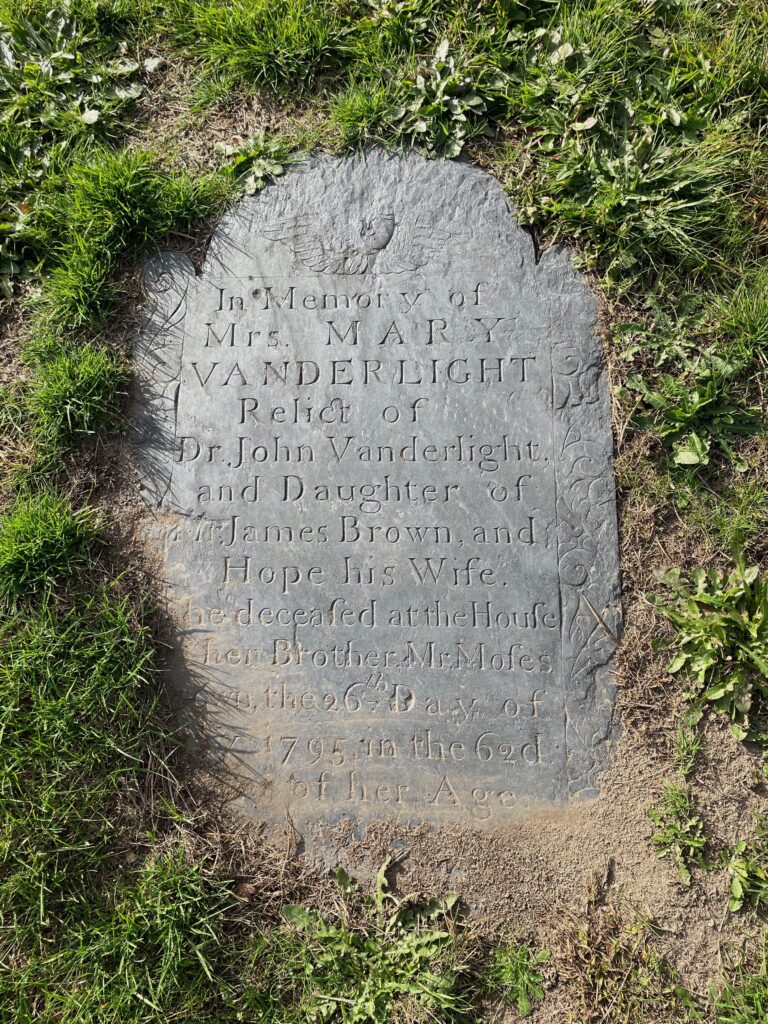
Shrimpton Hutchinson (1719–1811, gravestone shown above) was another well established Boston merchant. As an Anglican and a cousin of Gov. Thomas Hutchinson, he had reasons to become a Loyalist. But instead he kept out of politics, even as a justice of the peace. We know he lived in Boston after the war, becoming one of the leaders of the King’s Chapel congregation.

I’ve looked for other signs of Shrimpton Hutchinson’s movements during 1775 and 1776 without success. Therefore, I can’t say for sure that he had left Boston just a few days before his dinner at Payne’s, which was the first time Cooper mentioned him. But he was the sort of older, upper-class, well-connected man that Gen. Washington and his aides would have respected as a valuable intelligence source.

TOMORROW: The missing copies of the king’s speech.

Sunday, January 07, 2024

Joseph Reed’s Third Source?

I’ve been analyzing the likely sources for the 15 Jan 1776 article in John Dunlap’s Pennsylvania Packet about the flag on Prospect Hill and other information from Cambridge.

It’s clear one source was muster-master general Stephen Moylan’s letter to Joseph Reed, dated 2–3 January. Another was Gen. George Washington’s letter to Reed on 4 January. But the article contained some details not from either of those documents.

One possibility is that Reed received yet another letter from his Cambridge contacts dated 3 or 4 January which he added to the mix. But Reed and his family appear to have been conscientious about preserving his papers, and no such letter survives. I think the key to that mystery lies in Joseph Reed himself.

Reed was a leading Philadelphia lawyer before the war, with top contacts in London. He was also one of the city’s active Whigs, though not a member of the Continental Congress.

When the Congress commissioned Washington as its generalissimo, Reed decided to accompany the Virginian on the first leg of his journey north. Then on the second leg. Then all the way to Cambridge to help set up a headquarters.

At each of these stages, Reed wrote back to his wife, Esther, saying he’d be home soon. And then finally he had to break the news that Washington had convinced him to stay on as military secretary.

Reed worked alongside Washington in Cambridge from early July to late October. He drafted the general’s most important official correspondence, took notes on the top councils, and managed such initiatives as launching armed schooners against British supply ships. As part of the last task, Reed established Connecticut’s “Appeal to Heaven” banner as the flag those schooners should fly in battle.

In November Reed returned to his wife and young children. But he kept up a busy correspondence with the commander-in-chief and with other aides and officers he knew in Cambridge. The general hoped Reed would return as his secretary, so he didn’t give Robert Hanson Harrison that job on a permanent basis until 16 May 1776.

In the winter of 1775–76, Reed continued to serve Washington, unofficially. He was the general’s ears in Philadelphia; “you cannot render a more acceptable service, nor in my estimation give me a more convincing proof of your Friendship,” Washington wrote, “than by a free, open, & undisguised account of every matter relative to myself.”

Reed promoted Washington’s interests in the Philadelphia press. As one example of this work, the general sent a copy of the laudatory poem that Phillis Wheatley had written for him. After the British evacuated Boston, those lines appeared in the Pennsylvania Magazine. Reed probably spoke up for the commander in private conversations among politicians as well.

Even more important (and unusual) for Washington, Reed became an epistolary confidant. The general’s letters to his late secretary were more personal, emotional, even confessional than to almost any other colleague. Washington wrote about his frustrations, doubts, and personal wishes. Those letters said things that the general never expressed so bluntly to the Congress or never would have wanted to be public.

As for Reed’s side of that correspondence? We don’t know. In the dark days of late 1776, Washington opened a letter from Reed, who by then had been lured back into the military establishment as adjutant-general, to Gen. Charles Lee, thinking it might have vital military information. That letter revealed that Reed and Lee had been criticizing Washington behind his back. After that, the commander-in-chief was never so friendly with Reed, or practically anyone else. And Reed’s side of their personal correspondence in late 1775 and early 1776 disappeared.

Thus, we have Washington’s 4 January letter to Reed, as saved by Reed and his heirs, but we don’t have the 23 Dec 1775 letter from Reed that Washington was responding to, or any of Reed’s following responses.

In the absence of those documents, I’ll proffer three speculations about what Reed wrote.

First, the details about the Continental troops being “all in barracks, in good health and spirits,” and “impatient for an opportunity of action” came from Reed himself. They were what he as a Patriot politician wanted the people of Philadelphia to think. He certainly wasn’t going to publicize Washington’s actual gloomy assessment of the situation.

Second, the details about how the British had delivered copies of the king’s speech to the Continental lines in Roxbury and how the Continentals had raised their new flag on Prospect Hill before that speech reached Washington’s headquarters also came from Reed. Because he had worked in Cambridge for months, Reed knew how the two warring armies communicated. He knew where the big flagpole along the American lines stood. He could read Washington’s anecdote and fill in the blanks about how and where events unfolded.

Lastly, the new Continental flag that article referred to probably also came from Reed. I posit that he had sent a large version of the Congress’s new naval banner up to Cambridge, knowing there was a flagpole at Prospect Hill. Reed did that as Washington’s liaison in Philadelphia, and because he was concerned about naval banners.

Washington in turn sent back his anecdote about that flag, knowing his former secretary would be interested. And because Reed knew the size of that standard, his account for the Pennsylvania Packet referred to it as “the great Union Flag.” It was a form of Union Flag, not only adapted with the Congress’s thirteen stripes but also notably big.

As I said, those are all speculations. It’s possible that letters from Reed or others will come to light showing I’m all wrong. But I think these suggestions fit the evidence we have now.

TOMORROW: Another mystery in the flag anecdote.

Saturday, January 06, 2024

Joseph Reed’s Second Source

As I discussed yesterday, Joseph Reed (or someone close to him) adapted a 4 Jan 1776 letter from Gen. George Washington into part of an article that appeared in John Dunlap’s Pennsylvania Packet on 15 Jan 1776.

That article started by announcing its sources: “authentic advices from the Camp at Cambridge, of the 3d and 4th instant”—i.e., letters sent on 3 and 4 January. That meant it was based on at least one other source.

The second major source was Stephen Moylan’s letter to Reed dated 2–3 January, particularly the later pages penned on the 3rd. That document has been digitized by the New-York Historical Society.

Reed knew Moylan in Philadelphia before the war. The two men worked together in Cambridge as Washington’s military secretary and muster-master general. When Reed went home to his wife, he passed off a lot of his tasks to Moylan. So it was natural for those two men to correspond.

The Pennsylvania Packet article contained many items of intelligence, in addition to the general’s anecdote about the new flag. Here are those topics, and in whose letter that information appeared:

  • Boston’s harbor was open. (Moylan)
  • A British warship was outside Salem, Beverly, and Marblehead harbor. (Moylan)
  • 500 British soldiers arrived from Ireland, later identified as from the 55th and 17th. (Moylan, Washington)
  • Two British regiments had been sent to Halifax. (Moylan, Washington)
  • Two more regiments were moving up the St. Lawrence River to Québec. (Moylan)
  • Admiral Molyneux Shuldam arrived in Boston. (Washington)
  • H.M.S. Scarborough and Fowey would lead nine transport ships and other vessels south; they were said to be headed to Newport, but more likely were going to Long Island or Virginia. (Washington, Moylan slightly different)
  • British ships were taking on drinking water and biscuits. (Washington, Moylan slightly different)
  • The British army had no intention of attacking the Continental siege lines. (Moylan)
  • The redcoats were grumbling, so they were told that Gen. John Burgoyne had headed home to Britain to help settle the whole colonial dispute. (Moylan)
  • Four ships had sailed from Hispaniola with arms and ammunition. (Moylan)
  • The Continental “army were all in barracks, in good health and spirits.”
  • Five thousand militiamen were filling in for soldiers who had gone home when their enlistments ran out. (Washington)
  • The “whole army [was] impatient for an opportunity of action.”
Thus, almost every piece of information in the article came from one or both of those letters. The few exceptions were details of the anecdote about the flag, as listed yesterday, and positive descriptions of Continental soldiers being “all in barracks, in good health and spirits,” and “impatient for an opportunity of action.”

In fact, Gen. Washington had written gloomily about how few troops he had left after the end of 1775 and what he could now expect:
for more than two Months past I have scarcely immerged from one difficulty before I have plunged into another—how it will end God in his great goodness will direct, I am thankful for his protection to this time. We are told that we shall soon get the Army compleated, but I have been told so many things which have never come to pass, that I distrust every thing.
But of course Reed would never have those thoughts printed in a Patriot newspaper. In fact, sections like that are probably why he edited the general’s letter for public consumption.

Likewise, Moylan wrote a lot about how George III’s uncompromising speech to Parliament should impel the Continental Congress into seeking help from foreign powers like Spain—a big step toward independence which top politicians were not yet ready to go public with. His 2–3 January letter is becoming famous for containing the earliest appearance of the phrase “the United States of America,” months before the Congress adopted that moniker.
In the quest to find out more about the flag on Prospect Hill, however, Moylan’s letter is a dead end. He wrote nothing about the banner, and therefore didn’t provide the details that appeared in the Pennsylvania Packet without first appearing in Washington’s letter. Did Reed draw on another source?

TOMORROW: My theory that belongs to me.

Friday, January 05, 2024

“Our advices conclude with the following anecdote”

It’s easy to identify the main source of the report in John Dunlap’s Pennsylvania Packet about the new Continental flag on Prospect Hill.

That source has long been recognized as Gen. George Washington’s 4 Jan 1776 letter to his erstwhile military secretary, Joseph Reed (shown here). The commander-in-chief wrote:
We are at length favourd with a sight of his Majesty’s most gracious Speech, breathing sentiments of tenderness & compassion for his deluded American Subjects; the Eccho is not yet come to hand; but we know what it must be; and as Lord North said, & we ought to have believed (& acted accordingly) we now know the ultimatum of British Justice.

the Speech I send you—a volume of them was sent out by the Boston Gentry—And, farcical enough, we gave great Joy to them (the red Coats I mean) without knowing or intending it, for on that day, the day which gave being to the New Army (but before the Proclamation came to hand) we had hoisted the Union Flag in compliment to the United Colonies, but behold! it was receivd in Boston as a token of the deep Impression the Speech had made upon Us, and as a signal of Submission—so we learn by a person out of Boston last Night—by this time I presume they begin to think it strange that we have not made a formal surrender of our Lines.
Here’s a recap of the pertinent portion of the Pennsylvania Packet article, with phrases taken directly from Washington’s letter in boldface:
Our advices conclude with the following anecdote:—That upon the King’s Speech arriving at Boston, a great number of them were reprinted and sent out to our lines on the 2d of January, which being also the day of forming the new army, the great Union Flag was hoisted on Prospect Hill, in compliment to the United Colonies—this happening soon after the Speeches were delivered at Roxbury, but before they were received at Cambridge, the Boston gentry supposed it to be a token of the deep impression the Speech had made, and a signal of submission—That they were much disappointed at finding several days elapse without some formal measure leading to a surrender, with which they had begun to flatter themselves.
It therefore seems certain that Reed adapted or helped in adapting Washington’s letter for public consumption—a common way of spreading news in colonial America.

However, the article’s retelling also included details not in the general’s letter, including:
  • that events occurred on 2 January.
  • the king’s speech was delivered through Roxbury.
  • the flag went up on Prospect Hill.
  • the phrase “great Union Flag.”
So where did those details come from? Was there a second source for the Pennsylvania Packet article that could tell us more about the flag?

TOMORROW: Looking for clues in the longer article.

Thursday, January 04, 2024

A January 1776 Sketch of the Flag on Prospect Hill

We have two remarks from British observers inside besieged Boston about the flag the Continentals raised on Prospect Hill in what’s now Somerville in January 1776.

Peter Force’s American Archives included a letter from the captain of a British ship to his employers in London, dated 17 January, which says:

I can see the rebels’ camp very plain, whose colors, a little while ago, were entirely red; but on the receipt of the king’s speech, which they burnt, they hoisted the union flag, which is here supposed to intimate the union of the provinces.
Richard Frothingham’s History of the Siege of Boston quoted a British officer:
Lieut. [William] Carter...was on Charlestown Heights, and says, January 26: “The king’s speech was sent by a flag to them on the 1st instant [i.e., of this month]. In a short time after they received it, they hoisted an union flag (above the continental with the thirteen stripes) at Mount Pisgah; their citadel fired thirteen guns, and gave the like number of cheers.”
Back in 2006 in the vexillogical journal Raven Peter Ansoff argued that if the “union flag” meant the British flag, then perhaps “the continental with the thirteen stripes” was a second banner flown below it.

In 2013 Byron DeLear responded in favor of the traditional understanding that the army was flying the new Continental Navy banner, including examples of “union flag” as a blanket term for many banners with a Union Jack canton.

Fortunately, we also have an image from a British officer of the flag flying over the Continental fortification. It’s dated 4 Jan 1776—the same day that Gen. George Washington wrote about the flag to his former military secretary, Joseph Reed.

That image was sketched by Lt. Archibald Robertson as part of a multi-page panorama view from his posting on Bunker’s Hill. His notebook is now owned by the New-York Public Library, which digitized those pages. Back in 2015 Boston 1775 reader Marc Shelikoff pointed out how Robertson had shown Prospect Hill.

And here is the sketch:
That’s a detail from this page.

No wonder the British in Boston thought the Continentals were ready to surrender—they were flying a white flag!

Well, not really. Obviously Robertson simply sketched the outline of the union flag that others mentioned. He was an engineer, interested in topography and fortifications rather than flag design.

But Robertson’s drawing still contributes to our understanding of the Prospect Hill flag. First of all, this strongly suggests it was a single banner, not one over another. Second, it was big! That’s probably what Washington meant when he referred to a “great Union Flag.”

TOMORROW: The Pennsylvania Packet sources.

Wednesday, January 03, 2024

“The grand union flag of thirteen stripes was raised…”

In 1852 the British magazine Notes and Queries published a letter asking about the origin of the U.S. flag and then a response from America.

In addition to answering the first letter’s question, that response described earlier American flags:
ORIGIN OF THE STARS AND STRIPES.

(Vol. ii., p. 135.) [the original query]

JARLTZBERG wishes to know the origin of the stars and stripes in the American flag. . . .

The grand union flag of thirteen stripes was raised on the heights near Boston, January 2, 1776. Letters from there say that the regulars in Boston did not understand it; and as the king’s speech had just been sent to the Americans, they thought the new flag was a token of submission.

The British Annual Register of 1776 says: “They burnt the king’s speech and changed their colours from a plain red ground, which they had hitherto used, to a flag with thirteen stripes, as a symbol of the number and union of the colonies.”

A letter from Boston about the same time, published in the Penna Gazette for January, 1776, says: “The grand union flag was raised on the 2nd, in compliment to the united colonies.” . . .

T. WESTCOTT.
Philadelphia, U. S. A., June 5, 1852.
I believe this letter came from Thompson Westcott (1820–1888), a lawyer, journalist, and local historian.

This was, as far as I can tell, the first use of the phrase “grand union flag.” Westcott appears to have come up with that phrase by mistake. He cited the Pennsylvania Gazette, and indeed on 17 Jan 1776 that newspaper reprinted the item from the Pennsylvania Packet that I quoted yesterday. But that article said “great Union Flag.”

Later in 1852 Westcott was probably pleased to see his Notes and Queries letter reprinted in Arthur’s Home Magazine, based in Philadelphia, and in several American newspapers.

The text made the newspaper rounds again in 1857, also appearing in Things Not Generally Known: A Popular Hand-book of Facts Not Readily Accessible in Literature, History, and Science by David A. Wells (1857).

The article was handy patriotic filler for editors, so it even showed up in The American Mining Gazette and Geological Magazine (1866) with no credit to the original source.

In 1872 George Henry Preble (1816–1885, shown above) published Our Flag: Origin and Progress of the Flag of the United States of America. Without citing the Notes and Queries letter, which he might not have seen directly, Preble quoted and paraphrased it in his discussion of the 1776 flag.

One of those uses was: “A letter from Boston in the Pennsylvania Gazette, says: ‘the grand union flag was raised on the 2d, in compliment to the United Colonies,’…” Preble thus replicated Westcott’s error in transcribing the newspaper article, replacing “great” with “grand.”

Preble also wrote:
An anonymous letter, written under date Jan. 2, 1776, says: “The grand union flag of thirteen stripes was raised on a height near Boston. The regulars did not understand it, and as the king’s speech had just been read as they supposed, they thought the new flag was a token of submission.”
No one has found the original of that letter from 1776 because it wasn’t written in 1776. Those are Westcott’s own words for Notes and Queries, stating his findings.

Preble thus both relied on the Notes and Queries letter and mangled it. To his credit, he also collected other sources about the 1776 flag, including Gen. George Washington’s letter to Joseph Reed, observations by British officers, and a passage from Carlo Botta’s History of the American Revolution (1809).

Soon after that, around the Centennial of 1876, newspaper editors summarizing Westcott and/or Preble began to capitalize “Grand Union Flag.” That became the semi-official name for the design the Continental Congress had actually established for its new navy. Based on the misquotations, people believed the term was used in 1776, but it was really only a quarter-century old.

TOMORROW: A British officer’s sketch of the flag on Prospect Hill.

Tuesday, January 02, 2024

“Authentic advices from the Camp at Cambridge”

On 15 Jan 1776, John Dunlap’s Pennsylvania Packet newspaper in Philadelphia published a round-up of war news for its readers.

Here are some selections:
By authentic advices from the Camp at Cambridge, of the 3d and 4th instant [i.e., written on the third and fourth of this month], we learn, that the bay and harbour of Boston yet continue open; that a man of war is so stationed as to command the entrance of Salem, Beverly and Marblehead harbours.— . . .

An intellligent person got out of Boston on the 3d instant, who informed General [George] Washington that a fleet consisting of 9 transports, containing 360 men, were ready to sail under convoy of the Scarborough and Fowey men of war, with two bomb vessels and some flat bottomed boats; their avowed destination in Boston was to Newport, but it was generally supposed to be Long-Island or Virginia— . . .

This person also informs, that they have not the least idea in Boston of attacking our lines, but will be very thankful to be permitted to remain quiet—That before General [John] Burgoyne’s departure it was circulated thro’ the army, in order to keep the soldiery quiet under their distresses, that the disputes would soon be settled, and that he was going to England for that purpose— . . .

Our advices conclude with the following anecdote:—That upon the King’s Speech arriving at Boston, a great number of them were reprinted and sent out to our lines on the 2d of January, which being also the day of forming the new army, the great Union Flag was hoisted on Prospect Hill, in compliment to the United Colonies—

this happening soon after the Speeches were delivered at Roxbury, but before they were received at Cambridge, the Boston gentry supposed it to be a token of the deep impression the Speech had made, and a signal of submission—That they were much disappointed at finding several days elapse without some formal measure leading to a surrender, with which they had begun to flatter themselves.——

When these accounts came away the army were all in barracks, in good health and spirits—That 5000 Militia had taken the places of those soldiers who would not stay beyond their time of service; that they were good troops, and the whole army impatient for an opportunity of action.
This newspaper article is a crucial piece of evidence for the raising of the “Grand Union Flag” in Somerville each New Year’s Day, as shown above. No other source names Prospect Hill as the high point where that banner flew.

The British lieutenant William Carter wrote that the flag appeared on “Mount Pisga.” This hand-drawn map of the siege at the Massachusetts Historical Society shows that was the British officers’ term for the Continental fort on Prospect Hill.

One curious detail is that the Pennsylvania Packet article says the flag went up on 2 January, not New Year’s, when Somerville celebrates it.

The American commander-in-chief’s general orders seem clear that he considered New Year’s Day to be the launch of the new army—“new” in the sense that the men were enlisted and organized into regiments to serve for all of 1776.

Most historians have therefore concluded that the flag went up on the first of January, and somehow a dating error was introduced in the chain of communication from Cambridge to Dunlap’s print shop.

I’m going to do more analysis of this article over the next few days.

TOMORROW: From “great Union Flag” to “Grand Union Flag.”

Monday, January 01, 2024

“Three ill-fated tea-ships rode”

It’s a Boston 1775 tradition to start the new year with poetry. So far most of these verses have come from the handbills that newspaper carriers created to solicit end-of-year tips.

This year I’m deviating slightly from that approach to share lines that appeared in the Pennsylvania Packet newspaper on 3 Jan 1774.
A NEW SONG.
To the plaintive tune of Hosier’s Ghost.

I.
As near beauteous BOSTON lying
On the gentle swelling flood,
Without jack or pendant flying
Three ill-fated tea-ships rode:
II.
Just as glorious Sol was sitting,
On the wharf a numerous crew,
SONS of FREEDOM, fear forgetting,
Suddenly appear’d in view.
III.
Arm’d with hammer, axe and chissels,
Weapons new for warlike deeds,
Towards the herbage freighted vessels,
They approach’d with dreadful speed.
IV.
O’er their heads aloft in mid-sky
Three bright Angel forms were seen;
This was HAMPDEN, that was SIDNEY,
With fair LIBERTY between.
V.
“Soon, they cry’d, your foes you’ll banish,
“Soon the triumph shall be won;
“Scarce shall setting Phoebus vanish,
“Ere the deathless deed be done.’
VI.
Quick as thought the ships were boarded,
Hatches burst and chests display’d;
Axes, hammers, help afforded;
What a glorious crash they made!
VII.
Squash into the deep descended
Cursed weed of China’s coast—
Thus at once our fears were ended:
British rights shall ne’er be lost.
VIII.
Captains! Once more hoist your streamers,
Spread your sails, and plow the wave!
Tell your masters they were dreamers
When they thought to cheat the BRAVE.

BRITTANNO-AMERICANUS.
Philadelphia, Jan. 1st, 1774.
John Hampden (1594–1643) and Algernon Sidney (1622-1683) were two champions of the Parliamentarian side in the English civil wars of the seventeenth century, both dying for that cause and extolled as martyrs by British Whigs and republicans.

By the end of January 1774, this poem was proudly reprinted in the Massachusetts Spy and Boston Evening-Post.

The printer Judah P. Spooner (1748–1807) included the verses on a handbill with three other “Excellent Songs,” not on specific political events, when he was based on Norwich, Connecticut, in the 1770s. As an apprentice at the New-London Gazette, Spooner had been known for writing the new year’s verses, so he knew topical poetry when he saw it.

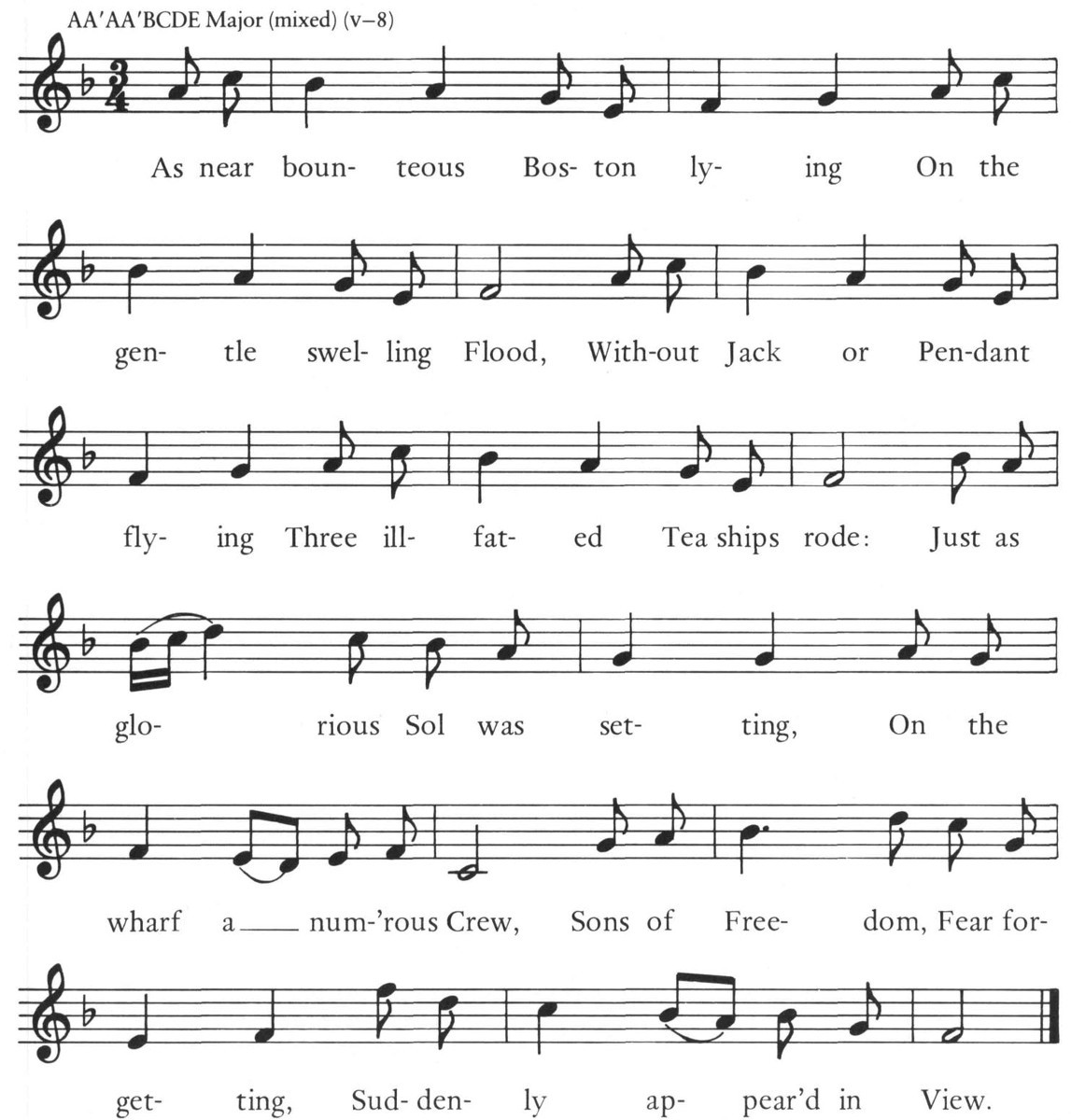
In addition to sharing images of two publications of this song, the Colonial Society of Massachusetts has provided sheet music for those who want to sing along.