J. L. BELL is a Massachusetts writer who specializes in (among other things) the start of the American Revolution in and around Boston. He is particularly interested in the experiences of children in 1765-75. He has published scholarly papers and popular articles for both children and adults. He was consultant for an episode of History Detectives, and contributed to a display at Minute Man National Historic Park.

Subscribe thru Follow.it


•••••••••••••••••


Wednesday, October 21, 2009

Even in Stereo, These Podcasts Sound Like They’re Coming from the Right

The Ashbrook Center for Public Affairs’s Teaching American History program offers free seminars for downloading. Its podcast page says:

The Teaching American History podcast will provide subscribers with a weekly seminar from a leading history scholar from our extensive audio archive. These seminars are designed to encourage teachers to seriously examine significant events in American history in light of the principles of the American founding, and also to encourage the use of primary source materials in the classroom.
Many of the offerings explore the Revolutionary period, and most others look back on that period from other crucial times in U.S. history, such as the Civil War and the Depression. The older recordings are available, for old times’ sake, in RealAudio format, too.

There are a couple of things to be aware of before you dive in. These recordings invite a big commitment of time. For example, Hadley Arkes’s seminar on “A Reconsideration of the Original Case Against the Bill of Rights” comes in two parts, meaning the two downloads comprise almost three hours of contrarianism.

And that stretch is surpassed by Jeremy Bailey’s “Thomas Jefferson and Executive Power” (3:07), Harry V. Jaffa’s “The Declaration in American History and World History” (3:14), and Gordon Lloyd’s four-part series on the “Constitutional Convention” (6:04). So any one of them offers more than a single commute’s worth of listening.

Secondly, these seminars reflect the thinking on part of the American political right. The Ashbrook Center was named after a Republican Representative from Ohio who ran against Richard Nixon in 1972 because he thought that President was too leftist. Its home is Ashland University, which describes itself as “associated with the Brethren Church, where Judeo-Christian values are the foundation of the educational and social environment.” Its collective blog is called “No Left Turns.”

The Ashbrook Center’s Board of Advisors includes the editors of both the Weekly Standard and National Review, and a token female. The podcasts do a little better on gender inclusion, with two female scholars to be heard—out of more than twenty.

On the other hand, the center has the sense to host a lecture on the political symbolism of Captain America.

Tuesday, October 20, 2009

Elizabeth F. Ellet as Historian and Busybody

Elizabeth F. Ellet holds a significant place in American historiography for writing The Women of the American Revolution in 1848-50. No previous author had bothered to study the first generation of American women, even the best known.

Furthermore, Ellet was a good historian, given the standards of the time and the obstacles she faced as a woman. She sought out descendants and documents. She wrote about both the wives of prominent men and women who gained prominence in their own right. Historians continue to rely on her work, though recognizing it as a secondary source shaped by the values of its time.

I hadn’t known the darker side of Ellet’s career until I came across her name on Rob Velella’s Poe-a-Day Calendar. She inserted herself into two nasty feuds and scandals in America’s nineteenth-century literary world—which didn’t lack for feuds and scandals. While Ellet never let her own reputation for purity droop, her reputation for honesty and beneficence suffered. According to Rob, bitter people blamed her machinations for hastening both Virginia Poe’s death in 1847 and Rufus Wilmot Griswold’s in 1857.

Wikipedia offers a clearer picture of the scandal involving letters to Edgar A. Poe. Rob offers details of the Griswold’s divorce. Griswold has previously shown up on Boston 1775 as the first author to claim that George Washington said, “So help me God,” after taking the oath of office, though without citing any credible source.

Next week, at 6:00 in the evening on 29 and 30 October, Rob Velella will lead “Voices of the Night” tours of Longfellow House, which was once Gen. Washington’s headquarters in Cambridge. These tours will focus on how the house’s décor and stories reflect Victorian ideas about death and mourning. Phone the house to reserve a spot.

Monday, October 19, 2009

“Is it an American work of art?”

Yesterday the Boston Globe’s “Brainiac” column alerted me to an article in ARTnews about a new acquisition of the New Britain Museum of American Art: a painting of George Washington on glass, from the first decade after his death and from the far side of the Northern Hemisphere.

In 1796, Martha Washington had commissioned Gilbert Stuart to paint portraits of herself and her husband, one of three times the outgoing President posed for the even more outgoing artist. Rather than finish and deliver that painting, however, Stuart kept it until his death so he and his daughter could make versions for other customers.

Furthermore, according to ARTnews:

collectors of his portraits had to sign an agreement stating that only he had the right to reproduce the image. . . .

One of Stuart’s clients was John E. Swords, a Philadelphia ship captain involved in the China trade. Swords broke his promise that he would not have the image copied. He reportedly arranged to have Stuart’s painting of Washington known as the Athenaeum portrait reproduced on glass in China in an edition of about 100.
Chinese porcelain artists were already practiced in reproducing scenes and portraits for customers in Europe.

Some of the Chinese portraits of Washington came back to the U.S. of A.—because, really, where else would the biggest demand be? Stuart sued Swords in 1802. (That same year, Martha Washington died, feeling “extremely ill used” by the artist, according to a quote attributed to a family friend that I haven’t been able to confirm.)

The court told Swords to stop, but enough examples of Washington on glass made it to America that two are now in the collection of Salem’s Peabody Essex Museum.

The artifacts fit right into the P.E.M.’s focus on the China Trade, but the portrait in the New Britain Museum raises more interesting questions, according to director Douglas Hyland: “As soon as it went on display, it became the subject of a great debate: Should it be at an American art museum? Is it an American work of art?”

Sunday, October 18, 2009

News from the Virginia Gazette (no, the other one)

Folks at Colonial Williamsburg (where this photograph of a journeyman printer comes from) have assembled a newspaper item for each day of the year from the three rival versions of the Virginia Gazette published in the 1770s. The “Learn More” links at the lower right of the page lead to more useful resources on newspapers and printers.

Unlike some “on this date” sites, you don’t need to wait for a particular day to come around; you can look up any date in the year. For example, on my birthday in 1773 Purdie and Dixon’s Gazette featured an editorial from London that lamented:

Profligacy is the Characteristick of this wretched Age.
But I want people to be profligate on that day!

Thanks to Taylor Stoermer at Transatlantic History for the link, via Twitter.

Saturday, October 17, 2009

“The balloon now rose with great velocity…”

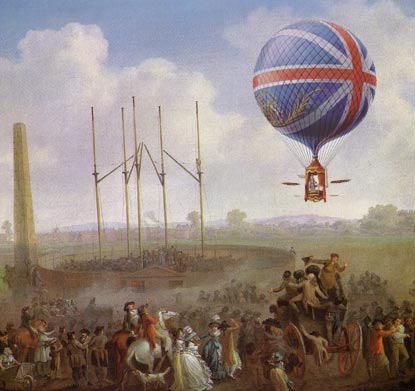
Vincent Lunardi, an Italian diplomat, became Britain’s first aeronaut on 15 Sept 1784. The painting of his spectacular ascent above comes from Fiddlers Green, which offers a paper model of his balloon. The poles are part of the launching apparatus.

Two years later Lunardi prepared his twelfth balloon ascension in Newcastle, but it didn’t go so well. Here’s the report from the Annual Register for 1786, the publication co-founded by Edmund Burke to collect Parliamentary records and notable news in the British Empire.

Newcastle upon Tyne, Sept. 20.

Lunardi’s attempt to ascend yesterday from the Spital ground was productive of a very melancholy accident. The balloon was about one-third full, and a great many gentlemen were holding it by the netting, when Lunardi went to pour into the cistern the rest of the oil of vitriol destined for the purpose.

This having caused a strong effervescence, generated inflammable air [i.e., hydrogen] with such rapidity, that some of it escaped from two different parts, of the lower end of the apparatus, and spread among the feet of several gentlemen who were holding the balloon, and who were so alarmed, that leaving it at liberty, they ran from the spot.

The balloon now rose with great velocity, carrying up with it Mr. Ralph Heron, a gentleman of this town, about twenty-two years of age, son of Mr. Heron, under-sheriff of Northumberland.

This unhappy victim held a strong rope which was fastened to the crown of the balloon, twisted about his hand, and could not disengage himself when the other gentlemen fled; he was of course elevated about the height of St. Paul’s cupola, when the balloon turned downward, the crown divided from it, and the unfortunate gentleman fell to the ground.

He did not expire immediately, having fallen upon very soft ground; he spoke for some time to his unhappy parents, and to the surgeons who came to assist him; but his internal vessels being broken, he died about an hour and a half after the fall.
According to the Monthly Chronicle of North-Country Lore and Legend, published in 1887 based on period sources, Lunardi issued a broadside lamenting the death and reminding the public how he had warned people that everything would be safe if everyone held tight to the balloon’s ropes. The Newcastle Chronicle agreed that he was blameless, and later criticized London newspapers for implying that the provincial crowd had chased the balloonist away.

There are conflicting accounts of Heron’s injuries. Richard Holmes’s Age of Wonder, a recent book, says, “The impact drove his legs into a flowerbed as far as his knees, and ruptured his internal organs, which burst out onto the ground.” The latter detail seems to be mistaken because Robert Robinson, who knew eyewitnesses and Heron’s younger sisters, said he was “found to have sustained no external injury from the fall,” but died of internal injuries.

Another detail that seems suspicious: By 1838, authors were saying that Ralph Heron’s fiancée had been standing beside him when he was lifted away, and the couple was due to be married the next day—details which escaped mention fifty years before.

Friday, October 16, 2009

The Difficulty of Making a Good American Revolution Movie

I have various topics in mind to write about, including a too-long-delayed series on Dr. Benjamin Church, Jr. But I’m so busy with next weekend’s “Abolitionism in Black and White: The Anti-Slavery Community of Boston and Cambridge” symposium that I’m going to grab any material the web offers me for a while.

Recently the novelist and social critic David Brin asked me if I’d seen any good movies about the Revolutionary War. I had to respond:

Parts of The Devil’s Disciple, with Burt Lancaster, Kirk Douglas, and Sir Laurence Olivier, are so bad they’re good.
By those parts I meant the way the film depicts the movement of great bodies of troops during Gen. John Burgoyne’s thrust down from Canada through stop-motion animation of little dolls across a tabletop. And there’s a scene near the end when Lancaster blows up a room, sending a dozen redcoats sprawling, but maintains his own footing because—dammit!—he’s Burt Lancaster. (Read more at Classic Film Guide.)

By coincidence, in the new issue of the online magazine Common-Place Mark Peterson writes about Hollywood’s difficulty creating a good movie about the Revolutionary War. After listing the usual disasters, he posits:
it seems as though the difficulty of making a good American Revolution movie has something to do with the challenge of finding a plot for the Revolution that can be arranged in the form of a family drama. Hollywood’s historical dramas tend to reduce complex processes to a small number of characters who can coherently depict the course of events, often through the intertwined lives of a family or two. The Civil War, of course, is perfect for this—“brother against brother” in a fratricidal family drama. . . .

The problem for this device in depicting the American Revolution lies in Americans’ squeamishness in accepting that the American Revolution was a form of patricide—a revolt against paternalistic government symbolized in the fatherly figure of the king.
Ironically, that patricidal ur-plot has let the American Revolution produce several good or great coming-of-age novels, usually treated as children’s literature: Johnny Tremain, April Morning, My Brother Sam Is Dead, and The Astonishing Life of Octavian Nothing, among others. The story we Americans tell ourselves about a nation coming to maturity mirrors the story of an adolescent coming to maturity.

Thursday, October 15, 2009

The “Suttonian Method” of Fighting the Smallpox

So what was the Suttonian method of smallpox treatment that Dr. James Latham offered in Salem in 1773-74?

Donald R. Hopkins’s The Greatest Killer: Smallpox in History says this was a medical regimen developed by the English physician Dr. Robert Sutton, and then used and modified by “his six sons.” One of them, Dr. Daniel Sutton, claimed to have changed the treatment and broken with his father in 1763, but other medical men and the public wrote as if there was a single “Suttonian method.”

In Public Health in the Town of Boston, 1630-1822 John B. Blake described the first part of the treatment this way:

the practice involved a diet of puddings, gruel, sago, milk, fruits, and vegetables for nine or ten days proceeding the operation and abstention from meat, butter, cheese, liquor, spices, and other heating foods. The typical patient also received relatively mild dosing with a preparation of mercury and antimony and with Glauber’s salt.
This was actually a shorter period of dieting than what earlier British doctors had insisted on.

Furthermore, in October 1768 Benjamin Rush, then studying medicine in London, wrote that “Dr. Sutton’s method is now universally advocated by most of the physicians in England,” but few patients were taking mercury.

The Suttons’ biggest improvement over previous British forms of inoculation was inserting the virus (though they didn’t know that’s what they were doing) through a shallow cut rather than a deep one. Solomon Drown, a Brown College student, underwent the procedure in New York in 1772. He wrote:
We are inoculated after the Suttonian Method, which is this, the doctor with his lancet just scratches up the skin so as to fetch blood, then fixes a piece of thread, infected with the matter [from a previous patient], into the scratch, upon which, a very tenacious plaister is applied, and a bandage around the arm.
Ironically, as Hopkins points out, the Suttons’ innovations—the shallow cut, less fasting and purging, less of that yummy mercury—brought the procedure closer to what doctors in Turkey had done for centuries. Lady Mary Wortley Montagu had published a description of that treatment in London in 1721.

I think British doctors had chosen to make the inoculation regimen more elaborate and more trying for two reasons. The first might well have been fee-for-service: the more patients saw them doing, the more they got to charge. Second, the eighteenth-century British seem to have believed that if a treatment didn’t cause major, uncomfortable side effects, you couldn’t be sure it was working.

A Dr. Thomas Dimsdale described some of the Suttonian method in print in 1767, and one of his pamphlets was reprinted in New York four years later. The Suttons themselves kept their secrets as long as they could, publishing nothing until 1796. Instead, they trained other doctors, who had to keep the secrets and probably kick back some earnings. William Sutton—presumably another son—licensed Dr. Latham to practice the Suttonian method in the northern American colonies, as described yesterday.

Another Suttonian inoculator I’ve found was an Oxford-educated doctor named Robert Houlton. In 1768 he moved to Dublin and published Indisputable Facts Relative to the Suttonian Art of Inoculation, advertising himself as authorized by the Sutton family to bring their methods to Ireland. Houlton also wrote poems, musical plays, and newspaper essays. His last recorded writing, alas, consisted of pleas for assistance from Fleet Prison in 1796.

At that time, the “Suttonian method” was still the most advanced protection against smallpox in the English-speaking world. But two years later Dr. Edward Jenner published his findings that cowpox protected against smallpox, and inoculation with live smallpox was on its way out. (Of course, some people feared the new method; the caricature above shows small cows bursting from the mouths of people Jenner has just vaccinated.)

Wednesday, October 14, 2009

Dr. James Latham’s Inoculation Franchise

Yesterday’s posting mentioned Dr. James Latham, a smallpox inoculator working in Salem in 1773-74. He came to town claiming to have a superior method for treating the disease. That probably sounded good to the town leaders at first, but when the people of Essex County turned against those newfangled and exclusive inoculation hospitals, Latham’s secrecy became a liability.

The best source on this doctor is an article by Barbara Tunis called “Dr. James Latham (c. 1734-1799): Pioneer Inoculator in Canada,” published in the Canadian Bulletin of Medical History in 1984. It draws on a 1903 profile in the Boston Medical and Surgical Journal of another physician who worked with Latham and left papers documenting their business relationship.

Tunis writes that Latham enters the historical record as a surgeon’s mate in His Majesty’s 8th Regiment of Foot in 1756, succeeding to the rank of surgeon in 1767. That regiment arrived in Québec in July 1768, and on 15 September Latham advertised his services in inoculating people against the smallpox. This is apparently the first documented example of inoculation in Canada. (That’s a bigger deal in the Canadian Bulletin of Medical History than elsewhere.)

Latham seems to have found enough business to retire from the army, perhaps on half-pay. The next year he moved to Montreal to inoculate people there, and in 1770 to New York. By 1773 Dr. Latham was married with children, living on a large farm in Livingston Manor.

The doctor advertised himself as following the “Suttonian” method of treatment—indeed, he declared, he had the exclusive license to offer that treatment in North America north of Philadelphia. He in turn authorized associates in seven towns and sold them the “Suttonian” medicines, which they had to promise not to try to replicate. They paid him half of all they earned up to £300 and a third above that. The contract started like this:

Whereas, William Sutton of Kensington Lane, in the County of Surrey, in England, hath found out and discovered a method or art of inoculation for the smallpox, and hath also discovered and prepared certain medicines, preparatory and effectual in the cure of that distemper, and, whereas the said William Sutton, in order to extend the benefit of this method to America, did, upon certain conditions, take James Latham into partnership for the carrying on and practising of this said method, art or mystery, and inoculation with the medicines aforesaid in certain districts in America, with power to depute under him other persons within said districts under certain terms and conditions,…
In sum, Dr. Latham set up a smallpox-inoculation franchise.

When the Revolutionary War broke out, Latham apparently tried to remain neutral, at least until he saw which way the fight was going. He resigned his army ties by August 1775, but in the following years Patriots suspected him of trying to smuggle flour to the British army and then of trying to cross enemy lines. In May 1783, with the war winding down, Latham wrote to Gen. Sir Guy Carleton in New York City, professing his continued loyalty to the Crown. Nonetheless, he remained at Livingston Manor with his family.

For a few months in 1786 Dr. Latham went back to Québec to inoculate people, and then in March 1790 he moved and officially became surgeon for the army garrison in Kingston, Ontario (well, it’s now Ontario). Smallpox treatment continued to be a big part of his practice. He died in Kingston on 28 Jan 1799, aged about sixty-five.

(The painting of a doctor inoculating a family above appears on a Scienceblogs posting by PalMD about eighteenth-century scientific wariness of the procedure.)

Tuesday, October 13, 2009

“Great excitement here against inoculation for small pox.”

When Justice Nathaniel Ropes of Salem came down with smallpox in early 1774, as reported yesterday, Essex County was already in an uproar over the disease and its treatment.

As Andrew Wehrman described here, in late January a crowd from neighboring Marblehead burned down the smallpox hospital on Cat Island (now Children’s Island, shown here via the Marblehead Reporter).

Salem’s selectmen had given their approval to that hospital in the summer of 1773. Then they approved creating a smaller hospital in Salem, according to these quotes from Joseph B. Felt’s Annals of Salem (1827):

Nov. 1 [1773]. Small pox of so mortal a kind had prevailed here, that 16 out of 28, who were seized with it and sent to the Pest house, died. The town grant leave to some of the inhabitants to build a hospital in the S. E. part of great pasture for the purpose of inoculating. . . .

[Dec.] 9th. First class of 132 enter the Hospital for inoculation. James Latham, called the Suttonian Doctor, inoculated them. . . .

Jan. 7th [1774]. Second class of 137 enter the Hospital for inoculation.
The Marblehead hospital went up in flames on 26 Jan 1774. Almost a month later, on 25 February, authorities jailed two men, John Watts and John Gulliard, on suspicion of setting that fire. Felt’s Annals report what happened that night:
In the evening 4 or 500 persons from Marblehead rescued the two men and carry them back. Military companies are ordered out to prevent this, but to no effect.

March 1st. By order of the High Sheriff, his deputy in Salem assembles several hundreds of the people here with arms, for recovering the two prisoners and seizing the principals concerned in their rescue. In the mean while, 6 or 800 were prepared at Marblehead to resist this force. The proprietors of the consumed hospital, fearful that if these two bodies came in collision, lives would be lost, agree to give up the prosecution of their claims for satisfaction. Such an agreement being made known here, the sheriff releases the men, whom he had summoned to enforce the law.
Salem’s town meeting then voted to stop inoculation at their own hospital, promising to reimburse the proprietors.

Two days later, those investors sat down with Dr. Latham to ask some pointed questions about his methods. Rumors said that “his patients had not done so well as those of American physicians.” Did that mean they might still be infectious?

Given all that, it’s no wonder that Felt’s Annals concludes its entry for 9 March with: “Great excitement here against inoculation for small pox.”

And just around that time, the people of Salem must have heard that Justice Ropes had the disease—perhaps even as a result of being inoculated at one hospital or the other. He was already known as a supporter and appointee of the unpopular royal government, and of course he was a rich man.

The common people of Salem might have perceived Ropes as having gotten a form of inoculation they couldn’t afford, then having brought the disease into their town. Such feelings could have been enough to spur a crowd to surround the judge’s house, breaking his windows and decorations—a time-honored way for a New England community to express disapproval of a wealthy citizen.

In any event, the very next item in Felt’s annals after the “Great excitement” over inoculation was Nathaniel Ropes’s death. As I noted yesterday, his family believed that the mobbing had hastened his death. I’m not sure how susceptible a man with late-stage terminal smallpox would be to psychological stress, but that couldn’t have been an easy night for his family.

Monday, October 12, 2009

The Death of Nathaniel Ropes

The Ropes Mansion, topic of yesterday’s posting, is named after the family of Nathaniel Ropes, who bought the house in 1768. Ropes was a wealthy Salem merchant and attorney, and an ally of the royal governors in the Council. In 1772, the royal government appointed him to the Superior Court.

That was just in time for a controversy over whether the court’s justices should receive salaries paid from the proceeds of the tea tax, which would insulate them from the Massachusetts General Court and thus from the people they judged. Ropes apparently first accepted the money (various sources put it at £100 to £250 a year), then realized how unpopular that move was. In early 1774 he refused the salary, and even reportedly submitted his resignation from the bench after less than two years.

On 29 May 1774 John Adams wrote in his diary about Ropes’s mix of feelings:

[Essex County lawyer William] Pynchon says Judge Ropes was exceedingly agitated, all the time of his last sickness, about the public affairs in general, and those of the superior court in particular; afraid his renunciation would be attributed to timidity; afraid to refuse to renounce; worried about the opinion of the bar, &c.
By then Ropes had died, on 18 Mar 1774 at the age of forty-eight.

The earliest reports of Ropes’s death in the newspapers apparently said nothing about the circumstances. But in the 1800s, historians recorded the local tradition—no doubt preserved by the Ropes family, who were still living in that Salem mansion—that the night before the justice died, a mob had been surrounding his house, breaking windows. The family felt those disturbances had hastened the justice’s death.

Most historians have since written that that crowd was motivated by the issue of judicial salaries. But Ropes had formally and publicly renounced his pay on 8 February, along with all of his colleagues except Chief Justice Peter Oliver. The legislature was focusing its ire on Oliver, threatening to impeach him, and the Whig press reported all that. Other historians have therefore suggested that the mob was driven by general class resentment.

I suspect the biggest reason for the attack on Ropes’s mansion in March 1774 was the disease the justice was dying of: smallpox.

TOMORROW: Salem’s smallpox crisis of 1774.

Sunday, October 11, 2009

Ropes Mansion Still Saved

Somehow I missed the news in August about how close the Ropes Mansion in Salem came to burning down. Or at least to losing a lot of the artifacts inside. I just read about the fire in the magazine of the Peabody Essex Museum, the mansion’s owner. Thanks to some quick action by museum employees, the only item broken was a glass pitcher.

There was damage to parts of the Ropes Mansion itself: the plaster ceilings and recreated period carpets and wallpaper. However, the interior has been extensively rebuilt twice. A History of the Putnam Family in England and America (1891) reports on previous damage:

Recently it has been moved back [from the street] and is now the residence of the Misses Ropes who have kept the old house externally nearly as it was but the interior unfortunately was recently damaged by fire.
Here’s the Peabody Essex Museum’s press release after the fire, and a Salem News story. The problem apparently began as workers removed paint during an exterior renovation with a heat gun. The Salem Gazette reported that people are reconsidering that method.

For your visual enjoyment, here are some older photos of the mansion from RopesCorner.com, and some shots of its colonial-revival garden.

TOMORROW: The legend of Nathaniel Ropes’s death.

Saturday, October 10, 2009

Revisiting “When Was John Crane Wounded?”

In 2006, I wrote about how Maj. John Crane of the Continental artillery was wounded in the foot during the fight over Manhattan Island in 1776.

In 2007, in response to a query from a Boston 1775 reader also named Crane, I tried to pin down the date of that wounding. I figured it had to be after 3 September, when Gen. George Washington gave orders to Crane, according to a letter the commander wrote the next day. And it had to be well before 23 September, when Col. Henry Knox wrote to Crane’s wife with an update that he was “in a fair way to do well” (not, apparently, her first news of the wound).

Last weekend I came across a mention of Crane’s wounding in the diary that Gen. William Heath published after the war. He wrote:

They [the British] ran a ship past the city [New York] up the East River: she was several times struck by the shot of a 12 pounder, which was drawn to the river’s bank. Major Crane of the artillery was wounded in the foot, by a cannon shot from this ship.
So Heath’s entry might pinpoint the date of Crane’s wound—except that its date is 2 Sept 1776, one day before Washington told the Congress that he’d sent Crane to attack that ship.

So what gives? Heath edited his diary for publication, so it’s not really a contemporaneous source, like Washington’s letter. I suspect that Heath added the details about Crane to his 2 September entry at some later date, possibly the next day, possibly years later. The most likely sequence of events seems to be:
  1. 2 Sept 1776, after dark: A forty-gun ship of the Royal Navy slipped into Turtle Bay, receiving fire from a shore battery to no effect.
  2. 3 September, morning: Washington sent Maj. Crane, known for his excellent sighting, with two twelve-pounder cannons and a mortar to oppose the ship. That day, Crane hit it several times, forcing its captain to withdraw closer to Long Island. Either that morning or the next day, the ship fired back a ball that struck Crane in the foot.
  3. 4 September, morning: Washington wrote to Congress, having seen the ship withdraw but not yet aware of Crane’s injury.
And eventually Heath edited his diary entry about the ship getting into the East River, adding what he felt was pertinent information about Crane’s marksmanship and wound.

At least we’re narrowing down the answer.

Friday, October 09, 2009

“Permitted to Die of the Small-Pox”

Last weekend the Boston Globe’s Ideas section ran an article by historian Andrew M. Wehrman headlined “A Pox on You.” It starts like this:

On a blustery January night in 1774, scarcely a month after the famous Tea Party in Boston, an even more shocking protest unfolded on Massachusetts’ North Shore. In the dead of night, a crew of 20 men blackened their faces and armed themselves with torches and buckets of tar. The object of their anger was not a chest of tea, a tax collector, or British soldiers. What these men, mostly sailors from Marblehead, burned down was the town’s brand new hospital.

On the surface, such an attack might seem inhuman, or at best ignorant. But the act was the calculated result of long-simmering anger over the cost and politics of smallpox inoculations in one of the largest and most prosperous towns in the Colonies. Their anger would be familiar to anyone today who has faced ballooning insurance premiums, or who was moved to stand up and shout at this summer’s town hall debates on health care.
Wehrman’s study of the destruction of the Marblehead smallpox hospital appeared this year in the New England Quarterly. In this opinion essay, and in a follow-up discussion on N.P.R.’s Talk of the Nation, he touches on larger questions of public health and public resources, which have concerned governments in America from the start.

Later in the week I stumbled across a pertinent item from the Columbian Centinel for 14 Nov 1804. It was a column that combined simple death notices, longer obituaries, and some bills of mortality—early public health information. Among those last items was:
In New-York, from the 26th Oct. to the 3d Nov. 42 deaths;—of whom 14 were men, 10 women, 13 boys, and 6 girls;—by taking laudanum, (suicide) 1 person; TEN of SMALL-POX!—Shame!

Among those who were permitted to die of the small-pox, was Mr. Charles B. Rich, printer, of Brookfield, (Massa.); a young man of strict integrity and emulative worth, and bid fair to be a public, as he had been a private, ornament to society.
The Centinel employees might have felt special regret for Rich’s death because he was a fellow printer, perhaps even one they knew. But they also regretted it because people had started to see smallpox as a preventable disease.

For decades people had realized that an infection with a mild form of smallpox could grant lifelong immunity, lowering the rate of the disease’s transmission and mortality. And in 1798 Dr. Edward Jenner of Gloucestershire (shown above, courtesy of the New York City Department of Health) started to publicize his success at vaccination: injecting people with the rarely fatal cowpox or “kinepox” virus made them immune to smallpox as well.

The Centinel printers felt that having citizens die when people knew of better medical and public-health methods was a stain on American society. And a drain—a healthier public would benefit the nation. That thinking seems to be neglected in the U.S. of A.’s current debate over medical insurance, in which people have paid a great deal of attention to how much different plans might cost without noting how much money each is projected to save based on a healthier population and more efficient use of medical services. (And of course the policy-makers’ debate basically ignores how much more the nation could save by reducing private bureaucracies.)

Thursday, October 08, 2009

Mrs. Tinkum and Madam Jenkins: one school-mistress or two?

When we last left John Jenkins, a public crier of Boston, he had fallen down dead in his yard in May 1767. I’m hoping to find out more about his family because they might offer clues to the most common and least documented aspect of education in colonial Boston: how children learned to read before boys were old enough for the public schools.

In 1835, Benjamin Bussey Thacher published Traits of the Tea Party, based on interviews with George R. T. Hewes (1742-1840). Of Hewes’s schooling, Thacher wrote:

The education he was able to get during these few years of his errantry, consisted, so far as literary matters were concerned, in learning to read and write tolerably well. For these accomplishments he was in the first instance indebted to “Miss Tinkum,” the worthy spouse of the town-crier, who lived and labored at the bottom of Water Street, in what was called Oliver's Dock,—having a school for both boys and girls in one of the rooms of her own domicil.
The Oliver’s Dock area was close to the center of town, in an area later called Liberty Square.

There was a Susannah Tinkum who had children baptized at the First Meeting-House (also near the center of town) from 1726 to 1740. She might have been Hewes’s teacher. But I’ve found no record of her husband, John Tinkum, being a public crier. Then again, as I’ve written before, once the job stopped being an elected office, the record of who filled it becomes incomplete.

Or could “Mrs. Tinkum” be how Thacher transcribed Hewes’s memory of the wife of John Jenkins, licensed to be a public crier in 1757? That was after Hewes’s childhood, but Jenkins’s prominent role in the town might have cemented his job in Hewes’s mind.

The Rev. Dr. William Bentley (1759-1819—shown above, courtesy of SalemWeb) recalled learning to read from a Boston widow named Jenkins. On 25 June 1816, musing at age sixty about people who had lived to a very old age, Bentley wrote in his diary:
My School Mistress, Madam Jenkins, died after 96 y. of age. . . . Madam Jenkins lived with her son in Law next door to the North [Latin] School, Boston, when I kept it [1778-80].
Two years earlier Bentley had also written about “My schoolmistress, Madam Jenkins.”

In 1791, a man named John Jenkins published a book called The Art of Writing; in the Boston Gazette he advertised that many prominent Bostonians had endorsed it. Here’s a look at that part of one. Was he a son of “Madam Jenkins,” carrying on his father’s name and his mother’s business?

Wednesday, October 07, 2009

A Kidnapping in Colonial Boston

Yesterday I described how when Boston families realized that one of their boys was lost, the public criers would go through the streets, calling out the news. (Girls, who were expected to stick closer to home, don’t seem to have gotten lost so often.)

An interesting example appeared in the Boston News-Letter on 27 Oct 1768:

Monday last in the Afternoon, a Child of about 3 Years of Age, Son of Mr. Benjamin Goodwin, at the North-End, being missing from School, a Search was made, and the Cryer employed about the Town, but no Intelligence of it was had till late in the Evening, when upon its being cry’d in the Common, a Soldier’s Wife gave Information that such a Child had been bro’t to their Tent by a Woman belonging to the Town, and the Child being weary was lain down and asleep;

upon which the Child was carried home to its Parents, and a Search was made for the Woman, who was taken up; and proves to be one who had been released from Goal the Saturday before:

she kidnapp’d the Child, taken the Buckles out of its Shoes and Buttons, and intended to have disposed of it, or something worse, as the Child said it was going to be carried into the Water.
This search came soon after British regiments had arrived in Boston and camped on the Common. If a woman associated with those troops had kidnapped a child, the Boston Whigs would have trumpeted the story as an example of the danger of turning the town into a military garrison. As it was, a soldier’s wife helped to rescue and return a child kidnapped by a “Woman belonging to the Town.”

Another intriguing detail in this story is that this three-year-old went to school. That must have been a private reading school rather than one of the five town schools, which enrolled boys starting about age seven.

The Descendants of Francis Le Baron of Plymouth, Mass. suggests that this particular three-year-old was Charles Goodwin, born 3 Aug 1765. He died at age eighteen in St. Augustine, Florida, so he did wander.

(The photo above was taken by kthypryn during a Revolutionary era reenactment on Boston Common.)

Tuesday, October 06, 2009

Boston’s Town Criers and Lost Boys

One of the most important functions of the town crier, I was surprised to learn when I investigated the office, was to act as a municipal Lost & Found Department. People who had found things would bring them to the crier, who would file them safely until anyone came to claim them. People who had lost things would pay the crier to make announcements about that property. And when a child was lost, the public crier sprang into action—though he apparently expected a suitable fee.

Several times I’ve quoted from John Greenwood (1760-1819), who grew up in Boston’s North End, became a Continental Army fifer at age fifteen, and eventually became George Washington’s dentist. The preface to the published edition of his memoir, written by a descendant, says:

The earliest incident connected with John Greenwood’s life is what, when quite young, he was taken out one day for a walk, escorted by a negro boy belonging to the family; when, attracted by the music and brilliant show of some passing soldiers, they followed along until the tired child was told to wait awhile and rest in a neighboring shop. Oblivious as to where he had laid his charge, the negro finally returned home empty-handed, and Johnny had to be recovered by the aid of the town-crier.
That descendant suggests, “This incident evidently refers to the landing, on Saturday, October 1, 1768, of some regular troops.” However, Johnny would have been eight years old then, and might have been able to get home himself. I wonder if this happened a few years earlier when troops passed through Boston as part of the French and Indian War.

Lost children were still a major part of the town crier’s business when tavern-keeper James Wilson held the office in the early 1800s, according to this account from Rambles in Old Boston, published in 1887:
Never was a man better fitted for a town-crier. Nature had endowed him with ready wit, a good flow of language, an imposing presence, and a voice which could touch the tenderest feelings of the heart by its pathetic tones, or, if occasion required, could alarm a whole neighborhood like the roar of a bull. His custom was to appear on the street, and ring three times to attract attention. Then, putting his bell under his arm, he would produce a paper, and announce with great solemnity that somebody’s cow had strayed away, or that certain articles of value were missing.

Occasionally his cry would be like this: “Child lost! There’s a child lost! A boy, between the ages of five and six years, left his home on Salem Street about seven o’clock last night, and has not since been heard from. When last seen, he had on a black cloth cap and a short red coat. He had light hair and blue eyes. Whoever can give information of such a boy, either to his anxious parents at No. — Salem Street, or at the crier’s office, will be suitably rewarded.”

Wilson would then ring his bell again three times, and move on to repeat the process in other parts of the town.
Not every parent thought Wilson’s work was as valuable as he thought himself, as shown by this item in the Boston selectmen’s minutes on 24 Mar 1819:
The Chairman informed that Mr. Galen Holmes had complained to him, that the town crier had charged an exorbitant fee for crying two children that were lost some time since;—that he (the Chairman[)] had sent for Mr. Wilson and made enquiry on the subject;—that he had advised Mr. Wilson to return Mr. Holmes one half the sum which he had received, which he consented to do.—That Mr. Holmes had since received from Mr. Wilson two notes couched in very reprehensible language—and requested the Board would take the subject under consideration and afford him such redress as the nature of the offence demanded.
The board ordered Holmes and Wilson to appear before them the following Wednesday, but—alas!—there’s no record of what happened then.

TOMORROW: A kidnapped child?

Monday, October 05, 2009

“Accompanied by a drum and the common cryer”

In his 1845 history of Newbury and Newburyport, Joshua Coffin described an event he dated to 15 Nov 1774:

One Holland Shaw, having been detected in stealing a shirt, was immediately taken before a sort of ex tempore court, convened for the occasion, was sentenced as follows, namely, ‘that he parade through the principal streets of the town, accompanied by the town crier with his drum.’ The sentence was forthwith put into execution.

The town crier, William Douglass, with his brass barreled drum, and the thief with the shirt, headed the procession, which took up its line of march. The paper of that day informs us, ‘that he was compelled to proclaim his crime and produce the evidence, which was the shirt with the sleeves tied round his neck, the other part on his back,’ The proclamation, which he was compelled to utter with a loud voice, was, ‘I stole this shirt, which is tied round my neck from Mr. Joseph Coffin’s house in Salisbury, and I am very sorry for it.’

Having been thus marched through the principal streets, and satisfied the demands of this new court of justice, he was dismissed, and never, after that night, was he seen in Newburyport.
Coffin quotes from a “paper of that day,” which sent me to my favorite newspaper database to look for the original article. After several fruitless searches, I came across an item from the 16 Feb 1774 Essex Journal, published in Newburyport.

It’s a letter to the newspaper signed “Philo Publis Justicia” (Love of Public Justice). Most of the text is taken up with mild complaints about local magistrates (“very often out of town”) and more serious complaints about how the London government was paying salaries to the judges on the Massachusetts Superior Court, thus making them independent of the local people. And it closes:
it seem the public have lost confidence in the executive part of government since the Judges are pensioned by our step-mother for yesterday the posse assisted prestine justice in the arrest of a theif who had stole a shirt, and upon his trial before her bar confessed;

upon which, (similar to her sentences in other parts of the province, for justice is always the same every where) ordered the convict to parade the length [?] of this town, accompanied by a drum and the common cryer, who at the corner of each street [?] should proclaim his crime and produce the evidence, which was the shirt, with the sleeves tied round his neck, the other part on his back, making the appearance of a stripped jackcoat, which sentence was punctually performed to the satisfaction of the court.
This item doesn’t contain any of the names that Coffin listed—those of the thief, the victim, and the crier. It also suggests that the “common cryer” rather than the thief made the announcements of the crime, and that the “drum” was separate from that crier, most likely one of the militia regiment’s usual drummers.

So where did Joshua Coffin get the details he wove around into the newspaper account? The victim was his great-grandfather, so the full story might have been part of his family lore.

The photograph above shows the house, built starting in 1678, where both Joseph Coffin and Joshua Coffin lived. It’s now owned by Historic New England. The image comes courtesy of Newbury 375, which is preparing to celebrate the 375th anniversity of the founding of Newbury next year.

TOMORROW: More town criers at work.

Sunday, October 04, 2009

More on Town Criers and Town Government

A look at Robert Seybolt’s Town Officials of Colonial Boston confirmed what I’d surmised back here: originally the job of town crier was one of Boston’s elective town offices, but it changed to being an appointment of the selectmen.

Specifically, this happened after the meeting on 9 Mar 1702. Bostonians voted then to make Thomas Davis, Robert Shelston, Gabriel Warner, and Ezekiel Gardner their town criers, and they never voted on candidates again.

Seventeen years later, the meeting instructed the Boston selectmen to “Introduce a Cryer” in Shelston’s place, and from then on men applied to the selectmen for official approval to do the job for whoever paid them.

That privatization of what was once government work makes it a challenge to find evidence of criers’ activities in the Revolutionary period. For example, I’ve seen statements that a Boston town crier spread word of a public meeting at Liberty Tree on 1 Nov 1773, during the tea crisis. However, I haven’t seen those statements in contemporaneous sources, such as newspapers; the trail goes back only to the mid-1800s.

It’s possible that the public crier was such a familiar part of daily life in the Revolutionary period that people didn’t feel a need to record his activities. Or it’s possible that when nostalgic Americans looked back on the Revolution, they added details that they considered authentically historic, like those vanished criers. In that regard, the image above, showing a town crier in a cocked hat, almost certainly dates from the late nineteenth century.

TOMORROW: A case study from Newbury.

Friday, October 02, 2009

“I did not go to bundle with her”

In 1777, Thomas Anburey was a young officer in Gen. John Burgoyne’s army thrusting down into the U.S. of A. from Canada. Then Anburey was a prisoner of war, being marched to Boston. Twelve years later, he published his observations on that experience in the form of a series of letters home.

Here’s Anburey writing about a surprising night he spent just outside Boston:

The night before we came to this town, being quartered at a small log-hut, I was convinced in how innocent a view the Americans look upon that indelicate custom they call bundling: though they have remarkable good feather beds, and are extremely neat and clean, still I preferred my hard mattrass, as being accustomed to it;

this evening, however, owing to the badness of the roads, and the weakness of my mare, my servant had not arrived with my baggage, at the time for retiring to rest; there being only two beds in the house, I enquired which I was to sleep in, when the old woman replied, “Mr. Ensign,” here I should observe to you, that the New England people are very inquisitive as to the rank you have in the army: “Mr. Ensign,” says she, “Our Jonathan and I will sleep in this, and our Jemima and you shall sleep in that.”

I was much astonished at such a proposal, and offered to sit up all night, when Jonathan immediately replied, “Oh, la! Mr. Ensign, you won’t be the first man our Jemima has bundled with, will it Jemima?” when little Jemima, who, by the bye, was a very pretty black-eyed girl, of about 16, or 17, archly replied, “No, Father, by many, but it will be with the first Britainer,” (the name they give to Englishmen.)

In this dilemma, what could I do?—the smiling invitation of pretty Jemima—the eye, the lip, the—Lord ha’ mercy, where am I going to?—but wherever I may be going to now, I did not go to bundle with her—in the same room with her father and mother, my kind host and hostess too!—

I thought of that—I thought of more besides—to struggle with the passions of nature; to clasp Jemima in my arms—to—do what? you’ll ask—why, to do—nothing! for if amid all these temptations, the lovely Jemima had melted into kindness, she had been an outcast from the world—treated with contempt, abused by violence, and left perhaps to perish!—

No, Jemima; I could have endured all this to have been blessed with you, but it was too vast a sacrifice, when you was to be victim!—Suppose how great the test of virtue must be, or how cold the American constitution, when this unaccountable custom is in hospitable repute, and perpetual practice.
As social historians have pointed out, in the eighteenth century about a third of all first-time brides in New England gave birth within seven months of marriage. So the American constitution wasn’t really that cold after all.