J. L. BELL is a Massachusetts writer who specializes in (among other things) the start of the American Revolution in and around Boston. He is particularly interested in the experiences of children in 1765-75. He has published scholarly papers and popular articles for both children and adults. He was consultant for an episode of History Detectives, and contributed to a display at Minute Man National Historic Park.

Subscribe thru Follow.it


•••••••••••••••••


Friday, March 19, 2010

The Desertion I’d Most Like to See Reenacted

From the diary of Pvt. Samuel Bixby, stationed at Roxbury, 17 Aug 1775:

Three or four deserters came in from the ships of war. Also, a light horseman from Boston by swimming bis horse—reports sickness among the regulars.

Thursday, March 18, 2010

“Necessary to abandon Boston before the Winter”

One of the great ironies of the British military evacuation of Boston in 1776, celebrated yesterday, is that the British generals in charge of the town had wanted to leave months before.

Gen. Thomas Gage wrote to his superiors in London soon after the Battle of Bunker Hill that there was no military advantage to holding Boston. Geography and the fervor of the Massachusetts people made that town a lousy place from which to pacify the rebellious region. At the same time, Gen. William Howe (Shown here) started sending letters home, recommending that the army move most of its troops to New York or Newport, Rhode Island.

The problem was that neither Gage nor Howe dared to make such a big move without approval from London, and it took weeks after they sent a message across the Atlantic before they received a considered reply.

On 5 Sept 1775, Lord Dartmouth, the Secretary of State in London, came to the same conclusion as his top general. (He had also concluded that his top general should be Howe, and told Gage to come home.) An official summary of the secretary’s correspondence with Howe says:

his Lordship, after describing the State of the Troops cooped up in Boston & exposed to numberless wants, difficulties and danger, observed, that it was not only advisable but necessary to abandon Boston before the Winter & to dismantle Castle William, and having embarked all the Stores and Artillery, and afforded to the well disposed Inhabitants every means of getting away with safety, to remove with the Troops either to New York or to some other place to the Southward, which considerations of superior Advantage should point out as the most proper, and where a Squadron of the King’s Ships might lye in the Winter:

His Lordship then proceeds to point out the advantages of such a Measure in various lights, and concludes with directing him to make an early return of every thing that would be wanted for the ensuing Campaign, and authorized him to appoint such Persons to be Adjutant General and Quarter Master General as he should think most fit for those Situations.
So why did the British army stay through the winter?

On 27 Dec 1775, almost at the end of the year, Gen. John Burgoyne arrived in London from Boston with letters Howe had written between 26 November and 3 December. Once again, the government summary:
In these Dispatches General Howe begins by stating that Lord Dartmouth’s Dispatches of the 5th September, directing the removal of the Troops from Boston arrived so late that they could not be carried into Execution,…[because of] the want of a sufficient number of Transport[ ship]s (there being a Deficiency of 11,062 Tons in, the Quantity necessary for the whole Embarkation at once[)], and that if they were embarked in separate Divisions, at different Periods, more would be hazarded than Prudence would justify.

He then says they are under no apprehensions of Attack or Surprize by the Rebel Army, on the contrary, it was very much to be wished they would make such attempt; that, however, from Sickness of the Army, and the extent of Post to be defended, the Force would not be adequate to any undertaking of Consequence, such as the Possession of Rhode Island, New York, Philadelphia or Charles Town [i.e., Charleston, South Carolina].
Since his troops didn’t have enough ships to move and couldn’t accomplish anything anywhere that winter, Howe concluded, they might as well stay in Boston, where they were already well fortified. Come spring, he’d leave.

The American bombardment from Dorchester in March 1776 sped up the British departure. It may well have made the army leave behind some supplies it would have liked to take, and it probably postponed a spring attempt on New York (with far fewer forces than eventually arrived in summer). But Howe hadn’t planned on staying in Boston much longer, anyway.

Wednesday, March 17, 2010

“What we had so bravely won”

Here’s Gen. John Sullivan’s account, in a 19 Mar 1776 letter to John Adams, of warily investigating British fortifications in Charlestown two days earlier, after seeing the British soldiers going aboard ships:

I then took my Horse, & rode down to Charlestown Neck, where I had a clear view of Bunker Hill. I saw the Sentrys standing as usual with their Firelocks shouldered, but finding they never moved, I soon suspected what Regiment they belonged to; and upon taking a clear view with my Glass found they were only Effigies set there by the flying Enemy.

This convinced me that they were actually fled, for if they meant to Decoy us, they would have taken away every appearance of man. By this time, I was joined by Colo. [Thomas] Mifflin, who, with my Brigade Major agreed to go up, sending two persons round the works to Examine whether there was any of them in the Rear of the works, while we went up in the front. I, at the same time sent for a strong party to follow us on to the Hill, to assist us in running away (if necessary).

We found no person there & bravely took a fortress Defended by Lifeless Sentries. I then brought on the Party to secure what we had so bravely won, & went down to the other works where we found all abandoned, but the works not injured in any part. We hailed the ferry Boat, which came over & Informed us that they had abandoned the Town.

We then gave Information to the General [Washington], who ordered me with the Troops under my Command to take possession of Charlestown, & General [Israel] Putnam with 2000 men, to take possession of the works in Boston; and on Monday morning His Excellency made his Entry into Boston, & Repaired to Mr. [John] Hancock’s House, where we found his Furniture left without Injury or Diminution.
Gen. Henry Clinton had used Hancock’s Beacon Hill mansion as his quarters, which spared it from being looted.

Tuesday, March 16, 2010

“A General Assault upon the Town”?

On 16 Feb 1776, Gen. George Washington summoned his top generals—Artemas Ward, Israel Putnam, John Thomas, William Heath, Joseph Spencer, John Sullivan, and Horatio Gates—to a council of war at his headquarters. Such a discussion among top officers was standard operating procedure in the British army, and the Continental Congress had instructed Washington to convene councils before major decisions.

The minutes of this council of war preserve the generalissimo’s big proposal:

His Excellency, the Commander-in-chief, informed the Council, that…the Regiments of the United Colonies, at these encampments, by Saturday’s return, amounted to eight thousand seven hundred and ninety-seven men fit for duty, besides officers, and one thousand four hundred and five men on command, which might be ordered to join their respective Regiments immediately.

That our Stock of powder was so small as to afford but little aid from cannon and mortars; and, therefore, that small-arms must be our principal reliance in any event, till a supply could be obtained.

That in the state Boston harbour has been all this year, and now is, a bombardment might probably destroy the town, without doing much damage to the Ministerial troops within it, as there were transports [i.e., ships], wooded and watered, with a view, more than probable, to take them in upon any sudden emergency, consequently, that might not produce the desired effect, if those transports were sufficient for the embarkation of the Army.

That from the best intelligence which had been procured, the strength of the Army in Boston did not much exceed five thousand men, fit for duty. That considerable reinforcements were expected, and, when arrived, they would undoubtedly endeavour to penetrate into the country, if their strength should be sufficient, or remove to some other part of the Continent, if not; and, thereby, greatly harass and fatigue our troops, by constant marching and countermarching, for which, in the present situation of affairs, they neither were, nor could be provided.

Therefore, that a stroke, well aimed, at this critical juncture, might put a final end to the war, and restore peace and tranquillity, so much to be wished for.

For these reasons, and under these circumstances, and as part of Cambridge and Roxbury Bays were so frozen as to admit an easier entry into the town of Boston than could be obtained, either by water or through the lines on the Neck, the General desired to know the sentiments of the General Officers respecting a general assault upon the town.
Washington wanted to push the British military out of Boston with a glorious attack. He wanted to do something. For weeks he’d planned an assault across the frozen mudflats on either side of the Boston Neck and across the frozen Charles River. He hoped such an infantry attack would capture or wipe out most of the British force in North America, thus hobbling the empire and bringing the Revolutionary War to an end after less than a year.

The other generals didn’t share his thinking.
The question being put, and their opinion demanded, [the council] Resolved, That an assault on the town of Boston, in the present circumstances of the Continental Army, is, for the following reasons, judged improper:

Because, it is the opinion of this Council, that the King’s forces in Boston, comprehending new-raised corps, and armed Tories, amount to a much larger number than five thousand, furnished with artillery, assisted by a fleet, and possessed of every advantage the situation of the place affords. The officers, in proportion to the number of men, are so many, that the troops there may be said, with propriety, to be doubly officered.

Because our Army is at present very defective in the numbers this Council declared to be sufficient for the purposes of offensive war; and, also, deficient in arms to the amount of two thousand stand. . . .

Because, it appears to the Council, by the report of a majority of the General’s commanding Brigades, that upon discoursing with the Field-Officers of their respective Regiments upon the subject of an assault, they, in general, declared a disapprobation of the measure, as exceedingly doubtful.

Because, if an assault should be found practicable and expedient at any time, it was declared highly necessary, that it should, for some days, be preceded by a cannonade and bombardment.
So after all Washington’s planning, after making all those PowerPoint slides, he didn’t convince anybody to go with his plan. So he asked his colleagues—perhaps still hoping they’d see their error—if they really wanted to go with plan B.
His Excellency the Commander-in-chief, then required the opinion of the Council, whether it would be advisable to begin a cannonade and bombardment, with the present stock of powder?

Resolved, That a cannonade and bombardment will be expedient and advisable, as soon as there shall be a proper supply of powder, and not before; and that, in the mean time, preparations should be made to take possession of Dorchester-Hill, with a view of drawing out the enemy, and of Noddle’s Island, if the situation of the water, and other circumstances will admit of it.
Gen. Ward had in fact been pushing his colleagues to take control of Dorchester since before Washington had arrived in Cambridge, though his plans were never detailed. And Col. Henry Knox’s arrival the previous month with cannons from Fort Ticonderoga meant that the Americans now had enough heavy artillery to do something with that peninsula besides just keep the British from grabbing it.

So that’s how the Continental Army ended up mounting many of those cannons on Dorchester Heights—because it seemed smarter than Gen. Washington’s plan, but it was still doing something.

TOMORROW: And how did that plan work out?

(Photo of Washington’s headquarters in winter by j-fi, available through Flickr under a Creative Commons license.)


Monday, March 15, 2010

Twitter Feed, 28 Feb-13 Mar 2010

  • From @lucyinglis, sites linked to gay life in Georgian London. Unlike ethnic groups, not confined to neighborhoods: bit.ly/8Y2VWJ #
  • Tabitha Taylor's gravestone: bit.ly/chPmjH The tilt makes all the difference. #
  • Spending a lot of hours these days at the searchable AMERICAN ARCHIVES: bit.ly/cQCPwc Let's hear it for Peter Force! #
  • RT @2palaver: Dinosaur State Park: On the trail of a predator, 200 million years later- Rocky Hill, CT bit.ly/b6A13C #
  • RT @tami24: Countries like to ignore and forget about embarrassing incidents unless forced to confront them. #ncph2010 #
  • RT @bostonhistory: Six Original George Washington Letters - and One Forgery tinyurl.com/ygpo3c2 #history #
  • RT @Boy_Monday: According to the Oxford DNB, David Hume "lost whatever Christian belief he had at Edinburgh University". #
  • RT @PaulRevere1734: A Meeting of the Mechanics of Boston this night 1795 at the Concert Hall, planning together a Charitable Association. #
  • From @lucyinglis, the non-British ethnic neighborhoods of 1700s London: bit.ly/byvhy6 #
  • Trying to sort out Revolutionary service records of the DeHarts at Walking the Berkshires: bit.ly/bmN7Kq #
  • At Walking the Berkshires, two Continental Army officers caught in bed: bit.ly/cB0tRQ #
  • Jon Rowe and Clayton Cramer highlight two fraudulent quotations from George Washington: bit.ly/cO0E04 #
  • .@LucyInglis doubts Franklin invented bifocals: bit.ly/atHD2q College of Optometrists refracts the evidence: bit.ly/9z1quO #
  • Liked @LooknBackward on Boston's oldest house: bit.ly/dbgBwf LOVED its painted bricks from other old houses: bit.ly/b4PGJ4 #
  • Historic Tale Construction Kit: bit.ly/6YaR6 A reason for me to upgrade my Flash software. #
  • RT @wceberly: 218 yrs today, 10 Mar 1792, John Stuart, earl of Bute & advisor to George III, dies in London; bit.ly/apaZGu #
  • RT @quackwriter: RT @GentlemanAdmn: History! Comics! History Comics! - new BLOGGE POSTE at wp.me/pxnIu-iJ #comics #
  • RT @KevinLevin: Latest Virginia Magazine of History & Biography on publication of Madison's notes on Constitution bit.ly/an1Db9 #
  • RT @history_book: Pitt the Elder: Man of War - by Edward Pearce - Bodley Head. bit.ly/cytZhz #
  • BOSTON GLOBE print edition ran cute photos of kids reenacting Boston Massacre on Saturday, but not in online edition: bit.ly/cjrCLI #
  • RT @history_book: Sealed with Blood: War, Sacrifice, and Memory in Revolutionary America - by Sarah J. Purcell. j.mp/dgines #
  • I was wrong. @TheFreedomTrail found the BOSTON GLOBE kids' Boston Massacre slide show: bit.ly/bxgC7I #
  • RT @classroomtools: what Gary Nash wrote in 1997 about the formation of his history education commission. bit.ly/cGzn2d #ecosys #
  • One reason why Boston didn't allow theater until after the Revolution—the corrupting presence of actresses: bit.ly/8XIwey #
  • Interview with M T Anderson, author of ASTONISHING LIFE OF OCTAVIAN NOTHING and SERPENT CAME TO GLOUCESTER: bit.ly/attocI #
  • Studying Massachusetts Provincial Congress records from 1775. Have actually been able to identify "Joseph Smith" and "Seth Brown." Ha! #
  • Podcast interview with Dr Tony Vaver of Early American Crime blog: bit.ly/9JMwXV #
  • RT @JBD1: RT @PhiBetaKappa What if senators rep'd by income or race, not state? is.gd/a3587 // Senate working as intended? #
  • RT @2palaver: Newport RI's Redwood Library and Athenæum is the oldest lending library in America bit.ly/8YLQvU #
  • Gravestone of Elizabeth Russell, Marblehead, Mass., dead 1771: bit.ly/9LY6tS #
  • When an eighteenth-century lady really has to go: bit.ly/cfbFNx #
  • Phillis Wheatley writes on Christopher Seider, 11-yr-old killed before Boston Massacre: bit.ly/cfJJ4U But she spells his name Snider. #
  • Finished 13,000 words on John Vassall of Cambridge: ~900 words for each year he lived at Longfellow House. Imagine if he'd done anything! #
  • AMERICAN EXPERIENCE website for Dolley Madison show reportedly has deleted scenes: to.pbs.org/bl8tDd (Videos seem to play right away) #
  • Timely extract from new book about events leading up to the Boston Massacre, AS IF IN AN ENEMY'S COUNTRY: bit.ly/d7AQZU #
  • RT @Boy_Monday: New on Transatlantic History blog | Account of the Boston Massacre: "This inhuman piece of barbarity" bit.ly/brPgcS #
  • Review of new children's book about Boston Massacre: bit.ly/cxUCqb #
  • BOSTON HERALD's Jules Crittenden walks with redcoats in Boston after reading 1776: bit.ly/cE4byK #
  • RT @Boy_Monday: New brief Transatlantic History blog post: The death of the divine right of kings | bit.ly/aNskIb #
  • RT @Boy_Monday: "It demands great industry and patience to wade into such abstruse stores as records and charters." Horace Walpole, 1768. #
  • RT @GeoWashington: On this day in 1793 I gave my 2d inaugural address, shortest in history. But slightly longer than Twitter - 133 words. #
  • RT @JenServenti: #webwise Lisa Fischer from Colonial Williamsburg describes projects from i ts Digital History Center is.gd/9I1b6 #
  • Last night: Heard lecture on Cape Cod's in-shore fisheries. Done in by American Revolution or market revolution? Or both? #
  • Tonight: Seminar on Eliza Lucas Pinckney's audience with Dowager Princess of Wales. Political status riding on 5-year-old's manners. #
  • RT @history_book: Historical Re-enactment: From Realism to the Affective Turn - Palgrave Macmillan. bit.ly/bl3PRU // From Australia! #
  • @halseanderson I'd never heard of the American Historian Laureate. Is there an Economic H.L.? Medieval H.L.? Alternative H.L.? Does it last? #
  • Two privates in king's 22nd Regiment during Revolution—one died young, one died old—and how we know about each: bit.ly/aAQuKi #
  • Death of Susanna Rowson, 2 Mar 1824: Boston teen, Loyalist, actress, bestselling novelist, Boston schoolteacher: bit.ly/clGjyn #
  • From Walking the Berkshires, Patriots playing politics and skirting the rules for profit during Revolutionary War: bit.ly/agqAPl #
  • RT @ToddHouse: RT @LooknBackward: Animated map of the fill-in of Boston, look at all that space! bit.ly/adboKm #
  • Gordon Wood wins American History Book Prize for EMPIRE OF LIBERTY. Apparently he's now "American Historian Laureate." #
  • RT @history_book: The Chronicles of John Cannon, Excise Officer and Writing Master, Part 2: 1734-43 - by John Money j.mp/afvJS3 #
  • RT @history_book: The English Jacobins: Reformers in Late 18th Century England - by Carl Cone tinyurl.com/yeyn4w2 #
  • .@JBD1 looks at books of Dr John Jeffries, who left with British troops, flew the Channel, and came home to Boston: bit.ly/acPeTg #
  • Quack Doctor analyzes Bloom of Ninon, a lead-based cosmetic of the late 1700s: bit.ly/95EEHD #
  • RT @PaulRevereHouse: Col. Paul Revere's long career in ordinance manufacturing may have begun on Feb 28 1777 - bit.ly/bhBMSx #
  • RT @amhistorymuseum: Today in 1784: John Wesley charters first Methodist church in US. ow.ly/1bIN7 #
  • RT @lucyinglis: Mystery object? Right answers in the comments - it's an Argyll or Argyle. post.ly/Pj8u // Oh, it's an Argyll. #
  • Upcoming PBS show about Continental Army camp at Morristown—worst winter of the Revolutionary War: bit.ly/bPCHGJ #
  • Snopes tackles myth of "Washington's Vision": bit.ly/9nLSFa The Boston 1775 analysis from 2006: bit.ly/cHjxYW #
  • Edward Rothstein reviews new NYC African Burying Ground Museum for NY TIMES: nyti.ms/cZSQ0A #

Sunday, March 14, 2010

This Week’s Revolutionary Lectures

Puzzles of Dorchester Heights: Washington Ends the Siege of Boston
6:30 P.M. on Wednesday, 17 March, at Longfellow National Historic Site in Cambridge
Robert Cameron Mitchell, Professor Emeritus, Clark University

Historians agree that placing artillery on the hills of the Dorchester peninsula was decisive in forcing the British military to evacuate Boston on March 17, 1776. But why had it taken so long for either army to seize that high ground? What was General George Washington’s role in setting strategy? And what other factors were important in the end of the siege? Free, but to reserve a seat, please call 617-876-4491.

Concord Goes to War: How a Conservative Colonial Town Became the Starting-Point of the Revolutionary War
8:00 P.M. on Wednesday, 17 March, at the Trinity Episcopal Church in Concord
Robert Gross, James L. & Shirley A. Draper Professor of Early American History, University of Connecticut

Gross specializes in the social and cultural history of the U.S., from the colonial era through the 19th century. His first book on the American Revolution, The Minutemen and Their World, a study of social and political life in Concord in the generation before 1775, won the Bancroft Prize in American History. Sponsored by the Friends of Minute Man National Park. Free, with parking available along Elm Street.

[ADDENDUM:
In Slavery and Freedom: Boston’s Black Community since 1638
6:30 P.M. on Thursday, 18 March, at the Boston Public Library, Copley Square (rescheduled from 10 February)
Alex Goldfeld, president and historian of the North End Historical Society

Goldfeld will give an illustrated presentation about Boston’s earliest African-American community, located in the North End prior to the Revolution. He will follow the community to the north slope of Beacon Hill, where African Americans established a new base to fight for equality in the antebellum era. New facts will come to light, including a black church established over 110 years before Boston’s venerable nineteenth-century African Meeting House.]

The Four Shapes of Boston
2:00 P.M. on Saturday, 20 March, at the Brooks Free Library in Harwich
John Morrison of Boston By Foot, the city’s nonprofit architectural walking-tour service

This lecture traces the city’s topography and architecture from 1630 to the present in four chapters: Surviving (the colonial period), Settling (the Federal period), Spreading (the Victorian period), and Soaring (the contemporary period). How did the great fire of 1760 feed into political turmoil in Boston over the next fifteen years, culminating in a break with Britain?

Saturday, March 13, 2010

“Took Their Cockades from Their Hats”

As the Continental Army prepared to defend New York in 1776, the system of color-coded hat cockades that Gen. George Washington had instituted over a year before was still in place, as shown by this item in his general orders for 15 August:

Lieut. Holcomb of Capt. Anderson’s Company, and Col Johnson’s Regiment, tried by the same Court Martial for “assuming the rank of a Captain, wearing a yellow Cockade, and mounting Guard in that capacity”—it appearing to be done thro’ misinformation and want of experience, the Court are of opinion, he should be cautioned by his Colonel, to make himself acquainted with his duty, and that he be released from his arrest.
There were many new regiments coming into the army, with soldiers not knowing the officers of other units, so five days later Washington repeated his orders about cockades:
The officers who have lately come into Camp are also informed that it has been found necessary, amidst such frequent changes of Troops to introduce some distinctions by which their several ranks may be known—viz: Field Officers wear a pink or red cockade—Captains white or buff—Subalterns green

The General flatters himself every Gentlemen will conform to a regulation which he has found essentially necessary to prevent mistakes and confusion.
The “yellow or buff” for captains had changed to “white or buff”—which probably didn’t mean much.

Pvt. Joseph Plumb Martin recalled those cockades, though he thought they were meant to separate “officers of the new levies” from those of “the standing forces, as they were called.”

And how did the system work in battle? Here’s Pvt. Martin:
While we were resting here our Lieutenant-Colonel and Major, (our Colonel not being with us,) took their cockades from their hats; being asked the reason, the Lieutenant-Colonel replied, that he was willing to risk his life in the cause of his country, but was unwilling to stand a particular mark for the enemy to fire at. He was a fine officer and a brave soldier.
Gosh, do you think that last line was sarcastic?

Friday, March 12, 2010

“Distinction of ye. different ranks of ye. Officers”

Just because a commander issues orders, as I’ve quoted Gen. George Washington doing over the past two days, that doesn’t mean everyone in the army follows them. They might not be able to, for one thing.

Did all the officers of the Continental Army besieging Boston rush to put different colors of cockades in their hats? Did they train all sentries in how to recognize the different ranks of generals and aides-de-camp? All we can say for sure is that the word of the insignia went out in the general orders.

And got fairly widely disseminated. Schoolboy Joshua Green, whose family had left Boston for Westfield, wrote this in his almanac opposite the page for July 1775:

Distinction of ye. different ranks of ye. Officers in ye. Continental Army undr. Genl. Washington.

For ye. General a black cockade & a broad scarlet ribbon from ye. left shoulder to ye. right hip but being under ye. coat is seen only across his breast.

Major General a blk cockade wth. a purple ribbon as above.

Aid de camps, a blue.

Colo:, Lt: Colo:, & Major a scarlet cockade.

Captains a yellow cockade.

First & Secd: Lieuts: a green
Joshua’s notes weren’t accurate for the generals’ ribbands, and he left out the brigadier rank entirely. But he got the cockade colors for junior officers correct, and we can take “scarlet” to mean colonels and majors were seeking out something brighter than just “red or pink.”

Another observer who tried to record the system was Benjamin Thompson (shown above). In November 1775, he had sailed into British-occupied Boston from Newport after months of hanging around behind the American lines. He sat down to summarize all the intelligence he had gathered, including:
The marks of distinction among them are as follows, viz.:—The Commander-in-Chief wears a wide blue ribbon between his coat and waistcoat, over the right shoulder and across the breast; Major Generals a pink ribbon in the same manner; Brigadier Generals a [blank] ribbon; and all Aids-du-camp a green one; all Field Officers wear red, pink, or scarlet cockades; Captains, yellow or buff cockades; and Subalterns, green ones.
Even Thompson couldn’t remember that special distinction between major and brigadier generals.

TOMORROW: And how did the system work when it came time for a battle?

Thursday, March 11, 2010

“A Ribband to Distinguish Myself”

Does that look like a general? How can you tell? Well, yes, he is taller than most people, and he hasn’t got mud all over him. But the real tip-off is supposed to be the thin band of light blue cloth across his chest.

Yesterday I quoted Gen. George Washington’s orders to officers in the Continental Army around Boston to distinguish themselves with colored cockades on their hats. Nine days before that, he had addressed an even more pressing issue: making sure soldiers recognized him. The general orders for 14 July 1775 declared:

There being something awkward, as well as improper, in the General Officers being stopp’d at the out-posts; ask’d for passes by the Sentries, and obliged often to send for the Officer of the Guard (who it sometimes happens is as much unacquainted with the Persons of the Generals, as the Private Men) before they can pass in or out: It is recommended to both Officers and Men to make themselves acquainted with the persons of all the Officers in General Command, and in the mean time to prevent mistakes: The General Officers and their Aids-de-Camp, will be distinguished in the following manner.

The Commander in Chief by a light blue Ribband, wore across his breast, between his Coat and Waistcoat.

The Majors and Brigadiers General, by a Pink Ribband wore in the like manner.

The Aids-de-Camp by a green ribband.
The general had already expensed, on 10 July, “a ribband to distinguish myself.” Nowadays we usually spell that word “riband,” and we’re more likely to call that band of cloth a “sash” (as well as to expect it to say something like “Miss Rappahannock”).

Somebody apparently raised the issue of distinguishing major generals from their subordinate brigadier generals. The Boston theater had only two major generals, Artemas Ward and Charles Lee, and the latter was a notorious sloven when it came to dress and manners. [ADDENDUM: Oops! I was wrong. Ward and Lee were the first two major generals appointed by Congress, but by the time Washington was ordering ribands Israel Putnam had also received that rank.]

On 24 July the commander’s general orders included:
It being thought proper to distinguish the Majors, from the Brigadiers General, by some particular Mark; for the future the Majors General will wear a broad purple ribband.
TOMORROW: So did people pay attention to Washington’s color-coded system?

(The image above is a detail from Charles Willson Peale’s portrait of Washington at Princeton.)

Wednesday, March 10, 2010

“Some Badges of Distinction”

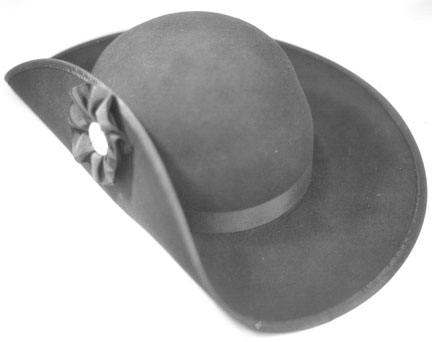
There are many workshops scheduled for this weekend’s Hive gathering at the Noah Brooks Tavern in Minute Man National Historical Park, including a new one from Ray Najecki: “Making Horsehair Fabric Cockades.” The cockade was the decorative ribbon that helped hold up one flap of the brim of a cocked hat. Here’s a sampling of Mr. Najecki’s work in this area.

Why were cockades so important? Because Gen. George Washington said they were. One of his priorities after taking over the army around Boston was to instill a stronger sense of rank and hierarchy into those New Englanders. In particular, that meant being able to tell the officers from the enlisted men.

On 23 July 1775, the generalissimo issued this order:

As the Continental Army have unfortunately no Uniforms, and consequently many inconveniences must arise, from not being able always to distinguish the Commissioned Officers, from the non Commissioned, and the Non Commissioned from the private; it is desired that some Badges of Distinction may be immediately provided, for Instance, the Field Officers may have red or pink colour’d Cockades in their Hatts: the Captains yellow or buff: and the Subalterns green. They are to furnish themselves accordingly.
So not only did an officer need a cockade on his hat, but it had to be the right color.

TOMORROW: Sometimes a general just wants to be recognized. Is that so wrong?

(The cocked hat above is from the online catalogue of C. & D. Jarnagin.)

Tuesday, March 09, 2010

Josiah Quincy, Jr., Takes the Case (Again)

Back in October 2006, I noted a public dispute over whether unpopular defendants deserve legal representation. The Republican candidate for governor of Massachusetts had criticized her opponent, current Gov. Deval Patrick, for doing so.

This month Liz Cheney raised the same complaint about people working for the U.S. Justice Department. Cheney is still best known for who she was born to, and the department is still dealing with how her father’s administration tried to politicize its personnel choices (inspector’s report as PDF).

Several prominent Republican lawyers have now called Cheney’s campaign “a shameful series of attacks.” They stated, “The American tradition of zealous representation of unpopular clients is at least as old as John Adams’s representation of the British soldiers charged in the Boston massacre,“ meaning it predates the U.S. Constitution. (Not that the Cheneys have shown much interest in the details of the U.S. Constitution.)

I’ve raised questions about Adams’s memory of how he came to defend the soldiers and how much grief he really took because of that. But there’s solid evidence of criticism for the same decision from Adams’s younger colleague on the defense team, Josiah Quincy, Jr.

As discussed in the Colonial Society of Massachusetts volume Portrait of a Patriot, Quincy was an energetic advocate for the Whig party in pre-Revolutionary politics. His father, Col. Josiah Quincy of north Braintree, wrote to Josiah, Jr., on 22 Mar 1770:

My dear Son,

I am under great affliction, at hearing the bitterest reproaches uttered against you, for having become an advocate for those criminals who are charged with the murder of the fellow citizens. Good God! Is it possible? I will not believe it.

Just before I returned home from Boston, I knew, indeed, that on the day those criminals were committed to prison, a sergeant had inquired for you at your brother’s house,—but I had no apprehension that it was possible an application would be made to you to undertake their defence. Since then I have been told that you have actually engaged for Captain [Thomas] Preston;—and I have heard the severest reflections made upon the occasion, by men who had just before manifested the highest esteem for you, as one destined to be a saviour of your country.

I must own to you, it has filled the bosom of your aged and infirm parent with anxiety and distress, lest it should not only prove true, but destructive of your reputation and interest; and I repeat, I will not believe it, unless it be confirmed by your own mouth, and under your own hand.

Your anxious and distressed parent,...
Four days later the young lawyer replied to his father from Boston:
Honoured Sir,

I have little leisure, and less inclination either to know, or to take notice, of those ignorant slanderers, who have dared to utter their “bitter reproaches” in your hearing against me, for having become an advocate for criminals charged with murder. But the sting of reproach when envenomed only by envy and falsehood, will never prove mortal.

Before pouring their reproaches into the ear of the aged and infirm, if they had been friends, they would have surely spared a little reflection on the nature of an attorney’s oath, and duty;—some trifling scrutiny into the business and discharge of his office, and some portion of patience in viewing my past and future conduct.

Let such be told, Sir, that these criminals, charged with murder, are not yet legally guilty, and therefore, however criminal, are entitled, by the laws of God and man, to all legal counsel and aid; that my duty as a man obliged me to undertake; that my duty as a lawyer strengthened the obligation; that from abundant caution, I at first declined being engaged; that after the best advice, and most mature deliberation had determined my judgment, I waited on Captain Preston, and told him I would afford him my assistance; but, prior to this, in presence of two of his friends, I made the most explicit declaration to him, of my real opinion, on the contests (as I expressed it to him) of the times, and that my heart and hand were indissolubly attached to the cause of my country; and finally, that I refused all engagement, until advised and urged to undertake it, by an Adams, a Hancock, a Molineux, a Cushing, a Henshaw, a Pemberton, a Warren, a Cooper, and a Phillips.
Samuel Adams, John Hancock, William Molineux, Thomas Cushing, Joshua (probably) Henshaw, Samuel Pemberton, Dr. Joseph Warren, William (or the Rev. Dr. Samuel) Cooper, and William Phillips made up the bulk of genteel Whig office-holders and activists in Boston. They all agreed that Quincy should take the case and ensure the soldiers received a fair trail.

The young lawyer continued:
This and much more might be told with great truth, and I dare affirm, that you, and this whole people will one day REJOICE, that I became an advocate for the aforesaid “criminals,” charged with the murder of our fellow-citizens.

I never harboured the expectation, nor any great desire, that all men should speak well of me. To inquire my duty, and to do it, is my aim. Being mortal, I am subject to error; and conscious of this, I wish to be diffident. Being a rational creature, I judge for myself, according to the light afforded me. When a plan of conduct is formed with an honest deliberation, neither murmuring, slander, nor reproaches move. For my single self, I consider, judge, and with reason hope to be immutable.

There are honest men in all sects—I wish their approbation;—there are wicked bigots in all parties,—I abhor them.

I am, truly and affectionately,

your son,

Josiah Quincy Jun.
A few weeks later, Quincy also agreed to represent Ebenezer Richardson, an even less popular defendant charged with killing young Christopher Seider. Because an unjust trial doesn’t produce justice for anybody.

Monday, March 08, 2010

Old and New Views of Colonial Boston

I wish I had the tech and the knowledge to appreciate Charlie Frye’s Historical GIS: Boston 1775. Last year he posted his work at ESRI Mapping Center and explained:

One of the projects I undertook was to create a GIS of Boston in 1775, using only maps published from that period. I eventually included some later source material of reliable historical character to flush out locations for specific or notorious events, structures, and so on. My goal was to create an inventory and therefore as complete a picture as possible of Boston’s environs in 1775. Not only that, I wanted to be able to cite every feature, making it possible to create a map that was in essence a spatial argument for what I think was in Boston in the year 1775.
There’s also a discussion group on using GIS technology to illuminate the Revolutionary War.

I was able to enjoy the Harvard Map Collection’s image of William Price’s panoramic picture of Boston a few decades before the war. The Image Delivery Service page lets you zoom, pan, and (though it’s not really helpful with this view) twirl the image.

But don’t assume that the panorama Price created is entirely accurate. In New England Prospect, Peter Benes notes that Price included church towers that we know hadn’t been built yet. That’s the magic of drawing, after all.

Sunday, March 07, 2010

Sleeping on Linen Rags

At last night’s Boston Massacre reenactment I got to see a number of familiar faces, and a couple of new ones: the gents from TeachHistory and RagLinen. The latter had, in fact, come all the way from Chicago to witness the event.

This brief posting, therefore, is in honor of rag linen, which printers collected to give to their paper-makers so they could eventually have more paper to print on. Particularly during the war, when imports from Britain were scant, newspapers contained a lot of advertisements asking homemakers to bring in scraps of linen for recycling.

The printer Joseph T. Buckingham collected this anecdote from an older printer, Benjamin Russell (1761-1845, shown here), who had been a teen-aged apprentice to Isaiah Thomas around 1776. Feeling threatened by the army, Thomas had left Boston in a hurry just before the war broke out. He had a tough time establishing himself in central Massachusetts. Buckingham wrote:

Mr. Thomas was not, at that time, in very affluent circumstances. During the first year or two of his apprenticeship, Russell, with a fellow-apprentice, slept in a garret, over the printing-office, on the rags that were taken in from time to time for the paper-maker.

Not only his apprentices, but the master himself, frequently made their meals in the office on bread, and “milk bought by the penny-worth at a time.”
Eventually Thomas was able to put his Massachusetts Spy newspaper on firm footing in Worcester, and became one of America’s pioneering printers of children’s books (mostly pirated from Britain). He founded the American Antiquarian Society.

Benjamin Russell also became a prosperous printer, publishing the Columbian Centinel, Boston’s leading Federalist newspaper, and Boston Gazette. Over the course of his career, printers moved from being ink-stained members of the working class to influential shapers of opinion, and Russell ended up in the state senate and on the governor’s council.

Saturday, March 06, 2010

“Among the mob near the town-house in Boston”

Tonight there will be a reenactment of the Boston Massacre, taking place on the actual site of the shooting on 5 Mar 1770. As preparation, here’s an account of that evening from Edward Hill.

I was among the mob near the town-house in Boston, on Monday the 5th of March instant [i.e., this year], about nine o’clock at night, when the bells were set a ringing by order of the towns men (as I do believe) in order to bring the people together. I saw some of them armed with sticks, and heard some of them say they would go down to the custom-house, where there was a centry placed, and they would take him off his place.

Hearing this, I went to the main-guard, and acquainted the soldiers with what I heard. I heard the serjeant of the guard order a party of men to conduct the officer of the guard to his post; I staid thereabout till I saw Capt. [Thomas] Preston and another officer join the guard; then I saw Capt. Preston with a party of men go towards the custom-house; then, as I went towards the post-office, I heard the report of two muskets, fired as if from the custom-house; upon this I returned and went towards the custom-house with a number of towns-men;

while I was one the way thither, I heard the report of three or four muskets more; when I went down, I saw the people carrying off for dead one or two men; and then I saw a man lying on his back with a gore of blood by him, who, as I afterwards learned, was a Mulatto, upon which I heard the towns-people cry out to the soldiers who stood at the custom-house, “Fire, damn you, we defy you to fire;” whereon one of the soldiers of that party, thus provoked, turned out of the ranks a little, took up his musket, and was going to fire, when Capt. Preston took him by the arm and hindered him from firing.

It was after the firing beforementioned was over, according to the best of my knowledge, that I heard the drum beating to arms. I saw several officers of the 14th regiment running towards their barracks, and some of the towns-people running after them, crying, “Knock them down, sons of bitches.”

As I was running after some of these officers; I had in my hand a small stick, which somebody pursuing the officers asked me to let him have. I refused, saying, I wanted it myself. He took hold of the stick, and endeavoured in vain to take it from me; a crowd of people coming up, and walking faster than I did, threw me down.

As I got up again, some of them asked, “Who son of a bitch was that?” and one of them made a thrust at me with a blade, which I took to be a cut and thrust sword, and by the thrust cut through my jacket on the left breast about six inches; then I run down to the barracks of the 14th regiment, where I remained all night.
This deposition was taken down on 15 Mar 1770 by justice James Murray, a fervent supporter of the royal government. Customs Commissioner John Robinson, who had laid low since his coffee-house brawl with James Otis, Jr., carried it to London, and it was published with others in a pamphlet titled A Fair Account of the Late Unhappy Disturbance at Boston in New England.

Capt. Preston’s defense team, which consisted of John Adams, Robert Auchmuty, and Josiah Quincy, Jr., called Hill as their second defense witness. The notes on his testimony add a few details to this account. Hill was “in a house by Mr. Deblois” before going out. The other officer at the main guard with Preston was “Mr. Bassett”—twenty-year-old Lt. James Bassett, officer of the guard that night. And the soldier whom Preston stopped from shooting had “Attempted to fire at a Boy.” Hill did not clarify exactly why he had been running after army officers with a stick in his hand.

Hill’s deposition identified him as “late servant to Mr. George Spooner, merchant, of Boston.” Usually Bostonians used “servant” to mean “slave,” but that meaning doesn’t seem to fit this context. As for Spooner, he had attended the Sons of Liberty dinner in Dorchester in August 1769, but five years later he was a Loyalist and left town with the British military.

(Photo of the Old State House at night by Wally Gobetz, via Flickr under a Creative Commons license.)

Friday, March 05, 2010

Boston Massacre On Its Way!

Today is the 240th anniversary of the Boston Massacre, which will be commemorated at the Old State House tomorrow. (Back in colonial Boston, the town would postpone the anniversary commemorations for a day if 5 March fell on a Sunday; now we do so if it falls on a workday.)

The Bostonian Society, Adams National Historical Park, and some of the area’s most dedicated Revolutionary reenactors are teaming up to recreate the Massacre and subsequent events in three ways on Saturday, 6 Mar 2010.

Kids Reenact the Massacre
11:00 A.M. and 2:00 P.M.
Free; on the mall outside of the Old State House.
With little red coats and styrofoam snowballs, young visitors will be the stars in a recreation of the Boston Massacre led by rangers from the Adams National Historical Park.

Trial of the Century
11:30 A.M. and 2:30 P.M.
Free with museum admission; in the Old State House.
Immediately following the Kids’ Reenactment, come inside to watch patriot lawyers John Adams and Josiah Quincy defend the British soldiers accused of murdering Bostonians. Audience members are invited to act as witnesses and jurors for this celebrated case. Space is limited; tickets for both performances go on sale at 9:00 a.m. at the Old State House.

Boston Massacre Reenactment
7:00 P.M.
Free; in front of the Old State House, at the corner of State and Congress Streets.
Witness the event that sparked the American Revolution! Become a part of this infamous event as it is reenacted in front of the Old State House, in the very place where it took place in 1770. Decide for yourself if the soldiers fired into the crowd in self-defense or cold-blooded murder. Before the action unfolds, hear from patriots, loyalists, and moderates who will talk about the events and attitudes that led to that fateful night.

One of the most important words in that last description is “hear.” This year the Bostonian Society found funding to wire more of the presenters for sound. Which means that (as long as the wireless microphones don’t pick up police dispatches, cell-phone calls, or other stray transmissions) more spectators should be able to hear the words I scripted for various historical figures last year. Listen to the political and social arguments that led up to the fatal confrontation on King Street!

Thursday, March 04, 2010

Upcoming Lectures at the Marblehead Museum

The Marblehead Museum is featuring a couple of lectures on Revolutionary topics this month.

On Wednesday, 10 March, clothing historians Matthew Brenckle and Victoria Rebal Brenckle will speak on “What They Wore: Soldiers and Camp Followers in Glover’s Regiment, 1775”:

How did Marblehead’s seafaring soldiers and landside laborers—the men of [Col. John] Glover’s Regiment—dress as they prepared for war in 1775? What did their attire say about who they and their families were as citizens?
This session starts at 7:30 P.M. It looks like it’s free to the public, and there will even be refreshments. Call 781-631-1768 for reservations.

On Thursday, 18 March, Don Doliber will trace “The History of Masons in Marblehead.” Admission to this talk is listed as $15, or $10 for museum members. It is in conjunction with the museum’s current exhibit on “Masons in Colonial Marblehead,” which features the punchbowl shown here.

Wednesday, March 03, 2010

“An Alchemist Who Consecrates George Washington…”

From the Library Company of Philadelphia’s website on the “Philadelphia Gothic” school of early American popular fiction:

George Lippard. Paul Ardenheim, the Monk of the Wissahikon. (Philadelphia, 1848). Historical Society of Pennsylvania.

A would-be recruit to the mystics haunting Philadelphia’s most romantic stream comes upon an alchemist who consecrates George Washington as the Deliverer prophesied in the Bible; but the hero is diverted from patriotic duty by a voluptuous demon-woman who lures him into her bedroom.

In what might still be an understatement, Lippard stated proudly in his preface that he had written “the most improbable book in the world.” It may also be spiritually autobiographical: Lippard may have considered joining a Rosicrucian order before he invented a secret brotherhood of his own with many of the same rituals.
Can’t wait to read that novel? No need! It’s available through Google Books. All 536 pages.

Here’s a taste of Lippard’s preface:
The author was aided in the preparation of this work, by a series of papers, letters, and other MSS. relating to the events and men of our Revolution, and especially to certain incidents, connected with the Wissahikon, near Philadelphia. The incidents detailed in the MSS. were of a remarkable and various character; presenting at one view, a picture of the home-life, the battles, and superstitions of olden time.

Some portions of the MSS. were written in a cipher, not only difficult, but utterly untranslatable, at least, without a key. As the pages in cipher occurred in the most interesting points of the narrative, and seemed from the context to picture not only events which took place in ’75, ’77 and ’78 on the Wissahikon, but also events of other lands, and of distant centuries, the author was exceedingly anxious to discover the key to this secret writing.

The reader will appreciate the difficulty when he beholds a specimen of the untranslatable Cipher: or, perhaps, Cryptograph would be a better word.
At first sight, this of course, looked like nothing but a scrawl, without object or meaning, but as entire pages were written in the same manner—as there seemed to be something like system, in the very irregularity of the lines and their angles,—curiosity was excited, and the most strenuous exertions made to discover the meaning of some particular part, and thus construct a key for the whole. After much effort, the characters given above were discovered to represent the word—“MOUNT SEPULCHRE.”
Of course, once you know the answer, it seems obvious.

Some of Lippard’s Revolutionary stories actually made their way into the history books, such as the legend that a mysterious stranger harangued the Continental Congress about independence, and that the Liberty Bell was rung on 4 July 1776 to signal the Declaration of Independence. But later authors have generally been able to see that the presence of a “voluptuous demon-woman” makes Paul Ardenheim fiction.

Tuesday, March 02, 2010

Fort at No. 4’s Powder Horns to Remain in Charlestown, N.H.

The Fort at No. 4 in Charlestown, New Hampshire, is one of the U.S. of A.’s few sites dedicated to the King George’s War, also called the War of the Austrian Succession and the War of Jenkins’ Ear.

In the early 1740s the fort was an outpost (the fourth, to be exact) on the frontier between British New England and French Canada. The fort was used as a militia base during the French and Indian/Seven Years’ War, but then lost military significance and was dismantled by the time of the Revolution.

The fort was recreated in the 1960s as a living history museum, and hosted reenactments of different periods. I attended one in conjunction with the town’s blueberry festival, and we hardly noticed that the blueberries were late coming in.

Last year the Fort at No. 4 was closed because of budget problems. With the economy in a slump since late 2008, it wasn’t taking in as much revenue donations and school trips, and of course King George’s War has never been as big a draw as other parts of American history.

To raise money, the organization even offered to sell a couple of 18th-century powder horns from its collection. One has a picture of the fort, and the other, carved in 1757 by a young soldier named Zera Beebe (1740-c. 1804), says, “Made at No. 4.” The sad part is that these horns are estimated to be worth $8,000 apiece, so the fort must have really been scraping for its operating budget.

Last month the local press reported that some anonymous neighbors had offered to fund the purchase of those artifacts by the town of Charlestown. Details are still being worked out, but the goal is for the horns to remain in the area and available for public events.

Last year the Fort at No. 4 was hoping to reopen this year. The local news story about the powder horns says the site’s board now hopes to reopen in 2011. The website is still up and offering resources on life and warfare on the New England frontier.

Sunday, February 28, 2010

Answers to Spot the Actual British Aristocrats!

On Saturday I challenged folks to identify, from a group of four men’s names, which were actual high-born friends of Gen. Charles Lee, and which were inventions of the comic novelist P. G. Wodehouse. I promised an answer on Sunday, and it’s still Sunday.

Three of the names were real, found in John R. Alden’s biography of Lee, and one fictional.

Clotworthy Upton (1721-1785) was made the first Baron Templetown on 3 Aug 1776, having served as clerk comptroller to the Princess Dowager of Wales. (Another Clotworthy Upton served as a captain in the Royal Navy during Britain’s wars with Napoleonic France.)

Capt. Primrose Kennedy of the 44th Regiment of Foot had the dubious distinction of being wounded on two of the British Army’s worst days in North America: Gen. Edward Braddock’s disastrous march to Fort Duquesne in 1755, and the Pyrrhic victory at Bunker Hill twenty years later. He left the army in early 1779.

Godfrey “Biscuit” Brent, formally Viscount Biskerton, is one of the male leads in Wodehouse’s Big Money. He’s a member of the Drones Club, but doesn’t appear in any other stories.

Constantine Phipps (1744-1792, shown above) was a captain in the Royal Navy and a Member of Parliament. In 1773 he set out for the North Pole in the ship Racehorse, accompanied by the Carcass, commanded by Skeffington Lutwidge. The ships got to within about ten degrees of latitude of the Pole before ice forced them back. In his report on the voyage, Phipps was the first European to describe seeing a polar bear.

In 1775 Phipps succeeded his father and became the second Baron Mulgrave, but he continued to serve in the Navy. He participated in the Battle of Ushant in 1778, defending the British coast from the French. At the end of the American war he retired from active service.

Surviving Morristown

Tonight at 10:30 P.M., WGBH in Boston will broadcast the documentary Morristown: Where America Survived. Other public broadcasting stations are airing the show at various times.

While Valley Forge has become part of most Americans’ understanding of the Revolutionary War, the Continental Army encampment at Morristown, New Jersey, in 1779-80 faced worse weather and equally desperate political straits.

The documentary’s website offers background information and some educational materials for teachers to use in conjunction with the show.