J. L. BELL is a Massachusetts writer who specializes in (among other things) the start of the American Revolution in and around Boston. He is particularly interested in the experiences of children in 1765-75. He has published scholarly papers and popular articles for both children and adults. He was consultant for an episode of History Detectives, and contributed to a display at Minute Man National Historic Park.

Subscribe thru Follow.it


•••••••••••••••••


Sunday, May 13, 2012

Viewing Washington’s Letter to the Touro Synagogue

In 1790, President George Washington wrote a letter to the Touro Synagogue in Newport, Rhode Island, which was an early expression of the federal government’s commitment to religious neutrality. The text of that letter appears back here.

Two upcoming events pertain to that letter. First, on 13 June, Ted Widmer, head of the John Carter Brown Library in Providence, will speak about “A Test Case for America: Washington, Longfellow and the Jewish Community at Newport” at the First Parish Church in Cambridge. The touchstones of this talk will be Washington’s letter and Henry W. Longfellow’s poem on the Jewish cemetery at Newport.

Widmer speaks as part of the Cambridge Forum series of lectures and talks. His lecture is free, co-sponsored by the Friends of the Longfellow House–Washington’s Headquarters in Cambridge, The Massachusetts Society of the Cincinnati, and fellow organizations. It is scheduled to begin at 7:00.

Second, starting on 4 July Washington’s original letter will be the center of an exhibit called “To Bigotry No Sanction” at the National Museum of American Jewish History in Philadelphia. Paul Berger at the Jewish Daily Forward reported the background of this display:
As the Forward reported in a series of articles and editorials last year, Washington’s letter spent decades on display in the Klutznick Museum at B’nai B’rith International’s flagship headquarters in Washington. In 2002, when financial pressures forced B’nai B’rith to relocate to smaller offices, the majority of its collection, including the letter, was put into storage. Many scholars did not know where the letter was until the Forward revealed it to be housed in an art storage facility in suburban Maryland.

Several institutions, including the NMAJH and the Library of Congress, have tried for years to pry the letter away. But B’nai B’rith claimed that its hands were tied by the letter’s legal owner, the Morris Morgenstern Foundation, which would not allow the letter to be moved.
The Forward’s website catalogues its reporting and editorials on the matter that resulted in the July display.

Saturday, May 12, 2012

Looking at Lexington in 1775

I’m abashed that I’m only now calling attention to Mary Babson Fuhrer’s article “The Revolutionary Worlds of Lexington and Concord Compared” in the March 2012 New England Quarterly. Its jumping-off point is Robert Gross’s The Minutemen and Their World, a highly respected study of Concord published in 1976.

Fuhrer writes:
Gross’s study, grounded as it is in local evidence, has withstood the test of time with few revisions. However, Concord had a partner in rebellion on 19 April. As the oft-repeated phrase “Lexington and Concord” suggests, the two towns have been fused in popular memory, and so the findings of The Minutemen and Their World have generally been taken to apply to Lexington as well.

But Lexington was no Concord. Unlike those in their neighboring town, the citizens of Lexington did not drag their feet on the way to revolution but made the most of every opportunity to assert and defend the hard-won inheritance of their ancestors. Moreover, Lexington was not rent by factions and troubled by the local animosities that so disturbed the peace in Concord. Supported by a community that had longed challenged British authority and fomented rebellion, the militia on Lexington’s common stood in, and for, unity.

Surprisingly long overdue, an analysis of Lexington’s social, demographic, political, religious, and ideological characteristics as against Concord’s sheds light on the communities’ radically different responses to imperial crisis, whereas identifying their commonalities reveals the shared motivations that prompted the inhabitants of both towns, when finally pressed, to take up arms against the forces of their king.
This article is available for downloading as a P.D.F. file. What’s more, Fuhrer and Gross discuss their findings and interpretations in a podcast discussion with William Fowler.

(The photo above, courtesy of Bill Coughlin and the Historical Marker Database, shows Lexington’s recreated colonial belfry.)

Friday, May 11, 2012

Gen. Gage Slept Here

As part of the London government’s program to punish Boston for the Tea Party, Gen. Thomas Gage used his prerogative as new governor in the spring of 1774 to move the Massachusetts General Court to Salem.

The legislature protested, but it was protesting everything those days. The body met in Salem for less than two weeks, from 7 to 17 June. As soon as Gage heard that the lower house was voting to send delegates to the First Continental Congress, he declared the session adjourned.

Samuel Adams as Clerk had arranged to have the chamber locked, so Secretary Thomas Flucker had to read the governor’s proclamation to the closed doors until the legislators had finished their business. (There’s a little more intrigue to that story.)

Gage remained in Salem through the nearly the end of August. Last month, Boston 1775 reader P. J. Curran asked me where exactly he lived during that time. I did some digging, and found that the governor borrowed a mansion built in Danvers around 1754 for Robert “King” Hooper (1709-1790). That Loyalist merchant dominated the trade in Essex County’s fishing catch. His Danvers estate became known as “the Lindens.”

The good news is that the Lindens house has largely been preserved. The bad news, at least for folks touring Massachusetts, is that it was preserved by being dismantled and reassembled on Kalorama Road in Washington, D.C., in 1935. Here’s a Washington Post article about the house, and here’s a Library of Congress collection of photographs taken shortly before the move. In addition, one room’s paneling went to the Nelson-Atkins Museum of Art in Kansas City.

Thursday, May 10, 2012

Samuel Bowen Brings Soy to America

Blogger’s new behind-the-scenes design shows me the number of hits on each Boston 1775 posting, and the most viewed of last month by far was “Benjamin Franklin Discovers Tofu for America.” Its numbers are edging up to 1,000 views, far ahead of the next most popular.

Unfortunately, that posting contained an error. I repeated the Franklin tercentenary website’s claim that Benjamin Franklin’s 1770 letter to John Bartram was the first record of someone supplying soy beans to America. After all, Franklin invented everything else in colonial America, right?

Bill Shurtleff of the Soy Info Center alerted me in a comment that another man had brought soy beans to America five years before. So this posting is about that forgotten pioneer, Samuel Bowen of Georgia.

Theodore Hymowitz and J.R. Harlan described in this paper how in 1758 Bowen embarked from London on the large East India Company ship Pitt. He transfered to a smaller ship, the Success, which dared to visit two Chinese ports besides Canton. The interpreter and supercargo on the Success, an old East India hand named James Flint, ended up in Chinese jails for three years.

Bowen later stated that he was also imprisoned in China for years and transported around the interior of the country. He reappeared in London in late 1763. The next year, Bowen was in Georgia. In 1765 he married Jane Spencer, daughter of the Collector of Customs at Savannah. He bought land east of that port and slaves to work it. Bowen called his slave-labor plantation “Greenwich,” perhaps reflecting his background as an English sailor.

Even before setting up his own farm, Bowen asked the colony’s Surveyor-General, Henry Yonge, to plant some “pease or vetch” he had brought from China. In December 1766 letter to London, Yonge wrote that these new seeds
did yield three crops: and had the frost kept off one week longer, I should have had a fourth crop, which is a very extraordinary increase, and must, if attended to and be of great utility and advantage to this and his Majesty’s other southern American provinces.
Yonge therefore gets credit for “planting America’s first soy beans.”

The next year Bowen reported in more detail on the seeds and how Chinese people used them: to “prepare an excellent kind of vermicelli”; “for salad, and also boiled like greens, or stewed in soup”; as sprouts; as “an excellent antiscorbutic”; and as “most excellent fodder for your cattle.” He doesn’t appear to have described tofu.

Bowen made a trip back to London in 1766, receiving a gold medal from the Society of Arts, Manufacturers, and Commerce; an audience with the Earl of Dartmouth; and 200 guineas from George III. The next year the British government granted him a patent for his “new invented method of preparing and making sago, vermicelli and soy from plants growing in America, to be equal in goodness to those made in the East lndies.”

Bowen sent “six bottles of Soy and six pounds of powdered Sago” to the American Philosophical Society in Philadelphia, which noted the goods in January 1769 and made Bowen a member in April. Franklin had, of course, co-founded that organization and kept in touch. It’s therefore possible that he heard about soy from America before he sent his own samples to Bartram. When Franklin investigated soy seeds in 1770, he definitely talked with James Flint, who remained friendly with Bowen; the Georgian named a son after Flint and welcomed him to the Greenwich plantation in 1775.

Bowen was back in London again on 30 Dec 1777 when he died. His widow Jane ended up hosting some officers from the fleet of Adm. Jean Baptiste Charles Henri Hector, comte d’Estaing, in 1779. According to this article by Edward Pinkowski, she oversaw the burial of Gen. Casimir Pulaski “between her mansion and the river.” Jane Bowen died in 1782, leaving her four children 26 slaves, 17 cows and oxen, and many items involved in the production of sago powder.

Wednesday, May 09, 2012

Crowd-sourcing Mr. Bentham and Mr. Madison

Yesterday I used the word “crowd-sourcing,” which seems to be a growing buzzword in digital humanities—especially when funding for traditional, in-house transcription projects is in jeopardy.

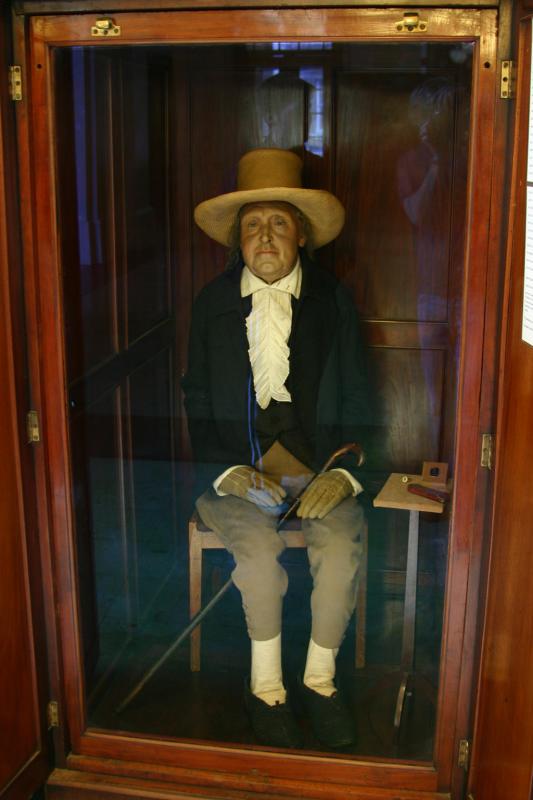
One example related to the eighteenth century is Transcribe Bentham, centered at the University College London. Jeremy Bentham (1748-1832), the only utilitarian philosopher whose taxidermied body I’ve seen, left thousands of pages of handwritten drafts, notes, and other material. This digital initiative invited anyone to sign up and translate that material into digital texts. The “About Us” page introduces the process:
Access the Transcription Desk, where you can create a user account which will give you transcribing privileges. You can then select a manuscript to view and transcribe, save your work, and return to view your own contributions. You can interact with other users by creating a social profile and by sharing ideas in the discussion forum. There is a quickstart guide to using the tool and detailed guidelines on how to transcribe the manuscripts. You can contact us for general advice, help with a specific problem or for further information.
Currently there are over 1,600 registered transcribers. Given that the project says elsewhere that the collective has completed 3,300 manuscripts, that doesn’t suggest high productivity from every registrant. But of course the project just needs enough.

Here in North America, Montpelier recently announced ConText’s crowd-sourcing project to create an extensive commentary on James Madison’s notes from the Constitutional Convention. That site says:
The Notes of Debates in ConText addresses a real need in our constitutional scholarship. There is currently no systematic, accessible commentary on the Notes that explains the details and context of each decision made at the convention, while also describing the subsequent (and ongoing) debates over constitutional meaning that have stemmed from those decisions. With this site, we are providing the most up-to-date analysis of the Framers’ debates by some of the country’s leading academic voices.
This project too offers registered users a chance to add their own comments. Discussions about the meaning and current importance of the convention’s decisions could conceivably get heated.

Tuesday, May 08, 2012

Crowd-sourcing Massachusetts’s Milestones

After reading Charles Bahne’s remarks on colonial-era milestones around Boston yesterday, I wondered if the web had a map of all the stones still standing.

Forty milestones erected by 1767 on the route between Boston and Springfield (with, it appears, a few on the road from Boston to Cambridge) were entered on the National Register of Historic Places in 1971. Their Wikipedia entry offers photographs of many and geographic locations for all. That page automatically pumps out a Google Map of those locations.

Another resource, which I learned about from the City Record and Boston News-Letter blog, is this Historic American Buildings Survey publication completed in 1935-36. It includes drawings and maps of the stones then known.

The Stones Structures website catalogues several milestones that didn’t make Wikipedia, and invites folks to send in more photographs. Waymarking offers photos of more in central Massachusetts in its “Milestones” grouping. In addition, the Jamaica Plain Historical Society offers a couple of newspaper articles about the milestones in that area.

According to Boston.com, the state transportation department has catalogued 47 early milestones. How does its list match up with those on these websites? Are there more out there, perhaps removed from busy roads?

Is anyone up for creating a comprehensive map and catalogue of all the markers that exist in Massachusetts or New England today? Perhaps that could be a class project, or a collaboration among schools. It might even preserve the memory of some now-vanished stones known to have stood in 1909 when this Brookline Historical Society paper was written. Anyone?

Monday, May 07, 2012

Milestones of Greater Boston, Then and Now

Last week Matt Rocheleau reported for Boston.com on the state government’s plan to restore a colonial milestone along Harvard Avenue in Allston that was damaged by a truck. I knew that Charles Bahne, author of the just-published Chronicles of Old Boston, has studied milestones and other early road markings around Boston, so I asked him for his reaction. Charlie kindly supplied this guest blogger essay.

I’m glad to see that the Massachusetts Department of Transportation is overseeing the milestones now, and that the Massachusetts Historical Commission is involved in plans for preserving this one. I’m pleasantly surprised that they have a count of surviving stones— 47 known to exist in situ. I’m sure that there were many more than 99 erected in the colonial era.

The article repeats the myth that the stones mark the “distance from a stone near City Hall in downtown Boston”—referring to the Boston Stone on Marshall Street. All of the colonial stones in the immediate Boston area were erected before 1735, thus before the Boston Stone was set in a public place. The actual zero point was the northwest corner of the Old State House, today’s State and Washington Streets.

It also does not appear that the Allston 6-mile stone was ever part of a mail delivery system; it was erected before the establishment of an official colonial post office and was never along any of the established post roads.

Rather, most of the stones in the immediate Boston area were erected by prominent political figures, such as Samuel Sewall, Jonathan Belcher, and Paul Dudley. I’m guessing that those men saw the milestones partly as a public service, and partly as a billboard advertising their beneficence—just as we see signs near highway construction projects that give the names of government officials today.

There were originally eight milestones along the road from Boston to Cambridge (Harvard Square). Of these, the stones at 1, 2, and 3 miles are now lost. I assume that the 1- and 2-mile stones—and possibly the 3 as well—were lost during the siege of Boston, since they were in a hotly contested area with entrenchments on both sides.

The 4-mile stone still stands on Huntington Avenue in Roxbury. The 5-mile stone is on Harvard Street in Brookline. The 6-mile stone is referenced in this article. The 7-mile stone is on North Harvard Street in Allston. And the 8-mile stone is at the corner of Garden Street & Massachusetts Avenue in Cambridge (slightly moved from its original location in the middle of Harvard Square).

I’ve seen the 3-mile stone on Centre Street in Roxbury and the 5-mile stone at Monument Square (Centre & Eliot Streets) in Jamaica Plain. And of course the “Parting Stone” (not a milestone, but it indicates which route went where) stands at Eliot Square in Roxbury.

I have a copy of an article from the Brookline Historical Society in 1909 reporting the location of several then-existing stones along other highways in Roxbury, Dorchester, Milton, Quincy, Braintree, Canton, Jamaica Plain, and Walpole, in addition to the ones I just mentioned. There is an old milestone in Arlington, near Arlington Heights, which reads simply “8,” and I can’t figure out where that number refers to.

The stones referred to in the article along the Boston Post Road were indeed set up under the instruction of Benjamin Franklin, and in some cases directly under his field supervision. They were erected much later than the stones mentioned in earlier paragraphs.

The Post Road follows U.S. 20 west (with a few modern bypasses) from Watertown Square to about Northborough. At that point U.S. 20 diverges to the south of the Post Road, which goes directly through Worcester. West of Worcester the Post Road follows Mass. Route 9 for several miles, then some other highways, and then rejoins U.S. 20 west of Palmer. In the Springfield area some of the Post Road has been designated as Route 20A.

There were two other routings of the Boston Post Road, one going southwest from Dedham towards Hartford, and one going south from Dedham towards Rhode Island. And in the early nineteenth-century another set of milestones was erected along turnpikes, including the Worcester Turnpike, now Route 9.

As for the sad story of the Allston stone, until about fifteen or twenty years ago it was fairly well protected simply because the city had installed parking meters in that block. The meters defined the parking spaces so that the stone was relatively safe from “attack” by motorized vehicles. When the parking meters were removed, the parking spaces were no longer defined, so people continued to parallel-park in spaces of random length and positions. As a result the milestone was frequently hit and scratched by cars and trucks, a fact which I observed circa 1999. Thus I wasn’t wholly surprised to see that this accident had happened last August.

The other surviving stones along the Roxbury-Allston-Cambridge route are all set back behind the sidewalk, relatively safe from vehicular incursions.

Thanks, Charlie! Part of the plan for restoring the Allston stone is to move it back from the road by about a foot, which would provide a little more protection.

TOMORROW: Milestones on the web.

Sunday, May 06, 2012

Responding to Responses to the Bill of Rights

The April 2012 issue of the William and Mary Quarterly arrived this weekend. Its articles aren’t available free online, but the Omohundro Institute publishes the book reviews for everyone. And in this issue that includes a detailed discussion of M.I.T. professor Pauline Maier’s Ratification: The People Debate the Constitution, 1787-1788, available as a series of P.D.F. files from this page (for now).

First are five essays responding to Ratification by other scholars: Todd Estes, Saul Cornell, Seth Cotlar, Maeva Marcus, and R. B. Bernstein. Maier herself responds to those comments, and then the five respond to her responses. Finally, Maier responds to the responses to her response to the responses to her book. And they could have gone on forever.

A clear division opens among the scholars in the conversation, as shown by how Marcus began her second essay:
After reading the comments of my fellow Forum participants, I came away thinking that perhaps I had read a different book from the one read by Professors Seth Cotlar and Todd Estes. . .
The big question is, as so often, whether this study gives enough attention to the people as opposed to elite politicians. Maier chose to examine ratifying the Constitution rather than writing it, a process that necessarily was more broadly based. But did that widen the focus only a bit to the elite politicians in each state? And what if those gentlemen were the biggest part of the story?

Along the way there are interesting exchanges like this, starting with Maier:
Although bills of rights were a popular issue in the state ratification debates, of the five states that both ratified and recommended amendments, only Virginia formally asked that a bill of rights be added to the Constitution.

However, Virginians who ardently supported that demand, such as Patrick Henry and Richard Henry Lee, were bitterly disappointed with the amendments the First Federal Congress proposed. Neither they nor, for that matter, anybody else—not Washington, or Jefferson, or Madison—referred to the twelve amendments proposed by Congress or the ten ratified by the end of 1791 as a “bill of rights.” When did that term become commonplace, and why?
To which Cornell replied:
Maier…places a bit too much confidence in the work of legal scholar Akhil Reed Amar, whose controversial study of the Bill of Rights claims that this term was not applied to the first ten amendments until late in the nineteenth century, when collective rights such as the Second Amendment morphed into individual rights during Reconstruction. If one looks closely at Amar’s sources, they turn out to have a clear bias that reflects his heavy reliance on case law.

To be sure, Amar and Maier are absolutely correct that the term Bill of Rights was not widely used in the years immediately following the adoption of the first ten amendments. I have found evidence that it began to gain some purchase during the Alien and Sedition crisis. By the time his law lectures were published in 1831, Henry St. George Tucker referenced “the bill of rights and written constitutions, both of the federal and state governments.” Two years later the eminent legal scholar and Supreme Court justice Joseph Story used the same phrase in his influential Commentaries on the Constitution. Story wrote that “at its very first session, [Congress] took into consideration the amendments so proposed; and by a succession of supplementary articles provided, in substance, a bill of rights.” In the time between the Alien and Sedition crisis and the Jacksonian era, the term had clearly entered American legal discourse.
Story was born in Marblehead in 1779, Tucker in Virginia in 1780. They were too young to have closely followed the original debates over amending the Constitution, so their writings represented the consensus of the next generation of American legal scholars. The first generation was divided enough about the meaning and weight of those amendments that they passed the Sedition Act. The ascendancy of the Jeffersonian Republicans—including Story and Tucker—might have made their interpretation of the first ten amendments as a Bill of Rights the American standard.

Saturday, May 05, 2012

New Book on New England Meetinghouses

This spring the University of Massachusetts Press is publishing Meetinghouses of Early New England, by Peter Benes, a comprehensive study of early American vernacular architecture.

The publisher’s copy says:
Built primarily for public religious exercises, New England’s wood-frame meetinghouses nevertheless were closely wedded to the social and cultural fabric of the neighborhood and fulfilled multiple secular purposes for much of the seventeenth and eighteenth centuries. As the only municipal building in the community, these structures provided locations for town and parish meetings. They also hosted criminal trials, public punishments and executions, and political and religious protests, and on occasion they served as defensive forts, barracks, hospitals, and places to store gunpowder.
The Lexington meetinghouse had kegs of gunpowder in its gallery on the morning of 19 Apr 1775, as the story of Joshua Simonds preserved. Watertown’s meetinghouse was where the Massachusetts Provincial Congress and then Massachusetts General Court met during the siege of Boston.

In small rural towns, the meetinghouse was sometimes the only building large enough to accommodate such gatherings. (Larger towns might have big taverns or courthouses.) With the religious homogeneity of those small societies, there was rarely objection to having secular meetings in a religious place—or, conversely, using a religious building for secular purposes.

Within Boston, the town used the Old South Meetinghouse as its venue for especially large meetings, such as the day after the Boston Massacre and the annual orations that commemorated that event. The First Baptist Meetinghouse was the site of Massachusetts’s convention to ratify the U.S. Constitution.

Back to Peter Benes’s book. It catalogues “more than 2,200 houses of worship in the region during the period from 1622 to 1830, bringing many of them to light for the first time.” It also “traces their evolution through the eighteenth and early nineteenth centuries into Congregational, Presbyterian, and Baptist churches heavily influenced by an Anglican precedent that made a place of worship a ‘house of God.’” With greater religious variety and freedom, citizens no longer viewed a sectarian meetinghouse the same way.

Friday, May 04, 2012

Happy Independence Day!

In Rhode Island, that is.

On 4 May 1776, the Rhode Island Assembly voted to break legal ties with Great Britain. It was the first colony to take that step, at least as Rhode Island historians would have it.

Other colonial bodies had instructed their delegates to the Continental Congress to support independence, or had started to alter their legal language to remove references to the British king. But Rhode Island’s legislature repealed the law that had bound the colony to Great Britain.

The repeal bill was rather legalistic and far less stirring than the Congress’s July Declaration of Independence, but it contained the same basic argument:
WHEREAS in all States, existing by Compact, Protection and Allegiance are reciprocal, the latter being only due in Consequence of the former;

And whereas GEORGE the Third, King of Great-Britain, forgetting his Dignity, regardless of the Compact most solemnly entered into, ratified and confirmed, to the Inhabitants of this Colony, by his illustrious Ancestors, and till of late fully recognized by Him—and entirely departing from the Duties and Character of a good King, instead of protecting, is endeavoring to destroy the good People of this Colony, and of all the United Colonies, by sending Fleets and Armies to America, to confiscate our Property, and spread Fire, Sword and Desolation, throughout our Country, in order to compel us to submit to the most debasing and detestable Tyranny;

whereby we are obliged by Necessity, and it becomes our highest Duty, to use every Means, with which God and Nature have furnished us, in Support of our invaluable Rights and Privileges; to oppose that Power which is exerted only for our Destruction.

BE it therefore Enacted by this General Assembly, and by the Authority thereof it is Enacted, That an Act intituled, “An Act for the more effectual securing to his Majesty the Allegiance of his Subjects in this his Colony and Dominion of Rhode-Island and Providence Plantations,” be, and the same is hereby, repealed.

AND be it further Enacted by this General Assembly, and by the Authority thereof it is Enacted, That in all Commissions for Offices, civil and military, and in all Writs and Processes in Law, whether original, judicial or executory, civil or criminal, wherever the Name, and Authority of the said King is made Use of, the same shall be omitted, and in the Room thereof the Name and Authority of the Governor and Company of this Colony shall be Substituted, in the following Words, to Wit: “The Governor and Company of the English Colony of Rhode-Island and Providence Plantations:”

That all Such Commissions, Writs and Processes, shall be otherwise of the same Form and Tenure as they heretofore were: That the Courts of Law be no longer entitled nor considered as the King’s Courts: And that no Instrument in Writing, of any Nature or Kind, whether public or private, shall in the Date thereof mention the Year of the said King’s Reign: Provided nevertheless That nothing in this Act contained shall render void or vitiate any Commission, Writ, Process or Instrument, heretofore made or executed, on Account of the Name and Authority of the said King being therein inserted.
The rest of the long law laid out new language for all sorts of government oaths, from the governor down to petit jurors and town officials. Not the sort of thing schoolchildren would feel proud to memorize.

Notably, civil officials had to “engage” to carry out their offices, and their oaths didn’t end with “So help me God.” However, militia officers and clerks had to “swear” and say “So help me God.” The former oaths might have been written with Quakers in mind, but Quakers were excused from militia duty on religious grounds.

(The photo above shows the Old State House in Providence, site of the assembly’s vote in May 1776, courtesy of the state’s Secretary of State.)

Thursday, May 03, 2012

Which Teacher Said, “War’s Begun”?

Last month Prof. Chris McDonough of the University of the South queried me about how Master John Lovell (shown here) of Boston’s South Latin School announced an end to the school day on 19 Apr 1775. Did he make the announcement in Latin or English or both? I’d noticed a discrepancy, but hadn’t tried to nail it down until then.

Our main (and perhaps only) source for that day in the South Latin School is the recollection that politician Harrison Gray Otis wrote down in 1844, quoted here:

As I entered School I heard the announcement of “deponite libros” and ran home for fear of the regulars.
Deponite libros [put down your books]” was the traditional way that Latin School masters signaled the end of every school day. It just came early that April morning.

Meanwhile, an alumnus of the Writing School on Queen Street, the newspaper publisher and politician Benjamin Russell, recalled how Master James Carter had closed that school. People recorded Russell’s anecdote in a couple of different ways.
  • “Master Carter then said: ‘Boys, war has begun; the school is broken up’,” quoted here.
  • “Master Carter said,—‘Boys, the war’s begun, and you may run’,” quoted here.
It makes sense for Carter to give his instructions in English.

In 1880, Henry F. Jenks wrote a history of Boston’s South Latin School that quoted Otis’s letter but added to it the line ”War’s begun and school’s done,” evidently inspired by Russell’s story. I haven’t found those words in any previous publication.

Jenks’s book was prestigious and widespread enough that his formulation went into a lot of reference books and histories over the next few decades. In fact, in 1887 a writer in The Nation responded to a recent article in The Magazine of History with this quibble:
And when Mr. Benjamin tells of “Master Carter,” in Boston, saying to his pupils, “Boys, the war’s begun, and you may run!” is he not thinking of Master John Lovell, of the Public Latin School, whose formula of dismissal was—“War’s begun and school’s done”?
Master Carter had been totally forgotten, and his best line assigned to someone else!

Wednesday, May 02, 2012

Muffins at Monticello

Thomas Jefferson’s Granddaughter in Queen Victoria’s England: The Travel Diary of Ellen Wayles Coolidge, 1838-1839, edited by Ann Lucas Birle and Lisa A. Francavilla, is a book from the Massachusetts Historical Society. (Other authors call the diarist Ellen Randolph Coolidge, using her maiden name.)

Soon after arriving in London, Coolidge wrote a long journal entry for Monday, 9 July 1838, which reports:
We breakfast about ten and dine at seven, taking coffee immediately after and tea when we call for it—at any hour. Our breakfast consists of black tea, comme ça, butter la la—having no ice upon it; but delicious muffins, light, white, spongy just such as we had, in former days, at Monticello, when the cook happened to be sober. Such as I once heard a little boy desire his mother to “butter on the back, stick holes in with a fork, and squeeze down in the plate till the juice run out.” Add to these, new-laid eggs with the date of their production written on them with a pencil, and very fine, large, ripe strawberries.
The little boy was Coolidge’s little brother Benjamin Franklin Randolph, born in 1808. Others retold the anecdote. At some point he might have been sick of hearing it.

Ellen Coolidge’s grandfather also enjoyed Monticello’s muffins in that period. As President, Thomas Jefferson wrote home to his daughter: “Pray enable yourself to direct us here how to make muffins in Peter’s method. My cook here cannot succeed at all in them, and they are a great luxury to me.”

Birle and Francavilla write:
The cook [whom Coolidge remembered] may have been Peter Hemings (1770–after 1834), whose recipe for muffins Jefferson preferred, or possibly Edith Fossett (1787-1854), who trained and cooked at the President’s House [in Philadelphia] and became head cook at Monticello in 1809, after Peter Hemings departed.
Hemings didn’t “depart” Monticello—like Fossett, he was enslaved, and departing would have been difficult. Rather, Hemings became Monticello’s brewer instead of its cook. Some connection with beer might explain Ellen Coolidge’s reference to the cook as less than constantly sober. Later Hemings supported himself and his family as a tailor.

Monticello has whole pages on the muffins, including the original recipe and a modern version.

Tuesday, May 01, 2012

Portrait of a Lady Chevalier

The British art dealer Philip Mould saw this portrait in a New York gallery, labeled as “Portrait of a Woman with a Feather in her hat” and attributed to Gilbert Stuart. Scholars last examined it around 1926, but it had not been seen publicly since that decade.

Mould saw something more in the painting, bought it, and brought it to Britain for conservation. Eventually he determined the portrait wasn’t by Stuart, and wasn’t of a woman.

According to the History Blog:
Old varnish and dirt had obscured the signature of the real artist: Thomas Stewart, an 18th century English painter who is not very well known today, but who starting in the 1780s was a successful painter specializing in portraits of actors. Next to the “T. Stewart” signature is the date “1792.” . . .

The cleaning also revealed another telling detail: a noticeable five o’clock shadow on the lady’s face. . . .

[Charles-Geneviève-Louis-Auguste-André-Timothée d’Éon de Beaumont,] the Chevalier d’Eon…was known to always wear a black dress and the medal of the Order of St. Louis, which he had been awarded by Louis XV for his work as a spy. D’Eon was living in London in 1792, making a living doing demonstration fencing matches, so that fits with the timing and focus of Thomas Stewart’s work.
The Chevalier d’Eon was one of the most famous figures of late-eighteenth-century Europe—a French spy, soldier, and ambassador who fell out with the French monarchy. Having drafted the treaty that ended the Seven Years’ War, he settled in England in the mid-1760s. There D’Eon took to wearing women’s clothing all the time, telling various stories of why he did so. The chevalier’s life thus took him across several delicate boundary lines: male and female; France and Britain; war, espionage, and diplomacy.

As a foreigner of high birth, a recognized eccentric, and a public performer, the chevalier in exile became a British celebrity. Engravers created several images of him for public consumption, but this oil painting is a rare large formal portrait. Stewart evidently created it for Francis Rawdon-Hastings, second Earl of Moira, whom we have met during the Battle of Bunker Hill.

Click on the picture above for a webpage with a larger image of the portrait that includes the chevalier’s medal.

Monday, April 30, 2012

Benjamin Franklin Discovers Tofu for America

I’ve previously written about Benjamin Franklin’s experiment with vegetarianism while he was a bothersome teenager in Boston.

Now comes word from Ben Franklin 300 (via Robin Shreeves at the Mother Nature Network) that Franklin is the first American documented as sending soybeans to North America and describing tofu. [ADDENDUM: See this follow-up.]

The tercentenary site quotes this letter from Franklin in London to naturalist John Bartram in Philadelphia on 11 Jan 1770:
I send, also, some green dry Pease, highly esteemed here as the best for making pease soup; and also some Chinese Garavances, with Father [Ferdinand] Navaretta’s account of the universal use of a cheese made of them, in China, which so excited my curiosity, that I caused inquiry to be made of Mr. [James] Flint, who lived many years there, in what manner the cheese was made; and I send you his answer. I have since learnt, that some runnings of salt (I suppose runnet) is put into water when the meal is in it, to turn it to curds.

I think we have Garavances with us; but I know not whether they are the same with these, which actually came from China, and are what the Tau-fu is made of. They are said to be of great increase.
This letter was transcribed differently in nineteenth-century editions of Franklin’s works, leaving out the phrase about “Tau-fu.” Pamela Roper Wagner writes at the Oxford English Dictionary site that this letter antedates the next appearance of “tofu” in English writing by over a century. As for “garavances,” which Franklin thought soybeans were similar to, those are now better known as garbanzo beans.

Sunday, April 29, 2012

Boston National Historical Park and Marblehead Museum Seek Volunteers

Boston National Historical Park is recruiting history-loving volunteers to help the hundreds of thousands of visitors expected to come through its new Faneuil Hall Visitor Center, opening on 25 May. These Volunteers-In-Parks (V.I.P.’s, get it?) will work alongside National Park Service employees and partners to share facts about Boston’s history, answer telephones, distribute program tickets, and provide visitors with a friendly welcome.

Volunteers can enjoy behind-the-scenes tours, continuing-education learning opportunities, and some special programs. The call says, “Tax credits, senior citizens’ reimbursements and, in some cases, reimbursements for out-of-pocket expenses may be available. The park service will provide volunteer uniforms and professional training.”

The park asks volunteers to commit to working a shift of two to four hours per week for a minimum of two years. For more information on the program, contact manager Bernadette Williams by email or at 617-242-5222.

For folks on the North Shore, the Marblehead Museum is also seeking volunteers in the Jeremiah Lee Mansion. These guides welcome visitors to that house and lead them through the three floors of furnished rooms, placing merchant and politician Jeremiah Lee within the history of Marblehead and colonial America.

The museum provides guides with training and asks them to commit to a three-hour weekly schedule any day from Tuesday through Saturday. Becoming a volunteer requires an interview and references. The museum’s Welcome Breakfast for new and returning guides is on the morning of Saturday, 5 May. For more information about volunteering, call Pam Peterson at 781-631-1768.

Of course, other N.P.S. sites and local historical museums also want dedicated volunteers, especially with the summer season coming soon, so if you’ve got time, ask your favorite nearby site.

Saturday, April 28, 2012

Lectures Online and On the Calendar

A friendly ranger from the National Park Service recorded my March talk on “Washington’s Artillery: Remaking the Regiment Between Bunker Hill and Dorchester Heights” and produced this video on YouTube.

It’s about 53 minutes long from introduction to end. (We left out the fine question-and-answer session because no microphone picked up the audience’s comments.) If you choose to look back on that evening, I hope you enjoy it.

Looking ahead, the Metrowest Daily News and affiliated papers ran an article about a new show at the Concord Museum based on objects from the Massachusetts Historical Society. Among many other things, that report noted:
A powder horn from around 1775 bearing an inscribed map of the Boston area represents a fascinating intersection of warfare and decorative arts.
That powder horn will be the subject of my next scheduled public talk, “Reading a Powder Horn: The Siege of Boston through One Soldier’s Eyes,” at the museum on 14 June. What does that horn tell us about the soldier who decorated it? By June, I hope to have found out a lot more.

Friday, April 27, 2012

A Petition from Fifty Woburn Women

This is a guest-blogger posting from Chris Hurley of Woburn, a researcher and reenactor with a deep knowledge of that big town’s Revolutionary experience. Today he shares a notable document from 1775.


FIFTY women of Woburn.

In May 1775 they wanted the Massachusetts Provincial Congress to incentivize home manufacture by paying bounties to families with the best and most output of home-produced goods. How to pay for it? Their petition offered an answer.
To the Honorable Gentlemen the House of Delegates for the Province of the Massachsetts Bay, in Provincial Congress assembled, by Adjournment from Cambridge to Concord in the County of Middlesex on Wednesday the Twenty second day of March 1775

The Petition of the subscribers Female Inhabitents of the Town of Woburn and County aforesaid.

Humbly sheweth, that your Petitioners being greatly alarmed at the many bold & daring attempts of the British Administration to reduce this devoted Province & Continent to a state of the most abject Slavery; Do esteem it our indisspensible duty to exert our utmost efforts to defeat all the plans of our [restless and] inveterate Enemies and if possible [render] their projects to enslave us, Abortive.

Your Petitioners from a just sense of the Duty they owe to themselves, their Country and Posterity, have come to a full determination Totally to abstain from the use of all India Teas so long as the same shall be attended with a duty or Tax for the purpose of enslaving America & to refrain from all superfluities in our dress untill the Acts, & parts of Acts of the British Parliament enumerated by the Grand American Congress shall be totally Repeal’d.

That August assembly in their great Wisdom have strongly enjoind on all Merchants, Traders & others not, to import any, Goods, Wares, or Merchandize from any part of Great Britain or Ireland till said Acts & parts of Acts are repealed. It therefore becomes absolutely necessary according to their & your own recommendation to encourage & promote our own Manufactories as much as possible.

Your Petitioners humbly pray your Patronage & Encouragement in this Laudable & necessary undertak’g but without the assistance of the industrious Farmers to furnish us with the necessary materials which we flatter our selves may be produced in in [sic] plenty from a proper Cultivation of the Soil of this Province & Continent.

It is with the utmost regret that your Petitioners are constrain’d to say that too many Men are Guilty of a very great mispence of Time at Taverns & Tippling Houses, & Expence of Money laid out for Rum & other spiritous Liquors which ought to have been expended for Materials for the Women to Manufacture or the support of their Families.

Your Petioners pray a speedy remedy for this great and prevailing Evil and humbly recommend and submitt the following to the Consideration of this Hon-ble Congress Viz—That you would be pleased in your great Wisdom & prudence to cause an Excis to be laid on all spiritous Liquors expecially on Rum Retailed in this Province in such way & manner as you shall in your Wisdom think most effectual to prevent the present excessive use and abuse of those articles of Luxury, and that the [net?] proceeds of the same may be appropiated to the encouragement of Manufactures in this Town & Province by way of Bounty to those of us that shall produce the most and best Cloths & other Manufactures of various kinds, your Petitioners the more earnestly request your aid & assistance in this important affair as we have have sacrificed our favorite Teas at the Altar of Liberty for the good of the Community & your Petitioners further pray that you would be pleased to appoint such a Number of suitable Persons to determine the qualities of the Manufactures produced by our Industry as to you shall seem [meet?] and to see that the several Bounties you in your Wisdom may assign are equitably disposed of according to the merit of our performances, as in duty bound your Petioners shall ever pray

Ruth Baldwin
Phebe Snow
Perses Garry
Kezia thomson
Perses Snow
Ruth Snow
Lydia thomson
Kezia Thompson
Abigail Tay
Deborah Eatton
Mary Baldwin
Bridget Tompson
Abigail Thomson
Ruth thomson
Abigail thomson
Anna Snow
Sarah Tay
Phebe Peirce
Susanna Tay
Joanna Eames
Huldah Wyman
mary convers
Mary Wright
Lydia Wright
Jemima Richardson
Mary Flagg
Phebe Thomson
Abigail thomson
Abigail Wyman
Rebekah Wyman
Sarah [Gay?]
Phebe Wright
Abigail Richardson
[erased Hanna ___]
Hannah Brewster
Mary Carter
Eleanor Douglass
Eleanor Douglass
Sarah Richardson
Mary Richarson
Hannan Richardson
Alice Richarson
Mary Richardson
Martha Richardson
Mary Leathe
Eleanor Leathe
Susanna Leathe
Lydia Richardson
abigail [Tilar?]
Abigail Warren
This document is in the collections of the Houghton Library at Harvard University. It’s not mentioned in the published records of the Provincial Congress. A fair photographic copy of the original petition will be on display at Saturday’s Pathway of the Patriots living-history presentation in Woburn.

This year’s Pathways of the Patiots consists of tours of the Old Lexington Road (now in wooded conservation land), marched by Loammi Baldwin’s militia on April 19th. There are multiple starting times for the tours on Saturday afternoon. Each tour features five documented scenes of Revolutionary Woburn. Scene one features this petition. Reserve a spot on a free tour.

Thanks, Chris! (And look at all those Wymans, Richardsons, and Thompsons in Woburn. A nice reminder of how rural New England towns were often settled by extended families.)

Thursday, April 26, 2012

Henrikson on J. Q. Adams and the Ghent Treaty, Quincy, 30 Apr.

John Quincy Adams entered the American diplomatic service in 1781 at the age of fourteen. He was the French-speaking secretary of Francis Dana, the U.S. of A.’s first designated minister to Russia.

That mission wasn’t a success. Catherine the Great, ever canny, avoided meeting Dana to accept his credentials, thus keeping her empire out of western Europe’s argument over whether the British colonies should be independent. In 1783, Dana and Adams headed back west.

Adams went on to other posts, including American minister to Holland, Portugal, Prussia, Russia (for reals this time), and Great Britain. Eventually he was Secretary of State under James Monroe. But his most important diplomatic service to America was as chief negotiator of the treaty to end the War of 1812.

The keen mind for details that served Adams well as a politician, and the total stubbornness that usually didn’t, allowed him and his colleagues to wear down the British negotiators. The U.S. hadn’t been doing well in the war, but its diplomats pulled out an advantageous peace.

Prof. Alan Henrikson of the Fletcher School of Law and Diplomacy at Tufts University will deliver an illustrated lecture on “John Quincy Adams in Ghent: The Diplomacy of the War of 1812” at the Adams National Historical Park in Quincy on Monday, 30 April. In addition to his expertise as the school’s Director of Diplomatic Studies, Henrickson photographed many of the sites in Belgium where Adams and the other delegates worked.

This lecture, which starts at 7:00 P.M, is free and open to the public. For more information, visit the park site.

Wednesday, April 25, 2012

Eastman on the Benefits of Travel in the 1700s, 27 Apr.

This Friday, 27 April, the American Antiquarian Society’s regional seminar series journeys to Providence for a talk by Carolyn Eastman at Brown University. It’s titled “Looking, Loving, and Losing: Sex and Gender on the Move in 18th-Century Travelogues.”

Eastman is a professor of history at Virginia Commonwealth University and author of A Nation of Speechifiers: Making an American Public after the Revolution. She offered this précis of her talk:
18th-century travel writers did not always adhere to strictly “objective” modes of description in their books. Interspersed throughout both published narratives and lay individuals’ travel diaries or letters are accounts that indicate how often fantasies of romance or sex were associated with the act of traveling.

My talk analyzes the infectiousness of published travelogues, some of which included quite operatic tales of love, sex, and loss, and considers how these may have inspired ordinary men and women on much less exotic voyages to scrutinize their fellow travelers or the people they encountered for promises of romance, or the dark side of love.
The event will take place in the Pavilion Room of the Peter Green House, 79 Brown Street (corner of Angell), from 4:00 to 5::30 P.M. Try to control yourself on the drive there.

Tuesday, April 24, 2012

Townsend-Warner History Prize—Play Along at Home!

The St. Paul’s Preparatory School (Colet Court) in London won this year’s Townsend-Warner competition for historical knowledge. As this webpage explains, this test has been an unofficial part of upper-class English private education since the late 1800s.

The questions now take this form:
13. Explain the link between each of the following:
a) Conwy, Beaumaris, Caernarfon
b) John Balliol, John Comyn, Robert Bruce
c) Crécy, Poitiers, Agincourt
d) Lambert Simnel, Perkin Warbeck, Edmund de la Pole
e) Bartolomeu Dias, Vasco da Gama, Ferdinand Magellan
f) Jane Seymour, Catherine Howard, Katherine Parr
g) John Adams, James Madison, James Monroe
h) Osborne House, Sandringham, Balmoral
i) Winston Churchill, Dardanelles, Suvla Bay
And this:
1. Write fully on TWO of the following: . . .
The Seven Years’ War (1756-1763)
Canals in the 18th Century in England
The Agricultural Revolution in the 18th Century
The Boston Tea Party (1773)
The Settlement of Australia (1788 on)
The achievements of Horatio Nelson (1758-1805)
I’ve chosen examples that touch a little on eighteenth-century American history, but those are naturally just a small part of the test. Britain has so much more history than the U.S. of A. Of course, that national outlook can hinder as well as help: one of the most common mistakes in the quoted quizzes was to credit Lincoln’s “house divided” speech to the English abolitionist William Wilberforce.

Why do I mention all this? Because Godson’s Brother placed 47th out of 700 scholars who took the test this academic year and thus helped St. Paul’s Prep School to its win. While he wasn’t quite in the Top 30 individual performances, most of the students who took the test were ages 12 or 13 and he was only 10. He had another birthday last month, and is raring for another go next year. Everyone is, of course, very proud of him and his teammates.

(Pictured above: One of the individuals mentioned in this posting. Click on the image to see who.)